Episode 520: What is it about this family?

Permanent house-guest Julia Hoffman walks into the great house of Collinwood and greets Roger Collins with a chipper “Good morning, Rodgie!” This is the second time we have heard Roger addressed as “Rodgie.” The first time was in #103, when he called to well-meaning governess Victoria Winters with “Oh, Vicki!” and she responded with “Oh, Rodgie!” That was a disastrous blooper; at that point, Roger was the show’s chief villain and Vicki was supposed to be terrified that he was about to murder her. Roger has long since been rendered harmless, and Julia is in a breezy mood, so “Rodgie” seems appropriate.

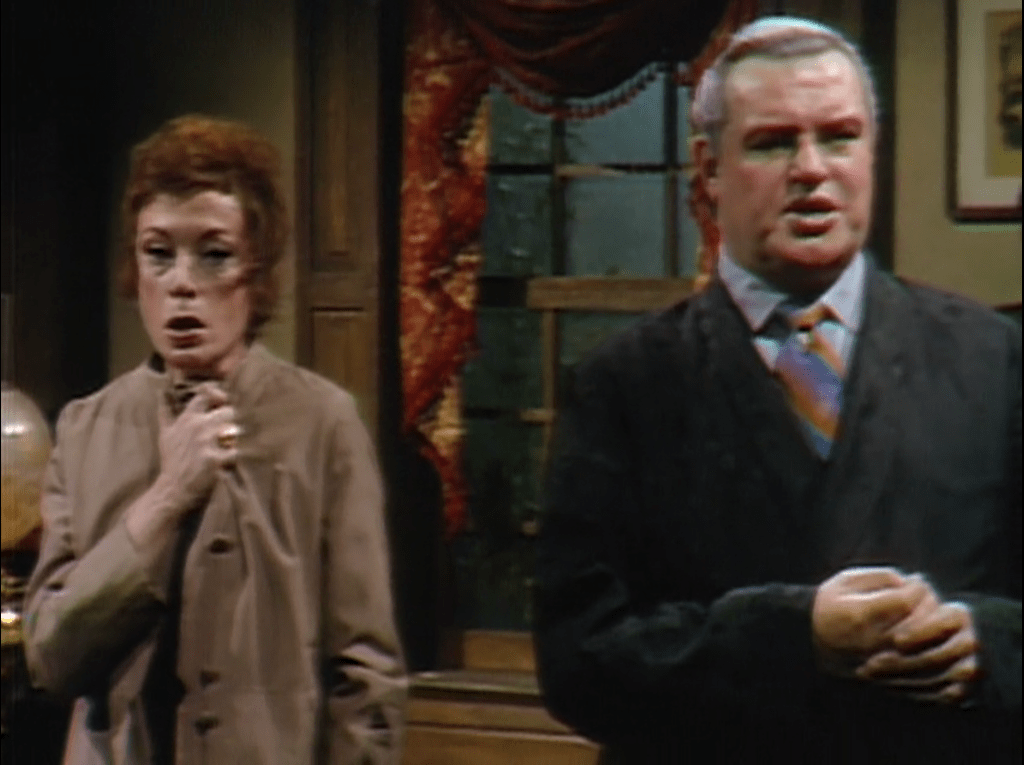
Roger’s own mood is anything but cheerful. His wife Cassandra hasn’t been seen since last night, and there is no indication where she might be. He is convinced something must have happened to her, and he calls the police.

Julia knows that Cassandra is actually Angelique, a wicked witch who in the 1790s turned Barnabas Collins into a vampire. Now Barnabas’ vampirism has gone into remission, and Angelique/ Cassandra is determined to revive her curse on him. The other day, Julia and some other people conjured up another personage from the 1790s, the Rev’d Mr Trask, a fanatical but wildly inept witchfinder. Julia hopes that Angelique/ Cassandra’s absence means that Trask has destroyed her.

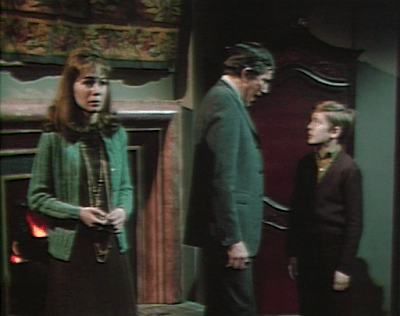
Barnabas stops by. Julia tells him of her theory. He can’t believe Angelique/ Cassandra is really gone. They go to Barnabas’ house and look in the alcove in the basement where, in 1796, Barnabas murdered Trask by hanging him from the ceiling and bricking him up. Trask’s bones had disappeared when Julia and the others brought him back to life, but are there again now. Julia takes this to mean that he is at peace, not a condition usually associated with hanging from a ceiling in a bricked-up little space, and that Angelique/ Cassandra must therefore have been defeated once and for all. At no point does it occur to them to take Trask’s bones down and give him a more respectful resting place. Apparently they consider human remains a standard part of household decor.

Trask, Julia, and Barnabas.

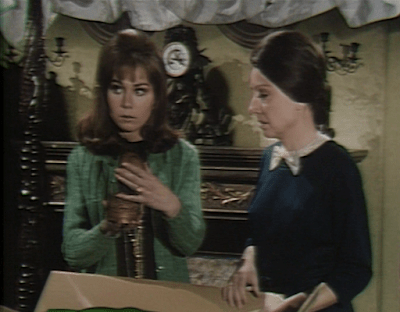
Back in the great house, Julia finds evidence that Angelique/ Cassandra’s powers are still at work. Matriarch Liz is still under a spell Angelique/ Cassandra cast and believes herself to be Naomi Collins, mother of Barnabas. She believes her brother Roger to be Naomi’s husband Joshua and Julia to be houseguest the Countess DuPrés. Most alarming, Liz has all the knowledge Naomi had in the hour before her suicide. She even mentions to Roger and Julia that Barnabas is “the living dead.” Roger and Liz don’t know that Barnabas was a vampire, and Julia doesn’t want them finding out.

Julia goes back to Barnabas’ house and confers with him about the situation. Barnabas says that Roger knows more about the family history than Liz does, and that if he starts hearing the actual facts there is a great danger he will figure everything out. This is a change- previously the show had always indicated that while Liz took some interest in the Collinses of years gone by, Roger took none.

We cut back to the great house and see Liz sitting at the desk in the drawing room. She is putting a note in an envelope addressed to “Joshua.” Regular viewers saw Naomi sit at this same desk and put a note in just such an envelope in #458. As Naomi did then, Liz pours a snifter of brandy, takes a container from the desk drawer, pours a powder from the container into the brandy, then drinks it. She again follows Naomi’s lead when she goes upstairs.

Barnabas and Julia enter. Julia asks exactly what Naomi did before she died. He starts telling the story, and she finds the note. Barnabas says Naomi died in the tower room; they go there, and find Liz. She talks to Barnabas as if she were Naomi and he were her accursed son. She collapses in his arms, as Naomi did in 1796.

Episode 516: Man of God

We open with a reprise of yesterday’s close, with mad scientist Julia Hoffman and servant Willie Loomis in the basement of the Old House on the estate of Collinwood. They hear a sobbing in the air; Julia knows it is the sound of the ghost of gracious lady Josette. Yesterday, the sobbing sounded like Kathryn Leigh Scott, who played Josette in the part of Dark Shadows set in the 1790s; today, it is a recording used in the early months of the series when a mysterious sobbing was heard coming from the basement of the great house on the estate. That sobbing was implied at that time to be Josette also, but in #272 it turned out to be matriarch Elizabeth Collins Stoddard. Using the same recording for Josette, and playing it on a redress of the set used for the basement at the great house, would seem to be a way of admitting to longtime viewers that it was a mistake to resolve the Mystery of the Sobbing Woman that way.

The performer on the old recording is Florence Stanley. Stanley would become nationally famous in the 1970s as Bernice, wife of Sergeant Fish on Barney Miller and later on a spinoff series titled Fish. Fish was played by Abe Vigoda, who will later appear in a couple of episodes of Dark Shadows. I doubt very much Stanley and Vigoda ever talked with each other about their experiences on the show, but it makes me happy that they were both alums.

Abe Vigoda and Florence Stanley as Phil and Bernice Fish.

Julia figures out that recovering vampire Barnabas Collins has been bricked up behind a wall in the basement by the vengeful spirit of eighteenth century witchfinder the Rev’d Mr Trask. She orders Willie to chisel away the bricks and rescue Barnabas. Willie is confused and frightened by what Julia has told him, and resists her command. As he chips away, he is interrupted first by a strange, sudden chill and then by the feeling of a hand on his shoulder. Julia conjured Trask up at a séance held on this spot a few days ago. But she at first refuses to acknowledge that he can be a real obstacle to Willie’s compliance with her commands, so she tells Willie to “shut up!” and get back to work. When Trask becomes visible to them both, Julia has no choice but to address herself to him.

Trask strikes a characteristic pose. Screenshot by Dark Shadows Before I Die.

Julia tells Trask that, as a man of God, he must know that murder is wrong. This changes nothing; evidently Trask’s moral theology has evolved considerably since his physical death. Then she tells him that if he wants to correct a terrible mistake he made in life, he should forget about Barnabas and turn to the witch he hunted then, who now calls herself Cassandra Collins and lives at the great house on the estate. Again, no change. When Julia says that Cassandra is the one who ultimately caused Trask’s own misfortunes and that if he is going to take revenge on someone, it should be her, he disappears and the cold, clammy feeling of a ghostly presence goes with him. Willie gets back to work, and they get Barnabas out of his predicament in the nick of time.

In the great house, Cassandra plays a scene with Elizabeth. Cassandra has caused Elizabeth to be obsessed with death, and now causes her to believe she is one of her own collateral ancestors, Naomi Collins, who died in 1796. Cassandra leads Elizabeth to Naomi’s tomb and shows her the stone wall plates inscribed with the dates of the people buried there.

Cassandra does some more spellcasting to deepen Elizabeth’s misery and confusion. Elizabeth resists and runs out; Cassandra laughs gleefully. Her laughter stops when Trask appears to her, a torch glowing in his hand. He tells her that she is the witch, and that he has come to burn her. He commands “Burn, witch, burn!” and she bursts into flames.

The scene in the basement is great fun, as is Cassandra’s confrontation with Trask. But the parts with Cassandra and Elizabeth drag. This is the second time Elizabeth has moped around hopelessly and thought of nothing but death; the first time was a year ago, in late June and early July 1967. It was deadly dull then, and is no better now. The show simply does not know what to do with Elizabeth, and usually wastes the great talents of Joan Bennett.

There are a couple of famous production faults at the tomb. When they get there, the plate over Naomi’s casket still reads “born, 1761; died, 1821,” as it did before the show settled on the 1790s as the decisive period. When Cassandra causes Elizabeth to see the tomb as incomplete and still awaiting Naomi’s interment, the inscription is covered by a piece of cardboard painted to match the stone and clumsily pasted on it.

Episode 512: A jury of the dead!

For nineteen weeks from November 1967 to March 1968, Dark Shadows was a costume drama set in the late eighteenth century. Among the more interesting characters introduced in that period were fanatical witchfinder the Rev’d Mr Trask; roguish naval officer Nathan Forbes; fast-talking con artist Suki Forbes; and streetwalkers Ruby Tate and Maude Browning. All five of these characters were murdered by vampire Barnabas Collins, and all five of them are among those who return today for an impromptu trial of Barnabas.

Barnabas killed Trask by luring him to his basement and bricking him up in an alcove, as Montresor did to Fortunato in Edgar Allan Poe’s 1846 story “The Cask of Amontillado.” Some other characters invited themselves to the basement yesterday and held a séance there. As a result of the séance, the bricks fell away and Trask came back to life. Now, Trask has confined Barnabas to the same alcove. He declares that he will give him a trial before he bricks him up.

In the eighteenth century, Trask was the prosecutor in the trial of time traveling governess Vicki Winters. Victoria was convicted of witchcraft and sentenced to death. Vicki’s trip from the 1960s to the 1790s inverted Barnabas’ displacement in time; as Vicki’s witchcraft trial was so chaotic it did not seem to follow rules of any kind, neither does the murder trial Trask improvises for Barnabas fit any conceivable model of procedure. Vicki’s trial stretched over two weeks, from #427 to #437; Barnabas’ begins and ends today, during the second half of the episode.

Trask conjures up Nathan, Suki, Ruby, Maude, and Barnabas’ first homicide victim, his uncle Jeremiah, to serve as a jury; he conjures up a man named Ezra Simpson, of whom we have never previously heard, to act as judge. Trask is the prosecutor, and Nathan is his sole witness. This court of “the damned!,” as Trask calls them, recalls the rogues who confront Jabez Stone as jurors and judge in Stephen Vincent Benét’s 1936 story “The Devil and Daniel Webster.” Unlike Jabez Stone, however, Barnabas does not have a right to counsel.

Court is in session. Screenshot by Dark Shadows Before I Die.

Trask asks Nathan how he died. After Nathan says that Barnabas strangled him, Trask asks him how Suki died. Barnabas objects that Nathan shouldn’t be allowed to speak for others; regular viewers sympathize with this, since Suki, played today as she was originally by Jane Draper, was sensational every second she was on screen, and when we saw Miss Draper again we were happy to think that she would have another chance to show what she could do. Barnabas also shouts at one point that he is innocent; this is less likely to attract the audience’s sympathy. Mrs Acilius and I certainly got a good laugh from it.

Barnabas asks to be allowed to present a defense. Trask invites him to question Nathan. He is about to do so when Nathan smiles at him, turns around, and vanishes. Trask explains that Nathan has already said all that needs to be said. Later, Trask looks at the recompleted wall and laughs with vicious glee, delighted at what is behind it.

Barnabas has neither the powers nor the limitations of a vampire now. The effects of the curse went into remission when mad scientists Eric Lang and Julia Hoffman created a man from parts scavenged from the cemetery and connected Barnabas to him as they electrified him and brought him to life. Barnabas named this man Adam.

Now Adam has escaped from the horribly abusive home Barnabas and Julia provided for him. He has found a friend in Sam Evans, an artist who was blinded when Barnabas enlisted him in one of his hare-brained schemes. Sam is teaching Adam to speak, and is so impressed with his ability to learn that he wonders aloud if he will be able to teach him to paint professionally.

Adam develops a sudden pain in his wrists. He moans “Barnabas! Hurt!” A shot of Barnabas hanging by his wrists in the basement alcove is laid over a closeup of Adam. Evidently the bond between them is such that Adam can sense Barnabas’ pain, even though they are miles apart. Apparently it is mid-1840s day on Dark Shadows; the scene in Barnabas’ house recalls “The Cask of Amontillado,” and the scene at Sam’s house is based on Alexandre Dumas’ 1846 novella The Corsican Brothers. “The Devil and Daniel Webster” was set in that decade or a bit earlier, and while Frankenstein was written in 1818 many adaptations of it, including the one Dark Shadows creator Dan Curtis would make in 1973, are set in the 1840s.

Adam becomes agitated. He cannot explain what is happening to him, no matter how patiently Sam asks. Sam’s son-in-law-to-be Joe Haskell comes in; Adam brushes against Joe as he runs out the door. Though Joe is a tall and sturdy man, Adam is so tremendously strong that this casual contact sends him flying.

It dawns on Joe that Adam is the man who abducted heiress Carolyn Collins Stoddard and then fell from the cliff on Widows’ Hill. Sam calmly replies that he had already figured that out. Joe is shocked that Sam hasn’t called the police; Sam replies that Adam is as disabled as he is, and that he means no one any harm. Joe is not at all convinced of the second of these points, and worries that “Barnabas! Hurt!” might not have reflected a fear that Barnabas is hurt, as Sam thinks it does, but might rather express Adam’s resolution to hurt Barnabas. Joel Crothers and David Ford bring out the full comic value of this scene; Mrs Acilius laughed at the blandness with which Ford’s Sam confirms that he knows who Adam is.

Joe goes to Barnabas’ house to warn him, but finds it locked and apparently empty. Later, Julia goes there too. She has a key, and lets herself in. She doesn’t see any evidence that Barnabas is or has been home; she goes downstairs, and is mystified to see that the alcove wall, which was broken when she was there for the séance, is now bricked up again.

Several times, Dark Shadows has contrasted Barnabas’ home, the Old House on the great estate of Collinwood, with the Evans cottage, a working class residence in the village of Collinsport. Today they draw this contrast in sharp relief. The basement of the Old House is always dark, but even the upstairs is lit by candles today; the scenes in the Evans cottage, taking place at the same time, are sunlit. The basement is the most haunted part of the most haunted house on the haunted estate, and eight characters in costume dress materialize from thin air there; the Evans cottage is a part of the modern world where Sam and Joe can use reason to arrive at agreement about facts, even if they make different judgments about the significance of those facts. When Julia and Joe go to the Old House, each wanders about alone, finding no one to talk to; at the Evans cottage, even Adam is able to have a conversation, and while there he can receive a message from Barnabas by some mysterious means. Trask seizes control of the basement of the Old House to make a parody of the criminal justice system and enact his vengeance on Barnabas; in the Evans cottage, Sam refuses to call the sheriff because he wants to shield Adam from punishment for the crimes he inadvertently committed.

Episode 511: It’s not fair to come into someone’s house

In the first months of Dark Shadows, the audience’s point of view was represented by well-meaning governess Vicki, who needed to have explained to her everything we might want to know and who reacted to all the strange goings-on with the mixture of disquiet and curiosity that the makers of the show hope we will feel.

Vicki has long since been replaced as our representative by mad scientist Julia. We no longer want characters to tell us what has been going on, nor are we making up our minds about our moral evaluation of the events in the stories. We find ourselves in the middle of a whole clutch of fast-moving plots, trying to keep up with them all and hoping that nothing will stop the thrills. Julia’s loyalty to her best friend, sometime vampire Barnabas, and her supremely well-developed capacity for lying put her in the same position, and her vestigial conscience is no obstacle to any juicy storyline.

When Vicki was our on-screen counterpart, her charge, strange and troubled boy David, was the show’s most powerful chaos agent. David precipitated a series of crises that seemed likely to expose the secrets of the ancient and esteemed Collins family, to kill one or more of the major characters, or both. In #70, David led Vicki to his favorite playground, the long-vacant Old House on the estate of Collinwood. David would keep sneaking into the Old House even after Barnabas took up residence there in #218.

Today, David again lets himself into the Old House. He is caught there by Julia and a man he has not seen before. Julia is stern with him for entering the house without Barnabas’ permission; he defends his presence there, reminding Julia that she promised him he could play with the tape recorder on Barnabas’ desk. He asks who the man is.

The man introduces himself to David as “Timothy Eliot Stokes.” This is the first time time we have heard his middle name. Soon, the show will phase “Timothy” out, and his friends will address Stokes as “Eliot.” I suppose that’s because he’s a professor, and “Eliot” suggests Harvard.

Stokes introduces himself to David.

In 1966, Thayer David played crazed groundskeeper Matthew. Suspected of murder, Matthew hid out in the Old House and kept Vicki prisoner there until some ghosts scared him to death in #126. David didn’t believe Matthew was a killer and didn’t know he was holding Vicki, so when he stumbled upon him in the Old House he brought him food and cigarettes. Even after he found Vicki bound and gagged behind a hidden panel, he kept Matthew’s secret. When David meets another character played by the same actor on the same set, longtime viewers can see that Stokes is as genteel and urbane as Matthew was rough-hewn and paranoid. For her part, Julia recalls Vicki when she scolds David for sneaking into the Old House, but where Vicki was doing her job as David’s governess and trying to enforce the rules of the household as a governess might, Julia is scrambling to keep David from finding out about her own secret activities.

Julia tells David to take the tape recorder and go home to the great house on the estate. As he makes his way to the front door, Stokes takes Julia aside and tells her that it will not be well if it is known in the great house that David has seen him. Julia hurries to David and tells him to keep quiet about the fact that he has seen Stokes. She says that she hates to ask him to lie; at this, I mimicked Julia and said “I know you share my devotion to the truth,” prompting Mrs Acilius to laugh out loud. Later, Julia will go to the great house, where she lives as a permanent guest, and David will cheerfully assure her that he kept her secret. The two of them seem quite relaxed together, leading us to believe that he will continue to do so.

There is a bit of irony in Julia’s harshness with David for entering Barnabas’ house without his permission. She and Stokes didn’t have Barnabas’ permission to be there, either. Indeed, if he had known what they were up to he would likely have objected most strenuously. Along with a man named Tony, they held a séance in the part of the basement where Barnabas kept his coffin when he was under the full effect of the vampire curse. They were trying to contact the Rev’d Mr Trask, a Puritan divine whom Barnabas bricked up to die in the eighteenth century. The séance was so successful that the bricks crumbled, exposing Trask’s bones, still held together somehow in the shape of a skeleton hanging from the ceiling. At the end of the episode, Trask has resumed his corporeal form and set about taking revenge on Barnabas by walling him up in the same spot.

Odd that Trask’s skeleton holds together after all the ligaments and tendons have rotted away, odder that there is a straight cleavage separating the top of the skull from the rest, oddest of all that the section is attached to the rest of the skull by a piece of Scotch tape.

Episode 505: Prepare yourself for an ordeal

Sheriff Patterson, leading his deputies through the woods in search of a very tall man named Adam who has escaped from gaol, finds a scrap of Adam’s clothing on a tree. He looks ahead and sees the Old House on the estate of Collinwood. He remarks “That’s the old Collins house. Every time anything goes wrong around here, that’s where all roads seem to lead.” He takes his party toward the house. Once they are gone, Adam comes out from behind a tree, and goes in another direction. Unknown to the sheriff and his men, Adam is a Frankenstein’s monster. He is four weeks old and has a vocabulary of fewer than a dozen words, but he easily outwits Collinsport’s entire law enforcement community.

The Old House is home to Barnabas Collins, whom the audience knows to be a recovering vampire. The sheriff calls on Barnabas and recaps the story for his benefit. In his post about the episode, Danny Horn ridicules every part of this preposterous scene, getting half a dozen genuine laughs. I won’t compete with him, but I do want to point out that while in both Wednesday’s episode and yesterday’s, the sheriff said it took twenty men to subdue Adam and take him into custody, today he says it took six. Maybe by next week it will be down to one deputy and a mynah bird.

Adam has abducted heiress Carolyn Collins Stoddard. When he eludes the police, he goes to the abandoned structure where he has cooped her up. He had left her there to go look for food. That mission was interrupted by his arrest. Now, she asks to go home. He is carrying her back there when they meet the sheriff, his deputies, and Barnabas at the top of Widows’ Hill. From the second episode, we have known that people plunge to their deaths from this hill. We’ve heard stories about several such incidents, have seen a number of characters come close to falling from it, and in #425 we saw gracious lady Josette make the fatal leap. Carolyn slips from Adam’s arms to the edge of the cliff; the deputies see him pull her up. She runs into Barnabas’ arms, and Adam falls.

After Adam’s fall, we hear a message that is very familiar to us, but that Barnabas and his friends have never heard. Adam was created in an experimental procedure that was meant to relieve Barnabas of his vampirism. His creator, mad scientist Eric Lang, died shortly after recording an audiotape explaining that as long as Adam lives, Barnabas will be human, but that he will become a vampire again if he outlives Adam. This message plays out over images of the waves crashing into the rocks of the shore. It’s an effective visual complement to the message, a metaphor for the overwhelming power that will engulf Barnabas and the rest of them if Adam is in fact dead.

Episode 501: You’ve lied your way out of worse situations

Virtually every episode of Dark Shadows begins with one of a handful of still images of the exterior of a mansion in Newport, Rhode Island, known in those days as Seaview Terrace.* Before the series went into production, Dan Curtis took the cast up to Newport and shot some video of them on the grounds of the mansion. In 1966 and the first half of 1967, bits of that footage were occasionally inserted to give the show a more spacious and less static feeling. When they started shooting episodes in color at the end of July 1967, they could no longer use those inserts, and they had neither the time nor the budget to go back to make more.

Now, Dark Shadows uses green screen effects to create the illusion of exterior shots. Twice today, they show us actors in front of the still of Seaview Terrace that most frequently appears at the opening, with foliage hanging next to them to give an illusion of depth. The result isn’t as satisfactory as the location inserts were, but it’s nice to know the makers of the show are trying to broaden their canvas.**

Frankenstein’s monster Adam has escaped from the Old House at Collinwood and finds his way to the principal mansion on the same great estate. There, he stands outside the windows and listens to a conversation in the drawing room between matriarch Liz and her daughter Carolyn. Carolyn tells her mother that she saw Cassandra, Liz’ brother Roger’s new wife, having a romantic moment with local man Tony. Liz’ keynote has always been denial, and true to form she refuses to believe Carolyn. They go on with this until Adam stumbles through the front door and terrifies them.

Adam can only speak a few words. He smiles when he says one of his favorites, “music.” Carolyn turns on a radio we have never seen before and we hear Francois Lai’s theme to the movie “A Man and a Woman,” an instrumental hit of the 1960s which played on the jukebox at the Blue Whale tavern in #307. Adam scowls, declares it “not music,” and smashes the radio. I’ve always had a fondness for the tune, but listening to this arrangement I have to admit he has a point.

Liz reacts to Adam’s violent act by grabbing a letter opener and threatening him. Panicked, he grabs Carolyn. Two more residents of the estate burst in. They are old world gentleman Barnabas Collins, master of the Old House, and Julia Hoffman, permanent houseguest in the great house. Barnabas has a rifle and threatens to shoot Adam if he doesn’t put Carolyn down immediately. Adam flees into the woods, still carrying Carolyn.

Julia stays in the drawing room with Liz. It dawns on Liz that Barnabas must have been hunting Adam. Julia denies this, and Liz asks why Barnabas had a gun. In response, Julia talks very fast and says very little. That gives us a wonderful little scene. It’s always exciting when a brick falls out of the wall Liz built between herself and reality, and Julia is one of the most accomplished liars in drama.

Liz realizes that Barnabas and Julia know more about Adam than they are letting on. Screenshot by Dark Shadows Before I Die.

*A family named Carey bought the place in 1974, so these days it is usually referred to as the Carey mansion.

**The screenshots are from John and Christine Scoleri’s post on their blog Dark Shadows Before I Die.

Episode 500: Ruined another life

Dark Shadows never followed the traditional soap opera pattern of building up through the week to a slam-bang spectacle on Friday. Its one-hundredth week is a case in point. Yesterday was a big event, with two special makeups representing the rapid aging of wicked witch Angelique, a confrontation between heiress Carolyn and lawyer Tony, and the blinding of artist Sam. Today is mostly recapping.

A few minutes of action break up the chatter. Frankenstein’s monster Adam fights with his keeper Willie and breaks out of his cell. Recovering vampire Barnabas and his friend, mad scientist Julia, come in and find Adam hitting Willie. Barnabas orders Adam to stop. He loses his temper and beats Adam with his cane, leading Adam to fight back. This indicates that Barnabas has lost his control over Adam.

Barnabas talks about all the people he has killed and maimed, prompting Julia to feel sorry for him. Screenshot by Dark Shadows Before I Die.

The only moment from this one that stuck with me came when Barnabas was lamenting his role in attracting Angelique’s attention to Sam. While he is talking about all the misery he has brought to people over the centuries, Julia interjects “You’ve suffered too!” When Julia says things like this, my wife and I mimic her and say “You mustn’t blame yourself!” Julia’s misplaced sympathy for Barnabas is the foundation of her character, and it becomes steadily more bizarre as the show progresses.

Episode 498: One step closer to the dream

Sarcastic dandy Roger Collins has remarried. His previous wife, undead blonde witch Laura Murdoch Collins, was Dark Shadows’ first supernatural menace, posing a threat to the life of their son David from #123 until she vanished amid a cloud of smoke in #191. The ghost of gracious lady Josette joined in the battle against Laura. Among other things, Josette compelled artist Sam Evans to paint a series of pictures warning of Laura’s evil plans. Laura responded to those paintings in #145 and #146 by causing a fire that burned Sam’s hands so badly it seemed he might never again be able to paint.

Roger’s new wife is also an undead blonde witch, though she wears a black wig all the time. This wiggéd witch calls herself Cassandra, but is actually Angelique, who in the 1790s killed many of Roger’s ancestors and turned his distant cousin Barnabas into a vampire. Angelique/ Cassandra has returned to the world of the living because Barnabas’ vampirism is now in remission, and she is determined to restore it.

Before he met Angelique/ Cassandra, Roger became obsessed with a portrait of her. Barnabas concludes that this portrait is essential to her power. He orders his servant Willie to steal it from the great house of Collinwood. Barnabas takes the portrait to Sam and commissions him to paint over it so that Angelique will look tremendously old. He doesn’t offer Sam any explanations, but we heard him tell Willie his theory that what happens to the painting will also happen to Angelique. If her likeness is aged to reflect her actual years, then she will vanish from 1968 and be confined to the past. At the end of the episode, Angelique’s hands have aged dramatically, suggesting that Barnabas is correct.

This is David Ford’s first appearance on the show since December, and he had shaved his mustache in the interim. The fake is not up to the makeup department’s usual standards. Screenshot by Dark Shadows Before I Die.

Portraits have been a very prominent part of the visual composition of Dark Shadows from the beginning, and a battlefield on which supernatural combat could be joined for almost as long. So it is hardly surprising that the show would eventually get around to doing a story based on Oscar Wilde’s The Picture of Dorian Gray.

It would seem Barnabas has little time to lose. Angelique/ Cassandra has distributed some malware to the minds of the people around Barnabas by means of a dream that one person after another will have. The first dreamer is beckoned into a Haunted House attraction by someone, opens some doors behind which there are scary images, is terrified, and cannot find relief until telling its details to the beckoner. That person then has the dream, changed in only two particulars, the identity of the beckoner and the image behind the final door. When everyone’s brain has been hacked, this worm is supposed to reset Barnabas as a vampire.

Yesterday, David had the dream, and Willie was his beckoner. Today, we open in Barnabas’ house, where Willie is paralyzed with fear. David has already told him the dream, and Willie knows he will have it. With all the previous instances of the dream, the audience had to sit through a highly repetitious dream sequence, then a scene in which the character agonizes about whether to tell the dream to the next person, and finally a speech repeating all the details of the dream. At least this time we skip the second and third of those rehashings.

Since Willie is so close to Barnabas, it seems likely that he will be the last to have the dream before it gets back to Barnabas and makes him a vampire again. So it’s no wonder that Barnabas decides it’s time for the high-stakes gamble of a burglary at Collinwood.

There’s also a scene in Barnabas’ basement. Barnabas’ vampirism is in remission because some mad scientists created a Frankenstein’s monster, whom Barnabas named Adam. They connected Barnabas to Adam in a way that drains the symptoms of the curse from Barnabas without manifesting them in Adam. Barnabas has no idea how to raise any child, let alone a 6’6″ newborn with the strength of several grown men, and so locks him up in the prison cell where he used to keep Sam’s daughter Maggie.

The imprisonment of Maggie was a dreary, unpleasant story, but Adam’s time in the cell is even harder to take. Maggie was established as a strong, intelligent person who knew her way around, she could speak, and she had many friends who cared about her. So we never quite gave up hope that she would get away and be all right in the end. But Adam has none of that. As a result, his scenes in the basement are a tale of extreme child abuse, made all the harder to watch by Robert Rodan’s affecting portrayal of the big guy’s misery.

Moreover, Maggie was a major character, introduced in the first episode and connected to everyone else. It’s unlikely they would kill her off unless the show had been canceled and they were going out with a bang. But only the people holding Adam prisoner know who he is, and Frankenstein’s monsters meet their deaths practically every time they feature in a story.

Worst of all, the show is basically very silly right now. A story about a child locked in a cell from birth can be made bearable only by joining it to some kind of deep insight into the human condition, and there is little prospect that anything like that will crop up among all the witches and vampires and other Halloween paraphernalia. My wife, Mrs Acilius, watched the whole series with me in 2020-2021. She was avidly rewatching it with me this time. But when they took Adam to the cell, she suggested I start watching it on days when I get home from work before she does. I’m sure she isn’t the only Dark Shadows fan who takes a pass on the Adam story.

This is the first episode credited to director Jack Sullivan. Lela Swift and John Sedwick took turns at the helm until #450, when executive producer Dan Curtis tried his hand at directing a week of episodes. Swift and Sedwick then returned to their usual pattern. Sedwick will be leaving in a few weeks; Sullivan, who has been with the show as an associate director since the third week, will be Swift’s alternate until November, and from #553 on will be credited as Sean Dhu Sullivan.

Episode 496: A walking dead man

In the 1790s, wicked witch Angelique turned scion Barnabas Collins into a vampire. When Barnabas realized what she had done to him, he killed Angelique.

In 1967, Barnabas was freed from a long captivity once more to prey upon the living. In 1968, Angelique also returned. Wearing a black wig and calling herself Cassandra, Angelique met sarcastic dandy Roger, ensorcelled him into marrying her, and thereby established herself as a resident of the great house of Collinwood. Wiggéd witch Angelique/ Cassandra found that Barnabas’ vampirism had gone into remission as a result of treatments he had received from mad scientist Eric Lang. She killed Lang before he could complete the process meant to make the cure permanent, but the senior mad scientist in the area, Barnabas’ friend Julia Hoffman, finished his work.

Angelique/ Cassandra and Julia know these facts about each other, but it is unclear how much Angelique/ Cassandra knows about Lang’s process. In particular, when today’s episode begins we do not know whether she has figured out that the main part of it was building a Frankenstein’s monster named Adam and trying to transfer Barnabas’ “life force” into him. Still less do we know whether Angelique/ Cassandra is aware that when Julia took over the experiment she brought Adam to life without killing Barnabas, and that as long as Adam is alive Barnabas will be free of the effects of the vampire curse.

Julia lives at Collinwood as a permanent guest. Today’s episode opens with her and Angelique/ Cassandra coming home, both smiling and chirpy, talking about an exciting conversation they had while they were out together. They had visited Angelique/ Cassandra’s former professor, Timothy Eliot Stokes. Stokes is an expert on paranormal phenomena. In #488 Barnabas told Stokes that Angelique/ Cassandra was a witch and he resolved to join Julia and Barnabas in the battle against her. Julia tells Roger that the exciting conversation she and Angelique/ Cassandra had at Stokes’ home was about the occult.

Considering what these three people know about each other, this conversation would have been fascinating to watch. Julia and Stokes want to probe for Angelique/ Cassandra’s weaknesses; she wants to make sure neither of them has any powers she doesn’t know about, to find out their plans, and if possible to bring them under her influence. Properly written and played by actors as accomplished as Grayson Hall, Lara Parker, and Thayer David, that scene might have been one of the highlights of the whole series. But it doesn’t happen. They just tell us about it in the first 30 seconds of the episode, then move on. It’s one of the major what-ifs of Dark Shadows.

Yesterday Adam escaped from the cell in the basement of Barnabas’ house where he has been confined and met several members of the family who live in the great house. They spend the day recapping that incident. Roger tells Cassandra that Adam seemed to know Barnabas, and she is all ears. It quickly becomes clear that Adam’s existence is news to her, that she is putting everything together, and that Adam is now in grave danger from her.

Angelique/ Cassandra takes in the news Roger has brought her. Screenshot by Dark Shadows Before I Die.

Episode 495: A nice boy

In #134, strange and troubled boy David saw his mother Laura Murdoch Collins for the first time in years. To everyone’s surprise, not least his own, David reacted to Laura with terror. It turned out that he had good reason for this reaction, as Laura was actually an undead blonde fire witch come to lure him to his own death.

In #489, David learned that his father Roger had remarried. Like everyone else in the great house of Collinwood, David was stunned to learn that Roger had known his new wife for less than a day before he married her. Unlike the others, his speechless reaction prompted Roger to jump to the conclusion that he disliked his new stepmother. Roger scolded David and sent him to play outside until he could come back and be charming.

While outside, David had stumbled upon the new Mrs Collins kissing a man other than her husband. Later, he found her alone in the drawing room, told her what he had seen, and informed her that he would tell his father about it.

Roger’s new wife wears a black wig and calls herself Cassandra. What the audience knows, but neither Roger nor David do, is that she is actually an undead blonde witch. Roger does have a type.

The new Mrs Collins’ real name is Angelique. She has come to 1968 from the late eighteenth century to resume her punishment of Barnabas Collins, whom she turned into a vampire in their time, but who has now been freed from the symptoms of the curse. When David told Angelique/ Cassandra that he would report her misconduct to Roger, she used her magic powers to strike him dumb. When his muteness became inconvenient for her in #492, she cast another spell to erase his memory and restore his speech. To execute this spell, she took fire from the hearth and spoke words to David that caused him to drift into a trance. We remember #140, when Laura urged David to stare into the flames of this same hearth while she told the story of the Phoenix, causing him to drift into a trance. From that point on, he liked his mother very much.

Today, David meets Roger in the foyer of Collinwood. He tells his father that Angelique/ Cassandra took him into town, where she bought him a Swiss army knife. He says she would have bought him anything he wanted. Thus we learn that, though she is a wicked witch (as well as a wigged one,) Angelique/ Cassandra is in some ways a typical step-parent. When Roger says he is glad to see that David now likes Angelique/ Cassandra, David is mystified. As far as he can recall, he always liked her.

Roger sends David to answer a knock at the door. It is their distant cousin Barnabas. This is the first time we have seen David and Barnabas together since #333, when David barely escaped with his life after Barnabas caught him looking at his coffin. David now greets him quite calmly.

David leaves. In the foyer, Roger scolds Barnabas for his rudeness to Angelique/ Cassandra. Barnabas could hardly be expected to fail to recognize his old nemesis, but he has indeed shown an extreme lack of prudence in his uninhibited talks with her. Not only has he created unpleasant scenes to which Roger is bound to object, but he has also let Angelique/ Cassandra know exactly what he does and does not know about her.

Roger says that if Barnabas cannot be friendly to Angelique/ Cassandra, he shouldn’t come to the great house anymore. Barnabas asks if Roger shouldn’t ask his sister Liz, who after all owns the house, what she thinks. Roger says that will be unnecessary, since Liz has even less tolerance for rude behavior than he does. Barnabas is promising to do better when Liz runs in, frightened by a tall man she met on the grounds. Liz told the man he was on private property and directed him to leave. The man said nothing at all in response to this challenge or to her subsequent questions. He stood still and appeared to be mute until he spoke Barnabas’ name. Liz ran from him when she saw that he had a shackle attached to his leg. Roger flies into a panic, assuming that a shackled man must be dangerous and remembering that David is alone in the woods. He gets his gun, and rushes out. Barnabas accompanies him.

In the woods, David is playing Mumblety-Peg with his new knife. The tall man shows up; when David finds that the man cannot talk, he says that he is glad. He says that he often wishes no one could talk. He goes on at considerable length about the disadvantages that come with the ability to speak. He then explains to the man that you play Mumblety-Peg by dropping the knife into the ground so that it sticks there. The man becomes excited and grabs the knife. David objects and demands he return it. They struggle; David falls and hurts his ankle. David grumbles that all the man had to do was give him his knife back. The man looks alarmed and picks David up. David doesn’t like that one bit, and insists he be put down.

Roger points the gun at Adam and David.

David’s shouting brings Roger and Barnabas. Roger points his gun at the man and orders him to put David down. When the man does not move, Barnabas tells Roger not to shoot. David, in the line of fire, seconds this recommendation. Barnabas talks to the man in a soothing voice, gesturing towards the ground, and the man does set David down. David runs to Barnabas and gives him a hug.

This is the second time David has run into Barnabas’ arms. The first was in #315. David had been trapped in the hidden chamber in the old Collins family mausoleum, where Barnabas was confined in his coffin from the 1790s until 1967. Barnabas learned that David was there, suspected he might have deduced his secret, and decided to kill him. David got out of the chamber just as Barnabas was approaching it, and ran from it directly to him. He had not in fact figured out Barnabas’ secret while in the hidden chamber, but Barnabas’ behavior in the minute before someone else came along was menacing enough that David caught on that he had sinister plans for him. For the next ten weeks, his fear of Barnabas would deepen, leading him to discover the whole horrible truth about his distant relative. All that is forgotten now, evidently.

Roger jumps to the conclusion that the tall man had “tried to kill David!” He shoots him in the shoulder and runs after him with his gun, over Barnabas’ objections. Roger had been quite unconcerned with David’s well-being throughout the first year of the show. In the first months, he openly hated the boy and continually tried to persuade Liz to send him off to an institution; in #83, he coldly manipulated David into attempting to murder someone who posed a problem for him; even after other characters had begun to realize that Laura was a deadly threat to David, Roger continued to press eagerly for her to get full custody of him and take him away; and in #313, when David was trapped in the mausoleum, Roger could barely be bothered to take part in the search. Roger’s behavior will therefore be less likely to suggest to regular viewers that he is overcome with paternal feeling than that he is a panicky fool who is much too excited about an opportunity to shoot someone.

The tall man is Adam, a Frankenstein’s monster created in the procedure that caused Barnabas’ vampirism to go into remission. Though he is 6’6″, Adam is only a couple of weeks old, effectively a baby. Barnabas has been keeping him in his basement, chained to the wall in the prison cell he maintains for those times when he has abducted a pretty girl and has to keep her from running away. The opening voiceover tells us that “no man has suffered more” than Barnabas, just as we cut to Adam, despondent in his shackles. Barnabas comes in to give Adam a cup of broth and a couple of minutes of rigidly formal social interaction, then leaves him alone again. Somehow this sequence makes it difficult to sympathize as deeply with Barnabas as the narration would have us do.