Episode 548: Too much a part of him

Wicked witch Angelique defied her supervisor, suave warlock Nicholas, one too many times. Yesterday, Nicholas stripped Angelique of her powers, including her immunity to aging. Since she is 194 years old, this leaves her with a sharply limited future.

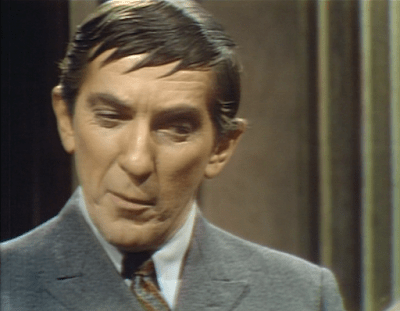
Today, Nicholas tells Angelique he will think of sparing her from her imminent demise if she can persuade recovering vampire Barnabas to forgive her for her extreme abuse of him and of everyone he has ever cared about. She goes to Barnabas and begs him for forgiveness. Barnabas replies that when he asked her for forgiveness, she responded by turning him into a vampire. He does show signs of concern for her, but cannot pardon everything she has done. He specifically mentions The Dream Curse, a three month storyline that not only brought great suffering to him and a dozen other characters, but which also made the audience miserable. She dies.

Angelique begs Barnabas for forgiveness. Screenshot by Dark Shadows Before I Die.

Nicholas’ only acknowledged motivation to this point has been a selfless devotion to evil for its own sake. That makes it odd that he would place a value on forgiveness. Dark Shadows is pervaded with ghost stories, and ghost stories are, first and foremost, explanations of how unresolved conflicts in the past can poison relationships among people in the present. It is also a soap opera, and the biggest events in soaps are changes in the way particular characters feel about each other. So both genres tend to elevate forgiveness, not only as a virtue, but as the highest form of The Good in human life. We saw this in the first year of the show, when well-meaning governess Vicki kept forgiving strange and troubled boy David for his attempts to kill her, acts of forgiveness which culminated in #191 when David ran from the mother who was trying to lure him to his own death into Vicki’s arms and an acceptance of life. Two weeks later, in #201, dashing action hero Burke closed another narrative thread left over from episode #1 when he forgave sarcastic dandy Roger for an old grievance he had against him. With those events, it was pardoning that cleared the flotsam left over from Dark Shadows 1.0, paving the way for the introduction of Barnabas and the advent of Dark Shadows 2.0.

Perhaps Nicholas was so certain Barnabas would not be able to bring himself to forgive Angelique in the time available before her death that making her beg for forgiveness was his way of perverting the world’s best thing into yet another instrument of cruelty. Certainly he suggests this interpretation when he introduces the idea with a laugh and a comment that he might find it “amusing.”

When Nicholas stands over Angelique’s corpse, he tells her that her own hatred had made it impossible for Barnabas to forgive her because it had “become too much a part of him.” That Angelique’s hatred became a part of Barnabas rings a bell for longtime viewers. The show has always depicted supernatural beings, not as self-contained individuals, but as complexes of phenomena that operate more or less independently, often without each other’s knowledge, sometimes in pursuit of mutually exclusive goals. For example, in 1967 the ghost of Barnabas’ little sister Sarah visited David during the day and tried to prevent him finding out Barnabas was a vampire, but she also appeared to David in a dream and showed him everything the daytime ghost wanted to keep hidden. When David told the Sarah of the waking hours what her dream visitation form had shown him, she was horrified and forbade him from following up on any of that information.

When Angelique places a curse, she sometimes seems to create a little version of herself, give it possession of the person she is targeting, and turn it loose in the world. Sometimes that little Angelique turns against her. For example, she raised the body of Barnabas’ uncle Jeremiah from the dead to use for her own nefarious purposes, only to find that it would not return to its grave when she was finished with it. When Barnabas was a vampire, he had some obsessions that were strikingly similar to obsessions Angelique had shown. So Angelique wanted Barnabas to love her, and had the power to cast a spell that would make him do so, but instead wrought immense havoc on everyone else with one wild scheme after another, because she wanted him to come to her “of his own will.” Likewise the vampire Barnabas wanted to make Vicki his victim, but passed up one opportunity after another to bite her because he wanted her to come to him “of her own will.” That similarity is so close that it makes us wonder if the Barnabas we first met was simply Angelique in disguise. Not only her hatred, but all of her quirks had become part of him.

Angelique came from the 1790s to 1968 by some magical process that involved a portrait of her that is now on a stand in Vicki’s room. Today she uses a secret panel to let herself into the room and look at the portrait. We first saw that panel open when the show was a costume drama set in the 1790s. The room was occupied then by gracious lady Josette, and it was the vampire Barnabas who used the panel to enter. We haven’t seen the panel since, leaving it strongly associated with Barnabas in the minds of regular viewers. Angelique’s use of it today further suggests her identity with him when he is in his vampire state.

In their post about the episode on Dark Shadows Before I Die, John and Christine Scoleri find a resemblance between Angelique’s old age makeup and another TV character:

Captured from Dark Shadows Before I Die.

But look at Angelique’s creator, writer Sam Hall. She came by her looks honestly:

Episode 547: I can’t let you lose this moment

In the great house of Collinwood, well-meaning governess Vicki awakens to find a strange glow emanating from the portrait of wicked witch Angelique which, for some reason, she keeps on a stand in her bedroom. The portrait transforms itself before her eyes into that of an extremely old woman. Vicki goes to get permanent houseguest Julia. Seeing the transformed portrait, Julia agrees with Vicki that the portrait is like a living thing, says that Vicki knows more about Angelique than anyone else, and is unable to answer when Vicki asks what the portrait’s transformation means for someone called Cassandra.

Transformed portrait. Screenshot by Dark Shadows Before I Die.

Vicki and Julia know that Cassandra, wife of sarcastic dandy Roger, is Angelique in a black wig, come from the eighteenth century to wreak a terrible vengeance on old world gentleman Barnabas. Vicki apparently does not know what form that vengeance was meant to take.

In the 1790s, Angelique/ Cassandra turned Barnabas into a vampire, and her curse was in effect for 172 years. After his vampirism went into remission, she returned, obsessively driven to restore him to his undead state. Since it was the vampire story that first made Dark Shadows a hit in May and June of 1967, and it has ever since been known as the “1960s vampire soap opera,” Angelique/ Cassandra’s obsession likely reflected the concern of ABC network executives who must have been nervous when the makers of the show decided to turn Barnabas into a human. Angelique/ Cassandra’s attempts to revive the curse do keep the threat of vampirism at the center of the action.

Julia knows all about Barnabas and Angelique/ Cassandra, and so she rushes from Vicki’s room to Barnabas’ house. There, she finds Angelique/ Cassandra slumped in a chair in the front parlor, her face concealed inside a deep hood. Barnabas explains that Angelique/ Cassandra told him that her associate Nicholas told her she had wasted too much time trying to restore his curse, that Nicholas had then punished her by stripping her of her powers, that one of those powers was her immunity to aging, and that she had come to his house to shoot him to death before her 194 years caught up with her and she turned into a pile of dust. Angelique/ Cassandra began to collapse before she could fire the gun, and now it is on the mantel.

Julia is a medical doctor, and makes an effort to examine Angelique/ Cassandra. Angelique/ Cassandra rushes out of the house, and Julia asks Barnabas why he didn’t kill her when he had the chance. Barnabas, who had already killed his uncle in a duel before he began his long career as a bloodsucking fiend and part-time serial murderer and who within minutes of being freed from the effects of the curse picked up a gun with the intention of shooting a man named Adam, gives a self-satisfied little speech about how much he values life. Julia, who was extremely reluctant to join Barnabas in the murder of her onetime friend Dave in #341 and was miserable when he gleefully taunted her afterward with her “new status” as a “murderer!,” takes the gun and announces that she will go kill Angelique/ Cassandra herself.

Outside the door of the great house, Barnabas tries to talk Julia out of killing Angelique/ Cassandra. Julia says that if Angelique/ Cassandra is out of the way once and for all, she might herself be able to return to her old life. Barnabas points out that she is overlooking the obstacle that a murder charge might present to that plan. Julia says that no one would convict her if they knew what Angelique/ Cassandra was, to which Barnabas replies that no one will know, since no one would believe the true story. He does not mention what he had brought up earlier, that Nicholas is more powerful than Angelique/ Cassandra, or draw the obvious inference, that he must be at least as dangerous. As long as Nicholas is around, killing Angelique/ Cassandra won’t gain Julia or Barnabas very much.

Inside, Barnabas and Julia find that Roger has let Angelique/ Cassandra into the house. She has aged tremendously, so much so that Roger did not recognize her as his wife. She is resting on the couch in the drawing room, where Julia examines her while Roger and Barnabas talk in the foyer.

Julia comes out and tells the men that her patient’s heartbeat is so weak she can have only minutes left to live. Barnabas gives a stern response, and Julia assures him she did nothing to change the woman’s condition. The word “minutes” will strike a chord with returning viewers, who remember that Nicholas yesterday referred to Angelique/ Cassandra’s future as “the minutes remaining to you.” If we also remember how easy it is to underestimate Angelique/ Cassandra, we will not be very surprised when, after Roger insists on driving the old woman to the hospital, they go into the drawing room they find that she is gone and the windows are open. Angelique/ Cassandra is so interesting that the number of minutes she will continue to exist is rarely less than the 22 minutes that make up an episode of Dark Shadows.

Angelique/ Cassandra is Lara Parker’s usual young and beautiful self at the beginning of the episode. She then goes off camera for a moment and comes right back with her face hidden inside a hood. She is in a couple of scenes as a hooded figure before we see her face again, close to the end, when she is wearing the same old age makeup she had on in #499. Considering that the show was done live-to-tape, that leads me to wonder if the makeup was applied in stages during multiple commercial breaks.

Episode 546: A woman, born on Martinique in 1774

Suave warlock Nicholas has expressly forbidden his subordinate, the wicked witch known variously as Angelique and Cassandra, from killing Frankenstein’s monster Adam. But now he has twice caught her trying to do just that. He punishes her by stripping her of her powers. He tells her that she is now a human being, and that she will die soon.

Nicholas de-witches Angelique/ Cassandra, while also trying to hold her wig in place. Screenshot by Dark Shadows Before I Die.

Angelique/ Cassandra’s husband, sarcastic dandy Roger, comes downstairs and confronts her about her indifference to him. She responds that there never was anything between them and never will be, and rushes out of the house. My wife, Mrs Acilius, is a soap opera fan from way back, and she says that as far as she is concerned this archetypal soap moment makes for a “Genuinely Good Episode.”

Angelique/ Cassandra goes to see recovering vampire Barnabas. He opens the door and asks what she wants. She says that she was once the mistress of the house and that as such she has a right to enter.

Ever since she showed up in the year 1968, Angelique/ Cassandra has been trying Barnabas’ patience and the audience’s by pretending that she was not the witch he married in the 1790s. He asks her why she has dropped that pretense now, and she says that she, like he, has become human. She also says that she will die at dawn. It is unclear why she thinks this- all Nicholas told her was that her life expectancy was to be measured in “minutes.” She declares her intention to kill Barnabas, and is pointing a gun at him when the episode ends.

If it does not lead to her immediate demise, depriving Angelique/ Cassandra of her powers would be an intriguing way of making her a more flexible character. In the costume drama segment set in the late eighteenth century, she was so powerful that she painted herself into a corner, facing no real opposition. The only suspense she could generate came when she was indecisive or distracted and got in her own way. In 1968, her subordination to Nicholas has pushed her to the opposite extreme. She has been very busy, but hasn’t done much. If she survives without her powers, it might be interesting to see her learn how to live as a human after all this time.

Angelique/ Cassandra’s appearance reflects the end of her dual identity perhaps more clearly than was intended. When she answered to the name Angelique in the 1790s, she had blonde hair; when she turned up in 1968 calling herself Cassandra, she wore a black wig. Throughout this episode, the wig keeps sliding around on her head.

This episode includes another of the innumerable replays of an audiotape message about Barnabas and Adam. The other day, it seemed that Nicholas and Cassandra had taped over the message, as undead fire witch Laura Murdoch Collins taped over a recording she didn’t want parapsychologist Peter Guthrie to hear in #172. But Friday they played it for us yet again. When Nicholas threatens Angelique/ Cassandra with death if she keeps disobeying him, Mrs Acilius said to the screen “I’ll kill you myself if you play that tape again!” I am glad to report that this is the last time we will hear the thing.

Danny Horn’s Dark Shadows Every Day post about this episode juxtaposes screenshots and dialogue from the scene in which Nicholas strips Angelique/ Cassandra of her powers with screenshots and dialogue from a contemporary episode of General Hospital. The contrast is hilarious. It also shows why even the conventionally soapy scenes with Roger and Barnabas stand out from the other daytime dramas of the period. Director Lela Swift’s use of the camera was incomparably more dynamic and ambitious than anything General Hospital was doing, Robert Cobert’s original orchestral score is comprehensible to a modern audience in a way that an organ playing in the background would never be, and the action is paced so that it takes less time for Angelique/ Cassandra to lose her supernatural powers, end her marriage to Roger, and pull a gun on Barnabas than it took Lucille to explain to Audrey that she had an idea about how she could learn to play bridge.

Episode 536: Now we’re gonna hear the dogs howlin’ again!

A magical bat has bitten recovering vampire Barnabas Collins on the neck and Barnabas appears to have died. Barnabas’ friend Julia and his servant Willie have a conference to discuss their next steps. Barnabas had expected such an attack, knowing that the witch who made him a vampire in the first place has been working to renew her curse. Willie laments the situation, crying out, “Aw, now we’re gonna hear the dogs howlin’ again!” Evidently that’s the bad part.

No more quiet nights for Willie. Screenshot by Dark Shadows Before I Die.

Barnabas had directed Julia and Willie to drive a stake through his heart once it had stopped beating. They can’t do it. They decide to bury him in the woods instead. Willie mentions a cross; a silver cross inside the lid of his coffin had kept Barnabas immobilized for the 171 years before Willie inadvertently released him to prey upon the living in April 1967, so perhaps that’s how they plan to show mercy to their friend.

Once Willie has dug the grave and put Barnabas’ coffin in it, he and Julia decide to pray. She takes the lead, kneeling and throwing dirt, presumably including stones, onto the coffin. Dark Shadows avoided the topic of religion almost completely until repressed spinster Abigail Collins made her first appearance in #367; she and the Rev’d Mr Trask, introduced in #385, presented a wildly unfair, highly entertaining lampoon of eighteenth century New England Congregationalism. Recently the show has been lurching towards a vaguely friendly attitude towards Christianity. If Julia keeps strewing stones onto the grave once it is filled in, we might think that this friendliness extends to Judaism as well.

Julia praying. Screenshot by Dark Shadows Before I Die.

Meanwhile, a very tall man named Adam is having a bad time. Adam is a Frankenstein’s monster, and when he was created he drew the effect of the vampire curse from Barnabas. He does not feel the effects of that curse, but he does suffer pain when Barnabas is injured. When heiress Carolyn calls on Adam at the old shack in the woods where he is hiding, she finds that his neck hurts where Barnabas was bitten. When Julia declares Barnabas dead, we cut back to the shack, where Adam has stopped moving. Occult expert Timothy Eliot Stokes has joined Carolyn; he feels Adam’s wrist, and in a bit of Collinsport English that is becoming increasingly prominent on the show says that he can find no “pulsebeat.”

Barnabas was bricked up in a wall from #512 to #516, and Adam felt his pain during that period. So it is no surprise to returning viewers that Adam suffers along with Barnabas now. We also have heard countless repetitions of something neither Julia nor Willie has ever heard, an audiotape in which Eric Lang, the mad scientist who created Adam, explains that as long as Adam lives Barnabas will be free of vampirism. So we doubt that Barnabas’ curse will return, and hope that Adam’s suffering will be the clue that leads Julia and Willie to rescue Barnabas from being buried alive. Since Julia and Willie have no idea where Adam is and Adam hates them both, it’s as difficult to see how they could find out what he’s going through as it is to see how Barnabas could get out of the grave any other way. In that difficulty is the suspense with which the episode ends.

Episode 535: The dream begins

Three months ago, the wicked witch known variously as Angelique and Cassandra cast a spell that has kept the story going in tight little circles ever since. It is “The Dream Curse.” A character has a nightmare, is compelled to tell it to another person, that person has the same nightmare, and the process repeats. When the nightmare makes its way to well-meaning governess Vicki Winters, she is compelled to tell it to old world gentleman Barnabas Collins. She and Barnabas both know that he is Angelique/ Cassandra’s real target. Vicki thinks the dream will kill Barnabas; he knows that it is meant to turn him back into what he was for 172 years, a vampire.

Vicki is struggling against the urge to tell Barnabas the dream. He knows that she is suffering mightily, and is resigned to his fate. So he shows up at the great house of Collinwood and insists that she tell him the dream. When she resists, he says that “I haven’t loved many things in my lifetime, but, Vicki, I love you.” The last time we heard Barnabas say “I love you” was in #415, when his little sister Sarah died in his arms. We have reason to believe that Vicki knows a lot more about Barnabas than she seems to; for example, she officially believes Barnabas’ story that he is the descendant of Sarah’s brother, but in this conversation she mentions that “the original Barnabas” died before he could have had any children. We also know that her feelings about him are complicated; when she looks at him after his “I love you” we see that she has something she very much wants to say. What that might be, we can only imagine.

Vicki has something to say

Vicki tells Barnabas the dream. After he leaves, permanent houseguest Julia Hoffman, MD, sits with Vicki. Julia is Barnabas’ best friend and partner in crime, and she usually has trouble concealing her impatience with the ingenuous Vicki. But today the two women are united in their grief. They share a touching scene that ends when Angelique/ Cassandra enters. Julia slaps Angelique/ Cassandra’s face and storms off. Vicki tells Angelique/ Cassandra she deserves far more than a slap, then walks out as well.

Back in his house, Barnabas takes an evil looking pill. Julia comes in with her medical bag and offers to give him something to stave off the dream. He says that he has already taken a pill to bring sleep on. Further, he tells her that he has ordered his servant Willie Loomis to sharpen a wooden stake. When he has the dream and passes into apparent death, she is to drive the stake through his heart.

In moments of despair, Barnabas has often presented his resignation to reverting to vampirism as his noble self-sacrifice. But this is the first time he has presented a plan to ensure that he will not resume preying on the living. It suggests that there really is something in him other than narcissism. Maybe he knew what the words meant when he told Vicki he loved her.

Barnabas has the dream. It stops short of the climactic moment, and he awakens. He jumps to the conclusion that Angelique/ Cassandra botched her curse and it’s all over. He sends Julia to get Willie. As soon as he is alone, a knock comes at the door. He opens it and goes outside. A bat lowers on him, and he falls to the ground screaming.

This was the last episode of Dark Shadows ABC-TV asked its affiliates to broadcast at 3:30 PM. Starting Monday, it moved to the 4:00 timeslot, suitable for viewing by kids running home from school. In his delightful post about the episode, Danny Horn envisions the show as a patient on a therapist’s couch, talking about its need to leave its tedious recurring dream behind before it makes its big move.

Episode 534: Selfish fool

This was the second of five episodes credited to director John Weaver. One possible reason he wasn’t contracted to do more is seen in the first minute, when recovering vampire Barnabas crouches down to lift a paper from the floor. The camera lingers on the show’s biggest star in this ungainly posture.

The latest installment of our occasional series of photos, “Sex Symbols of the 1960s.”

The paper is a note in the handwriting of well-meaning governess Vicki. It says that Vicki wants to go away rather than tell Barnabas about a dream she had. It ends with the declaration that Vicki would “rather die” than hurt Barnabas; he jumps to the conclusion that this means she is about to commit suicide, and he rushes off to the great house of Collinwood to stop her.

Barnabas and Vicki know what regular viewers also know, that her dream was no ordinary nightmare, but was the penultimate event in the “Dream Curse” that the wicked witch known variously as Angelique and Cassandra has set as part of her quest to destroy Barnabas. Each of an appallingly long list of characters has the same dream and suffers terrible torment that can be relieved only by telling it to the next person in line, who repeats the process. Vicki knows that when the dream gets back to Barnabas, Angelique/ Cassandra’s goal is supposed to be complete. Vicki thinks that goal is Barnabas’ death; he and we know that it is his relapse into active vampirism.

Barnabas’ interpretation of “I’d rather die than do that” as Vicki saying she is going to kill herself may seem silly to first-time viewers, but those who have been watching Dark Shadows from the beginning will see some grounds for it. In #2, Vicki was standing on the cliff of Widows’ Hill when sarcastic dandy Roger startled her by asking if she was planning to jump; he went on to tell her that she wouldn’t be the first to end her life in that way. In #5, drunken artist Sam saw her in the same place and told her the story of gracious lady Josette, who apparently was the first to do so. In the months that followed, we several times heard of a legend that governesses kept jumping off the cliff. Throughout the first year, Vicki came to be deeply involved with the ghost of Josette. When Barnabas joined the show, Josette was retconned as his lost love, and her suicide as her response to his vampirism. So Vicki’s connection to Josette, her job as a governess, her affection for Barnabas, and her involvement in a crisis about his curse combine to prompt him to think of her as a likely suicide.

When Barnabas gets to the great house, Vicki tells him she did not write the note. They figure out that it was a forgery by Angelique/ Cassandra, meant to bring Barnabas into contact with Vicki so that she would have an opportunity to tell him the dream. Barnabas goes, and permanent houseguest Julia, who is Barnabas’ best friend and partner in crime, talks with Vicki about the dream.

Later, Julia goes to Barnabas’ house, and he tells her that he cannot let Vicki go on suffering for his sake. He says that he will make her tell him the dream to end her suffering. Julia points out that this will make him a vampire again, and he says he will just have to accept that.

Barnabas laments his own past selfishness throughout this scene, but his willingness to revert to vampirism suggests that he has learned nothing. He will not be the only one who suffers if that condition reoccurs. Vicki herself was his victim when his blood-lust went into remission, and there is no telling how many other people he will bite, enslave, and kill if he reverts. That he can strike a noble pose while claiming that he is going to sacrifice himself for Vicki creates an image of total narcissism.

Meanwhile, heiress Carolyn learns that a very tall man named Adam is still alive and is being hunted by the police. Adam abducted Carolyn and held her prisoner in an old shack in the woods some weeks before, but later saved her life. What she does not know is that Adam is a Frankenstein’s monster and that before she met him, he had spent virtually his whole conscious life chained to a wall in a prison cell in Barnabas’ basement. As far as he knew, holding each other captive was just how people behaved. In those days, Adam spoke only a few words, and could not explain this to Carolyn. But she did find a gentleness in him, and even while she was his prisoner she never hated him.

Now, Carolyn is very concerned about Adam’s well-being. She goes back to the old shack in the woods and finds him hiding there. She discovers that he has learned a great many words since she knew him; he confirms that Professor Timothy Eliot Stokes had been harboring him and teaching him. She goes off to get Stokes, promising to bring him back so that he and Adam can reconnect.

In the discussion following the recap of this episode on Dark Shadows Before I Die, Christine Scoleri remarks on Carolyn’s “Frankenfantasy date with Adam.” That was the first I’d seen the expression “Frankenfantasy,” or had thought that enough people harbored erotic feelings about Frankenstein’s monster that such a term would be necessary.

Amused as I am by the word “Frankenfantasy,” I really don’t think it applies to Carolyn. But since she is the only woman with whom Adam has ever had a conversation, it makes sense that he might interpret her behavior that way. As my wife, Mrs Acilius, pointed out, that would continue theme that has been developed among the other male and female characters who interact in the episode. Barnabas sees Julia as a close friend, and she wants him to be her lover. Barnabas and Vicki share a real affection, which he has a vague idea of converting into a romance, but there is zero erotic chemistry between them. If Adam mistakes Carolyn’s earnest friendship for sexual desire, he’ll fit right in.

Episode 532/533: Your dream will end with me

Well-meaning governess Vicki has had a nightmare. She knows that it is no ordinary dream, but the penultimate stage in “The Dream Curse,” a spell cast by the wicked witch known variously as Angelique and Cassandra. She will feel a compulsion to tell the dream to old world gentleman Barnabas. If she gives in to this compulsion, he will have the same dream, and it is supposed to bring disaster to him. She does not know, but he does, that this disaster is to be his reversion to vampirism, a condition with which he was afflicted for 172 years.

Barnabas calls on Angelique/ Cassandra at the great house of Collinwood, where she lives as the wife of his distant cousin Roger. Barnabas says he will surrender to Angelique/ Cassandra and become her faithful lover if she will relieve Vicki of the suffering that the dream brings. He tells her that Vicki is a person of great strength, that she has deep affection for him, and that she will hold out for a very long time rather than endanger him. Angelique/ Cassandra says nothing, but after he leaves she thinks his offer over with great excitement.

Vicki comes home to the great house with her friend Maggie. No one is downstairs when they arrive; Maggie leads Vicki through the front door, approaches the partly open doors to the drawing room, and opens them the rest of the way.

This will intrigue longtime viewers. First, because the camera is looking out of the drawing room into the foyer when Maggie comes toward the lens, takes hold of the doors, and opens them, a visual composition we have never seen before. Second, because opening and closing those doors has always been a sign that a person had authority in the house, and while Maggie is very much in charge of the rattled Vicki at this moment, she has never had any connection to Collinwood.

Maggie meets the suave Nicholas, who flatters her extravagantly and offers her a ride to the hospital where she will visit her injured fiancé Joe. Nicholas is a warlock, and he has been very severe with his subordinate Angelique/ Cassandra for her ability to feel love for Barnabas. He is fun to watch when he is casting spells or deceiving people or giving bizarre motivational speeches to Angelique/ Cassandra, but his single-minded devotion to evil for its own sake is a shallow foundation for a regular character. When we see his obvious attraction to Maggie putting the lie to his scornful denunciations of Angelique/ Cassandra’s mushy feelings for Barnabas, we might wonder if he will develop another side to his personality, one which will make it possible for him to stay on the show for the long term.

After Nicholas returns from taking Maggie to the hospital, he meets Angelique/ Cassandra in the foyer. He asks her if Vicki has told Barnabas the dream yet. She says that she has not, and that it may be quite some time before she does. But she also tells him that that may not matter. She looks at Barnabas’ portrait and, in a blissful tone, tells Nicholas that she has won and the Dream Curse need not continue. When she describes Barnabas’ offer, Nicholas is appalled. He says that he brought her back to the world of the living to take revenge, not to indulge in love. She acquiesces.

Vicki comes downstairs and confronts Angelique/ Cassandra. She tells her that she will never go to Barnabas, no matter how much the dream makes her suffer. While Vicki tells her off, Angelique/ Cassandra’s back is against the large clock that stands on the floor of the foyer.

Vicki has had it with Angelique/ Cassandra.

Vicki was the main character on Dark Shadows for its first year, when the only story on the show that really worked was her difficult relationship with her charge, strange and troubled boy David. That story was resolved when David’s mother, undead fire witch Laura, vanished in a cloud of smoke in #191, and the show hasn’t known what to do with Vicki since. The writers often seem to have given up on her, and occasionally Alexandra Moltke Isles shows signs of withdrawing from the character. But she gives her all in this scene.

I’ve noticed that Mrs Isles tends to be at her most vigorous when she is in the foyer near the clock. Maybe she was inspired by Vicki’s complex relationship with time- in #85 and #126, she was the first character to interact with ghosts, and from #365 to #461 she was displaced to the late 1790s. She was therefore the key figure in breaking down the barriers between past and present in the narrative universe of Dark Shadows. Moreover, her old role as the audience’s point of view long put her at the beginning of every episode with a voiceover beginning “My name is Victoria Winters,” and the cast credits for every episode she is in still end with “and Alexandra Moltke as Victoria Winters.” Her position as the last in the long, long line of victims of the Dream Curse is another example of her function as an indicator that a narrative arc is approaching its climax. So maybe she could sympathize with the clock.

Episode 531: A blazing light

Yesterday, recovering vampire Barnabas opened the door to his closet. Hardworking young fisherman Joe fell out, and Barnabas saw Frankenstein’s monster Adam at the window, laughing menacingly. Adam has many reasons to hate Barnabas, and Barnabas concludes that Adam wants to frame him for the murder of Joe.

A commenter on John and Christine Scoleri’s Dark Shadows Before I Die, posting under the name “Grant,” pointed out that in Mary Wollstonecraft Shelley’s novel Frankenstein the Creature kills someone and frames one of Frankenstein’s closest friends for the crime. The reference seems to be pretty obvious.

Barnabas’ friend, mad scientist Julia, shows up. She finds that Joe is not dead. She says that he has, in a bit of Collinsport English we have heard once or twice before, “a pulsebeat.” She and Barnabas have a long conversation about a variety of topics, several of them highly incriminating, while Joe lies on the floor. Julia goes off to attend to another matter, and Barnabas’ servant Willie comes. Joe is still on the floor while Willie argues against Barnabas’ orders to take Joe to the hospital. Barnabas, who had told Julia that Adam must have “wanted Joe to be found here,” dismisses Willie as “absurd” when he says that Adam is trying to frame them.

When Willie was first on the show, he was a dangerously unstable ruffian who was determined to rape all the young women and beat up their boyfriends. In #210, he accidentally released Barnabas, who enslaved him and turned him into a nice guy. Now that Barnabas’ vampirism has gone into remission, Willie has taken several steps back to his old ways. He whines that if Joe dies, his fiancée Maggie might turn to him. Barnabas finds this idea “insane,” and Willie tells him that Maggie has recently stopped by the house and talked to him more than once. This is true, and Barnabas’ reaction makes it clear that it is the first time he has heard it. He responds that he is not interested in discussing Willie’s “mental aberrations,” and tells him that if Joe dies he will tell the police about Willie’s interest in Maggie. That leaves Willie no choice but to help get Joe to the hospital.

Julia has gone off to see well-meaning governess Vicki. Vicki is about to have a nightmare that is part of the “Dream Curse.” Three months ago, wicked witch Angelique decreed that one person after another would have the same dream. After Vicki has it, the dream will pass to Barnabas, and Angelique means for it to reactivate his vampirism. Vicki doesn’t seem to know that Barnabas was a vampire, though she has had many clues, as for example when he kept biting her and sucking her blood. I suppose she just thought he had a really aggressive make-out technique. But she does know that Barnabas is supposed to die if he has the dream.

Julia urges Vicki to come with her to Windcliff, a sanitarium she runs, and promises that she will get the best of care there. But she finds that Vicki is resigned to having the dream. Julia reports this to Barnabas, and tells him that she wants to go away with him, far away from Vicki. Vicki can’t pass the dream to Barnabas unless she describes it to him after she has it, and she won’t be able to do that if she can’t find him. Barnabas refuses to go, reminding Julia that those who have the dream suffer terribly until they pass it on to the next person. When he says “You know how I feel about Vicki,” Julia gets a brief closeup, and her reaction reminds us that she is supposed to be harboring an unrequited love for Barnabas. This is rather an easy point to forget. Barnabas and Julia spend all their time together and tell each other all their secrets. Since there doesn’t seem to be any such thing as sexual contact in the world of Dark Shadows, it’s hard to see how her feelings could be much more requited.

Julia urges Barnabas to run away with her.
“You know how I feel about Vicki.”

Vampires are metaphors for extreme selfishness, and Barnabas usually plays to type. It is startling that he tells Julia that any part of his motivation for sticking around is his wish to spare Vicki suffering. But he also talks about his long vain struggle against Angelique in terms that immediately make it clear that whatever goodwill he might have for Vicki is a distant third behind his usual ruling passions, self-pity and laziness, but still, her well-being is among his considerations. That sets him apart from her ostensible boyfriend, a man variously known as Peter and Jeff. As Christine Scoleri points out on Dark Shadows Before I Die, Vicki might never have had the dream at all if Peter/ Jeff hadn’t refused to listen to her explanation of the curse and insisted that she stay where he could visit her easily, yet now that she is suffering from the dream and its effects he is nowhere to be seen. Christine speaks for all of us with her summary of Peter/ Jeff’s character- “What a louse!”

Vicki has the dream. Barnabas beckons her into the haunted house attraction where the bulk of it has always taken place before. She keeps telling him that she doesn’t want to have the dream, not for her sake, but for his. She opens three doors that show Halloween gimmicks we’ve seen before, then opens a fourth behind which she sees the Sun. The Sun shrinks into the distance, and she walks through the door, following it. Her face dissolves into an image of the Sun; the Sun dissolves to the exterior of Barnabas’ house. We cut to the interior, looking at the doors. A small dot of Sun appears there. It expands until it fills most of the screen. The doors open, and the Sun gives way to Vicki. She enters, and sees Barnabas lying on the floor by his desk. He is bleeding from two small wounds on his neck.

Part of the dream is a bit of doggerel that has never made much sense. The last lines are “Ahead a blazing light does burn, And one door leads to the point of return.” These lines are almost explained today. Each door exposes a symbol of something that is frightening either to the dreamer or to Barnabas or to both. Vicki isn’t afraid of the Sun, but she knows that Barnabas has a strange and intense relationship with it. In #277, he harangued her about his hatred for the Sun; in #347, he made plans with her to watch the Sun rise, plans which he had to break under very strange circumstances in #349. So now we know that the “blazing light” is the Sun, which vampires cannot withstand.

Of the ten characters who had the dream before Vicki, only strange and troubled boy David, her charge and dear friend, was able to walk through any of the doorways. In his case, he walked into a gigantic spider web and was caught there, just a few feet beyond the entry. But Vicki is on the path that “leads to the point of return,” and she goes to a different set altogether.

Had Barnabas’ introduction not brought a new audience to the show, Dark Shadows would probably have been canceled in June 1967. In that case, the final episode would have been #260, and it surely would have ended with Vicki, who was in those days the show’s main character, driving a stake through Barnabas’ heart. That she and the Sun overlap in the same space on the screen suggests that by passing the dream to Barnabas she will fulfill her original destiny and become his destroyer.

When Vicki looks into the parlor and sees Barnabas bloodied and lying on the floor by his desk, we are reminded of #405. In that episode, we saw that Angelique originally turned Barnabas into a vampire by sending a bat to bite him in this room. At that time, he fell, not by his desk, but by the staircase. That’s very close to where Joe was lying for the first half of the episode, so they have to do some rearranging to avoid suggesting an identity between them. Barnabas’ vampirism is so much the foundation of the show’s success that virtually everyone in the audience expects him to relapse sooner or later, but they are being careful not to raise the question of whether Joe will also join the ranks of the undead.

Until the dream, the episode is made up of long scenes with a great deal of dialogue. That isn’t unusual for Dark Shadows. It is unusual that the scenes play out with very little background music. I wonder if director Jack Sullivan decided that a spare sound design would set the right mood for the very ambitious dream sequence. I think it paid off- the dialogue scenes felt slow, but Vicki’s dream achieves the surrealistic quality it needs.

One of the main themes Danny Horn developed on his blog Dark Shadows Every Day was his ridiculously exaggerated impatience with the character of Vicki and his severe bias against Alexandra Moltke Isles’ acting. That gave me something to talk about in his comments section, and was part of the reason I started this blog. Danny’s post about this episode very nearly makes up for his incessant Vickiphobia. He alternates stills of Vicki with epigrams written in her voice, and the result is just magnificent, worth anyone’s while to read.

Episode 530: A fine line between love and hate

In the eighteenth century, wicked witch Angelique loved scion Barnabas Collins. He betrayed her in those days, rejecting her in favor of the gracious Josette, and ever since she has been casting deadly spells on him and everyone close to him. Today she encounters him in the woods. After a brief confrontation, she is left thinking about the feelings of love for him that still linger in her and undermine her killing power.

A few months ago, Frankenstein’s monster Adam imprinted on Barnabas when he saw him at the moment he came to life. Barnabas betrayed Adam’s filial love time and again, chaining him to a wall in a windowless basement cell, leaving him alone for all but a few minutes a day, and entrusting his care to his abusive servant Willie. When Barnabas beat Adam with his cane to stop him retaliating against Willie, Adam’s love turned to hate and he adopted “Kill Barnabas!” as his motto.

Today, well-meaning governess Vicki stops by Barnabas’ house to update him on the progress of Angelique’s latest attempt to destroy him. Vicki is to be the next to have a nightmare that Angelique has sent to a series of people, and after she has it she will pass it to Barnabas. Vicki doesn’t know that Barnabas was a vampire from the 1790s until 1968, much less that Angelique is trying to turn him back into one, but she does know that if Barnabas has the nightmare he is supposed to die as a result.

While Barnabas and Vicki confer, Angelique raises the ghost of Sam Evans from his grave. Sam was supposed to tell Vicki the nightmare, causing her to have it, but died before he could do so. Sam resists Angelique’s commands, but finds that Angelique can prevent him from returning to his grave. His soul needs rest, so he complies.

Back at Barnabas’ house, the sound of a gunshot interrupts the conversation. Barnabas goes out to investigate while Vicki waits in the parlor. Sam materializes there. Evidently his need to rest is quite urgent, since he sits down in an armchair while he talks to Vicki. The dead must rest! Or at least take a load off, it’s very tiring being dead apparently.

Vicki pleads with Sam not to tell her the dream, since she does not want to bring death to Barnabas. Sam says that in Barnabas’ case, death might come as a welcome relief. He declines to explain to Vicki what he means, but longtime viewers will be intrigued. Sam now knows about Angelique, so presumably he knows about Barnabas’ vampirism as well. Sam was the father of Maggie, The Nicest Girl in Town, whom Barnabas attacked, imprisoned, tried to brainwash into thinking she was Josette, and set out to kill when his brainwashing plan failed. If Sam knows about that part of Barnabas’ career, you’d think he would be a bit more peeved with him than he seems to be. At any rate, Vicki can’t stop Sam telling her the dream. When Barnabas comes back, she tells him what happened, and tells him she is already tempted to tell him the dream. She must go far away for his sake.

Many people have already had the dream, and none of them had the compulsion to tell it until they awoke from it. Vicki’s relationship to Barnabas is an odd one; shortly after his attempt to Josettify Maggie failed, he decided to repeat the experiment with her. Yet he never made much of an effort to get close to her, even though she time and again went out of her way to present him with opportunities to have his way with her. She even invited herself to his house for a sleepover in #285, only to have him back off the opportunity to suck her blood. He finally bit her in #462, only for his vampirism to be put into remission less than a week later. In this scene, Vicki keeps looking at Barnabas with wide, longing eyes, while he reacts coolly. So perhaps Vicki’s compulsion suggests that her attachment to Barnabas causes the Dream Curse to affect her differently.

Back at the grave, Angelique asks Sam’s ghost whether he told Vicki the dream. He said he did. She heaves a sigh of relief and exclaims “Excellent!,” and lets him go back to his grave. She doesn’t ask any follow-up questions or require any evidence. Clearly she couldn’t read Sam’s mind, or she wouldn’t have had to ask the question in the first place. So he could just as easily have gone off to haunt someone else, then lie to her.

We cut back to Barnabas’ house. Evidently he went somewhere after Vicki left, because he is walking in the front door. He looks around, apparently sensing a presence. He calls for Willie and gets no response. He opens a closet door, and hardworking young fisherman Joe falls out, unconscious. He hears a loud dirty laugh and sees Adam at the window, jeering at him.

This episode marks the final appearance of Sam Evans and of actor David Ford. Ford brought a fresh energy to the show when he took over the part of Sam from the execrable Mark Allen in #35, prompting blogger Marc Masse to discern what he called “The David Ford Effect” in the brightened performances of all the cast in the weeks that followed. But ever since the major storyline he was part of fizzled out in #201, Sam has been at the outer fringes of the plotlines, and Ford has been coasting. He inhabits his characters comfortably enough that he is always pleasant to watch, but it’s easy to forget the verve he originally brought to the show.

A few months after leaving Dark Shadows, Ford would join many other Dark Shadows alumni in the original Broadway cast of the musical 1776. He played John Hancock on Broadway and in the 1972 movie, and John Dickinson in the national touring company. I’ve been in the habit of watching the movie every year on or around the Fourth of July since the 1980s, and so it’s oddly fitting that Ford should depart Dark Shadows early in July. Fitting too that Sam Evans’ grave should be decorated with what looks to be a red, white, and blue floral wreath.

Screenshot by Dark Shadows Before I Die.

Episode 522: Brother devil

A stranger comes to the great house on the estate of Collinwood and introduces himself as Nicholas Blair, brother of Cassandra Blair Collins. Cassandra’s husband Roger Collins is shocked; Cassandra had never mentioned that she had a brother. Moreover, she has been missing for the last 24 hours, and Roger is convinced something terrible has happened to her. Roger’s distant cousin Barnabas Collins and Dr Julia Hoffman are also shocked, but for a different reason. They know that Cassandra is actually Angelique, a wicked witch who, in the 1790s, turned Barnabas into a vampire. She recently returned to the world of the living when Barnabas’ vampirism went into remission, and she tried to implement a plan to bring it back in full force. When Angelique/ Cassandra went missing, they hoped it meant that she had been defeated. Nicholas’ arrival replaces their hopes with the fear of new battles.

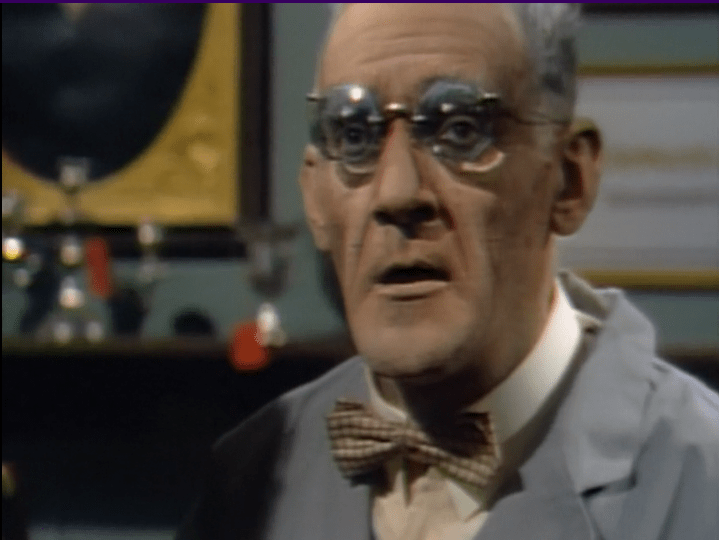
Nicholas at first assumed that Barnabas was Angelique/ Cassandra’s husband, and told him “I should have recognized you anywhere!” This is a sure sign of trouble- Barnabas, who was in fact briefly married to Angelique in 1796, has not been out of the state of Maine since 1795, and has never been photographed. Nicholas says that he has recently been on Martinique, where Barnabas first met Angelique in the eighteenth century, and that he is a “citizen of the world” with no fixed address. He assures Roger that it is Cassandra’s way to disappear abruptly, and that she is sure to return.

Roger, Julia, Barnabas, and Nicholas in the drawing room.

Roger takes Nicholas to the bedroom he and Angelique/ Cassandra share. He shows Nicholas a portrait of Angelique which returning viewers know to have a mysterious connection with Angelique/ Cassandra’s physical being. Roger leaves the room, and Nicholas talks to the portrait. He asks Angelique if she can hear him, and a musical cue associated with her plays on the soundtrack. The cue cuts out, and Nicholas follows up with another question. Dark Shadows stood out from the daytime soaps of the period in having an orchestral score instead of an organ accompanying the action. The meta-theatrical touch of a character who can hear that score is a major departure. It is something people at the time would have seen in animated shorts from Warner Brothers, but likely not anywhere else. Since the biggest and fastest-growing share of Dark Shadows’ audience at this point was children under the age of 13, there was a risk that adult viewers might take that association with cartoons as a sign that it was time for them to find something else to do with their mid-afternoons.

Back in his own house on the same estate, Barnabas finds his servant Willie Loomis holding a rifle. Willie says that he is afraid that man named Adam will come to the house. Barnabas dismisses that fear and orders Willie to put the rifle away. Willie objects. Barnabas repeats the command and leaves. Willie grumbles, but does as he was told. We see a face peering in at the window.

The face belongs to hardworking young fisherman Joe Haskell. Returning viewers know that Barnabas held Joe’s fiancée Maggie prisoner from May to June of 1967 and was extremely cruel to her. When the case was being investigated, Barnabas framed Willie for those crimes. Willie was sent to a mental hospital, and Barnabas had Willie released and brought him back to work for him some weeks ago. Joe thinks that Willie is the perpetrator, and has no patience with him. He knocks on the door and demands Willie let him in.

Joe insists that Willie tell him what he knows about Adam. Willie tries to evade his questions. When Willie says that Adam dislikes him, Joe responds”that means he knows you.” Joe twists Willie’s arm while repeating his questions. Once Joe releases him, Willie runs off and comes back with the rifle. He points it at Joe and orders him out of the house. Joe complies, but says that he will be back, and that he will be having words with Barnabas.

Later, Willie is in the basement. Some bricks are missing from a wall, exposing a skeleton hanging from the ceiling. Viewers who have been with Dark Shadows all along will recognize the basement of Barnabas’ house as a redress of the set that represented the basement of the main house in the first year of the show. The spot with the missing bricks was where a door stood that was always locked in those days. For the first 54 weeks of Dark Shadows, matriarch Liz thought that her husband’s corpse was buried behind that door. That belief turned out to be mistaken, but now we see that there are indeed human remains in the most similar possible spot. We might wonder what else Liz might have been less wrong about than at first sight appeared.

We watch Willie preparing to fill in the missing bricks, leaving the skeleton in place. After all, judging by Liz’ old way of thinking, that’s what ought to be in a space like that. We hear Willie’s interior monologue. He is making himself laugh with a pun on his own name when a stagehand wanders into the shot.

Uh, hello?

That moment of unintentional humor gives way to a scene rich in intentional comedy. Willie goes upstairs and finds that Nicholas has let himself into the house. Nicholas entrances him and extracts information from him. Willie tells him about a meeting with a ghost- “the one downstairs,” he specifies. Nicholas directs Willie to sit down, to remain in a blissed-out state until he leaves, and then to forget all about their encounter.

Nicholas goes to the basement, looks at the skeleton, and calls it “Reverend Trask!” Willie hadn’t given him this name; evidently he recognizes Trask the same way he recognized Barnabas.

The gang’s all here.