Little Sarah Collins misses her governess, the well-meaning Vicki. Unknown to Sarah or her elders, Vicki is a time-traveler, displaced from 1967 by Sarah’s own ghost to come to this year 1795 and see how the troubles that will afflict the Collins family in days to come began. Vicki has utterly failed to adapt to her new surroundings, and is now in hiding, suspected of witchcraft.
Vicki is secreted in the Old House on the great estate of Collinwood, the guest of its owner, gallant gentleman Barnabas Collins. Unfortunately for her, Barnabas’ new wife Angelique is the real witch, and by her harebrained behavior Vicki has volunteered for the role of Angelique’s patsy. Angelique takes advantage of Vicki’s presence in the house to cast spells directing ever more suspicion her way and increasing the likelihood she will be caught.
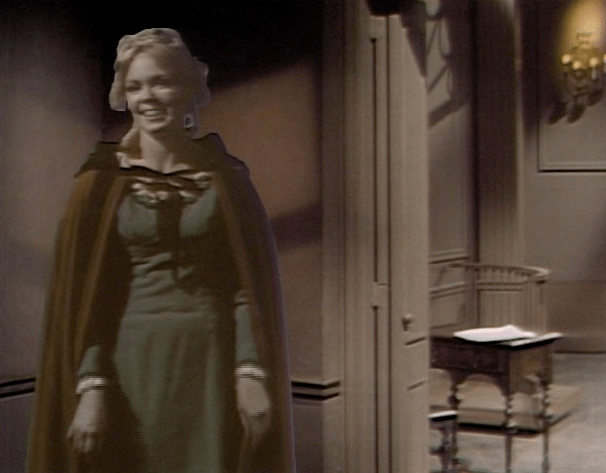
We see Sarah in the foyer of the great house, tossing a ball in the air. Tossing a ball was one of her favorite pastimes as a ghost in 1967. In those days, she usually sang “London Bridge” while playing ball, but she is silent now. Indeed, we have yet to hear the tune in connection with the living Sarah. She is interrupted by Vicki’s disembodied voice calling her to the Old House. Regular viewers, remembering Sarah as the calmest and most adroit of ghosts, will be intrigued to see the living Sarah bewildered by a supernatural phenomenon.
The voice stops, and we cut to the Old House, where a puzzled Barnabas catches Angelique doing something weird with candles. She makes up a story about having needed the light to search a dark corner for a piece of jewelry she dropped. In the course of the story, she says that she was crawling about “like a cat.” It’s a bit startling to hear her compare herself to a cat, since in #378 she turned Barnabas’ father, haughty overlord Joshua, into a cat. It doesn’t make an impression on Barnabas, though, and he quickly disregards the whole thing.
Back in the great house, repressed spinster Abigail meets her brother Joshua in the drawing room of the great house. She is sure Vicki is a witch and that Barnabas is sheltering her in the Old House. Joshua had earlier given Abigail and her favorite divine, the Rev’d Mr Trask, free rein to investigate Vicki; he now seems to regret that decision, and on no account does he want any member of the family to go to his disowned son Barnabas’ house. When Abigail finds Sarah and forces her to tell the story about hearing Vicki’s voice calling her to the Old House, she seizes the high ground. She insists that Sarah go to the Old House and that she and Joshua follow her there. When Abigail says “Come, Joshua,” she leaves him little choice but to comply.
Sarah enters the Old House through the front door, and for the first time in 1795 the strains of “London Bridge” play on the soundtrack. Apparently Sarah’s visit to her former home marks a step towards her postmortem fate. She calls for Vicki. Barnabas asks Sarah what she’s doing there. Abigail and Joshua appear at the threshold and ask to be admitted. Angelique, as lady of the house, invites them in and offers to make tea. Abigail refuses the offer and announces their purpose. While the adults quarrel, Sarah slips out. We cut to Vicki’s room; evidently Sarah went directly to her, for they are already in the middle of a conversation.
In 1967, the spectral Sarah was an expert in the arts of concealment and escape. She has some of those talents already in her living form. She takes Vicki to a compartment in the attic that none of the adults, not even Barnabas, remembers. Vicki hides there while Abigail and Joshua search the house.
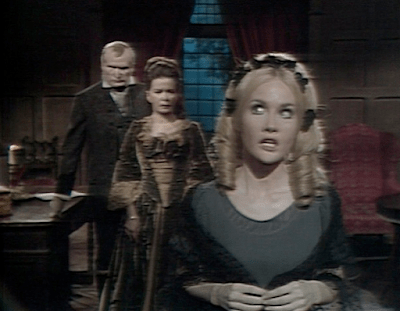
Having found Sarah, Abigail questions her closely. Sarah stands with her back to her aunt; it is uncharacteristic of Abigail to allow this, and we wonder why she does. Young Sharon Smyth plays the scene so well that we are glad to see her face. Abigail asks if Sarah knows that “curious and terrible forces” beset them; Sarah replies with a crisp “Yes, ma’am!” She asks if she knows what happens to little girls who lie, especially to their elders; “Yes, ma’am!” We see the struggle on Sarah’s face as she denies having seen Vicki.
After they complete their search, Joshua agrees that Vicki is not there and is embarrassed by the whole thing. Abigail insists that she is there, citing Sarah’s lies as proof. Now we understand why she let Sarah turn her back on her- she didn’t intend to extract the truth from her, since a lie would serve equally well. Abigail demands that Trask be brought back to perform a rite of exorcism. Joshua reacts to this demand with distaste, Barnabas with indignation, but Angelique persuades her husband to allow it.
After the visitors have left and Barnabas has gone to be alone, Angelique gives a soliloquy about how she will turn Trask’s fraudulent mumbo-jumbo to her own purposes. Vicki’s face is superimposed over hers in an effect we have not seen since the days of blonde fire witch Laura Murdoch Collins. Laura’s face was superimposed over those of people on whom she cast spells, most significantly over parapsychologist Dr Peter Guthrie in #185. Laura’s spell killed Guthrie; evidently Angelique’s plans for Vicki are equally final.
Wrongly suspected of witchcraft, bewildered time-traveler Vicki has found refuge in the home of young gentleman Barnabas Collins. Vicki doesn’t know it yet, but last night Barnabas married a woman named Angelique. Vicki knew Angelique when they were both working in the home of Barnabas’ family, Vicki as a governess, Angelique as a lady’s maid. Unknown to almost anyone, Angelique is the real witch and is glad Vicki has fallen into taking the blame for her evil deeds.
Angelique herself is in the dark about Vicki’s presence in the house. She chances upon Vicki in the morning. Angelique is the only character in the segment of Dark Shadows set in the year 1795 to address her as “Vicki”; everyone else insists on calling her “Victoria” or “Miss Winters.” Since we have known Vicki since the first episode, and we know that her friends call her “Vicki,” hearing her use that form of the name tells us that Angelique has presented herself to Vicki as a friend.
Angelique tells Vicki that she and Barnabas are now married. If Vicki had learned anything from the long string of failures to adapt to the mores of 1795 that have brought her to her current state, she would respond to this by lowering her eyes, curtsying, and saying “Mrs. Collins.” But instead, she reacts with a blank stare. Angelique asks what if she is merely startled by the news, or is shocked. Vicki resumes babbling, still calling Angelique by her first name, still referring to Barnabas by his.
Not only is Vicki continuing to flout the modes of address conventional to the period in which she finds herself, she seems genuinely unaware that a newlywed might be disturbed to stumble upon an attractive young woman her husband is hiding in the house. After a minute or two, it occurs to her to ask Angelique if she wants her to stay. Angelique says that because Barnabas is the master of the house, it is not for her to object. Vicki responds by jumping into her face and exclaiming “But you’re the mistress!” Even after that, she keeps on with her first-naming of Barnabas and Angelique and shows absolutely no sign of awareness that Angelique might be concerned about the nature of Barnabas’ attachment to her.
“But you’re the mistress!”
Downstairs, Angelique asks Barnabas about Vicki. He asks incredulously if she is jealous. Barnabas didn’t visit Angelique in her bedroom on their wedding night and she knows that he tends to make free with servant girls, since that’s how they met. Even so, he can’t figure out why Angelique might be unhappy to find that he has Vicki stashed in the house. It really is a shame Barnabas and Vicki didn’t marry, just imagine what oblivious children they might have had. They might have been the progenitors of a whole line of Detective Frank Drebins.
Later, Angelique has a spell she wants to cast on Barnabas’ aunt, repressed spinster Abigail Collins. She summons indentured servant Ben, whom she has enslaved. She orders Ben to steal Abigail’s hair ribbon from her night-stand. Ben is horrified by the command. It would have been bad enough if he had been caught sneaking into one of the gentlemen’s bedrooms, but he might have been able to talk his way out of that. If he is found in a lady’s bedroom, he’ll be lucky if all that happens is that he’s sent back to prison for several years. Impatient, Angelique tells him not to get caught.
Abigail does catch Ben in her room with the hair ribbon in his hand. She was the first to suspect witchcraft at Collinwood, before there even was any. Ben begs her not to ask him any questions, but she isn’t having it. She presses him, and he says that the witch sent him. She demands he say the witch’s name, wanting to hear him say “Victoria Winters.” He is about to say “Angelique” when we see her, in the Old House, cast the spell that causes him to choke. This scene takes about a minute to make all the points the story needs, but goes on for several times that long. That doesn’t hurt a thing- Clarice Blackburn and Thayer David were such a pair of pros that they could hold the audience’s attention for a good deal longer with a lot less to work with. It’s a fine ending.
Yesterday, the ghost of Jeremiah Collins started to bury wicked witch Angelique alive. Today, we see that he barely got her dress dirty. She’s lying on a mound next to the empty grave when we find her.
This is the one where Angelique marries Barnabas. It ought to be packed with incident. There is a lot of activity, but like the live burial, it doesn’t amount to much. It’s a real disappointment.
One particular weak spot in the episode is the officiant at the wedding, the aptly named Reverend Bland. Actor Paul Kirk Giles does what he can, but as soon as the Rev’d Mr B realizes that something unwholesome is going on he declares that he is getting out of the place. Apparently his conception of the duties of a pastor consists of avoiding people who might need help confronting the spiritual forces of darkness. It doesn’t matter- Bland’s squeamishness disappears after Barnabas orders him to stay and perform the wedding.
After the wedding, Angelique returns to her bedroom. There is a gift that hadn’t been there before. Opening it, she finds a music box. The music box was a big deal in 1967, when Barnabas was a vampire and he thought that a woman who listened to it would turn into his lost love, the gracious Josette. This is the first time we have seen the music box during the segment of Dark Shadows set in 1795. In 1967, Barnabas told various stories about the origin of the music box, but the one thing that remained consistent was that it was meant for Josette.
Barnabas and Josette were engaged when the 1795 segment began, but that ended when Josette and Jeremiah conceived a mad passion for each other and eloped. Unknown to Barnabas, that was the result of a spell Angelique cast in hopes of getting Barnabas for herself. Barnabas responded to the elopement by killing Jeremiah in a duel. He has told Angelique that he still loves Josette and always will, but that he knows there can never again be anything between them. Moments after he had told her that, Angelique agreed to marry him. Evidently it was to be a sham marriage.
Jeremiah’s ghost has been railing at Angelique for raising him from his grave, and apparently he wants to be avenged by making the sham marriage even shammier. When Barnabas comes into the room, he sees the music box, explodes in rage, and storms out.
In life, Jeremiah never knew that Angelique was behind his and Josette’s passion. He has evidently learned that and other of her secrets, and is using them against her. Perhaps Angelique put more of herself into him than she intended.
On The Collinsport Historical Society, Patrick McCray says that this is an important episode because Barnabas and Angelique’s wedding is the basis for some developments much later in the series. That’s true, but by the time he’s talking about the show isn’t very good any more. So I consign it to the ranks of the “Stinkers.”
Well-meaning governess Vicki is wrongly suspected of witchcraft and needs a place to hide. Young gentleman Barnabas takes her into his house. In her gratitude, Vicki tells Barnabas the truth about herself. She is a time-traveler, yanked back to this year 1795 from her native 1967 by forces she does not understand. Indentured servant Ben enters the room and Vicki leaves. Mystified by her story, Barnabas asks Ben if he thinks Vicki might be a witch after all.
It is exciting when Vicki starts confiding in Barnabas. She has utterly failed to adapt to her new environment, and has none of the abilities she would need to scam her way into a secure place there. She has ended up as an obstacle to story development and an irritating screen presence. If Vicki isn’t going to lie competently, she may as well tell the truth. But that turns out to be a dead end as well- there is no use for Barnabas to make of the information she has given him.
Barnabas doesn’t repeat Vicki’s story to Ben- he just reports that she said something utterly bizarre. What Barnabas does not know, but Ben does, is that there really is a witch in the house- it is Barnabas’ bride-to-be Angelique. Angelique has enslaved Ben, so if he found out Vicki’s secret she would as well, and would be able to use it against her as she frames Vicki for all of her own crimes. Ben proclaims to Barnabas his absolute certainty that Vicki is not a witch, but since he can’t tell anyone about Angelique, this only puzzles Barnabas. Barnabas is further baffled when Ben says he hopes that Barnabas’ marriage to Angelique brings an end to his troubles.
The other day, Angelique tried to solve a problem of her own by raising a corpse from its grave. This was the late Jeremiah Collins, uncle of Barnabas and his best friend until, under the influence of Angelique’s spell, he and Barnabas’ fiancée Josette eloped together. Barnabas responded to that by challenging Jeremiah to a duel. Conscience-stricken, Jeremiah decided to let Barnabas kill him and told Josette that she would be free to marry Barnabas once he was dead.
Angelique had ordered Jeremiah to plague Josette and Barnabas with angry demands that they stay apart. We could interpret that simply as puppetry on Angelique’s part. But today, Jeremiah is harassing Angelique and refusing her repeated commands to go back to his grave. He says he was at peace in the earth until Angelique disturbed him. He was content with his decision to forfeit his life, but now he has become something he didn’t bargain for. Maybe it’s the indignity of that change that accounts for his change of personality, or maybe he’s just cranky because he can’t get back to sleep.
Regular viewers will think of a third possibility. In the segments of Dark Shadows set in 1966 and 1967, we saw other supernatural beings, such as undead fire witch Laura Murdoch Collins and the ghosts of Josette and of Barnabas’ little sister Sarah. These beings looked at first glance like humans, but the more we learned about them the clearer it became that each was in fact a complex of multiple entities, some of which operated independently of and occasionally at cross-purposes with others. As a witch, Angelique might also be a composite being. Perhaps each time she casts a spell, she breaks off a little piece of herself and deposits it within the person she is trying to control. If so, the creature she is trying to send away is not simply Jeremiah, but the body of Jeremiah animated by a chunk of the spirit of Angelique. That would explain why the actions of the risen Jeremiah are characterized by three traits that were alien to the living man, but that Angelique has in abundance- single-mindedness, vengefulness, and ineffectiveness.
Barnabas, Ben, and a clergyman are in the front parlor, ready for the wedding. Angelique takes a long time to come downstairs. Barnabas goes up to her room to see what is keeping her. He finds her terribly upset, insisting that they have the ceremony somewhere else. Barnabas looks in her suitcase, which had a moment before held the clothes she removed to put on her bridal gown. Those clothes have vanished, and in their place Barnabas finds a doll belonging to his little sister Sarah and some pins. Had Barnabas ever seen a horror movie, he would know to interpret this as a clue from Jeremiah that Angelique had caused a recent illness of Sarah’s by sticking pins in her doll, but people didn’t get to the cinema in 1795, so it’s another dead end.
Angelique composes herself and says she will be right down for the wedding. Barnabas leaves the room. The door closes itself, and Angelique cannot open it. Jeremiah enters and tells Angelique she must be punished for disturbing the dead. He takes her to his grave, which is open. Angelique raised Jeremiah some days ago- if the grave has been open this whole time, you’d think someone would have noticed and people would be talking about it. Anyway, he puts her in the grave, and from her point of view we see him throwing dirt into it.
Jeremiah dropping dirt onto Angelique, from her point of view. Screenshot by
This is the first live burial we’ve seen on Dark Shadows. It’s true that the POV shot from inside the grave echoes a moment in #248 when Barnabas, who is in 1967 a vampire, shuts his prisoner Maggie Evans in a coffin and we see him through her eyes, but that coffin wasn’t in the ground.
Harking back as it does to that shocking moment from Barnabas’ early days on the show, the image of the reanimated Jeremiah dropping dirt in the grave invites us to make a comparison between Jeremiah and Barnabas. In life Jeremiah was a mild-mannered, good-hearted fellow, as is the living Barnabas. The destructive behavior he has exhibited since Angelique raised him from the dead is not only typical of her, but also of what we saw from the vampire Barnabas in 1967. Again, we wonder if the fate that awaits Barnabas is not only something Angelique will do to him, but if everything we saw of him in the months between April and November was what Angelique was doing disguised as him.
Closing Miscellany
Angelique’s repeated commands to Jeremiah today to “Go back to your grave!” find an echo in one of the great moments in the history of Dark Shadows conventions, when Lara Parker used that line to explain the Dark Shadows house style of acting:
“Go back to your grave!!!!!”
When Vicki tells Barnabas the truth about herself, the camerawork makes Alexandra Moltke Isles’ strabismus impossible to miss. Previously they had taken great care to photograph her from angles that would obscure this condition, but we’re going to get another clear look at it on Thursday. Combined with the lousy lines the scripts have given Vicki since the beginning of the 1795 segment, it is hard not to suspect that there was some kind of deliberate effort behind the scenes to push Mrs Isles aside.
This was the first episode of Dark Shadows broadcast in 1968. The copyright date printed on the screen at the end still says 1967. They were several months late before they stopped putting “1966” there, so I guess we shouldn’t be surprised they didn’t update it for an episode shown on New Year’s Day.
It is 1795. In the foyer of the great house of Collinwood, young gentleman Barnabas Collins stands on the staircase, his father Joshua stands on the floor. Joshua forbids Barnabas to marry lady’s maid Angelique on pain of disinheritance; when Barnabas declares he will marry her anyway, Joshua announces that they are no longer father and son.
In 1967, Barnabas will return to Collinwood as a vampire. In that year, in episode #214, he will take well-meaning governess Vicki on a guided tour of the foyer of the old manor house, indicate the staircase there, and say that “On these stairs, a father and son hurled words at each other, words that would lead to the death of the son.” He will then begin laughing maniacally and repeat the words “The death!,” seeing the desperate irony of referring to his own death in the past tense.
By today’s episode, the Collinses have moved out of the old manor house without any shocking scenes between Barnabas and Joshua playing out on the stairs there. That isn’t so surprising- that one remark eight months ago was the only reference to the stairs as the site of a fateful quarrel between Barnabas and Joshua, and the writer responsible for that day’s script, Malcolm Marmorstein, has been gone and forgotten since August. Neither today’s screenwriter, Gordon Russell, nor his colleague, Sam Hall, was with the show when Barnabas gave that speech to Vicki, and the third member of the writing staff, Ron Sproat, has been in the background for most of the 1795 segment so far.
But they do go out of their way to put Barnabas on the stairs of the new house for his showdown with Joshua today. It seems likely that they are hoping that at least some viewers will remember Barnabas’ remark in #214 and look for a significance in the connection. They did that sort of thing all the time in the early months of the show. For example, when they were developing a murder mystery about the death of beloved local man Bill Malloy in the last four months of 1966, they would show us a clock face in one episode, then weeks later have a character lie about the time established by that clock. Sproat more or less put a stop to those kinds of wild over-estimations of the audience’s attention span when he joined the writing staff near the end of 1966, but ever since the vampire story began in April of 1967 they had acquired obsessive fans who sent letters and gathered outside the studio. So they do have a reason to try to close the loop on a very long and very slender thread. What might the significance be of this particular nod to Barnabas’ first days on the show?
The 1795 segment began when the ghost of Barnabas’ little sister Sarah took possession of Vicki at a séance in #365, announced she wanted to “tell the story from the beginning,” and hurled Vicki back to her own time as a living being. But it is not simply a flashback explaining what made Barnabas a vampire. Vicki has completely failed to adapt to her new environment, and as a result has made significant changes to the timeline. She is now in hiding, suspected of witchcraft because of her endless stream of bizarre words and actions.
In fact, there is a witch at Collinwood. It is Angelique. Presumably, the first time these events took place Angelique pinned responsibility for her crimes on Sarah’s proper governess, Phyllis Wick. We caught a glimpse of Phyllis in #365; we could tell, not only that she was indigenous to the eighteenth century, but that she was quite cautious about anything that might suggest the paranormal. It would have taken Angelique some time and effort to set Phyllis up as a patsy, while Vicki volunteered for the role without any action at all on Angelique’s part. So maybe Vicki has speeded everything up. Maybe the family was still in the Old House when Joshua disowned Barnabas in the original sequence of events, but Vicki’s blunderings have accelerated matters so that they moved out before the conflict between them came to a head.
There is another puzzle about the writers’ intentions in this episode. It is established that without his inheritance or his position in the family business, Barnabas will be in a most parlous state. In separate scenes, both Barnabas and Joshua talk about the impossibility of Barnabas finding a job in Collinsport. Barnabas tells Angelique they will have to go at least as far as Boston before they can find anyone who will risk Joshua’s displeasure by hiring him. Later, Joshua tells Naomi that Barnabas won’t even be able to reach Boston- he doesn’t have enough money and won’t be able to get enough credit to stay in an inn, and he has no friends who will so much as put him up for a night if they know he doesn’t have an inheritance coming.
Barnabas’ mother, Naomi, has a solution to his financial problems. She gives him the Old House. The Old House is supposed to be a huge mansion, which it takes a very substantial income to maintain. How a man who can’t even afford a room for the night is going to meet those expenses is not made clear.
The frustrating thing about this is that they dwell at such length about the hard realities of dollars and cents immediately before, and then again after, Naomi makes her gift. By the laws of Soap Opera Land, a character who possesses a symbol of wealth such as a mansion does not need an income. We can accept that convention, and do in the 1967 segment, when a moneyless Barnabas occupies the Old House and can pay for all sorts of expensive things. But today they keep rubbing our faces in the implausibility of it.
My wife, Mrs Acilius, suggested they could have presented both themes if they’d dealt with the realistic financial problems in one episode and in a subsequent episode had gone back to the fantasy world. Maybe Joshua disinherits Barnabas on a Friday, he worries about getting a job on Monday, Tuesday we watch someone try to introduce Vicki to the concept of “lying,” Wednesday we see caddish naval officer Nathan woo feather-headed heiress Millicent, Thursday much-put-upon servant Ben Stokes tries to escape from the spell with which Angelique controls him, and then comes another Friday, when Naomi waves her magic wand and gives Barnabas the house. But as it stands, Barnabas talks to Angelique about how they have to go hundreds of miles to eke out a bare subsistence, Joshua talks to Naomi about Barnabas’ impending poverty, and then all of a sudden they remember that none of that matters, sorry sorry we shouldn’t have bothered you with it.
There were times in 1966 and 1967 when Dark Shadows only had one viable storyline, and no readily apparent means of starting others. But now they have several stories in progress, and an abundance of lively characters with whom they can make as many more as they like. There is no need for events in any one plot-line to move so quickly that incompatible themes crash into each other with such an unfortunate result.
Naomi’s gift to Barnabas was legally impossible in 1795. Until 1821, Maine was part of Massachusetts, and married women could not own property in Massachusetts until 1822. Maine did not pass its own Married Women’s Property Act until 1844. The show never brings this up, so it isn’t the same kind of problem as Barnabas’ lack of income.
Still, it does represent a missed opportunity. If Naomi’s family of origin had owned the house, they might have placed it in a trust over which she would have enough influence to deliver it to her son against her husband’s wishes. In fact, the show never makes the slightest allusion to where Naomi came from. If they’d given her relatives of her own, she would have had potential allies in a clash with Joshua and potential goals to pursue independently of him. As it stands, they have put her firmly in his shadow, so that the category of possible stories about Naomi is a subset of stories about Joshua. That’s a sad situation for a character who is capable of the dynamism she shows today, and a criminal waste of the talents of an actress as accomplished as Joan Bennett.
The ghost of Jeremiah Collins has gone to the newly built great house of Collinwood and made a terrible mess in the bedroom that was to be occupied by a house-guest of the Collins family, the Countess DuPrés. Among those who discover the mess is Angelique, who was the countess’ maid before she became the fiancée of Jeremiah’s nephew, Barnabas. Not everyone in the house knows of the change in Angelique’s station, so it is unclear whether she ought to stick with her former role and clean the room herself or start functioning as a member of the family by calling for a servant to do it. Since Angelique is also the wicked witch who raised Jeremiah from the grave, putting her in this awkward position would seem to be a passive-aggressive way for him to get back at her.
Repressed spinster Abigail Collins, sister of the master of the house, comes into the room. She insults Angelique’s former master, the countess’ brother André, prompting him to leave the room in a huff. Angelique begins to follow André, but Abigail orders her to to stay.
Angelique has taken no care to cover her tracks, and it is obvious to all that something very unusual has been happening around the estate of Collinwood since she arrived. Most of those who have witnessed the strange goings-on are rational, modern people who are reluctant to believe in the supernatural, and the rest have settled on the idea that eccentric governess Victoria Winters is the witch. But Abigail has learned of Angelique’s engagement to Barnabas, has realized that every bizarre occurrence has contributed to making it possible, and has concluded that Angelique is in league with Vicki and the devil.
Up to this point, Abigail has been a figure who did ridiculous things but whom we came to respect as we saw that a person of her time and place might well have interpreted the information available to her as she does. In this scene, she isn’t ridiculous at all. She is mistaken about Vicki, who is a well-meaning innocent. But she has figured Angelique out long before anyone else has even begun to suspect her. Abigail emerges as a character who is smart enough to turn the story in fresh and surprising directions.
Once Abigail has left the room, Angelique summons Jeremiah and tells him she has something for him to do before she will let him return to his grave. Jeremiah has already gone beyond the instructions she gave him, not only in befouling the countess’ room but also in repeatedly showing himself to Naomi Collins, the lady of the house. But I suppose Angelique has such a limited staff she can’t afford to let someone go for overenthusiasm.
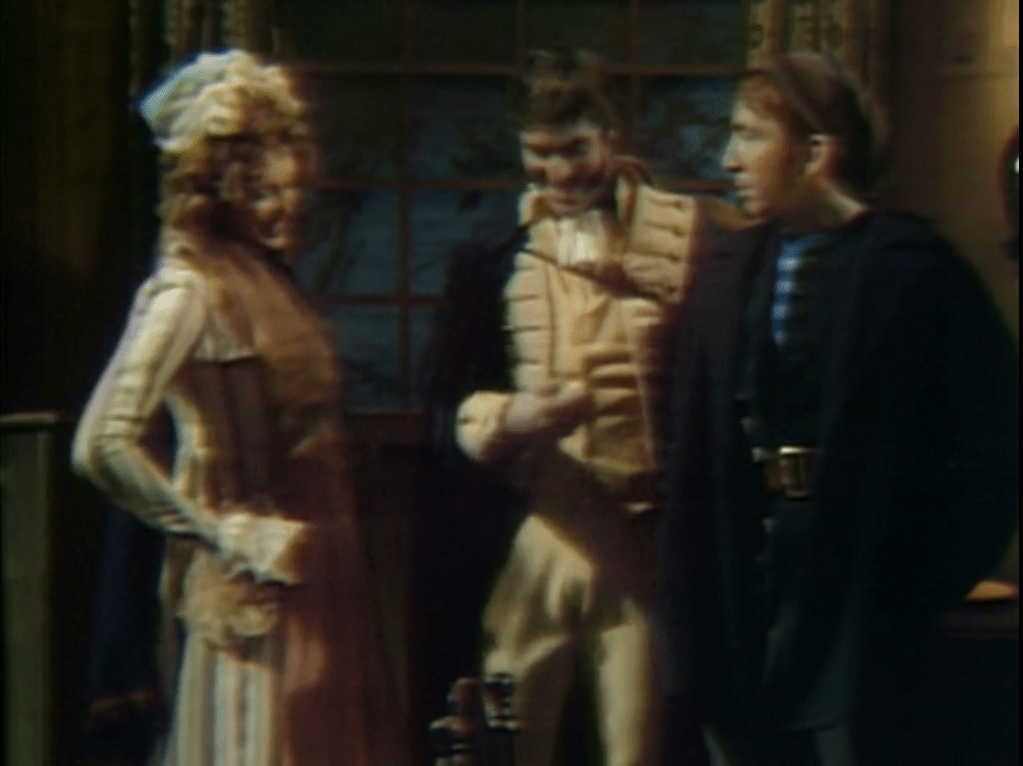
We see Barnabas in his new room in the great house. His friend Nathan comes and asks him about the report that he is going to marry Angelique. Barnabas confirms that it is true, and assures Nathan that Angelique is not pregnant.
As written, the scene is a bit of a throwaway, but the actors flirt with each other pretty blatantly throughout the scene. As the screenshot above shows, it begins with Nathan thrusting his crotch into Barnabas’ face while Barnabas smiles appreciatively, and it continues along that line. Considering that Nathan is puzzled that Barnabas wants to marry a woman, even a beautiful one, and that viewers know that Barnabas intends it to be a sham marriage, the flirty tone makes it hard not to recognize a comment on a familiar closet situation. Jonathan Frid and Joel Crothers were both gay, but they had many scenes together and never seemed to be flirting at any other time, so perhaps this comment was intentional on their part and that of director John Sedwick.
After Nathan leaves, Jeremiah appears in Barnabas’ room. He denounces Barnabas for killing him in a duel over the gracious Josette and vows to haunt Barnabas and Josette forever if they marry.
This does not at all reflect the attitude Jeremiah had in life. Jeremiah and Josette married under the influence of a spell Angelique cast on them, and they deeply regretted the pain their elopement brought Barnabas. In his last conversation with Josette before the duel, Jeremiah made it clear that he was going to let Barnabas kill him and that it was all right with him if Josette and Barnabas went on to marry. Jeremiah’s rantings to Barnabas today are Angelique’s words, not his own. This leads us to wonder if she is simply manipulating him as a puppet, or if some fragment of her personality took up residence in Jeremiah when she raised him from the dead. We’ve seen several times that supernatural beings on Dark Shadows are complex phenomena made of parts that work independently and often at cross-purposes with each other, so perhaps when Angelique casts a spell she is dividing herself into parts that will thwart each other’s goals.
Regular viewers know that the segment of the show set in 1795 will show us Barnabas becoming a vampire. We assume that Angelique will be responsible for this transformation. Since the Barnabas we knew in 1967 showed many of the personality traits that Angelique has shown in 1795, seeing her at least use Jeremiah’s reanimated corpse as a mouthpiece for her words and perhaps turn it into a part of herself makes us speculate if the vampiric Barnabas we thought we knew was really Angelique all along.
After Jeremiah leaves Barnabas’ room, Angelique comes in. She tells Barnabas that Abigail is making trouble for them, he tells her about Jeremiah’s apparition, and they decide to marry at once. This three-part sequence in Barnabas’ room- his scenes with Nathan, with Jeremiah, and then with Angelique- mirrors a sequence in Josette’s room in yesterday’s episode, in which she is visited by Jeremiah, then by the countess, then by Angelique. That sequence ended with Angelique telling Josette that she and Barnabas were to be married and thus represented a step towards the wedding. The echo of its structure at the end of today’s installment gives us a sense that the wedding is approaching with irresistible momentum.
Wicked witch Angelique cast a spell bringing a painful and apparently terminal illness to little Sarah Collins, beloved baby sister of young gentleman Barnabas. Angelique was enraged that Barnabas would not love her and wanted him to watch Sarah in agony, so that the love he felt for his sister would torture him. Barnabas happened by Angelique’s room in the servants’ quarters of the manor house of Collinwood while Sarah was languishing, and it occurred to Angelique that she had some leverage to use against him. She told him she might know of a cure for Sarah, and extorted his promise to marry her if she effected it. He agreed, Sarah recovered, and today Angelique comes to collect.
At first, Barnabas is bewildered by Angelique’s belief that they are going to marry. She brings up his promise. He is flabbergasted to find that she took it seriously. He does not know that she is a witch, and only now seems to suspect that she is a crazy person. She asks if he won’t have her because she is a servant. He gallantly denies that class makes any difference. He says that the real problem is in his feelings for Josette, his former fiancée, who eloped with his uncle Jeremiah. He says that he knows there can never again be anything between him and Josette, but neither will he ever cease to love her. Barnabas asks if Angelique would be willing to marry him, knowing that Josette will always have the first place in his heart; she asks what that matters, as long as she gets to be his wife. She repeatedly releases him from the promise he made while Sarah was ill, but he agrees to marry her anyway.
Yesterday’s episode and today’s include writer Ron Sproat’s first significant scenes featuring Angelique and Barnabas. In the scenes Sam Hall and Gordon Russell gave them, it seems that, while Barnabas has definitely made up his mind that Josette is the one for him, he also has the hots for Angelique. So he squirms and looks unhappy when Angelique throws herself at him, but he does kiss her and he does not hesitate to accept her invitation to visit her alone in her room in the servants’ quarters. So we can imagine that when Barnabas first met Angelique on the island of Martinique, believing as he did at that time that Josette could never love him, he was just doing what came naturally to him when he availed himself of her favors.
But in Sproat’s scenes, Barnabas isn’t attracted to Angelique at all. Yesterday he saw her while he was frantically worried about Sarah’s illness, so any sign of attraction would have had to be subtle. But today, they have a long, deeply emotional conversation in the course of which they decide to get married, and throughout he looks and sounds like he’s talking to his grandmother. That invites us to imagine their affair on Martinique in quite a different light. Perhaps he settled for Angelique then in the same way he is settling for her now- he despaired of ever getting the relationship he really wanted, and decided to give the path of least resistance a try.
It may not be irrelevant that Sproat was gay. For that matter, so was actor Jonathan Frid, a fact that wasn’t publicly acknowledged by his representatives until he’d been dead for ten years, but that can’t have been all that hard for sophisticated viewers to figure out in 1967.
Before Dark Shadows took us back in time to 1795, we knew Barnabas as a vampire trying to convince people he was a living man. In his efforts to pass, we often saw him alienated from his own feelings, isolated from others, and unable to express himself through any conventional form of masculinity. It wasn’t hard to find gay subtext in him then. But I think that in this scene we see the most specific and recognizable closet situation he has been in so far. When he expresses disbelief that Angelique will “accept me as I am,” even knowing “the way I feel,” the character collapses into the actor for a moment, and Josette merges into some guy to whom Frid would never feel comfortable introducing us. When he takes Angelique at her word and agrees to a sham marriage, he sees her as someone who has a place for the man he is. From what we have seen of her single-minded pursuit of Barnabas’ devotion, we know that she expects to turn him into someone else, and that they will both be terribly disappointed.
Like every other episode of Dark Shadows, this one opens with a voiceover delivered by a member of the cast. The voiceovers in the segment of the series set in the year 1795 usually begin thus:
A séance has been held in the great house of Collinwood, a séance which has suspended time and space and sent one girl on an uncertain and frightening journey into the past, back to the year 1795. There, each of the Collins ancestors resembles a present-day member of the Collins family. But the names and relationships have changed, and Victoria Winters finds herself a stranger in a sea of familiar faces.
The “sea of familiar faces” results from the same actors appearing in the parts of the show set in different periods. The emphasis the show places on this, both by the repeated use of “sea of familiar faces” in one opening voiceover after another and by the hapless Vicki’s (Alexandra Moltke Isles) exasperating habit of telling the characters that they are being played by actors who previously took other parts, gives the audience a reading instruction. Evidently we are meant to compare and contrast each actor’s twentieth century and eighteenth century roles.
The first face we see today is the only unfamiliar one that has bobbed to the surface of the 1795 sea. It belongs to wicked witch/ lady’s maid Angelique, played by Lara Parker. Angelique had a brief fling with young gentleman Barnabas Collins (Jonathan Frid) some time ago. They met when he first went to the island of Martinique and met her employers, the wealthy DuPrés family.
Barnabas had fallen in love with the gracious young Josette DuPrés (Kathryn Leigh Scott,) but was convinced Josette could never love him. Barnabas consoled himself in Angelique’s arms until he realized Josette did love him. Barnabas and Josette agreed to marry. Josette came to Collinwood for the wedding, accompanied by her father André (David Ford) and her aunt, the Countess DuPrés (Grayson Hall.) Angelique is the countess’ maid, but also attends Josette.
Angelique used her powers of black magic to make Josette and Jeremiah Collins (Anthony George,) Barnabas’ uncle, conceive a mad passion for each other. Josette and Jeremiah eloped, breaking Barnabas’ heart. Barnabas and Jeremiah fought a duel; consumed with remorse, Jeremiah let his nephew kill him. Even after all that, Barnabas realized he would always love Josette, a fact of which he apprised Angelique. Frustrated to find that she could never have Barnabas, Angelique yesterday announced in a soliloquy that she would punish him by forcing him to watch his beloved little sister Sarah (Sharon Smyth) suffer. At the top of the episode, Angelique is in her room in the servants’ quarters of Collinwood’s manor house with Sarah’s doll and some pins.
We cut to the front parlor, where Sarah is looking up adoringly at her mother Naomi Collins (Joan Bennett,) who is reciting a story. We cut back to Angelique, who drives a pin into Sarah’s doll. In the front parlor, Sarah clutches her chest and cries out in pain. Angelique sticks more pins into the doll, and Sarah cries out again.
In the parts of Dark Shadows set in the 1960s, Joan Bennett plays matriarch Elizabeth Collins Stoddard, owner of the great estate of Collinwood, of the Collins family enterprises, and of any other piece of property that they decide to tell a story about. In Liz’ time, the Collins family is much decayed from its eminence in 1795, but she is still the foremost figure in the town of Collinsport, and would have the authority to make just about anything happen. In fact, Liz can rarely bring herself to do very much that pertains to the plot, but when she does speak up we can see that she has great depths.
Naomi, by contrast, is utterly powerless, shut out by her husband, haughty overlord Joshua (Louis Edmonds) even from the management of the house. In today’s pre-title teaser, we see Sarah sitting on the floor of the front parlor, looking up adoringly while Naomi recites a story to her. That Naomi is reciting to Sarah rather than reading to her reminds us of what we learned when first we saw her in #366, that unlike most women in eighteenth century New England Naomi is altogether illiterate. Naomi occasionally bewails her inability to spend her time productively, and often drinks.
Sharon Smyth plays Sarah in 1795. In 1967, she was Sarah’s ghost, a frequent visitor to Collinwood and its environs. Sarah’s ghost was quite a different character than is the living Sarah. The little girl in the white bonnet who showed up in the oddest places and made the oddest remarks was only one aspect of a vast and mighty dislocation in time and space. It was Sarah’s ghost that started Vicki’s “uncertain and frightening journey into the past.”
Miss Smyth* nowadays describes her acting style when she was nine and ten saying “the first word that comes to mind is ‘clueless,'” but that works out surprisingly well for a ghost. It isn’t clear to us how the visible part of the Sarah phenomenon relates to the rest, much less how the whole thing works, and it can’t be clear- if a phenomenon stops being mysterious, it isn’t supernatural anymore. So it is gripping to see that the visible Sarah is herself in the dark about what she represents. That doesn’t work so well for living characters. When Miss Smyth can’t take her eyes off the teleprompter while delivering lines like “Help me, mother! It hurts!,” we can perhaps see one reason why the unfathomably mighty Sarah of 1967 was reduced to such a subordinate role in 1795.
But Miss Smyth’s limitations as a performer were not the only reason this development was inevitable. The whole idea of the supernatural is that something which appears to be very weak is in fact very strong. So children usually have fewer resources at their disposal than do adults, females are less likely to be found in positions of authority than are males, and the dead cannot rival the dynamism of the living. So the ghost of a little girl will of course be an immense force. The Sarah we see in 1795 is not yet a supernatural being, and so it would ruin the irony if even before her death she were already great and powerful.
In the part of the show set in 1967, Liz was one of the few major characters who never saw the ghost of Sarah. Liz was pretty firmly in denial about all reports of paranormal phenomena, and in #348 Sarah would declare that she could appear only to people who were prepared to believe in ghosts. So it is a bit startling for regular viewers to see these two actors together for the first time. Naomi is the same calm, indulgent presence to Sarah that Liz is to the children in her life, suggesting that though “the names and relationships have changed,” Liz and Naomi are two versions of the same person.
If the viewer’s main activity in watching the 1795 segment is contrasting the characters with those played by the same actors in the first 73 weeks, Angelique’s prominence is a puzzle. She is the only one who doesn’t fit into that scheme, yet she has driven all of the action so far. By the end of today’s episode, I think we can see a 1967 character with whom Angelique stands in juxtaposition. That character is Barnabas.
From April to November of 1967, Dark Shadows was largely the story of vampire Barnabas Collins (Jonathan Frid) and his attempt to impersonate a living man native to the twentieth century. It was so much fun to watch Barnabas scramble to keep this game going that the audience found it easy to put to one side the horrible evil he did and to look for reasons to think of him as good. But if we ever succeeded in doing that, Dark Shadows would be ruined. A deep-dyed villain allows a drama to be less serious overall than it might otherwise be, so that a thoroughly bad Barnabas lightens the tone. Make him relatable, or even forgivable, and everything gets terribly serious again. Yet a nonthreatening vampire is a purely comic character, like Count von Count on Sesame Street. So until they can establish another Big Bad, Barnabas has to be beyond redemption. If he is a lovable guy who just needs help dealing with his neck-biting problem, he has no place on the show, and it has no story left to tell. So they spent the fall systematically kicking away every possible mitigating factor and forcing us to behold Barnabas’ unrelieved evil.
The last hope of redemption for Barnabas in 1967 was his attachment to the late Sarah. Sarah had died when she was about ten, and her ghost started haunting the estate of Collinwood back in June, when Barnabas was holding Maggie Evans, The Nicest Girl in Town (Kathryn Leigh Scott,) prisoner in his basement. By November, many people had seen and talked with Sarah, but she had shunned Barnabas, even though he was desperately eager to reconnect with his baby sister. In his speeches about his longing for Sarah and in two moments when a suggestion he might see Sarah distracted him from a murder he was in the middle of committing, we saw the possibility that when Barnabas was finally reunited with her, he would change his ways.
That reunion finally took place in #364. Sarah walks in as Barnabas is strangling his only friend and sometime co-conspirator, mad scientist Julia Hoffman (Grayson Hall.) Barnabas does let Julia go, and has a heartfelt conversation with Sarah. Sarah says that she will not come back until Barnabas learns to be good. We can see just how long that is likely to be when, less than two minutes after Sarah has vanished, Barnabas tells Julia that, while he may not kill her tonight, her existence means no more to him than does that of a moth.
When even a direct encounter with Sarah cannot move Barnabas to find value in human life, we see that what Barnabas wanted when he was yearning for her to come near him was not to renew a relationship in which anything would be expected of him, but was something more like nostalgia. He has moved into the house where he spent his time when he was alive, and has restored it to its appearance in those days. He once persuaded his distant relatives, Liz and the other living members of the Collins family, to attend a party in that house dressed in clothing that belonged to their ancestors of his period and answering to their names. And he cherishes a fantasy that a young woman will discard her personality and replace it with that of Josette, then come to him and live out the life he had once believed he would have, long ago. His wishes for Sarah are of a piece with these attempts to recreate a past world. He wants to reenact the time he had with her, not to face the present alongside her. Barnabas is a damned soul, unable to love, unable to grow, unable to do anything for the first time.
Today, the show pushes Angelique into the same “Irredeemable” category where his reaction to Sarah’s visit had landed Barnabas. Again, it is an interaction with Sarah that represents the last straw. Josette and Barnabas made a sweet couple, but we knew before we ever saw them together that they were not fated to end up together. Jeremiah was likable enough, but we knew that he, too, had a sharply limited future. But Sarah is a child, a particularly adorable one, and is someone we have come to feel we know through her months as a ghost. When Angelique treats her so cruelly, we cannot imagine ever forgiving her.
And yet, there were times we felt that way about Barnabas, too. Angelique’s insane fixations are remarkably close to those vampire Barnabas exhibited in 1967, so much so that we keep wondering if whatever she does that turns Barnabas into a vampire will also put her personality into his body. We have come to be attached to the vampire; perhaps we will eventually discover it is Angelique we were watching until Vicki came to the past.
That isn’t to deny that the human Barnabas we have seen so far has points of contact with the ghoul from 1967. He was selfish enough to take advantage of a servant girl in Martinique when he didn’t think he could win the love of the grand lady he wanted and to discard her when he learned he could. He is cowardly enough that it never occurred to him to tell Josette that he had a past with Angelique at a time when doing so could have prevented Angelique casting the fatal spells on her and Jeremiah.
Real as these vices are, they are endemic to soap opera characters. Few daytime serials would have any stories to tell if they were about people who had a gift for monogamy, and we are supposed to find ourselves yelling at the screen “Just tell her!” and “Just tell him!” at regular intervals. Even the power differential between Barnabas the scion of the wealthy Collins family and Angelique the servant girl, problematic** as it would be in real life, is less troubling in the soaps, which take place in worlds where heirs and heiresses marry servants and their relatives all the time. Of course, most viewers know that Barnabas is destined to become a vampire, a metaphor for selfishness, and will be inclined to see in his use of Angelique the seeds of his subsequent damnation. And Angelique has enough lines about Barnabas’ selfishness that even viewers who joined the show during the 1795 segment can’t let him off the hook altogether.
Still, there is a great deal of good in the living Barnabas. We see him at Sarah’s bedside, consumed with worry for his beloved little sister. The doctor has been to see Sarah, and he has nothing to offer. Sarah asks to see her governess Vicki, who is in hiding because a visiting witch-hunter named Trask has blamed her for a series of inexplicable misfortunes that have befallen the house since she showed up in #366. It was Vicki’s own odd behavior that first made her a suspect, and Angelique has taken advantage of Trask’s foolishness to fabricate evidence against Vicki. She has gone into hiding, and Barnabas is helping her.
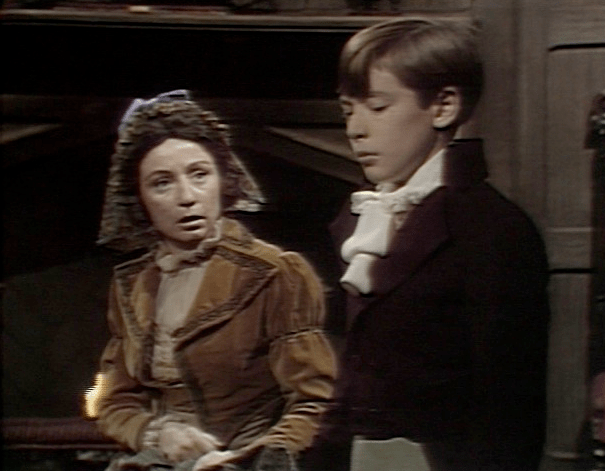
When Sarah keeps asking to see Vicki, Barnabas promises to bring her. Naomi is surprised to learn that Barnabas knows where Vicki is, and is not at all sure Trask isn’t right about her. But when she sees her daughter with Vicki, she is sure that she is innocent.
Vicki was the audience’s main point-of-view character throughout 1966 and well into 1967. Major story developments took place after Vicki found out what was going on. Vicki was the chief protagonist in the most important story of that period, the crisis represented by undead fire witch Laura Murdoch Collins. Vicki took charge of the household, organized a group to fight Laura, and rescued strange and troubled boy David from the flames when Laura tried to burn him alive. That intelligent, forceful character has been fading ever further into memory in recent months, and we haven’t seen a trace of her in the 1795 storyline. Sarah is happy to see Vicki and says she likes the stories she tells, but she is a passive witness to today’s events. She serves chiefly as a prop, used to demonstrate that the human Barnabas, whatever his faults, is capable of heroic action.
Barnabas’ compassion for Sarah and his valiant defense of Vicki do not negate his vices. As the heir to Collinwood, Barnabas can express his self-regard both by gratifying his urge to treat some women badly and by earning admiration for treating other women well. In her low station, the same trait leads Angelique directly to the “Dark Triad” of Narcissism, Manipulativeness, and Psychopathy. As a vampire, Barnabas will exhibit the same three qualities in abundance, but for now, we still have license to hope for better from him.
As it was so much fun to watch Barnabas trying to pass as a modern man that we wanted to like him even after he had been terribly cruel to Maggie, a character we like very much, it was so much fun to watch Angelique twist Trask around her finger that we wanted to like her. Besides, her desire to remake Barnabas as her lover is understandable for those who have been watching the show and wanting him to be something other than a heartless murder machine. So, perhaps we will wind up liking Angelique after all.
Angelique has bewitched indentured servant Ben Stokes (Thayer David) and forced him to act as her assistant. Ben is devoted to Barnabas and miserable that he has been the instrument of so much evil done to him, but has been powerless to resist Angelique’s commands. When he realizes that Angelique is causing Sarah to sicken and perhaps die, he goes to her room and demands that she stop. He threatens to kill her if she does not relent. In response, Angelique causes him to have a heart attack. She lets his heart start pumping again when he promises to be quiet.
This is the second heart attack a character of David’s has had on screen. The first also prevented a servant in this same house from killing a young woman. That came in #126, when crazed handyman Matthew Morgan had been holding Vicki prisoner here and was about to decapitate her. The ghost of Josette led several other supernatural presences who scared Matthew to death before he could complete his fell purpose. Matthew and Ben are both devoted to the Collinses, and both are led astray so that they become parties to terrible crimes. As the benevolent spirit of Josette put a stop to Matthew’s crimes, so the malign Angelique prevents Ben from putting a stop to her own.
Barnabas drops by Angelique’s room to ask if she has seen Sarah’s doll, which she calls Samantha. He tells her that Sarah is very ill and has asked for the doll. It occurs to Angelique that she has some leverage over Barnabas. She says that she can brew a special kind of tea that might cure Sarah’s symptoms. He asks her to do so. She makes him promise to marry her if she does.
Several times, we have seen that Angelique is flying by the seat of her pants. She had no idea of using Sarah’s illness to gain a hold over Barnabas until he chanced to come into her room. Nor is she thinking ahead- as it stands, the witch-hunters have fastened on Vicki as their suspect, and are not thinking of her. If word gets out that she had the power to cure Sarah’s mysterious ailment and exercised it only after extorting Barnabas’ promise of marriage, that would seem to be proof positive that she is a witch.
In her own bedroom, Sarah sips the tea. At the same moment, Angelique, in the servants’ quarters, pulls the pins from the doll. How exactly Angelique got the timing just right isn’t exactly clear, but she must have had a way- she is perfectly confident when she tells the doll that it has served her well.
*Mrs Lentz now, but it’s strange to say “Mrs” when you’re talking about a ten year old.
**I know people don’t really say “problematic” anymore, but it seems to be the right word here.
Gracious lady Josette DuPrés left her home on the island of Martinique to marry her fiancé, young gentleman Barnabas Collins. She is Mrs Collins now, but not Mrs Barnabas Collins.Her aunt’s maid, Angelique, is a wicked witch who wants Barnabas for herself. To that end, she cast one spell to cause Josette to conceive a mad passion for Barnabas’ uncle and dearest friend, Jeremiah Collins, and another to cause Jeremiah to reciprocate her feelings. On what was supposed to be the night of Josette’s wedding to Barnabas, she ran off with Jeremiah. The two of them married. When they returned to the estate of Collinwood, Barnabas challenged Jeremiah to a duel. Remorseful, Jeremiah let Barnabas shoot him. Now, he is hovering at the point of death.
We open with Angelique in Barnabas’ room, massaging his forehead. She wants him to say that he hates Josette. He says “I hate her!,” but can’t bring himself to say “I hate Josette.” He kisses Angelique and agrees to visit her room in the servants’ quarters later.
The results of Angelique’s magical activities have not gone unnoticed. Some members of the household believe there is a witch at work among them, and have called a professional witch-hunter named the Rev’d Trask to conduct an investigation. No one suspects Angelique- Trask and his supporters have fastened on recently arrived governess Victoria Winters. Vicki is in hiding, and Barnabas and his friend, caddish naval officer Nathan Forbes, have been helping her.
Downstairs in the manor house, Trask is questioning Josette. When he raises the possibility that she may have been the victim of demonic influence and therefore not responsible for her recent actions and their tragic consequences, she is intrigued. But she cannot take the escape he offers. She insists that she is responsible for her actions. Even so, she allows Trask to begin an exorcism.
Barnabas interrupts the ceremony. He makes no secret of his contempt for Trask. When Trask tells him that Josette has been under the control of forces alien to herself, Barnabas demands Josette tell him what she did that she did not want to do. She will not say anything to suggest disloyalty to Jeremiah. “He is my husband, and he is dying. That is all that matters.” When Barnabas asks if she loves him, she says yes. He asks if she married him because she loved him, again she says yes. She says she wishes things had been different; he asks what she could wish different, if she has married the man she loves. She cannot answer.
Barnabas is back in his room, looking depressed. Angelique enters and asks why he didn’t come to her. He says that it can’t work between them. He still loves Josette, in spite of everything. She asks what Josette told him to make him feel that way. He says that all she said was that she is married to Jeremiah and loves him.
Angelique is devoted to manipulating people, and cannot believe Josette did not somehow trick Barnabas into loving her. But we can see that Barnabas is responding to Josette’s attempt to do her duty to Jeremiah. He does not believe in magic, and is convinced that Josette and Jeremiah willfully betrayed him. But he knows virtue when he sees it, and in Josette’s attempt to be a good wife to the dying Jeremiah he recognizes the trustworthy partner with whom he had expected to share his life.
Barnabas asks Angelique if it is still possible for them to be friends. She notices a doll on a shelf, a favorite plaything of Barnabas’ ten-year old sister Sarah. She takes the doll, saying she will return it to Sarah.
Back in her room, Angelique talks to herself. She says that she will punish Barnabas for spurning her. This time, she will not cast a spell on Josette. Instead, she will use her powers to make Sarah suffer. Barnabas will watch Sarah suffer, Angelique proclaims, and that will be the hardest experience of his life.
Angelique is a fun character, and up to now the roots of her behavior in her unrequited love for Barnabas have made it possible for us to sympathize with her. But we’ve known Sarah since she first showed up as a ghost in #255, back in June. She is adorable, and the doll Angelique is planning to use against her was something she used in lifesaving good deeds back in the summer. There is nothing sympathetic about a threat to hurt her. With her final scene today, Angelique crosses into very dark territory.
In 1966 and the early weeks of 1967, the Collinsport Inn was an important place on Dark Shadows. The restaurant there, presided over by Maggie Evans (Kathryn Leigh Scott,) The Nicest Girl in Town, was a place where people could meet each other unexpectedly and characters new to town could be introduced. Dashing action hero Burke Devlin (Mitch Ryan) lived in a suite at the inn, and the place often represented his territory, the base from which he conducted his war against the ancient and esteemed Collins family.
We haven’t seen Burke’s room since #206, at which point he had given up his vendetta against the Collinses and proceeded far down the road to irrelevance. We haven’t seen the restaurant since vampire Barnabas Collins (Jonathan Frid) met Maggie there in #221. By the time Anthony George took over the part of Burke in #262, Burke seemed to live in the Blue Whale tavern. He made business calls from the pay phone there, and in one episode apparently stayed behind when the bartender locked the place up for the night.
The inn makes a return appearance at the top of today’s episode. It is 1795, and Jeremiah Collins (Anthony George) is sharing a suite with Josette DuPrés (Kathryn Leigh Scott.) They are on their honeymoon.
Jeremiah and Josette eloped from the estate of Collinwood on the night when Josette was supposed to marry Jeremiah’s nephew, kindly gentleman Barnabas Collins (Jonathan Frid.) Josette truly loved Barnabas and Jeremiah was his dearest friend, but they were under a spell cast by wicked witch Angelique, who wanted Josette out of the way so she could have Barnabas for herself. The power of the spell waxes and wanes. When Josette and Jeremiah are in the grip of it, a trident shaped mark appears on their hands; when they return to their senses, the mark disappears.
When the episode begins, the tridents are showing, and the newlyweds are inflamed with passion. Shortly after, Josette’s mark is gone, Jeremiah’s still showing. She is filled with regret, he is still ardent.
Back in the manor house of Collinwood, Barnabas has a conversation with Josette’s father André and his own father Joshua. He resists André’s suggestion that Josette and Jeremiah must have left together, and resists even more strenuously Joshua’s declaration that they did so because they are the victims of witchcraft. Joshua says that his sister Abigail and André’s sister, the Countess DuPrés, found a blasphemous trinket in the quarters of governess Victoria Winters, and that a witch-hunting divine, the Reverend Trask, is coming to investigate the matter. Barnabas is appalled at the notion of an inquiry into witchcraft, and vows to defend Victoria if Trask comes. Joshua forbids him to do so.
Barnabas’ reaction to the idea of a witchcraft trial, coupled with what we have seen of him so far in the 1795 segment, looks like a retcon. In #358, only a week and a half before we began this uncertain and frightening journey to the past, vampire Barnabas told a story about studying witchcraft under a warlock on Barbados who taught him “the secret magic number of the universe.” Events are moving so fast that it doesn’t look like Barnabas will have time to sail to the Caribbean before he becomes a vampire, and he won’t be crossing any waters after that. But now he is a man of the Enlightenment, who scoffs at the idea of witchcraft today as he scoffed at the tarot when the countess introduced him to it in #368/369.
Jeremiah returns to the house. There is an exquisite little scene with a servant, Riggs, who is uncomfortable at the sight of the disgraced Mr Jeremiah. Riggs stands in for the establishment of Collinwood and the whole working class of the town of Collinsport, and in his reaction we see the disquiet that bad news from the big house on the hill would spread among the people whose livelihoods are at stake when trouble comes to the family there. Riggs makes haste when Jeremiah tells him to go out and fetch Joshua.
When Riggs is gone, Josette enters. The audience sees that the mark is gone from Jeremiah’s hand, and Josette can tell that his passion for her is gone. She tells him that he no more loves her than she loves him. He begins with a protest against this remark, but ends by saying that they must be kind to each other.
Joshua and André enter. André embraces his daughter and tells her everything will be all right; Joshua looks at his brother with distaste and demands an explanation.
Jeremiah says that he and Josette are married. He further says he realizes they are not welcome, and that they will return to the inn. This raises the prospect of a recreation of the early days, with the inn as a territory separate from and opposed to Collinwood. Joshua rejects the idea at once. He will not have the scandal of Jeremiah and his new wife living in town because they have been estranged from the rest of the Collinses. He decrees that they will live at Collinwood and put on a happy face for the townsfolk.
Barnabas enters. Joshua tells him that Jeremiah and Josette are married. He refuses to believe it until Josette confirms it herself. He takes the glove from Jeremiah’s hand and slaps him in the face. He gives him a choice of weapons.
Dueling may have been as alien to the ideals of the Enlightenment as were Barbadian warlocks, but so too is Joshua’s plan of forcing the whole family to commit itself to a massive lie in order to preserve its hereditary privileges. Joshua, the proud apostle of Jeffersonian republicanism, is simply being a hypocrite, but Barnabas is a more complicated figure. Seeing his every hope turned to dust before him, his ideals have become useless. He has only a moment to choose among the evils the Enlightenment had promised to stamp out, and he chooses the most macho one available.
Joshua forbids the duel, but Barnabas disregards his father’s authority and insists on it. In 1795 and for some time after, dueling was widely practiced in much of the United States, and particularly in the South and West a gentleman lost face if he refused a challenge. No such stigma attached in New England, where dueling was condemned by law and religion. Had Joshua or Jeremiah gone to the police, Barnabas would have been arrested. In 1719, Massachusetts, of which Maine was a part until 1821, passed a law making it an offense punishable by a fine of £100 (equivalent to about $7000 today) to challenge someone to a duel. Massachusetts law already considered it murder to kill someone in a duel, and prescribed death by hanging as punishment. Of course, Joshua’s declaration that Jeremiah and Josette will live in the house and the family will present a “united front” to deter scandal makes it clear he will never turn his son over to the police, and the pattern of cover-up with the support of law enforcement we saw among the Collinses in 1966 and 1967 leads us to doubt that anything a member of the family does will ever be a matter for the courts to judge.
There is a missed opportunity in the show’s lack of interest in Massachusetts’ actual laws about dueling. The 1719 law was amended to be even stricter in 1730. Among the provisions added to the law at that time was a requirement that anyone who had either been killed in a duel or been put to death for winning a duel would “be given an unchristian burial at a gallows or crossroads, with a stake driven through their body.” Since the audience knows that Barnabas is fated to become a vampire, there is a chilling irony in seeing him volunteer for a staked burial.