Rich young gentleman Barnabas Collins is having trouble breathing, and the doctor thinks he may die at any moment. The source of Barnabas’ ailment is a spell cast on him by wicked witch Angelique. Angelique panics when she hears that Barnabas may die, and spends almost the whole episode figuring out how to undo the spell.
Angelique scrambles desperately to correct her error before it is too late. Screenshot by Dark Shadows Before I Die.
We only learned on Friday that Angelique was a witch. Her trouble today makes us wonder how long she’s been at it. For all we know this might be the first spell she has ever cast, and that’s why she bungled it so badly. That in turn leads us to wonder how big a part of her character witchcraft will turn out to be. If she hasn’t been involved with it for very long, maybe she’ll swear off black magic soon and become a different sort of person. We do expect that she will have something to do with whatever it is that is about to turn Barnabas into a vampire, but maybe that will be an accident of some kind, or maybe she will be on the side of good, trying to stop it, by the time that ultimate disaster happens.
In 1966 and 1967, supernatural menaces Laura Murdoch Collins and Barnabas Collins would often be seen staring out the windows of their houses on the great estate of Collinwood, sending psychic energy towards the targets of their sinister plans. In 1795, Barnabas is neither supernatural nor menacing, but we already see him peering out one of those windows. He is not projecting bad vibes into the world, but is worried about his beloved fiancée, Josette DuPrés. She is supposed to arrive soon, in fact was supposed to arrive some time ago. Now there is a storm, and he hopes she is not at sea.
The audience’s main point-of-view character in 1966 and for most of 1967 was well-meaning governess Vicki. Now Vicki has come unstuck in time, and found herself in this extended flashback to the eighteenth century. Since she will know Barnabas and regard him as a close friend in the 1960s, she is at her ease talking to him now. Although she is a member of the staff in his family’s house in a period when it was customary for masters to summon their servants with bells and communicate with them only in direct commands, Barnabas is a remarkably genial and democratic sort who welcomes her casual manner.
Vicki has already annoyed the audience several times by blurting out information that makes it obvious to the other characters that she does not belong in their world. She does that again in this scene. Barnabas is worried something may have happened to Josette, and Vicki tells him that she will arrive safely. He is surprised by the assurance with which she delivers this prediction, and asks if she is clairvoyant. She realizes that she has been indiscreet, and denies that she is. He is unconvinced.
Barnabas’ father, haughty overlord Joshua Collins, enters. He is appalled to find his son socializing with a servant. He dispatches Vicki to the nursery to look after her charge, his young daughter Sarah. He demands to know why Barnabas is not tending to his own duties at the family’s shipyard. They begin to quarrel, when a knock comes at the door.
Barnabas opens the door to find a woman named Angelique, whom he identifies as maid to Josette’s aunt, the Countess DuPrés. Angelique says that the countess was on her way to Collinwood, but that her carriage is stuck in the mud. Joshua orders Barnabas to send a footman to rescue her. Angelique is the first character we have met in 1795 who is not played by a performer we have seen in the first 73 weeks of the show.
Joshua goes to his wife, Naomi. Naomi is an alcoholic, a fact of which we are made aware because almost her every scene begins with a shot of her drinking alone. That’s what she is doing before Joshua finds her. He scolds her for her drinking; she complains that he doesn’t allow her to do anything else. She can’t even pass the time with a book- we saw Monday that Naomi is completely illiterate.
Naomi’s alcoholism is both a nod to the concern of first-wave feminism with the atrophy of the elite housewife, and a suggestive side-light on Barnabas as we knew him in the 1967 segment. Then, Barnabas abducted Maggie Evans, The Nicest Girl in Town, and tried by more or less magical means to replace her personality with that of Josette. For the first 40 weeks of Dark Shadows, Maggie’s father’s alcoholism had been a substantial story element, and she would always retain a number of classic Adult Child of an Alcoholic (ACoA, in the lingo of the recovery movement) characteristics, such as beginning utterances with a little laugh to prove that she is happy. Now that we know that Barnabas is also an ACoA, we can wonder if that shared experience was part of the reason he was drawn to Maggie.
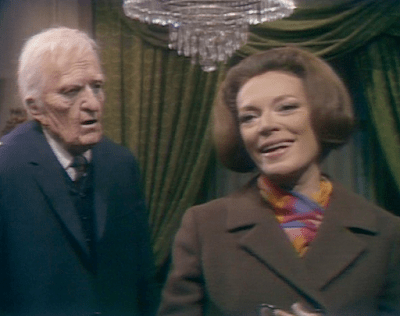
The countess arrives. Since she is played by Grayson Hall, who also plays mad scientist Julia Hoffman in the parts of the show set in the 1960s, Vicki blurts out “Julia!” when she sees her. Hall had also been nominated for an Academy Award for her performance as Judith Fellowes in the 1964 film Night of the Iguana; if Vicki is going to keep the audience up to date on the cast’s resumes, it would have been more interesting if she’d exclaimed “Judith!” Vicki explains that the countess looks like someone she once knew who was named Julia, a remark which irritates the countess, who would like to think her appearance is distinctive. Vicki has certainly not made a favorable impression on this grand lady.
Joshua tells the countess he is surprised that “You still affect a title” when “France has followed our example and become a republic.” His pride in this development, after the Terror and in the bloodiest year of the wars in the Vendée, marks Joshua as a member of the Jeffersonian party in US politics. The Federalists and others had long since turned against the French Revolution by that year.
The countess tells Joshua that it is precisely because France has become a republic that she chooses to live on the island of Martinique. That answers a question that some fans ask about Angelique- why is she white? If the DuPrés family lives on Martinique and are major sugar planters there, they must hold a great many African people in slavery. When we hear that they are bringing a servant with them, we expect that servant to be Black. When we learn that the the countess is an emigré, we realize that she brought Angelique with her from France.
The countess may solve one puzzle for us in her exchange with Joshua, but she presents us with another. Josette’s father André is the countess’ brother, yet he is never referred to as a count. Indeed, when he appears, we will see him answer to “Mr DuPrés.” Perhaps he renounced his title, as many French aristocrats did during the Revolution.
Whatever the explanation, “DuPrés” would seem to represent a missed opportunity. When Josette was first mentioned, in the early months of Dark Shadows, her maiden name was given as “LaFrenière.” It would have been a nice touch to have kept that name for Josette and her father, and to have reserved “DuPrés” as the name of the countess’ late husband.
“LaFrenière” had been a perfect choice because of its class ambiguity for a show about an aristocratic family in the state of Maine- it was originally the family name of the barons of Fresnes, and could therefore be a sign of a senior order of nobility, but is also a very widespread name in Quebec. So “Josette LaFrenière” might either have been a French noblewoman who deigned to marry into the mercantile Collins family at the apex of their prestige, or a working class girl from the north who eloped with the boss’ son.
The choice of Martinique as Josette’s place of origin might add a new twist to this class ambiguity. The Empress Josephine grew up there as a member of the untitled but ancient Tascher family, who, like the fictional DuPrés family, owned an enormous sugar plantation on the island. The Taschers of Martinique went back and forth between Martinique and metropolitan France, and Josephine herself was living there in 1779 when she married her first husband, the Vicomte de Beauharnais. Josephine herself was in prison when the vicomte was guillotined in 1794, one of the last to die in the Reign of Terror, and she was freed just a few days later. The next year, she recovered her husband’s property, and a year after that married the young general Napoleon Bonaparte. It seems likely that the similarity between the names “Josephine” and “Josette” was writer Sam Hall’s inspiration for placing Josette’s origins on Martinique. Association with a figure who was at once a grand lady and an example of very steep upward social mobility could synthesize the two possible Josettes LaFrenière into a single figure.
Had they developed the story of the family’s relationship with the town of Collinsport more richly in Dark Shadows 1.0 and 2.0, they could have used this ambiguity to build up suspense that would be resolved today, in the third episode of Dark Shadows 3.0. Since they did so little with that theme in those days, when the story was moving very slowly and it would have been relatively easy to fit just about anything in, I suppose we shouldn’t be surprised that they drop it so completely at this period of the show, when the story is flowing at a breakneck speed.
The countess’ lofty aristocratic manner stings Joshua. Alone with Naomi, he loudly proclaims his belief that all men are equal. We already know enough about Joshua’s tyranny over his household that this absurd little speech must be an intentional spoof of the rich landowners who supported the Jeffersonian party in the early decades of the Republic. Again, this would be funnier and more poignant if the show had done more with social class in its first 73 weeks.
Barnabas sees the countess dealing out tarot cards. He tells her she is too sophisticated for them, and is reluctant to sit with her while she uses them to read his fortune. The moment she says that the cards suggest a connection between him and the concept of infinity, his skepticism evaporates instantly and he excitedly asks if that means he will live forever. The countess cautions that his jubilation at this idea may be misplaced. She notices the “Wicked Woman” card, and takes a significant look at Vicki. Evidently the audience is not alone in objecting to Vicki’s brainless nattering about what the show used to be like.*
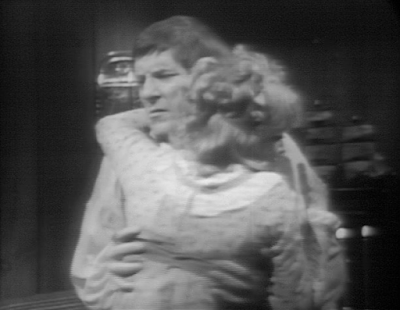
Angelique comes to Barnabas’ room. It turns out the two of them had a brief affair when he was first on Martinique, and she expects to resume it. He is not at all pleased at her attentions.
Not how every man would react to a passionate embrace from Lara Parker… Screenshot by Dark Shadows Before I Die.
Barnabas explains that he was already falling in love with Josette when he and Angelique had their fling, but that he didn’t really know her. He couldn’t believe that she would reciprocate his feelings, and consoled himself by dallying with Angelique. This explanation goes over with her about as well as you’d expect, and she storms out of the room, vowing that she will get her way in the end.
We know that the tarot cards are giving accurate information, because the show leans heavily on the uncanny and they wouldn’t have spent so much time on a gimmick that wasn’t meant to advance the plot. We also know that Vicki is not the Wicked Woman the countess is looking for. That leaves Angelique, and we can assume that her wickedness will express itself in some supernatural action taken to avenge herself on Barnabas. Since we know that Barnabas will become a vampire, we wonder if it is Angelique who makes him one.
Closing Miscellany
I usually refer to surviving cast members with courtesy titles and to deceased ones by surname alone. So Alexandra Moltke Isles is “Mrs Isles,” which has been her professional name for 56 years, David Henesy is “Mr Henesy,” Nancy Barrett is “Miss Barrett,” etc, while Jonathan Frid, Joan Bennett, Louis Edmonds, and Grayson Hall are just “Frid,” “Bennett,” “Edmonds,” and “Hall.” Until last month, I’d been looking forward to saying lots of things about “Miss Parker” and her portrayal of Angelique, but Lara Parker died on 12 October 2023. So she’s just going to be “Parker,” and I’m going to be sad about it.
Artist Teri S. Wood has created a number of short animations about Angelique and Barnabas. This one is based on their two-scene at the end of today’s episode:
Patrick McCray has a post about this episode that mystifies me. He writes that “After seven months of hearing about Angelique, today, she enters. So, no pressure Lara. You only have to live up to a half year of build-up.” Uh, what? There has been absolutely no reference to Angelique on the show before today. I can think of an interpretation of the story that might retroject Angelique into episodes #211-365, and I will talk about it next week. But I don’t think it is an interpretation Patrick would favor.
He also talks about David Ball’s method of reading plays from the ending back to the beginning and then from the beginning forward, so that the ending comes to seem implicit in everything else. He allows that Dark Shadows has more than one ending, but I would say he doesn’t go far enough. I’d say the series has ten endings. The first came in #191, when Laura went up in smoke while her son David found refuge in Vicki’s arms. That ending defined Dark Shadows 1.0 as the story of David’s escape from his evil, undead mother Laura, and his adoption of Vicki as his new, life-affirming mother. The second came in #364, when Barnabas met the ghost of his little sister Sarah, she commanded him to be nice to the living, and he went right on with his murderous plans. That ending defined Dark Shadows 2.0 as the story of Barnabas’ irredeemable evil.
Two of the other endings will feature Angelique dying in Barnabas’ arms, and Patrick suggests that those make the whole show the story of their relationship. I don’t buy it at all. Each of the ten parts is about what it is about, and even those two episodes with Angelique dying derive more dramatic charge from other moments.
*Making connections with the first 73 weeks is my job!
Vampire Barnabas Collins has been part of Dark Shadows at least since we first saw his portrait on the wall of the great house of Collinwood in #204, more properly since they went to great lengths to make it look like there was a portrait on that spot in #195. He is now the main force driving the action of the show, and pretty much the only reason people are tuning in to watch it. The ghost of Barnabas’ ten year old sister, Sarah, first appeared in #255; ever since, we’ve been waiting for the two of them to meet. At the end of yesterday’s installment, they finally did.
Barnabas was in his living room, trying to choke the life out of his only friend and would-be lover, mad scientist Julia Hoffman. Sarah materialized, and he let Julia go.
This echoes a scene in #341. Barnabas and Julia were in the act of murdering her medical school classmate and onetime friend, Dave Woodard, when Woodard claimed to see Sarah. At that, Barnabas almost let Woodard escape. Only when Julia called out “Stop him!” did Barnabas take hold of Woodard and kill him. Not only is he murdering a good-guy character, he has coerced Julia into taking part in the crime and will gloat over her new status as a murderer. But in the middle of all that loathsome cruelty, we see a flash of his longing for his baby sister. It is a tribute to actor Jonathan Frid that we can feel Barnabas’ loneliness and want to like him even in the middle of one of the character’s very darkest moments.
This time, Sarah really is there, and she really does stop a murder. There is a puzzle as to why. In #360 and #361, Julia knew that Barnabas wanted to destroy her, and appealed to Sarah for help. Sarah refused, saying that she liked Dr Woodard and knew what Julia did to him. We heard Sarah’s “London Bridge” theme on the soundtrack during the murder of Woodard, so it is clear that she witnessed that crime. But if she can stop Barnabas killing Julia, why couldn’t she stop him killing Woodard?
Today is only the second time Sarah has appeared to more than one person at a time. When Barnabas’ ex-victim Maggie Evans, The Nicest Girl in Town, wanted to escape from the hospital where Julia was keeping her locked up in #294, both she and her nurse could see and hear Sarah. Maybe it is difficult for Sarah to manifest herself to two people, and impossible for her to show herself to three. In that case, Julia’s presence would have stopped Sarah from saving Woodard.
It’s also possible that Sarah can’t do anything that will lead to Barnabas’ capture. She has appeared to many people and given all of them clues about the strange goings-on, but she has referred directly to Barnabas only when speaking to his partners in crime Willie and Julia. Time and again she has stopped short of giving information that would expose her big brother. When Barnabas and Julia moved against Woodard, he was calling the sheriff. Woodard might have placed himself beyond Sarah’s protection when he picked up the telephone.
Indeed, if Barnabas does kill Julia now, he will probably be caught. Julia has given a notebook full of incriminating evidence about Barnabas to a local attorney to be handed over to the authorities in case anything happens to her. Besides, everyone knows she spends a great deal of time at Barnabas’ house, so if she suddenly goes missing he will be investigated. By preventing Barnabas from killing Julia, Sarah is protecting him from exposure.
Sarah tells Barnabas that he taught her the first lessons she ever received in morality, and that he has now forgotten them himself. He begs her to stay, showing at length the vulnerability and need that have been so effective at recruiting our sympathy when we have glimpsed them before. She says she will never appear to him again, not until he learns to be good. We’ve known him long enough to know that this will be an extremely long wait.
Sarah vanishes. Julia sees her friend shattered. She approaches him. She addresses him, for the first time, as “Barnabas, Barnabas.” He recoils from her. He does not renew his attempt to strangle her, but he does tell her in the coldest imaginable voice that he could kill her as easily as he could crush a moth. It hasn’t been two minutes since his little sister reduced him to tears, and he has snapped back into his place as death itself.
Some say that Barnabas’ frequent references to his longing for Sarah during these weeks are meant to make him easier for the audience to sympathize with. I think this scene shows that the opposite is more nearly the case. They’ve undercut every other ground for liking Barnabas, leaving us only his love for Sarah. When we see that not even a visit from Sarah can thaw him out for any length of time, not only do we have to give up any hope that there is a nice guy hidden inside him, but we also hear the door slamming shut on any possibility that his character will develop in a way that will surprise us. Since he is the show, the closing of that door means that Dark Shadows 2.0 is all but over.
In the great house, matriarch Liz breaks the news to well-meaning governess Vicki learns that the authorities in Brazil have identified one of the corpses found in the wreckage of an airplane that crashed outside Belem as that of Vicki’s depressing fiancé, Burke Devlin. It has been clear for some time that Burke probably died in that crash, so Liz is worried that Vicki’s refusal to accept their verdict is a sign that she is in an unhealthy denial about the facts of the situation.
In the first 25 weeks of Dark Shadows, Burke was a major figure, the arch-nemesis of the Collins family. His storyline never really took off, though, and when undead fire witch Laura Murdoch Collins was on the show from #126-191 his issues were all absorbed into her arc. He formally renounced his grudge against the Collinses in #201, and has been surplus to requirements ever since.
There is just one thing I wish they had done differently about Burke’s death. During the early period of the show, there was a story about high-born ne’er-do-well Roger Collins trying desperately to hide a custom-made filigreed fountain pen of Burke’s. That dragged on for months, and dominated 21 whole episodes. It would have been a nice Easter egg for those of us who sat through those not-very-interesting installments if Liz had said the authorities were able to identify Burke’s body in part because that pen was on it.
There is a bit of intentional comedy this time that works very well. Telling Barnabas of Vicki’s refusal to accept Burke’s death, Liz exclaims “She can’t go on loving a dead man all her life!” Barnabas is clearly offended by this remark, quite understandably since he is deceased himself. He responds that “It has been known to happen.” But he manages to keep cool enough that Liz doesn’t notice.
This episode marks the last appearance of Sharon Smyth as the ghost of Sarah Collins.
Episode 1-274 of Dark Shadows each began with the words “My name is Victoria Winters,” delivered in voiceover by Alexandra Moltke Isles and leading into a few sentences vaguely related to the plot of the show. Beginning with #275, these voiceovers might be delivered by any actress with a speaking parts in that episode, and do not involve their character’s names. Many are written in the first person, however, as is today’s:
There has been a homecoming in the great house of Collinwood, and those who have returned have found that very little has changed. We still live within a ring of fear, a fear that is generated by the one who lives in the Old House, where on this night a kind of madness prevails, a madness that will lead to the threat of murder.
Every time this happens, the Dark Shadows wiki complains that “by this time in the series, the narrations are no longer spoken in character.” That complaint might have made sense if only a few of the episodes since #275 included first person pronouns, but dozens of them do. So we would have to say that they often are spoken in character, but that it isn’t always clear who the character is. The wiki editors will be glad from now on, because this is the last time a narrator says “we.”
Yesterday, mad scientist Julia Hoffman saw and heard many distressing things. It was unclear which, if any, of these were caused by a spell cast on Julia by her sometime associate, vampire Barnabas Collins, and which, if any, were the result of some other force.
At the opening of today’s episode, we find evidence that Barnabas might indeed be behind Julia’s troubles. We begin with a reprise of a moment from yesterday when Julia answered her telephone and heard the voice of Dave Woodard, a medical school classmate of hers whom she and Barnabas murdered a few weeks ago. Woodard tells Julia that she will die soon. Rather than leave it at that, he rambles at such length about the possible scheduling of her death that he is still on the phone after the opening title. Watching the episode, we laughed out loud when he said “Perhaps it will happen tomorrow. Or the next day. Or the day after that.” Julia hangs up before the voice can start speculating that maybe the weekend would be a good time, or it might be something to save for Thanksgiving. Barnabas is so long-winded that it’s easy to imagine him thinking out loud about his plans in the middle of a threatening phone call and getting so caught up in it that his victim loses interest.
Further evidence comes shortly after, when Barnabas comes to Julia’s door. He is continuing the act he put on when last they saw each other, pretending to regret his previous harshness towards her and lamenting their currently frosty relationship. She is unconvinced. She demands he stop causing her to suffer. In a quivering voice, she tells him she is not afraid of him. He feigns ignorance of her situation, and says that he wishes she could trust him as he has learned to trust her. He leaves.
Frightened as Julia is and self-satisfied as Barnabas is in this scene, it nonetheless makes him seem less formidable. He is not simply trying to scare her, but to reduce her to total, permanent insanity. If he makes it as obvious as this that everything that is happening to her has a single, identifiable cause, she can focus all her fear on that cause and deal with the rest of the world calmly and rationally.
Barnabas then makes himself look even less intimidating. He meets with his distant cousin and blood thrall, Carolyn Collins Stoddard. Carolyn tells him that she has managed to get the combination to the safe in lawyer Tony Peterson’s office. Julia had entrusted her notebook full of incriminating information to Tony and had him put it in the safe when she realized Barnabas had turned against her.
Regular viewers know that Barnabas can materialize inside closed rooms. When Barnabas was first on the show, they had done something with the idea that vampires can enter only places they have been invited, but that went by the boards when Barnabas broke into Woodard’s office in #242. Moreover, Tony doesn’t know anything about Barnabas, and Barnabas isn’t doing anything else tonight. Nonetheless, he tells Carolyn that she must get into Tony’s office and steal the notebook herself.
To comply with Barnabas’ command, Carolyn has to ask Tony on a dinner date, invite herself up to his apartment, steal his office keys from his coat while he is in the kitchen mixing her a drink, and excuse herself as soon as he comes back with the drinks. She does promise to be back in a matter of minutes, but it means that she would be an obvious suspect if the notebook went missing. And it sets up an utterly predictable ending, in which Tony catches her in the act of opening the safe.
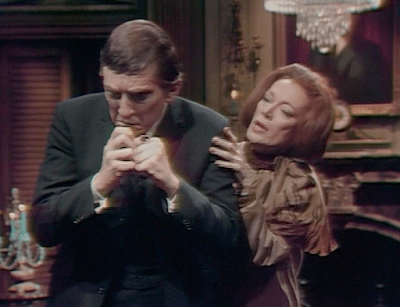
Barnabas’ visit to Julia may have undercut his plan to drive her mad, but at least it illustrates a weakness the character has always had- his tendency to admire his own evil handiwork and a resulting inability to leave his victims to suffer in isolation. That weakness in turn reflects the deep loneliness that makes it possible for us to feel some sympathy for Barnabas even when we are afraid of him or angry at him. But sending Carolyn to do a job that would under the best possible scenario bring deep suspicion on her when he could do it himself without any danger of detection is a pure example of Idiot Plot, characters behaving in a way that has nothing to do with any thought that might be in their heads solely to make life easy for the writers.
Idiot Plot is bad enough when minor characters are the Designated Dum-Dums. To use Barnabas in that role is unforgivable. By now, the audience consists chiefly of people who first tuned in out of curiosity to see how they could fit a vampire into a daytime soap, and who became hooked when they saw that Barnabas was sinister enough to drive the action but lonesome enough to enlist at least some of our goodwill. If he turns into a bumbling fool, Dark Shadows has nowhere to go.
Barnabas can’t very well avoid becoming a bumbling fool by succeeding in his effort to destroy Julia. He became so much more interesting once he had her to talk to, conspire with, and struggle against that if she leaves the show they will have to invent another character to replace her and hope that they catch lightning in a bottle again. I remember watching these episodes on the Sci-Fi Channel, as it then was called, in the 1990s, and being stumped as to where they were heading. Up to that point it had always been easy to think up a long list of possible directions things might go, but once Julia started worrying about her notebook the story was busy eating itself alive. There didn’t seem to be anything at all waiting around the next corner.
Barnabas Collins is a vampire, but he rarely bites anyone. He spends most of his time pursuing an acting career. His role is that of Living Man Born in the Twentieth Century, and his audience is almost everyone he meets.
Jonathan Frid often has trouble with Barnabas’ lines, but usually he manages to make it seem that it is Barnabas, not he, who is scrambling to keep his performance on track. His posture and facial expression project whatever emotion Barnabas is supposed to be feeling, and the words rarely get in the way.
As my wife, Mrs Acilius, pointed out, there is a moment today when he simply falls out of character. Barnabas is telling his distant cousin and blood thrall, Carolyn, that he is going to cast a spell that will bring madness upon his co-conspirator turned bête-noire, mad scientist Julia Hoffman. Barnabas has been acquiring new powers lately, and this is the first time we hear that he knows how to cast spells. Apparently this case of power creep was too much for Frid. While telling Carolyn about the “secret magic number of the universe,” he drifts from Barnabas’ voice into his own, looks down, then breaks off and stares mutely, not at Carolyn, but at Nancy Barrett struggling valiantly to keep a straight face. He then has to stand up and do a little dance while wearing a green dressing gown. The ridiculousness of it, for once, overwhelms him.
Things have been happening fast on Dark Shadows for the last several days, and writer Ron Sproat was always aware of the need to let new viewers catch up. This is the first chance Sproat has had to write a Friday episode in some time, and since some people would watch daytime soaps only on Fridays, he goes in today for some extra heavy recapping about doings at the estate of Collinwood.
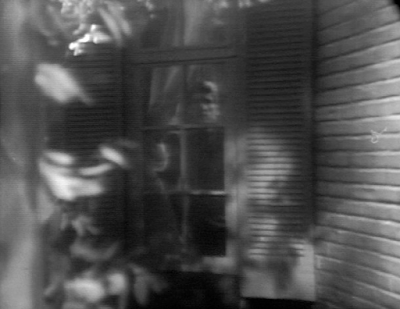
As a result, the first half of the episode is confusing to viewers who have been watching regularly. In recent days, the ghost of ten year old Sarah Collins gave a toy soldier to strange and troubled boy David to keep with him as a talisman against evil; David had a premonition that his cousin, heiress Carolyn, was in danger, and passed the toy soldier on to her; Carolyn saw Sarah, and gave the toy soldier back to David; and as we begin today, David brings the toy soldier back to Carolyn. David catches a glimpse of an extremely old man peering in through the window of the drawing room; he is gone by the time Carolyn turns to look. They talk about ghosts and visions, reenacting in one scene Carolyn’s whole progression from total rejection of David’s claims about the supernatural to total openness to them, and David’s from a desperate need to be believed to an even more desperate fear that Carolyn will be killed unless he can convince her he was lying about everything.
Carolyn tells her mother Liz that she doesn’t think David is lying, and decides to confront Liz’ aversion to the topic of ghosts and tell her that she has seen Sarah. Liz says she thinks David is mentally disturbed and must be sent away to an institution; eavesdropping, David reacts with horror. He meets Carolyn in the foyer afterward. He asks her if she thinks he is crazy. When she says she doesn’t, he says that maybe he is. He pleads with her to reject his stories as either delusions or lies.
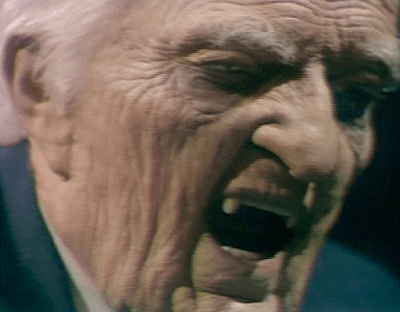
The old man David saw looking at Carolyn is their distant cousin Barnabas, who is, unknown to them and the other residents of the great house on the estate, a vampire. Mad scientist Julia Hoffman has been trying to cure Barnabas of vampirism, but she inadvertently restarted the aging process which his condition had arrested. No longer does he look like a man in his forties- now he appears to be about ninety. He fears that if he does not start sucking people’s blood again tonight, he will soon turn into the pile of dust he would have been long ago were it not for his curse.
In Barnabas’ home at the Old House on the estate, we see him talking with Julia. His peeping at Carolyn might suggest that he has her in mind as his victim, but he does not mention her. Instead, he says he will go out into the town of Collinsport and find a stranger. Julia is disappointed that Barnabas is not planning to bite well-meaning governess Vicki, with whom she had hoped never to have another conversation. So she offers herself as a victim instead.
This offer stuns Barnabas so deeply that, for the first time, he addresses Julia by her first name. She smiles when he does this. He seems sincerely dismayed by the thought of enslaving Julia. When he tells her that if he bites her, she will have no will of her own, she smiles even more brightly. Evidently Julia believes that would be a price well worth paying if it kept Vicki from talking to her.
Julia contemplates enslavement. Screenshot by Dark Shadows Before I Die.
Barnabas declines the offer, saying that he might need to call on Julia for medical treatment at some point in the future and that as a blood thrall she wouldn’t be able to function as a doctor. Julia is hurt by Barnabas’ refusal, and asks him if the only reason he won’t enslave her is that he wants to use her professional services, and he assures her that it is.
Back in the great house, Carolyn stands in the foyer under the gaze of Barnabas’ portrait. She looks at the toy soldier and wonders about David. She decides to go to Barnabas’ house and look for evidence of the things David had claimed to see there. Oddly, she sets the toy soldier on the table and leaves without it.
Carolyn lets herself into Barnabas’ house, goes to his basement, and finds his coffin. Julia sees her there and tells her to leave immediately, “before it’s too late.” We hear Barnabas’ voice announcing “It is already too late.” Carolyn is baffled by Barnabas’ aged appearance. He moves in, bares his fangs, and bites her.
Barnabas’ old man makeup is phenomenally good, as all the Dark Shadows blogs mention. The show was very lucky to land Dick Smith, one of the pre-eminent makeup artists of all time, to do it. But I would add that Jonathan Frid’s acting takes Smith’s appliances and turns them to the best possible advantage. It is utterly absorbing to watch him as a man suddenly thrust into extreme old age, trying to figure out how to move his newly enfeebled limbs. In Frid and Smith, two artists at the top of their form collaborated to create a remarkable turn.
In the great house of Collinwood, well-meaning governess Vicki is worried about her depressing fiancé Burke, who is missing and feared dead after a plane crash in Brazil. Permanent houseguest Julia Hoffman enters and shows her a piece of crystal. Julia says that she thinks the crystal might have been part of a chandelier that hung in the foyer of the long-abandoned west wing of the house. Vicki plans to restore the west wing and hopes to live there with Burke, so this is of interest to her.
Julia tells Vicki to peer into the center of the crystal. As she complies, Julia stares directly into the camera and continues to give instructions. The Federal Communications Commission was very nervous about hypnosis in the 1960s, so much so that even indirect references to the process would draw memos from the television networks’ Standards and Practices offices warning producers that they must not put anything on the air that could hypnotize the audience. Apparently ABC’s Standards and Practices office wasn’t vigilant enough about the daytime dramas, because after a while we hear the tinkling sound Julia tells us we will hear and instead of the picture we see a kaleidoscope effect. By the time we come out of the trance, Julia and Vicki are in the basement of the Old House on the estate.
The Old House is home to Old World gentleman Barnabas Collins. Vicki sees a coffin in the basement, and Julia orders her to open it. After a long display of reluctance, she does. She finds Barnabas inside, apparently dead. Julia shows her the crystal again. Once more the screen shows the kaleidoscope pattern, and next thing we know Julia and Vicki are returning to the drawing room of the great house.
There, Vicki is about to say that she wants to show the crystal to her dear friend Barnabas, only to find that she has an unaccountable difficulty bringing herself to say Barnabas’ name. Later, Barnabas comes to the house and asks Vicki to watch the sunrise with him. He is diffident about the invitation, and she is uncomfortable with him. Actor Jonathan Frid may have had some difficulty with Barnabas’ lines at this point, but if so, his stumbles dovetail so well with Barnabas’ own display of shyness that they don’t hurt the scene.
Vicki overcomes her discomfort and agrees to meet Barnabas at dawn. He is about to shake her hand when she notices that there is something wrong with his hand. He looks at it and is shocked. He says something about having injured it this morning. She pleads with him to stay and let her put something on his hand, but he rushes out.
Unknown to Vicki, Barnabas is a vampire and Julia is a mad scientist trying to turn him back into a human. The night before, Julia had given him an accelerated treatment that initially caused numbness in his hand, but that later gave him such a sense of well-being that he thought he would be free of his curse by the time the sun came up. After leaving Vicki, he returns to Julia’s laboratory in the basement of his house and shows her his hand, which has aged enormously.
Also unknown to Vicki, Barnabas has designs on her and sees Burke’s absence as a sign that he should move quickly to win her affections. That’s why he ignored Julia’s objections and insisted on the accelerated treatment. In the last few episodes, the show has put heavy emphasis on Julia’s wish to start a romance of her own with Barnabas and his scornful response to this wish; perhaps she took Vicki to Barnabas’ coffin to keep her from becoming a rival for his affections. Or perhaps her motives were altruistic- even if Barnabas weren’t a vampire, there would still be plenty of reasons why a woman would be well-advised to steer clear of him.
Vampire Barnabas Collins is in a chirpy mood. He and his associate, mad scientist Julia Hoffman, have just committed the premeditated murder of Julia’s medical school classmate Dave Woodard. As we saw when Barnabas made his sorely bedraggled blood thrall Willie to help him hide the corpse of seagoing con man Jason McGuire, nothing makes him happier than forcing someone to help with the killing of a former friend.
I think the actors were placed behind the laboratory apparatus intentionally, to highlight the characters’ helplessness and isolation.
Today, Julia wants to stop her attempt to cure Barnabas of vampirism, but he won’t hear of it. When she tells him she might try to kill him instead of curing him, Barnabas relishes telling her that he trusts her completely. She does knock him out of his blissful state when she suggests that if she manages to turn him into a real boy, he might have a conscience. He gives a little speech in which he says some brave things about being willing to accept the punishment fitting a man who had done the things he has done if he also gains the ability to love as a man can love. Jonathan Frid puts enough into this speech that it is possible to sympathize with Barnabas in the moment that he is delivering it.
That moment doesn’t last very long. By the end of the episode, we are back on this set, where Julia says that “someone” might love Barnabas as he is, and he takes delight in her humiliation as he makes it obvious that he knows she is referring to herself.
Some say that Barnabas’ speech about wanting to love is meant to make the character more likable, but it has the opposite effect when he so smoothly transitions back into this gleeful cruelty. The other day, Julia told Barnabas that she had wondered whether he was capable of feeling any emotions at all, but we see in this scene what we’ve seen all along, that he is nothing but emotion. Except when he is acting, trying to convince the living members of the Collins family that he is their long-lost cousin from England, his feelings are right on the surface. For a minute or two, he has some feelings about love and justice, and we see those very clearly. But that is a brief interlude in the middle of his entirely gratuitous torture of Julia. We are left in no doubt that he takes an utterly unmixed pleasure in causing her pain. We’ve already seen very cold villains on Dark Shadows and before the series ends we will see more, but by the end of this scene Barnabas claims the crown of most detestable character ever to appear on the show. It’s so hard to imagine how he could possibly sustain such a level of malignity that it’s no wonder viewers still keep tuning in to see what he will do next.
The main theme of the episode is the contrast between Barnabas’ relationship with Julia and his relationship with well-meaning governess Vicki. For the first 39 weeks of Dark Shadows, Vicki was the audience’s main point-of-view character; now Julia is the one who knows what we know, and who makes things happen when she learns new information. Seeing Barnabas first with one woman, then with the other, we see how the show has been changing since he joined the cast.
Barnabas eavesdrops on Vicki’s conversation with her depressing fiancé Burke on the terrace at the great house of Collinwood, then slides in and claims to have inadvertently overheard the last few words of their conversation. Burke gives Barnabas a dirty look, then excuses himself to do some telephoning while Vicki and Barnabas stay on the terrace and talk for a little while.
Barnabas has some vague idea of seducing Vicki, an idea he has been remarkably desultory about pursuing. In this scene, he does the only thing he has ever really got round to doing about it, which is to listen sympathetically while Vicki tells him her troubles. This time, she’s trying to convince herself that she wants what Burke wants, which is to get away from Collinwood and start a new life somewhere else. It isn’t an exciting situation, but Alexandra Moltke Isles delivers her lines with so much urgency that it holds our attention.
Vicki shares her anguish with her kindly friend Barnabas
Julia eavesdrops on this conversation. She looks miserable. Whatever she may have had in mind when she first came to Collinwood, Julia is stuck with Barnabas for the foreseeable future. Not only has Julia murdered one of her oldest friends for Barnabas’ sake, she has involved herself so deeply in so many of his activities that it is unclear how she would go back to the successful professional life she had before she met him even if he were destroyed. If he is going to spend his time hanging around other women, she faces a drab prospect.
Julia contemplates a lonely future
In the drawing room, Burke, Vicki, and Julia talk about the death of Dr Woodard. Julia can’t bear the topic, and excuses herself to go out to the terrace. There, she catches a glimpse of Woodard’s ghost. Julia screams, Burke and Vicki come, and all she can do when they ask what’s wrong is to keep jabbering that “he wasn’t there.”
There are some rough patches in the script today. For example, in the opening, Julia is touching the equipment when Barnabas exclaims “Don’t stop!” This is puzzling- she doesn’t appear to be stopping anything. And when Julia says “He wasn’t there,” Vicki has to ask “Who wasn’t there?” A person might reflexively say such a thing, and Mrs Isles’ rapid delivery of the line and simultaneous movement of the neck and the shoulders suggest such a reflex. That’s probably the best choice any actor could have made, but the line still gets a bad laugh. Barnabas and Julia’s successive eavesdropping expeditions also come off as some kind of joke, and all the scenes take too long. The whole thing could have used another trip through the typewriter. Still, writer Joe Caldwell was at his best with miniature character studies, and while he may not have had the time he needed to give this one his usual polish, the actors still have more than enough to show what they can do. It’s a fairly good outing, all things considered.
A few days after Dark Shadows began, we learned that high-born ne’er-do-well Roger Collins had squandered his entire inheritance. He and his son, strange and troubled boy David, then moved into Roger’s childhood home, the great house of Collinwood. The house belongs to Roger’s sister Liz. Roger lives there as her guest, and draws a salary from her business as an employee.
Time and again, Liz tells Roger that he must behave himself; time and again, she shields him from the consequences of his actions. Liz may want to believe that she is a model of adult authority, but in fact their relationship is one of Bossy Big Sister and Bratty Little Brother.
Liz extends that enabling behavior to the rest of the family. In episode #10, David overheard Roger in the drawing room, telling Liz that he wanted to send him away to school. Liz refused, because she saw that as Roger’s attempt to resign his responsibilities as a father. For his part, David reacted by tampering with the brakes on Roger’s car so that they would fail when he was driving down a steep hill and kill him. His murder plan failed. When Liz discovered it in #32 she lied to the sheriff in order to keep the whole thing quiet, and a few days later she ordered the family’s handyman to take the blame for the crash.
David had no big sister. Liz’ daughter Carolyn would later become a surrogate sister to him, but through the first months of the show she took no interest at all in her cousin. David spent his time with his well-meaning governess, Vicki. David was certainly bratty towards Vicki, trying to frame her for his attempt on Roger’s life in #27, and making an attempt on hers in #84. But while Vicki was glad to be sisterly towards David, she did not fall into the same pattern with him that traps Liz and Roger. She listened to him patiently, and enforced rules firmly. In response, David not only stopped committing crimes against Vicki, but when his mother, undead fire witch Laura Murdoch Collins, tried to claim him, he chose life with Vicki over death with her. Episode #191, the last installment of Dark Shadows 1.0, ends with David in Vicki’s arms, his new mother consoling him for the loss of his original mother.
Roger and Liz are minor characters in Dark Shadows 2.0, and Vicki is fast fading into the background as well. But #332 and #333 take us back to the first weeks. Yesterday, David again overheard his father in the drawing room saying he wanted to send him away to “a special school” where psychotherapy can cure him of his weird ideas. But Vicki’s influence has realigned David from evil to good, so that instead of trying to kill his father, he tries to collect evidence that his ideas are not a product of mental illness. In that effort, he went to the Old House on the estate and came upon the coffin in which his cousin Barnabas Collins, a vampire, rests during the day. Barnabas found him there and was closing in on him when mad scientist Julia Hoffman came into the house.
“Are you afraid of me?”
Julia and Barnabas are at the center of the show now, and they reproduce Liz and Roger’s Bossy Big Sister/ Bratty Little Brother dynamic. When Barnabas announces that someone or other “must die!,” Julia talks him out of doing anything to bring that death about. Sometimes she threatens to expose him, sometimes she promises to cure him of vampirism, sometimes she wears him down with lists of the practical difficulties of the murders he would like to commit.
But Julia also conceals and destroys evidence of Barnabas’ crimes. She induces grave amnesia in his victim Maggie Evans, and lets his sorely bedraggled blood thrall Willie Loomis take the blame for abducting Maggie. In fact, she very nearly killed Willie when it looked like he might not go down quietly. She may have rescued David today, but she protects Barnabas all the time, and it seems to be just a matter of time before she becomes an active participant in a murder for his sake.
Back in the great house, local man Burke Devlin is conferring with Dave Woodard, MD. Burke says that he is worried about David’s “fantasies,” to which Woodard replies “If they are fantasies.” Woodard is coming to believe that Barnabas is an uncanny being responsible for Maggie’s abduction and the other troubles the town of Collinsport has seen recently, and he takes everything David says very seriously. When David comes home and announces that he found the coffin, that Barnabas tried to kill him, and that Barnabas is a dead thing that can move around at night, Woodard listens intently.
Julia comes in, as does Roger. Julia dismisses all of David’s assertions. She claims to have seen Barnabas’ basement, and to know that there is no coffin there. David looks at Julia, and asks in an oddly calm voice “Why are you lying?” Roger is appalled at this question, but Woodard studies David carefully as he asks it and studies Julia’s reaction just as closely afterward.
“Why are you lying?”
In #331, Woodard gave David a sleeping pill and asked him questions about the strange goings-on. Robert Gerringer and David Henesy played that scene marvelously. Gerringer showed Woodard’s struggle, as a man of science, to come to terms with a set of facts that made logical sense only in a world where supernatural forces are at work, while Mr Henesy showed David’s desperation to find a responsible adult who will listen to what he knows. Gerringer also showed Woodard’s tender affection for David, tugging the covers of his bed over him when he fell asleep. As Woodard watches David today, we see the same intellectual crisis and the same tenderness that he played then.
Roger demands David apologize to Julia. He will not. Woodard says they ought to go look at Barnabas’ basement and see if there really is a coffin there. Roger is horrified by the implied insult to his cousin, and forbids any such thing. Burke points out that Roger is in no position to forbid it, and accompanies Woodard to the Old House.
There, Barnabas presents himself as shocked that Burke and Woodard want to search his basement. Woodard is polite about the whole thing, but Burke is an utter swine, declaring that they won’t leave until Barnabas submits to their demand. This is not the first time returning viewers have seen Burke impose himself as an unwanted house-guest, and it doesn’t get more attractive the more we see it. When Barnabas orders them to leave, Burke says they will come back “with a search warrant!” Even under the law codes of soap opera land, this would seem to be an empty threat- neither of them is a police officer, and while it may be eccentric to keep a vacant coffin in your basement I can’t think of a reason to suppose it would be a crime. Watching this scene, my wife, Mrs Acilius, said that Burke is so obnoxious that he makes us root for Barnabas despite everything we know.
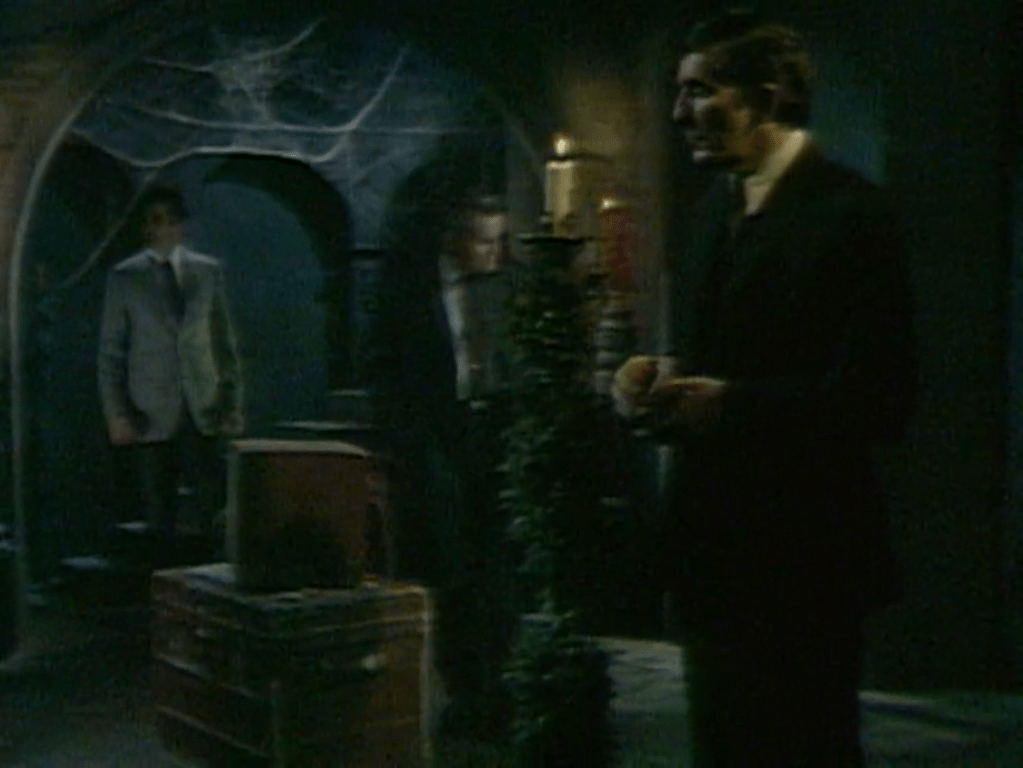
Burke and Woodard start to go, and Barnabas relents. He takes them to the basement. The coffin is usually in the main area at the foot of the stairs, but when the three of them get there some crates and a trunk are stacked up on that spot.
No coffin.
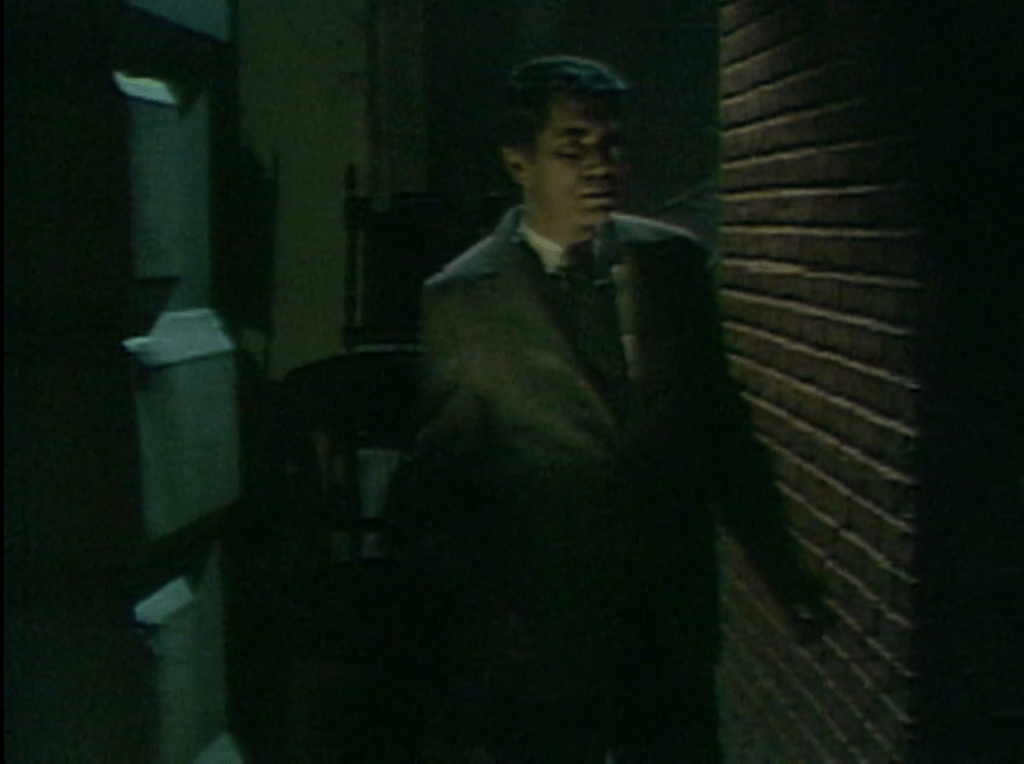
Burke goes down a little corridor and sees nothing there, either.
Burke in the corridor.
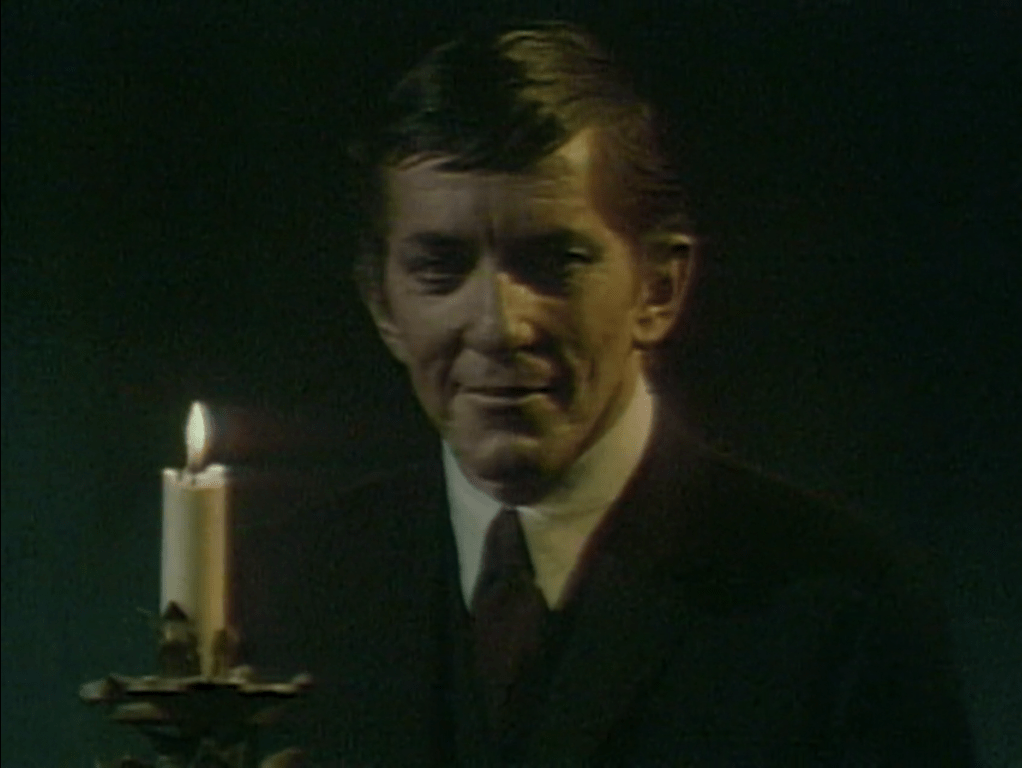
Burke and Woodard are embarrassed, and Barnabas grins. We know that he had moved the coffin so that when someone came to check out David’s story they would see nothing, and that his resistance to Burke and Woodard’s requests to search was put on for effect. Barnabas spends most of his time with other people pretending to be a living man born in the twentieth century; his grin is that of an actor who finds he has given a particularly convincing performance.
Receiving his ovation.
We had seen corridors in the basement when Barnabas was holding Maggie prisoner there. We saw them most prominently in the episode that ended with her escape, #260. In that one, they looked very extensive. He had kept Maggie in a prison cell at the end of one of those corridors. That cell had been there since Barnabas’ time as a living being in a previous century, but none of the many people who had visited the basement before Barnabas moved in, including Burke in #118, had seen the cell. So there must be quite a bit of space down there that only Barnabas knows about, but he has chosen to put his most embarrassing possession in the one place no one coming to the basement could fail to notice. It’s like the old days, when you’d go to visit a single guy at home and find that he had left sexually explicit magazines or videos on his coffee table.
Strange and troubled boy David Collins stands outside the drawing room at the great house of Collinwood and overhears his father, Roger, talking with permanent house-guest Julia Hoffman. Roger and Julia are discussing David’s fear of his cousin, old world gentleman Barnabas Collins, and his belief that Barnabas is hiding something terrible in the basement of his home in the Old House on the estate. Roger takes it for granted that Barnabas is above reproach, and has therefore concluded that David is suffering from some sort of mental disorder. Julia encourages Roger in this conclusion, and urges him to send David away to boarding school. Roger is amenable to this idea, but tells Julia that his sister, matriarch Liz, will never allow it.
The last time David overheard his father in the drawing room saying he wanted to send him away to school, he attempted to murder him. But that was in episode #10, almost fifteen months ago. Since then, David has been through a lot, and has decided he wants to align himself with good against evil. So he doesn’t try to kill Roger this time. Instead, he steals a set of keys to Barnabas’ house that Liz keeps in her study and sets off to gather evidence with which he can prove himself right.
Returning viewers will recall that David’s friend, the ghost of ten year old Sarah, has repeatedly warned him not to go near the Old House, and especially to stay away from the basement. David remembers her words, but makes his way into Barnabas’ basement regardless. There, he sees an open coffin. While David is looking the other way, Barnabas comes up behind the lid and slams it shut. David turns, and Barnabas glares at him. Since Barnabas is a vampire who has spent quite a bit of time thinking of killing David, this would seem to leave the boy in something of a pickle.
There are three firsts in this episode, all relating to voice acting. This is the first time Alexandra Moltke Isles appears in an episode but does not read the opening voiceover. Sharon Smyth appears only through the pre-recorded voice of Sarah; her name does appear in the closing credits, the first time a performer is credited for something other than an on-camera appearance. And the closing titles end with Grayson Hall saying “Dark Shadows is a Dan Curtis Production,” the first time someone other than an ABC staff announcer* has delivered that line.
*Usually Bob Lloyd, though someone else filled in for Lloyd in #156 and #167.










 Dark Shadows Commentary