Episode 242: One of the best men in the field

Maggie Evans, The Nicest Girl in Town, suffered from an ailment her doctor, Dave Woodard M. D., could not identify. She then vanished from her hospital room in a manner law enforcement, led by Sheriff George Patterson, could not explain. The opening voiceover says that Maggie’s troubles “mystify the finest minds.” This is the first and last time either Woodard or Patterson is classed with “the finest minds” even among the low-functioning characters who abound in the period when Dark Shadows is being written by Ron Sproat and Malcolm Marmorstein. Well-meaning governess Vicki is still the single smartest character on the show, and she turns into an absolute moron every two or three days.

In the opening teaser, dashing action hero Burke Devlin asks Dr Woodard if his studies of Maggie’s blood samples will help find her. He says that they won’t, but that if he can diagnose her he might be able to help her after she is found. Burke asks if he is about to make a diagnosis. He says that he might be making progress towards that goal. At that point, there is a dramatic musical sting, and we cut to the credits. That’s the hook, a statement that further study is needed.

Dr Woodard tells Burke that he has contacted “Hoffman, one of the best men in the field,” and that he hopes Hoffman will be able to get things moving. Under Burke’s questioning, he admits that he is pessimistic that Hoffman will see anything he has missed. This is the first mention of the name “Hoffman” on Dark Shadows. I believe it is only the second mention* of any surname that is not derived from Irish (as are such names as Collins, Devlin, Malloy, and McGuire,) English (as are names such as Woodard, Patterson, Loomis, Johnson, Stockbridge, and Garner,) Welsh (as are names such as Evans and Morgan,) Scottish (as are the names Adair and Murdoch,) or French (as are the names La Freniere, Bilodeau, and du Près.)** It is certainly the first name we have heard that suggests there might be Jewish people in the universe of Dark Shadows.

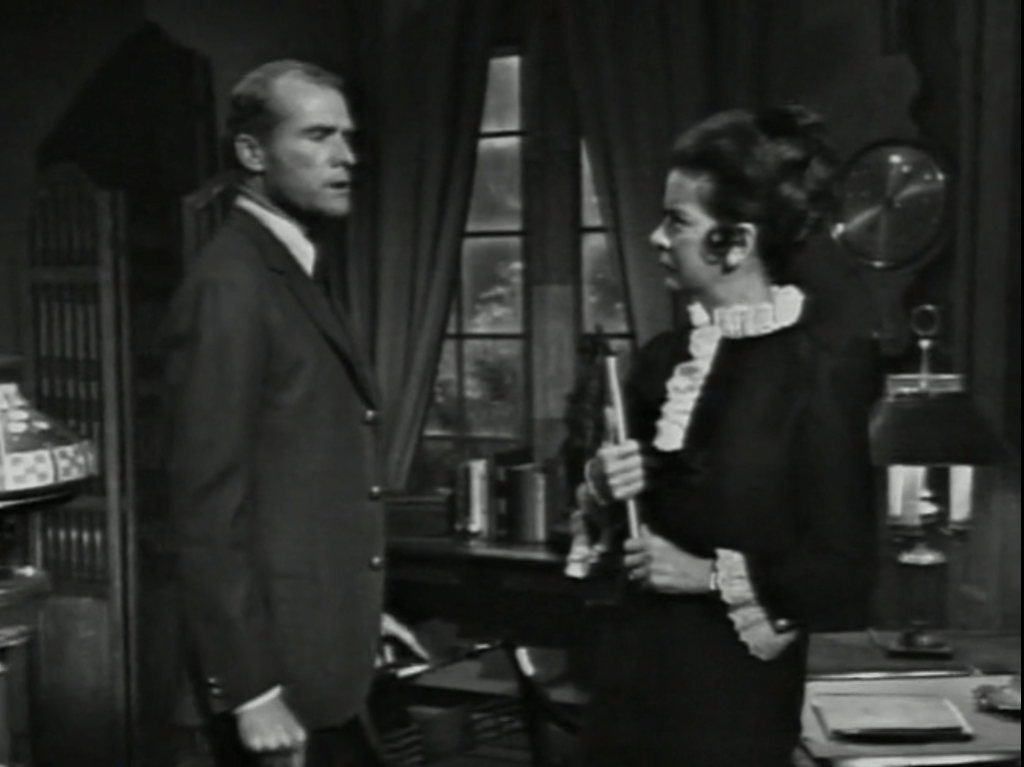
We then cut to the study in great house of Collinwood, where high-born ne’er-do-well Roger Collins has to confront his sister, reclusive matriarch Liz. The auditors have told Roger that the books are out of balance at the family business. Roger knows that the reason for this is that Liz is giving money to buy the silence of seagoing con man Jason McGuire. He reminds Liz that he himself was afraid of blackmail for the first 40 weeks of the show, so he knows from personal experience that it is no way to live. Liz refuses Roger’s plea that she tell him her secret. As he probes and she resists, they move around the room at times like fencers, at times like dancers performing a paso doble. Their movements are easily the most interesting element of the episode, a credit to director John Sedwick.
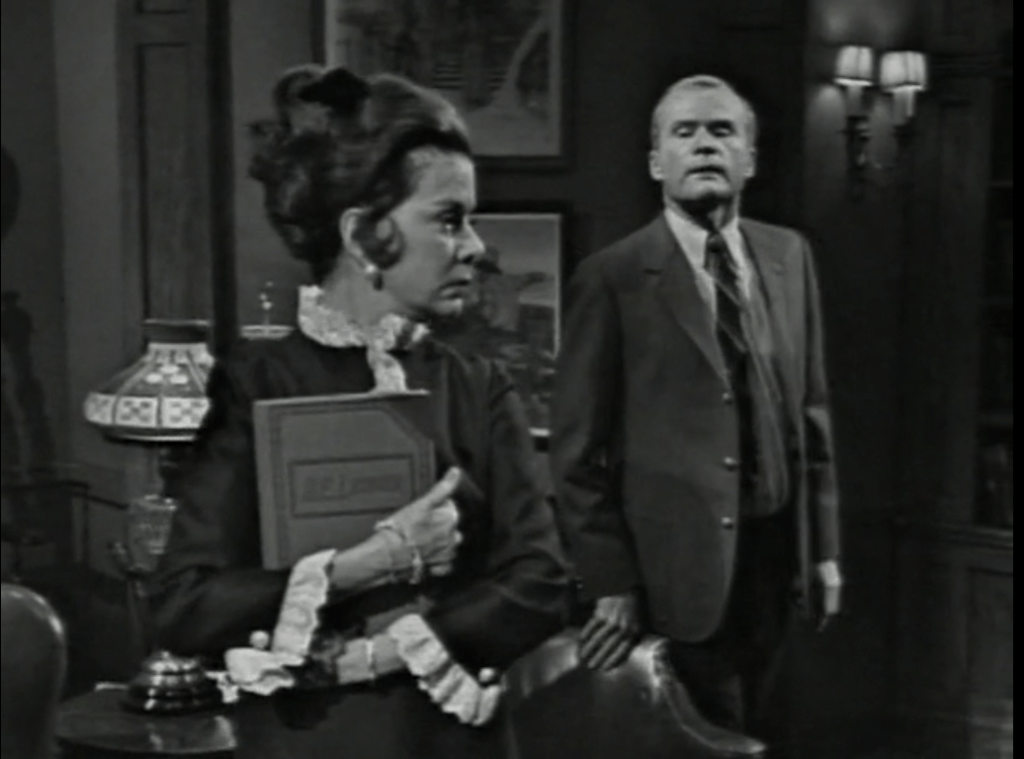
Roger’s first approach to the shielded Liz
Liz parries Roger’s thrust
Roger’s second approach

Roger admits that he hasn’t been much help to Liz over the years, but begs her to let him help her now. Liz won’t tell him anything, but she is touched to see her bratty brother sincerely trying to step up.

Liz goes to the drawing room. The camera is behind her as she approaches the room. Jason is standing at the fireplace under the large portrait, the spot furthest from the camera. Not only does he look as small as possible, but at the moment we first see him he is turned away from us, his head tilted far back as he takes a drink. Jason’s smallness and obscurity, coming so soon after Roger’s speech about the dreariness of blackmail, feels like an acknowledgment that Jason doesn’t have much to offer the audience.***

Coming upon Jason

Liz tells Jason she can’t give him any more money without blowing the secret they share. He amazes her by accepting this information calmly, but she is sure he is not done tormenting her.

Liz returns to the study, where Roger is still sitting. She tells him that she has talked to the auditor and straightened out the books. That sounds like something that would take quite a while, even if you are sitting across from each other, and Liz and the auditor had to do it over the telephone. So how long has Roger been sitting there?

Then we rejoin Burke and Woodard in the doctor’s office, which someone has ransacked. The perpetrator wrenched the metal bars out of the window and stole Maggie’s blood samples. Dr Woodard says that the only way the bars could have been twisted was by someone with the “supernatural strength of madness.” I’m not an expert in mental health, but that does not sound like a conventional psychiatric opinion to me.

*After Lieutenant Costa of the Arizona State Police, whom we saw when Dark Shadows took us to Phoenix in #174.

**It is pretty weird that a show set in Maine has so few French-surnamed characters. We’ve only heard of one working-class Mainer with a French name, Amos Bilodeau. La Freniere was given in #45 as the maiden name of Josette, a grand lady who came from France to marry into the Collins family in a previous century; eventually, Josette’s birth name will be retconned to du Près.

***My wife, Mrs Acilius, was the one who really noticed the visual strategy both in Liz and Roger’s first scene in the study and in Liz’ entry into the drawing room.

Episode 198: Only up to a point

In the drawing room of the great house of Collinwood, seagoing con man Jason McGuire has his third conversation with reclusive matriarch Liz. It is identical in form and content to their first two conversations. He makes a demand, she resists, he threatens to expose her one and only secret, and she gives in.

Liz’ brother, high-born ne’er-do-well Roger, is also being blackmailed. His blackmailer is drunken artist Sam Evans. Unlike Jason, Sam is someone we know and have reason to like. And unlike Jason and Liz, Sam and Roger do not repeat the same conversation every time we see them.

Moreover, Jason is acting against the interests of the audience, while Sam is trying to achieve something we might like. Jason is working to isolate Liz and to drain her funds. Those goals reduce the range of stories the show can tell, limiting a major character’s interactions with the rest of the cast and cutting back on the power of the family at the center of the series from making things happen in town. Sam wants to get hold of some old paintings of his, which will give him a chance at making a big splash in New York. If Sam succeeds, future episodes will be set at least partly in the midtown Manhattan art world. That would be a radical departure from the show we’ve been watching, but a radical departure of some kind is inevitable if Dark Shadows is to keep going at all. Dark Shadows 1.0 finished its liveliest stories when blonde fire witch Laura Murdoch Collins vanished two weeks ago, and if Dark Shadows 2.0 is going to hold our attention it is going to have to come up with something very fresh.

Ten years ago, Roger paid Sam $15,000 and received from him ten paintings. These paintings have suddenly become fashionable, and a prominent art dealer has come to Sam asking about them. The real reason Roger gave Sam the money was nothing to do with the paintings, but to bribe him. The paintings changed hands only to cover the bribe.

Sam had seen a fatal hit and run accident, and knew that Roger, not dashing action hero Burke Devlin, was the driver. Burke went to prison for the crime, and has been trying ever since to prove that Roger was responsible. Now Sam threatens to go to Burke unless Roger produces the paintings. Roger has been searching Collinwood for the paintings, but he cannot find them.

The highlights of the episode are two scenes between Sam and his daughter Maggie. In the first, we see Sam drinking and talking to himself while Maggie is in the room getting ready to go to work. Maggie knows that her father has a great opportunity and that the man who has the paintings is keeping him from realizing it. She doesn’t know who that man is. She keeps asking questions, and he keeps getting upset. He shouts “Are you going to work or aren’t you!?” Then he apologizes and tells her he didn’t mean to raise his voice. She says bitterly that she should be used to it by now. He tells her that what he’s doing, he’s doing for her, that if he succeeds she will get everything she has coming to her. She isn’t impressed, and doesn’t have much to say.

As Maggie, Kathryn Leigh Scott does a fine job of showing an Adult Child of an Alcoholic trying to distinguish between the challenges the outside world is presenting to her father and those he has brought on himself. She’s looking for a way to simultaneously be Sam’s ally against the man who is keeping the paintings from him and to stand firm as an opponent of his drinking. Above all, she is trying not to let her pity for him harden into contempt. As Sam, David Ford is alternately so self-absorbed he apparently forgets Maggie is in the room, so angry he doesn’t care what he says to her, and so hopelessly dependent on her that he all but transforms into a baby. When he is looking up at Maggie and telling her all he hopes to do for her, Sam looks for all the world like a toddler trying to keep his mommy from being angry with him. It’s a heartbreaking finish.

Sam telling Maggie his hopes. Screenshot by Dark Shadows Before I Die

Their second scene is even more powerful. Maggie comes home from work to find a groggy Sam slumped in a low chair. Once he has come back to life, Sam tells her that the man was in the house while she was at work, and that he can’t find the paintings. He lets slip that the man lives in Collinwood. Maggie realizes that it must be Roger. Sam tries to deny it, but since Roger is the only man who lives there he is stuck. He can hardly claim that well-meaning governess Vicki, a 20 year old woman, was a man ten years ago, or that she paid $15,000 for ten paintings to put on display in her cubicle at the Hammond Foundling Home. He briefly claims that “Collinwood” was a slip of the tongue, but can’t keep that lie up.

Sam finally admits that Roger is the man. Maggie asks why Roger bought the paintings. Sam asks if she really wants to hear him say it. When she says she does, he starts to speak, but falls abruptly silent in the middle of a sentence. While he looks down in shame, she blurts out that he took the money as a bribe to keep silent about Roger’s crime and to consign Burke to prison. She has suspected this for some time, but is devastated to say the words and see her father’s face.

Of all the questions the two blackmail plots might prompt the show to answer, how Maggie and Sam’s relationship will change as the result of the disclosure of his secrets is the most interesting. So it should be no surprise these two scenes are among the strongest we’ve seen in months.

Closing miscellany:

At one point in the episode, we see Jason talking on the telephone to someone named “Willie.” This marks the first time we hear this name on Dark Shadows.

During a conversation with Roger, Jason sits at the piano and pokes at a few keys. This is the first time since flighty heiress Carolyn tried her hand at “Chopsticks” in #119 that a member of the cast makes use of the instrument.

Roger and Liz have a scene in the basement of Collinwood. Roger’s fear of blackmail leads him to hope that he might find Sam’s paintings in a locked room there, while Liz’ fear of blackmail leads her to forbid that anyone ever go into that room. When Roger asks Liz what is in there, she refers to her long-absent husband, Paul Stoddard: “They are… ah… old things of Paul’s. Yes, that’s it! I put his things in there.” This is so obviously a lie she is making up on the spot that we laughed out loud. Joan Bennett must have meant to elicit this reaction.

Episode 197: Our most prominent loose ends

The two most senior members of the ancient and esteemed Collins family, reclusive matriarch Liz and her brother, high-born ne’er-do-well Roger, are both being blackmailed. At rise, Liz and her blackmailer, seagoing con man Jason McGuire, are having another version of the same conversation that took up most of yesterday, in which he makes demands, she resists, he threatens to expose her secret, and she gives in. Jason is a new character, connected to no one but Liz, and this is all we’ve seen him do. The actor is appealing, but not enough to make us want to see that scene a third time. When Liz and Jason summarize their relationship by telling each other “We’re stuck with it,” they give voice to a sinking feeling in the pit of the audience’s stomach.

Roger’s blackmailer is someone we know and care about. He is drunken artist Sam Evans. Sam took money from Roger years ago in exchange for keeping silent about evidence that Roger was responsible for a fatal hit-and-run, and to make the transaction look legitimate gave Roger some of his paintings. Now a powerful New York art dealer has told Sam that she can make him rich and famous if she shows those paintings in her gallery, and Sam is desperate to get them back. He threatens to take his information to dashing action hero Burke Devlin, who went to prison over the incident, unless Roger produces the paintings.

Roger spends today’s episode trying to find the paintings. His search takes him to the basement. There, he shines a flashlight directly into the camera.

Roger enters the basement with a halo

Shortly after, Jason comes to the basement, and Roger catches him fiddling with the lock on a room Liz insists no one ever enter. Roger shines his flashlight in Jason’s eyes. When Jason complains about that, we again see Roger shining the flashlight directly into the camera. We’ve seen actors shine flashlights into the camera so many times that it must be in some way intentional, but this is the first time there is dialogue to give the show an intelligible reason to do it.

Roger shining the light into Jason’s eyes, from Jason’s point of view

Jason won’t tell Roger what he is doing, but does say that he saw Liz’ husband, the never-seen Paul Stoddard, in that basement the night he disappeared. He then throws around some hints that there may have something untoward about Stoddard’s disappearance and that Liz may be hiding something about it. Later, he mentions to Liz that Roger doesn’t seem to know anything about the situation, suggesting that the hints were his attempt to test Roger.

Roger meets with Sam at the Blue Whale, the working-class bar where Sam spends his time (and, presumably, his daughter’s paychecks.) Roger can see that Sam is serious about his threat to go to Burke if the paintings do not materialize. Roger tells him that there is only one place he hasn’t searched. At the end of the episode, we see Roger back in the basement, trying to open the locked door.

These two blackmail stories have the potential to clear out all of the unresolved questions left over from Dark Shadows 1.0. Why is Liz a recluse, what happened the night Stoddard disappeared, what’s with the locked room in the basement, and what is the connection between Liz and the origins of well-meaning governess Vicki? Jason’s demands on Liz might answer all of these questions. How will Burke react when he learns what Sam knows, and what will the consequences be for Roger, for Sam, and for Sam’s relationship with his daughter Maggie? Sam’s threat to Roger might bring all of those answers to light.

The problem is that those questions have been around for thirty nine weeks and have yet to drive much of a story. It’s hard to believe they will suddenly become exciting now. Perhaps when they do clear them out of the way, they will find something different to put front and center in Dark Shadows 2.0. Let’s hope they do, and that they find a way to keep things interesting until then.

Episode 196: How long will it take him to say goodbye?

Seagoing con man Jason McGuire has talked his way into the drawing room of the great house at Collinwood. Reclusive matriarch Liz is dismayed to see him. Their conversation builds to his threat that the secret they share about something that happened one night eighteen years ago will not be safe unless she lets him stay at the house. She capitulates to this threat.

Jason invades Liz’ space
Liz trapped under Jason

Liz’ husband, the never-seen Paul Stoddard, disappeared eighteen years ago, and she hasn’t left Collinwood since. Jason makes it clear to more than one character that he knew Stoddard, and implies to Liz that the terrible secret they share explains Stoddard’s absence. She is very uncomfortable any time anyone goes into the basement of the house. After Jason goes to get his luggage today, Liz tells well-meaning governess Vicki that it is more important than ever that no one know she saw her coming out of the locked room in the basement the other night. The obvious conclusion would seem to be that Liz and Jason killed Stoddard and hid his corpse in the locked room, though perhaps there might be some twist coming up that will lead us to a different conclusion.

Looking at today’s episode, I think we can see several routes they might take to add interest to the tale. Vicki is eager to help Liz in any way she can, and both Liz’ daughter Carolyn and her brother Roger show themselves more than ready to stand with her against Jason. If she accepts their help and tells them any part of the truth, their reactions to what she tells them and their attempts to work together against Jason might change the relationships among them in exciting ways.

Carolyn wonders if Jason is an old flame of Liz’. If there is an attraction between Liz and Jason, then we might see that Carolyn inherited her tendency to fall for the worst possible man from her mother, and there might be conflict between mother and daughter mirroring the tension when Carolyn was chasing after the family’s nemesis, dashing action hero Burke Devlin. Jason is mysterious enough, and actor Dennis Patrick is charismatic enough, that a romance that begins with Liz disregarding her better judgment and falling for Jason in spite of everything could lead to any number of interesting places.

Jason’s threat to Liz today, and indeed all of his talk when they are alone in the drawing room, is in terms of a single incident- “the most important incident of your life,” as Jason describes it to Liz. If his only leverage over her comes from one isolated event, then all he can do is repeat the same threat every time he wants her to make another concession. That would get to be unbearably monotonous very quickly. On the other hand, Liz’ reaction to him shows that when she and Stoddard knew him eighteen years ago, he was just as smooth-talking and untrustworthy as he is now. So it might be that Liz and Stoddard involved themselves in a series of his scams, and that she has a long list of secrets she is afraid he will expose. If that turns out to be the case, there might be a long list of pressure points where he can place his finger depending on just how outrageous his demand might be.

Failing any of those twists, the Jason storyline could be pretty dreary. Art Wallace, who was the sole credited writer for the first 40 episodes of Dark Shadows and stayed with show until #85, wrote a 30 minute episode of a CBS anthology series called The Web in 1954 under the title “The House.” You can see the whole thing here:

That version features a retired sailor coming to a coastal town. He finds out that a local woman whom he knew years before hasn’t left her house since he was around, which was at the same time her husband disappeared. He goes to her house and threatens that he will expose the hideous secret in her basement unless she lets him stay with her. His demands mount. When he insists that she marry him, she finally admits that she killed her husband and the sailor hid his body in the basement. The basement is dug up, revealing that there never was a body there. Indeed, she never killed anyone. The husband tricked her into thinking she had killed him, and the sailor tricked her into thinking he had buried him. When this truth comes out, the sailor flees and the woman lives happily ever after.

That may sound like enough story to fill a 30 minute time-slot, but The House has a number of slow parts. That thinness bodes ill for the narrative arc now starting. This is already Jason’s third episode, and the themes of Stoddard’s absence, Liz’ seclusion, and the locked room in the basement were dealt with over and again in the first weeks of Dark Shadows. Art Wallace’s original story bible for the series, Shadows on the Wall, included a straight retelling of the plot of The House, with no fresh complications until the very end. Today, when Jason tells Liz that as a houseguest he won’t require much entertaining, she replies “I don’t intend to entertain you at all!” If they stick to Wallace’s idea, the same might be the epigram for Jason’s whole storyline.