Episode 27: In your room

Vicki tells Carolyn that David was the one who sabotaged Roger’s car, which Carolyn accepts as fact almost immediately. The story does build a foundation for Carolyn’s reaction- she repeatedly calls David a monster, and has been guilt-stricken at the thought that she let Burke into the house to commit the crime. But it is also the first example of what will become the hallmark of all of Nancy Barrett’s performances on the show. Her characters are the first to throw themselves into whatever is going on. She comes to serve as a one-woman chorus backing whoever happens to be the protagonist at the moment.

Liz still refuses to face the facts about David. When Vicki finds David’s Mechano magazine in her underwear drawer with the page about hydraulic braking systems marked, she and Carolyn see it as evidence that David had access both to the drawer and to the technical information he needed to commit the crime. Liz sees it differently, saying in a distant, ghostly voice “It was in your room, Miss Winters.”

Liz’ ghostliness is highlighted strikingly earlier in the episode. In the upstairs hallway, Carolyn is chattering away about ghosts, both the metaphorical ghosts of current problems resulting from past conflicts and the literal ghosts that, she would have you know, most definitely exist. Vicki looks at the door to the rest of the house which inexplicably opened and closed itself a few episodes back, and gasps as it opens again. This time it’s Liz coming out, having looked for David in the closed-off wing. Liz is impatient with the girls’ talk of ghosts, but her manner and appearance as she enters through that door are spectral.

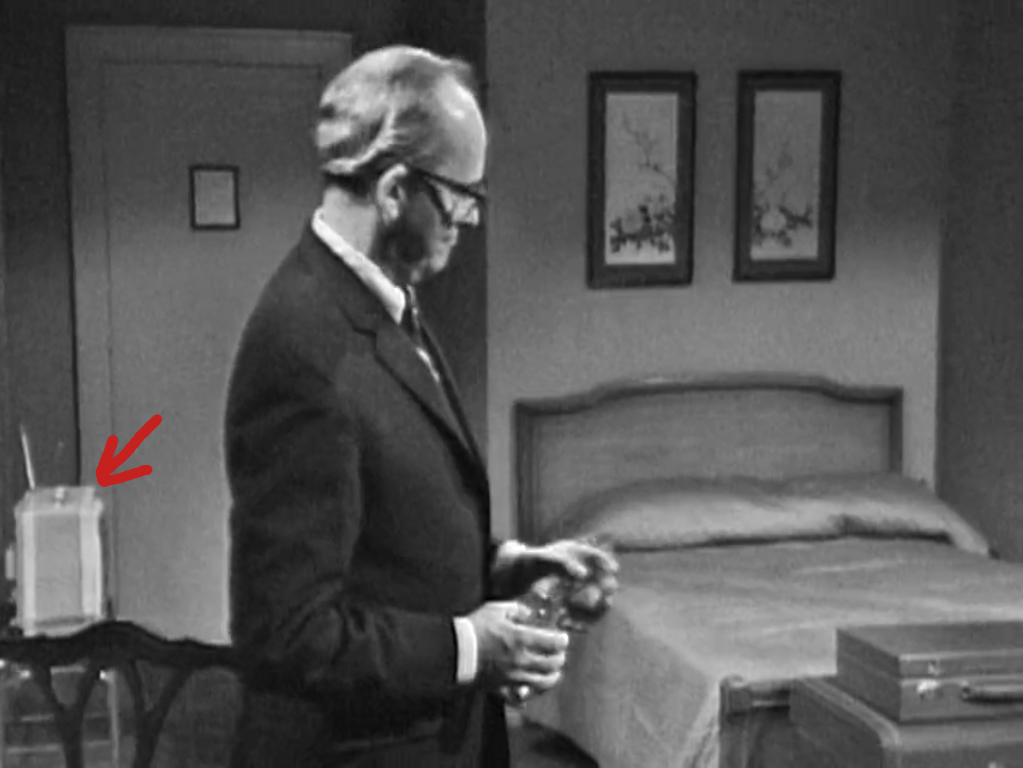
The other setting in today’s diptych is a hotel room in Bangor.* Burke is meeting a private investigator there. He’s giving him a tough assignment. He wants more information about the Collinses in less time than the investigator had originally expected. He also wants the job done in absolute secrecy, and if the Collinses catch wind of the project the investigator will suffer dire consequences. The investigator is played by Barnard Hughes, a highly accomplished actor, and his skills are needed. Burke is being harsh and unreasonable, and the investigator is being deferential. Hughes is able to give his character enough texture that he seems to be keeping his dignity. Without that, Burke would have come off as a bully. The audience has to like Burke, so Hughes makes an important contribution to the show in this, his only appearance.

There’s an irony to Burke’s hard-driving intensity. He’s looking for information to hurt the Collinses, while the women at Collinwood have information far more damaging to the family than anything he’s sending his man to look for. So we’re in suspense as to what he’ll do when he catches up to them.

*In a comment on Danny Horn’s Dark Shadows Every Day, “TD” points out that the hotel room in Bangor has a television set, the first such device we see on Dark Shadows. We will not see another until 1970. That one will be in a parallel universe. We never do see a TV set in the Collinsport of the main continuity.

Evidently Mr Bronson had the hotel send a TV up to his room.

Episode 19: If it isn’t Burke Devlin, it’s somebody else

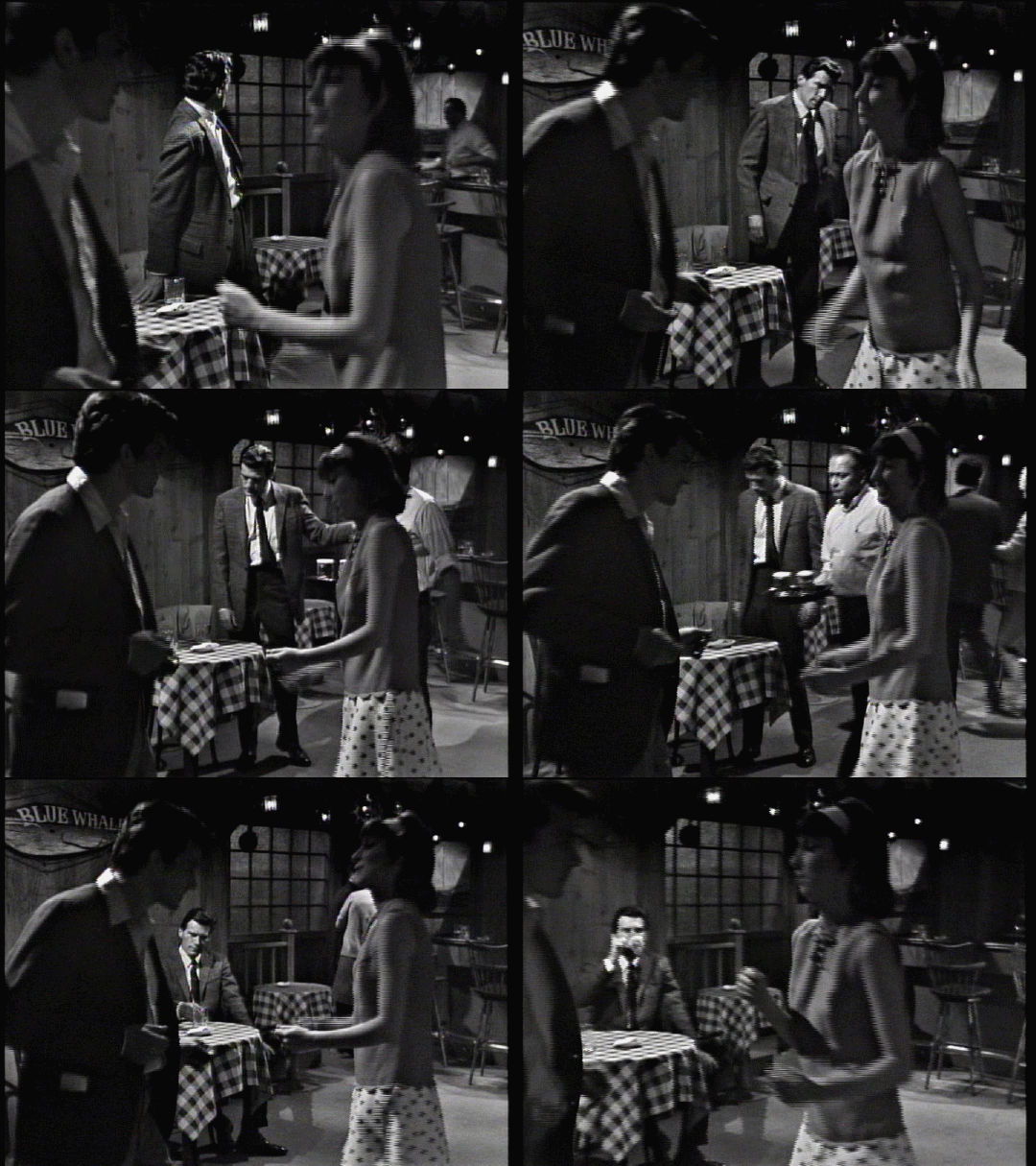
Most of this one consists of people worrying about each other’s attitudes towards Burke. Bill and Sam see each other, first in the Blue Whale, later in the restaurant, and in each place they share beverages while Bill needles Sam about Burke. In between these scenes, Joe and Carolyn are alone in the restaurant- completely alone, Joe apparently has to go behind the counter and prepare their meal himself- and they quarrel about Carolyn’s bold approaches to Burke before and during their date. At the end, Carolyn goes home, where her mother tells her about Roger’s wreck and about why she oughtn’t to be friendly with Burke.

Burke himself doesn’t appear in the episode, and none of the characters who do appear know as much about him as they think they do. What we get is a portrait of an isolated, gossipy little town, where rumors can start rapidly and grow in any direction. To the extent that “soap operas are approximately 90% information management,” as Danny Horn says, the typical setting of the gossipy little town, and its outgrowth, the false accusation, are the heart of the genre. As we watch these characters gossip and jump to conclusions, suspense forms as to how justice might miscarry if it isn’t stopped soon enough.

Episode 1: Who’s talking?

In 281 of the posts that follow, I link to comments I made on Danny Horn’s great blog Dark Shadows Every Day. Danny starts with episode 210 and makes only a handful of remarks, most of them highly disparaging, about the first 42 weeks of the show. As a particular fan of that period of the show, that distressed me when I first started reading him, but I found that it gave me an opportunity to make substantial contributions to the comment section. I could always find something in those early stories that gave extra depth to whatever was going on in the later installments.

Now, Mrs Acilius and I are watching the show through a second time, again starting with episode 1. I’d so much enjoyed commenting on Danny’s site when we were watching 210-1245 from March of 2020 to April of 2021 that I decided to start commenting on a blog that covered the first 42 weeks. So I’ve left many comments on John and Christine Scoleri’s Dark Shadows Before I Die.

The Scoleris haven’t assembled the kind of community that made Danny’s comment section a big party. I still get responses to comments I left on Danny’s site, almost a year and a half after his final post. I have yet to get a reaction to any of my comments on Dark Shadows Before I Die. So I’m thinking of just recording my thoughts here.

The Scoleris aren’t the only bloggers who discuss the first 42 weeks of the show. There’s also Marc Masse, a.k.a. Prisoner of the Night, whose (fiercely controversial) Dark Shadows from the Beginning is occasionally viewable, usually private. And of course Patrick McCray, whose Dark Shadows Daybook set the standard for online commentary on the show. Neither of those sites has an open comments section, which is why I’ve been contributing to the Scoleris. There are also podcasts, Facebook groups, Reddit threads, etc, but I’m not into any of those.

Asking who to talk to and how to get through to them brings episode 1 to mind. Vicki comes to an unfamiliar town, and the audience comes to an unfamiliar show. She’s a stranger looking for someone to talk with; we’re viewers of a daytime soap, a genre that consists almost entirely of conversation. Everyone Vicki meets is talkative enough, but most of their talk is about how they aren’t speaking. The lady sitting next to her on the train goes on about what a nasty place Collinsport is. The fellow who gives her a ride from the train station responds to the innkeeper’s warm greeting with an ostentatious refusal even to acknowledge that he knows him, let alone to engage in conversation. The server at the lunch counter announces to Vicki, before she’s had a chance to say two sentences, that she regards her as a “jerk.” The family she will be working for is represented by a lady who won’t answer her brother’s questions as to who Vicki is and why she hired her, a reticence that is made all the more ominous when a private investigator reports on their strange, unfriendly ways. Dark Shadows fandom is far less forbidding than the situation Vicki faced!

The Back-Worlds

In 281 of the posts that follow, I link to comments I made on Danny Horn’s blog, “Dark Shadows Every Day.”

I added most of these comments in the months between the shutdown of live theater in March of 2020 and the completion of the blog in April of 2021. But I have added some since.

In the last few days, I’ve added four. They all discuss on the way the show shifts its focus, once the vampire story becomes a hit, in the direction that will come to define it as the months and years go on. The first three of these comments are on posts discussing episodes where Barnabas the vampire is holding Maggie the lovable girl prisoner and trying to brainwash her into becoming his late love Josette, so that he can kill her and turn her into a vampire. This comment is on the post for episode 253, in which the boy David has broken into Barnabas’ house and had a shouting match with Barnabas’ servant Willie:

The scene between David and Willie marks a definitive break from the pre-Barnabas show. David’s great concern is that Barnabas and Willie are “hurting Josette.” By which he means that he can no longer sense the presence of the ghost of Josette. On the contrary, the name “Josette” now refers to something horrible and that horrible thing is a part of Barnabas’ story.

In the first 42 weeks, the ghost of Josette had been the principal supernatural element in the show. Serene, mysterious, uncanny, the ghost fit perfectly into that series, which was something like 99% atmosphere and 1% story. And Josette came out of the background at two key moments, leading the rescue of Vicki from Matthew in 126 and informing the family of the danger Laura represents to David in 149 and 170. And of course when Barnabas first meets David in 212, David tells him that Josette protects the family.

So when Barnabas starts his rampage, regular viewers would at first be waiting for the ghost of Josette to make its move and stop him. By the time David sees the Josette-ified Maggie in 240 and 241, we know that the imperturbable Josette of the first 42 weeks is not coming back. If we do see Josette’s ghost again after we’ve seen Maggie in her wedding dress, it could not have the lightly amused smile in its voice with which it told Vicki not to be afraid of Matthew; it could return only as a terrifying spirit of vengeance. By the time David and Willie finish their confrontation in this episode, the show has told us that the protecting ghost won’t return at all.

This one is on the post for 255, in response to a comment from someone wondering what Barnabas was planning to do if he had succeeded in his evil plan for Maggie. How could he have gone on presenting himself to the rich Collinses as their long-lost cousin from England?:

I think we have to assume that all the “cousin from England” stuff would have gone by the boards if Barnabas had succeeded with Maggie. When they revisited Barnabas’ Josettifying project in HOUSE OF DARK SHADOWS, they had to ask what would come next, and the answer was “He kills everyone and turns the estate into an impenetrable outpost of Hell.”

Some time after they came back from making that movie, the show would send Barnabas and Julia on a two-week visit to the future, to the far-off year 1995, where they find that most of the family is dead, the rest of them are hopelessly insane, and no one dares go to the estate, all because of hideous supernatural doings that took place there a quarter century before. Those two weeks are sensational, the last genuinely great phase of the show, and part of what makes them so great is that they are a logical sequel to the part of the show everyone remembers most clearly.

This one is on the post for 256. In that episode, the hapless Maggie has seen a mysterious little girl playing outside the cell in which Barnabas keeps her. The girl’s name turns out to be Sarah:

I’d say Sarah’s introduction is the single most important moment in the whole show, more important than Barnabas coming out of the box, more important even than Barnabas’ first decision not to kill Julia.

From the beginning they’d been playing with the idea that there was another cast of characters hidden behind the characters we’ve been watching, supernatural characters who can make their influence felt at certain moments. The most prominent of these was the ghost of Josette…

So the show has discarded the old supernatural realm of Josette and the widows, a realm that was, as you say, never more than slightly accessible. With Sarah’s appearance, we are introduced to an entirely new part of the show. Once again we have a set of characters hidden in the supernatural background, but they can interact with the characters from the main continuity more directly and at greater length than Josette and the widows ever could.

The puzzle of Sarah’s connection to Barnabas, and her talk about looking for the members of her family, indicates that this new order of supernatural beings have complex and unsettled relationships with each other, and that characters from the main continuity can have an influence on those relationships. We will have to figure those relationships out in the weeks and months to come, but as soon as Sarah demands Maggie not tell her big brother that she saw her, we know that they might come to enmesh the living beings. Every scene with Sarah, then, is a step leading directly to the time-travel and parallel universe storylines that will come to define the show.

This one, on the post for 279, sums up the major points of the three comments above. It regards an episode in which Barnabas and Willie are planning to host a costume party in which members of the present-day Collins family will come dressed as their forebears from Barnabas’ time, the late eighteenth century. Barnabas has rather surprisingly claimed that this party will be “the most important night of [his] life”:

‘Dude… you rose from the dead. I think the prize for “most important night of my life” is pretty much taken.’

I think he has a point, though. While it is undoubtedly true that the writers, producers, and other creatives never had an elaborate plan that they had agreed on and that they would stick to regarding the future storylines of the show, they did have some memory of the storylines they had already developed. They spent the first 25 weeks building up the ghosts of Josette and of The Widows as presences in the show, a whole second cast of characters existing in a back-world behind the one in which the events we see take place…

Once the vampire story gets going, Josette and the Widows can’t come back. Their distant, mysterious, impassive qualities suited the slow, atmospheric early months of the show, but once you have a ghoul rampaging about sucking people’s blood there’s no place for remote and uncanny presences. To hold the stage while that’s going on, you need to be a dynamic character…

So the old supernatural order of Josette and the Widows is gone. But the idea of a second cast of characters, mostly invisible to us, properly associated with the distant past, but still wielding powerful influence over the events on screen. is stronger than ever. Barnabas had been hidden away, he belongs dead, yet he has irrupted into the present and taken over the story. Sarah is a denizen of the same back-world, she has broken through with Barnabas, and is steadily pulling aside the curtain that conceals their realm from that in which the established characters live and which the audience sees. The audience is going to have to be introduced to more characters from Barnabas and Sarah’s world, and the party is going to serve that function.

Once we’ve learned their names and how they relate to each other, the back-world characters and their time will have to become a concrete part of the show in a way that Josette and the Widows never could. In retrospect, the only way that could end is with an extended flashback. So the party does turn out to be a solid candidate for ‘the most important night of Barnabas’ life’, in that it is a major step towards the time-travel and parallel-universe stories that would come to define the show.

The time-travel and parallel-universe stories put the back-worlds into the foreground and the usual continuity into the background. Those reversal may not have been the only way to resolve the crisis they created by introducing Barnabas and Sarah, but certainly some kind of radical change in the relationship of back-world and usual continuity was unavoidable.

I’d like to say one more thing about a point I make in that final comment. “While it is undoubtedly true that the writers, producers, and other creatives never had an elaborate plan that they had agreed on and that they would stick to regarding the future storylines of the show, they did have some memory of the storylines they had already developed.” Throughout the blog, Danny repeatedly claims never to have seen most of the episodes from the first 42 weeks of the show. At times this claim seems like it must be an exaggeration- for example, at one point he catalogs all 21 episodes (between #42 and #108) which revolve around the questions of what kind of physical contact had with Burke Devlin’s pen and where Burke’s pen is, a catalog that could only have been made by someone who had seen all of those episodes and all those between. Be that as it may, he does vociferously disclaim any interest in the show as it was before the vampire comes along. Which is his privilege, Dark Shadows was a very different show pre-Barnabas and post-Barnabas and there is no reason to assume that a person who likes one of those shows will like the other.

He also stresses the point that there was no advance planning in the writing of the show, that they were making it all up from week to week, often dropping one story abruptly and expanding another just as abruptly as soon as the ratings came in. That should be obvious to anyone who watches the show for any length of time.

However, it can be misleading to stress the impromptu nature of the stories while ignoring the first 42 weeks, especially when you’re considering the period of the show immediately after those weeks. No one knew what was coming, but the producers, the directors, most of the writers, and many of the actors had been with the show from the beginning and knew exactly where they had been. So the idea of a ghostly back-world and the difficulties that come when you have to define the relationship of back-world to main world were very familiar to them, and it would have been clear that redefining that relationship would have major implications for the future of the show.

Another weakness of Danny’s is a tendency to both emphasize intentionality (a fine thing in itself!) and to reduce intentionality to what “the writers” had in mind. In my comments I usually play along with the focus on intentions, even though I don’t tend to favor that myself. -If it were just me, I wouldn’t be so concerned with proving that anyone associated with the show was thinking about the relationship of back-world to main-world in the summer of 1967- it would be enough that the logic of the show leaves them nowhere else to go. But Dark Shadows Every Day is Danny’s blog, so when I’m there I want to play his game as much as possible.

Where I can’t follow is with his tendency to reduce “intentionality” to “the writers.” A TV series has lots of creators- in addition to writers, there are producers, directors, actors, set designers, costumers, camera people, executives representing networks, executives representing studios, etc, etc. Each of those people has to make contributions, and each has a whole bunch of things to think about at any given time. So there’s always a multitude of intentions, and many levels of intentionality, to be considered.

Dark Shadows and the legends of the Holy Grail

In 281 of the posts that follow, I link to comments I made on Danny Horn’s blog, “Dark Shadows Every Day.”

I added most of these comments in the months between the shutdown of live theater in March of 2020 and the completion of the blog in April of 2021. But I have added some comments since. Yesterday, I read Julius Evola’s The Mysteries of the Grail (translated by Guido Stucco; Rochester, Vermont, 1997.) Evola is not someone I agree with about things, to put it mildly, but that book describes dozens of moments from legends about the Quest for the Holy Grail that may have been in the minds of people making Dark Shadows.

In this long comment on Danny’s post about episode 559, I collect various moments in the medieval romances concerning the quest for the Holy Grail that may have inspired story points on Dark Shadows. The whole thing starts as a response to Danny’s exasperated remark about the apparently uncharacteristic infatuation of evil wizard Nicholas Blair for nice girl Maggie Evans, an infatuation that will lead to Nicholas’ downfall. I do not claim that the show does a good job of fitting this relationship into the story, but I do use it as a jumping-off point for a long catalog of similarities:

“Also, Nicholas is in love with Maggie.

“Sorry to spring it on you like that, but it’s that kind of storyline. Nicholas Blair is some kind of evil wizard man, and so far we haven’t had any indication that he’s looking for a girlfriend. In fact, he’s been mocking Angelique relentlessly for having human emotions. And yet, here we are.”

I think there’s a possible explanation for this. By the end of the 1960s, the legends of King Arthur, the Knights of the Round Table, and the Holy Grail had been in vogue for decades. New York theater people like those involved in Dark Shadows would of course have been keenly mindful of Lerner and Loewe’s CAMELOT, which was a hit on Broadway from 1960 to 1963 and which appeared as a feature film in 1967. As part of that fashion, bookstores generally would carry paperback translations of Thomas Malory’s 1453 LE MORTE D’ARTHUR and of selections from the romances about the Holy Grail written in the years 1175-1225 on which the legends of Arthur and his group were based.

Nicholas is a representative of the Devil. In Malory (especially Book 14, verses 9 and 10,) we see a theme that recurs in several of the Grail romances, that Lucifer fell from Heaven because he had conceived a passion for a mortal woman.

In fact, many of the themes of the Grail romances show up in DARK SHADOWS. The title of the novel on which the musical CAMELOT was based is THE ONCE AND FUTURE KING, harking back to a legend that King Arthur only appears to be dead- he is in suspended animation, confined to a coffin in a hidden tomb, awaiting a hero who will revive him and restore his dynasty. There are many many such figures in the Grail romances and in similar legends in Norse and Celtic myth. Obviously vampires like Dracula, Barnabas Collins, and Mamuwalde* represents a dark inversion of this legend, as do figures like The Mummy of the Universal and Hammer horror movies.

One of the more interesting of the Hidden Kings in the Grail romances is Amfortas. As the tale is told in Heinrich of Turlin’s THE CROWN, Amfortas was a king who was wounded, paralyzed and confined to a hidden coffin because of a wound he received from a sorceress he disappointed in love, the mighty Orgeluse. Sir Gawain found Amfortas and restored to him both his strength and his ability to die. Barnabas’ transformation into a vampire at the hands of Angelique recalls the wounding of Amfortas; his reemergence as a mortal man under the ministrations of Dr Lang recalls Amfortas’ restoration by Gawain.

After he is restored, Amfortas yields his kingdom to Sir Percival, marking the end of the original dynasty of the Grail. Barnabas’ attempt to replace himself with Adam, whether Adam has the face he actually has or Peter/Jeff’s face, an attempt which will eventually lead Adam to ask him “How can you hate yourself so much?,” brings this self-effacement to mind.

After his abdication, Amfortas’ wound reappears and seems to make him a leper. Again, Barnabas’ eventual return to vampirism, accompanied as it is by all the Grail-inflected imagery of the Leviathans, may have echoes of this story.

The dynasty of the Grail appears in several of the romances in connection with the figure of Joseph of Arimathea. This Joseph of Arimathea is very different from the man of the same name who appears in the New Testament. There he is a Jewish elder, a member of the Council, and a secret disciple of Jesus. In the Grail legends, Joseph is a pagan knight, who was never Jewish and is never quite Christian. He comes to be associated with Simon Peter and with Jesus’ other fisherman followers, and is known as The Rich Fisherman or the Fisher King. His dynasty rules over the Grail itself and all of its heads are known by these same titles. Again, that the Collinses are supposed to have derived their wealth from the Atlantic fisheries of Maine is not only historically plausible, since the first prosperity of upper New England came from the cod industry, but also mythically resonant, as it would make them a line of Rich Fishermen.

There is more. For a series of writings that appeared in northwestern Europe around the turn of the twelfth century, the Grail romances are startlingly cool to the whole idea of Christianity. There are no good guy priests, and the Christian imagery overlaid on the stories is so inconsistent with the traditions of the church that it must be deliberately opposed to it. Indeed, Sir Percival explicitly renounces the whole idea of serving God on his way to attain the highest honors. For its part, the church repaid the compliment by declaring that there was no such thing as the Holy Grail and denouncing the whole cycle of the romances. That the only identifiable representatives of organized Christianity in the show are the Reverends Trask, and that it is in general, as Danny says, “one of your more Satan-friendly TV shows,” is at least consistent with a connection to the Arthurian stories.

Also, when the various knights are initiated into the mysteries of the Grail, their first response is usually an overwhelming sense of nostalgia. Again, this connects us to DARK SHADOWS, where most of the characters seem to be torn between a desire to return to the past and a desire to reinvent it.

*Also known as “Blacula.”

I considered adding one more point. Throughout the Grail romances, there are moments when knights and kings fail in their missions because they fail to ask a crucial question- usually, “Where is the Grail?” Time and again watching Dark Shadows, we find ourselves frustrated with the characters for their failure to communicate with each other. This could be a sign that the writers, producers, and others were not reading the Grail romances while they were creating the show.

They may not have had to read them, or works derived from them, at all to achieve the similarities noted above. As I said, the stories were prominent enough in the English-speaking world in the twentieth century, and certainly in the New York theater world in the 1960s, that a group of creative people could be influenced by them at second-hand or third-hand. It’s a shame, though- if they’d read Wolfram of Eschenbach calling Sir Percival a tool of the Devil for his failure to ask the right question, they may have seen a way to convert the characters’ taciturnities into productive story points.

My usual themes: Lela Swift

In 281 of the posts that follow, I link to comments I made on Danny Horn’s blog, “Dark Shadows Every Day.”

Not all of these comments were absolutely unique. Several times I brought up the contribution Lela Swift made to Dark Shadows. Swift directed 595 of the show’s 1225 episodes, including the first and last installments, and she also served as line producer of the last 127 episodes. Only series creator and executive producer Dan Curtis could be said to have had more impact on Dark Shadows than did Swift, and very few people could be said to have had as much.

Danny’s background, like mine, is in literary study. I know I have a tendency to overemphasize the writer’s contribution to a dramatic work at the expense of the director and other visual artists, and I think he does too. Many of my remarks about Swift reflected my conscious effort to overcome this bias of mine, and incidentally involved my disagreeing with him.

Here’s a comment I made about episode 299. In the original post, Danny argued that the writers must by that point have intended to present mad scientist Dr Julia Hoffman as suffering from unrequited love for vampire Barnabas Collins. Some posters in the comment thread pointed out the visual similarity between the scene from which Danny draws his evidence and a scene in The Sound of Music in which a love triangle is developed. I tried to make the point that these similarities are more to do with elements under the control of the director than of the writers. So, while there is a reason to think that there was an intention to tell that story, we can’t be sure exactly whose intention that was:

THE SOUND OF MUSIC was such a big hit, so fresh in people’s minds in 1967, and the way the actors are positioned on this new set looks so much like it that I can’t believe the resonance wasn’t intentional. I don’t know if that means that the Barnabas/ Vicki/ Julia love triangle was already intentional at this point on the part of the writers, but it is strong evidence that it was on the part of director Lela Swift.

In a comment on episode 1116, I say that the new burst of energy that many in the comment threads had found at the beginning of the segment of the show set in the year 1840 came just as Swift was made producer, and suggest that she may deserve credit for it.

In a comment on episode 1166, I rebut one of her detractors:

“If Lela had been the executive producer, Dark Shadows would have been off the air after the first 13 weeks.” Perhaps so. But without her as the principal director, it’s doubtful there would have been a single episode anyone would have remembered. The endlessly ambitious visual compositions and the hyper-intense acting style originated with her, and she had as much as anyone to do with the fact that there was always an episode in the can ready to go on the air at 4 PM five days a week.

In a comment on episode 1244, I compare Swift to the only other director on Dark Shadows in its dying days, the woefully inept Henry Kaplan:

This episode and the one before also show that, even though television is famously Not A Director’s Medium, a director can have great importance from time to time. Episode 1243 was really rather good, and that is entirely to the credit of Lela Swift. The pacing is rapid, the visual composition tells as much of the story as we could want it to do, and she elicits good performances from all the actors, even Keith Prentice.

In this one, Henry Kaplan keeps moving the actors around in tight little spaces, with the result that they have to shuffle from one set of marks to another. Even worse, he indulges himself in a series of dissolves, each of which would probably have looked cluttered and been distracting under the best of circumstances, but with the camera faults in this episode it’s as if the TV screen is at the bottom of a pond. Poor Keith Prentice, finally doing a good job of acting for a second consecutive episode, winds up looking like the world’s biggest idiot when a closeup of him laughing in wicked triumph dissolves to a shot of the cobwebbed room.

My usual themes: Supernaturalism

In 281 of the posts that follow, I link to comments I made on Danny Horn’s blog, “Dark Shadows Every Day.”

Not all of these comments were absolutely unique. Several times I made remarks about the concept of the supernatural that Dark Shadows develops with all its ghosts, witches, and other weird beings.

In this remark about Danny’s post on episode 659, I respond to a discussion in the comment thread in which several people dismissed the idea that it was the ghost of Sarah Collins who sent Vicki back in time in episode 364, precipitating the show’s first time travel storyline:

It makes sense to me that Sarah sent Vicki back. The whole thing with the supernatural is that what seems weakest is actually strongest. The dead are stronger than the living, children stronger than adults, etc. So it fits the conceit that a long-dead and not especially bright little girl is the greatest power. It fits the dramatic development as well- throughout her time as a ghost Sarah steadily reveals more and more powers, and by the time of the seance we’re wondering what she will show us next. Moreover, her whole approach throughout 1967 is an attempt to curb Barnabas’ murderousness and to shield him from accountability at the same time. Vicki’s return from 1795 storyline precipitates events that achieve precisely that goal, and it is the goal to which Julia (Sarah’s successor as a sister to Barnabas) devotes herself for the rest of Barnabas’ time on the show.

I enlarged on my thoughts about Sarah’s ghost in a response to a post about an episode in which she actually appears, number 294:

“I don’t really think the writers are sure who Sarah is, or what she wants.” I don’t think that either we or she are supposed to know what Sarah wants. Up to this point she’s been very mysterious- for the first few episodes it was unclear what she remembered from one appearance to the next. And of course she several times expresses puzzlement that she can’t find her parents in the Old House, and she doesn’t know why David and the others think her clothes are old-fashioned. So they leave open the possibility that she was just a projection from the past with no intentions and no ability to learn in the present.

By now it’s clear that she is a character interacting with other characters, but still unsettled as to whether she knows she’s a ghost, or what happened to any of the people from her corporeal days, or what century it is. It still could be that her presence is just a side-effect of Barnabas’ revival, that she represents some kind of energy that was released into the world when he came out of the box. In the Phoenix storyline, they played with that same kind of ambiguity- Laura’s presence in the house coincided with other disturbances, over which she had no control and of which she was not aware.

Later it will become clearer that Sarah knows a fair bit, but right up to the moment Vicki vanishes from the seance she is trying to figure out a way to curb Barnabas’ murderousness without betraying him. Indeed, the speech Sarah gives speaking through Vicki at that seance is the climax of that whole development- Sarah is deep in her own thoughts, trying to solve an impossible problem, and taking a gamble on something amazing of which the most she can say is that “maybe” it will work out.

In a comment on episode 639, I said a bit more about the idea that Sarah herself is supposed to seem uncertain about her nature, her powers, and her goals, finding actress Sharon Smyth the perfect choice to play such a character:

When she first starts showing up, Sarah is a total mystery to us- it’s pretty clear she’s a ghost, but do ghosts form memories? That is, can she remember during one appearance what happened in her previous appearances, or does she know only what she learned in life? Does she have plans and intentions, or are her appearances simply the result of invisible forces? … young Sharon Smyth’s confused demeanor (nowadays she sums her performance up in “one word- clueless”) plays right into all those questions.

In a comment responding to the post about 730, I commented on how the original Phoenix storyline of episodes 126-192 (what I call the “Meet Laura” period of the show) set the stage for the supernatural tales that would come to dominate the show after the vampire shows up in episode 211:

Laura is the first paranormal being who sets a story in motion. Ghosts had been in the background from the beginning and had played important roles in ending Vicki’s first two imprisonments, but they hadn’t started any plotlines. The Phoenix story is bounded by the supernatural on all sides. At the end of it, virtually all the characters concede that they have just seen something that cannot be explained and tacitly agree never to speak of it again.

One of my less well-formed comments was a rambling half-essay about ways that particular kinds of Christians might be expected to respond to particular supernatural stories that I contributed to the thread responding to episode 1017. It was one of those internet moments where you click “Post” because it’s the only way you can imagine yourself letting go of something you’ve already wasted too much time on. Unsatisfactory as that comment wound up being, I can defend my motivation for writing it. Several contributors had made blanket assertions about what Christianity teaches concerning various matters, and someone really ought to have objected that different groups of Christians teach different things.

A story idea: Adam in New York

In 281 of the posts that follow, I link to comments I made on Danny Horn’s “Dark Shadows Every Day.”

In a number of these comments, I explained particular ways I had of correcting Dark Shadows in my head while I watched it. I rarely bothered telling people about times when I didn’t notice bloopers because I had put the words in the right order while hearing them, or other small corrections. I did mention times when I thought out major changes. Many of those changes could only be called fanfic.

Perhaps the most ambitious piece of fanfic I shared there, and certainly the longest, was my response to the show’s failure to resolve the story of Adam, the Frankenstein’s monster-like creature. My idea, if presented at the right time, would also have tied up the show’s most embarrassing loose end:

Here’s an idea I had today for a story that would save Vicki.

It would be a TV movie airing late in 1969. Start with a prologue set in Collinwood at that time. Adam returns, looking for Barnabas and Julia. He’s very well-spoken and accomplished now, but still socially awkward, still prone to fits of anger, and in need of help to get papers that he needs to establish a legal identity.

He finds that Barnabas and Julia are gone. He also happens upon some mumbo-jumbo that dislocates him in time and space.

It plops him down in NYC in 1945. With his facial scars, everyone assumes he’s a returning GI injured in the war. He meets a young woman, supporting herself by work at a magazine about handheld machines, trying to establish independence from her wealthy family back in Maine. This woman, played by Alexandra Moltke Isles, is Elizabeth [Collins.]*

Adam and Elizabeth slide into a love affair. She has another boyfriend, a dashing young naval officer named Paul Stoddard. Elizabeth is frustrated with both Adam and Paul; Adam refuses to talk about his background, and while Paul says many words when asked about himself, he doesn’t really give significantly more information than Adam does. Paul is slick, charming, and familiar with all the most fashionable night spots, but he does show signs of a nasty side. Besides, he rooms with a disreputable young sailor named Jason McGuire who keeps turning up at the most disconcerting moments.

For his part, Adam is sincere, passionate, and attentive, but given to quick flashes of anger. He’s just as quick to apologize and sometimes blubbers like a giant baby with remorse for his harsh words, but he’s so big and so strong that when he is carried away in his fits of anger Elizabeth can’t help but be afraid of him. Besides, he’s not a lot of fun on a Saturday night. He doesn’t have a nickel to his name, and his idea of an exciting weekend is an impromptu seminar on Freud’s TOTEM AND TABOO, followed by a couple of games of chess.

Elizabeth’s mother, played by Joan Bennett, comes to town. Mrs Collins is appalled by Adam’s scars, impatient with his refusal to discuss his background, and contemptuous of his obvious poverty. Paul’s effortless charm and sparkling wit, packaged in the naval dress uniform he makes sure he’s wearing when she first sees him, fit far more tidily into her vision of a son-in-law. Mrs Collins presses her daughter to spurn Adam and pursue Paul, and for a time Elizabeth tries to comply with her wishes.

Yet she cannot forget Adam. Paul realizes this, and sees his chance at an easy life slipping away. We see him in a dive in Greenwich Village telling Jason McGuire that Elizabeth and her inheritance are going to end up with the scar-faced scholar. He and McGuire review Adam’s weaknesses, and decide they can exploit Elizabeth’s concern about his temper. They trick her into believing that Adam is on the run from the law, having beaten his wife to death. They lead her to believe that it’s just a matter of time before his occasional verbal outbursts give way to physical abuse, and that when that happens it will be too late- he will kill her. Believing this, Elizabeth gives Paul another chance, but still cannot break things off with Adam.

Adam does not know what Paul and Jason have led Elizabeth to believe. He knows only that she has become distant from him, and that she is still seeing Paul. He becomes angry and shouts at Elizabeth. He reaches for an object; she believes it is a blunt instrument with which he will kill her. In a moment of panic, she grabs a gun she has been studying for an article the magazine has assigned her to write and shoots him. As he lies motionless on her floor, she discovers that he wasn’t reaching for a weapon at all- he was reaching for a love letter that he had written to her. She realizes that he was no threat to her, that she has shot him for no reason.

She flees to Paul and Jason’s apartment, telling them that she has killed Adam. Paul calms her and promises to take care of matters so that she will not be suspected of any crime. Paul and Jason go to her apartment and find it empty. There are bloodstains on the carpet where Adam fell, and a trail of bloodstains leading down the hallway out the front door. They follow the stains and find Adam nursing a serious, but clearly not fatal, wound. They lead Adam back to Elizabeth’s apartment. They draw on their naval training to remove the bullet, clean and dress the wound. After a conversation. Adam admits that there is no point in his pursuing Elizabeth, and he agrees to leave town. Paul gives Adam some money and promises to tell Elizabeth that he is all right and that he doesn’t hold a grudge. Adam shakes Paul’s hand and leaves.

Paul and Jason clean the bloodstains. They then return to their own apartment. On the way they exchange a look that begins as nervous, and ends with two broad grins. Elizabeth asks why they were away so long. They tell her that it takes quite a while to dispose of a corpse. She sobs. Paul holds her.

Paul and Elizabeth announce their engagement. A few weeks later, the doctor informs Elizabeth that she is pregnant. The child must be Adam’s. Paul is not interested in raising any child, and certainly not interested in splitting the estate with a child not even his own. He orders Elizabeth to give the baby up. She refuses. He points out that she wouldn’t be able to do much mothering if she were in prison for murder. She sobs. In the final scene, we see Elizabeth outside on a snowy day, holding a basket and writing a note. In voiceover, we hear the contents of the note: “Her name is Victoria. I cannot take care of her.”

*Originally I wrote “Stoddard” here.

My usual themes: Bossy Big Sister/ Bratty Little Brother

In 281 of the posts that follow, I link to comments I made on Danny Horn’s blog, “Dark Shadows Every Day.”

Not all of these comments were absolutely unique. Several times it occurred to me that a Dark Shadows features a number of older sisters who clean up messes that their misbehaving younger brothers make, and that a variety of male-female relationships on the show take on the dynamic of a bossy big sister and her bratty little brother. Danny doesn’t cover the first 209 episodes of the show, when we learn that Roger Collins has managed to squander his entire inheritance, half of the family fortune, and that his older sister Elizabeth Collins Stoddard has gone deeply into debt to contain the damage that his irresponsibility has done to the family business. Elizabeth takes Roger into her house, and alternates between demanding that he reform his ways and enabling his ongoing bad conduct. She takes charge of the raising of Roger’s son David and puts Roger to work in the family business, setting bounds to Roger’s crapulence but also insulating him from its consequences.

My first remarks about this theme were in a comment on episode 565:

Watching this episode, I just realized the main relationship in DARK SHADOWS- Bossy Big Sister/ Bratty Little Brother. Liz and Roger are literally that, and each one’s struggle to safeguard their relationship by keeping the other in the dark about their shameful secrets is the background of every storyline in the first 209 episodes. Carolyn and David become the functional equivalent of a Bossy Big Sister and a Bratty Little Brother, and that’s the development that makes Carolyn a relatable character.

In Julia and Barnabas, we have the supreme example of such a relationship. They fall into it naturally; Julia is used to giving orders, and Barnabas is used to disobeying them. From the moment Julia lit her cigarette on the candles in the old house, she’s been Barnabas’ Bossy Big Sister, pursuing one plan after another meant for his own good. He’s been alternately pouting at her, raging against her, and clinging to her, at once resenting her demands on him and craving her validation for his narcissism. The climax of the episode, when they both know that a he-vampire is roaming about in search of a victim but it occurs to neither Julia nor Barnabas that Julia might be in danger, shows how deeply they have embedded themselves in these roles. Barnabas won’t even let Vicki walk to her car alone, and Julia, hearing the dognoise, understands why. But when Julia tells Barnabas that she will close up the lab and leave shortly after he goes out to join Willie, implying that she’s going to walk all the way back to the Great House by herself, he just leaves. Of course nothing will happen to Big Sis, she’ll always be OK.

That’s also why I don’t see how slashfic positing a sexual relationship between Barnabas and Julia can work. They are so much Bossy Big Sister and Bratty Little Brother that no matter how much time they spent telling themselves that they aren’t actually related, it would still be impossibly weird to try to be something else to each other.

I returned to the theme in a remark about episode 572, where Jonathan Frid gives a line-reading so pouty that I wonder if he was consciously trying to depict Barnabas as a bratty little brother to Julia:

I love the way Jonathan Frid pouts the line “I was afraid your visit would be pointless.” He’s every inch the bratty little brother upset that his big sister went out when he didn’t want her to go.

By episode 648, the idea has moved me to fanfic:

Cavada Humphrey looks quite a bit like Jonathan Frid. I wonder what 1795 would have been like if Barnabas had had an older sister who bossed him around, stood around during his ridiculously childish fits of petulance, occasionally acted as his conscience, and time and again serve as his enabler and protector. It would have been funny to see Grayson Hall’s Countess express disapproval of such a relationship.

Heck, that older sister could have been Sarah. Just because she’s a child in her ghost form doesn’t mean she has to have died at that age. Maybe she comes back in the form in which her relationship to her brother took its permanent shape, when she was about nine and he was about seven. Of course, that possibility is foreclosed at Sarah’s first appearance, when she tells Maggie not to let her “big brother” know she saw her, but I suppose they could have retconned that away with a phony flashback where she says “little brother.”

I revisited these points a few times- Danny’s blog consists of over a thousand posts, one each for episodes 210-1245, plus a few dozen about properties related to Dark Shadows, and each post has its own discussion thread. So it isn’t bad netiquette to repeat yourself a bit from one thread to another- there is always a chance someone who didn’t see a comment previously posted elsewhere will take an interest when you post a similar one. But I did try to keep from making a bore of myself to those who read everything.

I could have mentioned some other bossy big sister/ bratty little brother combos. In a comment on the 1897 storyline, I alluded to the relationship between Judith Collins Trask and her feckless younger brothers. Judith’s arc doesn’t really allow her to be a bossy big sister to any of her three bratty little brothers. But each of them does find himself attached to at least one woman who is stronger than he is, and who might well treat him as Elizabeth does Roger and as Julia does Barnabas.

It’s a shame Terry Crawford wasn’t a more accomplished actress in the 1960s- in the scripts Beth fluctuates between indulging Quentin in his every vice and insisting that he clean up his act. That’s the bossy big sister/ bratty little brother dynamic we’ve seen so many times, but unlike any previous pair who have enacted it Beth and Quentin are lovers and are not social equals. It would be interesting to explore the dynamic in that context, but Ms Crawford’s performance is so wooden that you sometimes have to think about her scenes after it is over and call to memory the dialogue and the visual composition before it strikes you what the point was.

Pansy Faye isn’t on the show very long, unfortunately but she’s clearly in the driver’s seat in her relationship with her thoroughly clownish husband Carl Collins. And Edward Collins is much the weaker personality in his connections with both his estranged wife Laura and with Kitty Soames. So each of those men was looking for a woman who was forceful enough to take charge of him, but indulgent enough to allow him to continue in all his established habits.

I also made only one brief reference to the bossy big sister/ bratty little brother dynamic in the discussions of the 1840 storyline. That’s rather odd- after all, in that one Julia actually presents herself to the family as Barnabas’ sister, and he is forced to go along with the pretense.

I did not refer to the theme in my comments on posts about “The Haunting of Collinwood” by the ghost of Quentin, and I made only a single reference to it in my comments on posts about the “Re-Haunting of Collinwood” by the ghost of mini-Quentin Gerard. Indeed, that single reference is to Julia’s failure to focus her bossiness on Barnabas. I dropped the ball there, I think- the relationship between David and Amy in the original “Haunting of Collinwood” is at its most interesting when it mixes elements of the bossy big sister/ bratty little brother dynamic with other types of interaction, while the bland, lifeless relationships between David and Hallie on the one hand and between Tad and Carrie on the other in the “Re-Haunting of Collinwood” could benefit from some kind of structure.

I also left the theme unmentioned in my comments regarding the show’s dying days, the 1841 Parallel Time storyline of episodes 1199-1245. That’s understandable- the show did not develop any bossy big sister/ bratty little brother relationships in that period. But there was an implicit one- Miss Julia Collins was the sister of Justin Collins, and she had functioned as head of the household during his years of madness. Justin dies a few episodes into the story, without sharing a scene with Julia, and she is left as a bossy big sister with no bratty brother to whom she can attach herself. Meanwhile, Bramwell is a thoroughly bratty man with no big sister. It’s rather sad for the loyal audience, having enjoyed so many scenes in which Grayson Hall and Jonathan Frid had enormous fun with the bossy big sister/ bratty little brother pattern, seeing them drift separately through these dreary episodes.

The closest we get to a bossy big sister/ bratty little brother scene in the dying days of the show is also the one genuinely irresistible moment of that segment. In episode 1215, Flora Collins (Joan Bennett) and her son Morgan (Keith Prentice) are walking through the woods on their way to Biddleford’s Creek. He whines about the pointlessness of the trip, she scolds him, and we get a brilliant little glimpse of what their relationship must have been like since he first learned to talk. That authoritative mother/ whiny son moment left me, not only wanting more such scenes between them, but also wishing it had been presented in contrast with a bossy big sister/ bratty little brother relationship elsewhere in the show.

My usual themes: Denial and the demonic

In 281 of the posts that follow, I link to comments I made on Danny Horn’s blog, “Dark Shadows Every Day.”

Not all of these comments were absolutely unique. I frequently refer to denial, the psychological defense mechanism, as a story point on Dark Shadows, and more than once I connect it with the show’s supernatural themes.

From the very beginning, the show focuses on the Collinses as a family addicted to denial. Elizabeth hasn’t left her house for 19 years because she’s guarding a secret; she’s summoned Vicki to live with the family for reasons she conceals so deeply that we never find out what they are; she almost loses the house, the business, and everything else as she gives in to the demands Jason McGuire makes in return for his silence. For his part, Roger is terrified that Burke will reveal the secret they share, and goes to extreme lengths to keep that secret hidden; he openly hates his son, but can tell no one why; his estranged wife is a profoundly mysterious figure, whose own secret is so powerful as to imply that the consensus view of reality prevailing in the community where the show is set is an elaborate lie. David sees ghosts; eventually the audience also sees them, and we know that some of the adult characters can see them, too. Yet all of the adult characters hotly deny that the ghosts exist until Vicki breaks the embargo after she sees the ghost of Bill Malloy in episode 126. Not until Carolyn tells David about her childhood friend Randy in episode 344 will another adult even allow David to suspect that she thinks ghosts might be real.

Here’s a concise statement about denial as a theme in the show, from a comment I made on one of Danny’s posts about the “Re-Haunting of Collinwood” segment:

Of course it doesn’t make much difference that Gerard possesses Liz. Liz’ whole thing, from episode 1 on, is that she refuses to acknowledge painful realities. That’s what Gerard wants her to do, so all she needs is a little nudge to go back to her usual state. Even though she isn’t on the show much, I think of Liz as the main character in the sense she embodies denial, and the show is very largely an exploration of what can happen when people are deep enough in denial.

And here’s a somewhat more developed remark, this time from a post about the first “Haunting of Collinwood”:

Roger’s angry dismissal of Barnabas and Julia’s concerns this time, combined with Liz’s triumphant reaction to the sight of Mr Jughans at the end of last Monday’s episode, actually do make sense both of Barnabas and Julia’s refusal to tell her what they’re up to and of Liz’s own acquiescence in their absurd behavior. The Collinses may reside in the state of Maine, but the state in which they hold their true citizenship and to which they give their sole allegiance is the state of denial. If Barnabas and Julia tell Liz what’s going on, she will have to build some structure of lies to conceal it from herself and from everyone else, regardless of the cost. If they simply act like lunatics and impose on her with nonsensical demands, however, she can set about convincing herself that it is somehow all right to have Barnabas and Julia around her house.

Here’s a response to another post about the original haunting of Collinwood, this time dissenting from the view of several others in the thread that the writers had simply lost track of which characters knew what and ended up presenting Liz and Roger as memory-free, “goldfish” characters:

I don’t think Roger and Liz are goldfish in the way that so many characters were in earlier episodes. They’re people in deep denial about the nature of the world in which they find themselves. That’s what makes their scenes powerful in the two or three weeks leading up to this installment. They refuse to believe in ghosts, and so they think they are protecting the children from Maggie, Mrs Johnson, Julia, and Barnabas when those characters talk about what’s going on. In fact, they are enabling Quentin’s abuse of the children. When Liz and Roger break down and face facts, they relieve us from involvement in that terrible situation. They also stun us, especially if we’ve been watching from Episode 1, because we’ve seen the immense price each of them has paid to avoid dealing with unhappy realities.

Both the original haunting of Collinwood by the ghost of Quentin and its re-haunting by the ghost of mini-Quentin Gerard mainly take the form of child abuse. The Collinses respond to that child abuse with a solid wall of denial:

Of course, it is abuse to coerce children into harming their loved ones, so it isn’t just allegorical. It’s realistic to show this form of child abuse working in the same ways as do other forms.

The Collinses are such a wretched bunch that the children of the family must have been the objects of a great deal of abuse over the centuries, yet the show wimps out of exploring that topic at the climax of the Phoenix story, when Roger and Carolyn stop openly proclaiming their hatred for David. For the next 500 or so episodes, the only abuse inflicted on the few Collins children we see is the occasional attempt to murder one of them. In this fictional universe, being the target of a murder plot is a so routine an experience for so wide a variety of people that it seem odd to describe it specifically as “child abuse.”

We don’t really have to think about Collins children being abused until the Haunting of Collinwood story. Then we go to 1897, when the show finally takes child abuse seriously and connects it to the Collinses’ addiction to secrecy and their desperate unhappiness.

In a thread about the 1897 storyline, I go into some depth connecting the show’s theme of denial with its depiction of dark supernatural forces. I compare those depictions with understandings of the supernatural found in some familiar traditions and end with fanfic:

I think of the climax of the Iliad. As Achilles moves in to kill Hector, Athena takes hold of his spear and drives it in, delivering the fatal wound herself.

For modern readers, this may ruin the story. The whole poem has been leading up to this moment; we’ve spent a lot of time with Achilles, listening to him try to figure out what it would mean for him to kill Hector. So why have the goddess take over at the last minute? Isn’t it an evasion of Achilles’ responsibility for his actions, and a cheat for us as we’ve been observing his psychological development?

For the original audience, it was not. They actually believed in their gods. Athena really existed, as far as they were concerned. When an event was important enough, they took a interest. If it was really huge, they would get involved. Moreover, the gods worked closely with each other. So much so that you didn’t pray to one at a time, but always to groups of them. When Athena joins Achilles in his fight, it isn’t her pushing him aside- it’s him doing something so important it blurs the boundary between human and divine.

Something like that is at work in the traditional, pre-modern, conception of demonic possession. To say that a person is possessed is a way of looking at behavior that is reducible neither to moralistic judgment nor to psychological analysis. It isn’t individualistic in the way that those modes of discourse are. Rather, it suggests that the boundaries between the person and the spiritual forces of darkness have broken down. Perhaps the person is partly to blame for that breakdown, but the whole point is that s/he is no longer a distinct being, but is merging into those supernatural forces.

So, imagine a version of Dark Shadows where Elizabeth Collins Stoddard really was the main character. Her whole approach to life is denial. So, you could have had a story with a beginning, middle, and end. In the beginning, we see the lengths she has gone to in her quest to keep from ever having to have an embarrassing conversation. In the middle, we see various horrors take place around her, each worse than the one before, each more obvious than the one before, and each time she finds a way to convince herself it doesn’t exist. At the end, a couple of innocent characters go to her in the drawing room of Collinwood to rescue her from the monsters who are running rampant there. She looks at them placidly and tells them she sees nothing wrong. Why ever do they think she would want to leave her home? All the while leathery-winged demons are fluttering about her head. She doesn’t see them, and they have no choice but to flee.

Made as it was to be shown on the ABC television network from 1966-1971, it is unsurprising that Dark Shadows is, off and on, vaguely Christian in its worldview. At one point they even imply that the Collinses are affiliated with a specific Christian denomination, The Episcopal Church. Of course, the view of the world they present is not exactly orthodox, but the idea of an individual human personality as something that can gradually become less distinct from various spiritual forces is a familiar one, not only to Christians, but to others who are invested in the idea of a supernatural realm.