In its early months, Dark Shadows was set in contemporary times, and from December 1966 to March 1967 undead blonde fire witch Laura Murdoch Collins was its first supernatural menace. Now it is a costume drama set in 1897, and another version of Laura is on the show.
Well-meaning time-traveler/ bloodsucking ghoul Barnabas Collins recognized Laura from their acquaintance in the eighteenth century. Barnabas has taken it upon himself to engage Laura in battle, for no apparent reason. The scripts have also been hard to explain. At moments, they have dug deep into the old stories. So today, Laura orders ethnic stereotype Magda Rákóczi to take a portrait of her and burn it in the fireplace. Magda tells her to burn it herself, and Laura says she cannot. In her first tour of duty on the show, Laura was distressed to find herself depicted in a couple of portraits, which she was relieved to have burned. Late in the episode, a telegram comes from the authorities in Alexandria, Egypt, providing official documentation that Laura died there the year before. This echoes the police reports that kept coming to Collinsport from Phoenix, Arizona, substantiating a story that Laura had died in that city in 1966. And yesterday and today, we see Barnabas and his henchman Sandor on virtually the same set that Laura’s adversaries visited in 1967 when they looked for the tomb of her eighteenth century incarnation, and like them they open that tomb and find the coffin empty.
At other times, they deviate sharply from the old continuity. It was hugely important the first time that Laura’s previous dates of death were 1767 and 1867. Now they’ve changed that first date to 1785. That one is explicable as part of a doomed effort to pretend that actor Jonathan Frid was the age one would expect him to be, considering that he had somehow become a teen idol. Originally, Laura had married into a different prominent family in the Collinsport area with each incarnation. Now she always marries a Collins. That is also easy to explain. Dark Shadows has failed to develop any other prominent families, even as names of people we never see, so if she’s going to marry a rich guy the Collinses are the only game in town.
Another retcon is introduced today that is really hard to make sense of. The main thing about Laura in 1966 and 1967 was that each time she appeared, she had a son, named him David, and when he was about nine years old she incinerated herself with him so that she, but not he, would rise from the ashes as a humanoid Phoenix. In this episode, Barnabas declares that the Laura who died by fire in 1785 “had no children!”
This not only blows up the continuity completely, it also renders Barnabas’ insistence on making an enemy of Laura unintelligible. He has come to the past as part of an effort to prevent curses and hauntings that will make life impossible for everyone on the estate of Collinwood in 1969. The Laura of 1897 is the mother of Jamison Collins, a boy who will become the father of the adults at Collinwood in the 1960s. If Barnabas knew that Laura represented a danger to Jamison, we could understand his motive in undertaking this side-quest, even though his tactics would still be obviously self-defeating. But they kick that explanation away when Barnabas announces that the Laura he knew was childless. It seems they must have made a deliberate decision to deny any rational foundation for Barnabas’ behavior.
It’s true that they have established that Laura represents a danger, and that Barnabas is clearly the chief protagonist. Therefore, we expect the two of them to have a showdown sooner or later, and we might not notice if it isn’t really explained just how the two of them got on the path that leads to the climax. That would explain why they don’t wade into all the details they spent time on at the beginning of 1967. But there is no reason for them to do that. All they need are a few lines here and there affirming that the previous Lauras took their children into the flames with them, and it’s all settled. The decision to retcon David Stockbridge away really is bizarre.
The highlight of today’s episode is a confrontation between two of Dark Shadows‘ most effective villains.
Laura Murdoch Collins (Diana Millay) was on Dark Shadows from December 1966 to March 1967, when the show took place in a contemporary setting. She emerged from the supernatural back-world behind the action, and at first she was as vague and indefinite as are the beings who lurk out of our sight there. Eventually she took on a forceful enough personality that Diana Millay could display her gift for dry comedy, but that personality was only a mask that Laura wore. The real Laura was something entirely different, unreachable, unknowable. The visible Laura marks the boundary between the world we can hope to understand and one where humans would find no points of reference, no standards of comparison. As such, she represents the danger that we might lose our way and find ourselves in a place where our minds will be useless to us. That is to say, she inspired the fear that comes from a well-told ghost story.
Now the dramatic date is 1897, and another iteration of Laura is the mother of twelve year old Jamison and nine year old Nora. Laura’s estranged husband, the stuffy Edward Collins, and Edward’s sister, spinster Judith, have sent Jamsion and Nora to Worthington Hall, a boarding school which doubles as a particularly cruel cult. Laura’s plans for Nora and Jamison require them to be home on the estate of Collinwood, and so she sets out to release them from Worthington Hall.
The headmaster/ cult leader of Worthington Hall is the vile Gregory Trask (Jerry Lacy.) Trask is at the opposite pole from Laura. She is terrifying because we can never understand her or the realm whose existence she implies; he is an overpoweringly oppressive presence because he is so thoroughly comprehensible. It is perfectly obvious what Trask has done, what he plans to do next, and why he wants to do it, but knowing all that is of absolutely no use in stopping him.
In today’s opening scene, Trask confronted fugitive teacher Rachel Drummond, whom he is extorting into coming back to work at Worthington Hall. He kept sidling up to Rachel and touching her, telling her that perhaps the two of them were destined to change each other. He could not make it clearer that he wants to exploit his power over Rachel to coerce her, not only into returning to her old job, but into a sexual relationship.
Trask has been in a position of authority over Rachel since she was a small child, suggesting that his unrelentingly punitive approach to his students and the undisguised joy he takes in being cruel to them are also sexual in their origin. Rachel even used the word “sadist” to describe Trask the other day, a word coined only in 1892. Someone using it in 1897 would certainly have seen it in its original clinical context, and the neurotic intellectual Rachel undoubtedly understood it very well in its technical sense.
We see Laura on a dark set. She looks at a candelabra. She points at its three candles, one by one. As she points at each candle, it lights. Thus first time viewers learn that Laura is a supernatural being with a relationship to fire.
At Worthington Hall, Nora wanders into a room where a fireplace is alight. Nora can hear her mother’s voice urging her to look into the flames, but cannot see her. She is afraid until she looks into the flames and sees Laura’s face. Nora begins to enter a deep trance. Before she can, a teacher finds her and interrupts her. We cut back to Laura, who is pleading with Nora not to look away from the fire. Nora does, and the candles on Laura’s candelabra go out.
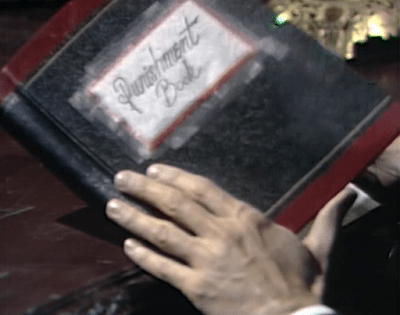
We see Trask in his study, browsing through a Bible. He returns that to his bookshelf and finds more congenial reading. He picks up a ledger and brightens. We see its cover, on which is taped a label reading “PUNISHMENT BOOK.” Trask smiles blissfully and sits down to examine its contents.
A knock comes at the door, pulling Trask out of his sun-kissed dream of past cruelties. Irritated, he demands to know who it is, but receives no answer. When the knocking continues, he opens the door and sees Laura.
LAURA: Are there no servants at Worthington Hall? I’m not accustomed to letting myself in.
Longtime viewers will remember that when Laura was first on the show, they made a big deal out of the fact that she never ate or drank. So much so that they had the next uncanny menace, Barnabas Collins, drink a cup of coffee in #221. Even though Barnabas was a vampire and Laura was not, they had used up the traditional indicator of vampirism. non-consumption of food or drink, on Laura. Laura’s inability to open the door herself may be another borrowing from the same stock of imagery, from the idea that the vampire cannot cross a threshold without being invited.
TRASK: Who are you?
LAURA: I am Laura Collins and I come for my children. You are Mr. Trask, of course.
TRASK: Reverend Trask!
LAURA: Anyone can call themselves anything. I knew a woman in Brooklyn, once. Insisted she was a countess.
This is an inside joke. There was quite a well-known fashion correspondent-turned-executive in Brooklyn in 1969 named Mabel Wilson Gross. Mrs Gross’ first husband was a Danish nobleman named Count Carl Adam von Moltke, known to his friends as “Bobby.” Mrs Gross was known professionally as “Countess Mab Moltke.” She and “Bobby” were the parents of Alexandra Moltke Isles, who appeared in 333 episodes of Dark Shadows as well-meaning governess Vicki. I don’t believe Mrs Isles has ever used the title “Countess” herself, though under the laws of Denmark she would have the right to do so. Since it was Vicki who led the battle against Laura in 1967, a remark from Laura twitting Mrs Isles and her family might raise quite a laugh from longtime viewers who get the reference.
LAURA: (Goes to Trask’s desk and leafs through the “Punishment Book.”) But you are Trask. Yes, there’s no doubt about that.
TRASK: But you could be anyone as far as I’m concerned, anyone at all. I have too much respect for the defenseless souls in my charge.
LAURA: Oh, please, don’t be dreary.
TRASK: Dreary, Madam?
LAURA: Surely you know the word. Simply have my children brought down here, if there’s anyone to bring them.
TRASK: And how am I to know that you are their mother?
LAURA: Oh, what a trusting man you are.
TRASK: There is no question of the children leaving the school.
LAURA: Jamison possibly. Nora will leave here tonight. I’m willing to take them one at a time.
TRASK: As far as I know, Madam, their mother is away.
LAURA: You should keep more in touch.
TRASK: My wife returned from Collinwood this afternoon. She made no mention of your return.
LAURA: Hmm. How odd. I thought her a great gossip.
TRASK: Minerva? Madam.
That Minerva appeared to be “a great gossip” will also amuse longtime viewers. She is played by Clarice Blackburn, who in the parts of Dark Shadows set in the 1960s played housekeeper Mrs Johnson. After a brief period in which Mrs Johnson was supposed to be a spy planted in the house by an enemy of the Collins family, she settled into the role of a benevolent but excitable woman whose chief function was to blab everything she knew to the character likeliest to use the information to advance the plot.
LAURA: Now, will you have Nora sent down.
TRASK: I will not. Not without proper orders from Miss Judith Collins or Mr. Edward Collins. I shall call Collinwood and verify your strange appearance.
LAURA: Do.
(TRASK picks up the telephone receiver. Shows pain and drops it.)
LAURA: What’s wrong, Mr. Trask?
TRASK: It burned my hand.
LAURA: I’ve always thought the telephone an instrument of the devil, haven’t you?
TRASK: I have not!
Many times on Dark Shadows, as recently as this week, we have seen men forcibly intervene to stop a woman from talking on the telephone. I believe this is the first time we have seen a woman turn the tables and do this to a man.
TRASK: What a ridiculous conversation. I don’t know what I could have been thinking of to call Mr. Edward Collins. We have rules at Worthington Hall, Madam.
LAURA: Ah, rules are made to be broken.
TRASK: Not here. The children are asleep. They shall remain asleep. We do not encourage visits even from members of the immediate family unless of course it’s an emergency.
LAURA: Then you won’t reconsider?
TRASK: No.
LAURA: Not wise. Not wise at all.
TRASK: Are you threatening me?
LAURA: My children will not spend one more night in this school.
Laura remains perfectly calm throughout this conversation. Even her closing threat is delivered in a light tone, with an easy smile. Trask is agitated at the outset, and becomes ever more so as he realizes he cannot intimidate Laura. Since Diana Millay and Jerry Lacy are two of the most capable comic actors on Dark Shadows, the result is hilarious.
We first saw the effect of Laura’s imperturbability on an earnest interlocutor in #183 and #184, when she confronted a profoundly different character. In those installments, visiting parapsychologist Peter Guthrie called on Laura at the same cottage where she is staying in 1897. He introduced a new word to Dark Shadows‘ lexicon when he told her that he had concluded that she was “The Undead.” He said that he knew of her evil intentions, and said that if she abandoned them and turned to good, he would make every effort to help her live a different kind of life. Guthrie’s offer meant exactly nothing to Laura, and she responded to it with the same sardonic indifference Trask elicits from her today. Her next act was to cast a spell that caused Guthrie to crash his car and die in a ball of flame.
Trask gets off easier. Laura just sets his school on fire. The closing shot shows Nora apparently surrounded by flames. Laura does not want to burn Nora to death, at least not yet, but she is not one of your more detail-oriented otherworldly menaces. It will not surprise longtime viewers that she is blithely assuming that her children will somehow escape alive from the blaze she has started.
Ethnic stereotype Magda Rákóczi is at home in the Old House on the great estate of Collinwood when Rachel Drummond, governess to the children in the great house on the same estate, comes to the door. Rachel says that the late Quentin Collins has risen from the dead and attacked her. Quentin was about to bury Rachel in his own disused grave when Magda’s husband Sandor showed up. Sandor fought Quentin, enabling Rachel to escape. Rachel cannot satisfactorily answer Magda’s questions about whether Sandor survived the fight, and Magda will not honestly answer Rachel’s questions about how Sandor knew to come to her aid.
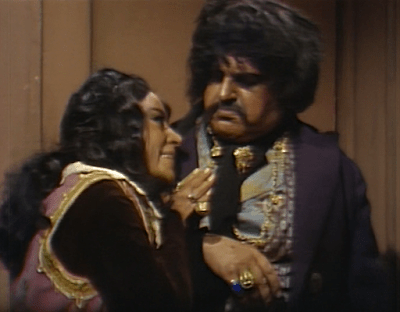
Sandor makes his way back. Magda is overjoyed to see him and throws herself at him with undisguised affection. He responds with his usual grumpiness. At the end, she remembers that they are not alone, and she reverts to their usual form of pretend-quarreling. Their dialogue is great fun, and Grayson Hall and Thayer David make the most of every laugh line:
Sandor: Oh, shut up. I cannot hit you. My arm is too sore.
Magda: Oh, what a brave man you are.
Sandor: Yes.
Magda: What a brave man to fight a zombie, a brave, foolish man.
Rachel: He is a brave man. Thank you, Sandor.
Sandor: I don’t like to see a beautiful lady getting buried before her time.
Magda: But you could have been killed.
Sandor: Yes, that at least would have made you cry. Get me some hot water. My wrist is beginning to swell.
Magda: Oh, so now, I have to nurse you. It is better he should have finished you!
Sandor and Magda are the first happily married couple we have seen on Dark Shadows, and this scene shows them at their very happiest. It is not only a good bit of comedy, it is quite lovely.
Rachel is bookish and intellectually ambitious, very much the sort of young lady you might expect to find in charge of the education of the children in a wealthy family in the late Victorian age. She tells Sandor that she cannot accept that Quentin has risen from the dead and is roaming about as a zombie, even though she has encountered as much evidence of the fact as anyone could want. When Sandor urges Rachel to believe what she has seen, she asks what she will have to believe in next- “Ghosts? Witches? Werewolves?” Sandor affirms that he believes in all of those things, and Rachel replies that she cannot.
Well might Sandor believe in such beings. He is under the power of the new master of the Old House, Barnabas Collins, a vampire. Barnabas rises from his coffin in the basement at dusk, when Rachel is upstairs sleeping. Barnabas knows that Angelique, the same witch who made him into a vampire in the 1790s, is controlling Quentin and persecuting Rachel. When Quentin turns up in the basement, Barnabas remembers a ceremony he saw on Angelique’s home island of Martinique that reunited a zombie’s soul with his body and made him once more a living man. He sends Sandor to the attic to retrieve a packet of letters he wrote to his uncle Jeremiah in those days, describing the ceremony.
Jeremiah’s name will jolt longtime viewers. Angelique raised Jeremiah from his grave as a zombie in #393. Over the next five episodes he initially did Angelique’s bidding, then turned on her. They never did tell us that Jeremiah had returned to his grave, in spite of Angelique’s phenomenally vehement exhortations to him to do so. It’s too bad Barnabas didn’t remember these letters then, he might have been able to un-kill Jeremiah.
Or perhaps not. The ceremony is a total failure today, so maybe Barnabas just doesn’t have what it takes to reunite a soul with a body.
When Sandor and Quentin are fighting in the graveyard, we see a tombstone labeled “Laura Murdoch Radcliffe, born 1840.” The Oxford English Dictionary doesn’t have any examples of the phrase “Easter Egg” meaning hidden content of special interest to devotees until 1986, and for that matter this episode aired a few days before Easter began in 1969. So it is doubly premature to call this an Easter Egg. We learned in #181 that a woman named Laura Murdoch Radcliffe died (by fire!) in 1867, with her young son David in her arms; other Laura Murdochs have died that way in other years, and in #187 the residents of the great house decide that Laura Murdoch Collins is likely to take her own young son David to the same fate. The show has been dropping reminders of the Laura story lately, and any longtime viewers who can read this tombstone will appreciate the reference.
I suspect that the original audience for this particular Easter Egg was pretty nearly limited to the set decorators. The inscription is on screen for less than a second, and it is as clear as it is in the capture above for only a small fraction of that time. It’s hard to see even on a modern television; on a 1960s-vintage TV set tuned to an ABC affiliate, many of which had the worst reception in their markets, it must have been totally illegible to something like 99% of the audience. Moreover, it comes at the end of the fight scene, when most eyes were focused on Sandor’s falling figure. Not very many of the few thousand people who might have had a good enough picture to read the inscription would have been looking at it. And most of the audience who were tuning in at this point had joined the show after Barnabas was introduced, the month after Laura went up in smoke, her name unmentioned since. But in the age of streaming and DVDs, we can all appreciate the reference.
This one is an exercise in nostalgia for people who have been watching Dark Shadows from the beginning.
We remember the days when high-born ne’er-do-well Roger Collins was the show’s chief villain, a man with so little sense of family loyalty that he openly hated his own son. That son, strange and troubled boy David, repaid his father’s hatred by trying to murder him. Roger has been off-screen for over six weeks; when he comes back today, the first thing he sees is the sheriff’s car in the driveway, and the first thing he hears is that the sheriff has come about David. He stiffens, and in a voice dripping with distaste asks “What about David?” When well-meaning governess Vicki explains that David is not suspected of a crime, but is missing, Roger scolds her for failing to earn her pay by keeping track of the boy. He seems to be far more irked by the money wasted on Vicki’s salary than by David’s disappearance.
When heiress Carolyn and hardworking young fisherman Joe come to report on their fruitless search for David, Roger turns his disdain on them, berating them for letting him get away in the first place. Seeing Joe and Carolyn together brings back memories of the early months of the show, when the two of them were dating and there was a whole storyline about how bored they were with each other. For that matter, we were reminded of the first 40 weeks when Vicki hesitated to tell Roger that she had been on a date with her depressing fiancé Burke Devlin- Burke had been Roger’s sworn enemy until he decided to peace out in #201.
Roger agrees to go with Joe on a search of the countryside. When Vicki and Carolyn are left alone in the drawing room, they have a conversation about how tired they both are. Each of them urges the other to take a nap, and each responds that she can’t sleep. Writer Malcolm Marmorstein was fired off the show a few days ago; he was perfectly capable of taking a conversation like that and making a whole episode out of it. Today’s episode is filler from the point of view of the overall plot, but the ludicrous pointlessness of this conversation is a rarity in the post-Marmorstein era.
Roger and Joe’s search is represented in a couple of shots done in front of a green screen showing outdoor locations. That casts our minds back to the black and white episodes, which occasionally spliced in location inserts. Most of that footage was taken before the series started principal photography, and none of it can be reused now that the show is in color. The last of these inserts came in #275, when Carolyn took a walk on the beach. Now Dark Shadows is shut within the doors of 442 West 54th Street forever, and its only memory of the outside is in these green screen shots.
Roger continues his flagrant display of indifference to David throughout this sequence. When he sees men in blue uniforms searching for David, he makes some acerbic comments about the incompetence of the local police.* When Joe points out a nearby cemetery where odd events have been taking place of late, Roger remarks on its dreariness and on the generally low aesthetic standard of cemeteries in central Maine. When Joe suggests searching there, Roger is appalled, and joins him only with loud reluctance.
After Roger says “down” meaning “up,” which is a feature of Collinsport English we heard in #12, In the cemetery, we get another reminder of the show’s past. The Caretaker, a doddering old fool played hilariously by Daniel F. Keyes, had a significant part in the story of Roger’s ex-wife, undead fire witch Laura Murdoch Collins, appearing in #154, #157, #179, and #180, and appeared again in episodes #209 and #211, which dealt with the introduction of vampire Barnabas Collins.
When we find him today, the Caretaker is inspecting the area around the Tomb of the Collinses. Unknown to him, there is a secret chamber hidden inside this tomb. David is trapped in that chamber. The Caretaker opens the door to the visible part of the tomb and asks if anyone is there. He hears David’s voice calling for help from the other side of the wall, and jumps to the conclusion that he is hearing a bunch of ghosts. “There is no help for you!” he cries out. As he hurries away, he shouts, “You must rest!”
David is nothing if not obedient. A minute after the Caretaker told him he must rest, he sits down and falls asleep.
The Caretaker runs into Roger and Joe. He asks them if they are alive. As “You must rest!” harked back to his constant refrain in his previous appearances that “The dead must rest!,” so this greeting echoes his first line in his first scene, when he asked Vicki and her instantly forgettable boyfriend Frank if they were alive. Frank responded to that one calmly; with his personality, it was a question he probably got from a lot of people. By contrast, Joe is disbelieving and Roger scoffs.
When they tell the Caretaker they are looking for a boy named David, he replies “Yes, he is here,” then describes the death of a boy named David who is buried in one of the graves. His compulsion to tell us the circumstances of people’s deaths is another trait of his we remember from the Laura days, especially in his oft-repeated phrase “died by fire!”
The Caretaker tells them that he heard the voices of the dead in the tomb. He urges Roger and Joe to stay away from it. Roger tells him he will be happy to oblige, but Joe insists they search there. Roger declares that he is embarrassed by the very idea of going inside such a place, and says that if anyone finds out he did he will blame Joe. Again, Roger can barely restrain his eagerness to give up the search for David.
David is too deeply asleep to hear Roger and Joe in the outer chamber. Since they are there, Roger decides to take a moment and look at the plaques naming the people buried in the tomb. After all, they are his “incestors – incestors! I mean ancestors.” This is one of the most famous bloopers in the entire series. If Louis Edmonds hadn’t stopped, glanced back at Joel Crothers, repeated “incestors,” and corrected himself, I doubt many people would have noticed it. It was a suprisingly unprofessional moment, but who would have it otherwise? To the extent that the episode is a retrospective of Dark Shadows so far, it wouldn’t be complete without an attention-grabbing mess-up. If the camera isn’t going to drift away from the mark and show a crew member eating a sandwich, “incestors” is the least we can expect.
Since the episode is so much a review of the show’s bygone themes, it is understandable that some viewers are disturbed by a line in the first scene. Roger mentions to Vicki that, while he has just returned from a trip to Boston, matriarch Liz is staying on in that city a while longer. The Dark Shadows wiki objects: “Elizabeth has decided to stay in Boston. This is incredible, since she was still afraid to leave Collinwood a few weeks ago, even hesitant to go to the Old House.”
I don’t find it incredible. Liz’ hesitation about going out was last mentioned in #280, and by #298 she was not only quick to accept Burke’s suggestion that she go with him to inspect a property on the other side of town, but she was the one who talked Carolyn into coming along with them. Neither Carolyn nor Burke expressed surprise that Liz was the one who was enthusiastic about getting out of the house. With that, Dark Shadows told us that it had no further use for the “Liz is a recluse” theme. They may be taking us on a stroll down memory lane today, but they aren’t going to take us all the way to that particular dead end.
*In all fairness, the Collinsport police are exceptionally incompetent.
Yesterday, we saw four men visiting a crypt. They are parapsychologist Dr Guthrie, hardworking young fisherman Joe, instantly forgettable young lawyer Frank, and the unnamed Caretaker of the old cemetery. They witnessed an uncanny event when the ghost of Josette Collins opened the coffin of Laura Murdoch Stockbridge, who died (by fire!) in 1767.
The ghostly intervention was disturbing enough in itself, but when the four men saw that the coffin was absolutely empty they had to change their ideas. Before Josette took action, the Caretaker had vowed that he would die rather than let a grave be disturbed. After they have seen the empty interior of the coffin, Guthrie asks him about another grave he wants to dig up and the Caretaker gives him directions. Frank had shouted at Joe and Guthrie that they would go to jail if they didn’t immediately stop disturbing the crypt, but now he agrees to go to the other grave and help dig. Joe had joined Guthrie only with utmost reluctance and had wanted to stop when the Caretaker first showed up, but now he is the one who points out a toolshed from which he volunteers to grab some shovels.
The second grave is that of Laura Murdoch Radcliffe. In 1867, just one hundred years after the fire that killed Laura Murdoch Stockbridge, Laura Murdoch Radcliffe died the same way. What’s more, a woman initially identified as Laura Murdoch Collins died (by fire!) in Phoenix, Arizona earlier in 1967 and her body inexplicably disappeared from the morgue some weeks after her death. Evidently Guthrie’s hypothesis is that graves will both be empty, because the body of each Laura Murdoch disappeared after death. He also surmises an otherworldly connection between these three dead and vanished Laura Murdochs and the apparently alive Laura Murdoch Collins who has been hanging around the great estate of Collinwood for a couple of months.
Back in the crypt, the Caretaker is delivering a soliloquy. He thinks Guthrie, Joe, and Frank are wasting their time trying to learn secrets from the dead. He has information he could share if they would stay and listen to him. He remembers that there was something strange about the death of Laura Murdoch Radcliffe, and that a book about the Radcliffes is on the shelves in the crypt. He looks through the book and finds the information. “The child!” he exclaims.
Laura Murdoch Collins materializes in a dark corner and strikes up a conversation with the Caretaker. As her talk grows more and more mystifying, the Caretaker looks confused, as if he has never before been the least weird person in any room.
Laura’s appearance gave us (Mrs Acilius and I) two grounds for fear. Our first fear was that Laura might kill the Caretaker. We could easily imagine Guthrie, Joe, and Frank coming back to the crypt to find it in flames, the records kept there in ashes, and the Caretaker dead (by fire!) We like the Caretaker, and want to see him in future episodes.
Our second fear was that Laura would go to the grave of Laura Murdoch Radcliffe and interrupt the exhumation. What we dreaded about that prospect was that it would slow the story down. Yesterday’s show moved at a nice clip, and while today does not match it, at least some things are happening to advance the plot. In the last several weeks, the pace has alternated between glacial and dead stop. So the idea of yet another delay is well worth a shudder.
Laura Murdoch Collins examines the coffin of Laura Murdoch Stockbridge
There is a moment when it seems that Laura will go to stop the men. The Caretaker tells her that they have gone to the grave of Laura Murdoch Radcliffe, and starts to give her directions. She tells him not to bother explaining where it is. Laura doesn’t speak the line “I’ve been there before,” but Diana Millay’s eyes communicate the thought to the audience. Having already seen her inspecting the inside of Laura Murdoch Stockbridge’s empty coffin, we know that she is on a tour of her old neighborhood.
Laura Murdoch Collins doesn’t need directions to the grave of Laura Murdoch Radcliffe
For whatever reason, Laura does not interfere with Guthrie, Joe, and Frank. They dig up the coffin of Laura Murdoch Radcliffe. They open it and look inside. Guthrie asks “What do you see?” Frank replies “What you thought we’d see.” There it is, a bullfrog in a top hat singing “Hello, My Baby.” Oh no wait, I changed the channel there for a second. On Dark Shadows, the answer is “Nothing. Absolutely nothing. An empty box. It’s almost like it’s always been empty.” No wonder we’re still watching the show after all these years, where else can you find thrills like that.
Hello, my ragtime gal
The Caretaker is talking to Laura and looks down for a second. When he looks up, he is baffled. We cut back to the spot where she had been standing, and it is vacant.
Guthrie, Joe, and Frank return to the crypt. They apologize for having been away for so long. The Caretaker tells them they have only been gone for a minute or two. They are puzzled. They find the book about the Radcliffes, and discover that a portion of a newspaper clipping containing an account of Laura Murdoch Radcliffe’s death has been erased, as by an intense light generated by a fire. This leaves us wondering why Laura erased only that section of the clipping, calling attention to it, when she could just as easily have set fire to the book and destroyed the whole thing.
It’s a relief that the Caretaker survives to dodder another day, and a relief that Guthrie, Joe, and Frank complete their business in the cemetery and free us to move on to the next story point. As Guthrie, John Lasell was visibly bored yesterday; today his part is smaller, but he is back on his game, and the others are good too.
Daniel F. Keyes has some particularly good moments as the Caretaker. Yesterday he struck the heroic note when he told Guthrie and Joe that they would have to kill him before they could open the graves, and he made that a powerful moment. Today, he shows us both how lonely the Caretaker is, and why he cannot escape that loneliness. The feeling is painfully raw in his soliloquy about the information he could give if only the others would listen, and his exaggeratedly careful movements and other mimicries of a fragile old age give that rendition of helpless, desperate loneliness an extra punch. His interaction with Laura is even more interesting- while he lives too much in the world of ghosts and taboos to be at home with the living, he is too much a part of the this-world institution of the cemetery and of its rational, bureaucratic routines to know what to do when he encounters an otherworldly being face to face. He is entirely alone, caught in the interstices between the natural and the supernatural, unable to communicate with the denizens of either realm.
Today is the last time we will see actor Conard Fowkes and his character, Frank. I call him “instantly forgettable young lawyer Frank” because, while Fowkes consistently does an excellent job of embodying whatever Frank supposed to be at any given moment, he never gives the feeling that there is anything else under the surface. I keep wishing Frederic Forrest, who danced at the Blue Whale in #137, had been cast as Frank. Forrest could have created a convincing character while also giving a sense of a goofy, engaging personality inside whatever Frank is in any given scene, so that you not only appreciate each turn but also wonder what is coming next. Each time you see Fowkes, you can recognize that he presented exactly what he was supposed to present, but he never drops a hint that anything different might be coming. Still less does he leave you wanting more.
Today, Frank is supposed to be chastened by the sight of what Josette did and willing to join Guthrie and Joe in their exhumation. He is the very image of “Chastened.” Yesterday, he was indignant about Guthrie and Joe’s lawless behavior. A still of him from that episode would have been a fine illustration for a dictionary definition of “Indignant.” In #169, he was haggard and concerned about the mysterious illness gripping reclusive matriarch Liz. Again, he was a faultless model for “Haggard and Concerned.” When we first saw him in the offices of his firm in #92, he was so much the fellow you would expect to meet in a law office in Bangor, Maine in 1966 that you felt like you were reading a writ of replevin.
In a way, Fowkes was an excellent actor. Unfortunately, it wasn’t the way in which a regular member of the cast of a scripted television series ought to excel. The proper medium for him would be something more static, such as filmstrips or View Master reels, in which we could stop and look at him as he demonstrated various moods and personality types. I suppose he might also have been an outstanding mime. Fowkes was always pleasant, and in her scenes with him Alexandra Moltke Isles has a chance to show aspects of the personality of well-meaning governess Vicki that we never see in any other setting. So I’ll miss him, but I’d have missed Forrest a whole lot more.
John Lasell is a tremendous actor, and was electrifying when he first appeared on Dark Shadows as parapsychologist Peter Guthrie in episode 160. But four weeks of endless recapping has taken its toll on him. In today’s pre-credits sequence, recreating yesterday’s final scene, we see what it looks like when John Lasell is bored.
Dr Guthrie and hardworking young fisherman Joe have arrived at the door to a mausoleum which houses a grave they plan to break into. Finding that he cannot turn the knob to the building’s front door, Guthrie says “It’s locked.” More precisely, he whines “It’s laaaakt.” The character has several sides, but this is the first time we’ve seen him as a cranky five-year old. As the two of them fumble about, Guthrie at one point lifts Joe’s tool box, gestures towards the inside of it, and says “Try this.” Try what, all of his tools simultaneously? When the door mysteriously opens, Guthrie takes a beat before he turns to look at it, and he never does get around to looking surprised.
They enter the crypt. Guthrie shines a flashlight directly into the camera. Characters on Dark Shadows do this so often that it must be intentional, at least to the extent that the directors resigned themselves to letting actors get away with it, but it always looks like a mistake. It’s especially jarring here, when John Lasell is himself looking into the camera when he shines the light in our eyes.
Hey Guthrie, are you a doctor of optometry?
Once Guthrie and Joe have found the vault housing the coffin of Laura Murdoch Stockbridge, they quarrel about whether to go through with their plan. They go through the same arguments they used in their scene in the drawing room of the great house of Collinwood yesterday. As yesterday, Joel Crothers manages to put enough verve into Joe’s mixed emotions that he is interesting to watch, but Lasell simply cannot bring himself to commit to another tired rehash. The only thought his performance in this scene brings to mind is puzzlement as to what happened to Guthrie’s glasses.
Back at Collinwood, instantly forgettable young lawyer Frank charges into the drawing room and demands that flighty heiress Carolyn tell him where Guthrie is. She replies that Guthrie swore her to secrecy. Frank says that Guthrie had called him shortly before to ask about a plan that might get him sent to jail. Frank asks Carolyn if Guthrie has gone to the crypt at the old cemetery. Faced with the prospect that Guthrie and Joe might land in jail, Carolyn admits that they are both there.
Guthrie and Joe try to pry Laura Murdoch Stockbridge’s nameplate off the wall of the crypt. They keep talking about how the whole thing might as well be a single block of stone. The actual wall keeps springing back in a way that only cheap grades of plywood do, undercutting this dialogue and requiring the actors to put more and more effort into keeping it from falling down. By the end of the sequence, both of Joel Crothers’ arms and one of John Lasell’s are holding the wall up, so that Dr Guthrie has to remove the supposedly massive nameplate with one hand. Even the blocking isn’t up to director Lela Swift’s usual standards- most of what we see in this sequence is the back of John Lasell’s coat. Considering what’s going on with the set, that may not be such a bad thing.
After Joe and Guthrie get the nameplate off the wall, Crothers flashes a look at Lasell that shows he is struggling to keep a straight face. Lasell’s boredom saves the take- if he had been intellectually available enough to notice Crothers’ twitching lips, he would have burst out laughing:
Straight face
The coffin is quite large and apparently very heavy. Guthrie and Joe put all their strength into carrying it a few feet. They then place it on a miniature tea stand.
Sure, that’ll hold, why not.
Guthrie fits a wedge under the lid and holds it while Joe swings a hammer. The elderly Caretaker enters and orders them to stop. If only for the sake of the tea stand, this command comes as a great relief.
The Caretaker tells Guthrie and Joe that they won’t open the coffin unless they kill him first. That doesn’t stop Guthrie’s efforts to win him over, but it is enough for Joe. Frank shows up. He apologizes to the Caretaker and yells at Guthrie.
Guthrie tries to explain himself to Frank. When Frank tells him that a court would likely respond to his hypotheses by committing him to a psych ward, Guthrie responds “Well, doesn’t that prove my point halfway?” When Frank asks how, Guthrie says “Wouldn’t a court… um… would a court be more sympathetic… uh… before the point? My reasons? Than after?” I’m sure that was not how it was phrased in the script, but I can’t imagine that whatever was written there made any more sense. Guthrie’s behavior is so preposterous today that it is understandable John Lasell didn’t bother to put in much of a performance. Still terribly disappointing, and quite unusual to see him as the weakest member of the cast. The rest of them all do very well in this well-paced, if not particularly well-mounted, episode.
The three men are about to leave the crypt when Joe says he detects a flowery scent. Guthrie asks if it is the scent of jasmine- the sign that the ghost of Josette Collins is near. Joe doesn’t know what jasmine smells like. The Caretaker can just about make out the scent of jasmine, far away, as if it were wafting in from the sea. In a reprise of a moment from #154, when the Caretaker told Vicki the same thing, Joe protests that the scent is not far away at all. It is flooding the room, is overpowering, is coming from behind an obstacle in the crypt.
The coffin opens itself, evidently the result of Josette’s action. The men gather round and look inside. It is empty- no bones, no dust, no sign that there ever was a body inside. Guthrie’s hypothesis, that the body of Laura Murdoch Stockbridge vanished after burial, is confirmed.
Eventually, Dark Shadows became the kind of pop culture phenomenon that even people who never saw the show couldn’t really avoid. Most such things spawn catchphrases that become widely familiar and remain so for years. Think of Star Trek with “Beam me up!” or “Warp speed.” To my knowledge, Dark Shadows was an exception to that, with no phrases or expressions spreading beyond its fans. But if it had already been a hit when today’s episode aired, I think a character we meet in it would have been the source of two catchphrases. That character is Cemetery Caretaker, played by DanielF.Keyes.
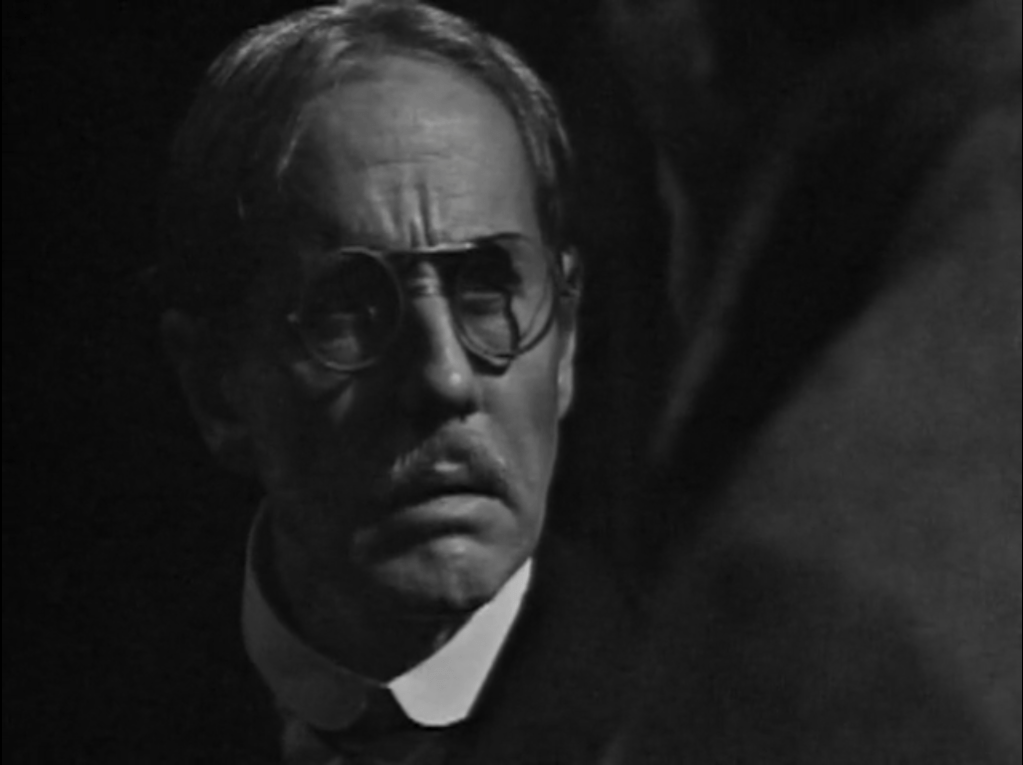
Under the influence of the ghost of Josette Collins, well-meaning governess Vicki has ordered her boyfriend, instantly forgettable lawyer Frank, to take her to a graveyard out in the country someplace. Vicki knocks on the door of a building there, and at length an aged figure in a celluloid collar and wire-frame glasses opens the door. He stands mute for the first minute Vicki and Frank talk to him. When he finally starts speaking, he asks them if they are alive.
Guy’s got star quality
Frank doesn’t show any surprise at the question. You wouldn’t really expect him to- with his personality, he must get that a lot. He assures the caretaker that yes, he and Vicki are alive. The caretaker explains that he often hears knocking at the door, but it is usually the unquiet spirits of the dead.
Some months from now, the caretaker will introduce his second memorable phrase, “The dead must rest!” At this first appearance, we learn why they must. If the dead aren’t resting, they’re going to be keeping him awake all night, and he has things to do in the morning.
Frank tells the caretaker that they are lost. Vicki contradicts him and insists that this is where she is supposed to be. Frank apologizes for bothering him and tries to go; Vicki insists on staying. The caretaker lets them into the building.
Inside, Vicki and Frank find a strange combination of archive and mausoleum. By the standards of Dark Shadows, it’s a big, elaborate new set, a definite sign that something important is happening.
The front room of the caretaker’s buildingVicki examines one of the bookcasesEntering the archive areaIn the archive area
Vicki keeps talking about how fresh the air is, and how full of the scent of jasmine. The caretaker is bewildered by her words, and Frank says the only scents he can detect are must and mold. The audience knows that the scent of jasmine is a sign that the ghost of Josette Collins is trying to attract a character’s attention.
Vicki declares that the source of the scent is in a connected room. The caretaker is reluctant to let Vicki and Frank into that room. He says that it is the final resting place of those members of the illustrious Stockbridge family* who died particularly gruesome deaths. Vicki pleads with him, and he gives in. He does insist that while in the crypt, they must be very quiet- “So quiet, even they can’t hear.”
Entering the crypt areaExamining a plaque
The caretaker talks in a not-particularly hushed stage voice the entire time they are in the crypt, so he must not think the dead have such great hearing after all. He tells the stories of the crimes and accidents that took the lives of each of the people whose remains lie behind the large stone plaques on the wall. When he comes to the last of them, L. Murdoch Stockbridge, Frank interrupts him. “L. Murdoch! I’ve seen that name on legal documents around the office a hundred times!” Frank is handling the divorce of high-born ne’er-do-well Roger Collins from his mysterious and long-absent wife, Laura Murdoch Collins.
Examining THE plaque
Frank asks about L. Murdoch Stockbridge. The caretaker doesn’t know what the L. stood for. He does know that she was a woman, and he can describe the circumstances of her death. One night in 1767, a candle set the curtains around her bed ablaze, and she burned to death. Such remains as are in the niche are little but ashes. He says, and then repeats, “L. Murdoch Stockbridge died by fire! L. Murdoch Stockbridge died by fire!” Once Vicki learns about L. Murdoch Stockbridge, the scent of jasmine disappears and she is in the same dank musty space as Frank and the caretaker.
I heard she died by fire
It’s been three years since Mrs Acilius and I first saw these episodes, and I can still make her laugh by putting on an old man voice and saying “Died by fire!” Sometimes we find ourselves in situations where everyone is being very serious, and someone mentions that a person “died by fire.” I glance at her, and find her biting her lip to keep from laughing out loud. That’s why I say that if Dark Shadows had been at the peak of its popularity in January of 1967, “Died by fire!” would have been one of the great pop culture catchphrases of the period.
Back at the great house of Collinwood, wildly indiscreet housekeeper Mrs Johnson comes into the drawing room while Roger is at his usual station, leaning on the cabinet where the brandy is kept and draining a snifter. She asks him if she can bring him anything. Those are the words, but the voice spells out a stern sermon about the evils of alcohol. Roger goes to sit down, saying nothing of consequence but saying it in a way that makes clear he dislikes and resents her.
Laura enters. Roger sends Mrs Johnson off to make coffee. Alone in the drawing room, Roger and Laura argue about all the things they have been arguing about since she returned from her long absence. There is no new information in the dialogue, but it is good to see another side of Roger. Lately we’ve seen him almost exclusively as the bratty little brother of reclusive matriarch Liz, and his interactions with other characters are dominated by the narcissism that is most fully expressed in his scenes with Liz. When he is the unloving father of strange and troubled boy David, the unsettlingly flirtatious uncle of flighty heiress Carolyn, the cowardly foe of dashing action hero Burke Devlin, or the malign co-conspirator of drunken artist Sam Evans, we see vices that we can trace back directly to his certainty that Liz will always shelter him from the consequences of his actions, whatever they may be. When he stands up to Laura in this scene, we see that there is a semi-functional adult somewhere inside Roger.
Roger and Laura realize that Mrs Johnson has been eavesdropping on their conversation. They are worried about what she might have heard. They do not know what regular viewers know, that she is a paid agent of Roger’s enemy Burke, placed in the house to spy on the Collinses. They do know that she has a big mouth, though, and since the last words they spoke were about a crime they want to keep covered up that’s enough to give them pause.
Frank brings Vicki home to Collinwood. Standing outside the front door, they remark on the caretaker’s frequent muttering of “died by fire! Died by fire!”
Reviewing their visit to the caretaker
Vicki reviews all of the strange occurrences that have taken place since Laura’s return. She sums up the whole course of any story about people investigating the supernatural- “It seems connected- and yet so unconnected.” By the laws of nature as science describes them, by the ordinary logic of waking life, none of the events she lists means anything. It’s only after you accept the idea that uncanny forces are at work that they form a pattern pointing to Laura. The audience can accept that, because we can hear the theremin on the soundtrack. Vicki and Frank have a harder time.
Frank tells Vicki he has to get home. She invites him in for a drink. He replies “You make it a stiff one, and you’re on!” That’s what you need before a long drive on dark, winding roads, to get tanked up on a lot of booze. They open the doors and walk into the house. The camera dwells on them as they make this procession. As they had gone through doors that led to L. Murdoch Stockbridge, now they go through the doors that lead to L. Murdoch Collins.
Entering the house
Vicki and Frank join Roger and Laura in the drawing room. The men drink brandy, the women sip coffee. Vicki asks Laura about her family background, claiming that David is curious about it. Laura responds merely that her family is a distinguished one and had been in the area for a long time.
Roger tells Frank that he will be hearing from Lieutenant Riley of the state police tomorrow. Laura objects that she doesn’t want to talk about Riley’s message, Roger says there won’t be any conversation- he will simply announce the lieutenant’s laughable news. The authorities in Phoenix, Arizona are convinced that a charred corpse found in Laura’s apartment there is hers, and that she died when the apartment building burned to the ground. Vicki looks at Laura, and with a strange smile says “Laura Murdoch Collins died by fire.”
“Laura Murdoch Collins died by fire”
*The caretaker was deeply versed in the lore of the Stockbridge family, and told Vicki and Frank that most of the graves in this eighteenth century cemetery were theirs. Yet he showed no glimmer of recognition when Vicki mentioned Josette Collins to him. That suggests that the Stockbridges were leading citizens of the area before the Collinses rose to prominence.
It might be interesting if someone would write a story in which the first Collinses were servants of the Stockbridges who got rich by doing their dirty work. Maybe the first and darkest shadow of all was that some colonial Collins scabbed on his fellow employees when they were trying to get a fair deal from the Stockbridges. I’m not up on Dark Shadows fanfic, for all I know there may be whole novels out there on this theme.







 Dark Shadows Commentary