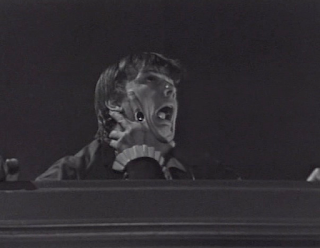
Episode 643: Magda, whoever she is

The whole episode takes place within the great house of Collinwood. We start with conversations between heiress Carolyn Collins Stoddard, mysterious drifter Chris Jennings, and sarcastic dandy Roger Collins. They are trying to determine the significance of the events of a séance that took place yesterday, during which Carolyn was possessed by the spirit of someone named “Magda.” This name is unknown to anyone in the house.

Through Carolyn, Magda uttered a command to “Stop them!” because “My curse!” means that “He must stay where he is!” Returning viewers know that Chris’ little sister Amy and Roger’s young son David are in touch with the ghost of Quentin Collins, a great-uncle of Roger’s who lived in the late nineteenth century and whom the family history falsely records as having gone to France and died there. We can assume that Magda was a contemporary of Quentin’s, that he is the one who must remain where he is, and that she means the children when she says “Stop them!” But none of the adult characters knows what Amy and David are up to, and Magda’s words mystify them.

Roger is alone in the drawing room while Carolyn is showing Chris out of the house. He is about to take care of some work he brought home from the office when a book flies off the piano and lands on the floor. He finds a letter tucked in the book. Carolyn comes back, and he tells her what happened. He says that the letter is addressed to his father, Jamison Collins; this is the first time we have heard Jamison’s name. He says that it is dated 1887, when Jamison would have been a boy. And he tells her that it is signed “Quentin.” With a look of recognition, he says “We have a Quentin Collins as an ancestor. Actually, I didn’t know very much about him. I think he spent most of his time abroad.”

Roger reads the letter to her. The text is: “Dear Jamison, you must return to Collinwood. I need your help. You must intercede with Oscar. Only you can save me.” Considering how the book spontaneously leapt from the piano, Carolyn is sure that Magda’s ghost must have wanted them to read the letter, and that she is trying to warn them that someone in the house is in danger. It calls Quentin to their attention.

Roger goes upstairs to check on David. As it happens, Amy is in David’s room at the time, and they are about to go looking for Quentin’s ghost. They know that the adults will not tolerate this, and so David jumps into bed and Amy hides behind the door. There is some farcical business as Roger starts to go, Amy starts to come out, then he stops and she scurries back to her hiding place. Once his father is gone, David tells Amy that it was very unusual for him to drop in. “He never says good night to me.”

When Roger returns to the drawing room, Carolyn, who a few minutes ago announced that someone in the house- “It could be any one of us!”- was in imminent danger, asked Roger why he was “suddenly so concerned about David.” Even longtime viewers who remember Roger as the phenomenally bad father he was in the first 38 weeks of the show will think that this is overdoing it. After all, Magda’s warning to him and Carolyn came in the form of a letter addressed to a boy, and David is the only boy in the house. It is natural enough that the reference to Jamison would bring David to mind.

Amy had slipped into David’s room while he was sleeping. She woke him to say that Quentin was angry because “Something has happened.” She knows nothing about the séance or the conversations going on downstairs, and so cannot share our conjecture that Magda is an old enemy of Quentin’s and it is her activities that are disturbing him. David is at first reluctant to get up and irritated when Amy wants to contact Quentin. As he grumbles at her, they begin to sound like an old married couple, even though they only met on Monday and are eleven years old.

David grudgingly agrees to pick up the antique telephone through which he has heard Quentin’s breath and Amy has heard him speak. The breath is audible, and when he gives the receiver to Amy she hears Quentin says that “she would try to stop” them. He didn’t specify who “she” was, but Amy has drawn the conclusion that they should go to the room in the long deserted west wing of the house where they originally found the telephone and contacted Quentin. Every time David resists her ideas, Amy strikes exactly the note that will lead him to do what she wants. At one point, Amy tells David “You’re braaver than I am!” to which he bluffly replies “Because you’re a girl!” He then presses forward with the plan she had formulated.

You know how kids are, always on their phones. Screenshot by Dark Shadows Before I Die.

The children find that the door they had previously used to get into the west wing is now locked. David says that there is another way in, but that it is a secret very few people know about. He leads her to the door of the drawing room, only to find that Roger and Carolyn are still in there. They hide. Once the coast is clear, David leads Amy to a secret panel behind a chair next to the fireplace. We have seen this panel before, in #87. On that occasion, Roger had used it to sneak into the west wing unobserved and release well-meaning governess Vicki from the room to which David had confined her, hoping that she would die. It was unclear whether anyone other than Roger knew of its existence. We haven’t seen it since. Dark Shadows‘ ratings were very low in October 1966, and most of the people watching now hadn’t heard of it then. So when David says that very few people know about the secret panel in the drawing room, his words apply to the audience as well as to the characters.

David opens the panel. He and Amy go into the passage. When the panel is closed behind them, we see the chair move itself back into place in front of it, suggesting an occult power is at work.

David and Amy encounter various signs of supernatural opposition as they make their way to the room. At one point Amy sounds genuinely frightened and suggests turning back, but she has done her work too well- David is now determined to prove his courage. Once they are in the room, the door slams shut and they find that they are trapped. Longtime viewers who remember what David did to Vicki way back when will see an irony in his captivity in the west wing.

Skillful as Amy is in her management of David Collins, Denise Nickerson and David Henesy haven’t quite figured out how to work together yet. They had very different styles of acting, his coming from inside out as he uses his lines and stage directions to project the character’s feelings and intentions, hers coming from outside in as she throws herself into whatever the character is doing at the moment and finding her inner life through those. She is on top of her form right from the start, but he keeps getting thrown off, atypically mangling his dialogue several times and putting the emphasis in odd places in the lines he does get right. That won’t last long- soon David and Amy will be a “supercouple,” as fun to watch together as any other pairing on the show. But this episode is a bad day at the office for Mr Henesy.

Danny Horn’s post about this episode on his Dark Shadows Every Day takes the bits and pieces of information that will fit well with continuity months down the line, contrasts them with the bits and pieces that won’t, and focuses on a case that the writers didn’t have any plan in mind when they were writing the show. I think Danny simultaneously goes too far and not far enough with this point.

In a 1991 interview that Danny himself put online, writer Violet Welles confirmed that the writing on Dark Shadows, as on other soaps, began with a six month story projection that the writers would break down into “flimsies,” day by day outlines of how it might all play out. No one was going to force them to stick with those projections, much less with the flimsies, but creating them meant that the writers spent a lot of time kicking ideas around for possible plots and possible characters. They also meant that there were stacks of paper recording those ideas, so if someone suggests in November that Quentin might have been enemies with a witch named Magda, it won’t require a feat of memory to recall that suggestion in January. So it is going too far to dismiss all thought of a connection between what the characters say today and what we will see next year.

But he doesn’t go far enough when he suggests that the pressure the writers were under to crank out five scripts a week would have kept them from planning for events we wouldn’t see for several more months. They were indeed subject to impossible deadlines, and they did indeed have to improvise at the last minute. So much so that they did not know whether any given event would happen next week, next month, six months from now, or not at all. They may well have planned a story out in detail thinking they might need it soon, only to have it sit on the shelf until next summer.

I always try to write these commentaries as if I hadn’t seen any of the subsequent episodes, so when I mention foreshadowing I try not to say whether or how it will pay off. I also try to write from a perspective that would have been more or less possible for someone watching the show when it was originally broadcast, so when foreshadowing does pay off or when in other ways an episode echoes something we had seen earlier I try to note that echo first and to speculate about what it might mean later, confining any references to information that became public afterward to the bottom of the post. So I won’t quote the particulars of Danny’s argument, or of my comment on it. I hesitated to say as much as I have about Magda, but when I tried to make the same point without using names the results looked like algebra (“Let x be a ghost and y be a witch. Suppose that x and y lived in the same period; call this period P.”) Since the episode leans so heavily into the relationship between Magda and Quentin today, I resigned myself to the spoiler.

Episode 603: Almost on the point of believing it

Today is devoted to non-supernatural stories. More precisely, we should call them post-supernatural, because they show people dealing with the aftermath of spells and curses.

The episode consists largely of solo performances. As troubled matriarch Liz, Joan Bennett has two scenes in which she is alone with her own voice in a recorded monologue. Dark Shadows has long used these monologues when characters were alone on screen and their faces would silently show how they felt about the thoughts their voices expressed on the soundtrack, but recently it has been experimenting with new ways of deploying them. For example, #581 marked the first time this device was used to share the thoughts a character was having in the middle of a conversation. Today Liz has a remarkably intense debate with her own recorded voice, first in her bedroom, later in an old graveyard.

Some time ago, wicked witch Angelique cast a spell causing Liz to be obsessed with death. Since then, Angelique lost her power and died. But Liz had been the victim of similar spells before, and is prone to depression in any case, as witness the fact that she once holed up in her house for eighteen years. So even if the spell broke when Angelique was de-witched, it makes sense Liz would continue to suffer the psychological damage it inflicted on her.

Between Liz’ two solo scenes, her brother Roger knocks on her bedroom door, This scene lasts less than a minute, but Louis Edmonds shows us a variety of emotions as he talks to Liz through the door, then opens it and finds she is not there. His discovery that he was giving a soliloquy when he thought he was having a conversation makes for a different kind of solo scene.

The other post-supernatural story concerns well-meaning governess Vicki and her ex-fiancé, an unpleasant man named Peter who insists on being called Jeff. Angelique became a vampire after her most recent death, and for a time she took Peter/ Jeff as her victim. The effects of the vampire’s bite made it impossible for Peter/ Jeff to sustain his relationship with Vicki. Peter/ Jeff has been freed from Angelique’s influence, and even his memory of the experience has been erased. Today he comes to ask Vicki to take him back. But he can explain nothing to her about what happened to him. Vicki is frustrated with Peter/ Jeff. Feeling that he does not trust her enough to tell her what happened, Vicki rejects Peter/ Jeff’s attempt at reconciliation. Alexandra Moltke Isles plays Vicki’s frustration with great force. Considering that her scene partner is the lamentable Roger Davis, this, too, qualifies as a solo performance.

Dark Shadows never had more than three credited writers producing scripts at a time. Often it had only two, and there were stretches when a single writer would have to crank out a script every day for weeks. Since they worked under those conditions, the writers’ methods would often be made obvious. So, Art Wallace, who was credited as the writer of the first 40 episodes, started by crafting the structure of an episode, and fitted incidents and information into that structure as time permitted. Ron Sproat, another very prolific contributor, also put structure first, sometimes resulting in a slow-paced script. Today’s author, Gordon Russell, seems to have taken the opposite approach, cramming each script with action and letting the material shake itself out as best it could. So there is some interesting stuff in this one that doesn’t really connect to anything.

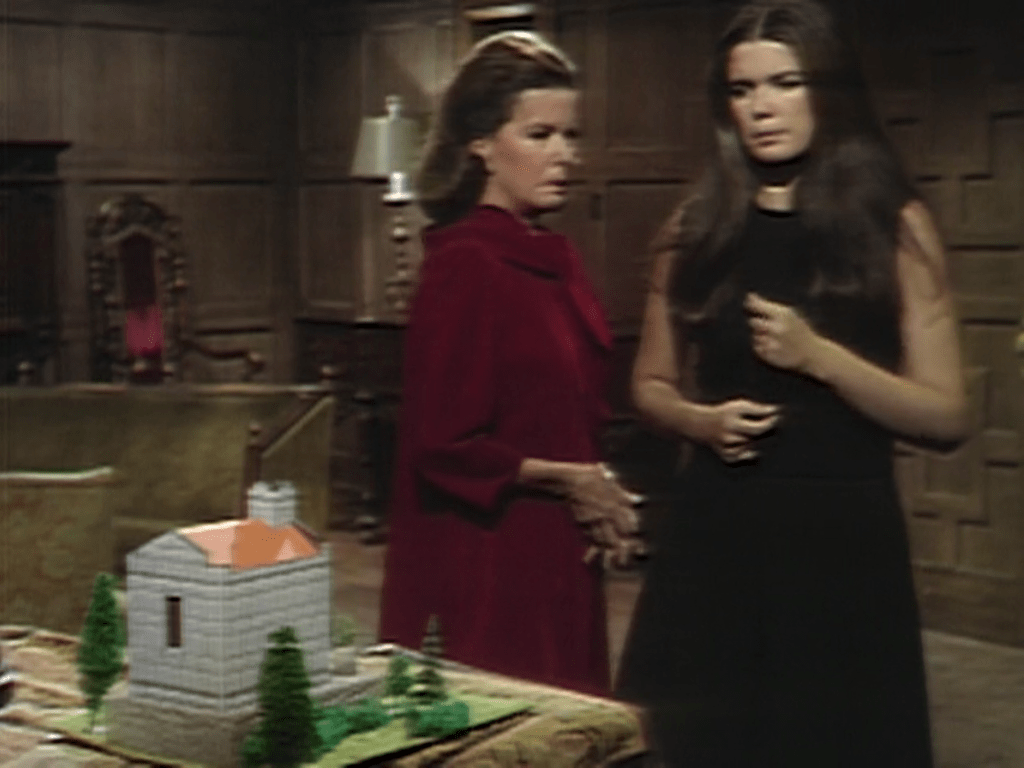
For example, we open today with Liz contemplating an architects’ model of a mausoleum. It really is a lovely little thing.

We have a scene where Vicki is horrified by the idea of the mausoleum. Liz insists Vicki be her voice after her death and stand up to her family for her, seeing to it that she is buried in the mausoleum as she wishes. The show hinted very heavily for a long time that Vicki is Liz’ unacknowledged daughter, but they dropped that a long time ago. As it stands, Vicki is a member of the household staff. As such, she would put herself in an awkward position were she to oppose the family’s wishes after Liz’ death.

Roger enters, demands that Liz forget about everything related to death, and smashes the model. That’s all very dramatic, but it doesn’t make any sense. Though he might well be distressed at Liz’ fixation on the idea that she will soon be buried alive, everyone dies eventually, and rich people often build elaborate mausoleums. Roger’s assertion that the architects must think they are humoring an insane woman and the villagers are all laughing at her is just as nonsensical as his domineering attitude is unconnected to his character as it has been developed up to this point. All of it is entirely irrelevant to the progress of the story.

After that, Liz leaves the room, and Roger talks to Vicki for a bit. He says that Liz’ trouble seemed to start when he married a woman named Cassandra. Unknown to him, Cassandra was actually Angelique in a wig. He tells Vicki “We’ve never been very lucky in love, you and I, have we?,” and edges closer to her. This may come as a bit of a jolt to longtime viewers. In the early days of Dark Shadows, there were a few hints that Vicki and Roger, who are after all modeled on Jane Eyre and Mr Rochester, might strike up a romance. Since they are both single, all of a sudden it seems possible they might get together after all.

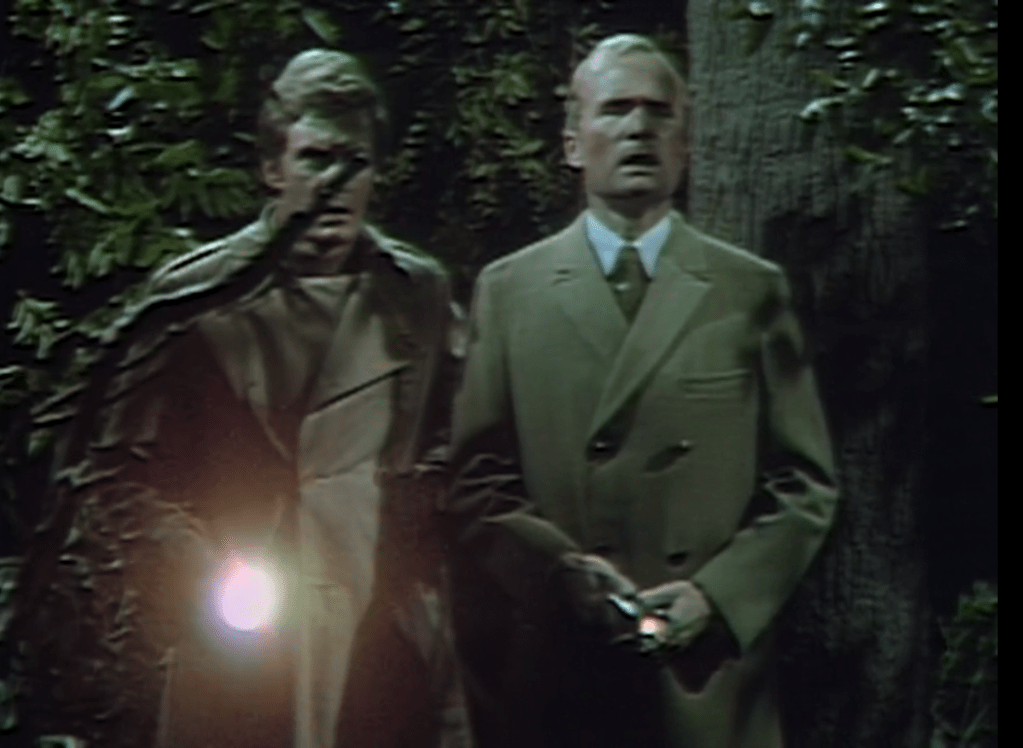
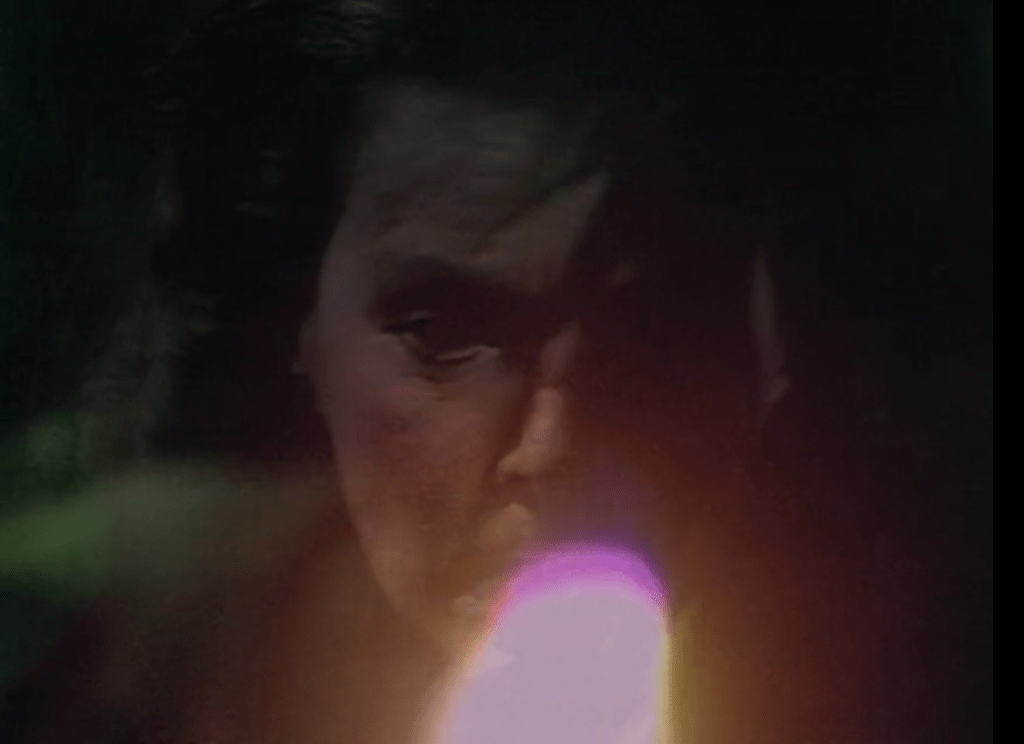
Later, Roger and Peter/ Jeff are outdoors looking for Liz. Each of them shines his flashlight directly into the camera. This is a Dark Shadows trademark. Sometimes it is clearly accidental; Peter/ Jeff does it once, briefly, and that may be an accident. But Roger does it twice, and each time the camera lingers on it. The first time comes as we cut from Liz in the graveyard to Roger and Peter/ Jeff, the second time as we dissolve from them back to Liz.

Cut to a closeup on Roger’s flashlight
Peter/ Jeff accidentally shines his flashlight directly into the camera
Dissolve to Liz from a second closeup on Roger’s flashlight

Liz is at the grave of Peter Bradford, which is to say Peter/ Jeff. He died in the 1790s and returned from the dead in March, a fact which is obvious to the audience and to Vicki but which he persistently denies. These denials are pointless and dull, but are the closest thing Peter/ Jeff has to a personality, so we can’t very well blame him for sticking to them. Peter/ Jeff finds Liz at his grave; she recognizes him as the dead man and faints. He carries her home. If there is any significance to any of this, it is apparently none of the audience’s business. The script certainly isn’t going to show us what it is.

Episode 553: The five captivities of Victoria Winters

The First Captivity

In #83, strange and troubled boy David Collins repaid his governess, the well-meaning Vicki, for her determined attempts to befriend him by locking her in a room where he hoped she would die. The room was located deep in the long-deserted west wing of the great house of Collinwood, and Vicki found that she could neither open the door nor reach the window.

Vicki had two visitors during her time trapped in this dusty chamber. In #85, the ghost of local man Bill Malloy appeared and sang to her; this was the first sustained and direct interaction between a living person and a supernatural being on Dark Shadows, and it left Vicki terrified and confused. In #87, David’s abusive father, high-born ne’er-do-well Roger Collins, knocked on the door and pretended to be a ghost, scaring Vicki further. When Roger then opened the door and rescued Vicki, she threw her arms around him, sobbing and saying that he was right and David really was a monster. In those days, Vicki’s attempt to win David over was the only storyline on the show that worked; when it seems that she will join all the other grownups in giving up on the little guy, the audience’s hearts break.

The Second Captivity

In #108, Vicki had come to the conclusion that Roger killed Bill. Unsure where to go, she stopped in the cottage on the estate where handyman Matthew Morgan made his home. Talking to him, she prompted him to make an indiscreet remark that revealed that he, not Roger, pushed Bill off the cliff from which he fell to his death.

Matthew would not let her leave the cottage. He acknowledged that she had done nothing wrong, but said that he would have to kill her now that she knew his secret. She tried to dissuade him, but it was only a chance visit from matriarch Elizabeth Collins Stoddard that prevented the murder. Matthew ran away, and Vicki was free.

The Third Captivity

In #116, Vicki went to look for David in the long-deserted Old House on the estate. She did not find him, but instead found Matthew, a wanted fugitive with a grudge against her. Until #126, Matthew kept her bound and gagged in the secret room behind the bookcase in the front parlor.

Others came and went. David, no longer homicidal, is convinced Matthew is innocent of Bill’s death and unaware he is holding Vicki, and he sneaks Matthew food he has stolen from the kitchen in the great house. Vicki’s friends Burke and Joe search the Old House, and she can only listen while Matthew hides with her in the secret room.

Matthew was fetching an ax with which to kill Vicki when the ghost of the gracious Josette Collins appeared to her and told her not to be afraid. When he came back, Josette led the ghosts of Bill Malloy and of the legendary Widows of Widows’ Hill as they surrounded Matthew and scared him to death.

The Fourth Captivity

From #365 to #461, Dark Shadows was a costume drama set in the late eighteenth century. Vicki had come unstuck in time, and found herself at Collinwood as it was in those days. Her total failure to adapt to her new environment led to her arrest, trial, and condemnation as a witch. From #401 on, she was in gaol, with a couple of brief and disastrous excursions.

Vicki had several visitors during her time in gaol, most of them people who had at some point wished her well but whom she alienated by her compulsive sharing of information she had learned when she was in the 1960s. By the time she had been sentenced to hang, she had only two friends left. One was her gaoler/ defense attorney/ boyfriend/ co-conspirator/ fellow prisoner, an unpleasant man named Peter Bradford. The other was Barnabas Collins, a vampire. Neither was able to do her much good, so in #460 and #461, Vicki mounted the gallows, was hooded, a noose placed around her neck, and the lever pulled to open the trap door under her feet. She then found herself restored to her own time, mere moments after her departure, but wearing the clothes she wore in the 1790s and bearing the marks of the wounds she sustained then, including the rope burns on her neck.

The Fifth Captivity

Shortly after Vicki returned to 1968, Barnabas’ vampirism went into remission. Peter also turned up, suffering from total amnesia and calling himself Jeff Clark, but still disagreeable to look at or listen to. Vicki and Peter/ Jeff became engaged the other day. Yesterday, Vicki left Peter/ Jeff to wait for her in the great house while she went to the Old House, which is now Barnabas’ home. She wanted to give him the news.

What freed Barnabas of the vampire curse was the creation of Frankenstein’s monster Adam. Now, Adam wants a mate, and is under the mistaken impression that Barnabas can create one for him. He has decided to extort Barnabas’ cooperation by taking Vicki as his hostage.

Adam is wanted by the police for abductions and assaults he committed before he learned to talk. Heiress Carolyn Collins Stoddard, who is acting as mistress of Collinwood while Liz is in the hospital, took pity on Adam and has been hiding him in a dusty room in the west wing. It is not the room Vicki was trapped in back in 1966; there is a window within reach. But when she comes to and finds herself there, she tells Adam she knows where she is. He responds “No!” She says that it’s the west wing, and she has been there before Most of the audience joined the show long after Vicki’s first captivity, so it will be as much news to them as it is to Adam that Vicki is on familiar ground.

Adam agrees that Vicki has done nothing to harm him, but tells her that he may nonetheless have to kill her. In this, he reminds us of what Matthew said to Vicki when he held her prisoner in his cottage.

Peter/ Jeff is still waiting for Vicki in the foyer of the great house when Carolyn finds him. He tells her Vicki went to Barnabas’ house more than two hours before, promising to return in an hour. Carolyn smiles and, with a mischievous twinkle in her eye, tells Peter/ Jeff that Barnabas and Vicki are “such good friends” it’s no wonder the two of them would lose track of time when they were alone together. This bothers Peter/ Jeff almost as much as it was obviously intended to do, and he goes to the Old House.

Peter/ Jeff arrives and demands Barnabas take him to Vicki. Barnabas is taken aback by Peter/ Jeff’s tone, and for good reason. When actor Roger Davis shouted his lines, which he did most of the time, he projected his voice not from the muscles of the pelvic floor, as singers are often taught to do, but from the sphincters in his buttocks, with the result that he sounded like he was trying to defecate. Barnabas has some nice rugs on his floor, so an angry Peter/ Jeff is an alarming visitor.

While Peter/ Jeff yells at him, Barnabas remembers that Adam had been in the house just moments before Vicki came, and that he had threatened to make Barnabas “very sorry” for not doing what he wanted. It was odd that Barnabas didn’t offer to walk Vicki home after that, a fact which has apparently dawned on him. He rounds on Peter/ Jeff and says that they are both to blame if anything happened to Vicki, since neither of them should have let her walk through the woods alone. Peter/ Jeff agrees with that, and his yelling moderates a bit. They get some flashlights and go out to search for her.

As they are searching, Peter/ Jeff proves that he is a true member of the Dark Shadows cast when he shines a flashlight directly into the camera. Barnabas tells him they should split up. This may or may not be a logical step towards finding Vicki, but it definitely will reduce Barnabas’ exposure to Peter/ Jeff, so it is no wonder he is eager to do it.

Peter/ Jeff carries on the tradition. Screenshot by Dark Shadows Before I Die.

Barnabas goes to the great house and talks to Carolyn. He tells her that Vicki is missing, that he and Peter/ Jeff have searched the woods thoroughly, and that he suspects Adam has abducted her. He insists that she tell him where Adam is, and she denies knowing. He tells her he does not believe her, and says that if Adam harms Vicki, she “will be held responsible.” Jonathan Frid and Nancy Barrett were always interesting to watch together, and this is the first time they have played a scene where their characters were adversaries facing each other down. The dialogue is nothing special and the situation is all too familiar, but their performances make for a few fresh and exciting minutes.

Carolyn goes to Adam’s room. As Barnabas had been reading when Peter/ Jeff called on him, so Adam, who shares a mystical connection with Barnabas, has a book in his hand when Carolyn stops by. As David sneaked food from the kitchen to Matthew at the Old House, so Carolyn has been sneaking food from the kitchen to Adam in the west wing.

Adam is very slow to let Carolyn into the room. She notes that he has always invited her in before, and does not go away when he claims to have been asleep. He lets her in. As Burke and Joe had searched the Old House when Matthew was hiding Vicki in the secret room there, so Carolyn looks around the room while we know Vicki is somewhere inside it. Adam denies having been out of the room, and tells her Barnabas was lying when he said he had gone to his house. Adam has not lied to Carolyn before, so she accepts what he says. After she leaves, Adam opens the door to his own secret room, a closet in which Vicki is bound and gagged as Matthew had once bound and gagged her.

This is the twelfth episode directed by John Walter Sullivan, but the first credited to him as “Sean Dhu Sullivan.” The name “Jack Sullivan” appeared on the previous installments.

Episode 469: Temporarily arrested

Well-meaning governess Vicki and mad scientist Julia have gone to the Collins family mausoleum in the old cemetery north of town. Vicki wants to see whether her memory is correct and there is a chamber hidden behind a secret panel in the mausoleum, and Julia is trying to limit what Vicki can find. As they enter the mausoleum, Vicki shines a flashlight directly into the camera, then sees a man lurking in a dark corner of the mausoleum.

Vicki assures us that, no matter how much the show might have changed since last summer, it’s still Dark Shadows.

The man is Peter, an unpleasant fellow with whom Vicki unaccountably fell in love when she met him on an unscheduled journey through time to the 1790s. For no reason that will ever be of interest to the audience, Peter keeps insisting that his name is Jeff and that he is not a time traveler. Yet he is the one who finds the mechanism to open the secret panel and expose the hidden chamber where Vicki and Peter once found refuge. Even after that he keeps wasting our time with his pointless denials of the obvious facts.

While they inspect the chamber, Vicki realizes that Julia knew it was there. She confronts her about it, and Julia feigns ignorance. Vicki points out that Julia tried everything she could to keep her from going to the mausoleum and that when those efforts failed she insisted on accompanying her there. Vicki is taking a breath, apparently about to list further evidence supporting the same conclusion, when she glances at Peter and changes the subject.

Vicki remarks that the only way the room has changed since she was there in the late eighteenth century is that there is now a coffin in the middle of it. Julia knows that it is the coffin in which vampire Barnabas Collins was confined from the 1790s until 1967. Barnabas bit Vicki several days ago, but it didn’t really take, and he has since been cured of vampirism. So Vicki probably doesn’t know that Barnabas ever was a vampire, and certainly doesn’t know that it is his coffin. Peter opens the coffin. The empty interior of the coffin dissolves to Barnabas in his hospital bed.

Mid-dissolve.

Barnabas sits up by bending from the waist, showing that old habits die hard. He cries out for the doctor who rehumanized him, Eric Lang. A look of panic spreads across his face.

Terrified Barnabas

He is alarmed to hear hounds baying outside his window. He goes out on the terrace of his hospital room and touches its stone balustrade.

What, your hospital room doesn’t have a terrace with a stone balustrade?

Barnabas goes back inside and continues crying for Lang. When Lang shows up, he explains that the cure isn’t quite complete. There will be occasional relapses of varying intensity, and further treatments are necessary. Barnabas throws a tantrum in response to this news, pouting that if he has to keep taking medicine he may as well go back to being an undead abomination who preys upon the living. Lang talks him down, telling him that he is confident he will be able to effect permanent remission.

We see Julia standing in the rain beside a sign for the Collinsport Hospital, looking up at Barnabas’ silhouette in the window behind his balustrade. She walks away. We then see Lang at a desk in a large wood-paneled room. There is a knock. Lang gives a self-satisfied smirk as he looks at his watch, then opens the door to let Julia in. We see that the wood paneling continues in the corridor behind her. In later episodes we will learn this is in Lang’s house. In that case, the paneling in the corridor behind Julia makes it clear someone has already let her in. At this point, a viewer would naturally assume that it is Lang’s office in the hospital. Wood paneling may not be standard for doctors’ offices in hospitals, but neither are terraces with stone balustrades standard for patient rooms.

Julia looking innocent.

Julia had been treating Barnabas’ vampirism in 1967, and wants to reclaim the case. She and Lang sit across from each other and engage in a verbal fencing match. Lang uses many of the ploys we have seen Julia use to keep control of the situation. On his great blog Dark Shadows Every Day, Danny Horn speculates that the audience’s revulsion at the prospect of Lang replacing Julia was the intended reaction. It cements our sympathy for Julia as a trickster figure and as the de facto protagonist of the chief storylines.

I agree with Danny’s assessment of the scene’s effect, but I doubt it was fully intentional. When I imagine the scene played with Howard da Silva instead of Addison Powell as Lang, I see the audience conflicted and in suspense. We are invested in Julia and her relationship with Barnabas, and so we don’t want Lang to push her aside. But an actor like da Silva would be so intriguing that we couldn’t help but be curious how it would play out if he did. It is only the severity of Powell’s professional deficiencies that causes us to see Lang as nothing but a threat. Compared with the more complex reaction a da Silva could have generated, this scene falls flat.

As Julia is leaving Lang’s office, Peter barges in. Julia’s eyes widen when she sees that the two are connected. Lang realizes that she is likely to make good use of this information, and is furious with Peter for exposing it to her.

It becomes clear that Peter has been implicated in a homicide, that he is suffering from amnesia, and that Lang is blackmailing him into stealing body parts from a nearby cemetery. When Peter says he will no longer help Lang, Lang threatens to send him back to the institution for the criminally insane where he found him. He also forbids Peter to see Vicki again, telling him that Barnabas Collins wants to marry Vicki and that Barnabas’ happiness is important to his plans.

In yesterday’s episode, Peter talked to Lang about his hope that he might be able to learn something about himself from Vicki. This reminds longtime viewers of the first year of Dark Shadows, when Vicki’s motivation for staying in the great house of Collinwood was her hope that she would learn who her biological parents were and why she was left as a newborn at the Hammond Foundling Home. Peter even uses the same phrases Vicki had used in expressing the desire to learn more about himself. Moreover, Vicki, like Peter, has an important gap in her memory, having forgotten key details of her time in the eighteenth century.

That Lang has plans for Vicki was strongly suggested last time, when he told her that he expected her to have an extremely significant future. When we see what future he has decreed for a character who is in a position so similar to Vicki’s, and that the future he has in mind for her includes marriage to Barnabas, we can have little doubt that his plans for her are most evil.

The scene between Lang and Peter is a very efficient piece of exposition, but it is poorly executed as drama. Addison Powell keeps pulling funny faces for no apparent reason, does not appear to have any control over the volume of his voice, and alternately drifts off his mark and stands unnaturally still. Roger Davis is a highly trained professional actor, but he must have skipped the day when his acting teachers covered means of shouting without sounding constipated. The two of them together are not very easy to watch. I get through their scenes with a further bit of imaginary recasting, picturing a onetime Dark Shadows extra like Harvey Keitel as Peter opposite da Silva’s Lang.

Episode 249: The most pitiful exhibition I’ve ever seen

Seagoing con man Jason McGuire stands outside the drawing room of the great house of Collinwood, eavesdropping. The conversation is among heiress Carolyn, Carolyn’s uncle Roger, and well-meaning governess Vicki. Carolyn tells Roger and Vicki that she wants to stop Jason from blackmailing her mother, reclusive matriarch Liz, into marriage. She doesn’t know what hold Jason has over Liz, but is sure it has to do with something secreted in a locked room in the basement. Roger agrees to help Carolyn break into the room.

Jason reports this conversation to Liz and suggests they give Carolyn the key to the room. What Liz is desperate to hide is that Jason buried the body of her husband, Paul Stoddard, under the floor there eighteen years ago. Jason tells her that he sealed the floor up well enough that there is nothing to see unless you start digging. Liz is unsure, and Jason offers to go to the room and look.

First-time viewers may not make much of this, but those who have been watching from the beginning will be exasperated. Liz has gone into the room herself many times over the years; Vicki has even caught her coming out of it. When they take us to the room and show us that there is nothing interesting to see there, they are telling us that there was no point to any of the scenes where Liz gets frantic at the prospect of someone going into the room. It’s a slap in the face of the audience.

The cast assembles in the room and pokes around a little. They don’t open all the trunks and cases; there is a big barrel that could hold the remains of several missing husbands, and they never so much as look at that. After this has gone on for some time, Jason declares that it is “The most pitiful exhibition I’ve ever seen.” That’s good, it’s always fun when the villain has a chance to put the audience’s feelings into words. After they go back upstairs, Roger says that he’s never been more embarrassed in his life. Louis Edmonds delivers that line with tremendous feeling, it doesn’t sound like he had to act at all.

The whole miserable mess leads to Liz and Jason announcing their engagement, something Carolyn had been talking about when she lamented for “Poor mother- abandoned in her first marriage, blackmailed into a second.” But Carolyn, Roger, and Vicki all look shocked, a dramatic sting plays on the soundtrack, and the closing credits start to roll, as if this were some kind of news.

Closing Miscellany

On his great Dark Shadows Every Day, Danny Horn analyzes the action of the episode as a series of devices to prevent anything interesting happening. He also goes through much of the unbelievably repetitious dialogue that clutters it up. He’s hilarious, the post is highly recommended.

When Jason goes to the basement to make sure that there is nothing there worth looking at, he shines his flashlight directly into the camera several times. It’s a flashlight we haven’t seen before, with a bulb mounted on top of a box. I’ve never been a particular flashlight aficionado, but that prop is the most dynamic part of today’s show.

Flashlight mounted on a box
Jason enters the basement
Looking at an old shirt

Episode 217: A terrible beating

Dennis Patrick was a fine actor, but so far he has had very little to do as seagoing con man Jason McGuire. Jason’s endlessly repeated blackmail threats against reclusive matriarch Liz are tedious in the extreme, and his attempts to charm others limit Dennis Patrick to the acting choices we might expect Jason to make. Things get livelier when he has to rein in his sidekick, Willie Loomis. Willie was introduced as a dangerously unstable ruffian, and Jason had to scramble to keep up with Willie’s moods. When Jason has to think fast, Patrick has room to maneuver.

Now, Willie is strangely changed. He is ill, and is for a second time a house guest in the great mansion of Collinwood. Flighty heiress Carolyn and well-meaning governess Vicki talk about Willie’s new demeanor, and Carolyn says that it is as if Willie has become another person. Considering that Willie tried to rape each of them the last time he stayed at Collinwood, you might think just about anyone else would represent an improvement, but Carolyn is for some reason distressed.

The episode really belongs to Dennis Patrick. It has never been clear why Jason wanted Willie around, and today there is only one possible answer- he cares about him. Even when Jason has a scene alone with Carolyn and confirms a threat he made a few days ago to make “serious trouble” for her mother Liz if Carolyn didn’t stop asking questions, he never stops being a man concerned for his friend.* It is interesting to see him combine that admirable quality with Jason’s overall rottenness.

Willie is very sick all day, barely able to stay awake, stumbling as soon as he tries to get out of bed. But at nightfall, he seems to gain strength. He hears the sound of a heartbeat. He gets up, goes downstairs, and gets past Jason. We hear a car squeal away while Jason calls after him to come back.

It is unclear whose car this is. The other day Carolyn mentioned “Willie’s car,” but before and after the idea of Willie leaving town had always been mentioned in connection with bus fare. Perhaps we are back to the idea that Willie has a car- he started it so quickly he must have had the keys. Since whatever car it is is parked by the house on what is supposed to be a large estate, its owner may have left the keys on the dashboard, but since Willie seems to have expected to have them it is at least as likely that it is his car and they were in his pocket.

Jason follows Willie to the old cemetery north of town, where he shines a flashlight directly into the camera. Willie disappears into the Tomb of the Collinses, and Jason loses his trail there.

Flashlight halo

*My wife, Mrs Acilius, phrased it this way. She also developed the idea of the episode as a glimpse of a different side of Jason, and called my attention to the phrase “a terrible beating” as the best title for a post about it.

Episode 210: He’d want to say goodbye

Dangerously unstable ruffian Willie Loomis is under the impression that Dark Shadows is still the show ABC originally bought, a Gothic romance. So when he hears a tale of a grand lady in a manor house who fell in love with a pirate and is buried with a fortune in jewels that he gave her, he takes the story at face value and sets out to find and rob her grave.

Willie’s associate, seagoing con man Jason McGuire, believes that Dark Shadows is now the crime drama it more or less became for a couple of months after the Gothic romance approach petered out. He is blackmailing reclusive matriarch Liz, and refers to his incessant threats against her in their first conversation today.

Yesterday, the Caretaker of Eagle Hill cemetery tried to warn Willie that Dark Shadows has changed direction, and has been developing as a supernatural thriller/ horror show since December. Willie wouldn’t listen to him, but regular viewers know that all the old storylines are finished, and even people tuning in for the first time today will notice that the emphasis is on the uncanny.

At the end of today’s episode, Willie finds a hidden coffin and forces it open. It doesn’t have the jewels he was seeking, but something is in there that will bring great wealth to ABC and Dan Curtis Productions.

Screenshot by Dark Shadows Before I Die

This is the first episode of Dark Shadows most people see. Posting commentary on episodes 1-209 is a bit like driving down a quiet, picturesque country road. By contrast, googling “Dark Shadows episode 210” is like merging onto a busy highway. I want to respond to two of the many, many commentators on this one, Patrick McCray and Danny Horn.

On his great Dark Shadows Every Day, Danny writes:

Elizabeth calls Jason into the drawing room and throws an envelope of money at him — she’s paying Willie to leave town. She tells Jason to count it, but he turns on the charm, assuring her, “It’s all there. I can tell by the feel of it.” She barks at him that his friend should leave the house immediately. He apologizes: “I wanted this to be kept quiet. You know, the same way you wanted something kept quiet?” She walks out, and as soon as her back is turned, he opens the envelope and counts the money. Jason is funny. We like Jason.

Danny Horn, Dark Shadows Every Day, “Episode 210: Opening the Box,” 2 September 2013

Danny makes a point of ignoring the first 42 weeks of the show, often claiming never to have seen most of it. As his blog goes on, it becomes clear that he has seen a lot more than he wants to let on, but he is consistent enough about writing from the point of view of someone who started from this episode that I could always find a place in his comment section to add remarks about the connections to the early months.

And indeed, it is easy to see how someone tuning in for the first time today could say “We like Jason.” He is trying to keep control of the situation when he doesn’t understand what’s going on and he can’t afford to tell anyone the truth, so he has to keep coming up with fresh lies that will keep the ladies of the house from calling his bluff and new ways of pretending to be scary that will keep Willie from laughing at him. That’s a winning formula for a character, as witness the history of theater all the way back to the Greek New Comedy. Actor Dennis Patrick has the craft and the charisma to sell it beautifully.

Returning viewers may well have a far less enthusiastic response to Jason. His conversations with Liz today are the first time the two of them talk without falling into a pattern where Jason makes a demand, Liz resists, he threatens to expose her terrible secret, and she capitulates. They’ve enacted that depressing ritual ten times in the weeks Jason has been on the show, sometimes twice in a single episode. In Jason’s scenes with Willie and some of the other characters, we’ve had hints of the breezy charm Dennis Patrick exudes today. But the Jason/ Liz exchanges are so deadly that we get a sinking feeling every time either of them appears. Since blackmail has been the only active storyline going for the last two weeks and the two of them are the only full participants in it, that’s a lot of sinking feelings.

Patrick McCray’s Dark Shadows Daybook entry focuses on Jason’s opening scene with Willie:

Jason is harassing Willie. The big one is abusing the little one, demanding that he account for his whereabouts and doing so violently. David and Goliath. Shrill and meek. Had we started earlier, it would be tougher to be on Willie’s side. Starting here? Jason is the villain. He accuses the bruised kid of having a scheme, and the kid obviously lies to the Irish galoot, gazing at the portrait conspiratorially. It’s as if he and the man in the painting already have a relationship. Cut to opening credits.

A lovable weasel. A bully. A silent and stern third party, hanging on the wall like a watchful ally, holding his action. Only a few lines, but resonantly human to anyone who’s been victimized by a know-it-all lout. Somehow, we know this power dynamic is bound to change, and that, for once, the know-it-all knows zip.

Patrick McCray, The Collinsport Historical Society, “Dark Shadows Daybook: April 13,” 13 April 2018

Willie has been a frantically violent character, showing every intention of raping every woman he meets and picking fights with every man. Some of Willie’s attempted rape scenes, especially in his first five appearances when he was played by Mississippian method actor James Hall, were so intense that they were very difficult to watch. Nor has Willie become less menacing since John Karlen took the part over. Just yesterday, Jason had to pounce on Willie as he was creeping up on well-meaning governess Vicki. It is indeed tough for anyone who has seen the previous episodes to be “on Willie’s side” in the sense of hoping that he will be the victor, even if we find him interesting enough that we want him to stay on the show.

But I think Patrick McCray overstates the degree of sympathy Willie is likely to gain from an audience watching Jason’s attempt to bully him today. At no point does Willie seem the least bit intimidated by Jason. He chuckles at him throughout the whole scene, and keeps his head up and his eyes open. The bruise Willie still has around his eye from a bar fight he lost the other day is faint enough that it does not give him any particular look of vulnerability. It’s true Willie is smaller than Jason, but he’s also younger and in good shape, so there is no reason to suppose he would be at a significant disadvantage were they to come to blows.

Returning viewers will also notice that the carpenters have been busy. Today we get a look inside the Tomb of the Collinses, a new set introduced yesterday. We also see a much more modest structural addition for the first time, a second panel of wall space downstage from the doors to the great house of Collinwood.

During the first weeks of the show, the foyer set ended right by the doors. When they added a panel to represent a bit more wall space, they decorated it at first with a metal contrivance that looked like a miniature suit of armor, then with a mirror, then alternated between these decorations for a while. When Jason first entered the house in #195, the mirror reflected a portrait, creating the illusion that a portrait was hanging by the door.

Episode 195

By #204, a portrait was in fact there, one we hadn’t seen before, but that they must have been painting when Jason first came on the show.

Episode 204

In #205, the portrait is identified as that of Barnabas Collins, and it is accompanied by special audio and video effects. Sharp-eyed viewers remembering #195 may then suspect that the point of Jason and Willie is to clear out the last remnants of the old storylines and to introduce Barnabas Collins.

Today, a second panel is added to the wall next to the portrait, and the mirror is mounted on it. Liz and Vicki are reflected in the mirror. The split screen effect not only puts the painting in the same shot as their reactions to it, but also establishes a visual contrast between the present-day inhabitants of the house and another generation of Collinses.

Screenshot by Dark Shadows Before I Die

Episode 209: The darkest and strangest secret of them all

Dangerously unstable ruffian Willie Loomis stares at the portrait of Barnabas Collins hanging in the foyer of the great house of Collinwood. The portrait’s eyes glow and the sound of a heartbeat fills the space. Willie’s fellow unwelcome house-guest, seagoing con man Jason McGuire, comes into the room. Willie is surprised Jason can’t hear the heartbeat.

After consulting the Collins family histories, Willie goes to an old cemetery where legend has it a woman was interred with many fine jewels. The Caretaker of the cemetery stops Willie before he can break into her tomb. Willie hears the heartbeat coming from the tomb, but, again to his amazement, the Caretaker cannot hear it.

Yesterday, strange and troubled boy David Collins had told Willie that in some previous century, a pirate fell in love with Abigail Collins, gave her jewels, and that Abigail took those jewels to her grave. Today, Willie repeats this story to wildly indiscreet housekeeper Mrs Johnson, only he identifies the woman as Naomi Collins. Fandom likes to seize on this kind of thing, presenting it either as an error or as a sign of retcons in progress, but I suspect that it is just a clumsy way of suggesting that the characters are hazy on the details of the legend.

The legend itself is very much the sort of thing that inspired Dark Shadows in its first months. ABC executive Leonard Goldberg explained that he greenlighted production of the show when he saw that Gothic romance novels were prominently featured everywhere books were sold. The idea of a grand lady in a manor house somehow meeting and having a secret romance with a pirate is a perfect Gothic romance plot, as for example in Daphne du Maurier’s Frenchman’s Creek. Willie’s fascination with the tale might reflect an accurate assessment of the situation if Dark Shadows were still a Gothic romance, but the show left that genre behind as the Laura Collins storyline developed from #126 to #193. If Willie had been watching the show, he would know that the story David told him is not the one that is going to shape his future as a character on it.

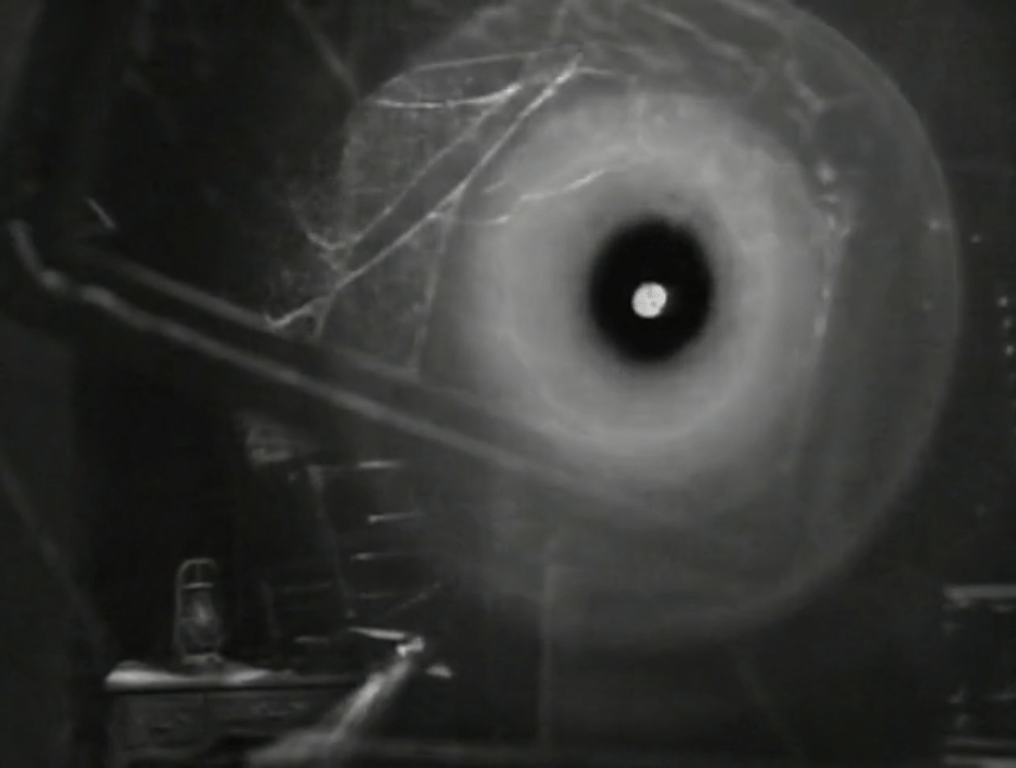
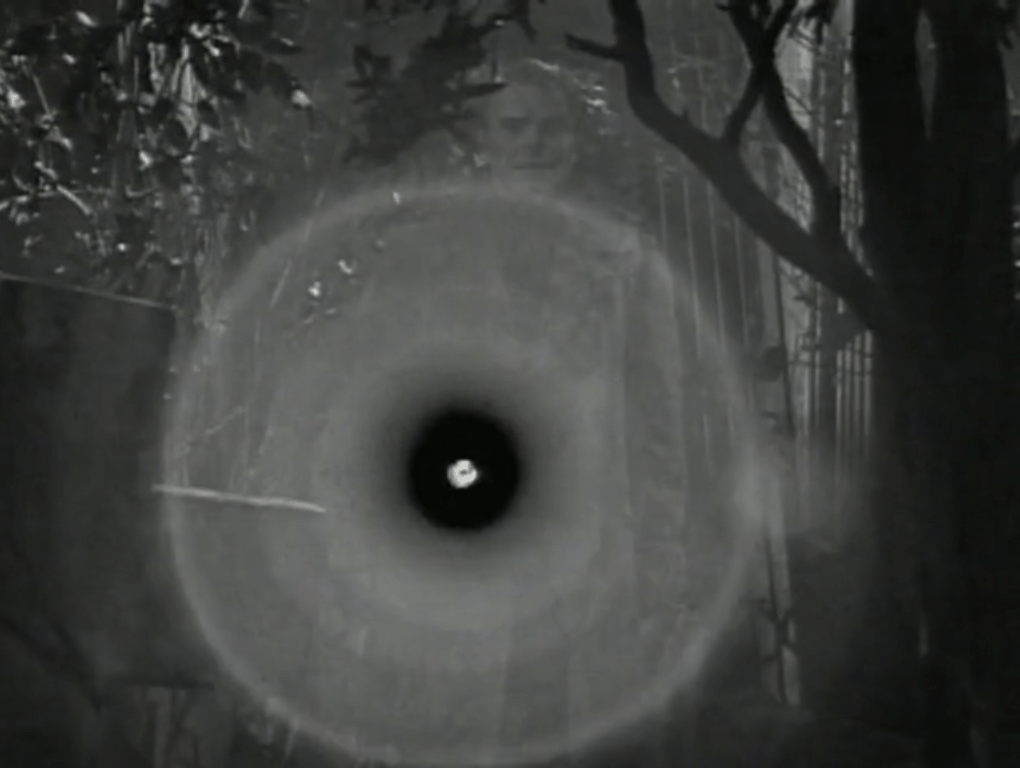
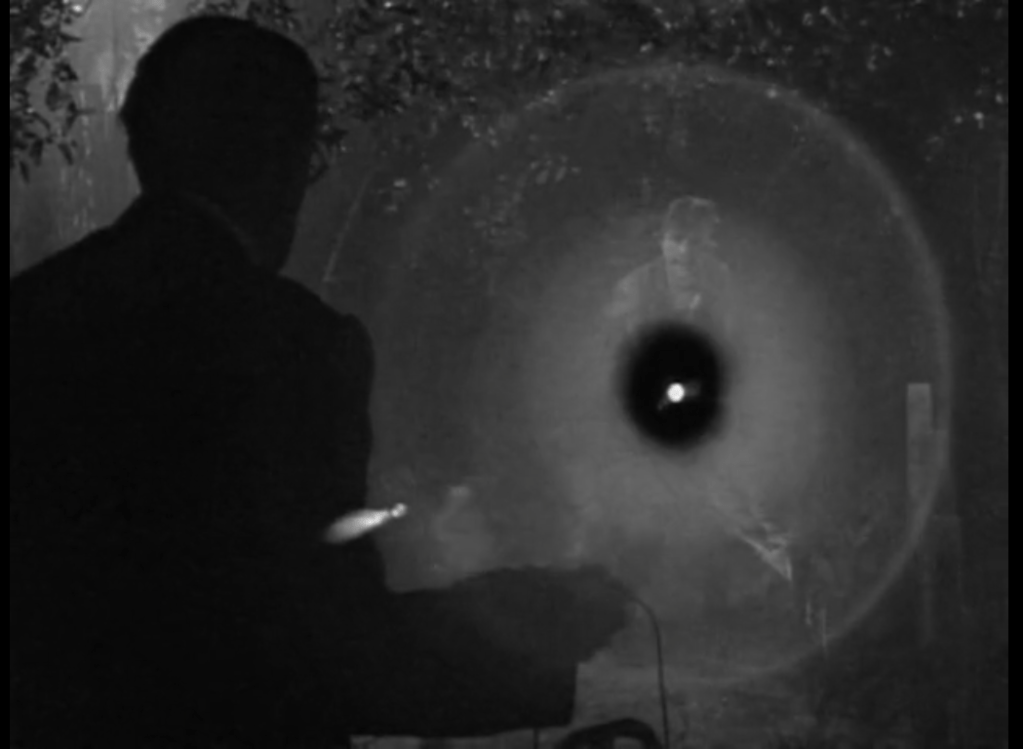
When Willie is wandering around the old cemetery, he twice shines a flashlight directly into the camera and creates a halo effect. The first time might have been an accident on the actor’s part, but the second time the halo frames the Caretaker in a way that is obviously intentional. Patrick McCray’s entry on this episode in his Dark Shadows Daybook describes the Caretaker as “a refugee from the EC universe.” Indeed, Willie’s crouching posture and angry facial expression, the halo filling so much of the screen, the tombstones in the background, and the Caretaker’s silhouetted figure carrying a lantern add up to a composition so much like a panel from an EC comic book that it may well be a conscious homage:

Beware the Vault of Horror!

This is our first look at the Tomb of the Collinses.

Introducing the Tomb of the Collinses
Willie sneaks up to the Tomb

It’s also the first time we are told the name of the cemetery five miles north of Collinsport in which the Tomb is situated. Mrs Johnson calls it “Eagle’s Hill Cemetery,” though later it will be called “Eagle Hill.” Mrs Johnson also mentions the Collinsport cemetery two miles south of town, and the Collins’ family’s private cemetery located in some other place. They won’t stick with any of this geography for long, though it all fits very neatly with everything we heard about burial grounds in the Collinsport area during the Laura story.

Episode 201: People like you

The first shot of the first episode of Dark Shadows featured well-meaning governess Vicki sitting on a train next to a window in which we saw the reflection of dashing action hero Burke Devlin. Vicki was on her way to the great estate of Collinwood, where she hoped to learn who her birth parents were. Burke was on his way to the village of Collinsport, where he hoped to exact revenge on high-born ne’er-do-well Roger Collins and other residents of Collinwood.

Vicki’s quest to learn her origins never took off, and hasn’t been mentioned for months. Burke’s pursuit of revenge drove a lot of action in the first twenty-one weeks of the show, but has been fading ever further into the background in the nineteen weeks since. Today, it fizzles out altogether.

In his original story bible for Dark Shadows, titled Shadows on the Wall, Art Wallace had proposed that Burke’s pressure on Roger would culminate in Roger’s death. Roger was to inadvertently reveal to Vicki that he was guilty of the crime that sent Burke to prison long ago. Roger would then try to push Vicki off the cliff at Widow’s Hill, but would miss her and go over the edge himself. The show discarded this resolution when Roger’s relationships with several other characters proved to be consistently interesting, particularly the Bossy Big Sister/ Bratty Little Brother dynamic between him and reclusive matriarch Liz. Besides, Louis Edmonds had such a gift for comic dialogue that he could get a laugh out of even the lines in which Malcolm Marmorstein attempted to be funny. So they couldn’t afford to kill Roger off.

Further, they have gone over Roger’s crime so frequently and made all the details so clear to everyone concerned that a trial wouldn’t give the audience any new information about what happened or show us any characters reacting to shocking news. It would be like a real trial, where all the evidence has gone through a discovery process and there are no surprise witnesses. No one is going to put that on commercial television in 1967.

So when Burke shows up at the great house of Collinwood with drunken artist Sam Evans, who has finally admitted that he saw what happened and took Roger’s bribe to keep quiet about it, the only real question is how Burke can leave the status quo in place.

Burke demands that Roger and Liz meet with him and Sam in the drawing room. Burke demonstrates his mastery by closing the drawing room doors, something that Liz, the mistress of Collinwood, usually does, and that Vicki did several times during the weeks when Liz was away and she was effectively in charge of the place.*

Roger of course tries out a series of lies in his attempts to deny Burke and Sam’s charges, but Liz is convinced. When she picks up the telephone and calls the sheriff, Burke reaches in and disconnects her. He says that she doesn’t have to turn Roger in- it is enough for him to know that she really would do it. She declares that she won’t let Burke keep coming back and using Roger’s guilt to blackmail the family, apparently intending to place another call. Burke says that he will never bring it up again, provided Roger confesses here and now in front of the three of them. He does. Burke tells Roger that he used to want to see him rot in jail but that now he realizes that “People like you rot wherever they are.” Burke and Sam leave, and that’s that as far as they are concerned.

During a few scenes scattered throughout the first forty weeks of Dark Shadows, Burke had considered relenting from his quest for vengeance. Those scenes hadn’t been developed in any great depth, and hadn’t been connected to each other. Only in the climactic week of the “Phoenix” storyline, when Burke and Roger briefly joined forces to save Roger’s young son David from death at the hands of his mother, blonde fire witch Laura Murdoch Collins, did we have a sustained glimpse of something other than all-consuming enmity between the two men. That was such an extreme situation, and was followed so quickly by a renewal of their hostilities, that Burke’s decision to peace out cannot be said to have any foundation in what we have seen the characters do so far. It is simply a convenient way of discarding a story element that has outlived its usefulness.

Most episodes of Dark Shadows have a cast of five actors. The rest are almost evenly divided between casts of six and casts of four. Today is a rarity with eight on screen. Six of these eight have been deeply involved in the Revenge of Burke Devlin storyline, and are at loose ends now that it has reached its abrupt conclusion. Burke, Roger, and Sam suddenly find themselves with nothing in particular to do. Also, flighty heiress Carolyn had a mad crush on Burke that alarmed her mother Liz and terrified her uncle Roger; that ended months ago, and she’s been a utility player ever since. Vicki is starting to date Burke; if Burke is no longer a threat to the family, there’s no obvious drama in that relationship, and she doesn’t have much else going on. David was as fascinated by Burke as Carolyn was; now that Laura is gone and he is happy with Vicki as his substitute mother, he’s pretty well settled in too.

We don’t see wildly indiscreet housekeeper Mrs Johnson today. She had come to Collinwood as Burke’s secret agent. Now that Burke is satisfied, presumably that’s over. Nor does Sam’s daughter Maggie, The Nicest Girl in Town, appear. She’s been dating hardworking young fisherman Joe, rebuffing his suggestions that they think about marriage because she is worried about what is going on with her Pop. Now that Sam’s conflict with Roger has come to its conclusion, there isn’t any reason the two of them shouldn’t get married, or stay unmarried, or whatever. So today’s episode leaves nine of the eleven major characters with no specific connection to any unresolved storyline.

Indeed, there is only one ongoing narrative arc. Long before he wrote Shadows on the Wall, Art Wallace wrote “The House,” a 1954 episode of The Web, an anthology series produced for CBS by Mark Goodson and Bill Todman.** Wallace recycled the story of “The House” for a 1957 installment of an hourlong anthology, Goodyear Playhouse, on NBC. Alternating with Alcoa Theatre in a window known collectively as A Turn of Fate, Goodyear Playhouse featured many pilots. The only one that seems to have been picked up was My World and Welcome to It, which went to series after an interval of more than a decade. I haven’t seen Wallace’s Goodyear Playhouse episode, but the 1954 version is too thin to fill a half hour, so I can’t see that an hourlong reworking would have been likely to catch the eyes of networks that passed on so many other pilots presented in that series, including teleplays by Rod Serling and Paddy Chayefsky. Wallace incorporated the story of “The House” in Shadows on the Wall, and a couple of weeks ago Dark Shadows dredged it up.

Seagoing con man Jason McGuire presented himself at Collinwood, to Liz’ great dismay. So far, they have had five conversations, two of them in Friday’s episode. All have followed the same pattern. Jason and Liz meet in the drawing room; he makes a demand of her; she resists; he threatens to expose her terrible secret; she capitulates. It’s true that on Friday they varied this a bit. Roger was with them during the first session, so that they had to veil their meanings, and in the second session Jason finds that Liz is unable to meet his initial demand, so that he shifts to a second one. In the first scene, they have a lot to show us as Liz and Jason manage to communicate their usual messages without letting Roger in on anything, and in the second they show us that Jason puts a higher priority on keeping Liz under his control than on any particular item he might want her to give him, so they managed to be interesting that day.

Today, Jason and Liz have their sixth conversation. It isn’t in the drawing room this time, but in the basement. While looking for David, Vicki had caught Jason listening at the doors of the drawing room at the moment when Liz was talking about going to the police, and he had rushed up to his room and telephoned*** his associate Willie, telling him they should be ready to get out of town fast. This conversation lets the audience know that Jason’s threat to Liz is a bluff. David had then caught Jason trying to get into the locked room in the basement. David told Liz what he saw Jason doing. Liz then goes down to the basement herself and shines a flashlight directly into the camera. We can see her in the halo, but Jason cannot. He seems helpless while she shines the light at him.

Jason blinded by the light

Jason scrambles a bit to regain control of the situation. Liz tells him he must leave the house immediately. He finally puts into words what the audience has long since figured out is on Liz’ mind, that she killed her husband Paul Stoddard eighteen years ago, that Jason buried him in the room, and that Jason will take this information to the police if she does not comply with his demands. She yields.

Liz’ reaction is interesting in the light of her scenes with Roger. When Burke was in the room, she explained her determination to call the police by saying that blackmail is no life for anyone to live. After Burke and Sam have gone, Roger starts begging Liz to let him and David keep living in her house. She doesn’t seem to know what he is talking about. She says that “Everyone does terrible things,” a remark she had also made to Burke and that is certainly true of characters who last on soap operas. He wants to go on pleading with her, but she just walks off, deep in thought about something else.

Remembering those scenes, we see Liz not simply giving in to Jason, but making a decision to keep going along with him. That makes today’s iteration of Jason Threatens Liz a bit more worthwhile than were the first three, if not quite as lively as the two we saw Friday. We can see something going on in her mind that raises the possibility she might do something different next time.

Two actors have bad trouble with lines today. When Burke is supposed to be saying something very dramatic and powerful about “hypocrites,” Mitch Ryan is actually blabbering about “hippie-crippie… er… hippie-crizz.” And when David Collins meets his Aunt Liz on the stairs and tells her he saw Jason in the basement, David Henesy stumbles over so many lines he falls out of character. Eventually he gets enough of the words out that you can tell what he’s trying to say, but he never really recaptures David Collins’ rhythm and intonations.

This latter slip-up leads to a reminder that there are always people in the audience checking in to a series for the first time with any given episode, so that actors are subject to judgments that don’t take into account what they have done before. At the bottom of their post on this episode, John and Christine Scoleri transcribe a conversation with a friend of theirs who hadn’t seen any of the episodes before this one. He says “Those who think the kid playing David went to any kind of acting school, raise your hand. Now leave the auditorium, please.”

In fact, David Henesy had been working steadily as a professional actor for four years before joining the cast of Dark Shadows at the age of nine. During that time, he had studied under many teachers, among them Uta Hagen. Usually, that background shows through, even when a particular script gives him problems. For example, he had a lot of difficulty with his lines in #191, and I rated that one as one of his weaker efforts. But here’s what Patrick McCray said about it on his Dark Shadows Daybook:

The success of this installment rests on the narrow shoulders of David Henesy. At the end of a big Henesy episode or scene, it’s common to announce that the kid nailed it, and this episode is no exception. His scene partners have it easy. They have straightforward, high stakes objectives to pursue. Either David goes into the fire or he doesn’t. There are only so many ways that people can implore the kid to come to them. On the other hand, Henesy has to stretch out indecision and keep it fresh for twenty minutes… with the help of an “ancient legend” that he recites. Not only does he succeed like a champ, but he concludes one of his better Hagen Days with a tearful catharsis that reads as properly-uncomfortably authentic.

Patrick McCray, Dark Shadows Daybook, 7 March 2018

I disagree with McCray overall about #191- I think Henesy’s line troubles in that one are bad enough that he doesn’t “succeed like a champ,” but I do agree that there are also some good things in his performance, particularly the way he uses his eyes and his posture. And there is no doubt that the last two minutes are very good.

Not even McCray comes to Henesy’s defense regarding #201, though the scene in the basement is all right. David Collins has a pleasant little conversation with Jason, and David Henesy gives sufficient support to Dennis Patrick that we can see just how badly wasted that talented actor is in all of those scenes where Jason repeats his threat to Liz.

*When we were watching the episode, my wife, Mrs Acilius, noticed the significance of Burke’s closing the drawing room doors. She had a lot to say about it, I wish she could remember her WordPress password and write her observations here.

**Later to become game show specialists, Goodson and Todman would be the producers of Match Game, which in the 1960s was on CBS 4:00-4:30 PM Monday through Friday opposite Dark Shadows, and of Password, a version of which would replace Dark Shadows on ABC in that timeslot when the show was canceled in April 1971.

***Just a few weeks ago, Laura nearly succeeded in killing David because there were no telephones upstairs. Apparently that has led Liz to have some new lines installed.

Episode 197: Our most prominent loose ends

The two most senior members of the ancient and esteemed Collins family, reclusive matriarch Liz and her brother, high-born ne’er-do-well Roger, are both being blackmailed. At rise, Liz and her blackmailer, seagoing con man Jason McGuire, are having another version of the same conversation that took up most of yesterday, in which he makes demands, she resists, he threatens to expose her secret, and she gives in. Jason is a new character, connected to no one but Liz, and this is all we’ve seen him do. The actor is appealing, but not enough to make us want to see that scene a third time. When Liz and Jason summarize their relationship by telling each other “We’re stuck with it,” they give voice to a sinking feeling in the pit of the audience’s stomach.

Roger’s blackmailer is someone we know and care about. He is drunken artist Sam Evans. Sam took money from Roger years ago in exchange for keeping silent about evidence that Roger was responsible for a fatal hit-and-run, and to make the transaction look legitimate gave Roger some of his paintings. Now a powerful New York art dealer has told Sam that she can make him rich and famous if she shows those paintings in her gallery, and Sam is desperate to get them back. He threatens to take his information to dashing action hero Burke Devlin, who went to prison over the incident, unless Roger produces the paintings.

Roger spends today’s episode trying to find the paintings. His search takes him to the basement. There, he shines a flashlight directly into the camera.

Roger enters the basement with a halo

Shortly after, Jason comes to the basement, and Roger catches him fiddling with the lock on a room Liz insists no one ever enter. Roger shines his flashlight in Jason’s eyes. When Jason complains about that, we again see Roger shining the flashlight directly into the camera. We’ve seen actors shine flashlights into the camera so many times that it must be in some way intentional, but this is the first time there is dialogue to give the show an intelligible reason to do it.

Roger shining the light into Jason’s eyes, from Jason’s point of view

Jason won’t tell Roger what he is doing, but does say that he saw Liz’ husband, the never-seen Paul Stoddard, in that basement the night he disappeared. He then throws around some hints that there may have something untoward about Stoddard’s disappearance and that Liz may be hiding something about it. Later, he mentions to Liz that Roger doesn’t seem to know anything about the situation, suggesting that the hints were his attempt to test Roger.

Roger meets with Sam at the Blue Whale, the working-class bar where Sam spends his time (and, presumably, his daughter’s paychecks.) Roger can see that Sam is serious about his threat to go to Burke if the paintings do not materialize. Roger tells him that there is only one place he hasn’t searched. At the end of the episode, we see Roger back in the basement, trying to open the locked door.

These two blackmail stories have the potential to clear out all of the unresolved questions left over from Dark Shadows 1.0. Why is Liz a recluse, what happened the night Stoddard disappeared, what’s with the locked room in the basement, and what is the connection between Liz and the origins of well-meaning governess Vicki? Jason’s demands on Liz might answer all of these questions. How will Burke react when he learns what Sam knows, and what will the consequences be for Roger, for Sam, and for Sam’s relationship with his daughter Maggie? Sam’s threat to Roger might bring all of those answers to light.

The problem is that those questions have been around for thirty nine weeks and have yet to drive much of a story. It’s hard to believe they will suddenly become exciting now. Perhaps when they do clear them out of the way, they will find something different to put front and center in Dark Shadows 2.0. Let’s hope they do, and that they find a way to keep things interesting until then.