
In #128, wisecracking waitress Maggie Evans opened a conversation in the diner at the Collinsport Inn with that old familiar ice-breaker, “Whaddaya hear from the morgue?” The show took us all the way to Phoenix, Arizona for a trip to that city’s morgue in #174, but it is only today we see the inside of Collinsport’s own morgue for the first time. Sheriff George Patterson brings heiress Carolyn Collins Stoddard in to identify a body found on her property. Carolyn is shocked to find that it is her friend, Donna Friedlander.
Last night, Carolyn and Donna were in the drawing room of the great house of Collinwood with permanent houseguest Julia Hoffman and old world gentleman Barnabas Collins, who lives in the Old House on the same estate. Also in the room was Chris Jennings, a mysterious drifter who caught Carolyn’s fancy and who now lives in the caretaker’s cottage on the estate as her guest. Barnabas invited everyone to dinner at his house. The ladies delightedly accepted, but Chris begged off, saying he would have to leave immediately to keep an important business engagement in Bangor, Maine. Donna said that she was going home to Bangor and that she was ready to leave, and asked Chris for a ride. When he tried to squirm his way out of taking her, Barnabas looked on with smug self-satisfaction.
This morning in the morgue, Carolyn tells Sheriff Patterson that the last time she saw Donna, she was leaving with Chris. But she recoils from the implication. She cannot believe that Chris had anything to do with Donna’s death.
Carolyn does not know what Barnabas has figured out. Chris is a werewolf. When Barnabas told Julia that he had come to that conclusion, she was unconvinced. Barnabas’ dinner invitation was a ploy intended to elicit just the panicked reaction Chris did have. Barnabas’ look of triumph at Chris’ frantic attempts to ensure that he is alone on this night of the full Moon reflects his belief that he has been proved right.
Barnabas went to the cottage some time after the Moon rose, intending to use his silver-headed cane to take control of Chris in his werewolf form. But he delayed too long, and by the time he got there the cottage was vacant and Donna’s mangled corpse lay in the woods nearby.
We cut to the cottage, where we see a disheveled and bloodstained Chris come home. He has just had time to change his shirt and set some furniture right side up when Carolyn drops in. She has come to warn Chris that Sheriff Patterson is coming. The sheriff is right behind her. Carolyn leaves the two of them alone. Chris refuses to allow a search of the premises; when he spots Donna’s purse on his table, he throws a newspaper over it. The sheriff somehow fails to notice this, but takes Chris to his office for questioning.
In the drawing room, Barnabas and Julia are fretting over Donna’s death. Barnabas asks “Could we have stopped it?” He decides that they could not have, and that whatever sequence of events led to the killing must have been “Donna’s fault.” It is always fun to watch the scenes where Barnabas faces the horrific results his actions have on other people, strikes a noble pose while briefly considering the possibility that he may be partially responsible for them, and then agrees with Julia that it is pointless for him to blame himself. Julia and Barnabas’ self-exculpatory attitudes are so transparently absurd that you have to admire Grayson Hall and Jonathan Frid for keeping straight faces while delivering their dialogue.
Meanwhile, Carolyn has called the Collins family lawyer, Richard Garner. Garner agrees to help Chris. We saw Garner and his son Frank a number of times in the first months of 1967, but he hasn’t been on screen since #246. He has only been mentioned a handful of times since then, most recently in #577. This is the last time his name will come up.
Back in the drawing room, Barnabas tells Julia that he can see “So many possibilities” for dealing with Chris’ problem. Frid’s delivery of this line made my wife, Mrs Acilius, shudder. She could hear the evil in his voice as he shows us Barnabas playing God.
Chris is in an interrogation room, telling Sheriff Patterson a series of mutually contradictory lies about what he did last night. The sheriff says he’s going to leave him alone for a few minutes so that he can come up with a more plausible story. You might think this was a sarcastic remark, but in this context it seems it might actually be sincere. Sheriff Patterson’s failure to notice Donna’s purse on Chris’ table is of a piece with the complete nonfeasance he has shown all along, and Vince O’Brien delivers the line so warmly it doesn’t sound like a joke. Moreover, Sheriff Patterson’s predecessor as Collinsport’s chief representative of law enforcement, Constable/ Sheriff Jonas Carter, capitulated to the Collins family’s directions to cover up a crime in his final appearance on the show, back in #32. Longtime viewers may suspect that Sheriff Patterson is as averse to the tough parts of his job as was Constable/ Sheriff Carter.
While Chris is alone in the interrogation room, he decides to tell Sheriff Patterson the truth when he comes back. He does in fact open his mouth and get the first few words of a confession out when the sheriff cuts him short. He says that Barnabas Collins called the office to tell him Chris was with him last night, and that Barnabas is “about the best alibi you can have in this town.” He shakes Chris’ hand and sends him on his way. Law enforcement characters on Dark Shadows are symbols of helplessness, and after that moment Sheriff Patterson has reached the zenith of that quality, achieving a measure of futility that cannot be surpassed. We never see him again.
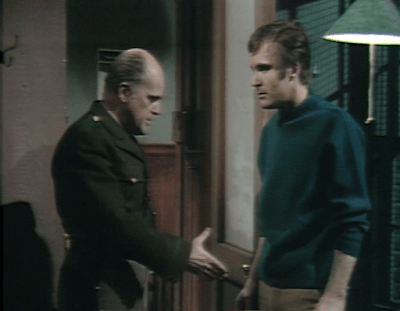
Chris goes home and finds Barnabas waiting for him. Chris expresses his gratitude for the alibi Barnabas gave him, but keeps trying to get him to leave before the Moon rises. Barnabas tells him that when he leaves, Chris will leave with him. Barnabas closes the episode by telling him that he knows that he is not only Chris Jennings, but that “You are also the werewolf.”
This episode marks the final appearance not only of Sheriff Patterson, but also of Vince O’Brien. O’Brien joined the show in #148 as the second actor to play Lieutenant Dan Riley of the Maine State Police. O’Brien’s stolid manner suited the role of that ineffective investigator, but he was much less fun to watch than was the man who originated the part, the charming John Connell.
O’Brien took over as the second Sheriff Patterson in #328. He was again a step down from his predecessor; the first Sheriff Patterson was Dana Elcar, an extraordinary performer who always found a way to give the audience hope that his character was only playing dumb. Other actors filled in for O’Brien a couple of times, Angus Cairns in #341 and #342 and Alfred Sandor in #615, leading some fans to refer to “the Patterson brothers” (whose parents named all of their sons George) and others to speculate that for a time Collinsport allowed any man to be sheriff who was willing to change his name to “George Patterson.” Like O’Brien, Cairns and Sandor were accomplished professionals, but none could match Elcar’s gift for overcoming bad writing and keeping our attention focused on the sheriff.








 Dark Shadows Commentary