Episode 258: Secret friend

Maggie Evans, The Nicest Girl in Town, is giving up hope. Vampire Barnabas Collins locked her up in the jail cell in the basement of his house some time ago, and everyone she knows is coming to believe that she is dead.

The other day, a little girl in eighteenth century clothing appeared outside Maggie’s cell. The girl did not respond when Maggie tried to get her attention, nor did Barnabas’ sorely bedraggled blood thrall, Willie, see her when she walked past him. Only on her second or third visit to Maggie did the girl interact with her, and then only to warn her not to tell her big brother that she had seen her. Maggie suspects that the girl was a hallucination of hers.

We know that the girl is real, because we saw her interacting with someone else. Outside Barnabas’ house, the girl talked with strange and troubled boy David Collins and played catch with him. If we’ve been watching the show from the beginning, we also know that there are many ghosts in and around Barnabas’ house, and that they have a special rapport with David. Further, this girl gives her name as Sarah and says that everyone she knows went away a long time ago. We’ve been told that Barnabas had a sister named Sarah who died in childhood, so we know that Sarah is the ghost of that sister.

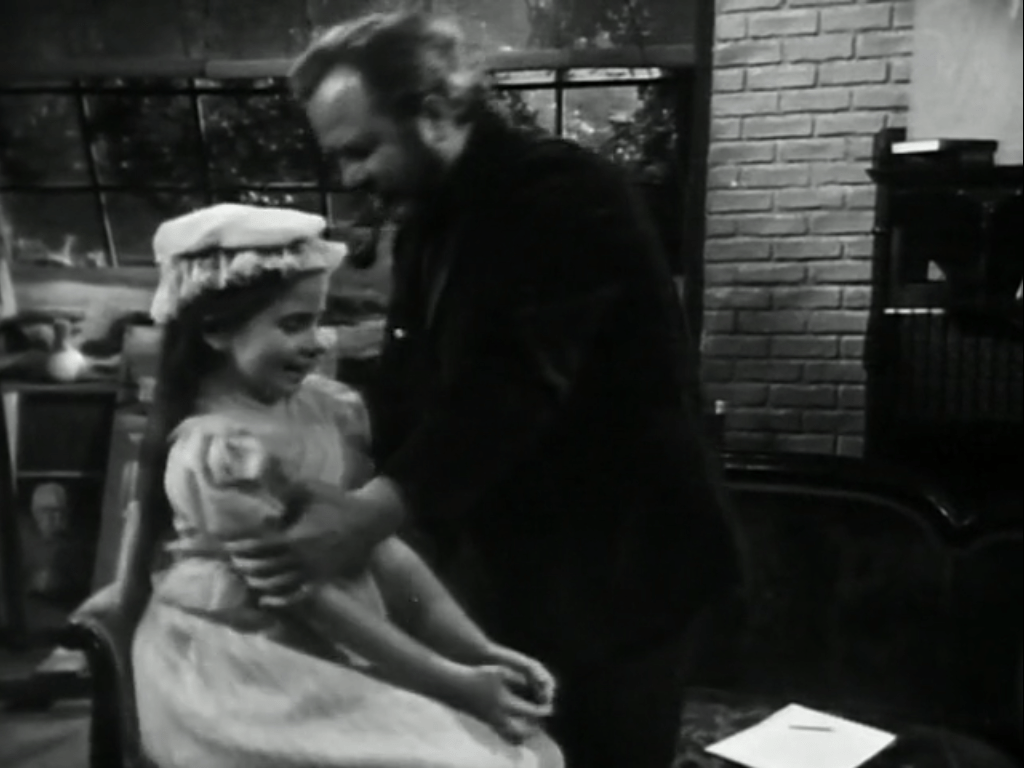
Today, the girl appears to Maggie again. This time she shows up in the cell itself. At first, she tosses her ball in the air, sings “London Bridge,” and ignores Maggie’s repeated questions. Eighteenth century kids didn’t have mobile phones, apparently they had to resort to a ball and “London Bridge” when they wanted to tune out the grownups. Sarah finally comes around when Maggie puts her hand on her shoulder.

Sarah explains that she came because Maggie was crying. She asks what Maggie is sad about, which Maggie doesn’t try to explain.

Sarah won’t answer many of Maggie’s questions. Sarah says that she has been looking for her parents, and she is puzzled as to where they and everyone else have gone. She says she does have one friend. If that is a reference to David, it would show that Sarah can learn information during one apparition and retain it during subsequent apparitions. It is unclear whether she knows that she is a ghost, and her understanding of Maggie’s situation is remarkably slight.

Maggie and Sarah play catch and sing “London Bridge” together. Sarah vanishes a moment before Barnabas arrives. Maggie reacts to him with terror, but when it becomes clear that he isn’t planning to kill her right away her excitement at Sarah’s visit comes bursting out. She tells him that she has a secret friend who visits her in her cell and plays with her. When he asks what she’s talking about, she tells him it’s a secret. She babbles in a gleeful, childlike way.

Barnabas reacts to this with discomfort. He keeps his eyes on Maggie and edges away from her, speaking to her in a pitying tone. Bleak as Maggie’s situation is, this is a laugh-out-loud moment- she’s become too weird for Barnabas.

Maggie weirds Barnabas out

Upstairs, Barnabas tells Willie that Maggie isn’t working out. In a moment of wild hope, Willie asks if that means he’ll let her go. Barnabas sourly replies that of course it does not mean that- they will have to kill her. His plan is to kill her in such a way that no trace of her will ever be found, “because there will be no trace.”

Willie takes a meal to Maggie and demands she stop pretending to be crazy. It isn’t helping her, he says. She denies that she is doing any such thing, and babbles cheerfully that “I do whatever anyone tells me to do.” Willie leans in, putting his face close to hers, and screams and shouts that she has to be her usual self if she is to have any chance of survival.

After Willie leaves, Maggie starts crying again and telling herself that there is no little girl. But then she looks at the floor and finds a doll Sarah left behind. Maggie smiles, knowing that her secret friend does exist.

Maggie’s mad scenes are fascinating. Even though she believes that Sarah is real and we know she is right, seeing Sarah has the same effect on Maggie a psychotic break might have. It takes her out of the reality that she shares with Barnabas and Willie, and gives her an affect that is neither continuous with her usual personality nor intelligible to them.

The three adult actors are all on the top of their form today, just superb. Nowadays, when Sharon Smyth Lentz describes her performance as Sarah, she says that “The first word that comes to mind is ‘clueless.’” But that works out surprisingly well. We know so little about what, if anything, is going on in Sarah’s mind that the keynotes of the performance would have to be “lost,” “confused,” and “vague,” and she had those three things down pat. Things sometimes get rocky when Sarah has a long stretch of dialogue or when multiple actors are moving at the same time, but neither of those is a problem today.

Joe Caldwell started making uncredited contributions to the writing of Dark Shadows early in 1967, and I am tempted to attribute every good thing in a script by Malcolm Marmorstein to him. But Caldwell’s name is showing up in the credits now, and this episode is excellent. So maybe Marmorstein could rise to an occasion every now and then.

My wife, Mrs Acilius, points out that this is the first episode set entirely in the Old House.

Episode 254: As much fun as a bag of spiders

Reclusive matriarch Liz and well-meaning governess Vicki are in the drawing room of the great house of Collinwood. Liz is depressed because her daughter Carolyn is dating motorcycle enthusiast Buzz. She asks Vicki if she has any idea how to break Carolyn and Buzz up, then answers her own question. Liz knows that Carolyn is protesting her engagement to seagoing con man Jason McGuire, and that only by breaking it off with Jason can she change things with Carolyn.

When Liz claims that she is marrying Jason because she wants to, Vicki says it’s none of her business. Vicki has seen abundant evidence that Jason is blackmailing Liz, and won’t pretend she hasn’t. She manages to be quite respectful to her employer without backing down an inch. Despite herself, Liz is impressed with Vicki’s firmness and diplomacy.

Alexandra Moltke Isles was cast as Vicki because she and Joan Bennett looked so much alike, and this is one of the scenes that uses their resemblance to show Vicki as a reflection of Liz. As Vicki is finding tactful ways to express her suspicions, she says things that we have heard Liz say and that we know she is thinking. Each time she does so, Joan Bennett does a quarter turn one direction from the shoulders and a quarter turn the other direction from the neck, as if she were being twisted open. When Liz tells Vicki to stop, she calls her “Victoria,” a name we haven’t heard her use since 1966, and when Vicki asks permission to leave the room she responds, in a near-whisper, with the usual “Vicki.” This alternation also suggests twisting, and to regular viewers who remember that Liz has a secret connected with the fact that “Her name is Victoria” it is another twisting open.

Meanwhile, Jason is entering the Blue Whale tavern with his former henchman, Willie Loomis. Jason wants to confront Willie with the fact that he saw him in town earlier in the day selling a piece of jewelry. Willie says that he was selling it on behalf of his employer, wealthy eccentric Barnabas Collins. Jason knows of Willie’s obsessive fascination with jewels and his tendency to steal them, and does not believe that Barnabas would entrust him with such a task. What Jason does not know is that Barnabas is a vampire and Willie is his sorely bedraggled blood-thrall. As such, Barnabas has a power over Willie that makes it rational to entrust the most remarkable tasks to him.

Carolyn and Buzz enter. They almost leave when Carolyn sees Jason and Willie. Jason and Willie rise and meet them at the door. Jason assures Carolyn that they were just going. Before they do, he taunts Carolyn with his engagement to Liz.

On Tuesday, Carolyn and Buzz started dancing together in the drawing room. Buzz made a few very graceful moves, saw Carolyn going into the Collinsport Convulsion, and sat down to observe. Today, Buzz sees two background players twitching awkwardly while the jukebox plays and declines Carolyn’s invitation to join her on the dance floor. He wants to stop drinking, saying that he is looking for something that will make him feel like he’s never lived before, while “drinking only makes you feel drunk.” It sounds a little bit like he’s going to offer Carolyn a drug stronger than alcohol, but by the end of the scene he just wants to get back on his bike. Liz’ fears to the contrary, Buzz seems pretty darned wholesome.

While Carolyn and Buzz are on their way out of the tavern, hardworking young fisherman Joe comes in. Carolyn asks Buzz to wait outside while she talks with Joe. Buzz reluctantly agrees to spend a few minutes alone with his bike.

Carolyn and Joe were dating when the show started, and there was a whole storyline about how they were tired of each other and couldn’t get themselves sufficiently organized to break up. Their scenes together reminded us that the 1960s were the decade in which Michelangelo Antonioni used the cinema to explore the nature and significance of boredom.

But they are far from boring today. After he and Carolyn finally called it quits, Joe started seeing Maggie Evans, The Nicest Girl in Town. Maggie is now missing and feared dead. Carolyn sits next to Joe at the bar and expresses her sympathies. When I say that Nancy Barrett’s acting style was to throw herself unreservedly into whatever the script gave her character to do that day, it may sound like I’m saying she was undisciplined or that she lacked subtlety. That is not at all what I mean, and in this scene she does one of the most delicate drunk acts I’ve ever seen. Carolyn sits a fraction of an inch too close to Joe, tilts her head back a fraction of a degree too far, opens her eyes the tiniest bit too wide, and speaks ever so slightly too slowly. No one of those signs would even be noticeable by itself, but together they make it very clear why Buzz was anxious that he and Carolyn should leave their drinks unfinished.

Back in the drawing room, Jason is badgering Liz into setting the date for their wedding. Carolyn and Buzz come back, and Jason tells them he and Liz will be married two weeks from tonight. Carolyn says that she and Buzz ought to get married the same night. Buzz is delighted when she first says this, and is still smiling when she insists she is being serious.

Buzz delighted with Carolyn’s proposal.
Screenshot by Dark Shadows Before I Die

My wife, Mrs Acilius, urged me to call this one “A piece of that action,” something Jason says to Willie. Trekkie that she is, that seemed irresistible to her. But Joe’s line that Buzz seems to be “about as much fun as a bag of spiders” is the funniest of the many witty lines in today’s script, and when you remember that Dark Shadows has, since December of 1966, been basically a horror story, you have to think that in its terms a bag of spiders might be a lot of fun. So that had to be the title.

Episode 253: Ring cycle

Vampire Barnabas Collins is keeping Maggie Evans, The Nicest Girl in Town, in a prison cell in his basement. He won’t let her out until she discards her personality and adopts that of his long-lost love Josette. That would seem to rule Maggie out as a source of plot development for quite some time.

Writer Joe Caldwell knew that he was not the first dramatist to have to tell a story in which one of the main female characters is cooped up. In ancient Athens, women of citizen rank were supposed to be immured in the house, hidden away from all men outside their immediate families. While the reality was a great deal more complicated, audiences at the city’s dramatic festivals liked to see plays set in a world that approximated that ideal. So tragedians like Euripides, and after him the Greek and Roman playwrights of the New Comedy, devised a whole repertoire of ways that ladies could send messages to their boyfriends without leaving home.

One of the most prominent of these methods was the dispatch of an identifiable token by a household servant. Since many people, both men and women, wore rings with unique decorations, rings were very often used for this purpose. In plays where the heroine has been captured by pirates and is being held prisoner by someone to whom the pirates made a gift of her, as in Plautus’ Miles Gloriosus (sometimes translated into English as The Swaggering Soldier,) the heroine and her accomplices will use the villain’s greed or that of his servant to trick them into taking a valuable ring and showing it to someone who will be able to help her. Plautus would have been relatively familiar to audiences in 1967, and very much front-of-mind for the Broadway-oriented people involved in making Dark Shadows, because of the success of the 1962 show A Funny Thing Happened on the Way to the Forum and its 1966 film version, both of which end with a recognition prompted by the sight of an unusual ring.

Maggie doesn’t seem to be up on her New Comedy. In the first part of the episode, she asks Barnabas to take her ring to her father to let him know she is still alive. Barnabas is insulted that she would think he was dumb enough to do that.

There is some good dialogue in this scene, and Kathryn Leigh Scott and Jonathan Frid are always fun to watch together, but we have to share Barnabas’ reaction. Until today, Maggie had been one of the few characters on the show who had never done or said anything inexplicably stupid, and asking Barnabas to give her father the ring breaks that streak. Barnabas’ complaint lampshades the problem, which does help a bit- it gives us time to think that maybe Maggie is trying to distract Barnabas from another plan she is cooking up, or maybe the script is telling us that she is so desperate she doesn’t know what she’s doing.

Later, Barnabas’ sorely-bedraggled blood thrall Willie Loomis comes to check in on Maggie. Willie is so obsessed with jewels that when Maggie offered him a diamond necklace on Friday, he turned his back on Barnabas’ coffin while she stood there preparing to stab him through the heart. Maggie persuades Willie to take her ring as a token of her gratitude for keeping Barnabas from killing her on Monday. That marks a good recovery from the earlier dumbness, and gets us off to a fresh start.

Strange and troubled boy David Collins sneaks into Barnabas’ house through an unlocked window. He often visited the house in the months before Barnabas was introduced to Dark Shadows, when the ghost of Josette was the principal supernatural presence on the show and the house was her stronghold. David can’t feel her presence there now, and calls for her forlornly as he wanders through the front parlor.

Willie catches David and demands to know why he is in the house. David tries to defend his indefensible behavior, and when that fails he goes on the attack. He says that he knows what Barnabas and Willie are doing. Willie tenses and asks what it is they are doing. David says they are hurting Josette. Willie listens until he is sure that David is talking only about the ghost, not about Maggie. Then he picks David up and throws him out the front door. There is so much hilarious stuff in this part that not even the bit in the middle when Willie briefly thinks he may have to murder David dampens the mood.

Willie picks David up…
…and throws him down.

In the course of bodily ejecting David from the house, Willie drops the ring. David finds it on the ground while he is getting back onto his feet. He calls to Willie and tries to return the ring, but Willie has already locked the door and will give no response but shouts of “Go away!” David takes a good long look at the ring and goes home to the great house of Collinwood.

Well-meaning governess Vicki greets him there, scolding him for having gone so far from the house. She notices the ring in his hand. This moment comes straight out of ancient comedy- David’s clothes have pockets, after all, but this scene is written for an actor wearing a pallium and a terracotta mask. David won’t tell Vicki where he found the ring, and she examines it. She has seen that there is an inscription in it and is just about able to read it when a knock comes at the door.

It is Barnabas. He tells David that he wants to apologize for Willie’s forcible ejection of him from his house. Vicki turns to David and asks if that’s where he was. The boy has little choice but to admit it, and suggests that the ghost of Josette invited him. Vicki asks if he found the ring at Barnabas’ house. Barnabas, startled by the mention of a ring, asks to see it. He claims that it is a family heirloom which he gave Willie to sell. He takes it, and in a genial voice suggests David steer clear of Willie.

Back home, Barnabas returns to Maggie’s cell. She pretends to be coming around to believing that she is Josette. Barnabas shows her the ring and shatters her hopes. He leaves. Rather than end the episode with a shot of her staring helpless through the barred door, we follow Maggie into the cell and see her slam shut the lid of Josette’s music box. We see her thwarted, but no less able to take action than she was when we began.

Caldwell deserves credit for a fine script, aside from the awkwardness in Maggie’s early scene with Barnabas. Director John Sedwick keeps it looking clean and crisp, and the final shot of Maggie in her cell is a triumph of timing. Best of all, the actors all liked each other and were having fun working together today, and that gives an irresistible energy to the finished product. The result is the fourteenth episode, and the first since #182 early in March, that I would label “Genuinely Good.”

Episode 182: That spook bit

Like many children of divorce, strange and troubled boy David Collins finds himself having to decide which parent he will live with. He and his father, high-born ne’er-do-well Roger, have been living in the great house of Collinwood as guests of Roger’s sister, reclusive matriarch Liz, ever since Roger ran out of money some months ago. Now David’s mother, blonde fire witch Laura Murdoch Collins, has reappeared after an absence of many years, and she wants to take David. This idea delighted Roger from the first, but David had initially reacted to Laura with fear. He still has mixed feelings about her.

Today, well-meaning governess Vicki is trying to get David to focus on his studies. He tells her that he is thinking about his living situation. He likes Collinwood, especially since Vicki came. But he has just about decided to go away with his mother.

Vicki asks why David wants to do this. He reminds her of a vision he had yesterday that terrified him. He saw himself in the fireplace, immersed in flames and showing no sign of wanting to escape them. He interprets this as a warning from the supernatural realm that he is in great danger, and that the danger is to be found at Collinwood. He believes he will find safety if he goes far from the estate with his mother.

Vicki knows that David is partly correct. She has considerable evidence that the ghost of Josette Collins has been trying to warn David and her and several other people that David is in danger of being burned alive. She is also sure that the source of this danger is at Collinwood- it is Laura herself. She is an inhuman creature who will burn David alive. Vicki can’t tell David about this, but she does remind him of some of Josette’s previous warnings. David realizes that his mother featured prominently in those warnings, but does not see that she is the one Josette is warning him about. To Vicki’s dismay, David concludes that Laura is also in danger, and that it is urgent that the two of them go off together at once.

When her warnings to David backfire, Josette is running true to form. The first time she tried to rescue someone from imminent peril was in episode 122, when crazed handyman Matthew Morgan had kidnapped Vicki. Matthew’s response upon hearing a ghostly voice was to put a knife to Vicki’s throat. Eventually Josette enlisted some of her buddies from that land of ghosts which forms the back-world behind what we see, and together they would stop Matthew and save Vicki. Here again, Josette needs help getting her point across.

Of all the characters, David is the one who has had the easiest rapport with Josette. In #102, we saw him standing in front of her portrait in the long-abandoned Old House on the grounds of Collinwood, chattering happily away to her. We couldn’t hear her, but he could. She had no need to manifest herself visibly or do anything else spectacular; she and David could just talk to each other.

Now, Laura is blocking Josette’s attempts to communicate. In #165, Josette manifested in a room with Laura and David; Laura ordered her to go away, and she did. In #170, Josette began speaking through Vicki at a séance; Laura silenced her, and in later episodes visiting parapsychologist Dr Guthrie said that Josette was battling against some power at least equal to her own. Strong as Josette’s connection to David has been, she cannot break through his mother’s interference.

Vicki confers with Guthrie. They decide to present their case to Roger, who alone has the legal right to oppose Laura’s wish to take David, and to dashing action hero Burke Devlin, who has a great influence over the boy. Guthrie meets with Roger in the drawing room, and Vicki goes to Burke’s suite at the Collinsport Inn.

Roger despised Guthrie as a quack starting almost as soon as he met him, but in his most recent appearance, in #178, he started to suspect that there might be something to Guthrie’s ideas. He is quite rude to Guthrie throughout their conversation today, but does hear him out.

Burke respects Vicki, but finds it impossible to sit still when she starts talking about Josette. So she sticks to the demonstrable facts. The camera sticks to Alexandra Moltke Isles’ eyes, on which the light plays arrestingly.

Vicki looks at Burke

At length, Burke admits that something strange might be going on. Vicki asks Burke if he will stop encouraging David to go away with his mother. He says he believes that he ought to stop doing that, but that he doesn’t know what he will actually do after he next sees Laura. Vicki says she knows how he feels about Laura. Burke tells her that he himself doesn’t know how he feels about Laura, or about anyone else.

Mitch Ryan projects Burke’s bewilderment about his own behavior when he is with Laura. We haven’t seen any sign that Laura has cast a spell on Burke. So far, it is entirely possible that Burke is just smitten with Laura. She was the ex-girlfriend who left him for Roger and is now suggesting she wants to get back together with him. As such, she is the symbol of both his lost youth and his upcoming triumph over his bitter enemy. Also, she is beautiful, and can be hilariously funny. That combination would be enough to cloud anyone’s mind. But when Burke is telling Vicki how confused he is about his emotions, we wonder if there might be some witchcraft involved as well.

Back at Collinwood, Roger and David are in the drawing room. David tells Roger that he wants to go away with Laura, and when Roger asks why he has made that decision David tells him what he saw in the fire. David asks him if he still wants him to go away. In previous episodes, David had asked Roger about his hostility towards him. Sometimes Roger parried these questions with witty remarks, other times he simply dismissed David and walked away. Now Roger just chokes up. “We’ll see,” he keeps saying. “We’ll see.” What we the audience see in Louis Edmonds’ performance is a man who is starting to realize what he has thrown away by refusing to love his son. It makes a powerful moment.

Roger tries to connect with David

After David leaves him alone in the drawing room, Roger assumes his usual position in front of the brandy bottle and pours himself a glass. He lifts it to his lips, then looks around, as if he detects an unusual scent in the air. He sets the drink down. He turns, and sees an old book open itself.

Roger sees the book open itself

A book first did this in the drawing room in #52. That time the Collins family history opened to a picture of Josette. More recently, Josette’s signature jasmine perfume was in the air in the crypt at the old cemetery when a book opened itself there in #157. Regular viewers will therefore assume that when a book opens without visible aid of a cast member, it is Josette, the spectral research librarian, leading the characters to the information they need.

Roger hasn’t seen these previous occurrences, and he has chosen to disregard the evidence he has seen for the existence of supernatural influences around him. So the sight of the book opening itself comes as a great shock to him. When he looks at the page to which it has opened, he finds out something about the death of a woman named Laura Murdoch Radcliffe, whom Guthrie and Vicki believe to be an earlier incarnation of his wife. That Laura had died by fire in 1867, along with her young son David. Guthrie had told Roger that. A fact he had not mentioned, and which strikes Roger with particular terror, is that David Radcliffe had not wanted to be rescued from the fire. He had wanted to burn.

The idea of Laura the Phoenix is an interesting one, and the storyline gives Josette and the other vague, indefinable spirits of the supernatural back-world Dark Shadows has been hinting at since it began a suitable adversary to bring them into the action of the main continuity. But most of the individual episodes are so slow, so heavy with recapping, and so confused in their development that few of them can be recommended on their own merits. Indeed, this is only the second episode from the Laura arc, after #146, to which I apply the “Genuinely Good Episode” tag.

After we watched the episode, my wife, Mrs Acilius, shared her theory that the show is getting better because they’ve learned that it will be renewed for another 13 weeks. That makes sense- if it was going to be canceled after #195, the writers might not want to come up with any fresh stories and the producers certainly wouldn’t want to pay to build any new sets or hire actors to play new characters. Better just to run out the clock so that the Laura arc ends in #195 and everyone else lives spookily ever after. But if they know they can keep going until #260, they will have time to work out new ideas.

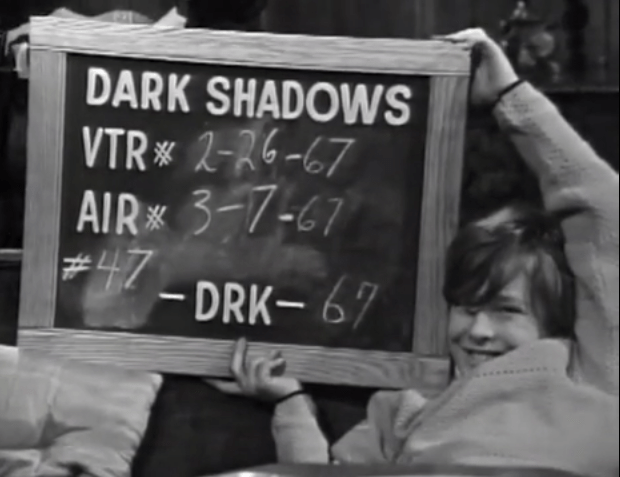
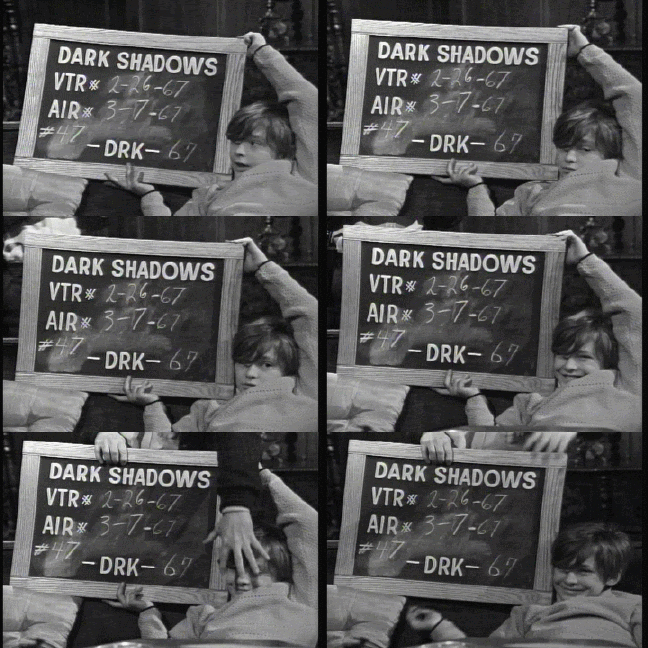
Whatever was going on among the writers, the actors seem to have been in a good mood today. David Henesy and Mrs Isles horse around a bit with the opening slate. He strikes a goofy pose to hold it, and she creeps up on him and puts her hand over his mouth.

Screenshot by Dark Shadows Before I Die

Episode 146: Laura Collins exists mostly in your imagination

At the end of yesterday’s episode, Maggie Evans, The Nicest Girl in Town, and her boyfriend, hardworking young fisherman Joe Haskell, had gone out to look for Maggie’s father, drunken artist Sam Evans. Maggie and Joe wound up carrying Sam home from the tavern.

Joe left the Evans cottage, Maggie went to the kitchen to brew up some coffee, and Sam lit a cigarette and passed out. The cigarette fell on some newspapers and started a fire.

While the fire began, the face of blonde fire witch Laura Collins was superimposed on the image of Sam. Some mysterious force has compelled Sam to paint pictures of Laura naked and in flames. Laura objects to these portraits. She came to the Evans cottage the afternoon before the fire and told Sam she would find a way to stop him painting any more of them. Her face appearing over the fire, along with spooky music and everything else the show has told us about Laura, demonstrates that she is casting a spell on Sam with the intention of making good her threat.

Today, Sam regains consciousness and sees the fire. He tries to put it out with his hands, burning them badly. Maggie comes running and beats the flames out with a rug.

The current storyline hinges on the idea that Laura’s supernatural powers make her a deadly threat to her son, strange and troubled boy David Collins, and perhaps to others as well. The outcome of this spell creates suspense as the audience wonders if Laura is mighty enough to keep the narrative arc going. After all, causing Sam to pass out and mess himself does not take much. There’s no suggestion that any magical abilities reside in Bob the bartender, yet he manages to do that just about every night, and he collects a paycheck for it to boot. For all we know, Laura’s spell might have been a total failure- it might be a sheer coincidence that she was trying to make him pass out and drop a lit cigarette when that’s what he was going to do anyway.

Maggie scolds Sam for his drinking. To Maggie’s exasperation, he raves that Laura started the fire. As he goes on and on about an unnamed power that has been controlling his behavior, Maggie responds “I think they call it alcohol.” Yesterday, Maggie was talking to Joe about laying aside her role enabling her father’s alcoholism and leaving the town of Collinsport altogether. Regular viewers will remember that conversation today, when she tells Sam that she is approaching the limit of what she will take from him. Sam loves Maggie more than anything, and he desperately tries to convince her that he is telling the truth. She sees his desperation, and we see her struggle to make herself say that nothing can convince her of a story like the one he is telling her.

As the voice of correction, Maggie is perfectly reasonable, perfectly justified, and perfectly mistaken. Sam is indeed the plaything of uncanny powers. A couple of weeks ago, they gave us scene after scene full of sound and fury, repeating the point that some spiritual force was making Sam paint Laura’s picture. We see today how little of that was necessary- Laura’s likeness and the theremin music are plenty to show us that the fire is in line with a spell she is casting. But Maggie, while she has often said that she wants to avoid the estate of Collinwood because she believes the stories that ghosts and ghouls haunt it, refuses to entertain the idea that there is anything unearthly at the root of Sam’s troubles. She says that she has to have evidence she can look at out in the open, and that she isn’t going to listen to Sam’s talk about unseen and unknowable powers. Although we know that Sam is right and Maggie is wrong about the particulars of this incident, to the extent that Maggie is speaking to her father as an adult child of an alcoholic she is the voice of the audience.

Meanwhile, Laura is sitting by the hearth in the drawing room at the great house of Collinwood. She is casting her spell on Sam. Reclusive matriarch Liz enters and tries to get Laura’s attention. When Laura finally looks up, her face is contorted in an unattractive expression. Liz remarks on it, and Laura asks if she looked ugly. Liz says yes, then for a fraction of a second looks embarrassed when she realizes that she told another woman that she was ugly. She quickly makes some meaningless remarks in a courteous voice. It is a small moment, but Joan Bennett extracts the jewel of comedy from it quite deftly.

Laura interrupted in mid-casting. Screenshot by Dark Shadows Before I Die

Laura has come to Collinwood to re-establish a relationship with David. After years away, she wants to take David and leave. David’s father, high-born ne’er-do-well Roger, is all for this plan, but Liz is determined to thwart it. As the only male of his generation in the family, David represents the sole hope that the name of Collins will continue. As the custodian of the family’s past and future, Liz wants to be the chief maternal presence in David’s life. Besides, she never leaves the estate, so she needs all the company she can get.

Liz tells Laura that, while she had agreed that Laura could take David if their relationship were to make the right sort of progress, she is not at all satisfied that such is happening. Her objections don’t make much sense, and if the audience hadn’t been informed that Laura is an uncanny being whose plans will likely lead to David’s death we would probably be appalled at how unfair she is.

Roger shows up and takes Laura’s side. While the two of them stand firm against Liz’ wispy arguments, a knock comes at the front door. It is Maggie. Laura is shocked to see her- apparently she had expected her spell to do enough damage to the Evans cottage that Maggie would be unable to go visiting tonight. Laura’s reaction is dramatic enough, and the music behind it is overstated enough, that we may think Laura expected to kill Maggie. Again, the indications of Laura’s failure lead us to wonder if she is enough of a witch to deliver the supernatural thriller we have been led to expect.

Maggie wants to tell Laura about Sam’s accident, and to lament that Sam’s obsession with Laura has led him to the idea that she somehow caused it. Roger is indignant that Sam would say such things about his estranged wife, and storms off to the Evans cottage to give Sam a piece of his mind. Liz, on the other hand, is intrigued by Sam’s ideas and wants Maggie to give as many details as possible about Laura’s visit to the cottage earlier that day.

When we were watching the episode, Mrs Acilius wondered if Liz’ interest in Maggie’s story was a sign that she had noticed something eerie about Laura during their previous acquaintance. My interpretation was that Liz is so desperate to find information she can use to present Laura as an unfit mother that she is ready to listen when the town drunk claims she cast a spell on him. As reasonable, justified, and wrong as Maggie was in her scolding of Sam, so unreasonable, unjustified, and right is Liz in her conversation with Laura.

When Maggie says that Laura had threatened to stop Sam painting pictures of her naked and in flames, Liz asks what threat she made. Laura answers that all she said was that she would find a way to stop him. With a look of suspicion on her face, Liz asks what she was planning to do when she said that. “Just what I did do,” Laura answers. After a pause, she specifies, “Turn the matter over to Roger.”

In the Evans cottage, Roger reads the Riot Act to Sam. Louis Edmonds was a master of sarcastic dialogue, and Roger’s lines in this scene give him many chances to shine. Indeed, he and David Ford have a blast playing Roger and Sam’s mutual hatred. When Roger ridicules his claim to be subject to mystic powers, Sam replies in a taunting voice that Roger is in as much trouble as he is. The two men jeer contemptuously at each other, and it is a wonder to behold.

Mrs Acilius was particularly impressed by the contrast between the opening scene with Maggie scolding Sam and the closing scene with Roger railing at him. Sam’s two interlocutors make the same basic point, but the differences between them as individuals and between their respective relationships to Sam tell us entirely different things. Sam hates Roger almost as much as he loves Maggie, and their hostility is as explosive as Sam’s scene with Maggie is poignant. Maggie’s lovable, down-to-earth persona makes her the polar opposite of Roger with his haughty manner, sharp tongue, and utterly debased moral stature. In her scene, Maggie was to an extent the voice of the audience; insofar as Roger is continuing the lesson Maggie began teaching Sam, he is taking over in that capacity. It is quite a different thing for us to relate to The Nicest Girl in Town as our voice than it is for us to see a virtueless snob like Roger in that capacity, and so Roger’s first moments berating Sam in the Evans cottage whip us around fast.

Sam confirms that he has been driven to paint another picture of Laura, and Roger announces that he will destroy it. Sam doesn’t object. When Roger goes over to the painting, he sees that most of it has already been burned away. Sam is shocked to see this- the fire was on the other side of the room, and nothing in the several feet between a burned spot on the carpet and the painting has been touched by the flames. With this, the suspense is resolved- we know that Laura’s fire magic did achieve a result that Sam’s drinking could not. So the show will have a story to tell after all.

The script is credited to Malcolm Marmorstein, who was by far the worst writer on Dark Shadows. It is difficult for me to believe that someone who delivered so many low points wrote a script this good all by himself. Joe Caldwell was making uncredited contributions to the writing by this time, and he was so much better than Marmorstein that I am inclined to suspect that he wrote this one.

I suppose Marmorstein might just have been having a good day. There don’t seem to be any surviving documents identifying those contributors to the writing whose names didn’t appear in the on-screen credits for any given episode, so we can only guess which ones Caldwell worked on in his first several months on the show. But the structure, dialogue, and pacing of this one feel a lot more like the ones with his name on them than they do like the general run of Marmorstein’s work.

Episode 126: Do not be afraid

In the long-abandoned Old House on the estate of Collinwood, fugitive Matthew is sharpening the ax with which he plans to kill his prisoner, well-meaning governess Vicki. In the great house on the same estate, strange and troubled boy David is struggling with himself. His hated father, high-born ne’er-do-well Roger Collins, and his idol, dashing action hero Burke Devlin, are waiting for him to tell what he knows about Matthew and Vicki, and he keeps asking for assurances that he won’t be punished if he tells.

While David’s pathological fear of punishment keeps her rescuers at bay, Matthew finishes sharpening his ax. In the secret chamber where she is bound to a chair, Vicki receives a visitor- the ghost of Josette Collins. The ghost tells her she need not be afraid. Vicki asks why not. The ghost simply repeats herself and vanishes. It is by no means clear that the ghosts mean to save Vicki from Matthew, or that they could keep him from killing her if that is what they want.

David finally tells Burke and Roger where Vicki is, and they get some shotguns. David delays their departure still further by pleading to go along with them. Meanwhile, Matthew is in front of Vicki, starting to swing his ax at her head.

Matthew hears ghostly voices and breaks off in mid-swing. He runs out of the hidden chamber to the parlor, where the ghost of beloved local man Bill Malloy comes strolling in to the room, singing one of the more family-friendly verses of “What Do You Do With a Drunken Sailor?” Matthew starts swinging his ax wildly at the ghost, which laughs at him. Four more ghosts, representing the famed “Widows,” follow, and he swings at them.

Bill and the Widows. Screenshot by Dark Shadows Before I Die

In her place of confinement, Vicki can hear Matthew screaming, but cannot hear the ghosts plaguing him. She calls out to Matthew, who falls silent. Burke and Roger come in, she calls to them, they find her and release her from her bonds. Matthew in a chair in the parlor, dead of fright.

With its six ghosts, this is one of the most spectacular episodes of the entire series. It is also one of the most effective. It’s no wonder Patrick McCray resumed his posting about episodes with this one after skipping a couple of months’ worth.

It is notable that Burke and Roger do not actually save Vicki- the ghosts of Bill and the Widows do. When Matthew first tried to kill Vicki in episode 111, it was reclusive matriarch Liz who saved her. Now, it is again a female-led effort, though as the victim of Matthew’s first homicide Bill does get a chance to help. I suppose that fits with the nature of the genre- daytime soaps are addressed to a predominantly female audience, so it only makes sense that female characters will drive most of the major plot points. It doesn’t bode well for the future development of Burke- he’s a dashing action hero, after all, and if all the dashing actions are going to be precipitated by women, girls, and feminine ghosts he’s likely to be left out in the cold.

Episode 112: A person has to trust somebody in this world

Yesterday, gruff caretaker Matthew held well-meaning governess Vicki prisoner in his cottage on the great estate of Collinwood. Having inadvertently confessed to Vicki that he killed beloved local man Bill Malloy, Matthew could see no alternative but to kill Vicki. Vicki kept trying to talk him into reassessing his options, but without success. At the end, Matthew had announced his intention to break Vicki’s neck and was choking her. Only when reclusive matriarch Liz entered the room did Matthew stop.

Today, we hear Liz take much the same approach to talking Matthew down that Vicki had tried yesterday. Matthew’s fanatical devotion to Liz keeps him from harming either woman, but his fear of prison drives him to block the exit when they try to leave. As Liz tries to reason with Matthew, we see Vicki’s terrified face between them. Not only does her expression add emotional depth to the scene, but Alexandra Moltke Isles’ resemblance to Joan Bennett drives home the similarity between what Liz is trying now and what Vicki tried in yesterday’s episode. No wonder Vicki is afraid Matthew will attack Liz next.

Eventually Matthew does raise his hands to Liz. She stands her ground. He retreats without touching her. When he menaces her, the music swells; when he backs off, it stops. Then we see Liz in closeup for a couple of seconds before the commercial. That silence makes for one of the most effective act breaks in the whole series.

Back at the great house, Liz and Vicki bring the sheriff and instantly forgettable young lawyer Frank up to date. It’s a lot of recapping, but the actors make it interesting.* Mrs Isles does a particularly good job of seeming bewildered and traumatized. Her lines are repetitive- a lot of “He tried to kill me”- but she delivers them in just the right tone of dreamlike detachment.

Liz’ brother, high-born ne’er-do-well Roger, comes home and is sarcastic to Vicki. Roger had been arrested because he was caught red-handed with some evidence he had hidden from the sheriff, and while in custody had confessed to a series of felonies. This led to him being detained for almost an entire day, an inconvenience for which he blames Vicki. Later, Roger will see Liz and the sheriff in Matthew’s cottage. He insults the sheriff, who is unimpressed. After the sheriff leaves, he demands Liz fire Vicki. Liz tells him that Vicki did nothing wrong and orders him to drop the subject.

I’m not going to bother explaining why Roger thinks Vicki is at fault for his brush with the law. Doing so would require a retelling of the saga of the fountain pen, and no one wants that. Besides, the only person who takes Roger at all seriously today is Vicki, and her attempts to apologize to him come off as a symptom of the extreme confusion she is in after her ordeal. There’s little reason to expect any plot developments to come of Roger’s hostility to Vicki, but Louis Edmonds is always hilarious to watch when he’s playing a character in a snippy mood.

The sheriff has told everyone that Matthew’s old station wagon was seen barreling down the highway toward his brother’s hometown, Coldwater, Maine.** That brings a great relief to Vicki and Liz, but the closing shot of the episode shows us Matthew entering the Old House on the grounds of Collinwood.

This is a fast-paced, well-acted, exciting episode. There is also some good soapcraft in it. The Old House and the caretaker’s cottage have by this point been established as permanent parts of the setting of the series. Matthew’s flight from the caretaker’s cottage leads us to expect that sooner or later a new character will take up residence there, and that there will be a new storyline centering on that character.

Our glimpses of the Old House so far have been tantalizing. We’ve seen the ghost of Josette Collins emerge from her portrait there twice. So we know that it is a place where very strange things are going to start happening one of these days. When we see Matthew go into the Old House, we may well expect that the day will soon be upon us.

*Well, the actors who play Vicki, Liz, and the sheriff do- as Frank, it isn’t Conard Fowkes’ job to be interesting.

**Coldwater, Maine is a fictional place, mentioned only in this episode. It’s a testament to the influence Dark Shadows has had in American popular culture that 56 years after a single reference to it in one of the series’ least-seen segments a significant number of people have heard of Coldwater and are interested in moving there.

Episode 103: The girl can’t help it

Another action-packed episode from writer Francis Swann. His new colleague Ron Sproat seems to have given him a jolt of energy.

High-born ne’er-do-well Roger Collins has been Dark Shadows‘ foremost villain so far. This week’s theme is that well-meaning governess Vicki suspects Roger of murdering beloved local man Bill Malloy. She is terrified of what Roger might do to her, and Roger is terrified she might go to the sheriff. Vicki and Roger scramble to keep up with each other, and draw the other characters into their frantic activity.

Today we divide our time between the great house of Collinwood, where Roger and Vicki live and play their high-stakes game of cat and mouse, and the Blue Whale, a tavern in the village of Collinsport where we see the consequences of their actions ripple out into the broader community. In yesterday’s episode, Vicki and Roger had a talk in which he told her that he did see Bill the night he died, but that he was already dead when he found him. That accounted for the evidence Vicki found, but only increased the tension between them.

We begin and end today in Vicki’s bedroom. In the opening teaser, Roger knocks on her door and lets himself in when she doesn’t answer him. In the closing scene, Vicki’s door is unlocked and opens while she is in bed. This prompts her to scream. When she does, the door quickly closes. Roger comes in seconds later, and implausibly denies that he opened it until after she screamed.

In between, we see Vicki in the tavern, telling Roger’s arch-nemesis, dashing action hero Burke Devlin, what Roger told her yesterday. Burke is incredulous that Vicki seems willing to believe that Roger might be telling the truth this time. She responds “I know you think I’m an idiot, but I can’t help it!” Maybe Bill wasn’t pushed to his death- maybe he was just clumsy and fell without anyone’s intervention. Burke does not contradict Vicki when she tells him he thinks she is an idiot. He urges her to leave town, since Roger might kill her at any time. She insists on staying at Collinwood.

Vicki and Burke leave the tavern. Drunken artist Sam Evans and his daughter Maggie Evans, The Nicest Girl in Town, enter. Maggie tells Sam that she talked to Vicki yesterday. Vicki told her almost everything, holding back Roger’s name but making it clear she can’t be thinking of anyone else. Maggie sees that the idea of the investigation into Bill’s death being reopened and connected with the incident that sent Burke to prison ten years ago disturbs Sam intensely. When Sam answers one of her questions with a lie, she asks “Haven’t you thought of a better one than that?” He mumbles a response, but won’t tell his daughter what he has to be afraid of.

Maggie calls Collinwood. Roger answers, and Maggie asks to speak to Vicki. Returning viewers will remember that when Burke called Vicki in yesterday’s episode, Roger was in the room. Vicki concealed the fact that she was talking to Burke by pretending she was talking to Maggie. Maggie’s call tips Roger off to Vicki’s lie. He tells her that Vicki isn’t home. She tells him that the Evanses are at the Blue Whale, that they haven’t been home all evening, and that they haven’t seen Vicki.

Vicki comes home. She tells Roger she was visiting Maggie at her house. Roger plays along and encourages Vicki to elaborate on this story. At the tavern, Burke had told Vicki she was a bad liar. She proves him right, giving Roger one falsifiable detail after another about her time at the Evans cottage.

After the affair of the door, Roger sees Vicki’s frank disbelief that he will not admit that he unlocked and opened it. Facing her unspoken accusation that he is brazenly lying to her, he casually mentions Maggie’s call. He suggests Vicki call her tomorrow, so that the two of them can get their story straight. He saunters away, having deflated her righteous indignation about his apparent lies.

As Vicki, Alexandra Moltke Isles was one of the cast members who delivered her lines with the fewest stumbles. She has a doozy today, though. When she returns from her conference with Burke, Roger sees her climbing the stairs and calls out to her: “Vicki!” She replies: “Rodgie!” A man you address as “Rodgie” is not someone of whom you are deathly afraid. They have done such a good job building up an atmosphere of tension between Vicki and Roger that this slip is one of the most breathtaking bloopers in the entire series. It’s still a Genuinely Good Episode, but that moment does make you wish for a videotape editor.

Vicki and Rodgie. Screenshot by Dark Shadows Before I Die

Episode 102: Come down like you do

A deluxe episode today- multiple location inserts, three sets, six credited actors, several extras, music we haven’t heard before, and a special effect. By Dark Shadows standards, that’s a spectacular.

At the end of yesterday’s episode, high-born ne’er-do-well Roger Collins had sneaked up on well-meaning governess Vicki from behind, seized her, covered her mouth with his hands, and ordered her to be silent. Since Vicki is convinced Roger is a murderer and is afraid he will murder her to protect his secrets, that was quite a cliffhanger.

As we open today, Roger makes Vicki promise she won’t scream if he lets her go. He explains that when he decided to forcibly silence her, Maggie, keeper of the Collinsport restaurant and The Nicest Girl in Town, might still have been within earshot of a scream. So he “had to do that.” Otherwise, Maggie, to whom he contemptuously refers as “that little countergirl,” might have intruded on their private conversation. Now, they are all alone in the house.

Vicki does not find Roger’s explanation of his assault on her any more satisfactory than we might expect. She moves about the room keeping her eyes on him, her weight on her toes, and a clear line between her and the exit. Roger asks if she thinks he killed beloved local man Bill Malloy. She answers “I don’t think anything.” He asks her to listen to the whole story. She hears him out, but doesn’t let her guard down for a second.

Roger admits that he did see Bill the night he died. That involves admitting that he tricked Vicki into thinking he left home later than he in fact did, and thereby into giving him a false alibi in a statement to the sheriff. Roger ignores Vicki’s shocked reaction to this, and goes on to explain that Bill was already dead when he saw him. They had arranged to meet atop Lookout Point, but when Roger arrived he saw a body face-down on the beach below. He hurried down, and saw that it was Bill. Vicki asks if he looked like he’d been dead long. Not long, Roger says; he must have fallen off the cliff, been knocked unconscious, and drowned in the two or three feet of water on the beach just moments before.

Roger says he left Bill without calling for help or reporting the accident because he was afraid people would think he murdered him. “After all, I had motive, as they say.” Roger’s motive would be that Bill was trying to prove that he, not dashing action hero Burke Devlin, was responsible for a fatal hit-and-run accident ten years before. “Even you don’t believe me, do you?” he asks Vicki. Vicki says she doesn’t know what to believe, and edges closer to the door.

Returning viewers know that Roger is Dark Shadows’ most clearly defined villain, and have seen him frantically trying to conceal or destroy evidence relating to Bill’s death. Any story the makers of the show want us to consider accepting will have to give him some share of guilt. In this story, he is admitting to leaving the scene of a fatal accident. That is the very crime Bill was trying to prove that he, not Burke, committed ten years before. Since Roger is not a doctor, he is not competent to make a determination as to whether an unresponsive person is dead. For all he knows, Bill might have been saved had he gone for help. If we’ve been paying attention to the “Revenge of Burke Devlin” story, we should be wondering whether the account Roger has given Vicki will itself be enough to send him to prison. If so, we will wonder what Roger has up his sleeve to keep her quiet.

At the long-abandoned Old House, Roger’s son, strange and troubled boy David Collins, is talking to the portrait of his ancestor Josette. He asks Josette why she won’t “come down like you usually do” and talk to him. We don’t hear an answer, but David says “Well, I suppose you know what’s best.”

David tells the portrait that his governess Vicki knows that his father murdered Bill Malloy. He asks Josette if Bill’s ghost is with her and the other ghosts. Apparently she doesn’t answer him. He says that if his father finds out what Vicki knows, he will murder her, and then probably go on to murder him as well. David hears sounds outside the Old House. He puts out his candle and hides behind a chair.

Gruff caretaker Matthew enters. He announces to the dark room that he saw a light through the window, so there’s no point hiding. David comes out from behind the chair. He tells Matthew that he is visiting his friends- the ghost of Josette, of another woman similar to her, and of a younger woman, one about Vicki’s age. Matthew dismisses the topic of ghosts. David tells him that Vicki knows who killed Bill Malloy. As he has done each time Bill’s death has been mentioned, Matthew becomes agitated.

This time, Matthew’s agitation takes the form of a solicitous curiosity. David declares that his father is the murderer. “Did Miss Winters say that?” Matthew asks. No, David allows, but that’s what she meant. He asks Matthew to help him protect Vicki from Roger. Matthew mutters that he wouldn’t want any harm to come to Vicki.

Matthew’s agitation redirects our attention to the opening voiceover. Each episode starts with a brief monologue. For the first 55 weeks, all of these are delivered by Alexandra Moltke Isles in character as Vicki. Usually, they are not very informative. They are more about setting a vaguely anxious mood than about giving us specific facts about what’s going on in the story. Usually, whatever factual claims they do make are true. The only clear exception we’ve seen to that pattern so far came in #15, when Vicki says in the opening voiceover that she has made friends with David, a claim utterly belied by all the events that follow. Today, Vicki says in the opening that Roger is “the one person I have reason to fear.” That may also be false. Early on, reclusive matriarch Liz warned her that Matthew is a “strange and violent man,” and his unease about the death of Bill suggests that she might do well to keep an eye on him.

After David and Matthew have left the house, we see a replay of a bit of video from episode 70. The portrait of Josette glows, and her transparent figure walks down invisible stairs from the mantelpiece to the floor, then turns and looks back at the portrait. When David asked Josette to “come down like you usually do,” evidently he was referring to this manifestation.

Josette’s apparition has a different resonance for viewers today than it would have had for most viewers in 1966. The devices on which we see the show now have bigger screens and far clearer pictures than almost anyone would have had in those days. So it is easy for us to recognize a fact of which almost no members of the original audience would have been aware- the ghost of Josette is played by Kathryn Leigh Scott, the same actress who plays the Maggie whom Roger disdained as “that little countergirl.” Social class is a major concern of the show in the first 42 weeks, and the contrast between high-status and low-status characters is especially vivid today. That a character whose station is so lowly Roger cannot even bring himself to mention her name is played by the same person who plays a personage so lofty that she has a mansion to herself more than a century after her death gives a special punch to that contrast.

Meanwhile, flighty heiress Carolyn is on a date with Burke in the local tavern, The Blue Whale. Carolyn and Burke are well-dressed, as are the several extras at the other tables. They have china plates in front of them, and there is a more upscale type of background music playing than we usually hear at The Blue Whale. The show is at pains to establish that the tavern is a place for a nice date, rather than the waterfront dive it often appears to be. If that isn’t enough to set up an expectation that Burke and Carolyn’s date will be an important one, he says he plans to take her to another, even nicer, place later on for dancing and drinks.

Carolyn tells Burke she thinks that Vicki and Roger are becoming a couple. He is surprised. As she is explaining what has led her to this theory, she mentions that she told Roger something which Burke knows will reveal that Vicki suspects him of killing Bill. Burke excuses himself, saying that he is supposed to telephone his lawyer. He calls Vicki, and tells her he’s sending a taxi to take her away from Roger. She agrees to meet it.

Back at the table, Burke abruptly terminates the date. He explains to Carolyn that he has an urgent business meeting in ten minutes. She takes the news with uncharacteristically good humor.

Vicki slips out the back door of the house. The episode closes with a new location insert, a shot of her outdoors in the dark.

Screenshot by Dark Shadows Before I Die

This may sound like a lot of talk, much of it recapping, but when you watch it the whole thing feels like it’s packed with high-stakes action. The actors are all in good form today, and, as usual, Francis Swann’s script gives them the opportunity to show what they can do. It is strong from beginning to end, well worth the extra expenditures they devoted to it.

Episode 87: She came to us from nowhere, and now it seems she has disappeared into nowhere

Hardworking young fisherman Joe is spending the evening with Maggie, The Nicest Girl in Town. It’s their first date. Maggie impresses him with her knowledge of ships, and he sings a verse of “What Do You Do With a Drunken Sailor?” It may not sound like much, but the actors, Kathryn Leigh Scott and Joel Crothers, sell it so well that we’ll be rooting for Joe and Maggie for years to come. The final moment of the scene comes after Joe leaves. Maggie looks directly into the camera and says to the audience, “Goodnight, pal.”

Goodnight, pal

In the great house of Collinwood, high-born ne’er-do-well Roger Collins greets his niece, flighty heiress Carolyn, on her return home. Carolyn is upset because Joe has broken off their relationship and is having a date with Maggie. The story of Joe and Carolyn was a bore, largely because the two of them never had a scene with any fraction of the sweetness we see between Joe and Maggie today. There was nothing at stake in their quarrels, because they had nothing to lose if they simply gave up on each other.

Roger tells Carolyn that well-meaning governess Vicki hasn’t been seen for hours, and that he promised Carolyn’s mother, reclusive matriarch Liz, that he would sit up waiting for Vicki’s return. Carolyn is worried as well, and asks Roger why he isn’t actively searching for her. He says she’s probably fine. When Carolyn says that people don’t just disappear, he reminds her of family friend Bill Malloy, who disappeared not so long ago, but then turned up. Considering that Bill turned up in the form of a corpse washed ashore by the tide, it is perhaps unsurprising that Carolyn does not find Roger’s analogy particularly comforting.

After Roger persuades Carolyn to toddle off to bed, he makes sure he’s alone (well, alone except for the stagehand in the lower left-hand corner of the screen.)

Once assured that no one mentioned in the script can see him, Roger returns to the drawing room and opens a secret passage we’ve never seen before. After he disappears into it, Carolyn comes to the drawing room and is baffled at his absence.

The suggestion that Carolyn doesn’t know about the secret passage is characteristic of the show. From the beginning, Vicki has represented our point of view. She started off knowing nothing about the other characters, and everything had to be explained to her while she was on camera. If Vicki knows just what we know, Carolyn, who grew up in the house where most of the action is set, can be presumed to know a great deal we do not. When they reveal a secret to us, they can amplify its importance by showing that Carolyn isn’t in on it. They’ve done this several times, mostly in situations having to do with the murky origins of Roger’s feud with dashing action hero Burke Devlin. Carolyn’s ignorance of the secret passage is particularly effective- it’s right there in the most important room of the only house she’s ever lived in. If she doesn’t know about it, it must be a very well-kept secret indeed.

We go with Roger into the secret passage. He shines his flashlight directly into the camera, creating a halo of light around it. This would not seem to be a desirable visual effect, yet we will see it many, many times in the years to come. This is the second appearance of the effect. The first time came when Roger’s son, strange and troubled boy David, was leading Vicki into the abandoned Old House in episode 70. Now we see it when Roger himself is entering another abandoned space, one where he might meet Vicki.

Halo

It’s hard to believe that the repeated use of this effect was altogether unintentional.

All the more so because of what follows Roger’s entry into the passageway. His journey through it actually does seem to wind through a very large space. In the opening narration, Vicki had said that the house is made up of 80 rooms, retconning the total of 40 given in the second episode. Roger’s trek up one flight of stairs, down another, up a spiral staircase, around corners, past windows, etc etc, seems like it must take him past enough space for at least that many. Perhaps the sequence would be a bit more attractive with less time spent focused on Roger’s feet, but all in all it is as effective a creation of space as Dark Shadows would ever do. If there had been Daytime Emmy Awards in 1966, Lela Swift would have had every right to expect to win Best Director for conjuring up this illusion of vast, winding corridors without editing or going outside the tiny studio space available to her.

Roger does indeed discover Vicki’s whereabouts. He hears her calling for David from behind a locked door, promising David not to tell anyone he imprisoned her there if he will let her out now. Roger does not simply let Vicki out. Instead, he makes some loud noises, then puts on a ghostly, wavering voice and calls out to Vicki that she is in great danger as long as she stays in Collinwood. He seems to be having trouble keeping a straight face when he makes these spooky sounds. Vicki isn’t laughing, and returning viewers aren’t either- in Friday’s episode, she and we saw the ghost of Bill Malloy in the room, and heard that ghost warn her that she would be killed if she stayed in the house much longer.

Once he’s had his fun, Roger opens the door. After another flashlight halo, Vicki recognizes him. Alexandra Moltke Isles gives us one of the finest moments of acting in the entire series, when Vicki throws her arms around Roger, her bodily movement as smooth as any ballet dancer’s but her voice jagged, and says that “David is a monster, you were right!” Up to this point, Roger has been brutally hostile to his son, Vicki heroically friendly to him. Her determination to befriend David has become so central to her character that hearing her make this declaration makes it seem that she is permanently broken.

Broken Vicki

Vicki struggles to hold back her sobbing long enough to tell Roger that she saw the ghost of Bill Malloy. That’s an episode-ending sting- Roger wants everyone to forget about Bill’s death, and if his ghost starts popping up he is unlikely to get that wish.

Stunned Roger

Mrs Isles was a “head actor,” one who found the character’s innermost psychological motivation and worked outward from that. That heavily interiorized style would be one of the things that left her in the dust, along with similar performers like Joel Crothers and Don Briscoe, in the period when Dark Shadows was a hyper-fast paced, wildly zany show about vampires and werewolves and time-travel and God knows what. But in the period when Art Wallace and Francis Swann were writing finely etched character studies, she consistently excelled. In this little turn, she shows that when it was logical for her character to go big, she could go as big as any of the stars of the show in those later days.