Episode 469: Temporarily arrested

Well-meaning governess Vicki and mad scientist Julia have gone to the Collins family mausoleum in the old cemetery north of town. Vicki wants to see whether her memory is correct and there is a chamber hidden behind a secret panel in the mausoleum, and Julia is trying to limit what Vicki can find. As they enter the mausoleum, Vicki shines a flashlight directly into the camera, then sees a man lurking in a dark corner of the mausoleum.

Vicki assures us that, no matter how much the show might have changed since last summer, it’s still Dark Shadows.

The man is Peter, an unpleasant fellow with whom Vicki unaccountably fell in love when she met him on an unscheduled journey through time to the 1790s. For no reason that will ever be of interest to the audience, Peter keeps insisting that his name is Jeff and that he is not a time traveler. Yet he is the one who finds the mechanism to open the secret panel and expose the hidden chamber where Vicki and Peter once found refuge. Even after that he keeps wasting our time with his pointless denials of the obvious facts.

While they inspect the chamber, Vicki realizes that Julia knew it was there. She confronts her about it, and Julia feigns ignorance. Vicki points out that Julia tried everything she could to keep her from going to the mausoleum and that when those efforts failed she insisted on accompanying her there. Vicki is taking a breath, apparently about to list further evidence supporting the same conclusion, when she glances at Peter and changes the subject.

Vicki remarks that the only way the room has changed since she was there in the late eighteenth century is that there is now a coffin in the middle of it. Julia knows that it is the coffin in which vampire Barnabas Collins was confined from the 1790s until 1967. Barnabas bit Vicki several days ago, but it didn’t really take, and he has since been cured of vampirism. So Vicki probably doesn’t know that Barnabas ever was a vampire, and certainly doesn’t know that it is his coffin. Peter opens the coffin. The empty interior of the coffin dissolves to Barnabas in his hospital bed.

Mid-dissolve.

Barnabas sits up by bending from the waist, showing that old habits die hard. He cries out for the doctor who rehumanized him, Eric Lang. A look of panic spreads across his face.

Terrified Barnabas

He is alarmed to hear hounds baying outside his window. He goes out on the terrace of his hospital room and touches its stone balustrade.

What, your hospital room doesn’t have a terrace with a stone balustrade?

Barnabas goes back inside and continues crying for Lang. When Lang shows up, he explains that the cure isn’t quite complete. There will be occasional relapses of varying intensity, and further treatments are necessary. Barnabas throws a tantrum in response to this news, pouting that if he has to keep taking medicine he may as well go back to being an undead abomination who preys upon the living. Lang talks him down, telling him that he is confident he will be able to effect permanent remission.

We see Julia standing in the rain beside a sign for the Collinsport Hospital, looking up at Barnabas’ silhouette in the window behind his balustrade. She walks away. We then see Lang at a desk in a large wood-paneled room. There is a knock. Lang gives a self-satisfied smirk as he looks at his watch, then opens the door to let Julia in. We see that the wood paneling continues in the corridor behind her. In later episodes we will learn this is in Lang’s house. In that case, the paneling in the corridor behind Julia makes it clear someone has already let her in. At this point, a viewer would naturally assume that it is Lang’s office in the hospital. Wood paneling may not be standard for doctors’ offices in hospitals, but neither are terraces with stone balustrades standard for patient rooms.

Julia looking innocent.

Julia had been treating Barnabas’ vampirism in 1967, and wants to reclaim the case. She and Lang sit across from each other and engage in a verbal fencing match. Lang uses many of the ploys we have seen Julia use to keep control of the situation. On his great blog Dark Shadows Every Day, Danny Horn speculates that the audience’s revulsion at the prospect of Lang replacing Julia was the intended reaction. It cements our sympathy for Julia as a trickster figure and as the de facto protagonist of the chief storylines.

I agree with Danny’s assessment of the scene’s effect, but I doubt it was fully intentional. When I imagine the scene played with Howard da Silva instead of Addison Powell as Lang, I see the audience conflicted and in suspense. We are invested in Julia and her relationship with Barnabas, and so we don’t want Lang to push her aside. But an actor like da Silva would be so intriguing that we couldn’t help but be curious how it would play out if he did. It is only the severity of Powell’s professional deficiencies that causes us to see Lang as nothing but a threat. Compared with the more complex reaction a da Silva could have generated, this scene falls flat.

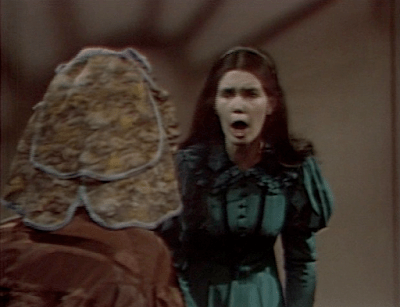
As Julia is leaving Lang’s office, Peter barges in. Julia’s eyes widen when she sees that the two are connected. Lang realizes that she is likely to make good use of this information, and is furious with Peter for exposing it to her.

It becomes clear that Peter has been implicated in a homicide, that he is suffering from amnesia, and that Lang is blackmailing him into stealing body parts from a nearby cemetery. When Peter says he will no longer help Lang, Lang threatens to send him back to the institution for the criminally insane where he found him. He also forbids Peter to see Vicki again, telling him that Barnabas Collins wants to marry Vicki and that Barnabas’ happiness is important to his plans.

In yesterday’s episode, Peter talked to Lang about his hope that he might be able to learn something about himself from Vicki. This reminds longtime viewers of the first year of Dark Shadows, when Vicki’s motivation for staying in the great house of Collinwood was her hope that she would learn who her biological parents were and why she was left as a newborn at the Hammond Foundling Home. Peter even uses the same phrases Vicki had used in expressing the desire to learn more about himself. Moreover, Vicki, like Peter, has an important gap in her memory, having forgotten key details of her time in the eighteenth century.

That Lang has plans for Vicki was strongly suggested last time, when he told her that he expected her to have an extremely significant future. When we see what future he has decreed for a character who is in a position so similar to Vicki’s, and that the future he has in mind for her includes marriage to Barnabas, we can have little doubt that his plans for her are most evil.

The scene between Lang and Peter is a very efficient piece of exposition, but it is poorly executed as drama. Addison Powell keeps pulling funny faces for no apparent reason, does not appear to have any control over the volume of his voice, and alternately drifts off his mark and stands unnaturally still. Roger Davis is a highly trained professional actor, but he must have skipped the day when his acting teachers covered means of shouting without sounding constipated. The two of them together are not very easy to watch. I get through their scenes with a further bit of imaginary recasting, picturing a onetime Dark Shadows extra like Harvey Keitel as Peter opposite da Silva’s Lang.

Episode 427: I object

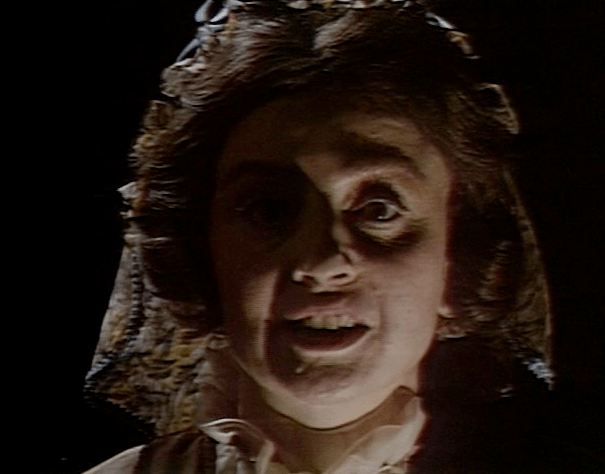
The opening voiceover melds into a sequence in which we cut back and forth between repressed spinster Abigail Collins and the fanatical Rev’d Mr Trask standing in front of black backgrounds, looking directly into the camera, and declaring that the trial of bewildered time-traveler Vicki for witchcraft must begin at once.

Soap Opera Land famously does not observe the legal codes that prevail elsewhere. If that is going to bother you, you probably aren’t in the right frame of mind to enjoy the show at all. But there is an art to depicting a fictional trial. You can deviate as much as you like from the rules that prevail in the real world, but there have to be some kind of rules the audience can understand. We can either see those rules applied with the result that a disorderly world is reduced to order, or see them flouted so that our heroes’ hopes of justice are cruelly dashed. If we aren’t aware of any rules, there is no point in setting the play in a courtroom.

That’s the first problem with Vicki’s trial. Now and then her lawyer/ gaoler/ boyfriend/ etc Peter will object to some question or move that a statement be stricken, and once or twice the judges will agree with him. But they are just as likely to respond to identical protests by ordering him to stop interrupting. The witnesses respond to questions with extended free association sessions. Vicki herself interrupts testimony repeatedly, usually to make self-incriminating remarks, and no one tries to stop her. Trask is for some reason simultaneously the prosecutor and one of the witnesses. Opposing counsel periodically engage in shouting matches with each other while the judges watch. The whole thing is so chaotic that it may as well be taking place in a bar-room or at the county fair or on the waterfront after dark.

The second problem with the trial is that it requires Peter to raise his voice repeatedly. Actor Roger Davis can deliver dialogue more or less competently when he is speaking in a normal conversational tone, but his loud voice always tends toward an ugly snarl. This is a major limitation for any performer on a show as shouty as Dark Shadows, but the opposition of Peter to Trask puts Davis head to head with Jerry Lacy, who is a virtuoso of shouting. Next to Lacy’s, Davis’ shouting is not recognizable as a performance.

When I’m watching a scene on Dark Shadows that suffers because of an actor’s shortcomings, I sometimes try to make it bearable by imagining what it would have been like had someone else who may have been available for the part been cast instead. Harvey Keitel was an extra on the show in #33; no doubt he would have accepted a speaking part if offered. Roger Davis plays Peter as a deeply angry man, and Mr Keitel is one of the very best at making audiences empathize with such characters. So it’s interesting to try to picture him as Peter.

On the other hand, there’s nothing in the scripts that requires Peter to constantly seethe with barely contained rage. That was Mr Davis’ contribution. Had the show gone with a more amiable Peter, they might have been able to cast Frederic Forrest in the part. In #137, Forrest was a background player. While Forrest played his share of angry men over the years, he also excelled as goofily cheerful characters, most famously as Chef in Apocalypse Now. I would have liked to see Peter played that way. I think he would have had some real chemistry with Alexandra Moltke Isles’ Vicki, and that we would have had protective feelings for him as he went up against the formidable Trask.

There is a third problem with the trial that neither Harvey Keitel nor the late Frederic Forrest could have done any more with than could Mrs Isles. That is that Vicki and Peter are written as phenomenally stupid. Vicki hasn’t done a single intelligent thing since arriving in the late eighteenth century in November,* but she has become, if anything, even dumber since 1795 gave way to 1796. Peter’s behavior has also been deeply foolish, and today he hits rock bottom when he blurts out to the court that he abused his position as gaoler to help Vicki sneak out, to commit a burglary at the great house of Collinwood, and to steal evidence against her so that it could not be presented to the court. Even under Soap Opera Law, that’s three felonies.

Some claim that the phrase “Dumb Vicki” is ableist. I disagree. “Dumb” really does not mean “mute” anymore, so that using it isn’t ableist against people who do not have the power of speech. And the intelligence characters like Peter and this version of Vicki lack is not the intelligence that IQ tests are supposed to measure. One of the most interesting characters in the part of Dark Shadows set in the eighteenth century is fluttery heiress Millicent Collins, who would probably fall far short of a triple digit score on a Stanford-Binet scale, but whose behavior makes sense to us because we tell what she wants out of life and how she thinks her actions will help her get it. That’s really all we mean when we talk about a “smart character.” A well-crafted story about someone with profound developmental disabilities can depict that person as a smart character, in that sense, as easily as can one about a great sage or a brilliant scientist. Vicki and Peter are not smart characters, no matter how what kind of school we might suppose would best suit them as students, because there is nothing for us to learn by observing their behavior and no suspense as to what their several actions will add up to. They just do one damn thing after another.

Clarice Blackburn and Jerry Lacy do some fine acting today, as does Grayson Hall in a brief turn as the Countess DuPrés. The pre-title bit with Blackburn and Lacy in front of the black backgrounds is so specific to theater in the 1960s that I can’t help but smile at it, but I’m glad it’s there. It isn’t as though you could ever really forget that the show is 56 years old, and I like to see that they preserved something that would have been so typical of the off-Broadway productions that would have been such a big part of the working lives of the cast and other creatives in those days.

*In her testimony today, Abigail gives the dramatic date of Vicki’s arrival in the past as 12 October 1795. The episodes in which the events she describes happened were broadcast on 17 November and 20 November 1967. In the last few weeks, the show has explicitly told us that the day and month of the dramatic setting in 1796 is the same as the broadcast date in 1968, so it’s confusing.

Episode 404: I forgot you were here

When I was a kid in the 80s, a friend of mine liked watching syndicated reruns of the tongue-in-cheek Western series Alias Smith and Jones on Saturday afternoons. I didn’t much care for it, but sat through a few of them with him. Eventually they got to some episodes in which the actor who played the character with the alias “Smith” was replaced by a man who was always smiling as if he had just said something terribly clever, even if he hadn’t said anything at all. After a few minutes of that bozo’s inane mugging, my friend couldn’t stand it either, and we could go back outside and play. So that worked out to my benefit.  

In those same years, I was a great fan of The Twilight Zone. The man whose pointless self-satisfied smile ruined Alias Smith and Jones for its fans showed up in one of those episodes, but he was used intelligently there. The episode was called “Spur of the Moment.” In it, a young woman has to choose between two lovers, one of them a prosperous fellow whom her father likes, the other a penniless dreamer whom the whole family hates. Any audience will have seen that story countless times and will assume that we are supposed to root for the penniless dreamer. But The Twilight Zone mixed that up for us by casting the likable Robert E. Hogan as daddy’s choice and the man with what we nowadays call an “instantly punchable face” as the poor boy. When the twist ending shows us that the woman was horribly wrong to marry the poor boy, it’s our dislike of the actor playing him that makes it a satisfying resolution.

So, when I first saw this episode of Dark Shadows some years ago, it was with some apprehension that I met the sight of that same repellent man on screen. His name is Roger Davis. In later years, Joan Bennett would look back at her time on Dark Shadows and would refer to Mr Davis as “Hollywood’s answer to the question, ‘What would Henry Fonda have been like if he had had no talent?'” Mr Davis’ head is shaped like Fonda’s, and his character turns out to be a defense attorney, a common occupation among the roles Fonda played.

The first line addressed to Mr Davis is “I forgot you were here,” spoken by bewildered time-traveler Vicki. When his character Peter, a jailer who is reading for the bar, tells her that he can hear her in her cell at night, she tells him she didn’t know he was there. Vicki’s repeated failure to notice Peter’s existence may not sound like an auspicious start to what is supposed to be a big romance, but it isn’t as bad as what happens when he is escorting her back to her cell. He puts his hand on her elbow, and she reflexively recoils.

Mr Davis is just awful in his scene today. He spits each of out his lines as if they were so many watermelon seeds, stops between them to strike poses almost in the manner of a bodybuilder, and looks at the teleprompter. The last was a near-universal practice on Dark Shadows, but I mention it for two reasons. First, because this is his debut on the show- even Jonathan Frid, whose relationship with the teleprompter is the true love story of Dark Shadows, didn’t start reading from it until he’d been on the show for a week or two. Second, in his attempts to defend what he did on Dark Shadows, Mr Davis has many times claimed that he “always” knew his lines, that he “never” used the teleprompter.

Mr Davis is going to be a heavy presence on the show for what will seem like a very, very long time to come. He, more than anyone else, prompted me to make a habit of what I call “imaginary recasting.” When Joan Bennett was stuck playing a scene with him, she evidently made the experience endurable by thinking back to the days when she was a movie star playing opposite the original, talented Henry Fonda. When I am watching him butcher a scene, I think of other actors who actually appeared on Dark Shadows or who would likely have accepted a part on it if offered, and try to visualize what they would have done in his stead.

Harvey Keitel was a background player in #33, and surely he would have accepted a speaking role on the show at this point in his career. Mr Davis’ invariably, pointlessly belligerent tone of voice makes Peter seem like a guy with a lot of anger. Mr Keitel is of course a master of playing men who have issues with anger but are still deeply sympathetic. When it’s time to sit through one of Mr Davis’ scenes as Peter, I have enough fun imagining what Mr Keitel could have done with the part that I am not too sorely tempted to give up.

Closing Miscellany

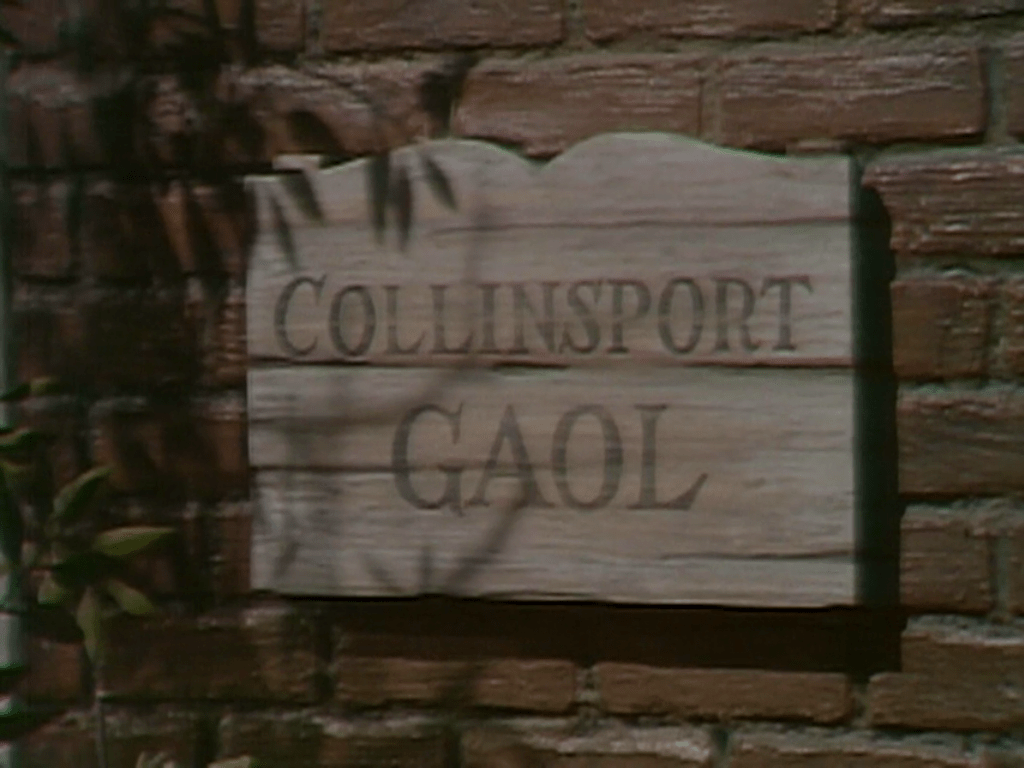
This is the first episode to show that the sign outside the town lockup is labeled, in a period-appropriate spelling, “Collinsport Gaol.”

Ballad of Collinsport Gaol.

The Bil Baird bat puppet appears in this episode, but is so close to the camera it looks like a felt cutout. Bit of a disappointment.

In his post about this episode on Dark Shadows Every Day, Danny Horn discusses the performance Addison Powell gives as a lawyer who meets with Vicki and decides he can’t take her case. He claims that Powell was THE WORST ACTOR EVER TO APPEAR ON DARK SHADOWS. Powell isn’t one of my favorites, but I don’t think he deserves that title. Of those we’ve seen so far, I’d say Mark Allen, who played drunken artist Sam Evans in the first weeks of the series, was the most consistently worthless performer, while Michael Hadge, who was motorcycle enthusiast Buzz for a while in 1967, was the most endearingly inept. Powell is awkward in his scene today, but Roger Davis is even more so, and he, unlike Powell, is so naturally unpleasant that he has to be flawless to earn the audience’s toleration.

Episode 276: Into the room

For the first 54 weeks of Dark Shadows, reclusive matriarch Liz was paralyzed by the fear that someone would enter the locked room in the basement of the great house of Collinwood and find the murdered body of her husband Paul Stoddard buried there. For the last 16 of those weeks, seagoing con man Jason McGuire exploited that fear to blackmail Liz.

It turned out that Liz didn’t actually kill Stoddard and there never was a corpse hidden in the basement of the great house. There is, however, a corpse hidden in the basement of another house on the same estate. During the daytime, Liz’ distant cousin Barnabas Collins is a dead body resting in a coffin in the basement of the Old House. He gets up at night to feed on the blood of the living, lure the unwary to their damnation, and deliver rambling monologues about how sorry he feels for himself. Unlike Stoddard’s supposed grave in the great house, Barnabas’ coffin is not kept in a locked room, so the parallel has been incomplete.

Today, Barnabas decides to complete it. Trying to find and steal Barnabas’ jewels, Jason had broken into the Old House. He made his way to the basement, where he stumbled upon the coffin. He opened it, and Barnabas strangled him. Now, Barnabas orders his sorely bedraggled blood thrall Willie to help him carry Jason’s body to the secret room in the mausoleum where Barnabas himself was imprisoned and undiscovered for “nearly 200 years.”

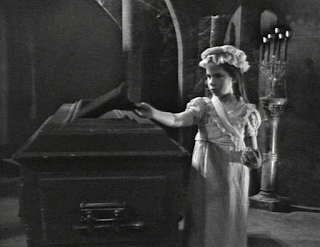
Before they leave the basement, Barnabas tells Willie about his sister Sarah, who died when she was very young and innocent. After they leave, Sarah’s ghost appears and puts Jason’s sea cap on Barnabas’ coffin.

Sarah places Jason’s cap. Screenshot by Dark Shadows Before I Die

Episodes #1-#274 had all opened with voiceover narrations delivered by Alexandra Moltke Isles in character as well-meaning governess Vicki. Starting Friday, they gave the opening monologues to one of the actresses who happened to be in the episode to deliver as an unnamed external narrator. Today, this spoils a surprise. We haven’t seen Maggie Evans, The Nicest Girl in Town, for a while, and aren’t sure when we will see her again. When Kathryn Leigh Scott delivers today’s opening voiceover, we know we will see Maggie today.

Barnabas had held Maggie prisoner for several weeks. He had borrowed a plan from the 1932 Universal film The Mummy. He would erase Maggie’s personality and replace it with that of his long lost love Josette. Once he had done that, he would kill her and she would rise from the dead as a vampiric version of Josette. Maggie did not go along with the plan, and Sarah’s ghost helped her to escape. Barnabas managed to scramble Maggie’s memory before her father found her, and she is now in treatment at a sanitarium called Windcliff.

Maggie’s hometown doctor, addled quack Dave Woodard, is visiting the director of Windcliff, Dr Julia Hoffman. Woodard wants to show Maggie a sketch Maggie’s father, artist Sam Evans, made when the ghost of Sarah visited him to tell him where to look for Maggie. Julia resists, Woodard insists. While Julia delays, she feeds the fish in the aquarium in her office. We see enough of the aquarium to suggest that Julia is the keeper of a world within a world, a little enclosure with its own rules.

Aquarium. Screenshot by Danny Horn.

Woodard shows Maggie the sketch. After a moment, she says “Sarah.” She tells them that Sarah visited her in the room where she was confined, that she told her a riddle that showed her how to escape. She becomes too upset to talk. She starts miming her search for a loose brick in the wall of the cell, then sings a verse of Sarah’s signature tune, “London Bridge.” She is shouting words from “London Bridge” when the nurse drags her down the hall, back to her room. Julia declares that the whole thing was a waste of time, a judgment in which Woodard does not concur.

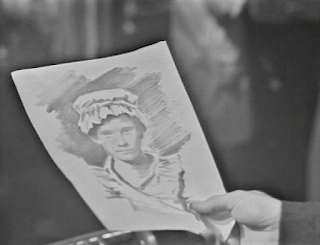
Sam’s sketch of Sarah. Apparently the drawing was done before Sharon Smyth was cast as Sarah, when they planned to give the part to Harvey Keitel in drag. Screenshot by Dark Shadows Before I Die

Meanwhile, Barnabas and Willie take the body of Jason to the tomb of the Collinses and bury it in the secret room. They talk about the people buried in the part of the structure known to the public- Barnabas’ parents and his sister Sarah. Barnabas confirms that Sarah is the one he was telling Willie about in the basement, the friend he knew long before he met Josette. He reminisces about repairing a doll of hers the night before she died. We see the plaque giving her dates as 1786-1796, implying that Barnabas met Josette after 1796. They leave, and Sarah appears.

Liz had last seen Jason the night she thought she killed Stoddard; his reappearance would lead to the opening of the locked room and the exposure of its secret. Barnabas last saw Sarah in 1796; her reappearance, today’s events suggest, might lead to the opening of all the rooms Barnabas wants to keep closed and to the exposure of all his secrets.

Episode 92: It’s hard to believe there was ever any gaiety at Collinwood

The only episode of the series to take place entirely outside of the town of Collinsport and the great house of Collinwood, this one is set in Bangor, Maine.

Well-meaning governess Vicki has gone to that town in search of information about herself. When she asks her employer, reclusive matriarch Liz, even the most basic questions about why she decided to hire her and how she knew she existed, Liz becomes evasive, then flatly and transparently lies to her. Vicki has found an old document in the house that may shed light not only on the matters Liz has already refused to discuss, but even on her questions about her birth family. Sure that Liz won’t give her any information about the document, she decides to take it to Liz’ lawyers, the firm of Garner and Garner.

Vicki meets Garner and Garner. Screenshot by Dark Shadows Before I Die

Lawyers on soap operas don’t always follow the rules that bind their counterparts in our universe, but at least in this episode Garner and Garner are not going to tell Vicki anything their client does not want her to know. Indeed, the Garners are realistic enough to present a problem. One of them is Frank Garner, a young lawyer who is going to date Vicki for a few months. As played by Conard Fowkes, Frank is very much the sort of fellow you would expect to meet in a law office in Bangor, Maine. In this phase Dark Shadows still has some room for low-key stories and naturalistic acting, but no TV series this side of C-SPAN would be able to accommodate a character like Frank.

It’s a shame Frank isn’t more suited to Dark Shadows. The show urgently needs more young men in the cast. At this point, the only male actors between the ages of 11 and 40 they have who have appeared more than once are Joel Crothers as hardworking young fisherman Joe Haskell, Mitch Ryan as dashing action hero Burke Devlin, and Dana Elcar as Sheriff Patterson. Sheriff Patterson is supposed to be older than the 39 year old Elcar, and is coded as an authority figure who is unavailable for dating. So Joe and Burke have to provide the male points on all of the love triangles.

I think Frank could have been saved had he been played by a different actor. However dull the dialogue the writers might give him, he is on screen enough that a sufficiently charismatic performer could have grabbed our attention. And maybe stimulated the imagination of the writers, so that he would have had interesting things to say and do. Harvey Keitel had danced in the background at The Blue Whale in episode 33, and so must have been available for a speaking part on the show. Keitel’s quiet, brooding intensity always convinces an audience that a character who is saying very little is thinking deeply and feeling strongly and planning mighty things. Keitel would have been quite powerful as Frank.

Fowkes brought a light tone to his performance, and that is welcome. Dark Shadows always struggled to maintain a bit of sparkle against the background of a setting so gloomy that in this episode Vicki finds it “hard to believe there was ever any real gaiety at Collinwood.” If that line is meant to raise our hopes that a Vicki-Frank relationship will create a bright new mood, it sets us up for instant disappointment. Frank is cheerful and pleasant enough, but he doesn’t project enough personality to change the feeling even of the shots he is in, let alone of the entire series.

Keitel has never been known for lightness. If you wanted that, you could have turned to another Blue Whale dancer- Frederic Forrest, whom we will see in episode 137. Thinking of the goofy charm that Forrest’s character maintained throughout a movie as heavy as Apocalypse Now it’s easy to imagine a breeze of fresh air running through Dark Shadows. Not only would Forrest himself have been fun to watch as Frank, but he might well have brought out some of the most under-utilized aspects of Vicki’s character. A handful of times in these early months, Vicki is allowed to make jokes, usually in her scenes with strange and troubled boy David. David will not be amused, but the audience can see that Alexandra Moltke Isles is capable of being extremely funny. A relationship between a character played by Forrest and one played by Mrs Isles might have given the writers abundant opportunities to showcase that side of her. A pairing with the earnest, cheerful, but entirely humorless Frank represents a death sentence for Funny Vicki.

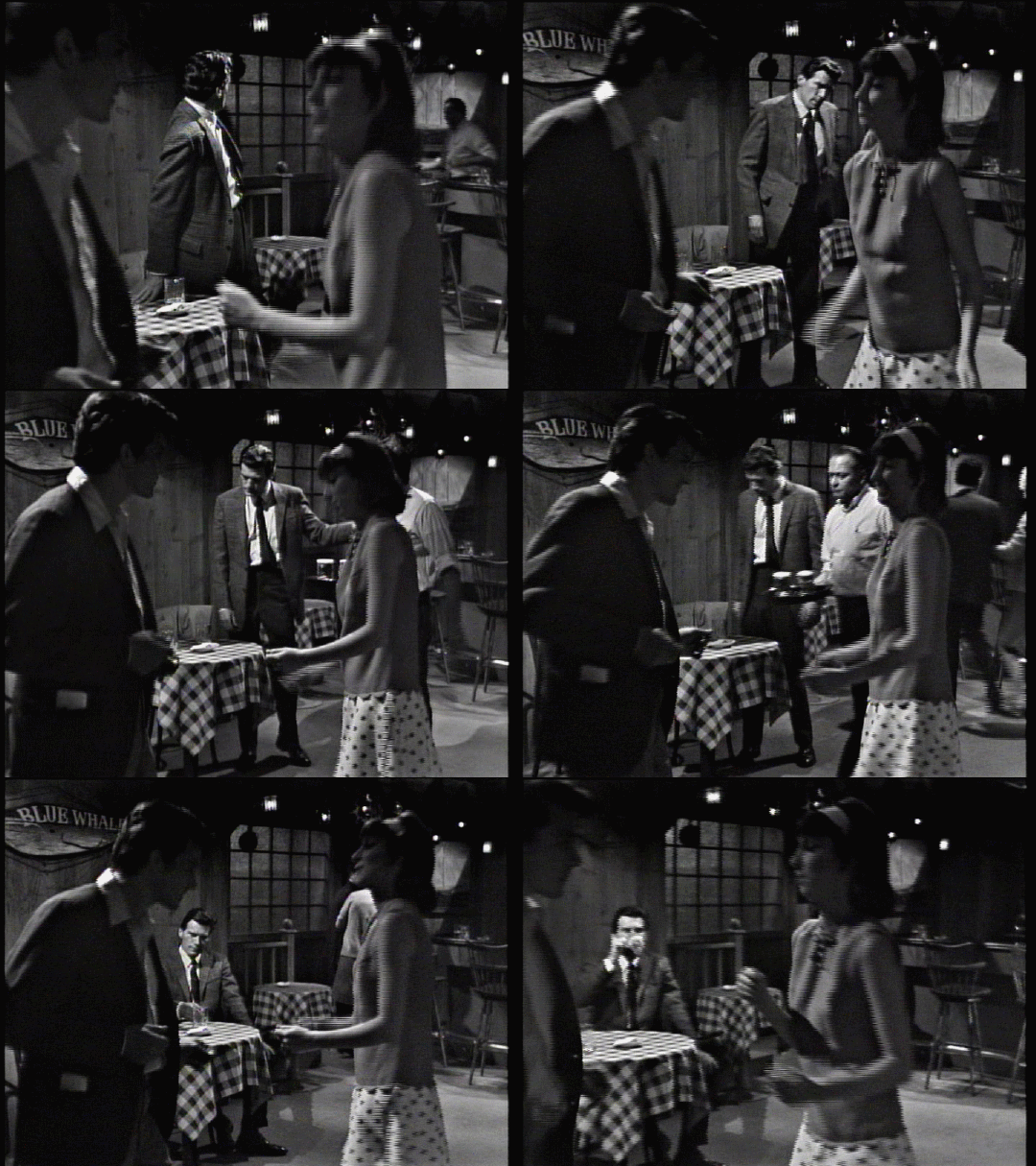
Episode 33: The one with Harvey Keitel

At Collinwood, Liz tells Carolyn that David won’t be going away just because he tried to murder his father. “Things will go on just as before.” On the other hand, Carolyn should marry Joe and leave the house, because “You’re the only one of us who can have a sane, happy life.” I suppose we’ve all seen that in real life, someone swinging wildly between deep denial and exaggerated despair. Two forms of learned helplessness, I guess.

At the Blue Whale, Joe is getting well and truly sloshed. Burke joins him at his table, interrupting a conversation between Joe and his whiskey glass. Joe tells Burke that he doesn’t like him, expresses his frustration with Carolyn’s refusal to get married, then goes to Collinwood, roaring drunk, and tells Carolyn, Liz, and Vicki what he thinks of them.

One thing Joe thinks is that Carolyn is doomed to be a spinster. Considering that she’s supposed to be about seventeen, that does call to mind Barnabas’ line to Carolyn in the 2012 Dark Shadows movie, “Fifteen? And no husband?

Marc Masse brings this point out well on his Dark Shadows from the Beginning, and argues that the depiction of Carolyn may be one of the things that sunk the show with young viewers between the end of the first month and the introduction of the vampire:

You have to wonder what kind of impression the character of Carolyn Stoddard would have made to young viewers in 1966. Here she is having grown up in a mansion with forty rooms and her only option in life is to be married off before her eighteenth birthday to a local fisherman, or else face a life of lonely spinsterhood. In that respect, Dark Shadows seems to belong to the sensibilities of previous decades.

This paragraph is part of an in-depth discussion of Dark Shadows’ place on ABC’s schedule, its ratings, the show that preceded it in its time-slot, and Art Wallace’s rather antiquated view of the world. It’s all very informative, highly recommended.

When Joe passes out on the couch, Vicki goes to town. She goes to the Blue Whale, where Burke asks if she’s looking for someone. “I just found him,” she replies. Obviously, she’s talking about Harvey Keitel, who is dancing a few feet away from her.

That Harvey Keitel was once an extra on Dark Shadows is pretty interesting. If he took that job, clearly he would have taken a speaking part. I gave some thought to parts I wish he had taken in comments on Danny Horn’s Dark Shadows Every Day four times: here (on episode 470,) here (on episode 769,) here (on episode 1057,) and here (on episode 1137.)

Episode 470: Mad Men

In which I say that by imagining Howard da Silva in Addison Powell’s place and Harvey Keitel in Roger Davis’, I was able to sit through the whole Dr Lang/ Jeff scene without throwing up. 

Episode 470: Mad Men