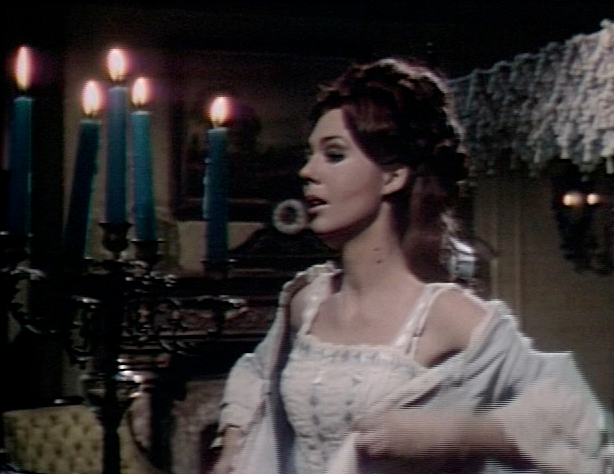
Episode 672: And it was my mother’s voice

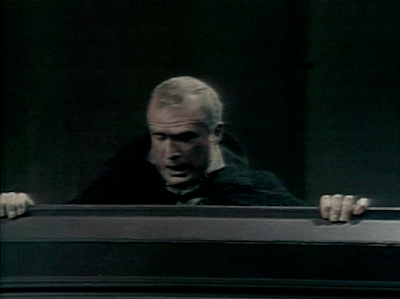
Today, everyone has the memory of a goldfish. Heiress Carolyn receives a telepathic message from her mother, the apparently-dead Liz, urging her to go home to the great house of Collinwood and stay inside in order to escape a terrible danger. A few minutes later, she has apparently forgotten the content of this message, as she goes back outside to check on Liz in her coffin.

During her brief stay in Collinwood, Carolyn talked with permanent houseguest Julia. Julia keeps telling her that Liz is dead and that the dead cannot communicate with the living, suggesting that she too has become a goldfish. Julia is a doctor, and Liz is entombed because she mistakenly declared her dead. She had made the same mistake about her several weeks before, and learned nothing from that experience. But she has also attended several séances, built two Frankenstein’s monsters, seen a number of ghosts, and spent a year and a half carrying on a one-sided romance with recovering vampire Barnabas. She also knows that in #592 and #593, Carolyn herself died and came back to life. So it is bizarre that she goes on about the finality of death and the impossibility of communication between the living and the dead.

Carolyn goes back to her mother’s crypt and is attacked by a werewolf. Liz knew she would be buried alive, and so insisted her coffin be equipped with a button that would ring bells everyone at Collinwood could hear. While Carolyn is confronting the werewolf, Liz overcomes her paralysis sufficiently to push this button. That brings Barnabas and Julia.

The werewolf paused in his attack on Carolyn when he saw her silver bracelet; that gave Julia and Barnabas time to arrive while Carolyn was still alive. Barnabas strikes him with the silver head of his cane, causing him to run off. When Carolyn tells of the werewolf’s fascination with the bracelet, Barnabas mentions that the head of the cane is also silver; he grows very thoughtful, apparently realizing that silver has a power over the werewolf. Yet later, when he goes to hunt for the werewolf, he takes a gun but nearly leaves the cane behind. He finally takes it, but his long hesitation shows that he, too, is suffering from goldfishism.

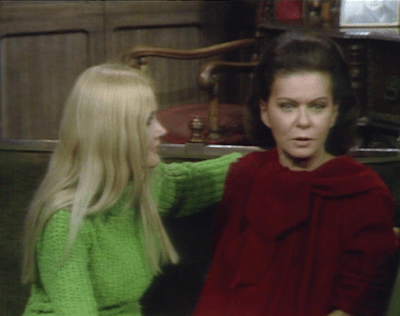
While still in the crypt, Julia had looked at Liz’ body and insisted she was dead. She wrote off the ringing of the bells as a coincidence, perhaps caused by some jostling during Carolyn’s encounter with the werewolf. Later, Liz gets out of the coffin and goes home to Collinwood. There, Julia, Barnabas, and Carolyn are astonished to see her. Julia examines her. After she finds that Liz has what is in Collinsport English called a “pulsebeat,” she seems willing to concede that she might be alive. She then starts giving orders which everyone willingly follows, because she is such a good doctor.

Liz remembers. Screenshot by Dark Shadows Before I Die.

Liz is the one character whose brain seems to be in working order today. She can remember that her trouble started when her brother Roger’s wife Cassandra cast a spell on her. Barnabas and Julia know that Cassandra was in fact a wicked witch named Angelique, and that Barnabas has just returned from a trip back in time during which he destroyed Angelique. They assure her that Cassandra will never return. They can’t tell her why they are sure of this, because they, like the producers of Dark Shadows, have decided that Liz must never know what is really happening around her, lest she become an active participant in the plot. So all they can say is that they just know, and she is of course unconvinced.

It is a relief to wrap up the “Liz will be buried alive” storyline; that was dull from the beginning, and just got duller as it went. It didn’t help that we have seen Liz immobilized by depression twice before. This isn’t even the first time she has been rendered catatonic as the result of a curse placed by an undead blonde fire witch.

It’s also encouraging that Julia and Barnabas have met the werewolf and are engaged with him. They are the show’s chief protagonists, and nothing can really move without their involvement. Now that they are involved with the werewolf, we can stop spinning our wheels.

Episode 482: Someone you hate

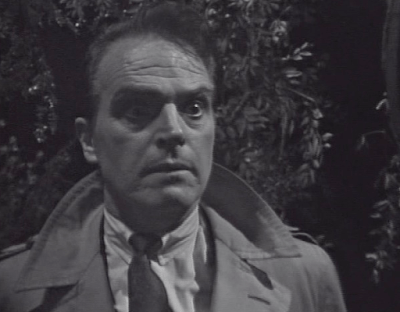
Recovering vampire Barnabas Collins hopes that mad scientist Eric Lang will be able to free him of his curse once and for all. Since wicked witch Angelique, who put the curse on Barnabas in the first place, has come back to the great estate of Collinwood, Barnabas found a twelfth century Sicilian talisman with the power to protect against witches and gave it to Lang with instructions that he was to keep it on his person at all times. Several days ago, Angelique drove Lang to the point of death, and he survived only because he managed to touch the talisman at the last moment. Even so, Lang refuses to wear the talisman or even to keep track of it. Now Barnabas is with Lang in his study, whence they discover that the talisman has been stolen. Lang asks Barnabas if he can get another one for him. Barnabas looks at Lang as if he were the world’s stupidest man, and tells him that such objects are extremely rare.

The whole business with Lang and the talisman is a prime example of what Roger Ebert called Idiot Plot, in which the story would end immediately if the characters showed as much intelligence as the average member of the audience has. If Lang were played by a good actor, he might be able to hold our interest through a few of these inexplicable actions. Both Alexandra Moltke Isles, as well-meaning governess Vicki, and Dana Elcar, as Sheriff George Patterson, were cast as the Designated Dum-Dum in a number of episodes, and each managed to survive longer than one might have expected. Mrs Isles kept the audience on board for Vicki by making us wonder how anyone could absorb the torrent of bizarre information drowning her. Elcar made the sheriff watchable by making speculate he might only be pretending to be clueless. But as Lang, Addison Powell is just dismally bad. Not only does he not invent a way to make Lang seem like he might be secretly smarter than the script makes him out to be, he does not show any sign of ever having acquired even the most basic acting skills. When Lang seems to think Barnabas can take him to Talismans-Я-Us to replace the priceless object he has lost, the audience loses whatever patience it may have had with him.

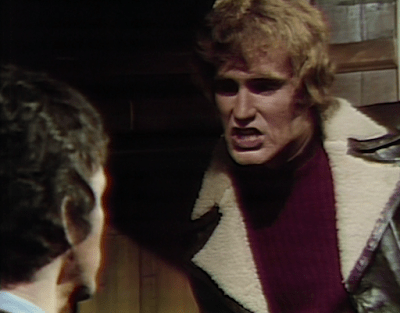
Lang’s assistant, a former mental patient named Peter who insists on being called “Jeff,” is quitting after months of helping Lang steal body parts from fresh graves. Peter/ Jeff tells Barnabas that he will be staying in town. That’s bad news for Barnabas, but much worse news for the audience. Peter/ Jeff is played by Roger Davis, who is a far more skilled actor than Addison Powell but, if anything, even less pleasant to watch. His characters are either full of rage or insufferably smug, he often manhandles his scene partners, and when he raises his voice he projects, not from the muscles of his pelvic floor, but from his anal sphincters, causing him to sound like he is suffering from severe constipation.

Lang tells Barnabas he needs a new assistant as soon as possible. Barnabas says he knows just the man. He is Willie Loomis. As Peter/ Jeff was a patient in an institution for the criminally insane when Lang found him, Willie is a patient in such an institution now. Willie was Barnabas’ servant for the first months he was in the 1960s, when Barnabas was a vampire rampaging through the village of Collinsport. Barnabas eventually took the heat off himself by pinning some of his crimes on Willie, packing him off to the mental hospital.

Willie was a fan favorite. Largely this was because actor John Karlen was as capable as Addison Powell was inept and as likable as Roger Davis is repellent. But the writers, too, always found fresh ways to make Barnabas’ conversations with Willie interesting, and when mad scientist Julia Hoffman teamed up with Barnabas she and Willie were great fun to watch together. The idea of Willie replacing Peter/ Jeff, in whatever capacity, is something to cheer for.

We cut to the cottage where Maggie Evans, The Nicest Girl in Town, lives with her father Sam. Maggie is wearing a pair of trousers which may well be the weirdest things ever shown on Dark Shadows. According to a blog called 1630 Revello Drive,* they are based on an article of women’s clothing traditional in India called a gharara. Surely no one in India ever made such things out of this brightly colored floral quilt. If this garment can exist, we would be foolhardy to rule out the possibility of ghosts or vampires or time travel or witches or anything else.

Maggie in her quilted pseudo-gharara. Screenshot by Dark Shadows Before I Die.

Maggie answers a knock on the door and finds Peter/ Jeff. Vicki had arranged for him to rent a room at the Evans cottage. Shortly after he arrives, Vicki comes. Peter/ Jeff tells her she doesn’t know much about him, and asks what she will do if it turns out he is someone she hates.

The next thing we see after that question is Peter/ Jeff with his shoe, a shoe he wears while robbing graves, on Maggie and Sam’s coffee table. Anyone who saw that might well conclude that Peter/ Jeff is such a clod that any civilized person would be tempted to hate him.

That isn’t an ottoman, buddy.

Again, there are actors who specialize in playing men who are compelling to watch when they do unpleasant things. Dark Shadows hit the jackpot in this regard when it cast Jonathan Frid as the vampire Barnabas. It narrowly missed doing so on other occasions. In the first year of the show, future movie stars Harvey Keitel (in #33) and Frederic Forrest (in #137) showed up as background players. Surely they would have taken speaking parts on the show at this point in their careers, and either of them could have made Peter/ Jeff almost as much of an asset as John Karlen made Willie, even if he did wantonly ruin people’s furniture.

*As cited by Christine Scoleri on Dark Shadows Before I Die.

Episode 427: I object

The opening voiceover melds into a sequence in which we cut back and forth between repressed spinster Abigail Collins and the fanatical Rev’d Mr Trask standing in front of black backgrounds, looking directly into the camera, and declaring that the trial of bewildered time-traveler Vicki for witchcraft must begin at once.

Soap Opera Land famously does not observe the legal codes that prevail elsewhere. If that is going to bother you, you probably aren’t in the right frame of mind to enjoy the show at all. But there is an art to depicting a fictional trial. You can deviate as much as you like from the rules that prevail in the real world, but there have to be some kind of rules the audience can understand. We can either see those rules applied with the result that a disorderly world is reduced to order, or see them flouted so that our heroes’ hopes of justice are cruelly dashed. If we aren’t aware of any rules, there is no point in setting the play in a courtroom.

That’s the first problem with Vicki’s trial. Now and then her lawyer/ gaoler/ boyfriend/ etc Peter will object to some question or move that a statement be stricken, and once or twice the judges will agree with him. But they are just as likely to respond to identical protests by ordering him to stop interrupting. The witnesses respond to questions with extended free association sessions. Vicki herself interrupts testimony repeatedly, usually to make self-incriminating remarks, and no one tries to stop her. Trask is for some reason simultaneously the prosecutor and one of the witnesses. Opposing counsel periodically engage in shouting matches with each other while the judges watch. The whole thing is so chaotic that it may as well be taking place in a bar-room or at the county fair or on the waterfront after dark.

The second problem with the trial is that it requires Peter to raise his voice repeatedly. Actor Roger Davis can deliver dialogue more or less competently when he is speaking in a normal conversational tone, but his loud voice always tends toward an ugly snarl. This is a major limitation for any performer on a show as shouty as Dark Shadows, but the opposition of Peter to Trask puts Davis head to head with Jerry Lacy, who is a virtuoso of shouting. Next to Lacy’s, Davis’ shouting is not recognizable as a performance.

When I’m watching a scene on Dark Shadows that suffers because of an actor’s shortcomings, I sometimes try to make it bearable by imagining what it would have been like had someone else who may have been available for the part been cast instead. Harvey Keitel was an extra on the show in #33; no doubt he would have accepted a speaking part if offered. Roger Davis plays Peter as a deeply angry man, and Mr Keitel is one of the very best at making audiences empathize with such characters. So it’s interesting to try to picture him as Peter.

On the other hand, there’s nothing in the scripts that requires Peter to constantly seethe with barely contained rage. That was Mr Davis’ contribution. Had the show gone with a more amiable Peter, they might have been able to cast Frederic Forrest in the part. In #137, Forrest was a background player. While Forrest played his share of angry men over the years, he also excelled as goofily cheerful characters, most famously as Chef in Apocalypse Now. I would have liked to see Peter played that way. I think he would have had some real chemistry with Alexandra Moltke Isles’ Vicki, and that we would have had protective feelings for him as he went up against the formidable Trask.

There is a third problem with the trial that neither Harvey Keitel nor the late Frederic Forrest could have done any more with than could Mrs Isles. That is that Vicki and Peter are written as phenomenally stupid. Vicki hasn’t done a single intelligent thing since arriving in the late eighteenth century in November,* but she has become, if anything, even dumber since 1795 gave way to 1796. Peter’s behavior has also been deeply foolish, and today he hits rock bottom when he blurts out to the court that he abused his position as gaoler to help Vicki sneak out, to commit a burglary at the great house of Collinwood, and to steal evidence against her so that it could not be presented to the court. Even under Soap Opera Law, that’s three felonies.

Some claim that the phrase “Dumb Vicki” is ableist. I disagree. “Dumb” really does not mean “mute” anymore, so that using it isn’t ableist against people who do not have the power of speech. And the intelligence characters like Peter and this version of Vicki lack is not the intelligence that IQ tests are supposed to measure. One of the most interesting characters in the part of Dark Shadows set in the eighteenth century is fluttery heiress Millicent Collins, who would probably fall far short of a triple digit score on a Stanford-Binet scale, but whose behavior makes sense to us because we tell what she wants out of life and how she thinks her actions will help her get it. That’s really all we mean when we talk about a “smart character.” A well-crafted story about someone with profound developmental disabilities can depict that person as a smart character, in that sense, as easily as can one about a great sage or a brilliant scientist. Vicki and Peter are not smart characters, no matter how what kind of school we might suppose would best suit them as students, because there is nothing for us to learn by observing their behavior and no suspense as to what their several actions will add up to. They just do one damn thing after another.

Clarice Blackburn and Jerry Lacy do some fine acting today, as does Grayson Hall in a brief turn as the Countess DuPrés. The pre-title bit with Blackburn and Lacy in front of the black backgrounds is so specific to theater in the 1960s that I can’t help but smile at it, but I’m glad it’s there. It isn’t as though you could ever really forget that the show is 56 years old, and I like to see that they preserved something that would have been so typical of the off-Broadway productions that would have been such a big part of the working lives of the cast and other creatives in those days.

*In her testimony today, Abigail gives the dramatic date of Vicki’s arrival in the past as 12 October 1795. The episodes in which the events she describes happened were broadcast on 17 November and 20 November 1967. In the last few weeks, the show has explicitly told us that the day and month of the dramatic setting in 1796 is the same as the broadcast date in 1968, so it’s confusing.

Episode 422: Never gave you love

Yesterday, 5 February 1796, the Countess DuPrés visited suspected witch Victoria Winters in the Collinsport gaol. The countess begged Vicki to lift the spell that she believes to be causing her niece, the gracious Josette, to behave strangely. Vicki responded that she had cast no spell on Josette or anyone else. She claimed that she was not a witch at all, but an unwilling and well-meaning time traveler displaced from the year 1968. As it happens, this is true.

Vicki told the countess that according to the history and legend she learned in the 1960s, Josette will soon die. The last events leading to her death will be triggered when she loses a ring with a black onyx stone. Vicki’s remarks settled any lingering doubts the countess may have. She is now certain that Vicki is a witch, and that when she claims to be warning people against upcoming dangers she is in fact taunting them with her own cruel plans.

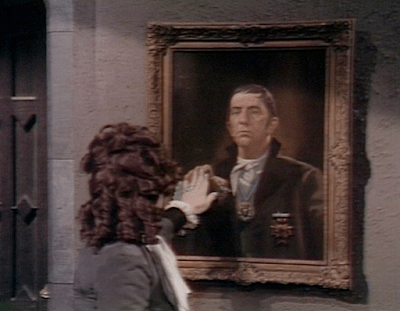
In Josette’s room, the countess discovers that Josette has somehow come into possession of just such a ring as Vicki described. Josette refuses to tell her where it came from. Later, the countess stands in the foyer of the great house of Collinwood, studying the portrait of the late Barnabas Collins that hangs there. She recognizes Josette’s new ring as the one in the portrait. Well might she recognize it- she knew Barnabas well, he died only a couple of weeks before, and he wore the ring all the time. He and Josette had been engaged to marry each other, and never gave up their passionate attachment even after they married other people. It is hard to think of a reason why the countess would not have thought of Barnabas at the moment Vicki began describing the ring, much less as soon as she saw it on Josette’s finger.

The countess studies the portrait of Barnabas. Screenshot by Dark Shadows Before I Die.

Barnabas’ father, haughty overlord Joshua, asks the countess what she finds so interesting about the portrait. She asks if the ring was part of a set; he answers that it was unique. He begins to reminisce about Barnabas’ great fondness for the ring. His warm look of recollection gives way to an expression of deep pain, and he stops himself as he is about to say that he left it on Barnabas’ finger when he buried him. He refuses to say any more about Barnabas.

The countess and Joshua do not like each other very much, but they are of one mind about Vicki. It is inexplicable that the countess does not tell Joshua about Vicki’s prediction and about the fact that Josette now has Barnabas’ ring. Her reticence sets up a dramatic moment, when Josette comes downstairs, faints, and Joshua finds the ring on her finger. But that moment would only have been more dramatic if it had also been the first time the countess saw Josette with the ring. Vicki’s description of a ring should have been more than enough to prompt her to study the portrait and ask Joshua about Barnabas’ ring, but perhaps not enough to embolden her to say much to Joshua. The scene in Josette’s room makes a hash of the countess’ motivations here, and leaves Joshua’s discovery of the ring as a pointless repetition.

Joshua goes to Barnabas’ coffin, hidden in a secret chamber of the family mausoleum. He talks to Barnabas for a while. He admits that he was a cold and distant father, but vows to take a terrible revenge on anyone who might have disturbed his rest. He opens the coffin and finds that it is empty. His shock is chiefly to do with the disappearance of the body, but can only be sharpened when he realizes that instead of delivering his heartfelt confession to his son’s corpse he was in the somewhat ridiculous position of delivering it to a piece of furniture. This is a characteristic situation for Joshua- when he is ready to open up about his feelings, he finds that no one is there who can even appear to be listening.

He ain’t got no body. Screenshot by Dark Shadows Before I Die.

Returning viewers know that no one robbed Barnabas’ grave. He has become a vampire. He gave Josette the ring himself, after biting her and telling her she would become his undead bride. All of this has been concealed from Joshua, the countess, and Vicki. Barnabas shows up today and has a forgettable scene with Josette. They get involved with the secret passage leading out of her bedroom.

Josette’s room will be Vicki’s in the 1960s, when she is the governess at Collinwood, and we saw in #412 that she knows about the secret passage. There is one other thing you would expect Vicki to have known. Barnabas returned to prey upon the living in April of 1967; Vicki knew him from then until she came unstuck in time in November of that year, though she thought he was alive. He wore the ring with the black onyx stone all the time in 1967, just as he did in 1795. Vicki was familiar with the portrait, which still hung there in her time. She believed its subject to be the ancestor of her acquaintance, knew that it was the same ring, and knew that the “original” Barnabas had been Josette’s lover. So if Vicki read a book or heard a legend that described the ring in connection with Josette, you would think she would have put one and one together and come up with two.

Episode 421: A series of prepared speeches

The Countess DuPrés (Grayson Hall) complains to her niece, gracious lady Josette (Kathryn Leigh Scott,) that life on the great estate of Collinwood is nothing but “a series of prepared speeches.” It’s hard to top that for commentary on this episode, but I do have a couple of things to add.

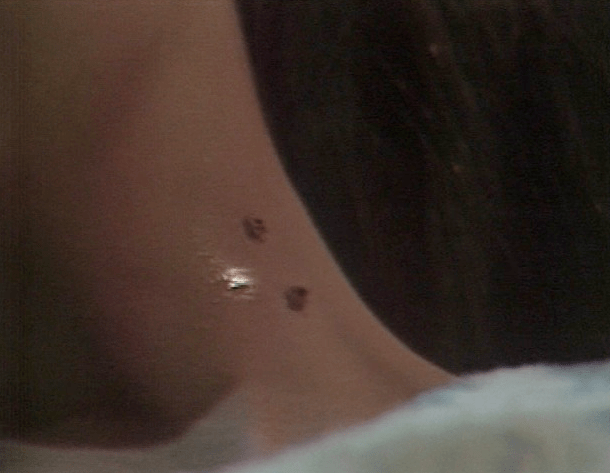
Josette has been seeing her lover and onetime fiancée, the late Barnabas Collins. Since his death, Barnabas has become a vampire. On Friday, he bit Josette. Now, she is trying to conceal her neck wounds from her aunt.

Josette, her neck wounds visible. Screenshot by Dark Shadows Before I Die.
These wounds are a single piece of makeup. Kathryn Leigh Scott still has it, she showed it in a Dark Shadows cast reunion on Zoom in 2020. The other cast members didn’t know why she wanted it any more than I do. Screenshot by Dark Shadows Before I Die.

Those who have been watching Dark Shadows for a while will find this story all too familiar. Until #365, the show was set in contemporary times, 1966 to 1967. Since then, it has been set in the years from 1795 to 1796. In the segments set in the 1960s, Miss Scott plays Maggie Evans, The Nicest Girl in Town, and Hall plays mad scientist Julia Hoffman. Maggie was Barnabas’ victim in May and June of 1967, and after she escaped from him, Julia was her psychiatrist. The countess is different enough from Julia that Hall has a lot of room to maneuver. But there are only so many ways an actor can convey the idea that her character is in a daze and alternately blissful and defensive. So Miss Scott winds up recycling the performance she gave as Maggie, and the result is pretty stale.

We traveled back to the 18th century with well-meaning governess Vicki. Vicki has not in any way adapted to her new environment, with the result that she is now in gaol on charges of witchcraft. When the countess visits her today, Vicki tells her that she is from the 1960s and that in that period she had learned from history and legend that a grim fate awaits Josette. The countess concludes from Vicki’s presentation that she is indeed a witch, and that she is not giving her warnings, but is cruelly gloating over the evil spells she has cast.

Vicki is accompanied by her gaoler/ defense attorney/ boyfriend, Peter. Peter had tried to stop her blabbing to the countess, and asks her why she did it. Vicki says that she is counting on the idea that if she keeps telling the truth, people will have to believe her. Peter asks her to think of how she would react if someone from the 21st century traveled to 1968 and went around telling everyone how and when they were going to die. At this, Vicki’s eyes widen. “Oh, Peter, what a fool I’ve been!”

At that, we can hear the sound of the viewing public giving up on Vicki once and for all. Peter isn’t even the first person to try to explain her situation to her. Both kindly gentleman Jeremiah Collins and caddish naval officer Nathan Forbes gave her explicit instructions about her need to lie and scam her way through her predicament, and neither of them made any impression on her. Movie reviewer Roger Ebert famously described stories that work only because the characters do things the average member of the audience would be too smart to do “idiot plots”; for the last eleven weeks, Vicki has been the Designated Dum-Dum at the heart of the most irritating idiot plot imaginable.

There actually is a very sweet little scene between Vicki and Peter right after that low point. She tells him about airplanes and other features of twentieth century life, and he tries to figure out what she’s talking about. Almost all of the anger we feel towards Vicki for being written so badly and towards Peter for being played by Roger Davis melts away by the end of that scene.

Episode 413: So sad for such a long time

Sarah Collins is going to turn 11 two days from now, on 26 January 1796. Sarah misses her big brother Barnabas. She has been told that Barnabas has gone to England, and today her mother, Naomi, tells her that Barnabas may not be back for a long time, maybe not until Sarah is grown up. Sarah refuses to believe this. She insists that if she lights a candle in the window of the bedroom where Barnabas’ onetime fiancée, the gracious Josette, has been staying, Barnabas will “somehow know it’s there” and come home.

Naomi lies to Sarah.

Sarah is right to disbelieve her mother. On the orders of her husband, haughty overlord Joshua, Naomi is repeating a lie to conceal Barnabas’ death. Joshua believes that Barnabas died from the plague, and that if that word gets out the men won’t report for work at the family’s shipyard. In fact, Barnabas never had the plague. He died of a witch’s curse. As a further result of the curse, he is now a vampire. The last few nights, he has been snacking on the women who frequent the waterfront of the village.

Josette is out of town, so Sarah takes the candle to her room, meaning to leave it there as a surprise. Looking out the window, she sees Barnabas on the lawn, peering up. Sarah is excited to see her brother, and runs out of the house after him. He doesn’t want her to know what has become of him, and runs off.

Barnabas on the lawn.
Sarah spots Barnabas.

Seconds after she exits the front door, Sarah is in the cemetery. It has been established many times that this cemetery is miles from the house; earlier in this very episode, Barnabas’ helper Ben visited him in his tomb there, and made it clear he had plenty of opportunity to shake anyone who might be following him as he journeyed there from the house. This inconsistency bothers a lot of people, but I kind of like it. We got to know Sarah as a ghost in 1967, and she was at the center of a number of very intriguing surrealistic sequences. She’s alive now, but the whole situation is so bizarre that it only seems right she moves as she would in a dream. Watching the scene this time, I was surprised- I had remembered the set behind Sarah being blurred as she ran and some other visual effects that would have presented it as an eldritch moment, but none of those was actually there.

The episode ends with Sarah in the outer part of the tomb, near the secret panel behind which Barnabas’ coffin is hidden. She is calling out to him. We have been warned that Sarah will die on her birthday as a result of exposure; when Barnabas does not come to her, she complains of the cold, and we end on an ominous note.

Sarah in the mausoleum.

When Sarah sees Barnabas standing on the lawn, we echo earlier phases of Dark Shadows. We often saw characters looking out that window during the first 73 weeks of Dark Shadows, when the dramatic date was 1966 or 1967 and the room was occupied by well-meaning governess Vicki. We also saw Barnabas peer up at Vicki’s window from the lawn several times. The first time was at the end of #214, when the camera stuck with him so long we wondered if he really was a vampire and not just a garden gnome.

The closing shot of #214, set in 1967. Compare with the image of Barnabas on the lawn above.

Barnabas’ penchant for staring at windows in turn echoed his predecessor as the show’s supernatural menace, undead fire witch Laura Murdoch Collins. As ten year old Sarah Collins looks out a window and sees her big brother Barnabas looking up at her from the lawn today, so in #134 did another child of the same age, strange and troubled boy David Collins, look out a window and see his mother Laura looking up at him from the same lawn.

Vicki is in this episode. Sarah’s ghost yanked her here from November 1967 so that she could “tell the story from the beginning.” It isn’t so much Vicki who has been getting the story as it is the audience. Vicki is left out of most of the key developments; in particular, she has no clue Barnabas is a vampire. She has done such a poor job of fitting into her new environment that even though witchcraft laws had been repealed throughout the English-speaking world sixty years before, the village of Collinsport has brought them back just for her. She is in gaol, and from there has continued to find ways to make her situation so much worse that she is now all but certain to be hanged.

Today, Vicki asks for Naomi to visit her in the gaol. Barnabas and Ben are the only ones who know who the witch really was, but neither of them is in a position to talk to the authorities and clear Vicki’s name. Naomi and Sarah are the only other people who believe that Vicki is innocent. Vicki tells Naomi that she has a book printed in the twentieth century that tells her Sarah will die of exposure on her eleventh birthday. In response, Naomi looks at her in wonderment and says that she is starting to believe she really is a witch. Vicki dismisses that topic, and pleads with her to keep Sarah indoors for the next few days. Naomi agrees to do so.

Vicki’s warnings not only make Naomi suspect that the charges against her are true; it is because Naomi is not home that no one stops Sarah running out and getting stuck in a cold place. I suppose there is meant to be a dramatic irony in seeing Vicki bring about the very disasters she is trying to prevent, but the character’s foolishness throughout the whole segment set in the late eighteenth century blunts that irony.

If we saw a smart person operating at the top of her form and still causing a series of calamities, we might have a sense of tragic inevitability, a feeling that the course of history cannot be changed whatever we do. But Vicki has not been that person. Movie reviewer Roger Ebert famously called stories that depend on the characters doing things the average member of the audience would be too smart to do “idiot plot.” For all the strengths of the 1795 segment, there is an idiot plot at the center of it, and Vicki is the Designated Dum-Dum. That undercuts the arc and destroys the character.

Episode 362: The charms of Collinwood

Yesterday, mad scientist Julia Hoffman saw and heard many distressing things. It was unclear which, if any, of these were caused by a spell cast on Julia by her sometime associate, vampire Barnabas Collins, and which, if any, were the result of some other force.

At the opening of today’s episode, we find evidence that Barnabas might indeed be behind Julia’s troubles. We begin with a reprise of a moment from yesterday when Julia answered her telephone and heard the voice of Dave Woodard, a medical school classmate of hers whom she and Barnabas murdered a few weeks ago. Woodard tells Julia that she will die soon. Rather than leave it at that, he rambles at such length about the possible scheduling of her death that he is still on the phone after the opening title. Watching the episode, we laughed out loud when he said “Perhaps it will happen tomorrow. Or the next day. Or the day after that.” Julia hangs up before the voice can start speculating that maybe the weekend would be a good time, or it might be something to save for Thanksgiving. Barnabas is so long-winded that it’s easy to imagine him thinking out loud about his plans in the middle of a threatening phone call and getting so caught up in it that his victim loses interest.

Further evidence comes shortly after, when Barnabas comes to Julia’s door. He is continuing the act he put on when last they saw each other, pretending to regret his previous harshness towards her and lamenting their currently frosty relationship. She is unconvinced. She demands he stop causing her to suffer. In a quivering voice, she tells him she is not afraid of him. He feigns ignorance of her situation, and says that he wishes she could trust him as he has learned to trust her. He leaves.

Julia frightened, Barnabas smug. Screenshot by Dark Shadows Before I Die.

Frightened as Julia is and self-satisfied as Barnabas is in this scene, it nonetheless makes him seem less formidable. He is not simply trying to scare her, but to reduce her to total, permanent insanity. If he makes it as obvious as this that everything that is happening to her has a single, identifiable cause, she can focus all her fear on that cause and deal with the rest of the world calmly and rationally.

Barnabas then makes himself look even less intimidating. He meets with his distant cousin and blood thrall, Carolyn Collins Stoddard. Carolyn tells him that she has managed to get the combination to the safe in lawyer Tony Peterson’s office. Julia had entrusted her notebook full of incriminating information to Tony and had him put it in the safe when she realized Barnabas had turned against her.

Regular viewers know that Barnabas can materialize inside closed rooms. When Barnabas was first on the show, they had done something with the idea that vampires can enter only places they have been invited, but that went by the boards when Barnabas broke into Woodard’s office in #242. Moreover, Tony doesn’t know anything about Barnabas, and Barnabas isn’t doing anything else tonight. Nonetheless, he tells Carolyn that she must get into Tony’s office and steal the notebook herself.

To comply with Barnabas’ command, Carolyn has to ask Tony on a dinner date, invite herself up to his apartment, steal his office keys from his coat while he is in the kitchen mixing her a drink, and excuse herself as soon as he comes back with the drinks. She does promise to be back in a matter of minutes, but it means that she would be an obvious suspect if the notebook went missing. And it sets up an utterly predictable ending, in which Tony catches her in the act of opening the safe.

Barnabas’ visit to Julia may have undercut his plan to drive her mad, but at least it illustrates a weakness the character has always had- his tendency to admire his own evil handiwork and a resulting inability to leave his victims to suffer in isolation. That weakness in turn reflects the deep loneliness that makes it possible for us to feel some sympathy for Barnabas even when we are afraid of him or angry at him. But sending Carolyn to do a job that would under the best possible scenario bring deep suspicion on her when he could do it himself without any danger of detection is a pure example of Idiot Plot, characters behaving in a way that has nothing to do with any thought that might be in their heads solely to make life easy for the writers.

Idiot Plot is bad enough when minor characters are the Designated Dum-Dums. To use Barnabas in that role is unforgivable. By now, the audience consists chiefly of people who first tuned in out of curiosity to see how they could fit a vampire into a daytime soap, and who became hooked when they saw that Barnabas was sinister enough to drive the action but lonesome enough to enlist at least some of our goodwill. If he turns into a bumbling fool, Dark Shadows has nowhere to go.

Barnabas can’t very well avoid becoming a bumbling fool by succeeding in his effort to destroy Julia. He became so much more interesting once he had her to talk to, conspire with, and struggle against that if she leaves the show they will have to invent another character to replace her and hope that they catch lightning in a bottle again. I remember watching these episodes on the Sci-Fi Channel, as it then was called, in the 1990s, and being stumped as to where they were heading. Up to that point it had always been easy to think up a long list of possible directions things might go, but once Julia started worrying about her notebook the story was busy eating itself alive. There didn’t seem to be anything at all waiting around the next corner.

Episode 237: Seemingly dead

Maggie Evans, The Nicest Girl in Town, has gone missing. The audience knows that she is in the keeping of vampire Barnabas Collins and Barnabas’ sorely bedraggled blood thrall Willie Loomis, but the show isn’t ready for any of the characters to get suspicious of Barnabas. So today is taken up with people bemoaning their ignorance of Maggie’s whereabouts.

To keep from stumbling upon information that might advance the plot, the sheriff and the doctor have to be idiots, and they both get particularly embarrassing scenes today. Not only does a frequently caustic commentator like Danny Horn mock them, but even the recap on the Dark Shadows wiki takes some potshots at their stupidity. It cites, as the sheriff’s most brilliant insight, that if Maggie is no longer where she was last seen, she “either got out… herself or was taken out by someone.” And it points out that the doctor goes on at length about the absolutely unique nature of Maggie’s ongoing illness, only to be reminded that Willie exhibited exactly the same symptoms a few weeks before.

Our point of view character in the first months of Dark Shadows was well-meaning governess Vicki. The other day Vicki received a phone call about Maggie from Willie, with whom she had spoken minutes before and who was not disguising his voice in any way. Somehow she failed to recognize him. They bring this up again today. They don’t replay the call, and she says that the voice was “muffled,” so people watching for the first time may not bracket her with the sheriff or the doctor among the show’s dum-dums. Regular viewers, however, will see further reason to despair that the characters will learn enough any time soon to get the story going again.

Seagoing con man Jason McGuire goes to Barnabas’ house and calls on Willie, who was originally his henchman. Jason is worried that Willie is attracting official attention, something which cannot be good for his own nefarious purposes. He refers to Barnabas as “His Nibs,” a phrase indiscreet housekeeper Mrs Johnson had applied to Jason himself in #185, and demands Willie leave town. Willie tells him he can’t do that. Willie threatens Jason with a hammer. Jason disarms Willie and beats him to the floor. As Jason leaves the house, he is surrounded by howling dogs and looks frightened.

Screenshot by Dark Shadows Before I Die

Episode 229: A very sick girl

The opening voiceover tells us that “Evil reaches deeply into man’s soul, turning his heart to stone, transforming him into a vile monstrosity, and it is horrible to observe this process in an innocent and not be able to recognize it or prevent it.” Without that introduction, first-time viewers would have no reason to assume that Maggie Evans, The Nicest Girl in Town, is going through anything other than an ordinary sickness that has her looking bad and snapping at people.

Kathryn Leigh Scott does play Maggie’s moodiness very well. She does an especially admirable job in the scene where she yells at her boyfriend, hardworking young fisherman Joe, and orders him out of the house. After Joe goes, Maggie looks directly into the camera, and returning viewers will recognize that she is well on her her way to becoming the undead.

Bloofer lady

Meanwhile, well-meaning governess Vicki and dashing action hero Burke are dressed up and having dinner in Collinsport’s only night spot, The Blue Whale. Most of the time, The Blue Whale is a waterfront dive with frequent bar fights. But when Burke and Vicki dine there in their good clothes, the place transforms into a respectable restaurant, as it did in #189.

Burke and Vicki recap some plot points surrounding the great estate of Collinwood. Later, Maggie’s father Sam comes in and tells them of her condition. Vicki replies to Sam’s description with “Now let me see if I understand this. You said that yesterday she was sick and she collapsed, and last night she was up and around, and this morning she was sick again?”

In his post about this episode on his great blog Dark Shadows Every Day, Danny Horn’s response to this line is “IT IS NOT OKAY TO SUMMARIZE A RECAP THAT HE JUST SAID ONE SENTENCE AGO.” It’s true that the episode is heavy on recapping. A defter writer than Malcolm Marmorstein probably would have started the scene with Vicki putting this question to Sam, leaving out the recap that it re-recaps. But Vicki’s question itself is a good moment. As she delivers it, Alexandra Moltke Isles uses her face to show Vicki coming to a realization that has so far eluded everyone else.

The moment of recognition

Vicki recognizes that Maggie’s symptoms are identical to those which sorely bedraggled blood-thrall Willie Loomis displayed a couple of weeks ago. As she explains this, we see Burke gradually catch on and Sam absorb the information. Up to this point, everyone has been remarkably obtuse in failing to make this connection- the same doctor who examined Willie examined Maggie today, and doesn’t give any sign of recognizing it, or for that matter of understanding anything else relating to medicine.

As Vicki was the only character yesterday who escaped the long-running Idiot Plot that goes on because everyone fails to notice the abundant evidence that reclusive matriarch Liz killed her husband and buried him in the basement, so she is the only character today who spots the obvious similarity between the cases of the two victims of the vampire. The show is still sputtering along, but in a Smart Vicki turn like this we can find a glimmer of hope that it will start moving soon.

Episode 228: An unending succession of demands

We start with the twelfth iteration of a ritual that has been numbing our minds since March. Seagoing con man Jason McGuire makes a demand of reclusive matriarch Liz, in this case a position as Director of Public Relations for the Collins family business. Liz resists. Jason threatens to expose her terrible secret. Liz capitulates.

Liz’ daughter, flighty heiress Carolyn, is fed up with Jason’s endless impositions on her mother and everyone else in and around the great house of Collinwood. She knows that Jason was a friend of her long-absent father, Paul Stoddard. When her uncle, high-born ne’er-do-well Roger Collins, tells her that some belongings of Stoddard’s are kept in the mysterious locked room of the basement of Collinwood, Carolyn decides she wants to go into the room and examine them.

Liz has the only key to the room, and hasn’t let anyone in it in the 18 or 19 years since Stoddard disappeared. She is shocked when Carolyn asks for the key. She tells her that they have nothing of Stoddard’s and that the room is empty. Roger and well-meaning governess Vicki are there when Carolyn presses Liz on the subject and Liz becomes agitated.

Later, Liz talks to Vicki privately and apologizes for her tone in that conversation. Vicki can’t believe that the locked room is empty. Vicki turns away from Liz, looks down, and says she can understand that it would be painful for her if Carolyn went through Stoddard’s belongings. We’ve seen Vicki try to lie on several occasions. She has always been unsuccessful at it, in part because she has mannerisms like these that give her away.

Vicki lying to Liz

Liz is so desperate to recruit an ally that she ignores Vicki’s tells, and immediately confirms that she is keeping things of Stoddard’s in the room. She must not realize that Vicki is an inept liar, because she asks her to back up her own lie and to persuade Carolyn that the room is empty.

Liz choosing to believe Vicki

In the study, Vicki finds Carolyn searching for the key to the locked room. The two women argue a bit about whether Carolyn ought to let herself into the room. Vicki turns away from Carolyn, looks down, and asks her to consider that her father’s things might not be in the room at all. Since these are the same mannerisms that told us she was lying to Liz, at first we think she is getting ready to repeat Liz’ lie to Carolyn.

Vicki looking like she’s about to lie to Carolyn

Carolyn asks Vicki what she is talking about. She turns to Carolyn and says that she wonders if there is something hidden in the room that would be far worse to uncover than a few random possessions of Paul Stoddard’s could be. With that, we cut to the closing credits.

Vicki not lying to Carolyn

The whole story of the locked room is a case of what Roger Ebert famously called “Idiot Plot,” a story that would end immediately if any of the characters were as smart as the typical member of the audience. No one has seen or heard from Stoddard since he disappeared. Liz hasn’t left the house since that night. She fired all the household staff, replacing them with a single extremely unsociable man, and discouraged strangers from entering the house. She is terrified of anyone entering a room in the basement that she locked shortly after Stoddard left, and is now flagrantly being blackmailed by a man who was around at that time.

It’s refreshing that Vicki is the one who seems to be figuring out that Stoddard’s corpse might be buried in the locked room. Again and again, the writers have painted themselves into a corner and found themselves able to get from one story point to the next only by having a character disregard all available facts and logic and do something inexplicably foolish. Since Vicki gets more screen time than anyone else, it has usually fallen to her to be Designated Dum-Dum. Indeed, the writers will eventually rely on Dumb Vicki so often that the character becomes unusable. But today, we get a look at Smart Vicki, and that version of her is terrific.