In November 1967, well-meaning governess Vicki Winters came unstuck in time and found herself marooned in the late eighteenth century. She took the audience with her, and for 19 weeks Dark Shadows was a costume drama set in that period.
Joel Crothers, who in the parts of Dark Shadows set in the 1960s plays hardworking young fisherman Joe Haskell, played roguish naval officer Nathan Forbes in the 1790s segment. Crothers was too capable an actor for Joe ever to be uninteresting to watch, but his scrupulous honesty and unfailingly wholesome desires keep him from making anything happen. Nathan comes as a revelation. Starting as a basically friendly fellow with some conspicuous weaknesses, Nathan steadily evolved into a very cold villain. Along the way, he figured in genuinely funny comic scenes and displayed rich psychological complexity. When Vicki brought us back to a contemporary setting in March 1968, it was more than a little sad to see Crothers return to duty as earnest Joe.
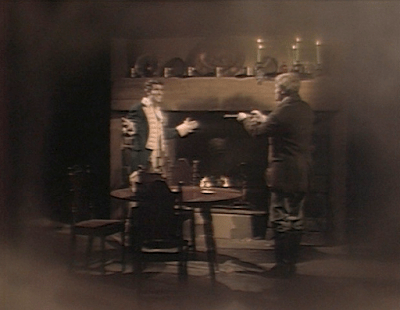
We get another visit from Nathan today. In the eighteenth century, Vicki stumbled into a romance with an unpleasant man named Peter Bradford. Peter has followed her to the present, but has amnesia and angrily refuses to believe Vicki when she tells him who he really is. Today, Peter has a dream in which he confronts Nathan. He fires a gun at Nathan, and is bewildered when Nathan only laughs. Nathan explains that Peter can’t kill him, because he’s already dead.
This scene plays out in front of a table and mantelpiece which we saw together in #459. In that one, it was Nathan who fired a shot with results that bewildered him. His target was Barnabas Collins, who smiled and told Nathan he could not kill him because he was already dead. Barnabas, a vampire, strangled Nathan not long after.
Joe is in the next room while Peter has this dream. He hears Peter talking in his sleep, and comes in to wake him up. When he does so, Peter mistakes him for Nathan and tries to strangle him.
This is not the first time Peter has picked up where Barnabas left off. Barnabas had some vague intention of joining with Vicki in one or another sort of relationship, and now Peter is the one who is in a confusing and unsatisfying relationship with her. Mad scientist Eric Lang built a Frankenstein’s monster, intending for Barnabas to leave his own body and wake up in it; Lang intended to cut Peter’s head off and sew it onto the creature. Had that plan succeeded, actor Roger Davis would have traded the part of Peter for that of Barnabas. It is not immediately clear why the makers of Dark Shadows want us to bracket Peter and Barnabas together, but evidently they do.
Roger Collins is on the telephone in the foyer of the great house of Collinwood. He is assuring the caller that it will be fine if Maggie, whom returning viewers know to be The Nicest Girl in Town, comes to stay. He says that he and Cassandra will be glad to have her for as long as she wants to be with them, and that he is sure Liz will approve. First time viewers thus learn that Roger has a wife named Cassandra, and that they live as guests in a house belonging to someone called Liz. A moment later, Liz enters, and is too distracted to hear anything Roger says to her.
Roger ends the phone call, and follows Liz into the drawing room. She stares out the window and makes a gloomy remark about death. He says he understands she must be very upset about Sam Evans. Returning viewers know that Sam was Maggie’s father, and that he died in yesterday’s episode. Roger goes on about how it is natural to be grieved at the loss of a friend like Sam, but soon learns that Liz’ mood has nothing to do with Sam’s demise- it’s news to her that he is dead.
Roger’s lines will startle longtime viewers. For the first 40 weeks of the show, Roger and Sam were united by a deep and abiding mutual hatred, and since then they have had no contact at all. Roger’s words about Sam as a family friend are so far from what we have previously seen that they should be considered a retcon.
Liz and Roger spend several minutes in the drawing room. She keeps going on about the all-pervasive reality of death, and he keeps urging her to see a doctor. There isn’t much to their lines, but Joan Bennett and Louis Edmonds were such extraordinary screen performers that it’s always fun to watch them together. This scene might be a particular pleasure to longtime viewers, who have rarely seen Roger as the responsible adult in any encounter.
We dissolve to a bedroom where a young woman in a black wig is sifting through some powders, looking directly into the camera, and telling Liz that her obsession with death will become even worse than it already is and will have dire consequences. Liz will believe that she is someone else, a woman who lived and died in another century, and may die by the same poison that killed that person.
There is a knock at the door. It is Roger. The woman hides her powders and lets him in. He addresses her as Cassandra and asks why the door was locked. Thus first-time viewers learn that she is his wife, that this is their room, that she is a witch, and that Liz’ problem is the result of a spell she has cast.
Cassandra tells Roger that she locked the door because David kept pestering her about Sam’s death and she wanted a moment to herself. With that, first-time viewers find out that David is Roger’s son, that Cassandra is his stepmother, and that she expects Roger to consider locking him out of the room an appropriate response to his grief about Sam.
Roger does not so consider it, and is bewildered by what Cassandra tells him. He tells Cassandra that Liz is in a bad way, and he is worried about her. Cassandra says she did not know that Roger was so concerned about his family. Baffled by this, Roger says that of course he is concerned, Liz is his sister. This tells first time viewers both what Roger’s relationship to Liz is, and that Cassandra has so little sense of family that she cannot imagine how other people feel.
Regular viewers will learn more. In the first year of the show, Roger’s keynote was his lack of loyalty to the family. That has now been set aside once and for all, and his normal attachment to his son and his sister provide a contrast with Cassandra’s apparently sociopathic coldness. Further, we saw a great deal of Cassandra from November 1967 through March 1968, when the show was a costume drama set in the 1790s and she was called Angelique. We saw then that Angelique had no conception of family or friendship, and that her idea of love begins and ends with her control over a person.
Cassandra promises to join Roger downstairs for a game of bridge in half an hour. He leaves, and she gets back to work spellcasting. As she does so, a figure in a black cassock materializes behind her. She turns, and the figure vanishes. In a quizzical tone, she says Roger’s name, revealing that she did not see the figure or realize that it is a supernatural presence. Together with her locking the door, scrambling to hide her magical paraphernalia when Roger knocked, lying to cover what she was doing, and failing to understand what a person with a reasonable amount of human empathy would consider acceptable behavior, her puzzlement shows that whatever her powers may be, they have definite limits.
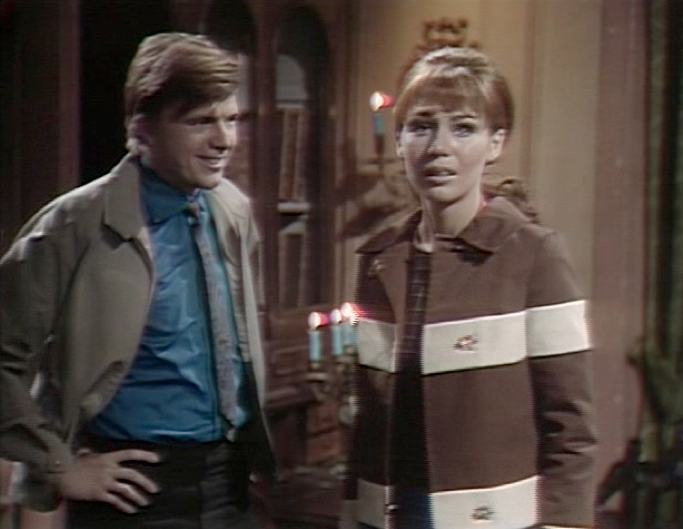
Back in the foyer, another young woman with black hair lets a man into the house. She calls him Joe, and he calls her Vicki. Joe and Vicki talk about Sam’s death and about Maggie. Joe says that he wants to marry Maggie as soon as possible and to move away. Vicki is all for their marriage, but does not want them to go. Joe talks about how close he and Sam were. Longtime viewers will remember that when Sam and Roger were enemies, Sam was the town drunk. Even then, Joe was always happy to help him in whatever way he could, and did not see his condition as any obstacle to marrying Maggie.
Liz enters and angrily addresses Joe as “Lieutenant Forbes.” Joe has never heard of Lieutenant Forbes, and cannot understand why Liz, who knows him well, would not recognize him. Vicki clearly does know who Liz is talking about, and manages to calm her down. After Liz apologizes and hastens away, Vicki answers Joe’s questions only by saying that Forbes is someone from “the past.” Since we heard Cassandra talk about Liz taking on the personality of someone who lived in “another century,” this suggests that Vicki, too, has an unnatural familiarity with that same century.
Joe wants to go upstairs to the room where Maggie is sleeping so that he will be the first person she sees when she wakes up. Vicki is about to lead him to Maggie when Cassandra insists she join her in the drawing room to talk about David. Vicki tells Joe which door to open, and complies with Cassandra’s directions. This shows that Vicki is a member of the household staff whose responsibilities have to do with David. Regular viewers know that she is his governess, and that they are very close.
Cassandra tells Vicki that David has been asking about Sam’s last words. Vicki says that he addressed them to Maggie, not to her, and implies that she did not hear them. When Cassandra continues probing, Vicki protests. She asks if Cassandra can’t see that she is upset. Considering how clueless Cassandra was about human feelings in her conversation with Roger, it is entirely possible that she cannot. Vicki tells her that Liz is deeply depressed; Cassandra feigns ignorance. Vicki says in a cold voice, “You wouldn’t know anything about that,” then leaves.
Longtime viewers know that it was Vicki who came unstuck in time in #365 and took us with her to the 1790s. During her nineteen weeks in the past, Vicki came to know not only Forbes, but Angelique. She knows perfectly well that Angelique and Cassandra are the same person, that she is a witch, and that she is a deadly menace to everyone. She likely suspects that Liz’ depression is the consequence of one of Cassandra’s spells, and the tone of her parting remark would suggest that she does. Further, those who saw the show yesterday know that Vicki is lying about Sam’s last words. They were addressed to her, and she heard them clearly. She is choosing not to repeat them to Cassandra lest Cassandra use them for her nefarious purposes.
Cassandra is alone in the drawing room for only a few seconds. She is joined there by the same figure who had appeared in her room. This time she sees him. He confronts her.
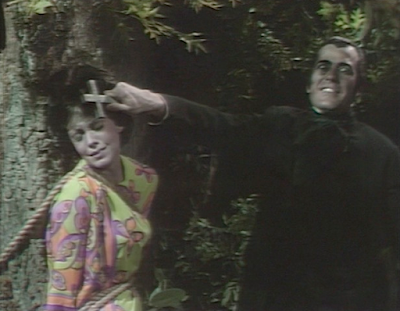
Regular viewers know that the figure is the Rev’d Mr Trask, a fanatical witchfinder who mistook Vicki for the witch in the 1790s and sent her to the gallows. He tells Cassandra that he now has the opportunity to correct that error. He shows her a cross, from which she recoils. We cut to a scene in the woods. Trask has tied Cassandra to a tree and performs an exorcism on her. This is Trask’s go-to technique; he tied Vicki to a tree in #385 and performed an exorcism on her in #386. Since Cassandra actually is in league with the devil (or as Trask would say, THE DE-VILLL!!!,) he has more success this time. Cassandra vanishes and leaves the ropes hanging on the tree.
A first-time viewer might take this climax as an indication that Dark Shadows is a Christian show and Trask is its hero. Not only is Trask going after the right target, he is clearly making some headway. He says all the right things about casting the evil out of Cassandra and saving whatever good is left in her. His delivery of his lines is so fervent that Mrs Acilius, a vigorous Christian, cheered him on. In fact, Trask’s wild incompetence throughout the 1790s segment led to one disaster after another, and was of a piece with the show’s light regard for religion. Not until #450 did a cross provoke a reaction from a monster; that was the first suggestion the show gave that there might be anything to Christianity, and the scenes between Cassandra and Trask today are the second.
Dark Shadows borrows story points freely from all sorts of books, plays, movies, and folklore. So far, it has steered clear of Christianity as a source. For obvious reasons- most of the audience is at least nominally Christian, and Christianity is, in one way or another, a live option for the rest. So it’s a topic that can take over very quickly once it is introduced. I suppose a specifically Christian version of Dark Shadows could have worked, but I can’t imagine that the staff they had would have been particularly interested in making a show like that. So when it looks like they are going to let Trask have even a temporary win, we see the show running one of its boldest risks yet.
Hardworking young fisherman Joe Haskell is engaged to marry Maggie Evans, The Nicest Girl in Town. Early in their relationship, Maggie warned Joe that they might never be able to get married, because her father Sam was an alcoholic and would always need her to come rescue him. Joe liked Sam, drunk or sober, and was always quick to lend him a hand. He didn’t seem to understand Maggie’s worries.
Now, it’s Joe who is worried, and Maggie who doesn’t understand why. Sam’s drinking doesn’t seem to be as much of a problem as it was then. But he has been struck blind, ending his career as a painter. Joe still wants to marry Maggie, and is still glad to help Sam. But Sam has befriended a very tall, phenomenally strong man named Adam, who is wanted by the police because he abducted heiress Carolyn Collins Stoddard several days ago. Sam doesn’t consider the abduction to be a strike against Adam, whose ignorance of social customs he considers to be a disability equal to his own blindness. Joe is convinced that Adam is a violent felon and is alarmed that Sam insists on inviting him to the Evans cottage. Maggie has been out of town and doesn’t know about Adam.
Today, Joe finds a reason to be as alarmed about Maggie’s judgment of men as he is about Sam’s. Maggie was missing for some weeks in May and June of 1967, and when she was found she was so severely traumatized that she could barely talk. She spent months in a mental hospital called Windcliff after that, during which time she had regressed to childhood and developed a tendency to become wildly agitated. She seems to be her old self now, but she still has amnesia covering the whole period from her disappearance through her time at Windcliff.
Like the rest of the village of Collinsport, Joe believes that Maggie was abducted and brutalized by Willie Loomis, servant to old world gentleman Barnabas Collins, and that Willie was trying to kill Maggie when the police shot him in #322 and #323. When he survived his gunshot wounds, Willie was sent to Windcliff. In #483, Joe was appalled to find that Barnabas had arranged Willie’s release and brought him back to work for him. Joe informed Barnabas that he intended to kill Willie if he ever again saw him near Maggie.
Joe is on his way to the Evans cottage when he sees Willie heading for the front door. He confronts him and reminds him of what he told Barnabas. Willie tells him Maggie is no longer afraid of him, that they are friends now, that she visited him at Barnabas’ house earlier that evening, and that it wasn’t the first time she had gone there. Willie is going on about himself as Joe’s “competition” for Maggie’s attention when Joe hits him a couple of times and knocks him out.
Joe goes into the house and tells Maggie what happened. She admits that she did go to Barnabas’ house earlier, that she talked to Willie, and that it wasn’t the first time. Joe reacts with incredulity and says that Willie tried to kill her. Maggie insists that Willie is innocent. Joe asks why she believes that; she can’t explain. He asks why she went to Barnabas’ house. Again, she can’t explain. She says that she does not know why she went there, but that she is sure it wasn’t to see Willie. Joe is shocked that Maggie can’t explain something she did just an hour or two before. He keeps asking, but she insists that she does not know why she went to the Old House.
Joe becomes more and more alarmed. Maggie turns away from him, and he grabs her arm. All the fansites remark on the roughness of this move; it looks like an act of domestic violence. It certainly is not what we would expect of Nice Guy Joe, who was Carolyn’s doormat in the early months of the show and has been a Perfect Gentleman in his relationship with Maggie since then. The 1960s were a particularly bad time for intimate partner violence on screen, so it speaks relatively well of actors Joel Crothers and Kathryn Leigh Scott, and especially of director John Sedwick, that this moment passes briefly. Joe doesn’t follow it up with any further violence, and Maggie seems to forget about it instantly, as if it were an accident. In those days, it might just easily have been highlighted as a proof of Joe’s manliness.
The arm-grab is not defensible, but Joe’s intense feelings in response to Maggie’s inability to explain her behavior are. Joe and Sam visited Maggie at Windcliff in #265. She didn’t recognize them and started shrieking lyrics to “London Bridge” in what I think is the single most frightening scene in the whole of Dark Shadows. Maggie’s amnesia blotted that out, but Joe can hardly have forgotten it. He also remembers Willie as he was in his first weeks on the show, when he seemed determined to rape all the young women and beat up their boyfriends. The idea of Maggie’s mental health regressing to such a low point that she would wander off with a man like that must terrify Joe.
#1. Sam recently went blind; that’s why Joe has to pick him up at the bar.
#2. “Cassandra” is really Angelique, who’s cast a complicated Dream Curse spell that will eventually lead to Barnabas’ death. The gift that she brought was pipe tobacco, laced with a magic powder that would make Sam have the dream.
#3. Professor Stokes is fighting Cassandra, and trying to stop the Dream Curse. He stole the pipe tobacco, because he doesn’t want Sam to have the dream.
#4. Willie has a crush on Maggie, so he stole a pair of Josette’s earrings from Barnabas, and left them in Maggie’s purse while she wasn’t looking. When she puts the earrings on, she has a flashback to the period when Barnabas held her captive, and tried to convince her that she was Josette — a period that should be blocked from her memory.
#5. Adam, the newborn Frankenstein, has befriended Sam, and is now looking for him…
[#6.] Barnabas… was chained up a couple episodes ago and trapped behind this wall. Now he’s kicking at the wall, desperate for someone to come and rescue him.
[#7. A] man… abducted Carolyn a few weeks ago.
[#8.] Cassandra putting a curse on Liz, and making her think about death all the time.
Danny might have mentioned several other stories that don’t come up today, but of which regular viewers are aware and on which the ones that do come up depend. For example, Barnabas’ vampirism has gone into remission, and as a result his sometime victims were freed of the effects of his bites. It is unclear what this means for them, particularly for Willie, who often seems to have become once more the dangerously unstable ruffian whom Joe and the others knew when he first came to Collinsport. Also, a man named Peter is dating well-meaning governess Vicki, and Vicki has trouble remembering that Peter would prefer to be called Jeff. That may not be too exciting, but it’s no duller than Liz moaning endlessly about death. We could also bring up strange and troubled boy David, who has come into possession of a tape recorder with a message that has been played for the audience approximately umpteen billion gazillion times, but that no character other than Adam has heard, and if anyone else does there will be consequences. And Harry, the ex-convict son of housekeeper Mrs Johnson, is staying at Collinwood, and may someday be mentioned again. If he is, there is a danger that the audience will once more have to watch Craig Slocum try to act, truly a grim prospect.
Danny argues that the dense packing of so many storylines into the show makes watching it a stimulating cognitive exercise that “actually teaches people how to process information more efficiently.” As this blog makes obvious, I enjoy this kind of complexity very much. Not only do I keep talking about how ongoing storylines relate to each other, I reach back and find echoes of plot elements from months or years before and consider the significance of the common themes they develop; I look at the way the show borrows stories from books and plays and movies and folklore and notice how they put those source materials in dialogue with each other; and sometimes, my dissatisfaction with stories that didn’t work leads me to think up other stories that might have turned out better, adding yet another layer of narrative accretion to the already extremely intricate existing dramatic text.
I think Danny goes overboard, though, in his presentation of his case. He suggests that an increase in the number of storylines per minute of airtime is equivalent to an increase in the intellectual power of the show. But analysis and collation of plot elements is only one of many kinds of mental activities audiences engage in, and is far from the most important one. If that was all you wanted, you wouldn’t need actors. When an actor creates a character, s/he transforms the story points into the experiences of a person and the audience into witnesses of those experiences. When the drama is well executed, those experiences, even if they can be assigned to some category that is familiar to us, strike us as fresh and unique. When that happens, you don’t need a large number of interlocking storylines to generate complexity- your responses, emotionally and intellectually, will be as complex as your own background can support.
The audience’s background matters. There’s an old saying that when you engage with a literary work, it isn’t just you who read the book, but the book reads you. I often see how true this is in my job as a faculty member in ancient Greek and Latin at a state university in the interior of the USA. When I teach courses on ancient Mediterranean literature in translation, students aged 18-25 have an entirely different reaction than do the “non-traditional” students, those coming back to school after some years doing something else. Most of the students who are in the traditional college age group make interesting connections with a wide variety of topics, while others in that group get bored and can’t see a point in reading old books. But of the dozens of students I’ve taught when they were over the age of 40, every single one has found the reading to be a deeply rewarding experience. The literature that we have from the ancient world was written for adults, and the average American post-adolescent is only going to get so much out of it.
At this point in 1968, Dark Shadows is very much a show for children. The biggest and fastest-growing share of the audience is under 13 years old. So if it is going to be a smart show, it’s going to be smart in the sense that IQ tests measure, transmitting large amounts of information and giving the audience a short period of time to absorb, analyze, and recombine that information before it is followed by another close-packed message. It’s no wonder that an actor like Joel Crothers would become discontented with the show and go away complaining that the cast was being crowded out. He has ever less basis for the hope that he will be able to present the audience with a recognizable human feeling and leave them with hard thinking to do about what that feeling means.
For nineteen weeks from November 1967 to March 1968, Dark Shadows was a costume drama set in the late eighteenth century. Among the more interesting characters introduced in that period were fanatical witchfinder the Rev’d Mr Trask; roguish naval officer Nathan Forbes; fast-talking con artist Suki Forbes; and streetwalkers Ruby Tate and Maude Browning. All five of these characters were murdered by vampire Barnabas Collins, and all five of them are among those who return today for an impromptu trial of Barnabas.
Barnabas killed Trask by luring him to his basement and bricking him up in an alcove, as Montresor did to Fortunato in Edgar Allan Poe’s 1846 story “The Cask of Amontillado.” Some other characters invited themselves to the basement yesterday and held a séance there. As a result of the séance, the bricks fell away and Trask came back to life. Now, Trask has confined Barnabas to the same alcove. He declares that he will give him a trial before he bricks him up.
In the eighteenth century, Trask was the prosecutor in the trial of time traveling governess Vicki Winters. Victoria was convicted of witchcraft and sentenced to death. Vicki’s trip from the 1960s to the 1790s inverted Barnabas’ displacement in time; as Vicki’s witchcraft trial was so chaotic it did not seem to follow rules of any kind, neither does the murder trial Trask improvises for Barnabas fit any conceivable model of procedure. Vicki’s trial stretched over two weeks, from #427 to #437; Barnabas’ begins and ends today, during the second half of the episode.
Trask conjures up Nathan, Suki, Ruby, Maude, and Barnabas’ first homicide victim, his uncle Jeremiah, to serve as a jury; he conjures up a man named Ezra Simpson, of whom we have never previously heard, to act as judge. Trask is the prosecutor, and Nathan is his sole witness. This court of “the damned!,” as Trask calls them, recalls the rogues who confront Jabez Stone as jurors and judge in Stephen Vincent Benét’s 1936 story “The Devil and Daniel Webster.” Unlike Jabez Stone, however, Barnabas does not have a right to counsel.
Trask asks Nathan how he died. After Nathan says that Barnabas strangled him, Trask asks him how Suki died. Barnabas objects that Nathan shouldn’t be allowed to speak for others; regular viewers sympathize with this, since Suki, played today as she was originally by Jane Draper, was sensational every second she was on screen, and when we saw Miss Draper again we were happy to think that she would have another chance to show what she could do. Barnabas also shouts at one point that he is innocent; this is less likely to attract the audience’s sympathy. Mrs Acilius and I certainly got a good laugh from it.
Barnabas asks to be allowed to present a defense. Trask invites him to question Nathan. He is about to do so when Nathan smiles at him, turns around, and vanishes. Trask explains that Nathan has already said all that needs to be said. Later, Trask looks at the recompleted wall and laughs with vicious glee, delighted at what is behind it.
Barnabas has neither the powers nor the limitations of a vampire now. The effects of the curse went into remission when mad scientists Eric Lang and Julia Hoffman created a man from parts scavenged from the cemetery and connected Barnabas to him as they electrified him and brought him to life. Barnabas named this man Adam.
Now Adam has escaped from the horribly abusive home Barnabas and Julia provided for him. He has found a friend in Sam Evans, an artist who was blinded when Barnabas enlisted him in one of his hare-brained schemes. Sam is teaching Adam to speak, and is so impressed with his ability to learn that he wonders aloud if he will be able to teach him to paint professionally.
Adam develops a sudden pain in his wrists. He moans “Barnabas! Hurt!” A shot of Barnabas hanging by his wrists in the basement alcove is laid over a closeup of Adam. Evidently the bond between them is such that Adam can sense Barnabas’ pain, even though they are miles apart. Apparently it is mid-1840s day on Dark Shadows; the scene in Barnabas’ house recalls “The Cask of Amontillado,” and the scene at Sam’s house is based on Alexandre Dumas’ 1846 novella The Corsican Brothers. “The Devil and Daniel Webster” was set in that decade or a bit earlier, and while Frankenstein was written in 1818 many adaptations of it, including the one Dark Shadows creator Dan Curtis would make in 1973, are set in the 1840s.
Adam becomes agitated. He cannot explain what is happening to him, no matter how patiently Sam asks. Sam’s son-in-law-to-be Joe Haskell comes in; Adam brushes against Joe as he runs out the door. Though Joe is a tall and sturdy man, Adam is so tremendously strong that this casual contact sends him flying.
It dawns on Joe that Adam is the man who abducted heiress Carolyn Collins Stoddard and then fell from the cliff on Widows’ Hill. Sam calmly replies that he had already figured that out. Joe is shocked that Sam hasn’t called the police; Sam replies that Adam is as disabled as he is, and that he means no one any harm. Joe is not at all convinced of the second of these points, and worries that “Barnabas! Hurt!” might not have reflected a fear that Barnabas is hurt, as Sam thinks it does, but might rather express Adam’s resolution to hurt Barnabas. Joel Crothers and David Ford bring out the full comic value of this scene; Mrs Acilius laughed at the blandness with which Ford’s Sam confirms that he knows who Adam is.
Joe goes to Barnabas’ house to warn him, but finds it locked and apparently empty. Later, Julia goes there too. She has a key, and lets herself in. She doesn’t see any evidence that Barnabas is or has been home; she goes downstairs, and is mystified to see that the alcove wall, which was broken when she was there for the séance, is now bricked up again.
Several times, Dark Shadows has contrasted Barnabas’ home, the Old House on the great estate of Collinwood, with the Evans cottage, a working class residence in the village of Collinsport. Today they draw this contrast in sharp relief. The basement of the Old House is always dark, but even the upstairs is lit by candles today; the scenes in the Evans cottage, taking place at the same time, are sunlit. The basement is the most haunted part of the most haunted house on the haunted estate, and eight characters in costume dress materialize from thin air there; the Evans cottage is a part of the modern world where Sam and Joe can use reason to arrive at agreement about facts, even if they make different judgments about the significance of those facts. When Julia and Joe go to the Old House, each wanders about alone, finding no one to talk to; at the Evans cottage, even Adam is able to have a conversation, and while there he can receive a message from Barnabas by some mysterious means. Trask seizes control of the basement of the Old House to make a parody of the criminal justice system and enact his vengeance on Barnabas; in the Evans cottage, Sam refuses to call the sheriff because he wants to shield Adam from punishment for the crimes he inadvertently committed.
Mrs Johnson, housekeeper in the principal mansion on the great estate of Collinwood, isn’t herself. She had a nightmare a week ago, and ever since has been plagued with a compulsion to tell its details to strange and troubled boy David Collins. She knows that if she does, David will have the same nightmare, the same compulsion to tell it to some third person, and that if he does that person will suffer the same complex. She doesn’t know that the nightmare is part of a curse sent by wicked witch Angelique, or that at the climax of the curse old world gentleman Barnabas Collins is supposed to revert to the vampirism that afflicted him from the 1790s until last month. But she does know that it is part of something horrible, and she has tried desperately to keep it from continuing.
Mrs Johnson spent a couple of days with her sister in Boston to stay far from David, but she kept having the nightmare there. She has given up, and has come back to Collinwood. She does not go straight home to the great house, but stops first at the Old House in the estate. Barnabas lives there, but it is Barnabas’ friend Julia Hoffman she sees. Julia had passed the dream to her. Julia urges Mrs Johnson not to tell David about it. She replies that she knows she should not tell him, but that she has no more choice in the matter than Julia had in telling her.
This scene will raise a question in the minds of regular viewers. Julia is a medical doctor doubly qualified in hematology and psychiatry; she also has developed a method of hypnosis so powerful that she can virtually rewrite a subject’s memory, confining even very intense recollections to the depths of the unconscious mind, sometimes after an acquaintance of only a few minutes. Why doesn’t she try to hypnotize Mrs Johnson into forgetting the dream? All she actually does is slap her and repeat her command to avoid David.
David turns up. His father has sent him to ask Julia to come to the great house at her convenience. Julia tries to manage the situation by sending Mrs Johnson home first and keeping David in the house for a while. After Mrs Johnson leaves, Barnabas’ servant Willie enters and tells Julia there is an emergency in the basement. David agrees to wait for her to come back, but once she is gone he shouts that he will be playing outside.
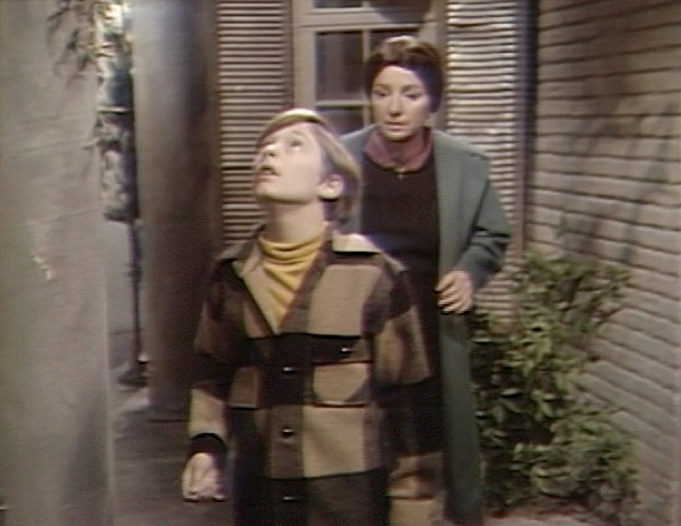
We follow David out the front door, and find that Mrs Johnson is there waiting for him. She comes up on him from behind and says she has something to tell him. This scene will startle regular viewers. For nineteen weeks, from #365 to #461, Dark Shadows was a costume drama set in the 1790s. In that period, Clarice Blackburn played repressed spinster Abigail Collins and David Henesy played Daniel Collins, heir to the Collins fortune. We first saw Daniel in #431, when his Aunt Abigail intercepted him on this very spot and scolded him for playing at the Old House. Abigail was enforcing rules and believed she was acting in Daniel’s best interests; now the same actors invert the scene, showing us Mrs Johnson doing something she knows to be wrong and harmful to David.
Maggie Evans, The Nicest Girl in Town, isn’t herself. Some emerald earrings mysteriously appeared in her purse the other day, and when she tried them on she got a faraway look on her face, began speaking in a voice different from her own, and a tinkling music played on the soundtrack. Today her boyfriend Joe tells her that he took the earrings and showed them to a jeweler and to the police. The jeweler valued them at $15,000* and the police said that they didn’t match the description of any jewelry that had been reported missing. Maggie was not only irked that Joe had taken the earrings without her permission, as anyone might be, but when he tries to get her to agree that such expensive things don’t just materialize out of thin air her usual level-headedness and cheerful disposition vanish and she becomes childishly defensive. Maggie does not know that Barnabas’ servant Willie placed the earrings in her purse as an attempt to reestablish the connection the two of them had when she was Barnabas’ prisoner in the Old House. As a result of Julia’s hypnosis, she does not even remember what Barnabas did to her. But after she runs Joe off, she is compelled to go to the Old House.
Again, regular viewers will recognize an echo of an earlier episode, in this case one that aired a year ago. When Maggie was Barnabas’ victim in May 1967, she snapped at Joe and drove him out of her house as she does today. Then too, she headed for Barnabas once Joe was gone.
Maggie doesn’t find Barnabas at the Old House. Instead, she sees Willie. Barnabas had framed Willie for his crimes against Maggie, and Willie was confined to the mental hospital Julia runs. Barnabas and Julia have brought him back to the Old House to help with their latest nefarious scheme. Willie had been Barnabas’ blood thrall; it is not clear to the audience just what effect it had on Willie when Barnabas’ vampirism went into remission. When we first see him today, he is playing with an unloaded rifle and grinning maniacally, reminding us of the dangerously unstable ruffian he was before Barnabas first bit him.
Maggie knocks on the door and asks Willie if she can come in. He falls over himself inviting her. He becomes the friend he tried to be to her during her imprisonment. She says she knows that he wasn’t the one who hurt her, and he is overjoyed. She seems blissful. He asks her out on a date; she says that Joe wouldn’t like it. Before Barnabas, Willie propositioned all the young women and threatened all their boyfriends, and at first this approach, like his gleeful handling of the rifle, suggests that dangerously unstable ruffian is back. He assures Maggie that he only wants friendship, but after she leaves he picks the rifle up again and says that Joe will be out of the way soon.
For her part, Maggie’s behavior does not represent a reversion to her time as Barnabas’ prisoner. Rather, the earrings seem to have done what Barnabas tried to do when he bit her, imprisoned her, and subjected her to a series of role-playing exercises. Her personality is showing signs of giving way to that of Barnabas’ lost love, gracious lady Josette. In #260, Barnabas told Maggie “You are Josette!”; in #370, we saw that he was right, inasmuch as Kathryn Leigh Scott played both characters, as Zita Johanns had played both Helen Grosvenor and Princess Ankh-Esen-Amun in the 1932 film The Mummy, from which Barnabas’ Josettification project was borrowed. The tinkling melody that plays on the soundtrack when Maggie wears the earrings is that of Josette’s music box; this could be a sign that her memory of what Barnabas did to her is coming back, since he forced her to listen to the music box for hours on end. But the voice she speaks in at those times is the voice Miss Scott used as Josette, and her blissfulness reminds us of Josette’s first scenes with her beloved Barnabas, not of Maggie’s captivity in the ghoul’s dungeon.
Back at Collinwood, Mrs Johnson watches David sleep. She tells him she is sorry for what she has done and for what he will suffer. Clarice Blackburn was always good, but she outdoes herself with this speech. It is a beautiful performance.
David has the nightmare. The first several dream sequences in the Dream Curse storyline ended with the dreamer opening a door, seeing something scary, and screaming. David’s goes a step further. There is a gigantic spider web behind the last door he opens. He not only sees it, but is tangled in it when he starts screaming. He awakes, still screaming, and Mrs Johnson holds him.
In April 1967, dangerously unstable ruffian Willie Loomis inadvertently freed vampire Barnabas Collins to prey upon the living. Barnabas made Willie his blood thrall, and reduced him to a sorely bedraggled state. As spring turned to summer, Barnabas added Maggie Evans, The Nicest Girl in Town, to his diet. When Barnabas first held her captive in his house, Maggie was dazed and submissive, but as he tried to brainwash her so that her personality would disappear and that of his lost love Josette would take its place, she began to rebel. Maggie and Willie formed a strange friendship as he did what he could to protect her from Barnabas. Eventually she escaped, and mad scientist Julia Hoffman erased her memory of what Barnabas did to her. When Willie tried to warn Maggie that Barnabas might attack her again, the police jumped to the conclusion that it was he who had abducted her. They shot him. He was declared insane and sent to Windcliff, a mental hospital of which Julia is the director.
A few weeks ago, another mad scientist, Eric Lang, gave Barnabas a treatment that put the symptoms of his vampirism into remission. At the time he was feeding on two women, heiress Carolyn and well-meaning governess Vicki. When Barnabas gained the ability to go around in the sunlight, cast a reflection, and eat solid food, Carolyn and Vicki’s bite marks disappeared. It is unclear whether either of them remembers that Barnabas was a vampire, but their personalities certainly went back to what they were before he bit them. That leaves us wondering about Willie. When Barnabas responded to Lang’s treatment, did Willie revert to the violent personality he had in his first full week on the show, when on Tuesday he menaced Maggie in a barroom, on Wednesday he cornered Vicki in the study at Collinwood, and on Thursday would have raped Carolyn if she hadn’t drawn a gun on him? Did he become some version of the deeply troubled young man who was desperate to help Maggie but powerless to resist Barnabas? Or did he become something else entirely?
Today, in furtherance of Lang’s evil plans, Barnabas wants to free Willie from Windcliff and bring him back to his house on the great estate of Collinwood. Julia has become Barnabas’ best friend, but she is firmly opposed to his association with Lang. So Barnabas lies and tells her that he wants to free Willie because his conscience is plaguing him. Julia knows that isn’t true, and points out that he never visited Willie at Windcliff. Barnabas replies that when he was in the full grip of the curse, he could move about only after dark, and says that he could hardly show up at the hospital to visit Willie in the middle of the night. Julia says that she would have arranged it had he asked. He doesn’t have an answer to this, and she doesn’t fall for any of Barnabas’ other fabrications. But she can’t figure out what he really is doing. She plays along with him, and the two of them go to see Willie at Windcliff.
This is the first time we have seen Barnabas outside of a little orbit composed of Collinwood, the village of Collinsport, and the cemetery north of town. Not only was Barnabas’ ability to travel limited while the symptoms of the curse were manifest, he often lost interest in people when they left the area. So in the fall of 1967 he was obsessively hostile to strange and troubled boy David and obsessively indecisive about Vicki until the two of them went to Boston, at which point he seemed to forget they existed. It’s too bad the set representing the waiting area at Windcliff isn’t more visually striking- Barnabas’ first trip out of the Collinsport area marks a significant change in the character’s possibilities, and it would be good if it came with an image that would stick with us.
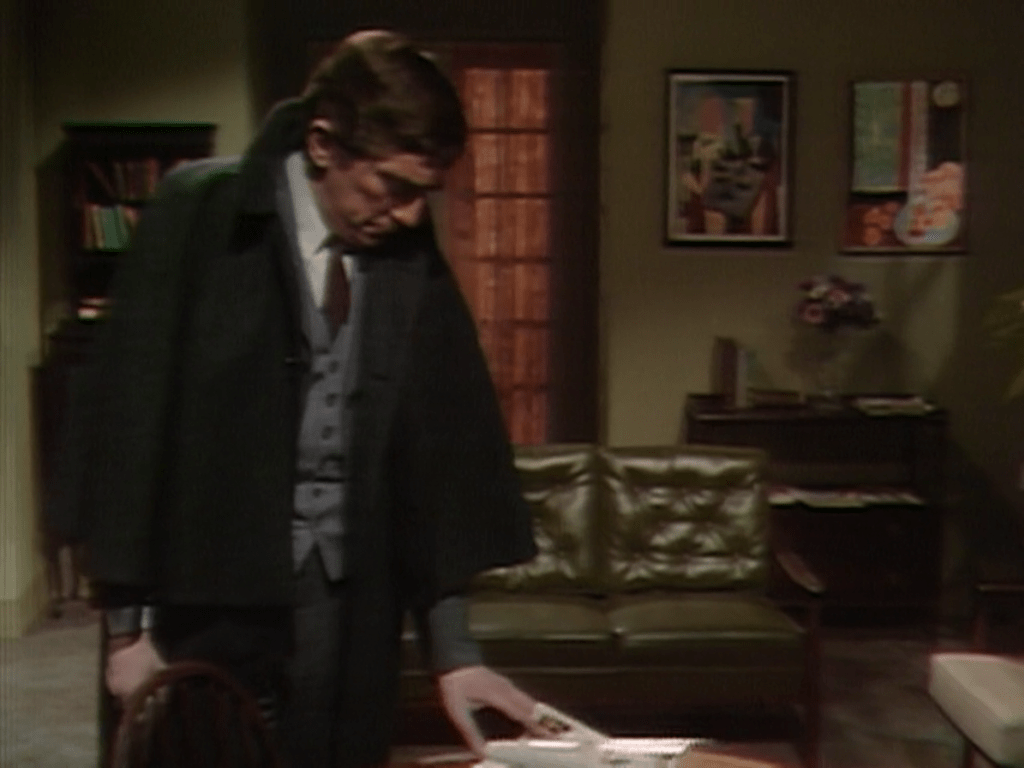
While Barnabas waits, a glossy magazine catches his attention. He picks it up and leafs through it. Since we are about to see Willie for the first time in several months, there is a good chance that this little bit of stage business will remind regular viewers of a peculiar remark Barnabas made shortly before the last time we saw Willie. Shifting the blame for his own crimes onto Willie, Barnabas planted Maggie’s ring in Willie’s room. When he came up with this plan, Barnabas remarked that the cheaper sort of tabloids say that criminals sometimes hold onto morbid mementos of their crimes, prompting us to picture Barnabas reading a cheap tabloid. That incongruous image comes to life here:
Julia joins Barnabas in the waiting room. They talk for a moment, then a nurse ushers Willie in.
At first, Willie is silent, a confused look on his face. He walks slowly towards Barnabas. Barnabas asks Willie if he recognizes him. In this moment we pick up exactly where we left off in #329, when Willie was a patient in another hospital and did not remember who Barnabas was.
This time Willie does recognize Barnabas. But as he did at the end of #329, he seems happy and untroubled. He is positively childlike in his eagerness to go back to Barnabas’ house and work for him again. He says that he and Barnabas were friends and that he always enjoyed their time together, a statement that dumbfounds Julia, as it dumbfounds anyone who remembers the show from April to September 1967. Even when Barnabas wasn’t bashing Willie across the face with his cane, Willie was miserable beyond words and hated everything Barnabas forced him to do.
Julia sends Willie back to his room, and Barnabas proclaims that Willie is entirely cured. Julia sarcastically thanks him for his diagnosis, calling him “DOCTOR Collins!” This too harks back to #329, which ended with Willie asking Barnabas if he were a doctor, to which Barnabas replied, “That’s right. I am a doctor!”
Barnabas takes Willie back to his house and tells him that for the time being, he must not so much as go outside by himself. Willie accepts Barnabas’ explanation that many people in the area will have to be prepared for his return before they see him. Willie gladly agrees to stay in the house. Barnabas leaves him alone, and he immediately slips out. He is heading for Maggie’s place.
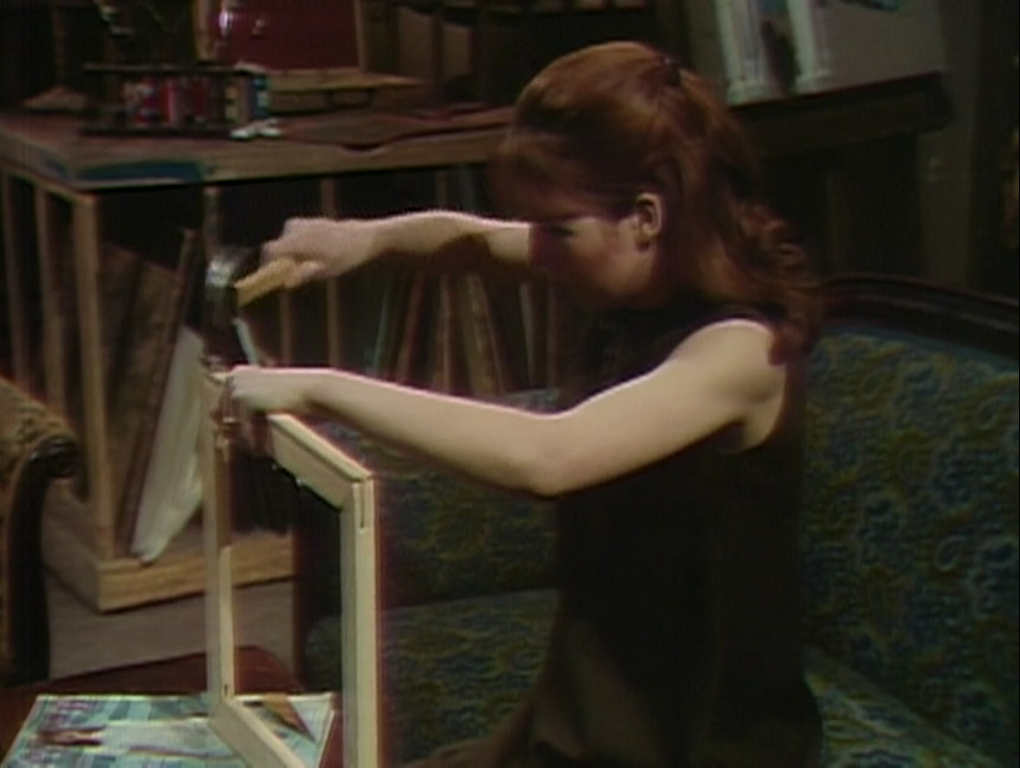
Maggie’s father Sam is a painter, a fact advertised by the canvases around the cottage they share. When we cut to the cottage, she is making a frame. This is rather an obvious visual metaphor. The last time Willie came to the cottage, he inadvertently framed himself for Barnabas’ crimes against Maggie.
Of course Maggie is horrified to see Willie at the door; of course she demands he leave; of course she threatens him with her hammer when he insists on staying and telling her he is innocent; of course she cries for help when her boyfriend Joe comes to the door; of course Willie runs off when Joe enters. Willie puts himself in the frame again, this time as an ongoing threat to Maggie and all the women of Collinsport.
Joe goes to Barnabas’ house and demands to see Willie. At first Barnabas plays dumb, but Joe doesn’t give an inch. Barnabas then admits that he persuaded Julia to let Willie out of the hospital, but assures Joe that Willie is no longer dangerous and tells him that he will see to it that Willie behaves himself. Joe says that Barnabas has already failed in his responsibility, since Willie just went to Maggie’s house and scared her. Joe says that he will kill Willie if he goes near Maggie again. He repeats that assurance, and his voice is pure steel.
Joe exits the house. We see him outside, walking away. Willie emerges from the shadows with a rifle. He takes aim at Joe and squeezes the trigger. The gun isn’t loaded, so Willie makes nothing more than a click. Apparently that was enough for him. He grins maniacally.
On their Dark Shadows Every Day, John and Christine Scoleri point out that the the gleeful face Willie flashes after he clicks his rifle at Joe is the same expression he showed in the frenzied crimes he committed before he came under Barnabas’ power. They back this observation up with a pair of screenshots, one of Willie immediately after he pretended to kill Joe, one from his last moment before he released Barnabas and lost his freedom:
Indeed, the whole episode replays Willie’s character arc from April to September in reverse. He starts as the crushed little thing we had seen at the end of #329, becomes Maggie’s tormented and misunderstood would-be protector, then ends as the dangerously unstable ruffian who followed seagoing con man Jason McGuire to town. If the episode were a few minutes longer, John Karlen might have had to take a break and let James Hall play the last scene. This recapitulation heightens the initial suspense generated by the question of how Willie would be after Barnabas had lost his vampire powers. Whatever effect the change in Barnabas has had on Willie has certainly not made him less complex or more predictable. We can’t tell when he is being sincere and when he is faking. Based on what we see today, it’s possible he is being sincere the whole time, but that he is just extremely impulsive, and equally possible that everything he does and says is a fake meant to cover up something we don’t yet know enough to guess at.
The actors are uniformly excellent today. John Karlen has to recreate the three faces of Willie in quick succession, and executes each of them clearly and memorably. Almost all of Grayson Hall’s dialogue is expository, but while delivering it she shows us all of Julia’s complicated feelings about Barnabas and lets us into her attempt to solve the riddle of his plans for Willie. Kathryn Leigh Scott is only on screen for a few minutes, beginning with her absorbed in carpentry and proceeding directly to screaming and running around and clutching at her male scene partners, but still makes it clear that Maggie is a strong and level-headed person who has been forced into frantic behavior by circumstances no one should have to face.
In the confrontation with Barnabas, Joel Crothers shows us a new side of Joe. Always loyal, always honest, always hardworking, Joe has up to this point been soft-spoken and self-effacing, deferential towards members of the ancient and esteemed Collins family. The only time he broke that deference was when he spoke some harsh words to matriarch Liz in #33, and he had to get thoroughly drunk to manage that. There is no trace of drink in him now, and he does not regard himself as anything less than Barnabas’ equal. For the first time since Burke Devlin lost his connection with the plot and shriveled so drastically that he ceased to be Mitch Ryan and became Anthony George, Dark Shadows has a plausible action hero in its cast.
The part of Barnabas is especially challenging today; he tries and fails to fool Julia in the beginning and Joe at the end, and in between may or may not have fooled Willie. So Jonathan Frid must show us what it looks like when Barnabas does an unsuccessful job of acting. He chooses to do that by having Barnabas overact. My wife, Mrs Acilius, pointed out that Frid’s own performance in the role of a man who is severely overacting is in fact exceptionally restrained and precise. Frid bobbles his lines as he usually does, but never makes a wrong physical move, and not for one second does he miss the perfect tone for Barnabas’ lines. The result is simply outstanding.
When gallant gentleman Barnabas discovered that his wife Angelique was a wicked witch who had been casting spells to ruin the lives of everyone he knows, she forbade him to disclose this information. If he did, she would kill his true love, the gracious Josette.
Now, Angelique has turned Barnabas into a vampire. When he found out about this, he killed her. Sadly, that didn’t take. For the last few days Angelique’s disembodied head has been floating around foiling all of Barnabas’ attempts to contain the damage he has been doing.
Today, we open in the Collins family mausoleum. Barnabas’ coffin is hidden in a secret chamber inside the mausoleum. He and Josette are in the publicly-known outer chamber, where she found him yesterday. He pleads with her to leave him and forget she ever knew him, but will not tell her why. Angelique has made it obvious that she is already working to kill Josette, so obvious that Barnabas and his friend Ben were talking about it yesterday. So Barnabas has no reason to withhold any information from Josette, and every reason to tell all. But he continues to keep everything back that might persuade her to flee from him. This does fit with his pattern of behavior- half the reason they are in this situation is that Barnabas wouldn’t tell Josette that he and Angelique had had an affair long ago. But it is still frustrating.
Back in the great house of Collinwood, Josette runs into the two characters who have been keeping the show watchable for the last couple of weeks, fluttery heiress Millicent Collins (Nancy Barrett) and caddish naval officer Nathan Forbes (Joel Crothers.) After a series of delightfully played comedy scenes, Millicent and Nathan have become engaged. They break their happy news to Josette. She is so preoccupied with her encounter with Barnabas that she barely reacts.
Nathan leaves. In the drawing room, Josette tells Millicent that she saw Barnabas tonight. Millicent knows that, according to Barnabas’ parents, Barnabas has gone to England. She is therefore certain that Josette could not have seen Barnabas, and she patiently explains this impossibility to Josette. The difficulties Millicent knows about are nothing to what Josette knows- she saw Barnabas die.
In the parts of Dark Shadows set in the 1960s, Nancy Barrett plays another heiress, Carolyn Collins Stoddard. In those same parts of the series, Joel Crothers plays hardworking young fisherman Joe. In 1966, Carolyn and Joe were dating each other for no reason they could discern, and the audience was afflicted with scene after scene of them out on dates staring at each other in boredom. Millicent and Nathan are as much fun to watch together as Carolyn and Joe were dull. They are pursuing objectives we can understand, and we can also be sure that their plans will not work out as they expect.
Nathan is clever, charming, and unscrupulous. He was uninterested in Millicent until he found out she was rich, then immediately began an assiduous pursuit of her hand and her inheritance. In addition to greed, he has also shown a keen eye for opportunities to bed the women on the household staff. When his naval career is threatened by the villains, he shows no sign of courage. Yet we have also seen him behave admirably, even heroically, in trying to help bewildered time-traveler Vicki. And when Barnabas was alive, Nathan was a trustworthy friend to him. So for all we know, by the time he gets his hands on Millicent’s money, this complex man might have fallen in love with her and made up his mind to be a good husband.
Millicent is not a “smart character” in an IQ-test sense, but her limitations translate into an accidental wisdom. Her ideas of life have been shaped by plays she has seen and novels she has read, leading her to think she is a character in a florid melodrama. But of course that is exactly what she is, and so her behavior is, if anything, more situationally appropriate than are the actions of the more superficially rational people around her. Certainly it is jarring when Josette starts telling Millicent about Barnabas, when she knows that Barnabas wants to keep his presence secret. Considering what will happen to Josette if she keeps approaching Barnabas, Millicent does quite the sensible thing when she insists on leaving the official story alone.
Nathan has gone to the local tavern. In the 1960s, this same set will be a tavern known as The Blue Whale. Joe will be a regular customer, and the man who will preside behind the bar is played by actor Bob O’Connell. In #319, a character pretending to be drunk called the bartender “Bob-a-roonie,” leading fans of the show to call the character “Bob Rooney,” a name never used in the series.
Now, in 1796, the tavern is called The Eagle. Bob O’Connell again plays the man who pours the drinks. His name is Mr Mooney. “Mooney” sounds enough like “Rooney” that I wonder if the “Bob Rooney” gag circulated among the production staff. Mr Mooney gets more lines today than Bob the bartender ever did, and his name is listed in the credits for the first time at the end of his 57th episode.
O’Connell did a lot of very good work in those first 56 appearances. He was especially good with facial expressions that showed he had overheard enough of a conversation to think he ought to be more aggressive about refusing to serve drinks to customers before they lose all sense, but not enough to have anything substantial to report to the police. I’m sorry to say that his delivery of dialogue today is not on that level. Partly that’s because he has to put on some kind of Anglo-Celtic accent that he is none too sure of. But that isn’t the only problem. He delivers his lines much too fast and too loud, and does not modulate his voice in response to anything his scene-mates do. He isn’t interacting with the others at all, just waiting for his cues and making sure the microphone picks up the words. His scene is a major letdown for Bob the bartender fans everywhere. O’Connell’s previous successes as a working guy who knows more than others assume he does leave me wishing they could have done another take of the scene with some fresh guidance from the director.
Fortunately, the same scene introduces one of the most magnificent characters in all of Dark Shadows. She walks in, tells Mr Mooney she’s with Nathan, and gives her name as Suki Forbes. That’s Forbes as in “Mrs Nathan Forbes.”
Nathan tries out a series of lies on Suki, each of which she bats away effortlessly. He offers to pay her to leave town; she lets him go collect his money, while she stays in the tavern and gets all the relevant information from Mr Mooney. Nathan has been away for about ten seconds by the time Suki finds out he plans to marry into the family that owns the town. She is quite pleased by the prospects this introduces.
Suki thinks of how much she might earn by pimping Nathan out. Screenshot by Dark Shadows Before I Die.
Our hopes that Nathan would eventually make Millicent happy are thus reduced to a very low order of probability. Regular viewers are again reminded of Carolyn, in this case of Carolyn’s absentee father Paul Stoddard. Paul was a charming, dishonest, and cruel man who married Carolyn’s mother Elizabeth only for her money.
We haven’t seen Paul, and know very little about his background. What we do know is that he was not from the village of Collinsport, had no money of his own, and that his best friend was a merchant seaman named Jason McGuire. We got to know Jason quite well when he showed up and blackmailed Liz for a long dull stretch of the show. Poor men would have few opportunities to meet young women of Liz’ lofty station, and even fewer means of persuading them they were acceptable marriage partners. Since the marriage took place in 1945 or 1946, when a sizable fraction of American men were on active duty in the armed forces, and since Paul was connected to Jason and therefore to the sea, it would seem likely that Paul was a Navy officer. After all, an officer’s uniform can get a man admitted to any social circle, as Nathan illustrates. So the miserable marriage that Liz endured might have echoed a similarly ill-conceived match a collateral ancestor of hers made in the late 18th century.
Hi I am the Jane Draper who played Suki on Dark Shadows! Thought I’d be on it longer but got killed off by Barnabas. I worked on Broadway, film and this soap opera. Now, I play Bluegrass, always my passion, on guitar and upright bass. Born in Illinois, grew up mostly in Southern Indiana and moved to NYC in my teens.
thank you for your kind words.
Jane Draper, comment left 13 August 2020 on “Episode 420: The Stalking Dead,” Dark Shadows Every Day.
Vampire Barnabas Collins is taking a page from the 1932 Universal Pictures film The Mummy. Boris Karloff plays Imhotep, who rises from the dead and decides that a young lady named Helen Grosvenor is actually the reincarnation of his lost love, Princess Ankh-esen-amun. He abducts Helen, tells her she is Ankh-esen-amun, and tries to kill her so that she can come back to life as that lady. Likewise, Barnabas has abducted Maggie Evans, The Nicest Girl in Town, and set about brainwashing her into thinking she is his lost love Josette. He has made it clear to the audience, if not to the other characters, that he will kill her so that she can rise as a vampiric Josette.
Today, Barnabas and Maggie are having dinner. Maggie seems to be in a daze, and only repeats what Barnabas says to her. Still, she is smiling at him and answering to the name Josette. We can’t quite tell if she is succumbing to his lunatic plan or is simply playing along with him.
Maggie’s father Sam and boyfriend Joe knock on the door. When Barnabas’ sorely-bedraggled blood-thrall Willie Loomis mentions Joe’s name, Maggie’s head jerks to the side and her eyes open. At that, we know that she was falling under Barnabas’ spell, because we can see her coming out of it.
Maggie recognizes Joe’s name
That it is Joe’s name that breaks Barnabas’ hold over Maggie echoes another of Barnabas’ sources, Bram Stoker’s Dracula. In that novel, Professor Van Helsing is delighted to hear that the vampire’s victim Lucy Westenra is receiving blood from Arthur Holmwood, because Arthur “is the lover of her!” The vampire represents, among other things, a travesty of a sexual relationship, so that real sexuality is a weapon against him.
Willie hustles Maggie upstairs to Josette’s bedroom, which Barnabas has restored complete with hairbrush, perfume, jewelry, and a portrait of the lady herself. Included among these items is a mirror, which will be of no use to Maggie once she becomes a vampire, but which, like the other things, is among the standard appointments of an ancient Egyptian lady’s tomb. Maggie can hear her father and Joe talking in the parlor below, and their voices bring her back to herself. Willie tries to keep her quiet, and does succeed in preventing her from letting Sam and Joe know that she is there, but Barnabas hears enough to know that she is trying to escape.
Sam is an artist. Before Barnabas abducted Maggie, Sam had been coming to Barnabas’ house to paint a portrait of him. He tells Barnabas that with Maggie missing, he can’t concentrate on painting. Barnabas says that of course he wouldn’t dream of asking him to work at such a time. Sam offers to take the painting home and work on it there, but Barnabas insists it stay at the house.
It has been strange that Barnabas wanted Sam to paint at his house. Barnabas only exists at night, and his house has no electricity, so conditions couldn’t be worse for painting. Moreover, he wants to get close to Maggie, and working at the Evans cottage would mean seeing her every night. Perhaps there is some magical quality that will inhere in the painting if it is done in Barnabas’ house. We’ve already seen a number of portraits act as gateways to the supernatural. The ghost of Josette has emerged from her portrait several times. And a few months ago, Josette’s ghost went to the Evans cottage and possessed Sam to literally paint a picture of what blonde fire witch Laura Murdoch Collins was up to. So Barnabas may be leery of letting the portrait out of his sight, lest Josette or some other paranormal adversary of his take control of Sam and use it to reveal his horrible secrets.
In his scenes with Maggie at the dinner table, Jonathan Frid manages to convince us that Barnabas sincerely believes that his plan will benefit her, so much so that here would be no point in trying to appeal to his conscience. It is a tribute to his success that it is startling when the episode ends with Barnabas closing in on Maggie with the intention of doing her some kind of violence. We know that he is a vampire, we know that he has attacked Maggie and other women off-screen, and we’ve seen him beat Willie savagely. But it is still chilling to see his earnest sweetness give way to violent abuse.
Dark Shadows is recycling a story element from December 1966 and January 1967. Back then, blonde fire witch Laura Murdoch Collins kept staring out the window into the night and establishing a psychic connection with her son, strange and troubled boy David Collins. Each time she did so, David would have a terrible nightmare in which she was beckoning him to his death in flames. Since burning him to death was in fact her plan, we were left wondering if the nightmares were Laura’s attempt to get him used to the idea; if they were signs of his own willpower as he resisted her influence; if they were messages from the benevolent ghost of Josette Collins trying to warn her descendant of the danger his mother presented to him; or were the result of some other force that travels with Laura, but that is not under her control or necessarily known to her.
The other day, vampire Barnabas Collins stared out his window into the night and established a psychic connection with Maggie Evans, The Nicest Girl in Town. Maggie reacted to that contact with confusion and dismay. In yesterday’s episode, she had a nightmare in which she saw a coffin open from the inside and herself laid out in it. It isn’t much of a stretch to assume that Barnabas’ plans for Maggie will require her to spend her days in a coffin. That leaves us with just the same options we had in accounting for David’s nightmares.
Maggie and Barnabas cross paths today in Collinsport’s night spot, The Blue Whale tavern. When Maggie leaves, Barnabas wishes her “Sweet Dreams.” She is shocked at this conventional night-time farewell. We see her at home getting ready for bed; Barnabas is still in The Blue Whale, chatting amiably with dashing action hero Burke Devlin. Barnabas gets a peculiar look on his face, excuses himself, and hurries out. Then we cut to the Evans cottage, where we see him entering her room to bite her. These are things we might have expected to see if the nightmare was something Barnabas sent to get Maggie used to the idea of becoming a vampire.
Barnabas sits at a table in the tavern with Maggie’s father Sam. They talk about how strong and independent she is. We have known her since the first episode, and know that she is indeed someone who can stand up for herself. Reminding us of that, this conversation leaves open the idea that the source of the nightmare is Maggie’s own struggle against Barnabas.
Sam himself figured prominently in the Laura story as a medium for Josette’s influence. He is an artist, and when David’s nightmares did not suffice to make Laura’s plans clear to the characters, Josette took possession of Sam and used him to literally paint a picture for them. That possession occurred in Sam and Maggie’s cottage. Moreover, Maggie had been delighted with Barnabas before the nightmare, but seeing him now she is extremely uncomfortable. That reaction, Sam’s presence in the episode, and the scene in the Evans cottage would all seem to support the idea that the nightmare was a warning from Josette.
When Barnabas and Burke are alone at the table, Burke is admiring the silver wolf’s head sculpted on the handle of Barnabas’ cane. He says that it looks ferocious and asks if the cane was made to be a weapon. Barnabas replies that he sees the wolf’s head as a peaceful symbol, an animal originally wild and hostile that has been tamed to be a companion, “almost a servant,” to humans. Canines are not so tame when Barnabas is busy, however. We hear a variety of dog noises, ranging from the howl of a sad hound to the violent snarling of a pack of large hunting dogs. This does not appear to serve his interests. Since it happens around people like Maggie who are mystically connected to him when he is far away, it is difficult to see it as a natural phenomenon. And since Josette’s previous interventions have not involved dogs, she is not an obvious suspect. So perhaps when Barnabas rose from his grave, he brought with him a ghostly companion who is not his servant, but is working at cross-purposes with him.
Barnabas realizes that he wants to have a bite before sunrise
Joe and Maggie are interesting today. Maggie wakes up from her nightmare and calls Joe. We see Joe, getting our first look at his apartment. We don’t see much of the place, just a single panel behind him decorated in true Collinsport fashion with a painting on one side and the shadow of some studio equipment on the other.
Joe at home
It isn’t just the decor that tells us Joe is a true Collinsporter. Maggie waits anxiously for him to answer when the phone rings several times. When we see him, we know what took him so long- he had to put his robe on over his pajamas. Sure, he lives alone, but he isn’t a savage.
When Joe and Maggie enter the tavern, she remarks that they could have saved money- she has liquor at home. Joe tells her she needed to get out of the house. Again, he is following the norms of Collinsport. A young woman alone at home telephones her boyfriend in the middle of the night and asks him to come over right away. A fellow from another town might not have realized that the best thing to do was to take her to a public place where they would be likely to meet her father.
Maggie and Joe have been talking about getting married for a while now. She kept saying she couldn’t marry, because she was worried about her father. During the “Revenge of Burke Devlin” arc, which ran from the first episode until Burke decided to peace out in #201, Sam was an alcoholic given to binge drinking. When they gave up on that storyline, they dropped the theme of Sam’s alcoholism as well. Today he goes to a bar with someone who is determined to buy him all the liquor he will accept. He stops after a couple of drinks and goes home, where he is crisp and sober. Apparently he just isn’t an alcoholic any more. I’m no expert, but I have a feeling it doesn’t really work that way. Be that as it may, it leaves Joe and Maggie with no reason not to get married.
Joe and Maggie not only run into Sam at The Blue Whale, but also Barnabas. If Art Wallace and Francis Swann were still writing the show, or if Violet Welles had come on board, I might wonder if this were a subtle hint that sexual repression creates monsters. Joe Caldwell has been making uncredited contributions to the writing for months, and he was perfectly capable of slipping in a point like that. But this one is credited to Ron Sproat, and Sproat is shameless about putting characters where they need to be to make the next plot point happen on whatever flimsy pretext he can find, regardless of any other consideration. So while it is always possible that the cast or the director or someone else associated with the production was trying to make a clever point, I don’t think Sproat was in on it.
Closing Miscellany:
The makers of Dark Shadows wanted episodes aired on Fridays to have numbers that ended in 5 or 0. A strike several weeks ago caused them to miss a day of broadcasting, and the numbers have been off ever since. They gave this one two numbers, 525 and 526, to get back on track.
Barnabas addresses Burke as “Devlin” and hardworking young fisherman Joe Haskell as “Haskell.” We’ve heard him call Sam “Mr Evans,” so evidently he’s following some rule of his own about who gets a courtesy title and who doesn’t. His exquisite manners are such a big part of what comes up when the other characters talk about him that the writers might well have thought they were making some kind of point with this, but heaven knows what it was. Making it even harder to decipher, he calls Maggie “Miss Evans” at the beginning of the episode, but “Maggie” at the end.
In the great house of Collinwood, well-meaning governess Vicki makes unsuccessful attempts to reason with strange, troubled boy David and with David’s father, high-born ne’er-do-well Roger. At the restaurant in the Collinsport Inn, it dawns on hardworking young fisherman Joe that Maggie, The Nicest Girl in Town, would like to date him.
A fancy fountain pen Vicki found on the beach has gone missing from David’s room. After the two of them have spent a few relaxed moments looking for it, David declares it isn’t in the room. He suggests a ghost might have taken it. Rejecting this possibility out of hand and seeing no other explanation, Vicki concludes that David must be hiding the pen from her. She calmly asks him to return it; he indignantly denies having taken it. Exasperated with him, she raises her voice.
We cut to an outdoor setting, where we see Roger burying the pen. The audience saw him steal the pen at the end of yesterday’s episode. Roger is afraid the pen will be a piece of physical evidence implicating him in a homicide, so he is desperate to get everyone to forget that it exists. Why he doesn’t throw it in the ocean, or in a trash can, is never explained.
Roger returns to the house and hears Vicki and David yelling at each other about the pen. He goes upstairs to make inquiries. He takes David’s side, leaving both David and Vicki staring at him in astonishment. Roger then talks privately to Vicki, and urges her to forget about the whole thing. She reluctantly agrees never to speak of the pen again, to anyone. Roger visits David in his room, extracting the same promise from him. David tells Roger that he will get even with Vicki for her false accusation against him. Roger, eager as ever to get Vicki out of the house, has no objection to that idea. David glares out the window, looking directly into the camera and muttering to the audience that he will settle his score with Vicki.
The B-plot is much friendlier. Joe and Maggie are nice, attractive young people who have known each other for a long time, have fun together, and share many interests. Maggie is single, and Joe is at the end of a dull and mismatched relationship with flighty heiress Carolyn. There is no reason why they shouldn’t become a couple.
In fact, that is their biggest problem. As soap opera characters, they can have a romance if and only if there is some obstacle between them they will have to overcome in a dramatic fashion. Maggie and Joe are so obviously well-matched that generating such an obstacle will require the writing staff either to dig deep into the characters’ psychology and to expound that psychology in a superlatively well-crafted plot, or, if that is beyond them, to do something dumb like have them get bitten by vampires.
Joe stops by Collinwood to see if he can talk to Carolyn. Vicki tells him that Carolyn isn’t around, but asks him to stay for a while anyway. Vicki is nervous. She explains that “You don’t know what it’s like to be alone in this house with David.” Joe asks Vicki if she thinks he is an idiot for trying to resuscitate his relationship with Carolyn. When she can’t say he isn’t, he announces that he’s resigning from the idiot’s union and leaving for a dinner date. We know that he’s going to Maggie’s house, but he doesn’t tell Vicki that.
Joe may be resigning from the idiot’s union, but it looks like Vicki is ready to fill his place. David looks at her with undisguised hostility and tells her that he has indeed hidden her pen. When she asks where it is, he points to the closed-off part of the house. Vicki tells him no one can get in there; he shows her a key, and says that no one but he can. She is clearly on edge throughout the whole scene. After some protest, she follows this person she has just said she fears into a locked area to which he has said only he has the key. All that’s missing is a gigantic sign made of electric lights spelling out the words THIS IS A TRAP.
Future writing teams will gradually transform Vicki from the intelligent, appealing young woman we have come to know into a fool who will get them from one story point to another by doing or saying something stupid. We’ve seen Dumb Vicki in one or two fleeting moments already, but those moments haven’t really damaged the character yet. She is just on screen so much of the time, and is so consistently the innocent party in whatever conflict is going on, that when the writers paint themselves into a corner she is the only person available to take some insufficiently motivated action that will solve their problems for them.
This time, though, the episode is credited to not to any of those future writing teams, but to Vicki’s creator, Art Wallace. And her inexplicable action is going to stick us with her in a frustrating situation for days to come. As Vicki, Alexandra Moltke Isles follows David into the place of confinement with slow steps and her neck bent, as if she has resigned herself to being sacrificed. That’s an intriguing acting choice, but there is nothing at all in the writing to suggest that her spirit has been broken in that way. My theory is that Wallace, who will be leaving the show in a few days, is losing interest in the work, and Mrs Isles is trying to salvage what she can from a weak script.
Vicki to the slaughter
Monday’s episode was so washed-out I thought it was a kinescope, and I said in my post that it was the first one of the series. Apparently it wasn’t- that episode is taken from a surviving videotape, just one that is in bad shape. This one really is the first episode to come down to us on kinescope. It really doesn’t look any worse than do prints like Monday’s.
PS- This is the only episode from the first 42 weeks that Danny Horn discussed on his tremendous blog Dark Shadows Every Day. He includes an analysis of it in the middle of a long riff about #1219, the “missing episode.” His remarks are hostile, unfair, misleading, and absolutely brilliant. I recommend it to everyone.






 Dark Shadows Commentary