Episode 341: A fatal curiosity

Mad scientist Julia Hoffman and vampire Barnabas Collins are visiting Dr Dave Woodard in his office. Woodard has stolen the notebook in which Julia has recorded the truth about Barnabas and is planning to hand it over to the sheriff. At Barnabas’ insistence, Julia has prepared a hypodermic with a potion that will induce a heart attack. He orders her to give Woodard the lethal injection.

In her reluctance to kill her onetime friend, Julia suggests that Barnabas turn Woodard into a vampire. Julia believes she will soon find a cure for vampirism. So, Woodard will just be one more patient who will benefit from her imminent success. Neither he nor Barnabas receives her brainstorm with any great enthusiasm.

Woodard claims that, even if he became a vampire, he would have free will and would be able to fight Barnabas and destroy himself. He then asserts that Barnabas, too, has the ability to do the right thing. As viewers of drama, we are predisposed to believe that characters whom we hear talking and who have motivations we can understand are at liberty to choose what they will do, so we may believe that Woodard is right. But we haven’t seen any evidence to support his contention.

Julia keeps trying to postpone the killing. Exasperated with her procrastination, Barnabas tells her to hand him the hypodermic. She does so. As he is about to give the shot, Woodard claims to see the ghost of Barnabas’ little sister Sarah. Barnabas is so desperate to see Sarah that he falls for this and lets Woodard go. Julia calls out “Stop him!”

Barnabas is furious that Woodard has hit him at his most sensitive spot. As he regains his grip on Woodard, he jabs him in the shoulder with the needle. While Woodard crumples at his feet, Barnabas picks up on the words Woodard had earlier used to describe him, exclaiming “Loathsome I am, and evil! You can mock me for that, but leave my pain alone!” Even after that exclamation, Barnabas asks Julia if Sarah really was there. We don’t see her, but we do hear the strains of “London Bridge,” a song that has always before told us that Sarah is present.

Barnabas places Woodard’s corpse in the desk chair. He appears to be enjoying himself hugely while he taunts Julia for her squeamishness. He asks her, as a medical doctor, to verify that Woodard is dead; she can’t bring herself even to look at the body. She wants to leave immediately; he asks if she plans to leave the needle on Woodard’s desk. Once she puts the murder weapon in her purse, she again wants to rush out; he asks if she is planning to leave the notebook in Woodard’s pocket.

Even after they return to his house, Barnabas continues tormenting Julia. He tells her she will soon grow accustomed to her new identity as a murderer. She resists the label, and he magnanimously agrees to share half the responsibility for the killing. She says she will stop trying to cure him and go away; he tells her that will no longer be possible. They need each other more than ever now. When he tells her that he is her only friend, she hears Woodard’s voice saying “You no longer have friends.” As those words sound, so do the notes of “London Bridge.”

Barnabas is at his most compelling in these scenes, thanks to the actor who plays him. Jonathan Frid’s style of acting was rather old-fashioned even in 1967, but his achievement today is extraordinary. He takes us on a dizzying ride from horror at the brutal killing of Dr Woodard, to pity for the vastly lonely man longing for his little sister, and back to horror at Barnabas’ glee in bestowing the title of murderer on Julia. I can’t imagine any performer doing a better job.

The killing of Dr Woodard is quite a shock. It is only the second premeditated murder we see on Dark Shadows. Undead fire witch Laura Murdoch Collins used black magic to cause parapsychologist Peter Guthrie to have a fatal car crash in #186. There’s no magic this time- this is a plain old death by poisoning. We also saw Barnabas kill seagoing con man Jason McGuire, but that was not a premeditated act. Jason opened Barnabas’ coffin at sunset, and Barnabas, apparently by reflex, strangled him. That’s a reflex many of us might understand, I’m certainly not at my best when I first wake up. So when Barnabas wrestles with Woodard and jabs him with the needle, we are entering new territory.

When Julia and Barnabas are back in his house, she throws the needle into the fireplace. The Dark Shadows wiki disapproves of this action:

The destruction of the murder weapon was taken more lightly in this scene than it would have been in real life. The heat from a normal fireplace would not be hot enough to melt glass. The metal needle would have been blackened, and if someone looked through the ashes thoroughly, it would have been discovered. Had the syringe been discovered, Woodard’s death would have been ruled a homicide.

Dark Shadows wiki, episode 341.

I don’t see why the presence of a warmed-over medical sharp in Barnabas’ fireplace would mean that “Woodard’s death would have been ruled a homicide.” The police haven’t made any connection between Woodard’s death and Barnabas’ house. Even if they had, they would have no reason to suppose a hypodermic needle in his fireplace would have anything to do with Woodard. Julia is keeping it quiet that she is a medical doctor, but it isn’t a secret from the authorities. She spends most of her time at Barnabas’ house and is treating him for what she believes to be a rare blood disease, so she’s likely to have all sorts of medical supplies there. It is never specified what the chemical was that caused Woodard’s death, but if it was potassium chloride, it would have had the effects Julia describes and the heat of the fireplace would be sufficient to cause it to disappear without a trace in a little flash of dark purple flame. And of course potassium chloride dissolves in the bloodstream so completely that even a large dose of it cannot be detected in a normal postmortem examination. Unless they had dripped some of it into Woodard’s ashtray, Julia and Barnabas would have no reason to believe that the police would be looking for potassium chloride.

Julia moves to throw her notebook into the fire after the needle. Barnabas intercepts it in a move that looks so much like what you’d see on a basketball court that I count it as a blooper.
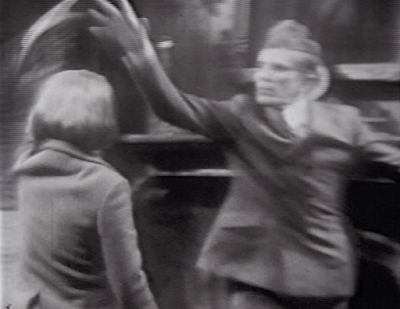
“Hoffman goes up, and is DENIED by Collins!” Screenshot by Dark Shadows Before I Die.

In between the scenes with Barnabas and Julia, there is some stuff with the sheriff and artist Sam Evans. The sheriff ambles into The Blue Whale tavern and finds Sam starting his fourth shot of whisky. They talk about Woodard, and Sam insists they go to his office to look for him. For the first 40 weeks of Dark Shadows, Sam’s alcoholism was a substantial story element, part of the “Revenge of Burke Devlin” arc. When that arc finally dried up in #201, Sam’s alcoholism went away. He’s a social drinker now. Still, he used to be the town drunk, and apparently that’s a higher post than sheriff. The sheriff follows Sam’s orders and accompanies him to Woodard’s office.

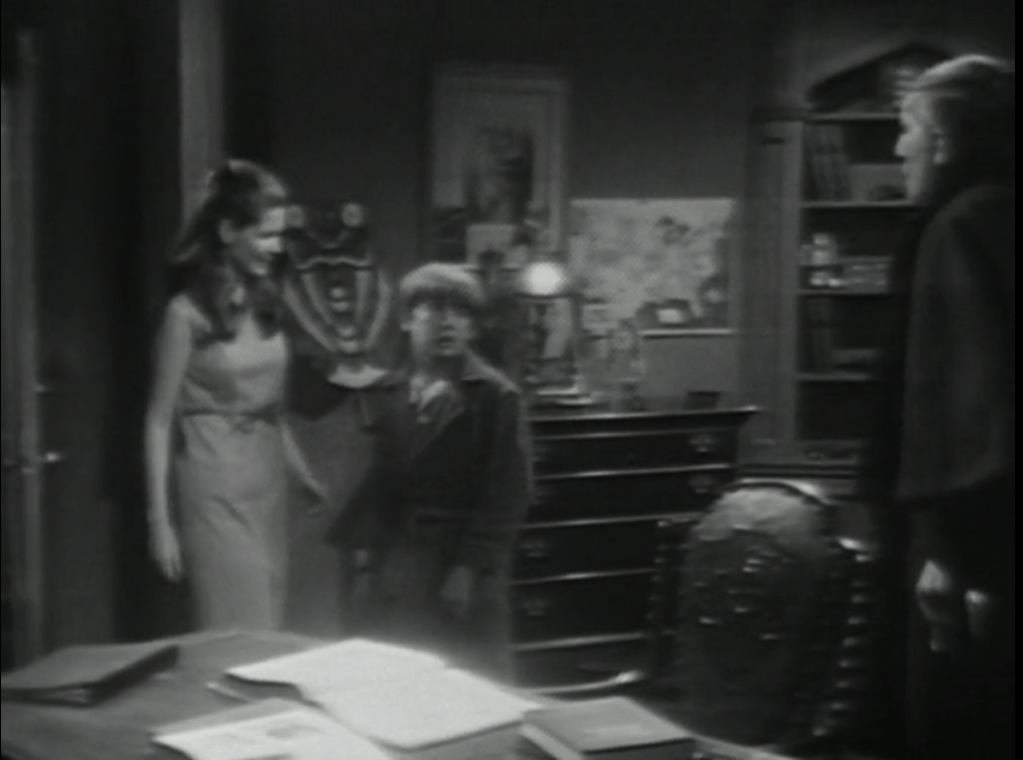
They knock on the office door. There is no answer. Sam suggests they break the door down. They haven’t tried to turn the knob, so they have no reason to suppose it is locked. Returning viewers will recall that yesterday Julia just walked into the office, without even knocking, and she and Barnabas did not lock the door behind them. So we can be fairly sure it is not locked. Still, orders are orders, so when the Town Drunk (Retired) says it’s time to break the door down, the sheriff watches him respectfully. Of course the whole set is made of a sheet of plywood, so when Sam “flings himself” against the door, he has to maintain a ludicrous gentleness to keep any part of it standing.

Inside, they find Woodard dead in his chair. Their response is bewildering. At first they are going to call for help, but then decide that because Woodard is dead there is no point. Eventually the sheriff remembers that he ought to call the coroner. They also take turns declaring that they believe Woodard’s death was the result of foul play.

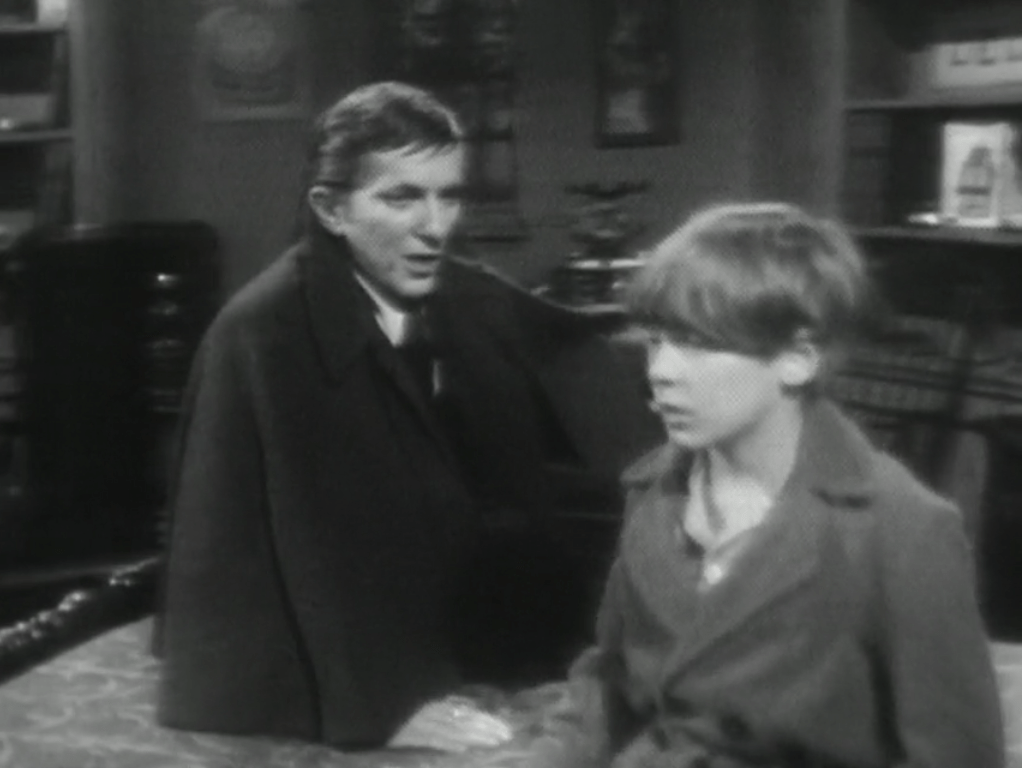
Episode 335: The imaginary Barnabas

Gordon Russell’s script contains an interesting scene. A psychiatrist brought in to examine strange and troubled boy David Collins gives a little speech attributing David’s fear of his cousin Barnabas to various unresolved traumas he has recently experienced. This speech sounds very plausible to the adults who listen to it, and might go some way towards explaining the appeal of Dark Shadows to its audience. But we know that David’s fears are entirely rational and that Barnabas really is a vampire. When the psychiatrist mentions that Barnabas had fangs in one of David’s dreams, family doctor Dave Woodard catches up with us and realizes that Barnabas really does have fangs and that he used them to inflict bite marks on some of his patients.

Episode 335 of Dark Shadows was a scab job done during the October 1967 National Association of Broadcast Employees and Technicians strike. In March of that year, at a time when Dark Shadows was at rock bottom in the ratings, the actors stayed out in support of the announcers and newscasters when they went on strike, and the show survived even though it went dark by the time the strike ended. Now, the vampire story is pulling in more viewers every week, making it a valuable property to ABC. But it is at this time that executive producer Dan Curtis told the cast that he would pay their union fines if they crossed the NABET picket line, and most of them did, with network executives and their stooges handling the equipment.

Sad to say, only two cast members did the right thing by the technicians. Robert Gerringer, who played Woodard, was one of those. Even if he had been a good actor, the scab stealing food from the mouths of Robert Gerringer’s children wouldn’t have been able to deliver on the moment when Woodard figures out that Barnabas is a vampire- we need Gerringer for that. He is the person we’ve grown used to seeing in the part, and his self-consciously soap operatic style of acting sets him apart from the rest of the cast and highlights the weirdness of this story playing out on a daytime serial in 1967.

But the scab isn’t a good actor. His most memorable moment comes when Joan Bennett, as matriarch Liz, bobbles a line, and he corrects her. She flashes a look of anger, but what does she expect? What she is doing is no better than what he is- if anything, it’s worse, because she was a big star and could have called a halt to the whole filthy disgrace if she’d lived up to her obligations as a member of AFTRA.

I’m writing this in September 2023, month three of the SAG-AFTRA actors’ strike and month five of the Writer’s Guild of America strike, so I’m even angrier about the whole thing than I usually would be. But I always find it hard to watch material produced under these conditions.

The character of Maggie Evans wasn’t in any of the episodes produced during the strike, so Kathryn Leigh Scott wasn’t involved in breaking it. She is walking a picket line today, and in her column she wrote about the particular issues at stake in the 2023 strikes. Different matters hung in the balance in 1967, but it’s always true that we live in a society, for the love of God, and if working people don’t stick together they don’t have anything.

Two actors who were too young to know better. Screenshot by Dark Shadows Before I Die.

Episode 325: Such pretty flowers

Strange and troubled boy David Collins was, for the first 39 weeks of Dark Shadows, the character most intimately connected to the supernatural back-world of ghosts and uncanny phenomena that would occasionally peek through the main action of the show. That changed in #191, when he chose life with well-meaning governess Vicki over death with his mother, humanoid Phoenix Laura Murdoch Collins. After that, he had little memory of his mother, and none at all of the paranormal experiences he had during her time with him on the great estate of Collinwood.

Not that David lost his connection to the supernatural all at once. When he first met his cousin Barnabas in #212, he cheerfully asked him if he was a ghost, and was disappointed to hear that he wasn’t. In #288, he speculated that his friend, mysterious little girl Sarah, might be a ghost, and he has taken it in his stride every time he has seen Sarah do something only a ghost could do. In #310, he took out his crystal ball, a gift he had received in #48 and hadn’t used since #82, and peered into it to try to find Sarah. He did see her in it, too.

Yet David seems to be resisting the idea that Sarah is a ghost, and indeed to be shying away from the whole concept of the supernatural. When she led him to the secret chamber in the Collins mausoleum in #306, she told him that the empty coffin there once had a body in it, but that the body got up and left. David objected that the dead don’t walk away, and was incredulous when she assured him that sometimes, they do. When David was trapped in the chamber in #315, Sarah materialized there and showed him how to get out. He had called on her to come, and was facing away from the only door when he did so, indicating that he knew she could pass through the walls. Yet when she did, he demanded a naturalistic explanation for her entrance, and when she vanished he asserted that she must be hiding in the chamber somewhere.

Now, David is terrified of Barnabas, much to the puzzlement of the adults he lives with. In the opening scenes, he is staring at the portrait of Barnabas in the foyer of the great house, and we hear Barnabas in voiceover, delivering the lines with which he frightened David in #315. He screams with terror, bringing his aunt Liz. She sees that David is upset, but he hurries away from her, upstairs to his bedroom.

There, we hear his thoughts in another voiceover. He remembers the events of #310, when he discovered that Barnabas and his servant Willie knew about the secret chamber in the mausoleum. In his agitation, he calls out to Sarah. He hasn’t admitted to himself that Sarah is a ghost, but evidently he expects her to materialize out of thin air. Sarah doesn’t come, but Vicki does, asking who he was talking to.

After David says he wants to work on his stamp collection, Vicki goes downstairs and finds Liz putting her coat on. She says that David is afraid of Barnabas for some reason, and that she is going to Barnabas’ house to ask him to help put the boy’s fears to rest. She says that David is more disturbed than he has been since his mother Laura was around; this is the first direct reference to Laura in months.

There is a knock on the front door. It is Barnabas, saving Liz the trip. Liz and Vicki explain how fearful David is, and Barnabas offers to have a talk with him.

Liz ushers Barnabas into David’s room. Once the door is closed on the two of them, Barnabas questions David aggressively about Sarah and the secret chamber in the mausoleum. He asks him if Sarah told him about her family, twice mentioning her brother. When David says that Sarah hasn’t told him anything about herself, Barnabas accuses him of lying. He sits next to David on his bed. David doesn’t know that Barnabas is a vampire, but if he did he couldn’t look much more uncomfortable than he does when Barnabas assumes this position.

Barnabas sitting with David on his bed.

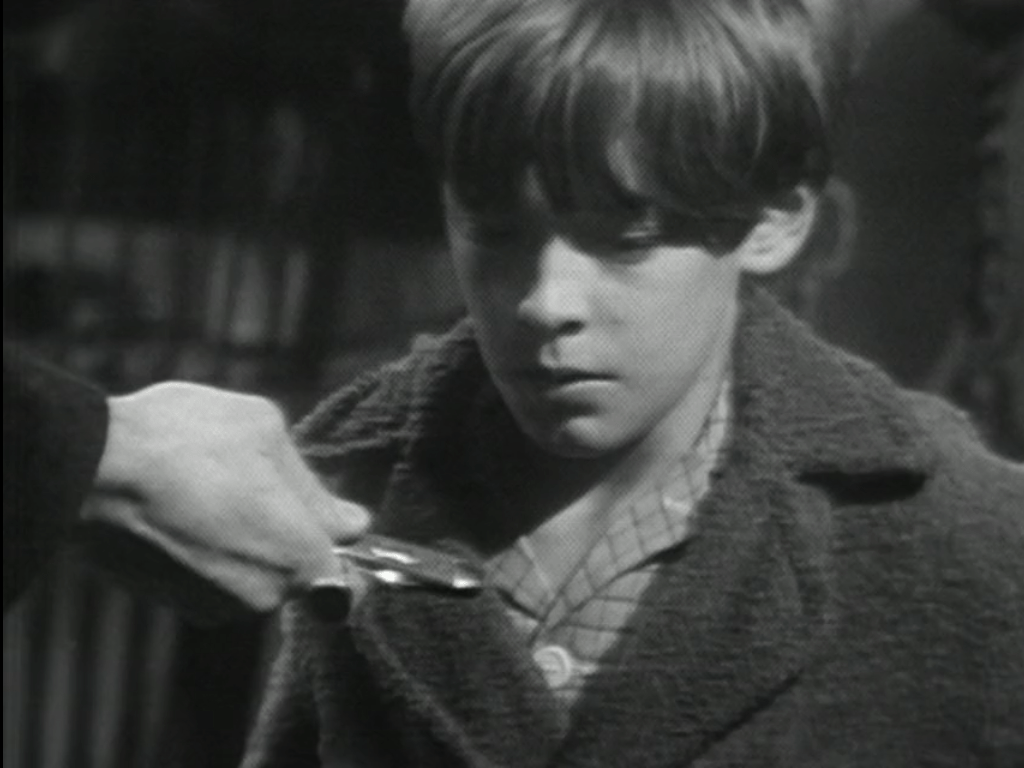
Barnabas tells David repeatedly that he knows he was in the secret chamber. David denies it, Barnabas again tells him he is lying, and to prove it shows him the knife he left there.

Barnabas confronts David with his knife

A knock comes at the door. It is Vicki. Vicki adores Barnabas, and the smile she wears when she enters the room shows her certainty that a heart-to-heart talk with him will have relieved David’s anxiety.

Smiling Vicki, sure everything will be all right

Vicki sees that David is still frightened, and her smile gives way to a look of confusion. Vicki was originally the audience’s point-of-view character; the audience is now composed chiefly of people who have tuned in wanting to see how they were going to fit a vampire into a daytime soap opera, and so of course she has to be Barnabas’ biggest fan at Collinwood. She and Barnabas leave David’s room together, and Barnabas wishes David “Pleasant dreams…”

We see David tossing in bed. He is talking in his sleep, calling out to Sarah. In yet another voiceover, we hear his dream. It is a bit of conversation from #306, when Sarah told him about the empty coffin.

We then see the beginning of another dream. It takes place amid a composite of decorations from the cemetery set and from the set representing Barnabas’ basement. David at first appears in a corridor like the ones we saw in the basement in #260.

The fog machine is working hard today.
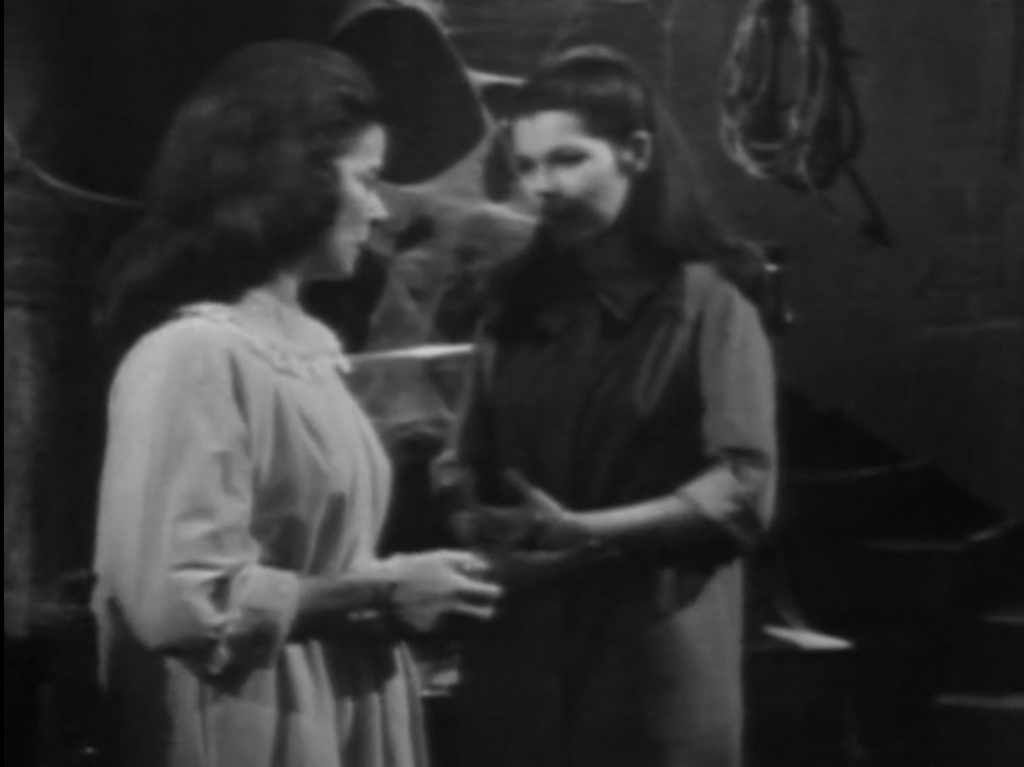
He then encounters a faceless woman whom regular viewers will recognize as Barnabas’ co-conspirator, mad scientist Julia Hoffman.

David sees the faceless woman.

We see that she is wearing Julia’s wig and frock and holding the jeweled medallion she uses to hypnotize people:

Julia’s identifying marks.

David flees from the faceless woman, saying he has to find Sarah. He finds himself behind a grating like the one on the door to the Collins mausoleum:

Entering the tomb

He walks up a few stairs, and sees Sarah.

David finds Sarah

When David tells Sarah that she is hard to find, she denies it, saying that she is easy to find if you know where she is. David does not respond to this characteristically cryptic remark, but complains that she won’t tell him anything about herself. She asks what he wants to know, and says he wants to know who she is and where she comes from. She tells him:

Sarah: That’s easy. I was born the same place you were. I lived in a house on a hill until I was nine years old. Then I got very sick. Everyone came to see me, and they were very sad.

David: Because you were sick?

Sarah: No, because I died. I died, and everyone brought such pretty flowers.

“I died that time. I died, and everyone brought such pretty flowers.”

When David asks why she is around now if she died then, she tells him she doesn’t really know. All she knows is that she is looking for someone. David asks who that might be, and Sarah says she will show him. Suddenly he becomes frightened and does not want to go with her. She insists. She takes his hand and leads him.

Sarah leading David to her secret

The camera follows the children on their journey across the set. At first Sarah takes David down some stairs, leading him from depths to depths:

Sarah leads David down into the depths

The set is now unmistakably Barnabas’ basement, though with more candelabra casting more intricate shadows on the walls than we have seen there:

Vergil and Dante, junior edition

At last Sarah stops and looks straight ahead. They have reached their destination.

David is bewildered by the sight.

They see a coffin. David asks if this coffin is empty, as was the one in the secret chamber. Sarah tells him no. This one has a body in it. The lid starts to open. David points in astonishment, while Sarah looks on serenely.

The lid begins to open.

Barnabas rises from the coffin.

Barnabas rises.

David recognizes Barnabas and is stunned. Sarah has eyes only for her big brother.

David stunned.

Barnabas stands. He turns, and sees Sarah. He is glad to see her.

David watches Sarah’s reunion with Barnabas.

Barnabas notices David. He turns to follow him.

Barnabas blocks David from our view and from Sarah’s.

As Barnabas follows David, Sarah simply watches.

Sarah watching big brother.

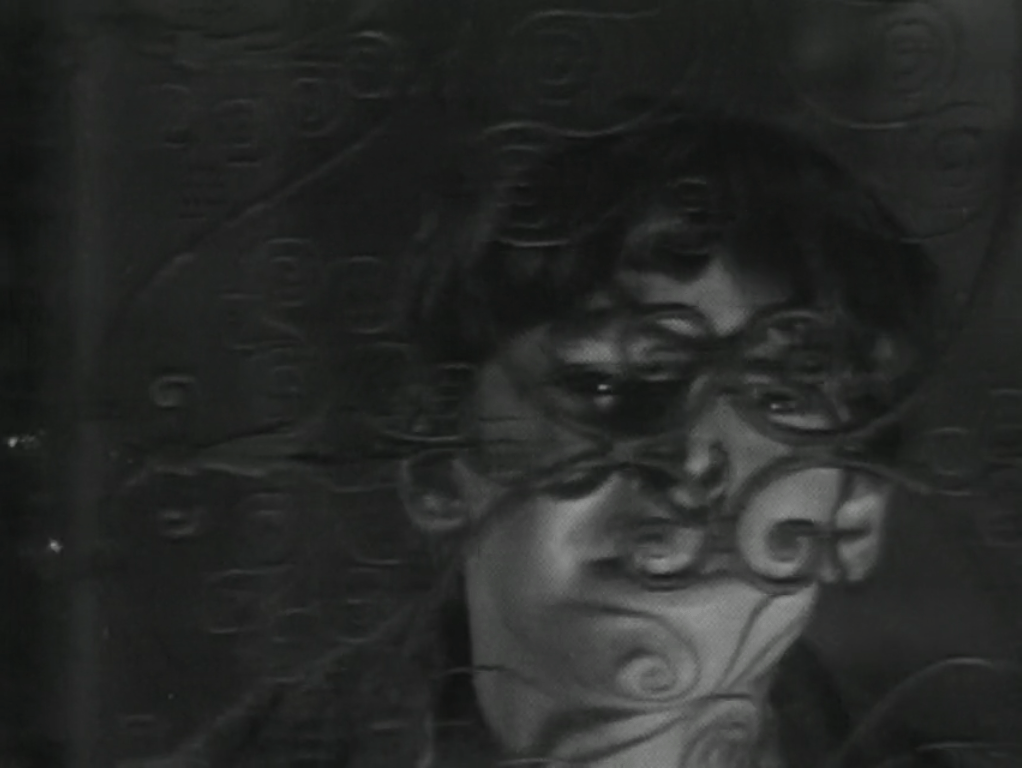
Barnabas follows David through another corridor. The shadows on the wall and floor form a design suggesting David is caught in a web. Readers of Gold Key comics’ Dark Shadows series will recognize the bend of Barnabas’ knees and the angle of his cane in this shot as their usual depiction of him:

David caught in Barnabas’ web.

David’s back is to the wall and Barnabas closes in on him.

Cornered.

Barnabas raises the cane he used to block David’s escape in #315 and which regular viewers several times saw him use to beat Willie. We zoom in on the wall, where we see the cane’s shadow rise and fall while we hear David cry out in distress.

Sarah’s fixation on Barnabas and her passivity when Barnabas follows David mark a pivotal moment in her development. She looks and sounds like a friendly little girl, and we have seen her rescue people from danger. She usually seems like a cross between Caspar the Friendly Ghost and the Powerpuff Girls. But she is not that at all. She is a symptom of the same curse that has brought Barnabas forth to prey upon the living, and she is leading David ever deeper into a world where only the dead belong. The show has given us no reason at all to think that she can bring him back to the realm of the living.

Even if Sarah wants to save David, she may still represent a deadly threat to him. We saw this in the Laura story. When Laura tried to lure David into the flames, she told him that he, like her, would rise from the ashes and live again. We had heard her say things like this before, and she may well have believed it to be true. But unknown to her, we saw a séance in which David spoke with the voice of a son Laura had in one of her previous incarnations. She had burned him with her, but while she gained a new life in the flames, he had become one of the unquiet spirits of the dead. Perhaps Sarah, too, is unwittingly leading David to his death.

Closing Miscellany

When Liz leads Barnabas into David’s room, she tells David that “Unc- Cousin Barnabas” wants to have a man-to-man talk with him. In later years, Jonathan Frid would refer to his character as “Uncle Barnabas” when he talked with interviewers about how the Collinses responded to him. I wonder if Joan Bennett’s blooper is a sign that he was already calling him that at this time.

There is a slight puzzle in Sarah telling David she was “born in the same place” he was. We’d heard in the early episodes that Laura and Roger never spent a night together in Collinwood as man and wife- the day of their wedding, they went to their new home in Augusta, Maine, and David was born a few months later. Perhaps Sarah’s remark is a retcon, and we are now to think of David as having been born at Collinwood. Or perhaps Sarah really was born where Augusta would stand- we know that her birth year was 1786, and that was the year the settlement that would become Augusta saw the establishment of its first public whipping post. Maybe her parents wanted to go there to celebrate the occasion.

When Sarah tells David she lived on the hill until she was nine, she interrupts herself and shouts “Ten!” This is an odd little blooper. Just a few days ago, David told Barnabas that Sarah was ten, and Barnabas jumped down his throat asking if she wasn’t “almost ten?” Now Sharon Smyth has been on the show long enough to have celebrated a birthday, and they aren’t done with Sarah yet. So they are retconning Sarah as having made it to ten.

Episode 323: Partly responsible

Maggie Evans, The Nicest Girl in Town, has amnesia and can’t remember who abducted her in episode #235 and held her prisoner until #260. So the police started a rumor that her memory was returning, camped out in her yard, shot the first guy who strayed into it, and declared him to be the guilty party.

The man with five bullets in his back is Willie Loomis, servant to Old World gentleman Barnabas Collins. Sheriff Patterson tells Maggie, her father Sam, and her boyfriend Joe that he will be going to visit Barnabas and break the news to him about Willie. Maggie expresses sympathy for “poor Barnabas,” who will no doubt be heartbroken to hear ill-tidings about Willie. Sam is sorry to hear the sheriff will have to blight the dear fellow’s night, but the sheriff says Barnabas must be told. Willie lives in Barnabas’ house and, so far as anyone knows, has no access to any other building. So if he held Maggie prisoner for five weeks, you’d think the sheriff would have more to do on a visit to Barnabas’ place than simply deliver a message.

As it happens, Barnabas is the one responsible for Maggie’s plight. Willie was trying to get to Maggie to warn her that Barnabas had heard that her memory was coming back and was on his way to kill her. When the sheriff gets to Barnabas’ house, he finds him with his co-conspirator, mad scientist Julia Hoffman. Julia explains that she just came to the house to borrow a book. It’s four o’clock in the morning, by the way, but the sheriff takes that in stride and tells them what happened to Willie. He apologizes for disturbing them and says he can come back later if they would like. Barnabas says he wishes he could talk to Maggie, and the sheriff offers to take him and Julia to the Evans cottage. They accept this offer, and the sheriff goes outside to wait for them. Barnabas has long since cleaned up the evidence left over from Maggie’s weeks in his dungeon, so he doesn’t have to spend the time the sheriff so thoughtfully provides in tidying up. He and Julia can devote all of it to further conspiring.

Screenshot by Dark Shadows Before I Die.

Only Julia knows that Barnabas was the one who abducted Maggie in May, and only she knows that he has been planning to kill her ever since. But the sheriff and the Evanses drift into their own odd little conspiracy to shelter Barnabas from accountability.

Barnabas tells Maggie that he can’t help but “feel partly responsible” for what happened to her. She and Sam fall over themselves assuring him that he has nothing to feel bad about, that it was wonderful of him to try to rehabilitate Willie and that everyone was very impressed with how far he seemed to have got with that project.

Barnabas goes home. Julia accompanies him. She assures him that Willie will probably die, and urges him to relax, because he is “completely in the clear.” He bids her goodnight, by which I mean he grabs her throat and threatens to kill her if she is wrong. Once he is alone in the house, he thinks of the various people who might be able to bring his secrets to light. He settles on his ten year old cousin David, and resolves that “something must be done to keep him from exposing me, and it must be done soon!”

There is a touch of social satire in the deference everyone pays Barnabas. In #26, high-born ne’er-do-well Roger Collins wanted a particular service from Sheriff Patterson’s predecessor, the hapless Constable Jonas Carter. He told Carter that “My family is responsible for over half the jobs in this town,” and made a dark reference to an upcoming election. In #32, Carter went along with the Collins family’s cover-up of a case involving David, and in #272 and #273 Sheriff Patterson himself showed a mind-bending amount of solicitude to matriarch Elizabeth Collins Stoddard when she called to report that she had murdered her husband and that his body was buried in her basement.

Among the jobs for which the town has the Collinses to thank was an important one of Sam’s. In #222, Barnabas commissioned Sam to paint his portrait. When he offered to pay $1000, Sam and Maggie’s electrified reactions showed that this was more money than they had seen in a long time. They have good reason to think as highly of Barnabas as they possibly can.

Not only is Barnabas a member of the Collins family of Collinsport, but he is, again unknown to any of his protectors but Julia, a vampire. As such, he is a symbol both of extreme selfishness and of the dead past holding back people who want to make a new future. Dark Shadows does not often explore political themes in depth, to put it mildly. But today it does give us a glimpse of the way working people can find themselves defending the position and privileges of their very deadliest enemies.

Closing Miscellany

Barnabas looks at a “portrait” of his little sister Sarah, who died in 1796. We’ve seen this “portrait” many times, but usually it was at something of a distance from the camera, often at an oblique angle, and rarely shown for more than a brief moment. The typical TV set in 1967 would have allowed the viewer to believe it was a painting. But this time it fills the screen and is stationary for several seconds. Even though this episode only survives in an especially low-quality kinescope, it is impossible to overlook the fact that it is a photograph of Sharon Smyth, the child actress who plays Sarah’s ghost, taken at least 30 years before Joseph Nicéphore Niépce built his first camera.

Sarah Collins, d. 1796

This episode has an unusually large cast. In addition to the six regular actors, three of Sheriff Patterson’s deputies appear. None of them is credited, but the Dark Shadows wiki names them as Ed Crowley, Ted Beniades, and Dennis Johnson.

Episode 320: It must have been a nightmare

We open with the most spectacular dream sequence Dark Shadows has yet attempted. Strange and troubled boy David Collins is tossing and turning in bed. We cut to his dream, where he sees his distant cousin, old world gentleman Barnabas Collins, approaching. Barnabas gets closer and closer, grows enormous, and opens his mouth, exposing the fangs of a vampire. David screams and wakes up.

Screenshot by Dark Shadows Before I Die.

As it happens, Barnabas really is a vampire. He has heard a rumor that Maggie Evans, The Nicest Girl in Town, is recovering from amnesia. Since that amnesia was induced by his associate, mad scientist Julia Hoffman, in order to keep her from remembering that Barnabas is an undead ghoul who abducted her and held her prisoner, he is on the point of a panic attack.

Jonathan Frid turns in a bravura performance as Barnabas today. He plays Barnabas’ mounting anxiety compellingly when we see him in his house alone with his sorely bedraggled blood thrall Willie, waiting for Julia. When she does come, he rages at her and demands she go to Maggie at once to reinforce her memory loss. When Julia admits that she is no longer Maggie’s doctor, Barnabas’ rage mounts and he threatens to kill her. She keeps talking, and eventually he composes himself and suavely tells her that he won’t kill anyone tonight. She smiles, and goes off to her laboratory to resume meddling in God’s realm. Willie knows Barnabas better than Julia does and has none of her self-assurance; he doesn’t for a moment believe that Barnabas has relented. When he gets Barnabas to confirm that he is indeed going to kill Maggie, Frid moves from the cool suavity he had achieved just before Julia’s exit back to the near-panic he had displayed before she entered. The whole trip from panic to rage to suavity and back to panic is remarkably well executed.

Episode 318: What can a little girl know?

In the outer room of the Tomb of the Collinses, Sam Evans and Dr Dave Woodard recap the story so far. In the hidden chamber on the other side of the wall, vampire Barnabas Collins and mad scientist Julia Hoffman eavesdrop on their conversation. When they hear how close Evans and Woodard have come to discovering their terrible secrets, Julia squirms and Barnabas looks shocked.

Busted.

When Dr Woodard mentions that Julia had used the word “supernatural” in a conversation with him, Barnabas nearly blows their cover. He grabs Julia by the throat and she lets out a yelp. Sam hears this, Woodard does not. Woodard suspects that there are ghosts at work in the area, but he cannot believe that Sam’s hearing is better than his, so he dismisses the idea.* He notices the plaque marking the burial site of Sarah Collins, 1786-1796, and says out loud that the little girl named Sarah whom everyone has been looking for lately is the ghost of that Sarah.

Evans and Woodard leave the tomb, and Barnabas resumes raging at Julia. He opens his old coffin and pushes her head into it, asking if she wants to spend eternity confined there. She talks him down with warnings of what would happen were he to kill strange and troubled boy David Collins.

Woodard goes to the great house of Collinwood, where he questions David. Woodard is much more forthcoming with what he knows than he has been in any previous conversation. David listens closely, trying to find out what he knows. But Woodard’s questions are all about David’s friend, Sarah. David doesn’t know that answers to many of Woodard’s questions, and Sarah has sworn him to secrecy about much of what he does know. So the only new piece of information Woodard learns from David is that Julia was lying to him the other day when she said that she hadn’t given much thought to Sarah. David tells him that she asks him about her all the time.

Julia comes in and tries to stop Woodard questioning David. He ignores her and asks another question, then warns him to stay away from the Tomb of the Collinses. When he tells David that whatever secret Sarah told him about the tomb is also known to someone else, and that that other person is very dangerous, David is horrified. When he was trapped in the hidden chamber last week, Barnabas and his servant Willie entered. David hid from them in Barnabas’ old coffin and eavesdropped on a conversation in which Barnabas dropped a huge number of clues about his secrets. Since Woodard started his questioning of David with a reference to the unknown person who has been terrorizing the area since April, David now has reason to believe that Barnabas is that person.

David leaves the room, and Woodard asks Julia what she was trying to prevent him from finding out. She refuses to answer any of his questions. She hears the sound of dogs howling, and knows that it means Barnabas is getting ready to kill someone. Knowing that she has very little time to try to prevent David’s murder, she cannot focus on Woodard’s questions. For once, she can’t think of any lies that will hold him off. Her reason for being in town, so far as Woodard is concerned, is that she is a doctor treating Sam Evans’ daughter Maggie, Barnabas’ former victim. When she won’t answer his questions, he takes her off Maggie’s case.

Julia goes to Barnabas’ house. She finds him on his way out the door, on a mission to kill David. She opposes him, and he declares that nothing can stop him. At that, the wind blows the doors open. It extinguishes some of the candles in the room. The strains of “London Bridge” begin playing, and Barnabas and Julia realize that Sarah, who in reality is the permanently nine year old ghost of Barnabas’ little sister, is in the room. Barnabas cannot leave. Julia says with satisfaction that nothing can stop him- “except one little girl.”

The whole episode is very strong from beginning to end. Julia is usually so much in charge that the only suspense is what she will choose to do, but throughout this one she is scrambling to bring Barnabas under control. When her final attempt fails, Sarah’s intervention comes as a thrilling surprise.

The performances of both Jonathan Frid and Grayson Hall stand out today. Hall is as powerful a presence playing a character who controls nothing as she usually is playing a character who controls everything. And few could match Frid’s ability to appall us with Barnabas’ plan to kill a ten year old and seconds later to elicit tears by calling out to his beloved little sister.

*My wife, Mrs Acilius, put it that way.

Episode 300: Burke Devlin must die

Sorely bedraggled blood thrall Willie Loomis tries to tell his master, vampire Barnabas Collins, that his plans for well-meaning governess Vicki Winters are unlikely to come to fruition. Barnabas wants Vicki to volunteer to become his vampire bride, a goal he has done remarkably little to advance. Even when Vicki invited herself to spend the night in his house, he couldn’t be bothered to bite her. Now she’s getting serious about her depressing boyfriend, Burke Devlin, and Willie thinks Barnabas has missed his chance.

Barnabas responds to Willie’s opinion as we might expect- he grabs him by the throat and threatens to kill him. He sends him away with orders to follow Vicki and Burke on their date and to report on every detail of their conversations.

Mad scientist Julia Hoffman is trying to cure Barnabas of his vampirism, and she brings him substantially the same message, along with a command to leave Vicki alone. Barnabas has enough hope that Julia’s experiments will succeed that he can’t treat her as he does Willie. So he evades her questions, pouts at her orders, and sulks when he finds himself having to go along with her.

Barnabas agrees to do as Julia says. Screenshot by Dark Shadows Before I Die.

The scene looks very much like the interactions we saw in the early months of the show between matriarch Liz and her brother, high-born ne’er-do-well Roger. Those were sometimes echoed in the interactions Vicki had with her charge, Roger’s son strange and troubled boy David. The bossy big sister/ bratty little brother pattern is on its way to becoming the signature relationship of Dark Shadows.

Meanwhile, Willie has been following his orders. He saw Burke and Vicki make several laughably awkward attempts to kiss each other, then heard Burke propose marriage to Vicki. Vicki asked for time to think it over.

When Willie reports this to Barnabas, he says he is sure she will say yes. Barnabas says that there will be no marriage, and proclaims “Burke Devlin must die!”

Episode 296: Safe tonight

Maggie Evans, The Nicest Girl in Town, has come back to Collinsport. This is bad news for vampire Barnabas Collins, who kept Maggie prisoner and fears she will expose him. Barnabas’ new accomplice, mad scientist Julia Hoffman, has erased Maggie’s memory and assures him she is no longer a threat to him.

Barnabas is unconvinced that Maggie’s amnesia will last. As he grows more agitated, Julia grows calmer. This contrast reaches its climax when Julia blithely lights a cigarette from Barnabas’ candelabra and he reacts with stunned bewilderment.

Julia lights up. Screen capture by The Collinsport Historical Society.

Julia tells Barnabas he has no choice but to trust her and leave Maggie be. He says that it would seem so. It doesn’t seem so to the audience- we know all Barnabas has to do is bite Julia to bring her under his power.

Julia shows herself out, a spring in her step. Once Barnabas is alone, he hears a rooster announce the dawn. He mutters that Maggie is safe for the moment, but that he will kill her tonight.

By now, there are three groups of characters on Dark Shadows: those who know Barnabas is a vampire; those who do not know this, but do know that supernatural doings are afoot; and those who think the show is still the Gothic romance/ noir thriller it was in its first weeks. Those in category one can move the story along very quickly, those in category two can nudge it forward a bit, and those in category three are blocking figures who slow things down.

When she was Barnabas’ victim, Maggie was in category one. Now she’s fallen back into category three. She has even resumed her vocal habits of showing herself to be happy by starting every statement with a laugh in her voice and of exaggerating the stress on whatever words have a rising intonation. She had those classic Adult Child of an Alcoholic mannerisms in the early days of Dark Shadows, when her father’s drinking problem was a story element. Months ago they revised him as a social drinker, so it’s like she’s been spliced in from tapes of old episodes. The question of Maggie’s memory therefore generates suspense, not only because we don’t want Barnabas to kill her, but also because we don’t want her to end up in a narrative dead end and fade from the foreground of the show.

Episode 260: One, two, away they flew

Maggie Evans, The Nicest Girl in Town, has been a prisoner of vampire Barnabas Collins for a long time now. Barnabas is planning to kill her tonight. We spend the opening scene with Barnabas’ sorely bedraggled blood thrall, Willie Loomis. We hear Willie’s thoughts as he does the housekeeping. Willie wishes he could save Maggie, but Barnabas has too much power over him. The most he can do is bring her a poisoned glass of milk and invite her to drink it if she wants to die an easy death.

Willie is not Maggie’s only friend. The ghost of Barnabas’ nine year old sister, Sarah, materializes in Maggie’s cell. Sarah asks Maggie why she is crying. Maggie tells her that if she doesn’t get out of the cell very soon, she will die. Sarah is distressed to hear this- “You mustn’t die- I don’t want you to die.”

Maggie hasn’t figured out that Sarah is a ghost, and keeps asking her how she manages to get in and out of the cell. Sarah usually evades this question, but now she says that there is a way. She came upon it accidentally, long ago, and her father ordered her not to tell anyone, not even her brother. She will be punished if she tells. If her father put her in the prison cell in their basement intentionally, Sarah’s fear of punishment is quite understandable.

Sarah overcomes her fear sufficiently to share a riddle with Maggie which she says will give her the answer:

One, two, away they flew.

Three, four, by the door.

Five, six, count the bricks.

Seven, eight, the clue is “grate.”

Nine, ten, home again.

Maggie asks Sarah to repeat the riddle, and she says she can only say it once. Maggie tells her where to find her own father, Sam Evans, and asks her to tell Sam that she has seen her. Sarah disappears.

Sarah’s fear of punishment will ring a bell for regular viewers. Strange and troubled boy David Collins is so intensely afraid that his father, high-born ne’er-do-well Roger, will punish him by sending him away to a boarding school or a jail that he tried to murder Roger. Later, David left his favorite person, well-meaning governess Vicki, to be decapitated by crazed handyman Matthew Morgan because he was afraid that if he helped Vicki his father would find out he had earlier defied him and would punish him. Now, Maggie is in mortal danger because another Collins child, one who lived in a previous century, has a similar fear of punishment. The cell in the basement of the Old House was there before slavery was abolished in the area in 1783; perhaps Sarah’s fear and David’s are a bequest from the slaves and indentured servants whom their forebears locked up in it.

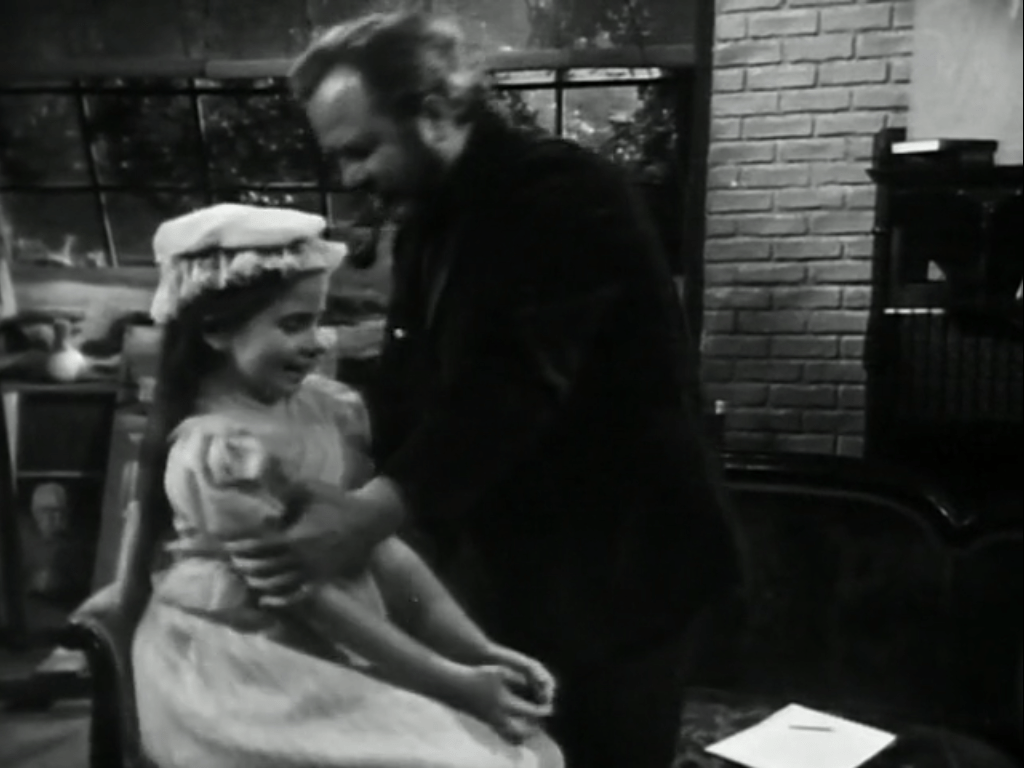
We cut to the Evans cottage. Sam is an artist, and is working. Sarah materializes in the living room. Sam had locked the door and Sarah won’t explain how she got in, but he seems to be delighted with her anyway. She is impressed with his paintings and asks him to paint a picture of her. He offers a drawing instead. When she agrees, he picks her up and sets her on a stool. She flashes a grin at being picked up. She asks if she can keep the drawing when he is done with it.

The most fun Sarah has had the whole time she’s been dead

Sam tells Sarah that her dress is very pretty. He then mentions that you don’t see many dresses in its style. She asks if that means he doesn’t like it. When Sam says that all he means is that it isn’t the sort of thing other little girls wear, she says she doesn’t play with other little girls so she doesn’t care what they wear. She seems to be getting worked up about this, so Sam calms her down with, “All right, all right, I see.” This little exchange gave my wife, Mrs Acilius, a laugh. Sarah may have been born in the same year as Jacob Grimm, but she is very much a nine year old girl.

While Sam draws Sarah, she steers the conversation to Maggie. She asks Sam if he looked for Maggie on the beach under Widow’s Hill. He says he’s looked everywhere he could. She repeats her suggestion that he look for her on the beach. He says he is sure he won’t find her there. She responds “You might, if you go there tonight.” Disturbed by this, Sam looks up, and finds that Sarah has vanished.

This surprises us almost as much as it surprises Sam. Sarah had made it clear that she very much wanted to keep the drawing, yet she disappears before Sam is finished. Evidently, it wasn’t within her power to stay.

Back in the cell, we see Maggie and hear her thoughts as she tries to remember Sarah’s riddle. Like Willie’s voiceover internal monologue in the opening scenes, Maggie’s goes on too long. We can see that Maggie is in an upsetting situation and understand why Sarah’s presence confuses and distracts her. That makes it clear she would have difficulty remembering the exact wording of the riddle, but we really don’t need to hear her go over every part of it.

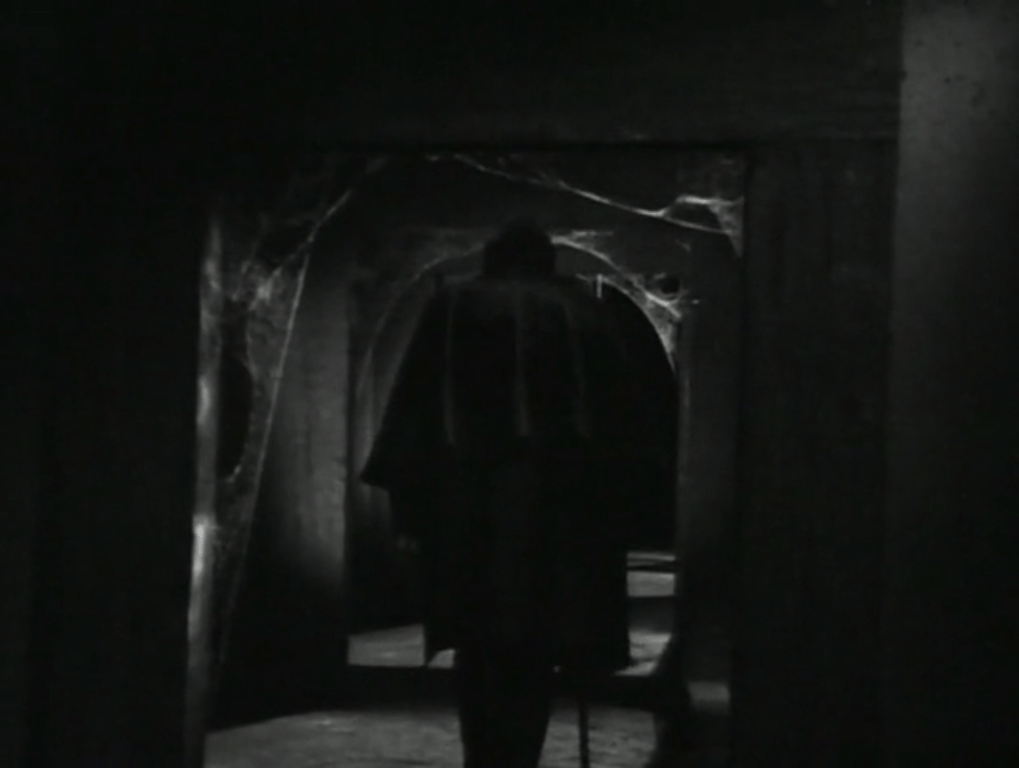
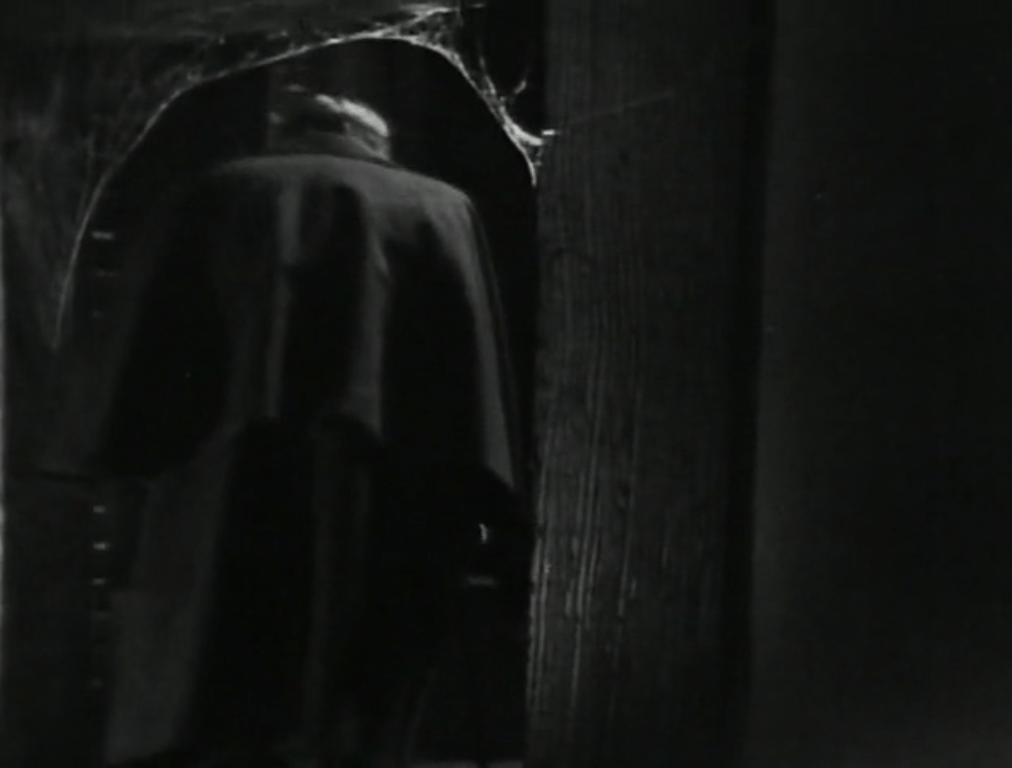
By the time Maggie finds the loose brick that triggers the opening of the secret panel, Barnabas is already rising from his coffin. We cut between Barnabas walking through the basement and Maggie struggling to open the panel. It may sound like we’re describing filler when we say that we see Barnabas traversing three distinct corridors between his coffin and Maggie’s cell, but it doesn’t feel that way. Not only do these shots build suspense as we wonder if Maggie will get out before he reaches her, but in Barnabas shown as a hunched, solitary figure in narrow spaces sketched in shades of gray we see the representative of a world bleak beyond endurance. We can see why the first serious feature film about a vampire, F. W. Murnau’s Nosferatu (1922), devoted so much screen time to showing Count Orlok skulking about the corridors of his castle.

First corridor
Second corridor
Third corridor

Maggie crawls into the secret passage. She doesn’t close the panel behind her. Not only doesn’t Maggie know that Sarah is a ghost, she doesn’t know that Barnabas is Sarah’s brother. When Sarah says that not even her brother knows about the secret panel, she is telling us, but not Maggie, that Barnabas is unfamiliar with this way. We know that if Maggie had closed the panel, Barnabas wouldn’t have known where to look for her, and so we might yell at the screen urging her to do that. But since it is his house, she has to assume that he does know about the panel, and she knows that he might be at the door any second. So it is rational for her to forget the panel and use all of her time moving forward.

The gap between Maggie’s knowledge and ours again adds to the suspense as we watch her flee from Barnabas through the twisting passages beyond the panel. We only see one path, but the looks on the actors’ faces as they look from side to side tell us that there are several. Maggie is moving cautiously, choosing her way with care, the sensible thing to do if Barnabas is familiar with the passages. Since we know that it is new to him as it is to her, we want her simply to pick a path and run.

Maggie beholding the paths before her

Maggie finds two heavy doors, both of them apparently stuck. Barnabas looks around, seems bewildered, and takes a breath. He shouts a speech at Maggie, claiming that she has no chance of escape because he can hear her. He can’t hear much while he’s shouting, so we want her to take advantage of that and bash away at one of the doors during his speech.

Barnabas wondering at part of his house he never knew existed
Maggie with two closed doors in front of her and an angry vampire behind her

This episode ends the 52nd week of Dark Shadows. When ABC* picked the series up in 1966, it gave executive producer Dan Curtis a 26 week commitment, carrying production to #130. After that, the network renewed it for the then-standard 13 week period. The first renewal carried them to #195, the second to this episode. Until just a couple of months ago, the ratings were so low that no one thought it was likely that it would get a third renewal. When the vampire was introduced in April, viewership started to pick up, preventing cancellation and requiring them to come up with a story that they could keep telling.

I do think we can see traces here and there of the original plan. The first part of the plan seems to have been to copy Bram Stoker’s Dracula far more thoroughly than they wound up doing.

The two female characters on the show who had or were about to have boyfriends when Barnabas was introduced were Maggie and Vicki, who are both seeing men who are cut out to be stout-hearted action heroes. The two female characters in Bram Stoker’s Dracula who had boyfriends were Lucy Westenra and Mina Murray, who were both seeing men who emerge as stout-hearted action heroes. Dracula feeds on Lucy, prompting several other people to band together to try to save her. Dr John Seward, MD, contacts his old Professor, the brilliant Abraham Van Helsing, to advise the group. Despite their best efforts, Lucy dies and rises as a vampire, the “Bloofer Lady” who feeds on the children of east London. Lucy’s boyfriend has to destroy her body to free her soul of the vampire curse.

If the show was about to be canceled, it would have been a favor to Kathryn Leigh Scott to have Maggie suffer Lucy’s fate. Going out with a splash like that would certainly have given her something to lead with as she looked for her next job. But once it was decided that the show would continue beyond #260, it was out of the question to lose a character as popular and versatile as Maggie. When the network ordered 65 more episodes, Maggie had to be saved.

The Van Helsing analogue was actually named on screen. In #242, the show’s equivalent of Dr John Seward, addled quack Dr Woodard, said that he was going to call in a specialist to consult on Maggie’s case, a Dr Hoffman, who is “one of the best men in the field.” We haven’t heard about this man since Dan Curtis found out the show was going to be renewed, suggesting that they’ve abandoned the idea to hew quite so closely to Dracula.

In Stoker’s novel, once Van Helsing has corrected the group’s knowledge deficits concerning vampires, Mina emerges as its leader. Attempting to be gallant, the men cut Mina out of their operations, with the result that Dracula escapes them and bites her. Mina is able to resist his influence so far that she can play a pivotal role in the Count’s final destruction.

The first time Dark Shadows modeled a storyline on Dracula, the menace was not a vampire, but undead fire witch Laura Murdoch Collins. In that arc, the men formed a group of stout-hearted heroes advised by Dr Peter Guthrie and led by well-meaning governess Vicki. Guthrie and Vicki were plainly Van Helsing and Mina. Laura killed Guthrie, so he can’t come back to help in the fight against Barnabas, but Vicki is still around, still the chief protagonist, and still the one likeliest to lead the opposition to a villain.

Indeed, Barnabas has expressed interest in Vicki as a replacement for Maggie, and in #233 he blurted out an obvious threat when he realized she was getting uncomfortably close to figuring out the truth about him. So, had Dark Shadows ended with this episode, it is likely that it would have ended with Vicki overcoming Barnabas’ power and driving a stake through his heart.

Of course, the vampire is the source of the ratings, and Vicki and Maggie are needed for future story development. So the makers of the show can’t use any of those plot elements. What in the world they can do is a question that does not, as yet, have a clear answer. So they have been stalling and stalling. Sooner or later, the stalling will have to end.

*The American Broadcasting Company, that is, not the Australian Broadcasting Corporation.

Episode 194: Traces of fear

The residents of the great house of Collinwood stand around recapping the series so far. The only unanswered question that comes up is matriarch Liz’ extreme reluctance to leave the house.

Regular viewers could probably explain that to the characters. She has nowhere to go. She conducts the family’s enterprises from the drawing room, doing paperwork on a coffee table and holding meetings on the couch. The only room we’ve seen in the headquarters of the company is the office assigned to her brother Roger, and no work is done there. Since dashing action hero Burke Devlin is supposed to be a major corporate raider and he runs his business from his hotel room, the show takes a firm stand in favor of remote work.

The only spaces for socializing that we’ve seen are the Blue Whale tavern, a downscale hangout which wouldn’t have much to attract Liz, who is such a grand lady that she is played by Joan Bennett, and the restaurant at the Collinsport Inn, which is part of her adversary Burke’s territory. The only private home that has appeared is the cottage occupied by drunken artist Sam Evans and his daughter Maggie, The Nicest Girl in Town, who represent the working class in Collinsport and upon whom the head of the Collins family decidedly does not call. We’ve also paid two visits to the Pine Hotel in Bangor, Maine, whence hapless fountain pens are launched on endless journeys. That leaves the sheriff’s office, the crypt at the old cemetery, and the waterfront as the only places not on the grounds of the estate we’ve seen more than once. There doesn’t seem to be any reason why Liz, or anyone like her, would ever want to go to any of those places.

So if they are going to launch a storyline built around the question of why Liz is a recluse, they are going to have to show us someplace she might like to go. If we know that she doesn’t have anywhere to go, we won’t be in suspense as to why she isn’t going there.

Related to Liz’ reclusiveness is her concern that no one go into certain parts of the house. This is such a dead end that not even the other characters take an interest in it. When she asks if, during her recent absence in the hospital, the late and much-missed parapsychologist Dr Guthrie went into the basement, well-meaning governess Vicki almost yawns while responding “Oh, sure, he went down there.” The show didn’t bother putting Guthrie’s explorations of the house on screen, and the audience never heard him talk about anything he found there. Vicki makes it clear to Liz that he never talked about it to her, and regular viewers will remember that she was his chief contact.

Today, we learn that Liz has been wearing a chain around her neck with a key at the end for years, and that it hasn’t occurred to anyone to ask what the key unlocks. When Roger casually puts that question to her today, she angrily tells him that they shouldn’t question each other. Later, we see her use the key to open the door to a locked room in the basement. When Vicki finds Liz coming out of that room at 2:40 AM, Liz explains that she went there because she was having trouble sleeping. Evidently it is such a dull place that going there can cure insomnia. With scenes like these, they are signaling that only Liz ever thinks about the basement, and that when she takes note of the attitudes of the people around her not even she believes that there is anything there worth paying attention to. Since Liz’ interest in the basement is the only plot point we get all day, that is not a recipe for excitement.

Vicki finds Liz trying to cure her insomnia

In their post about this episode, John and Christine Scoleri pick up on Vicki’s remark that Guthrie explored the great house of Collinwood very thoroughly. John mentions that the show didn’t put any of that exploration on screen, and Christine responds with a series of images with Guthrie inserted into various rooms of the house. It’s hilarious, you should take a look.