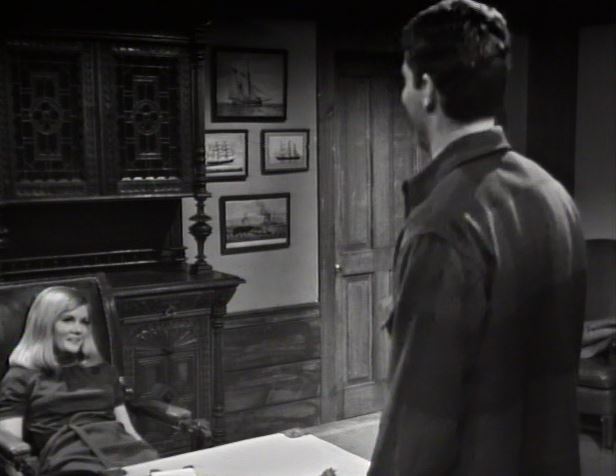
Hardworking young fisherman Joe is spending the evening with Maggie, The Nicest Girl in Town. It’s their first date. Maggie impresses him with her knowledge of ships, and he sings a verse of “What Do You Do With a Drunken Sailor?” It may not sound like much, but the actors, Kathryn Leigh Scott and Joel Crothers, sell it so well that we’ll be rooting for Joe and Maggie for years to come. The final moment of the scene comes after Joe leaves. Maggie looks directly into the camera and says to the audience, “Goodnight, pal.”

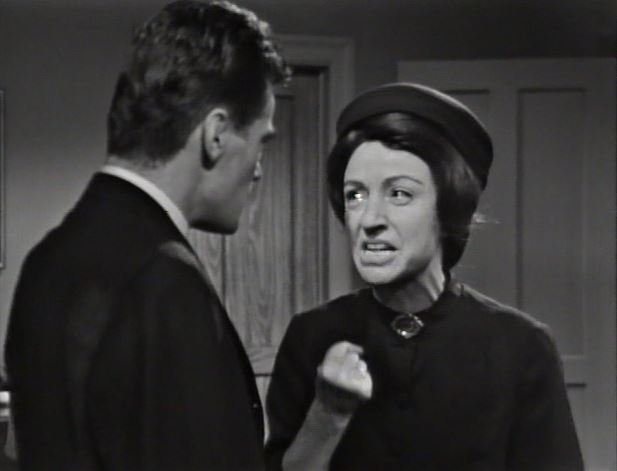
In the great house of Collinwood, high-born ne’er-do-well Roger Collins greets his niece, flighty heiress Carolyn, on her return home. Carolyn is upset because Joe has broken off their relationship and is having a date with Maggie. The story of Joe and Carolyn was a bore, largely because the two of them never had a scene with any fraction of the sweetness we see between Joe and Maggie today. There was nothing at stake in their quarrels, because they had nothing to lose if they simply gave up on each other.
Roger tells Carolyn that well-meaning governess Vicki hasn’t been seen for hours, and that he promised Carolyn’s mother, reclusive matriarch Liz, that he would sit up waiting for Vicki’s return. Carolyn is worried as well, and asks Roger why he isn’t actively searching for her. He says she’s probably fine. When Carolyn says that people don’t just disappear, he reminds her of family friend Bill Malloy, who disappeared not so long ago, but then turned up. Considering that Bill turned up in the form of a corpse washed ashore by the tide, it is perhaps unsurprising that Carolyn does not find Roger’s analogy particularly comforting.
After Roger persuades Carolyn to toddle off to bed, he makes sure he’s alone (well, alone except for the stagehand in the lower left-hand corner of the screen.)

Once assured that no one mentioned in the script can see him, Roger returns to the drawing room and opens a secret passage we’ve never seen before. After he disappears into it, Carolyn comes to the drawing room and is baffled at his absence.
The suggestion that Carolyn doesn’t know about the secret passage is characteristic of the show. From the beginning, Vicki has represented our point of view. She started off knowing nothing about the other characters, and everything had to be explained to her while she was on camera. If Vicki knows just what we know, Carolyn, who grew up in the house where most of the action is set, can be presumed to know a great deal we do not. When they reveal a secret to us, they can amplify its importance by showing that Carolyn isn’t in on it. They’ve done this several times, mostly in situations having to do with the murky origins of Roger’s feud with dashing action hero Burke Devlin. Carolyn’s ignorance of the secret passage is particularly effective- it’s right there in the most important room of the only house she’s ever lived in. If she doesn’t know about it, it must be a very well-kept secret indeed.
We go with Roger into the secret passage. He shines his flashlight directly into the camera, creating a halo of light around it. This would not seem to be a desirable visual effect, yet we will see it many, many times in the years to come. This is the second appearance of the effect. The first time came when Roger’s son, strange and troubled boy David, was leading Vicki into the abandoned Old House in episode 70. Now we see it when Roger himself is entering another abandoned space, one where he might meet Vicki.
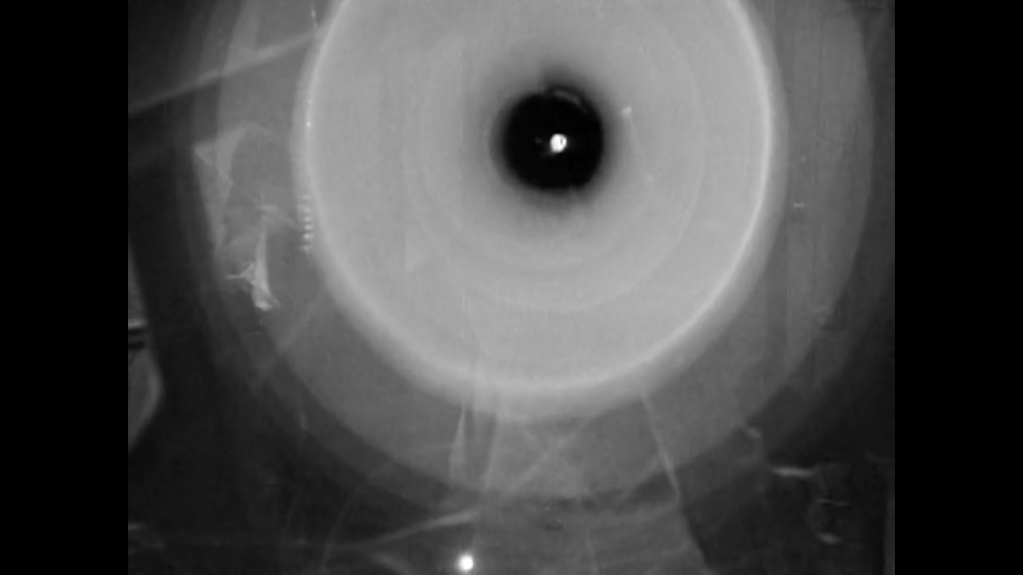
It’s hard to believe that the repeated use of this effect was altogether unintentional.
All the more so because of what follows Roger’s entry into the passageway. His journey through it actually does seem to wind through a very large space. In the opening narration, Vicki had said that the house is made up of 80 rooms, retconning the total of 40 given in the second episode. Roger’s trek up one flight of stairs, down another, up a spiral staircase, around corners, past windows, etc etc, seems like it must take him past enough space for at least that many. Perhaps the sequence would be a bit more attractive with less time spent focused on Roger’s feet, but all in all it is as effective a creation of space as Dark Shadows would ever do. If there had been Daytime Emmy Awards in 1966, Lela Swift would have had every right to expect to win Best Director for conjuring up this illusion of vast, winding corridors without editing or going outside the tiny studio space available to her.
Roger does indeed discover Vicki’s whereabouts. He hears her calling for David from behind a locked door, promising David not to tell anyone he imprisoned her there if he will let her out now. Roger does not simply let Vicki out. Instead, he makes some loud noises, then puts on a ghostly, wavering voice and calls out to Vicki that she is in great danger as long as she stays in Collinwood. He seems to be having trouble keeping a straight face when he makes these spooky sounds. Vicki isn’t laughing, and returning viewers aren’t either- in Friday’s episode, she and we saw the ghost of Bill Malloy in the room, and heard that ghost warn her that she would be killed if she stayed in the house much longer.
Once he’s had his fun, Roger opens the door. After another flashlight halo, Vicki recognizes him. Alexandra Moltke Isles gives us one of the finest moments of acting in the entire series, when Vicki throws her arms around Roger, her bodily movement as smooth as any ballet dancer’s but her voice jagged, and says that “David is a monster, you were right!” Up to this point, Roger has been brutally hostile to his son, Vicki heroically friendly to him. Her determination to befriend David has become so central to her character that hearing her make this declaration makes it seem that she is permanently broken.
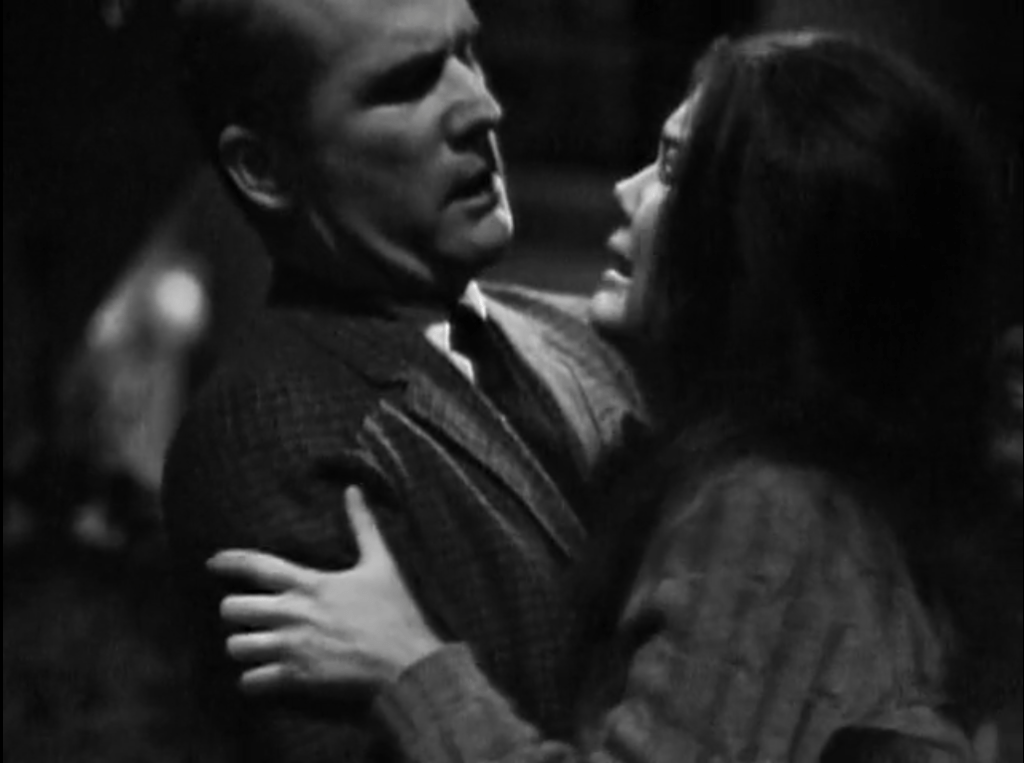
Vicki struggles to hold back her sobbing long enough to tell Roger that she saw the ghost of Bill Malloy. That’s an episode-ending sting- Roger wants everyone to forget about Bill’s death, and if his ghost starts popping up he is unlikely to get that wish.
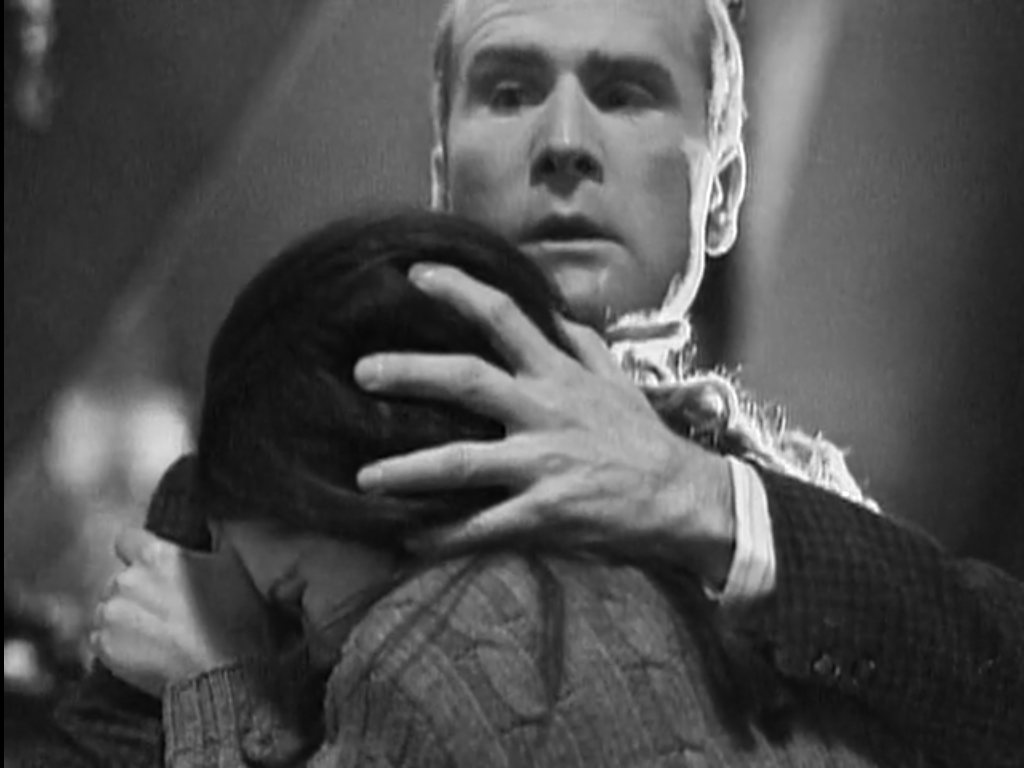
Mrs Isles was a “head actor,” one who found the character’s innermost psychological motivation and worked outward from that. That heavily interiorized style would be one of the things that left her in the dust, along with similar performers like Joel Crothers and Don Briscoe, in the period when Dark Shadows was a hyper-fast paced, wildly zany show about vampires and werewolves and time-travel and God knows what. But in the period when Art Wallace and Francis Swann were writing finely etched character studies, she consistently excelled. In this little turn, she shows that when it was logical for her character to go big, she could go as big as any of the stars of the show in those later days.