Episode 165: It feels like someone was here

Our point of view character is well-meaning governess Vicki. Vicki believes that her charge, strange and troubled boy David, is in danger from his mother, blonde fire witch Laura. Today we see several weaknesses in Vicki’s position against Laura.

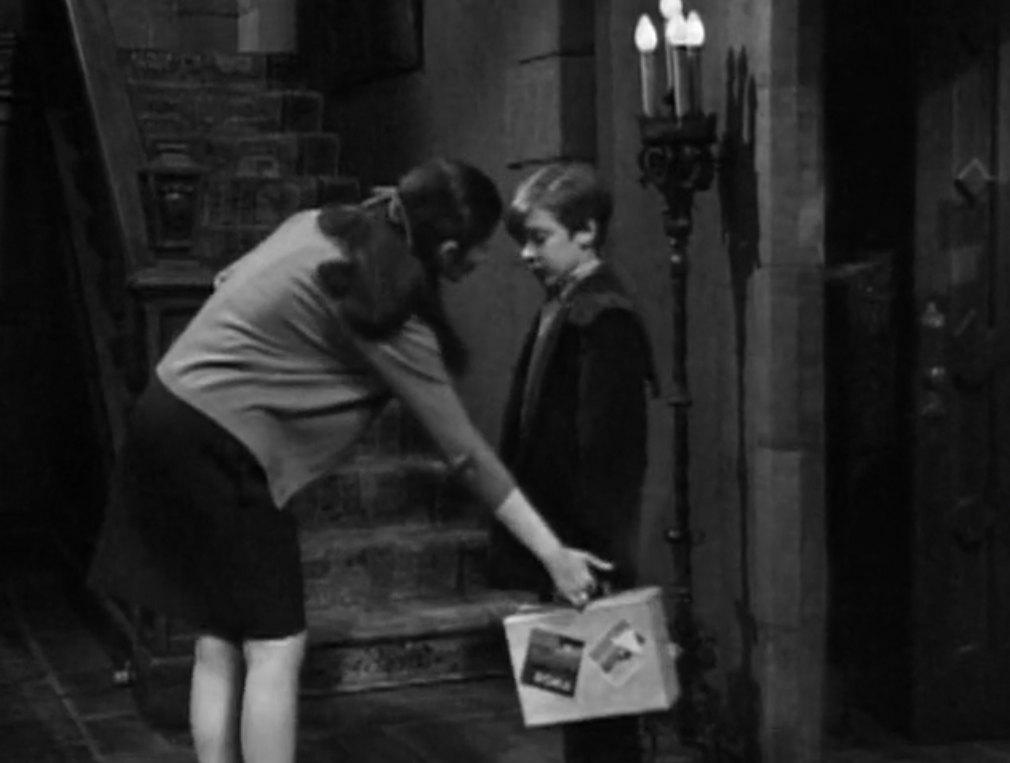
The opening sequence shows that physical force is useless to Vicki. David comes down the stairs in the great house on the estate of Collinwood carrying a small cardboard suitcase. Vicki sees him and asks where he is going. He tells her he is going to the cottage on the estate to spend the night with his mother. Vicki tells him he is not. She grabs at his suitcase.

Vicki grabs for the suitcase

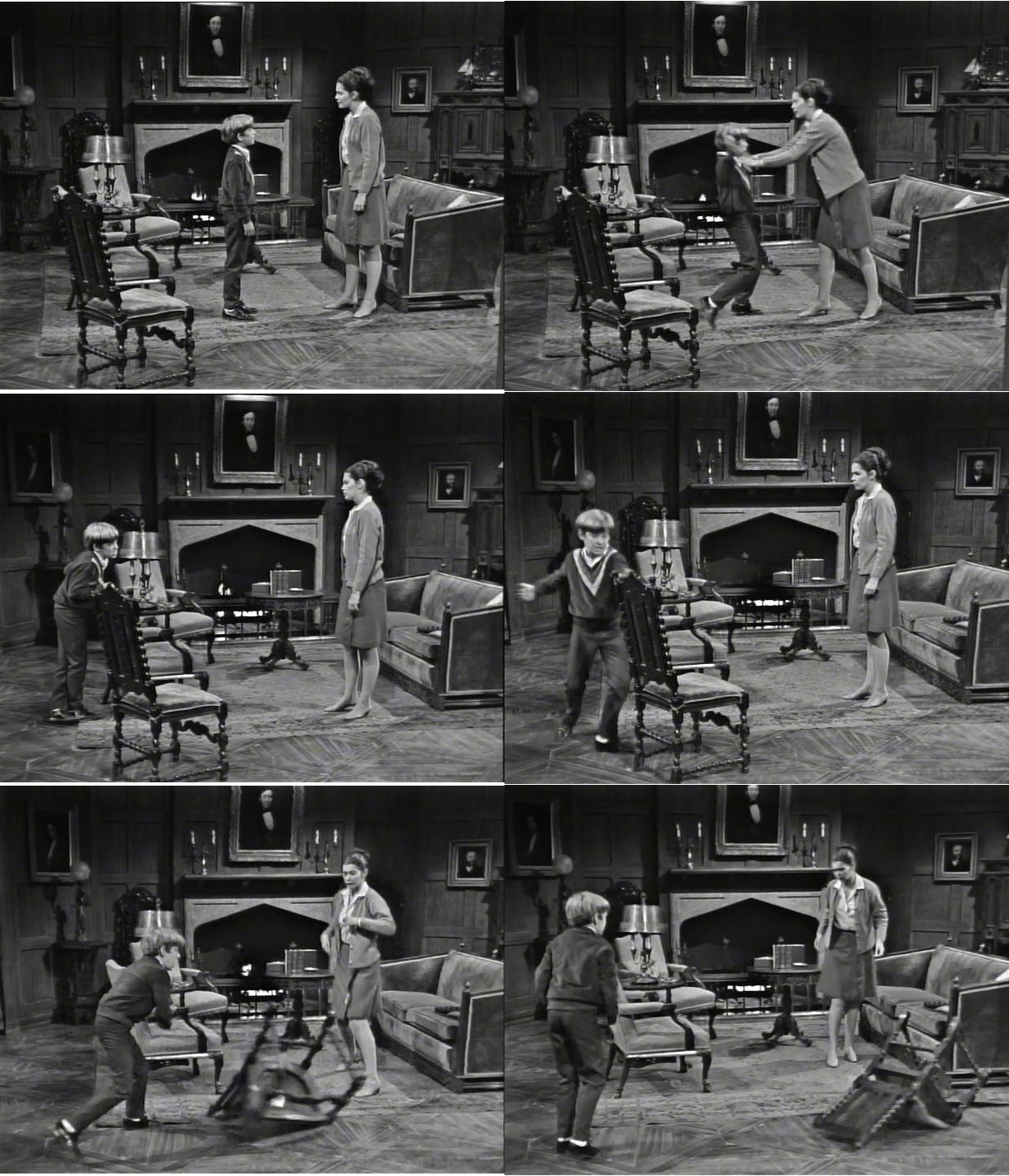
Vicki is not given to clutching at David or his possessions. The last time they had a physical confrontation comparable to this was in #68. In that one, David was throwing a tantrum, and Vicki’s attempt to restrain him only led him to escalate his violent behavior:

From episode 68. Screen capture by Dark Shadows from the Beginning

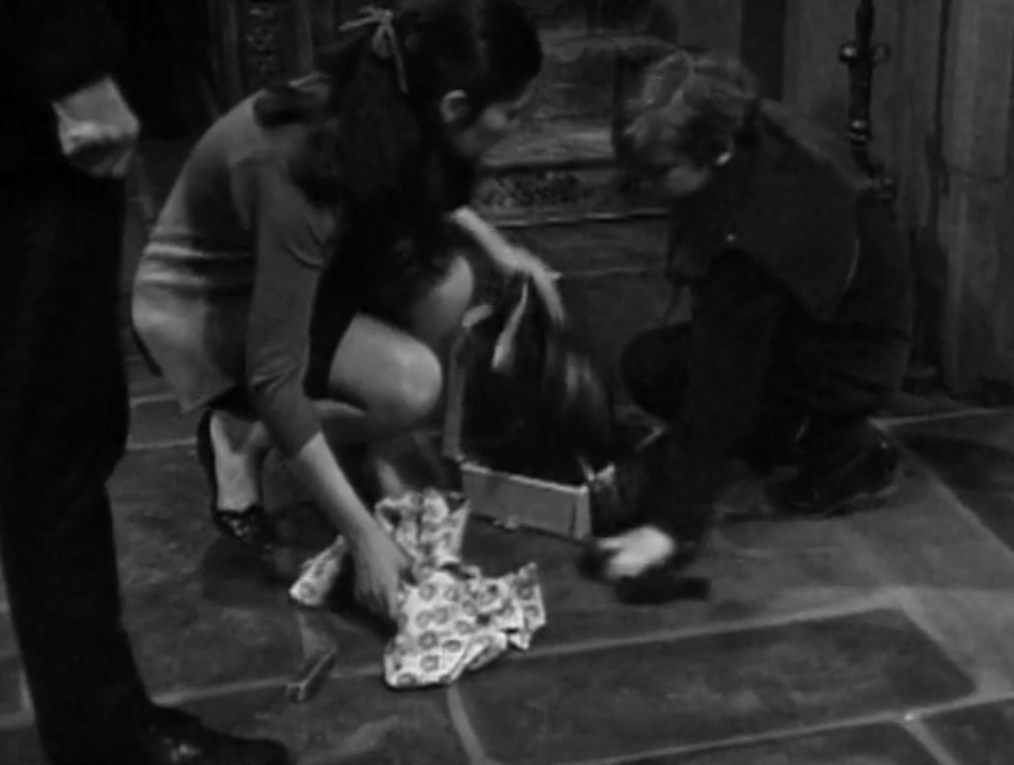
Today, Vicki’s intrusion into David’s personal space backfires just as badly. She inadvertently knocks the suitcase open, dumping his pajamas on the floor. She is shocked to see what she has done:

Vicki sees what she has done

She tries to undo the damage by picking up the contents of the suitcase. That requires her to crouch down before David, destroying whatever authority she may have had over him at the beginning of the encounter:

Kneel before D’vod!

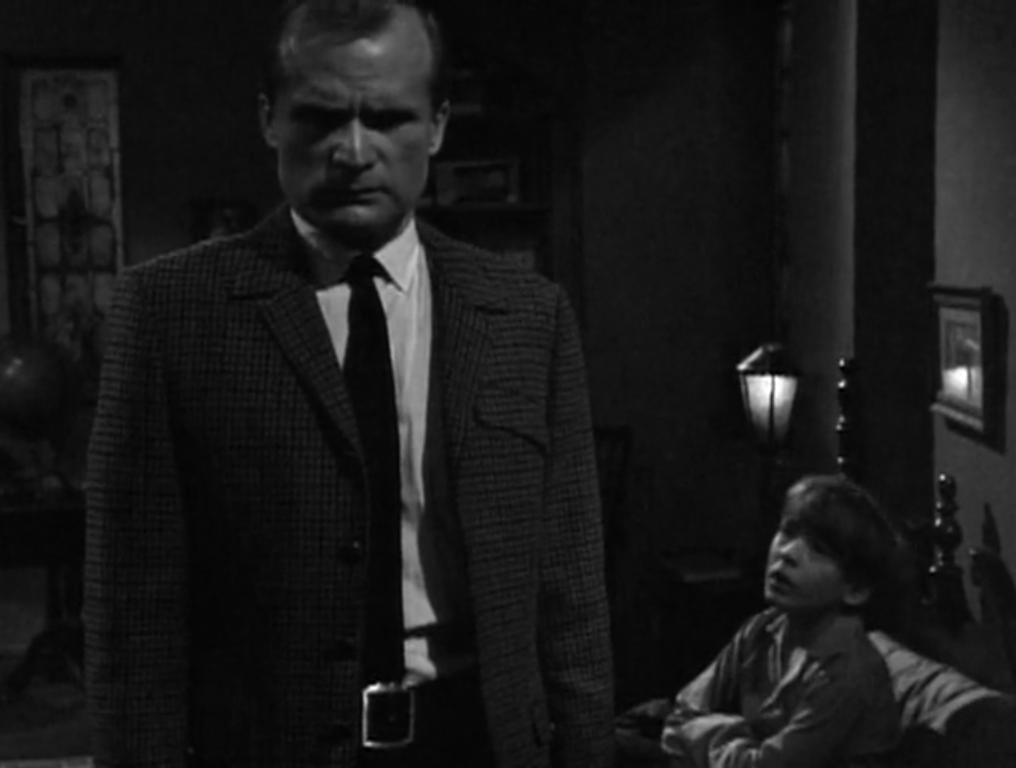
Making matters even worse, David’s father, high-born ne’er-do-well Roger, shows up and stands over Vicki while she and David are on the floor. Roger wants David to go away, and since Laura wants to take him he is working with her. As David’s governess, Vicki has no legal right to oppose the wishes of his parents, and in a conversation that begins with her in this position it is going to be psychologically difficult for her even to voice her objections:

Roger stands over Vicki and David

Vicki does insist Roger meet with her alone in the drawing room while David waits upstairs, and she makes her case valiantly. But that conversation only shows that Roger is as useless to Vicki as is brawn. He ignores every consideration that does not advance his own interest, and his interest now is getting rid of David.

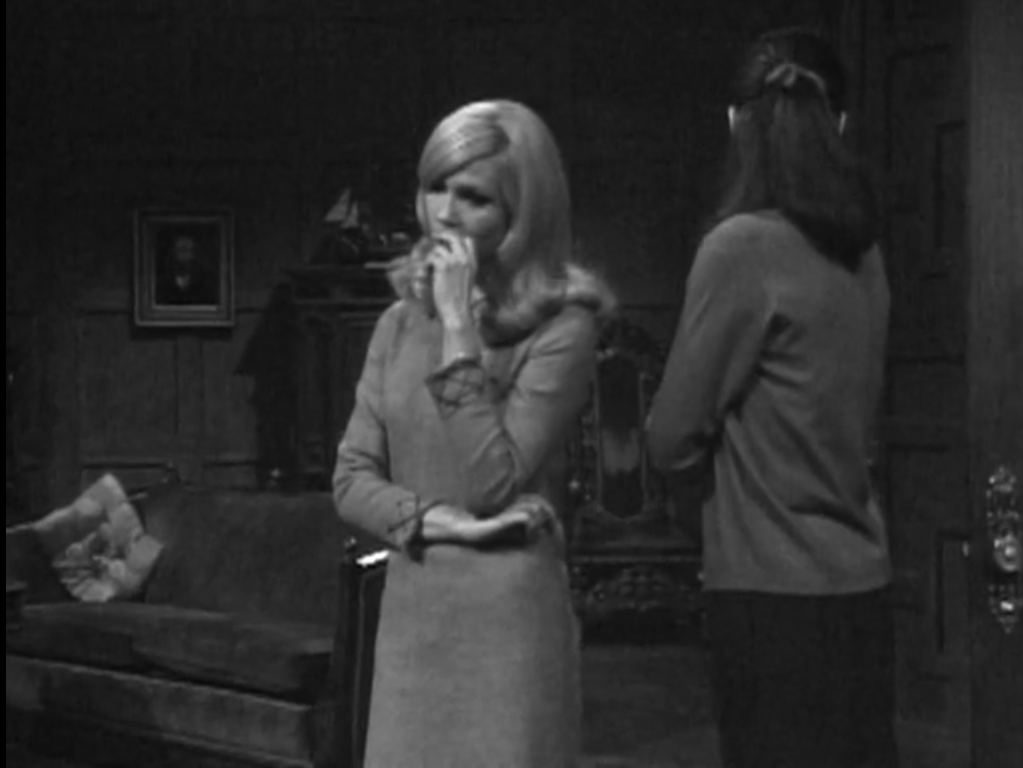
Flighty heiress Carolyn comes into the room and supports Vicki. Roger won’t budge. He gives a long speech about his position as David’s father, a speech which actor Louis Edmonds takes straight off the teleprompter. He delivers it with as much conviction and brio as if he had actually learned it. At the end of his dramatic reading, Nancy Barrett and Alexandra Moltke Isles bite their fingers and Mrs Isles finally turns her back to the camera, so we don’t see either of them laughing.

The finger-biters
Mrs Isles gives up and laughs silently

In Laura’s cottage, David complains to his parents about Vicki’s attempts to keep him from his mother and mentions that his father stood up for him. Roger, rather surprisingly, rises to Vicki’s defense, denying that there was any need for standing up to anyone- he claims that Vicki simply did not realize that he had given David permission to spend the night with Laura, and that they had talked about improving communication to avoid similar confusions in the future. Laura isn’t fooled by Roger’s covering up his conflict with Vicki- she clearly knows that Vicki is her adversary. Nor is the audience encouraged to believe that Roger will support Vicki when it counts. He simply thinks that he has her under control.

When Roger leaves David and Laura alone in the cottage, he says good night. He turns and walks out the door as they watch him. Neither of them says anything. This is the sort of thing that often happens in plays, less often on screen, and almost never in real life. I suppose it’s hard to make the sorts of fumbling exchanges people actually have in those moments fit into a drama, but still, it would have avoided a distracting moment to have Laura and David say good night in reply.

Back in the great house, Vicki talks with Carolyn and visiting parapsychologist Dr Guthrie. They tell Carolyn that Laura was lying when she denied having seen Carolyn’s mother, reclusive matriarch Liz, on the day when Liz was stricken with the mysterious ailment that has sent her to the hospital. Dashing action hero Burke Devlin has told Vicki that Liz came upon him and Laura in Laura’s cottage shortly before Liz’ first attack, and that Liz and Laura were still together when Burke left them.

Carolyn has been madly in love with Burke, unable to think about anything else when she is reminded of him. She does initially react to his name with “You talked to Burke?” in the same dreamy tone of voice she has used hithertofore, but quickly resumes her focus on the business at hand. Her feelings for him have not vanished, but she has matured sufficiently that she can set them aside while she deals with a crisis.

That is not to say that Carolyn is entirely grown-up in her behavior. When she learns that Laura has lied about Liz, Carolyn wants to march down to the cottage at once and confront her with “absolute proof that she is responsible for my mother’s illness.” Vicki points out that Laura’s lie is by no means proof of any such thing, and Guthrie says that he doesn’t want Laura to know how much the three of them know.

Having learned that Vicki and her allies have nothing to hope from either physical force or from Roger, we then discover that they can’t count on the writers either. Carolyn asks why Guthrie wants to hide their knowledge from Laura. The audience knows that they are in conflict with Laura and will have to be careful with any information that might enable them to catch her off-guard at a strategic moment. That Carolyn does not know this makes her sound like an idiot.

Guthrie’s response makes this bad situation worse. He makes the nonsensical claim that they should try to keep Laura from realizing that they are suspicious of her. Carolyn is openly hostile to Laura, Vicki has had to tell Laura repeatedly that she is trying to keep her son from her, and Laura treated Guthrie frankly as an enemy when they met yesterday. Considering that the only thing that has happened so far this week is that Dr Guthrie has been brought up to date with the story, seeing him presented to us as someone unable to hold onto information or process it gives the audience the feeling that we’ve just wasted a whole lot of time.

In the course of this miserable conversation, Guthrie does disclose a fateful plan. He says that he is considering organizing a séance. That marks the first utterance of what will, in the years to come, become perhaps the single most important word in all of Dark Shadows. In this instance, it is obscured by Guthrie’s inexplicable idea that Laura might agree to join them as a participant in their séance.

In the cottage, Laura’s behavior towards David is quite peculiar and seems to unsettle him. He was sitting next to her on the couch she has made up for a bed when she suggested he go get a book and read to her. When he found the book and sat down where it had been, she at once pleaded with him to come back and sit by her again. After expressing his puzzlement, David humors her. She squeezes him while he holds a smile. In an extended closeup, that smile shows several emotions- pleasure and self-satisfaction are in there, but so are confusion, discomfort, and loneliness.

Mixed feelings
Mixed feelings
Mixed feelings

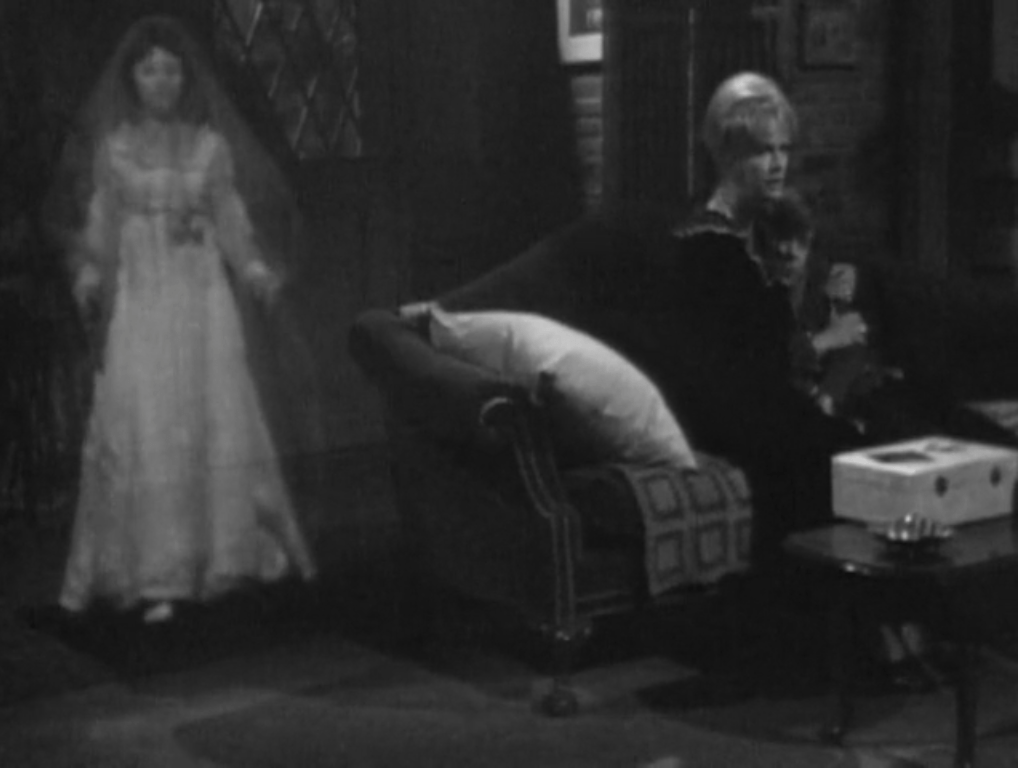
David drifts off, and a visitor comes to the cottage. Laura calls to her before we can see her. “Josette! I know you’re here!” David has a friendly relationship with the ghost of his ancestor, Josette Collins. Apparently Laura is also on a first name basis with Josette. For some time now, the show has emphasized that Josette never appears to more than one person at a time. Though Laura and David are both in the room, Josette manifests:

Manifestation

Laura orders Josette to go away, and she does. After she has gone, David wakes up. He says that “It feels like someone was here.”Laura tells him no one was, and he goes back to sleep.

Laura has her back to Josette, and David is unconscious. So perhaps that’s why she is able to break her usual rule and appear when more than one person is in the room.

Or perhaps there isn’t more than one person in the room. We know that Laura is not quite human, and not exactly alive. In her previous star turn, when she rescued Vicki from the crazed Matthew Morgan in #126, Josette was accompanied by the ghosts of beloved local man Bill Malloy and the Widows of Collinsport. Perhaps we are to conclude that Laura, like them, has erupted into the narrative from the supernatural back-world.

As we opened with a demonstration of the protagonists’ weaknesses, so Josette’s retreat exposes a further weakness. Josette has been established as the mighty supernatural protectress of David, Vicki, and the rest of the household. Yet Josette cannot overpower Laura. If there is to be a happy ending for David, Vicki will have to marshal her forces with care.

Episode 146: Laura Collins exists mostly in your imagination

At the end of yesterday’s episode, Maggie Evans, The Nicest Girl in Town, and her boyfriend, hardworking young fisherman Joe Haskell, had gone out to look for Maggie’s father, drunken artist Sam Evans. Maggie and Joe wound up carrying Sam home from the tavern.

Joe left the Evans cottage, Maggie went to the kitchen to brew up some coffee, and Sam lit a cigarette and passed out. The cigarette fell on some newspapers and started a fire.

While the fire began, the face of blonde fire witch Laura Collins was superimposed on the image of Sam. Some mysterious force has compelled Sam to paint pictures of Laura naked and in flames. Laura objects to these portraits. She came to the Evans cottage the afternoon before the fire and told Sam she would find a way to stop him painting any more of them. Her face appearing over the fire, along with spooky music and everything else the show has told us about Laura, demonstrates that she is casting a spell on Sam with the intention of making good her threat.

Today, Sam regains consciousness and sees the fire. He tries to put it out with his hands, burning them badly. Maggie comes running and beats the flames out with a rug.

The current storyline hinges on the idea that Laura’s supernatural powers make her a deadly threat to her son, strange and troubled boy David Collins, and perhaps to others as well. The outcome of this spell creates suspense as the audience wonders if Laura is mighty enough to keep the narrative arc going. After all, causing Sam to pass out and mess himself does not take much. There’s no suggestion that any magical abilities reside in Bob the bartender, yet he manages to do that just about every night, and he collects a paycheck for it to boot. For all we know, Laura’s spell might have been a total failure- it might be a sheer coincidence that she was trying to make him pass out and drop a lit cigarette when that’s what he was going to do anyway.

Maggie scolds Sam for his drinking. To Maggie’s exasperation, he raves that Laura started the fire. As he goes on and on about an unnamed power that has been controlling his behavior, Maggie responds “I think they call it alcohol.” Yesterday, Maggie was talking to Joe about laying aside her role enabling her father’s alcoholism and leaving the town of Collinsport altogether. Regular viewers will remember that conversation today, when she tells Sam that she is approaching the limit of what she will take from him. Sam loves Maggie more than anything, and he desperately tries to convince her that he is telling the truth. She sees his desperation, and we see her struggle to make herself say that nothing can convince her of a story like the one he is telling her.

As the voice of correction, Maggie is perfectly reasonable, perfectly justified, and perfectly mistaken. Sam is indeed the plaything of uncanny powers. A couple of weeks ago, they gave us scene after scene full of sound and fury, repeating the point that some spiritual force was making Sam paint Laura’s picture. We see today how little of that was necessary- Laura’s likeness and the theremin music are plenty to show us that the fire is in line with a spell she is casting. But Maggie, while she has often said that she wants to avoid the estate of Collinwood because she believes the stories that ghosts and ghouls haunt it, refuses to entertain the idea that there is anything unearthly at the root of Sam’s troubles. She says that she has to have evidence she can look at out in the open, and that she isn’t going to listen to Sam’s talk about unseen and unknowable powers. Although we know that Sam is right and Maggie is wrong about the particulars of this incident, to the extent that Maggie is speaking to her father as an adult child of an alcoholic she is the voice of the audience.

Meanwhile, Laura is sitting by the hearth in the drawing room at the great house of Collinwood. She is casting her spell on Sam. Reclusive matriarch Liz enters and tries to get Laura’s attention. When Laura finally looks up, her face is contorted in an unattractive expression. Liz remarks on it, and Laura asks if she looked ugly. Liz says yes, then for a fraction of a second looks embarrassed when she realizes that she told another woman that she was ugly. She quickly makes some meaningless remarks in a courteous voice. It is a small moment, but Joan Bennett extracts the jewel of comedy from it quite deftly.

Laura interrupted in mid-casting. Screenshot by Dark Shadows Before I Die

Laura has come to Collinwood to re-establish a relationship with David. After years away, she wants to take David and leave. David’s father, high-born ne’er-do-well Roger, is all for this plan, but Liz is determined to thwart it. As the only male of his generation in the family, David represents the sole hope that the name of Collins will continue. As the custodian of the family’s past and future, Liz wants to be the chief maternal presence in David’s life. Besides, she never leaves the estate, so she needs all the company she can get.

Liz tells Laura that, while she had agreed that Laura could take David if their relationship were to make the right sort of progress, she is not at all satisfied that such is happening. Her objections don’t make much sense, and if the audience hadn’t been informed that Laura is an uncanny being whose plans will likely lead to David’s death we would probably be appalled at how unfair she is.

Roger shows up and takes Laura’s side. While the two of them stand firm against Liz’ wispy arguments, a knock comes at the front door. It is Maggie. Laura is shocked to see her- apparently she had expected her spell to do enough damage to the Evans cottage that Maggie would be unable to go visiting tonight. Laura’s reaction is dramatic enough, and the music behind it is overstated enough, that we may think Laura expected to kill Maggie. Again, the indications of Laura’s failure lead us to wonder if she is enough of a witch to deliver the supernatural thriller we have been led to expect.

Maggie wants to tell Laura about Sam’s accident, and to lament that Sam’s obsession with Laura has led him to the idea that she somehow caused it. Roger is indignant that Sam would say such things about his estranged wife, and storms off to the Evans cottage to give Sam a piece of his mind. Liz, on the other hand, is intrigued by Sam’s ideas and wants Maggie to give as many details as possible about Laura’s visit to the cottage earlier that day.

When we were watching the episode, Mrs Acilius wondered if Liz’ interest in Maggie’s story was a sign that she had noticed something eerie about Laura during their previous acquaintance. My interpretation was that Liz is so desperate to find information she can use to present Laura as an unfit mother that she is ready to listen when the town drunk claims she cast a spell on him. As reasonable, justified, and wrong as Maggie was in her scolding of Sam, so unreasonable, unjustified, and right is Liz in her conversation with Laura.

When Maggie says that Laura had threatened to stop Sam painting pictures of her naked and in flames, Liz asks what threat she made. Laura answers that all she said was that she would find a way to stop him. With a look of suspicion on her face, Liz asks what she was planning to do when she said that. “Just what I did do,” Laura answers. After a pause, she specifies, “Turn the matter over to Roger.”

In the Evans cottage, Roger reads the Riot Act to Sam. Louis Edmonds was a master of sarcastic dialogue, and Roger’s lines in this scene give him many chances to shine. Indeed, he and David Ford have a blast playing Roger and Sam’s mutual hatred. When Roger ridicules his claim to be subject to mystic powers, Sam replies in a taunting voice that Roger is in as much trouble as he is. The two men jeer contemptuously at each other, and it is a wonder to behold.

Mrs Acilius was particularly impressed by the contrast between the opening scene with Maggie scolding Sam and the closing scene with Roger railing at him. Sam’s two interlocutors make the same basic point, but the differences between them as individuals and between their respective relationships to Sam tell us entirely different things. Sam hates Roger almost as much as he loves Maggie, and their hostility is as explosive as Sam’s scene with Maggie is poignant. Maggie’s lovable, down-to-earth persona makes her the polar opposite of Roger with his haughty manner, sharp tongue, and utterly debased moral stature. In her scene, Maggie was to an extent the voice of the audience; insofar as Roger is continuing the lesson Maggie began teaching Sam, he is taking over in that capacity. It is quite a different thing for us to relate to The Nicest Girl in Town as our voice than it is for us to see a virtueless snob like Roger in that capacity, and so Roger’s first moments berating Sam in the Evans cottage whip us around fast.

Sam confirms that he has been driven to paint another picture of Laura, and Roger announces that he will destroy it. Sam doesn’t object. When Roger goes over to the painting, he sees that most of it has already been burned away. Sam is shocked to see this- the fire was on the other side of the room, and nothing in the several feet between a burned spot on the carpet and the painting has been touched by the flames. With this, the suspense is resolved- we know that Laura’s fire magic did achieve a result that Sam’s drinking could not. So the show will have a story to tell after all.

The script is credited to Malcolm Marmorstein, who was by far the worst writer on Dark Shadows. It is difficult for me to believe that someone who delivered so many low points wrote a script this good all by himself. Joe Caldwell was making uncredited contributions to the writing by this time, and he was so much better than Marmorstein that I am inclined to suspect that he wrote this one.

I suppose Marmorstein might just have been having a good day. There don’t seem to be any surviving documents identifying those contributors to the writing whose names didn’t appear in the on-screen credits for any given episode, so we can only guess which ones Caldwell worked on in his first several months on the show. But the structure, dialogue, and pacing of this one feel a lot more like the ones with his name on them than they do like the general run of Marmorstein’s work.

Episode 138: You should know about the Grim Reaper

The authorities in Phoenix, Arizona have asked the sheriff in Collinsport, Maine to inform high-born ne’er-do-well Roger Collins that they have identified the charred body of a woman as that of Roger’s wife, mysterious and long-absent Laura. The body was found in what was left of Laura’s apartment in Phoenix after a fire destroyed the building, and the woman was Laura’s age, height, and build. Since Laura was the only person associated with the building whose whereabouts were unknown, the identification of the remains as hers seemed secure to the Arizona authorities.

It seems less so in Collinsport, as Laura is no longer absent. She’s been back in town for days. She has been staying at the Collinsport Inn, where she met several old acquaintances. They recognized each other and engaged in conversation. She has come to the great house of Collinwood, where she talked with Roger and other members of the family, and will be staying in the caretaker’s cottage on the grounds of the estate. Only her son, strange and troubled boy David, has expressed any doubt as to her identity, and no one takes that doubt literally.

If the sheriff knew that he was living in a soap opera, he might suspect that the woman who has come to town is a previously unknown evil twin posing as Laura. If he knew that his particular soap is loaded with supernatural storylines, he might try to figure out what sort of uncanny being she could be. But he seems to be under the impression that he lives in the world. When at one point Roger tells him to “Stop being melodramatic,” it doesn’t occur to him that he has no choice but to be melodramatic. So, all he can do is ask Laura if she knows who the dead woman might have been. When tells him she doesn’t, he leaves.

Roger is eager to divorce Laura and send her away with their son, David. After the sheriff goes, Roger expresses his consternation at the news of the fire. Laura has nowhere to take David. When she tells him that she never planned to take David to that apartment, but that she had “made a commitment to another place,” he is instantly relieved. He does not ask where that other place is. His interest in where Laura or David will be or what they will be doing is exhausted the moment he learns they will be far away from him.

Someone else is visiting Collinwood tonight who wants more from Laura than Roger does. That is Roger’s nemesis and Laura’s ex-boyfriend, dashing action hero Burke Devlin. Flighty heiress Carolyn has gone to get Laura’s bag from the Collinsport Inn and bring it to her aunt. While in town, she met Burke. When she told him of her errand, Burke volunteered to help her carry the bag. Now she and Burke are in the drawing room at Collinwood. They kiss, and he persuades her to let him carry the bag to the cottage. When Carolyn says that she is jealous of his interest in her aunt, he assures her it’s “all business.” She tells him he can’t fool her, to which he replies “Yes I can.”

Burke kisses Carolyn. Screenshot by Dark Shadows Before I Die.

As Carolyn, Nancy Barrett plays, first, excitement as Burke moves in to kiss her; then, a mixture of frustration and confusion, as she begins to suspect that he is only using her to get to Laura. Regular viewers have seen Burke several times after a flirtatious scene with Carolyn, and each time he has switched immediately into hard-driving businessman mode the moment she wasn’t looking. With her performance in this scene, we start to wonder if she is about to catch on that he doesn’t have any feelings for her.

Roger finds Burke and Carolyn in the drawing room. He is furious with Burke for coming to the house, and with Carolyn for inviting him in. He and Burke rage at each other. As Roger, Louis Edmonds does a superb job of simultaneously conveying white-hot rage at Burke and a much colder anger towards his niece. Up to now, Carolyn has responded to her uncle’s prohibitions against seeing Burke flippantly, but this time she seems to accept that she has gone too far. After Burke leaves, she kisses Roger on the cheek and whispers “Goodnight, uncle,” sounding genuinely chastened. Roger is usually a difficult man to take seriously, but Edmonds’ tremendous performance in this scene leaves her with no choice but to give a hushed reaction.

Placing this scene after Roger’s blasé reaction to his wife and Burke’s cynical toying with Carolyn makes the point that Roger and Burke are more excited about each other than either ever is about anyone else. The show embeds their emotions in the “Revenge of Burke Devlin” storyline. Burke is trying to send Roger to prison, and is scheming to enlist Laura in his efforts. Ten years ago, Burke was imprisoned because Roger and Laura testified that he was driving his car, with them as passengers, when he ran down a pedestrian and left him to die. Before the accident, Burke and Laura had been a couple; the day Burke was sentenced, Laura and Roger were married. Now Burke hopes Laura will say that she perjured herself, and that Roger was driving.

Burke’s plans never quite make logical sense. Were Laura to confess to perjury, she would be in as much legal trouble as Roger. Even if she struck a bargain to keep herself out of prison, she would certainly not advance her goal of taking David by alienating Roger and branding herself a criminal. It is difficult to see what incentive Burke imagines that she has to join him.

At the cottage, Laura is sitting by the fire, staring off into space. When Burke knocks on her door, she continues staring. In Laura’s scenes by fireplaces, the spooky music, the slowly panning camera, and Diana Millay’s rigid posture all combine to create the impression that what we see when we look at Laura is only a fragment of a human being.

Laura stares off into space. Screenshot by Dark Shadows Before I Die.

Once Laura lets Burke in, he talks her into closing the door, pushes himself close to her, and insists on telling her about the demands he will be making on her. He wants her to testify against Roger, to restore the years he spent behind bars, and to love him. When she tells him that the things he wants are not in her power to give, he refuses to take no for an answer. Over her objections, he takes her in his arms and forces a kiss on her. As Burke kisses Laura, the door opens and Roger appears with a gun.

Burke kisses Laura. Screenshot by Dark Shadows Before I Die.

Burke’s demand that the past be undone and his attempt to force Laura to feel love for him show the unreality of his ambitions. He claims to represent “Honesty and the Truth,” but everything he clamors for is an empty fantasy. So much so that we wonder if what he really wants might be something quite different from what he keeps saying he wants.

Episode 93: A little wrong about David

Strange and troubled boy David Collins talks with his father, high-born ne’er-do-well Roger, about David’s governess, the well-meaning Vicki. David wants Vicki to stay on. Puzzled by this, Roger lists some of the cruelties David has meted out to Vicki. David explains that he has changed his mind about her since he did those things. Roger asks why. David explains that Vicki has seen the ghost of beloved local man Bill Malloy, and that if she sees the ghost again, it might reveal that Roger murdered Bill. Roger responds to this remark by slapping David across the face. David is shocked, and runs to his aunt, reclusive matriarch Liz, to complain.

Roger is well-established as an abusive parent. He has time and again spoken openly of his hatred for his son, and more than once we have seen him manipulate the rage with which he has filled David so that the boy will do his dirty work for him. This is the first time we’ve seen him engage in physical violence. David’s disbelieving reaction and his assumption that he has the right to complain support the idea that Roger has previously limited himself to psychological abuse.

The actors are such pros that I find it hard to imagine Louis Edmonds really made contact with David Henesy when he swung his hand. But Henesy visibly flinches a second before the slap, as if he expected to be hit. Maybe Edmonds came close enough in dress rehearsal that Henesy couldn’t help being scared.

Roger hits David. Screenshot by Dark Shadows Before I Die

When David runs to Liz, he finds that she is busy trying to reason with her own strange and troubled child, flighty heiress Carolyn. Carolyn is annoyed by David’s interruption, and dismisses his claims about Roger out of hand. Even after Roger proclaims that he did hit David and will do it again if he doesn’t stop babbling about ghosts, Carolyn says that she believes David made the whole thing up. Liz sends Roger, but not Carolyn, out of the room, and talks to David about the incident. Liz walks him back to his room, not saying much as he seethes and says that he wishes his father were dead.

Liz returns to her conversation with Carolyn, trying to talk her out of her obsession with the family’s arch-nemesis, dashing action hero Burke Devlin. Liz understands the fascination- how could she not? Carolyn is a vigorous young woman, and she’s already broken up with the only other attractive man on the show, hardworking young fisherman Joe. So Liz shares some information about how miserable her marriage to Carolyn’s father was, tells her that Joe reminds her of the man she wishes she had married instead, and urges her to try to patch things up with him.

Roger reappears and pouts to his sister Liz. He claims that Vicki is a bad influence on David and demands that Liz fire her. Liz refuses to do so, or to take anything Roger says at all seriously. When he refers to the idea that he might take David and leave her house, she tells him she is sure that her money means more to him than does his son. His response to that is to slam his hand on the piano and to concede her point.

The Liz/ Roger moments today focus on Dark Shadows‘ most characteristic relationship, that between a Bossy Big Sister and her Bratty Little Brother. Liz fails to address Roger’s hitting David for the same reason she fails to address his psychological abuse of the boy- facing either problem would require acknowledging that Roger is a father and that he has the responsibilities of a grown man. Liz is deeply invested in treating him like a naughty little boy whose behavior she will try to correct when the two of them are alone together, but for whom she will always cover when the grownups are around.

Her cutting remark about Roger’s attachment to her money shows the same pattern. When it’s just the two of them, Liz scolds him for living off her. But when there was a prospect he would face consequences for his spendthrift ways, she borrowed against everything she has to pay his way out of trouble.

In a world of Bossy Big Sisters and Bratty Little Brothers, David is adrift. He’s bratty enough, but has no sister. The obvious candidate for a substitute big sister, his cousin Carolyn, makes it clear today she couldn’t be less interested in David. Regular viewers know that Roger and David moved into the house not long before episode 1, that Carolyn didn’t grow up with David, and that she was not happy when he ended her long reign as an only child. Aunt Liz likes David very much, but she has spent too much time protecting Roger from accountability to protect anyone from Roger. Vicki is determined to befriend David, and now that she has seen a ghost there is a chance she will succeed. But she is far too mentally healthy to reenact with him the pattern the Collinses of Collinwood are bred to expect. To accept Vicki’s friendship, David will have to learn an altogether new way of relating to another person. 

Episode 68: Only friend in the world

Well-meaning governess Vicki is determined to befriend her charge, problem child David Collins. In today’s episode, David throws a violent tantrum. Vicki looks genuinely frightened:

David throws a chair in Vicki's direction
Screen capture by Dark Shadows from the Beginning

Meanwhile, David’s father, problem adult Roger Collins, has decided to charm Vicki so as to reduce the likelihood that she will testify against him. Roger walks in on David’s tantrum. After scolding the boy and letting him go, he talks sweetly to Vicki. She tells him that she will do anything she can to understand David. He invites her to a lobster dinner. We see David, who has been eavesdropping on his hated father making friends with his hated governess, looking troubled.

David confronts his father about what he heard. Roger responds with the same charm he showed Vicki, acknowledging that he has been difficult to live with, taking the blame for all of it, and promising to be a new man in the future. He agrees with all of David’s baseless accusations against Vicki, and says that the reason he was being nice to her a few minutes before was to disarm her against David. David says that he wants to frame Vicki for some terrible misdeed that will prompt reclusive matriarch Liz to fire her; Roger replies that he doesn’t want to know what David does about that matter. He asks the boy to consider which he wants more- to be rid of him, or rid of Vicki.

These are outstanding scenes. As Vicki and David, Alexandra Moltke Isles and David Henesy both developed acting styles that built strongly on eye contact. Those styles mesh perfectly and produce an electric effect. As Roger, Louis Edmonds does everything well, but is peerless as a charming sophisticate. When Roger’s scene with Vicki begins, we don’t know that he has any especially sinister plans for her, so that scene plays as a pleasant interlude. We do know that Roger loathes David, so when we see him turning on the charm with his son, and especially when we see him agreeing with all sorts of statements from David that he knows to be false, the effect is alarming. By the time he is instructing David to keep him out of the loop when he acts against Vicki, Roger takes on a Satanic quality. His cold way of asking David his final question demonstrates that he knows David hates him and is unmoved by the fact. It’s heartbreaking to see David Henesy’s little face and imagine him as a child whose father shows that ultimate disregard for him, one of the bleakest endings of any episode in the entire series.

Episode 65: I think I’m having tea

Last Friday, the sheriff called the home of drunken artist Sam Evans. He warned Sam that dashing action hero Burke Devlin might be coming to his house, and urged him to call back if he did. Burke did go to Sam’s house, but Sam didn’t call the sheriff. After a brief confrontation with Burke, Sam ran away and left Burke alone with his daughter Maggie and their house-guest, well-meaning governess Vicki.

Yesterday, the sheriff called reclusive matriarch Liz at her home, the great house of Collinwood. He warned Liz that Burke might be coming to her house, and urged her to call back if he did so. Burke showed up at the house at the end of the episode.

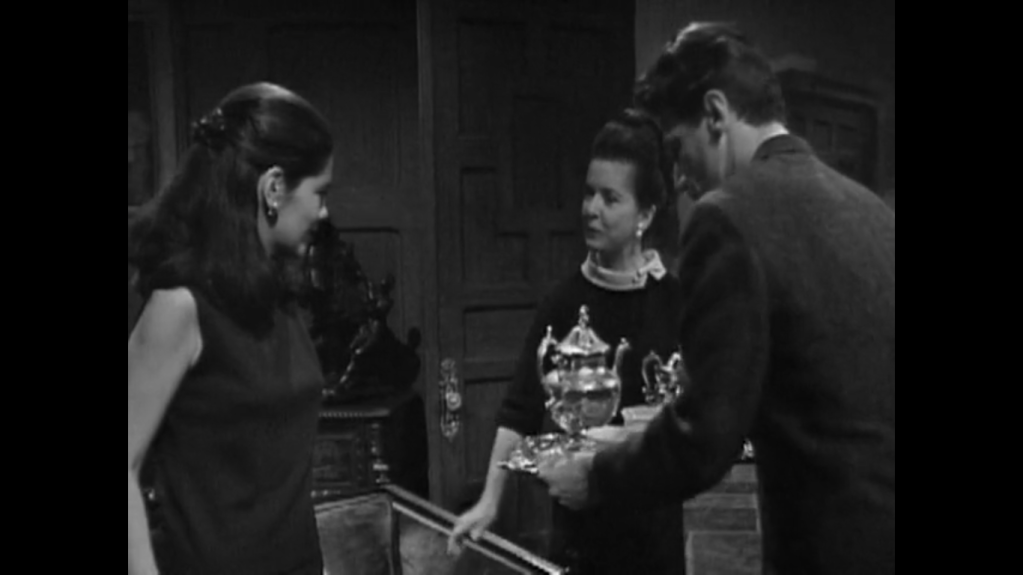
Liz doesn’t call the sheriff either. After Burke refuses her commands to get out of her house, she decides to confuse him with a display of hospitality. It turns out to be quite an effective tactic. When Vicki walks in and asks Burke what he’s doing at Collinwood, he replies in bewilderment “I think I’m having tea.”

Burke takes the tea tray from Liz

Burke had gone to Collinwood looking for Liz’ brother, ne’er-do-well Roger. Roger is with Sam at the tavern in town. Yesterday we heard some new music at the tavern, a funky tune that sounds like it was cut from a Booker T and the MGs album. It played then as grizzled caretaker Matthew sat by himself waiting for Burke to come in so he could threaten him. It was so obviously not something Matthew would listen to that it served to emphasize his isolation. It plays again today as Roger and Sam reach the end of a strange conversation, with Roger first refusing Sam’s offer to leave town for money, then Sam refusing Roger’s offer to give him money to leave town. As Roger and Sam, Louis Edmonds and David Ford have so much fun with this exchange that it feels like an Abbott and Costello routine. The music is different enough from what we’ve heard on the show so far that it highlights Roger and Sam’s silliness.

I should also mention that in the opening voiceover, Vicki says the phrase “Dark Shadows.” This is the second time we’ve heard a character say the title of the series. The first was in episode 46, when Roger had said that a drawing by his son, problem child David, had captured “Collinwood, with all its dark shadows.”

Episode 59: He sort of talked me out of it

Yet another G. G. E.- Genuinely Good Episode. There have been several of those this week.

The sheriff is in the big dark house on the estate of Collinwood, questioning high-born ne’er-do-well Roger about the mysterious death of plant manager Bill Malloy. Roger’s sister, reclusive matriarch Liz, joins them. They deny knowing anything, including things we’ve seen them find out in previous episodes. Much of the conversation is to do with drunken artist Sam Evans and the idea that Sam might be keeping a secret.

Roger’s son, nine year old problem child David, is all smiles when he drops in on his well-meaning governess Vicki. Convinced that she can befriend David, Vicki responds instantly to his smile. She asks why he’s so chipper. He says that it’s because he will never see his father again. The sheriff has come to arrest him for murder.

Vicki asks him if the sheriff said that he was going to arrest Roger, and David admits that he did not. But David is sure that he will. He is sure he is guilty. He lists the three sources of information he has that confirm for him that his father killed Bill- the ghosts of the Widows told him, he saw it in his crystal ball, and he used a tide table to calculate the spot at which Bill fell in the water. When Vicki insists that he doesn’t know what he’s talking about, he says she’s just refusing to face facts because she’s afraid his father will kill her, too. By the end of what had begun with the sound of a very cozy conversation, David tells Vicki that he might not be unhappy if his father does murder her.

Vicki keeps her eyes on David throughout this conversation, listens carefully even when he keeps talking after she’s told him to stop, and looks thoughtful after he leaves the room. As Vicki and David, Alexandra Moltke Isles and David Henesy play a wide enough range of emotions in this scene that we, in spite of the dialogue, can see why Vicki is still sure she and David will someday be friends.

Vicki trying to think of a way to reach David

David goes downstairs in time to see the sheriff leaving. He asks him if he’s arresting his father. The sheriff says he’d thought about it, but that Roger talked him out of it. That’s a pretty weird thing for a policeman to tell a boy, but Dana Elcar, as the sheriff, is such an engaging presence that we can accept it, somehow. I think it’s because he makes a show of choosing his words carefully and plays the scene with an eye on Roger, so that we can regard his strange words as a tactic to unsettle his suspect.

David gives the sheriff the book of maps and tide tables, open to the page where he marked the spot at which he believes Bill went into the water. The sheriff thanks David and tells him to keep up the detective work. David and Roger stare daggers at each other. In this staring match, David Henesy and Louis Edmonds, as Roger, do such a compelling job of embodying filial hate that the audience can respond in only one of two ways- either it will send a chill down your spine, or you’ll laugh out loud. This time we laughed, because we’ve seen so much of the show we feel we know the actors and know that they had great fun with scenes like this. I think we were chilled the first time through, though.

David and Roger stare at each other
Staring contest

After the sheriff leaves, Liz tells Roger that she has now lied to the sheriff for him, and demands that he tell her the truth. Roger says that he, not dashing action hero Burke Devlin, was responsible for a killing ten years ago, that his testimony at the trial that sent Burke to prison was a lie, and that he murdered Bill because he was afraid Bill would expose that lie. Liz trembles, sits down, says “It can’t be true,” then Roger bursts out that of course it can’t be true, not one word of it is true. Having heard the story out loud, Liz is happy to disbelieve it.

David listened to this conversation through the keyhole. When Vicki catches him listening, David declares that he had heard his father admit his crimes. He heard the denial as well, but that did not make the impression on him that it made on his aunt. He is as highly motivated to accept the confession as Liz is to reject it.

After David is sent to his room, Liz and Roger ask Vicki what he told her he heard. Vicki says it was nothing- “His imagination.” She is on her way into town to have dinner with friends. Liz asks who those friends are. Vicki tells her they are Maggie Evans and Maggie’s father.

Vicki leaves, and Liz asks Roger if Maggie Evans’ father is Sam Evans. Yes, says Roger. Why does that bother you, asks Liz. Roger denies that it bothers him, and stomps away up the stairs. Liz looks thoughtful, much as Vicki had looked thoughtful when David talked about her as a potential murder victim and walked out of her room.

Liz wonders about Roger

Denial, the psychological defense mechanism, presents a rich challenge to an actor. Liz cannot allow herself to believe that Roger is guilty of the crimes that have been discussed in this episode, and so she gladly accepts his declaration that “not one ugly word” of his confession to her was true. Yet Liz is an intelligent woman, and she knows her brother extremely well. She certainly knows him well enough to know that he is a scoundrel through and through, and it is obvious he has a great deal to hide in connection with these events. So as Liz, Joan Bennett has to play a person who simultaneously rejects an idea and accepts it. That’s a challenge to which she rises brilliantly.

The comparison between Vicki’s pensive moment after David leaves her room and Liz’ pensive moment after Roger leaves the foyer highlights the similarities between Roger and David. Those similarities are prominent this week. In yesterday’s episode, David was cool as a cucumber while others stormed and raged. Today, Roger plays it cool while confessing to a list of serious crimes, some of which he actually committed, and then exposes that list as a tactic to force Liz to deny his guilt. When David is in Vicki’s room, Vicki compares him to his father, to which David replies that he never killed anyone. If she were less concerned with winning David’s friendship, Vicki could have told him it wasn’t for lack of trying- he did tamper with the brakes on his father’s car and cause him a serious wreck, after all.

We can only assume that Roger has always been like this, that he once was what David is, and that unless something changes David will someday be what Roger is. Vicki’s pensiveness is all about the future, about the difference she might be able to make for David. Liz’ reaches into the past, back to all the times she, as Roger’s bossy big sister, tried to keep her bratty little brother out of trouble, and to cover up for him when he slipped beyond her influence. Whatever approach Vicki comes up with in her quest for David’s friendship, then, will have to be different from the approach Liz took to Roger throughout their early days.

Episode 50: He wasn’t there again today

This one is so good that I can’t resist going over it scene by scene. It has a wide variety of mood and image, tautly structured in a clearly told story, subtly realized by highly accomplished acting, and memorably presented in superb photography and imaginative sound design.

Well-meaning governess Vicki, out for a night-time stroll, makes her way to the crest of Widow’s Hill, where flighty heiress Carolyn stands looking down at the ocean swirling a hundred feet below. “Advance and be recognized! Friend or foe?” Carolyn challenges. Seeing Vicki, she remarks “Even the tutors are out tonight.”

Despite her whimsical greeting, Carolyn is in a low mood. She’s wondering at her own inability to take hardworking young fisherman Joe Haskell’s desire to marry her seriously. She tries to interest Vicki in some of the ghost stories that surround the great estate of Collinwood, while the wind whips around the hill making the eerie sound known as “The Widows’ Wail.” Vicki stoutly insists on reducing all of Carolyn’s tales to psychology and asking her about her feelings. You can really see Nancy Barrett’s Carolyn trying to maintain a light tone despite her gloom, and in Alexandra Moltke Isles’ Vicki you can just as easily see a determination to cut through the nonsense and stick to what’s real, a determination fueled partly by her empathy for Carolyn and partly by her reflexive rejection of the weirdness of her new home in the old dark house.

In the house, troubled rich boy David Collins is complaining to his aunt Liz that the ghosts won’t let him sleep. Liz tells him to turn the lights on and chase them away. Unsatisfied by that response, David persists. Liz tells him that she has no time for him now and sends him to his room. Ten year old David Henesy trades these well-written lines with veteran movie star Joan Bennett as her professional equal. David Collins continually does nasty things to characters we like, refuses to take responsibility for any of his wrong-doing, and becomes violently surly when interrupted in his endless bouts of self-pity. He ought by rights to be a difficult character to take. But David Henesy finds something lovable in him, and brings that out clearly enough that he’s always a welcome presence on screen.

Vicki and Carolyn come to the house. Liz is disappointed they aren’t her ne’er-do-well brother Roger. Liz had ordered Roger to leave his desk at her company and come home early in the afternoon. She has questions about the disappearance of plant manager Bill Malloy, and about Roger’s lie that he hadn’t seen Malloy the night before. It’s well after 10 PM now, and no one has seen or heard from Roger since Liz called him.

Carolyn and Vicki have tea and try to take Liz’ mind off her worries, but without success. Liz scolds Carolyn for bringing up the ghost stories at a time when everyone is worried about Bill Malloy, but she can’t long keep herself from drifting off into the tale of the two women who died falling off the cliff, and the third who will someday follow them. That drifting, as Joan Bennett plays it, speaks volumes about Liz’ state of mind. She’s agitated about Bill Malloy, about Roger, about the possible connection between their two absences. That agitation gives way to hopelessness.

Roger comes home. Liz greets him with a demand for explanations. He responds with perfect insouciance, informing his sister, in whose house he lives as a guest and from whose business he draws a salary on her sufferance, that he is going to the kitchen to make a sandwich. Louis Edmonds’ delivery of Roger’s lines is brilliantly funny- we laughed out loud.

Liz most definitely does not see the humor. She has a brief scene by herself after he goes off to prepare his snack. All she does is watch him leave the foyer, turn, walk a few steps to the drawing room, and take a seat. With no dialogue and no mugging for the camera, she shows anger, disbelief, exasperation, and despair. It is a wonderfully economical performance, quite as extraordinary as is Edmonds’ comic turn preceding it.

In Vicki’s room, we see the word “death” scrawled on her mirror in all caps. Vicki enters, dragging David behind her. She demands to know who wrote it. He insists that the ghosts of the Widows did it. Vicki remarks that it is surprising that the Widows have the same handwriting as David. Carolyn enters, sees the word, and scolds David. Vicki silences Carolyn with a glance and asserts control of the situation. Only when Vicki threatens to tell Liz about the word does David erase it, though he still insists it was the Widows who wrote it, not him.

After David has left the room, Carolyn tells Vicki how horrid David is. Vicki perks up and makes a series of jokes about the Widows. She’s in such a chipper mood as soon as David is out of earshot that she must have been putting on an act presenting herself to him as angry. Much to Carolyn’s mystification, Vicki likes David and is confident that sooner or later she will make friends with him.

At another point in the series, this scene might have been padded out to fill a whole episode. Today, Art Wallace writes a quick and forceful interlude, showing us everything we need to know about what the three characters in it are like and where they stand in their relationships to each other, shedding some light on the idea of the ghosts of the Widows, then moving on to the next story point. The writing is as economical as the acting, and as absorbing.

Liz and Roger have a confrontation in the drawing room. Liz asks why Roger didn’t come home when she told him to. He tells her that he went to Bill Malloy’s cousins’ house to see if Bill had been there, and that he simply forgot to tell her he would be making the trip. This response is so unsatisfactory that it seems to double the anger with which Liz puts her next question- why did he lie to her when he denied having seen Bill Malloy last night? Roger tries to weasel out of answering that question, and does manage to get Liz to give him some information he can use to craft more plausible lies, but does not get himself off the hook.

The relationship between Liz and Roger is the first of Dark Shadows’ several relationships between a Bossy Big Sister and a Bratty Little Brother. In Liz and Roger’s case, they are literally older sister and younger brother; the most important such relationship will be a figurative one, between Julia and Barnabas. But it’s Liz and Roger who set the pattern. Roger’s impossible behavior in this scene is certainly among the finest examples of brattiness among all the little brothers, and Liz shows with crystal clarity the limitations of the power of the Bossy Big Sister when confronted with a truly horrid Bratty Little Brother.

Carolyn and Vicki come downstairs. They are going back to the crest of the hill to look for Carolyn’s wristwatch. Once they’ve left, Liz meets David at the top of the stairs. She tells David that they are looking for a wristwatch. “That’s not what they’ll find- they’ll find death” replies the boy. Last episode, David received the gift of a crystal ball; that marked the beginning of his career as a clairvoyant.

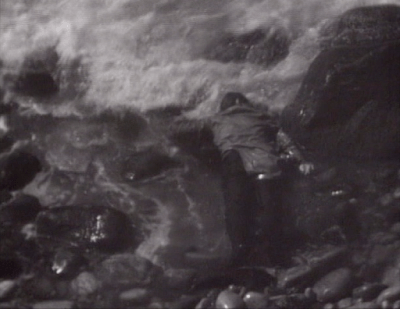
No sooner has the seer made his prediction than we hear Vicki screaming. Looking down from the cliff, she and Carolyn see a figure on the beach- a man face-down in the water. We hear the tide and the wind, sounds of nature on a large scale, and the immobile figure seems to represent something vast and inevitable.

Face down in the water, wearing an overcoat, with a flask in his back pocket
Screenshot by Dark Shadows Before I Die

Episode 46: Collinwood, with all its dark shadows

Bill Malloy’s investigation into the manslaughter case that sent Burke Devlin to prison ten years ago is coming to a head. Bill tells Burke, Sam Evans and Roger Collins to meet him to discuss the case in Roger’s office at 11 PM. When Bill leaves the Evans cottage, Sam mutters something about stopping him and looks directly into the camera.

Sam looks directly into the camera

Roger is no happier at the idea of the meeting. Louis Edmonds’ performance ever so subtly hints at Roger’s reluctance to attend:

Roger contemplating unwelcome news
Screenshot by Dark Shadows Before I Die

Roger gives a speech to Vicki about how David is better off than he was at nine, since he already knows that the world is a horrible place. The speech is vague, rambling, and high-flown. That’s suitable for the occasion, since Vicki isn’t supposed to know what the hell he’s talking about, but Louis Edmonds struggles with it. In a future period such speeches will become a hallmark of the show. Malcolm Marmorstein is credited as the writer of 82 episodes in all, from 115 (broadcast 2 December 1966) to 309 (broadcast 31 August 1967,) and often as not speeches just like that crop up in them. Marmorstein’s flowery gibberish will defeat actor after actor, until Jonathan Frid joins the cast as Barnabas Collins. In Frid’s voice, the speeches sound so gorgeous you barely notice that they don’t make a lick of sense. After a while, Marmorstein stops giving them to other actors, and they become the way Barnabas talks. I wonder if Marmorstein did some uncredited work on this episode. Art Wallace, sole credited writer of episodes 1-40, is listed on screen again as the author of this teleplay, but at many points it sounds more like Marmorstein than it does like Wallace.

This one also has a key moment in one of the aspects of the show that most saddens me, the decline and fall of Vicki. In the drawing room, Roger is in a panic about Bill’s investigation. Vicki sees this and asks if the investigation has something to do with her quest to learn her origins. Roger laughs in her face. Of course it doesn’t have anything to do with that story-line- nothing happening on the show does. As long as she’s chained to that rotting corpse of a narrative element, Vicki is going to be of limited relevance.

Episode 41: Working day

Three people expressed surprise in episode 40 that Roger Collins wasn’t at his office. He still isn’t there today, and three more people are surprised. He finally decides to go in when Liz presents him with the alternative of looking for Carolyn.

Bill Malloy isn’t at work either, hasn’t been all day. He and Roger have been taking turns inviting themselves into Sam Evans’ house. Sam is also not working, and in fact takes time out of his busy schedule of downing one glass of whiskey after another to destroy the only thing we’ve seen him make as part of a paying job, a sketch of Burke. Maggie pieces the sketch back together- she’s also at home when she’s supposed to be working.

Telephones are unusually dynamic in this episode. Typically we see only one end of a phone call on Dark Shadows. This time, we cut back and forth between both ends of three telephone conversations this time. In the teaser Roger is browbeating Sam; Sam sets the phone down and walks off. While he gets another drink, the receiver is in the foreground and we hear Roger’s voice at the same volume as we did when Sam was listening. Sam comes back, returns the receiver to its cradle, and goes to sit down while it rings.

The bit when we see the phone and hear Roger’s voice, though Sam isn’t looking at the phone and can’t hear it, establishes the telephone as a character with its own relationship to the audience, independent of anyone who may or may not be paying attention to it. It’s a neat moment:

Screenshot by Dark Shadows Before I Die

Liz calls the office and talks to Joe. Joe tells her Bill hasn’t been in all day. The stress in his voice, the papers piled on his desk, and the tight grip he has on the telephone receiver all make it credible that he’s the only person in town who showed up for work today:

Screenshot by Dark Shadows Before I Die

Liz mainly wants to talk to Joe about Carolyn. Joe tells her he hasn’t talked to Carolyn in some time, and that he has no idea what if anything she is thinking about their relationship. While he breaks this news to Liz, we see him continue working, then cut back to the look of distress on Liz’ face.

Maggie calls Collinwood. Vicki answers and is excited to talk to Maggie. I guess the show is telling us they’re friends now. Maggie asks to talk to Roger. Vicki says Roger is probably in the office at this time of day, Maggie somehow knows he isn’t, Vicki remarks that he isn’t in the habit of confiding in her. Roger overhears this and asks “Is there any reason why I should confide in you?” When Vicki holds the receiver out to him and says Maggie Evans is on the line, he takes it and hangs up without so much as putting the receiver to his ear. Vicki and Roger then have one of their little quarrels.

That’s the only thing Vicki does in the episode. Her character is heading into a danger zone. Through the first eight weeks, she was on all the time. She was our representative, the outsider who knew nothing about the other characters or the town they live in, and to whom everything had to be explained. Now she knows as much about the rest of the characters as they know about each other, and we know as much as we want to learn by hearing explanations.

The major characters all have their secrets, but the only two who know each other’s secret are Roger and Sam. Vicki isn’t any likelier than anyone else to uncover that one. She has no secrets of her own, and her original story-line- her quest to discover her origins- is dead in the water. What’s more, Vicki is no good at lying. Soap operas are mostly conversation, and the big events on them are lies and the exposure of lies. The only time Vicki has tried to lie to anyone- in episode 13, when she told Matthew that Liz knew she was in his cottage- she was immediately found out, with disastrous consequences. If she’s going to stay relevant to the show, something is going to have to change, and fast. It’s fun to watch Alexandra Moltke Isles bicker with Louis Edmonds, but the characters they play need something meatier to bicker about.

This is the first episode credited to writer Francis Swann, indeed the first episode credited to anyone other than Art Wallace. Swann’s teleplay finds humor in the idea that so many people have taken the day off. Each time another character remarks on a case of absenteeism it gets that much closer to raising a chuckle. And Roger’s line that looking for Carolyn would require him to “neglect my vital tasks at the office… Dear me, no” is genuinely funny, especially as Louis Edmonds delivers it. The telephone scenes are also an innovation, and promise a new source of visual activity. Those favorable omens are offset by Vicki’s scene and its suggestion that her character is about to be allowed to wither on the vine.

A couple of the blogs I read when I prepare my comments made remarks about this episode with which I disagree. John Scoleri of Dark Shadows Before I Die says this of the quarrel between Sam and Maggie:

I know Sam gets frustrated with Maggie, but I’m beginning to wonder about their relationship. If he’s that close to hitting Maggie when he gets drunk, there’s no way I’m believing he hasn’t done that before.

To which I replied:

It doesn’t look to me like Sam has hit Maggie. She’s inches from his face when he is at his angriest, yet she doesn’t flinch, doesn’t slump down, doesn’t show any sign of withdrawal or fear or anger or panic or sullenness or bewilderment or any other possible response to physical abuse.

Patrick McCray said this:

There hasn’t been much happening on DARK SHADOWS in the last few weeks, but that doesn’t mean the show hasn’t been moving forward. There’s been a growing sense of doom throughout the show, and it’s obvious that someone is going to die. In this episode Sam rips up his portrait sketch of Burke Devlin, he and Roger lob threats at each other, Liz begins to draw Joe’s attention to his girlfriend’s romantic intentions on the family rival, and Victoria has been pushed around by just about everyone in the cast. In theory, any one of them is eligible for a ride in the bone wagon, but the show has been implying that Devlin is headed for a fall. It’s interesting that the show decides to go in another direction: I don’t know when Bill Malloy checks in at Eagle Hill Cemetery, but it’s probably sooner rather than later.

While it is true that “in theory, any one of them is eligible for a ride in the bone wagon,” I do think there’s a clear front-runner to be the first Dark Shadows character to be killed. It’s Sam who is obsessed with the fear of death, Sam whom Roger has threatened, Sam who left a mysterious sealed envelope to be opened in the event “something happens.” And, from an out-of-universe perspective, it’s Sam who has a daughter played by an appealing actress who needs a story-line. Maggie seeking revenge for the killing of her father would be just the plot to elevate Kathryn Leigh Scott from the bottom of the second string to the starting lineup where she so obviously belongs.

No other character has anyone so well-positioned to play avenger if they’re killed. The only keen attachment Bill Malloy has shown is his devotion to Liz, and in her scene with Matthew in episode 38 Liz demonstrated that she sees devotion from people outside the family as a tool to use when time comes to protect the good name of those inside it. So if she suspects Roger killed Bill, she won’t become Bill’s avenger- if she could order Matthew to throw away his own good name to cover up the truth about David, we can hardly expect her to expose Roger to redress Bill’s grievance against him. Indeed, when Bill is murdered, they will introduce an entirely new character to seek revenge for him.

Vicki is an orphan, who tells us in today’s opening narration that before she arrived at Collinwood she had never known a home. No one is likely to avenge her, and besides, she still does the opening narration for every episode- she’s supposed to be important, even if the writers can’t quite figure out what to do with her. Burke is supposed to be rich and powerful. Presumably he has friends, but we haven’t seen any of them. Joe is Mr Nice Guy and he’s mentioned a friend or two, but again, we haven’t seen them. The series story bible calls for Roger to die when Burke finally gets his revenge, but every time Louis Edmonds’ performance is the most interesting thing in an episode it becomes so much the less likely that they will ever get around to playing that scene. So the smart money, at this point, would be on Sam to be the victim in the first Dark Shadows murder. So much so, indeed, that it might not be surprising enough if it does happen- they may think they have to kill someone else to keep the audience engaged.