Episode 446: You have given me nothing I can understand

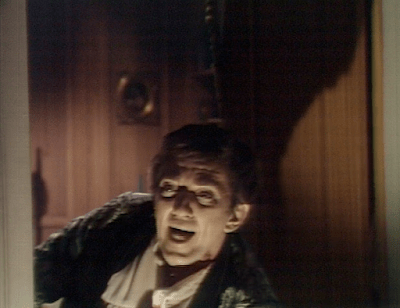
Haughty tyrant Joshua Collins goes to the basement of the Old House on his estate and finds his son Barnabas rising from a coffin. Barnabas explains to his father that he has become a vampire.

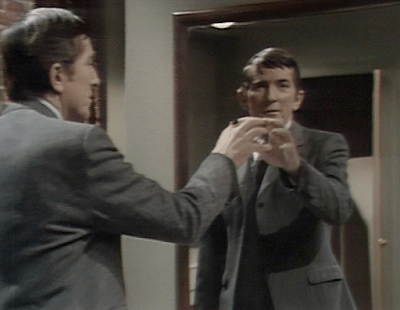
Joshua and Barnabas in the coffin room. Screenshot by Dark Shadows Before I Die.

This scene prompts considerable discussion in fandom about gay subtext. In his post about the episode on Dark Shadows Every Day, Danny Horn points out that actors Jonathan Frid and Louis Edmonds were both gay, and speculates that this fact might have had some influence on the way they play Barnabas’ coming out to his father. “I’m not suggesting that this situation is intended to be a metaphor for a gay child talking to his father about his terrible, shameful secret life… But the ‘keep the secret, don’t tell my mother’ part — there’s some resonance, isn’t there? At least, it’s a hook into the story that helps us to get closer, and really feel some of the horror of this moment. A father hands a gun to his son, and says, Kill yourself, so that your mother never finds out.”

Even this tentative raising of the question, with its “I’m not suggesting” and “some resonance” and “at least,” is too much for Patrick McCray. In his Dark Shadows Daybook post about #446, he concedes that “homosexuality is the obvious choice” for an interpretive lens through which to read the scene, but goes on to flatly assert that “this isn’t a veiled metaphor for something like homosexuality.” For him, as for Danny, Barnabas figures in the scene as a murderer first and last, and Joshua as a man finding himself irrevocably severed from the world of rationally explainable phenomena.

For my part, I think that we have to remember that intentionality is always a more complicated thing in a work of art than it is when lawyers are interpreting a contract or cryptographers are cracking a cipher. Certainly the scene is not simply a coming-out scene played in code. Barnabas’ murders do not map onto any metaphor for sexual encounters. While the vampire’s bite is often a metaphor for the sexual act, Barnabas presents his acknowledgement in this scene that he has murdered three women in terms of the secrets he calculated he could keep by killing them and maintains a cold, matter-of-fact tone while doing so. When in the course of the scene Barnabas exasperates Joshua by attempting to murder him, there is nothing erotic between the men. No doubt the scene is at one level meant to be what Danny Horn and Patrick McCray say it is, the point when Joshua realizes he is part of a supernatural horror story and the audience realizes that Barnabas is a cold-blooded killer. As such, it is one of the key moments that defines the 1795 flashback as The Tragedy of Joshua Collins.

But there are other levels of intentionality here as well. One has to do with the word “vampire.” When Barnabas is trying to tell his story to Joshua, his first approach is to give him the facts and leave it to him to apply the correct label. But the facts are so alien to Joshua that they only deepen his confusion. Seeing his father’s bewildered reaction, Barnabas’ frustration mounts until he finally shouts “I am a vampire!”

We have heard this word only once before on Dark Shadows, when wicked witch Angelique mentioned it in #410, but it figured in the show as a metaphor for outness long before it was spoken. In #315, Barnabas’ associate, mad scientist Julia Hoffman, urges him not to murder strange and troubled boy David Collins. She catches herself, breaking off after saying that David deserves better than “to die at the hands of a-” Barnabas grins and teases her, asking “At the hands of a what, doctor?” He dares her to say the word and taunts her for her faux pas in coming so close to using it. Julia and Barnabas have a tacit understanding that they will discuss his vampirism only in euphemisms and circumlocutions. To say the word would be to push beyond the limits of Barnabas’ outness to Julia.

When he tries to avoid calling himself a vampire, Barnabas is trying to establish a relationship in which his father will know enough that he is no longer inclined to ask questions, but not enough to achieve any real understanding of his feelings. When he realizes that he cannot keep from using the embarrassing, ridiculous, utterly necessary word, Barnabas is forced to come out to Joshua in a way he had desperately wanted to avoid.

Moreover, Jonathan Frid’s performance as Barnabas departs starkly from anything else he does on Dark Shadows. After he calls himself a vampire, Frid’s whole body relaxes. His neck, shoulders, and hips are looser than we have ever seen them; even his knees bend a little. His voice shifts a bit away from the old-fashioned mid-Atlantic accent he typically uses as Barnabas, a bit toward twentieth century Hamilton, Ontario. At that point, he is not playing a murderer or a creature from the supernatural or an eighteenth century aristocrat- he is playing himself, enacting a scene from his own life.

Barnabas’ coming out to his father is not today’s only story about information management. Joshua rules his corner of the world by parceling out just that information he thinks people ought to have. We have seen this habit lead to disaster after disaster. In his scene with Barnabas, we see another such instance. Joshua has come to the basement because naval officer/ sleazy operator Nathan Forbes told him that he had seen Barnabas at the Old House, and that Barnabas had attacked Joshua’s second cousin Millicent. After Barnabas admits to his various murders, Joshua brings up the attack on Millicent. Barnabas denies that he had any involvement in that attack, sparking an angry response from Joshua. When Barnabas later asks Joshua why he came to the basement, he swears that Barnabas will never know why.

Had Joshua told Barnabas that Nathan sent him to the basement, the two of them might have figured out that Nathan faked the attack on Millicent as part of his scheme to trick her into agreeing to marry him and to blackmail Joshua into consenting to the marriage. That in turn might have helped Joshua find a way to prevent Nathan from carrying out his evil schemes. But his parsimony with information leaves Joshua believing Nathan’s story about the attack, and therefore puts him and the rest of the Collinses entirely at Nathan’s mercy. When we see the effect that the radical honesty of coming out as a vampire had on Barnabas, we can’t help but wonder how many misfortunes the Collinses might have avoided if they had not lived according to Joshua’s code of truthlessness.

A voice comes from the upstairs. Naomi Collins, wife to Joshua and mother to Barnabas, has entered the house. Joshua leaves his gun with Barnabas and tells him to do the honorable thing, then hastens up to meet her.

Naomi tells Joshua that she he came to the Old House because Nathan told her he had gone there. She insists that Joshua explain what is going on; he pleads with her not to ask. She tells him to think of her; a quiver in his voice, he says “I am thinking of you now.” Naomi is as mystified and as frustrated by Joshua’s refusal to explain himself as Joshua had been with Barnabas’ story, but even as she plays these reactions Joan Bennett also shows us Naomi softening towards her husband. She catches a glimpse of the lover hidden beneath the lord of the manor, peeking out from below the massive superstructure of his pride.

Back in the great house, Nathan is sprawled on the sofa, his boots resting on a polished table, guzzling the Collinses’ fine liqueurs. When Joshua and Naomi return, Nathan offers Joshua a snifter of brandy and invites him to drink it with him in the drawing room. Joshua reacts indignantly, protesting that he is not accustomed to a guest offering him the hospitality of his own house.

This exchange is familiar to longtime viewers. From March to June of 1967, when Dark Shadows was set in contemporary times, the great house was dominated by seagoing con man Jason McGuire, who was blackmailing reclusive matriarch Liz. Several times, most notably in #200 and #264, Jason poured himself a drink and invited Liz’ brother, high-born ne’er-do-well Roger Collins, to join him. Roger would protest that he was not accustomed to being offered a drink of his own brandy in his own house, often drawing the rejoinder that it was Liz’ brandy and Liz’ house, and that he was as much her guest as Jason was.

Roger and Joshua are both played by Louis Edmonds. Roger represents the final stage of decay from the height Joshua represents. He has squandered his entire inheritance, committed acts of cowardice that cost the lives of two men, and let a more or less innocent man go to prison in his place. In #4 he tried to sneak into well-meaning governess Vicki’s room while she slept, and when Liz caught him he told her he didn’t want to be lectured on his “morals,” leaving no doubt that he was looking for some kind of cheap sexual thrill at Vicki’s expense. He openly scorns his responsibilities as a father, cares nothing for the family’s traditions, and the one time we see him working in his office at the headquarters of the family’s business all he does is answer the telephone and tell the caller to contact someone else instead. He drinks constantly, is always the first to give up on a difficult task, makes sarcastic remarks to everyone, and backs down whenever he faces the prospect of a fair fight. In #273, he even admitted to Liz that, had he known what Jason knew about her, he probably would have blackmailed her too.

Joshua’s relentlessly dishonest approach to life may be rooted in fear, and it is never difficult to see that its end result would be to produce a man as craven as Roger. But Joshua himself is as strong as Roger is weak. It is impossible to imagine Roger shaking off an attempt on his life as Joshua shakes off Barnabas’ attempt to strangle him today. While Roger is prepared to sacrifice any member of his family for his own convenience, Joshua will go to any lengths to protect Naomi from the truth of Barnabas’ horrible secret. Nor does Joshua take the easy way out even when he is knuckling under to Nathan. In their scene today, Nathan makes it clear that he is willing to accompany Joshua back to the Old House. Had Roger known what Joshua knows about that basement, he would never have missed an opportunity to send Jason there and let Barnabas do his dirty work for him. But Joshua cuts Nathan off the moment he raises the subject.

Joshua does go back to the coffin room, and he finds Barnabas standing around. He is disappointed that his son has not killed himself. Barnabas tries to explain that he cannot die by a gunshot, but Joshua dismisses his words. He takes the gun himself and, with a display of anguish, shoots Barnabas in the heart. Only thus, he believes, can he keep the unbearable truth from coming to light.

Episode 434: No business to run

Some people have conversations relating to the ongoing witchcraft trial of bewildered time traveler Vicki Winters. The trial itself is a waste of time, so a half hour listening to people talk about what might happen during the trial is a grim prospect. Indeed, none of today’s scenes is necessary to the overall development of the plot or of any major themes. Still, they give the actors an opportunity to show us what they can do, and four of the five members of the cast turn that opportunity to good advantage.

The exception is of course Roger Davis as Vicki’s defense attorney Peter Bradford. Mr Davis was usually tolerable when he delivered his lines in a normal conversational tone, but when he had to raise his voice, as characters on Dark Shadows have to do very frequently, the results were painfully bad. Voice teachers sometimes tell their students to sing from way down in their bodies; the more indelicate among them have been known to tell boys’ choirs that “The music escapes from the testicles.” Such a teacher would be displeased with Mr Davis. When he raises his voice, the muscles he is tensing are not those around the pelvic floor, but the sphincters in his buttocks, with the result that he seems to be having difficulty evacuating his bowels. I realize this is rather a distasteful discussion, but the topic is impossible to avoid when you listen to Davis going through one sentence after another, in each case building up to one word and grunting it out loudly. Yesterday, young Daniel Collins mentioned that repressed spinster Abigail’s personality was that of someone suffering from indigestion, and when today we hear Peter ask untrustworthy naval officer Nathan Forbes (Joel Crothers) “Why did you LIE!” or tell him “You already DID!” he sounds so much like someone struggling with constipation that we can think of nothing else.

The episode opens with a long scene between Peter and Nathan. One of Crothers’ great strengths as an actor was his ability to relax. He stays loose and moves fluidly, never stiffening in response to Mr Davis’ muscular tension, much less reacting to his straining sounds with either a giggle or a misplaced expression of disgust.

Nathan and Peter’s scene involves a fistfight, the first we have seen on Dark Shadows since dashing action hero Burke Devlin fought dangerously unstable ruffian Willie Loomis in #207. The fight is well-choreographed and Crothers does a good job falling down and looking like he has been beaten, but that result stretches credibility. Not only was Crothers the taller man, but his easy physicality would have given him a great advantage in hand-to-hand combat against someone as rigid and awkward as Mr Davis.

Peter and Nathan do battle. Screenshot by Dark Shadows Before I Die.

We cut to the drawing room of the great house at Collinwood, where Naomi Collins (Joan Bennett) wants to talk to her husband, haughty tyrant Joshua Collins (Louis Edmonds.) Joshua is moping after the death of his sister Abigail, and doesn’t want to talk to Naomi or anyone else. At first they exchange a few words about Abigail. Naomi doesn’t try to hide her dislike of her late sister-in-law, saying that she led a senseless life. This of course offends Joshua, but Naomi stands her ground.

This part of the conversation includes two lines that are interesting to fans who are curious about the details of the characters’ relationship to their society. When Naomi says that it was because Abigail had too few responsibilities that she became a religious fanatic and a dangerous bigot, Joshua says that she did have some things to do. “She had her church,” he says. Not “the church,” not “our church,” but “her church.” This is not the first indication we have had that Abigail differed from the rest of the family in religion, but it is the most definite confirmation. As aristocratic New Englanders of the eighteenth century, presumably the family would be Congregationalists. Abigail might just have gone to the another, stricter meeting within the Congregationalist fold, or she might have joined a different group.

The other line marks Naomi as a remarkably advanced feminist for her time and place. She says that Abigail was “Like a businesswoman with no business to run.” The concept of “businesswoman” was hardly familiar in the days when this episode is set. Even the word “businessman” was not widely known then- the earliest citation of it in The Oxford English Dictionary dates to 1798, two years after this episode is supposed to be taking place, and its first appearance in the modern sense came several years after that. The same dictionary can find no use of “business-woman” until 1827, and then in only a strongly pejorative sense. But the audience, seeing Joan Bennett on this set, will think of her character matriarch Elizabeth Collins Stoddard, who in the parts of Dark Shadows set in the 1960s runs the family’s business enterprises from this room. Naomi is looking towards the future, and she sees Liz.

Edmonds and Bennett are both wonderful in this scene. She is steady and authoritative throughout; he is alternately gloomy, irritated, and sullen. It is as compelling to watch her hold her single mood as it is to watch him navigate from one to the other. Joshua at no point concedes anything to Naomi, and he ends by turning his back on her and going away. But he is not at all in command today, as he has always been in command before. He is hurting too deeply to give orders and compel obedience by the force of his presence.

In the village of Collinsport, Nathan meets with the Rev’d Mr Trask (Jerry Lacy,) visiting witchfinder. The other day, Nathan capitulated to Trask’s blackmail and testified against Vicki. Now he wants Trask to intercede with Joshua and to talk him out of informing the Navy of his many crimes. He tries to sell Trask a bill of goods, claiming that all the things he did wrong were simply the result of his pure and innocent love for fluttery heiress Millicent Collins. The audience knows that this is entirely false, but Trask doesn’t even let him start on it- he responds that “Physical love is beyond my comprehension.” Mr Lacy is an accomplished comic, and he doesn’t fail to get a laugh with this line. Trask realizes that Nathan’s testimony would lose much of its persuasiveness if he were exposed as the scoundrel he is, Trask agrees.

Joshua comes to meet with Trask. Mr Lacy is a great shouter, and Trask is always on full volume. When he insists that Joshua meet with Nathan and forswear his plan to send a letter to the Navy, he builds Trask into a tower of hypocrisy and repression, and we remember all of the scenes where Joshua has demolished people he disdains, Trask among them. But Joshua is not going to demolish anyone now, not while he is mourning everyone he ever loved. He mutters, frowns, and finally caves in to Trask’s demand. The contrast between the overweening Trask and the fusty Joshua is electrifying to returning viewers.

Joshua then consents to meet privately with Nathan. He tells Nathan that he will keep quiet on condition he secure a transfer to another port as soon as possible. Nathan tells some lies and makes some excuses that impress neither Joshua nor anyone who has been watching the show for any length of time, but again, the actors are fascinating to watch together. The chaos and evil Trask represents has turned the world upside down, weakening the strong Joshua and emboldening the degenerate Nathan.

More bad news awaits Joshua when he goes home. Unhappy as Joshua was with Naomi’s insistence on discussing the faults of his recently deceased sister, he is much more upset when she tells him she has decided to go to court and testify in Vicki’s defense. Joshua is appalled she would do this. He is sure Vicki is to blame for the deaths of both of their children, of both of his siblings, and of various other people, some of whom he cared about when they were alive. He threatens to lock Naomi up in her room to prevent her going to court, but she replies that if he does that she will escape, and he will never see her again. The children are dead and she has no work of her own; she has no reason to stay.

Episode 428: Witness for the defense

Fluttery heiress Millicent Collins thought that she had a bright future to look forward to when she became engaged to young naval officer Nathan Forbes. That prospect shattered when she discovered that Nathan was already married. Making matters worse, Nathan’s wife, Suki, had presented herself to the Collinses as his sister, and he had gone along with this imposture. Suki is now dead, strangled in an apparently empty house, her body discovered by Nathan when no one else was anywhere near and he had a great deal to gain by her death. For some reason, no one seriously suspects Nathan of the murder, but the whole thing rather tends to cast him in a poor light.

Millicent has recently seen her second cousin, Barnabas Collins. Barnabas’ father, haughty tyrant Joshua, has put the word about that Barnabas has gone to England. Like most people in and around the village of Collinsport, Millicent had believed this story. But the other night she spotted Barnabas in the cemetery. Now she is determined to find Barnabas and recruit him to avenge her honor by fighting a duel with Nathan. She is indignant that Joshua and his wife Naomi keep insisting that she did not really see Barnabas, and that he is not available to fight Nathan.

As it happens, Barnabas did not go to England. Joshua invented that story to cover up the fact that Barnabas had died. Joshua believed that Barnabas died of the plague, and that if that became known the men would not show up to work at the family’s shipyard.

Today, Millicent hears for the first time that Barnabas has died. The news comes from an unpleasant young man named Peter, who is acting as attorney for accused witch Victoria Winters. Peter comes to the great house of Collinwood looking for much put-upon servant Ben Stokes, hoping that Ben will testify for Vicki. Millicent is uninterested in Peter’s mission, but asks him to look for Barnabas. Peter has heard that Barnabas is dead, and passes that information along to Millicent. Since she has seen Barnabas with her own eyes, she simply laughs at this.

As it happens, Peter and Millicent are both right. Barnabas is dead, most of the time. At night he rises as a vampire and preys upon the living. No one but his friend Ben knows this.

In her scene with Peter, Nancy Barrett’s Millicent is slightly, cheerfully crazy. She doesn’t get much support from Roger Davis as Peter, and winds up playing the part a little bit bigger than she might have wished. In her next scene, she has a partner who helps her stay on firm ground.

Millicent answers the front door, as she had done when Peter knocked. This time she is appalled to find that it is Nathan. He puts his foot in the door and refuses to leave until she has heard him out.

Nathan spins a tale to Millicent that he and Suki were in the process of divorcing. We know this is false, and Millicent should as well. When they became engaged, Nathan insisted on the earliest possible wedding date. Since Suki did not show up with a final decree, Nathan could not have been sure that the divorce would be official by that date. Of course, we also know that there was no divorce in the offing; Nathan had abandoned Suki, she had tracked him down, and when she found out about Millicent, she planned to force Nathan to send as much of Millicent’s vast inheritance her way as possible.

Millicent doesn’t know about those details, but she is quite sure Nathan is lying. When he tries to embrace her, she takes a letter opener and tries to stab him.

Millicent takes matters into her own hands. Screenshot by Dark Shadows Before I Die.

Millicent is not supposed to be particularly brainy, but she is a smart character in every sense that matters. She absorbs the facts presented to her, interprets them reasonably, forms plans, and pursues those plans by means which, if her interpretations are correct, might well succeed. She believes, correctly, that Nathan has mistreated her and made her look like a fool. She believes, as a young lady of the late 18th century well might, that matters can be set right only by Nathan’s violent death. Having seen Barnabas and knowing that he once fought a duel, she hoped that he would be her avenger. Since Barnabas is being kept from her for no reason she can fathom, she has decided to take matters into her own hands. Her actions may not be the optimal response to the situation, but we can follow her train of thought at each point and are in suspense as to what it will lead her to do next.

Joshua interrupts Millicent before she can accomplish her purpose. He sends her out of the room and confronts Nathan. He tells Nathan he will soon inform the Navy department of what he has done, and that he is sure they will share his eagerness to resolve the issue discreetly. Joshua’s horror of scandal, which we have seen many times, most spectacularly in his cover-up of Barnabas’ death, explains his willingness to believe that Nathan is innocent of Suki’s murder. There would be no way to settle that entirely out of the public eye.

Joel Crothers brought a great deal of wholesome charm to the role of the scoundrel Nathan. We are impressed when Millicent does not give him an inch, even though we can see that she is tempted to do so. We can understand why Joshua several times seems to have to remind himself that he disapproves of Nathan. When, as Joshua, he says he does not believe Nathan killed Suki, Louis Edmonds gives a little smile which flashes real affection for the man he is condemning. It is a testament to Crothers’ talent that his partners are able to achieve these subtle effects in the scenes they share with him in the drawing room.

We cut to the cemetery, where Ben is digging a grave in a heavy fog. Peter shows up to shout at him about testifying for Vicki. Thayer David answers him with an impressive simplicity. Roger Davis is as loud and monotonous as he usually is, but David’s Ben doesn’t waste the tiniest energy on any uncalled-for displays with his voice or face or gestures. It really is a master class in acting under difficult circumstances.

Joshua shows up and shoos Peter away. Joshua insists on going with Ben into the secret chamber where Barnabas’ coffin is hidden. The other night he went into the chamber alone, opened the coffin, and found it empty. Today he goes in with Ben and opens the coffin again. Unaware of the vampire curse, he is as shocked to find the body there as he had earlier been to find it missing.

Episode 426: Men change, and seldom for the better

For months now, fluttery heiress Millicent Collins has been staying at the great house of Collinwood as the guest of her cousin Joshua and Joshua’s wife Naomi. Tonight, she returns to the drawing room after a moonlight stroll and makes a series of statements that bewilder Joshua and Naomi.  

Joshua and Naomi wonder what Millicent could possibly be talking about. Screenshot by Dark Shadows Before I Die.

Millicent tells her hosts that she has seen their son Barnabas. Joshua and Naomi are shocked to hear this, because they know that Barnabas has died. Believing that Barnabas died of the plague and that this news would scare the workers away from the family’s shipyard, Joshua put the word out that Barnabas went to England. Millicent saw Barnabas standing in the graveyard, near the secret chamber where his coffin is hidden. This further shocks Joshua and Naomi.

Millicent says that she needs Barnabas. He is the only member of the family who has fought a duel, and there is a family matter that can be settled only by dueling. Joshua and Naomi have no idea what she is talking about. She tells them she has learned that naval officer Nathan Forbes, to whom she recently became engaged, was already married. That hits them so hard they almost embrace her, something characters on this show do not do. They are supposed to be New Englanders, after all. She shies away from them.

What neither his parents nor Naomi know is that Barnabas rises from the dead by night and walks the earth as a vampire. The only living person privy to this secret is Barnabas’ friend, much put-upon servant Ben Stokes.

Ben saw Millicent at the graveyard, moments after Barnabas vanished into thin air. He tried desperately to convince her that she did not see Barnabas, repeating Joshua’s story that he has gone to England. He tried to bargain with her, promising to look for Barnabas and tell her if he finds him. His insistent denials that she saw what she knows she saw frustrated her. She told him that she wants to be buried in the mausoleum, and that she thinks of herself as already dead, dead as of today, no matter how long her body may survive. She told him her grave marker should reflect this date of death. He begged her to let him walk her back to Collinwood. Irritated with him, she allowed him only to follow her at a distance.

Millicent complains to Joshua and Naomi that Ben kept telling her that Barnabas had gone to England. She says that he must be punished. Joshua has been telling Millicent she is ill, and he wants Ben to stick to the official story. But he is such a tyrant that he cannot help but warm to the idea of punishing Ben. He ends the episode by expressing his vigorous agreement with Millicent.

Ben and Millicent are both wonderful today. Millicent has dozens of lines, all of them quotable, and most of them quoted in Danny Horn’s post about this episode. Nancy Barrett developed a deliberately stagy style for Millicent that always works, and today it reaches its summit.

As Ben, Thayer David has a subtler part to play, and he does it perfectly in this one. In an opening scene with Barnabas, he begins with a gruff expression of distaste for the horrible things Barnabas does, and before we know it is pleading with him not to allow himself to be destroyed. In a tiny bit of time, with only a few lines to speak and only a few opportunities to show his face, he takes us from loathing for the vampire to devotion to his friend, and at no point does the transition feel forced.

Naomi and Joshua have recently lost both of their children, among other loved ones, and there doesn’t seem to be any end to the death that surrounds them. Joan Bennett and Louis Edmonds fully connect us to their grief today. Dark Shadows too rarely gives these two extraordinary actors a chance to show what they can do, and both of them make great use of this opportunity.

Barnabas’ part is somewhat ridiculous. Today, he outdoes himself in narcissism, describing the death of his true love Josette solely as a thing that happened to him. But we know going in that that’s his deal- as a vampire, he is a metaphor for selfishness, and he was pretty self-centered even when he was alive. By this time, Jonathan Frid’s performance has made this preposterous creature into a major phenomenon of the era’s pop culture, and when he is this deep in his wheelhouse he does not disappoint. The result is a surprisingly strong entry in the series.

Episode 407: Damn spot

In a moment of anger, wicked witch Angelique cursed her husband Barnabas Collins. In the first stage of the curse, a bat bit Barnabas on the neck. Barnabas lost a great deal of blood, and now has a high fever. If he dies, he will rise as a vampire. Angelique regrets placing the curse and is trying to undo it.

At the top of today’s episode, Angelique is fussing over a large bloodstain on the floor of the front parlor. With a word, she can turn Barnabas into a vampire. Earlier, she turned his father Joshua into a cat one day and back into a human another day. She made Barnabas’ true love, the gracious Josette, conceive a mad passion for his uncle, Jeremiah, made Jeremiah reciprocate it, and drove the two of them to elope. She enthralled Barnabas’ devoted friend, much put-upon servant Ben Stokes, and forced him to assist her in her evil plans. She could sicken Barnabas’ little sister Sarah and kill her or heal her as she chose. She made bewildered time traveler Vicki suffer hallucinations that led her to incriminate herself as the witch. Yet for all her powers over humans, she is utterly stumped by the stain on the floor. She stares at it and talks to herself for a minute or two, helplessly rubs it with a dry cloth, then stands up, defeated. Considering that she was a lady’s maid until she married Barnabas, you might think that the first thing she would have learned when she took up black magic would be spells to help with the house-cleaning, but evidently not.

“Out, out, damn spot!” Screenshot by Dark Shadows Before I Die.

Unlike the blood on Lady MacBeth’s hands, the stain on the floor is visible to everyone. Barnabas’ mother Naomi sees it when she has come to the house and asked to see her son. Angelique denies that he is there. We cut back and forth between the women in the front parlor and Barnabas in his sick room. When Naomi notices the bloodstain on the floor, Angelique claims that it is a wine stain. Naomi is a serious alcoholic, so she probably knows the difference between a wine stain and a bloodstain. The ailing Barnabas makes noises that Naomi hears, and Angelique claims that they are just the sounds of the house. Naomi lived in the house until she gave it to Barnabas a couple of weeks before, so she probably knows the house’s noises well enough that this won’t fool her either. Even after Angelique has resorted to these two very ill-chosen lies, Naomi gives up and goes away. It is fun to watch Angelique struggle to find a way out of an awkward situation with her mother-in-law, and touching to see that Naomi is so determined to believe the best about Barnabas and his new wife that she decides to accept Angelique’s explanations.

Angelique goes upstairs and gives Barnabas a potion meant to cure him of her curse. She is terribly upset when it doesn’t work. We’ve seen Angelique regret her spells before, and in #377 we heard her thinking about the fact that she can’t control their effects once she has cast them. But this is the first time we have seen her go so far in an effort to undo her evil deeds. When she offers to bring Josette to Barnabas, there is enough desperation on her face that it seems plausible that she sincerely intends to let her rival try to help him.

In the great house, Naomi and Joshua quarrel about Barnabas and Angelique. Joshua claims that he has not the slightest concern about Barnabas; as soon as Naomi leaves the room to answer the door, we see a haunted look on his face that shows this to be a lie. It’s a wonderful touch, and sets up an expectation that Joshua will soon relent in his hostility to Barnabas.

Naomi opens the door to find Josette and her aunt, the Countess DuPrés. When the bat attacked Barnabas, Josette and the countess were many miles away from Collinwood, yet Josette not only sensed that something terrible was happening, streams of blood appeared on her neck at the same spots where they appeared on Barnabas’ neck. After this experience, they hastened back to Collinwood.

While Josette and the countess were in the inn far away, a bat appeared outside their window. Though Angelique has been dispatching bats to do her bidding, she did not then know and still does not know where Josette and the countess were at that time. Regular viewers of Dark Shadows should be ready for this. The show’s first supernatural menace, undead fire witch Laura Murdoch Collins, was introduced in December 1966 as an assortment of related but autonomous phenomena, and we saw in 1967 that the ghost of Sarah was also made up of several parts, not all of which were aware of each other or working towards the same goals. So the bat that spies on Barnabas, the bat that bites Barnabas, and the bat that hangs around Josette and the countess may all be parts of the complex known as “Angelique,” but that need not mean that they are all under the control of the woman we know by that name or that she is even aware of them.

Josette is determined to help Barnabas and says that she and her aunt will be going to the Old House to ask Angelique where he is. Naomi is sure Angelique does not know, but Josette and the countess insist on going to the Old House anyway.

When Naomi came to visit, Angelique had to be pleasant. Naomi is Barnabas’ mother, and she is the only ally Angelique can hope to have in the family. But she doesn’t have any need to be nice to Josette or the countess. She keeps telling them to get out of her house, and they keep refusing. Finally they are on their way to the door when they hear Barnabas’ voice crying out “Josette!” At that, there’s no stopping Josette from rushing up the staircase to his room. The countess holds Angelique back, and Josette finds Barnabas bleeding and delirious. He keeps calling her name, unable to recognize that she is with him. He staggers past her. His back to her, he leans out into the hallway and calls “Josette! Josette!” It’s a poignant image of a man who has never fully appreciated anything he had, and who has now lost everything.

“Josette! Josette!” Screenshot by Dark Shadows Before I Die.

Episode 372: He took a liberty

Time-traveling governess Victoria Winters sees a man fueling the fireplace in the front parlor of the manor house on the estate of Collinwood. As she has done several times since arriving in the year 1795, she jumps to the conclusion that he is the character the same actor played in the 1960s. In fairness to Vicki, a couple of the people are the same- young gentleman Barnabas Collins will become a vampire and meet her in her own time, and Barnabas’ ten year old sister Sarah will die soon and her ghost will haunt Collinwood and its environs in 1967. So it’s tricky to handle the repertory theater aspect of the rest of the cast, and, by having Vicki freak out and shout about the main time period every time she meets someone, the show has chosen the most irritating possible way of addressing this problem.

The man Vicki meets today is indentured servant Ben Stokes, and the man she mistakes him for is gruff groundskeeper Matthew Morgan. Since Matthew held her prisoner in this very house and tried to decapitate her here in 1966, her misidentification of Ben leads Vicki to scream and holler and bring the master of the house to ask what is going on. Ben responds that he did nothing at all, Vicki volunteers that it was all her fault and tries to explain.

The master, haughty overlord Joshua Collins, is ever mindful of Ben’s status as a felon entrusted by the state to his custody, and declares that Ben is forbidden to speak to any woman for any reason. Vicki is appalled by this, but as governess she is a servant herself, so Joshua orders her to be silent. Besides, her protestations don’t make any sense to anyone who didn’t see episodes #108-#126 of Dark Shadows. Since it is 1795, Joshua doesn’t have access to the show on streaming or even on cable. He tells Matthew he won’t get the day off he’d asked for tomorrow.

Before Joshua dismisses Vicki to return to her duties, he mentions that his second cousins Millicent and Daniel Collins will be arriving soon and staying for the month leading up to the wedding of Joshua’s son Barnabas to Josette duPrés. Daniel is a child the age of Joshua’s daughter Sarah, and will be joining Sarah as Vicki’s charge during his stay at Collinwood. Joshua mentions that Millicent is a lovely young woman, and that from her early childhood it had been understood that she would marry Joshua’s younger brother Jeremiah. Joshua is quite pleased with this prospect, not least because Millicent has inherited a considerable fortune.

Vicki’s compulsion to keep the audience up to date on the resumés of the actors is mirrored by a compulsion to blurt out information she knows only because she comes from 1967. She had studied the Collins family history, so when Joshua talks of Millicent’s prospective marriage to Jeremiah she shouts “Millicent never married!” Joshua is puzzled by this idiotic remark, but quick to accept Vicki’s explanation that she had read a novel about a spinster named Millicent and couldn’t help but yell about it.

Joshua irritated by Vicki’s outburst. Screenshot by Dark Shadows Before I Die.

During the first year of Dark Shadows, Vicki was, on balance, one of the smartest characters and was the one who made the most important things happen. So it is distressing to see her verbalizing her every thought, including irrelevancies about the actors’ other roles and information that would tend to expose her secret. If she is going to survive in this past world, she’s going to have to regain enough brain power to keep her mouth shut. Moreover, even when she was at her smartest Vicki was always a conspicuously inept liar. Joshua is fundamentally uninterested in a person of her apparently low social status, and so he accepted the story she made up to cover herself this time. But someone more willing to pay attention to her might very quickly conclude that Vicki is a strange and dangerous person.

Meanwhile, lady’s maid/ wicked witch Angelique is in the woods gathering noxious weeds to use in an evil potion. Ben catches her there, and warns her that the plants she has in her basket are poisonous. She drops them, thanks him, and strikes up a conversation. He tells her Joshua has forbidden him to talk to women. She says this is horribly cruel, and Ben agrees. He goes, and she picks the deadly leaves back up.

In the servants’ quarters, Vicki enters Angelique’s room. She sees some things of Barnabas’ that Angelique had used to cast a spell on him the other day. When Angelique comes in, Vicki tells her that Josette was asking for her. Vicki then asks how Barnabas’ things got to be in Angelique’s room. She says she doesn’t know, then puts the blame on Sarah. Vicki says she will scold Sarah for carrying Barnabas’ things around the house, and Angelique begs her not to. She says she is afraid that if she does, Sarah won’t visit her anymore.

Angelique has no way of knowing it, but this is the perfect lie to tell Vicki. For months before she left 1967, everyone was eager for Sarah’s ghost to come and visit them. Indeed, Vicki was at a séance called to contact Sarah when Sarah took possession of her, said through her that she would tell the “story from the beginning,” and yanked her back to this time. So, when Angelique presents herself as afraid that Sarah will stop visiting her, Vicki cannot refuse her request.

Angelique decides she needs a helper to keep herself from being suspected. We cut between the outdoors, where we see Ben chopping wood, and the servant’s quarters, where Angelique is mixing up a potion. Vicki comes to Ben, and we wonder which of them will be Angelique’s target.

Vicki apologizes to Ben. He just wants her to go away- he’s got into enough trouble for talking to her once, the last thing he wants is to be caught repeating the offense. She says that she knows that Joshua “can seem stern,” to which Ben reacts with disbelief. He says that Joshua is far worse than stern.

Again, this is Vicki failing to distinguish characters from the actors who play them. Louis Edmonds plays Joshua in 1795, and high-born ne’er-do-well Roger Collins in the parts of Dark Shadows set in the twentieth century. For the first 25 weeks of the show, Roger was the villain, and he tried to kill Vicki once or twice. By the time his ex-wife Laura went up in smoke in #191, Roger was no threat to anyone. When Sarah brought Vicki back here, Roger had long since been reduced to occasional comic relief.

Joshua is as selfish and cold as Roger at his worst, but where Roger is cowardly, weak, and shameless, Joshua is bold, imperious, and utterly convinced that he is right. Roger is what Joshua might become after a long period of continual degeneration and degradation, a grotesque parody of his ancestor. He has Joshua’s style, but none of his strength. He is reminiscent of the “Last Men” in Nietzsche’s Also Sprach Zarathustra, who were strangers to every consideration but their own immediate comfort. Even so, enough of Louis Edmonds’ wit and personality come through that we always enjoy seeing Roger, and we can understand why Vicki likes him. Edmonds is so good that we are sure we will enjoy watching Joshua as well, but he is clearly never going to become a lovable squish.

Ben is trying to orient Vicki to the current phase of the show when we cut to Angelique in her room. She calls Ben’s name. Suddenly Ben seems to have taken ill. He finally persuades Vicki to leave him alone before he gets caught talking to her again. Once Vicki is gone, he sees a vision of Angelique calling to him and sets off.

When Ben gets to Angelique’s room, he tells her he has no idea what he is doing there. She tells him he is there because she wanted him. This means only one thing to him, so he lifts his arms and steps forward, obviously intending to brighten the day with some rapid love-making. She pulls back and tells him to take a drink first. The beverage she offers him is readily identifiable to a modern audience as Coca-Cola.

The real thing. Screenshot by Dark Shadows Before I Die.

In the 1960s, Coca-Cola may have been the pause that refreshes, but in 1795 it had more drastic effects. After Ben drinks it, he staggers back and Angelique tells him that he no longer has a will of his own and will be her slave forevermore. He doesn’t make love to her, either, so no matter how tasty the Coke was the visit would have to be reckoned a loss from Ben’s point of view.

Episode 368/369: Whole future

In 1966 and 1967, supernatural menaces Laura Murdoch Collins and Barnabas Collins would often be seen staring out the windows of their houses on the great estate of Collinwood, sending psychic energy towards the targets of their sinister plans. In 1795, Barnabas is neither supernatural nor menacing, but we already see him peering out one of those windows. He is not projecting bad vibes into the world, but is worried about his beloved fiancée, Josette DuPrés. She is supposed to arrive soon, in fact was supposed to arrive some time ago. Now there is a storm, and he hopes she is not at sea.

Earliest window-stare, by dramatic date. Screenshot by Dark Shadows Before I Die.

The audience’s main point-of-view character in 1966 and for most of 1967 was well-meaning governess Vicki. Now Vicki has come unstuck in time, and found herself in this extended flashback to the eighteenth century. Since she will know Barnabas and regard him as a close friend in the 1960s, she is at her ease talking to him now. Although she is a member of the staff in his family’s house in a period when it was customary for masters to summon their servants with bells and communicate with them only in direct commands, Barnabas is a remarkably genial and democratic sort who welcomes her casual manner.

Vicki has already annoyed the audience several times by blurting out information that makes it obvious to the other characters that she does not belong in their world. She does that again in this scene. Barnabas is worried something may have happened to Josette, and Vicki tells him that she will arrive safely. He is surprised by the assurance with which she delivers this prediction, and asks if she is clairvoyant. She realizes that she has been indiscreet, and denies that she is. He is unconvinced.

Barnabas’ father, haughty overlord Joshua Collins, enters. He is appalled to find his son socializing with a servant. He dispatches Vicki to the nursery to look after her charge, his young daughter Sarah. He demands to know why Barnabas is not tending to his own duties at the family’s shipyard. They begin to quarrel, when a knock comes at the door.

Barnabas opens the door to find a woman named Angelique, whom he identifies as maid to Josette’s aunt, the Countess DuPrés. Angelique says that the countess was on her way to Collinwood, but that her carriage is stuck in the mud. Joshua orders Barnabas to send a footman to rescue her. Angelique is the first character we have met in 1795 who is not played by a performer we have seen in the first 73 weeks of the show.

Enter Angelique. Screenshot by Dark Shadows Before I Die.

Joshua goes to his wife, Naomi. Naomi is an alcoholic, a fact of which we are made aware because almost her every scene begins with a shot of her drinking alone. That’s what she is doing before Joshua finds her. He scolds her for her drinking; she complains that he doesn’t allow her to do anything else. She can’t even pass the time with a book- we saw Monday that Naomi is completely illiterate.

Glug glug glug. Screenshot by Dark Shadows Before I Die.

Naomi’s alcoholism is both a nod to the concern of first-wave feminism with the atrophy of the elite housewife, and a suggestive side-light on Barnabas as we knew him in the 1967 segment. Then, Barnabas abducted Maggie Evans, The Nicest Girl in Town, and tried by more or less magical means to replace her personality with that of Josette. For the first 40 weeks of Dark Shadows, Maggie’s father’s alcoholism had been a substantial story element, and she would always retain a number of classic Adult Child of an Alcoholic (ACoA, in the lingo of the recovery movement) characteristics, such as beginning utterances with a little laugh to prove that she is happy. Now that we know that Barnabas is also an ACoA, we can wonder if that shared experience was part of the reason he was drawn to Maggie.

The countess arrives. Since she is played by Grayson Hall, who also plays mad scientist Julia Hoffman in the parts of the show set in the 1960s, Vicki blurts out “Julia!” when she sees her. Hall had also been nominated for an Academy Award for her performance as Judith Fellowes in the 1964 film Night of the Iguana; if Vicki is going to keep the audience up to date on the cast’s resumes, it would have been more interesting if she’d exclaimed “Judith!” Vicki explains that the countess looks like someone she once knew who was named Julia, a remark which irritates the countess, who would like to think her appearance is distinctive. Vicki has certainly not made a favorable impression on this grand lady.

Joshua tells the countess he is surprised that “You still affect a title” when “France has followed our example and become a republic.” His pride in this development, after the Terror and in the bloodiest year of the wars in the Vendée, marks Joshua as a member of the Jeffersonian party in US politics. The Federalists and others had long since turned against the French Revolution by that year.

The countess tells Joshua that it is precisely because France has become a republic that she chooses to live on the island of Martinique. That answers a question that some fans ask about Angelique- why is she white? If the DuPrés family lives on Martinique and are major sugar planters there, they must hold a great many African people in slavery. When we hear that they are bringing a servant with them, we expect that servant to be Black. When we learn that the the countess is an emigré, we realize that she brought Angelique with her from France.

The countess may solve one puzzle for us in her exchange with Joshua, but she presents us with another. Josette’s father André is the countess’ brother, yet he is never referred to as a count. Indeed, when he appears, we will see him answer to “Mr DuPrés.” Perhaps he renounced his title, as many French aristocrats did during the Revolution.

Whatever the explanation, “DuPrés” would seem to represent a missed opportunity. When Josette was first mentioned, in the early months of Dark Shadows, her maiden name was given as “LaFrenière.” It would have been a nice touch to have kept that name for Josette and her father, and to have reserved “DuPrés” as the name of the countess’ late husband.

“LaFrenière” had been a perfect choice because of its class ambiguity for a show about an aristocratic family in the state of Maine- it was originally the family name of the barons of Fresnes, and could therefore be a sign of a senior order of nobility, but is also a very widespread name in Quebec. So “Josette LaFrenière” might either have been a French noblewoman who deigned to marry into the mercantile Collins family at the apex of their prestige, or a working class girl from the north who eloped with the boss’ son.

The choice of Martinique as Josette’s place of origin might add a new twist to this class ambiguity. The Empress Josephine grew up there as a member of the untitled but ancient Tascher family, who, like the fictional DuPrés family, owned an enormous sugar plantation on the island. The Taschers of Martinique went back and forth between Martinique and metropolitan France, and Josephine herself was living there in 1779 when she married her first husband, the Vicomte de Beauharnais. Josephine herself was in prison when the vicomte was guillotined in 1794, one of the last to die in the Reign of Terror, and she was freed just a few days later. The next year, she recovered her husband’s property, and a year after that married the young general Napoleon Bonaparte. It seems likely that the similarity between the names “Josephine” and “Josette” was writer Sam Hall’s inspiration for placing Josette’s origins on Martinique. Association with a figure who was at once a grand lady and an example of very steep upward social mobility could synthesize the two possible Josettes LaFrenière into a single figure.

Had they developed the story of the family’s relationship with the town of Collinsport more richly in Dark Shadows 1.0 and 2.0, they could have used this ambiguity to build up suspense that would be resolved today, in the third episode of Dark Shadows 3.0. Since they did so little with that theme in those days, when the story was moving very slowly and it would have been relatively easy to fit just about anything in, I suppose we shouldn’t be surprised that they drop it so completely at this period of the show, when the story is flowing at a breakneck speed.

The countess’ lofty aristocratic manner stings Joshua. Alone with Naomi, he loudly proclaims his belief that all men are equal. We already know enough about Joshua’s tyranny over his household that this absurd little speech must be an intentional spoof of the rich landowners who supported the Jeffersonian party in the early decades of the Republic. Again, this would be funnier and more poignant if the show had done more with social class in its first 73 weeks.

Barnabas sees the countess dealing out tarot cards. He tells her she is too sophisticated for them, and is reluctant to sit with her while she uses them to read his fortune. The moment she says that the cards suggest a connection between him and the concept of infinity, his skepticism evaporates instantly and he excitedly asks if that means he will live forever. The countess cautions that his jubilation at this idea may be misplaced. She notices the “Wicked Woman” card, and takes a significant look at Vicki. Evidently the audience is not alone in objecting to Vicki’s brainless nattering about what the show used to be like.*

Angelique comes to Barnabas’ room. It turns out the two of them had a brief affair when he was first on Martinique, and she expects to resume it. He is not at all pleased at her attentions.

Not how every man would react to a passionate embrace from Lara Parker… Screenshot by Dark Shadows Before I Die.

Barnabas explains that he was already falling in love with Josette when he and Angelique had their fling, but that he didn’t really know her. He couldn’t believe that she would reciprocate his feelings, and consoled himself by dallying with Angelique. This explanation goes over with her about as well as you’d expect, and she storms out of the room, vowing that she will get her way in the end.

We know that the tarot cards are giving accurate information, because the show leans heavily on the uncanny and they wouldn’t have spent so much time on a gimmick that wasn’t meant to advance the plot. We also know that Vicki is not the Wicked Woman the countess is looking for. That leaves Angelique, and we can assume that her wickedness will express itself in some supernatural action taken to avenge herself on Barnabas. Since we know that Barnabas will become a vampire, we wonder if it is Angelique who makes him one.

Closing Miscellany

I usually refer to surviving cast members with courtesy titles and to deceased ones by surname alone. So Alexandra Moltke Isles is “Mrs Isles,” which has been her professional name for 56 years, David Henesy is “Mr Henesy,” Nancy Barrett is “Miss Barrett,” etc, while Jonathan Frid, Joan Bennett, Louis Edmonds, and Grayson Hall are just “Frid,” “Bennett,” “Edmonds,” and “Hall.” Until last month, I’d been looking forward to saying lots of things about “Miss Parker” and her portrayal of Angelique, but Lara Parker died on 12 October 2023. So she’s just going to be “Parker,” and I’m going to be sad about it.

Artist Teri S. Wood has created a number of short animations about Angelique and Barnabas. This one is based on their two-scene at the end of today’s episode:

https://www.youtube.com/watch?v=pyxI0q2aOIk

Patrick McCray has a post about this episode that mystifies me. He writes that “After seven months of hearing about Angelique, today, she enters. So, no pressure Lara. You only have to live up to a half year of build-up.” Uh, what? There has been absolutely no reference to Angelique on the show before today. I can think of an interpretation of the story that might retroject Angelique into episodes #211-365, and I will talk about it next week. But I don’t think it is an interpretation Patrick would favor.

He also talks about David Ball’s method of reading plays from the ending back to the beginning and then from the beginning forward, so that the ending comes to seem implicit in everything else. He allows that Dark Shadows has more than one ending, but I would say he doesn’t go far enough. I’d say the series has ten endings. The first came in #191, when Laura went up in smoke while her son David found refuge in Vicki’s arms. That ending defined Dark Shadows 1.0 as the story of David’s escape from his evil, undead mother Laura, and his adoption of Vicki as his new, life-affirming mother. The second came in #364, when Barnabas met the ghost of his little sister Sarah, she commanded him to be nice to the living, and he went right on with his murderous plans. That ending defined Dark Shadows 2.0 as the story of Barnabas’ irredeemable evil.

Two of the other endings will feature Angelique dying in Barnabas’ arms, and Patrick suggests that those make the whole show the story of their relationship. I don’t buy it at all. Each of the ten parts is about what it is about, and even those two episodes with Angelique dying derive more dramatic charge from other moments.

*Making connections with the first 73 weeks is my job!

Episode 334: Help the boy

High-born ne’er-do-well Roger Collins was the first of Dark Shadows’ icy, calculating villains, and Roger’s son, strange and troubled boy David, was the first of its adorable homicidal maniacs. By the time David’s mother, blonde fire witch Laura Murdoch Collins, went up in smoke in #191, well-meaning governess Vicki had converted David from evil to good, and the subsumption of the “Revenge of Burke Devlin” storyline into Laura’s arc had set Roger on the path to becoming occasional comic relief.

Now, bumbling vampire Barnabas Collins combines the roles Roger and David pioneered. Barnabas has been so inept at keeping his secrets that David has learned some of them and is frantically trying to warn the adults about him, but he has shown enough calculation in his damage control that most of the adults receive David’s warnings as signs of mental illness.

The highlights of today’s episode are two sequences in which Roger makes himself remarkably vulnerable to his old nemesis Burke Devlin and family doctor Dave Woodard. Early on, Burke and Woodard are telling him that David is a frightened boy, and Roger answers them with a speech in which he claims that all boys live in constant terror. “I was a child in this house. I was terrified of the darkness in the corners and frightened to walk along the corridors by myself. I used to think that all the people in these Collins portraits… all those dead people… stared at me wherever I went… looked at me with piercing eyes… hated me! Well, I outgrew it, and so will David.” Burke and Woodard simply ignore Roger’s speech- evidently they are true New England men, and cannot imagine talking to each other about their feelings. After Burke and Woodard leave Roger, he looks at the portrait of Jeremiah Collins above the fireplace in the drawing room, and recoils in fear.

Roger, alone with the portrait of Jeremiah Collins, and still scared out of his wits. Screenshot by Dark Shadows Before I Die.

After Burke and Woodard have talked with David a while, they come back to ask Roger’s permission to take the boy to look for a secret chamber he says can be found in the Collins family mausoleum. Roger says in reply that they should forget about looking into tombs and get a psychiatrist who can look into David’s mind. He says that David “is like a person on a thin wire, very high off the ground… Any minute he may fall and plunge downward- out of our reach forever.”

Again, Burke and Woodard don’t react to Roger’s speech at all. Viewers who have been with the show from the beginning, though, will see these two scenes as a significant retcon. For the first 38 weeks of Dark Shadows, Roger openly hated David, was eager to get rid of him, and exploited his troubles for his own advantage. Perhaps the single most shocking scene in the entire series came in #68, when Roger coolly manipulated David into making an attempt on Vicki’s life. But now Roger is a caring father whose concern for David drives him to make the most astonishing emotional displays.

In the scene between Roger’s speeches, David told Burke and Woodard about two vacant coffins he has seen. Woodard, who is inclined to believe David is onto something, can’t help but try his hand at psychotherapy, and asks David if he isn’t terribly afraid of coffins. Again, long-time fans will remember that matriarch Liz went eighteen years without once willingly leaving home, because she thought that the murdered body of her husband Paul Stoddard was buried in the basement. In #275, it turned out that Stoddard’s supposed grave held only an empty trunk. Burke was there when that came to light, and Woodard probably knows about it too. So he might well imagine that David would have a lot of unresolved feelings surrounding the image of a vacant coffin. The Liz-is-a-recluse story was a dud from the beginning, so it is understandable it hasn’t been referenced in months, but it’s a shame Woodard doesn’t have the chance to clue new viewers into what may well be on his mind.

Also in that scene, David tells Burke and Woodard he will have to break a promise he made to his friend, the ghost of ten-year-old Sarah Collins. When he says this, the wind blows the window to his room open, and the strains of “London Bridge” play on a wooden flute. When David asks the men if they can hear the music, they make it clear that they can. He tells them that it is Sarah objecting that he ought not to share her secret, but that he has no choice.

He takes them to the Tomb of the Collinses, where Sarah and her parents are buried. He tries to open the panel to the secret chamber, but it has been locked. When Burke and Woodard tell him they don’t believe that there is a secret chamber, he finds Sarah’s flute on her mother’s crypt. This is enough to convince Woodard that there is something to David’s story.

In life, Sarah was Barnabas’ sister. Her current relationship to Barnabas echoes Liz’ relationship to Roger, and the relationship developing between Barnabas and mad scientist Julia Hoffman. She tries to prevent him from committing crimes, but she will not allow him to be caught once he has committed them. At the moment, the crime Barnabas is busiest committing is an attempt to spread the idea that David is insane and to trick the adults into giving him inappropriate psychiatric treatment. So Sarah leaves her flute where it will give David’s doctor evidence that he is not ill at all. On the other hand, Barnabas has reason to fear that if the secret chamber becomes generally known, he will be exposed and destroyed. So she swears David to secrecy about it, and is upset when he is going to violate that secrecy. The usual Dark Shadows dynamic, seen in both the Liz/ Roger and Julia/ Barnabas relationships, is that of Bossy Big Sister and Bratty Little Brother; Sarah is Barnabas’ little sister, and she isn’t exactly bossy, but the end result is similar.

Episode 316: He just showed up one night

Strange and troubled boy David Collins got himself trapped in the secret chamber of the old Collins mausoleum in #310, and everyone has been searching for him ever since. Most of them want to get him home safe, but his distant cousin, Barnabas, has a different agenda. He suspects that David has learned that he is a vampire, and is determined to be the first to find him so that he can kill him.

Friday, David got out of the secret chamber and walked outside, straight into Barnabas’ hands. Today, we open with a reprise of that scene. After Barnabas greets his young cousin with a richly sinister “Hel-lo, David!,” he questions him sharply. He expresses dissatisfaction with David’s answers, then tells him that because no one is at home in the great house of Collinwood, he will be taking David to his own house. David grows more and more uncomfortable. Just as he is coming to be really frightened, the voice of local man Burke Devlin calls his name.

When Burke reaches them, David throws his arms around him and Barnabas squirms guiltily. Burke dislikes Barnabas, and gives him a suspicious look while he and David explain what has happened. When Burke says that there are people at home in the great house, David flashes a look of alarm at Barnabas. Barnabas says that no one had answered when he knocked on the door earlier, so he assumed everyone had joined the search. The two men take David home.

There, David eats a sandwich in his room while his father Roger asks him where he has been. This conversation is just magnificent. Roger is trying to be stern, but is such a flagrantly neglectful father that David knows full well that he can’t be bothered to punish him. So while Roger puts a series of pointed questions to him, David ignores him and muses aloud about Barnabas. “Barnabas is mysterious, isn’t he, Father?…You know, we don’t know anything about him. He just showed up one night.” Roger keeps urging David to forget about Barnabas and start answering his questions, but gets nowhere. Louis Edmonds and David Henesy were both talented comic actors, and they worked well together, so it’s no surprise this scene is laugh-out-loud funny.

Screenshot by Dark Shadows Before I Die.

Along with the comedy comes the thrill of a potential change in the show. In his post about this episode, Danny Horn writes: “It’s a great moment. It’s like the ‘logical explanation’ spell was suddenly broken, and David just realized how bizarre his life is.” The structure of Dark Shadows’ storylines has been that someone has a terrible secret, they are deep in denial about the extent to which the secret is deforming their lives, and when they finally let go of their secrets they are free. So matriarch Liz had a terrible secret that kept her from leaving her house for over eighteen years, she revealed the secret in #270, and now she’s happy to go anywhere. She’s on an extended visit to Boston at the moment. Roger had a secret connected with an incident for which Burke went to prison years ago and he spent all his time making a fool of himself as he struggled to keep it hidden; he admitted the truth in #201, and since then he has been a carefree fellow who can make anyone laugh. So the Collins family curse that Barnabas embodies is made up chiefly of denial, and it can be defeated by facing facts. If David has seen through all the lies and is willing to reckon with the truth, he has the power to bring everything to a conclusion. So when he says that Barnabas “just showed up one night,” we catch a glimpse of what it would be like if the entire series came to its ultimate climax.

We end with David still in his room, telling well-meaning governess Vicki that he feels someone evil is watching him. We cut to Barnabas in his own house, staring out the window at the great house in the distance, thinking his sinister thoughts. David’s feeling should be familiar to him- when his mother, undead fire witch Laura Murdoch Collins, was staying in the cottage in the estate, she often stared out her window and caused David to have nightmares.

Laura was a threat to David because the basic conditions of her existence drove to kill her son. Barnabas’ threat to him is a result of circumstances that were always likely to arise, but that might not have, and that might yet be changed. So when Laura was on the show, the suspense was how she would be destroyed before she could kill David. Now with Barnabas, there is a question whether he will try to kill David at all. So the suspense is more complicated, and there are more options for pacing. The plot doesn’t have to be either glacial or rapid, as it did with Laura, but can move at any of a variety of speeds depending on which of the many possible directions they decide to take the story.

Episode 313: You must rest

This one is an exercise in nostalgia for people who have been watching Dark Shadows from the beginning.

We remember the days when high-born ne’er-do-well Roger Collins was the show’s chief villain, a man with so little sense of family loyalty that he openly hated his own son. That son, strange and troubled boy David, repaid his father’s hatred by trying to murder him. Roger has been off-screen for over six weeks; when he comes back today, the first thing he sees is the sheriff’s car in the driveway, and the first thing he hears is that the sheriff has come about David. He stiffens, and in a voice dripping with distaste asks “What about David?” When well-meaning governess Vicki explains that David is not suspected of a crime, but is missing, Roger scolds her for failing to earn her pay by keeping track of the boy. He seems to be far more irked by the money wasted on Vicki’s salary than by David’s disappearance.

When heiress Carolyn and hardworking young fisherman Joe come to report on their fruitless search for David, Roger turns his disdain on them, berating them for letting him get away in the first place. Seeing Joe and Carolyn together brings back memories of the early months of the show, when the two of them were dating and there was a whole storyline about how bored they were with each other. For that matter, we were reminded of the first 40 weeks when Vicki hesitated to tell Roger that she had been on a date with her depressing fiancé Burke Devlin- Burke had been Roger’s sworn enemy until he decided to peace out in #201.

Roger agrees to go with Joe on a search of the countryside. When Vicki and Carolyn are left alone in the drawing room, they have a conversation about how tired they both are. Each of them urges the other to take a nap, and each responds that she can’t sleep. Writer Malcolm Marmorstein was fired off the show a few days ago; he was perfectly capable of taking a conversation like that and making a whole episode out of it. Today’s episode is filler from the point of view of the overall plot, but the ludicrous pointlessness of this conversation is a rarity in the post-Marmorstein era.

Roger and Joe’s search is represented in a couple of shots done in front of a green screen showing outdoor locations. That casts our minds back to the black and white episodes, which occasionally spliced in location inserts. Most of that footage was taken before the series started principal photography, and none of it can be reused now that the show is in color. The last of these inserts came in #275, when Carolyn took a walk on the beach. Now Dark Shadows is shut within the doors of 442 West 54th Street forever, and its only memory of the outside is in these green screen shots.

Joe and Roger in front of a green screen. Screenshot by Dark Shadows Before I Die.
A less successful use of the same process. Screenshot by Dark Shadows Before I Die.

Roger continues his flagrant display of indifference to David throughout this sequence. When he sees men in blue uniforms searching for David, he makes some acerbic comments about the incompetence of the local police.* When Joe points out a nearby cemetery where odd events have been taking place of late, Roger remarks on its dreariness and on the generally low aesthetic standard of cemeteries in central Maine. When Joe suggests searching there, Roger is appalled, and joins him only with loud reluctance.

After Roger says “down” meaning “up,” which is a feature of Collinsport English we heard in #12, In the cemetery, we get another reminder of the show’s past. The Caretaker, a doddering old fool played hilariously by Daniel F. Keyes, had a significant part in the story of Roger’s ex-wife, undead fire witch Laura Murdoch Collins, appearing in #154, #157, #179, and #180, and appeared again in episodes #209 and #211, which dealt with the introduction of vampire Barnabas Collins.

When we find him today, the Caretaker is inspecting the area around the Tomb of the Collinses. Unknown to him, there is a secret chamber hidden inside this tomb. David is trapped in that chamber. The Caretaker opens the door to the visible part of the tomb and asks if anyone is there. He hears David’s voice calling for help from the other side of the wall, and jumps to the conclusion that he is hearing a bunch of ghosts. “There is no help for you!” he cries out. As he hurries away, he shouts, “You must rest!”

David is nothing if not obedient. A minute after the Caretaker told him he must rest, he sits down and falls asleep.

The Caretaker runs into Roger and Joe. He asks them if they are alive. As “You must rest!” harked back to his constant refrain in his previous appearances that “The dead must rest!,” so this greeting echoes his first line in his first scene, when he asked Vicki and her instantly forgettable boyfriend Frank if they were alive. Frank responded to that one calmly; with his personality, it was a question he probably got from a lot of people. By contrast, Joe is disbelieving and Roger scoffs.

When they tell the Caretaker they are looking for a boy named David, he replies “Yes, he is here,” then describes the death of a boy named David who is buried in one of the graves. His compulsion to tell us the circumstances of people’s deaths is another trait of his we remember from the Laura days, especially in his oft-repeated phrase “died by fire!”

The Caretaker tells them that he heard the voices of the dead in the tomb. He urges Roger and Joe to stay away from it. Roger tells him he will be happy to oblige, but Joe insists they search there. Roger declares that he is embarrassed by the very idea of going inside such a place, and says that if anyone finds out he did he will blame Joe. Again, Roger can barely restrain his eagerness to give up the search for David.

David is too deeply asleep to hear Roger and Joe in the outer chamber. Since they are there, Roger decides to take a moment and look at the plaques naming the people buried in the tomb. After all, they are his “incestors – incestors! I mean ancestors.” This is one of the most famous bloopers in the entire series. If Louis Edmonds hadn’t stopped, glanced back at Joel Crothers, repeated “incestors,” and corrected himself, I doubt many people would have noticed it. It was a suprisingly unprofessional moment, but who would have it otherwise? To the extent that the episode is a retrospective of Dark Shadows so far, it wouldn’t be complete without an attention-grabbing mess-up. If the camera isn’t going to drift away from the mark and show a crew member eating a sandwich, “incestors” is the least we can expect.

Since the episode is so much a review of the show’s bygone themes, it is understandable that some viewers are disturbed by a line in the first scene. Roger mentions to Vicki that, while he has just returned from a trip to Boston, matriarch Liz is staying on in that city a while longer. The Dark Shadows wiki objects: “Elizabeth has decided to stay in Boston. This is incredible, since she was still afraid to leave Collinwood a few weeks ago, even hesitant to go to the Old House.”

I don’t find it incredible. Liz’ hesitation about going out was last mentioned in #280, and by #298 she was not only quick to accept Burke’s suggestion that she go with him to inspect a property on the other side of town, but she was the one who talked Carolyn into coming along with them. Neither Carolyn nor Burke expressed surprise that Liz was the one who was enthusiastic about getting out of the house. With that, Dark Shadows told us that it had no further use for the “Liz is a recluse” theme. They may be taking us on a stroll down memory lane today, but they aren’t going to take us all the way to that particular dead end.

*In all fairness, the Collinsport police are exceptionally incompetent.