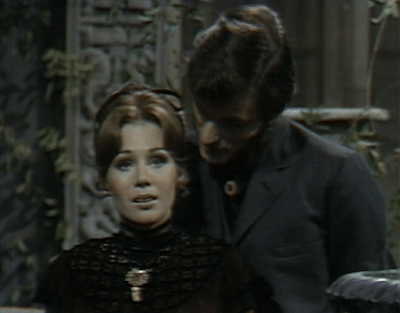
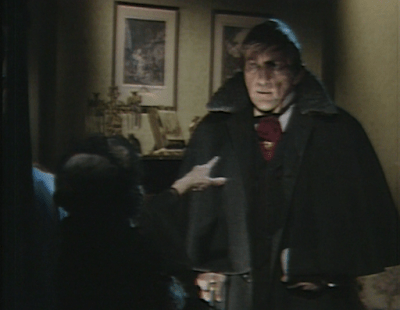
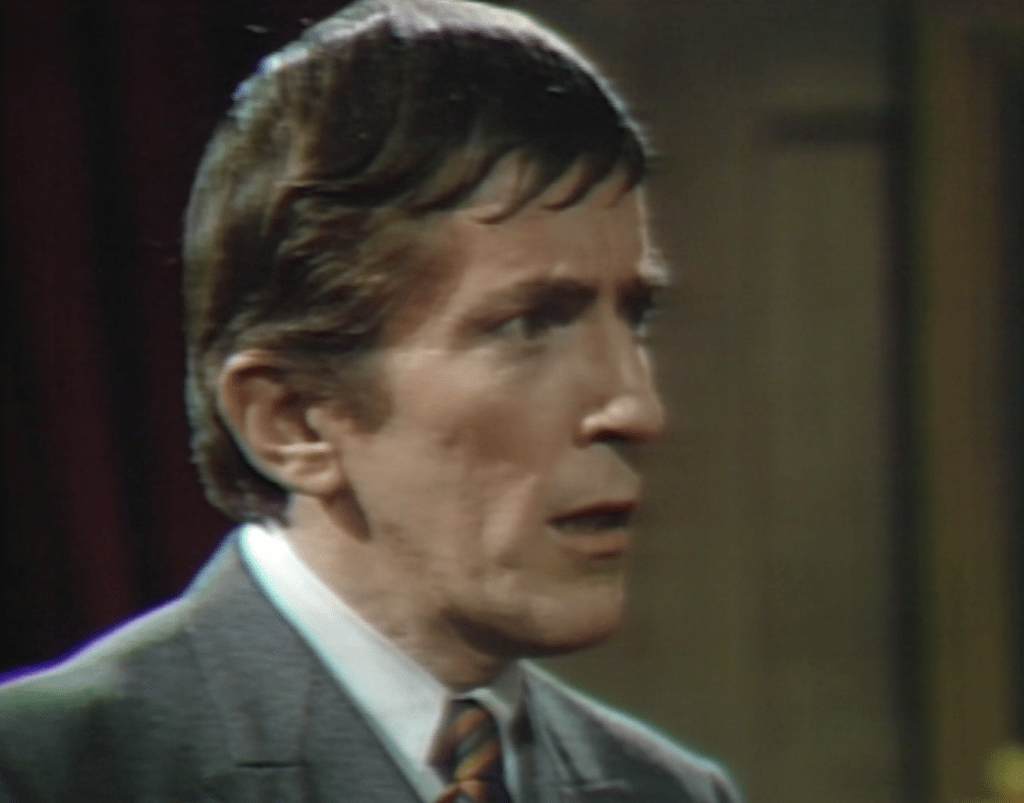
Libertine Quentin Collins has learned that his estranged wife, madwoman Jenny, is being kept locked up somewhere in the great house of Collinwood. He learned this when Jenny escaped and stabbed him. He also learned that his brother, stuffy Edward, and maidservant Beth Chavez are involved in the plot to keep Jenny in confinement. He spends time today trying to find out where Jenny is, openly telling both Beth and Edward that when he finds her, he will kill her.
Edward is estranged from his own wife, and just yesterday we learned that her name is Laura. Evidently she is the same sort of creature as we came to know from December 1966 to March 1967. In those days Dark Shadows was set in contemporary times, and Edward’s grandson Roger Collins was dismayed at the return of his estranged wife, who was also named Laura. That Laura was an undead blonde fire witch, a humanoid Phoenix who sought to be incinerated with her son, strange and troubled boy David Collins, so that her own life could be renewed.
Today, the year is 1897 and Edward and Laura’s nine year old daughter Nora is convinced that her mother will return after a year when she has been away and it has been forbidden to mention her name. Nora has a vision of Laura’s face in the fireplace, a vision of flames in the corridor, and a dream in which she meets Laura in the woods outside the house. At the end of the episode she wakes up, sneaks out to the woods, and finds the cloak Laura was wearing in her dream lying on the ground.
All of this is recapped from previous episodes, but actors David Selby, Louis Edmonds, and Denise Nickerson make it worth watching. As Beth, Terrayne Crawford is stiff and literal, and her awkward performance does detract from her scenes. But everyone else is so good that you don’t notice her weaknesses too much.
This episode marks the second time we hear the name “Mrs Fillmore.” In #707, we learned that Beth took substantial sums of money into the village of Collinsport to a lady of that name as part of the plot to cover up Jenny’s presence in the house. Today Beth has to remind Edward of that fact, and Quentin looks through the envelope with hundreds of dollars in banknotes meant for Mrs Fillmore.
When Nora screams that there is a fire in the upstairs hallway, Edward and Beth run towards it. Quentin just sulks in the drawing room; evidently the idea that the house is on fire bores him. By the time Beth and Edward get upstairs, the flames Nora saw have vanished, and nothing is burned. She swears that there was a fire, they cannot believe her. This echoes #400, when wicked witch Angelique cast a spell that caused time-traveling governess Vicki to see flames in her room in the Old House on the estate, and subsequently Vicki’s friends were puzzled that there was no indication there of anything burned. That confusion led to trouble for Vicki, and longtime viewers can imagine it is a sign of trouble for Nora as well.
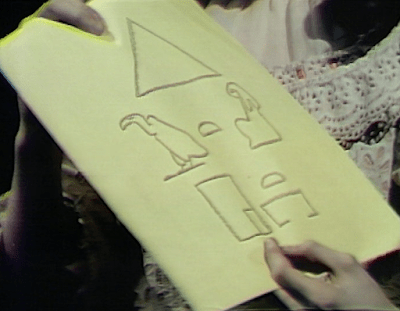
Yesterday, Nora drew a series of Egyptian hieroglyphics saying that her mother was coming home. At the beginning of her dream, a maniacal Edward holds an oversized copy of that drawing and rips it up, declaring Laura will never be back. The oversized drawing harks back all the way to episode #722, when Nora’s governess, neurotic intellectual Rachel Drummond, had a dream in which the daffy Carl Collins held a gigantic pocket watch. That was a striking enough image that not even the Vaseline almost entirely covering the lens could ruin it. But today even less of the picture is legible, and the gambit isn’t fresh anymore. Louis Edmonds does do a fine job of laughing maniacally, though, I will grant that.
The picture really does look like that, and it is supposed to look like that. Director Henry Kaplan was not much of a visual artist. Screenshot by Dark Shadows Before I Die.
Repressed patrician Edward Collins enters his study in the great house on the estate of Collinwood and finds his brother, libertine Quentin, riffling through his desk. Quentin does not feel an obligation to apologize for going through Edward’s things since Edward is among the conspirators holding Quentin’s estranged wife, madwoman Jenny, prisoner somewhere in the house. Quentin learned that Jenny was around only when she escaped from her cell and stabbed him. He is looking for information about where she is now so that she will not get another chance at him. Edward says that Quentin does not need to know where Jenny is, since he is confident she will not escape again.
Quentin is not at all reassured by Edward’s promise. He brings up another topic, Edward’s own estranged wife. For the first several weeks of the portion of Dark Shadows set in the year 1897, the audience was led to believe that Jenny was Edward’s wife, and the mother of his children, twelve year old Jamison and nine year old Nora. When we found out that Jenny was Quentin’s wife, we wondered not only who Edward was married to, but also whether Jenny had borne children by Quentin. After all, she is obsessed with her “babies,” and in #707 we learned that the enterprise of concealing Jenny’s presence in the house involved taking substantial sums of money into the village of Collinsport and giving them to a Mrs Fillmore. Perhaps Mrs Fillmore is taking care of Jenny and Quentin’s children.
Today, Quentin mentions that Edward’s wife, whom Edward said in #705 and says again today “no longer exists” as far as he is concerned, is named Laura. This rings a very loud bell for longtime viewers. The first supernatural menace to dominate the plot of Dark Shadows was Laura Murdoch Collins, estranged wife of high-born ne’er-do-well Roger Collins. That Laura was on the show from December 1966 to March 1967. In the first week of the show, newly hired governess Vicki was surprised to learn that Roger’s wife was still alive, and was told in no uncertain terms that she was not to be discussed. In #705, during the first week of the 1897 portion, newly hired governess Rachel Drummond was surprised to learn that Edward’s wife was still alive, and was told in no uncertain terms that she was not to be discussed. Like Roger, Edward is played by Louis Edmonds. When we learn that Edward’s wife, too, is named Laura, we can only assume that she, too will prove to be an undead fire witch out to incinerate her children for the sake of her own immortality.
Quentin reminds Edward that Laura followed him the year before when he was banished from Collinwood. Indeed, Laura followed Quentin all the way to Alexandria, Egypt. The other day, Quentin admitted to Jamison that he had been a police spy in that city. Edward does not want to hear about any of it.
Nora enters. She asks Edward if she can use his desk to draw with crayons. Edward says that he was just leaving, and she can do what she wants. Quentin stays behind with her for a moment. Nora asks her uncle if he thinks her mother will come back. He looks uncomfortable, says he doesn’t know, and exits.
Barnabas Collins, a distant cousin recently arrived from someplace far away, enters. He looks at what Nora has drawn and recognizes Egyptian hieroglyphics. He asks if she copied them out of a book; she says that they just popped into her head. He says he wonders what they mean; she looks directly into the camera and tells the audience she knows exactly what they mean. They say that her mother is coming home soon. And indeed, they do include actual hieroglyphic symbols for “Mother,” “Come,” and “Home.”
Nora starts talking about her mother. Barnabas encourages her to continue with the topic, and Edward enters. Edward is quite stern with Barnabas; he had made it clear that his wife was not to be discussed with anyone in the house, least of all with his children. Barnabas explains that Nora brought her mother up. He goes on to show Edward the drawing and tell him that he finds it profoundly disturbing. Edward accepts that as a sufficient excuse for going along with Nora while she talks about her mother, but he attributes the drawing to Quentin’s influence.
Whenever we saw Laura alone indoors during the “Phoenix” storyline, she was staring blankly into a fire burning in a hearth. She kept urging her son, strange and troubled boy David, to join her in this pastime, and every time he did we were led to believe that she had taken a sizable step towards her terrible goal. Now we see Nora in the drawing room, staring into the fire that always burns in its hearth.
Nora hears gurgling noises, like indistinct voices rising from below or behind the fire. Frightened, she runs into the foyer, into her father’s arms. She tries to explain to Edward what she heard, and he insists there is nothing to be afraid of. He carries her into the drawing room, where he declares they will look into the fire together and will both realize that nothing out of the ordinary is going on. His plan fails when Nora sees a face wearing a blonde wig starting to take shape in the flames. Nora cries out that it is her mother’s face. We pan to Edward. He is also looking into the fire, and he looks shocked. We wonder whether he is shocked because he can also see the face, or if he is merely alarmed by Nora’s reaction.
Roger and his sister Liz, the adults in the generation of Collinses who live at Collinwood in the 1960s, are Jamison’s children. So Edward and Laura are their grandparents. If this Laura is indeed the same immortal humanoid Phoenix who was David’s mother, Roger therefore married his own grandmother. In #313, Roger had a line about his “ancestors,” which Louis Edmonds bobbled. When he said “incestors,” he giggled, repeated the misspoken word, then corrected himself, calling the maximum possible attention to his error. Many fans bring that rather bizarre blooper up when we come to this story. The writing staff picked up ideas wherever they could, and I suppose the cast’s line difficulties might have been as good a source as any.
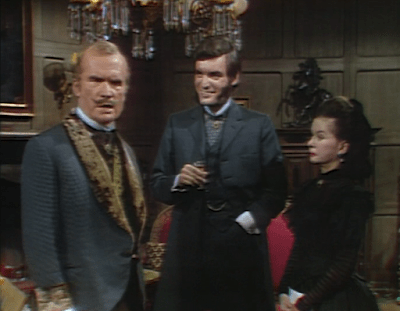
One day in the year 1897, Edward, Carl, and Quentin Collins hear their sister Judith read their grandmother’s will. Stuffy Edward and childlike Carl are shocked to find that Judith is the sole heir of their family’s vast holdings. Quentin stole the will and tried to forge a new one, so he is not shocked, but he is weirdly gleeful about the paragraph relating to him. He will receive no property and no income, but will be guaranteed a place to live in the great house of Collinwood forever. This enshrines his relationship with Judith as one of the clearest examples of Dark Shadows’ signature dynamic of Bossy Big Sister and Bratty Little Brother. No matter how atrociously Quentin may behave, no matter how loudly Judith may disapprove of him, she has no authority to punish him and her concern for the family’s good name will compel her to cover up his misdeeds and shelter him from their natural consequences.
Meanwhile, governess Rachel Drummond and ladies’ maid Beth Chavez are busy with a mystery concerning the room on top of the tower that stands in the middle of the great house. Rachel has seen lights in the room and suspects someone is being held prisoner there; contrary to the direct orders of Judith and Edward, and against Beth’s very strongly worded advice, Rachel is investigating this matter aggressively. She sneaks up the stairs to the top of the tower, listens at the door to the room, and sees Beth coming out of it with a tray.* She then goes to Beth’s room, where she interrupts Quentin sexually harassing Beth. When she tells Beth what she saw in the tower and asks about it, Beth is shocked that Rachel went into the tower. She denies everything.
Later, Rachel goes back to the top of the tower and again listens at the door. She hears a cradle rocking. We saw that cradle in #645, when Dark Shadows was set in contemporary times and Quentin and Beth were ghosts haunting children David Collins and Amy Jennings. They sent Amy and David to fetch the cradle from the attic of the Old House on the estate and to bring it to Quentin’s old room in the west wing of the great house. This is one of the first times in the 1897 segment when we explicitly close a loop opened during the “Haunting of Collinwood” story.
*At the beginning of the episode, we saw Beth approach the room with the tray and a baby doll. During that scene, we hear what I believe is new music. It has been quite some time since we have heard any new cues, so this stands out.
One day in 1897, Edward Collins convenes his siblings Judith, Carl, and Quentin for a family meeting in the drawing room of the great house of Collinwood. Their grandmother Edith died the night before. She was supposed to tell Edward a celebrated family secret, but did not do so. Edward is convinced she must have told one of the others, and declares that no one will leave the room until he finds out which.
Returning viewers know that Edith did not tell any of them, and we can imagine a half hour of nothing but the four Collinses of Collinwood sitting around staring at each other. Fortunately, Quentin points out that Edith was briefly alone with their recently arrived and thoroughly mysterious cousin, Barnabas Collins, and she might possibly have told him. Edward orders Carl to go to the Old House on the estate, where Barnabas is staying. Carl asks why it’s always him who has to do these things, and Edward angrily shoos him away. Louis Edmonds and John Karlen were both talented comic actors, and this little exchange is very funny.
In the Old House, Carl finds Sandor Rákóczi coming up from the cellar. He asks Sandor what he is doing there. Sandor says he lives there. Carl says that he’d heard Barnabas was living in the house now. Sandor says that Barnabas hired him and his wife Magda as servants. Carl laughs at that and says of Barnabas “He is an odd one, isn’t he?” Sandor gives him a fierce look, offended. Carl apologizes.
Carl explains that he has come to fetch Barnabas. Sandor says Barnabas won’t be back until after dark. Carl explains why they need him at the great house, and Sandor laughs. “You must have Gypsy blood! Nobody in the family trusts nobody else!” Carl laughs, too.
This scene may remind longtime viewers of the first time we saw Thayer David on this set, when he was playing crazed handyman Matthew Morgan. The dramatic date and the date of production were both 1966 then. Strange and troubled boy David Collins found Matthew hiding in the Old House, and agreed to help him avoid the police. Carl is a grown man, but he is as eager to please and uninterested in asserting dominance for any length of time as was the nine year old David. Further, he is so naive that he reacts with bewilderment to the idea that lust for money might be a motive for murder. Carl may not be less prejudiced against Romani people than are the rest of the Collinses, but his childlike qualities allow him to laugh at a joke that would have drawn a violent response from any of his siblings.
Carl insists that Sandor go home with him and tell Edward that Barnabas is away. Again, this shows Carl’s childishness. He wants to prove to Edward that he did as he was told and went to the Old House. In fact, Edward is appalled to see Sandor in the great house, and can barely stand listening to him.
While Sandor is leaving, Judith stops him. Sandor is astounded that she is speaking to him at all. She tells him that her grandmother may have tolerated his presence in the Old House, but that she and her brothers will not. Sandor and his wife Magda are to leave the property within twenty four hours. Judith does not give Sandor a chance to tell her that Barnabas has hired them as servants.
On the terrace, Quentin finds Rachel Drummond, the new governess. The two of them look very good together. In fact, Quentin’s seductive manner and Rachel’s response to it make them the most attractive couple we have seen on the show, by a long way.
They talk about the house. Quentin mentions that no one has been in the room on top of the tower since 1796, 101 years ago. Later that night, Rachel will see a light burning in the room, and she will rush into the drawing room to tell Edward about it.
She comes in after a meeting between Edward and Judith. Judith came to tell her brother about something entirely new to the audience. She says that the matter relating to the tower room is going well. Maidservant Beth goes to the room three times a day, and Beth also goes into town regularly to take money to a Mrs Fillmore.
This will interest returning viewers. The other day, Quentin found Beth going into town with a parcel and an envelope containing $300 in cash. Beth said Judith gave her permission to go to town to conduct personal errands, and claimed, absurdly, that she had saved the money from her salary. We now know that she was taking the money to this Mrs Fillmore for some purpose of Edward and Judith’s. Later, Quentin found Beth taking a tray of food upstairs. He asked who was supposed to eat it; she said it was for Edith. When he pointed out that it was more than Edith could eat, she said Judith would be eating with her. In Edith’s room, Beth told Judith about this. She said they would have to be more careful now that Quentin was back home, and dismissed her to take the rest of the food “upstairs.” We now know that this “upstairs” is the tower room, and that Beth is helping Judith and Edward to hide someone there of whose presence in the house Quentin is unaware.
However much this may interest us, it does not interest Edward at all. He is outraged that Judith so much as mentioned the matter to him, saying that he wants her to handle it without notifying him in any way. She objects that they will have to talk about it sometimes; he does not agree.
When Rachel enters and tells them about the light, Edward detains her with a disquisition about the impossibility of the tower room being lighted while Judith scurries off and goes upstairs. After a while, Edward takes Rachel back to the terrace and shows her that the room is dark. He asserts that it was also dark when she looked at it earlier, and it has been dark for over a hundred years.
Longtime viewers will recognize this scene. In March 1968, Dark Shadows was set in 1796, and Barnabas had just become what he is again now, a vampire. Barnabas’ father, haughty overlord Joshua, confined him to the tower room while he tried to find a way to free his son of his curse. Barnabas’ mother Naomi saw lights in the tower room, as did his second cousin Millicent. When Naomi told Joshua about the lights, he pretended not to see them, and when Millicent told her husband Nathan she had seen the lights, he, for his own reasons, also pretended not to see them. Those pretenses led each woman to go to the room, resulting in madness for Millicent and suicide for Naomi. Quentin tells Rachel that the tower room has been closed since 1796 because “a woman killed herself” there; that is an explicit reference to Naomi.
Like Edward and Judith, Joshua and Naomi were played by Louis Edmonds and Joan Bennett. It is a sign of how much more dynamic the 1897 section is than the 1790s section that Judith is an active participant in whatever scheme is going on, not simply a helpless person who stumbles upon a terrible secret and promptly kills herself.
Yesterday, we were in the great house on the estate of Collinwood when dying nonagenarian Edith Collins met mysterious newcomer Barnabas Collins. She told Barnabas that she recognized him. Edith had been entrusted with the Collins family’s darkest secret, which was about Barnabas. He is a vampire, entombed in the 1790s to be kept forever away from the living. Now it is 1897, and Edith sees that the family has failed. She must tell the secret to her eldest grandchild, Edward Collins. Edward comes into the room and Edith tries to tell him what has happened. She has difficulty speaking. Edward asks Barnabas to excuse them. He replies “Of course,” and leaves the room. He does stand at the door and listen to their conversation, apparently waiting to see if Edward will come out with a crucifix and a sharpened stake.
Today, we find that Edith was so shocked by the sight of Barnabas that she has lost her sense of her surroundings. Barnabas was kept in a chained coffin in an old family mausoleum, and Edith does manage to say the word “mausoleum” to Edward, but that’s as far as she gets with the secret. Thereafter, she weaves in and out of the moment, reliving several periods of her life, some as far back as the time of her wedding to Edward’s grandfather.
At the word “mausoleum,” Barnabas rushes back to the Old House on the estate, where he has been staying. He tells his unwilling servant, a woman named Magda Rákóczi, that she must fetch her husband Sandor and that she and Sandor must go to the mausoleum at once, take the coffin out of the secret chamber where it is hidden, leave no trace of any kind in the chamber, and carry the coffin to the house. Magda points out one of several facts that make it impossible to comply with these orders, which is that Sandor is in town where Barnabas sent him. Barnabas refuses to acknowledge this or any other insuperable difficulties, and goes back to the great house.
While Barnabas is sitting in the drawing room clenching his fists on the armchair where he is waiting to see what Edward will do when he learns that he is a vampire, a hidden panel opens and a man carries a pistol into the room. The man holds the pistol at Barnabas’ head and demands he tells him who he really is. The man identifies himself as Carl Collins, one of Edward’s brothers. Barnabas yields nothing. The man discharges the pistol, from which emerges a flag labeled “Fib.” He laughs. Barnabas is not amused. The audience may not share Carl’s sense of humor either, but the subsequent scene in which Carl claims to see that Barnabas has a kind face, predicts that the two of them will become close friends, and offers to let him borrow the pistol and play jokes with it himself, is hilarious. Jonathan Frid plays Barnabas’ icy reaction to Carl perfectly, and as Carl John Karlen does not betray the least glimmer of awareness of Barnabas’ affect.
Carl goes to the Old House to call on Magda. The scene there begins with Magda showing her palm to Carl. He wants her to read the Tarot cards; she says the cards will not speak unless she has money in her hand. Like his siblings, Carl is convinced that the secret which Edith keeps and which she has vowed to disclose only to Edward is the key to control of the family fortune. Magda knows better, but she goes through the cards anyway. They tell her that the family’s fortune is even larger than anyone knows, that when Edith’s will is found it will come as a surprise to everyone, that the surprise will lead to murder, and that the person who inherits the money will not keep it. The Queen of Cups turns up in a position that indicates Edith is still in control, but the last card Magda draws leads her to gasp and stand. She reels about the room, and declares that Edith is dead. “The cards are silent.”
Back in the house, Edward lets Barnabas into Edith’s room. He closes his grandmother’s eyes, and tells Barnabas that she did not tell him the secret. He vows to learn the secret even “if it’s the last thing I do!” We cut to Barnabas, looking uncomfortable. No doubt he is thinking of how inconvenient it would be if Edward were to find out the secret and he had to see to it that it was indeed the last thing he ever did.
This is the sixth consecutive installment to which I have given the “Genuinely Good Episode” tag, a record so far. Like the preceding five, it is stuffed with wonderful things. The acting is all very very good. Isabella Hoopes does a marvelous job as the delirious Edith, as Edward Louis Edmonds gives a master class in how to play a stuffy man, and the pairings of Grayson Hall, John Karlen, and Jonathan Frid with each other all unfold brilliantly, full of laughs but never losing their dramatic tension. So many of the episodes fans most enjoy would be drab for people coming to the show for the first time that it is always a memorable occasion when we see one like this, that anyone should be able to recognize as an outstanding half hour of television. It’s true the visual side lets us down a little; even by the standards of 1960s daytime television, the color is murky and there are too many closeups. But Sam Hall’s script and the performances are so good that no fair-minded person will complain very much about those problems.
Fans will take a special interest in Edith’s ramblings. When it first aired, viewers had no way of knowing how much of what she says about the family’s history will be reflected in upcoming episodes. The writers themselves probably didn’t have a much clearer idea about that than we do. But watching the series through for the first time, our default assumption about each of her lines is that it will have some significance as we go, so if we are committed to watching the show we listen closely.
We’ve already learned that Edith is over 90, so the very latest she could have been born is 1807. More likely she was born a bit before that, sometime between 1801 and 1806. She says today that her father-in-law was Daniel Collins. From November 1967 to March 1968, Dark Shadows was set in the late 1790s, and we saw Daniel. He was about 11 in 1795, so he would have been born in 1784 or thereabouts. So he could have been no more than 23 years old when Edith was born. Presumably his son Gabriel was the same age as his bride, though he might have been significantly younger. Edith does say that she always hated Daniel; perhaps she was a good deal older than Gabriel, and Daniel disapproved of her initially for that reason.
Edith tells us that Gabriel has been dead for 34 years, placing his death date in late 1862 or early 1863. She does not mention his cause of death or say anything about their son who was the father of Edward, Carl, and the others. It is firmly fixed that Edward and Carl’s brother Quentin was born in 1870, so Gabriel’s son must have survived him by several years.*
Edith says several times that the secret has been passed down from generation to generation and that she must tell it to Edward because he is the oldest. That seems to imply that Daniel told his oldest child, whom we presume to have been Gabriel, and that Gabriel told his oldest child, whom we presume to have been the unnamed father of Edith’s four grandchildren. He would then have told Edith before he died, either because Edward was not yet old enough to hear it, or because he was not available at the time.
But that implication is not at all secure. Edith says that Edward must be the keeper of the secret because he is the oldest- she doesn’t say what the connection is between being the oldest and keeping the secret. For all we know, she could have decided on her own to invent that tradition, starting with Edward and continuing with Edward’s oldest child. And when she says that it was passed down from generation to generation, she does not specify how many generations have been involved or which member of each generation did the passing. All we know is that someone of one generation learned it from someone else of a different generation, and that Edith believes it is the family’s responsibility to keep Barnabas from preying upon the living.
I think it’s reasonable to assume that sometime between 1897 and 1967 the secret was lost and not continually passed down. Perhaps in the original timeline Quentin was successful in killing Edith before Edward arrived, or maybe Edward died later in life before he was able to pass it on.
As far as Joshua passing the secret on, maybe he did, or maybe it was the elderly Ben Stokes who started the tradition?
Joshua was Barnabas’ father, and Ben Stokes was a much-put-upon indentured servant who was Barnabas’ devoted friend. They were the two people who knew that Barnabas was a vampire and that he was entombed in the secret chamber of the mausoleum. I replied to “Mike”:
I love that idea. Edith’s desire to tell the oldest son may lead us to assume that it has been handed down to the oldest son generation after generation, and it does lead the “Fab Four”** to assume that it brings with it some kind of power and access to riches. But their assumption is wrong, and ours may also be. Perhaps Joshua never told anyone. Perhaps the first person to tell the secret was Ben Stokes, and the person he told was Edith.
The scene between Barnabas and Magda brought another question to my mind. In #334, Barnabas was able to lock the panel in the mausoleum that leads to the secret room. Why doesn’t he just do that? It has also been made clear that as a vampire he is far stronger than are humans- if he wants to move the coffin from the mausoleum to the Old House, surely he could pick it up himself and do it more quickly and with less risk of detection than could Magda and Sandor. My wife, Mrs Acilius, agrees that we don’t know why Barnabas doesn’t lock the panel, but she says that it is perfectly clear why he can’t move the coffin- that is manual labor, and he is an aristocrat. His servants must do that.
*In a later episode, Quentin will mention that he knew Gabriel, throwing the 1862/3 date into question. But they never get around to any stories that depend on anything that happened in Gabriel’s later years. By the time we get to that one, only obsessive fans will remember his name. Eventually we meet two characters named Gabriel Collins, one in episodes that will air in 1970 and the other in the 1971 film Night of Dark Shadows, but a death date in the 1860s is not relevant to anything we learn about either of them.
**The “Fab Four” are Edith’s grandchildren, Edward, Carl, Quentin, and their sister Judith.
Three of the residents of the great house of Collinwood in the year 1897 are spinster Judith Collins, her brother, libertine Quentin Collins, and their grandmother, nonagenarian Edith Collins. At the opening of today’s episode, Judith walks in on Quentin strangling Edith in her bed. She tells him to stop it and leave the room. He complies, with a sulk. Edith shakes off her annoyance with Quentin, and she and Judith have a conversation about various matters.
One of Dark Shadows’ signature relationships is that between Bossy Big Sister and Bratty Little Brother. However serious the misconduct Bratty Little Brother commits in his disobedience to Bossy Big Sister, in the end she will cover it up and protect him from its consequences. Nothing at all will happen to Quentin as a result of his attempt on his grandmother’s life; Judith will just continue disapproving of him, as she has always done. Later in the episode, Quentin will remark to his recently arrived and quite mysterious distant cousin Barnabas Collins that Judith “gets carried away by delusions of authority. The fact is, she has no authority whatsoever.” Judith overhears this and objects to it, but Quentin’s presence in the house suffices to prove that her manner is not an expression of authority, but simply childlike role-playing.
Quentin’s motive for his attack on dear old grand-mama was his demand that she tell him the family’s “secret.” Edith has declared that she will pass this secret on only to Edward, who is Judith and Quentin’s eldest sibling. Edward is away, and Edith is terribly afraid she will die before he returns. After Judith shoos Quentin out of Edith’s room, she herself tries to wheedle Edith into telling her the secret. Edith tells Judith she is better off not knowing, but Judith does not seem to be convinced. Quentin has said in so many words that his only desire is to take control of the family’s wealth, and Judith is focused on preventing him from doing that. So we can assume that their frantic eagerness to learn the secret is rooted in the belief that the person who knows it will inherit the estate from Edith.
We see Edward. He is not at Collinwood, or even in the village of Collinsport. If I recall correctly, this is the first time the show has taken us anyplace out of town other than the mental hospital since we visited Phoenix, Arizona in #174, more than two years ago.
Edward is in a train station, impatient and irritable, talking with a young woman whose rigid posture and blank facial expression show that she is exceedingly uncomfortable. Her name is Rachel Drummond, and she is to be the new governess for Edward’s son and daughter. He says that he means for her to use her own judgment in making up their curriculum. Rachel says she will have a clearer idea of what her approach will be once she has met the children and Edward’s wife. Edward freezes, and says that he has no wife. Rachel apologizes for her assumption; he says that she has no need to do that, as he had given her no way of knowing about the situation. In a soft voice, Rachel asks about Mrs Collins’ death; Edward replies that “Mrs Collins no longer exists” and that is all he will be saying about the topic. Rachel asks how she should respond if the children ask about their mother; Edward tells her to say that she is away, nothing more.
Back at Collinwood, a recently arrived visitor named Barnabas Collins comes calling with a gift for Edith. It is a piece of jewelry that he inherited from Naomi Collins, whom he identifies as his great-great-great-grandmother. Judith accompanies him to Edith’s bedroom.
Meanwhile, Edward lets himself and Rachel in the front door. He is carrying their bags and grumbling about the lack of servants. Quentin enters. Edward is shocked that his ne’er-do-well brother has returned to the house from which he was banished a year ago, he hoped forever. He has little to say as Quentin teases him and Rachel, saying that she is too pretty to be either the new governess or Edward’s new wife. He asks if she is Edward’s mistress, angering him and making the already unhappy Rachel quite miserable. She says she is the new governess. Quentin asks if she is married. Edward erupts with “Would it make any difference to you if she were?” In the wake of the painful exchange about Edward’s wife no longer existing, this carries a suggestion that makes Rachel’s position even more difficult. Edward realizes what he has said and falls into a horrified silence.
Edward asks Rachel to excuse him and Quentin while they have a private talk. She has nowhere to go; she has not been shown around the house or told which areas she is free to enter, so all she can do is sit quietly in the foyer. Still, that would appear to be an improvement over the endless cascade of awkward exchanges she has had so far, and so she agrees without protest.
While Edward reads Quentin the Riot Act in the drawing room, Judith shows Barnabas into Edith’s room. The room is darkened so that only the outlines of their figures are visible. Judith opens the curtains to let the moonlight in, and sees Edward’s carriage outside. She hurries down to fetch Edward, leaving Barnabas alone with Edith.
Edith asks his name. When he says that he is called Barnabas Collins, she is startled. She sits up and uneasily asks him to step into the light so she can see his face. She reacts with horror. “You! You are the secret!” she exclaims. “Passed down from one generation to the other! You were never to be let out! We have failed! We have failed!” He approaches her. “Don’t come near me! I know what you are!”
When Dark Shadows premiered, the Collinses of 1966 had three big secrets. Matriarch Elizabeth Collins Stoddard had summoned a young woman who had never heard of her or of Collinwood, Victoria Winters, to be governess to her nephew David. Vicki was trying to find out who her biological parents were and why she was left at a foundling home as an infant; the show hinted heavily that Liz was her mother, but dropped that without any resolution. Also, Liz hadn’t left the house for 18 years. That turned out to be because she thought she killed her husband and that his body was buried in the basement. After 55 weeks of that story, it turned out she hadn’t killed him at all, and within days they forgot about the whole thing forever. The third secret was about Liz’ brother Roger. A man named Burke Devlin thought Roger had framed him on the manslaughter charge that cost him five years in prison, and vowed to destroy the Collinses in revenge. After 40 weeks, Burke forced Roger to confess that his suspicions were correct, but by that time Burke had decided to let bygones be bygones and that story also vanished with barely a trace.
With that record, all the talk about “the secret” that we hear when we first arrive in 1897 might make longtime viewers apprehensive that there will be another interminable guessing game that peters out with little or no resolution. But the show has changed. This secret is not only revealed to us within a week, it is a forceful and elegant solution to a major problem.
Barnabas is a time traveler from the 1960s. He has come back by means of some mumbo-jumbo to prevent Quentin’s ghost from haunting Collinwood and making life impossible for the Collins family in the year 1969. He is also a vampire. He originally lived in the 1790s, and Naomi was his mother, not his great-great-great-grandmother. A would-be thief accidentally freed him to prey on the living in April 1967; he managed to conceal his true nature from his living relatives, and in March 1968 he was freed from the effects of the vampire curse. When he came to this period, he found himself once more an undead abomination.
Barnabas has no idea why Quentin’s ghost has become such a problem in 1969, no idea how to investigate the question, and no idea what, if anything, he will be able to do to correct matters if he somehow does manage to find the answer. Since events are moving very fast in 1897, everyone there is deeply and intricately involved with everyone else, and Barnabas is a stranger, there is a distinct possibility that he will be sidelined. That happened to Vicki when she left November 1967 and found herself in the year 1795; by the time the show returned to contemporary dress four months later, she had been an ineffectual ninny for so long that she had lost the loyalty of the audience, never to regain it. As a vampire, Barnabas could make his way to the center of the story by killing everyone, but that would tend to create a narrative cul-de-sac. So Dark Shadows is taking an enormous risk with its star by putting him in this situation.
When Edith tells Barnabas that he is the secret, at one stroke she puts him at the center of the story, connects the part of the show set in 1897 with that set in 1795, and raises a whole set of questions about how the events of those two periods led to what we have seen in the parts set in the 1960s. She electrifies the audience with the promise of an entirely new kind of show.
She also answers a minor, but potentially nagging question. From #204 on, we saw that Barnabas’ portrait hangs beside the entrance to the great house, and we are repeatedly told that it has been there as long as anyone can remember. The Collinses know that the man who sat for it was a cousin of their direct ancestor, and believe that he left for England in the 1790s, never to return. Why display the portrait of so distant a relative in so prominent a place for so long?
Edith’s recognition of Barnabas tells us why. She has studied the portrait for as long as she has known the secret, and when he comes into the light she can see at once that he is its subject. The portrait was therefore meant to help the keeper of the secret defend the family against Barnabas. It actually had the opposite effect. In 1967 and again on his arrival at the great house this week, Barnabas appealed to his resemblance to the portrait as evidence that he was a descendant of “the original Barnabas Collins,” and so persuaded the living members of the family to let him make his home in the Old House on the estate.
The opening voiceover today is the same we heard yesterday and the day before. I do not believe they had ever replayed an opening voiceover even once prior to this; I’m sure they had never done so twice. This one just tells you that Barnabas has traveled back in time, and it is now 1897. Repeating it doesn’t hurt anything, but I do wonder what they were thinking. Were they considering changing the nature of the voiceover, making them so simple that they could be reused routinely? Or was there some kind of problem, say a technical difficulty with the equipment or an issue with the actors’ contracts, which kept them from recording fresh ones?
When Dark Shadows began in June 1966, we were introduced to Roger Collins as a high-born ne’er-do-well with no sense of responsibility to anyone or anything. Roger had squandered his entire inheritance; his sister, reclusive matriarch Elizabeth Collins Stoddard, nearly bankrupted herself trying to buy up his half of the family business to keep it from falling into outside hands. Roger and his son, strange and troubled boy David, lived in Liz’ house as her guests. Roger drew a salary from the business, but barely pretended to do any work for it. He made absolutely no pretense of concern for David; on the contrary, he expressed his hatred for his son openly, tried to persuade Liz to send him to a boarding school or an institution or any other place that was far away, and speculated out loud that David might be the natural son of his sworn enemy, dashing action hero Burke Devlin.
David’s mother, Roger’s estranged wife Laura Murdoch Collins, was on the show from December 1966 to March 1967. Roger schemed to get her to leave and take David with her. When he discovered that Laura was an undead fire witch whose plan was to burn David alive in order to secure her own peculiar immortality, he was shocked into a display of fatherly tenderness. He’s never been quite himself since.
By April 1968, the show had long since erased all signs of the financial crisis Roger’s crapulent youth had brought upon the family. Further, Roger had by that time shown so many signs of mature responsibility in his attitudes both towards his son and towards his work that we might have wondered if they were going to retcon away all of his vices. It was a genuine surprise when, in #474, Liz told Roger’s new wife Cassandra that Roger lived in her house as her guest, worked in her business as her employee, and owned nothing himself. Roger’s spendthrift past seemed to have no place in the story by that point.
Today, Roger is at his most conventionally respectable. He comes home from a long business trip, indicating his sober devotion to the work of Collins Enterprises. He finds David in his room, struggling with distant cousin Barnabas Collins and permanent houseguest Julia Hoffman. After a commercial break, Roger says that he has heard about the many complicated events that took place while he was away. Barnabas explains that David had told him that silversmith Ezra Braithwaite came to the house to see him, bearing a ledger with information he wanted. David found Mr Braithwaite in the drawing room, dead of a heart attack. The ledger was nowhere to be found. Barnabas and Julia have come to David to ask if he can shed any light on what may have happened to the ledger, and the boy became violently upset. Roger insists Julia and Barnabas leave the room. He talks soothingly to David and tells him he does not believe any accusations against him.
Later, Roger confronts Barnabas and Julia in the drawing room. He finds the ledger on the desk where Mr Braithwaite was sitting when he died; he does not accept Julia and Barnabas’ assurance that it was not there earlier. He dismissively asks if they are suggesting that “a ghost” put it there. He demands they apologize to David, making it a condition for their continued presence in the house that they do so.
Barnabas is shocked when Roger threatens to revoke his great house privileges. Screenshot by Dark Shadows Before I Die.
As it happens, Barnabas and Julia strongly suspect that a ghost did put the ledger back on the desk, and the audience knows they are right. Roger has seen quite a bit of evidence of supernatural forces at work in and around Collinwood, as has Liz. But both of them consistently refuse to acknowledge this evidence. Each of them has had moments when the wall of denial started to crumble; notably in #88, Roger said to Liz, “I’ve seen and felt things, things I couldn’t actually explain. You can’t tell me it hasn’t happened to you, because I know better.” But they always snap back to form sooner or later, no matter how obvious the truth is, and there would obviously be no point in laying the facts before Roger when he is in this mood.
Julia and Barnabas have asked Liz to show them the old family archives. It is the middle of the night, everyone is very tired as the result of the fuss and bother that occurs when a corpse has to be removed from the house by lawful means, they will not tell her what topic they are researching, and they insist on starting work immediately. She asks if they expect her to go along with them on this basis, prompting Barnabas to smile as genially as he can and say “Of course!” You can’t expect to persuade crazy people to behave reasonably, so she gives in.
The archives are a dusty room somewhere in the great house that Julia somehow failed to enter during the months when she was staying at the house under the pretense of being an historian looking into the early years of the Collins family. The first book Julia picks up is an old photo album, and one of the first pages she turns to is a photograph of a woman whose ghost she and Barnabas saw the other night. The photo is dated 1897. The woman looks just as she did in her ghostly form, suggesting that she died not much later than that. There is some business with doors slamming shut and windows blowing open to fill the last thirty seconds of the episode, and the closing credits roll.
My wife, Mrs Acilius, pointed out that Roger’s defensiveness concerning David serves the same purpose in the plot as does Barnabas and Julia’s ludicrously cack-handed approach to questioning him. The evil ghost is still quite weak, the ghost of the woman opposes him, and David and his friend Amy Jennings are desperate to escape from his influence. If any of the adults caught on to what was happening at this point, they could cut the Haunting of Collinwood story short. But it is just getting interesting, and there is only one other plot ongoing now. So we don’t want that. Roger and Liz have to be in full denial mode, Julia and Barnabas have to be terrible at talking with kids, and governess Maggie Evans has to be a squish who doesn’t know the first thing about discipline for the plot to work.
Fortunately, we have ample foundation for each of these character developments. Roger’s origin as a shockingly indifferent father makes it understandable that he would swing to the opposite extreme and treat David with excessive indulgence. As a former vampire and a mad scientist, Barnabas and Julia are metaphors for extreme selfishness, and when they were called upon to act as parents to Frankenstein’s monster Adam in April 1968 they did the worst possible job. Maggie is brand new to governessing; she has been on the show since #1, so we know that she was good at running the coffee shop in the Collinsport Inn, at containing the damage her father did by his alcoholism, at escaping from vampires and mad scientists, and at miscellaneous other tasks involving other adults. But she has never been responsible for children or trained as a teacher, and so it neither surprises us nor alienates us from her that she is bad at the job.
Today is devoted to non-supernatural stories. More precisely, we should call them post-supernatural, because they show people dealing with the aftermath of spells and curses.
The episode consists largely of solo performances. As troubled matriarch Liz, Joan Bennett has two scenes in which she is alone with her own voice in a recorded monologue. Dark Shadows has long used these monologues when characters were alone on screen and their faces would silently show how they felt about the thoughts their voices expressed on the soundtrack, but recently it has been experimenting with new ways of deploying them. For example, #581 marked the first time this device was used to share the thoughts a character was having in the middle of a conversation. Today Liz has a remarkably intense debate with her own recorded voice, first in her bedroom, later in an old graveyard.
Some time ago, wicked witch Angelique cast a spell causing Liz to be obsessed with death. Since then, Angelique lost her power and died. But Liz had been the victim of similar spells before, and is prone to depression in any case, as witness the fact that she once holed up in her house for eighteen years. So even if the spell broke when Angelique was de-witched, it makes sense Liz would continue to suffer the psychological damage it inflicted on her.
Between Liz’ two solo scenes, her brother Roger knocks on her bedroom door, This scene lasts less than a minute, but Louis Edmonds shows us a variety of emotions as he talks to Liz through the door, then opens it and finds she is not there. His discovery that he was giving a soliloquy when he thought he was having a conversation makes for a different kind of solo scene.
The other post-supernatural story concerns well-meaning governess Vicki and her ex-fiancé, an unpleasant man named Peter who insists on being called Jeff. Angelique became a vampire after her most recent death, and for a time she took Peter/ Jeff as her victim. The effects of the vampire’s bite made it impossible for Peter/ Jeff to sustain his relationship with Vicki. Peter/ Jeff has been freed from Angelique’s influence, and even his memory of the experience has been erased. Today he comes to ask Vicki to take him back. But he can explain nothing to her about what happened to him. Vicki is frustrated with Peter/ Jeff. Feeling that he does not trust her enough to tell her what happened, Vicki rejects Peter/ Jeff’s attempt at reconciliation. Alexandra Moltke Isles plays Vicki’s frustration with great force. Considering that her scene partner is the lamentable Roger Davis, this, too, qualifies as a solo performance.
Dark Shadows never had more than three credited writers producing scripts at a time. Often it had only two, and there were stretches when a single writer would have to crank out a script every day for weeks. Since they worked under those conditions, the writers’ methods would often be made obvious. So, Art Wallace, who was credited as the writer of the first 40 episodes, started by crafting the structure of an episode, and fitted incidents and information into that structure as time permitted. Ron Sproat, another very prolific contributor, also put structure first, sometimes resulting in a slow-paced script. Today’s author, Gordon Russell, seems to have taken the opposite approach, cramming each script with action and letting the material shake itself out as best it could. So there is some interesting stuff in this one that doesn’t really connect to anything.
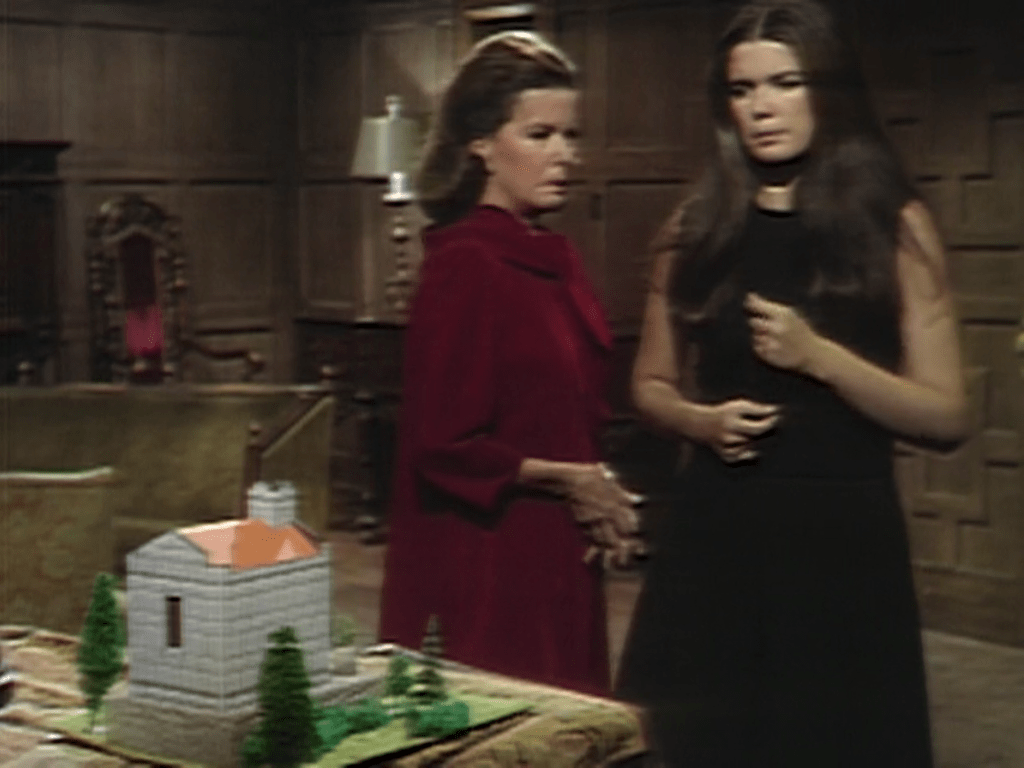
For example, we open today with Liz contemplating an architects’ model of a mausoleum. It really is a lovely little thing.
We have a scene where Vicki is horrified by the idea of the mausoleum. Liz insists Vicki be her voice after her death and stand up to her family for her, seeing to it that she is buried in the mausoleum as she wishes. The show hinted very heavily for a long time that Vicki is Liz’ unacknowledged daughter, but they dropped that a long time ago. As it stands, Vicki is a member of the household staff. As such, she would put herself in an awkward position were she to oppose the family’s wishes after Liz’ death.
Roger enters, demands that Liz forget about everything related to death, and smashes the model. That’s all very dramatic, but it doesn’t make any sense. Though he might well be distressed at Liz’ fixation on the idea that she will soon be buried alive, everyone dies eventually, and rich people often build elaborate mausoleums. Roger’s assertion that the architects must think they are humoring an insane woman and the villagers are all laughing at her is just as nonsensical as his domineering attitude is unconnected to his character as it has been developed up to this point. All of it is entirely irrelevant to the progress of the story.
After that, Liz leaves the room, and Roger talks to Vicki for a bit. He says that Liz’ trouble seemed to start when he married a woman named Cassandra. Unknown to him, Cassandra was actually Angelique in a wig. He tells Vicki “We’ve never been very lucky in love, you and I, have we?,” and edges closer to her. This may come as a bit of a jolt to longtime viewers. In the early days of Dark Shadows, there were a few hints that Vicki and Roger, who are after all modeled on Jane Eyre and Mr Rochester, might strike up a romance. Since they are both single, all of a sudden it seems possible they might get together after all.
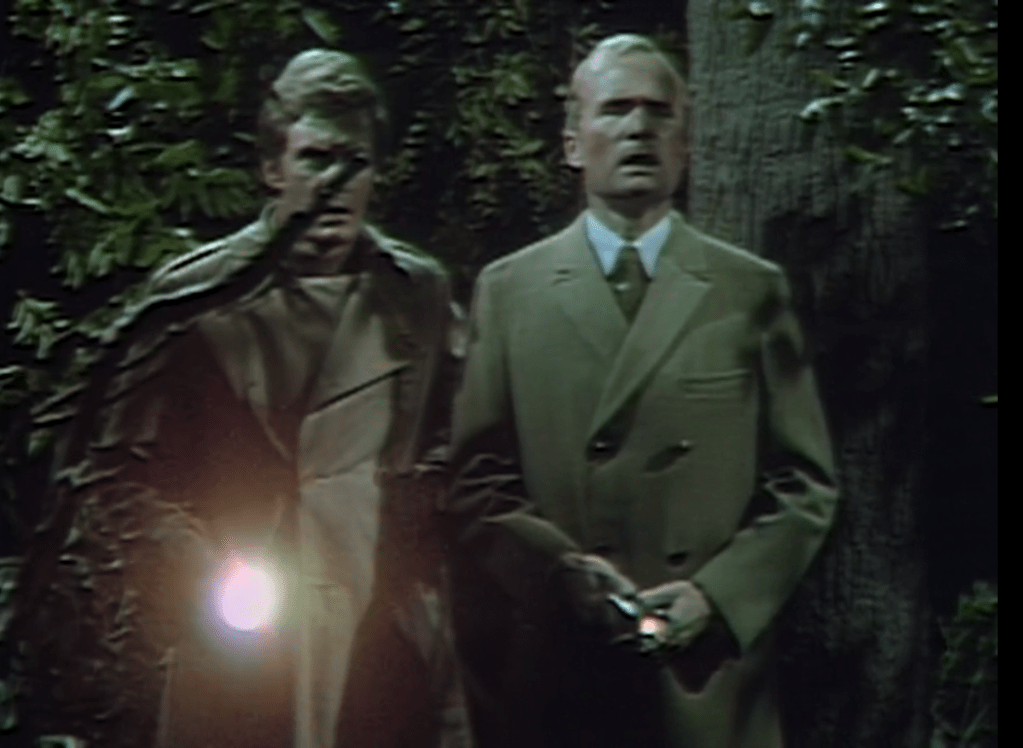
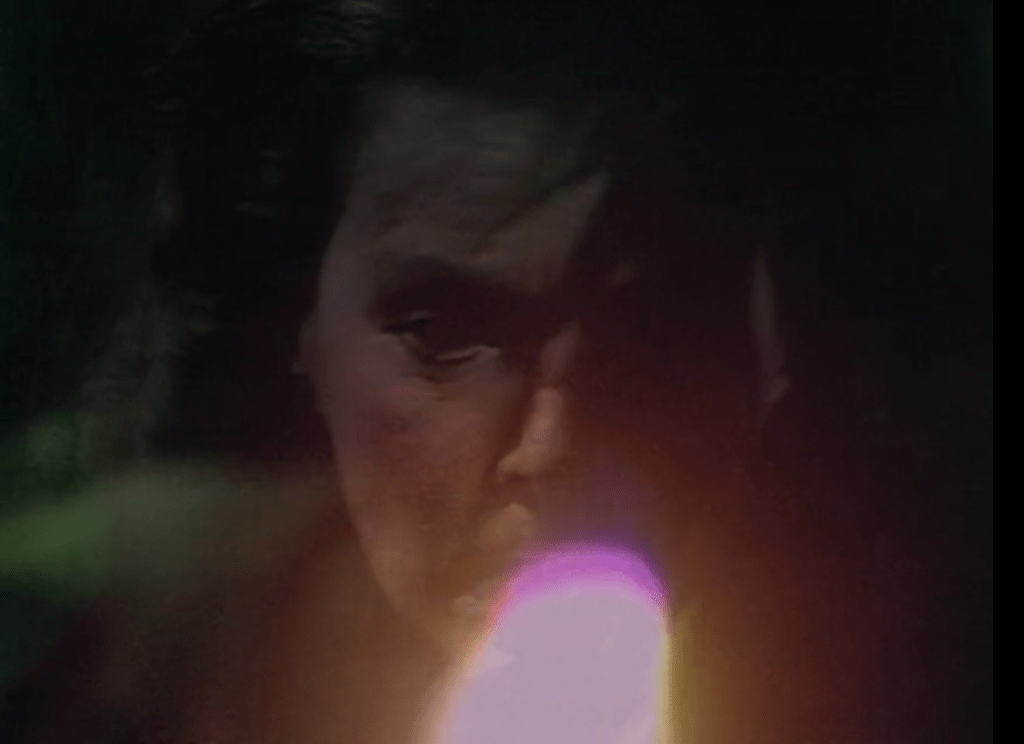
Later, Roger and Peter/ Jeff are outdoors looking for Liz. Each of them shines his flashlight directly into the camera. This is a Dark Shadows trademark. Sometimes it is clearly accidental; Peter/ Jeff does it once, briefly, and that may be an accident. But Roger does it twice, and each time the camera lingers on it. The first time comes as we cut from Liz in the graveyard to Roger and Peter/ Jeff, the second time as we dissolve from them back to Liz.
Cut to a closeup on Roger’s flashlightPeter/ Jeff accidentally shines his flashlight directly into the cameraDissolve to Liz from a second closeup on Roger’s flashlight
Liz is at the grave of Peter Bradford, which is to say Peter/ Jeff. He died in the 1790s and returned from the dead in March, a fact which is obvious to the audience and to Vicki but which he persistently denies. These denials are pointless and dull, but are the closest thing Peter/ Jeff has to a personality, so we can’t very well blame him for sticking to them. Peter/ Jeff finds Liz at his grave; she recognizes him as the dead man and faints. He carries her home. If there is any significance to any of this, it is apparently none of the audience’s business. The script certainly isn’t going to show us what it is.
Roger Collins is on the telephone in the foyer of the great house of Collinwood. He is assuring the caller that it will be fine if Maggie, whom returning viewers know to be The Nicest Girl in Town, comes to stay. He says that he and Cassandra will be glad to have her for as long as she wants to be with them, and that he is sure Liz will approve. First time viewers thus learn that Roger has a wife named Cassandra, and that they live as guests in a house belonging to someone called Liz. A moment later, Liz enters, and is too distracted to hear anything Roger says to her.
Roger ends the phone call, and follows Liz into the drawing room. She stares out the window and makes a gloomy remark about death. He says he understands she must be very upset about Sam Evans. Returning viewers know that Sam was Maggie’s father, and that he died in yesterday’s episode. Roger goes on about how it is natural to be grieved at the loss of a friend like Sam, but soon learns that Liz’ mood has nothing to do with Sam’s demise- it’s news to her that he is dead.
Roger’s lines will startle longtime viewers. For the first 40 weeks of the show, Roger and Sam were united by a deep and abiding mutual hatred, and since then they have had no contact at all. Roger’s words about Sam as a family friend are so far from what we have previously seen that they should be considered a retcon.
Liz and Roger spend several minutes in the drawing room. She keeps going on about the all-pervasive reality of death, and he keeps urging her to see a doctor. There isn’t much to their lines, but Joan Bennett and Louis Edmonds were such extraordinary screen performers that it’s always fun to watch them together. This scene might be a particular pleasure to longtime viewers, who have rarely seen Roger as the responsible adult in any encounter.
We dissolve to a bedroom where a young woman in a black wig is sifting through some powders, looking directly into the camera, and telling Liz that her obsession with death will become even worse than it already is and will have dire consequences. Liz will believe that she is someone else, a woman who lived and died in another century, and may die by the same poison that killed that person.
There is a knock at the door. It is Roger. The woman hides her powders and lets him in. He addresses her as Cassandra and asks why the door was locked. Thus first-time viewers learn that she is his wife, that this is their room, that she is a witch, and that Liz’ problem is the result of a spell she has cast.
Cassandra tells Roger that she locked the door because David kept pestering her about Sam’s death and she wanted a moment to herself. With that, first-time viewers find out that David is Roger’s son, that Cassandra is his stepmother, and that she expects Roger to consider locking him out of the room an appropriate response to his grief about Sam.
Roger does not so consider it, and is bewildered by what Cassandra tells him. He tells Cassandra that Liz is in a bad way, and he is worried about her. Cassandra says she did not know that Roger was so concerned about his family. Baffled by this, Roger says that of course he is concerned, Liz is his sister. This tells first time viewers both what Roger’s relationship to Liz is, and that Cassandra has so little sense of family that she cannot imagine how other people feel.
Regular viewers will learn more. In the first year of the show, Roger’s keynote was his lack of loyalty to the family. That has now been set aside once and for all, and his normal attachment to his son and his sister provide a contrast with Cassandra’s apparently sociopathic coldness. Further, we saw a great deal of Cassandra from November 1967 through March 1968, when the show was a costume drama set in the 1790s and she was called Angelique. We saw then that Angelique had no conception of family or friendship, and that her idea of love begins and ends with her control over a person.
Cassandra promises to join Roger downstairs for a game of bridge in half an hour. He leaves, and she gets back to work spellcasting. As she does so, a figure in a black cassock materializes behind her. She turns, and the figure vanishes. In a quizzical tone, she says Roger’s name, revealing that she did not see the figure or realize that it is a supernatural presence. Together with her locking the door, scrambling to hide her magical paraphernalia when Roger knocked, lying to cover what she was doing, and failing to understand what a person with a reasonable amount of human empathy would consider acceptable behavior, her puzzlement shows that whatever her powers may be, they have definite limits.
Back in the foyer, another young woman with black hair lets a man into the house. She calls him Joe, and he calls her Vicki. Joe and Vicki talk about Sam’s death and about Maggie. Joe says that he wants to marry Maggie as soon as possible and to move away. Vicki is all for their marriage, but does not want them to go. Joe talks about how close he and Sam were. Longtime viewers will remember that when Sam and Roger were enemies, Sam was the town drunk. Even then, Joe was always happy to help him in whatever way he could, and did not see his condition as any obstacle to marrying Maggie.
Liz enters and angrily addresses Joe as “Lieutenant Forbes.” Joe has never heard of Lieutenant Forbes, and cannot understand why Liz, who knows him well, would not recognize him. Vicki clearly does know who Liz is talking about, and manages to calm her down. After Liz apologizes and hastens away, Vicki answers Joe’s questions only by saying that Forbes is someone from “the past.” Since we heard Cassandra talk about Liz taking on the personality of someone who lived in “another century,” this suggests that Vicki, too, has an unnatural familiarity with that same century.
Joe wants to go upstairs to the room where Maggie is sleeping so that he will be the first person she sees when she wakes up. Vicki is about to lead him to Maggie when Cassandra insists she join her in the drawing room to talk about David. Vicki tells Joe which door to open, and complies with Cassandra’s directions. This shows that Vicki is a member of the household staff whose responsibilities have to do with David. Regular viewers know that she is his governess, and that they are very close.
Cassandra tells Vicki that David has been asking about Sam’s last words. Vicki says that he addressed them to Maggie, not to her, and implies that she did not hear them. When Cassandra continues probing, Vicki protests. She asks if Cassandra can’t see that she is upset. Considering how clueless Cassandra was about human feelings in her conversation with Roger, it is entirely possible that she cannot. Vicki tells her that Liz is deeply depressed; Cassandra feigns ignorance. Vicki says in a cold voice, “You wouldn’t know anything about that,” then leaves.
Longtime viewers know that it was Vicki who came unstuck in time in #365 and took us with her to the 1790s. During her nineteen weeks in the past, Vicki came to know not only Forbes, but Angelique. She knows perfectly well that Angelique and Cassandra are the same person, that she is a witch, and that she is a deadly menace to everyone. She likely suspects that Liz’ depression is the consequence of one of Cassandra’s spells, and the tone of her parting remark would suggest that she does. Further, those who saw the show yesterday know that Vicki is lying about Sam’s last words. They were addressed to her, and she heard them clearly. She is choosing not to repeat them to Cassandra lest Cassandra use them for her nefarious purposes.
Cassandra is alone in the drawing room for only a few seconds. She is joined there by the same figure who had appeared in her room. This time she sees him. He confronts her.
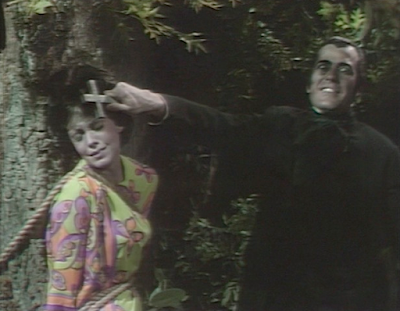
Regular viewers know that the figure is the Rev’d Mr Trask, a fanatical witchfinder who mistook Vicki for the witch in the 1790s and sent her to the gallows. He tells Cassandra that he now has the opportunity to correct that error. He shows her a cross, from which she recoils. We cut to a scene in the woods. Trask has tied Cassandra to a tree and performs an exorcism on her. This is Trask’s go-to technique; he tied Vicki to a tree in #385 and performed an exorcism on her in #386. Since Cassandra actually is in league with the devil (or as Trask would say, THE DE-VILLL!!!,) he has more success this time. Cassandra vanishes and leaves the ropes hanging on the tree.
A first-time viewer might take this climax as an indication that Dark Shadows is a Christian show and Trask is its hero. Not only is Trask going after the right target, he is clearly making some headway. He says all the right things about casting the evil out of Cassandra and saving whatever good is left in her. His delivery of his lines is so fervent that Mrs Acilius, a vigorous Christian, cheered him on. In fact, Trask’s wild incompetence throughout the 1790s segment led to one disaster after another, and was of a piece with the show’s light regard for religion. Not until #450 did a cross provoke a reaction from a monster; that was the first suggestion the show gave that there might be anything to Christianity, and the scenes between Cassandra and Trask today are the second.
Dark Shadows borrows story points freely from all sorts of books, plays, movies, and folklore. So far, it has steered clear of Christianity as a source. For obvious reasons- most of the audience is at least nominally Christian, and Christianity is, in one way or another, a live option for the rest. So it’s a topic that can take over very quickly once it is introduced. I suppose a specifically Christian version of Dark Shadows could have worked, but I can’t imagine that the staff they had would have been particularly interested in making a show like that. So when it looks like they are going to let Trask have even a temporary win, we see the show running one of its boldest risks yet.
Wicked witch Angelique (Lara Parker,) pretending to be named Cassandra, met sarcastic dandy Roger Collins (Louis Edmonds) one day and married him the next. Roger’s sister, matriarch Liz (Joan Bennett,) confronts Angelique/ Cassandra. Liz tells her that Roger has not been well and urges her to annul their marriage.
In the course of her confrontation with Liz, Angelique/ Cassandra reveals that she is not all-knowing. She thinks that Roger owns the great estate of Collinwood and the family’s business. Liz quickly explains that Roger owns nothing. He lives as a guest in her house and works as an employee of her company. Angelique/ Cassandra takes this in stride, and stands up to Liz’ insistence that the marriage must end. The only sign that Liz’ words are having an effect on anyone at all comes in the very last syllable of the scene. Unfortunately for Liz, it is not Angelique/ Cassandra who is intimidated by her, but Lara Parker who is intimidated by Joan Bennett. Angelique/ Cassandra’s mid-Atlantic accent vanishes and the purest musical note of Parker’s native Tennessee sounds as the word “you” emerges as “yeww.” If there had been another page or two of dialogue, she might have ended with a honeyed smile and a lethal “Bless your heart!”
From #395 to #461, Dark Shadows was a costume drama set in the late 1790s. In that segment, Angelique came to Collinwood as a servant girl and used her magical powers to manipulate scion Barnabas Collins (Jonathan Frid) into marrying her. Barnabas’ parents, Joshua (Louis Edmonds) and Naomi (Joan Bennett) were unhappy about the marriage. Joshua demanded that it be annulled, as Liz today demands Roger and Angelique/ Cassandra’s marriage be annulled. Naomi took a more conciliatory approach. Advocating Joshua’s position and but showing Naomi’s temperament, Liz combines two challenges Angelique has already shown herself able to overcome easily. Returning viewers will therefore have little hope that Liz will be able to stave off the disasters Angelique has in mind for the Collinses.
Angelique/ Cassandra is eager to get to work on the evil plans she has for the people at Collinwood, and so she is trying to stop Roger taking her on a honeymoon. She contrives to injure her ankle. We see permanent houseguest/ medical doctor/ mad scientist Julia Hoffman (Grayson Hall) in the bedroom Angelique/ Cassandra will be sharing with Roger, bandaging her ankle. Angelique/ Cassandra asks a series of questions about old world gentleman Barnabas Collins (Jonathan Frid,) making Julia visibly uncomfortable.
Barnabas is the same man Angelique married in the 1790s. He is here in 1968 because she turned him into a vampire then. He was relieved of the symptoms of vampirism only a couple of weeks ago. He and Julia are becoming fast friends, and on Tuesday he told her all about Angelique. He identified her as the woman in a portrait that has obsessed Roger, and expressed his belief that Roger’s obsession was a sign that Angelique herself was returning to Collinwood. Julia can see how strongly Cassandra resembles the portrait, and knows that Roger’s obsession led directly to his marrying her, so she really ought to have figured out by now that she is Angelique.
Like the scene between Angelique/ Cassandra and Liz, the scene between her and Julia makes an instructive comparison with the parts the same actresses played in the 1790s segment. Angelique was originally lady’s maid to the Countess DuPrés. We saw her helping the Countess put herself together in a bedroom that was a different dressing of the set on which Julia is now attending to her foot. This apparent reversal of roles illuminates the extent to which Angelique’s command of black magic always made her a mightier figure than her nominal mistress. As a mad scientist, Julia is far more formidable than was the countess, but this scene leaves us wondering if she will be able to stand up to Angelique for any longer than could her counterpart.
Well-meaning governess Vicki (Alexandra Moltke Isles) had traveled back in time and was at Collinwood through the 1790s segment. She recognizes Angelique, knows well how dangerous she is, and is desperate to stop her. She tries to tell Liz about the situation, but Liz has a very limited tolerance for information about the supernatural. Vicki later meets Julia at the gazebo on the grounds of the estate and shares her information with her. Julia knows as much as anyone about the strange goings-on, and what Vicki tells her confirms what she already has reason to suspect. However, Julia pretends to have trouble believing Vicki.
This pretense enables Julia to probe the limits of Vicki’s own knowledge. Barnabas and Julia do not want Vicki to know any of Barnabas’ secrets. Julia incredulously asks Vicki if she thinks the Barnabas Collins of 1968 is the same person she knew in the eighteenth century. Vicki turns away from Julia, looks troubled, and says that she does not believe this. Vicki has encountered plenty of evidence to that effect, not least when Barnabas bit her and sucked her blood, and the audience wonders what she knows. We see Julia studying her, trying to find the answer to the same question. In the first year of Dark Shadows, Vicki represented the audience’s point of view, the resolutely normal outsider getting to know the Collinwood crazies. In this moment, we see Vicki through Julia’s eyes. We identify, not with any sane person from the world of sunlight and natural laws, but with a mad scientist who has cast her lot with a vampire.
Vicki thinking about Barnabas, with a facial expression straight out of MAD magazine. Screenshot by Dark Shadows Before I Die.
Angelique/ Cassandra and Roger chat in their bedroom. He seems utterly delighted to be married to her, until she slips something into his drink. Suddenly he starts having doubts. Nothing we have seen leads us to expect she would want him to feel this way. The scene leaves us scratching our heads.
We end with Angelique/ Cassandra alone in the foyer of the great house, looking at the portrait of Barnabas that hangs there and vowing to restore the curse that had made him a vampire. We know that she is Angelique and that such is her goal, so her speech doesn’t set up any new story points.
It does give us some world-building information. Angelique says that the only way she knew that Barnabas was walking among the living in the 1960s was that Vicki had traveled back in time to the 1790s and told her. That explodes a theory some fans like that Angelique herself called Vicki back in time. When Vicki left the 1960s in #365, it was quite clear that the ghost of Barnabas’ little sister Sarah was sending her on the journey. Sarah has been fading steadily from our awareness, not least because child actress Sharon Smyth aged out of the part, and so it is not surprising that people expect a retcon to attribute the time travel story to a different force. But not only does Angelique rule herself out with this line, Sarah’s name comes up in the conversation between Julia and Vicki, reminding regular viewers of the original explanation.
More importantly, it confirms that once one person has made a wrong-way journey through time, a gate opens through which other unexpected things may come. To some extent we saw this when Barnabas himself was released from his coffin and Sarah’s ghost began showing up around the estate. The cosmological point will become extremely important for the rest of Dark Shadows, as one time-travel story keeps leading to another. Dark Shadows is often described as the story of the house, and so I can’t resist an inelegant metaphor from the building trades. It’s as if Vicki wrecked the plumbing of the universe when she went through the pipes backwards and then abruptly forward. Time will never flow the right way again.