Episode 929: The convergence

For the first 55 weeks of Dark Shadows, matriarch Elizabeth Collins Stoddard was under the impression that she had killed her husband Paul and that Paul’s associate Jason McGuire had buried his corpse in the basement of the great house on the estate of Collinwood. She spent nineteen years at home, terrified that if she left the estate someone might find Paul’s grave and hold her to account for his killing. Finally it turned out that she had only stunned Paul. He and Jason had faked his death to trick Liz into giving them a lot of money. Soon, Liz was no longer a recluse and that whole story was forgotten.

Now, Paul has returned. He denies knowing anything about his fake death, claiming that Jason acted alone. Longtime viewers will be skeptical of this claim, and Liz certainly is. But she doesn’t care about it as much as you might expect. She is now part of a secret cult that serves mysterious supernatural forces known as the Leviathan People, who plan to take over the earth, supplanting the human race. Paul has learned that he inadvertently sold Carolyn Collins Stoddard, his daughter with Liz, to the Leviathans, and he has been trying to sound the alarm about them. As a serenely happy devotee of the Leviathan cult, Liz has agreed to keep Paul at Collinwood where she can drug him into immobility.

The power of the Leviathans has taken bodily form in a succession of children who live in an antique shop in the village of Collinsport. The shop’s owners, Megan and Philip Todd, were the first people inducted into the cult by Liz’ distant cousin, old world gentleman Barnabas Collins. The latest manifestation of this being, an apparently thirteen year old boy known as Michael, had been attracting attention that threatened to blow the cult’s cover, so Philip and Megan faked his death. They held a funeral this morning.

Michael is supposed to retire into his room above the antique shop and stay there until he has graduated to his next form. He comes out and tells Megan and Philip that he has decided not to go through with this plan. Philip picks him up and carries him there, putting a new lock on the outside of the door to keep him in until he has gone through another transformation.

Carolyn calls the Todds and extends her mother’s invitation to an evening at Collinwood. They accept.

Unknown to Liz or the Todds, Barnabas has become disaffected from the cult. He visits Paul in his room. He gives Paul clothes and a lot of money and urges him to go far away. Paul doesn’t trust Barnabas, and holds him at gunpoint throughout their entire conversation.

When the Leviathan cult first emerged, its members were siloed off from each other. Barnabas gave Philip and Megan their instructions in dream visitations. When they were awake, they would not recognize him as their leader. They and Liz were not aware of each other’s connection to the cult, though Liz did know that Barnabas was her leader and her nephew David Collins was a fellow cultist. It reminded us of secret operations in the real world, where only people who work with each other directly are allowed to know of their shared allegiance.

Now, all that security is out the window. Liz and the Todds stand around the drawing room at Collinwood having drinks and talking about what Barnabas has and has not told them about the Leviathans and their goals. They do still keep some secrets, however. Liz says that she can’t help but wonder what Carolyn’s role will be in the time to come. Barnabas and the Todds know that she is fated to be the bride of the force currently incarnated as Michael, but they are not allowed to tell Liz this. They look at each other with alarm, and Barnabas gives her some vague and hasty assurances.

There is an unintentionally hilarious moment during the cocktail party scene. Megan is seized by enthusiasm for the Leviathan project, and starts babbling all sorts of portentous phrases about the new world that is taking shape through their efforts. Marie Wallace was one of the most committed exponents of the Dark Shadows house style of acting, which consists largely of delivering your lines so vehemently that you are in constant danger of spraining your back. For her part, while Joan Bennett sometimes played to the balcony as Liz and her other characters, she never really let go of the urbane and relatively understated approach that made her one of the biggest movie stars of the late 1930s. When Liz responds to Megan with the amiable smile and subtly musical voice of a sophisticated society hostess, it all of a sudden strikes regular viewers who have got used to the show’s peculiarities just how incredibly bombastic Miss Wallace was.

Meanwhile, Paul goes through a lot of business with Barnabas and Carolyn in which he is told to wait an hour, no half an hour, no ten minutes, before leaving the house. He steals the keys from Megan’s purse and sneaks off to the antique shop. He has decided he must figure out what exactly is going on there. He lets himself into the room where the Leviathan force is kept when it is not embodied as a child. He hears a heavy breathing. The camera zooms in on his shocked face. With that, the episode closes. Paul’s future would appear to be extremely brief. On the day of Michael’s phony funeral, he seems likely to bring the show’s first fake death firmly into the realm of the actual.
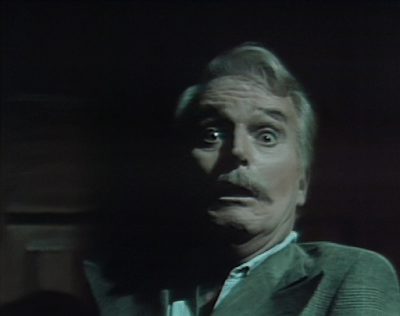
Paul gets more than he bargained for. Screenshot by Dark Shadows Before I Die.

Today marks Michael Maitland’s last appearance as Michael. He did a lot of acting as a child, including major roles on Broadway both before and after his run on Dark Shadows. Playing Michael didn’t give him much chance to show what he could do. His resume suggests that is a shame- he must have had a lot to offer to get all those big parts. And by all accounts, he was a very nice guy.

Michael Maitland died of cancer in 2014, at the age of 57. That means that three of the five child actors who appeared on Dark Shadows during the Leviathan segment have died. Denise Nickerson, who played Amy Jennings, was 62 when she died in 2019; Alyssa Mary Ross Eppich, who under the name Lisa Ross played the Leviathan child in the guise of an eight year old version of Carolyn in #909, was 60 when she died in 2020. David Henesy, who played David Collins, and David Jay, who played the Leviathan child as an eight year boy called Alexander, are still going strong. So too is Sharon Smyth Lentz, who played the ghost of nine year old Sarah Collins in 31 episodes in 1967 and the living Sarah in six episodes in 1967 and early 1968.
Episode 926: I don’t want to know who you are

This episode has the same story as Friday’s.

The current A-story is about the coming of the Leviathans, mysterious beings who act through a cult that has absorbed several people in the village of Collinsport and on the estate of Collinwood. Antique shop owners Megan and Philip Todd have been entrusted with the care of a creature that has assumed the forms of several human children in succession. This creature, currently presenting itself as a thirteen year old boy named Michael, is extremely obnoxious to everyone for no apparent reason, prompting them all to reconsider their commitment to the program. Philip is ready to turn against the Leviathans; Megan from time to time admits that he is onto something, but by the end of yesterday’s episode was back under Michael’s control. She had said Philip needed to be got out of the way and picked up a gun.

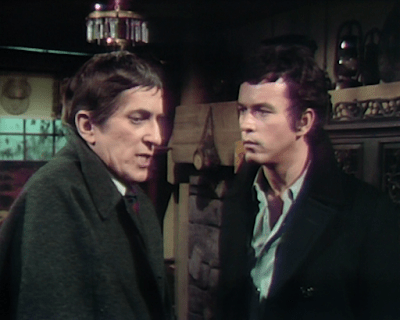
Old world gentleman Barnabas Collins goes to the Todds’ shop in the village. He finds Megan pointing her gun at Philip and orders her to cut it out. Barnabas had been the leader who initiated the Todds into the cult and as we hear his thoughts in internal monologues today we hear that he still has some loyalty to it, but Michael has been too much for him. When he tells Megan to listen to him instead of Michael, she is shocked at his sacrilegious words. He hastily claims that he was only testing her.

Barnabas and Philip have a staff conference. Screenshot by Dark Shadows Every Day.

For his part, Michael is at the great house of Collinwood. Last night he was there as the guest of strange and troubled boy David Collins, who has shared supervision of the Todds with his distant cousin Barnabas. David’s governess, Maggie Evans, is not a member of the cult, and she had done something that bothered Michael. So he trapped her in the house’s long-disused west wing. She is still trapped there, and he has returned to use his powers to torment her further. David is anguished about this, but does not feel he can oppose Michael.

Maggie’s captivity prompts us to ask just why it is so frustrating that this episode is essentially a duplicate of Friday’s. In May and June of 1967, Barnabas was a vampire, he was holding Maggie prisoner in his basement, and there were a number of duplicated episodes. It was during that period that the show first became a hit, and it is that story that every revival of the show, from the 1970 film House of Dark Shadows on, goes out of its way to incorporate.

I think what kept people coming back to watch Barnabas’ imprisonment of Maggie was not so much what he was doing to her, but his relationship with his blood thrall Willie. In the course of Barnabas’ abuse of Maggie, Willie went through all of the psychological phases that Megan, Philip, David, and Barnabas exhibit today. I think the actors playing all four of those characters live up to John Karlen’s performance as Willie; even those who disagree with me on that will have to concede that some of them do good work. So the problem is not with the performances.

Rather, these episodes fall short because the character of Michael does not have the depth Barnabas had in the spring and summer of 1967. We kept wondering what Barnabas was thinking, and the more we learned about him the more puzzled we became, since all his ideas were so crazy. In his role as Barnabas’ external conscience, Willie gave us grounds to hope that we would eventually reach a layer of his mind where the nonsense would give way to something intelligible. But we don’t wonder what Michael is thinking, because there’s no evidence Michael is thinking at all. He demands submission from all and sundry and flies into a rage the instant he encounters resistance. He is just a spoiled brat.

Moreover, as a vampire Barnabas needed people to protect him during the day and to surrender their blood to him at night. When David is slow to submit today, Michael tells him he doesn’t need him or anyone else. This seems to be all too true- nothing is at stake for Michael in any interaction. No matter what Michael Maitland brings to the part, no matter how well his four Willies play their roles, the character is a dead end.

One viewer who seems to have been carried away with his frustration with this one is Danny Horn, author of the great blog Dark Shadows Every Day. His post about it includes some rather obtuse remarks about the performances, some of which fit with his usual shortcomings (e.g., his habitual underestimate of David Henesy’s acting.) But in other comments he loses track of his own analysis. For example, time and again throughout the blog he stressed that the show was made for an audience that saw each episode only once, and that their memories of the images that had appeared on their television screens would drift over time. When a particular moment makes a big enough impact that it is frequently referred to in later episodes and is a topic of discussion among fans, the images of that moment that appeared on screen during the original broadcast are at most a starting point, something that the viewers build on in their imaginations, so that the pictures that memory supplies soon enough have little or nothing in common with what was actually produced.

Danny makes all of these points over and over. Yet his post on #926 ends with this objection to the invisible form Michael and the other Leviathan boys assume when they are supposed to be mighty:

Dark Shadows actually has a great track record at creating scary things out of not that much money. The legendary hand of Count Petofi was incredibly cool and memorable — a Halloween decoration that they invested with real power. The scariest thing about the legendary hand was that it wasn’t under anybody’s control, even Petofi’s; it would fly around on its own, doing unexpected things. Not an expensive or difficult effect, just good writing, using what they have to tell an interesting story.

Television is a visual medium; we need to see the thing that the story is about. “It’s better in your imagination” is just a way to weasel out of coming up with a compelling visual. If you can’t actually show us the monster, then maybe you should consider a non-visual medium like print, or radio. Or not doing it at all.

Danny Horn, “Episode 926: The Shark, and How to Jump It,” posted on Dark Shadows Every Day, 15 September 2016.

I reached that point in Danny’s blog more than four years after the post went up, but even so I felt compelled to join those who piled on him for those two paragraphs. Here’s what I wrote:

I don’t think there would be a point in showing the monster. If the monster had done anything really scary, our imaginations would be working overtime to frighten us. Any image they put on screen would let the steam out of our anxieties. And since it hasn’t done anything scary, we won’t be worked up when we see it. Looking at it calmly, we’ll just be examining a costume or a prop or a visual effect or whatever.

Now, you can show the audience a thing or a person that looks harmless, and then build up fear around it. That’s what they did with The Hand of Count Petofi, which Barnabas observes with utter contempt when Magda first shows it to him, but which then wreaks havoc. Or you can build up a fear, introduce a person, and suddenly connect the person with the fear in an unexpected way. That’s how they gave us Barnabas- Willie opens the box, there are vampire attacks, a pleasant man shows up wearing a hat and speaking with a mid-Atlantic accent, and then we see that man without his hat, waiting for Maggie in the cemetery. There are lots of ways to scare an audience, but showing a picture of something that’s supposed to be scary isn’t one of them.

Comment posted 17 December 2020 by “Acilius” on Danny Horn, “Episode 926: The Shark, and How to Jump It,” posted on Dark Shadows Every Day, 15 September 2016.

I still agree with that, more or less, though I suppose it makes the creative process sound a lot tidier than it ever is. I do wish I’d thought of the comparison I make above between the four disaffected cultists and Willie. Danny’s blog was still drawing comments in those days, and I think that would have attracted some responses.

Episode 924: Afraid of the dark

Mad scientist Julia Hoffman finds that wicked witch Angelique has married a businessman who has a house on an island off the coast of central Maine. Angelique tells Julia that her husband’s love has freed her to live as a human being, and that for the sake of that love she has renounced her powers. In #882, set in the year 1897, Angelique said that she would soon have to return to the underworld unless she could find a man who would love her. The show has since returned to a contemporary setting, and she met her husband less than a year before, sometime in 1969. Evidently her time wasn’t running as short as she led us to believe it was.

In the 1897 segment, the show was quite clear that Angelique was aligned with Satan and that the underworld she was talking about was a Hell that Dante or Milton or other Christians would have recognized. The deal she described with her master therefore made little sense then. But Dark Shadows has drawn freely on the mythologies of many cultures and has made up stories about supernatural worlds of its own. The borrowings from the Christian tradition are a relatively minor part of the universe they have been patching together, and they have recently given us reason to suspect it is something they are backing away from. So I don’t think we are under any obligation to reconcile Angelique’s account of the lord of the damned with the teachings of any church.

Angelique is afraid that Julia has come to reenlist her in the cosmic battles surrounding the estate of Collinwood. In fact, Julia had no idea she would find Angelique. She went to the island because she had figured out that a painting she was looking for was there. It is a magical portrait of rakish Quentin Collins, obscured by a landscape painted over it. Quentin has amnesia, and Julia apparently thinks that if she shows him the portrait she will be able to jar some memories loose.

Angelique agrees to let Julia take the painting and expose Quentin’s portrait, on condition that the overpainting be exactly reproduced on another canvas and brought back to the house on the island before her husband knows it was gone. Julia suggests they tell him a lie that will give them more flexibility, but Angelique says he is “a very thorough man” and would ask too many follow-up questions if they gave him any information at all.

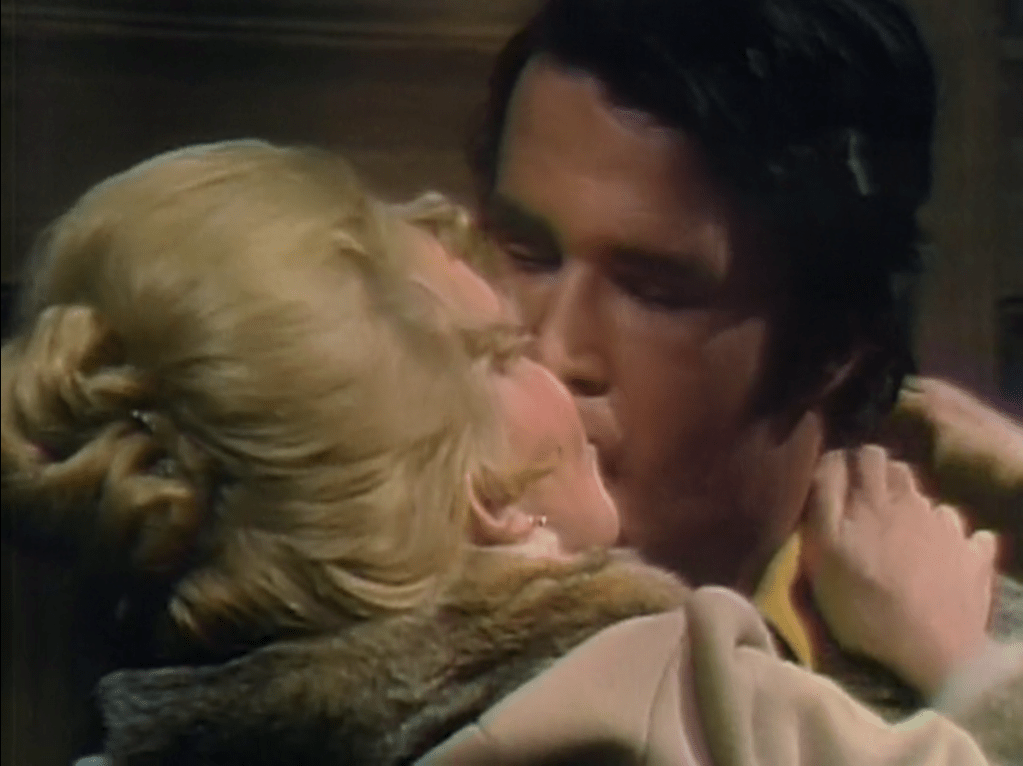
Before and after her scene with Julia, we see Angelique with her husband. The first scene begins with some very awkward kissing. The awkwardness is partly due to Geoffrey Scott’s total incompetence as an actor; he stands stiffly while Lara Parker simultaneously kisses him and nudges him to his mark, making it look like she is moving a couch. But part of the blame must rest with director Lela Swift, who set up the shot from an angle that puts the emphasis on the straining muscles in Parker’s neck and back. Perhaps Swift overestimated Scott’s abilities.

“Move three inches back and to the right, dummy, you’re supposed to be in the center of the frame!”

This scene is accompanied by some music for a small string ensemble; I don’t believe we have heard the track since the very early days of the show. It feels jarringly old-fashioned. All of Dark Shadows’ orchestral score strikes 21st century viewers as a relic of an earlier era, but it set it apart from other daytime soaps of the 1960s and early 70s, most of which had an organ playing on the soundtrack. Compared to the organ accompaniment, which today’s audiences would find simply intolerable, I suppose even these creaky old violins are relatively modern.

The second scene ends with a more successful kiss. It is accompanied by a woodwind piece that used to be associated strongly with well-meaning governess Vicki and her doomed love for dashing action hero Burke Devlin. Burke was written out of the show in 1967, Vicki in 1968, and this music cropped up occasionally in 1969 during sentimental moments. It is still noticeably more old-fashioned than the rest of the score, albeit more dynamic than the string serenade that went along with the first kiss.

Meanwhile, in the great house at Collinwood, strange and troubled boy David Collins is coming down with a cold. David’s governess, Vicki’s successor Maggie Evans, is trying to get him to take his schoolwork seriously. A boy known as Michael appears in the house and announces that he and David will be playing now. Maggie explains that it is not a good time, and Michael bullies both her and David into giving him his way.

Michael is not really human, but is a manifestation of a supernatural force that has subjugated David and many other people. Seeing Michael push Maggie around, we might remember May and June of 1967, when Maggie was the prisoner of vampire Barnabas Collins. Those episodes were bleak and at moments painful to watch, but they also drew a new audience and made Dark Shadows, for the first time, a hit.

Barnabas attracted a crowd, not simply because he was cruel to Maggie, but because we wondered how others would react to his evil deeds, because his motives were unbelievably zany, and because actor Jonathan Frid took a visible joy in playing him. He became a breakout star, familiar to millions who never saw a single episode of Dark Shadows or knew anything else about it, because he generated stories that allowed the whole cast to shine, followed his crazy ideas to the point where many of them became the realities of the show’s narrative universe, and had quirks that dovetailed perfectly with Frid’s strengths.

Michael has none of these things going for him. When he is nasty to Maggie, he does not produce any suspense as to what others will do. Not only do most characters assume that as a teacher she will be able to handle an obstreperous child by herself, but most of the people to whom she would likely turn for support are among Michael’s subordinates. There are no crazy ideas bursting out of him- he is just a little tyrant, who at no point seems to have any hidden motives or nuances of feeling. And Michael Maitland seems depressed the whole time he is on screen. As a result, Michael is as straightforward and tedious as Barnabas was luridly intriguing.

When Barnabas was holding Maggie prisoner, his blood-thrall Willie felt sorry for her. He occasionally made efforts to help her, none of which did anything but make her situation even worse. John Karlen’s portrayal of the feckless Willie brought him almost as much fan mail as Jonathan Frid received during that period. Today it is David’s turn to play Willie to Michael’s Barnabas, and he does not disappoint. Thirteen year old David Henesy plays David Collins’ conflicted feelings more subtly than Karlen had played Willie’s, and as a result we watch him very closely. Disappointed as we may be in Michael, Mr Henesy’s triumph in these scenes brings the episode to a strong close.

Episode 919/ 920/ 921: The giver without a gift

Centenarian Charles Delaware Tate, once a famous painter, is trapped in his parlor with a man who is threatening to kill him. The man is Chris Jennings. Chris tells Tate that there will be a full moon tonight, and he identifies himself as a werewolf. In 1897, Tate painted a portrait of Chris’ great-grandfather, Quentin Collins. That portrait had magical powers that immunized Quentin against both lycanthropy and aging, and Chris is demanding Tate do the same for him. Tate keeps telling Chris that he no longer has the ability to create such things, but Chris won’t listen. Tate does a sketch. He says that his work is finished and tells Chris to take it and leave. Before Chris can comply, he turns into the wolf and attacks Tate.

Chris had been in a secure room at a mental hospital controlled by his friend, mad scientist Julia Hoffman. He deliberately checked himself out and forced his way into Tate’s house because he wanted to use his condition as a weapon to coerce Tate. Julia is the audience’s chief point of view character these days, and she feels sorry for Chris. We also like two characters who care about Chris and don’t know that he is a werewolf. Heiress Carolyn Collins Stoddard is attracted to Chris and seems to have some lingering hopes that a romance might blossom between them, and Chris’ little sister Amy loves him and believes in him. Even one of Chris’ surviving victims, prematurely gray Sabrina Stuart, told Carolyn in #889 that while Chris is dangerous, “he is good.”

Despite everything these ladies are doing to help us like Chris, there can be no doubt that his attack on Tate is murder with premeditation and extraordinary cruelty. Roger Davis can usually be counted on to make us sympathize with anyone who is murdering one of his characters, but he plays Tate today with sensitivity and pathos, leaving us no way to avoid seeing a helpless old man locked up with a vicious killer. Chris’ future on Dark Shadows is limited for a number of reasons, chiefly his passivity in the face of his curse and his dependence on Julia and others to initiate action on his behalf. His abuse of Tate suggests that for whatever time he may have left on the show, Chris will be an unsympathetic villain.

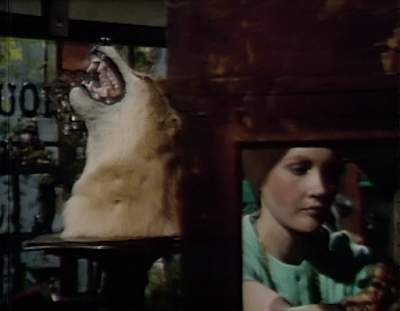
Meanwhile, Carolyn is spending the day working as an assistant in an antique shop owned by her friends Megan and Philip Todd. Our first view of the shop today features Carolyn reflected in a mirror, but the main part of it is the taxidermied head of a baying wolf, emphasizing the danger Chris poses to everyone in and around the village of Collinsport.

The Wolf is loose, Carolyn is boxed in. Screenshot by Dark Shadows Before I Die.

A pair of hands cover Carolyn’s eyes. When they are pulled away, she expects to find that they belong to Philip’s eight year old nephew Alexander, but instead discovers that a thirteen year old boy she has never before seen has introduced himself to her by creeping up behind her and grabbing her face. The boy tells her that his name is Michael, that he is another of Megan and Philip’s relatives, and that Alexander has gone away. He tries to give Carolyn a pendant, but she recognizes it as one Megan wears and says that Michael can’t very well make a gift of something that doesn’t belong to him. He becomes very stiff and screams “How dare you not believe me!?” He doesn’t get any more pleasant as the scene goes on.

Philip comes in and tries to establish some kind of control; Carolyn takes the opportunity to excuse herself. As Michael and Philip talk, it becomes clear that they are part of a secret group with sinister plans. Returning viewers know that Michael and Alexander are not really human children, but are two manifestations of the same supernatural force. As Alexander, this force was a joyless, hateful little tyrant; Michael is no more appealing.

Dark Shadows originally ran on the ABC television network five days a week, from Monday through Friday. The episodes were numbered in a sequence reflecting the order of their original broadcast. When for whatever reason the show did not air on a given day, they would skip a number to keep the episodes airing on Fridays associated with production numbers divisible by 5. That made it easy to figure out how many weeks the show had been on, which in turn made it easy to keep track of where the show was in the thirteen week cycle that governed its long-term planning and the network’s decision to renew it.

In the last months of 1969, the show was being taped several weeks in advance of airdates, in a couple of instances more than five weeks ahead of time. This was atypical, and it led to a problem with the numbering. They knew that no episodes would air on Thanksgiving Day, Christmas Day, or New Year’s Day, but did not foresee that the network would preempt #891 for live news coverage of the return of the Apollo 12 astronauts to Earth on 24 November 1969. Since they had already shot that episode and many following it with the original production numbers on the opening slate, it wasn’t until this one that they had the chance to get the numbers back in synch. That is why it is listed with the three numbers 919, 920, and 921. The only other time they had to skip two numbers was in November 1966, when coverage of football games on and after Thanksgiving Day blotted out #109 and #110. Since that disruption to the schedule was planned, the slate for the next episode was just marked #111. This is therefore the only episode regularly referred to with a triple number.

Episode 915: Emergency Leviathan Broadcast

In #701, old world gentleman Barnabas Collins traveled in time from 1969 to 1897. For the next eight months, ending in #884, Dark Shadows was a costume drama set in that year. On his way back to a contemporary setting, Barnabas took a detour to the 1790s, when he was a vampire. Before he left the 1790s, he was abducted by and absorbed into a cult that serves supernatural beings known as the Leviathans. At their behest, he took a small wooden box with him to November, 1969, and functioned as one of the leaders of the Leviathan cult in that period.

The first six weeks of the Leviathan story has had its strengths. Ever since Barnabas was first cured of vampirism in March 1969, he has been under the impression that he was a good guy and has been doing battle with various supernatural menaces. He was hopelessly inept at this, and created as much work for the other characters by his attempts at virtue as he formerly did in his unyielding evil. That has made him a tremendously productive member of the cast, but it does leave him with a tendency to seem harmless, even when he is trying to murder his way out of a problem. But Barnabas the Leviathan chief has been ice-cold and formidably efficient. Even though not much has yet been done to hurt anyone, seeing him in this mode adds a note of terror to the proceedings.

Moreover, the Leviathans have voided Barnabas’ friendship with mad scientist Julia Hoffman. Since the relationship between the two of them has been the heart of the show for over two years now, from the hostility of their early days to the close bond they formed in the summer of 1968, this reinvigorates the action. It is as interesting to see them fight with each other as it is to see them collaborate against a common foe, and their hate scenes gain an extra depth because we keep wondering about their eventual reconciliation. If they play their cards right, they should be able to keep this up for months.

Today, it all falls apart. Barnabas has drawn a huge following of very young fans who run home from elementary school to watch the show. The 1897 segment was a triumph in large part because it had a core of stories that could hold the attention of adults while also appealing to the preteen demographic. But the Leviathan arc has so far had little to offer anyone but grownups. Apparently the kids were writing angry letters, because this episode, rushed into production at the last minute and bearing signs of haste in every shot, turns Barnabas back into the would-be hero who was such a klutz that he couldn’t even stay in the right century.

The creature who emerged from the box Barnabas brought from the past now appears to be a 13 year old boy and answers to the name Michael. In the opening scene, Michael orders Barnabas to kill Julia. Barnabas declares that he will not, and goes home. There, he tells his troubles to the box, then falls asleep in his chair.

A hooded figure appears to him. This hooded figure says that he is a Leviathan, and tells Barnabas he must comply with Michael’s commands. The Leviathan is not named in the dialogue and there are no actors’ credits at the end, but reference works based on the original paperwork call him Adlar.

Adlar sets out to explain Barnabas’ position, much as Marley’s ghost did to Scrooge in Dickens’ A Christmas Carol. The shortened production schedule shows in inconsistencies that litter Adlar’s speeches. At one point he says that the Leviathans needed Barnabas to transport the box from the eighteenth century to the twentieth; at another, he claims that they are holding his lost love Josette prisoner in the eighteenth century and will inflict a new, far more horrible death on her than the one she died the last time Barnabas was in the 1790s, a threat they will be able to carry out only if they have their own means of traveling back and forth through the years. Barnabas doesn’t pick up on this or any of Adlar’s other inconsistencies; perhaps he is too distracted by the many jump cuts that make this episode look like the videotape was edited with a rusty butter knife.

Adlar threatens to make Barnabas a vampire again, then disappears. He does not tell him that he will be visited by three spirits, one representing his past, another his present, and the third the future he is risking by his present course of action, but this is in fact what happens. Barnabas goes outside, and sees a bat. It was a bat whom he first saw on this very spot who initially made him a vampire. Barnabas rushes inside, looks in the mirror, and does not see a reflection. He thinks of his mouth, and feels fangs growing there.

Next comes Megan Todd, a Leviathan cultist who with her husband Philip is fostering Michael in their home. Barnabas cannot take his eyes off Megan’s long white neck. Megan keeps telling Barnabas that he is the only one she can confide in about her concerns with the progress of the Leviathan plan; he keeps demanding ever more stridently that she leave at once. His bloodlust may explain why he doesn’t notice the continuity problem in the scene. They’ve made the point time and again that it is only while Barnabas is giving orders to her and Philip that Megan remembers that he is their leader. At other times, she thinks he is an outsider. But Megan is the only one who can tell Barnabas a story of family life in any way paralleling that which the Ghost of Christmas Present brings to Scrooge’s attention at the Cratchit house. Continuity has to go if the episode is going to fit into the form of A Christmas Carol.

Suddenly, Barnabas finds himself in an alley by the waterfront. A sign behind him says that he is next to the Greenfield Inn; we saw this sign in #439, set in the year 1796. Evidently the Greenfield Inn is a long-established, though not very reputable, place of lodging.

A woman approaches him. She is very aggressive about insisting he take her with him wherever he is going. He is reluctant at first, urging her to seek friends at the Blue Whale tavern, but she won’t take no for an answer. All of a sudden, he brightens and looks at her with desire. She says she is afraid of him. He asks if she wants to go, and she screws up her courage to declare that she will stay with him. He bares his fangs and attacks. The rough videotape editing adds to the violence of the scene. There is no sensuous bite, only a flash as he lunges at her and then is standing up again, protesting that he didn’t want to do it. When the camera zooms in on the bleeding marks on her neck, it is surprising to see that he didn’t rip her throat out altogether.

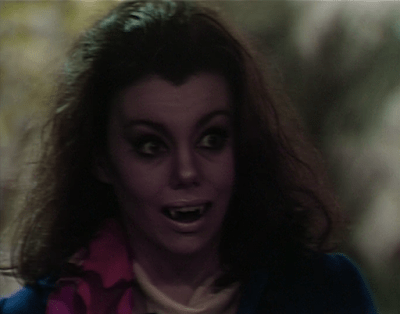
We cut back to Barnabas’ house. He is dozing in his chair, and the woman, displaying vampire fangs of her own, walks in through the front door. She approaches Barnabas. He awakens, and is horrified. Adlar tells Barnabas that “she is not up to your usual standards.” She’s standing right there, that’s pretty tactless. Also, she is future four-time Academy Award nominee Marsha Mason. The only other Oscar nominee Barnabas bit was Grayson Hall as Josette’s aunt, the Countess DuPrés, in #886. Hall was only nominated once, so if anything this woman is a step up for him.

Four time Academy Award Nominee Marsha Mason. Screenshot by Dark Shadows Before I Die.

Adlar makes the woman disappear, and shows Barnabas that he is not really a vampire again. With that, we see that she is a shade of a future that may come to be, not one that is already ordained. Adlar also tells Barnabas that it is not now necessary to kill Julia. But he does say that Barnabas will have to do something to ensure Julia’s silence, or else Josette will suffer. Barnabas hangs his head and says to the mirror that he has no choice to obey.