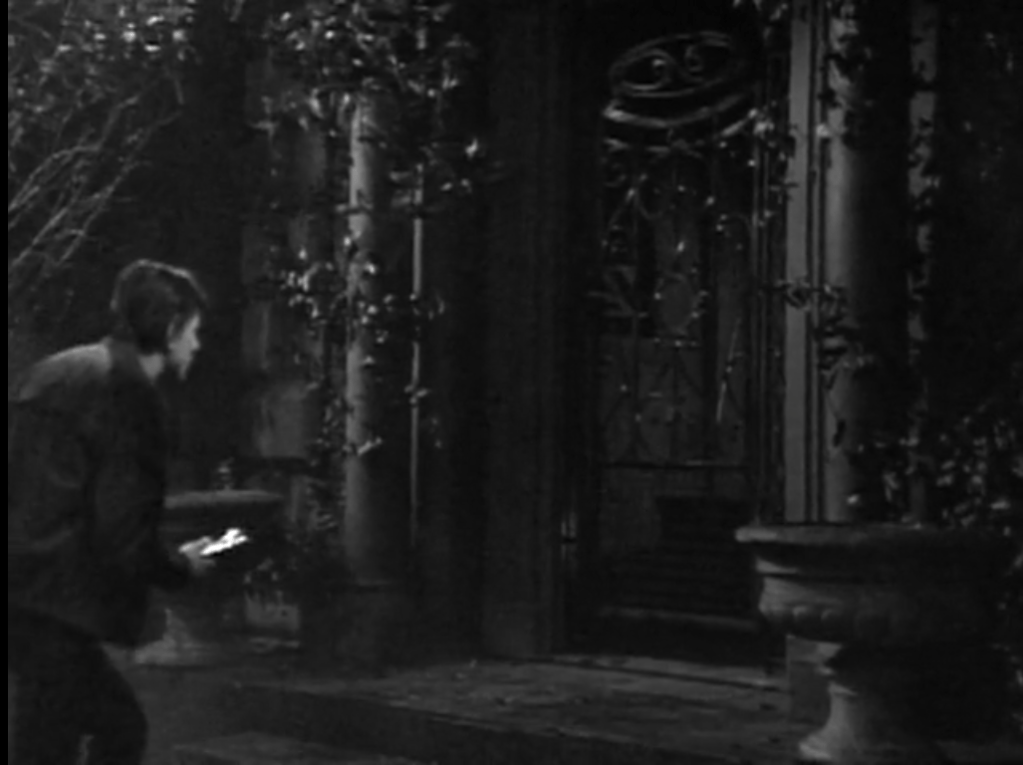
Episode 343: Not as a monster

Vampire Barnabas Collins is in a chirpy mood. He and his associate, mad scientist Julia Hoffman, have just committed the premeditated murder of Julia’s medical school classmate Dave Woodard. As we saw when Barnabas made his sorely bedraggled blood thrall Willie to help him hide the corpse of seagoing con man Jason McGuire, nothing makes him happier than forcing someone to help with the killing of a former friend.

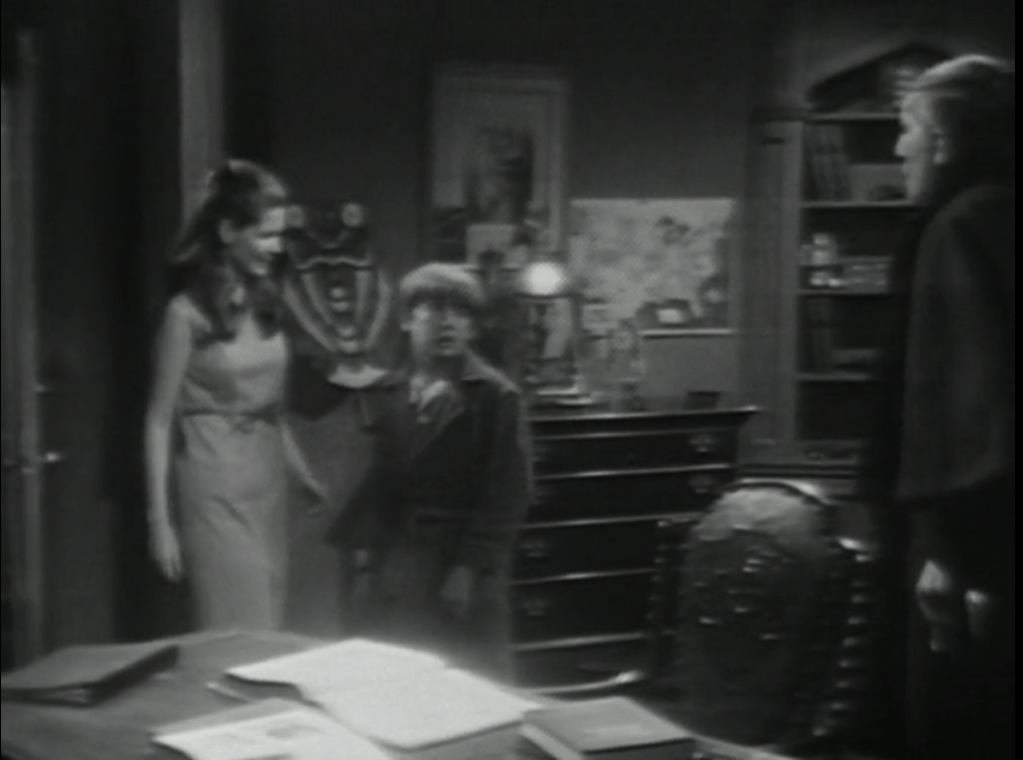
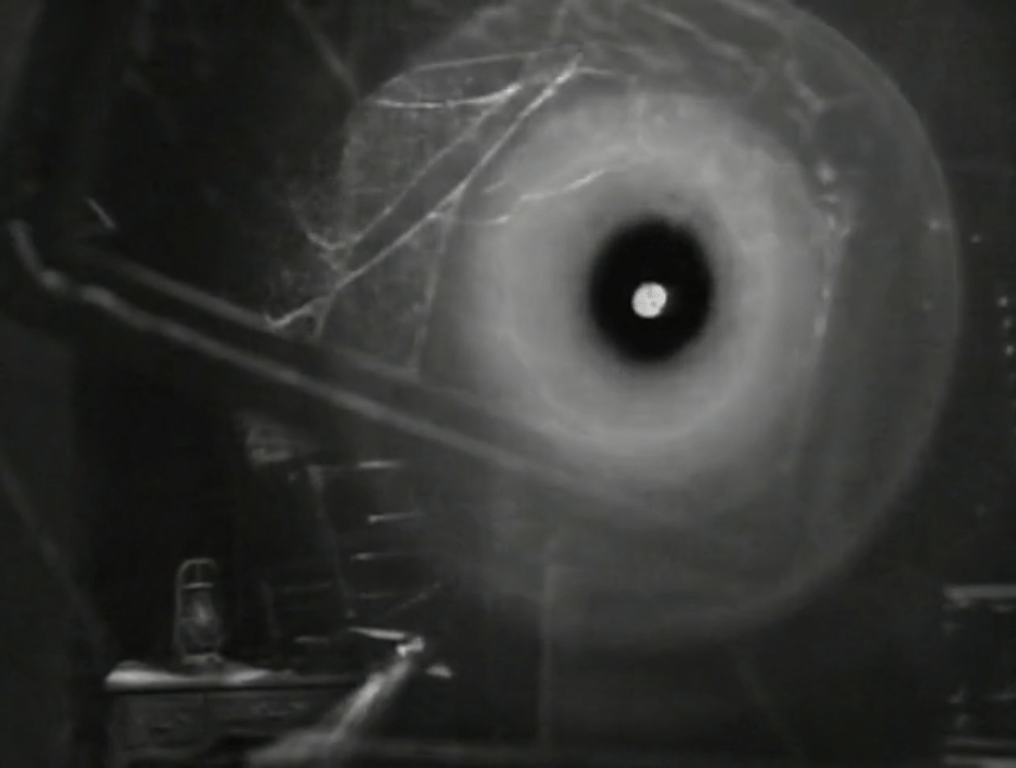
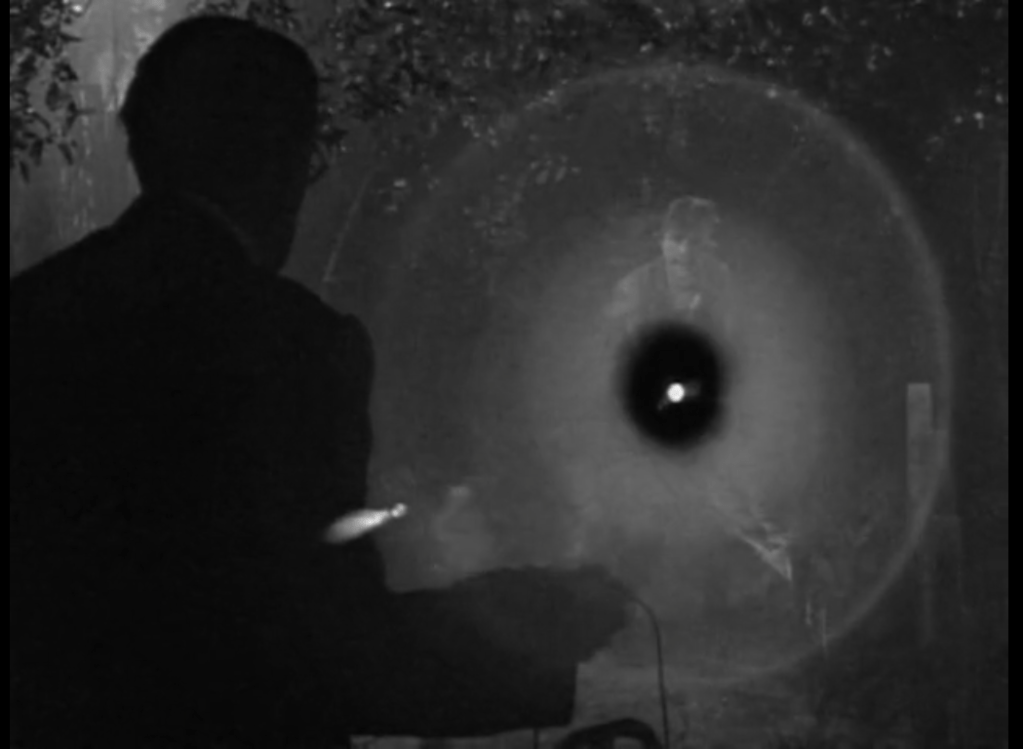
I think the actors were placed behind the laboratory apparatus intentionally, to highlight the characters’ helplessness and isolation.

Today, Julia wants to stop her attempt to cure Barnabas of vampirism, but he won’t hear of it. When she tells him she might try to kill him instead of curing him, Barnabas relishes telling her that he trusts her completely. She does knock him out of his blissful state when she suggests that if she manages to turn him into a real boy, he might have a conscience. He gives a little speech in which he says some brave things about being willing to accept the punishment fitting a man who had done the things he has done if he also gains the ability to love as a man can love. Jonathan Frid puts enough into this speech that it is possible to sympathize with Barnabas in the moment that he is delivering it.

That moment doesn’t last very long. By the end of the episode, we are back on this set, where Julia says that “someone” might love Barnabas as he is, and he takes delight in her humiliation as he makes it obvious that he knows she is referring to herself.

Some say that Barnabas’ speech about wanting to love is meant to make the character more likable, but it has the opposite effect when he so smoothly transitions back into this gleeful cruelty. The other day, Julia told Barnabas that she had wondered whether he was capable of feeling any emotions at all, but we see in this scene what we’ve seen all along, that he is nothing but emotion. Except when he is acting, trying to convince the living members of the Collins family that he is their long-lost cousin from England, his feelings are right on the surface. For a minute or two, he has some feelings about love and justice, and we see those very clearly. But that is a brief interlude in the middle of his entirely gratuitous torture of Julia. We are left in no doubt that he takes an utterly unmixed pleasure in causing her pain. We’ve already seen very cold villains on Dark Shadows and before the series ends we will see more, but by the end of this scene Barnabas claims the crown of most detestable character ever to appear on the show. It’s so hard to imagine how he could possibly sustain such a level of malignity that it’s no wonder viewers still keep tuning in to see what he will do next.

The main theme of the episode is the contrast between Barnabas’ relationship with Julia and his relationship with well-meaning governess Vicki. For the first 39 weeks of Dark Shadows, Vicki was the audience’s main point-of-view character; now Julia is the one who knows what we know, and who makes things happen when she learns new information. Seeing Barnabas first with one woman, then with the other, we see how the show has been changing since he joined the cast.

Barnabas eavesdrops on Vicki’s conversation with her depressing fiancé Burke on the terrace at the great house of Collinwood, then slides in and claims to have inadvertently overheard the last few words of their conversation. Burke gives Barnabas a dirty look, then excuses himself to do some telephoning while Vicki and Barnabas stay on the terrace and talk for a little while.

Barnabas has some vague idea of seducing Vicki, an idea he has been remarkably desultory about pursuing. In this scene, he does the only thing he has ever really got round to doing about it, which is to listen sympathetically while Vicki tells him her troubles. This time, she’s trying to convince herself that she wants what Burke wants, which is to get away from Collinwood and start a new life somewhere else. It isn’t an exciting situation, but Alexandra Moltke Isles delivers her lines with so much urgency that it holds our attention.

Vicki shares her anguish with her kindly friend Barnabas

Julia eavesdrops on this conversation. She looks miserable. Whatever she may have had in mind when she first came to Collinwood, Julia is stuck with Barnabas for the foreseeable future. Not only has Julia murdered one of her oldest friends for Barnabas’ sake, she has involved herself so deeply in so many of his activities that it is unclear how she would go back to the successful professional life she had before she met him even if he were destroyed. If he is going to spend his time hanging around other women, she faces a drab prospect.

Julia contemplates a lonely future

In the drawing room, Burke, Vicki, and Julia talk about the death of Dr Woodard. Julia can’t bear the topic, and excuses herself to go out to the terrace. There, she catches a glimpse of Woodard’s ghost. Julia screams, Burke and Vicki come, and all she can do when they ask what’s wrong is to keep jabbering that “he wasn’t there.”

There are some rough patches in the script today. For example, in the opening, Julia is touching the equipment when Barnabas exclaims “Don’t stop!” This is puzzling- she doesn’t appear to be stopping anything. And when Julia says “He wasn’t there,” Vicki has to ask “Who wasn’t there?” A person might reflexively say such a thing, and Mrs Isles’ rapid delivery of the line and simultaneous movement of the neck and the shoulders suggest such a reflex. That’s probably the best choice any actor could have made, but the line still gets a bad laugh. Barnabas and Julia’s successive eavesdropping expeditions also come off as some kind of joke, and all the scenes take too long. The whole thing could have used another trip through the typewriter. Still, writer Joe Caldwell was at his best with miniature character studies, and while he may not have had the time he needed to give this one his usual polish, the actors still have more than enough to show what they can do. It’s a fairly good outing, all things considered.
Episode 325: Such pretty flowers

Strange and troubled boy David Collins was, for the first 39 weeks of Dark Shadows, the character most intimately connected to the supernatural back-world of ghosts and uncanny phenomena that would occasionally peek through the main action of the show. That changed in #191, when he chose life with well-meaning governess Vicki over death with his mother, humanoid Phoenix Laura Murdoch Collins. After that, he had little memory of his mother, and none at all of the paranormal experiences he had during her time with him on the great estate of Collinwood.

Not that David lost his connection to the supernatural all at once. When he first met his cousin Barnabas in #212, he cheerfully asked him if he was a ghost, and was disappointed to hear that he wasn’t. In #288, he speculated that his friend, mysterious little girl Sarah, might be a ghost, and he has taken it in his stride every time he has seen Sarah do something only a ghost could do. In #310, he took out his crystal ball, a gift he had received in #48 and hadn’t used since #82, and peered into it to try to find Sarah. He did see her in it, too.

Yet David seems to be resisting the idea that Sarah is a ghost, and indeed to be shying away from the whole concept of the supernatural. When she led him to the secret chamber in the Collins mausoleum in #306, she told him that the empty coffin there once had a body in it, but that the body got up and left. David objected that the dead don’t walk away, and was incredulous when she assured him that sometimes, they do. When David was trapped in the chamber in #315, Sarah materialized there and showed him how to get out. He had called on her to come, and was facing away from the only door when he did so, indicating that he knew she could pass through the walls. Yet when she did, he demanded a naturalistic explanation for her entrance, and when she vanished he asserted that she must be hiding in the chamber somewhere.

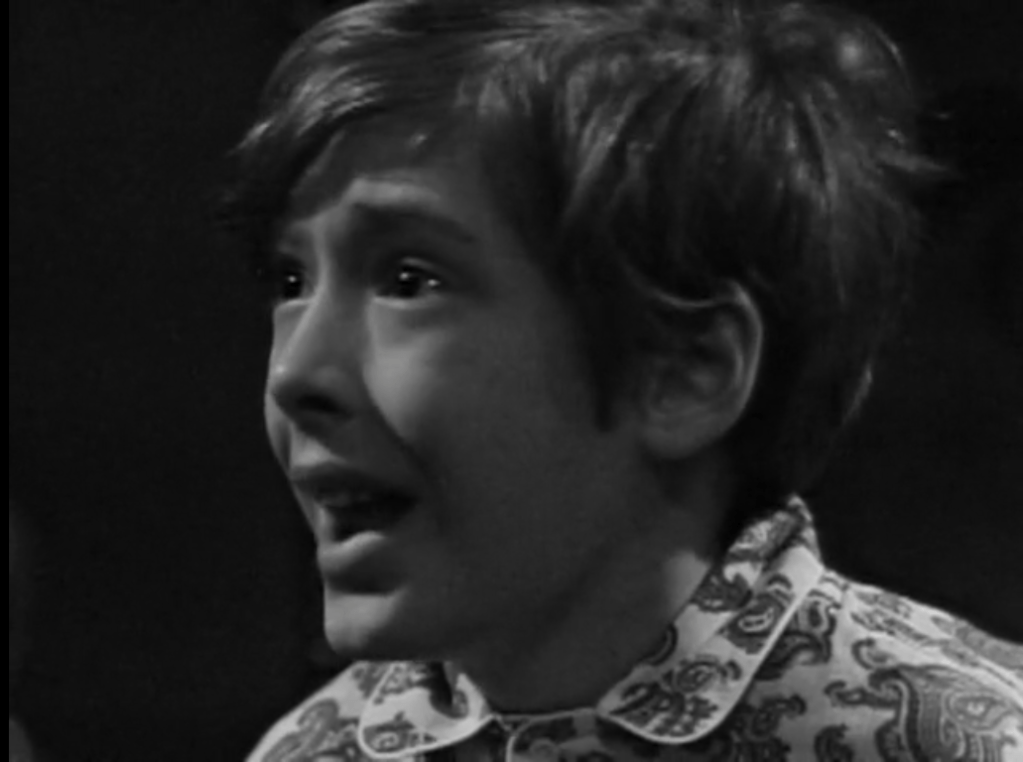
Now, David is terrified of Barnabas, much to the puzzlement of the adults he lives with. In the opening scenes, he is staring at the portrait of Barnabas in the foyer of the great house, and we hear Barnabas in voiceover, delivering the lines with which he frightened David in #315. He screams with terror, bringing his aunt Liz. She sees that David is upset, but he hurries away from her, upstairs to his bedroom.

There, we hear his thoughts in another voiceover. He remembers the events of #310, when he discovered that Barnabas and his servant Willie knew about the secret chamber in the mausoleum. In his agitation, he calls out to Sarah. He hasn’t admitted to himself that Sarah is a ghost, but evidently he expects her to materialize out of thin air. Sarah doesn’t come, but Vicki does, asking who he was talking to.

After David says he wants to work on his stamp collection, Vicki goes downstairs and finds Liz putting her coat on. She says that David is afraid of Barnabas for some reason, and that she is going to Barnabas’ house to ask him to help put the boy’s fears to rest. She says that David is more disturbed than he has been since his mother Laura was around; this is the first direct reference to Laura in months.

There is a knock on the front door. It is Barnabas, saving Liz the trip. Liz and Vicki explain how fearful David is, and Barnabas offers to have a talk with him.

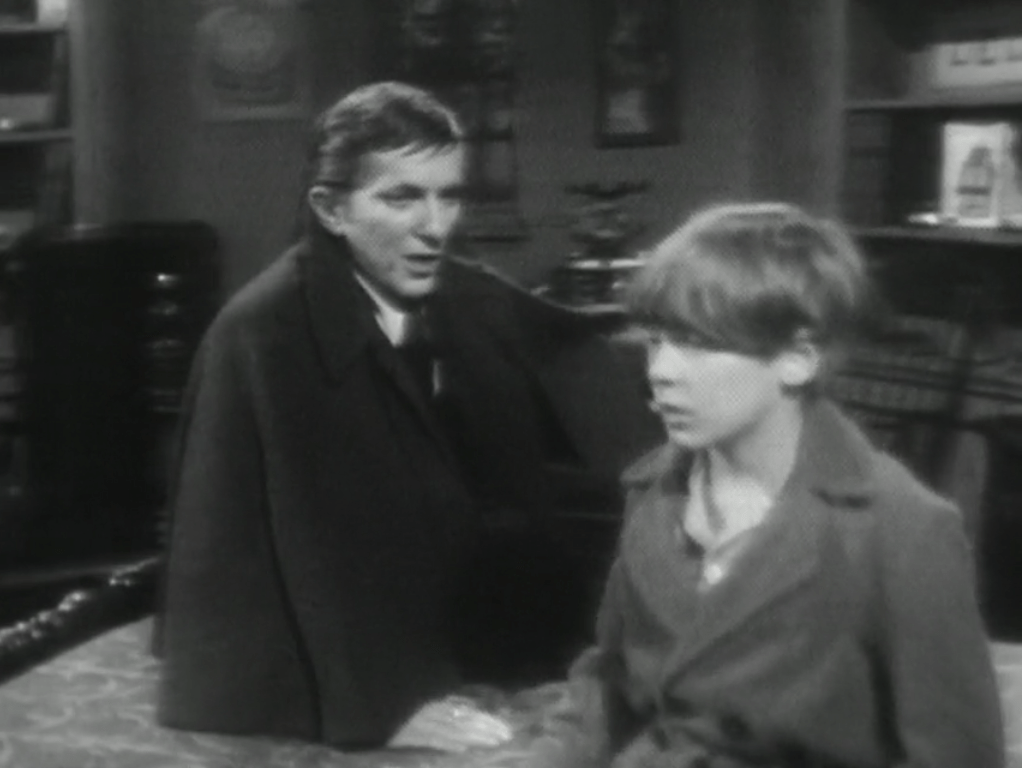
Liz ushers Barnabas into David’s room. Once the door is closed on the two of them, Barnabas questions David aggressively about Sarah and the secret chamber in the mausoleum. He asks him if Sarah told him about her family, twice mentioning her brother. When David says that Sarah hasn’t told him anything about herself, Barnabas accuses him of lying. He sits next to David on his bed. David doesn’t know that Barnabas is a vampire, but if he did he couldn’t look much more uncomfortable than he does when Barnabas assumes this position.

Barnabas sitting with David on his bed.

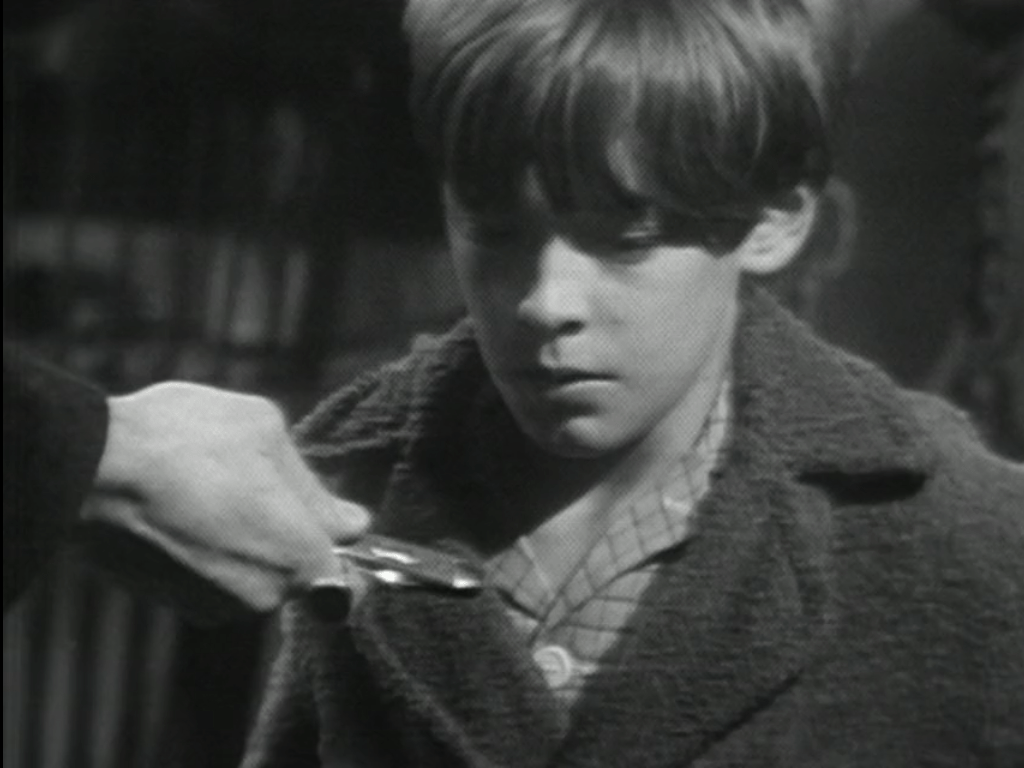
Barnabas tells David repeatedly that he knows he was in the secret chamber. David denies it, Barnabas again tells him he is lying, and to prove it shows him the knife he left there.

Barnabas confronts David with his knife

A knock comes at the door. It is Vicki. Vicki adores Barnabas, and the smile she wears when she enters the room shows her certainty that a heart-to-heart talk with him will have relieved David’s anxiety.

Smiling Vicki, sure everything will be all right

Vicki sees that David is still frightened, and her smile gives way to a look of confusion. Vicki was originally the audience’s point-of-view character; the audience is now composed chiefly of people who have tuned in wanting to see how they were going to fit a vampire into a daytime soap opera, and so of course she has to be Barnabas’ biggest fan at Collinwood. She and Barnabas leave David’s room together, and Barnabas wishes David “Pleasant dreams…”

We see David tossing in bed. He is talking in his sleep, calling out to Sarah. In yet another voiceover, we hear his dream. It is a bit of conversation from #306, when Sarah told him about the empty coffin.

We then see the beginning of another dream. It takes place amid a composite of decorations from the cemetery set and from the set representing Barnabas’ basement. David at first appears in a corridor like the ones we saw in the basement in #260.

The fog machine is working hard today.

He then encounters a faceless woman whom regular viewers will recognize as Barnabas’ co-conspirator, mad scientist Julia Hoffman.

David sees the faceless woman.

We see that she is wearing Julia’s wig and frock and holding the jeweled medallion she uses to hypnotize people:

Julia’s identifying marks.

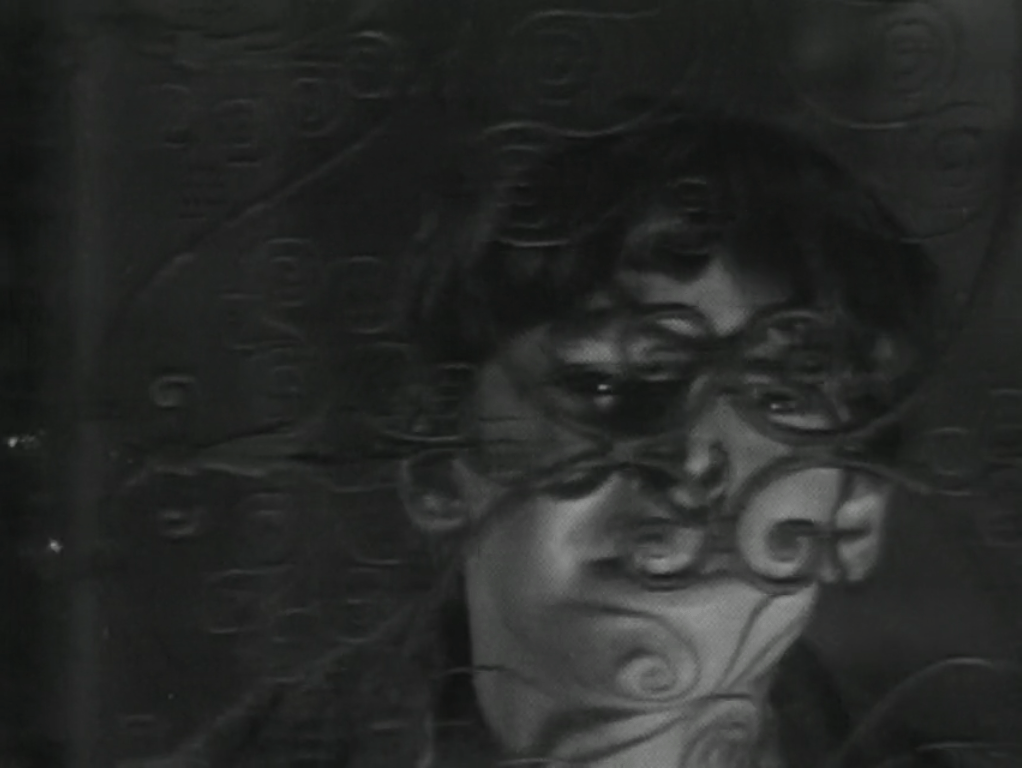
David flees from the faceless woman, saying he has to find Sarah. He finds himself behind a grating like the one on the door to the Collins mausoleum:

Entering the tomb

He walks up a few stairs, and sees Sarah.

David finds Sarah

When David tells Sarah that she is hard to find, she denies it, saying that she is easy to find if you know where she is. David does not respond to this characteristically cryptic remark, but complains that she won’t tell him anything about herself. She asks what he wants to know, and says he wants to know who she is and where she comes from. She tells him:

Sarah: That’s easy. I was born the same place you were. I lived in a house on a hill until I was nine years old. Then I got very sick. Everyone came to see me, and they were very sad.

David: Because you were sick?

Sarah: No, because I died. I died, and everyone brought such pretty flowers.

“I died that time. I died, and everyone brought such pretty flowers.”

When David asks why she is around now if she died then, she tells him she doesn’t really know. All she knows is that she is looking for someone. David asks who that might be, and Sarah says she will show him. Suddenly he becomes frightened and does not want to go with her. She insists. She takes his hand and leads him.

Sarah leading David to her secret

The camera follows the children on their journey across the set. At first Sarah takes David down some stairs, leading him from depths to depths:

Sarah leads David down into the depths

The set is now unmistakably Barnabas’ basement, though with more candelabra casting more intricate shadows on the walls than we have seen there:

Vergil and Dante, junior edition

At last Sarah stops and looks straight ahead. They have reached their destination.

David is bewildered by the sight.

They see a coffin. David asks if this coffin is empty, as was the one in the secret chamber. Sarah tells him no. This one has a body in it. The lid starts to open. David points in astonishment, while Sarah looks on serenely.

The lid begins to open.

Barnabas rises from the coffin.

Barnabas rises.

David recognizes Barnabas and is stunned. Sarah has eyes only for her big brother.

David stunned.

Barnabas stands. He turns, and sees Sarah. He is glad to see her.

David watches Sarah’s reunion with Barnabas.

Barnabas notices David. He turns to follow him.

Barnabas blocks David from our view and from Sarah’s.

As Barnabas follows David, Sarah simply watches.

Sarah watching big brother.

Barnabas follows David through another corridor. The shadows on the wall and floor form a design suggesting David is caught in a web. Readers of Gold Key comics’ Dark Shadows series will recognize the bend of Barnabas’ knees and the angle of his cane in this shot as their usual depiction of him:

David caught in Barnabas’ web.

David’s back is to the wall and Barnabas closes in on him.

Cornered.

Barnabas raises the cane he used to block David’s escape in #315 and which regular viewers several times saw him use to beat Willie. We zoom in on the wall, where we see the cane’s shadow rise and fall while we hear David cry out in distress.

Sarah’s fixation on Barnabas and her passivity when Barnabas follows David mark a pivotal moment in her development. She looks and sounds like a friendly little girl, and we have seen her rescue people from danger. She usually seems like a cross between Caspar the Friendly Ghost and the Powerpuff Girls. But she is not that at all. She is a symptom of the same curse that has brought Barnabas forth to prey upon the living, and she is leading David ever deeper into a world where only the dead belong. The show has given us no reason at all to think that she can bring him back to the realm of the living.

Even if Sarah wants to save David, she may still represent a deadly threat to him. We saw this in the Laura story. When Laura tried to lure David into the flames, she told him that he, like her, would rise from the ashes and live again. We had heard her say things like this before, and she may well have believed it to be true. But unknown to her, we saw a séance in which David spoke with the voice of a son Laura had in one of her previous incarnations. She had burned him with her, but while she gained a new life in the flames, he had become one of the unquiet spirits of the dead. Perhaps Sarah, too, is unwittingly leading David to his death.

Closing Miscellany

When Liz leads Barnabas into David’s room, she tells David that “Unc- Cousin Barnabas” wants to have a man-to-man talk with him. In later years, Jonathan Frid would refer to his character as “Uncle Barnabas” when he talked with interviewers about how the Collinses responded to him. I wonder if Joan Bennett’s blooper is a sign that he was already calling him that at this time.

There is a slight puzzle in Sarah telling David she was “born in the same place” he was. We’d heard in the early episodes that Laura and Roger never spent a night together in Collinwood as man and wife- the day of their wedding, they went to their new home in Augusta, Maine, and David was born a few months later. Perhaps Sarah’s remark is a retcon, and we are now to think of David as having been born at Collinwood. Or perhaps Sarah really was born where Augusta would stand- we know that her birth year was 1786, and that was the year the settlement that would become Augusta saw the establishment of its first public whipping post. Maybe her parents wanted to go there to celebrate the occasion.

When Sarah tells David she lived on the hill until she was nine, she interrupts herself and shouts “Ten!” This is an odd little blooper. Just a few days ago, David told Barnabas that Sarah was ten, and Barnabas jumped down his throat asking if she wasn’t “almost ten?” Now Sharon Smyth has been on the show long enough to have celebrated a birthday, and they aren’t done with Sarah yet. So they are retconning Sarah as having made it to ten.

Episode 299: When darkness falls

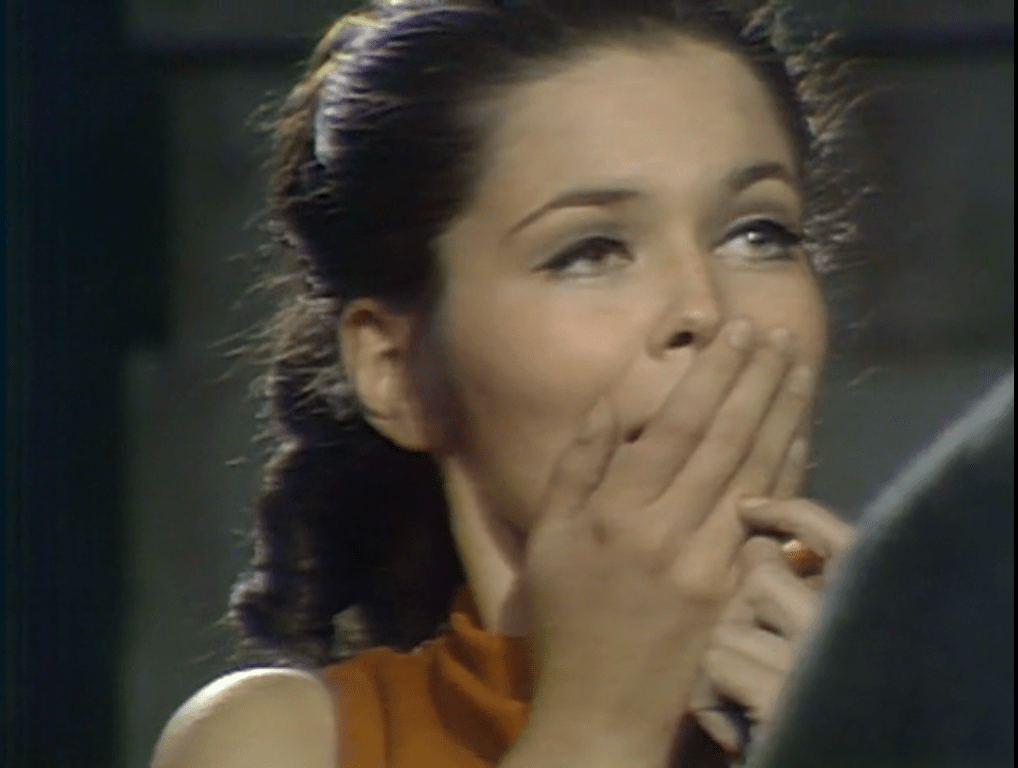
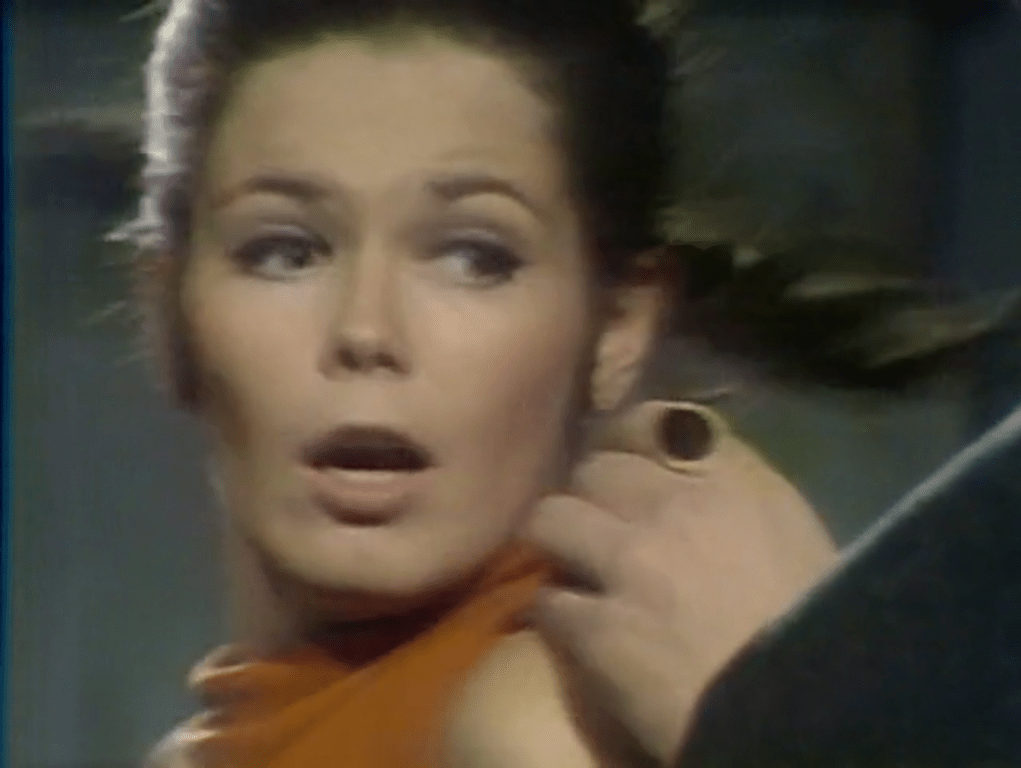
Vampire Barnabas Collins creeps up on well-meaning governess Vicki from behind. He touches her neck, and she is startled.

Stifling a giggle

This scene plays twice. First, before the opening title sequence, then again immediately after. The first time around, Vicki stifles a giggle when she sees Barnabas. The second, she seems frightened.

Frightened

Barnabas does not bite Vicki. He apologizes for startling her. She says that no apology is needed, and she stands very close to him. They talk about the Moon and the night and about what incredible romantics they both are.

Incredible romantics

In #285 and #286, Vicki contrived to get Barnabas to invite her to spend the night in his house. In #293, she invited Barnabas to tag along on a date she was having with her depressing boyfriend Burke, and while Burke stood there she had eyes only for Barnabas. In this conversation, Vicki reluctantly turns down an invitation from Barnabas so she can go on some more dismal dates with Burke.

Mad scientist Julia Hoffman interrupts Barnabas and Vicki. After Vicki excuses herself to get ready for her date, Julia demands that Barnabas leave her alone. Barnabas says that he means her no harm. This is all too believable- twice before today, we have seen Barnabas enter a room where Vicki was sleeping and leave without biting her. It’s starting to seem unlikely that she will ever have a place in the vampire story. Since the vampire story is the only plot going on Dark Shadows, that leads us to wonder why she is still on the show.

This scene takes place on a new set, a courtyard with a terrace and a fountain. It looks very much like a set in the 1965 film The Sound of Music, the one where the Countess who is supposed to marry Captain von Trapp has the conversations that remove her from the love triangle and leave the path open for von Trapp to marry Maria. That movie was such a big hit that it seems likely that they had it in mind when they designed this set for scenes concerned with the love triangle involving Vicki, Burke, and Barnabas.

Julia’s intervention leads some to believe that there is another love triangle budding in which she will vie for Barnabas’ affections, but I don’t see any trace of that in Julia’s stern manner today. She simply seems to be concerned that Barnabas stop preying on people while she performs the experiments that are supposed to cure him of vampirism.

In later years, Grayson Hall would claim that she decided on her own initiative to play Julia as if she were in love with Barnabas. She said that by the time the writers and directors caught on to what she was doing, they had received so much enthusiastic fan mail that they had to let her go on doing it. In response to this story, Danny Horn makes some uncharacteristic remarks in his post about this episode on Dark Shadows Every Day:

It’s a great story, especially because it appeals to the audience’s secret belief that the actors really are the characters that they play. We love to believe that, especially for daytime soap opera characters, who we spend time with every day.

But really, everybody who watches television believes that the characters are real. That’s why we love to hear about unscripted moments that were invented during rehearsal. As intelligent adults, we understand that writers and directors and producers create the characters, and then the actors show up and say the words. But there’s a little child inside of us, who wants to be told that Julia Hoffman is real, and she lives inside Grayson Hall.

Danny Horn, “A Human Life,” Dark Shadows Every Day, 2 Jaunary 2014.

As the blog went on, Danny put more and more emphasis on the chaotic process by which Dark Shadows was created. I suspect this passage was something he wrote in haste. Even at this early stage, he had made it clear that he knew that it was not true that “writers and directors and producers create the characters, and then the actors show up and say the words.” By the time he finished in 2021, his main theme had long been that the real subject of Dark Shadows was “a team of under-resourced lunatics desperately struggling every day to make the most surprising possible show.” That team most definitely included actors padding their parts in ways they could do only because the show was done live to tape, with edits never done if not absolutely necessary, and often not done even when they were.

Julia visits Vicki’s room and helps her choose an outfit for her date with Burke. Julia urges Vicki to avoid Barnabas, because he has a crush on her and it would hurt him to encourage him in it. Vicki says that she has never seen any sign of such a crush. Nor have we- he has talked with his sorely bedraggled blood thrall Willie about a plan to take Vicki as his next victim. Aside from giving her an enchanted music box that is supposed to brainwash her, he has been remarkably leisurely about the whole thing. If anything, she is the one who has been pursuing him.

Vicki and Burke are out by the fountain. He remarks that she has been very quiet, and she refers to having a lot on her mind. This raises our hopes that she is thinking about what Julia told her and is going to ditch Burke and go to Barnabas. They start talking about their wretched childhoods. Previously, we had heard that Burke’s mother died when he was young and that his alcoholic father supported the family by making lobster pots; now Burke tells us that when he was nine his father left the family. It’s hard to see much point in this retcon; most likely the writers had just forgotten about the earlier story.

Vicki mentions that there was one nurse at the Hammond Foundling Home whom she liked. In the early days of the Dark Shadows, she would often reminisce about her ridiculously bleak experiences growing up in this fictional orphanage. Usually she would get a faraway look in her eyes and smile, then tell some story that started with an appalling horror and got worse and worse as it went. This time, she again stares off into the distance and smiles, so that viewers who have been watching from the beginning brace themselves to hear that the nurse turned out to be the worst abuser of all, or that she was murdered in front of Vicki while the other children laughed, or that she ran the kitchen the winter they ran out of food and had to resort to cannibalism. But no, Vicki is just sharing a pleasant little memory. The show is a lot less hard-edged now that it’s about a vampire.

Not that they’ve stopped presenting horrible images altogether. No, they show us Burke kissing Vicki.

When Burke was played by Mitch Ryan, he was a great kisser, a talent he displayed with Vicki among others. But Anthony George does not appear to have seen anyone kiss before he attempts it. As he points his lips at Alexandra Moltke Isles, she stiffens her neck, a move that may have suggested excitement if her partner were doing something recognizable as a sign of affection, but that in this context looks like she’s suffering from whiplash. After his first failed effort, he rests his head on her shoulder and looks miserable.

Attempted kiss
After the failure

We pull back from Burke’s fumbling and see Barnabas at the gate to the courtyard, looking forlorn. I’m sure the writer and director wanted us to take this image as a sign that Barnabas is feeling sorry for himself, but the scene he’s been watching with us is so dreary that we would all have the same look on our faces.

Barnabas has seen the sorry spectacle

Some attribute George’s phenomenally bad kissing to his sexuality. I don’t buy it. Joel Crothers was also gay, and we’ve seen Joe Haskell give convincingly sultry kisses to two actresses. Louis Edmonds was gay too, and when Dark Shadows finally gives him an on-screen kiss two years from now he will do just as well. And the actresses unanimously testified that Jonathan Frid was the best kisser in the cast. Furthermore, the other conspicuously inept kisser on the show was the emphatically heterosexual Roger Davis (whom we have yet to see.) So George’s failures in this department are his alone, and do not reflect on any demographic group of which he was a member.

In the house, Vicki and Burke continue their vain struggle to kiss. Julia walks in and apologizes for intruding. She does not leave, nor does she take her eyes off Vicki and Burke. That makes sense- after all, she is still an MD, and it would appear that whatever is wrong with Burke might require some kind of medical intervention.

Vicki excuses herself to go to bed, and Burke asks Julia to join him in the drawing room. There, he denounces Vicki for her “vivid imagination,” a terrible quality that must be stamped out. He tells Julia that Vicki has experienced two hallucinations recently. We know that these were not hallucinations at all, but actual visitations from the ghost of Sarah Collins. Burke doesn’t know that. However, he does know of another sighting which led him to angrily accuse Vicki of being insane, when she saw Maggie Evans, The Nicest Girl in Town, walking in a cemetery. At the time, everyone thought Maggie was dead, but now that it has been revealed she is alive, he removes the incident from his bill of particulars against Vicki.

Burke is furious with Vicki for having an imagination and wanting to be part of the story

Burke and Vicki, like most of the other characters, believe Julia’s cover story that she is an historian researching the Collinses for a book about the old families of New England. He asserts that helping Julia with her project is having a bad effect on Vicki, because she must “live in the present.” Julia asks if this means that she must live with him. Burke agrees that it does.

To Burke’s surprise, Julia agrees that Vicki should stop helping her and stay away from anything suggestive of past centuries. The two of them talk about how Vicki must be watched and controlled lest her imagination “run wild.” Julia is a mad scientist in league with a vampire, so this sort of talk is to be expected from her, but Burke is supposed to be on Vicki’s side. His frank intention to crush her imagination, expressed alternately with undisguised rage and airy paternalism, is as repulsive as anything we have seen from Barnabas.

Upstairs, Vicki is asleep. Barnabas opens the door and walks into the room. Again he thinks about biting her, again he doesn’t. He opens the enchanted music box, looks at her a bit longer, and leaves the way he came. If Barnabas doesn’t get off the dime soon, Vicki may marry Burke and become useless forever.

Episode 249: The most pitiful exhibition I’ve ever seen

Seagoing con man Jason McGuire stands outside the drawing room of the great house of Collinwood, eavesdropping. The conversation is among heiress Carolyn, Carolyn’s uncle Roger, and well-meaning governess Vicki. Carolyn tells Roger and Vicki that she wants to stop Jason from blackmailing her mother, reclusive matriarch Liz, into marriage. She doesn’t know what hold Jason has over Liz, but is sure it has to do with something secreted in a locked room in the basement. Roger agrees to help Carolyn break into the room.

Jason reports this conversation to Liz and suggests they give Carolyn the key to the room. What Liz is desperate to hide is that Jason buried the body of her husband, Paul Stoddard, under the floor there eighteen years ago. Jason tells her that he sealed the floor up well enough that there is nothing to see unless you start digging. Liz is unsure, and Jason offers to go to the room and look.

First-time viewers may not make much of this, but those who have been watching from the beginning will be exasperated. Liz has gone into the room herself many times over the years; Vicki has even caught her coming out of it. When they take us to the room and show us that there is nothing interesting to see there, they are telling us that there was no point to any of the scenes where Liz gets frantic at the prospect of someone going into the room. It’s a slap in the face of the audience.

The cast assembles in the room and pokes around a little. They don’t open all the trunks and cases; there is a big barrel that could hold the remains of several missing husbands, and they never so much as look at that. After this has gone on for some time, Jason declares that it is “The most pitiful exhibition I’ve ever seen.” That’s good, it’s always fun when the villain has a chance to put the audience’s feelings into words. After they go back upstairs, Roger says that he’s never been more embarrassed in his life. Louis Edmonds delivers that line with tremendous feeling, it doesn’t sound like he had to act at all.

The whole miserable mess leads to Liz and Jason announcing their engagement, something Carolyn had been talking about when she lamented for “Poor mother- abandoned in her first marriage, blackmailed into a second.” But Carolyn, Roger, and Vicki all look shocked, a dramatic sting plays on the soundtrack, and the closing credits start to roll, as if this were some kind of news.

Closing Miscellany

On his great Dark Shadows Every Day, Danny Horn analyzes the action of the episode as a series of devices to prevent anything interesting happening. He also goes through much of the unbelievably repetitious dialogue that clutters it up. He’s hilarious, the post is highly recommended.

When Jason goes to the basement to make sure that there is nothing there worth looking at, he shines his flashlight directly into the camera several times. It’s a flashlight we haven’t seen before, with a bulb mounted on top of a box. I’ve never been a particular flashlight aficionado, but that prop is the most dynamic part of today’s show.

Flashlight mounted on a box
Jason enters the basement
Looking at an old shirt

Episode 247: A fix on this man’s character

Artist Sam Evans can think of nothing but his daughter Maggie, The Nicest Girl in Town. Maggie disappeared from the hospital weeks ago, and the police haven’t found a clue as to how she got out or where she is. Sam’s friend, dashing action hero Burke Devlin, drops by Sam’s house and offers to take him to dinner. Sam isn’t hungry. Burke urges Sam to work on a painting; he says he can’t concentrate.

Burke brings up the idea of Sam painting a portrait of him. Burke did commission Sam to paint him in #22, and for weeks and weeks afterward Sam vacillated about doing so. That was part of the since-abandoned “Revenge of Burke Devlin” storyline. In the notes about this episode on the Dark Shadows wiki, we read that “the episode’s writer seems unaware of the portrait-painting history between Sam and Burke, the fact that it was a sore subject, and even of the general animosity between the two.” I don’t think that is necessarily so. Burke gave up on his revenge in #201, and everyone was thoroughly bored by the topic well before then. So I suspect this conversation is telling us that Burke and Sam have turned the page on all that.

Before Maggie disappeared, Sam had been painting a portrait of mysterious eccentric Barnabas Collins. Barnabas insisted on working only at night and on doing all the painting at his place, the Old House on the estate of Collinwood, which does not have electricity. Since Maggie vanished, Sam has offered to take the canvas home and work on it there, but Barnabas would not let it leave his house. Tonight, Sam decides to go to Barnabas’ and do some painting by candlelight.

Sam knocks on Barnabas’ door. Barnabas’ servant, Willie Loomis, answers. Before he met Barnabas, Willie was a dangerously unstable ruffian. Willie menaced Sam and Maggie in the local tavern so severely that Burke had to beat him to a pulp, and Sam came away from the experience hating Willie. But in his time working on the portrait, Sam has come to believe that Willie is a changed man.

Willie explains that Barnabas is away, that he doesn’t know when he will be back, and that he isn’t supposed to let anyone in the house in his absence. Sam protests that he is no stranger, and that he is sure Barnabas will want the portrait finished. Willie finally suggests that he take the canvas home and work on it there. That’s what Sam has wanted to do all along, so he is delighted to hear it. He carries the painting to his station wagon while Willie carries the easel. The two are in a jolly mood as they leave the house, seeming very much like good friends.

Sam leaves his pipe on a table in the front parlor of Barnabas’ house. In the first months of the show he went back and forth between smoking this pipe with its white bowl carved into a likeness of George Washington and puffing on cigarettes. We haven’t seen the pipe in a long while, but today we get a number of closeups of it. The first comes before Sam leaves home to go visit Barnabas, and the second when he and Willie are on their way to the station wagon.

The pipe in the Evans cottage
The pipe at Barnabas’ house

As soon as Sam and Willie are outside, a figure draped in white comes down the stairs into the parlor. It is Maggie. It turns out Barnabas is the one who is holding Maggie. He has taken his cue from the 1932 film The Mummy, in which Boris Karloff is an undead creature who tries to convince a woman that she is the reincarnation of his lost love so that he can kill her and bring her back to life as that other person. Barnabas, it turns out, is a vampire. He wants to erase Maggie’s personality, replace it with that of his long-lost Josette, and then turn her into a vampire.

Maggie is sufficiently under Barnabas’ sway that doesn’t know who she is, but she is not fully convinced that she is Josette. When she picks up her father’s pipe she seems to remember something. She doesn’t sniff it, but a pipe is a highly aromatic object, and scents are powerful drivers of memory.

Maggie reaches for the pipe
Something comes back to Maggie’s mind

Maggie wanders back upstairs, keeping the pipe with her. Sam and Willie come in, and Sam is mystified that his pipe has vanished. When Willie says he must have left it outside, Sam starts to argue. Seeing that the pipe isn’t in the room and believing there is no one else in the house, Sam laughingly calls himself absent minded and asks Willie to keep an eye out for it.

Maggie wanders back downstairs after her father has gone. She and Willie argue about whether she ought to leave her room and who she is. She doesn’t let on that she knows anything about the pipe. She goes upstairs again, and Willie goes to the basement.

This is the first time we have seen the basement, and we get a long look at it. There is a metal door with a barred window, big cobwebs, a stone staircase, big candelabra, and a coffin. The coffin lid opens, and we see Barnabas inside. This is the first time we’ve seen him there.

Barnabas asks Willie why he has come. When Willie tells him he has news, Barnabas beckons him closer. When Willie obeys, he grabs him by the throat. When Willie has delivered his report, he flings him to the floor, apparently on general principles. He stands over Willie’s crumpled form and gives a lecture about the importance of keeping visitors out of the house during the day. Notably, he does not object to sending the canvas home with Sam.

Maggie wanders downstairs a third time. We see her face and hear her recorded voice on the soundtrack. This is the third instance of interior monologue on Dark Shadows, after we heard Willie thinking at the portrait of Barnabas in #205 and #208. As Willie did not know who Barnabas was or why he was drawn towards him when we heard his thoughts, so today Maggie does not know who she is or what Barnabas is doing to her. She looks at the pipe in her hand, concludes that there is someone she must take it to, and walks out the front door.

In the Evans cottage, Sam is working on the portrait of Barnabas when Burke comes in with a sandwich to share. They chat about the painting. Sam explains that he can’t get the eyes right- they keep looking cold and forbidding, while he and Burke agree that Barnabas doesn’t seem that way at all.

We cut back to the Old House, where Barnabas is sitting in his armchair, giving Willie some orders. He may not seem cold and forbidding to Sam, but he couldn’t be more blatantly malevolent than he is with Willie. When they discover that Maggie is gone, Barnabas and Willie run out the front door.

This is the first episode in which Barnabas is just a total bastard the entire time. When he is with people who don’t know that he is a vampire, he plays the role of the Collins family’s mild-mannered cousin from England; Barnabas is so committed to that performance that we wonder to what extent he is a monster pretending to be a nice guy, and to what extent he is a nice guy forced to function as a monster. When we’ve seen him alone with Maggie, he has obviously been a crazy person, but a twisted sweetness comes peeping out as he talks about his longing for Josette. Even in his previous scenes alone with Willie, scenes that have more than once ended with him beating Willie unmercifully, Barnabas has allowed Willie to go on talking about his feelings much longer than he would have to if he were entirely sincere when he tells Willie that his inner life is of no consequence. But there isn’t the least flicker of warmth in either of Barnabas’ scenes today.

In the Evans cottage, Sam is puzzling over the portrait while Burke is in the kitchen. Maggie comes drifting into view in the window behind Sam. The Evans cottage has been a prominent feature of the show from its early days, and the foliage visible through the window has changed often enough from episode to episode that regular viewers know there is an actual space behind it, but this is the first time we have seen a person there. In her white dress, with her dazed expression and her wafting movements, Maggie looks like a ghost. Sam sees her and is startled. He calls her name. She disappears. Sam and Burke run out of the house to look for her.

There are some significant flaws in the episode. The opening scene between Sam and Burke goes on too long, the repeated closeups on the pipe are embarrassingly heavy-handed, and Maggie’s three trips downstairs are one too many. There are also some badly framed shots, surprisingly so for director Lela Swift. For example, I cropped the fifth image above to zoom in on Sam and Maggie. Here is what actually appears in the show, cluttered with distracting junk on all sides and devoting more screen space to David Ford’s butt than anyone wanted to see:

Moon over Collinsport

Still, there is a lot of good stuff in the episode, and the ending is very effective. It is far from a gem by any reasonable standard, but it may be the best script Malcolm Marmorstein ever wrote.

Episode 210: He’d want to say goodbye

Dangerously unstable ruffian Willie Loomis is under the impression that Dark Shadows is still the show ABC originally bought, a Gothic romance. So when he hears a tale of a grand lady in a manor house who fell in love with a pirate and is buried with a fortune in jewels that he gave her, he takes the story at face value and sets out to find and rob her grave.

Willie’s associate, seagoing con man Jason McGuire, believes that Dark Shadows is now the crime drama it more or less became for a couple of months after the Gothic romance approach petered out. He is blackmailing reclusive matriarch Liz, and refers to his incessant threats against her in their first conversation today.

Yesterday, the Caretaker of Eagle Hill cemetery tried to warn Willie that Dark Shadows has changed direction, and has been developing as a supernatural thriller/ horror show since December. Willie wouldn’t listen to him, but regular viewers know that all the old storylines are finished, and even people tuning in for the first time today will notice that the emphasis is on the uncanny.

At the end of today’s episode, Willie finds a hidden coffin and forces it open. It doesn’t have the jewels he was seeking, but something is in there that will bring great wealth to ABC and Dan Curtis Productions.

Screenshot by Dark Shadows Before I Die

This is the first episode of Dark Shadows most people see. Posting commentary on episodes 1-209 is a bit like driving down a quiet, picturesque country road. By contrast, googling “Dark Shadows episode 210” is like merging onto a busy highway. I want to respond to two of the many, many commentators on this one, Patrick McCray and Danny Horn.

On his great Dark Shadows Every Day, Danny writes:

Elizabeth calls Jason into the drawing room and throws an envelope of money at him — she’s paying Willie to leave town. She tells Jason to count it, but he turns on the charm, assuring her, “It’s all there. I can tell by the feel of it.” She barks at him that his friend should leave the house immediately. He apologizes: “I wanted this to be kept quiet. You know, the same way you wanted something kept quiet?” She walks out, and as soon as her back is turned, he opens the envelope and counts the money. Jason is funny. We like Jason.

Danny Horn, Dark Shadows Every Day, “Episode 210: Opening the Box,” 2 September 2013

Danny makes a point of ignoring the first 42 weeks of the show, often claiming never to have seen most of it. As his blog goes on, it becomes clear that he has seen a lot more than he wants to let on, but he is consistent enough about writing from the point of view of someone who started from this episode that I could always find a place in his comment section to add remarks about the connections to the early months.

And indeed, it is easy to see how someone tuning in for the first time today could say “We like Jason.” He is trying to keep control of the situation when he doesn’t understand what’s going on and he can’t afford to tell anyone the truth, so he has to keep coming up with fresh lies that will keep the ladies of the house from calling his bluff and new ways of pretending to be scary that will keep Willie from laughing at him. That’s a winning formula for a character, as witness the history of theater all the way back to the Greek New Comedy. Actor Dennis Patrick has the craft and the charisma to sell it beautifully.

Returning viewers may well have a far less enthusiastic response to Jason. His conversations with Liz today are the first time the two of them talk without falling into a pattern where Jason makes a demand, Liz resists, he threatens to expose her terrible secret, and she capitulates. They’ve enacted that depressing ritual ten times in the weeks Jason has been on the show, sometimes twice in a single episode. In Jason’s scenes with Willie and some of the other characters, we’ve had hints of the breezy charm Dennis Patrick exudes today. But the Jason/ Liz exchanges are so deadly that we get a sinking feeling every time either of them appears. Since blackmail has been the only active storyline going for the last two weeks and the two of them are the only full participants in it, that’s a lot of sinking feelings.

Patrick McCray’s Dark Shadows Daybook entry focuses on Jason’s opening scene with Willie:

Jason is harassing Willie. The big one is abusing the little one, demanding that he account for his whereabouts and doing so violently. David and Goliath. Shrill and meek. Had we started earlier, it would be tougher to be on Willie’s side. Starting here? Jason is the villain. He accuses the bruised kid of having a scheme, and the kid obviously lies to the Irish galoot, gazing at the portrait conspiratorially. It’s as if he and the man in the painting already have a relationship. Cut to opening credits.

A lovable weasel. A bully. A silent and stern third party, hanging on the wall like a watchful ally, holding his action. Only a few lines, but resonantly human to anyone who’s been victimized by a know-it-all lout. Somehow, we know this power dynamic is bound to change, and that, for once, the know-it-all knows zip.

Patrick McCray, The Collinsport Historical Society, “Dark Shadows Daybook: April 13,” 13 April 2018

Willie has been a frantically violent character, showing every intention of raping every woman he meets and picking fights with every man. Some of Willie’s attempted rape scenes, especially in his first five appearances when he was played by Mississippian method actor James Hall, were so intense that they were very difficult to watch. Nor has Willie become less menacing since John Karlen took the part over. Just yesterday, Jason had to pounce on Willie as he was creeping up on well-meaning governess Vicki. It is indeed tough for anyone who has seen the previous episodes to be “on Willie’s side” in the sense of hoping that he will be the victor, even if we find him interesting enough that we want him to stay on the show.

But I think Patrick McCray overstates the degree of sympathy Willie is likely to gain from an audience watching Jason’s attempt to bully him today. At no point does Willie seem the least bit intimidated by Jason. He chuckles at him throughout the whole scene, and keeps his head up and his eyes open. The bruise Willie still has around his eye from a bar fight he lost the other day is faint enough that it does not give him any particular look of vulnerability. It’s true Willie is smaller than Jason, but he’s also younger and in good shape, so there is no reason to suppose he would be at a significant disadvantage were they to come to blows.

Returning viewers will also notice that the carpenters have been busy. Today we get a look inside the Tomb of the Collinses, a new set introduced yesterday. We also see a much more modest structural addition for the first time, a second panel of wall space downstage from the doors to the great house of Collinwood.

During the first weeks of the show, the foyer set ended right by the doors. When they added a panel to represent a bit more wall space, they decorated it at first with a metal contrivance that looked like a miniature suit of armor, then with a mirror, then alternated between these decorations for a while. When Jason first entered the house in #195, the mirror reflected a portrait, creating the illusion that a portrait was hanging by the door.

Episode 195

By #204, a portrait was in fact there, one we hadn’t seen before, but that they must have been painting when Jason first came on the show.

Episode 204

In #205, the portrait is identified as that of Barnabas Collins, and it is accompanied by special audio and video effects. Sharp-eyed viewers remembering #195 may then suspect that the point of Jason and Willie is to clear out the last remnants of the old storylines and to introduce Barnabas Collins.

Today, a second panel is added to the wall next to the portrait, and the mirror is mounted on it. Liz and Vicki are reflected in the mirror. The split screen effect not only puts the painting in the same shot as their reactions to it, but also establishes a visual contrast between the present-day inhabitants of the house and another generation of Collinses.

Screenshot by Dark Shadows Before I Die

Episode 209: The darkest and strangest secret of them all

Dangerously unstable ruffian Willie Loomis stares at the portrait of Barnabas Collins hanging in the foyer of the great house of Collinwood. The portrait’s eyes glow and the sound of a heartbeat fills the space. Willie’s fellow unwelcome house-guest, seagoing con man Jason McGuire, comes into the room. Willie is surprised Jason can’t hear the heartbeat.

After consulting the Collins family histories, Willie goes to an old cemetery where legend has it a woman was interred with many fine jewels. The Caretaker of the cemetery stops Willie before he can break into her tomb. Willie hears the heartbeat coming from the tomb, but, again to his amazement, the Caretaker cannot hear it.

Yesterday, strange and troubled boy David Collins had told Willie that in some previous century, a pirate fell in love with Abigail Collins, gave her jewels, and that Abigail took those jewels to her grave. Today, Willie repeats this story to wildly indiscreet housekeeper Mrs Johnson, only he identifies the woman as Naomi Collins. Fandom likes to seize on this kind of thing, presenting it either as an error or as a sign of retcons in progress, but I suspect that it is just a clumsy way of suggesting that the characters are hazy on the details of the legend.

The legend itself is very much the sort of thing that inspired Dark Shadows in its first months. ABC executive Leonard Goldberg explained that he greenlighted production of the show when he saw that Gothic romance novels were prominently featured everywhere books were sold. The idea of a grand lady in a manor house somehow meeting and having a secret romance with a pirate is a perfect Gothic romance plot, as for example in Daphne du Maurier’s Frenchman’s Creek. Willie’s fascination with the tale might reflect an accurate assessment of the situation if Dark Shadows were still a Gothic romance, but the show left that genre behind as the Laura Collins storyline developed from #126 to #193. If Willie had been watching the show, he would know that the story David told him is not the one that is going to shape his future as a character on it.

When Willie is wandering around the old cemetery, he twice shines a flashlight directly into the camera and creates a halo effect. The first time might have been an accident on the actor’s part, but the second time the halo frames the Caretaker in a way that is obviously intentional. Patrick McCray’s entry on this episode in his Dark Shadows Daybook describes the Caretaker as “a refugee from the EC universe.” Indeed, Willie’s crouching posture and angry facial expression, the halo filling so much of the screen, the tombstones in the background, and the Caretaker’s silhouetted figure carrying a lantern add up to a composition so much like a panel from an EC comic book that it may well be a conscious homage:

Beware the Vault of Horror!

This is our first look at the Tomb of the Collinses.

Introducing the Tomb of the Collinses
Willie sneaks up to the Tomb

It’s also the first time we are told the name of the cemetery five miles north of Collinsport in which the Tomb is situated. Mrs Johnson calls it “Eagle’s Hill Cemetery,” though later it will be called “Eagle Hill.” Mrs Johnson also mentions the Collinsport cemetery two miles south of town, and the Collins’ family’s private cemetery located in some other place. They won’t stick with any of this geography for long, though it all fits very neatly with everything we heard about burial grounds in the Collinsport area during the Laura story.

Episode 207: Just fate

Today we’re in Collinsport’s night spot, The Blue Whale tavern. Seagoing con man Jason McGuire is at the bar, trying to convince his henchman, dangerously unstable Willie Loomis, to stop acting like he’s about to rape every woman he meets before they get thrown out of town.

A party comes in consisting of artist Sam Evans, Sam’s daughter Maggie, and Maggie’s boyfriend Joe. Dashing action hero Burke Devlin enters and joins Sam, Maggie, and Joe at their table. Burke has confronted Willie a couple of times, and Willie tells Jason that they are fated to have it out sooner or later. Jason tries to persuade him to abandon this idea, telling him that Burke would be a useful friend and a formidable enemy.

Jason delights Willie by telling him that Burke is an ex-convict. John Karlen brings such enormous joy to Willie’s reaction to this news that it lightens the whole atmosphere of the episode.

Jason buys Burke a drink and tells him that Willie is secretly a nice person. He and Burke find that they both have a high opinion of psychoanalysis, of all things, but their shared admiration of the Freudian school does not lead them to agree about Willie.

Sam goes to the bar, leaving Maggie and Joe to themselves. A bit later, Joe has to leave Maggie alone for a few minutes while he makes a telephone call to check in with a situation at work. He urges her to stay at the table and avoid Willie. She notices that Willie is talking to her father, and is alarmed. Joe tells her not to worry- from what they’ve seen, it appears that Willie only likes to hurt girls.

At first, Willie and Sam’s conversation is cheery enough. Willie is impressed with Sam’s beard, and even more impressed that Sam is a professional painter. For a moment, we catch a glimpse of Willie, not as an explosively violent felon, but as an awkward guy who is trying to make a friend. This passes when the idea of nude models pops into Willie’s head, and he asks again and again where Sam keeps the naked ladies. Sam tells Willie that he doesn’t use live models, at first politely, then with irritation. Willie responds with his usual vicious menace.

Maggie goes up to intercede. This would seem to be an odd choice. Jason is at the next table, and when Willie was harassing her and picking a fight with Joe last week she saw Jason rein Willie in. She knows that Jason is eager to smooth things over with the people Willie has already alienated, so it would be logical to appeal to him. Burke and Joe are nearby as well, and have both made it clear that they are ready to fight Willie. If either of them goes to Willie, he will be distracted and Sam will have a clear avenue of escape. And of course Bob the bartender really ought to have thrown Willie out of the tavern long ago. Maggie, on the other hand, will attract Willie’s leering attentions and complicate her father’s attempt to get away from Willie by making him feel he has to defend her.

From his first appearance in #5, Sam was a heavy-drinking sad-sack. Today, Sam seems to have become a social drinker. He’s gone out with friends for a couple of rounds, and is pleasant and calm the whole time. Soap operas are allowed to reinvent characters as often as they like. If Sam’s alcoholism isn’t story-productive anymore, they are free to forget about it.

The problem with this scene is that Maggie hasn’t forgotten. Maggie’s whole character is that of an Adult Child of an Alcoholic. It makes sense that an ACoA, seeing her father in trouble, would cast aside all rational calculations and rush up to protect him. But if Sam isn’t an alcoholic anymore, Maggie is just a very nice girl who laughs at inappropriate times.

Burke comes to Maggie and Sam’s rescue. Willie draws a knife on Burke, they circle, Burke disarms Willie and knocks him to the floor.

We’ve seen many couples move about on the floor of The Blue Whale while music was playing, and usually their movements have been so awkward and irregular that it is not clear that what they are doing ought to be called “dancing.” But Burke and Willie’s fight is a remarkably well-executed bit of choreography. At one point Willie brushes against the bar, and it wobbles, showing that it is a plywood construction that weighs about eight pounds. But it doesn’t wobble again, even though the fighters both make a lot of very dynamic movements within inches of it, and at the end of the fight Willie looks like he is being smashed into it.

Burke about to deliver the knockout blow. Screenshot by Dark Shadows Before I Die

After the fight, Willie and Jason meet in a back alley, the first time we have seen that set. Jason assures Willie that he will eventually get his cut of the proceeds of Jason’s evil scheme, but tells him he will have to leave town right away. Willie vows to kill Burke.

The jukebox at The Blue Whale plays throughout the episode. In addition to Robert Cobert’s usual “Blue Whale” compositions, we hear Les and Larry Elgart’s versions of a couple of Beatles tunes and of a Glenn Miller number.

Episode 181: People can change

Strange and troubled boy David Collins is sleeping peacefully in his bed. His cousin, flighty heiress Carolyn, comes into his room to check on him. She tucks him in, waking him. He asks what she is doing in his room. When she says that she was making sure he was asleep, he points out that she woke him up. When she keeps showing concern for him, he reminds her that she has called him “a spoiled monster” and a “menace to the civilized world” among other endearments, and that if he showed up in her room there would be no end of hollering.

Carolyn goes on talking to David in a gentle voice about how important he is to her, and says that maybe she’s the one who is a spoiled monster and a menace to the civilized world. After Carolyn maintains an affectionate attitude towards him for a few unbroken minutes, David asks her if she is OK. She assures him that she is. As David Collins, David Henesy’s bewildered response to Carolyn’s friendliness brings the house down.

While we are still laughing, David presses Carolyn to explain why she is being nice to him. A look of fear comes over him, and he asks if something terrible has happened. Carolyn assures him that nothing has, but he just looks more and more alarmed. By the time she leaves him, his expression is little short of heartbreaking.

David alarmed

The next morning, well-meaning governess Vicki is sitting with David in the drawing room, going over his homework. He has written an essay about what it might be like to have an older sister. He wonders if such a sister would love him. Vicki says that she might, and that it is a waste when you don’t love the people who love you. When Vicki asks David where he got the idea of writing about an imaginary older sister who loves him, he doesn’t give a direct answer. He does start talking about Carolyn, making it clear that he is thinking of her.

Vicki leaves David alone in the drawing room for a short while. He looks into the fireplace and sees his own face wearing a placid expression and immersed in the flames. He flees the room in terror, bumping into visiting parapsychologist Dr Guthrie. Vicki comes running, and David holds onto her for dear life.

Reflections
Safe with Vicki

David’s vision reminds me of a post of Wallace McBride’s on The Collinsport Historical Society from April of 2020. His point is summarized in his title, “In Dark Shadows, Your Reflection Always Tells the Truth.” David lives in 1967, so he doesn’t have access to that article. But he already knows the truth it tells- his terrified reaction shows that he knows it means there is an imminent danger that he will die by fire.

We see hardworking young fisherman Joe poring over old newspapers in the Collinsport Public Library. He finds something that alarms him, and rushes to a public telephone to call Vicki. He tells her he is coming to the house to show something important to her and Guthrie.

Joe on the phone

When Vicki tells Joe and Guthrie that David had a vision of himself in flames, she connects it with a recurring nightmare that had plagued him several weeks ago. David’s mother, blonde fire witch Laura Murdoch Collins, had come back into his life after an absence of several years, and he kept dreaming that she was beckoning him to join her in flames. While he was suffering from this nightmare, drunken artist Sam Evans, miles away in town, inexplicably painted a couple of canvases depicting exactly the image that kept appearing in David’s dreams.

Joe and Guthrie become very animated when Vicki tells them what David saw and how he reacted. Joe declares that what David has seen is a vision of the past. Joe has already shown Guthrie what he found in the library, a newspaper article from one hundred years before. The article is about someone named Laura Murdoch Radcliffe. That Laura Murdoch died in 1867 in a fire along with her young son. His name was David.

Episode 180: She’s out there somewhere

Yesterday, we saw four men visiting a crypt. They are parapsychologist Dr Guthrie, hardworking young fisherman Joe, instantly forgettable young lawyer Frank, and the unnamed Caretaker of the old cemetery. They witnessed an uncanny event when the ghost of Josette Collins opened the coffin of Laura Murdoch Stockbridge, who died (by fire!) in 1767.

The ghostly intervention was disturbing enough in itself, but when the four men saw that the coffin was absolutely empty they had to change their ideas. Before Josette took action, the Caretaker had vowed that he would die rather than let a grave be disturbed. After they have seen the empty interior of the coffin, Guthrie asks him about another grave he wants to dig up and the Caretaker gives him directions. Frank had shouted at Joe and Guthrie that they would go to jail if they didn’t immediately stop disturbing the crypt, but now he agrees to go to the other grave and help dig. Joe had joined Guthrie only with utmost reluctance and had wanted to stop when the Caretaker first showed up, but now he is the one who points out a toolshed from which he volunteers to grab some shovels.

The second grave is that of Laura Murdoch Radcliffe. In 1867, just one hundred years after the fire that killed Laura Murdoch Stockbridge, Laura Murdoch Radcliffe died the same way. What’s more, a woman initially identified as Laura Murdoch Collins died (by fire!) in Phoenix, Arizona earlier in 1967 and her body inexplicably disappeared from the morgue some weeks after her death. Evidently Guthrie’s hypothesis is that graves will both be empty, because the body of each Laura Murdoch disappeared after death. He also surmises an otherworldly connection between these three dead and vanished Laura Murdochs and the apparently alive Laura Murdoch Collins who has been hanging around the great estate of Collinwood for a couple of months.

Back in the crypt, the Caretaker is delivering a soliloquy. He thinks Guthrie, Joe, and Frank are wasting their time trying to learn secrets from the dead. He has information he could share if they would stay and listen to him. He remembers that there was something strange about the death of Laura Murdoch Radcliffe, and that a book about the Radcliffes is on the shelves in the crypt. He looks through the book and finds the information. “The child!” he exclaims.

Laura Murdoch Collins materializes in a dark corner and strikes up a conversation with the Caretaker. As her talk grows more and more mystifying, the Caretaker looks confused, as if he has never before been the least weird person in any room.

Laura’s appearance gave us (Mrs Acilius and I) two grounds for fear. Our first fear was that Laura might kill the Caretaker. We could easily imagine Guthrie, Joe, and Frank coming back to the crypt to find it in flames, the records kept there in ashes, and the Caretaker dead (by fire!) We like the Caretaker, and want to see him in future episodes.

Our second fear was that Laura would go to the grave of Laura Murdoch Radcliffe and interrupt the exhumation. What we dreaded about that prospect was that it would slow the story down. Yesterday’s show moved at a nice clip, and while today does not match it, at least some things are happening to advance the plot. In the last several weeks, the pace has alternated between glacial and dead stop. So the idea of yet another delay is well worth a shudder.

Laura Murdoch Collins examines the coffin of Laura Murdoch Stockbridge

There is a moment when it seems that Laura will go to stop the men. The Caretaker tells her that they have gone to the grave of Laura Murdoch Radcliffe, and starts to give her directions. She tells him not to bother explaining where it is. Laura doesn’t speak the line “I’ve been there before,” but Diana Millay’s eyes communicate the thought to the audience. Having already seen her inspecting the inside of Laura Murdoch Stockbridge’s empty coffin, we know that she is on a tour of her old neighborhood.

Laura Murdoch Collins doesn’t need directions to the grave of Laura Murdoch Radcliffe

For whatever reason, Laura does not interfere with Guthrie, Joe, and Frank. They dig up the coffin of Laura Murdoch Radcliffe. They open it and look inside. Guthrie asks “What do you see?” Frank replies “What you thought we’d see.” There it is, a bullfrog in a top hat singing “Hello, My Baby.” Oh no wait, I changed the channel there for a second. On Dark Shadows, the answer is “Nothing. Absolutely nothing. An empty box. It’s almost like it’s always been empty.” No wonder we’re still watching the show after all these years, where else can you find thrills like that.

Hello, my ragtime gal

The Caretaker is talking to Laura and looks down for a second. When he looks up, he is baffled. We cut back to the spot where she had been standing, and it is vacant.

Guthrie, Joe, and Frank return to the crypt. They apologize for having been away for so long. The Caretaker tells them they have only been gone for a minute or two. They are puzzled. They find the book about the Radcliffes, and discover that a portion of a newspaper clipping containing an account of Laura Murdoch Radcliffe’s death has been erased, as by an intense light generated by a fire. This leaves us wondering why Laura erased only that section of the clipping, calling attention to it, when she could just as easily have set fire to the book and destroyed the whole thing.

It’s a relief that the Caretaker survives to dodder another day, and a relief that Guthrie, Joe, and Frank complete their business in the cemetery and free us to move on to the next story point. As Guthrie, John Lasell was visibly bored yesterday; today his part is smaller, but he is back on his game, and the others are good too.

Daniel F. Keyes has some particularly good moments as the Caretaker. Yesterday he struck the heroic note when he told Guthrie and Joe that they would have to kill him before they could open the graves, and he made that a powerful moment. Today, he shows us both how lonely the Caretaker is, and why he cannot escape that loneliness. The feeling is painfully raw in his soliloquy about the information he could give if only the others would listen, and his exaggeratedly careful movements and other mimicries of a fragile old age give that rendition of helpless, desperate loneliness an extra punch. His interaction with Laura is even more interesting- while he lives too much in the world of ghosts and taboos to be at home with the living, he is too much a part of the this-world institution of the cemetery and of its rational, bureaucratic routines to know what to do when he encounters an otherworldly being face to face. He is entirely alone, caught in the interstices between the natural and the supernatural, unable to communicate with the denizens of either realm.

Today is the last time we will see actor Conard Fowkes and his character, Frank. I call him “instantly forgettable young lawyer Frank” because, while Fowkes consistently does an excellent job of embodying whatever Frank supposed to be at any given moment, he never gives the feeling that there is anything else under the surface. I keep wishing Frederic Forrest, who danced at the Blue Whale in #137, had been cast as Frank. Forrest could have created a convincing character while also giving a sense of a goofy, engaging personality inside whatever Frank is in any given scene, so that you not only appreciate each turn but also wonder what is coming next. Each time you see Fowkes, you can recognize that he presented exactly what he was supposed to present, but he never drops a hint that anything different might be coming. Still less does he leave you wanting more.

Today, Frank is supposed to be chastened by the sight of what Josette did and willing to join Guthrie and Joe in their exhumation. He is the very image of “Chastened.” Yesterday, he was indignant about Guthrie and Joe’s lawless behavior. A still of him from that episode would have been a fine illustration for a dictionary definition of “Indignant.” In #169, he was haggard and concerned about the mysterious illness gripping reclusive matriarch Liz. Again, he was a faultless model for “Haggard and Concerned.” When we first saw him in the offices of his firm in #92, he was so much the fellow you would expect to meet in a law office in Bangor, Maine in 1966 that you felt like you were reading a writ of replevin.

In a way, Fowkes was an excellent actor. Unfortunately, it wasn’t the way in which a regular member of the cast of a scripted television series ought to excel. The proper medium for him would be something more static, such as filmstrips or View Master reels, in which we could stop and look at him as he demonstrated various moods and personality types. I suppose he might also have been an outstanding mime. Fowkes was always pleasant, and in her scenes with him Alexandra Moltke Isles has a chance to show aspects of the personality of well-meaning governess Vicki that we never see in any other setting. So I’ll miss him, but I’d have missed Forrest a whole lot more.