
Mrs Sarah Johnson, longtime housekeeper to the late Bill Malloy, shows up in the hotel room of dashing action hero Burke Devlin. She tells Burke that she believes his enemy, high-born ne’er-do-well Roger Collins, killed Bill. Her principal evidence for this is the fact that Bill’s body washed ashore near Roger’s home on the estate of Collinwood, and “I believe in signs and omens!”
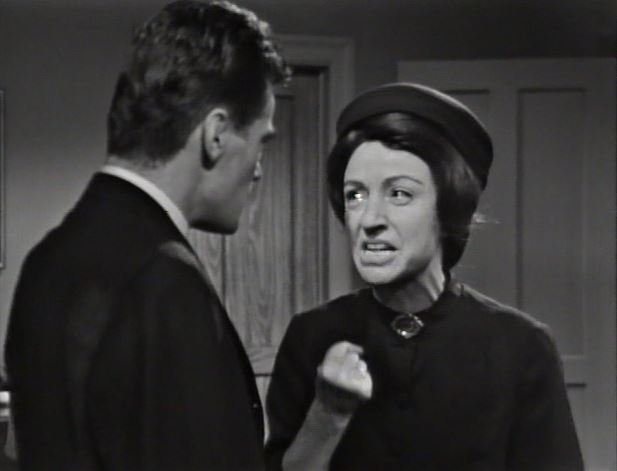
This line is a bit of an omen itself- Clarice Blackburn will be an important part of the show, not only as Mrs Johnson, but as other characters who believe in signs and omens, and who make things happen in the name of that belief.
Meanwhile, hardworking young fisherman turned hardworking young clerk Joe Haskell is called into Roger’s office at the cannery. There, he finds flighty heiress Carolyn behind her uncle’s desk, looking seductive, or at least highly available.
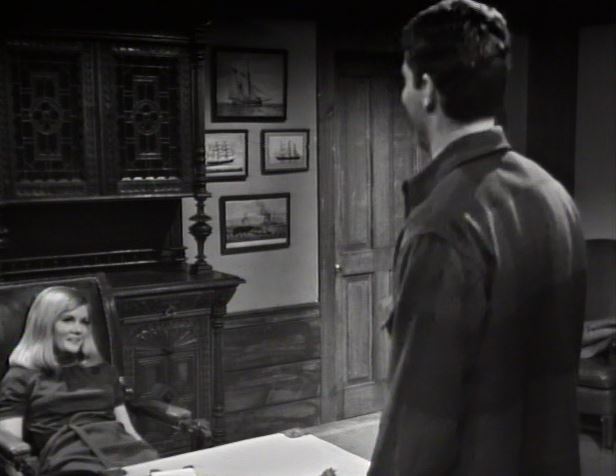
Nancy Barrett’s way of throwing herself completely into whatever her character is supposed to be doing at any given moment sometimes makes Carolyn seem even more scattered than her persona as Flighty Heiress required, but it does come in handy when the character is supposed to be sexy. That makes her stand out- even by the standards of an American television show of the 1960s, Dark Shadows is remarkably un-sultry. Sometimes it’s a marvel that they can put so many good-looking young people in close proximity to each other and still project an image of total chastity.
Joe and Carolyn kiss, and she asks him to go away with her. He tells her that he can’t just leave work in the middle of the day. She explains that she is troubled by the doings of Joe’s bête noire, Burke. This leads to a lively conversation, which in turn leads Carolyn to resume her attempts to persuade Joe to take the rest of the day off. When Joe’s boss calls for him, she offers to use her clout as the owner’s daughter to persuade him to let Joe go. He won’t let her do this. She leaves, frustrated by his refusal.
Back at the hotel, Burke and Mrs Johnson are devising a plan in which she will get a job at Collinwood and act as a secret agent for him. We get a glimpse of Burke’s persuasive abilities. When Mrs Johnson is showing reluctance to follow his plan, Burke mentions that well-meaning governess Vicki has given Roger an alibi. She immediately declares that Vicki is lying. Burke won’t agree, leading her to demand that he set aside his personal feelings and devote himself wholeheartedly to making the case against Roger. Not only does the audience see Burke showing kindly feelings towards Vicki, keeping the idea alive that they might become a couple, but we also see Mrs Johnson commit herself to going along with Burke’s plan. Whatever Burke’s actual feelings for Vicki, his emotional display at this moment is timed to lock Mrs Johnson into doing what he wants.
There is a knock on the door. It’s Carolyn. Mrs Johnson hides in Burke’s kitchen and listens as he gives Carolyn the idea of hiring her as housekeeper at Collinwood. This isn’t very hard- Burke simply mentions that Mrs Johnson needs a job, and Carolyn at once says that she will tell her mother to hire her as housekeeper at Collinwood. Even so, Burke’s skillful handling of Mrs Johnson is so fresh in our minds that we don’t need to see him actually do anything to enlist Carolyn in his scheme for this scene to reinforce his image as master manipulator.

The sight of Mrs Johnson lurking in the shadows, eavesdropping on Burke and Carolyn, further reinforces this image. A guileless woman comes into his room proclaiming her every thought at the top of her lungs, as she had done when she was introduced at the sheriff’s office in episode 67. We can hardly imagine so straightforward a personality becoming an effective undercover operative Yet within minutes of meeting Burke, he has her working as a spy.
Writer Francis Swann is credited with the script for today’s episode. He is particularly good with installments that, like this one, have only four characters. Swann’s ability to slip substantial amounts of plot exposition into natural-sounding dialogue makes a minimalist drama seem busy. In this one, it also helps us to feel that we have seen Burke perform great feats of persuasion. Burke may not have had to work very hard to plant ideas in the minds of Carolyn and Mrs Johnson, but we are aware that the scripted dialogue has planted ideas in our minds, and know that someone on the other side of the screen is good at subtle communication.
Swann and director Lela Swift also make effective use of the sets in today’s episode. This is our first look at the kitchen in Burke’s room. He’s gone in and out of there several times, most notably in episode 29 when he prepared a nonalcoholic mixed drink, the “Burke Devlin Special,” for Roger’s son, problem child David. Regular viewers might have started to wonder what it might look like, and might pay close attention when we get our first look at it. What we do see is a complex pattern of shadows that signals Mrs Johnson’s initiation into the world of film noir.
In today’s scenes with Carolyn and Joe, we spend as much time in Roger’s office as we have in any other episode. It’s the only part of the Collins’ business location we see, standing in for the whole enterprise. Played on that set, Carolyn’s flippant attitude towards Joe’s job and his mixed feelings about the demands she makes lead us to wonder if she’s going to wreck the whole business. Her persistent friendliness towards family nemesis Burke gives substance to that thought. Regular viewers will remember that Roger’s self-indulgent behavior nearly annihilated the business; seeing his favorite niece play-act as him in his office leads us to wonder if she will finish the job.

