Angelique, wicked witch turned vampire, is dissatisfied with her boss, suave warlock Nicholas. She finds out that Nicholas has botched his current project and sees an opportunity to report him to his boss, a figure identified in the dialogue simply as “The Master” but in the closing credits as “Diabolos.” She performs a ceremony that is intended to get Diabolos to come to her in the basement of Nicholas’ house, but Diabolos insists she meet him in his office. That is obviously a redress of the set used for the basement of old world gentleman Barnabas Collins’ house. The show never does explain where Barnabas gets his income, so I guess it makes sense he rents out space to local businesses.
Diabolos is impatient with Angelique. When she starts complaining that Nicholas has been harsh with her, he responds “From what I know, you deserved it.” When she persists on this point, he says “I don’t want to hear anymore.” He goes on to praise Nicholas, saying that “His plan for creating a super-race which will follow only me is excellent.” Angelique then tells him that this plan has in fact failed. “One of the beings chosen for the plan has destroyed the other.” Indeed, the male Frankenstein’s monster known as Adam killed the woman built to be his Eve on Monday. Diabolos is shocked to hear this, and at the end of the episode we hear his voice telling Nicholas that he will soon face judgment.
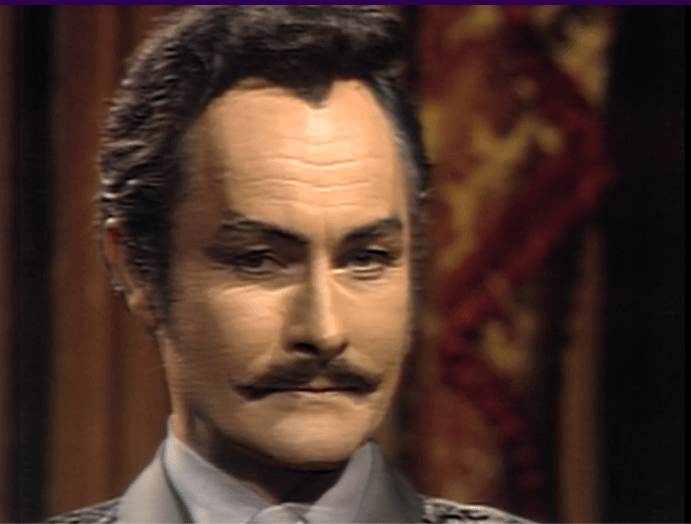
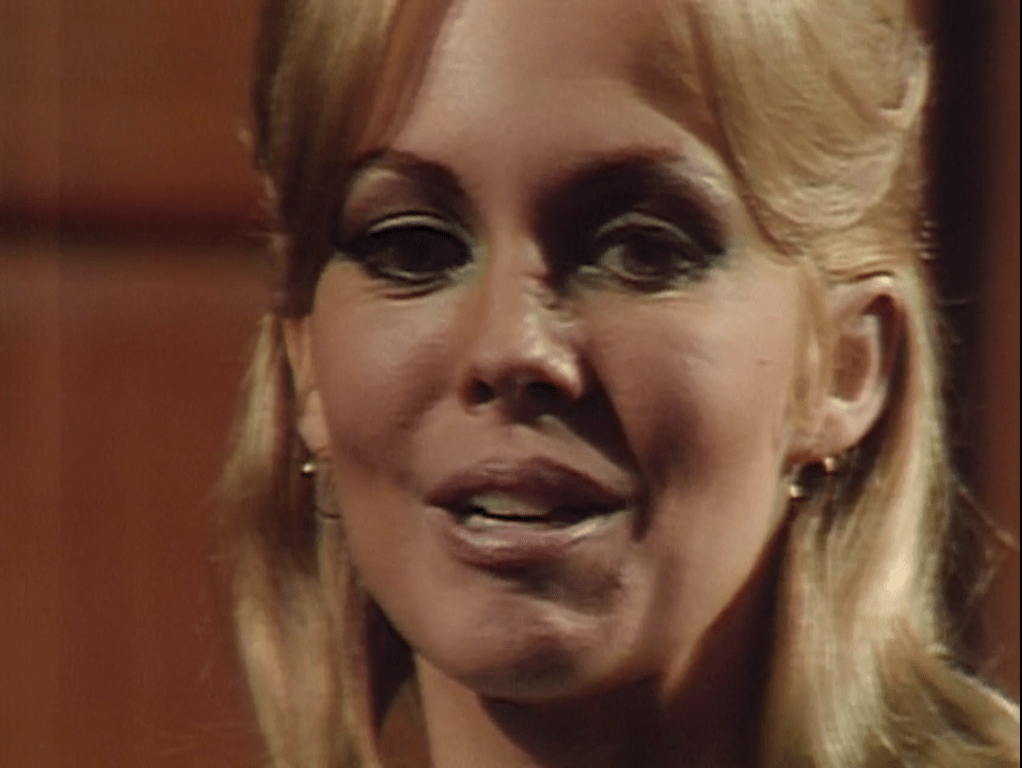
Duane Morris plays Diabolos. Morris appeared several times as a stand-in for Adam before Robert Rodan wa s cast in the part; this is his first speaking role on the show. It would be a very difficult challenge for any actor. In the first place, his costume conceals his face altogether, so his physical movements and his voice acting in his scene with Angelique are two separate performances which he has to give simultaneously. Second, in that scene he spends much of his time looking away from her, so he cannot use his imposing height to create a sense of menace. Third, his voiceover at the close plays during an extreme closeup on the motionless face of Maggie, The Nicest Girl in Town, who is supposed to be acting as his medium. But there is nothing to suggest Maggie is in peril, so even the mood lighting and other practical effects that precede the speech do not focus our attention on Diabolos as a threat. Fourth, the lines Morris has to deliver are written for a middle manager in a mundane office, not for one of the principalities of Hell. At every turn, Morris has to convince us of Diabolos’ dread might with only his voice. Unfortunately, his voice was anything but intimidating. As a result, the whole episode falls flat.
There is also some business with Adam and mad scientist Julia. An unpleasant man known variously as Peter and Jeff is in police custody, charged with Eve’s killing, and Julia tries to convince Adam to help her clear him. In recent months Julia has become the audience’s chief point of view character, but in this case it is Adam’s resolute indifference to Peter/ Jeff’s fate that reflects our attitude. Julia tells Adam that Peter/ Jeff’s life may be on the line if he is tried for murder. In the state of Maine that exists in our universe, capital punishment was abolished for the last time in 1887. In November 1966, this was also true of the version of Maine in which Dark Shadows was set. It was mentioned in #101, broadcast that month, that the state did not carry out executions. Perhaps the fictional Mainers in the show’s universe responded to the horrendous news continually emanating from Collinsport by reestablishing the death penalty, or perhaps Julia realizes that no true statement could enlist anyone’s sympathy for the entirely repellent Peter/ Jeff and so she is resorting to a desperate lie.
Well-meaning governess Vicki has found a grievously injured Barnabas Collins in the woods. Barnabas insists Vicki not take him to a doctor or anyone else, but hide him somewhere no one will find him. She thinks of a secret door to the long-abandoned west wing of the great house of Collinwood, and uses that to take him to a hiding place there.
For the first year of Dark Shadows, the west wing was strongly associated with Vicki. In #14, she alone saw the locked door separating the bedrooms from the west wing open and close, apparently by itself. That was the first unequivocal evidence of supernatural activity on the show. In #84, Vicki’s charge, strange and troubled boy David, led her into the west wing, the first time we had seen its interior. He then trapped her in a room there, hoping she would die. She would languish in that room until David’s father, high-born ne’er-do-well Roger Collins, rescued her in #87. When Vicki was engaged to Roger’s nemesis Burke Devlin in #338, matriarch Liz offered to restore the west wing and let Vicki and Burke live there. After Burke died in a plane crash in #345, Vicki vowed to go on with the project of restoring the west wing. In #347, permanent houseguest Julia Hoffman, MD, exploited Vicki’s interest in the west wing to get her to stare into a crystal supposedly taken from a chandelier there until she is in a state of deep hypnosis.
More recently, Frankenstein’s monster Adam stayed in the west wing for many weeks as the guest of heiress Carolyn. Vicki’s connection with the wing was renewed when Adam abducted her and hid her there for a few days starting in #553. Today, Vicki hides Barnabas in Adam’s old room, re-establishing the west wing as her space. Thus we loop back to a theme that goes back to the third week of the show.
Later in the episode, Barnabas wakes up and is distressed to find that it is almost sunset. He pleads with Vicki to bring him a cross as quickly as possible. The audience knows, but Vicki does not, that Barnabas is the victim of vampire Angelique. Vicki’s ignorance of this point reminds us that she has been excluded from the show’s A-plots ever since #211, when Barnabas was introduced, himself in those days a vampire. Her calm departure to go fetch a cross reminds us that she knows this part of the house well. Every room in it is stuffed with bric-a-brac, undoubtedly she will have seen something nearby that is in the shape of a cross.
Meanwhile, Julia is in a hospital room, visiting local man Joe Haskell. Julia has become Barnabas’ inseparable friend, and Joe is Angelique’s other victim. She does not know that Angelique is the vampire, though she had surmised as much in #608. She questions Joe. At first he denies everything, but after she discloses that she was for a time the victim of yet another vampire he tells her that she must know why he can’t tell her who has been sucking his blood. She asks if the suave Nicholas Blair is hiding the vampire. Joe closes his eyes and scoffs at the idea. This reaction does nothing to curtail Julia’s suspicions of Nicholas.
Julia goes to Nicholas’ house. He genially escorts her into his living room. There, he takes a seat while she stalks about the room and tells him what she knows about him. Barnabas has a self-defeating habit of showing his cards to his adversaries, and longtime viewers may at first be afraid Julia has picked it up from him. Since Nicholas is a warlock who not only controls Angelique but has a wide range of magical powers that he uses to promote Satan’s interests on Earth, he is not an opponent with whom one can afford to make mistakes. Angelique herself was once a witch who, in #378, was able to turn a man into a cat at a moment’s notice. Nicholas’ command of the black arts goes far beyond Angelique’s. He was able to strip Angelique of her powers, raise her from the dead at least twice, and turn her into a vampire. Julia is simply a mad scientist, and she does not have any equipment with her. There’s no telling what Nicholas might do to Julia if their interview displeases him.
On his great blog Dark Shadows Every Day,Danny Horn lists three reasons why we know Julia will survive this confrontation without being turned into a toadstool:
Really, the thing that everybody wants to know is: why can’t the Stormtroopers shoot straight in Star Wars? It turns out there are three simple answers. #1. Stormtroopers shooting laser bolts are more interesting to look at than Stormtroopers who stand around complaining. #2. Shooting Luke Skywalker in the head halfway through the first movie is going to leave a rather obvious gap in the trilogy. #3. ‘Strong Guy Kills Weak Guy’ is not headline news.
Danny Horn, Dark Shadows Every Day, “Episode 619: The Gunslinger,” posted 4 April 2015
This is all very true- of course Nicholas and Julia will not leave each other alone indefinitely, of course the show cannot spare her, of course she will overcome her disadvantages and come away from their showdown with the upper hand. But it misses the point. Suspense comes when we know what must happen, but cannot see any way it might happen. What makes the scene work is the moment when Julia tells Nicholas that Barnabas is missing. That is news to him, and as Danny says elsewhere in his post, it is “the first sign of a crack that’s going to bring his entire operation crashing down,” as his shocked reaction suggests it might be.
The scene is one of the best in the series, though it is marred by a miscalculated ending. In the early part, we see Julia making an effort to keep her cool while Nicholas sits watching her smugly. She succeeds in keeping her brave face on until she senses that she has Nicholas off guard, at which point she moves in for the kill and tells him about Barnabas. She is then firmly in command. He composes himself and dismisses her.
That’s when it goes wrong. When Julia is heading out the door, Nicholas recovers his smugness and tells her that he must admit that he admires her for coming to see him. She looks alarmed and asks why. He replies, in a half-whisper, “You know.” She hastens out. I can see that this ending may have seemed like a good idea. We clearly saw in the beginning how hard it was for Julia to keep her fear in check and how easy it was for Nicholas to bask in the superiority his powers give him over a mere mortal. Though Julia has emerged as the winner in this engagement, she still has grounds for immense fear, and he for boundless self-confidence. But it is so broadly drawn as to be confusing. Has Nicholas already found a way to turn Julia’s success against her? Has she realized too late that she has made a mistake we aren’t aware of?
We learn shortly after that neither of these things has happened. Angelique comes upstairs. She sees Nicholas being very still. She makes several attempts to engage him in conversation. He finally approaches her and strikes her across the face. He then orders her to undo what she has done to Barnabas before it ruins his plans.
This is the second time Nicholas has slapped a woman in the face. The first time was in #610, when he struck Frankenstein’s monster Eve. Humbert Allen Astredo and Marie Wallace executed that business well, as he and Lara Parker execute it well today. For that matter, Grayson Hall and Lara Parker had done a good job when Julia slapped Angelique in the face in #535. Watching them, you can admire trained professionals practicing a specialized aspect of their craft. But since Nicholas has such vast powers, he is persuasive as a villain only when we are left guessing about just what he is up to. When we see him is reduced to hitting a woman, he shrinks from avatar of Satan to cheap pimp.
After Julia leaves Nicholas’ house, she lingers in the woods outside, watching his front door. She sees Nicholas leave the house, then sees Angelique and realizes that she is the vampire.
Julia is the most intelligent character on the show, and while we watch her in the woods her face suggests that she is thinking clever thoughts. Unfortunately, we hear her interior monologue in a recorded voiceover, and her lines are remarkably obtuse. On the heels of her overdone fear on the way out of Nicholas’ house, it does as much to undercut Julia’s image as a smart person who can win a duel with the Devil as Nicholas’ physical abuse of Angelique undercuts his image as a demonic sorcerer.
In June 1967, vampire Barnabas Collins locked his victim Maggie Evans, The Nicest Girl in Town, in the prison cell in the basement of the Old House on the estate of Collinwood. The ghost of Barnabas’ little sister Sarah appeared to Maggie several times while she was in the cell. Sarah told Maggie that no one could know she had been to the cell, and particularly warned her not to tell her “big brother” she had seen her. With some reluctance, Sarah eventually gave Maggie a clue that led her to a hidden passage. Sarah’s father had sworn her to secrecy about the passage, and that not even her big brother knew about it. Maggie finally puzzled out the clue, enabling her to escape just moments before Barnabas came to the cell with the intention of killing her. When Barnabas chased Maggie through the hidden passage in #260, the wondering expression on his face confirmed that he had never had any idea the passage was there.
From November 1967 to March 1968, Dark Shadows was a costume drama set in the years 1795 and 1796, the period when Barnabas and Sarah were living beings and the Old House was their home. We saw how cruelly their father, haughty overlord Joshua, treated his indentured servant Ben, and we saw that Joshua had the great house of Collinwood built with a prison cell in its basement. Joshua confined Ben to that cell in #401. With that, we could be sure that Maggie’s cell was already in the basement of the Old House when Barnabas and Sarah lived there, and could surmise that Joshua really did forbid the living Sarah to share with Barnabas or anyone else what she had found about the hidden passage.
The show never explained how Sarah found out about the passage. We might imagine her hiding and watching Joshua or someone else do maintenance on the cell. But the fact that Joshua kept the existence of the escape hatch from Barnabas suggests he wanted the option of locking his son in the cell. Why not his daughter as well? Perhaps Sarah found the passage while confined in the cell herself. Or perhaps some other, older ghost appeared to her while she was there and told her about it. That the clue she gives Maggie is in the form of a rhyme (“One, two, away they flew…”) would suggest this latter possibility. Sarah may have memorized the rhyme as she memorized the lyrics to “London Bridge” and may have solved the riddle as Maggie solves it.
Shortly after Dark Shadows came back to a contemporary setting in March 1968, Barnabas was cured of vampirism. That cure was stabilized in May, when he donated some of his “life force” to the creation of Frankenstein’s monster Adam in an experiment completed by his friend, mad scientist Julia Hoffman. Barnabas and Julia locked Adam up in the basement prison cell for the first weeks of his life. Vampires and mad scientists are metaphors for selfishness, so it is hardly surprising that they are horribly bad parents. But if Joshua was in the habit of locking his children in that same cell, the moments when Barnabas takes fatherly pride in the imprisoned Adam take on a special pathos. It really does seem like a normal situation to him.
Adam escaped from the cell in #500, demolishing the doorway in the process. Today we see that it has been rebuilt. Perhaps to Barnabas, a house just isn’t a home unless it has a prison cell in the basement.
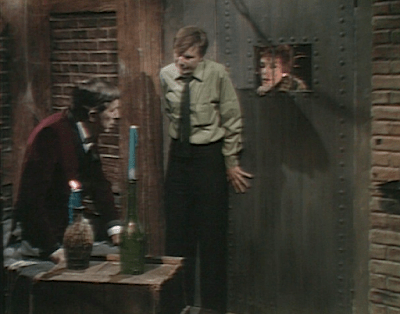
Now, Barnabas has himself become the blood thrall of a vampire, his ex-wife Angelique. Discovering the bite marks, Julia decides to address the situation by locking Barnabas and his servant Willie in the cell. Barnabas won’t be able to get out to heed Angelique’s summons, and Willie hangs a cross over the door to keep her from materializing inside it.
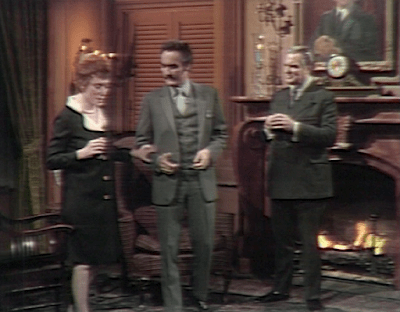
Left to right: Barnabas Collins (Jonathan Frid); Willie Loomis (John Karlen); Julia Hoffman (Lady Elaine Fairchilde.) Screenshot by Dark Shadows Before I Die.
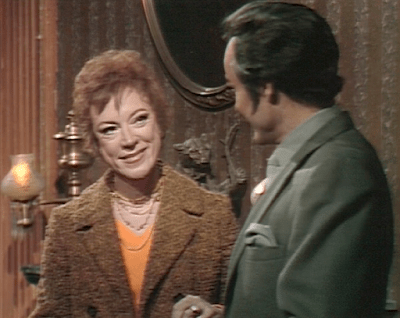
We cut to Maggie’s house. Maggie’s memory of her ordeal as Barnabas’ victim has been wiped from her mind a couple of times. She receives a visitor, the suave Nicholas Blair. Unknown to Maggie, Nicholas is a warlock and Angelique’s master. He has a crush on Maggie which has distracted him from his managerial responsibilities, which to be frank he had not been handling very diligently in the first place. Maggie gives Nicholas several pieces of news that he really ought to have been aware of for some time. She tells him that her ex-fiancé, Joe Haskell, is still alive; that she visited Joe twice while he was at the Old House recovering from some injuries; that Joe is now in the hospital under police guard; and that Joe tried to kill Barnabas and keeps vowing that he will try again, since he believes Barnabas is trying to kill him. Nicholas is flummoxed by all of this, and meekly goes along when Maggie insists on visiting the Old House to pay a call on dear, sweet Barnabas.
The scene in Maggie’s house has an odd feature. We’ve just had a closeup of Willie hanging a cross above the door in the cell to keep Angelique away. In the early days of the vampire storyline, it was not at all clear that the cross would deter vampires in the world of Dark Shadows, since Barnabas was often seen strolling comfortably through a cemetery where half the grave markers were cross-shaped. It was not until #450, during the 1790s flashback, that we saw Barnabas recoil from a cross. In #523, we learned that the cross also immobilizes Nicholas. Yet Maggie is today wearing a dress the front of which is dominated by a red cross, and it doesn’t bother Nicholas a bit. The show is drifting into a spot where it may have to stop and spend time explaining its theurgy. Does the cross only work against a demonic creature if it is specifically aimed at that creature? Or if the person setting it up knows about the creature? Or is there some other qualification? It’s getting confusing.
At the Old House, Julia tells Maggie and Nicholas that they cannot see Barnabas, because he is resting. Maggie keeps insisting, and Julia shifts her ground, claiming that Barnabas went out, she knows not where. When Julia says this, Maggie is incredulous, but Nicholas brightens. Evidently he wants to believe that Barnabas has gone off to respond to Angelique’s call, and accepts Julia’s statement happily. Maggie apologizes for demanding to see Barnabas, and she and Nicholas leave.
Meanwhile, Barnabas is scheming to get out of the cell. While Willie is complying with his request to pour a glass of water, Barnabas bashes him on the head with an empty bottle. He then goes to the hatch for the secret panel, remembers that “Maggie found it a long time ago!” and figures out how to open it. Since we saw Willie open the hatch and show Adam Barnabas’ jewel box in #494, you would think Barnabas already knew how it worked. At that time, it also seemed that the passage behind the hatch had been sealed up, so that it no longer led to the beach. Apparently we aren’t supposed to remember that. Barnabas crawls out and closes the hatch behind him before Julia comes back.
As Barnabas, Jonathan Frid usually moves in the stateliest possible manner. When he escapes from the cell today, the camera lingers on him crawling, driving home the contrast with his typical gait. That is quite different from what we saw in #260, when he followed Maggie into the hatch- then, we saw him move toward the opening, but cut away before he had to take an ungainly position. Today, the makers of the show want us to hold the image of a crawling Barnabas in our minds.
Crawling suggests Barnabas’ weakness under Angelique’s power, certainly, but in this setting it suggests more. This is the house where he was born, and what he is crawling into is a lightless passage that it looks like he will have to squeeze through to emerge outside. He has regressed not only to infancy, but all the way back to birth. If Joshua did indeed confine him to this cell in his childhood, Barnabas would likely have experienced that same regression in those days as well.
The sign of the cross reminds us of one who said that we must be born again to receive a life in which our hopes will be fulfilled more abundantly than we can ask or imagine; Barnabas labored for 172 years under a curse that compelled him to die at every dawn and revive at every sunset, but perhaps even before that he was the prisoner of a cycle of abuse that forced him to experience the trauma of birth over and again, each time finding himself in the same narrow space, a stranger to all hope. Indeed, when Barnabas first became a vampire in the 1790s, he put his coffin in this basement, near the cell, and he persisted in putting it there even after it became obvious that it was very likely to be discovered. That persistence made no logical sense in terms of Barnabas’ need for operational security, but if he saw his vampirism as a continuation of his childhood experience of confinement in the basement cell, it would make all the sense in the world. That is his place, that is where he belongs, that is his reality.
Suave warlock Nicholas Blair proposes to Maggie Evans, The Nicest Girl in Town. Maggie declines, citing her concern for her troubled ex-fiancé Joe Haskell. Nicholas has a man named Harry Johnson under his power, and a vial of poison he wants to give to Joe. After his disappointing date with Maggie, Nicholas goes home and takes a firm grip on his Harry Johnson. He orders Harry to slip the poison to Joe.
That was all I had to say about the episode, but my wife, Mrs Acilius, had a great deal more. She saw it as an essay about free will.
In the opening scenes, Nicholas talks with Frankenstein’s monsters named Adam and Eve. Adam was created in May, in a procedure that used parts salvaged from corpses and a “life force” extracted from recovering vampire Barnabas Collins. When Nicholas found out about Adam, he came up with the idea of a humanoid species bred from patchwork people and loyal to his master Satan. He schemed to have Eve created as Adam’s mate. Nicholas decided that the donor of Eve’s “life force” should be “the most evil woman who ever lived”; he therefore conjured up Danielle Roget, an eighteenth century homicidal maniac based on Madame DuFarge from A Tale of Two Cities, and assigned her the task. Now he finds that Eve has Danielle’s memories and personality, and that she hates Adam. She has found a man she recognized as the reincarnation of someone she was involved with when she was Danielle, and has made up her mind that they will love each other.
Nicholas is frustrated he cannot control Eve. He turns from her and looks into the camera, as if appealing to the audience for sympathy. Nicholas does not seem to understand what went wrong. He had the basic ingredients for his new species- a male and a female. He had not reckoned on one of them disregarding his plan and choosing a direction of her own.
Nicholas turns to us.
Adam sees Eve storm out of the house as he is going to see Nicholas. He asks Nicholas where she is going, and is astonished when Nicholas tells him he doesn’t know. Adam is unhappy that Eve does not want him, and thinks that a change of scene would help. Still upset about his conversation with Eve, Nicholas is slow to focus his attention on Adam. When Adam complains Nicholas thinks that he and Eve belong to him, Nicholas turns to him and starts telling him what he wants to hear. Evidently it is dawning on Nicholas that Adam, too, might start to make his own decisions.
The man Eve has chosen is named Peter, but he prefers to be called Jeff. Eve shows up at his apartment, refuses to leave, and tells him that they are going to be together from now on. Roger Davis’ inadequacies as an actor leave this scene flat. Eve keeps talking about signs of doubts and irresolution she sees in Peter/ Jeff’s face, none of which Mr Davis is able to manifest. All he does is yell and pout. But as Eve, Marie Wallace manages to make the point that Eve is no more interested in anyone else’s free will than is Nicholas. She wants Peter/ Jeff to love her, and that is all there is to it so far as she is concerned.
For his part, Nicholas has learned nothing from the failure of his attempt to match Adam and Eve. He thinks all he has to do is get Joe out of the way and Maggie will come to him “willingly.” He even seems to underestimate Harry. He doesn’t bother lying to Harry about what he wants him to do to Joe, and Harry is horrified at the idea of complicity in murder. Harry is a career criminal, and several times we have seen him try to get money out of people by blackmail, extortion, or spying. Nicholas could easily have told him he is about to commit a crime he is used to committing and avoid all resistance. For example, he might have said that the potion was a truth serum and once Joe took it he would have to tell him some secret they could use against him. But it simply doesn’t occur to him to take Harry’s sensibilities into account, and he winds up having to threaten him to gain his compliance. A villain who is supposed to have subtle but irresistible powers loses a piece of his menace every time he resorts to an “or else!,” so this is a significant setback for the character of Nicholas.
A woman named Eve sees a man standing on the terrace of the great house of Collinwood. She addresses the man as “Peter Bradford.” Regular viewers know that this is indeed his name, but we also know that he prefers to be called “Jeff Clark.” Peter/ Jeff has died and came back to life since he was first known as “Peter Bradford,” so I suppose you could say that’s a case of deadnaming. But while most transfolk tend to be patient when people inadvertently deadname them, Peter/ Jeff is a huge jerk about correcting people who use his former name. Yesterday twelve year old David Collins called him “Peter Bradford,” and he grabbed the boy and shook him until it looked like he had given him a concussion.
Eve is also a returnee from the world of the dead. Doubly so; her body is a Frankenstein creation made of parts salvaged from corpses, while her memories and personality are those of eighteenth century homicidal maniac Danielle Roget. Peter lived in that same era, and when Eve/ Danielle recognizes him we learn that they knew each other then. Peter/ Jeff doesn’t assault her as he did David; she’s his own size. He doesn’t recognize her, which she attributes to the fact that she looks different than she did when they knew each other. He keeps whining that his name is “Jeff Clark,” but she isn’t having it.
Meanwhile, Peter/ Jeff’s fiancée, well-meaning governess Vicki, is in the drawing room, having a conversation with matriarch Liz. There is a blooper in the middle of this conversation. Liz is supposed to say something like “Then you’ve resolved all your difficulties,” but Joan Bennett stumbles over the words. Alexandra Moltke Isles improvises a response that makes sense of it. That response is smooth enough, but she delivers the rest of her lines very quickly and with unusually little eye contact with her scene partner. Perhaps that is because she was afraid the improvised line was going to put the scene over time, or maybe she realized she had called attention to Bennett’s flub and was nervous because she had embarrassed a big star.
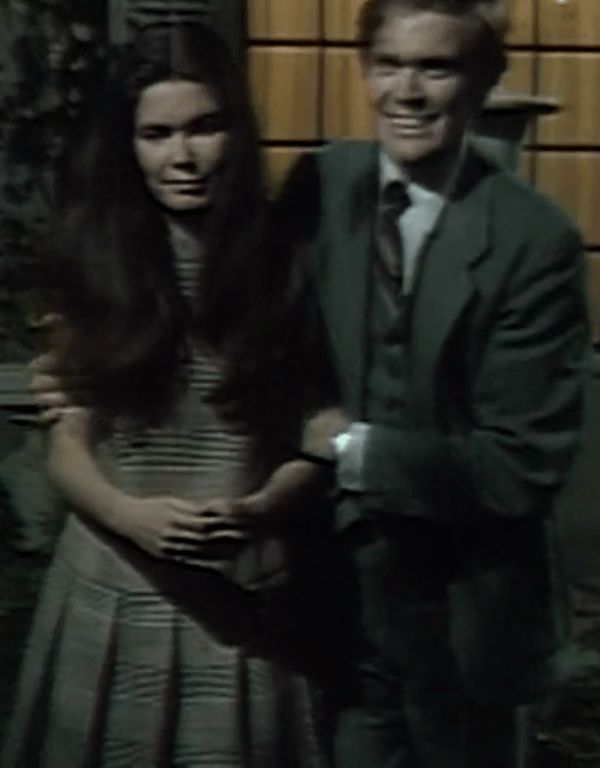
Or maybe Mrs Isles was nervous because her next scene was going to be with Peter/ Jeff, and she knew it would involve Roger Davis putting his hands on her. As they exit, Peter/ Jeff clutches Vicki by wrapping his arms around her in a remarkably awkward fashion, and she visibly squirms. This is most likely Mrs Isles’ discomfort arising from Mr Davis’ habit of physically assaulting his scene partners. A charitable viewer just might be able to believe that it is Vicki’s discomfort because Peter/ Jeff just spent the whole scene telling her transparent lies. He doesn’t want to tell her about his encounter with Eve/ Danielle, and makes up totally unconvincing excuses for his distracted state. Perhaps Mrs Isles channeled her unhappiness at being yoked with Mr Davis into her expression of Vicki’s dissatisfaction with the loathsome little man she is engaged to marry.
Peter/ Jeff steers Vicki offscreen.
Once Vicki and Peter/ Jeff are gone, Eve/ Danielle emerges from the bushes whence she had been spying on them. Liz comes out to the terrace and sees Eve/ Danielle. She asks who she is. When she does not answer, Liz tells her that she knows- she is the angel of death. Eve/ Danielle is startled by this, and hurries away.
The next scene takes place in the house of suave warlock Nicholas Blair. Nicholas has been keeping Eve/ Danielle there since she came to life. She has returned from Collinwood. Nicholas is upset with her for going out without his permission. She taunts him, and he slaps her. He threatens to kill her, and she says that while she does not know what his plans are, it is clear to her that she figures too prominently in them for him to do that.
Coming so shortly after we saw an actress give strong signs of unease at contact with Roger Davis, Nicholas’ slap to Eve/ Danielle’s face is a lesson in how professional actors handle scenes involving physical violence. Eve/ Danielle is relaxed before the slap and in shock after it. Her reaction gives the scene its energy. If Marie Wallace had reason to believe Humbert Allen Astredo would actually hit her, she may well have been as tense before the slap as Mrs Isles was before Roger Davis slithered his arms around her, and the scene would have dribbled out as lifelessly as does Peter/ Jeff’s scene with Vicki.
Once Nicholas concedes that Eve/ Danielle is important to his plans, she relaxes again and decides she may as well tell him about her encounter with Peter/ Jeff. Nicholas is intrigued, and disturbed. He tells Eve/ Danielle that “If it is true that they are one and the same, then there are forces at work here that I don’t know about.” Eve/ Danielle’s memory of her previous existence is very incomplete, and she wants Nicholas to help her to learn more about herself. Once he has heard about Peter/ Jeff, he is eager to oblige. He hypnotizes her.
At this point, my wife, Mrs Acilius, expressed frustration. “He’s going to hypnotize her and afterward she won’t remember anything! It’s only interesting if she remembers.” Eve/ Danielle does have a flashback to 1795, but at the end she seems to come out of the trance on her own. She turns to Nicholas, calls him by name, and says that she remembers Peter Bradford and she loves him. Since Nicholas doesn’t give her a post-hypnotic suggestion and snap his fingers, it seems likely she will remember her past with Peter.
When Danielle was introduced, I assumed that the name “Roget” was a case of deadline-induced selection. She is based on Madame DuFarge from A Tale of Two Cities, so she had to be French. But the writer didn’t have a list of French surnames at his fingertips, so he looked at his desk, saw a copy of Roget’s Thesaurus, and went with that. Perhaps that was what happened, but today Eve/ Danielle lives up to her namesake and goes into the synonym business. She calls Peter/ Jeff by his original name. She is on the receiving end of synonymy from Liz, since “the angel of death” is as good a name for her as any. And one of the memory gaps Eve/ Danielle wants Nicholas to help her fill is her previous name.
Marie Wallace plays Danielle in the flashback, even though she had mentioned in the first act that she looked different in those days. This occasions much discussion on the fansites. Here is the debate on the Dark Shadows Wiki:
During the fiashback scene, Danielle Roget should have been played by Erica Fitz instead of Marie Wallace. Fitz had previously portrayed Danielle Roget in episode 594, so it would have made sense and for character continuity to continue using the same actress. [Addendum: There are strong reasons to argue otherwise as well. One could argue that this is a memory that Nicholas is conjuring in Eve, so it’s from Eve’s perspective, and she would naturally see herself in her current guise, not even knowing what Danielle Roget looked like. This is also a reasonable place for dramatic license to prevail. The scene is very short, and it wouldn’t have been especially practical to have an additional actress. It’s also possible that viewers may have been confused if another actress was in the scene–Erica Fitz was on the show for only two episodes, so viewers at the time might not even have seen or not fully remembered what she looked like. Aside from that, it’s also possible Erica Fitz was not available.]
Discussion under “Bloopers and Continuity Errors” in “610” on The Dark Shadows Wiki.
In a comment on his own post about the episode on Dark Shadows Every Day, Danny Horn puts it more succinctly:
Yeah, I think the in-universe explanation is that the flashback pictured at the top of this post is Eve’s hypnosis-assisted memory of the event, so she’s picturing herself as she is now.
The real-world explanation is that Marie Wallace is playing Eve/Danielle now, and exactly nobody wants Erica Fitz to come back and appear in the flashback.
Comment left 23 March 2015 by Danny Horn on “Episode 610: Inexplicable You,” Dark Shadows Before I Die, 21 March 2015.
For my part, I’m sure Erica Fitz Mears is a very nice lady, and we should all give her money to help with her health problems. But no, she was not a good actress and I do not regret that she did not get more work on screen. Since Mrs Mears was only in two episodes, today’s flashback might have been an opportunity to give some other actress a chance to show what she could do as Danielle. But Miss Wallace does a very good job, and rounding the episode with two confrontations between the same pair of performers does a great deal to strengthen its structure. It would probably have been a mistake to cast anyone else in the flashback.
The flashback scene does come as bad news to longtime viewers, for reasons that have nothing to do with the casting of Danielle. When in November 1967 the show needed to develop a backstory for vampire Barnabas Collins, it took us back to 1795 and introduced Angelique, a maniacal ex-girlfriend who was determined to disrupt Barnabas’ new romance. That was a triumph that turned Barnabas from a stunt that boosted their ratings sufficiently to ward off cancellation into one of the major pop-culture phenomena of the 1960s, and Angelique herself became one of the show’s most important characters. That they are trying the same tactic with Peter/ Jeff, right down to a dramatic date of 1795, leads us to fear that they see him as a permanent part of the cast, and that they want to tie Eve/ Danielle as closely to him as Angelique is tied to Barnabas.
Recovering vampire Barnabas Collins has determined to let himself into a house occupied by suave warlock Nicholas Blair. He knows that Nicholas is harboring Frankenstein’s monsters named Adam and Eve, that Eve is the reincarnation of a homicidal maniac, and that Nicholas has sinister plans for the pair. Once in the house, he intends to kill Eve.
Most of the episode is taken up with Barnabas’ preparation for this mission. He works with his friends, mad scientist Julia Hoffman and occult expert Timothy Eliot Stokes, to ensure that Nicholas will be out of the house when Barnabas gets there. When he goes into the room where he expects to find Eve, Barnabas discovers that she is not there. Instead, he is greeted by his erstwhile wife, Angelique. Angelique is now a vampire. We end with her baring her fangs at him.
Beneath all the homicidal and fantastic elements is a classic situation of farce. A man sneaks into a house hoping to meet a young woman, only to come face to face with his ex-wife. There are several notes of intentional comedy. Keeping Nicholas distracted, Stokes gives him a long lecture about the history of the Collins family. When he starts in on the details of their shipping interests, Nicholas squirms, jumps up, and thinks of someplace else he ought to be. Stokes and Julia destroy that excuse, and Nicholas sinks sadly back into his chair, bracing himself to hear more.
It dawns on Nicholas he will have to listen to the rest of Stokes’ disquisition. Screenshot by Dark Shadows Before I Die.
When Barnabas first enters Eve’s room, he thinks he sees a figure in her bed, only to find that there are pillows piled up under the covers. Angelique pulled that on him in #403, and Julia did the same thing in #291. Longtime viewers are left wondering when he will fall for the same trick a fourth time.
I do wish writer Gordon Russell had called on his frequent collaborator Violet Welles for help with this one. There are four or five nice laughs, but the tone immediately subsides back to seriousness between them. Welles had a gift for glittering dialogue that could have kept us chuckling throughout.
Suave warlock Nicholas Blair is entertaining two guests in his home. They are Frankenstein’s monsters. The man is named Adam; in the 22 weeks since he came to life, Adam has learned to speak fluent English, to play chess, and to discuss the writings of Sigmund Freud, but he is still very unsure in his dealings with other people. Desperate to be loved but quick to resort to violence, he always winds up taking orders from someone or other.
The woman is named Eve. Created to be Adam’s mate, she came to life only in #596, but has all the memories and personality of Danielle Roget, a homicidal maniac who lived in France and America in the late eighteenth century. Her connection to Danielle was the result of Nicholas’ doing; when he learned of Adam’s existence, Nicholas decided to use him to found a new humanoid species, a race who would owe their existence to Satan rather than to God. In furtherance of that plan, Nicholas said in #575 he wanted to infuse Adam’s mate with the spirit of “the most evil woman who ever lived,” and he settled on Danielle as that woman.
We see today that Nicholas has over-egged his pudding. The thoroughly sincere Adam bores Eve/ Danielle to tears. She can barely stand to look at him while he tries to woo her, and sends him off to bed. She approaches Nicholas and suggests that he become her lover, preferably after she has killed Adam. Nicholas is amused by the idea, but tells Eve/ Danielle that unless she sticks with Adam, he will kill her. If Nicholas wants the two of them to found a whole new breed of creatures who will subdue the Earth for the Devil, he probably should have picked a woman whose vices ran less to violence and more to lust.
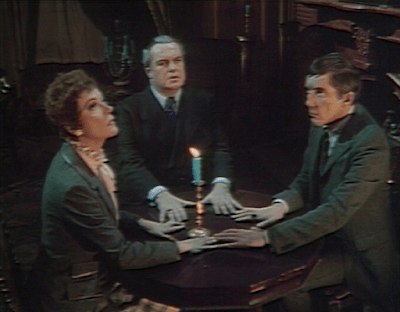
Shortly after Eve/ Danielle came to life, a wind blew into the room where she was staying, indicating that a ghostly visitor had come to her. She addressed it as “mon petit” and said “I will not go back.” Today, the same visitor appears at the Old House on the great estate of Collinwood, home of recovering vampire Barnabas Collins. The ghostly wind knocks a book off Barnabas’ shelf written in 1798 by one Philippe Cordier. Occult expert Timothy Eliot Stokes is visiting Barnabas and Barnabas’ inseparable friend, mad scientist Julia Hoffman. Stokes decrees that the three of them must hold a séance at once.
When there is a séance on Dark Shadows, there are three indispensable roles. There must be someone who gives instructions and supervises the proceedings, usually with considerable gruffness. The first time a séance was held in this room, using this table, was in #186, back in March 1967. Well-meaning governess Vicki was the supervisor that time, and it was startling to see her cast aside her demure manner to take the same gruff tone others would adopt in that role. It is not unusual for Stokes to be gruff, but since Julia and Barnabas have both attended multiple séances before, his tone will strike regular viewers as unnecessary.
The second indispensable role is that of medium. That role falls to Barnabas today. He passes out and starts moaning. At this point the third role comes into play. It is Julia who must express alarm and try to break the trance. As supervisor, Stokes must then sternly rebuke her and insist that the dead be allowed to speak through the medium.
Barnabas speaks a few phrases in French, as Vicki had spoken in French when the spirit of the gracious Josette possessed her in Dark Shadows’ very first séance, in #170 and #171 in February of 1967. He also speaks English with a French accent. Some fans like to poke fun at Jonathan Frid for the French accent that comes out of Barnabas’ mouth today, as indeed some liked to poke fun at Alexandra Moltke Isles for the accent that came out of Vicki’s. To those people I can only say, if those accents sound funny to you, just go to France- you will laugh all day long, because that’s how French people actually talk.
Through Barnabas, Philippe Cordier says that he has been lonely since Danielle’s spirit left him to return to the world of the living. Combined with Eve/Danielle’s refusal to “go back,” this implies that Philippe is Danielle’s boyfriend in Hell. He vows to kill “the man who says he loves her,” viz Adam, which seems illogical- if he wants her to leave the upper world and come back to him in Hell, he could achieve that simply by killing her. If he wants to punish the person who took her away from him, again Adam is the wrong target- it was Nicholas who picked Danielle. Adam had nothing to do with it. But Philippe, even though he was a published author when he was alive, is not an intellect now, only a spirit seeking vengeance. He is raw energy untrammeled by mind, and there is no reasoning with him.
Frid’s turn as Philippe is impressive. We’ve seen Barnabas in many moods, but he always has something to lose and almost always has something to hide. Frid often said that he played him as, first and foremost, a liar. But there is nothing disingenuous about Philippe. He is pure rage. In this tiny performance, Frid embodies that rage, and does not at all remind us of Barnabas.
Adam and Barnabas have a mystical connection that gives them a Corsican Brothers relationship. So far we have only seen this in action twice, both times when Barnabas was suffocating and Adam had trouble breathing. It does not work consistently, and it is not clear if Barnabas will suffer any of Adam’s pain. Indeed, when Adam fell off a cliff and nearly died, it didn’t bother Barnabas a bit. But apparently the bond does in fact go in both directions. When, after the séance, Philippe goes to Nicholas’ house and starts strangling Adam, Barnabas also starts choking.
In February and March of 1967 Dark Shadows was still aimed mostly at an adult audience made up of people who were impressed that the cast included Joan Bennett. But this episode demonstrates how completely it has since become a kids’ show. The first two séances resulted from long preparation, involved great effort, and produced tantalizingly vague, elusive messages. But this time around, the characters see signs of a ghost, Stokes immediately declares it’s time for a séance, and within two minutes Philippe Cordier is complaining about how he has to put himself back on the dating market of the damned. My wife, Mrs Acilius, pointed out that this is like something you would see in a story written by a small child. If the barrier between the dead and the living is inconvenient to the progression of the story, then you throw it out the window and proceed as if you could call up a ghost and have a conversation any time you wanted.
A mysterious woman appears at the front door of the Old House on the great estate of Collinwood. She introduces herself to the master of the house, old world gentleman Barnabas Collins, under the name Leona Eltridge. The door opens further and we see that Leona is accompanied by Frankenstein’s monster Adam. She tells Barnabas that she has come to donate her “life force” to an experiment meant to create a bride for Adam. Barnabas has many questions, none of which Leona will answer. Adam orders Barnabas to find mad scientist Julia Hoffman and ushers Leona to an upstairs bedroom.
Erica Fitz as Danielle/Leona. Some participants on message boards think she looks masculine. Those people are very confused. Screenshot by Dark Shadows Before I Die.
There, Adam tells Leona that he doesn’t know any more about her than Barnabas does. She tells him that he doesn’t need to know more, and reminds him that they must not let Barnabas or Julia know that they met for the first time this night. Moreover, no one must know that she has any connection with suave warlock Nicholas Blair.
Julia shows up with occult expert Timothy Eliot Stokes. Barnabas tells them about Leona, and Adam enters, demanding she start the experiment at once. Julia goes to the basement laboratory, and Stokes goes to question Leona.
Leona tells Stokes that she was in love with Adam’s creator, the late Dr Eric Lang. She also claims to be suffering from a terminal illness, and to have only a short time before she will die a painful death. She therefore wants to continue Lang’s work, and has no fear of the danger involved in the experiment.
Stokes, Julia, and Barnabas all regard Leona’s story as, in Julia’s words, “too pat and sentimental” to be true, but they have little choice but to comply with Adam’s demands. In fact, we know that Leona is really Danielle Roget, an eighteenth century homicidal maniac whom Nicholas conjured up yesterday. Nicholas himself has developed a crush on Maggie Evans, The Nicest Girl in Town, which puts the lie to his pretense to be a stranger to human emotions. That Nicholas thinks anyone who knew the fiendish Lang would believe Danielle/Leona’s sappy story suggests that he might be an even bigger softie than his attraction to the magnificently wholesome Maggie would indicates.
Stokes figures out how the name “Eltridge” is spelled, which somehow means that he must hurry off to work on something or other. In the basement, Julia directs Danielle/Leona to the donor’s table. She offers her a painkiller, which she refuses. Adam watches the experiment. When Danielle/Leona flatlines, Julia pronounces her dead and says that the experiment has been a failure. Adam tells Barnabas and Julia that he ought to kill them. Barnabas disagrees. Before they can explore the issue in any depth, the Bride comes to life and Adam cheers up.
The opening voiceover says that if Barnabas realized that Danielle/Leona was “one of the living dead,” his reaction would be terror. Barnabas was himself a vampire for 172 years, so you might think he would be happy to meet someone with whom he had so much in common, but maybe not.
In April 1968, mad scientist Eric Lang promised Barnabas Collins that he could cure him of vampirism. The cure was an experimental procedure modeled on the one in Hammer Studios’ 1967 film Frankenstein Created Woman. A body constructed of parts salvaged from several fresh corpses was to be associated with Barnabas, and when the procedure was complete Lang expected Barnabas’ body to be dead and his mind to awaken in the constructed body. After Lang’s death, Barnabas’ friend, Dr Julia Hoffman, completed the experiment. To their surprise, the procedure ends with both Barnabas and the new man alive. Barnabas named the new man Adam. They take Adam to the dungeon in Barnabas’ house, and keep him there in horrifyingly bad conditions until he escapes. Adam of course hates Barnabas and Julia.
Lately, Adam has been hiding out in a long-deserted part of the great house of Collinwood. Heiress Carolyn Collins Stoddard took pity on him and has been looking after him there. He has fallen in love with Carolyn, to her embarrassment and his frustration. Carolyn has delegated the day-to-day responsibility for looking after Adam to unsightly ex-convict Harry Johnson. Adam’s former protector, occult expert Timothy Eliot Stokes, visits from time to time. Adam’s most frequent and most influential visitor is suave warlock Nicholas Blair. Carolyn and Stokes are good, Nicholas is evil, and Harry is just distasteful.
When Nicholas found out about Adam, he forgot about whatever plans he may previously have had and focused on the goal of founding a new humanoid race. He has talked Adam into demanding Barnabas and Julia repeat the experiment to build a mate for him. Adam threatened to kill well-meaning governess Vicki Winters unless they complied. Now there is a patchwork female corpse and a lot of scientific equipment in Barnabas’ basement. All that is missing is a woman to donate her “life force.”
Barnabas and Julia were plotting to use Maggie Evans, The Nicest Girl in Town. When Barnabas was a vampire in May and June of 1967, he abducted Maggie and tortured her in an attempt to erase her personality and replace it with that of his lost love, the gracious Josette. When that evil scheme collapsed, Maggie escaped and Julia used her preternatural powers of hypnosis to block her memories. Ever since, Maggie has had no idea of what happened during those two months, and she has thought of Barnabas as a wonderful person. Barnabas wants Julia to use those same powers first to bring Maggie to the basement lab, and then to block her memory in case she survives.
Barnabas’ much-put-upon servant, Willie Loomis, overheard this plan. Willie has a crush on Maggie. He tried to talk Barnabas and Julia out of their fell intentions, and when they would not listen he tried to persuade Maggie to leave town. She wouldn’t listen either, so he took it upon himself to abduct Maggie. He stole some chloroform from the lab, broke into her room, and took her to the hidden chamber inside the old Collins family mausoleum.
We open today in the front parlor of the Old House, where Adam is coolly explaining to Barnabas that he does not want Maggie to donate the “life force” for his mate. Barnabas angrily explains that it must be Maggie, because Julia has proven that she can control her. Besides, Maggie lives alone, so she can go missing for several days before anyone knows she is gone. Barnabas is the chief protagonist of this show, by the way.
Adam says that the only woman whose “life force” he wants to animate his bride is Carolyn. Barnabas says that this is impossible. Adam has been gradually learning the details of the experiment that brought him to life; only now does Barnabas tell him that in the original plan, he would die and come back to life in his body. Adam is bewildered by this. “How could you hate yourself so much that you wanted to change your body?” Barnabas does not want to confess his his former vampirism, so Adam doesn’t get an answer.
Adam meets Nicholas at the gazebo on the grounds of the estate. Nicholas wants him to ignore everything Barnabas said, but Adam is giving deep thought to all of it. It was Nicholas’ idea that Carolyn should provide the “life force,” and Adam enthusiastically agreed, believing this meant that his mate would be like her. He says now that he and Barnabas do not recognize themselves in each other, and Nicholas tries to brush this very apt observation off by saying that Barnabas would hide his similarities. Adam demands Nicholas assure him that Carolyn will not be subjected to any violence. She must want to participate in the experiment. As my wife, Mrs Acilius, pointed out, that condition is indeed a similarity with his “life force” donor- Barnabas had been preoccupied with the idea that Maggie and his other female victims would eventually come to him of their own will. While Nicholas is trying to quell the big guy’s concern, Willie happens by.
Adam starts to figure everything out, and wants to reason with Nicholas.
Adam hides while Nicholas confronts Willie. He puts a magic zap on Willie to compel him to release Maggie. After Willie goes, Nicholas tells Adam he will use the same painless technique to cause Carolyn to cooperate. Adam is skeptical, but Nicholas assures him that his doubts will be settled when he sees that Maggie is free before daybreak.
That may not quite work out. Willie made the worst possible choice of hiding place when he stashed Maggie in the hidden chamber of the mausoleum. Barnabas took her to that chamber for torture when she was his prisoner, and shortly after she awoke there her memory started to come back. By the end of today’s episode, she remembers that Barnabas was her captor. When Willie returns, he will find that he has quite a problem on his hands.
Suave warlock Nicholas Blair has a job for a woman. Talking to his subordinate, vampire Angelique, he says that the job must go to “the most evil woman who ever lived.” At this, Angelique breaks into a smile, then raises her head proudly. Nicholas then says, “Someone like Lucrezia Borgia.” At this, Angelique’s face falls, and she protests that Lucrezia is dead.
Angelique, flattered when she thinks Nicholas is describing her as “The most evil woman who ever lived.”
Nicholas brushes this objection off, saying that “The spirit of evil can be made to live again.” Longtime viewers may have been wondering whether Lucrezia Borgia would make an appearance, since her name has come up more than once. In #152, sarcastic dandy Roger insulted his sister, reclusive matriarch Liz, by comparing her to Lucrezia; in #178, Roger insulted his niece, heiress Carolyn, in the same way; and in #523, Carolyn brought up Lucrezia to insult Angelique, whom she knew when Angelique was calling herself Cassandra and was married to Roger. Perhaps we might have imagined some kind of story where Roger turns out to have some kind of supernatural connection to Lucrezia.
Nicholas continues teasing Angelique, bringing up the Countess Elizabeth Bathory, alleged serial killer and blood drinker of the 16th and 17th centuries. Angelique calls that lady “a vile woman,” in a tone that suggests she knew her personally. From November 1967 through March 1968, Dark Shadows was a costume drama set in the 1790s, and Angelique was its chief villain. She was not a vampire then, but a witch. Her spells were very powerful, but she was quite clumsy in her use of them, suggesting that she was a young woman new to witchcraft. Perhaps this line is meant to open the door to a retcon, one which will make it possible to tell stories about Angelique set in even earlier periods than the 1790s segment.
Nicholas agrees that the countess was “a vile woman,” and repeats that epithet as the first in a list of her qualifications for the job he has in mind- “ambitious, cunning, devious, unprincipled, decadent!” He finally concludes his teasing of Angelique and tells her that he will not hire her for the job. She is disappointed, as one of the benefits of the job is release from vampirism. She leaves the room. In the corridor, she flashes a smile which regular viewers recognize as a sign that she is going to defy Nicholas and try to seize what he would not give her.
The Only Filthy Way It Could Be Done
The job is an unusual one. Nicholas has persuaded Frankenstein’s monster Adam to confront old world gentleman Barnabas Collins and mad scientist Julia Hoffman with a threat. If Julia and Barnabas do not repeat the procedure that created Adam and produce a woman who will be his mate, Adam will kill everyone in and around the great house of Collinwood. Subjected to that extortion, they undertake the project.
The procedure not only involves building a body from parts of corpses and running electrical charges through it, but also requires that the body be somehow connected to a person who will serve as its “life force.” It is energy drained from this person that will animate the body. Barnabas was Adam’s “life force.” Before the procedure, Barnabas was a vampire. Serving as Adam’s “life force” put his vampirism into remission. Nicholas talked about this with Angelique, raising her hopes that he would let her escape from vampirism the same way, only to dash those hopes cruelly.
Julia completed the experiment that brought Adam to life after the death of another mad scientist, Eric Lang. Lang had built the body and the apparatus, and had left detailed notes. Julia had studied those notes for some time before she knew which switches to throw and which dials to turn. Under Adam’s threat, Julia has rebuilt the apparatus in Barnabas’ basement and she has a cadaver there which she is using for parts. Barnabas has ordered his servant Willie to help with the grave robbing. Barnabas has also enlisted the aid of Lang’s former grave robber, an unpleasant man named Peter who prefers to be called Jeff. The equipment needs a lot of tending, and Peter/ Jeff is the lab tech on that detail.
A Nice, New, Clean Slab of Flesh
Peter/ Jeff is by himself in the basement lab when Professor Timothy Eliot Stokes walks in. It’s news to Peter/ Jeff that Stokes is aware of the project, but he tells him that he knows everything about it. Stokes stays so calm as he examines the apparatus and looks at the cadaver that one supposes he must know a great deal.
Stokes asks Peter/ Jeff how the equipment runs when Barnabas’ house has no electricity. Peter/ Jeff says that Julia installed a generator. This must be some unusual kind of generator, since it runs in absolute silence. Later in the episode, Stokes will have a conversation with another character about how Barnabas doesn’t have a telephone.
When Barnabas was a vampire, he didn’t want meter readers or other workers dropping by unannounced and he had no use for modern conveniences. So of course he did not connect his house to the electric grid or to telephone service in those days. As for other utilities, it is a fairly prominent bit of lore that vampires cannot tolerate running water, so of course he wasn’t going to have any plumbing. But he’s been unvamped for almost six months now, so he may as well just update his house. Stokes’ lines today lampshade the problems he creates by refusing to do so.
Another unannounced visitor interrupts Stokes’ conversation with Peter/ Jeff. It is Adam. He is upset to find Stokes in the lab. Stokes once took Adam in and taught him English, and in those days Adam considered Stokes to be his best friend. But Stokes shocked Adam when he broke the news to him that he was an artificially constructed man, and has thoroughly alienated him by trying to talk him out of the violent lifestyle Nicholas has persuaded him to adopt.
Adam goes on a self-pitying rant when Stokes tries to reason with him. Peter/ Jeff interrupts and tells Adam something Stokes left out of his birds and bees talk, that he was built out of parts of dead bodies. Peter/ Jeff taunts Adam about this in a speech that is full of such gems that I suspect it was written, not by the credited author of today’s script, Gordon Russell, but by Russell’s frequent uncredited collaborator Violet Welles. Welles’ name will start to appear in the credits in 711, and fans of the show recognize the sparkle that marks her dialogue.
Peter/ Jeff tries to stab Adam. Adam easily disarms him and holds the knife at his throat. Stokes tells Adam that without Peter/ Jeff the project will be delayed. Adam then flings Peter/ Jeff to the floor. Peter/ Jeff is played by Roger Davis, an actor who had a big television career and was irritating in every part. Mr Davis is so annoying on Dark Shadows that Mrs Acilius and I can’t be the only ones who are disappointed when Adam doesn’t kill his character off the show and who cheer when he throws him to the floor.
Peter/ Jeff gets up and leaves the lab. Adam demands Stokes bring him back to resume working. Knowing how violent Adam is, Stokes follows Peter/ Jeff to the great house of Collinwood. Peter/ Jeff is meeting his fiancée, well-meaning governess Vicki, there, planning to take her out for a date. Stokes tells him that they will be in grave danger from Adam unless he goes back to the lab at once. Peter/ Jeff looks out the window, and sees Adam peering in. Adam actually opens the window and reaches into the drawing room while Vicki and Peter/ Jeff are there; it is hard to understand how Vicki doesn’t notice him. Peter/ Jeff makes an excuse, and goes back to the lab.
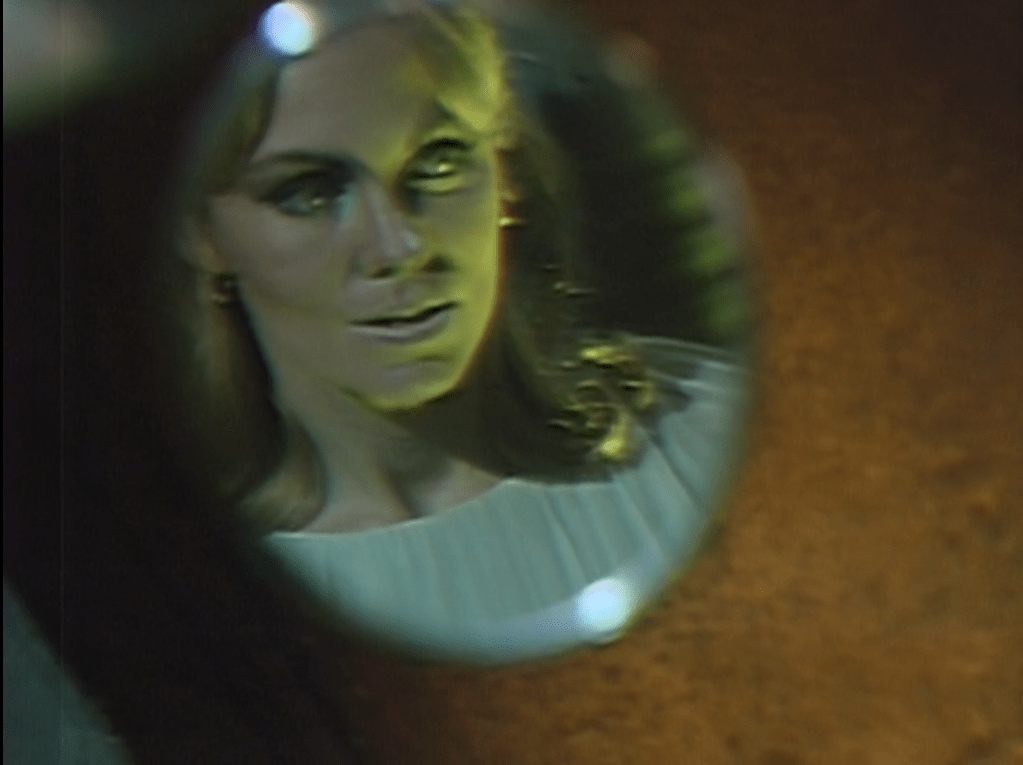
We see him back at work. The camera pans up to a mirror. It holds on the mirror for several seconds while we see Angelique’s reflection. Previously, they have stressed that vampires do not cast reflections. There have been several moments when actors have missed their marks or other production faults have occurred that left us seeing a vampire in a mirror, but this is obviously intentional, and it is jarring to regular viewers.
Angelique’s reflection
Angelique and Peter/ Jeff talk for a moment, then she bites him. Evidently she plans to enslave him and use his access to the laboratory to force her way into the role of “life force” for Adam’s mate. So far, almost every victim of a vampire we have seen has been left unable to do the work s/he was doing before being bitten, so regular viewers might suspect that Angelique’s ploy will simply incapacitate Peter/ Jeff from helping with the project. This expectation becomes all the more substantial when we remember the many times Angelique’s schemes have blown up in her face. The less likely it seems to us Angelique will succeed, the less effective this week-ending cliffhanger will be.




 Dark Shadows Commentary