In the long-abandoned Old House on the estate of Collinwood, fugitive Matthew is sharpening the ax with which he plans to kill his prisoner, well-meaning governess Vicki. In the great house on the same estate, strange and troubled boy David is struggling with himself. His hated father, high-born ne’er-do-well Roger Collins, and his idol, dashing action hero Burke Devlin, are waiting for him to tell what he knows about Matthew and Vicki, and he keeps asking for assurances that he won’t be punished if he tells.
While David’s pathological fear of punishment keeps her rescuers at bay, Matthew finishes sharpening his ax. In the secret chamber where she is bound to a chair, Vicki receives a visitor- the ghost of Josette Collins. The ghost tells her she need not be afraid. Vicki asks why not. The ghost simply repeats herself and vanishes. It is by no means clear that the ghosts mean to save Vicki from Matthew, or that they could keep him from killing her if that is what they want.
David finally tells Burke and Roger where Vicki is, and they get some shotguns. David delays their departure still further by pleading to go along with them. Meanwhile, Matthew is in front of Vicki, starting to swing his ax at her head.
Matthew hears ghostly voices and breaks off in mid-swing. He runs out of the hidden chamber to the parlor, where the ghost of beloved local man Bill Malloy comes strolling in to the room, singing one of the more family-friendly verses of “What Do You Do With a Drunken Sailor?” Matthew starts swinging his ax wildly at the ghost, which laughs at him. Four more ghosts, representing the famed “Widows,” follow, and he swings at them.
In her place of confinement, Vicki can hear Matthew screaming, but cannot hear the ghosts plaguing him. She calls out to Matthew, who falls silent. Burke and Roger come in, she calls to them, they find her and release her from her bonds. Matthew in a chair in the parlor, dead of fright.
It is notable that Burke and Roger do not actually save Vicki- the ghosts of Bill and the Widows do. When Matthew first tried to kill Vicki in episode 111, it was reclusive matriarch Liz who saved her. Now, it is again a female-led effort, though as the victim of Matthew’s first homicide Bill does get a chance to help. I suppose that fits with the nature of the genre- daytime soaps are addressed to a predominantly female audience, so it only makes sense that female characters will drive most of the major plot points. It doesn’t bode well for the future development of Burke- he’s a dashing action hero, after all, and if all the dashing actions are going to be precipitated by women, girls, and feminine ghosts he’s likely to be left out in the cold.
Well-meaning governess Vicki sits placidly in her bedroom at the great house of Collinwood, sewing and looking out the window. Flighty heiress Carolyn comes in and loudly berates Vicki for spending the day away from her charge, problem child David. Carolyn saw Vicki coming home as a passenger in a car driven by the family’s arch-nemesis, dashing action hero Burke Devlin, and jumped to the conclusion that Vicki was both on a date with Burke and on Burke’s side in his conflict with her family. Vicki is at first bewildered by Carolyn’s rage, and then confronts her with her own record of infatuation with Burke.
This scene shows how well cast Nancy Barrett and Alexandra Moltke Isles were as Carolyn and Vicki respectively. Miss Barrett throws herself completely into whatever her character is supposed to be doing at any given moment, a perfect style for the role of someone who is stormy and unpredictable. Mrs Isles takes a very deliberate approach to her part, working her way from the center of Vicki’s thoughts out to whatever lines she has to deliver. That suits the role of someone who is often baffled by the strange goings-on around her and who gradually gathers the strength to stand up for herself.
Carolyn is on her way to the front door when her mother, reclusive matriarch Liz, asks her where she’s going. Still upset after her confrontation with Vicki, Carolyn snaps at Liz and gives sarcastic answers. Eventually she tells her that Vicki didn’t give David his lessons for the day, that she spent the day with Burke, and that she brought Burke home with her. Alarmed by this report, Liz heads upstairs towards Vicki’s room. Carolyn remembers her latest project, persuading her mother to take Mrs Sarah Johnson onto the domestic staff as a housekeeper. Liz cuts her off, saying that she has no time to think of hiring a housekeeper- all she can think about is firing a governess.
After Liz leaves the foyer to fire Vicki because Carolyn has led her to suspect she might be a spy for Burke, Carolyn picks up the telephone. She tries to call Burke. Evidently the infatuation Vicki had brought up to her is still driving Carolyn to inexplicable actions.
Mrs Johnson is in the restaurant at the Collinsport Inn. In fact, we first see her on the pay-phone there, talking to Burke about her plan to join the staff at Collinwood so she can work as a spy for him. Patrick McCray makes a nice remark about this on his Dark Shadows Daybook:
[P]lanting a spy for Burke Devlin is just the touch of espionage intrigue that Collinwood needs. Finally, someone can actually be the spy that Vicki is suddenly accused of working as. (In the same episode no less, with the irony and subtlety of an anvil landing in your lap.) That kind of duality — especially among the backstairs staff — is a concession to the dramatic thinking that DARK SHADOWS kinda lost over the years. The show gained plot, but it lost those opportunities for characters to reflect one another. As it reached a supernatural frenzy, this earlier, authorial delicacy was a necessary casualty. However, it’s vital to know that a sculpted duality like Mrs. Johnson and Vicki is an instinct buried in the program’s DNA.
I think he paints with a bit of a broad brush when he says that “this earlier authorial delicacy was a necessary casualty.” The frenzied pace of the later years didn’t stop Joe Caldwell or Violet Welles from crafting dramatic miniatures Art Wallace and Francis Swann would have been proud of. While Sam Hall and Gordon Russell were no miniaturists and did often value slam-bang story development over every other consideration, they did take time to show characters in each other’s reflections. Indeed, the whole “1970 Parallel Time” arc is months and months of nothing but “opportunities for characters to reflect one another,” and the actors could often make those reflections interesting (at least the first two or three times you saw them.) Of course, there are also large numbers of episodes written by Ron Sproat and Malcolm Marmorstein, but you can’t blame their shortcomings on excessively rapid pacing.
Mrs Johnson is a difficult customer for Maggie Evans, who runs the restaurant. She sends a sandwich back because she disapproves of the mayonnaise, and the look on Maggie’s face shows us that the cost of that sandwich is coming out of her paycheck. Mrs Johnson insists her meal be served in courses, demands that Maggie sit at her table, and gives her a tip of 10 cents (I checked- 10 cents in October 1966 would have the same purchasing power as 90 cents in October 2022. You could take that to your local hardware store, buy several nails, and still have enough left to operate a gumball machine.) She declares that the death of her late employer, beloved local man Bill Malloy, was no accident, and that according to the Bible someone will have to pay for it. When Carolyn comes into the restaurant, Maggie leaps at the opportunity to leave Mrs Johnson and wait on her.
Clarice Blackburn must have had tremendous fun playing Mrs Johnson in these sequences. The character is exaggerated almost to the level of what would become Dark Shadows’ “Go back to your grave!” house style of acting, so that there is no need to worry about overacting. Besides, so many performers wait tables that one of the standard responses young people in Los Angeles get when they tell people they are actors is “Great! What restaurant?” So it must always be gratifying to play a character who will show the world what a bad restaurant customer looks like.
As Maggie, Kathryn Leigh Scott also has a juicy role today. We usually see her in one of two settings. Either she is in the restaurant, where she is required to be nice to everyone, or she is at home with her father, drunken artist Sam. As the adult child of an alcoholic, she has a thousand habits designed to keep the mood light. When she is dealing with Mrs Johnson, Miss Scott shows us what Maggie looks like when her Nicest Girl In Town persona is stretched to the max.
When she greets Carolyn, Maggie goes right into the chirpiest version of that persona. It’s a version that brings home the continuity between Maggie’s relationship to her father and her relationship to her customers. She speaks the first few syllables of each of her lines through a laugh. Many Dark Shadows fans complain about that as a habit of Kathryn Leigh Scott’s, but it’s a habit of Maggie’s. And if you start watching the series from episode 1, seeing all the scenes in the Evans cottage between Maggie and Sam, you’ll recognize it as something many adult children of alcoholics do. At the risk of giving away a spoiler, I’ll say that Sam will eventually cut back on his drinking, and some time after that will be written out of the show altogether. But Maggie’s character is formed in these weeks, when Sam is drunk all the time. Some of Miss Scott’s other characters on the show have similar habits, but those are the characters who are presented as Maggie Evans by other means, so they would have to be recognizable as her.
Carolyn tries to explain to Maggie, sotto voce, why Mrs Johnson is so upset, and Maggie drops her Nicest Girl In Town voice completely for a second- “I know who she is,” she rasps. Carolyn has been friendly to Maggie, and is equally friendly when she goes to sit with Mrs Johnson and tries to talk her into taking the job as housekeeper at Collinwood, assuming that her mother will offer it to her. After Mrs Johnson leaves, Maggie tells Carolyn that she has never been able to stand her- “She’s always given me the willies. I don’t know why,” she says, looking thoughtfully off into the middle distance.
Carolyn’s friendliness to the working class Maggie and Mrs Johnson is a welcome relief from her terribly snobbish sneer at Vicki as “Little Orphan Annie” who should “go back to your precious foundling home.” And it’s an opportunity for Nancy Barrett to take her performance from one emotional extreme to another within a single episode.
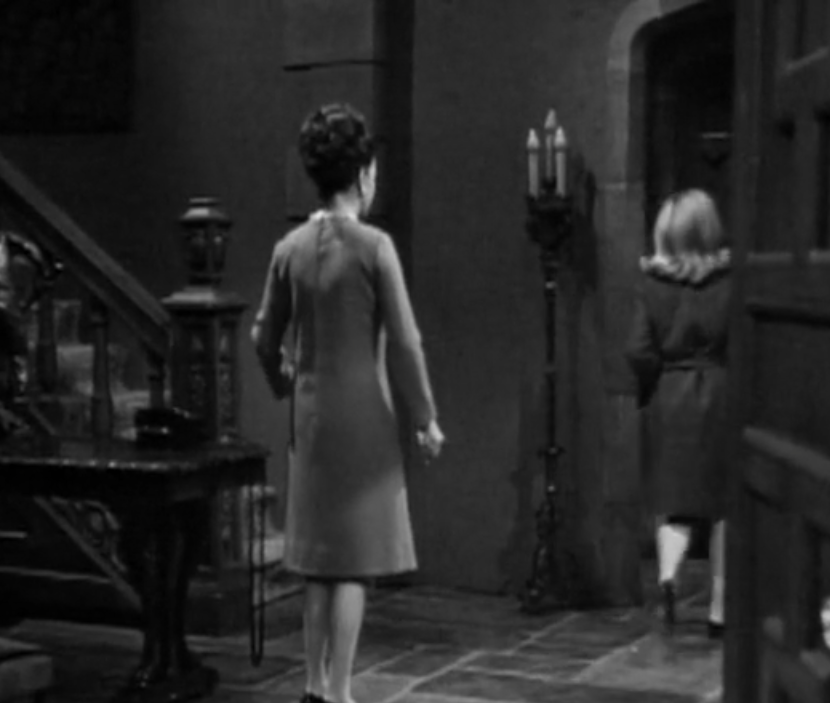
Back in the mansion, Liz confronts Vicki about not giving David his lessons. Vicki replies that Liz’ brother, high-born ne’er-do-well Roger, had said that he would tell Liz that he had taken Vicki on a tour of the cannery and had given David the day off. When Vicki hears Liz on the telephone confirming this with Roger, she blows up at Liz. She objects to being checked up on, she objects to being accused of lying, and, turning to look at the last spot where she had seen Carolyn, she objects to being accused of stealing people’s boyfriends. After she is done with her objections, she walks over to Liz. With their backs to the camera, the women quietly apologize to each other. Vicki explains that her protests mark the only way she can go on living in the house. Liz for the first time calls Vicki by her first name. Hearing this conversation when they are looking away from us is remarkably effective at creating a sense that they are sharing an intimate moment- more is happening between the two of them than even the audience can know.
Mrs Isles and Joan Bennett, as Liz, both play a wide array of emotions in their two scenes together, and do so brilliantly. It’s particularly interesting to compare Liz’ startled reaction to Carolyn’s snapping at her in the foyer when she asks her where she’s going to with her startled reaction to Vicki raising her voice at her in the drawing room when she’s been on the phone with Roger. They are two quite distinct startles. We see Liz from behind when Carolyn startles her. From that angle, we see the muscles in the back of her neck tense, signifying anger. That startle gives way to a parental sternness. The startle Vicki provokes is shown in profile. Liz pulls back a little, suggesting guilt. It leads to a rapid retreat.
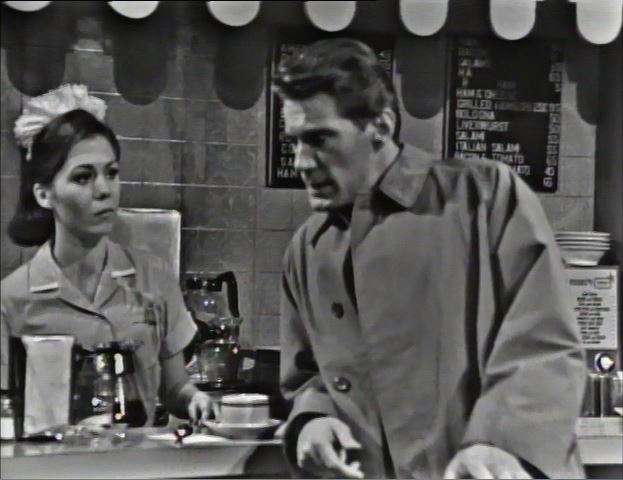
In the opening teaser, dashing action hero Burke Devlin is having lunch in the restaurant at the Collinsport Inn. As usual, he’s alone there. He strikes up a conversation with Maggie Evans, who runs the place. She listens sympathetically while he tells her that he’s worried about the missing man, plant manager Bill Malloy. He goes on about the great meal he’ll buy for his dear friend Bill when he finally turns up. Maggie has to break the news to him that the Coast Guard has fished Bill’s corpse out of the sea.
Burke suspects that his bitter enemy, high-born ne’er -do-well Roger Collins, is responsible for Bill’s death. After he telephones the sheriff’s office to ask for information and doesn’t get answers, he returns to the restaurant, agitated. Well-meaning governess Vicki walks in; Burke snaps at her about Roger, and they quarrel. Burke goes to the sheriff’s office with this suspicion. So far from enlisting the sheriff as an ally against Roger, Burke finds himself being questioned as a suspect.
Burke returns to the restaurant. Vicki is still there, having had a heart-to-heart with her new friend Maggie. Burke yet again asks Vicki for a date; she yet again refuses him, this time because she’s planning to have dinner at Maggie’s house where she will be introduced to Maggie’s father, Burke’s former friend Sam.
Patrick McCray and Marc Masse write characteristically admirable posts about this episode on their blogs. McCray cites this episode as a fine example of the kind of story-telling that defined the show in its first 42 weeks:
Episode 57 is a focused study in how much the show would change in its first year. That’s not damning with faint praise nor stating the obvious about supernatural vs secular threats. It’s a compelling little episode that moves faster than many in the post-1897 run of the series. Within it is an entirely different approach to storytelling. Far more than other soaps, DARK SHADOWS was a show about action. Characters did things in the present rather than just talk about things done in the past. And when time, space, morality, and death are irrelevant to many of your main characters, it’s easy to present a Nietzschean amusement park of action and story twists. That’s not how the program began, though. It was only with the introduction of Laura Collins that DARK SHADOWS became a series about possibilities, not limits. But limits, and seeing attractive, interesting people struggle against them, is the bread and butter of terrestrial TV drama, and episode 57 is a beautifully executed cage.
He goes on to talk about the sorts of characters they can have in this period of the show who would become impossible in later days. Bill Malloy, for example: “Malloy was too good at getting things done to coexist with incredibly vulnerable monsters whose only protection came from how unobservant everyone else was.” Because of the centrality of the character of Liz and the theme of her seclusion in this period of the show, I’d always thought of the first 42 weeks as a study in the social and psychological effects of the refusal to face unpleasant facts. But of course denial is still the show’s great theme all the way through.
Masse discusses the apparent discontinuity of Burke’s wistful tone before he learns that Bill is dead with Burke and Bill’s relationship as we saw it when Bill was alive:
And since when has Burke even cared about Malloy as a person? If he really had revered Malloy for having given him his start as he claims today, then how come he didn’t buy Malloy that best meal ever upon his return to Collinsport, instead of just toying with him at the Blue Whale in episode 3, hanging up the phone on him in episode 9, and then deftly evading his questions before showing him the door when Bill [paid] an unannounced visit to Burke’s hotel room in episode 21?
The above three episodes along with number 57 were all written by story creator and developer Art Wallace, which shows that already by September 1966 Dark Shadows was reinventing itself storywise to such a significant degree that contradictions in continuity would present themselves even if episodes in question were written by the same writer. Burke did acknowledge to Malloy in episode 45, a Francis Swann episode, that he’d been a fair employer to him when he was just starting out working on the boats of the Collins fleet; but in keeping with the opportunistic nature of Burke’s character, this was only after Malloy had offered to make a deal with him, which Burke must have surely understood would greatly benefit his own interests.
I think there is a bit more grounding in what we see for Burke’s rhapsody about Malloy in today’s episode than Masse gives the show credit for. Also, that it is misleading to suggest that only now are we seeing abrupt changes.
I’ll deal with the second of these points first. When Burke came to town in episode 1, he was cold to everyone. They retconned this aspect of his personality in episode 21, where he revisits the sets where he dealt some of his harshest snubs in #1 and is a hail-fellow-well-met even to people whom he had reason to avoid. That was a necessary revision. Soap opera writing is largely a matter of filling screen time with conversation, so a character who isn’t on speaking terms with anyone is useless. But it wasn’t a very well-motivated change in terms of what has happened in the story. Viewers who remembered episode 1 would have had a hard time explaining why Burke’s attitude is so different now.
This time, though, Art Wallace’s script makes it clear time and again that Burke is isolated and getting lonely. He had expected Sam to be his friend, but has learned that Sam fears him. Sam’s daughter Maggie listens sympathetically to him, but he’s a customer of hers, and that’s her job. He certainly can’t expect a social invitation to the Evans house. He thinks he might be able to join forces with the sheriff, but is lucky to get out of his office without a bail ticket. He arrived on the same train as Vicki, and was attracted to her from the first. Every time he sees her, he asks her out and she turns him down. When he finds out that Vicki will be having dinner with the Evanses, it makes the picture of his isolation complete. Burke hasn’t made a single friend all the time he’s been in town, and it’s getting to him.
This takes us back to Patrick McCray’s point, about the “incredibly vulnerable monsters whose only protection came from how unobservant everyone else was.” As time goes on and Dark Shadows becomes more and more a show for young children, it will often be laughable just how unobservant the human characters are. But the first of the incredibly vulnerable monsters will meet a family buffeted by hostility, suspicion, and blackmail, surrounded by enemies even inside the walls of their big dark house on the hill. He will present himself to the Collinses as a warm-hearted, charming, unworldly visitor from a foreign land who wants nothing but their friendship. The lonely people he meets will all but collapse into his arms. In Burke’s rhapsody about Bill, we see the same neediness at work.
Three people expressed surprise in episode 40 that Roger Collins wasn’t at his office. He still isn’t there today, and three more people are surprised. He finally decides to go in when Liz presents him with the alternative of looking for Carolyn.
Bill Malloy isn’t at work either, hasn’t been all day. He and Roger have been taking turns inviting themselves into Sam Evans’ house. Sam is also not working, and in fact takes time out of his busy schedule of downing one glass of whiskey after another to destroy the only thing we’ve seen him make as part of a paying job, a sketch of Burke. Maggie pieces the sketch back together- she’s also at home when she’s supposed to be working.
Telephones are unusually dynamic in this episode. Typically we see only one end of a phone call on Dark Shadows. This time, we cut back and forth between both ends of three telephone conversations this time. In the teaser Roger is browbeating Sam; Sam sets the phone down and walks off. While he gets another drink, the receiver is in the foreground and we hear Roger’s voice at the same volume as we did when Sam was listening. Sam comes back, returns the receiver to its cradle, and goes to sit down while it rings.
The bit when we see the phone and hear Roger’s voice, though Sam isn’t looking at the phone and can’t hear it, establishes the telephone as a character with its own relationship to the audience, independent of anyone who may or may not be paying attention to it. It’s a neat moment:
Liz calls the office and talks to Joe. Joe tells her Bill hasn’t been in all day. The stress in his voice, the papers piled on his desk, and the tight grip he has on the telephone receiver all make it credible that he’s the only person in town who showed up for work today:
Liz mainly wants to talk to Joe about Carolyn. Joe tells her he hasn’t talked to Carolyn in some time, and that he has no idea what if anything she is thinking about their relationship. While he breaks this news to Liz, we see him continue working, then cut back to the look of distress on Liz’ face.
Maggie calls Collinwood. Vicki answers and is excited to talk to Maggie. I guess the show is telling us they’re friends now. Maggie asks to talk to Roger. Vicki says Roger is probably in the office at this time of day, Maggie somehow knows he isn’t, Vicki remarks that he isn’t in the habit of confiding in her. Roger overhears this and asks “Is there any reason why I should confide in you?” When Vicki holds the receiver out to him and says Maggie Evans is on the line, he takes it and hangs up without so much as putting the receiver to his ear. Vicki and Roger then have one of their little quarrels.
That’s the only thing Vicki does in the episode. Her character is heading into a danger zone. Through the first eight weeks, she was on all the time. She was our representative, the outsider who knew nothing about the other characters or the town they live in, and to whom everything had to be explained. Now she knows as much about the rest of the characters as they know about each other, and we know as much as we want to learn by hearing explanations.
The major characters all have their secrets, but the only two who know each other’s secret are Roger and Sam. Vicki isn’t any likelier than anyone else to uncover that one. She has no secrets of her own, and her original story-line- her quest to discover her origins- is dead in the water. What’s more, Vicki is no good at lying. Soap operas are mostly conversation, and the big events on them are lies and the exposure of lies. The only time Vicki has tried to lie to anyone- in episode 13, when she told Matthew that Liz knew she was in his cottage- she was immediately found out, with disastrous consequences. If she’s going to stay relevant to the show, something is going to have to change, and fast. It’s fun to watch Alexandra Moltke Isles bicker with Louis Edmonds, but the characters they play need something meatier to bicker about.
This is the first episode credited to writer Francis Swann, indeed the first episode credited to anyone other than Art Wallace. Swann’s teleplay finds humor in the idea that so many people have taken the day off. Each time another character remarks on a case of absenteeism it gets that much closer to raising a chuckle. And Roger’s line that looking for Carolyn would require him to “neglect my vital tasks at the office… Dear me, no” is genuinely funny, especially as Louis Edmonds delivers it. The telephone scenes are also an innovation, and promise a new source of visual activity. Those favorable omens are offset by Vicki’s scene and its suggestion that her character is about to be allowed to wither on the vine.
A couple of the blogs I read when I prepare my comments made remarks about this episode with which I disagree. John Scoleri of Dark Shadows Before I Die says this of the quarrel between Sam and Maggie:
I know Sam gets frustrated with Maggie, but I’m beginning to wonder about their relationship. If he’s that close to hitting Maggie when he gets drunk, there’s no way I’m believing he hasn’t done that before.
It doesn’t look to me like Sam has hit Maggie. She’s inches from his face when he is at his angriest, yet she doesn’t flinch, doesn’t slump down, doesn’t show any sign of withdrawal or fear or anger or panic or sullenness or bewilderment or any other possible response to physical abuse.
There hasn’t been much happening on DARK SHADOWS in the last few weeks, but that doesn’t mean the show hasn’t been moving forward. There’s been a growing sense of doom throughout the show, and it’s obvious that someone is going to die. In this episode Sam rips up his portrait sketch of Burke Devlin, he and Roger lob threats at each other, Liz begins to draw Joe’s attention to his girlfriend’s romantic intentions on the family rival, and Victoria has been pushed around by just about everyone in the cast. In theory, any one of them is eligible for a ride in the bone wagon, but the show has been implying that Devlin is headed for a fall. It’s interesting that the show decides to go in another direction: I don’t know when Bill Malloy checks in at Eagle Hill Cemetery, but it’s probably sooner rather than later.
While it is true that “in theory, any one of them is eligible for a ride in the bone wagon,” I do think there’s a clear front-runner to be the first Dark Shadows character to be killed. It’s Sam who is obsessed with the fear of death, Sam whom Roger has threatened, Sam who left a mysterious sealed envelope to be opened in the event “something happens.” And, from an out-of-universe perspective, it’s Sam who has a daughter played by an appealing actress who needs a story-line. Maggie seeking revenge for the killing of her father would be just the plot to elevate Kathryn Leigh Scott from the bottom of the second string to the starting lineup where she so obviously belongs.
No other character has anyone so well-positioned to play avenger if they’re killed. The only keen attachment Bill Malloy has shown is his devotion to Liz, and in her scene with Matthew in episode 38 Liz demonstrated that she sees devotion from people outside the family as a tool to use when time comes to protect the good name of those inside it. So if she suspects Roger killed Bill, she won’t become Bill’s avenger- if she could order Matthew to throw away his own good name to cover up the truth about David, we can hardly expect her to expose Roger to redress Bill’s grievance against him. Indeed, when Bill is murdered, they will introduce an entirely new character to seek revenge for him.
Vicki is an orphan, who tells us in today’s opening narration that before she arrived at Collinwood she had never known a home. No one is likely to avenge her, and besides, she still does the opening narration for every episode- she’s supposed to be important, even if the writers can’t quite figure out what to do with her. Burke is supposed to be rich and powerful. Presumably he has friends, but we haven’t seen any of them. Joe is Mr Nice Guy and he’s mentioned a friend or two, but again, we haven’t seen them. The series story bible calls for Roger to die when Burke finally gets his revenge, but every time Louis Edmonds’ performance is the most interesting thing in an episode it becomes so much the less likely that they will ever get around to playing that scene. So the smart money, at this point, would be on Sam to be the victim in the first Dark Shadows murder. So much so, indeed, that it might not be surprising enough if it does happen- they may think they have to kill someone else to keep the audience engaged.
Vicki first met Matthew in the basement of Collinwood, back in episode 6. So the basement is Matthew’s territory. Not even the cottage where he lives is more so. Before we ever saw it, we heard him go on about how it was a gift from Liz. When we do see him there he’s having an uncharacteristic moment, baking muffins. The basement is the dusty, forbidding workspace is where we expect to find a dusty, forbidding workman like Matthew.
In his remarks on episode 37, Patrick McCray complained about “writing shortcuts that occasionally make Victoria look like a moron.” I didn’t quote him in my post on that episode, because I don’t agree with his assessment of the scene- he thinks Vicki is falling for Roger’s obvious lies, I think she is disregarding them because she knows she has him where he wants him and is about to squeeze some information out of him. But this opening scene is definitely a case of Idiot Plot. Vicki chased David into the basement in episode 6, only to be menaced by Matthew and scolded by Elizabeth; she followed the sound of the sobbing woman there in 37, to be yelled at by Roger. Those were moments of hot pursuit, when she could claim that in the heat of the moment she forgot Elizabeth’s prohibition on going to the basement. But now, she’s just looking for some books. There’s no reason she couldn’t have asked Liz about the books before going to the basement. What’s more, she’s going after those books only because David, last seen telling her he’d make her wish she had never come to the house, suggested she go after them. I realize she’s had a stressful few days, but unless she’s had a massive head injury off-camera, going to the basement at David’s suggestion is inexplicable.
Of course, the out-of-universe explanation is obvious- a new actor is taking over the role of Matthew, and they want to introduce him on this set. On the one hand, the scene is a reprise of the first introduction of Matthew, thereby making it clear that this is a new start for the character. On the other hand, because it is his territory, and our point of view character is trespassing there, he is all the more menacing to us than he would be if we met him in someone else’s space.
I think Danny Horn described Thayer David’s acting style well when he said that “He’s loud, and disruptive, and he plays to the balcony. Not this balcony, naturally; I mean the balcony in the theater next door.” He’s relatively subdued in his first outing as Matthew, but the appliances the makeup shop constructed on his face prepare us for the titanic approach he’ll be taking in the weeks ahead.
Matthew goes upstairs. In the foyer, a more or less neutral space among the residents of the estate, Liz gives him a shopping list to take into town. She then asks him into the drawing room, her home base. There, she asks him to do something horrible- take the blame for Roger’s car crash. He is shocked at the request, and asks for an explanation. She doesn’t give him one, but he agrees anyway. Thayer David’s anguished face shows the terrible price Matthew is paying for Liz’ insistence on covering up what really happened between David and Roger.
This encounter closes the story of Roger’s crash. Along with the Mystery of the Locked Room, Vicki’s search for something David might like, and the talk about ghosts, it ties Thayer David’s Matthew in to four of the stories we’ve been following.
We next see him in town, ordering coffee at the restaurant in the Collinsport Inn. There he’s tied in to a fifth story, The Revenge of Burke Devlin. The Inn is Devlin’s territory, and Matthew encounters him there. Still unhappy because of Liz’s shocking request, Matthew is in no mood to be diplomatic with the known enemy of the family he is sworn to serve. He tells Devlin that if he makes trouble for Liz, “I’ll kill you.” Devlin tries to reason with him, asking if it makes a difference whether the family deserves trouble, to which Matthew does not respond kindly.
Even before Matthew came to town, Devlin had met another Collinwood resident at the restaurant. Carolyn sits at his table and notices he is reading The Count of Monte Cristo. She summarizes the plot, and realizes that it is one of the sources of The Revenge of Burke Devlin story-line. She’s so self-aware it wouldn’t be surprising if she and Burke started gossiping about what the new writers coming on board next week have in mind for their characters. She drops the subject, and immediately starts wheedling him for a date. When he begs off, she deliberately leaves a ring behind.
Back at Collinwood, Carolyn and Vicki talk on the landing overlooking the foyer. This is the first conversation we’ve seen in that space. A couple of times, we’ve seen David Collins standing up there by himself, looking menacing, or as menacing as a not-very-tall nine year old boy could. In the years to come, a succession of villains will take turns declaring themselves to be Master of Collinwood by standing on this spot and looking at the camera. The last of these will be the ghost of Gerard, played by an adult actor about the same height as the nine year old David.
This time, the space is not being used to suggest menace, even though the camera is shooting up at the same drastic angle. Instead, it is a relatively intimate place, separated from the public-facing foyer by the stairs and leading to the bedrooms. Carolyn and Vicki are there because they are at home. Carolyn confides in Vicki about her plan to leave the ring where Burke would find it, obligating him to call her and return it. Vicki confides in Carolyn about the sobbing woman, and Carolyn admits to having heard her many times, and to having lied when Vicki asked her about the sounds her first morning in Collinwood. The friendship between Carolyn and Vicki is settling in as a wide-open information exchange, a regular channel not only to keep the audience up to date on what’s happened in previous episodes, but to make it possible for characters to learn enough about what’s going on to make plans and take action.
Back down in the foyer, Liz talks to Vicki about the basement. Vicki tells her that she can’t believe in ghosts; Liz assures her there’s no one being held in the locked room. Liz offers Vicki the key to the room and invites her to let herself into it and search it. Vicki declines the offer. Liz repeats it, doing everything she can to show that she has nothing to hide. Vicki declines again, and turns away. As soon as Vicki can’t see her, Liz’ face resolves into an expression of immense relief.
Over the closing credits, ABC staff announcer delivers the usual blurb for “Where the Action Is.” He trips over the title. It sounds like he’s stifling a laugh or is distracted or something. Unusual to hear him commit a blooper!
In 281 of the posts that follow, I link to comments I made on Danny Horn’s great blog Dark Shadows Every Day. Danny starts with episode 210 and makes only a handful of remarks, most of them highly disparaging, about the first 42 weeks of the show. As a particular fan of that period of the show, that distressed me when I first started reading him, but I found that it gave me an opportunity to make substantial contributions to the comment section. I could always find something in those early stories that gave extra depth to whatever was going on in the later installments.
Now, Mrs Acilius and I are watching the show through a second time, again starting with episode 1. I’d so much enjoyed commenting on Danny’s site when we were watching 210-1245 from March of 2020 to April of 2021 that I decided to start commenting on a blog that covered the first 42 weeks. So I’ve left many comments on John and Christine Scoleri’s Dark Shadows Before I Die.
The Scoleris haven’t assembled the kind of community that made Danny’s comment section a big party. I still get responses to comments I left on Danny’s site, almost a year and a half after his final post. I have yet to get a reaction to any of my comments on Dark Shadows Before I Die. So I’m thinking of just recording my thoughts here.
The Scoleris aren’t the only bloggers who discuss the first 42 weeks of the show. There’s also Marc Masse, a.k.a. Prisoner of the Night, whose (fiercely controversial) Dark Shadows from the Beginning is occasionally viewable, usually private. And of course Patrick McCray, whose Dark Shadows Daybookset the standard for online commentary on the show. Neither of those sites has an open comments section, which is why I’ve been contributing to the Scoleris. There are also podcasts, Facebook groups, Reddit threads, etc, but I’m not into any of those.
Asking who to talk to and how to get through to them brings episode 1 to mind. Vicki comes to an unfamiliar town, and the audience comes to an unfamiliar show. She’s a stranger looking for someone to talk with; we’re viewers of a daytime soap, a genre that consists almost entirely of conversation. Everyone Vicki meets is talkative enough, but most of their talk is about how they aren’t speaking. The lady sitting next to her on the train goes on about what a nasty place Collinsport is. The fellow who gives her a ride from the train station responds to the innkeeper’s warm greeting with an ostentatious refusal even to acknowledge that he knows him, let alone to engage in conversation. The server at the lunch counter announces to Vicki, before she’s had a chance to say two sentences, that she regards her as a “jerk.” The family she will be working for is represented by a lady who won’t answer her brother’s questions as to who Vicki is and why she hired her, a reticence that is made all the more ominous when a private investigator reports on their strange, unfriendly ways. Dark Shadows fandom is far less forbidding than the situation Vicki faced!




 Dark Shadows Commentary