Episode 698: The kind of scene you should be avoiding

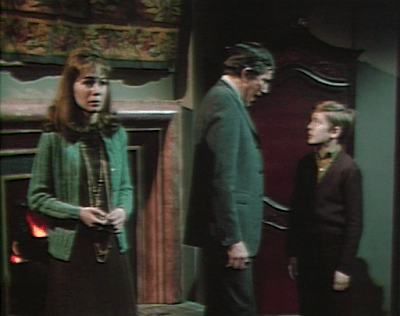
Barnabas Collins, old world gentleman extraordinaire, and Julia Hoffman, MD, are helping mysterious drifter Chris Jennings cover up the fact that he is a werewolf, responsible for a great many violent deaths. Lately Chris has started transforming into his lupine shape even on nights when the moon is not full, and this morning they find that he has not changed back even after dawn.

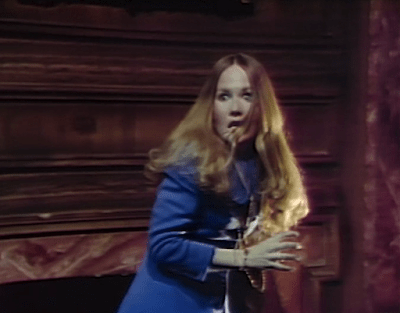
As if that did not present enough difficulty to Julia and Barnabas, one of Chris’ surviving victims is in town. She is his onetime fiancée, Sabrina Stuart. Two years ago, Sabrina saw Chris as the werewolf. She hasn’t told anyone about him, because she hasn’t been able to speak since. Her hair turned white, her skin turned pale, and she has been nearly catatonic.

Others have encountered the werewolf, and none has had this reaction. It’s true that Chris’ cousin Joe had to be taken to a mental hospital after he saw the transformation, but Joe had just been through a very long train of supernaturally induced traumas that had shattered his sensibilities and taken away everything he cared about. Seeing Chris change was just the last step in that process. Sabrina, as we see in a flashback segment today, was fine until she encountered Chris as the werewolf, and she didn’t even see the transformation itself. Yet here she is two years later, unspeaking, immobilized, and wearing the same makeup that Eli Wallach wore as Mr Freeze in the 1960s Batman TV show.

In a comment on Danny Horn’s post about this episode at Dark Shadows Every Day, “Cole” speculates that the show might have meant to tell us that the real reason Sabrina’s condition is less to do with what happened that on night in Chris’ apartment than with her brother and sole caretaker, Ned, played by Roger Davis:

I am once more getting through the Ned/Sabrina scenes thanks to this blog and the comments here; and although I still have to frequently avert my eyes from the screen to hold back the nausea, I keep concentrating on the dialogue while speculating further on JRM’s theory.

It does seem that we– and Julia– might be meant to feel especially concerned by Ned’s refusal to even consider allowing Sabrina to stay at Windcliff. He even says (or, rather, since it is Roger Davis, he SCREAMS), ​”I won’t be separated from her!”

I don’t think his character is meant to be overly suspicious of Julia and Barnabas so the vehemence behind his already rather alarming declaration becomes more baffling unless the viewer concludes he has … extremely unnatural feelings of possessiveness towards sad, PTSD-afflicted Sabrina.

It is almost half as frustrating as it is disturbing because, with any other actors, we would surely know for certain how to interpret these scenes.

We would perhaps recognize that when Sabrina stares pleadingly at Julia once Ned leaves the room, that her muteness is caused as much by her horror at being an ongoing victim of her brother’s unspeakable abuse as by having once witnessed Chris’s transformation into a werewolf. We wouldn’t wonder, instead if the actress, Lisa Richards, is actually pleading with Hall to help her endure Davis’s deliberate act of molesting and assaulting her through out these scenes.

If it wasn’t Roger Davis in this role, we would know who Ned is really meant to be since there is no way any of the other regular male cast members would willingly subject their costars to type of abuse Davis is inflicting on Richards.

If it were … say, Jerry Lacy who was currently playing “Ned Stuart” in a manner even remotely similar to Roger Davis’s ‘interpretation’ of the role, we would recognize at once that the character of Ned is obviously scripted to be an incestuous rapist (and I am sure Lacy would still keep his hands professionally and respectfully away from Lisa Richards’s/”Sabrina’s” breasts, instead using actual acting techniques to portray his character’s warped nature). But with Davis ..

It really could be, as Mary commented below, that he is trying to get the poor actress to break character. And how could we expect other than that he would use his usual disgusting and violent Drumph-like/”‘you can grab them by the pussy” sense of Curtis-granted entitlement to assault her as “Ned,” regardless of the intent of the writer and director.

Either way, what a horrifically mistaken choice in casting.

Lisa Richards: fifty years later, I am thinking of you and hoping you weren’t forced to endure PTSD after filming these scenes with Davis.

Comment left 29 August 2021 by “Cole” on “Episode 698: Sister Act,” Dark Shadows Every Day, Danny Horn, 8 August 2015

When I mentally recast the many parts Roger Davis played on Dark Shadows, I divide them between two men who were background players in the show’s first months. I imagine Fredric Forrest playing the two characters with aliases, Peter Bradford (a.k.a. Jeff Clark) and Charles Delaware Tate (a.k.a. Harrison Monroe.) Forrest excelled both as a quietly intense man under pressure and as a sweet, goofy, overgrown kid. In the hands of an actor who, unlike Mr Davis, could project those qualities, those two unloved characters might both have become fan favorites. His other two parts, Ned Stuart and Dirk Wilkins, would have been perfect for Harvey Keitel, who is unsurpassed as a man who is agitated by a deep anger that he himself barely understands and that he certainly cannot explain to anyone else. Not that it’s any secret why Ned is angry at Chris, but when he takes a break from pawing at Sabrina’s face and breasts he handles her so roughly that he is obviously angry with her, and that is something he isn’t going to be giving any thought.

Mr Davis’ behavior wasn’t much better in episodes directed by Lela Swift and others, but it is little surprise director Henry Kaplan didn’t rein him in. Kaplan directed with a conductor’s baton, and actresses complain that he would jab them with it. When the person in charge has that light a regard for women’s personal space, it’s no wonder a creep like Mr Davis felt free to rub himself all over Ms Richards.

Episode 671: We promised Maggie we’d be good children

An extraordinarily uneventful outing. In yesterday’s episode it looked like heiress Carolyn would go to visit Chris the werewolf as he is in the middle of a transformation and would be attacked. But she didn’t go. Governess Maggie did go to Chris’ cottage, and at the end of the episode it looked like she might be attacked. As we open today, she is there and he is about to change, but she leaves and gets home safely while he is still in human form.

It again looks like Carolyn might be attacked when she walks through the woods to visit the mausoleum where her mother, matriarch Liz, is entombed. Liz was alive when she was mistakenly buried and is still alive now. Liz is unable to move or speak, but she somehow shares the audience’s thought that Carolyn might possibly be attacked. We see her in her coffin and hear her interior monologue as she thinks about the “terrible danger” her daughter is in.

As it happens, Carolyn makes it home fine. Later she goes out again; we see the werewolf prowling nearby, again raising the theoretical possibility that she will be attacked. But Carolyn hears Liz’ voice in her head, a telepathic warning that she should hasten off. The werewolf also reacts as if he can hear Liz’ voice, and he goes off in another direction. The screen goes dark and the credits start rolling. The werewolf hasn’t attacked anyone and no one has learned anything about him.

It appears that the werewolf is trying to figure out where Liz’ voice is coming from.

It’s kind of interesting that Liz can transmit telepathic messages now. She could use a supernatural power or two if she’s going to get into the swing of things on the show. It’s also interesting that the werewolf seems to be able to overhear the messages Liz sends to Carolyn. Chris’ little sister Amy lives in the great house of Collinwood now, and along with strange and troubled boy David she is falling under the power of the evil ghost of Quentin Collins. Quentin communicated with Amy before he could get through to David. David was miffed by this, since “Quentin is my ancestor.” That suggested that Quentin will turn out to be Amy’s ancestor as well, making her and Chris members of the Collins family. If so, that might explain why Chris, even in his lupine form, was able to pick up a telepathic transmission Liz directed to her blood relatives.

There is a wardrobe malfunction in this one of a type that showed up several times in the first year of the show. When Carolyn makes her first entrance, she walks down the stairs in the foyer. At each step, Nancy Barrett’s chest thrusts into her sweater with results that would probably not have made it on the air had anyone from the ABC network’s office of Standards and Practices been watching the show. In the early days, they put the actresses into very form-fitting tops often enough that I thought they were challenging the audience to take an adult attitude towards female anatomy, and so I did my best to rise to that challenge by leaving it unremarked when we could see the exact shape of their breasts. But it’s a rare occurrence now, so I think we have to list it among production faults.

Episode 657: We will never leave this house

Old world gentleman Barnabas Collins, temporarily in charge of the great estate of Collinwood, has decided to place children David Collins and Amy Jennings in boarding school in Boston. Under the influence of the evil ghost of Quentin Collins, Amy and David want to remain in the house. While they pretend to be enthusiastic about Barnabas’ plan, they try to thwart it by talking about when exactly certain clothes had been in or out of certain closets. As it plays out on screen, this plan is somehow even more tedious than you might expect. Eventually Barnabas sets aside the idea of Boston, not because of anything the children have done or know about, but because the ghost of their former governess, the well-meaning Victoria Winters, made its presence known. Barnabas is attached to Vicki and he doesn’t want to miss a visit from her.

David and Amy’s new governess is Maggie Evans, The Nicest Girl in Town. For the first year of the show, Maggie was a waitress, her father Sam was a drunken artist, and their house was a counterpoint to Collinwood. As a working-class residence in the village of Collinsport, it represented all the homes affected by the crises the Collinses put themselves through, and scenes there suggested that there is a whole community of people whose futures hinge on what happens on top of the hill. In 1966, there were even stories about the Collins family business and its employees, and events at the Evans cottage were key to those.

When Barnabas joined the cast in April 1967, he was a vampire, and he soon took Maggie as his victim. In time, she escaped, her memory was erased, and he was cured of vampirism. Sam died in #518 and left the show in #530. Maggie’s engagement to hardworking young fisherman Joe Haskell ended a while ago; there isn’t much left to happen in the Evans cottage. When Maggie was hired to replace Vicki in #652/653, she moved into the mansion. The show formally bade farewell to the Evans cottage as a place in its own right at the end of that episode and beginning of the next, when Joe went there to get Maggie’s things and was attacked by a werewolf. From now on our excursions out of Collinwood will be brief; we don’t have any place left to stay.

Maggie looks like she’s rethinking her decision to move into the mansion. Screenshot by Dark Shadows Before I Die.

For some time one of the cameras has been on its last legs. In this one, it is almost completely unusable. It is something of a peculiar effect to cut back and forth between two cameras, one of them up to the broadcast standards of the period, the other of which produces only ghostly green images. The episode was directed by Henry Kaplan, who was a poor visual artist under any circumstances. The only remotely ambitious composition he tries today is a shot from a point of view inside a fireplace. They did this several times between December 1966 and March 1967, when David’s mother, undead blonde fire witch Laura Murdoch Collins, was on the show, often to good effect. But this time it is done with the defective camera, and it is simply difficult to see what is going on.

Episode 644: Well that was a waste of time

There is some reason to believe that writer Ron Sproat was disaffected from the rest of the production staff at this time. Today’s script is so unbelievably bad that it is tempting to think he wrote it as an act of protest.

Children Amy and David have gone looking for the ghost of Quentin Collins and are now trapped in a room in the long deserted west wing of the great house of Collinwood. David’s father Roger, his aunt Liz, and his cousin Carolyn are moving about the house in a conga line trying to find them.

Quentin’s ghost is keeping the children locked up; the ghost of someone named Magda is trying to lead the adults to rescue them. At one point the adults watch a mirror while letters appear on it spelling out “Jamison,” the name of Liz and Roger’s father. This is plainly a supernatural manifestation, but it advances neither Magda’s goal nor Quentin’s. Perhaps Jamison’s ghost can’t rest with all the racket Quentin and Magda are making, and he just wants to say hello.

Hi, kids, it’s grandpa! Screenshot by Dark Shadows Before I Die.

In the locked room, David bangs on a wall, finds it is hollow, and speculates about what is on the other side. Amy protests “We can’t go through a wall!” In response, he again bangs on the wall, again finds it hollow, again speculates about what’s on the other side, and Amy again protests “We can’t go through a wall!” Later in the episode, they start this scene a third time, but they stop before Amy has another chance to say “We can’t go through a wall!” It’s just as well she does stop short of saying this a third time. By the end of the episode, they’ve found a crowbar, which enables them to pry the paneling open and go through the wall quite easily.

Meanwhile, the adults have progressed to the drawing room, where they argue about whether to search the west wing. They troop upstairs and find the door to that part of the house locked. This leads them to conclude that David and Amy can’t have gone in there, and the parade goes back to the drawing room. There, they again argue about whether to search the west wing. They again troop upstairs, this time unlocking the door and conducting the search. After they fail to find the children, they return to the drawing room again, where Roger speaks for all of us when he says “Well, that was a waste of time.”

When the adults were shuffling around huddled in their little clump, I found it hard not to look at Liz’ face and see Joan Bennett thinking that she used to be a big movie star and now she’s reduced to this stage business that would have embarrassed the Three Stooges. This week’s episodes were directed by a mysterious figure billed as “Penberry Jones”; whoever Jones was, I don’t think s/he was to blame for the weird little parade the adult characters keep making through the house. The script calls for the actors to talk with each other constantly while walking together through narrow, awkward spaces such as stairways, darkened corridors, and a cluttered store-room, and so it would have taken more time than they had to choreograph a more fluid set of movements.

David and Amy hear a waltz. It has a creaky sound to it, as though it were being played on an old gramophone. This is introduced as a special effect. Unfortunately, Dark Shadows introduces special effects by ramping up the background music, so when the children first talk about the waltz we can barely hear it. After a commercial break, the background music calms down and the waltz is more audible. We will hear it a great many times over the next several months, so often that it will be ironic to think that there was a time when we wanted to hear it but could not. I suppose Penberry Jones probably did have the discretion to tone down the accompaniment, so that would be one strike against him or her.

Longtime viewers will notice a small deviation from continuity when David tells Amy that ghosts come out only at night. In the first year of the show, David often saw the ghost of the gracious Josette in the Old House of Collinwood during the day, and from June to November 1967 he and the ghost of nine year old Sarah played together in the sunlight several times.

Episode 541: Creating a living human being

When Dark Shadows began in the summer of 1966, its most intelligent character was also its most dangerous, strange and troubled boy David Collins. David twice came within an inch of committing the perfect murder, first when he sabotaged his father Roger’s car, then when he trapped his governess Vicki in a room in the long-deserted west wing of the great house of Collinwood.

The only story that consistently worked in those days was the relationship between David and Vicki, and that was solely due to actors David Henesy and Alexandra Moltke Isles. While the writers gave them terrible dialogue- at one point having Vicki read aloud to David from a reference book on the geography of Maine- they used their faces, voices, and movements to show us what was going on inside the characters. Mr Henesy always looked like an angry boy who was grimly determined to keep hating his governess even though he couldn’t help but like her, while Mrs Isles always looked like a fearless young woman who was determined to befriend a boy who might make an attempt on her life at any moment. As David relented from his hatred, we could see a friendship budding between them, even if the words were still no good.

The story of Vicki and David had its climactic phase from December 1966 to March 1967, when his mother Laura Murdoch Collins was on the show. Laura was Dark Shadows’ first supernatural menace, an undead fire witch who planned to incinerate herself and David so that she could attain a new life. When David ran from the burning Laura into Vicki’s arms in #191, he chose her and life over Laura and death. She thus became his new mother, and their story was complete.

Since then, the show has found very little for David to do. Yesterday, he was wandering around the house with a tape recorder. He told his stepmother Cassandra that he couldn’t figure out how to play a tape. The preoccupied Cassandra sent him away, and he asked his cousin Carolyn to help him. Carolyn made it clear that all you do is press the button labeled “Play.” Two years ago, David could sabotage a brake cylinder to fail at precisely the spot on the road where it would be likeliest to lead to a fatal crash, but now he can’t grasp the concept of “Press play to listen to the tape”?

Longtime viewers will see a missed opportunity here. Cassandra is a wicked witch, also known as Angelique. In #492, Angelique/ Cassandra cast a spell that caused David to forget some incriminating information about her, so we know that he is subject to her power. Vicki knows a great deal about Angelique/ Cassandra; they could easily give us a series of scenes in which Vicki tries to warn David about his stepmother, but his mind is clouded. Instead, we never see Vicki and David alone together during this phase of the show, and Angelique/ Cassandra rarely does anything more with David than display irritation and order him to go away.

David eventually played the tape for Angelique/ Cassandra. She reacted with great excitement, since it included a message that explained why she failed in her attempt to restore the vampire curse she once placed on David’s distant cousin Barnabas Collins. She sends David away and keeps the tape recorder.

Angelique/ Cassandra won’t let David take the tape recorder back to his room. Screenshot by Dark Shadows Before I Die.

Angelique/ Cassandra informs her supervisor, suave warlock Nicholas, that she can re-vamp Barnabas if she kills Frankenstein’s monster Adam. Fascinated by the idea of an artificially constructed human being, Nicholas loses interest in Barnabas and instructs Angelique/ Cassandra to find out more about Adam.

In #532/533, Nicholas met Maggie, The Nicest Girl in Town. Nicholas was obviously smitten with Maggie, putting the lie to his taunting of Angelique/ Cassandra for her ability to feel an emotional attachment to Barnabas and his own claim to be motivated solely by a devotion to evil for its own sake. After he gives Angelique/ Cassandra her orders, Nicholas goes to Maggie’s house. Ostensibly this is to find out if she knows where Adam might be, but she so obviously does not that it is clear he just wants to see her. He asks her about her hospitalized fiancé Joe, admires her late father’s paintings, and offers to buy one of them at a high price and lend it back to her. Maggie seems to be quite charmed by him. Nicholas’ “Evil, be thou my good” schtick can be fun to watch for short periods, but if he is going to be a major character for any length of time he will need a more complex inner life. His attraction to Maggie is a step towards giving him one.

David goes to Barnabas’ house. He tells Barnabas’ friend Julia that at least twice this evening he has listened to a message on a tape recorder that had something to do with Barnabas and Adam, but he can’t remember any of the details. He does remember that Angelique/ Cassandra got excited when he played it for her, but that’s it. If Angelique/ Cassandra had cast a spell on David, his forgetfulness would be understandable. If Vicki and Angelique/ Cassandra were locked in battle for David’s allegiance, it could be dramatic. But as it is, the show has chosen simply to present David as an abject moron, and that is infuriating.

Julia and David go back to the great house, where they find Nicholas and Angelique/ Cassandra with the tape recorder. Nicholas and Angelique/ Cassandra leave, and Julia and David play the tape. It no longer has the original message, but instead has the witches’ sabbath portion of Berlioz’ Symphonie Fantastique. David furrows his brow, then comes up with the bright suggestion that Angelique/ Cassandra, who has been in possession of the tape the entire time, may just possibly be the one who made the change. Again, since we have not seen Angelique/ Cassandra cast a spell to confuse David’s thinking, this incredible stupidity can do nothing but exasperate the audience.

They don’t even have the excuse that the current writing staff doesn’t know that David used to be interesting. The gimmick of replacing important information on a reel-to-reel tape with an audio signature suggestive of the culprit is a callback to #172, when Laura thwarted parapsychologist Dr Peter Guthrie by replacing an audio recording of a séance with the sound of fire crackling. If they can recall that bit, surely they can remember that David used to have a functioning brain.

In the early days of the show, Vicki was on a quest to find out who her parents were and why they left her at a foundling home when she was an infant. In #60, Vicki stumbled upon a portrait Maggie’s father Sam painted twenty years before of a woman who looked just like her. Vicki wondered if this woman, whose name was Betty Hanscombe, might have been her mother or aunt. Sam gave Vicki the painting then, but it is back in Maggie’s house today, and Nicholas picks it up at one point. We don’t get a very good look at it, but you can buy a reproduction of it on canvas for $25.99 plus shipping from someone on Etsy, it looks nice.

Nicholas examines the Betty Hanscombe portrait. Screenshot by Dark Shadows Before I Die.

Episode 506: That man again

All of the storylines in the part of Dark Shadows set in 1968 bear a heavy weight of repetitious elements. The “Dream Curse” consists of countless reenactments of the same dream sequence, almost all of them followed by at least one scene in which the character who had the dream struggles with a compulsion to tell it to someone else, and then by a speech in which we hear the details of the dream yet again. That curse was set by wicked witch Angelique, who for no particular reason keeps insisting that her name is Cassandra. Angelique is a time traveler from the eighteenth century, as is shouting man Peter, who for no particular reason keeps insisting that his name is Jeff.

Mad scientist Eric Lang tried to cure Barnabas Collins of vampirism by an experimental procedure that involved the creation of a Frankenstein’s monster. Angelique killed Lang before he could finish the experiment, but fortunately for Barnabas his best friend Julia is also a mad scientist, and she completed it. Barnabas named the creature Adam. Lang left behind an audiotape explaining that Barnabas will be free of vampirism as long as Adam lives, but that he will revert if Adam dies. Barnabas and Julia have not heard this message, but it has been played for the audience many times. Yesterday’s episode closed with yet another replay of the message, and today’s opens with still another. Since the message is nearly a minute long, it will soon have accumulated a full episode’s worth of airtime.

After the message, we see a new set. It represents the rocky shore below the cliff on Widows’ Hill. Barnabas is there with his servant Willie, looking for Adam. Adam jumped off the cliff yesterday. Since episode #2, that plunge has always been shorthand for certain death, so the opening voiceover introduces a new idea when it tells us that Adam’s leap merely “appeared to be” his self-destruction. Barnabas believes that Adam is still alive, though Willie does not. The two of them stand around and shout Adam’s name over and over; after the fifth or sixth repetition, Mrs Acilius and I cracked up laughing. At least they could have broken it up a little, and alternated “ADAM!!!” with “STELLA!!!”

The rocky shore below Widows’ Hill.

Willie had the dream last night, and now feels compelled to tell it to heiress Carolyn. Adam had abducted Carolyn and held her for a couple of days before he dove from the cliff; she is now at home in the great house of Collinwood. Willie wants to sneak into Collinwood to talk to Carolyn. Barnabas points out that Willie was only recently released from the mental hospital where he was confined after he took the rap for Barnabas’ abduction of another young woman, Maggie. If he sneaks into Carolyn’s bedroom it will go badly for him. Barnabas directs Willie to search for Adam inland, prompting Willie to flash a grin. The very first night Willie was back from the hospital, he disobeyed Barnabas’ orders and ran off to visit Maggie. So his grin tells us to expect that he will disobey Barnabas’ orders again, this time to visit Carolyn.

Willie goes to the great house. We see him standing by the wall, below the second-storey window of Carolyn’s room. In her room, Carolyn talks with her mother, matriarch Liz. She explains to her mother that she is neither frightened of Adam nor angry with him, but that she pities him, because he seemed like an inarticulate and lonely little child. After this conversation, Liz leaves the room. Willie scales the wall, slips in through Carolyn’s window, grabs Carolyn, holds her mouth shut, and forces her to listen while he starts to tell the dream. Carolyn bites Willie, screams, and Liz comes.

Willie flees through the window. Carolyn explains to her mother that she is neither frightened of Willie nor angry with him, but that she pities him, because he seemed to be deeply terrified by his dream. She says that she is afraid that she, too, will have the dream.

Three people who live in the house have already had the dream. One of them is Julia, who is careful about who she talks to. The others are strange and troubled boy David, who regularly confides in both Carolyn and Liz, and housekeeper Mrs Johnson, who tells everyone everything. It is surprising that neither of them has mentioned it to either Carolyn or Liz.

Episode 505: Prepare yourself for an ordeal

Sheriff Patterson, leading his deputies through the woods in search of a very tall man named Adam who has escaped from gaol, finds a scrap of Adam’s clothing on a tree. He looks ahead and sees the Old House on the estate of Collinwood. He remarks “That’s the old Collins house. Every time anything goes wrong around here, that’s where all roads seem to lead.” He takes his party toward the house. Once they are gone, Adam comes out from behind a tree, and goes in another direction. Unknown to the sheriff and his men, Adam is a Frankenstein’s monster. He is four weeks old and has a vocabulary of fewer than a dozen words, but he easily outwits Collinsport’s entire law enforcement community.

The Old House is home to Barnabas Collins, whom the audience knows to be a recovering vampire. The sheriff calls on Barnabas and recaps the story for his benefit. In his post about the episode, Danny Horn ridicules every part of this preposterous scene, getting half a dozen genuine laughs. I won’t compete with him, but I do want to point out that while in both Wednesday’s episode and yesterday’s, the sheriff said it took twenty men to subdue Adam and take him into custody, today he says it took six. Maybe by next week it will be down to one deputy and a mynah bird.

Adam has abducted heiress Carolyn Collins Stoddard. When he eludes the police, he goes to the abandoned structure where he has cooped her up. He had left her there to go look for food. That mission was interrupted by his arrest. Now, she asks to go home. He is carrying her back there when they meet the sheriff, his deputies, and Barnabas at the top of Widows’ Hill. From the second episode, we have known that people plunge to their deaths from this hill. We’ve heard stories about several such incidents, have seen a number of characters come close to falling from it, and in #425 we saw gracious lady Josette make the fatal leap. Carolyn slips from Adam’s arms to the edge of the cliff; the deputies see him pull her up. She runs into Barnabas’ arms, and Adam falls.

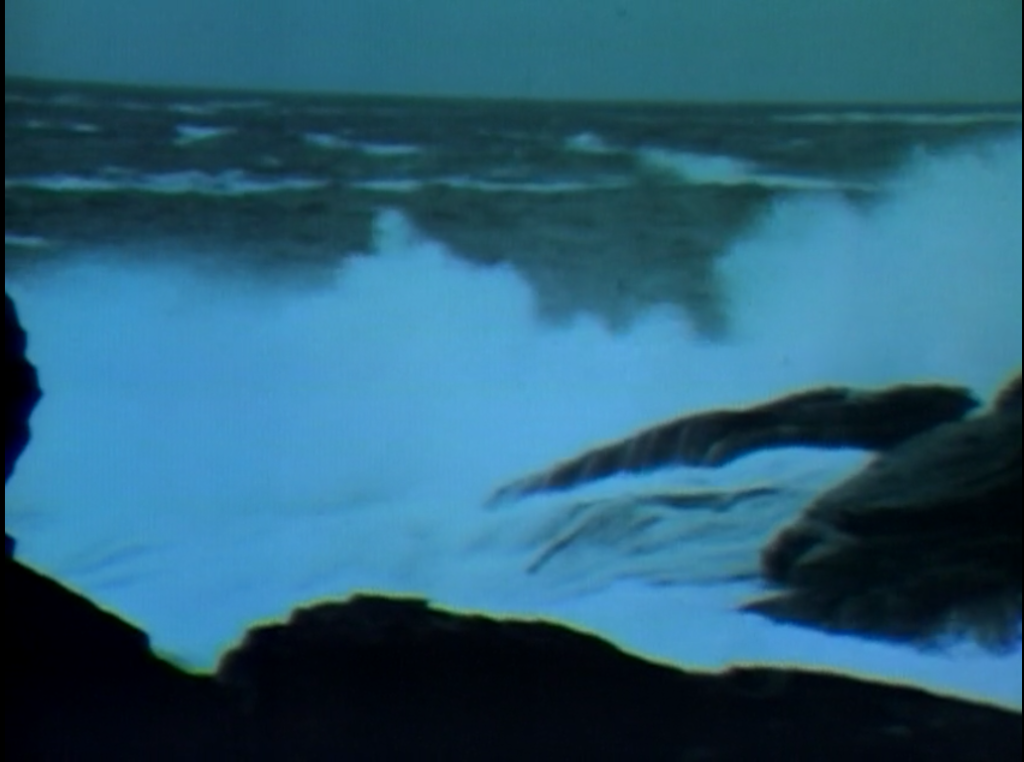
After Adam’s fall, we hear a message that is very familiar to us, but that Barnabas and his friends have never heard. Adam was created in an experimental procedure that was meant to relieve Barnabas of his vampirism. His creator, mad scientist Eric Lang, died shortly after recording an audiotape explaining that as long as Adam lives, Barnabas will be human, but that he will become a vampire again if he outlives Adam. This message plays out over images of the waves crashing into the rocks of the shore. It’s an effective visual complement to the message, a metaphor for the overwhelming power that will engulf Barnabas and the rest of them if Adam is in fact dead.

Episode 436: Thin air

Bewildered time traveler Vicki Winters is on trial for witchcraft, and it is not going well. Her lawyer/ gaoler/ boyfriend/ whatever else they don’t have the budget to hire another actor to play, an unpleasant young man named Peter, says that he wants the judges to see her as he does, as “a lovely girl who isn’t capable of witchcraft or anything else.” Unfortunately, Peter is right about Vicki’s capabilities- ever since she came unstuck in time and found herself in the year 1795, Vicki hasn’t done a thing worth mentioning.

Later, Peter catches up to much put-upon servant Ben Stokes. He persuades Ben to take him to the unmarked grave of wicked witch Angelique. Peter digs up the grave, but Angelique isn’t in at the moment, and there is no place to leave a message. Peter goes back to Vicki’s gaol cell and tells her that she may as well take the stand at her trial and tell the judges that she is a refugee from the 1960s.

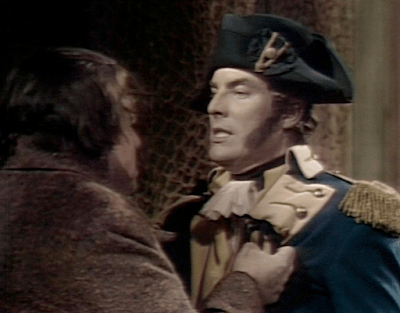
In between these scenes, untrustworthy naval officer Nathan Forbes finds Ben and tries to pay him for information about a man who was once their mutual friend, Barnabas Collins. Ben indignantly refuses the money. When Nathan keeps trying to talk him into it, Ben handles him roughly, then stalks off.

Ben shows Nathan he is not for sale. Screenshot by Dark Shadows Before I Die.

This exchange will be of some interest to those who have been watching Dark Shadows from the beginning. Nathan is played by Joel Crothers, who in the parts of Dark Shadows set in the 1960s plays hardworking young fisherman Joe Haskell. In #3, hard-charging businessman Burke Devlin found Joe and tried to pay him for information about the Collins family. Joe indignantly refused the money.

It’s interesting to see Crothers reprising the situation, playing the opposite role. Burke had poured on a heavy display of oily charm in response to Joe’s quiet stiffening, telling a rather alarming story about the beginning of his rise to wealth and inviting Joe to adopt him as a father figure. By contrast, Nathan retreats rather quickly in response to Ben’s angry outburst, but then rephrases the offer in a hale and hearty tone, trying to assure Ben that he sees him as an equal and wants to be his buddy.

Neither Burke nor Nathan gets anywhere with his persistence, but each man’s approach is typical of him. As a man born into the working class of Collinsport who became a millionaire, Burke proceeds from an ironclad certainty that every wage earner in town wants to follow his example. He cannot doubt that Joe will jump at the chance to take his money and his advice. As a self-involved navy officer, Nathan believes that enlisted sailors will be sincerely grateful to him if he acts like their friend, and extends that belief to include governesses, ladies’ maids, bartenders, streetwalkers, indentured servants, and everyone else he sees as his inferior.

Ben’s angry response to Nathan’s proposition also echoes the early days of the show. When Dark Shadows was set in 1966, Thayer David played violently irritable handyman Matthew Morgan. When Ben lunges at Nathan today, he is the very image of Matthew lunging at Burke in #64. But where Matthew had to be restrained by bystanders and threatened by the sheriff before he settled down, Ben quickly backs off.

The contrast between Matthew and Ben goes to the heart of the eighteenth century flashback. Each is a formidable fighter. Each is excessively devoted to a member of the Collins family, Matthew to reclusive matriarch Elizabeth Collins Stoddard, Ben to Barnabas. Each lands himself in trouble because of that devotion. But Matthew grew up in a Collinsport that had been laboring under a curse for many generations. He is unstable, irrational, dangerous. But for Ben, the curse just began a few months ago, long after his adult personality was fully formed. He is a sane man, and a good one. We can hope that he will emerge from Barnabas’ shadow and make a bright future. In that hope, we can see what the curse will cost not only the Collinses, but all the people of Collinsport.

Episode 433: Quite enough bickering

Today is taken up with the witchcraft trial of bewildered time-traveler Victoria Winters. That is to say, the actors stand around the courtroom set and shout random nonsense at each other until it is time for the closing credits.

Two of the good actors whose talents are wasted in this episode. Screenshot by Dark Shadows Before I Die.

The only line of dialogue that made an impression on me was Vicki shouting “That’s! Not! TROOOO!” when untrustworthy naval officer Nathan Forbes was on the stand falsely accusing her of something or other. In the first months of the show, Vicki often shouted that to strange and troubled boy David, usually in response to David saying something that the audience knew was perfectly true. In those days, the show’s slow pace and its focus on the budding friendship between Vicki and David gave Alexandra Moltke Isles and David Henesy a chance to overcome the crummy writing of their scenes together and show us what it looks like when two people learn to trust each other. But the part of the show set in the late eighteenth century moves at a rapid clip, and nothing human is at stake in the witchcraft trial. So when we hear another “That’s! Not! TROOOO!” this time, we miss the days when Mrs Isles was in a position to rescue us from the writers’ delinquencies.

When Nathan makes his entrance, we hear some music I don’t believe we have heard before. Christine Scoleri of Dark Shadows Before I Die identified it as a piece that it is on Dark Shadows: The Soundtrack Music Collection as “Cue 157: Dramatic Curtain.” It doesn’t fit the situation. It’s a busy little tune, suggestive of fidgety nervousness. It’s true that the whole trial is just so much fidgeting on the part of the show, but the background music really isn’t the place to complain about that.

Episode 408: My imperfect science

Late in 1966, the ghost of Josette Collins emerged from the supernatural back-world behind the action of Dark Shadows and rescued well-meaning governess Vicki from homicidal groundskeeper Matthew Morgan. Early in 1967, Vicki and several other characters worked closely with the ghost of Josette to thwart the evil plans of undead fire witch Laura Murdoch Collins. After these experiences, Vicki felt so close to the ghost that, to some, it seemed possible that her personality might disintegrate and she might become a sort of reincarnation of Josette.

In November 1967, the back-world and the foreground traded places. Vicki came unstuck in time and found herself in 1795, where Josette and others whom she had met as uncanny entities are alive and she is the alien interloper from another world. Vicki did not in any way adapt to her new surroundings, and immediately brought suspicion on herself. Now she is in jail, spelled “gaol,” awaiting trial on charges of witchcraft.

Josette visits Vicki today and begs her to lift the curse that has brought a mysterious and apparently terminal illness to gallant gentleman Barnabas Collins. Despite her situation, Vicki is shocked that Josette believes her to be a witch. Unable to persuade her of her innocence, Vicki tells Josette that she is a time-traveler and sends her off to look for a book she brought with her from the future. Josette interprets this as a confession of witchcraft, and when she finds the book makes it clear that she could not possibly have interpreted it as anything else.

Vicki makes Josette cry. Screenshot by Dark Shadows Before I Die.

If the show had kept the memory of Vicki’s friendship with Josette’s ghost fresh, this might have been a powerful scene. But Josette’s ghost receded from the action after the Laura story ended in #191, and in #223 and #240 it was made explicit that she is no longer a palpable presence on the estate of Collinwood. We’ve barely heard of Vicki’s connection to Josette in recent months. By this point, even viewers who have been with the show from the beginning are unlikely to make a connection between Vicki’s behavior in her scene with Josette and those old stories. Instead, we see yet another case of Vicki being a tiresome fool.

Disappointing as that scene is, it is not the low point of the episode. That came in the scene immediately before. Actor Jack Stamberger appears as a doctor called to treat Barnabas. Doctors on Dark Shadows are ineffectual figures brought on to fill time, unless they are mad scientists who take a bad situation that is troubling one or a few characters and make it so much worse that it can be a major narrative arc. Stamberger’s part is of the former sort.

It is a particularly objectionable specimen of the category. The other G.P.s usually started with at least a theoretical possibility that they might do something to advance the plot, or turn out to be old friends with established characters who could show a new facet of their personalities in interaction with them, or at least bring out some unusual medical equipment that would be fun to look at. They’ve already foreclosed all of those possibilities before this doctor appears, so the scene is advertised as a waste of time.

One of these is not like the others. Screenshot by Dark Shadows Before I Die.

Worse, watching Stamberger’s performance is like sticking your head in a bucket of itching powder. His scene partners, Kathryn Leigh Scott, Lara Parker, and Grayson Scott with dialogue, and Jonathan Frid with moans and anguished facial expressions, are all totally committed to the period setting, and really do seem like gentlefolk inhabiting a mansion in a previous century. Stamberger doesn’t even try to do what they are doing. He puts on a growly voice that might have been acceptable if he were playing a trail-boss in a Western, but that doesn’t have much place in any scene set indoors. It certainly doesn’t make sense for a man in genteel surroundings who talks about nothing but how helpless he is. He doesn’t maintain eye contact with any of the ladies long enough to put himself into the same space with them. He bungles most of his lines, and even those he speaks as written he follows by shuffling his feet, breathing heavily, and looking around. Dark Shadows was, for all practical purposes, done live; if videotape editing had been freely available, it’s hard to imagine director Lela Swift wouldn’t have stopped the scene and taken the time to smack him upside the head.

On his Dark Shadows Every Day, Danny Horn argues that Addison Powell was, as he stylizes it, THE WORST ACTOR EVER TO APPEAR ON DARK SHADOWS. I’m not sure who deserves that title, but today Stamberger locks up the award for Most Irritating Performance.