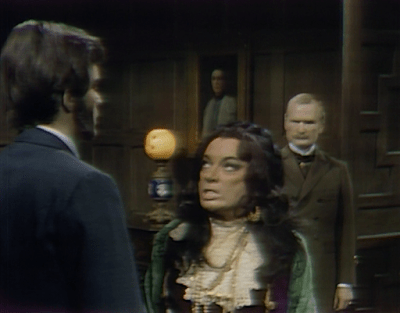
Episode 891: The only one there is

About Time

Dark Shadows committed itself to supernatural stories in late 1966 and early 1967, when the chief villain was undead blonde fire witch Laura Murdoch Collins. Since the usual laws of nature weren’t going to restrain Laura, they needed another set of rules that could predict her behavior sufficiently to create suspense. One of the things they settled on was that the barrier between past and present grows thin on the anniversaries of deadly events. So when well-meaning governess Vicki and the team she had assembled to fight Laura discovered that, in a previous iteration, she had taken a young son of hers to his fiery death “exactly one hundred years ago,” they knew that the crisis was at hand.

Anniversaries continued to have this effect in subsequent periods. So when in January 1969 recovering vampire Barnabas Collins wanted to take a day trip to the 1790s, he stood in a graveyard and shouted at a man who had died exactly 172 years previously to ask for a ride. It worked.

Barnabas was using a different form of mumbo-jumbo at the end of February, trying to contact the ghost that had made the great house of Collinwood uninhabitable, when he came unstuck in time and found himself in the year 1897.

In the middle of Barnabas’ long stay in 1897, the show decided to take its conceit that two events occurring on the same date in different years were mystically connected and show us both sides of the link. In #835, Barnabas was locked up in a cell with a secretary cabinet that he knew would be in the front parlor of his home, the Old House at Collinwood, in 1969. He wrote a letter to his friend, mad scientist Julia Hoffman, and hid it in a secret compartment of the secretary. We cut to the front parlor in 1969, exactly 172 years later, where a series of events leads Julia to discover the letter, travel back in time, and precipitate Barnabas’ rescue.

By #839, the events of 1897 had played out differently enough from whatever happened the first time through that year that the ghosts found peace. As we cut back and forth between that year and 1969, we saw that the 1960s characters remembered the haunting and the disasters that accompanied it and were relieved that they were over.

That gives us the present as the result, not of any one series of events in the past, but of a composite of many separate and mutually incompatible pasts. This idea is the logical culmination of substituting anniversaries for natural laws. In the first part of Barnabas’ trip to 1897, he had not yet done enough to lay the ghosts to rest. So the haunting continued, because it was happening on the anniversaries of events that were much the same as those that took place originally. By the time the living people of 1897 who would become the ghosts of 1969 had changed enough that they were no longer doomed to haunt the house, the date was one that would fall almost ten months into the haunting. In #836, Julia had a conversation in which one of the ghosts tells her about events in 1897 that could not have happened in the original timeline without Barnabas’ intervention, and which do not happen in #838 after Julia herself travels to that year. So each anniversary creates another past that becomes another ingredient in the stew that makes up the present.

This conception of the relationship between past and present shows the difference between a set of fantastic tales like Dark Shadows and a science fiction story exploring more-or-less plausible consequences of open questions in science. The “Copenhagen Interpretation” of quantum mechanics posits that the cosmos is made up of countless parallel universes, and that everything that could ever have happened did happen in at least one of those universes. Since that is a defensible position within science, an author can incorporate as much fact and reality as s/he likes in a story based on it. But since the idea that one period of history is the result of a confluence of many conflicting pasts is not only not a live option in science, but does not really make any practical sense except as a metaphor, the logic that really matters is dream logic. As dreams seem perfectly convincing to us when the only connections that lead from one moment to another are random similarities in names or shapes, so all that matters in a fantastic tale is that there is a pattern the audience can follow, whether or not that pattern corresponds to anything in the world where we spend our waking hours.

Now Barnabas has returned to 1969, brought back by a mysterious cult that has brainwashed him and adopted him as its leader. The characters he knew before he left are delighted to see him again. Today, matriarch Elizabeth Collins Stoddard comes to the Old House and is overjoyed that the haunting is over and that she and her family have been able to return to the great house. She is grateful to Barnabas for undertaking his harrowing journey back in time.

Liz and Barnabas talk about Chris Jennings, a young man in whom Liz’ daughter Carolyn is interested. Barnabas gives it as his firm opinion that Carolyn should avoid Chris, and he urges Liz to encourage her to do this. Barnabas knows that Chris is a werewolf, and we saw last week that the cult that has co-opted him has plans for Carolyn which do not include her death as one of Chris’ victims, so this will not surprise returning viewers.

Chris himself is another example of the weird metaphysics the show has stumbled upon. When Barnabas left 1969 for 1897, Chris was in his wolfish form all the time, apparently never to become human again. We learned during the 1897 segment that his lycanthropy is a curse inherited from his forebear, Quentin Collins. The version of 1897 we saw was changed sufficiently from the original that Quentin avoided his own death and was for a time relieved of the effects of the werewolf curse, though at the end of the segment it looked like they might be on their way back. That he is now human part of the time but still subject to transformation suggests that the difference in Quentin’s experiences in the later part of the 1897 stories had some effect on him. It’s unclear whether Chris’ condition fluctuated every time the date marked the 72nd anniversary of something happening to Quentin that hadn’t happened when he was living in a Barnabas-free zone, but it wouldn’t contradict anything we’ve seen if it did.

The Time to Come

Barnabas brought one object back with him from the past, a wooden box. The box must be opened only at a certain time, by certain people, for the cult’s plan to take effect. Today, Barnabas receives a visit from the people. They are Megan and Philip Todd, owners of the new antique shop in the village of Collinsport. Carolyn sent them, thinking that Barnabas would likely have some things they could add to their inventory. He sees that Megan is wearing a necklace with a symbol representing intertwined snakes, which Barnabas calls a “Naga.” When Megan is unable to explain just how she came into possession of the necklace, he shows them the box, which is topped with an oval in which the same symbol is carved. They are both thrilled at the prospect of buying the old furniture he has in the upstairs rooms of his house, but Megan is particularly fascinated by the box.

Later, Philip and Megan are back in their shop. They are confident they can buy a great deal of furniture from Barnabas, but are also sure that they wouldn’t be able to afford the box, even if he were willing to part from it. This is a bit odd- we get a good look at the box, and it is absolutely nothing special. The actors manage to sell the scene, but it would be better if they had either invested in a showier prop or been more sparing about putting it on camera.

Megan and Philip with the box. Screenshot by Dark Shadows Before I Die.

Barnabas comes to the shop and gives Megan and Philip the box as a present. After he goes, Megan is overwhelmed by an urge to open the box, which is locked. She is so consumed by this urge that she actually says “Let’s force it!” Since they had just minutes before been talking about it as if it were more expensive than anything they have for sale in their shop, this is a startling line. But when Philip opens the envelope Barnabas left to look at the list of furniture he is willing to sell them, he finds a key.

Philip is reluctant to open the box, having a strange feeling that if they do, nothing will ever be the same for them again. The other day it was Megan who had a strange feeling of impending doom. She wanted to sell the shop and flee Collinsport forever, lest they suffer an irretrievable disaster. That time it was Philip’s turn to urge her to set her misgivings aside. We’ve seen this kind of back and forth before. At the end of 1968, the great house of Collinwood was coming under the control of ghosts. Children Amy Jennings and David Collins kept trading the roles of possessed agent of the ghosts and unwilling sidekick. That alternation showed that the ghosts were not yet powerful enough to possess both children at once, and it faded as the haunting became more intense. It built suspense by suggesting that possible avenues of escape were gradually but inexorably closing.

As Philip and Megan begin to open the box, there is a whistling sound. They are unsettled, but decide they have to finish opening it anyway. They do, and we see their reaction to whatever is inside. Longtime viewers have seen similar reactions as cliffhangers many times; always before, they have indicated amazement that the container is empty.

New People

One of the less appealing villains of the 1897 segment was magically gifted artist/ surly criminal lowlife Charles Delaware Tate. Tate lived in a house that in the parts of Dark Shadows set in the 1960s was known as “the Evans Cottage,” home to drunken artist Sam Evans and his daughter Maggie, The Nicest Girl in Town. The cottage burned down in #883, leading us to wonder if it would still be there when the show returned to 1969.

Sam died last year, and Maggie now lives at Collinwood, where she is David and Amy’s governess. Today she goes to the cottage to prepare it for some tenants to whom she will be renting it. Evidently it must have been rebuilt before the Evanses moved in.

The only movable property in the cottage is a portrait of Maggie’s mother which her father painted. That portrait also appeared in the cottage a few times when Tate was living there; that was just carelessness on the part of the production staff, but it is kind of reassuring to see it again.

A man who has been in a couple of episodes knocks on the door. He identified himself as a friend of Sam’s and is saddened to hear of his death. He enters and asks Maggie to do him a favor. He keeps refusing to give her his name. We haven’t heard his name at all; evidently his identity is supposed to be a mystery to us. Word of that apparently did not reach the department responsible for making up the credits; they’ve been billing actor Dennis Patrick as Paul Stoddard, whom regular viewers know as the long-missing husband of matriarch Liz and father of Carolyn. They do that again today.

This is the last time we will see the Evans Cottage. In 1966 and 1967, the set was a symbol of the village of Collinsport, and scenes there showed the consequences that the doings of the rich people in the big house on the hill had for the working class who live in its shadow. By the time Maggie moved into Collinwood, they had long since given up on those kinds of stories. Dark Shadows is sometimes called “Star Trek for agoraphobes”; as we go, less and less of the action takes place anywhere other than Collinwood, and eventually they won’t even let us outside.

Liz agreed to let Barnabas live in the Old House in #218; by #223, she was talking about it, not only as his home, but as if he owned it and its contents. For while they went back and forth on the question of Barnabas’ legal status regarding the property, but when, at the suggestion of Liz’ daughter Carolyn, he gives the Todds a list of its furnishings that he is prepared to sell to them, I think we can take it for granted that Liz no longer has any claim on it.

Episode 883: The stone of justice

In the parts of Dark Shadows set in 1966 and 1967, the home of artist Sam Evans and his daughter Maggie, The Nicest Girl in Town, was a frequent set. Sam and Maggie were important characters in several storylines, and in their cottage they represented the working class of the village of Collinsport, as against the rich people in the big house on the hill.

Now, the show is a costume drama set in 1897. In that year, the Evans Cottage is already an artist’s studio. It is occupied by Charles Delaware Tate, who became a nationally renowned painter by making a deal with evil sorcerer Count Petofi. Today, Petofi is staying in the cottage, and Tate is functioning as his goon.

Petofi is deep in a trance, trying to cast a spell that will cause him and handsome young rake Quentin Collins to switch bodies. Once he has accomplished this switch, he will cast another spell to take himself, in Quentin’s body, to the year 1969, leaving Quentin behind in 1897 to face the vengeance of Petofi’s mortal enemies.

Cockney showgirl/ mentalist Pansy Faye has caught on to what Petofi is attempting to do, and has sneaked into the cottage to stop him. He snaps out of his trance and declares he will punish her. She grabs his glasses and runs to the door; Tate enters and grabs her. At Petofi’s behest, Tate ties Pansy up. Petofi then sends Tate to the great house of Collinwood to fetch Quentin. He is to say that Petofi will kill Pansy unless Quentin comes within the hour.

At the great house, Tate finds that Quentin has fled and cannot be reached. Quentin’s friend and distant cousin, time traveler/ recovering vampire Barnabas Collins, insists on going back to the cottage with him. When he arrives, it occurs to Petofi that Barnabas’ body is just as well suited to his purposes as is Quentin’s. He lists some of the characters who are waiting for Barnabas in 1969, and predicts they will receive him “with open arms” when he arrives in Barnabas’ form. Regular viewers are perhaps chilled, and certainly intrigued, by the idea that the show might go forward with Petofi impersonating Barnabas in a contemporary setting while a Barnabas who looks like Petofi tries to make his way back from the past, though there are so few surviving characters and unresolved story points left in 1897 that it is hard to imagine many more episodes even partially set in this period. Petofi uses his magic powers to knock Barnabas unconscious, and goes into a trance to effect the body swap.

The door swings open, and someone called Garth Blackwood enters. The other day, Petofi had Tate draw a picture of Blackwood, a picture endued with magical powers. It brought Blackwood back to life. Some years ago, Blackwood was a jailer murdered by an escaping convict named Aristide. Petofi found Aristide and took him on as a servant. Aristide has recently proven to be unreliable, and Petofi has decided he wants to be rid of him once and for all. He was amused by the idea of resurrecting Blackwood to perform the task. Blackwood has killed Aristide, but Petofi found on Monday that there is more to him than his own magical powers created. He cannot lay Blackwood to rest. Now, Blackwood has resolved to kill Petofi and Tate.

Tate flees at the sight of Blackwood. Pansy, free, asks if he is the police. He identifies himself as the master of Dartmoor Prison. Pansy, being English, is impressed. She points to Petofi and tells Blackwood that he must act against him. Blackwood puts handcuffs on Petofi, then slaps him until he comes out of his trance.

Petofi pleads with Blackwood to drop all charges against him, since he was the one who gave him the chance to kill Aristide. Barnabas comes to and asks what is going on. When Blackwood asks if he testifies for Petofi or against him, Barnabas gladly pronounces “Guilty!” He starts to say that Petofi must be killed immediately, and Blackwood cautions him against giving opinions. The witnesses are to offer only facts. So he asserts that Petofi and Aristide traveled the world together for years and committed every possible crime. At that, Blackwood bids him and Pansy leave. Once he is alone with Petofi, Blackwood picks up a metal can, douses the place with fluid, and lights a fire.

Back at the great house of Collinwood, Barnabas and Pansy talk about what just happened. Barnabas says he is confident Blackwood will kill Petofi, but he thinks he and Pansy may have to fight Blackwood later. Pansy has a vision of Blackwood and Petofi struggling with each other amid the flames in the Evans Cottage. She also sees the portrait of Quentin burning there. Since this portrait has a magical charge that keeps Quentin from turning into a werewolf, that’s bad news.

Garth Blackwood and Count Petofi, battling in the blazes. Screenshot by Dark Shadows Before I Die.

Petofi has been so powerful that it has long seemed likely that his destruction could come only as the result of his own action. When his right hand, the locus of most of his powers, was reattached to his wrist in #815, the show was giving hints it might wrap 1897 up soon. We kept hearing that the Hand had developed a mind of its own in the century it had been separated from Petofi; we could easily imagine it deciding to strangle him, and indeed in #841 it nearly did. But 1897 was such a big hit that they kept restarting it, and for some time now the Hand has done more or less what Petofi wanted it to do.

It would have been fitting had Pansy killed Petofi, since she is, in her present form, one of his creatures. The original Pansy Faye was killed in #771. In #819, Petofi erased the personality of minister’s daughter Charity Trask and gave Charity’s body to Pansy. Pansy’s light-heartedness and apparent harmlessness would have added to her suitability as the instrument of Petofi’s demise. The whole idea of the supernatural is that what appears to be weak is in fact irresistibly strong, so it would be fitting to have a tiny woman who is a character from very broad comedy conquer the great wizard.

Blackwood has only been on Dark Shadows since #878, was never previously mentioned, and is the shallowest character possible. But those weaknesses, too, give him a logical place as Petofi’s executioner. Petofi was never more smug in his self-assurance than he was when he used Tate to bring Blackwood into being in order to murder Aristide. Petofi has so easily defeated efforts by characters who had long records of dominating the action of the show, such as Barnabas and wicked witch Angelique, that we can understand why it would not occur to him that a day player could present him with any serious difficulty. That self-assurance leads him to carelessness, as he creates in Blackwood a being whose strength comes not only from him, but from the fires of Hell from which he came. Indeed, Petofi’s only thought when he brought Blackwood back from the dead was of the suffering he would inflict on Aristide, and his only feeling was delight in contemplating that suffering. Coming as the price of his overconfidence and his gleeful cruelty, it puts a moral at the end of the story when Petofi falls at Blackwood’s hands.

This episode marks the final appearance of the characters Petofi and Blackwood. It is also the final on-screen appearance of Pansy, though her voice will be heard once more, in an episode next week.

Episode 758: Strangled on her stories

Undead blonde fire witches Laura and Angelique are trying to destroy each other, using Laura’s son Jamison and Jamison’s uncle Quentin as their cat’s paws. At the beginning of the episode, it looks like the spell Angelique and Quentin are casting is about to incinerate Laura; at the end, it looks like the spell Laura is casting is incinerating Angelique. In between, Quentin’s sister Judith notices that something is wrong with Jamison, and suspects that whatever Quentin and Angelique are up to is the cause.

Quentin and Laura get all religioused-up asking the gods of ancient Egypt to help them against Laura. Screenshot by Dark Shadows Before I Die.

Laura is just about out of story, so we can see that she will be leaving the show soon. She has important relationships to all the characters on the show right now, so her departure will kick this segment of Dark Shadows, a costume drama set in the year 1897, into a new phase. Today’s episode is too deeply involved with the back and forth in the battle of the witches to give much indication as to what that next phase will be, but Judith’s perceptiveness suggests that whatever it is will keep up the rapid pace set in the first twelve weeks of the flashback, unencumbered by characters who slow things down by refusing to face facts.

Longtime viewers will be intrigued by variations on some familiar themes. Angelique orders Quentin to bring her a mirror and then leave the Old House on the great estate of Collinwood. Obviously she is going to use it to cast a spell that will protect her from Laura, but she refuses to tell Quentin the particulars. We know well how powerful reflections are in the universe of Dark Shadows; Wallace McBride of the Collinsport Historical Society made some very penetrating observations about how that motif was already in place in episode #1 in his 18 April 2020 post on that treasured, but now only intermittently available, site.

Later, Laura is in the drawing room at the great house on the estate about to tell Judith the secret of the mysterious Barnabas Collins, but Angelique enters, makes googly eyes at Laura, and thereby robs her of the power to speak. When the show had its first séance in #170 and #171, it was held in this room and another iteration of Laura was in attendance. It was that Laura who looked at the medium with bulging eyes when she began to speak, and that medium struggled to speak just as Laura does now. So today we see the tables turned on Laura.

Quentin and Angelique are alone for a moment in the foyer of the great house. He backs her against the portrait of Barnabas that hangs there and asks why she prefers Barnabas to him. That is a question that will have occurred to the audience. The two of them look great together and have a lot of fun together, while Barnabas hates Angelique. All she does is kill his family and friends to punish him for refusing to love her. She brushes Quentin off and orders him to go back to the Old House.

In the final scene, Quentin returns to the Old House and is baffled to find that Angelique not only got there before him, but that she has had time to play a long game of solitaire since returning from the great house. She dismisses his questions and tells him that she wants him to be with her when “it happens.” Before he can find the words to ask what she is expecting, she bursts into flames.

It seems that Angelique is in two places at once. More precisely, it seems that there are two of her, one that Quentin left in the great house, and another who was in the Old House all along waiting to be incinerated by Laura’s spells. Presumably the one in the Old House is a Doppelgänger that Angelique used the mirror to create. Nowadays, the idea of a home-made Doppelgänger fabricated to serve a specific purpose will remind many people of the 2017 season of Twin Peaks, with its concept of a “tulpa.” The Buddhist concept of the tulpa was indeed in circulation in the USA in the 1960s; Annie Besant had introduced it to the Theosophist movement, which had many followers in the Midwest, where writer Sam Hall was born. But Besant and her fans seem to have used the word in a sense closer to its original, in which people attaining Buddha-hood have the power to send copies of themselves back into the world to teach others pursuing enlightenment. Later heirs of Theosophy have tried to develop a non-Buddhist meaning for the word tulpa, but using it to refer to a lookalike that some practitioner of black magic can whip up to do a job appears to be the intellectual property of Lynch/ Frost Productions.

Be that as it may, we have seen ever since Laura was first on the show from December 1966 to March 1967 that each of the supernatural beings on Dark Shadows is a complex of related but independent phenomena, some of which may work at cross-purposes with each other. Angelique in particular seems to create another version of herself and send it out into the world each time she casts a spell. Since others of Angelique’s creatures have gone on to defy her, even trying to kill her, it must have come as a relief to know that this time the Doppelgänger would be going up in flames by nightfall.

Episode 748: Here in the past

Madwoman Jenny Collins is hiding in the quarters of her formerly devoted servant, Beth. Beth enters with Jenny’s estranged husband, libertine Quentin. Jenny eavesdrops as Beth tearfully tells Quentin that she was once very close to Jenny, but that now she wishes her ill, because she is in love with him. Quentin and Beth embrace, and Jenny lunges at them with a kitchen knife.

Quentin disarms Jenny and strangles her. We were introduced to Quentin as a murderous ghost haunting the great house of Collinwood in 1969, and when we first came to the year 1897 to meet him as a living being it was a matter of minutes before he was squeezing his grandmother’s throat and threatening to kill her. Quentin has been going around the house announcing for days and days that he plans to kill Jenny, so it comes as no surprise to the audience that he puts his hands around her neck even though she has already been disarmed, fights off Beth’s attempts to stop him, and keeps choking Jenny until some time after she has stopped moving. We have been well-prepared for this unambiguous image of intentional homicide.

Once Quentin has finished his work, he runs out of the room. Beth goes to the foyer and, between sobs, tells Quentin’s stuffy brother Edward that Jenny is in her room, dead.

In Beth’s room, Edward feels Jenny’s wrist and says that she is indeed dead. Once Beth has given him a few of the salient details of the murder, he declares that he has heard enough. He orders Beth to take the knife back to the kitchen and put it where it belongs. They talk briefly about Jenny and Quentin’s children, whose existence has previously only been hinted to the audience and has been denied to other characters as recently as yesterday.

We cut to the foyer. Quentin comes creeping down the stairs, holding a bag and looking from side to side. When Quentin reaches the foot of the stairs, Edward seizes the bag and orders him to stay in the house. In the drawing room, Edward tells Quentin and Beth what story they will put about to cover up the murder and save the family name. Beth is to say that she found Jenny lying at the foot of the stairs, stunned. She helped Jenny to her room, then left her there for a moment while she went to look for help. Finding no one, she came back and saw Jenny lying on the bed. When she could not wake her, she realized she had died of the injuries she sustained in her fall.

Quentin says that the story will not work. He tells Edward that earlier in the evening, Jenny’s presence at Collinwood was revealed to three more people, distant cousin Barnabas Collins and ethnic stereotypes Magda and Sandor Rákóczi. Edward says that as a member of the family, Barnabas will not question the story, and that as “Gypsies,” Sandor and Magda will do anything in return for money. Quentin says that Magda and Sandor will not be so easy to deal with. When they learned that Jenny was in the house, Magda told Quentin something which he tells Edward and Beth “None of us ever knew,” that Jenny was her sister.

Edward is thunderstruck, and exclaims “You married a Gypsy!” Yesterday it seemed that Edward and Quentin’s sister Judith, the owner of the house, had known Jenny’s origin for some time, and that it was why she locked Jenny up in the house when she went insane rather than sending her to a mental institution where Sandor and Magda might be among her visitors. And as far back as #701, it seemed likely that Beth knew secrets relating to Jenny, to Magda, and to Romani heritage. In that episode, Quentin marveled that Beth was still around Collinwood when Jenny, who had brought her to the house as her servant, had left, and Magda taunted Beth by bringing up a bit of Romani folklore and laughing “But you wouldn’t know anything about that, would you?” So while Jenny’s background is news to Quentin and Edward, it may not be true that “None of us” knew.

Magda and Sandor come to the house. On their previous visits to the great house, they have acted like servants or like stage Gypsies come to tell fortunes and sing songs. But now that the word is out about Jenny’s true identity, they come in with their heads up and look Edward in the eye. They say that they have come to see Jenny. Edward turns away from them, and says that there has been an accident. Jenny is dead. Horrified, Magda asks where she is. Edward says that she is in Beth’s room, and offers to have Beth show them the way. Magda says that she knows where it is, and that she and Sandor want to go by themselves. Edward says “Of course,” very much in the tone a gentleman uses with his equals.

In the room, Magda notices that Jenny is holding a button in her hand. She concludes that she pulled it off the coat of a man with whom she was fighting for her life. Sandor notices heavy bruising around her neck.

Meanwhile, Edward is drilling Beth and Quentin in the stories they are to tell. Beth recites the whole thing, and he tells her to remember every word. Quentin is less cooperative, but still seems to have learned his part. He tells them not to speak until they are spoken to.

Sandor and Magda enter. She asks some questions; Edward answers, and shows offense when she tries to direct them to Beth. Before he can proceed to the next act of the little drama he has prepared, letting first Beth and then Quentin corroborate his account with the stories he has given them, Magda looks at Quentin’s coat. She can see that a button is missing and that the ones that remain match the one she found in Jenny’s hand. She calls him a murderer, and says that the police will hear of it.

Edward says that Quentin might have lost the button anywhere at any time. He asks her what the authorities in the village of Collinsport would do if asked to choose between a Romani person’s word and that of a Collins. Magda drops the idea of going to the police, and tells Quentin that she will place a curse on him that will make him suffer as Jenny suffered, but that his suffering will not be subject to the release that death has brought Jenny. Quentin is terrified, Edward dismissive.

Magda tells Quentin she will curse him. Screenshot by Dark Shadows Before I Die.

From the very beginning, one of the main themes of Dark Shadows has been denial, the psychological defense mechanism. In this one, we see that denial is, among other things, the wish that time would stop moving forward. Quentin says that he is not going to go to jail for something he did not mean to do. He obviously did mean to kill Jenny, but he does not want to accept any of the consequences that follow from that act. He wants to be frozen in his comfortable, carefree life, without punishment from the law or vengeance from Magda. Edward wants the family name to be frozen in the lofty regard in which it was held before Quentin murdered Jenny.

For her part, when Magda tells Quentin it will not be possible for him to die, she is promising to give him and Edward what they want, but not in the way they want it. A curse is a way of freezing time. The suffering it brings persists, unchanged, from year to year. It cannot be explained, it cannot be escaped, it falls on one person after another whatever their deserts. Its only logic is to renew itself endlessly.

Episode 735: Defenseless souls

The highlight of today’s episode is a confrontation between two of Dark Shadows‘ most effective villains.

Laura Murdoch Collins (Diana Millay) was on Dark Shadows from December 1966 to March 1967, when the show took place in a contemporary setting. She emerged from the supernatural back-world behind the action, and at first she was as vague and indefinite as are the beings who lurk out of our sight there. Eventually she took on a forceful enough personality that Diana Millay could display her gift for dry comedy, but that personality was only a mask that Laura wore. The real Laura was something entirely different, unreachable, unknowable. The visible Laura marks the boundary between the world we can hope to understand and one where humans would find no points of reference, no standards of comparison. As such, she represents the danger that we might lose our way and find ourselves in a place where our minds will be useless to us. That is to say, she inspired the fear that comes from a well-told ghost story.

Now the dramatic date is 1897, and another iteration of Laura is the mother of twelve year old Jamison and nine year old Nora. Laura’s estranged husband, the stuffy Edward Collins, and Edward’s sister, spinster Judith, have sent Jamsion and Nora to Worthington Hall, a boarding school which doubles as a particularly cruel cult. Laura’s plans for Nora and Jamison require them to be home on the estate of Collinwood, and so she sets out to release them from Worthington Hall.

The headmaster/ cult leader of Worthington Hall is the vile Gregory Trask (Jerry Lacy.) Trask is at the opposite pole from Laura. She is terrifying because we can never understand her or the realm whose existence she implies; he is an overpoweringly oppressive presence because he is so thoroughly comprehensible. It is perfectly obvious what Trask has done, what he plans to do next, and why he wants to do it, but knowing all that is of absolutely no use in stopping him.

In today’s opening scene, Trask confronted fugitive teacher Rachel Drummond, whom he is extorting into coming back to work at Worthington Hall. He kept sidling up to Rachel and touching her, telling her that perhaps the two of them were destined to change each other. He could not make it clearer that he wants to exploit his power over Rachel to coerce her, not only into returning to her old job, but into a sexual relationship.

Trask has been in a position of authority over Rachel since she was a small child, suggesting that his unrelentingly punitive approach to his students and the undisguised joy he takes in being cruel to them are also sexual in their origin. Rachel even used the word “sadist” to describe Trask the other day, a word coined only in 1892. Someone using it in 1897 would certainly have seen it in its original clinical context, and the neurotic intellectual Rachel undoubtedly understood it very well in its technical sense.

We see Laura on a dark set. She looks at a candelabra. She points at its three candles, one by one. As she points at each candle, it lights. Thus first time viewers learn that Laura is a supernatural being with a relationship to fire.

At Worthington Hall, Nora wanders into a room where a fireplace is alight. Nora can hear her mother’s voice urging her to look into the flames, but cannot see her. She is afraid until she looks into the flames and sees Laura’s face. Nora begins to enter a deep trance. Before she can, a teacher finds her and interrupts her. We cut back to Laura, who is pleading with Nora not to look away from the fire. Nora does, and the candles on Laura’s candelabra go out.

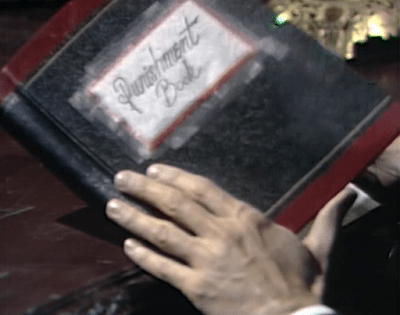
We see Trask in his study, browsing through a Bible. He returns that to his bookshelf and finds more congenial reading. He picks up a ledger and brightens. We see its cover, on which is taped a label reading “PUNISHMENT BOOK.” Trask smiles blissfully and sits down to examine its contents.

The volume that takes Trask to his happy place. Screenshot by Dark Shadows Before I Die.

A knock comes at the door, pulling Trask out of his sun-kissed dream of past cruelties. Irritated, he demands to know who it is, but receives no answer. When the knocking continues, he opens the door and sees Laura.

LAURA: Are there no servants at Worthington Hall? I’m not accustomed to letting myself in.

Longtime viewers will remember that when Laura was first on the show, they made a big deal out of the fact that she never ate or drank. So much so that they had the next uncanny menace, Barnabas Collins, drink a cup of coffee in #221. Even though Barnabas was a vampire and Laura was not, they had used up the traditional indicator of vampirism. non-consumption of food or drink, on Laura. Laura’s inability to open the door herself may be another borrowing from the same stock of imagery, from the idea that the vampire cannot cross a threshold without being invited.

TRASK: Who are you?

LAURA: I am Laura Collins and I come for my children. You are Mr. Trask, of course.

TRASK: Reverend Trask!

LAURA: Anyone can call themselves anything. I knew a woman in Brooklyn, once. Insisted she was a countess.

This is an inside joke. There was quite a well-known fashion correspondent-turned-executive in Brooklyn in 1969 named Mabel Wilson Gross. Mrs Gross’ first husband was a Danish nobleman named Count Carl Adam von Moltke, known to his friends as “Bobby.” Mrs Gross was known professionally as “Countess Mab Moltke.” She and “Bobby” were the parents of Alexandra Moltke Isles, who appeared in 333 episodes of Dark Shadows as well-meaning governess Vicki. I don’t believe Mrs Isles has ever used the title “Countess” herself, though under the laws of Denmark she would have the right to do so. Since it was Vicki who led the battle against Laura in 1967, a remark from Laura twitting Mrs Isles and her family might raise quite a laugh from longtime viewers who get the reference.

LAURA: (Goes to Trask’s desk and leafs through the “Punishment Book.”) But you are Trask. Yes, there’s no doubt about that.

TRASK: But you could be anyone as far as I’m concerned, anyone at all. I have too much respect for the defenseless souls in my charge.

LAURA: Oh, please, don’t be dreary.

TRASK: Dreary, Madam?

LAURA: Surely you know the word. Simply have my children brought down here, if there’s anyone to bring them.

TRASK: And how am I to know that you are their mother?

LAURA: Oh, what a trusting man you are.

TRASK: There is no question of the children leaving the school.

LAURA: Jamison possibly. Nora will leave here tonight. I’m willing to take them one at a time.

TRASK: As far as I know, Madam, their mother is away.

LAURA: You should keep more in touch.

TRASK: My wife returned from Collinwood this afternoon. She made no mention of your return.

LAURA: Hmm. How odd. I thought her a great gossip.

TRASK: Minerva? Madam.

That Minerva appeared to be “a great gossip” will also amuse longtime viewers. She is played by Clarice Blackburn, who in the parts of Dark Shadows set in the 1960s played housekeeper Mrs Johnson. After a brief period in which Mrs Johnson was supposed to be a spy planted in the house by an enemy of the Collins family, she settled into the role of a benevolent but excitable woman whose chief function was to blab everything she knew to the character likeliest to use the information to advance the plot.

LAURA: Now, will you have Nora sent down.

TRASK: I will not. Not without proper orders from Miss Judith Collins or Mr. Edward Collins. I shall call Collinwood and verify your strange appearance.

LAURA: Do.

(TRASK picks up the telephone receiver. Shows pain and drops it.)

LAURA: What’s wrong, Mr. Trask?

TRASK: It burned my hand.

LAURA: I’ve always thought the telephone an instrument of the devil, haven’t you?

TRASK: I have not!

Many times on Dark Shadows, as recently as this week, we have seen men forcibly intervene to stop a woman from talking on the telephone. I believe this is the first time we have seen a woman turn the tables and do this to a man.

TRASK: What a ridiculous conversation. I don’t know what I could have been thinking of to call Mr. Edward Collins. We have rules at Worthington Hall, Madam.

LAURA: Ah, rules are made to be broken.

TRASK: Not here. The children are asleep. They shall remain asleep. We do not encourage visits even from members of the immediate family unless of course it’s an emergency.

LAURA: Then you won’t reconsider?

TRASK: No.

LAURA: Not wise. Not wise at all.

TRASK: Are you threatening me?

LAURA: My children will not spend one more night in this school.

Laura remains perfectly calm throughout this conversation. Even her closing threat is delivered in a light tone, with an easy smile. Trask is agitated at the outset, and becomes ever more so as he realizes he cannot intimidate Laura. Since Diana Millay and Jerry Lacy are two of the most capable comic actors on Dark Shadows, the result is hilarious.

We first saw the effect of Laura’s imperturbability on an earnest interlocutor in #183 and #184, when she confronted a profoundly different character. In those installments, visiting parapsychologist Peter Guthrie called on Laura at the same cottage where she is staying in 1897. He introduced a new word to Dark Shadows‘ lexicon when he told her that he had concluded that she was “The Undead.” He said that he knew of her evil intentions, and said that if she abandoned them and turned to good, he would make every effort to help her live a different kind of life. Guthrie’s offer meant exactly nothing to Laura, and she responded to it with the same sardonic indifference Trask elicits from her today. Her next act was to cast a spell that caused Guthrie to crash his car and die in a ball of flame.

Trask gets off easier. Laura just sets his school on fire. The closing shot shows Nora apparently surrounded by flames. Laura does not want to burn Nora to death, at least not yet, but she is not one of your more detail-oriented otherworldly menaces. It will not surprise longtime viewers that she is blithely assuming that her children will somehow escape alive from the blaze she has started.

Episode 712: A pawn in this cruel game

Dark Shadows first developed its conception of the supernatural in depth when undead blonde fire witch Laura Murdoch Collins was on the show from December 1966 to March 1967. Laura was not so much one person as she was a complex of at least three distinct beings. There was a charred corpse in the morgue in Maricopa County, Arizona; a phantom that Laura’s son, strange and troubled boy David Collins, can sometimes see through his window as she flickers above the lawns of the estate of Collinwood; and a living woman who carries on conversations with people but is never seen eating or drinking. People who encounter Laura also experience dream visitations that resemble her and unaccountable compulsions to do things relating to her, but it is never clear which of those psychic phenomena come from Laura and which from her arch-nemesis, the ghost of the gracious Josette. It is clear that the various parts that make up Laura are not always aware of each other, and sometimes work at cross-purposes with each other.

Laura’s successor as Dark Shadows‘ chief supernatural menace was vampire Barnabas Collins, who joined the show in April 1967. Like Laura, Barnabas comes in several parts, not all of them working together harmoniously. For example, sometimes doors slam shut when he is in a house, and only he can open them. This is never shown as something he deliberately makes happen, and it does not always serve any intelligible purpose of his. Also, when he is active dogs start howling. Sometimes that immobilizes his targets with fear and confusion, but just as often it costs him the element of surprise and foils his plans. So whatever uncanny forces cause these things to happen are clearly not subject to Barnabas’ will. They accompanied him out of the darkness.

Shortly after Barnabas’ arrival, the show retconned Josette as his lost love and cast her as Princess Ankh-Esen-Amun to his Imhotep in a remake of the 1932 film The Mummy. In that film, the undead man tried to remake contemporary woman Helen Grosvenor in the image of the ancient Ankh-Esen-Amun. Taking that role in Barnabas’ attempt to recreate Josette was Maggie Evans, The Nicest Girl in Town. As in the 1932 film Zita Johanns played Helen in the contemporary scenes and Ankh-Esen-Amun in a flashback to ancient Egypt, so in #70 and #126 had Miss Scott already played the ghost of Josette.

While Barnabas pursued his crazed and evil plan to Josettify Maggie, the ghost of his little sister Sarah showed up. Sarah befriended Maggie and helped her escape from her “big brother.” Sarah did more and more, ultimately sending well-meaning governess Vicki back in time so that from November 1967 to March 1968, Dark Shadows was a costume drama set in the 1790s, when Barnabas and Sarah were alive.

Like Laura and Barnabas, Sarah may have looked like single person, but was in fact a complex of independent beings. In #325, she visits David in a dream and gives him information only she would have. In #327, David sees Sarah during waking hours and tells her about the dream, and it all comes as news to her. This daylight Sarah makes it clear to David that she does not want him to have the information the dream version of her gave him so shortly before.

Moreover, child actress Sharon Smyth was instructed to play Sarah as Barnabas’ conscience. When Barnabas is freed to prey upon the living, he unknowingly pulls Sarah out of the supernatural back-world behind the action of the show, the unseen realm where Josette’s ghost, the “Widows,” the ghost of Bill Malloy, and the rest of them lurk, and brings her with him into 1967. Sarah, however many of her there are, is part of the same complex that includes Barnabas and the forces that surround him.

In the 1790s portion, we met wicked witch Angelique and saw her place the curse that turned Barnabas into a vampire. Like the other supernatural forces, Angelique was a complex of multiple beings, some of which were opposed to each other. In her case, spellcasting was a matter of breaking off little bits of herself that took on lives of their own. Angelique was obsessed with the idea that Barnabas would fall in love with her. She could easily cast a spell to make him do that, but insisted to her helper that Barnabas must come to her “of his own will.” Those were the exact words Barnabas used when talking to his own thrall about Vicki, who succeeded Maggie as the object of his gruesome fantasies. When we heard Angelique take the same line, it dawned on us that the Barnabas we saw from April to November 1967 was not merely cursed by Angelique, he was possessed by her. His thoughts were her thoughts, his plans were her plans. When Barnabas fights Angelique, it is one of her replicas of herself coming back to oppose her, as the zombie version she created of Barnabas’ uncle Jeremiah came back to bury her alive in #396.

Now, Barnabas has traveled back in time to 1897. He has met governess Rachel Drummond, who is played by Kathryn Leigh Scott and whom he recognizes as a double of Josette. Angelique has also come to 1897, conjured up by some Satanists whom Barnabas has antagonized for no apparent reason. Angelique peered through the windows of the great house of Collinwood just in time to see Barnabas giving Rachel Josette’s music box. Dismayed, she went to the Old House on the estate, looked at Josette’s portrait, and declared “I am Angelique, and I hate you!” She, like Barnabas, looks at Rachel and sees another Josette.

Angelique’s motivation in the 1790s segment was ostensibly about her desire for Barnabas, but it was her hatred for Josette that drove her at every turn. Now we see that Barnabas is compelled to create another Josette whom he can love; Angelique is just as powerfully compelled to create another Josette to hate. Since Barnabas’ “love” involves killing its object and raising her as a vampire, it would seem to be as hateful as is Angelique’s overt hostility.

After Angelique proclaimed her hatred to the portrait, she took a cloth doll representing Rachel and strangled it. Rachel herself collapsed, unable to breathe. Angelique mouthed words; Rachel spoke them, leading Barnabas to believe that they were a message from Josette.

Today, Rachel is in the drawing room at the great house, recovering from her choking episode. Barnabas is holding her and looking longingly at her neck when stuffy Edward Collins enters. Edward demands to know what is going on, and Barnabas explains that Rachel had trouble breathing and fainted. Edward becomes concerned and wants to call a doctor; he becomes suspicious when Rachel, who he just met a few days ago, does not want to see a doctor. Barnabas manages to distract Edward from his suspicions with some chatter about the circumstances under which Rachel fainted.

In the groundskeeper’s cottage on the estate, Angelique casts a spell to summon Rachel. Back in the great house, Rachel suddenly looks up, her eyes wide open and focused at a point in the middle distance. She stands up and walks with her neck very still, moving like a wind-up doll. She announces to Edward and Barnabas that she will be going outside for a breath of fresh air. She refuses Barnabas’ offer to accompany her. Edward and Barnabas watch her wonderingly as she marches out with her robotic gait.

Barnabas and Edward wonder what has got into Rachel all of a sudden

Rachel arrives at the cottage and finds Angelique. Angelique calls Rachel “Josette.” When she protests that her name is Rachel, Angelique echoes the Barnabas we first knew and tells her that, when she wills it, her name will be Josette. She tells Rachel that she will not understand what is happening to her, but that Barnabas will soon understand very well.

Back in the great house, a servant tells Edward that he found a woman in the cottage. Barnabas is there, and he reacts to the description with alarm. He goes to the cottage, clearly afraid that he will find Angelique there. Before he can complete a search, a rooster crows and Barnabas hastens back to his coffin in the basement of the Old House on the estate.

Barnabas opens the coffin, and finds Rachel lying in it, unconscious. This sets up a comedy of manners. He hardly knows her well enough to lie down with her, and he can’t very well wake her and ask her to make way for him. We end with him facing this problem in etiquette.

We may also remember #248, when Barnabas expressed his frustration with Maggie’s refusal to turn into Josette by forcing her into his coffin. Perhaps Angelique knows that he did that, and is taunting him with a memory of which he has since shown an ability to be ashamed. If so, the point of the taunt is that he is not different from her. Angelique called Rachel a “pawn” in the “cruel game” she is playing with Barnabas. Angelique, who when we first saw her in the 1790s segment was so monomaniacally devoted to her goals that she could not see events from any perspective other than her own, can now understand that what she is doing to Rachel is horrible. That’s why she is doing it, to show Barnabas that he is part of the same horror as herself and that he can never transcend it.

Episode 548: Too much a part of him

Wicked witch Angelique defied her supervisor, suave warlock Nicholas, one too many times. Yesterday, Nicholas stripped Angelique of her powers, including her immunity to aging. Since she is 194 years old, this leaves her with a sharply limited future.

Today, Nicholas tells Angelique he will think of sparing her from her imminent demise if she can persuade recovering vampire Barnabas to forgive her for her extreme abuse of him and of everyone he has ever cared about. She goes to Barnabas and begs him for forgiveness. Barnabas replies that when he asked her for forgiveness, she responded by turning him into a vampire. He does show signs of concern for her, but cannot pardon everything she has done. He specifically mentions The Dream Curse, a three month storyline that not only brought great suffering to him and a dozen other characters, but which also made the audience miserable. She dies.

Angelique begs Barnabas for forgiveness. Screenshot by Dark Shadows Before I Die.

Nicholas’ only acknowledged motivation to this point has been a selfless devotion to evil for its own sake. That makes it odd that he would place a value on forgiveness. Dark Shadows is pervaded with ghost stories, and ghost stories are, first and foremost, explanations of how unresolved conflicts in the past can poison relationships among people in the present. It is also a soap opera, and the biggest events in soaps are changes in the way particular characters feel about each other. So both genres tend to elevate forgiveness, not only as a virtue, but as the highest form of The Good in human life. We saw this in the first year of the show, when well-meaning governess Vicki kept forgiving strange and troubled boy David for his attempts to kill her, acts of forgiveness which culminated in #191 when David ran from the mother who was trying to lure him to his own death into Vicki’s arms and an acceptance of life. Two weeks later, in #201, dashing action hero Burke closed another narrative thread left over from episode #1 when he forgave sarcastic dandy Roger for an old grievance he had against him. With those events, it was pardoning that cleared the flotsam left over from Dark Shadows 1.0, paving the way for the introduction of Barnabas and the advent of Dark Shadows 2.0.

Perhaps Nicholas was so certain Barnabas would not be able to bring himself to forgive Angelique in the time available before her death that making her beg for forgiveness was his way of perverting the world’s best thing into yet another instrument of cruelty. Certainly he suggests this interpretation when he introduces the idea with a laugh and a comment that he might find it “amusing.”

When Nicholas stands over Angelique’s corpse, he tells her that her own hatred had made it impossible for Barnabas to forgive her because it had “become too much a part of him.” That Angelique’s hatred became a part of Barnabas rings a bell for longtime viewers. The show has always depicted supernatural beings, not as self-contained individuals, but as complexes of phenomena that operate more or less independently, often without each other’s knowledge, sometimes in pursuit of mutually exclusive goals. For example, in 1967 the ghost of Barnabas’ little sister Sarah visited David during the day and tried to prevent him finding out Barnabas was a vampire, but she also appeared to David in a dream and showed him everything the daytime ghost wanted to keep hidden. When David told the Sarah of the waking hours what her dream visitation form had shown him, she was horrified and forbade him from following up on any of that information.

When Angelique places a curse, she sometimes seems to create a little version of herself, give it possession of the person she is targeting, and turn it loose in the world. Sometimes that little Angelique turns against her. For example, she raised the body of Barnabas’ uncle Jeremiah from the dead to use for her own nefarious purposes, only to find that it would not return to its grave when she was finished with it. When Barnabas was a vampire, he had some obsessions that were strikingly similar to obsessions Angelique had shown. So Angelique wanted Barnabas to love her, and had the power to cast a spell that would make him do so, but instead wrought immense havoc on everyone else with one wild scheme after another, because she wanted him to come to her “of his own will.” Likewise the vampire Barnabas wanted to make Vicki his victim, but passed up one opportunity after another to bite her because he wanted her to come to him “of her own will.” That similarity is so close that it makes us wonder if the Barnabas we first met was simply Angelique in disguise. Not only her hatred, but all of her quirks had become part of him.

Angelique came from the 1790s to 1968 by some magical process that involved a portrait of her that is now on a stand in Vicki’s room. Today she uses a secret panel to let herself into the room and look at the portrait. We first saw that panel open when the show was a costume drama set in the 1790s. The room was occupied then by gracious lady Josette, and it was the vampire Barnabas who used the panel to enter. We haven’t seen the panel since, leaving it strongly associated with Barnabas in the minds of regular viewers. Angelique’s use of it today further suggests her identity with him when he is in his vampire state.

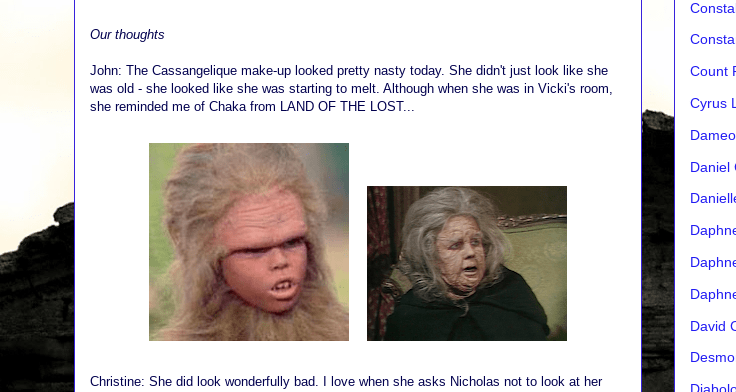
In their post about the episode on Dark Shadows Before I Die, John and Christine Scoleri find a resemblance between Angelique’s old age makeup and another TV character:

Captured from Dark Shadows Before I Die.

But look at Angelique’s creator, writer Sam Hall. She came by her looks honestly:

Episode 450: That man who says he is Barnabas

Haughty overlord Joshua Collins and his long-term house-guest the Countess DuPrés have summoned good witch Bathia Mapes to lift the curse that has made Joshua’s son Barnabas a vampire. Meanwhile, Barnabas has bitten his second cousin Millicent and gone to the waterfront to find another victim. Bloggers Danny Horn, Patrick McCray, and John and Christine Scoleri have said so much so well about this episode that I have only a few points to add.

Millicent tells Joshua that it is wrong of him to have “that man who says he is Barnabas” in the house when he does such frightful things. Nancy Barrett’s performance as a woman made insane by her encounter with the undead is achingly beautiful. And her idea that Barnabas is an impostor is an intriguing one. Should Bathia succeed, Barnabas will need a story to account for the several sightings people made of him when he was cursed. That success seems unlikely- if Barnabas is freed from the curse now, what will we find when Dark Shadows stops being a costume drama set in the 1790s and returns to a contemporary setting? But it is something to file away for future use…

Bathia summons Barnabas away from the docks, where he is about to kill a prostitute, by sending the flame from a candle to him. The movement of the flame is an interesting effect, but what most held my attention was the scene between Barnabas and the woman he almost victimizes. Jonathan Frid and day player Rebecca Shaw play this scene in silence, with exaggerated movements, against a heavy musical score. The resulting balletic interlude is a striking departure from Dark Shadows’ previous form.

Barnabas disappoints his partner at the end of the ballet sequence. Screenshot by Dark Shadows Before I Die.

Bathia keeps Barnabas in place by showing him a cross from which he recoils. This is the first time we have seen this reaction. Barnabas routinely comes and goes through a cemetery where many of the grave markers are in the shape of the cross, and they don’t bother him a bit.

Not only is it the first time this particular symbol has been a problem for Barnabas, it is the first time Dark Shadows has suggested there might be something to Christianity. The representatives of the faith we have seen so far in the 1790s have been Barnabas’ Aunt Abigail, a disastrously repressed spinster; the Rev’d Mr Bland, of whom the best that could be said was said by the doomed Ruby Tate when she described him to Barnabas as the preacher who looked like a duck; and the Rev’d Mr Trask, a fanatical witchfinder who inadvertently became the handiest tool wicked witch Angelique had at her disposal. The 1960s characters, aside from one fleeting mention of the word “Christmas” in 1966, have not betrayed any awareness that there is such a thing as Christianity.

Bathia commands the spirit of Angelique to speak to them through Barnabas. When Angelique was first on the show, she very conspicuously kept doing many of the weirdest things Barnabas was in the habit of doing in 1967. So Barnabas exasperated his henchmen by fixating on well-meaning governess Vicki but refusing to bite her, insisting that Vicki would eventually come to him “of her own will.” Angelique exasperates her thrall, much put-upon servant Ben, by casting spells on everyone but Barnabas when her goal is to win Barnabas’ love, insisting that Barnabas would eventually come to her “of his own will.” When in 1967 Barnabas sends his thrall Carolyn to steal an incriminating document and she asks what will happen if she is caught, he replies “See that you don’t get caught.” When Angelique sends Ben to steal a hair ribbon from Abigail and he speaks of what will happen if he is caught, she replies “See that you don’t get caught.” Moments like these suggest that the vampire Barnabas is not simply cursed by Angelique, but possessed by her. Perhaps it was Angelique, wearing Barnabas’ body as a suit, that we saw in 1967, not the son of Joshua and Naomi at all.

Jonathan Frid as Angelique . Screenshot by Dark Shadows Before I Die.

This fits with the general idea of the supernatural developed in the first 73 weeks of Dark Shadows. The first supernatural menace on the show was undead fire witch Laura Murdoch Collins, who was on from December 1966 to March 1967. Laura was a complex of beings, made up of at least two material bodies and an indeterminate number of spirits, some of which seemed to be unaware of the other parts of the system and pursuing goals incompatible with theirs. From June to November of 1967, the ghost of Barnabas’ little sister Sarah kept trying to contain the damage her big brother was doing to the living characters. Sarah too turned out to be a complicated sort of phenomenon, and the form in which she visited people when they were awake was unaware of and at odds with the form in which she visited them in their dreams. If we go by Laura and Sarah, we would have to assume that supernatural beings are multifarious and fissiparous. So perhaps each time Angelique casts a spell, she splits a bit off of herself and the fragment springs up as another version of her, functioning independently of the rest. In that case, the vampire Barnabas is an avatar of Angelique. When Bathia compels Angelique to speak, she is compelling one of the Angeliques to drop a mask.

The given name “Bathia” is rare; the only person with it who ranks higher in Google search than Bathia Mapes is a musicologist named Bathia Churgin. Professor Churgin was born in New York in 1928, went to Harvard, and taught in the USA until she moved to Israel in 1970. So it is possible that someone connected with Dark Shadows may have heard of Professor Churgin and named Bathia Mapes after her, either as a tribute or just because the name stuck in their mind.

The surname “Mapes” is somewhat less rare; apparently “it is borne by around one in 903,601 people.” In 1963 and 1965, Frank Herbert published two novels that were later issued together under the title Dune; there is an elderly woman with a mystical bent named The Shadout Mapes in those. I’ve never taken much interest in Dune, and owe my awareness of this to comments on Danny Horn’s blog (from Park Cooper here and from “Straker” here.) There doesn’t seem to be much doubt that Bathia’s family name is a nod to The Shadout Mapes; whether it was Sam Hall or another of the writers or someone else who worked on Dark Shadows or one of their kids who had read Dune, I cannot say.

Episode 425: Widows’ Hill

In episode #2 of Dark Shadows, well-meaning governess Vicki first visited the precipice known as Widows’ Hill. She was standing near the edge when high-born ne’er-do-well Roger Collins crept up on her, breaking his silence with a loud voice in a deliberate attempt to startle her. He tells her that she wouldn’t be the first to jump to her death from Widows’ Hill. The precipice is thus established as a place of danger.

Roger surprises Vicki atop Widows’ Hill.

In #5, Vicki again stood atop Widows’ Hill, and again a man she had never met startled her there. He was drunken artist Sam Evans, and he told Vicki the story of Josette Collins, a grand lady of a previous century who leapt to her death from the cliff.

In the same episode, strange and troubled boy David Collins mentions the ghosts of “The Widows” to Vicki. Later, we will hear that these are the ghosts of women who jumped to their deaths from Widows’ Hill at various moments in the nineteenth century. In #12, we will learn of “The Widows’ Wail,” a peculiar sound that can be heard in the wind around Widows’ Hill on nights when the ghosts of these sad women are restless. We will hear the Widows’ Wail several times, most effectively in #344, when Vicki is trying to talk her depressing fiancé Burke out of going on an airplane journey from which he will never return, leaving her a widow before she can become a bride.

The association of Widows’ Hill with deadly danger is reinforced in #50, when Vicki and heiress Carolyn look down from it and see the corpse of beloved local man Bill Malloy on the rocks below.

Bill in the water, as seen from the precipice of Widows’ Hill. Screenshot by Dark Shadows Before I Die.

In #75, we hark back to Vicki’s first meeting with Roger. Vicki finds Roger standing on the spot where she had stood when he startled her in #2. She reenacts that scene with the roles reversed. He exclaims angrily that she might have caused him to fall; she reminds him that he had done the same to her. He laughs happily and apologizes. They have a sweet little moment together after that, but his protest shows that she really was in danger then, and that she is none too safe now.

The death of Bill set off a series of events that ended with crazed handyman Matthew Morgan abducting Vicki, holding her bound and gagged in the Old House on the estate of Collinwood, and bringing an ax with the express intention of chopping her head off. At the last moment, he is stopped from decapitating Vicki by the manifested ghosts of Josette, the Widows, and Bill. When Bill appears with Josette and the Widows, it ceases to matter that he died somewhere else and only washed up below Widows’ Hill. Thereafter he is joined with them, and like their deaths, his death belongs to that place.

The Dead of Widows Hill confront Matthew. Josette manifested earlier in the episode, and is represented here by her portrait above the mantel. Screenshot by Dark Shadows Before I Die.

In #266, the Widows briefly reemerged from the supernatural back-world implicit in the action into the story, this time associated with a malign intention towards the characters. Reclusive matriarch Liz heard their voices luring her to throw herself off Widows’ Hill. We haven’t heard about them since then.

Liz dreams of the Widows, calling her to join them. Screenshot by Dark Shadows Before I Die.

Josette’s ghost was central to the action from #126 to #191, when she and Vicki together protected David from his mother, undead fire witch Laura Murdoch Collins. That Laura posed a danger to David was not clear to the characters in #139 and #140, when Laura startled David while he was at the edge of the precipice on Widows’ Hill. Vicki rescued him, then urged him to go to his mother. 

Vicki rescues David. Screenshot by Dark Shadows Before I Die.

In #185, Sam and Vicki visited the Old House, the seat of Josette’s power. Sam saw the portrait of Josette that hangs over the mantel. He asked if she was “the lady who went over the cliff.” Again, we join the image of Widows’ Hill with the concept of danger and the role of David’s protectress. Sam and Vicki came to the Old House to hold a séance. Josette speaks through Vicki at séances, suggesting that in sharing her role with regard to David, Vicki’s personality is coming to merge with that of Josette.

In April 1967, vampire Barnabas Collins succeeded Laura as Dark Shadows‘ resident supernatural menace. Barnabas was too dynamic an adversary for wispy presences like Josette and the Widows to oppose. In #212, he went to the Old House and told Josette’s portrait that her power there was at an end. In #223 and #240, David lamented that the family had lost its tutelary spirit.

With that, Josette ceased to be an active presence. She lost the role of David’s protectress, and with it her link to Vicki. But Josette is still an important element of the show. Instead of a guardian who intervenes in the story, she becomes the object of Barnabas’ obsession. Instead of a companion who acts with Vicki, speaks through her, and inspires her devotion, she becomes Barnabas’ motivation to victimize women, Vicki perhaps to be among them. Vicki’s personality may yet be replaced, not by a merger with Josette’s spirit, but by Barnabas’ insane plan to find a woman he can brainwash into becoming a facsimile of his long-lost, long-dead love.

The transformation of Josette from an active presence to the object of Barnabas’ delusions revolves around Widows’ Hill. In #233, Barnabas tells Vicki and Carolyn a story about Josette’s fatal leap. He says that she threw herself off the cliff to escape a lover with whom she quarreled there. Vicki was a bright person in those days, and she figured out that the lover must have been Barnabas Collins. She believes the Barnabas in question to have been the ancestor of the one she knows, but of course it is the man himself, as he was in that previous century. When Barnabas realizes that Vicki has picked up more information than he intended to disclose, he reacts apprehensively, and seems as if he is thinking about killing her. Barnabas would revise the story of Josette’s death many times, most notably in #345, when told it while standing on Widows’ Hill with his associate, mad scientist Julia Hoffman.

At the end of #365, the visible foreground and the implicit back-world traded places when Vicki came unstuck in time and found herself in the late eighteenth century. When she first arrived in the year 1795, Barnabas and Josette were living beings, as was Barnabas’ little sister Sarah, whose ghost haunted Collinwood in 1967. Sarah is dead and gone now; Barnabas is dead, but as a vampire he is not at all gone. He’s been sucking Josette’s blood, and today he plans to kill her so that she can rise as his undead bride.

Barnabas became the star of Dark Shadows and turned it into a hit with his efforts to scam everyone into believing that he was a living man native to the twentieth century. When Vicki first found herself in 1795, we may have hoped to see her running an equally suspenseful con game. But the show hasn’t given her any such thing to do. Instead, she flailed around helplessly. Lately, she’s taken to telling everyone how and when they will die. That has led to her imprisonment on charges of witchcraft. She told Josette and her aunt, the Countess DuPrés, that Josette would throw herself to her death off Widows’ Hill. The countess has been trying desperately to keep Josette off the hill, and Barnabas doesn’t want her to go there either. But the ghost of wicked witch Angelique tricks her into going there tonight.

Barnabas realizes what has happened. He races to Widows’ Hill. He sees Josette there. Angelique causes Josette to see a gruesome image of a vampiric version of herself, and brings it home that it reflects Barnabas’ plans for her. Barnabas approaches; terrified, Josette flees, and goes over the cliff.

Bride to be. Screenshot by Dark Shadows Before I Die.

For a scene that we’ve been hearing about for all 85 weeks Dark Shadows has been on the air, Josette’s death is not very impressive visually. Since they are going to pan from Josette and Barnabas over to the ghoul version of Josette, they have to put the camera very close to the action. The whole sequence also has to be in a low contrast color scheme for the ghoul version to have its effect. The tight frame and the drab palette make it impossible to create an illusion of space, leaving Jonathan Frid and Kathryn Leigh Scott looking like a couple of people monkeying around in a tiny television studio. At times we see so little of the set that it is not clear what’s happening. We don’t even see the edge of the cliff, blunting the effect of the climactic fall.

The introduction of the living Josette to the ensemble during the 1795 segment reduced the character’s importance in the show’s mythology. That is not any reflection on Miss Scott’s performance, or even of the scripts she had to work with or the direction she had to follow. It is the consequence of the whole idea of supernaturalism. To accept the idea of the supernatural is to believe that what seems to be weak is in fact strong. The dead, to all outward appearances, would seem to be utterly powerless, and the living would seem to have a monopoly on the means of making things happen in the world. But phantoms and revenants and zombies and vampires and the rest are supposed to have overwhelming advantages that we can defeat only by precise application of knowledge that only the rarest sort of people have. Likewise, people who are disadvantaged by the social order of the visible world are supposed to have access to powers in the supernatural realm that leave even the most eminent people at their mercy. So servant girl Angelique brought lofty aristocrats Barnabas and Josette to the very lowest of positions.

As a living person, Josette is charming, kindly, and beautiful. But she is not at all forceful. She cannot be. If she were, her ghost could not have gained the potency it would have in the 1960s. Our acquaintance with the living Josette has been a long anticlimax to the tales of her sovereign haunting of Collinwood. Her death scene is an anticlimax to that anticlimax. Widows’ Hill itself will continue to be a place of danger and death, but Josette will no longer be its patroness in the way she was before this episode.

Episode 415: Sarah Collins

Sarah dies. Screenshot by Dark Shadows Before I Die.

When Dark Shadows first aired in June 1966, it kept hinting that behind the action we saw there was a back-world of supernatural presences some of whom might eventually interact with the characters. Often these hints occurred in conversations between a character native to the village of Collinsport and newly arrived governess Vicki. The local would use the word “ghost” metaphorically to refer to unresolved conflicts around the estate of Collinwood, Vicki would shriek “You don’t mean you believe in ghosts!?,” and the other would say that he damn well did believe in ghosts and that if Vicki stuck around long enough she would, too.

The first ghost whose name we heard was Josette, mentioned in #5 as a grand lady from France who came to town to marry Jeremiah Collins, was unhappy with him, and threw herself to her death from the precipice known as Widows’ Hill. Josette manifested herself on camera in #70 and rescued Vicki from murderous groundskeeper Matthew Morgan in #126. In that climactic encounter, we saw Josette and a group of other wraiths. Joining the ghosts of women who jumped from Widows’ Hill at various points in the 19th century was the ghost of Bill Malloy, who had been a living character in the first ten weeks of the show and had shimmered into view as a ghost and sang a song in #85. This assemblage suggests that the spectres haunting Collinwood know each other and act with a common purpose at least occasionally.

The first supernatural menace to appear on the show was undead fire witch Laura Murdoch Collins, mother of strange and troubled boy David. Josette warned several characters of the threat Laura posed to David. Josette herself was unable to fight Laura directly. In #165, she manifested in the room where Laura held the sleeping David, but had to retreat when Laura ordered her to go. Thereafter it was up to Vicki, advised by Josette, to organize the opposition to Laura. If #126 showed that the benevolent spirits can act together to defeat a threat from a mortal man, #165 and its aftermath showed that they must withdraw into the back-world when the enemy is of an uncanny nature.

In April of 1967, vampire Barnabas Collins succeeded Laura as the show’s new danger from beyond the grave. In #212, Barnabas went to the Old House at Collinwood, the place where Josette is most present, and told her portrait above the mantel that her power was at an end. In #223 and #240, Josette’s friend David felt her absence from the Old House and lamented that the family had lost its tutelary spirit. With that, we bid farewell to the wispy presences we had seen in #126. A vampire is too dynamic an adversary for them. It seemed for a period that the show had simplified its ontology- there are those who live by the laws of nature we know, there is Barnabas, and that is that.

That period ended in #255. Barnabas has passed himself off as a cousin from the Collins family’s long-lost English branch and settled in to the Old House. He is keeping Maggie Evans, The Nicest Girl in Town, as a prisoner in a barred cell in the basement. Maggie looks out her window and sees a little girl in 18th century garb sitting in the corridor. The girl is holding a doll and singing “London Bridge.” She does not respond to Maggie’s attempts to get her attention.

In the next several episodes, we learn that the little girl’s name is Sarah, that she has a big brother, and that she can’t find anyone she knows. Even if the closing credits hadn’t immediately given away the fact that she is the ghost of Barnabas’ little sister, we would be able to gather that she is a supernatural being who was pulled out of the back-world when Barnabas rose from the grave. For the next 22 weeks, Sarah keeps popping up in the world of 1967. We wonder what she will do next, when she and Barnabas will confront each other, and what other paranormal beings are waiting to erupt into the visible world.

In #365, the major characters held a séance to contact Sarah and ask her what she was trying to tell them. Sarah spoke through Vicki and said that she would not appear to them again. She also said that she wanted to “tell the story from the beginning.” With that, Vicki vanished from the table and a woman in an 18th century dress appeared in her place. The woman identified herself as Phyllis Wick, governess to Sarah Collins, and demanded to know where she was. Meanwhile, Vicki found herself in the year 1795, in Phyllis’ place. At a stroke, the back-world and the foreground are interchanged.

Now it is 26 January 1796, Sarah’s eleventh birthday. She is not having a happy one. Last night she found Barnabas in the family mausoleum with blood smeared on his face. She may not know that he has become a vampire, but she knows that something has gone horribly wrong with him. She runs off and hides behind a tombstone. By the time faithful servant Ben finds her and carries her home, she is severely weakened by exposure. She cannot speak, but mouths Barnabas’ name and looks distressed. Her mother Naomi and cousin Millicent keep vigil at her bedside.

Night falls; Barnabas rises again, and Ben tells him that Sarah is gravely ill. Barnabas resolves to visit her. Unable to talk him out of this plan, Ben offers to help him get into her room unobserved.

Ben relieves Naomi and Millicent, then ushers Barnabas into the room. Barnabas tries to reassure Sarah. Eventually she warms to him. She regains the power of speech, and with her first words she asks her brother to hold her. He does. She tells him she will always love him, then dies in his arms.

This is Sharon Smyth’s last appearance on Dark Shadows. As a child, she had some rather obvious limitations as an actress, a fact Sharon Smyth Lentz cheerfully acknowledges nowadays. During her first 22 weeks, she was playing a ghost, so there were many scenes where all she had to do was seem vague and detached and she could be effective. The story moved very slowly during that period, giving the writers and directors time to figure out her strengths. Near the end of it, she excelled in two scenes with a lot of dialogue. In #348 she had a complicated, serious conversation with heiress Carolyn Collins Stoddard, and in #364 she had her confrontation with Barnabas. Supported by Nancy Barrett and Jonathan Frid, she executed those scenes very well indeed.

In 1795, Sarah is alive and the plot moves at a breakneck pace. Under those conditions, it would have taken intricate advance planning to craft scenes that would have been in Sharon Smyth’s range. But the writers of Dark Shadows rarely had time to do any advance planning. When the show was moving slowly enough, they could usually hit all the major points the audience would expect to see, but there are some glaring omissions in 1795. Young Daniel Collins will be played by David Henesy, who also plays David Collins. Since the relationship between Vicki and David had been the core of the first 39 weeks of the show and the relationship between Sarah’s ghost and David had been one of the most intriguing elements of the 22 weeks she was haunting Collinwood, it is particularly disappointing that we barely see Vicki with Sarah and never see Sarah and Daniel together at all.

I first saw Dark Shadows on the SciFi Channel, as it was then called, in the 1990s. I saw a handful of episodes on random mornings when I happened to be off work. They whetted my curiosity about the show, but I left it to chance until I saw an episode with Sarah’s ghost. Then I decided to set my VCR and watch regularly until I found an explanation for what was going on with her. The whole idea of supernaturalism is that there are phenomena which defy explanation, so of course I never reached that point. Naturally, I got hooked on the show within a couple of weeks.

On his Dark Shadows Every Day, Danny Horn rather unfairly, albeit hilariously, griped that “Sharon stopped acting after Dark Shadows, or possibly during.” When she looks back on her days as a child actress, Mrs Lentz talks about how excited her mother was to meet show biz celebrities, and says that her main gratification was in pleasing her. But she has fond memories of many castmates, and says that her favorite person to run lines with was Jonathan Frid. So there is something sweet about her ending her time on the show in his arms.