Episode 891: The only one there is

About Time

Dark Shadows committed itself to supernatural stories in late 1966 and early 1967, when the chief villain was undead blonde fire witch Laura Murdoch Collins. Since the usual laws of nature weren’t going to restrain Laura, they needed another set of rules that could predict her behavior sufficiently to create suspense. One of the things they settled on was that the barrier between past and present grows thin on the anniversaries of deadly events. So when well-meaning governess Vicki and the team she had assembled to fight Laura discovered that, in a previous iteration, she had taken a young son of hers to his fiery death “exactly one hundred years ago,” they knew that the crisis was at hand.

Anniversaries continued to have this effect in subsequent periods. So when in January 1969 recovering vampire Barnabas Collins wanted to take a day trip to the 1790s, he stood in a graveyard and shouted at a man who had died exactly 172 years previously to ask for a ride. It worked.

Barnabas was using a different form of mumbo-jumbo at the end of February, trying to contact the ghost that had made the great house of Collinwood uninhabitable, when he came unstuck in time and found himself in the year 1897.

In the middle of Barnabas’ long stay in 1897, the show decided to take its conceit that two events occurring on the same date in different years were mystically connected and show us both sides of the link. In #835, Barnabas was locked up in a cell with a secretary cabinet that he knew would be in the front parlor of his home, the Old House at Collinwood, in 1969. He wrote a letter to his friend, mad scientist Julia Hoffman, and hid it in a secret compartment of the secretary. We cut to the front parlor in 1969, exactly 172 years later, where a series of events leads Julia to discover the letter, travel back in time, and precipitate Barnabas’ rescue.

By #839, the events of 1897 had played out differently enough from whatever happened the first time through that year that the ghosts found peace. As we cut back and forth between that year and 1969, we saw that the 1960s characters remembered the haunting and the disasters that accompanied it and were relieved that they were over.

That gives us the present as the result, not of any one series of events in the past, but of a composite of many separate and mutually incompatible pasts. This idea is the logical culmination of substituting anniversaries for natural laws. In the first part of Barnabas’ trip to 1897, he had not yet done enough to lay the ghosts to rest. So the haunting continued, because it was happening on the anniversaries of events that were much the same as those that took place originally. By the time the living people of 1897 who would become the ghosts of 1969 had changed enough that they were no longer doomed to haunt the house, the date was one that would fall almost ten months into the haunting. In #836, Julia had a conversation in which one of the ghosts tells her about events in 1897 that could not have happened in the original timeline without Barnabas’ intervention, and which do not happen in #838 after Julia herself travels to that year. So each anniversary creates another past that becomes another ingredient in the stew that makes up the present.

This conception of the relationship between past and present shows the difference between a set of fantastic tales like Dark Shadows and a science fiction story exploring more-or-less plausible consequences of open questions in science. The “Copenhagen Interpretation” of quantum mechanics posits that the cosmos is made up of countless parallel universes, and that everything that could ever have happened did happen in at least one of those universes. Since that is a defensible position within science, an author can incorporate as much fact and reality as s/he likes in a story based on it. But since the idea that one period of history is the result of a confluence of many conflicting pasts is not only not a live option in science, but does not really make any practical sense except as a metaphor, the logic that really matters is dream logic. As dreams seem perfectly convincing to us when the only connections that lead from one moment to another are random similarities in names or shapes, so all that matters in a fantastic tale is that there is a pattern the audience can follow, whether or not that pattern corresponds to anything in the world where we spend our waking hours.

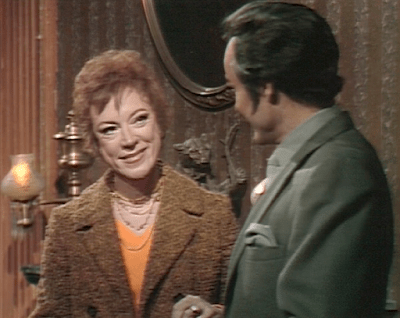
Now Barnabas has returned to 1969, brought back by a mysterious cult that has brainwashed him and adopted him as its leader. The characters he knew before he left are delighted to see him again. Today, matriarch Elizabeth Collins Stoddard comes to the Old House and is overjoyed that the haunting is over and that she and her family have been able to return to the great house. She is grateful to Barnabas for undertaking his harrowing journey back in time.

Liz and Barnabas talk about Chris Jennings, a young man in whom Liz’ daughter Carolyn is interested. Barnabas gives it as his firm opinion that Carolyn should avoid Chris, and he urges Liz to encourage her to do this. Barnabas knows that Chris is a werewolf, and we saw last week that the cult that has co-opted him has plans for Carolyn which do not include her death as one of Chris’ victims, so this will not surprise returning viewers.

Chris himself is another example of the weird metaphysics the show has stumbled upon. When Barnabas left 1969 for 1897, Chris was in his wolfish form all the time, apparently never to become human again. We learned during the 1897 segment that his lycanthropy is a curse inherited from his forebear, Quentin Collins. The version of 1897 we saw was changed sufficiently from the original that Quentin avoided his own death and was for a time relieved of the effects of the werewolf curse, though at the end of the segment it looked like they might be on their way back. That he is now human part of the time but still subject to transformation suggests that the difference in Quentin’s experiences in the later part of the 1897 stories had some effect on him. It’s unclear whether Chris’ condition fluctuated every time the date marked the 72nd anniversary of something happening to Quentin that hadn’t happened when he was living in a Barnabas-free zone, but it wouldn’t contradict anything we’ve seen if it did.

The Time to Come

Barnabas brought one object back with him from the past, a wooden box. The box must be opened only at a certain time, by certain people, for the cult’s plan to take effect. Today, Barnabas receives a visit from the people. They are Megan and Philip Todd, owners of the new antique shop in the village of Collinsport. Carolyn sent them, thinking that Barnabas would likely have some things they could add to their inventory. He sees that Megan is wearing a necklace with a symbol representing intertwined snakes, which Barnabas calls a “Naga.” When Megan is unable to explain just how she came into possession of the necklace, he shows them the box, which is topped with an oval in which the same symbol is carved. They are both thrilled at the prospect of buying the old furniture he has in the upstairs rooms of his house, but Megan is particularly fascinated by the box.

Later, Philip and Megan are back in their shop. They are confident they can buy a great deal of furniture from Barnabas, but are also sure that they wouldn’t be able to afford the box, even if he were willing to part from it. This is a bit odd- we get a good look at the box, and it is absolutely nothing special. The actors manage to sell the scene, but it would be better if they had either invested in a showier prop or been more sparing about putting it on camera.

Megan and Philip with the box. Screenshot by Dark Shadows Before I Die.

Barnabas comes to the shop and gives Megan and Philip the box as a present. After he goes, Megan is overwhelmed by an urge to open the box, which is locked. She is so consumed by this urge that she actually says “Let’s force it!” Since they had just minutes before been talking about it as if it were more expensive than anything they have for sale in their shop, this is a startling line. But when Philip opens the envelope Barnabas left to look at the list of furniture he is willing to sell them, he finds a key.

Philip is reluctant to open the box, having a strange feeling that if they do, nothing will ever be the same for them again. The other day it was Megan who had a strange feeling of impending doom. She wanted to sell the shop and flee Collinsport forever, lest they suffer an irretrievable disaster. That time it was Philip’s turn to urge her to set her misgivings aside. We’ve seen this kind of back and forth before. At the end of 1968, the great house of Collinwood was coming under the control of ghosts. Children Amy Jennings and David Collins kept trading the roles of possessed agent of the ghosts and unwilling sidekick. That alternation showed that the ghosts were not yet powerful enough to possess both children at once, and it faded as the haunting became more intense. It built suspense by suggesting that possible avenues of escape were gradually but inexorably closing.

As Philip and Megan begin to open the box, there is a whistling sound. They are unsettled, but decide they have to finish opening it anyway. They do, and we see their reaction to whatever is inside. Longtime viewers have seen similar reactions as cliffhangers many times; always before, they have indicated amazement that the container is empty.

New People

One of the less appealing villains of the 1897 segment was magically gifted artist/ surly criminal lowlife Charles Delaware Tate. Tate lived in a house that in the parts of Dark Shadows set in the 1960s was known as “the Evans Cottage,” home to drunken artist Sam Evans and his daughter Maggie, The Nicest Girl in Town. The cottage burned down in #883, leading us to wonder if it would still be there when the show returned to 1969.

Sam died last year, and Maggie now lives at Collinwood, where she is David and Amy’s governess. Today she goes to the cottage to prepare it for some tenants to whom she will be renting it. Evidently it must have been rebuilt before the Evanses moved in.

The only movable property in the cottage is a portrait of Maggie’s mother which her father painted. That portrait also appeared in the cottage a few times when Tate was living there; that was just carelessness on the part of the production staff, but it is kind of reassuring to see it again.

A man who has been in a couple of episodes knocks on the door. He identified himself as a friend of Sam’s and is saddened to hear of his death. He enters and asks Maggie to do him a favor. He keeps refusing to give her his name. We haven’t heard his name at all; evidently his identity is supposed to be a mystery to us. Word of that apparently did not reach the department responsible for making up the credits; they’ve been billing actor Dennis Patrick as Paul Stoddard, whom regular viewers know as the long-missing husband of matriarch Liz and father of Carolyn. They do that again today.

This is the last time we will see the Evans Cottage. In 1966 and 1967, the set was a symbol of the village of Collinsport, and scenes there showed the consequences that the doings of the rich people in the big house on the hill had for the working class who live in its shadow. By the time Maggie moved into Collinwood, they had long since given up on those kinds of stories. Dark Shadows is sometimes called “Star Trek for agoraphobes”; as we go, less and less of the action takes place anywhere other than Collinwood, and eventually they won’t even let us outside.

Liz agreed to let Barnabas live in the Old House in #218; by #223, she was talking about it, not only as his home, but as if he owned it and its contents. For while they went back and forth on the question of Barnabas’ legal status regarding the property, but when, at the suggestion of Liz’ daughter Carolyn, he gives the Todds a list of its furnishings that he is prepared to sell to them, I think we can take it for granted that Liz no longer has any claim on it.

Episode 829: Miss Moon Eyes

The dramatic date is 28 August 1897. On 23 July, in #803, sorcerer Count Petofi cast a spell on stuffy Edward Collins. Ever since, Edward has believed he was a valet recently separated from the service of the Earl of Hampshire. This led Edward’s brother, the rakish Quentin, to follow the Collinses’ long-established procedure for responding to mental illness and lock him up in the room on top of the tower in the great house of Collinwood.

In #816, broadcast on 11 August 1969 and therefore set on 11 August 1897, Petofi brought something even stranger on Edward’s twelve year old son Jamison. He called the spirit of Jamison’s grandson David to project itself from 1969 and to take possession of Jamison. In 1969, David is deathly ill because Quentin’s ghost had besieged him and everyone else at Collinwood. Now, Jamison too is dying, and in the moments he has been able to speak he has let the living Quentin in on the fact that he will eventually become a family-annihilating ghost.

Wicked witch Angelique has made a bargain with Quentin. She will try to restore Jamison and Edward to their usual selves, and if she succeeds Quentin will marry her. We see her beside Jamison, talking earnestly with him, praying loudly to “the Master of Darkness” to cure him and Edward so that she and Quentin can devote themselves to the service of that supernatural personage. In 1968, when the show was in contemporary dress, Angelique and others used a lot of euphemisms like “Master of Darkness,” but lately the ratings are high enough that the ABC network’s office of Standards and Practices has been letting them say the name “Satan.” I suppose Angelique’s persistence in the former phrasing shows that she’s still devoted to the old time religion.

Satan comes through, and Jamison and Edward are freed. This leads to a bit of awkwardness in each case. Quentin and Edward’s step-niece Charity Trask has lost her personality as the result of another of Petofi’s spells, and is now hosting that of the late Pansy Faye, Cockney showgirl and onetime fiancée of Quentin and Edward’s late brother Carl. Charity/ Pansy is exploring the great house when she comes to the locked door of the tower room. She hears Edward inside calling for help. He is still in his valet persona, and he is delighted with her when she promises to get a key and let him out. Edward returns to himself, with no memory of anything that has happened since 23 July, while Charity/ Pansy is away. When she comes back up and opens the door, she finds that he is in a foul mood and that he disapproves of her intensely. She is understandably miffed at his apparent fickleness and ingratitude.

For his part, Jamison’s quite different experience has left him with some memories. He tells Angelique of images that are floating around in his mind. She recognizes them as things associated with Petofi, and is distressed. She tells him he is better off not knowing what they are. Quentin is more distressed when Jamison looks at him and asks why he is trying to kill David Collins. Jamison can’t explain who David Collins is or how he learned that Quentin was trying to kill him, but this does confirm everything Quentin has gathered about his post-mortem destiny.

While Edward comforts Jamison in the study, Quentin and Angelique meet in the drawing room. She asks if he will honor his end of their deal; he says that he will, though he makes abundant protests about his reluctance to do so. Charity/ Pansy eavesdrops at the door. She has decided that she will marry Quentin, and is horrified to hear this conversation.

Edward enters and asks Angelique to excuse him and his brother. She exits, and Edward declares that the first order of business must be to hunt and destroy vampire Barnabas Collins. Quentin is appalled at this. He tries to tell Edward that Petofi is their most immediate threat; after he explains who Petofi is, Edward agrees that they will get around to fighting him at the appropriate time, but he insists that Barnabas is their main concern.

Edward exits, and Charity/ Pansy enters. She tells Quentin that she overheard his conversation with Angelique. She says that he will not marry Angelique. Quentin bitterly responds that he will, and that there is nothing she can do to stop it. At this, Charity/ Pansy picks up a knife and tries to stab Quentin. Quentin holds her at bay, and Edward enters in time to see what is happening and to get Charity/ Pansy off of Quentin. Quentin says that Charity/ Pansy’s condition is further evidence of the need to focus on fighting Petofi, but Edward will not swerve from his determination to concentrate on Barnabas. Moreover, he decides that he will now quiet Charity/ Pansy himself. He sends Quentin out of the room and prepares to give Charity/ Pansy a stern talking-to.

Charity/ Pansy’s attempt to prevent Quentin’s marriage to Angelique by stabbing him is of a piece with her attempt to break up Quentin’s relationship with maidservant Beth in #823/824 by poisoning Beth’s brandy. The original Pansy, whom we saw as a live person in #771, was not exactly nice. She was cold, hard, and cynical, trying to exploit the childlike Carl. But she didn’t seem to be bent towards physical violence. That appears to be Charity’s contribution to the composite being that the two of them now make up.

Before Edward can deliver whatever lecture he had planned to give Charity/ Pansy, she goes into a trance. The live Pansy had done a stage act as a “mentalist” and fortune teller, and was astonished in #771 when she tried to do her act at Collinwood and found herself actually channeling spirits from the great beyond. Now Charity/ Pansy routinely acts as a medium.

Charity/ Pansy announces that something terrible will happen on 10 September. Countdowns don’t usually work as a source of suspense on soaps. They might be all right in a play or a feature film, where we know that there will be a final curtain or a last frame after which the imaginary universe will cease to exist, but so long as the series is scheduled to come on every weekday at 4 PM, we know that there is always going to be room to move any deadline a little further out. Besides, since Dark Shadows was done virtually live to tape, they could rarely predict with any accuracy just how many ticks of the clock it would take to get all the movements made and dialogue spoken before the crisis is supposed to be reached. But “10 September” is in a slightly different category. Quentin explicitly says on screen that today is 28 August, which was indeed the original broadcast date in 1969. And when Edward says that his last memories are of 23 July, he is indeed referencing the original broadcast date of #803. So when Charity/ Pansy says “10 September,” she is committing the show to something in the real world. We may well sit up and take notice.

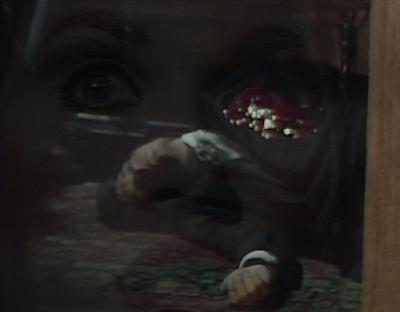
Charity/ Pansy has a vision of what will happen on that date. She sees Angelique looking at a portrait of Quentin in the drawing room. Red paint is dripping from the figure’s chest into a pool on the floor. That pool is next to a trail of other drops of red. In her mind’s eye, Charity/ Pansy follows the drops into the foyer, up the stairs, and into the tower. There, she sees Angelique opening the door to the tower room and finding Quentin sprawled, a sheet of red plastic, or perhaps construction paper, on his chest. Charity/ Pansy screams and runs out. From the dramatic music and Charity/ Pansy’s agitated reaction, I take it the object lying on Quentin’s chest is meant to suggest blood.

Through Charity/ Pansy’s eyes. Screenshot by Dark Shadows Before I Die.

The acting is all very strong today. I was fascinated with Nancy Barrett’s use of her face to highlight Charity/ Pansy’s makeup. She relaxes her jaw muscles slightly more than usual, causing the dark treatment around her eyes to stand out. That in turn creates a visual metaphor labeling Charity/ Pansy a “painted lady.”

My wife, Mrs Acilius, was particularly impressed with Louis Edmonds’ realization of Edward. When the spell breaks and he becomes himself again, Edward is alone in an empty room. He has no dialogue, no props, and no scene partner to work with. Yet he instantly conveys what has happened. Even first time viewers will understand that the obliging servant has now become a stuffy authority figure.

Edward’s towering indignation when Quentin first tells him he was the one who locked him in the tower room gives way instantly when Quentin explains that he was under a delusion at the time. Edmonds executes that transition so smoothly that first time viewers will not notice the oddness of it, but longtime fans who remember the many previous occasions when the Collinses locked each other there as a response to mental illness will chuckle.

One of the prominent features of Edward’s personality is his warm relationship with his children. This sets him apart from the first two characters Louis Edmonds played on the show, high-born ne’er-do-well Roger Collins and haughty overlord Joshua Collins. Edward’s dialogue in his scene alone with Jamison involves several discrete points of information, and it would have been understandable if the affection he displays for Jamison while he getting all of those words across had been either perfunctory or mawkish. But he and David Henesy get the emotions exactly right while also delivering the lines very clearly.

Edward’s preoccupation with Barnabas is a delicious little bit of commentary on the show itself. Dark Shadows‘ ratings, chronically low during its first 42 weeks on the air, perked up when it added Barnabas to the cast in April 1967. That summer, schoolkids curious to see a vampire on daytime TV made it into a hit, and not long after Barnabas became one of the pop culture sensations of the 1960s, instantly recognizable to many millions of people who never watched the show. To this day, people who have heard of Dark Shadows are likely to refer to it as “the vampire soap opera from the 60s.” It was Barnabas who took us with him to 1897, when he traveled back in time in the course of his attempt to rescue David from Quentin’s ghost, and for the first months of the 1897 storyline he was the only character who knew what was at stake for the 1969 version of the Collinses in the events going on around him.

But now Barnabas is on the fringes of the story, and Quentin, Angelique, and Petofi all know about 1969. Edward’s idea that the action has to focus on Barnabas is evidence that he hasn’t been watching the show. Petofi is the principal antagonist now, Quentin the chief protagonist, and Barnabas can be absent for weeks at a time while they and others find all sorts of things to do. This represents, not Barnabas’ failure, but his ultimate success. Before he was introduced, every story revolved around well-meaning governess Vicki, the main character. A soap opera can’t really have a main character. It needs to keep multiple storylines running at once, occasionally intersecting with each other, often running for long periods with little or no interaction. When one person had to be at the center of every development, the result was slow and claustrophobic.

Barnabas blew that confining structure open, because as a vampire his function in the story was not to solve problems, but to create problems for other people to solve. So no matter how much time they spent focusing on him, he always directed our attention towards everyone else. We wondered who would catch on to his secret, who would fall victim to his malign intentions, who would find a way to fight him, etc. When a mad scientist managed to free Barnabas of the effects of the vampire curse, he retained his function as a problem-maker, even when he set out to be a problem solver. Every time he announced that he had a plan, we looked forward to seeing how the rest of the cast would react to that plan’s rapid and catastrophic collapse.

Barnabas is as hapless in 1897 as he has been in every other time period, as witness the fact that he has been exposed as a vampire and driven into hiding. But he isn’t even the show’s Screw-Up-in-Chief now. That title belongs to broad ethnic stereotype Magda Rákóczi. In #807, Petofi compelled Magda to review the preceding 22 weeks of the show and admit that she had precipitated every plotline. The first of those was the release of Barnabas into the world of 1897, so that his crimes and misadventures are just a subcategory of hers. Since Magda is played by Grayson Hall, who in her original role of Julia Hoffman is waiting for us in 1969, we can be confident she won’t be coming back to contemporary dress with us, but for the moment she has relegated Barnabas to the status of a secondary character.

Episode 827: Magnificent, ain’t I?

Rroma chieftain/ New England crime boss King Johnny Romana and his Afro-Romani henchman Istvan have cornered broad ethnic stereotype Magda Rákóczi on top of the cliff at Widows’ Hill. King Johnny declares that he will now kill Magda. She is a major character, it’s a Tuesday, and this is the resolution of yesterday’s cliffhanger, so we have three reasons for expecting her to survive.

However, none of the three reasons is as strong as it might at first appear. First, while Magda precipitated every major storyline in the segment of Dark Shadows set in the year 1897, none of those stories needs any further action from her to continue right now. We’ve also had an indication that Grayson Hall’s original character, Julia Hoffman, will soon be returning to the cast. Second, Dark Shadows never followed the traditional soap opera format in which important developments were reserved for week-ending finales. Third, while the great majority of episode-ending cliffhangers fizzled out in the opening seconds of the next installment, occasionally they did go ahead and resolve one with a death. Besides, as my wife Mrs Acilius points out, Magda laid her husband Sandor’s ghost to rest at the top of the episode, and it is called Widows’ Hill because widows go there to die. So there actually is some suspense as to whether King Johnny will make good on his threat.

Time-traveling vampire Barnabas Collins shows up at the last moment and orders King Johnny to release Magda. King Johnny refuses and orders Istvan to throw Barnabas off the cliff. Barnabas looks into Istvan’s eyes, using his power of hypnosis. Once Istvan is under his control, Barnabas compels him to walk off the cliff. King Johnny then realizes who Barnabas is. He holds Barnabas at bay with a cross. Barnabas tells him that he can reclaim what Magda stole from him, but only if he lets her go. At that, King Johnny becomes cooperative. Too bad Barnabas didn’t open with that- Istvan could have lived. Fortunately for Barnabas and Magda, King Johnny forgets about Istvan instantly.

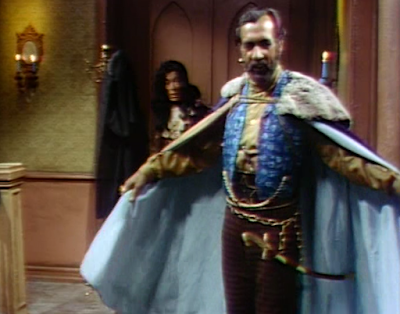
King Johnny shows off his hand-chopping clothes. Screenshot by Dark Shadows Before I Die.

For a hundred years, King Johnny’s tribe kept as its most prized possession The Hand of Count Petofi. This was literally a severed hand, cut from a Hungarian nobleman. Count Petofi was a sorcerer, and when nine Rroma men severed his right hand in a forest one night in 1797, most of his power went with it. Magda stole the Hand in hopes that she could use that power to undo a spell she herself had cast, but found that the Hand would not obey her. Now Count Petofi himself, 150 years of age, has reclaimed the Hand, and it is once more attached to his wrist. He is hugely powerful and a great problem for Barnabas.

Barnabas tells King Johnny what has happened. King Johnny turns out to be the one person in the world over whom Petofi has no power. In return for Petofi’s location, King Johnny agrees to return with the Hand and lift the curse Magda regrets. In his purple robe, King Johnny goes to Petofi’s hiding place. He and Petofi have a long and rather pointless conversation. Finally, Petofi is strapped to his chair and King Johnny raises his sacred scimitar, ready to re-sever the Hand.

This is a less suspenseful cliffhanger than yesterday’s. Petofi is still generating story; in fact, he is the only character who is. The hideout is Petofi’s territory; we have seen him thwarted there, but the defeats he suffered only confirmed that it is not a place where major changes take place in the direction of the narrative. And the meandering dialogue between Petofi and King Johnny deflates all the dramatic tension. Returning viewers have plenty of time to remember that, while Petofi’s magic may be useless against King Johnny, Petofi’s henchman Aristide is somewhere around, and he is quick with a knife. Without Istvan to run interference for him, King Johnny will be vulnerable to Aristide the whole time he’s dawdling around.

As King Johnny, Paul Michael has a very hard job. Not only is the character an egregious stereotype, but he really is scandalously ill-written. Violet Welles was far and away the best writer of dialogue on the show, and she manages to give a few glittering lines even to King Johnny. Still, he is ridiculous from beginning to end, a lot of menacing poses held together with a sinister laugh. That he is watchable at all is a tribute to Michael’s mastery of his craft. In his facial expressions and body language, we can see evidence of thought that is entirely absent from his words.

Episode 619: Advantages of being the master

Well-meaning governess Vicki has found a grievously injured Barnabas Collins in the woods. Barnabas insists Vicki not take him to a doctor or anyone else, but hide him somewhere no one will find him. She thinks of a secret door to the long-abandoned west wing of the great house of Collinwood, and uses that to take him to a hiding place there.

For the first year of Dark Shadows, the west wing was strongly associated with Vicki. In #14, she alone saw the locked door separating the bedrooms from the west wing open and close, apparently by itself. That was the first unequivocal evidence of supernatural activity on the show. In #84, Vicki’s charge, strange and troubled boy David, led her into the west wing, the first time we had seen its interior. He then trapped her in a room there, hoping she would die. She would languish in that room until David’s father, high-born ne’er-do-well Roger Collins, rescued her in #87. When Vicki was engaged to Roger’s nemesis Burke Devlin in #338, matriarch Liz offered to restore the west wing and let Vicki and Burke live there. After Burke died in a plane crash in #345, Vicki vowed to go on with the project of restoring the west wing. In #347, permanent houseguest Julia Hoffman, MD, exploited Vicki’s interest in the west wing to get her to stare into a crystal supposedly taken from a chandelier there until she is in a state of deep hypnosis.

More recently, Frankenstein’s monster Adam stayed in the west wing for many weeks as the guest of heiress Carolyn. Vicki’s connection with the wing was renewed when Adam abducted her and hid her there for a few days starting in #553. Today, Vicki hides Barnabas in Adam’s old room, re-establishing the west wing as her space. Thus we loop back to a theme that goes back to the third week of the show.

Later in the episode, Barnabas wakes up and is distressed to find that it is almost sunset. He pleads with Vicki to bring him a cross as quickly as possible. The audience knows, but Vicki does not, that Barnabas is the victim of vampire Angelique. Vicki’s ignorance of this point reminds us that she has been excluded from the show’s A-plots ever since #211, when Barnabas was introduced, himself in those days a vampire. Her calm departure to go fetch a cross reminds us that she knows this part of the house well. Every room in it is stuffed with bric-a-brac, undoubtedly she will have seen something nearby that is in the shape of a cross.

Meanwhile, Julia is in a hospital room, visiting local man Joe Haskell. Julia has become Barnabas’ inseparable friend, and Joe is Angelique’s other victim. She does not know that Angelique is the vampire, though she had surmised as much in #608. She questions Joe. At first he denies everything, but after she discloses that she was for a time the victim of yet another vampire he tells her that she must know why he can’t tell her who has been sucking his blood. She asks if the suave Nicholas Blair is hiding the vampire. Joe closes his eyes and scoffs at the idea. This reaction does nothing to curtail Julia’s suspicions of Nicholas.

Julia goes to Nicholas’ house. He genially escorts her into his living room. There, he takes a seat while she stalks about the room and tells him what she knows about him. Barnabas has a self-defeating habit of showing his cards to his adversaries, and longtime viewers may at first be afraid Julia has picked it up from him. Since Nicholas is a warlock who not only controls Angelique but has a wide range of magical powers that he uses to promote Satan’s interests on Earth, he is not an opponent with whom one can afford to make mistakes. Angelique herself was once a witch who, in #378, was able to turn a man into a cat at a moment’s notice. Nicholas’ command of the black arts goes far beyond Angelique’s. He was able to strip Angelique of her powers, raise her from the dead at least twice, and turn her into a vampire. Julia is simply a mad scientist, and she does not have any equipment with her. There’s no telling what Nicholas might do to Julia if their interview displeases him.

On his great blog Dark Shadows Every Day, Danny Horn lists three reasons why we know Julia will survive this confrontation without being turned into a toadstool:

Really, the thing that everybody wants to know is: why can’t the Stormtroopers shoot straight in Star Wars? It turns out there are three simple answers. #1. Stormtroopers shooting laser bolts are more interesting to look at than Stormtroopers who stand around complaining. #2. Shooting Luke Skywalker in the head halfway through the first movie is going to leave a rather obvious gap in the trilogy. #3. ‘Strong Guy Kills Weak Guy’ is not headline news.

Danny Horn, Dark Shadows Every Day, “Episode 619: The Gunslinger,” posted 4 April 2015

This is all very true- of course Nicholas and Julia will not leave each other alone indefinitely, of course the show cannot spare her, of course she will overcome her disadvantages and come away from their showdown with the upper hand. But it misses the point. Suspense comes when we know what must happen, but cannot see any way it might happen. What makes the scene work is the moment when Julia tells Nicholas that Barnabas is missing. That is news to him, and as Danny says elsewhere in his post, it is “the first sign of a crack that’s going to bring his entire operation crashing down,” as his shocked reaction suggests it might be.

Julia realizes she has won her showdown with Nicholas. Screenshot by Dark Shadows Before I Die.

The scene is one of the best in the series, though it is marred by a miscalculated ending. In the early part, we see Julia making an effort to keep her cool while Nicholas sits watching her smugly. She succeeds in keeping her brave face on until she senses that she has Nicholas off guard, at which point she moves in for the kill and tells him about Barnabas. She is then firmly in command. He composes himself and dismisses her.

That’s when it goes wrong. When Julia is heading out the door, Nicholas recovers his smugness and tells her that he must admit that he admires her for coming to see him. She looks alarmed and asks why. He replies, in a half-whisper, “You know.” She hastens out. I can see that this ending may have seemed like a good idea. We clearly saw in the beginning how hard it was for Julia to keep her fear in check and how easy it was for Nicholas to bask in the superiority his powers give him over a mere mortal. Though Julia has emerged as the winner in this engagement, she still has grounds for immense fear, and he for boundless self-confidence. But it is so broadly drawn as to be confusing. Has Nicholas already found a way to turn Julia’s success against her? Has she realized too late that she has made a mistake we aren’t aware of?

We learn shortly after that neither of these things has happened. Angelique comes upstairs. She sees Nicholas being very still. She makes several attempts to engage him in conversation. He finally approaches her and strikes her across the face. He then orders her to undo what she has done to Barnabas before it ruins his plans.

This is the second time Nicholas has slapped a woman in the face. The first time was in #610, when he struck Frankenstein’s monster Eve. Humbert Allen Astredo and Marie Wallace executed that business well, as he and Lara Parker execute it well today. For that matter, Grayson Hall and Lara Parker had done a good job when Julia slapped Angelique in the face in #535. Watching them, you can admire trained professionals practicing a specialized aspect of their craft. But since Nicholas has such vast powers, he is persuasive as a villain only when we are left guessing about just what he is up to. When we see him is reduced to hitting a woman, he shrinks from avatar of Satan to cheap pimp.

After Julia leaves Nicholas’ house, she lingers in the woods outside, watching his front door. She sees Nicholas leave the house, then sees Angelique and realizes that she is the vampire.

Julia is the most intelligent character on the show, and while we watch her in the woods her face suggests that she is thinking clever thoughts. Unfortunately, we hear her interior monologue in a recorded voiceover, and her lines are remarkably obtuse. On the heels of her overdone fear on the way out of Nicholas’ house, it does as much to undercut Julia’s image as a smart person who can win a duel with the Devil as Nicholas’ physical abuse of Angelique undercuts his image as a demonic sorcerer.

Episode 463: Comfort me

We open in the old cemetery north of town, where well-meaning governess Vicki and matriarch Liz are looking for the grave of Vicki’s old boyfriend Peter. Vicki last saw Peter this past Friday, which was over 170 years ago. That discrepancy was the result of some time travel she did in between. Vicki met Peter while spending nineteen weeks in the late eighteenth century. She came back home on Monday. By the end of her visit to the past, Vicki and Peter were both scheduled to be hanged for their many crimes. Vicki was whisked back to 1968 at the last possible instant, escaping by such a narrow margin that she had rope burns on her neck.

Vicki and Liz find Peter’s grave marker. Liz remarks that his date of death is the same as today’s date- 3 April. This sets Vicki off. She says that the hangings took place at dusk, that it’s dusk now, and that Peter is therefore being hanged even as they speak. Liz declares that this is gibberish. The date on the stone is 3 April 1795, and today’s date is 3 April 1968. Vicki tries to explain that everything that ever happened is happening over and again someplace. Yesterday, Liz heard similarly opaque verbiage from her distant cousin Barnabas. She didn’t buy this line when Barnabas was pitching it, and she isn’t any more impressed when she hears it from Vicki.

Longtime viewers of Dark Shadows are likely to make a connection. From December 1966 to March 1967, Vicki led the battle against the show’s first supernatural menace, undead fire witch Laura Murdoch Collins. When she saw the dates on which Laura’s previous incarnations immolated themselves along with their young sons, Vicki realized that she acted at intervals of exactly one hundred years. Laura was an embodiment of the cyclical nature of time; fighting her, Vicki is trying to break the cycle of death and rebirth, like a comely young Buddha.

I don’t think the show is making a serious metaphysical point by developing this theme. When you’re telling a story about a place where the usual laws of nature don’t apply, you need to substitute some other set of rules the audience can understand in order to create suspense. The power of anniversaries will do as well as anything else.

Back in the great house of Collinwood, we see Liz’ daughter Carolyn come in the front door wearing riding clothes and carrying a crop. This is the first indication that the Collinses have horses. In the early months of Dark Shadows, the family was running out of money, the estate was decrepit and mortgaged to the hilt, and they were barely holding onto control of their business. The stories those circumstances generated never went anywhere, and they’ve gradually been retconning the Collinses to be richer and richer. If they’re up to horse ownership now, by next year they might have a luxury yacht and a private jet.

The drawing room doors open, and lawyer Tony Peterson emerges. He quarrels with Carolyn about their last encounter. That was two weeks ago in story time, but we saw it before Vicki left for the past in November. It’s an even deeper dive for us than that makes it sound, because our view of Tony has changed profoundly in the interim. He was first introduced as an example of Jerry Lacy’s famous Humphrey Bogart imitation, and he still is that. But in the 1790s segment, Mr Lacy played the Rev’d Mr Trask, the fanatical witchfinder who hounded Vicki to her death and occasioned many other disasters. By now, we have come to see most of the 1960s characters as the (not necessarily dark) shadows cast by their eighteenth century counterparts. When Tony shows up today we find ourselves trying to figure out what it is about Collinsport in the twentieth century that could turn a holy terror like Trask into a basically nice guy like Tony.

Carolyn browbeats Tony into coming back at 8 pm to take her to dinner. He leaves, and Carolyn’s distant cousin, Barnabas the vampire, enters. Barnabas asks Carolyn if she’s noticed a change in Vicki. She has no idea what he’s talking about. He asks if she’s “more like you.” Thus first-time viewers learn that Carolyn is under Barnabas’ power. Returning viewers learn something, too. Yesterday’s episode ended with Barnabas about to bite Vicki, but cut to the closing credits before he sank his teeth into her. We’ve seen that before. Now we know that he has finally gone through with it.

In the opening scenes, Vicki showed absolutely no sign that anything had happened to her; Carolyn hasn’t noticed any change in her either. Soon, Vicki and Liz come home, and Vicki doesn’t react to Barnabas any differently than she had before he bit her. The people Barnabas has bitten have shown a wide variety of effects afterward. Perhaps Vicki will be the first victim who just can’t be bothered.

Vicki has a painting with her that she bought in town after she and Liz visited Peter’s grave. It turns out to be a portrait of Angelique, the wicked witch whose curse made Barnabas a vampire in the 1790s. That portrait first appeared in #449, a sign to the characters that Angelique’s evil spirit was still at work and to the audience that actress Lara Parker would be back on the show after the costume drama insert ended. Barnabas is upset to see this token of his old nemesis, and leaves the house. Vicki does not consciously remember the events she saw during her visit to the past, but when she sees Barnabas go she tells Liz that it makes sense that he would not like the picture.

Barnabas freaks out. Screenshot by Dark Shadows Before I Die.

Tony returns and spends a few moments twitting Carolyn for her glamorous attire, describing the homely pastimes in which a working class boy like himself whiles away his idle moments. This prompts her to tease him back. Viewers who remember Tony and Carolyn’s previous interactions will recognize this as their style of flirtatious banter. They agree to go to dinner.

Before Tony and Carolyn can leave, we cut to Barnabas, standing in the window of his own house and staring at the great house. He calls to Carolyn, summoning her to come to him immediately. We cut back to the great house, and see Carolyn’s face go blank while Tony is still talking. She excuses herself, telling him she will meet him later. He is outraged, and vows he will not wait for her.

In Barnabas’ house, Carolyn tells Barnabas she objects to his summons. Irritated by this, he starts talking about Vicki. He says that he couldn’t understand why biting her did not bring her under his power, but that seeing the portrait explained it to him. The witch is interfering with his efforts. Carolyn laughs at the idea of a witch. This is a bit odd. Carolyn has lived her whole life up to this point in a haunted house and is having a conversation with a vampire. It wouldn’t seem to be a stretch for her to believe in witches.

Barnabas has a bad habit of leaving his front window uncovered. Many times, we have seen people peer into that window and discover Barnabas’ secrets. Now, Tony sees Barnabas bite Carolyn’s neck.

No cousinly kiss. Screenshot by Dark Shadows Before I Die.

Carolyn goes home to the great house and finds Tony in the foyer. She is delighted at the idea that he is waiting to go on their date, but such is not the case. He is there to berate her for her perverse relationship with her cousin Barnabas and to storm out.

In this, we see the first point of similarity between Tony and Trask. Trask was right that there was a witch at Collinwood and right that the witch was the source of all the troubles afflicting the Collinses. But he was wrong about her identity, and wrong about the means to combat her. Likewise, Tony is right that Carolyn and Barnabas are manipulating him, and is right that their relationship is unwholesome. But he has no understanding of their goals, and his belief that their relationship is sexual is quite mistaken.

Carolyn’s protest that Barnabas is merely her cousin, like Tony’s indignant implication that their family relationship makes what they are doing incest, is rather strained. In the cemetery, Liz mentioned that Daniel Collins was her great-great grandfather, which would make Daniel’s sister Millicent Carolyn’s great-great-great-great aunt. When Millicent and Daniel were introduced during the 1790s segment, Barnabas’ father Joshua identified them as his second cousins. That was a distant enough relative that Joshua considered Millicent a potential marriage partner for either Joshua’s brother Jeremiah or for Barnabas himself. Since Barnabas and Carolyn are second cousins five times removed, nothing going on between them could very well be called incestuous.

Later, Barnabas goes to the drawing room in the great house and looks at the portrait of Angelique. To his surprise, Carolyn is waiting for him. She tells him that she doesn’t want to be his blood thrall anymore. She declares that he loves Vicki and that she has her own life to live. He is too busy to discuss the matter with her, and she leaves.

Barnabas cuts the portrait out of the frame, and throws it into the fireplace. He gives a little speech about how this is the only way Angelique can be destroyed. He turns from the fire, and sees that the portrait has regenerated. Angelique’s laughter sounds in the air, and Barnabas realizes that she is present.

This is not the first time a portrait of an undead blonde witch has been thrown into the fire in the drawing room, prompting a woman’s disembodied voice to make itself heard. In #149, Laura’s estranged husband, Roger Collins, threw into it a painting featuring her with their son, strange and troubled boy David. When that painting burned, we heard a scream coming from no one we could see. Whether the screamer was Laura or benevolent ghost Josette was never explained. What was clear was that burning the painting accomplished none of the goals Roger may have had in mind, as Barnabas’ incineration of this painting serves none of his purposes.

Episode 444: What if she doesn’t?

This one made us think about the nature of suspense. Yesterday, naval officer/ sleazy operator Nathan Forbes schemed with his henchman, the unsightly Noah Gifford, to trick fluttery heiress Millicent Collins into thinking that her second cousin Barnabas was trying to kill her.

Today, we see that plan unfold just as Nathan had hoped it would. Millicent goes to the gazebo on the estate of Collinwood, having received a message asking her to go there. The message appeared to be from Barnabas, but was actually from Nathan. Noah, wearing a Zorro costume and carrying Barnabas’ highly recognizable cane, springs out of the bushes. He attacks Millicent with the cane, then Nathan appears. The men pretend to fight, Noah pretends to lose, and he runs off into the night. Millicent thanks Nathan profusely and wonders why Barnabas would want to hurt her.

Noah really should wear that mask all the time, he has the face for it.

Millicent and Nathan are so interesting to watch together that we can’t stop ourselves hoping Nathan’s scheme works. On the other hand, we know that Nathan is only after Millicent’s money, and that if she marries him he will make her and the rest of the Collinses miserable. So when Barnabas’ mother Naomi shows up and asks Nathan what he was doing on the grounds of the estate of Collinwood, our hope for more Millicent/ Nathan scenes competes with a hope that Naomi will follow up Nathan’s answers with questions that will expose his plot. It would be easy enough to do- he says he was hoping to see Millicent, but how could he know she would be at the gazebo? And how could he have failed to see the assailant, considering that they arrived there at virtually the same moment?

Naomi and her husband Joshua have been telling everyone that Barnabas left for England several weeks ago. Nathan and Millicent both know this is false, because both have seen him since. Nathan has figured out that Barnabas is the serial killer preying on the women of Collinsport, and is apparently planning to use this information to blackmail Joshua. At the moment the Collinses are not afraid of being blackmailed with information about anything Barnabas has done lately. They spread the story about England because Barnabas had died. They thought he died from the plague, and Joshua feared that if that became known the men would not report to work at the family’s shipyard.

What neither Nathan nor any of the Collinses know is that Barnabas has become a vampire. Naomi is depressed that her son has died and that she cannot talk freely about his death with anyone. She is miserable when Millicent keeps claiming it was Barnabas who attacked her, and tries desperately to stop her from talking about him at all. Naomi and Millicent are both good-hearted people, of the sort we would like to see come to happy endings. They also make the most of the dramatic values in this situation. Again, we find ourselves in suspense generated by our conflicting desires. We have a rooting interest in the characters’ well-being, but we want to see a lively story, and the tragedy in which they are locked is providing that. So we can see any number of possible developments that would disappoint us, either by hurting characters we like or by short-circuiting a plot we are enjoying.

A very pure example of suspense comes in a scene between Nathan and Noah in Nathan’s room at a local inn. Noah refuses to leave until Nathan pays the money he owes him; Nathan says he has no money and that he isn’t likely to get any unless Noah leaves at once, since Millicent is on her way and will get suspicious if she sees him there. Noah doesn’t understand this, and Nathan has to keep repeating the point. When Millicent knocks on the door, Noah finally agrees to hide. On his way to let Millicent in, Nathan realizes Barnabas’ cane is in plain view in the middle of the room, and hides it under his bed.

The only danger in this scene is that the Nathan/ Millicent story will end abruptly, but we are sufficiently invested in watching that story play out that our irritation at Noah’s stupidity is combined with suspense as we fear that he will ruin the scheme. Nathan’s success with Noah and his last-second concealment of the cane come as a relief. Again, the suspense is entirely contained within our role as the audience, and is not a product of any concern we have for the characters or anything they represent to us.