Episode 880: I like all of my stories to have endings

Collinwood: Judith, Trask, Beth, Quentin

In November 1897, wronged woman Judith Collins Trask has had her husband, the odious Gregory Trask, bricked up in her brother Quentin’s bedroom. While Gregory is taking this in, the ghost of another wronged woman appears to him. She is Quentin’s ex-fiancée Beth Chavez. Beth is looking for Quentin. Trask is initially frightened, but then urges Beth to go to Quentin and tell him to come up to the room.

Quentin is in the drawing room, and Beth does appear to him. She says that she cannot rest in peace until she has given him a message. We wonder if she is about to tell him about Trask, but no such thing. Instead, she tells Quentin she forgives him. Then she vanishes, and he shouts that he can’t forgive himself.

We first saw Beth and Quentin at the same time, when their ghosts appeared to children David Collins and Amy Jennings in Quentin’s room in #646. That was broadcast and set in December 1968. Since the show went to 1897 in March, the living beings Quentin and Beth have attracted very different responses from the audience. Quentin has become a huge breakout star, while Beth has faded into the background. She died Monday; this is her first return as a ghost, and her final appearance overall. It rounds things off nicely that her departure begins in the room where we first saw her.

Quentin’s skeleton had been in the room in late 1968. David and Amy removed it and buried it on the grounds. Now history has been changed. Trask’s skeleton may take its place when the show returns to contemporary dress, behind a brick wall there that wasn’t there before. In #839, we saw that while the changes in 1897 have brought peace to the ghosts of Quentin and Beth in 1969, the characters in that year still remember the haunting. So you’d expect the wall to be a puzzle to them, and if they tear it down the skeleton will be as well.

Judith enters and tells Quentin that he can’t go to his room, or to any other room in the west wing of the house. She explains that it cost a fortune to keep that wing open, so she has had it sealed off. She has moved all of his things to a bedroom in the main part of the house. Quentin asks Judith where Trask is; she claims he ran out in pursuit of two violent men who forced their way into the house and hasn’t been seen since, and asserts that she is terribly worried about him. She sounds sincere, but Quentin isn’t fooled. He smiles and asks if he is right to believe that Trask’s story is ended. Judith says that it isn’t, not quite.

Collinwood is supposed to be an immense house, literally. After the first year of Dark Shadows, when a story about the Collinses running out of money was complemented with some specifics about the size of the place,* they have been making it out to be unknowably large. So it seemed inexplicable yesterday that Judith would choose Quentin’s room as Trask’s place of immurement. We learn what her plans were today. There is a telephone in the room; that telephone had been important during the Haunting of Collinwood story. Evidently Judith has rigged it to receive incoming calls only. It rings, and Trask can hear her taunting him. He cannot call out to summon help.

In the first 55 weeks of Dark Shadows, Joan Bennett’s character Elizabeth Collins Stoddard was a recluse who hadn’t left Collinwood in 18 years, believing that she had killed her lousy husband and that his body was buried in a locked room in the basement. It turned out that she hadn’t killed him at all, and the whole recluse theme, and the blackmail plot that it led to, were just one big dead end. As Judith, Bennett is making up for Liz’ lost time.

Outside: Petofi, Aristide, Garth Blackwood, the Widow Romana**

Sorcerer Count Petofi has tired of his unreliable servant, a bungling sadist named Aristide. He has conjured up the ghost of the man Aristide most fears, a jailer named Garth Blackwood whom Aristide killed while escaping from Dartmoor Prison. Blackwood is now hunting Aristide. Blackwood and Aristide were the two violent men who surprised Judith in her bedroom, though Trask never went in pursuit of them.

Aristide ducks into an abandoned mill on the old North Road where he and Petofi had squatted. He hears someone hiding in the back room. A woman jumps out with a knife. Aristide disarms her. He realizes she is the widow of King Johnny Romana, a Rroma chieftain/ organized crime boss whom he killed in #827. Rather than killing her with her own knife, Aristide offers to betray Petofi to the Widow Romana if she will let him join her tribe. He gives her directions to Petofi’s current location. On her way there, she crosses paths with Blackwood, who kills her. Blackwood then makes his way to the mill, where we see him grabbing Aristide.

Aristide draws a map for the Widow. Screenshot by Dark Shadows Before I Die.

When King Johnny died, we learned that in a few days another Rroma somewhere would inherit his immunity to Petofi’s spells and his mission to kill him. That was eleven weeks ago, and we’ve been waiting. The Widow Romana’s appearance today is a gesture towards tying up that loose end.

*In #2, Liz tells well-meaning governess Vicki that there are a total of 40 rooms, most of them in the closed-off parts of the house; in #87, the opening voiceover says that there are 80 rooms.

**Her name is given in the credits as “The Widow Romano,” but “Romana,” which we had heard as King Johnny’s surname in earlier episodes, is a likelier Romany name.
Episode 879: A room of one’s own

The odious Gregory Trask is plotting to murder his fabulously wealthy wife, the former Judith Collins, before she can change her will. He has made an arrangement with Aristide, a sadist who is fleeing a demon his former master conjured up from the depths of Hell to stalk him. He promises to lay the demon to rest once Aristide has murdered Judith.

For her part, Judith has made an arrangement of her own with a man named Tim Shaw. Tim is not appreciably more scrupulous than Aristide, and he hates Trask with a passion. He is also free of the time constraints that the stalking demon imposes on Aristide.

Judith goes upstairs to her bedroom, where Aristide is lurking behind the curtains. The scene looks rather like that in the 1954 film Dial M for Murder, in which a man hides behind curtains while waiting to murder a woman whose husband is blackmailing him into the crime. It is likely that Dial M for Murder was on the minds of the makers of Dark Shadows at this time, since star Jonathan Frid had just missed four and a half weeks while playing the lead in a stage production of it in the Chicago area.

In Dial M for Murder, the wife survives the attempt, killing the would-be assassin. Judith also survives, but not through her own action. Instead, the demon, whose name is Garth Blackwood, bursts into the room. Aristide escapes through the window. Trask enters and finds Blackwood still in the room. Blackwood menaces him with a heavy chain he carries, then leaves in pursuit of Aristide.

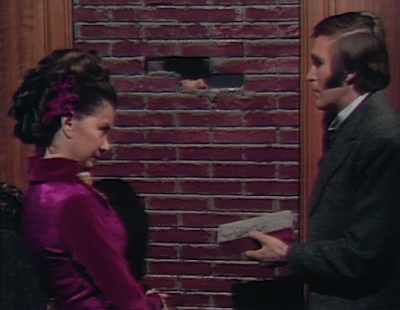
Judith persuades Trask to join her in a glass of brandy. He takes a sip, she does not. He passes out, and Tim enters. When Trask awakens, he finds himself in a room in the west wing of the house. Tim is with him in the room. Tim tells Trask goodbye, then springs out the door and locks it behind him. When Trask opens the door shortly after, he finds that Tim and Judith are bricking him in.

So long, Gregory. Screenshot by Dark Shadows Before I Die.

It’s rather much to ask us to believe that the mortar dries instantly, leaving Trask unable to push the wall down. To be bricked up in Collinwood is the fate of all Trasks- Gregory’s ancestor, the original Reverend Trask, was bricked up in an alcove in the basement of the Old House on the estate in #442 by the vengeful Barnabas Collins. Barnabas chained that Trask up, giving the mortar time to set. Moreover, Barnabas chose a dark little out-of-the-way spot in a vacant house. This is in a bedroom suite that Judith’s brother Quentin uses. Most of Quentin’s stuff is out of the room, but there is still some furniture in there and a bunch of candles. You have to wonder what she will tell Quentin when he comes home. For some time they’ve been going on about how vast the great house is, at one point saying that no one had ever counted the number of rooms in it, so it is just bizarre that Judith picked a room that someone is on his way to sleep in.

Episode 512: A jury of the dead!

For nineteen weeks from November 1967 to March 1968, Dark Shadows was a costume drama set in the late eighteenth century. Among the more interesting characters introduced in that period were fanatical witchfinder the Rev’d Mr Trask; roguish naval officer Nathan Forbes; fast-talking con artist Suki Forbes; and streetwalkers Ruby Tate and Maude Browning. All five of these characters were murdered by vampire Barnabas Collins, and all five of them are among those who return today for an impromptu trial of Barnabas.

Barnabas killed Trask by luring him to his basement and bricking him up in an alcove, as Montresor did to Fortunato in Edgar Allan Poe’s 1846 story “The Cask of Amontillado.” Some other characters invited themselves to the basement yesterday and held a séance there. As a result of the séance, the bricks fell away and Trask came back to life. Now, Trask has confined Barnabas to the same alcove. He declares that he will give him a trial before he bricks him up.

In the eighteenth century, Trask was the prosecutor in the trial of time traveling governess Vicki Winters. Victoria was convicted of witchcraft and sentenced to death. Vicki’s trip from the 1960s to the 1790s inverted Barnabas’ displacement in time; as Vicki’s witchcraft trial was so chaotic it did not seem to follow rules of any kind, neither does the murder trial Trask improvises for Barnabas fit any conceivable model of procedure. Vicki’s trial stretched over two weeks, from #427 to #437; Barnabas’ begins and ends today, during the second half of the episode.

Trask conjures up Nathan, Suki, Ruby, Maude, and Barnabas’ first homicide victim, his uncle Jeremiah, to serve as a jury; he conjures up a man named Ezra Simpson, of whom we have never previously heard, to act as judge. Trask is the prosecutor, and Nathan is his sole witness. This court of “the damned!,” as Trask calls them, recalls the rogues who confront Jabez Stone as jurors and judge in Stephen Vincent Benét’s 1936 story “The Devil and Daniel Webster.” Unlike Jabez Stone, however, Barnabas does not have a right to counsel.

Court is in session. Screenshot by Dark Shadows Before I Die.

Trask asks Nathan how he died. After Nathan says that Barnabas strangled him, Trask asks him how Suki died. Barnabas objects that Nathan shouldn’t be allowed to speak for others; regular viewers sympathize with this, since Suki, played today as she was originally by Jane Draper, was sensational every second she was on screen, and when we saw Miss Draper again we were happy to think that she would have another chance to show what she could do. Barnabas also shouts at one point that he is innocent; this is less likely to attract the audience’s sympathy. Mrs Acilius and I certainly got a good laugh from it.

Barnabas asks to be allowed to present a defense. Trask invites him to question Nathan. He is about to do so when Nathan smiles at him, turns around, and vanishes. Trask explains that Nathan has already said all that needs to be said. Later, Trask looks at the recompleted wall and laughs with vicious glee, delighted at what is behind it.

Barnabas has neither the powers nor the limitations of a vampire now. The effects of the curse went into remission when mad scientists Eric Lang and Julia Hoffman created a man from parts scavenged from the cemetery and connected Barnabas to him as they electrified him and brought him to life. Barnabas named this man Adam.

Now Adam has escaped from the horribly abusive home Barnabas and Julia provided for him. He has found a friend in Sam Evans, an artist who was blinded when Barnabas enlisted him in one of his hare-brained schemes. Sam is teaching Adam to speak, and is so impressed with his ability to learn that he wonders aloud if he will be able to teach him to paint professionally.

Adam develops a sudden pain in his wrists. He moans “Barnabas! Hurt!” A shot of Barnabas hanging by his wrists in the basement alcove is laid over a closeup of Adam. Evidently the bond between them is such that Adam can sense Barnabas’ pain, even though they are miles apart. Apparently it is mid-1840s day on Dark Shadows; the scene in Barnabas’ house recalls “The Cask of Amontillado,” and the scene at Sam’s house is based on Alexandre Dumas’ 1846 novella The Corsican Brothers. “The Devil and Daniel Webster” was set in that decade or a bit earlier, and while Frankenstein was written in 1818 many adaptations of it, including the one Dark Shadows creator Dan Curtis would make in 1973, are set in the 1840s.

Adam becomes agitated. He cannot explain what is happening to him, no matter how patiently Sam asks. Sam’s son-in-law-to-be Joe Haskell comes in; Adam brushes against Joe as he runs out the door. Though Joe is a tall and sturdy man, Adam is so tremendously strong that this casual contact sends him flying.

It dawns on Joe that Adam is the man who abducted heiress Carolyn Collins Stoddard and then fell from the cliff on Widows’ Hill. Sam calmly replies that he had already figured that out. Joe is shocked that Sam hasn’t called the police; Sam replies that Adam is as disabled as he is, and that he means no one any harm. Joe is not at all convinced of the second of these points, and worries that “Barnabas! Hurt!” might not have reflected a fear that Barnabas is hurt, as Sam thinks it does, but might rather express Adam’s resolution to hurt Barnabas. Joel Crothers and David Ford bring out the full comic value of this scene; Mrs Acilius laughed at the blandness with which Ford’s Sam confirms that he knows who Adam is.

Joe goes to Barnabas’ house to warn him, but finds it locked and apparently empty. Later, Julia goes there too. She has a key, and lets herself in. She doesn’t see any evidence that Barnabas is or has been home; she goes downstairs, and is mystified to see that the alcove wall, which was broken when she was there for the séance, is now bricked up again.

Several times, Dark Shadows has contrasted Barnabas’ home, the Old House on the great estate of Collinwood, with the Evans cottage, a working class residence in the village of Collinsport. Today they draw this contrast in sharp relief. The basement of the Old House is always dark, but even the upstairs is lit by candles today; the scenes in the Evans cottage, taking place at the same time, are sunlit. The basement is the most haunted part of the most haunted house on the haunted estate, and eight characters in costume dress materialize from thin air there; the Evans cottage is a part of the modern world where Sam and Joe can use reason to arrive at agreement about facts, even if they make different judgments about the significance of those facts. When Julia and Joe go to the Old House, each wanders about alone, finding no one to talk to; at the Evans cottage, even Adam is able to have a conversation, and while there he can receive a message from Barnabas by some mysterious means. Trask seizes control of the basement of the Old House to make a parody of the criminal justice system and enact his vengeance on Barnabas; in the Evans cottage, Sam refuses to call the sheriff because he wants to shield Adam from punishment for the crimes he inadvertently committed.

Episode 511: It’s not fair to come into someone’s house

In the first months of Dark Shadows, the audience’s point of view was represented by well-meaning governess Vicki, who needed to have explained to her everything we might want to know and who reacted to all the strange goings-on with the mixture of disquiet and curiosity that the makers of the show hope we will feel.

Vicki has long since been replaced as our representative by mad scientist Julia. We no longer want characters to tell us what has been going on, nor are we making up our minds about our moral evaluation of the events in the stories. We find ourselves in the middle of a whole clutch of fast-moving plots, trying to keep up with them all and hoping that nothing will stop the thrills. Julia’s loyalty to her best friend, sometime vampire Barnabas, and her supremely well-developed capacity for lying put her in the same position, and her vestigial conscience is no obstacle to any juicy storyline.

When Vicki was our on-screen counterpart, her charge, strange and troubled boy David, was the show’s most powerful chaos agent. David precipitated a series of crises that seemed likely to expose the secrets of the ancient and esteemed Collins family, to kill one or more of the major characters, or both. In #70, David led Vicki to his favorite playground, the long-vacant Old House on the estate of Collinwood. David would keep sneaking into the Old House even after Barnabas took up residence there in #218.

Today, David again lets himself into the Old House. He is caught there by Julia and a man he has not seen before. Julia is stern with him for entering the house without Barnabas’ permission; he defends his presence there, reminding Julia that she promised him he could play with the tape recorder on Barnabas’ desk. He asks who the man is.

The man introduces himself to David as “Timothy Eliot Stokes.” This is the first time time we have heard his middle name. Soon, the show will phase “Timothy” out, and his friends will address Stokes as “Eliot.” I suppose that’s because he’s a professor, and “Eliot” suggests Harvard.

Stokes introduces himself to David.

In 1966, Thayer David played crazed groundskeeper Matthew. Suspected of murder, Matthew hid out in the Old House and kept Vicki prisoner there until some ghosts scared him to death in #126. David didn’t believe Matthew was a killer and didn’t know he was holding Vicki, so when he stumbled upon him in the Old House he brought him food and cigarettes. Even after he found Vicki bound and gagged behind a hidden panel, he kept Matthew’s secret. When David meets another character played by the same actor on the same set, longtime viewers can see that Stokes is as genteel and urbane as Matthew was rough-hewn and paranoid. For her part, Julia recalls Vicki when she scolds David for sneaking into the Old House, but where Vicki was doing her job as David’s governess and trying to enforce the rules of the household as a governess might, Julia is scrambling to keep David from finding out about her own secret activities.

Julia tells David to take the tape recorder and go home to the great house on the estate. As he makes his way to the front door, Stokes takes Julia aside and tells her that it will not be well if it is known in the great house that David has seen him. Julia hurries to David and tells him to keep quiet about the fact that he has seen Stokes. She says that she hates to ask him to lie; at this, I mimicked Julia and said “I know you share my devotion to the truth,” prompting Mrs Acilius to laugh out loud. Later, Julia will go to the great house, where she lives as a permanent guest, and David will cheerfully assure her that he kept her secret. The two of them seem quite relaxed together, leading us to believe that he will continue to do so.

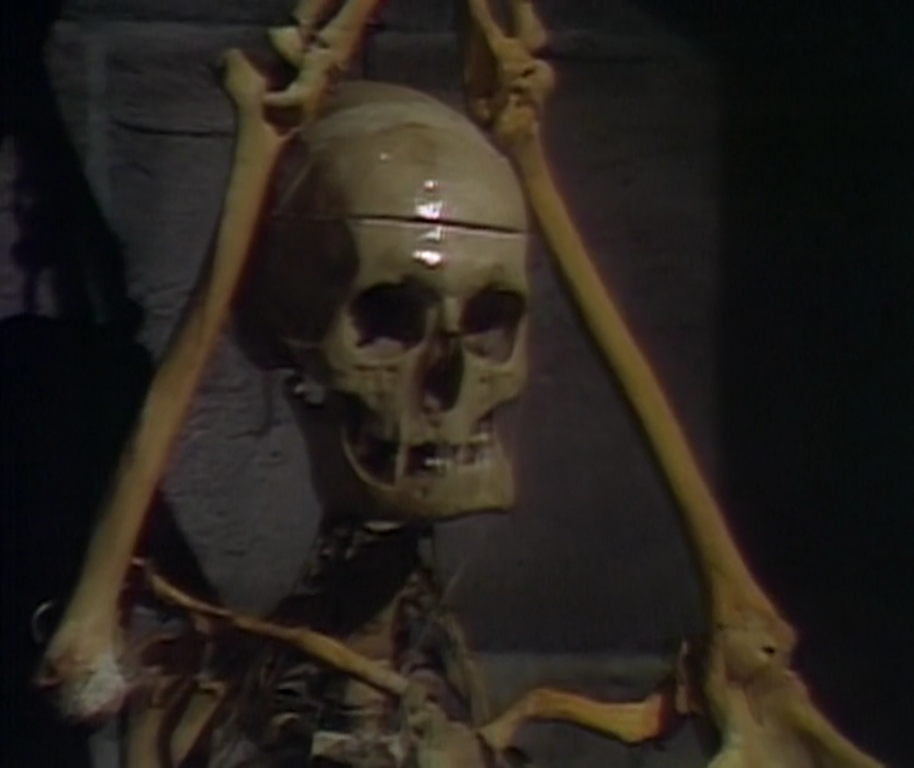
There is a bit of irony in Julia’s harshness with David for entering Barnabas’ house without his permission. She and Stokes didn’t have Barnabas’ permission to be there, either. Indeed, if he had known what they were up to he would likely have objected most strenuously. Along with a man named Tony, they held a séance in the part of the basement where Barnabas kept his coffin when he was under the full effect of the vampire curse. They were trying to contact the Rev’d Mr Trask, a Puritan divine whom Barnabas bricked up to die in the eighteenth century. The séance was so successful that the bricks crumbled, exposing Trask’s bones, still held together somehow in the shape of a skeleton hanging from the ceiling. At the end of the episode, Trask has resumed his corporeal form and set about taking revenge on Barnabas by walling him up in the same spot.

Odd that Trask’s skeleton holds together after all the ligaments and tendons have rotted away, odder that there is a straight cleavage separating the top of the skull from the rest, oddest of all that the section is attached to the rest of the skull by a piece of Scotch tape.

Episode 442: For the love of God, Montresor!

When vampire Barnabas Collins rose from his grave to prey upon the living in April 1967, he was a bleak, frightening presence. As the show went on, we saw him spend a great deal of time ruminating on murders he might like to commit, but he had few opportunities to act on those thoughts. By November, when well-meaning governess Vicki came unstuck in time and wound up in the year 1795, Barnabas had killed only two people, only one of them with premeditation. Both of those victims, seagoing con man Jason McGuire and addled quack Dave Woodard, had long since lost their relevance to the plot, and neither has been mentioned more than a few times since his death. As a result, Barnabas’ talk of killing comes to seem like nothing more than a series of hostile fantasies.

Soon, Dark Shadows will have to return to a contemporary setting. It was the frightening impression Barnabas created in his first weeks that made Dark Shadows a hit, and to keep it going the show will have to make him seem dangerous again. In the fifteen and a half weeks they have been in the 1790s, he has killed at least six people, including his uncle, his aunt, his wife, two streetwalkers, and a woman named Suki. That’s an adequate rate of murders to reestablish Barnabas as a fiend, but volume will only get you so far. They need to give us some shocking images of cruelty, preferably as the result of crimes committed with slender motives, to get him back in place as a truly scary creature.

Today, the show addresses both that need and the need to give a fitting sendoff to a character who has been one of the standouts of the eighteenth century flashback. The Rev’d Mr Trask, visiting witchfinder, was, along with repressed spinster Abigail, one of the two bright lights of the show’s otherwise dreary reworking of Arthur Miller’s The Crucible. Now the witch trial is over, Vicki has been convicted, and she is waiting to be hanged. In #437, Vicki gave a speech which left little doubt that at the moment appointed for her execution she would return to the 1960s and the costume drama period would end. Therefore, Trask can hardly reopen the case without confusing the whole plot. As a personality totally warped by fanaticism, he can’t very well branch out into other kinds of stories without a long buildup, much longer than they are likely to stay in the 1790s. Yet Trask has been so much fun that the audience would feel cheated if he simply went back where he came from.

So Barnabas lures Trask to his basement, ties him to the ceiling, and seals him up behind a brick wall. Unfortunately, this homage to Edgar Allan Poe’s “Cask of Amontillado” does not adapt the most celebrated line of that story and have Trask cry out “For the love of God, Mr Collins!”

Barney’s bricklaying project. Screenshot by Dark Shadows Before I Die.

Closing Miscellany

In a moment of black humor, the closing credits run over an image of the completed brick wall. We might imagine Jerry Lacy still dangling from the ceiling behind the wall. Mr Lacy was often a model of an actor’s devotion to his craft, but I very much doubt that even he took matters that far.

Hey Jerry, you OK in there until tomorrow? Screenshot by Dark Shadows Before I Die.

A recording of Jonathan Frid reading “The Cask of Amontillado” made in the spring of 1992 can be found on YouTube, posted by Frid’s longtime business partner Mary O’Leary.

In #264, high-born ne’er-do-well Roger Collins visited Barnabas at home. When it was time for a drink, Barnabas offered him a glass of amontillado. Poe’s story is so famous and amontillado is such an unusual variety of sherry that it must have been a deliberate reference. Perhaps the idea of Barnabas sealing someone up behind bricks was floating around among the writing staff for months and months.

Several fansites label it a continuity error that Trask reacts to the sight of Barnabas by exclaiming that he is dead. The family has been covering up Barnabas’ death, putting word about that he went to England. Many think Trask should not be among those privy to the Collinses’ secret. But as Danielle Gelehrter points out in a comment on Danny Horn’s Dark Shadows Before I Die, Trask and the gracious Josette discussed Barnabas’ death in #412.

I am writing this post on 19 February 2024. In a bit of synchronicity, yesterday, I saw this post on the site that all normal people still call Twitter: