Roger Collins is up late. He heads for bed, and finds his distant cousin, old world gentleman Barnabas Collins, in the house. Barnabas apologizes for prowling about at such a late hour, and offers an explanation. He was in the long-disused east wing, where he found a room that contains a parallel universe.
Barnabas takes Roger to the room, which is vacant. He tells him that the parallel universe is visible only occasionally, and that even when it can be seen there is an invisible barrier that keeps him from entering or communicating with the people he sees there. Roger asks Barnabas if he has ever seen the phenomenon during the day. He says he has not. Roger says he will come back himself in the morning and investigate. Roger goes back to the main part of the house, and Barnabas heads for an exit that is closer to his own house.
Before Barnabas gets very far, he hears Roger’s voice. It is coming from the room, which has changed. He sees Roger’s counterpart sipping wine and talking to the portrait that hangs there.
The portrait depicts the counterpart of Barnabas’ ex-wife, wicked witch Angelique. In #464, Roger became obsessed with an eighteenth century portrait of Angelique herself. When he stared at the portrait, his personality collapsed into that of haughty overlord Joshua Collins, who lived in the days when the portrait was painted. Shortly afterward, Angelique showed up, wearing a wig and using a false name. Roger married her.
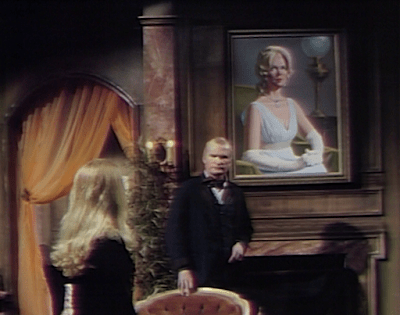
The portrait that holds Parallel Roger’s attention shows Parallel Angelique in contemporary guise. He talks to the portrait, not about a distant past which an ancestor of his might have known, but about the days when he and Parallel Angelique used to meet here, in her room. He says that people thought he was in love with her, but that he wasn’t. He was fascinated by her, but not in love. He says that he has never cared for the wine he is drinking, but that he still buys it, because it was her favorite.
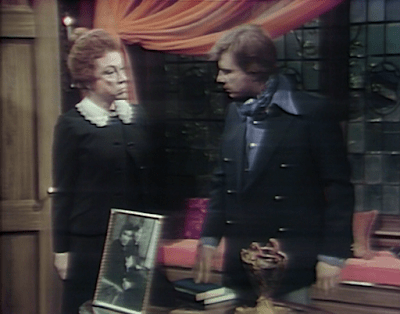
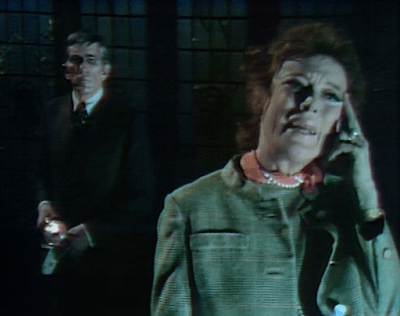
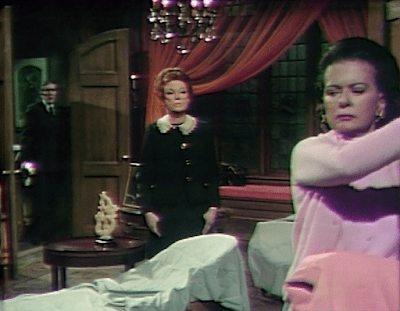
The counterpart of Roger’s niece Carolyn enters. We saw the Roger and Carolyn we have known since the first week of the series earlier in the episode. They were embracing while she cried on his shoulder about some problems she is having in the B story. He called her “Kitten,” a term of endearment he has used for her since #4. That was typical of their interactions. But Parallel Carolyn has little use for her uncle. She snaps at him about talking to himself, he snaps at her about being in the room, and they snap at each other about Parallel Angelique. Parallel Carolyn says she would like to make Parallel Angelique “whirl in her grave,” at which Parallel Roger contemptuously declares Carolyn could never accomplish such a thing.
Even in death, Parallel Angelique dominates Parallel Roger and Parallel Carolyn. Screenshot by Dark Shadows Before I Die.
Parallel Carolyn mentions that she is married to the counterpart of Barnabas’ servant Willie Loomis. Barnabas has seen this other William H. Loomis, and knows that unlike Willie he is an educated man, the author of several books. He is still unable to think of him as anything other than the man he knows, however, and is shocked at the idea that any iteration of Carolyn would marry him.
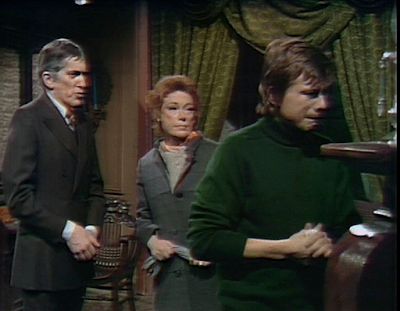
When Barnabas saw him, Parallel William was wearing pricey clothes and affecting a sophisticated manner, and Barnabas learned that three of his books were bestselling novels that had been made into feature films. But we find out in this scene that the Loomises are now short of funds. Parallel Carolyn is searching for a book that Parallel William wrote and from which he has the opportunity to make a few hundred more dollars by making an abridgment for a magazine. Parallel Roger mocks his niece for scrounging for money; she remarks that their cousin Quentin is not so generous with her as he is with him. This confirms what has been suggested in previous glimpses of the Parallel Time room, that Parallel Quentin is the Master of Collinwood in its universe.
The doors close. When Barnabas opens then again, the room is vacant. He is deeply frustrated that he cannot see more of what happens there. We can understand. We, too, want to watch Dark Shadows, and are disappointed when it isn’t on.
Occasions when we might expect to see Dark Shadows but don’t include most of this episode. The Parallel Time story is just getting started, and it needs a lot of actors who are away doing principal photography for the feature House of Dark Shadows. So we spend the bulk of today on what took up all of yesterday’s episode, a lot of back and forth among characters who aren’t really on the show anymore. They are left over from a couple of exhausted storylines.
A man named Bruno, a remnant of the show’s attempt to tell a story about some events that belong in the tales of H. P. Lovecraft, is holding two prisoners. The prisoners are Chris Jennings and his fiancée, Sabrina Stuart. Chris is a werewolf. He and Sabrina are left over from a story told at the end of 1968 and beginning of 1969, and in the last few months there was a lackadaisical attempt to tie them in with the Lovecraft material. Bruno is hoping to trap Carolyn with Chris when Chris transforms, so that he will kill her. His motivation for this is an overly elaborate plan that no one who has seen the show expects to work, so even though the episode ends with Chris and Carolyn locked up together while the full moon rises it doesn’t leave us in much suspense. I suppose it is a step up from yesterday’s closing cliffhanger, in which Chris found a stooge named Sky Rumson in Bruno’s closet, strung up by his wrists, bleeding and begging for help. That made so little impact it isn’t even mentioned today. For all we know Chris just closed the closet door and let Sky have his privacy.
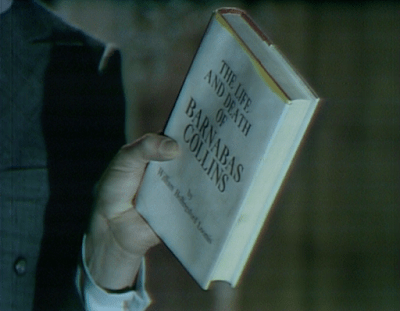
Vampire Barnabas Collins has discovered that he can occasionally see into a parallel universe through a doorway in the long-disused east wing of the great house of Collinwood. He cannot enter that universe or get the attention of its inhabitants, but yesterday a book came flying out of it and landed at his feet. It is titled The Life and Death of Barnabas Collins, and its author is William Hollingshead Loomis.
The Barnabas of the book’s title is our Barnabas’ counterpart in the parallel universe. He never became a vampire, but married his great love Josette, enjoyed prosperity as head of the Collins family, and died a natural death in 1830. It sounds like Parallel Barnabas lived a quiet life of the sort that would make for a dull biography.
Author William Hollingshead Loomis is the counterpart of Willie Loomis, once Barnabas’ sorely bedraggled blood thrall. Willie is back in Barnabas’ house, not as a slave, but as a volunteer in the battles Barnabas and Julia recently waged against the Leviathan People, a race of Elder Gods who sort of wanted to retake the Earth and annihilate humankind, but who could never figure out a way to get started. The Leviathans have been defeated now, and Willie’s fiancée Roxanne expects him to leave with her. But Barnabas and Julia are still bullying Willie into sticking around while they clean up the messes they have made recently. Most notably, yesterday they made him stake Megan Todd, a victim whom Barnabas inadvertently made into a vampire. Today Willie is still talking about how traumatic it was for him to do that.
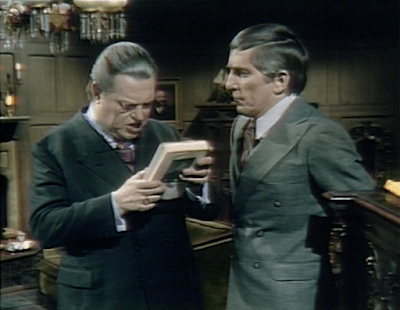
Parallel William H. Loomis is identified on the back of his book as the author of three best-selling novels that had been made into motion pictures, Pride of Lions, Gold Hatted Lover, and World Beyond the Doors. When Barnabas shows the book to our Willie, he reacts with panic. When he sees in the prefatory material that Parallel William dedicated the book to “the Clio who inspired” him, Willie declares that he doesn’t know anyone by that name. Barnabas contemptuously tells him that Clio was the Muse of History. Willie has never been represented as an especially literate fellow- when Frankenstein’s monster Adam began using standard grammar and diction in August 1968, Willie’s response was to ask “How come he talk so good?” While one suspects that a writer capable of publishing a book under the title Gold Hatted Lover is not exactly Thomas Hardy, Parallel William is clearly more bookish than is our Willie.
Barnabas tells occult expert Timothy Eliot Stokes about the room and takes him there. Stokes is excited by the possibility of examining this direct evidence for the many-worlds hypothesis, but alarmed by Barnabas’ apparent determination to cross over into the parallel universe he has glimpsed. He tells him of the dangers involved, and Barnabas does not want to hear it.
Meanwhile, heiress Carolyn Collins Stoddard is on her honeymoon with a man who once hoped people would call him Jabe. Like all his other hopes, that was summarily dashed, and he answers to Jeb. A leftover from the Leviathan arc, Jabe is plagued by an autonomous shadow that manifests itself to him in the manner of the shadow that plagues Anodos, the protagonist of George MacDonald’s 1858 novel Phantastes. Every time the shadow appears, Jabe insists on fleeing. Today, Carolyn sees the shadow herself, and finally understands why they haven’t been able to spend a whole night in any of the hotels they’ve checked into.
The shadow is not the most impressive special effect on Dark Shadows. In their post about the episode on their blog Dark Shadows Before I Die, John and Christine Scoleri said that the little dance the shadow does ought to be underscored with some Herb Alpert-style music, and they post a video to prove their point.
Vampire Barnabas Collins inadvertently killed his victim Megan Todd the other night, turning her into a creature like himself. Now his chief enabler, mad scientist Julia Hoffman, is browbeating his ex-blood thrall Willie Loomis into destroying Megan. Willie is horrified by the prospect of driving a stake through a woman’s heart, and Julia gives him a pep talk. She says that staking Megan is the only way to free her of the curse and to free her blood thrall, Barnabas’ distant cousin Roger Collins, from bondage. But it is necessary to finish Megan off “most of all, for Barnabas.”
The premise of Willie’s character at this point in Dark Shadows is that he regards Barnabas as a dear friend and valued patron. When Willie first knew Barnabas, from April to September 1967, Barnabas drank his blood, beat him savagely when he defied his fiendish commands, and framed him for his crimes. Barnabas had Julia fetch Willie back from the mental hospital she controls in May 1968, so he could use him to steal bodies to use in making a Frankenstein’s monster. Barnabas’ vampirism was in remission at that time, so he did not have any supernatural control over Willie. Willie’s attitude towards Barnabas then was rather insouciant, so he and Julia kept threatening to send him back to the ward for the criminally insane unless he obeyed them. Barnabas only seemed happy during this time once. That came in #560, when he saw the agony Willie went through when he persuaded him that it would be his fault if the monster murdered Maggie Evans, The Nicest Girl in Town. I suppose people do rewrite their own pasts to make them bearable, so it is understandable that Willie has chosen to believe that his abuser was really his best buddy. Still, it does seem a bit much for Julia to tell Willie that he should destroy Megan “most of all, for Barnabas.”
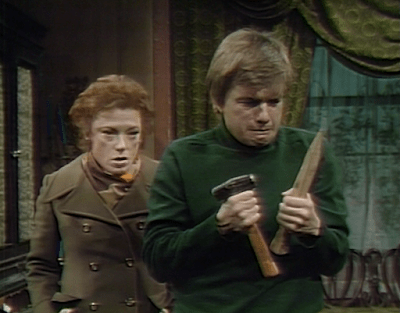
Julia accompanies Willie to Megan’s hiding place in the long-disused east wing of the great house of Collinwood. Willie breaks down outside the room where Roger is guarding her coffin, and Julia has to give him another motivational speech. She tells him he “mustn’t think of Megan as a person,” but as “a creature, an evil thing,” and besides that “You must help her to rest” and that staking is “the best thing for her.” While Willie struggles to hold back his tears, she warns him against waking Roger. By the time they enter the room, Roger is awake. He fights Willie and Julia to protect Megan, and Willie defeats him only by breaking a bottle over the back of his head.
Julia and Willie take Roger out of the room. Julia tends to Roger while we hear Megan’s screams. Once the staking is complete, Roger comes to, with no recollection of how he got to the east wing or what Megan did to him. This recovery tells us Megan is destroyed.
Later, Barnabas will tell Willie to bury Megan and all her belongings in a hole in the ground somewhere out in the woods. This shows longtime viewers that Barnabas has improved his post-murder game considerably. The first time he forced Willie into helping him cover up a killing came in #276. Barnabas had strangled Willie’s sometime friend, seagoing con man Jason McGuire. He had Willie help him bury Jason in the secret room in the old Collins family mausoleum, which would eventually cease to be much of a secret and which several people could connect with Barnabas. He also neglected to do anything about Jason’s belongings. Everyone thought Jason was leaving town and was glad to see him go, so there was no investigation. But in #277, Roger mentioned to his sister, matriarch Elizabeth Collins Stoddard, that all of Jason’s stuff was still in the room he had been occupying at Collinwood. He told Liz that even Jason’s razor was still there. It was strictly a matter of luck that no one asked any questions about Jason- had they done so, Barnabas would have been in trouble almost immediately.
This episode marks, not only the end of Megan’s career as a vampire, but Marie Wallace’s final appearance on Dark Shadows. Miss Wallace was one of the most exuberant practitioners of the Dark Shadows house style of acting, a hyper-vehement manner of performance previously unknown in the history of the dramatic arts. It can take a bit of getting used to. But once Megan became a vampire, she suddenly became quiet and subtle, almost understated. Miss Wallace explains that by saying that the dentures they gave her to wear as fangs didn’t stay in her mouth very well, so she had to go small to keep them from flying across the room. As a result, her last few episodes are a revelation. The first time we watched the show I was impatient with Miss Wallace’s ultra-intense technique; I can appreciate it now, but her miniaturizing approach to Vampire Megan is so very effective that I wish we could have seen a couple hundred more episodes of her doing that kind of thing.
Miss Wallace tells the story of the day they shot this episode. She got a telephone call from her agent that they wanted her for a part on a soap called Somerset. She was thrilled, since there was no new part planned for her after Megan’s demise. From the few surviving bits of video showing her on Somerset, it doesn’t look like she decided to become a miniaturist.
In With the New
Megan is left over from an exhausted story. The new one is starting in another room in the east wing. The Collinses cram all of the deserted rooms in their buildings full of stuff- vases, paintings, books, furniture of all sorts. This room outdoes all the rest, and contains a whole parallel universe.
Barnabas has been peeping in on the doings in the parallel universe room for couple of days, but there is an invisible barrier which prevents him entering it or communicating with the people he sees and hears there. At the opening today, he sees Julia’s counterpart and Liz’ continuing a quarrel they had been having when he observed them before; at the close, he sees Willie’s counterpart and Julia’s having a similar quarrel.
Parallel Julia wears a maid’s uniform, but is full of commands for Parallel Liz and Parallel Willie. Parallel Liz’ response to her commands shows that she is not the mistress of the house, and cannot control Parallel Julia. Parallel Willie wears an ascot and a smoking jacket, and regards Parallel Julia with amused contempt.
Parallel Willie finds a book in the room that he wanted; Parallel Julia takes it from him, and tosses it into the hallway. The book passes through the barrier, and lands at Barnabas’ feet. The doors to the room close. Barnabas opens them again, and finds that the room is empty, devoid of the people, furnishings, and lights that had been visible there a moment before. Carrying the book, he goes in.
The title and author of the book stun him. It is titled The Life and Death of Barnabas Collins; its author is William Hollingshead Loomis.
In #326, Willie had been shot by the police, who blamed him for some of Barnabas’ crimes. Barnabas grew anxious as the hours passed and Willie failed to die. He complained to Julia of Willie’s “leech-like persistence” in remaining alive. Julia tried to reassure Barnabas that Willie was unlikely to survive much longer, and in response he raged that Willie might just as easily recover from his wounds and “write his memoirs!”
That line found an echo in #464, when we learned that Barnabas’ eighteenth century servant Ben Stokes had indeed written a memoir, though the extant manuscript was missing some parts about Barnabas. In #756, undead blonde fire witch Laura Murdoch Collins heard that Ben had secrets about Barnabas which he “took to his grave,” so she dug the grave up and, by golly, there were the missing passages explaining that Barnabas was a vampire. Now the same line is going to give rise to another William Loomis, one who has written a book about his world’s counterpart of Barnabas.
Yesterday, Barnabas Collins went to the long-disused east wing of the great house of Collinwood to search for the coffin that vampire Megan Todd occupies during the day. Barnabas is himself the vampire who ended Megan’s human life, passing his curse along to her. When his friend, mad scientist Julia Hoffman, makes a characteristic remark and tells him “you must not feel personally about Megan Todd,” Barnabas asks “How can I feel any other way?” Most of Barnabas’ feelings, in this or any other matter, consist of pity for himself, but there is a trace of sympathy for Megan in there someplace, probably.
Now, Barnabas has taken Julia to a spot that he happened upon while looking for Megan. While Julia was in the carriage house on the estate with matriarch Elizabeth Collins Stoddard, Barnabas saw two women who looked and sounded exactly like them in a brightly lit, fully furnished, heavily decorated room behind a pair of doors in the otherwise dark and empty east wing. Julia’s double was wearing a French maid outfit and giving orders to Liz’, which is probably someone’s fetish but which is totally out of character for the women Barnabas knows.
In #351, Barnabas was without a blood-thrall. Julia offered to guard his coffin during the day. They were not really friends at that point, and he reacted to her offer warily. Among his objections was that it was not suitable for her, as a medical doctor, to fill such a position. She assured him that she was not volunteering “to be your maid.” Longtime viewers might remember that line when they see Parallel Julia in her livery.
There was an invisible barrier in the doorway that Barnabas could not cross, and he was unable to attract the attention of the women who were so near to him, even when he shouted what he supposed to be their names. The doors closed, and when they opened again the barrier was gone, but so were the doubles of Julia and Liz, along with all the furnishings and lights that had surrounded them.
Thinking of what Barnabas has told her about the room, Julia hesitates to enter it with him. She dismisses her concern as “silly.” Regular viewers will perk up at this- labeling a fear as “silly” is the surest way of marking it as the basis of an upcoming major story point. Once inside the bare room, Julia starts thinking out loud:
JULIA: I was at Eliot Stokes’ house one night, oh, last spring. We were having a brandy after dinner and he started talking about time… He was complaining that we all simply accept it. We don’t have much choice, I thought.
But Eliot had been reading a theory. It sounded insane to me. A theory of parallel time… we live on this universe in 1970, right? We accept the fact that our time is the only time that we can truly know. Suppose time is like a road and parallel to it there’s another road. On one we live the lives we know, but on the other road our lives are different because we’re in a different time-band* and we’ve made different choices. For example, in that other band of time I could’ve made a different choice when I was at college. Instead of being a doctor I could’ve married and had children.
Barnabas, you don’t actually think through some warp in the time band that you have actually seen us living other lives?
BARNABAS: I don’t know, there’s got to be a more rational explanation.
JULIA: Must there?
So, now we know that we are about to launch a new kind of time travel story. The show has taken us back in time for long costume drama inserts, most notably from November 1967 to March 1968 when it was set in the 1790s and from March to November 1969 when it was set in 1897. Now they are going to travel sideways in time, and take us to a parallel universe where Julia is a maid and Liz is not the lady of the house.
At the end of the episode, Barnabas sees the room change again. Parallel Time Liz and Parallel Time Julia uncover a portrait that hangs there, the portrait of a woman whom PT Liz insists is dead and PT Julia insists is still the rightful mistress of the room. Barnabas recognizes the subject as the Parallel Time counterpart of his ex-wife, wicked witch Angelique.
With this, the behavior of PT Liz and PT Julia falls into place. We’re about to see a story derived from Daphne Du Maurier’s Rebecca. PT Julia is Mrs Danvers, the housekeeper maniacally devoted to Rebecca, the late wife of Maxim de Winter. PT Angelique is the one whose death and continued ownership of the room have been a point of contention between PT Julia and PT Liz. We’ve seen a photograph of Parallel Time counterparts of Barnabas’ distant cousin Quentin Collins and strange and troubled boy David Collins, signed “Your loving husband, Quentin.” PT Quentin is the one whom we have heard Liz say is returning with a new wife. In the main “time-band,” Quentin is a penniless rogue with a long supernatural backstory, but his counterpart is the master of Collinwood, and Liz ranks somewhere below the uniformed domestics in the household hierarchy. The David we know is the son of Liz’ brother Roger and a blonde fire witch named Laura Murdoch, but evidently his Parallel Time counterpart is the son of the counterparts of Quentin and Angelique. We have had no indication of who Quentin’s new wife is to be.
This is not the first reference to Rebecca on the show. When Clarice Blackburn joined the cast as housekeeper Mrs Johnson in September 1966, she was supposed to model the character on Mrs Danvers. Mrs Johnson came to Collinwood as a spy for Collins family nemesis Burke Devlin, driven by her certainty that Roger was responsible for the death of her beloved former employer Bill Malloy. Bill, like Rebecca, had drowned under suspicious circumstances, though he didn’t have much else in common with her. By the time the “Death of Bill Malloy” story played out, Mrs Johnson had taken on a new function as an inveterate gossip who made narrative progression possible by blabbing everything she knew to everyone she met. Blackburn’s outstanding talents made her a significant part of the show for quite some time; it’s a shame she isn’t going to be part of the upcoming segment.
Rebecca was not the only Du Maurier novel to inspire a story on Dark Shadows. Dangerously unstable ruffian Willie Loomis first freed Barnabas to prey upon the living after David and Mrs Johnson told him the plot of Du Maurier’s Frenchman’s Creek and claimed that it happened to one of the Collins ancestors. Searching for the treasure the pirate gave to the lady, Willie stumbled upon Barnabas’ coffin. He opened it, earning a bite that made him the vampire’s slave.
Willie’s mistake was that he did not know what kind of show he was on. When Dark Shadows began, executive producer Dan Curtis and ABC vice president for daytime programming Leonard Goldberg** meant for it to be the television equivalent of the “Gothic romance” novels that were so popular in those days. Du Maurier’s novels were among the cornerstones of the Gothic romance genre, and if it were still that kind of show in April 1967 Willie would have been on solid ground in his expectation that there might be a lot of jewels hidden in an unmarked coffin in the old mausoleum. But when Laura was on the show from December 1966 to March 1967, her story subsumed all the major plot threads into a tale of the supernatural. Willie and his sometime friend, seagoing con man Jason McGuire, were on the show as in-betweeners to sweep up the last non-paranormal odds and ends and help introduce the next uncanny menace.
Now, the show is heading in the opposite direction, and Willie is back to help take us there. In Parallel Time, Dark Shadows will finally do the Daphne Du Maurier adaptation that didn’t work out in the Bill Malloy story and that was never meant to work out for Willie. But Megan has to be destroyed before Barnabas can decamp for Parallel Time, and he and Julia order Willie to destroy her.
It was not a foregone conclusion that Julia and Barnabas would want to stake Megan. At the moment, Julia is giving Barnabas injections meant to relieve him of the effects of the vampire curse. Similar injections had worked in 1968 and again during the 1897 segment. Julia shows Barnabas the cross she wears to ward Megan off, and he does not recoil from it. That suggests the injections are having some effect on him, even though he keeps complaining that they aren’t doing anything to curb his bloodlust. When Julia and Barnabas find Megan in the east wing, she refuses the injections. When they find that she is feeding on Roger, they conclude that she cannot be allowed to see another night.
Willie is horrified by the command to drive a stake through Megan’s heart. He protests that he doesn’t even know her. As Barnabas and Julia tell him of the nightmare that awaits everyone if he doesn’t do as they say, he starts to talk about his fiancée Roxanne and the secrets he has been keeping from her. He worries about the image she will have of him if she finds out that he is the former blood-thrall of one vampire and the destroyer of another. “I mean, she’s gonna be thinkin’ I’m weird or somethin’!” I suppose that would be an occupational hazard for blood-thralls.
Willie is worried Roxanne might get the wrong idea about him. Screenshot by Dark Shadows Before I Die.
There is an odd moment when Julia is asking Liz about the east wing. Liz tells her that Roger knows more about the legends of the house than she does. When Julia was first on the show, she was posing as an historian looking into the old families of New England. In those days, Liz mentioned that Roger knew far less about the Collins past than she did, which fit with the original keynote of Roger’s character, an extreme lack of family feeling. But by this point, Roger has merged with the roles Louis Edmonds played in the 1790s and 1897 segments, both of whom were dedicated to the honor of the Collins name.
*The first appearance of this bit of Collinsport English.
**Not to be confused with his then-boss, network president Leonard Goldenson.
On Dark Shadows, weddings are usually stopped when one of the couple makes a decision in the middle of the ceremony that leads to the exhumation of an empty coffin. In #270, the first wedding followed that pattern, when instead of saying her vows matriarch Elizabeth Collins Stoddard announced that she and her intended, seagoing con man Jason McGuire, had killed her first husband, Paul Stoddard. That led the sheriff to dig up the spot in the basement of the great house of Collinwood where Liz said Jason had buried Paul, only to discover an empty box. It turned out Paul wasn’t dead at all.
The next wedding we saw was in #397, set in the year 1796. Scion Barnabas Collins and wicked witch Angelique Bouchard managed to get through the ceremony, but before the night was out Angelique had been abducted by the late Jeremiah Collins, whom she had raised from the dead as a zombie. Jeremiah dug up his own grave, opened his empty coffin, and put Angelique in it.
In #625, well-meaning governess Vicki was supposed to marry an unpleasant man known variously as Peter and Jeff. Peter/ Jeff left the ceremony to dig up another grave, and find another empty coffin.
For sixteen weeks, Dark Shadows was dominated by an effort to take some themes from the tales of H. P. Lovecraft and build them into a story. We kept hearing about the Leviathan People, a race of Elder Gods who were trying to retake the Earth and destroy humankind. The Leviathan material never coalesced into a story, and they gave up on it last week.
The last event in the Leviathan segment was an attempted wedding between Liz’ daughter Carolyn and someone who appears to be a very tall young man, but is in fact a shape-shifting creature from beyond space and time. When he first assumed the form of the tall young man, the creature asked people to call him Jabe. That didn’t come off, so he answers to “Jeb” instead. The Leviathan plan has always called for Jabe to join himself with Carolyn in an unholy ceremony that would cause her to become the same sort of creature he is, and last Friday they stood by an altar in the woods while Nicholas Blair, the high priest of a cult devoted to the service of the Leviathans’ project, called on Jabe to take his place behind the altar. There, Jabe deviated from the rubrics of the ceremony. He smashed a small wooden box and called for Barnabas to rescue Carolyn. The wooden box was empty, but it was not exactly a coffin- it was the matrix from which Jabe first emerged, four months ago, when he was nothing more than a whistling.
After their traditional Collinwood non-wedding in #625, Vicki and Peter/ Jeff had a second ceremony in #637. They completed it, but shortly afterward the supernatural powers that allowed Peter/ Jeff to exist in the 1960s lost their grip and he vanished into a rift in time and space. Today Jabe and Carolyn also complete a second ceremony, but it seems their marriage is approaching a similar crisis. When Jabe smashed the box, Nicholas told him that his humanoid appearance was all that was left of him, and that it was only a projection from a true form that was destroyed with the box. He could not continue to exist as Jabe for very long. As Peter/ Jeff prolonged his time in the 1960s by force of will, Jabe has prolonged his own existence beyond what Nicholas had thought possible, but returning viewers will still expect him to vanish at any moment.
Moreover, Jabe has made many powerful enemies. One of them is Angelique. She has taken a cue from George MacDonald’s 1858 novel Phantastes and plagued him with a shadow that he does not cast but that follows him about. The shadow menaces Jabe a couple of times today, and each time it prompts him to shriek to Carolyn that they must flee. Since he won’t explain to her what is going on, we can only wonder if he will meet his demise before she concludes that he is an abject lunatic and files for an annulment.
Meanwhile, Barnabas and his friend, mad scientist Julia Hoffman, are on a vampire hunt. Barnabas is a vampire himself; Angelique turned him into one when their marriage didn’t work out, Julia and another mad scientist cured him of the effects of that curse in 1968, and then Jabe placed another vampire curse on him more recently. Barnabas has bitten a woman named Megan Todd and accidentally turned her into a vampire. One of Megan’s victims, a man named Sky Rumson, tips Barnabas and Julia off that her coffin is hidden somewhere in the long-disused east wing of the great house. Barnabas conducts a search there while Julia goes with Liz to inspect the carriage house on the estate, where Jabe has been staying.
In the first months of the show, they went back and forth on whether the great house had a vacant west wing or a vacant east wing. They eventually settled on a west wing, and the west wing was an important locale at various points. Once in a while actors would slip and refer to an east wing. It was not until #648 that the show made it unequivocally clear that the house had both east and west wings, and not until #760 that we had a look inside the east wing. This is the first reference to it since then.
Barnabas is walking through a dark, dusty corridor, thinking that no one had been down it in “years.” Double doors open, and Barnabas sees a fully furnished, brightly lit room. He tries to enter, and suddenly turns into a mime struggling to escape from an invisible cage. He sees a framed photograph on a table in the room. The photograph appears to show his distant cousin Quentin sitting next to Liz’ nephew, strange and troubled boy David. It is signed “Your loving husband, Quentin.” Barnabas knows that Quentin and David have not been photographed together, and Quentin’s only marriage ended when he murdered his wife long before David was born, so neither the photograph nor the writing on it make any sense to him.
Barnabas sees Liz enter the room from a doorway on the other side. She is wearing a completely different outfit than she had on when Barnabas saw her shortly before. She does not see Barnabas or hear him, even though he is standing only a few feet away and calling out to her. She opens a closet and examines some clothes.
Julia enters, wearing a French maid outfit. She demands to know what Liz is doing. Since Barnabas knows Liz as the owner of Collinwood and Julia as a houseguest there, albeit one of unlimited tenure and an overpowering nature, her tone is as inexplicable as her attire. She orders Liz to leave the clothes alone. They argue about a person to whom they refer only as “she.” Liz says that “she” is dead, Julia insists that “she” will return. Liz wants to prepare the room for someone else’s use, Julia declares that only “she” will ever possess it.
The doors close. Barnabas cries out to Liz and Julia. He opens the doors again, only to find that the room is entirely bare. It has no furniture, no carpeting, no lights, no decoration of any kind. It is as dark and as dusty as the rest of the east wing, and appears to have been unvisited for as long.
Barnabas returns to the main part of the house. He sees Liz and Julia returning through the front door, dressed as they had been before they left for the carriage house and talking to each other in the same relaxed, friendly manner. Flummoxed, he asks Julia if they went anywhere other than the carriage house. She says they did not. He tells her he did not find Megan’s coffin, and tries to explain what he did in fact see.
The Man Who Wasn’t There
It would seem that whatever phenomenon Barnabas is seeing when he looks into this room is going to mark the beginning of the next phase of Dark Shadows. When Jabe smashed the box, he ended the Lovecraft segment. But the show had not set up any story to follow it. For the last few days, we’ve passed the time watching him and some other characters left over from it flounder about helplessly. Peter/ Jeff’s ghost showed up and claimed to have a grudge against Jabe that dated from the 1790s. Since Jabe did not exist in those days, I suspect the tale Peter/ Jeff tells is a remnant of some story they planned long ago but never developed, with Jabe hastily put in the place of some character they projected but did not introduce.
I’m not sure what the untold story and never-introduced character were, but there may be a clue in this episode. Sky Rumson was at one point under the power of the Leviathans. Barnabas tells Sky that Jabe has smashed the box and everyone is now free of their power, which fits with what we have seen and with what Nicholas told his henchman Bruno. Sky is indeed disconnected from the Leviathans- he now figures only as Megan’s victim. But for no reason that has to do with today’s events, he denies that and says “My deal was with Mr Strak.”
In #899 and #900, there was a flashback to the year 1949. We saw that Paul Stoddard unwittingly sold his daughter Carolyn to the Leviathans that year, and that their agent was a Mr Strak. Strak was played by John Harkins, who had played a monster in several episodes not long before. The whole point of Strak as a character seemed to be that he was someone Paul could never find again, so that he was entirely helpless in the face of the deal he had struck. The casting of Hankins reinforced that for viewers who recognized him, since he was pretty obviously there to use up the last two episodes on his contract. It would seem to defeat the purpose to bring his name up again, yet Sky’s reference to Strak marks the second time we have heard his name recently. Doomed Leviathan cultist Nelle Gunston told Barnabas in #951 that Strak had recruited Bruno.
Nicholas’ association with the Leviathans is also hard to explain. He was on the show in 1968 as Angelique’s boss. At that time the show was taking a peculiar sort of Christian turn, and it was very clear that Nicholas was in the employ of Satan. Indeed, just last week he invoked Satan at the ceremony to join Carolyn and Jabe. But the Leviathans are rooted in Lovecraft’s resolutely non-Christian cosmology, and when Jabe himself performed an incantation to raise some dead men to serve him as zombies he called upon multiple “gods of the underworld,” not Satan. Moreover, we know that Nicholas was at Collinwood in 1968, and Nicholas tells Jabe that he has been confined to the underworld since then. It is therefore nonsensical when Sky treats Nicholas as his long-established supervisor in the Leviathan cult.
I suspect that Nicholas’ role, the references to Strak, and Peter/ Jeff’s complaint against Jabe are all traces of a single never-introduced character. They may have intended, in the early stages of planning the Leviathan segment, to bring in a second Leviathan, one who had been lurking on the Earth for a long time and had great powers, though he could not fill Jabe’s intended place as harbinger of the new age. This projected character would have been the main villain of the second half of the Leviathan segment, which would have involved another trip in time back to the late eighteenth century. When the ratings sagged, they often scrapped a lot of what they had written and everything they had planned to get to something fresh. Since the Leviathan segment was a flop, it certainly would not be surprising if they had chucked that new villain, along with the second half of the Leviathan segment and its time-travel story, plugging in Nicholas, the references to Strak, and Peter/Jeff’s complaint to Jabe to cover what they tore out.
Closing Miscellany
The clergyman who marries Jabe and Carolyn is called “the Reverend Brand.” The clergyman who married Barnabas and Angelique in 1796 was called “the Reverend Bland.” Those names are similar enough that I have to suppose there was some point to it. Perhaps an inside joke between writers Gordon Russell and Sam Hall.
The show has been ambiguous about the Collinses’ precise religious affiliation. In the 1790s, we saw that repressed spinster Abigail Collins was a very extreme sort of Congregationalist, but the other members of the family pointedly referred to “Cousin Abigail’s religion” as one of the things that set her apart from the rest of the family. As the name suggests, Congregationalists vary quite a bit from place to place, so the other Collinses’ differences with Abigail do not mean that they were not of that tradition in the 1790s. As upper crust New Englanders of an early vintage, they would likely have been Congregationalists at some point, though by the 1790s, they may well have been Unitarians or Presbyterians. By the 1960s they could have been just about any kind of Protestant without occasioning comment. Today, Liz mentions that the Reverend Brand has a “vestry meeting” to attend. Only Anglicans call the lay leadership of their parishes a “vestry,” and the only Anglican denomination the Collinses could plausibly have belonged to in 1970 was The Episcopal Church.
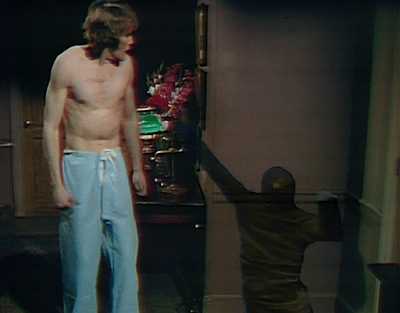
We see Jabe and Carolyn asleep in bed together on their wedding night. This is the first time we see a couple sharing a bed on Dark Shadows. What’s more, while most sleepers we have seen have been fully clothed under their bedsheets, even wearing shoes, Jabe is wearing only pajama bottoms, and those are tugged down noticeably below his waist when he first gets out of bed. You can say goodbye to the uptight Sixties, it’s the Seventies now, baby.
During the joining ceremony between Jabe and Carolyn, Bruno was in the carriage house. There was a magical room there where Jabe changed between his human form and his rugose, paleogean one. When Jabe smashed the box, Bruno saw that room suddenly engulfed in flames. Later, he and Nicholas examined the room, and could not find any sign there had ever been a fire there. Nicholas explained that the fire was a supernatural manifestation, and that what it consumed was not any of the material aspects of the room, but its character as Jabe’s changing station. But Liz tells Julia she is going to the carriage house to inspect fire damage, and when they come back they say that they have seen such damage.
Danny Horn’s post about this episode on his great blog Dark Shadows Every Dayis a particular delight. It’s so full of spoilers about the story that begins today that I can’t say much about it. I’ll tell you it is written from the perspective of a person who would be familiar with the versions of Liz and Julia that Barnabas encounters in the east wing, but not with him. Danny is writing from an imaginary world in which actor David Selby went into politics and was elected president of the United States in 2016.
Diana Millay’s Laura Murdoch Collins was instrumental in two of the most important turns in the development of Dark Shadows. When she was on the show from December 1966 to March 1967, she was its first supernatural menace, marking its transition from the Gothic melodrama of its first months to the monster-driven thriller it became. And in her current tour of duty, in April and May of 1969, it is while doing battle against Laura that Barnabas and Quentin Collins become friends, a friendship that will be central to the show from now on.
Today is Laura’s final appearance. Her sendoff is startling. After she bursts into flames, we cut directly to the closing credits, already in progress with Jonathan Frid’s credit for the part of Barnabas scrolling over an image of the outside of the great house typically shown during the opening voiceover. The bottom of the image is atypically cut off, creating a letterbox effect. None of this is in itself spectacular, but each part of it is a deviation from the usual format. Taken together, it leaves us with the feeling that Laura must have exited by way of the control room.
In the opening reprise, Laura thinks she is waking her son Jamison. She pulls the covers back from Jamison’s bed, and finds that she has been talking to a pile of pillows. In the corner of the room, Laura’s fellow undead blonde fire witch Angelique bursts out laughing.
Well might Angelique laugh. Not only is it ridiculous to see an ancient and terrible creature like Laura fall for so childishly simple a trick, but heaping up pillows under covers to make it look like someone is in bed is a favorite practice of Angelique’s. In #402, Barnabas went to Angelique’s bedroom intending to stab her, only to find her in the corner laughing at him after he had chopped up some pillows under her blanket.
It is fitting that Angelique is the one who destroys Laura. Matthew Hall, son of Sam and Grayson Hall, writes in the essay he contributed to The Dark Shadows Companion that when he and his father were among the writers developing the reboot of Dark Shadows that aired briefly on NBC early in 1991, the idea of including a version of Laura was rejected because “the Phoenix was virtually a test run of all the ideas that would subsequently reach fruition in the character of Angelique. Thus: Laura’s ability to cast spells that set fire to distant things is but one if Angelique’s large arsenal of tricks. Of course, on the original show, advantage was taken of how evenly matched these two characters were: they fought viciously during one episode.” There are some odd things in this assessment, but it is certainly that a character like Laura, who was frightening precisely because she herself was unknowable and her presence implied a world that humans could never hope to understand, had no place on a show where the supernatural is represented by figures like Angelique and Barnabas, whose feelings and intentions are overwhelmingly obvious and all too relatable.
Laura’s children are hidden from her in a room in the east wing of Collinwood. It is in this room, in front of them, that she burns up. The east wing has been mentioned only a few times, mostly by actors who were supposed to say “west wing.” This is the first episode with a scene set in the east wing.
From #701, the episode in which Dark Shadows first became a costume drama set in the year 1897, they have been strongly hinting that Jenny Collins, the madwoman locked in the room on top of the tower in the great house of Collinwood, is the estranged wife of stuffy Edward Collins. Today, Jenny gets loose, and confronts Edward’s brother, rakish Quentin. It is only then that we learn that she is in fact Quentin’s wife. All of the clues that had led us to the other conclusion take on new meanings in that moment, making it one of the most effective twists on the show.
Edward is the father of two children whom we have seen, twelve year old Jamison and nine year old Nora. Jenny has been preoccupied with some dolls she has with her in her prisons, which she calls “my babies.” She is afraid someone will take her “babies” from her.
We came to 1897 along with well-meaning adventurer/ bloodsucking ghoul Barnabas Collins, who in 1969 encountered the ghosts of Quentin and of maidservant Beth. Quentin’s ghost had made the great house uninhabitable and was in the process of killing strange and troubled boy David when Barnabas decided to resort to the mumbo-jumbo that has brought him back to this period. In 1969, Barnabas was not only trying to contain the damage Quentin’s ghost was doing; he was also trying to help drifter Chris Jennings, who was a werewolf. Beth’s ghost appeared to Chris and led him to an unmarked grave containing the remains of an infant wearing an amulet meant to ward off werewolves. This proved that there was a werewolf at Collinwood when Beth and Quentin were alive, and suggested that Chris’ curse was inherited from that person.
When Barnabas first met the living Beth in # 703, he asked if there were any children in the house other than Jamison and Nora. She said that there were not. He wondered if the newborn to whose grave Beth’s ghost led Chris had already died and been buried. But now that we know that Jenny is Quentin’s wife, we remember that in that same episode Quentin caught Beth with $300 and that in #707 we heard that she had taken the money to a “Mrs Fillmore” in town. Perhaps Jenny really did have babies who were taken from her, and perhaps Mrs Fillmore is taking care of them. Perhaps, too, the “Jennings” in Chris’ name indicates that he is a descendant of Jenny, and therefore of Quentin. We have already seen Quentin dabbling in black magic- perhaps he brings the curse of the werewolf on his descendants by means of it.
Jenny’s meeting with Quentin today does not come to a happy ending as far as he is concerned. She leaves him on the floor, with a dagger stuck in his chest.
While the search is on for Jenny, Beth tells another servant that Edward and Quentin’s sister Judith has searched the west wing and is now searching the east wing. This is only the second time the dialogue has made it unequivocally clear that there are two wings extending from the main house, and the first time it is established that the east wing exists prior to the twentieth century. There was a time when the writers had not settled on which side of the house the long-deserted wing lay; the first couple of appearances of the phrase “east wing” dated from then. Subsequently, there were slips of the tongue by actors who were supposed to say “west wing.” We may wonder when, if ever, the writers will find a use for this other part of the house.
This is the second of three episodes featuring Cavada Humphrey as Madame Janet Findley, a medium called in to investigate the strange goings-on at the great house of Collinwood. Humphrey’s performance so utterly dominates the segment, and I have so little to add to what I said about her style in yesterday’s post, that all I can do is make a series of more or less miscellaneous observations about its other aspects.
Today Madame Findley meets children David Collins and Amy Jennings. Amy and David are coming under the influence of evil spirit Quentin Collins. She questions them in the drawing room, and finds a hidden panel that leads to the long-abandoned west wing of the house. Over the children’s objections, she enters the secret passage. As soon as she is in, they hurriedly close the panel, locking her in. Evidently their objections were part of a ruse designed to lead her to Quentin’s stronghold. All too often on Dark Shadows, the audience knows too much about what characters are trying to do. This scene stands out, because they really do keep us guessing whether the children want Madame Findley to go into the secret passage. We don’t really know what their goals are until we see them shut her in.
Earlier in the episode, Amy’s brother Chris dropped in. He was very eager to see permanent houseguest Julia Hoffman, MD. Amy mentioned to Chris that there was another visitor in the house. When Chris asked who it was, Amy replied, “Her name is Madame- Madame something- at least that’s what they call her.”
I heard these lines in the voice of T. S. Eliot. The rhythm is reminiscent of a section of his poem The Waste Land, which in 1968 was an extremely familiar text to people with literary ambitions:
Madame Sosostris, famous clairvoyante,
Had a bad cold, nevertheless
Is known to be the wisest woman in Europe,
With a wicked pack of cards. Here, said she,
Is your card, the drowned Phoenician Sailor,
(Those are pearls that were his eyes. Look!)
Here is Belladonna, the Lady of the Rocks,
The lady of situations.
Here is the man with three staves, and here the Wheel,
And here is the one-eyed merchant, and this card,
Which is blank, is something he carries on his back,
Which I am forbidden to see. I do not find
The Hanged Man. Fear death by water.
I see crowds of people, walking round in a ring.
Thank you. If you see dear Mrs. Equitone,
Tell her I bring the horoscope myself:
One must be so careful these days.
It was indeed a mysterious Tarot card that prompted matriarch Elizabeth Collins Stoddard to call for help, and that call brought Madame Findley to the house. The card she interprets is the Tower of Destruction, which unlike the cards Eliot’s Madame Sostris describes actually appears in existing Tarot decks. She doesn’t have a cold, and she isn’t in the business of selling horoscopes door to door. On the contrary, as Humphrey plays her she is a dazzling presence.
Liz did not call Madame Findley directly. She telephoned occult expert Timothy Eliot Stokes, who introduced her to La Findley. At first sight, Stokes appears to be a stuffy academic with an impossible Anglophile manner, but as we get to know him he turns out to be very much at home in the bizarre netherworld in which the show takes place, so much so that his supernatural adversaries fear that he may have powers surpassing theirs. T(homas) St(earn)s Eliot was so much like T(imothy) Eliot St(oke)s in the first impression he made, so highly regarded by the sort of people who wrote Dark Shadows, and so generally famous in the 1960s that it is very likely that Stokes’ name was at least partly inspired by him.
It’s true that Madame Findley’s name lacks the exotic glamour Eliot gave his character. I suppose if you have all of Europe to choose from, you can take your stray Tarot cards to someone named “Madame Sosostris,” but if you are limited to central Maine, you have to settle for “Janet Findley.”
I made a remark about Madame Findley’s name in the comments on Danny Horn’s post about episode #647 on his great Dark Shadows Every Day:
It’s just delightful that they introduce an otherworldly, mystical character, played with an actress who brings a genuinely eerie note to her performance, and her name is… “Janet Findley.” It’s like Monty Python and the Holy Grail, when they meet the wizard who is known as “Tim.”
I wonder if there’s any connection between the name “Janet Findley” and the name “Janet Fisher,” whom Carolyn mentioned as a friend once of twice in the first season. Seems like a lot of Janet Fs. For that matter, I wonder if there’s a connection between Tim the Wizard from Monty Python and Tim(othy Eliot) Stokes, who a couple of episodes back had to tell Vicki that he isn’t a wizard.
–Comment left by Acilius, 8 October 2020, on Danny Horn, “Episode 647: The Wire,” Dark Shadows Every Day, 12 May 2015
That remark drew a response from a commenter who posts as “Mary”:
Findley is a popular name on Dark Shadows. In addition to Janet, Margaret Findley is one of the ghostly widows, Thomas Findley is one of Jeb’s zombies in the Leviathan storyline and Findley’s cove is the location of Carolyn’s cottage in 1995.
Comment left by “Mary,” 18 February 2021, on Danny Horn, “Episode 647: The Wire,” Dark Shadows Every Day, 12 May 2015
When Madame Findley asks about the closed-off parts of the house, Liz tells her about both the west wing and an east wing. The phrase “east wing” had come up a couple of times in the first year of the show, but it always seemed to be either a case of the writers not having made up their minds which side of the house the deserted wing was on or a slip of the tongue by the actors. This is the first time the show makes it clear that the house really does have two deserted wings.
Humphrey was too perfect for Dark Shadows to play only one role. In a comment on Danny’s post about this episode, I indulged in a little fanfic about another part that would have been right for her:
Cavada Humphrey looks quite a bit like Jonathan Frid. I wonder what 1795 would have been like if Barnabas had had an older sister who bossed him around, stood around during his ridiculously childish fits of petulance, occasionally acted as his conscience, and time and again serve as his enabler and protector. It would have been funny to see Grayson Hall’s Countess express disapproval of such a relationship.
Heck, that older sister could have been Sarah. Just because she’s a child in her ghost form doesn’t mean she has to have died at that age. Maybe she comes back in the form in which her relationship to her brother took its permanent shape, when she was about nine and he was about seven. Of course, that possibility is foreclosed at Sarah’s first appearance, when she tells Maggie not to let her “big brother” know she saw her, but I suppose they could have retconned that away with a phony flashback where she says “little brother.”
Comment left by Acilius, 8 October 2020, on Danny Horn, “Episode 648: Astral Disturbances,” Dark Shadows Every Day, 14 May 2015.
I’m very fond of Sharon Smyth, and Sarah’s last appearance in the 1795 segment was so poignant it would have been a substantial loss for her not to have been in it. On the other hand, she had so much less to do when she was playing a living being than she did in the preceding months when Sarah was a ghost, and so much of what she did get to do was outside her rather sharply limited range, that it is not difficult to imagine a different kind of Sarah making the eighteenth century insert a more compelling drama.
A woman named Mrs Johnson joins the domestic staff of the great house of Collinwood. After reclusive matriarch Liz has sat with her in the drawing room for a few minutes, Mrs Johnson rises to begin her duties. Liz asks her to wait, and stammeringly warns her that some members of the household may seem unfriendly at first. She isn’t to take notice of that- they simply need time to get used to having a new person around when they have been so isolated for so long. Mrs Johnson takes this warning in stride, and again thinks she has been dismissed. But a second time Liz asks her to wait. She tells Mrs Johnson that she needn’t go into the closed-off portions of the house,* and particularly emphasizes that she wants her to stay out of the basement.
Liz’ nephew, strange and troubled boy David Collins, is not at all happy with Mrs Johnson’s accession to the household establishment. When his aunt begins to introduce them, David cuts her off, saying that he had met Mrs Johnson in the restaurant at the Collinsport Inn. He asks Mrs Johnson why she wants to work in the house. His level tone shocks his aunt. She takes David into the drawing room while Mrs Johnson goes upstairs.
When Liz reproves him for rudeness, David asks if he will have to apologize to Mrs Johnson again. He explains that the Collins family’s arch-nemesis, dashing action hero Burke Devlin, had made him apologize to Mrs Johnson in the restaurant after he yelled at her to “Shut up!” Liz says that for once Burke did the right thing. David then asks if Mrs Johnson is going to be his jailer. Liz asks him where he got such an idea. David starts talking about ghosts, and Liz can’t take it anymore. She tells him to go. He complies, still eerily calm.
In the next scene, we’re back in the drawing room. Gruff caretaker Matthew is working in the fireplace. David sneaks up behind Matthew and startles him. He asks Matthew what he’s scared of- is it ghosts? Matthew says he doesn’t talk about such things. David keeps needling him. Matthew gets more and more agitated, David stays absolutely in control of himself.
Mrs Johnson comes in with a ham sandwich and a glass of milk on a tray. She tells David she’s been looking all over the house for him. He protests that he doesn’t take his meals on a tray, but in the kitchen. When Matthew warns him not to make a mess, he gladly sits down on the couch and takes hold of the sandwich. Matthew sulks away.
Mrs Johnson wheedles David into talking about the closed-off rooms of the house. She asks him what he sees there. He asks if she believes in ghosts. She says she doesn’t. He says, again in the blandest possible voice, “You will.”
Matthew returns in time to hear Mrs Johnson encouraging David to describe the closed-off rooms. He sends David to the kitchen with his tray, and scolds Mrs Johnson for asking questions about matters Liz doesn’t want anyone looking into.
When the clock strikes 3 AM, Mrs Johnson shines a flashlight directly into the camera. She is inspecting the basement. She tries the door to the locked room. She can’t open it, but looks into whatever she can. Suddenly, something grabs her from the darkness. She looks down, and sees David’s complacent grin.
Cheshire cat
Mrs Johnson tells David she came down to investigate a noise. That doesn’t impress David, perhaps because it doesn’t explain why she was opening drawers and cigar boxes. For his part, he tells her that he’s there waiting to see a ghost.
David tells Mrs Johnson that his aunt will be very upset if he finds out she was in the basement. She tries to bluster her way out of trouble, but David tells her not to worry- he won’t tell. She asks why not. Because, he says, she’s a friend of Burke Devlin. She denies being Burke’s friend. He says she must be- otherwise, when she publicly accused Burke of causing the death of beloved local man Bill Malloy, he would have been angry. Burke’s mildness persuaded David that the accusation was a little drama the two of them were acting out. Returning viewers have seen enough of Burke’s temper to know how David came up with his premises, and those who saw episode 79 know that his conclusion is true.
David goes on to say that he thinks Burke must have sent Mrs Johnson to the house to spy on his father, high-born ne’er-do-well Roger Collins. This is also true. Before she can try to deny it, David says that he is all for this mission, because he hates his father and hopes he dies. Mrs Johnson is shocked, both by the words and by the altogether relaxed demeanor with which David speaks them. She must never have met a nine year old sociopath before.
Mrs Johnson resumes her bluster. David assures her that he won’t tell Liz he saw her if she doesn’t tell that she saw him. He goes upstairs, disappointed that he missed seeing the ghost. Mrs Johnson stays downstairs, and after a moment hears a woman sobbing inside the locked room. She tries the door again- it is covered with cobwebs, and obviously hasn’t been opened in a very long time. She knocks, and the sobbing desists.
We’ve heard the sobbing woman before. She drew well-meaning governess Vicki to the basement in the first week of the show, and when Matthew found Vicki down there he rebuked her fiercely and reported to Liz that he caught her “snoopin’ around,” the supreme evil in Matthew’s moral universe. When Liz talked to Vicki about the incident, she amazed Vicki by denying that she had heard any sobbing. Eventually, Vicki forced Roger to admit that he had heard the sobbing many times over the years, and that he had no idea what it was. The reappearance of the sobbing woman promises a resolution to a long-standing mystery.
*Several times in the episode, Mrs Johnson mentions the disused “east wing” of Collinwood. We’ve heard a good deal about a closed-off west wing, and it will be years before the show confirms that there is also an east wing. So “east wing” is probably a blooper today. But it is clear that the house has multiple closed-off sections, and in episode 84 there is a distinct suggestion of a sealed east wing. So if it is a blooper, it is a felicitous one.
In the great house of Collinwood, strange and troubled boy David Collins tricks his well-meaning governess, Vicki, into a room where he locks her up. Hardworking young fisherman Joe comes to the house to tell his sometime girlfriend, flighty heiress Carolyn, that he can’t spend the evening with her because he has a date with someone else.
I suppose this is one of writer Art Wallace’s diptych episodes, in which the contrast between a pair of intercut scenes tells us more about the characters than we would gather watching either scene straight through. Most such episodes are powerful and engrossing. Unfortunately, both of today’s topics are deadly dull. The pointlessness of the one multiplies the tedium of the other.
Joe and Carolyn’s relationship has never been interesting for one second. Their scenes are divided between Carolyn’s flagrant displays of contempt for Joe, quarrels that begin when Joe objects to those displays, and the occasional conversation about how the two of them don’t have a future. Today’s conversation between them is a break-up scene. An actual breakup would be welcome, but they’ve raised our hopes that way before. Since the only emotion Carolyn and Joe have managed to arouse in the audience is impatience, we don’t have any of the mixed feelings that could make the scene poignant or exciting.
The contrast at the hinge of the diptych is between, on the one hand, David taunting the suddenly brainless Vicki with the prospect that she will be in her prison for the rest of her life and, on the other, Carolyn dismissing the suddenly self-assertive Joe with the prospect that they will never see each other again. Joe’s uncharacteristic strength is more appealing, and better grounded in what we’ve seen so far, than is the uncharacteristic stupidity that led Vicki into David’s trap. But even if the breakup is the real thing this time, it’s hard to feel much relief when we know that we’re going to be locked up and miserable with Vicki.
There is some trivia in this one that will appeal to confirmed fans of Dark Shadows. It’s the first time we go inside the west wing; we get a look at a corridor and at the room where Vicki will be confined. Vicki and David talk about the long, twisting way they have taken, suggesting that it is a very large place. Much larger than reclusive matriarch Liz suggested in episode 2, when she told Vicki that the whole house, including the closed-off portions, has a total of 40 rooms.
Also, Vicki mentions that the west wing has been closed for 50 years. David picks up on “50 years” in a story he tells to frighten Vicki, ensuring that it will stick in the audience’s mind. Yet Liz, who is supposed to be in her 40s, has a conversation with her daughter Carolyn in which she remembers a time when far “fewer rooms were closed off.” That suggests that there is not only a locked-up west wing, but perhaps an east wing as well. That won’t be confirmed for four years, but it is implicit here.
Reminiscing about the way the house used to be, Liz says “There’s nothing in those rooms now but ghosts and memories.” In fact, the rooms in the west wing, like the abandoned Old House and the basement, are stuffed to bursting, not only with antique furniture, books, trunks, vases, paintings, rugs, and other things that could be sold at a high enough price to finance a considerable amount of work on the house, but also with old newspapers, tattered clothing, helpless governesses, and other unsaleable items that should not be kept in storage. For his part, David tells us that the west wing is full of mice, and we see so many cobwebs that the air quality in the occupied parts of the house must be severely affected by its dust. The Collinses really ought to empty their disused spaces and hire a couple to keep them clean.
No abandoned corridor would be complete without a full-sized metal candelabra in front of a porcelain vase resting on a dedicated stand
Apparently executive producer Dan Curtis insisted as a point of visual style that abandoned buildings be shown crammed with stuff. Today, that means that Vicki’s failure to pick up any of the blunt objects surrounding her and start beating the door down makes her look like an even bigger idiot than she already does for falling into the trap in the first place. The window is too high for her to reach, but with so much furniture and so many other objects in the room it would be no trick for her to stack something up she could climb on. After all, animal behaviorists give intelligence tests in which they get baboons to pile one thing on top of another so that they can reach a piece of fruit dangling from the ceiling. Too bad Vicki doesn’t have a baboon with her to give her some guidance.




 Dark Shadows Commentary