The only story going on Dark Shadows is about the doings of vampire Barnabas Collins. So the only characters we will see in action are those connected to Barnabas. That puts the audience in the odd position of hoping that characters we like will become his victims or his accomplices.
Maggie Evans, The Nicest Girl in Town, has been an audience favorite since she was introduced in episode 1. Months ago, Barnabas bit Maggie and held her prisoner for a long time. After the ghost of Barnabas’ nine year old sister Sarah helped her escape him, Maggie had amnesia and became a patient at a mental hospital run by mad scientist Julia Hoffman, who is now in league with Barnabas. Sarah helped Maggie escape from the hospital and return to the town of Collinsport. Her amnesia lifted, but Julia erased Maggie’s memory before she could expose Barnabas.
The audience is tempted to accept Julia’s crime against Maggie as a convenient resolution of its own conflicting desires. On the one hand, we like Maggie and don’t want Julia to lock her up or Barnabas to kill her. On the other, Barnabas’ destruction would leave Dark Shadows without any stories to tell. That would lead to the show’s cancellation, taking Maggie and all the others with it. With Maggie’s memory mutilated, the show can stay on the air and Maggie can stay on it.
Our conflicting desires and divided loyalties create suspense. In his post about this episode on his blog Dark Shadows Every Day, Danny Horn analyzes a scene in which Sarah visits Maggie in her room today, and shows how it keeps us from simply accepting what Julia has done:
Maggie keeps making closing statements like, “Well, the important thing is that wherever I was, I’m back, and everything is going to be just like it was.” There’s an opportunity here to just wrap everything up in a bow and go do something else, the way they did with the blackmail storyline a month ago.
But then there’s Sarah, the weird little ghost girl who helped Maggie escape from the vampire’s dungeon, and then brought her home from the sanitarium…
It’s not clear whether Sarah actually has a plan to expose Barnabas as the vampire… But for today, at least, she seems to be dropping in purely for a social call.
She stands at the open French windows and watches Maggie read. Maggie looks up, and notices that she has a visitor.
Maggie: So, I see. Well, would you like to come in?
Sarah: Thank you.
And she strolls in, with a big smile…
Maggie is acting like a good-humored, friendly adult who’s meeting a strange child for the first time…
The penny drops. Maggie bends down, and looks Sarah in the eyes.
Maggie: Little girl… Sarah… Do you know anything about what happened to me?
Sarah: Will you tell me the truth?
Maggie: What truth?
Sarah: Do you remember me?
Maggie: The honest truth? No, I don’t.
Sarah pulls away.
She says, “You’ve forgotten me. Just like everybody else. You’ve forgotten me.”
Now, she’s not a great actress, and I’m not saying that she is. She’s nine years old and she has a strong Philadelphia accent,* and sometimes it sounds like she’s learned her lines phonetically. But right now, she’s a nine year old kid whose best friend suddenly doesn’t recognize her.
And it’s legitimately heartbreaking. Sarah is really important. She visited Maggie, and showed her how to escape, and told her father where to find her. Then she listened and concentrated for weeks, until she figured out where the sanitarium was, and then she helped Maggie escape from there, too. Sarah’s been faithful, and clever, and she truly believes that Maggie is her very best friend.
So Maggie’s memory loss isn’t just a magic reset button that wraps up this story thread. Sarah feels hurt, and with good reason. It really feels like a betrayal.
Sarah says she wants her doll back, and then she walks out, muttering, “Only my doll remembers me. Only my doll.”
…The important thing that happens in this episode is that Sarah is a lonely little girl who’s made one friend in the last hundred and fifty years, and Barnabas and Julia took her friend away.
That was a very bad mistake. Sarah is pissed. There will be consequences.
The reference to “the blackmail storyline a month ago” shows what is at stake for Maggie. When that story ended, Barnabas killed the character who drove it, seagoing con man Jason McGuire. Jason will be mentioned a couple of times in the next weeks, and then forgotten forever. If the show decides to “wrap everything up in a bow and go do something else,” there won’t be any way to fit Maggie into the only story they have. In the opening scene, Maggie’s father Sam and fiancé Joe are talking about leaving town. And rightly so- if Maggie no longer has unsettled business with Barnabas, either she and Joe will get married and move away, or they will simply fade into the background. Either way, they will be forgotten.
When Sarah goes away and takes her doll, we wonder if she will no longer protect Maggie. If so, we might see Maggie’s death very soon. Yesterday’s episode ended with Barnabas saying in a soliloquy that he didn’t believe Julia’s mumbo-jumbo would work, and that he would kill Maggie the following night. That night is tonight, and Barnabas is knocking on the door of the Evans cottage.
Sam and Maggie are happy to see Barnabas. Sam asks Barnabas to sit with Maggie while he goes to deliver a painting he has completed. Barnabas and Maggie chat about the gap in her memory. Barnabas says that he wishes people wouldn’t be so persistent with questions about it, a very credible statement. When Maggie says she thinks there is a chance her memory will come back bit by bit, he reacts with a look that tells us he has decided to come back later and go through with his plans.
Barnabas comes into Maggie’s room while she is sleeping. He picks up a pillow, intending to smother her. Why he doesn’t just drink her blood, I don’t know, maybe he’s on a diet or something. Suddenly Sarah’s voice rings out singing her signature song, “London Bridge.” Barnabas calls to Sarah and asks what she wants. She just keeps singing. He backs away from Maggie, then leaves. Sarah may be disappointed in Maggie and unwilling to let her keep the doll, but she is still watching over her.
In an entry in the “Dark Shadows Daybook,” Patrick McCray goes into depth about Sarah’s part today. I won’t quote any of it, because it is full of spoilers stretching right up to the final episode, but it is well worth reading if you have already seen the whole series.
*I don’t see any reason to object to Sharon Smyth’s accent. I’m sure a dialect expert could tell you all about the difference between the accents of eighteenth century Mainers and those of Baby Boomers from Philadelphia, but no one else could. Besides, the show gave up on having its actors sound like they were from Maine during its first month on the air.
Maggie Evans, The Nicest Girl in Town, has been a prisoner of vampire Barnabas Collins for a long time now. Barnabas is planning to kill her tonight. We spend the opening scene with Barnabas’ sorely bedraggled blood thrall, Willie Loomis. We hear Willie’s thoughts as he does the housekeeping. Willie wishes he could save Maggie, but Barnabas has too much power over him. The most he can do is bring her a poisoned glass of milk and invite her to drink it if she wants to die an easy death.
Willie is not Maggie’s only friend. The ghost of Barnabas’ nine year old sister, Sarah, materializes in Maggie’s cell. Sarah asks Maggie why she is crying. Maggie tells her that if she doesn’t get out of the cell very soon, she will die. Sarah is distressed to hear this- “You mustn’t die- I don’t want you to die.”
Maggie hasn’t figured out that Sarah is a ghost, and keeps asking her how she manages to get in and out of the cell. Sarah usually evades this question, but now she says that there is a way. She came upon it accidentally, long ago, and her father ordered her not to tell anyone, not even her brother. She will be punished if she tells. If her father put her in the prison cell in their basement intentionally, Sarah’s fear of punishment is quite understandable.
Sarah overcomes her fear sufficiently to share a riddle with Maggie which she says will give her the answer:
One, two, away they flew.
Three, four, by the door.
Five, six, count the bricks.
Seven, eight, the clue is “grate.”
Nine, ten, home again.
Maggie asks Sarah to repeat the riddle, and she says she can only say it once. Maggie tells her where to find her own father, Sam Evans, and asks her to tell Sam that she has seen her. Sarah disappears.
Sarah’s fear of punishment will ring a bell for regular viewers. Strange and troubled boy David Collins is so intensely afraid that his father, high-born ne’er-do-well Roger, will punish him by sending him away to a boarding school or a jail that he tried to murder Roger. Later, David left his favorite person, well-meaning governess Vicki, to be decapitated by crazed handyman Matthew Morgan because he was afraid that if he helped Vicki his father would find out he had earlier defied him and would punish him. Now, Maggie is in mortal danger because another Collins child, one who lived in a previous century, has a similar fear of punishment. The cell in the basement of the Old House was there before slavery was abolished in the area in 1783; perhaps Sarah’s fear and David’s are a bequest from the slaves and indentured servants whom their forebears locked up in it.
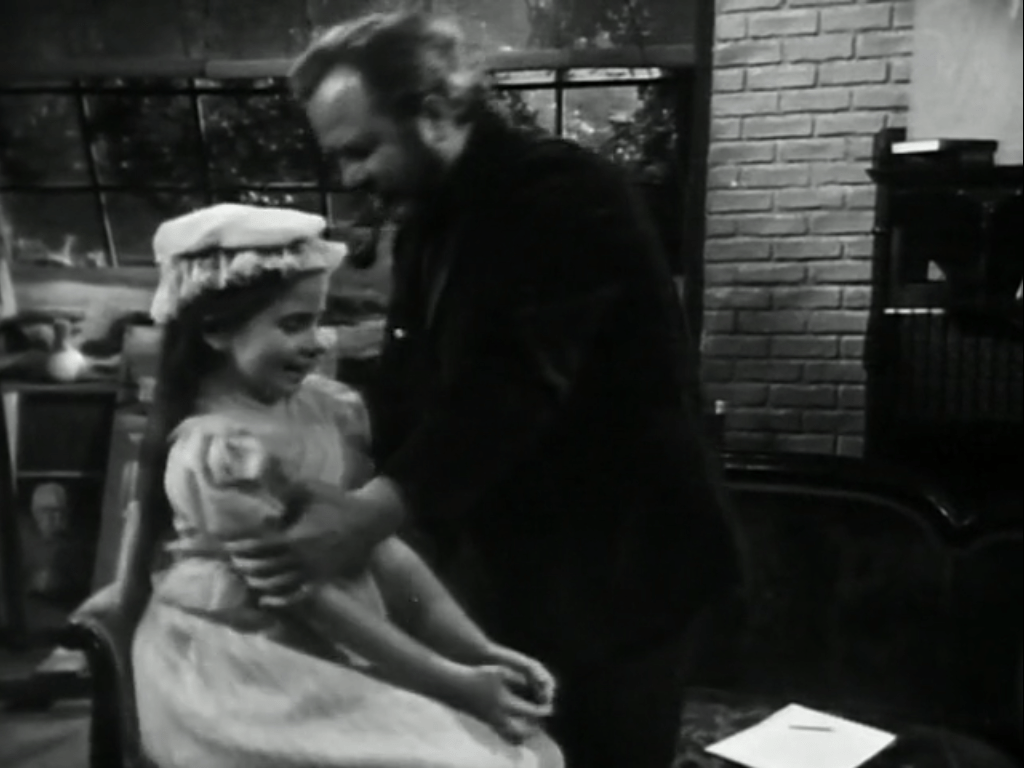
We cut to the Evans cottage. Sam is an artist, and is working. Sarah materializes in the living room. Sam had locked the door and Sarah won’t explain how she got in, but he seems to be delighted with her anyway. She is impressed with his paintings and asks him to paint a picture of her. He offers a drawing instead. When she agrees, he picks her up and sets her on a stool. She flashes a grin at being picked up. She asks if she can keep the drawing when he is done with it.
The most fun Sarah has had the whole time she’s been dead
Sam tells Sarah that her dress is very pretty. He then mentions that you don’t see many dresses in its style. She asks if that means he doesn’t like it. When Sam says that all he means is that it isn’t the sort of thing other little girls wear, she says she doesn’t play with other little girls so she doesn’t care what they wear. She seems to be getting worked up about this, so Sam calms her down with, “All right, all right, I see.” This little exchange gave my wife, Mrs Acilius, a laugh. Sarah may have been born in the same year as Jacob Grimm, but she is very much a nine year old girl.
While Sam draws Sarah, she steers the conversation to Maggie. She asks Sam if he looked for Maggie on the beach under Widow’s Hill. He says he’s looked everywhere he could. She repeats her suggestion that he look for her on the beach. He says he is sure he won’t find her there. She responds “You might, if you go there tonight.” Disturbed by this, Sam looks up, and finds that Sarah has vanished.
This surprises us almost as much as it surprises Sam. Sarah had made it clear that she very much wanted to keep the drawing, yet she disappears before Sam is finished. Evidently, it wasn’t within her power to stay.
Back in the cell, we see Maggie and hear her thoughts as she tries to remember Sarah’s riddle. Like Willie’s voiceover internal monologue in the opening scenes, Maggie’s goes on too long. We can see that Maggie is in an upsetting situation and understand why Sarah’s presence confuses and distracts her. That makes it clear she would have difficulty remembering the exact wording of the riddle, but we really don’t need to hear her go over every part of it.
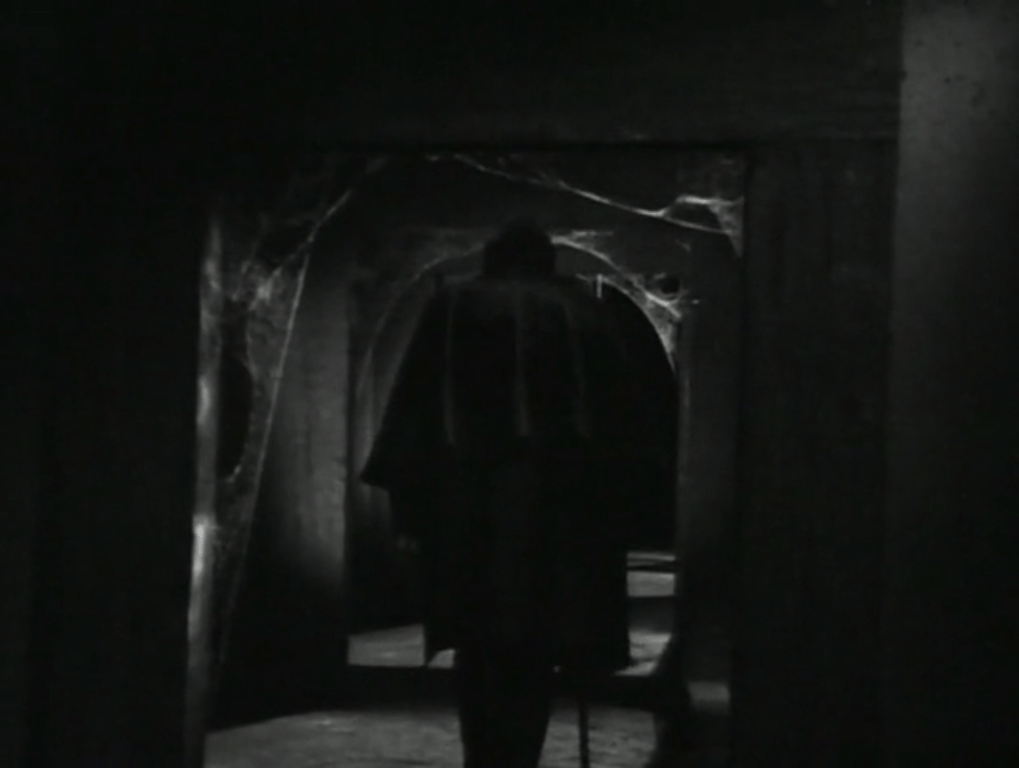
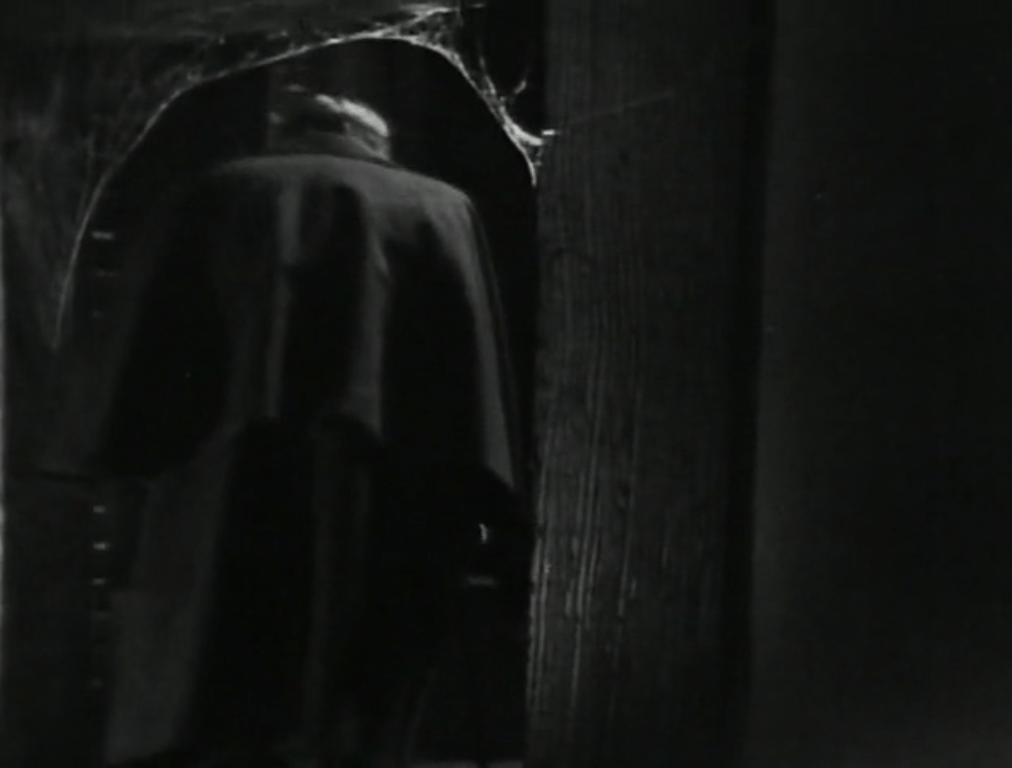
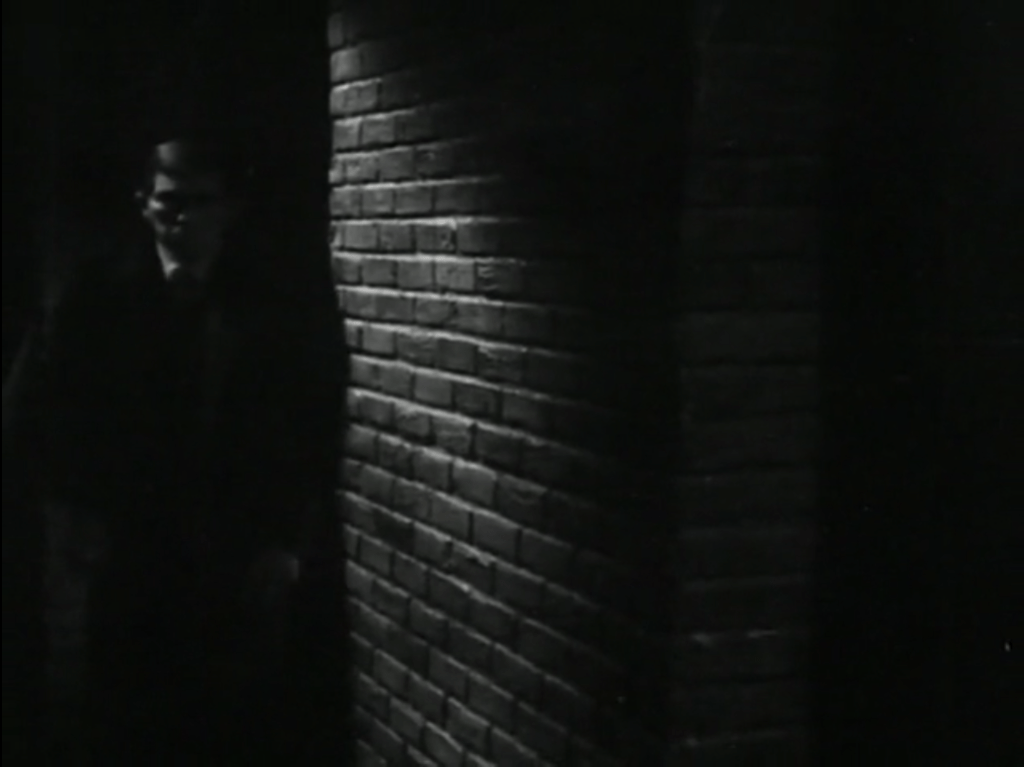
By the time Maggie finds the loose brick that triggers the opening of the secret panel, Barnabas is already rising from his coffin. We cut between Barnabas walking through the basement and Maggie struggling to open the panel. It may sound like we’re describing filler when we say that we see Barnabas traversing three distinct corridors between his coffin and Maggie’s cell, but it doesn’t feel that way. Not only do these shots build suspense as we wonder if Maggie will get out before he reaches her, but in Barnabas shown as a hunched, solitary figure in narrow spaces sketched in shades of gray we see the representative of a world bleak beyond endurance. We can see why the first serious feature film about a vampire, F. W. Murnau’s Nosferatu (1922), devoted so much screen time to showing Count Orlok skulking about the corridors of his castle.
First corridorSecond corridorThird corridor
Maggie crawls into the secret passage. She doesn’t close the panel behind her. Not only doesn’t Maggie know that Sarah is a ghost, she doesn’t know that Barnabas is Sarah’s brother. When Sarah says that not even her brother knows about the secret panel, she is telling us, but not Maggie, that Barnabas is unfamiliar with this way. We know that if Maggie had closed the panel, Barnabas wouldn’t have known where to look for her, and so we might yell at the screen urging her to do that. But since it is his house, she has to assume that he does know about the panel, and she knows that he might be at the door any second. So it is rational for her to forget the panel and use all of her time moving forward.
The gap between Maggie’s knowledge and ours again adds to the suspense as we watch her flee from Barnabas through the twisting passages beyond the panel. We only see one path, but the looks on the actors’ faces as they look from side to side tell us that there are several. Maggie is moving cautiously, choosing her way with care, the sensible thing to do if Barnabas is familiar with the passages. Since we know that it is new to him as it is to her, we want her simply to pick a path and run.
Maggie beholding the paths before her
Maggie finds two heavy doors, both of them apparently stuck. Barnabas looks around, seems bewildered, and takes a breath. He shouts a speech at Maggie, claiming that she has no chance of escape because he can hear her. He can’t hear much while he’s shouting, so we want her to take advantage of that and bash away at one of the doors during his speech.
Barnabas wondering at part of his house he never knew existedMaggie with two closed doors in front of her and an angry vampire behind her
This episode ends the 52nd week of Dark Shadows. When ABC* picked the series up in 1966, it gave executive producer Dan Curtis a 26 week commitment, carrying production to #130. After that, the network renewed it for the then-standard 13 week period. The first renewal carried them to #195, the second to this episode. Until just a couple of months ago, the ratings were so low that no one thought it was likely that it would get a third renewal. When the vampire was introduced in April, viewership started to pick up, preventing cancellation and requiring them to come up with a story that they could keep telling.
I do think we can see traces here and there of the original plan. The first part of the plan seems to have been to copy Bram Stoker’s Dracula far more thoroughly than they wound up doing.
The two female characters on the show who had or were about to have boyfriends when Barnabas was introduced were Maggie and Vicki, who are both seeing men who are cut out to be stout-hearted action heroes. The two female characters in Bram Stoker’s Dracula who had boyfriends were Lucy Westenra and Mina Murray, who were both seeing men who emerge as stout-hearted action heroes. Dracula feeds on Lucy, prompting several other people to band together to try to save her. Dr John Seward, MD, contacts his old Professor, the brilliant Abraham Van Helsing, to advise the group. Despite their best efforts, Lucy dies and rises as a vampire, the “Bloofer Lady” who feeds on the children of east London. Lucy’s boyfriend has to destroy her body to free her soul of the vampire curse.
If the show was about to be canceled, it would have been a favor to Kathryn Leigh Scott to have Maggie suffer Lucy’s fate. Going out with a splash like that would certainly have given her something to lead with as she looked for her next job. But once it was decided that the show would continue beyond #260, it was out of the question to lose a character as popular and versatile as Maggie. When the network ordered 65 more episodes, Maggie had to be saved.
The Van Helsing analogue was actually named on screen. In #242, the show’s equivalent of Dr John Seward, addled quack Dr Woodard, said that he was going to call in a specialist to consult on Maggie’s case, a Dr Hoffman, who is “one of the best men in the field.” We haven’t heard about this man since Dan Curtis found out the show was going to be renewed, suggesting that they’ve abandoned the idea to hew quite so closely to Dracula.
In Stoker’s novel, once Van Helsing has corrected the group’s knowledge deficits concerning vampires, Mina emerges as its leader. Attempting to be gallant, the men cut Mina out of their operations, with the result that Dracula escapes them and bites her. Mina is able to resist his influence so far that she can play a pivotal role in the Count’s final destruction.
The first time Dark Shadows modeled a storyline on Dracula, the menace was not a vampire, but undead fire witch Laura Murdoch Collins. In that arc, the men formed a group of stout-hearted heroes advised by Dr Peter Guthrie and led by well-meaning governess Vicki. Guthrie and Vicki were plainly Van Helsing and Mina. Laura killed Guthrie, so he can’t come back to help in the fight against Barnabas, but Vicki is still around, still the chief protagonist, and still the one likeliest to lead the opposition to a villain.
Indeed, Barnabas has expressed interest in Vicki as a replacement for Maggie, and in #233 he blurted out an obvious threat when he realized she was getting uncomfortably close to figuring out the truth about him. So, had Dark Shadows ended with this episode, it is likely that it would have ended with Vicki overcoming Barnabas’ power and driving a stake through his heart.
Of course, the vampire is the source of the ratings, and Vicki and Maggie are needed for future story development. So the makers of the show can’t use any of those plot elements. What in the world they can do is a question that does not, as yet, have a clear answer. So they have been stalling and stalling. Sooner or later, the stalling will have to end.
*The American Broadcasting Company, that is, not the Australian Broadcasting Corporation.
Today is only the second time we hear a voice announce a recast over the opening title. The first time was in #35, when David Ford took over the part of drunken artist Sam Evans from wildly incompetent actor Mark Allen. This time Robert Gerringer is taking over the part of addled quack Dr Woodard from Richard Woods. Woods only played the role twice, and neither time could he find a way to distract the audience from the ignorance of medicine that the writers showed in their scripts.
Gerringer’s lines don’t make much more sense than did the ones they dumped on Woods, but he acts up a storm. Woodard is examining Sam’s daughter Maggie Evans, The Nicest Girl in Town. Unknown to Sam or Woodard, vampire Barnabas Collins has been sucking Maggie’s blood. Woodard is firm with Maggie when she resists his examination. He seems to be somewhat on edge, just enough that we wonder if there is more to it than the difficulties we can see Maggie giving him. Perhaps he is thinking something he isn’t saying. Woods never managed to make us wonder if his version of the doctor was doing that.
When Woodard and Sam leave Maggie’s room, Woodard assumes an alarmed tone. He tells Sam that Maggie is on the point of death and needs a blood transfusion at once. By showing us that Woodard was concealing the true nature of his concern when he was with Maggie, Gerringer gives substance to our hopes that the character’s nonsensical words and deeds will turn out to be a screen hiding something interesting.
Maggie’s boyfriend, hardworking young fisherman Joe, joins Sam and Woodard. Woodard asks if either Sam or Joe has blood type A. Joe does. Woodard doesn’t ask about Rh factors or Joe’s medical history or anything else, he simply marches Joe into Maggie’s room and the bodily fluids start pumping right away. Joe holds Maggie’s hand at first, but her violent protests force him to let go.
Transfusion
In Bram Stoker’s Dracula, Professor Van Helsing and Dr John Seward give blood transfusions to the vampire’s victims. That novel was written in 1897, and blood types weren’t discovered until 1900, so Van Helsing and Seward take blood indiscriminately from all the men cooperating in the effort to defeat Dracula. Van Helsing is particularly enthusiastic when he learns that Arthur Holmwood has given blood to Lucy Westenra, because Arthur “is the lover of her!” Van Helsing is Dutch, and speaks in a vaguely comical broken English. Woodard doesn’t seem particularly excited that Joe is “the lover of her,” but audiences who had read the book will recognize the allusion.
At this point in the production of Dark Shadows, the tentative plan was that Dr Woodard would become something like the expert on paranormal dangers that Dr Peter Guthrie had been during the Phoenix storyline, and that Barnabas would be destroyed in episode 275. Like Stoker’s Dracula, the Phoenix arc had featured a group of stout-hearted men and one valiant young woman coming together to do battle with an undead menace. Dr Guthrie had been their Van Helsing, an expert from out of town who leapfrogs over some weaknesses in the evidence actually available to the protagonists to get them to the same level of understanding that the audience has been given. Also like Van Helsing, Guthrie is the first to realize that the one female member of the team is the key to the success of their efforts, and so he insists on putting her in situations the other men regard as too dangerous for her. As Mina had been instrumental in the destruction of Dracula, so well-meaning governess Vicki is the person who finally thwarts the plans of the Phoenix.
If Woodard and Vicki are going to destroy Barnabas in #275, we have to wonder what story the show will have to tell in #276. The only other plotline going at the moment is the blackmail of reclusive matriarch Liz by seagoing con man Jason McGuire, and that can’t continue indefinitely. Not only will Liz run out of things for Jason to take away from her, but Dennis Patrick, the actor playing Jason, will leave the show no later than the end of June. Since the end of June is when #275 will be airing, we can hardly expect Jason to take the show over after that time.
In fact, Jason is an in-betweener brought on the show to clear away the last non-paranormal plot elements left over from the period before the show became a supernatural thriller in December 1966. By the time he leaves, both the reason for Liz’ long self-immuration in the great house of Collinwood and the identity of Vicki’s parents are supposed to be laid bare for all to see. Neither of those secrets ever generated an interesting story, but as long as they are around it is at least theoretically possible that the show will become a conventional daytime soap opera again. Without them, they are altogether committed to the spook show route. Destroy Barnabas, and you just have to come up with yet another menace from beyond the grave.
I remember Gerringer’s acting style from the first time I saw Dark Shadows. That was back in the 90s, when it was on what was then called the SciFi Channel. He so perfectly represented the doctor characters on the soaps my mother used to watch when I was a kid twenty years before that seeing him in the middle of a story about a vampire told me everything about the strangeness of a conventional daytime serial switching to a horror theme. If that guy is the one to drive the stake through Barnabas’ heart, or if he is even part of the team that finishes him off, it will be a statement that the makers of Dark Shadows have decided to stop being silly and start imitating The Guiding Light.
My wife, Mrs Acilius, was particularly frustrated with the dialogue in this episode. As Maggie, Kathryn Leigh Scott does a good job with nonverbal communication creating the image of a reluctant patient trying to get out of her skin, but her lines consist chiefly of repeating whatever is said to her. The other members of the cast are equally effective at projecting concern for a loved one whose grave illness they don’t understand and can’t help, but their lines too are so heavily loaded with repetition that we started to suspect that Malcolm Marmorstein was writing for a cast of myna birds. In particular, Woodard’s lines to Sam in the living room repeat the word “shock” so many times that they start to sound like he’s stuttering.
The original choices for the roles of Sam, Joe, Dr Woodard, and Maggie. Photo by Bird Ecology Study Group
In his post about this episode, Danny Horn complains that there is not a single interesting still image in it. I agree with that, though I would say that the actors’ movements tell a story. Granted, it is a story that could have been told in a tiny fraction of the actual running time, but they deserve credit for holding the show together when the script gave them zero support.
Danny says that the episode would have been just as good if it were a radio show. Mrs Acilius says that it would have been “a thousand times better” than it is if it were a silent movie. Maybe they could compromise, and it could be presented with neither audio nor video, and the audience could spend the 22 minutes doing something else.
We begin with a chat between strange and troubled boy David Collins and his (vastly) older cousin, vampire Barnabas Collins. David has questions about the portrait of his ancestor Josette that long hung in the house Barnabas is now occupying. Barnabas assures him that he will hang it prominently once the house has been refurbished.
Yesterday, David was wandering from set to set moaning that he couldn’t feel the presence of Josette’s ghost. This was a clumsy way of addressing a question that is at the top of the minds of regular viewers. Josette’s ghost has been decisive in all the storylines on Dark Shadows for the six months prior to Barnabas’ arrival, and the house Barnabas has taken over is her stronghold. Though she can at moments erupt into the foreground with awesome power, as when she and the other ghosts scared crazed handyman Matthew Morgan to death in #126, she is usually a vague, wispy presence. It is unclear how or if she can survive contact with a menace as dynamic as a vampire.
Josette communicates with David through her portrait, and when she was recruiting a team to thwart the plans David’s mother, blonde fire witch Laura Murdoch Collins, had to burn him alive, she took possession of artist Sam Evans and made him paint pictures warning what Laura was up to. Now Barnabas has hired Sam and is sitting for a portrait that he will hang where Josette’s was long displayed. In #212, Barnabas looked at Josette’s portrait and said that the power it represented was ended, and David’s reactions yesterday suggested he was right.
Portraits are not Josette’s only means of communication. During the Laura storyline, David had a recurring nightmare that may have been in part the product of Josette’s intervention. Someone else has a nightmare today, and it is clearly a warning about Barnabas.
While Barnabas is sitting for Sam, he makes a series of remarks about Sam’s daughter Maggie, The Nicest Girl in Town. To those who know that he is a vampire, everything about Barnabas is creepy, but he lays such heavy emphasis on lines like “I believe her future is already assured” that it is hard to believe Sam isn’t alarmed. We dissolve from that sequence to Maggie in her bedroom* trying to get some sleep. That in turn dissolves to a dream sequence** in which Maggie sees herself in a coffin and screams. She then wakes up, still screaming.
Josette was able to use Sam as a medium, and to do so while he was in the front room of the same house where Maggie is sleeping. So those who remember the Laura storyline will see the nightmare as the opening gambit in Josette’s effort to oppose Barnabas, and will be anticipating her next move.
Between these two segments, we spend some time with seagoing con man Jason McGuire and his former associate, Barnabas’ sorely bedraggled blood thrall Willie Loomis. Reclusive matriarch Liz informs Jason that Willie has been living with and working for Barnabas. Jason had believed that Willie left town permanently several days earlier, and has no idea he is in any way connected with Barnabas. Liz wants to be rid of Willie. Jason likes to boast that he can control Willie, something we have never seen him succeed in doing, and assures her that he will be able to handle the situation.
Jason goes to the Old House and confronts Willie. He makes a number of sarcastic remarks questioning Willie’s masculinity, demands to know what kind of scam he is running on Barnabas, and grabs him by the lapels when Willie can tell him only that he is trying to lead a different sort of life. Jason is holding Willie and snarling at him when Barnabas shows up. Jason unhands Willie and is surprised at how meekly Willie complies with Barnabas’ command that he run an errand.
Barnabas catches Jason with his hands on his Willie
Barnabas tells Jason that he has spoken with Liz and that she has agreed to let him keep Willie. Jason tries to tell Barnabas about Willie’s past and boasts once more of his ability to control Willie. Barnabas cuts him off with “I can deal with him far more effectively than anyone.” That leaves Jason speechless.
In his post about this episode on Dark Shadows Every Day, Danny Horn tells us that the scene between Jason and Willie brought a memo from ABC’s Standards and Practices office. A censor named Bernardine McKenna was concerned that Jason’s lines might suggest a sexual relationship between Willie and Barnabas.***
McKenna’s memo raises some questions about Jason’s whole relationship with Willie. When Jason was first introduced, we occasionally saw him on the telephone talking to someone who was evidently important to his plans. Eventually he started calling this person “Willie.” After Willie appeared in person, we kept waiting to see what Jason wanted him to do. Jason’s only project is to blackmail Liz, and he doesn’t need any help with that. Not only did we never see Jason give Willie anything to do, but Willie continually caused him troubles that made life so unpleasant for Liz that she considered calling the police, a move that would would have brought Jason’s whole plan crashing down around his ears. So Jason’s decisions to bring Willie along and to keep him around were not motivated by any immediate need for his assistance.
A couple of times, Willie threatened to expose Jason’s own terrible secrets. But by the time Willie was recovering from Barnabas’ initial attacks on him, those threats didn’t seem to have much substance, and yet Jason insisted on keeping Willie around Collinwood and nursing him back to health. Jason’s scenes with Willie in his sickroom show enough traces of tenderness and genuine concern that there must be some depth to their relationship.
The original plan had been to name the character, not “Willie,” but “Chris.” I wonder if that would have given Bernadine McKenna more to worry about. If we’d listened to Jason on the telephone with a mysterious “Chris” who was in some kind of partnership with him, we might assume that “Chris” was his girlfriend. When Chris turned out to be Christopher, we would set that thought aside. But we might not have forgotten it entirely. When we were wondering what the connection is between the men, one of the possibilities we couldn’t quite exclude might have been that they had been lovers.
*This is the first time we see Maggie’s bedroom. The living room of the Evans cottage has been a frequent set from the earliest days of the show, but this addition of a second room augments its importance and confirms that Maggie will be a major character in the current storyline.
**We’ve heard characters talk about their dreams before, but this is the first time a dream is shown to us.
Parapsychologist Dr Guthrie visits blonde fire witch Laura Murdoch Collins in her cottage on the grounds of the estate of Collinwood. He tells her that his researches have led him to the conclusion that she is “The Undead” and that she poses a danger to her son, strange and troubled boy David. She replies that he is being preposterous, but she doesn’t deny anything he says.
Guthrie says that she is probably wondering why he has told her these things. The audience certainly is- Laura has already tried to cast a paralyzing spell on Guthrie, and can hardly be expected to grow more benevolent towards him now that she knows that he has figured out her nature and has told her he is “closing in on” her.
Guthrie explains to Laura that their meeting marks a significant moment in the history of the world- a scientist has come face to face with a being who has died and returned to walk the earth. He wants to learn from her, and offers to help her if she will stop trying to claim David. He tells her that an effort to bring science to bear on cases like hers “has been my life.” “What an interesting way to put it,” Laura responds, in her unforgettable sardonic tone. She dismisses his offer, and tells him he is powerless.
In a way, it’s too bad Laura doesn’t take an interest in what Guthrie might be able to do for her. That’s quite an idea, a scientist trying to help an undead being and to explore the realm of the supernatural thereby. It suggests the 1945 Universal movie The House of Dracula, in which a blood specialist treats Dracula for vampirism, with apparent success. That doctor then encounters the Wolf Man and Frankenstein’s monster. He attempts to treat them also, but things eventually go awry. The House of Dracula runs for 67 minutes; it might be interesting to develop a story like that in a daytime serial, where you have as much time as the audience and the network are willing to give you.
Guthrie is trying to organize a séance to contact Laura’s chief adversary, the ghost of Josette Collins. He tells hardworking young fisherman Joe* that they will have to recruit drunken artist Sam Evans to join them at the séance. Joe laughs at the thought of how Sam will react to such an invitation. Sam’s daughter, Maggie, is Joe’s girlfriend; Joe stops laughing and is a little bit scared when he thinks of Maggie’s likely reaction. But Guthrie insists that Sam’s participation is essential. Josette took possession of Sam to paint pictures that gave them some of their first and clearest warnings of what Laura might do to David, so he has already been one of her most powerful mediums. Joe agrees to ask him.
At the Evans cottage, Joe pitches Sam and Maggie on the séance. Sam at first finds the notion hard to take seriously. The more he thinks about it, the more convinced he becomes that Guthrie’s theories are correct and that it is his duty to participate. Maggie is dead set against her father having anything to do with Collinwood or the supernatural. She has worked on getting him to forget the paintings he made under Josette’s influence and his belief that Laura was responsible for the fire that injured his hands shortly after he painted them. As an Adult Child of an Alcoholic, Maggie is in the habit of heading Sam off when he’s on his way to do something weird. Usually Joe is her most reliable ally and greatest help in looking after her father. Today, she reluctantly gives in when Sam and Joe both think the séance is a good idea.
In the drawing room of the great house at Collinwood, Dr Guthrie is studying some documents. We see Laura staring into the fire in her cottage. Her eyes are superimposed over the image of Guthrie as he becomes ill.
Joe comes in and sees that Guthrie is struggling for breath. He asks Guthrie if he is all right. Guthrie complains of the heat. Since Joe is still wearing his heavy coat and looks perfectly comfortable, he ought to know that isn’t much of an explanation. He mentions that he has completed some tasks Guthrie asked him to perform. Guthrie has no idea what he’s talking about. When Laura attacked Guthrie in episodes 175 and 176, it was through a spell that hit him while he was in this same room. Then also, he had difficulty breathing during the attack and a gap in his memory afterward.
That time, well-meaning governess Vicki came into the drawing room and saw Guthrie suffering the effects of the attack. The attack abruptly ended. While Guthrie was recovering, David came back to the house and told him and Vicki that he had interrupted Laura a few minutes before while she was staring into the fire at her cottage. After David gave Vicki and Guthrie a full account of the incident, they sent him off to have dinner followed by two desserts- cake and ice cream.
That day, Vicki recognized the symptoms of Guthrie’s attack as the same those reclusive matriarch Liz exhibited after a confrontation with Laura and before she lapsed into a catatonic state from which she has not yet recovered. From this, Vicki concluded that David must have stopped Laura while she was in the process of casting the same spell on Guthrie that she earlier cast on Liz. Guthrie agreed with Vicki’s analysis, but was confident he could defend himself against any further spells Laura might cast. He never explained what his defense would be.
Whatever protection Guthrie thought he could give himself against Laura’s powers obviously isn’t working, at least not while he is alone. After Joe goes away, Laura resumes casting her spell.
While Guthrie struggles in the drawing room, David strolls into the foyer. The ghost of Josette manifests on the staircase above. She takes a few steps down towards him and points to the drawing room doors.
Josette sends David to rescue Dr Guthrie
David realizes Josette is telling him to go into that room at once. He obeys, and finds Dr Guthrie on the floor by the fireplace, apparently near death.
*Who is evidently fishing again. Months ago, Joe got a white-collar position in the offices of the cannery, a position he accepted only in order to make enough money to buy his own boat. Today David asks him when he will take him along on the boats, and Maggie mentions that he’d recently lost his watch in a mackerel net. They never told us that he’d gone back out, and indeed he was carrying papers back and forth from the office as recently as #174.
Maggie Evans, The Nicest Girl in Town, is worried about her father, drunken artist Sam. Maggie’s boyfriend, hardworking young fisherman Joe, is with Maggie at the Evans Cottage, waiting for Sam to come back from his current binge.
Maggie is particularly worried about Sam’s attitude towards a mysterious woman who has recently returned to town. Maggie doesn’t know who the woman is, but yesterday, Sam and the audience found out. She is Laura Collins, estranged wife of high-born ne’er-do-well Roger Collins. Laura is the other witness to an incident ten years ago that Roger paid Sam not to tell the police about. It was his guilt about that bribe that started Sam drinking in the first place, and he is terrified that his secret will come out. As Maggie and Joe talk about Sam, Sam is in the tavern with Roger, trying to figure out why Laura has come back to town.
Roger goes home to the great house of Collinwood and tells his sister, reclusive matriarch Liz, that Laura has come back to town. Liz wonders why Roger is afraid of Laura. Roger denies being afraid of her, and Liz loses interest in the question. She wonders what Laura wants. At the thought that Laura might want to see strange and troubled boy David, the son she shares with Roger, Liz expresses emphatic opposition. Liz thinks of Laura as a severely disturbed woman, and is convinced that seeing his mother would only harm David.
Sam returns to the Evans Cottage. Joe sees that he is massively drunk, and whispers an offer to Maggie to help her take care of him. She declines, saying that she has plenty of experience. Sam insists on starting a painting. Maggie can’t stop him, and goes to bed.
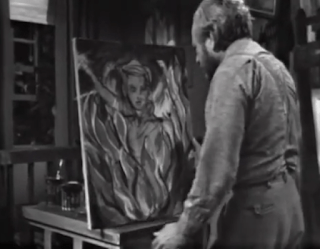
Sam lights a cigarette and stares raptly into the flame, as we saw Laura do yesterday. He then goes to the canvas and makes painterly motions with great rapidity.
The following morning, Maggie wakes Sam up. He lies passed out on the couch, a liquor bottle that had been mostly full the night before empty on the floor beside him. In response to his protests, she refuses to leave for work with him unconscious. On her way to make coffee for him, she sees the painting he did the night before. She remarks that it is not in any style she’s ever seen him use before, and he doesn’t remember a thing about it. It depicts a woman in flames. He reacts to the painting with horror.
Dark Shadows has already shown us portraits as powerful objects, even as a locus for the natural and supernatural. Just on Monday, the ghost of Josette Collins (which, like Maggie Evans, is played by Kathryn Leigh Scott) emerged from the portrait of Josette in the Old House and brought about the climax of a story arc that began in episode 38. Now we see where these eerie portraits come from.
We will see more portraits created by possessed artists in the years to come. Something else happens in this episode for the first time, but not the last. The bartender at The Blue Whale, who has been addressed variously as “Bill,” “Joe,” “Mike,” “Andy,” and “Punchy,” today answers to “Bob.” That’s the name they settle on, perhaps because the actor’s name is Bob O’Connell.
In these early months of Dark Shadows, we hear that all the money made in the town of Collinsport finds its way to the old dark house on the top of the hill, where it does nobody any good.
The house itself is full of examples of wealth going to waste. Each of the last few episodes have involved long treks through abandoned corridors and visits to forgotten rooms. Everywhere you turn in these dank spaces, years of accumulated dust bury vases, paintings, antique furniture, oriental rugs, and other apparently valuable objects.
The Collins family is headed by a woman who hasn’t left the house in eighteen years. Reclusive matriarch Liz shares her home with her brother Roger, a spectacularly irresponsible man who squandered his entire inheritance and now holds a position in the family business which seems to involve little or no work. It is difficult to imagine that they run a dynamic enterprise that is taking advantage of the economic boom of the 1960s.
At the same time, Liz seems to have a vigilant concern for the security of her employees. Her only household servant, gruff caretaker Matthew, often brings up the fact that she gave him a cottage on the grounds of the great estate and assured him he would have it for the rest of his life. When plant manager Bill Malloy comes to the house to ask Liz to approve the acquisition of some new machinery for the cannery, her first question is how many men will lose their jobs as a result of it. Only when he assures her that the answer is zero does she agree to the purchase. So we might imagine that the attitude of local wage-earners towards the Collinses will be two-fold- on the one hand, gratitude that they go out of their way to ensure that the people working for them keep what they have, but on the other frustration with their failure to create opportunities for them to move ahead at a time when working people everywhere else in the USA were experiencing the fastest rise in real incomes in the nation’s history.
The relationship between hardworking young fisherman Joe and flighty heiress Carolyn occasionally seems like it will dramatize this situation. Joe is a local boy, and like everyone else in town, he works for the Collinses. Liz has taken a liking to him, and wants him to marry her daughter and have a career as an executive with the firm. He would be glad to marry Carolyn, but is not interested in that career- he wants to buy his own fishing boat and build his own business around it. Liz keeps trying to pull him deeper into her family’s firm, but he keeps insisting on his plan to go his own way. Joe mentions a friend with whom he wants to go into partnership. We never see this friend or anyone else who is working with Joe, and Carolyn doesn’t show the slightest interest in Joe’s plans. Since he doesn’t have anyone to talk to about his ideas, beyond a couple of scenes when he shakes his head at Liz and says “I’m sorry, Mrs Stoddard, but my mind’s made up,” the story of his attempt to diversify Collinsport’s economy doesn’t go anywhere. Earlier this week, the Joe/ Carolyn relationship met its long-awaited demise.
Joe has moved on to a relationship with Maggie Evans, The Nicest Girl in Town. The daughter of drunken artist Sam Evans, Maggie runs the restaurant in the Collinsport Inn. She and Joe are representatives of Collinsport’s working class. During their first date, Maggie demonstrated an encyclopedic knowledge of sail-rigging, which may not be the most useful thing for a commercial fisherman in the age of diesel, but her interest in the sea raises our hopes that she might be a partner to Joe in his ambitions. Together, they might show us what it has meant for the town that the Collinses control so much wealth and do so little with it.
In a comment on Danny Horn’s blog Dark Shadows Every Day, I mentioned another way the show could have done more with this theme. I imagined that they might have expanded the part played by the only African American actor to deliver lines on Dark Shadows, Beverly Hope Atkinson.
The opportunities they missed came into view in episode 563, when Beverly Hope Atkinson appears as the unnamed nurse who keeps Nicholas Blair out of Joe’s hospital room but lets Maggie in. Unnamed Nurse lights up when she sees Maggie and greets her by name; they seem to be old friends.
In the first 42 weeks of the show, when the supernatural was in the background and the stories were slow, it would have been easy to have a couple of tea party scenes at the Evans cottage where Maggie and her lifelong friend, Unnamed Nurse, recap whatever is going on. Those scenes could have led to a whole exploration of the tension between the working-class people in the village and the jerks in the big house on the hill. That in turn could have led to the introduction of Unnamed Nurse’s family, headed by Unnamed’s parents, Mr and Mrs Nurse, including her brothers, Young Mr Nurse and Master Nurse, and her sister, Miss Nurse. We could then have seen the ancestors of the Nurse family in each of the flashback segments and analogues of them in Parallel Time.
I try to keep my contributions to Dark Shadows fanfic modest, so I didn’t try to think up a new name for Unnamed Nurse. My point is that the makers of the show did not need any more sets or many more characters to create a much more spacious world in the imaginations of the audience. The Evans cottage by itself, as an instance of a working-class home in Collinsport, is almost enough to make us think of a whole town of people teeming with ambitions, resentments, plans, and frustrations. Just a few small scenes there shedding light on some underused themes could have got us the rest of the way.
Another character who brings the Collinses’ deficiencies as commercial leaders of Collinsport into view is dashing action hero Burke Devlin. Himself born into Collinsport’s poorest class, Burke has gone away and somehow made himself very rich. The whole time he was in Collinsport he was penniless. He left town when he was sent to prison. Only five years after his release from prison, he is a millionaire many times over, in a position to buy up the Collinses’ debts and claim all of their assets. The show has dwelt on this timeline often enough that they have started making awkward attempts to explain how he got so rich so quickly. But it seems that we are supposed to feel that it was simply getting clear of Collinsport that opened the doors to wealth for him. He went to South America, he went to New York, he went to an oil field, he went someplace, but all that really matters is that he went far from the stifling influence of the Collinses and their gloomy house.
Now, Burke is moving to destroy the Collinses and supplant them at the head of local industry. Today, he and his lawyer meet with some of the key men from the Collins cannery and fishing fleet. He wants to recruit them to work for a competing firm he is buying. When the lawyer tells him the men may be too loyal to Liz to take his offer, Burke recites a list of the tired cliches that wealthy villains spout when boasting to their henchmen of the power their money gives them: “Money talks. Money buys loyalty. Everyone has their price. Name it and you can buy them. Some just come a little higher than others, that’s all, but everyone is for sale.” Too bad Cabaret didn’t get to Broadway until three weeks after this episode was broadcast, or he might have closed with a few bars of “Money Makes the World Go Around.”
The men are offended when Burke says he wants them to leave the Collinses and come to work for him. They pride themselves on their loyalty to the Collinses. If they feel that way, it’s a mystery why they agreed to come to a meeting with Burke in the first place- everyone in town knows about his vendetta against the Collinses. They start to leave, but stay long enough to hear Burke offer them higher wages than the Collinses can pay, and a profit-sharing plan.
The most senior of the men present, Amos Fitch, stops by the house to tell Liz and Roger about the meeting. Apparently the other men are more rational economic actors than Amos, and they are considering Burke’s offer.
After the meeting has broken up, Burke spends a few more minutes expounding to his lawyer on his theme that anyone will do anything if you dangle enough money in front of them. He interrupts himself before he can literally say that all people are whores and gives the lawyer a check, telling him that it’s always good to have some extra loyalty around. Apparently he decided that leaving a two-dollar bill on the night-stand might be too subtle. The lawyer reacts with distaste to Burke’s crassness, but takes the check.
Burke’s first attempt to buy someone’s loyalty took place all the way back in episode 3. He met Joe in the local tavern and offered him enough money to buy a fishing boat in return for information on the Collinses. When Joe refused, Burke told him that he himself got his start when a strange man approached him in a sleazy bar and offered him a lot of money to do something he wasn’t very specific about. He accepted, and that led him directly to great riches. That’s wonderful career advice, “A guy in a bar flashes some dough, you don’t ask no questions, honey, just leave with him.” Sounds like a guaranteed path to success. Anyway, it’s obvious in that one that Burke is trying to lure Joe into something dishonorable. We already care about Joe, so if he were to be tempted we would be in suspense until he proved his uprightness.
Contrast Burke’s attempt to buy Joe’s services back then with today’s attempt to hire this group. We’ve never seen or even heard of any of the men whom Burke is trying to lure. So if the conflict over control of the sardine-packing business is a test of their moral rectitude, it’s none of our concern. On the other hand, if it were a choice between a prosperous future for the town that does not include the Collins family or a stagnant future that does, there might be real suspense.
The Collinses are our point of view characters and the story cannot continue if they are thoroughly defeated, so if we enjoy watching the show we will root for them no matter how strong a case their antagonist may make for his position. On the other hand, we do care about Maggie and Joe, and are ready to care about characters who are friends of theirs. Therefore, if we see that a plan will be good for the working people in town, it won’t be easy for us to hope Liz and Roger will foil it. If the show can put us in that situation, we will feel suspense as we watch the events of the story and look for a way to resolve the tension that our mixed feelings have created. That’s how every thriller works- we may want the good guy to beat the bad guy eventually, but not until we’re done enjoying the contest between them.
Think again about Burke’s temptation of Joe in episode 3. Joe earns a few points with the audience by rejecting Burke’s offer out of hand. If he’d considered it, we would have paid attention to him until he made his decision, but only to him- a temptation story works only if the person or people being tempted find themselves isolated from everyone else. If he ultimately rejected the offer, the story ends and leads nowhere. If he’d accepted it, we would be disappointed in him and lose interest in his subsequent doings. He wouldn’t become interesting again until he either went through a redemption story, which would again tend to isolate him from the rest of the cast, or became a villain, which isn’t what they want the character for right now. But if, instead of a moral test, he had been presented with a plausible business decision, we could have had a story that would have given us a virtual tour of Collinsport and given us a feeling that we know the place, even if we didn’t actually see any new sets.
So that’s why I wish Dark Shadows had done more with the relationship between the Collinses and the rest of Collinsport. Not that I suppose the writers had deep political and sociological insights that I long to have heard, but that putting your characters in a bigger world allows you to tell bigger stories.





 Dark Shadows Commentary
