Episode 949: Not that Quentin Collins

Ten year old Amy Jennings is at home in the great house on the estate of Collinwood. Evidently she’s in a literal mood- she’s in the drawing room, so she’s drawing. Heiress Carolyn Collins Stoddard sees Amy’s work and asks why she is doing it. Amy says she thinks the design is “pretty”; Carolyn replies that “pretty” is the last thing she would call it. That may seem rather rude, but as Amy hasn’t been seen since #912 I suppose she’ll take what she can get.

The design is one which on Dark Shadows is called simply a Naga. It is the secret emblem of a secret cult serving the Leviathan People, a race of Elder Gods. Secret cultist Megan Todd wears the Naga on a large pendant around her neck; Megan’s husband, secret cultist Philip, wears it on a shining ring; Carolyn’s mother, secret cultist Elizabeth Collins Stoddard, wears it as an oversized broach. Amy herself is a secret member of the secret cult, but she hasn’t yet acquired any conspicuous jewelry emblazoned with the secret symbol, leaving her to do her own artwork. Carolyn wonders aloud why so many people are so preoccupied with the design.

Quentin Collins enters. Amy is terrified. Starting in December 1968, Quentin’s ghost haunted Collinwood. By March, the house was uninhabitable and strange and troubled boy David Collins was near death. Old world gentleman Barnabas Collins tried some mumbo-jumbo in hopes of communicating with Quentin; he came unstuck in time and found himself in the year 1897, where he remained for eight months. While Barnabas was flailing about in the late Victorian era, time continued to pass in 1969, and Quentin’s obsession of David finally killed him in September. But a sequence of events with which Barnabas had a tenuous connection changed the circumstances on the night in September 1897 when Quentin originally died, causing him to survive. That night, as it happened, was exactly 72 years before David’s death. On Dark Shadows, anniversaries have the power that laws of nature have in our world, so that caused the haunting to break and David to come back to life. Due to a series of spells cast on him during Barnabas’ sojourn in the past, Quentin is still alive and still apparently in his late twenties in 1970. But the haunting still happened between December 1968 and September 1969, and everyone who lived through it still remembers it.

Quentin has introduced himself to Carolyn as his own great-grandson. Since Carolyn never actually saw his ghost, she is willing to accept this. But Amy had more dealings with the ghost than anyone but David, and it is obvious to her that they are one and the same. She clings to Carolyn.
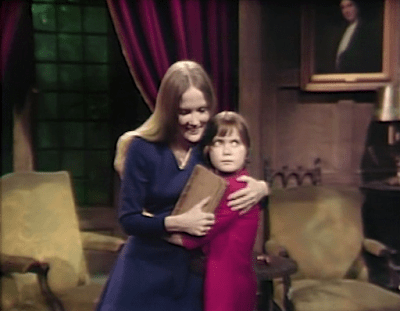
Amy knows a Quentin when she sees one. Screenshot by Dark Shadows Before I Die.

Carolyn laughs at Amy’s fear and tells her that this Quentin is not the ghost, but is “a cousin of ours.” This is intriguing to regular viewers. It was during the 1897 segment that the audience learned that Quentin was the great-grandfather of Amy and her brother Chris, and just a few weeks ago that Chris learned about that relationship. It is through their descent from Quentin that Amy and Chris are cousins to Carolyn. So if Amy knows she is a Collins, she must have been told that the ghost that tormented her and David was that of her great-grandfather. A scene in which someone gave her that information might have been a good use of Denise Nickerson’s considerable acting talent, but they didn’t bother to produce one.

Quentin tells Carolyn to leave him alone with Amy. Still chuckling, she complies. Once they are alone in the drawing room, Quentin kneels and touches Amy’s face, assuring her that he is “not that Quentin Collins.” David Selby brought immense charm to the role of Quentin, so this scene isn’t as revolting as it might have been, but it is still pretty bad, and we can’t be surprised that Amy is not satisfied.

Amy goes to the village of Collinsport to seek guidance from her spiritual advisor. He is a shape-shifting monster from beyond space and time who usually takes the form of a very tall young man. When he first assumed that form, he invited people to “Call me Jabe,” but no one did. They call him “Jeb” instead, and he answers to it.

Jabe lives in a room above Megan and Philip’s antique shop, and when Amy enters the shop she finds him looking after the place. Apparently shape-shifting monsters from beyond space and time aren’t above doing a little work in retail now and then. She tells Jabe about her encounter with Quentin, and then tells him about a dream she had. In the dream, she went into the long-disused room where she and David first met Quentin. Quentin’s theme song, a sickly little waltz, was playing; she exclaims “It was terrible!” Longtime viewers know the feeling. The tune played incessantly during the “Haunting of Collinwood” period, and when they went back to 1897 characters kept complaining to the living Quentin that he was making them miserable by playing it on his phonograph all the time.

In the dream, Quentin appeared to Amy wearing the nineteenth century clothing and the angry scowl that he wore when he was a ghost. But when he was a ghost, he never spoke words the audience could hear. The only exception was a dream sequence in #767, when Quentin’s ghost spoke to David. That was also the only other dream sequence to be presented as this one is, in flashback as the dreamer is recounting it after the fact. That sequence marked a watershed, the first attempt to explain how Quentin the cranky ghost emerged from Quentin the charming scoundrel we had got to know in the 1897 segment.

This episode, also, has to do with the relationship between these two iterations of Quentin. Amy tells Jabe that Quentin’s ghost in the dream warned her against him by name, and says that she is therefore convinced that the living man she met in the drawing room today is in some way identical to the ghost who haunted the house for those ten months. Amy’s dream marks the final appearance of Quentin’s ghost, but we can see the ghost will not be forgotten.

A state police investigator named Lawrence Guthrie is in town looking into two murders Jabe has committed, those of Carolyn’s father Paul and of a law enforcement officer whose gravestone revealed that his given name was “Sheriff Davenport” (we never learn what Mr Davenport’s title was.) Jabe orders Philip to kill Guthrie. Philip calls Guthrie and asks him to come to the antique shop when Jabe will be out. Once Guthrie is there, Philip tells him that the upstairs room where Jabe stays is an important part of the story of the murders. He shows Guthrie into the room. He stays outside, and locks Guthrie in. Guthrie encounters Jabe there in his true form; Jabe kills him. This is quite effectively handled. My wife, Mrs Acilius, was completely caught off guard by the killing. She believed Philip really was trying to break free of the Leviathan cult, and wondered what Guthrie was supposed to find in the room.

Neither Jabe nor Philip is an especially well-developed character, but Christopher Bernau and Christopher Pennock were both fine actors, and they play off each other very well today. It is a tribute to their performances that Guthrie’s death scene comes as a surprise.

At the end, Quentin is at Collinwood trying to tell Carolyn that it was Jabe who killed her father and Mr S. Davenport. Inexplicably, Carolyn is interested in dating Jabe, and is unwilling to listen to this. Jabe bursts in and announces that there has been another murder, that the murderer is in custody, and that he has confessed to it and to the killings of Paul and Sheriff. That murderer, Jabe says, is Philip. That’s another surprise- after the murder of Guthrie, Jabe did tell Philip that he had another task to perform, and once we hear that he has confessed to the killings it makes perfect sense that that would have been what Jabe meant. But I don’t think anyone could have predicted it. It makes for a strong ending.

Danny Horn’s post about this episode on his great blog Dark Shadows Every Day is a lovely little bit of fanfic proceeding from the assumption that Lawrence Guthrie is the brother of Dr Peter Guthrie, the parapsychologist whom undead blonde fire witch Laura Murdoch Collins killed in March 1967.

The closing credits again misspell writer Violet Welles’ name as “Wells.” They started doing that last week, around the same time the misspelling of wardrobe house Ohrbach’s as “Orhbach’s,” a frequent goof in the show’s first year, reappeared after a long absence.

Episode 357: Hit the blood

Mad scientist Julia Hoffman must hide her notebook from vampire Barnabas Collins and Barnabas’ blood thrall, his distant cousin Carolyn. The notebook documents Barnabas’ vampirism, and he does not want it to fall into the hands of the authorities. Once he gets hold of it, he plans to kill Julia.

The last time Dark Shadows devoted as much story time to attempts to hide and find an object as they have to this notebook was when high-born ne’er-do-well Roger Collins was frantically trying to hide local man Burke Devlin’s filigreed fountain pen, a story that dragged on from August to November of 1966. Few remember that storyline fondly, but at least the pen was a unique piece of evidence that might connect Roger to a homicide. The notebook is less satisfactory as a focus of attention, since there is nothing unique about it- Julia could easily have written a hundred documents detailing Barnabas’ secret and stashed them all over the world, and for all Barnabas knows she may have done. There are several strong episodes during this period, but the inadequacy of the notebook as a MacGuffin, combined with the fact that Julia could at any moment hop in her car and drive someplace where Barnabas wouldn’t be able to hurt her, prevents any momentum carrying over from day to day.

There are two important things about this installment. It is the first episode written chiefly by Sam Hall,* who will become far and away the most important member of Dark Shadows‘ writing staff. Hall would write hundreds of episodes, right up to the final one, would write the two theatrical features based on the show that were produced in the early 1970s, and would stick with producer Dan Curtis for years afterward, even contributing a script to the ill-fated 1991 primetime reboot of Dark Shadows. The husband of Grayson Hall, who played Julia, he would develop the show into something as different from its November 1967 incarnation as that version is from the show that premiered in June 1966.

On his blog Dark Shadows Every Day, Danny Horn argued that Hall’s contribution was to see Dark Shadows as, first and foremost, a “mashup” of various stories. The example he gives in his post about this episode are the scenes in the office of Tony Peterson, a local attorney whom Julia has hired to keep the notebook locked up in his safe. Tony is played by Jerry Lacy, who in the 1960s and 1970s was chiefly known for his Humphrey Bogart imitation. He would do that imitation on Broadway in 1969 in Woody Allen’s Play It Again, Sam and again in the 1972 film version of that play; here he is doing it in a 1980 commercial for the Long Beach California Press-Telegram.

In the scenes Danny focuses on, Mr Lacy imitates Bogart as Sam Spade or Philip Marlowe meeting a succession of mysterious women in his office. Grayson Hall plays Julia as a frightened and barely coherent client and Nancy Barrett plays Carolyn as the blonde you’d be a fool to trust, even if she does have a pair of gams that won’t quit. They’re all having a great time with their pastiche of The Maltese Falcon, The Big Sleep, and other staples of the Late Late Show.

Carolyn fingers the notebook. Screenshot by Dark Shadows Before I Die.

I do have to demur from Danny’s claim that Hall pioneered Dark Shadows as a mashup. It was that from #1, when Jane Eyre met the Count of Monte Cristo and they both found Art Wallace trying to remake a script he’d already sold to television twice. Nor is he the first to mash up disparate genres. The story of Burke’s fountain pen led into a police procedural that merged with a ghost story; Burke’s typically soapy conflict with Roger dissolved into the story of Roger’s ex-wife, undead fire witch Laura Murdoch Collins, a story which was Dark Shadows’ first and most detailed adaptation of Dracula. The difference in Hall’s approach to mashups is that always before, one of the genres was Gothic melodrama. Today, a vampire story is meeting a film noir, and there are some elements of conventional daytime soap opera in the margins. Hall is letting go of Dan Curtis’ original idea of chasing viewers who read Gothic romances.

We get a clue as to what that might mean for the existing characters when Tony asks Julia if she is afraid of Roger Collins. Julia laughs loud and long at the idea that Roger is any kind of danger. For the first 25 weeks, Roger was indeed a deadly menace, but ever since Laura came through he has been reduced to occasional comic relief. Viewers who find a reminder of Burke’s fountain pen in the business with the notebook will see that even the villainous early Roger is a minor threat compared to the supernatural force Barnabas represents. So we are not to assume that any character or theme surviving from the show’s original conception is safe.

*The credits on screen say Gordon Russell wrote it, but evidently the paperwork from the show demonstrates that Hall did. Also, some of last week’s episodes sounded and felt as much like Hall’s work as this one does, but none of the experts tries to credit him with those, so I’ll defer to the consensus and say that while his influence may have been visible some days ago, this one marks his debut on Dark Shadows as the principal author of a teleplay.

Episode 356: The clock is running

Yesterday, mad scientist Julia Hoffman discovered that vampire Barnabas had sent his distant cousin and devoted blood thrall Carolyn to steal the notebook in which she recorded Barnabas’ secrets. Julia knew that this meant Barnabas had decided to kill her, and that only by keeping the notebook hidden could she save herself.

At the beginning of today’s episode, Julia hides the notebook inside the clock in the foyer of the great house of Collinwood. At the end, Carolyn notices that the clock has stopped chiming. The foyer clock is a very impressive piece of property, and it’s always nice when it gets screen time.

Fine clock. Screenshot by Dark Shadows Before I Die.

Episode 206: Hey, it’s Big Man

Villains on soap operas can never be quite as destructive as they at first seem they will be, and heroes can never be quite as effective. To catch on, villains and heroes have to seem like they are about to take swift action that will have far-reaching and permanent effects on many characters and storylines. Yet the genre requires stories that go on indefinitely, so that no soap can long accommodate a truly dynamic character.

This point was dramatized in Friday’s episode. The chief villain of the moment, seagoing con man Jason McGuire, stood in front of some candles, placed to make him look like he was the Devil with long, fiery horns. Seconds after this image of Jason, his henchman Willie loses interest in him and wanders off, first listening to a lecture from a nine year old boy, then becoming obsessed with an oil painting. They aren’t making Devils the way they used to.

Jason and Willie look at the portrait of Jeremiah Collins

Today, dashing action hero Burke Devlin goes to the great house of Collinwood and confronts Willie. Well-meaning governess Vicki asks Burke why he wants to defend the ancient and esteemed Collins family from Willie and Jason if the Collinses are his enemies. He gives a flip answer to her, and is equally unable to explain himself to reclusive matriarch Liz. Regular viewers remember that the “Revenge of Burke Devlin” storyline never really led to anything very interesting, and that last week the show formally gave up on it. Without it, Burke has nothing to do. So, if the character can’t keep busy as the Collinses’ nemesis, he may as well try to justify his place in the cast with a turn as their protector.

In the foyer of Collinwood, Burke orders Willie to leave Vicki alone. Willie taunts him, and Burke picks him up and holds him with his back against the great clock. Vicki and Liz become upset, demanding that Burke let Willie go. Willie himself remains collected. After Burke releases him, Willie goes to his room, and the ladies scold Burke further. He doesn’t appear to have accomplished a thing.

Willie, off his feet but undisturbed

This is John Karlen’s first episode as Willie Loomis. His interpretation of the character is poles apart from that of James Hall, who played Willie in his previous five appearances. When I was trying to get screenshots to illustrate the moods of Hall’s Willie, I found that I had an extremely difficult task on my hands. His face would fluctuate wildly, showing a mask of calculated menace for a few seconds, then a flash of white-hot rage for a tenth of a second, then sinking into utter depression for a moment before turning to a nasty sneer. These expressions followed each other in such rapid succession it was almost impossible to catch the one I set out to get. The overall impression Hall creates is of a man driven by desperate, unreasoning emotions, lashing out in violence at everyone around him because of the chaos inside himself.

Karlen’s Willie is just as dangerous as Hall’s, but he is as composed as Hall’s Willie was frantic. At rise, he is staring at the portrait of Barnabas Collins, studying the baubles Barnabas is wearing. When housekeeper Mrs Johnson enters, Willie asks her about the Collins family jewels. When she uncharacteristically manages to be less than totally indiscreet, he shows considerably more cleverness and infinitely more calmness than Hall’s Willie ever did in maneuvering her to the subject again. If Hall’s Willie was a rabid dog charging heedless in every direction, Karlen’s is a deliberate hunter, acting coolly and undaunted by resistance.

Hall played Willie with a lighter Mississippi accent than he uses in real life, while the Brooklyn-born Karlen assumes a vaguely Southern accent in parts of this episode. That trace of Hall’s influence will remain for some months- eventually Willie will become a Brooklynite, but between now and then Karlen’s accent will go to some pretty weird places.

This was also the first episode of Dark Shadows which ABC suggested its affiliates broadcast at 3:30 PM. It would not return to 4:00 until 15 July 1968. When the core demographic of the show’s audience shifts from housewives and the chronically ill to school-age kids, as will happen quite soon, this earlier time slot will present a major problem. Those kids are now in their 60s, and they usually begin their reminiscences of Dark Shadows with “I used to run home from school to see it!” If school let out at 3:00 and the TV set at home took as long to warm up as most of them did in those days, you’d have to run pretty fast to be sure to catch the opening teaser even if you lived nearby.

Episode 47: Three calls for the ghosts of Collinwood, and none for me

Carolyn finds her mother playing the piano in the drawing room. They have a very sweet conversation about the good times they had when Carolyn was growing up. Liz laughs when her daughter calls her a “bit of a kook.”

Carolyn wants to talk about Roger and Bill Malloy; Liz doesn’t, but can’t help listening when Carolyn tells her that Roger had declared that he wouldn’t be anyone’s sacrificial lamb. Liz is troubled by what Bill had told her about Roger and the manslaughter charge that sent Burke Devlin to prison ten years before, and wonders if the sacrificial lamb has been led to the altar.

Screenshot by Dark Shadows Before I Die

In this scene between Liz and Carolyn, we see a relationship we can care about. In the concern the two women have for Roger, we can see their wish that he would just be part of the good times, not a source of heartache.

Roger is in his office, where Bill had told him, Sam Evans, and Burke he wanted to meet them at 11 PM sharp. It’s 11:30 when we first see the three of them sitting around wondering where Bill is. Burke wants to keep waiting, the others decide to leave. Roger tells Burke that he wants to give him his pen back, feels for it in his pocket, and says he must have left it at home.

The three men in the office don’t have anything interesting to do today. They mention that they’ve spent their time talking about the weather and the price of sardines; it’s a wonder that three New England men with nothing in particular to say to each other on an August evening wouldn’t talk about the Red Sox, but I suppose the club had a bad enough season in 1966 that it would just have added to the gloom.

Roger comes home, apparently quite happy that Bill never showed up and the meeting ended without any new information for Burke. Liz confronts him in the drawing room. She tells him that Bill had told her he thought Roger, not Burke, was responsible for the manslaughter ten years ago, and demands Roger tell her the truth. He emphatically denies Bill’s charges. For good measure, he adds more lies, denying that Bill had said the same thing to him. Liz leaves him alone in the drawing room. Out of her sight, he looks stricken.

In yesterday’s episode, the clock in the foyer at Collinwood chimed at 10:10 and again at 10:30 pm. In today’s, it chimes at 11:10 and 11:30. We saw the hands on the clock each time, and today Carolyn even says that it is 11:10 immediately before it chimes. So it isn’t a blooper- they really want us to think that the clock chimes at 10 minutes and 30 minutes after the hour. That’s just a weird thing to set your clock to do, is what I’m saying. Staying home for 18 years isn’t the only kooky thing about Liz.