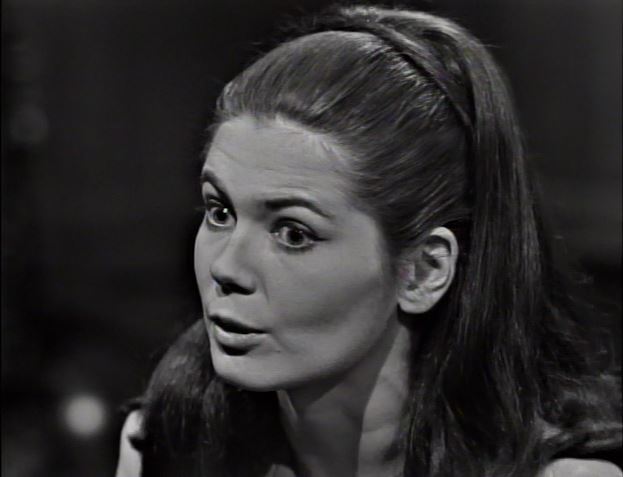
Episode 299: When darkness falls

Vampire Barnabas Collins creeps up on well-meaning governess Vicki from behind. He touches her neck, and she is startled.
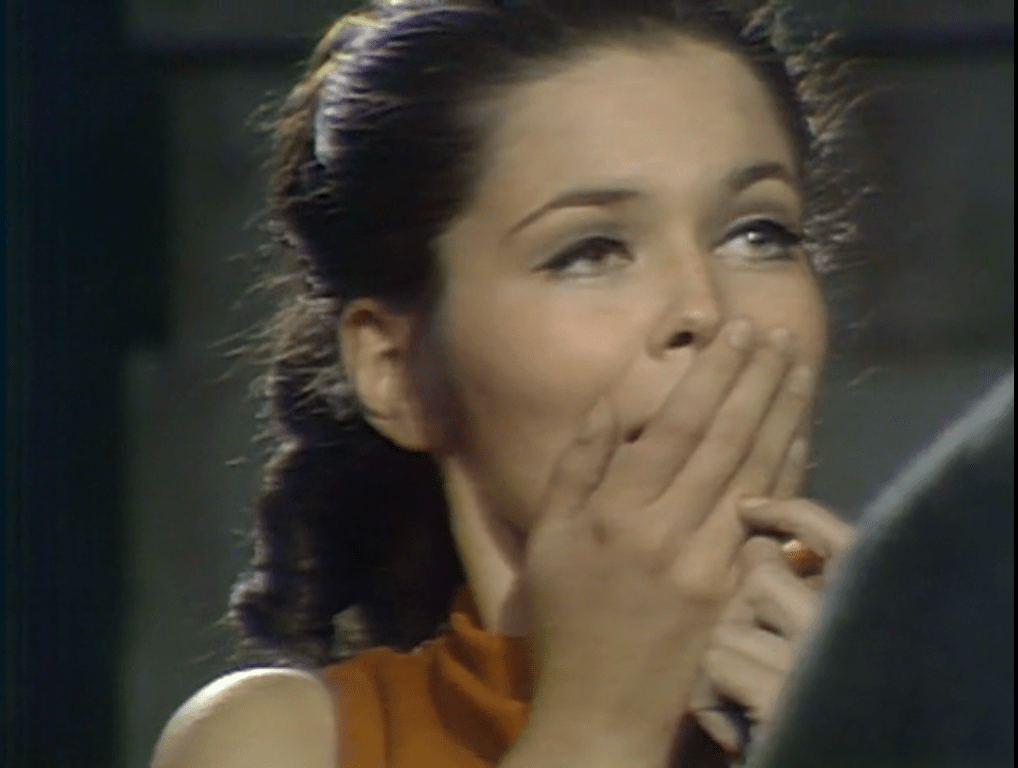
Stifling a giggle

This scene plays twice. First, before the opening title sequence, then again immediately after. The first time around, Vicki stifles a giggle when she sees Barnabas. The second, she seems frightened.
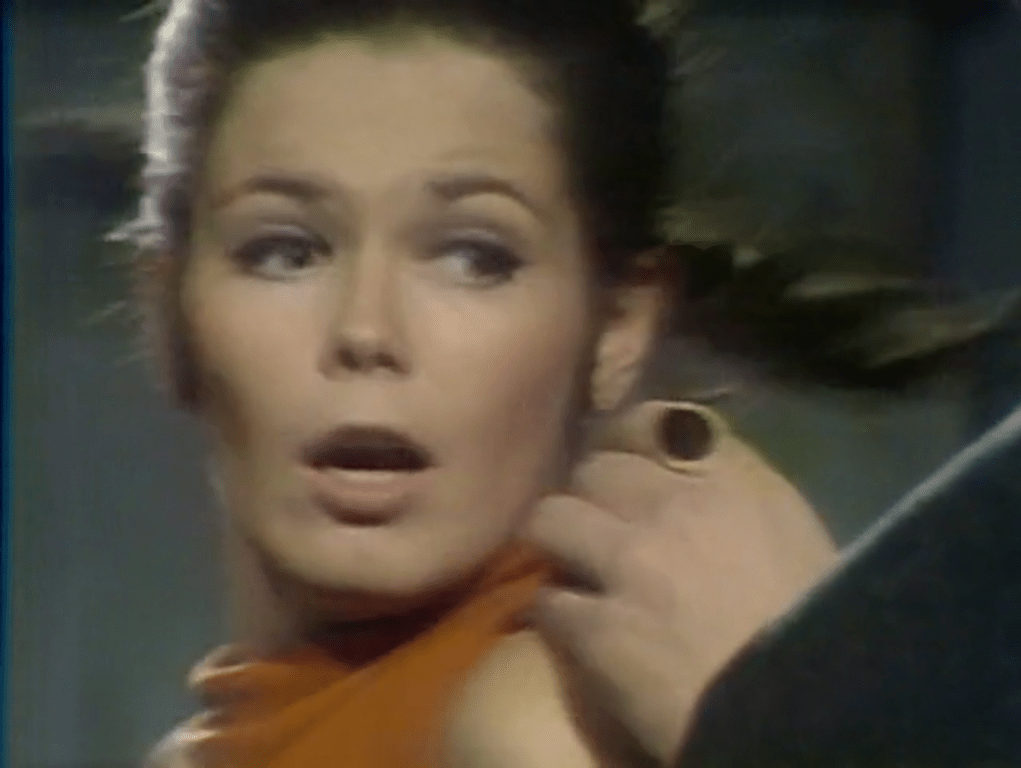
Frightened

Barnabas does not bite Vicki. He apologizes for startling her. She says that no apology is needed, and she stands very close to him. They talk about the Moon and the night and about what incredible romantics they both are.

Incredible romantics

In #285 and #286, Vicki contrived to get Barnabas to invite her to spend the night in his house. In #293, she invited Barnabas to tag along on a date she was having with her depressing boyfriend Burke, and while Burke stood there she had eyes only for Barnabas. In this conversation, Vicki reluctantly turns down an invitation from Barnabas so she can go on some more dismal dates with Burke.

Mad scientist Julia Hoffman interrupts Barnabas and Vicki. After Vicki excuses herself to get ready for her date, Julia demands that Barnabas leave her alone. Barnabas says that he means her no harm. This is all too believable- twice before today, we have seen Barnabas enter a room where Vicki was sleeping and leave without biting her. It’s starting to seem unlikely that she will ever have a place in the vampire story. Since the vampire story is the only plot going on Dark Shadows, that leads us to wonder why she is still on the show.

This scene takes place on a new set, a courtyard with a terrace and a fountain. It looks very much like a set in the 1965 film The Sound of Music, the one where the Countess who is supposed to marry Captain von Trapp has the conversations that remove her from the love triangle and leave the path open for von Trapp to marry Maria. That movie was such a big hit that it seems likely that they had it in mind when they designed this set for scenes concerned with the love triangle involving Vicki, Burke, and Barnabas.

Julia’s intervention leads some to believe that there is another love triangle budding in which she will vie for Barnabas’ affections, but I don’t see any trace of that in Julia’s stern manner today. She simply seems to be concerned that Barnabas stop preying on people while she performs the experiments that are supposed to cure him of vampirism.

In later years, Grayson Hall would claim that she decided on her own initiative to play Julia as if she were in love with Barnabas. She said that by the time the writers and directors caught on to what she was doing, they had received so much enthusiastic fan mail that they had to let her go on doing it. In response to this story, Danny Horn makes some uncharacteristic remarks in his post about this episode on Dark Shadows Every Day:

It’s a great story, especially because it appeals to the audience’s secret belief that the actors really are the characters that they play. We love to believe that, especially for daytime soap opera characters, who we spend time with every day.

But really, everybody who watches television believes that the characters are real. That’s why we love to hear about unscripted moments that were invented during rehearsal. As intelligent adults, we understand that writers and directors and producers create the characters, and then the actors show up and say the words. But there’s a little child inside of us, who wants to be told that Julia Hoffman is real, and she lives inside Grayson Hall.

Danny Horn, “A Human Life,” Dark Shadows Every Day, 2 Jaunary 2014.

As the blog went on, Danny put more and more emphasis on the chaotic process by which Dark Shadows was created. I suspect this passage was something he wrote in haste. Even at this early stage, he had made it clear that he knew that it was not true that “writers and directors and producers create the characters, and then the actors show up and say the words.” By the time he finished in 2021, his main theme had long been that the real subject of Dark Shadows was “a team of under-resourced lunatics desperately struggling every day to make the most surprising possible show.” That team most definitely included actors padding their parts in ways they could do only because the show was done live to tape, with edits never done if not absolutely necessary, and often not done even when they were.

Julia visits Vicki’s room and helps her choose an outfit for her date with Burke. Julia urges Vicki to avoid Barnabas, because he has a crush on her and it would hurt him to encourage him in it. Vicki says that she has never seen any sign of such a crush. Nor have we- he has talked with his sorely bedraggled blood thrall Willie about a plan to take Vicki as his next victim. Aside from giving her an enchanted music box that is supposed to brainwash her, he has been remarkably leisurely about the whole thing. If anything, she is the one who has been pursuing him.

Vicki and Burke are out by the fountain. He remarks that she has been very quiet, and she refers to having a lot on her mind. This raises our hopes that she is thinking about what Julia told her and is going to ditch Burke and go to Barnabas. They start talking about their wretched childhoods. Previously, we had heard that Burke’s mother died when he was young and that his alcoholic father supported the family by making lobster pots; now Burke tells us that when he was nine his father left the family. It’s hard to see much point in this retcon; most likely the writers had just forgotten about the earlier story.

Vicki mentions that there was one nurse at the Hammond Foundling Home whom she liked. In the early days of the Dark Shadows, she would often reminisce about her ridiculously bleak experiences growing up in this fictional orphanage. Usually she would get a faraway look in her eyes and smile, then tell some story that started with an appalling horror and got worse and worse as it went. This time, she again stares off into the distance and smiles, so that viewers who have been watching from the beginning brace themselves to hear that the nurse turned out to be the worst abuser of all, or that she was murdered in front of Vicki while the other children laughed, or that she ran the kitchen the winter they ran out of food and had to resort to cannibalism. But no, Vicki is just sharing a pleasant little memory. The show is a lot less hard-edged now that it’s about a vampire.

Not that they’ve stopped presenting horrible images altogether. No, they show us Burke kissing Vicki.

When Burke was played by Mitch Ryan, he was a great kisser, a talent he displayed with Vicki among others. But Anthony George does not appear to have seen anyone kiss before he attempts it. As he points his lips at Alexandra Moltke Isles, she stiffens her neck, a move that may have suggested excitement if her partner were doing something recognizable as a sign of affection, but that in this context looks like she’s suffering from whiplash. After his first failed effort, he rests his head on her shoulder and looks miserable.

Attempted kiss
After the failure

We pull back from Burke’s fumbling and see Barnabas at the gate to the courtyard, looking forlorn. I’m sure the writer and director wanted us to take this image as a sign that Barnabas is feeling sorry for himself, but the scene he’s been watching with us is so dreary that we would all have the same look on our faces.

Barnabas has seen the sorry spectacle

Some attribute George’s phenomenally bad kissing to his sexuality. I don’t buy it. Joel Crothers was also gay, and we’ve seen Joe Haskell give convincingly sultry kisses to two actresses. Louis Edmonds was gay too, and when Dark Shadows finally gives him an on-screen kiss two years from now he will do just as well. And the actresses unanimously testified that Jonathan Frid was the best kisser in the cast. Furthermore, the other conspicuously inept kisser on the show was the emphatically heterosexual Roger Davis (whom we have yet to see.) So George’s failures in this department are his alone, and do not reflect on any demographic group of which he was a member.

In the house, Vicki and Burke continue their vain struggle to kiss. Julia walks in and apologizes for intruding. She does not leave, nor does she take her eyes off Vicki and Burke. That makes sense- after all, she is still an MD, and it would appear that whatever is wrong with Burke might require some kind of medical intervention.

Vicki excuses herself to go to bed, and Burke asks Julia to join him in the drawing room. There, he denounces Vicki for her “vivid imagination,” a terrible quality that must be stamped out. He tells Julia that Vicki has experienced two hallucinations recently. We know that these were not hallucinations at all, but actual visitations from the ghost of Sarah Collins. Burke doesn’t know that. However, he does know of another sighting which led him to angrily accuse Vicki of being insane, when she saw Maggie Evans, The Nicest Girl in Town, walking in a cemetery. At the time, everyone thought Maggie was dead, but now that it has been revealed she is alive, he removes the incident from his bill of particulars against Vicki.

Burke is furious with Vicki for having an imagination and wanting to be part of the story

Burke and Vicki, like most of the other characters, believe Julia’s cover story that she is an historian researching the Collinses for a book about the old families of New England. He asserts that helping Julia with her project is having a bad effect on Vicki, because she must “live in the present.” Julia asks if this means that she must live with him. Burke agrees that it does.

To Burke’s surprise, Julia agrees that Vicki should stop helping her and stay away from anything suggestive of past centuries. The two of them talk about how Vicki must be watched and controlled lest her imagination “run wild.” Julia is a mad scientist in league with a vampire, so this sort of talk is to be expected from her, but Burke is supposed to be on Vicki’s side. His frank intention to crush her imagination, expressed alternately with undisguised rage and airy paternalism, is as repulsive as anything we have seen from Barnabas.

Upstairs, Vicki is asleep. Barnabas opens the door and walks into the room. Again he thinks about biting her, again he doesn’t. He opens the enchanted music box, looks at her a bit longer, and leaves the way he came. If Barnabas doesn’t get off the dime soon, Vicki may marry Burke and become useless forever.

Episode 115: The suddenness that frightens

In episode 98, strange and troubled boy David Collins appeared to be a true sociopath, never losing his cool while he manipulated the adults around him according to his sinister plans. It was easy to see how a character like that could drive the story for a long time.

Traces of this conception resonated in David Henesy’s portrayal of David Collins as recently as this week. In #113, David Collins found homicidal fugitive Matthew hiding in the Old House on the estate of Collinwood. Matthew shows David the same fury he had earlier shown both well-meaning governess Vicki and reclusive matriarch Liz. Those grown women needed impressive amounts of courage to keep their composure while dealing with Matthew in that state, but nine-year-old David is as relaxed and chipper as a kitten. He simply disregards Matthew’s obviously menacing affect, and cheerfully enlists him in his scheme to send his father to prison. We can see a detached, calculating mind undisturbed by mere human feelings.

Matthew greets David. Screenshot by Dark Shadows Before I Die

Today seems to put an end to the idea of Sociopath David. David brings Matthew a meal at the Old House. Matthew startles David, then spends a moment making vaguely creepy remarks about having frightened people in the past. These remarks suffice to petrify David. It takes Matthew two and a half scenes of happy talk to calm David’s fears. Once David has warmed up, he starts boasting about how well he knows the Old House. Matthew claims to know a secret about the place that David does not know. This upsets David. He pleads with Matthew to fill him in, and won’t let it go until they hear Vicki nearby calling for him.

Matthew hides while David and Vicki stand in the entryway talking. David’s defensive mood carries over to that conversation. He insists that ghosts really do haunt the Old House, something Vicki hasn’t denied. He tries to frighten her by talking about the multitude of rats that infest the house. Longtime resident that she was of the Hammond Foundling Home, an institution that sounds like a cross between the bleakest creations of Charles Dickens and H. P. Lovecraft, Vicki doesn’t bat an eye at the notion that she is surrounded by countless rats. Still, she does have a bus to catch, so she hustles David back to the great house on the estate.

There, David has an earnest conversation with his aunt Liz about loyalty and unfortunate people who need help. David feels unloved and expresses a longing for a friendship with someone he can trust absolutely. The unemotional iceman of #98 is nowhere in sight.

The best storyline they’ve had so far has been the budding friendship between David and Vicki. I suppose turning David into a master manipulator with no conscience and no capacity for empathy would bring that storyline to an abrupt conclusion, but the move they make here folds him into it completely. His relationships with the other characters have so far been defined for us by what Vicki learned about events that took place before she arrived at the beginning of the series. The only person David knew before Vicki came and towards whom he has changed his attitude since is Matthew, and there is a very short list of possible surprises that David and Matthew can generate together.

That raises the question of how David will meet any new characters who might come on the show. He’s nine, so presumably he will need to be introduced. He hates his father, high-born ne’er-do-well Roger, and his cousin Carolyn has no patience for him. Liz loves him very much, but she hasn’t left home in 18 years. He often sneaks off and visits his father’s sworn enemy, dashing action hero Burke Devlin, but Burke keeps these meetings secret. So if David does interact with any new characters, those interactions are likely to be presented in the context of his friendship with Vicki. Since Vicki has more possibilities than David does to move the plot, that means that they will be presented primarily in terms of their effects on Vicki. The needy, untrusting David of this episode might get himself into trouble from which Vicki will have to rescue him, and he might get Vicki into trouble from which others will have to rescue her. But unless he gets a more dynamic character motivation matrix, it’s hard to see how he will ever contribute anything to the narrative beyond support for Vicki.

Vicki is the main character of the first 39 weeks of Dark Shadows, and this week is particularly Vicki-heavy. The week began with Liz preventing Matthew from breaking Vicki’s neck, and ends today with Matthew capturing Vicki when she comes back to the Old House to get something she had dropped there. The next couple of weeks will focus on her imprisonment. So if you’re going to be relegated to supporting one character, I suppose Vicki is the one you would choose. But still, it’s a shame. Not only is David Collins too promising a character, and David Henesy too talented an actor, to be reduced to sidekick status, but the notion of a show that’s on five days a week having one main character is just nuts. You need multiple sources of plot development and thematic coherence. David would be a terrific one.

Episode 66: The appearance of hospitality

Downstairs in the great house of Collinwood, high-born ne’er-do-well Roger and dashing action hero Burke have another of their quarrels. Upstairs, well-meaning governess Vicki tells reclusive matriarch Liz about her shockingly lonesome childhood. Nothing happens to advance the plot, but the actors make Francis Swann’s dialogue sparkle.

Roger and Burke’s conversation revolves around one of the two major storylines introduced in episode 1, The Revenge of Burke Devlin. Liz and Vicki’s revolves around the other, Victoria Winters’ Quest to Learn Her Origins. The investigation into the death of beloved local man Bill Malloy has suggested that one or both of these may become interesting, though by now that prospect has been reduced to rather a low order of probability.

The real themes of the conversations are the real themes of the whole series- loneliness and denial. As Vicki goes on about how solitary her childhood was at the Hammond Foundling Home, Liz’ face shows one expression of agony after another. When Liz tells Vicki that she can understand loneliness, Vicki tells her that she could leave the house if she wanted to do so. Liz replies with a note of absolute finality- “No. I couldn’t.” Vicki tries to open a new topic, mentioning Liz’ daughter Carolyn, but the barriers have gone up.

Roger insisted on talking to Burke alone. The two of them go round and round, not answering each other directly or telling each other anything new. They can’t talk productively to each other, but can’t talk to anyone else at all. The unresolved, unexplained past they share binds them together and shuts everyone else out. As he leaves, Burke declares that he will return to Collinwood- “possibly to stay.” He’d been telling Liz that he wanted to buy the house, and in previous episodes we’ve seen him scheming to drive the family to bankruptcy and collect their assets. But in this context, his line sounds less like a threat to take the house from the family than like a proposal to move in with them.

There is also a memorable production fault. A camera bounces out of control and gives the audience a view of the lights above the set:

Lights above the set

Episode 25: A neat way of managing people

The episode revolves around a letter to Victoria from the Hammond Foundling Home. The letter reports that no one connected with the Home had ever heard of the Elizabeth Collins Stoddard or any of the other Collinses before the letter came offering Vicki the job as David’s governess. This letter has set Elizabeth into a panic, since it exposes as a lie her story that Roger was friends with someone connected to the Home and that that person had recommended her. It sets David into an even more extreme panic, since he is terrified that his father will send him away to some kind of institution where children are kept and the Hammond Foundling Home is such an institution.

In her panic, Elizabeth demands that Roger sit down with Vicki and corroborate her lie. Roger is worried that Burke, who has hired private investigators to look into Vicki’s background, will discover some piece of information that will damage the family, and wants Elizabeth to confide in him. He is insistent enough about this to raise the audience’s hopes that in some future episode, we will get answers about Vicki through dialogue between the two of them. For now, she shuts him down by threatening to throw him out of the house unless he obeys her.

When Roger does talk with Vicki, she reminds him that she had asked him if she knew anything about her or about the reason she was hired when they first met. He had said no, and in every way showed bafflement about how Elizabeth heard of her. He tries to explain that away by saying that he was distracted by worry about Burke, and tries to deflect further questions by saying that his contact is a donor who wishes to remain anonymous.

Vicki is obviously unconvinced. Alexandra Moltke Isles has strabismus, and in her closeups during the scene with Roger she turns this to her advantage. Her eyes seem to be moving independently of each other, a more polite expression than eye-rolling, but just as effective at communicating disbelief. Marc Masse captured the effect quite well in this still image, on his Dark Shadows from the Beginning:

Roger’s remark to Elizabeth in this line, that she has “a neat way of managing people,” applies equally well to Vicki in her scene with him. At the end of the conversation, she knows that he was lying, and he knows that she knows. She also knows that he is under his sister’s thumb, not a threat to her position no matter how uncomfortable he may find her presence on the staff, and he knows that she knows that.

David’s panic leads him to take a less devious path than does his aunt, but ultimately an even more disastrous one. He steals the letter from Vicki. His father catches him with it and returns it to her.

Vicki herself is less concerned with the letter than with a thought we saw take shape in the back of her mind at the end of episode 23. She asks David about the magazines on auto mechanics he likes to read, about how he learns to put things together and take them apart. David responds with a denial that he sabotaged his father’s car; Vicki calmly replies that she hadn’t accused him of that.

Vicki comes into the drawing room and tells Elizabeth that David has been acting strangely ever since his father’s car went off the road, that when the sheriff came he was overwhelmed with the thought that he would be arrested, etc. Elizabeth dismisses the topic brusquely, seeing no significance in it. Vicki persists in the topic, reminding her that the sheriff said they should try to think of someone other than Burke who might want to kill Roger. Elizabeth declares “There is no one else”; at that, Roger sashays into the room and declares “Except my loving son, of course.”

Elizabeth has even less patience with this remark from Roger than with whatever it is Vicki is saying, and moves along so that Roger can tell Vicki the lie she has ordained. In the course of that conversation, she again says that they don’t actually know that Burke was the saboteur, a point that is no more meaningful to Roger than it had been to his sister.

Afterward, she goes back to her room and finds that David has stolen the letter again. She goes to his room to look for it. She doesn’t find it. Instead, she finds the bleeder valve, evidence that her suspicions are correct.

Episode 23: The dignity of my badge

Roger has finally deigned to notify the police of his suspicion that Burke Devlin tampered with his brakes in an attempt to kill him. In story time, that was twelve hours ago. In the interim, both Roger and Bill Malloy have gone to Burke’s room and told him everything they know and think they know. Roger presented Burke with Vicki and her testimony. The newspaper has run a front-page story about it.

The sheriff is peeved that Roger is bringing him into it only now. Roger explains that his goal in giving Burke all the evidence in advance of any investigation was to persuade him to leave town, but that he never had the opportunity to present that idea to Burke.

Upstairs, Vicki is trying to teach David a lesson about the history of Maine. Considering that we learned in episode 13 that Vicki has never heard of Augusta, the capital of the state, it’s difficult to be optimistic about that instruction. But every scene between David and Vicki in his room is worth watching. No matter what lines they may be required to say, David Henesy and Alexandra Moltke Isles always use body language, facial expression, tone of voice, and spatial position to convey the emotions appropriate to their characters. As episode follows episode, those emotions shift from wild hostility on David’s part and patient solicitude on Vicki’s to genuine affection and trust. It’s the one story-line that really works in the first 42 weeks of the show.

David made some incriminating remarks to Vicki and his aunt the night of his father’s wreck; they both thought he was simply expressing his guilt over his hostility to his father. In this one, he asks Vicki if she ever tried to kill anyone. She tells a story of some fist-fighting she did at the Hammond Foundling Home, and says that’s as close as she got. She looks happy telling David that story, not because it’s a happy story, but because it’s a chance to make a connection.

She isn’t happy at the end of the episode- when David grabs at the bleeder valve and the other adults ignore his action, we see it dawn on her that he is the culprit.

I had a lot to say about this episode in the comments section of John and Christine Scoleri’s Dark Shadows Before I Die. Here it is:

I don’t agree that Constable Carter seems intelligent. He greets David by asking his name. If a cop has been on the job for over ten years in Collinsport, a town under the shadow of a big house called Collinwood, home of the the Collins Cannery and the Collins Fishing Fleet, and he still doesn’t know the four members of the Collins family, he’s an idiot.

Of course, he is sensible when he’s demanding to know why Roger waited twelve hours before coming to him and expressing incredulity at Roger’s visit to Devlin. Characters in soaps and suchlike productions are always declaring they have to do their own investigations before they can go to the police, and often this is treated in the story as if it were a reasonable thing to do. But every step of the way they’ve lampshaded the preposterousness of it. Vicki kept telling him it was a bad idea before he did it, last episode Sam reacted scornfully when he told him what he repeats to the constable here, that he wanted to give Devlin a chance to leave town and never come back. And the constable shows the same scorn for the idea today.

Those scenes make Vicki, Sam, and the constable look smarter than Roger, but we’ve seen enough of Roger to know that he isn’t a fool. Something is clouding his judgment, something more complicated and slipperier than the stories that have been suggested to us so far. Roger is hiding more than one thing, and he doesn’t trust himself with his own secrets.

David looks at the camera again today, when he’s eavesdropping on the conversation with the constable. An effective tactic- we the audience know what he knows, and he seems to be pleading with us to keep quiet.

Another meaningful look at the end of the episode. When the constable, who is an idiot, says cheerfully that now we’ll know how David’s fingerprints got on the wrench, Vicki gives David a grim little glance. Just for a second- but not only is it the last moment of the episode and therefore emphatic, it is also the second time we’ve seen her give David that look. The first time was in his room, when he was betraying himself with some remarks about how terrible it would be to go to prison. We can see a terrible idea starting to form in the back of Vicki’s mind.

Episode 21: “Carolyn’s mother is a witch.”

In the teaser, Carolyn asks Vicki what’s on her mind. “The meaning of life?” “No, just the opposite- death.” Exchanges like that go a long way towards explaining the appeal the show has to depressives. Casting makes a difference, too- actresses Nancy Barrett and Alexandra Moltke Isles seem to be far from death-obsessed, so they can deliver the most preposterously gloomy lines without boring the audience.

After the first break, Vicki and Carolyn are having breakfast in the kitchen. As it always does, that set creates an intimate atmosphere which makes it seem natural that the characters should share confidences. Carolyn confesses her feelings of guilt at having brought Burke to the house; Vicki confesses that she doesn’t believe Burke tampered with Roger’s brakes. For some reason, Vicki tells Carolyn that when she was six years old, an attendant at the foundling home played a prank and told her that her birth parents would be coming for her. All of Vicki’s stories about her childhood are like that, it’s no wonder she feels at home in Collinwood.

There’s a scene between Bill Malloy and Burke in Burke’s room. It’s always interesting to see actors as talented as Mitch Ryan and Frank Schofield playing off each other. It is puzzling that a Collins family retainer as loyal and intelligent as Bill would go to Burke before the police have a chance to question him or search his room and tell him everything he knows and suspects about the crime. But Roger has already tipped his hand to Burke, so another indiscretion isn’t going to damage the prospects of the prosecution by much. This scene, in which Burke is eating breakfast while Bill is confronting him with his suspicions, is intercut with the scene in which Vicki and Carolyn are eating breakfast and consoling each other. So, opposite extremes- former friends in a hostile setting, new friends in a nurturing setting.

Carolyn tells Liz that Vicki doesn’t think Burke is guilty. Liz responds that she doesn’t “care what Miss Winters thinks.” Liz then collapses into pity for Carolyn and guilt about herself as a mother. She remembers that when Carolyn was a child, she would come home from school crying because the other children taunted her, saying that “Carolyn’s mother is a witch.”

That’s an interesting story, because it implies that Carolyn went to the school in town. How did she get there? It’s much too far to walk. Did a school bus come up the hill to Collinwood to pick her up and drop her off? That’s a bit hard to imagine. Liz doesn’t want anyone around the place. Sooner or later, some adventurous child would slip off the bus with Carolyn and go exploring the grounds, no doubt finding a way into the house itself. Roger didn’t live there until recently, and Liz has never set foot outside the grounds since Carolyn’s birth. The only servant on the estate is Matthew, and he and Carolyn are not at all close, not as they would be if he’d taken her to and from school every day in her childhood.

That leaves Bill Malloy. He comes to the house more or less daily to go over business with Liz- perhaps he used to combine those visits with picking Carolyn up for school and dropping her off afterward. He is very close to her, calling her “Princess.” He’d have to pick her up very early in the morning, since his responsibilities involve supervision of the fishing boats. She might still have been in her pajamas. She’d have needed to get dressed and have breakfast at Bill’s house. We learn later that he has a housekeeper who has been with him many years; much, much later, that housekeeper will reminisce with Carolyn about brushing her hair for her when she was a little girl. So maybe that was it…

Vicki talks with Liz and Carolyn about the private investigator Burke has hired to look into her background. Liz doesn’t want to talk about anything that touches on how she heard about Vicki and what she knows about her, but by a skillful line of Socratic questioning, Vicki leads Liz to the conclusion that something about her origins might be embarrassing to someone associated with Collinwood. Liz walks out of the room, as Euthyphro walks out when Plato’s Socrates springs a similar trap for him, and we can see how smart and determined Vicki is.

Scenes that focus on the question of Vicki’s origins tend not to get much attention from fandom, perhaps because the whole story-line ultimately fizzled out with no resolution. But watching it forward, not thinking about what comes later, we can see some strong scenes devoted to it.

Episode 8: The famous ghosts of Collinwood

Vicki calls the Hammond Foundling Home in an attempt to verify Liz’s claim that someone there recommended her for the job. We see Ms Hopewell, director of the home, in her office. The office is a nice glimpse of the world Vicki left to come to the house, and of the show’s idea of what was going on in the buildings around the NYC studio where it was produced.

Liz frets over Carolyn’s reluctance to marry Joe, Joe frets over the idea that his recent promotion was arranged to ease that reluctance, and everyone frets over Burke’s latest doings. Liz blames Carolyn’s hesitancy, and perhaps all the rest of her woes, on “the famous ghosts of Collinwood.” Like everyone else in these early episodes, she uses the word “ghost” figuratively, but with the door conspicuously open to the possibility that we will be hearing literal ghost stories later on.