
Episode 762: You called the Devil, and you got me

In December 1967, Dark Shadows was a costume drama set in the 1790s. In that month it introduced the Rev’d Mr Trask, a witch-hunter from Salem, Massachusetts, came to central Maine* to drive witchcraft out of the village of Collinsport and off the estate of Collinwood. Trask was bad at this job; wicked witch Angelique easily deceived him into blaming well-meaning governess Victoria Winters for her own crimes, leading to Vicki’s hanging and exacerbating the consequences of Angelique’s evil spells.

Now the show has relocated to the year 1897, and a descendant of Trask is among the villains. He is the Rev’d Mr Gregory Trask, and he runs a boarding school along lines dictated by his own sadistic delight in punishing innocent children.

Fans often say that while the original Trask** was a sincere believer who did harm because of his fanaticism, Gregory is a hypocrite who uses a pretense of religion to enable his perversions and his greed. I think the truth is more complicated, and more interesting, than this. In #441, the original Trask found the strangled body of a professionally agreeable lady named Maude Browning in his bed; it had been placed there to frame him for Maude’s murder. Trask’s principles, were he to follow them, would seem to imply that he should go directly to the authorities. If the worst happened and they hanged him, to the extent that he was targeted because of his Christian witness his death would win for him an everlasting crown of martyrdom. But fear got the better of Trask. He enlisted a man named Nathan Forbes to help him hide Maude’s remains, and went on from there to expand his conspiracy to suborn Nathan’s perjured testimony against Vicki. Considering the emphasis the Reformed movement put on the Ten Commandments, Trask could not have been unaware of the sinfulness of bearing false witness against a neighbor.

I think Trask’s fanaticism led him to overestimate the importance of the success of his mission in this world. It is not enough that he will be vindicated in the courts of God; God must be vindicated through Trask’s success in the courts of Massachusetts. Thus it is his very sincerity that turns Trask into a hypocrite. Eric Hoffer’s book The True Believer was one of the most influential publications of the 1960s; Trask, the fanatic-turned-hypocrite, could easily have found a home in its pages.

Gregory Trask is certainly a hypocrite. Today we hear Gregory’s wife Minerva talk about women he has dallied with over the years. Gregory comes upon Satanists Quentin Collins and Evan Hanley in the act of summoning the Devil; Gregory’s response is to blackmail Evan into using his command of the black arts to cast a spell to brainwash hapless schoolteacher Tim Shaw into murdering Minerva. We have seen in previous episodes that Gregory has plans for spinster Judith Collins and her enormous fortune; Minerva’s death, if it can be arranged just so, will leave him well-positioned to marry Judith and become the Master of Collinwood.
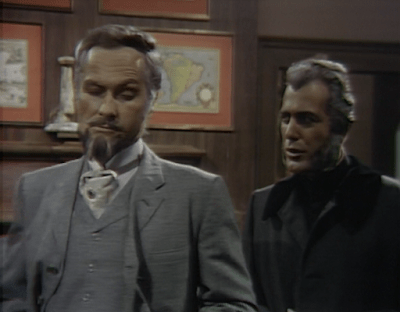
Trask tells Evan the price of his silence. Screenshot by Dark Shadows Before I Die.

As his ancestor’s very sincerity turned him into a hypocrite, so Gregory’s hypocrisy occasionally turns him into a sincere believer in his own powers, if not exactly in God. We saw in #735 that Gregory does not take the same pleasure in reading the Bible that he does in leafing through his “Punishment Book,” a ledger which evidently details his abuse of the children attending his school. But he does read it and quote it, and when in #726 he encountered a case of possession, he immediately and with untroubled self-assurance set to work performing an exorcism. The possession was real, and so far as Gregory could tell his exorcism was successful. He reacted to that apparent success with a serenity that betrayed no suggestion that he had ever doubted that he was the right person to cast out the spiritual forces of darkness.

As the original Trask was a stranger to the routine play-acting that makes ordinary social life bearable and therefore gave himself permission to become a party to the most horrendous deceptions, so Gregory wears his mask so tightly that his face grows to fit it. Dark Shadows was often very self-conscious about showing characters who were acting; its greatest success, vampire Barnabas Collins, won over the audience when they saw him trying desperately hard to play the role of a living man native to the twentieth century. In the Trasks, we see men who do not know that they are acting and therefore cannot manage the effect that the parts they play in everyday life have on their personalities.

Gregory does have a tight mental focus on his projects. When he goes to Evan with his blackmail demands, Evan has learned of his eye for the ladies, and is hoping to use that information to lower his price. So his opening gambit is to describe himself as a man who drifts from one idea to another as other men drift from one woman to another. Three times he says the word “woman,” in each case as the last word of a sentence, in each case about twice as loudly as the words before it. Gregory is unimpressed, and Evan realizes he doesn’t have anything definite to use against Gregory. He crumbles and agrees to Gregory’s extreme demand.

Gregory’s academic standards seem considerably less exacting than are his expectations of his co-conspirators. He mentions to Tim today that when he was a young teacher, the first class he ever taught was in elementary Latin. He challenges Tim to translate the words amo, amas, amat; Tim wearily replies “I love, you love, he loves.” “Very good!” exclaims Gregory. Traditionally the first words students learned on the first day of Latin class were amo, amas, amat, amamus, amatis, amant– I love, you love, s/he loves, we love, you (plural) love, they love. “Very good!” would seem to be an outrageously inflated appraisal to apply to someone who has merely recognized the first three of those six words.

Gregory sends Tim to Evan’s house to read a Latin document that has some bearing on a legal matter that has come up in Evan’s work as an attorney. As it happens, I went to graduate school in ancient Greek and Latin at the University of Texas at Austin, and local attorneys would sometimes call our department asking for someone to help them translate Latin they had found in old Spanish legal documents. They would usually refer those calls to the ablest Latinists among us, since the legal Latin used in the Spanish Empire in the days it ruled Texas was rather a specialized form of the language. Tim can virtually speed-read Evan’s document, suggesting that “amo, amas, amat” was not a particularly stringent test of his abilities.

*Maine was part of Massachusetts until 1821.

**Who is never given a first name. One of the Big Finish audio dramas refers to him as “Vilorus Trask” and actor Jerry Lacy once said he thought his name should have been “Orville.” Neither of those sounds like a very plausible name for a junior-grade Puritan divine of the late eighteenth century. So we are left calling him “the original Trask.” My wife, Mrs Acilius, points out that this seems to suggest that Gregory should be “the extra-crispy Trask.” Maybe he will die by fire, as others have done.

Episode 753: Each and every one of us is doomed

Before Dark Shadows became a costume drama set in 1897, we learned about a number of things erstwhile lady’s maid Beth Chavez had done in that year, none of which she has yet had a chance to do. So when yesterday’s cliffhanger left Beth alone in a small room with her boyfriend Quentin Collins after he had turned into a werewolf, we could be fairly sure she would somehow escape. In today’s opening teaser, we see that she stumbles into the middle of a pentagram that was chalked onto a rug as part of an abortive effort to contain Quentin’s lycanthropy. The werewolf paws at the space above the pentagram, but cannot enter it. As a stunt performer, Alex Stevens must have had considerable occasion to practice miming, but I guess there’s only so much you can do with the old “I’m trapped in an invisible box!” routine. He gives up, goes to the door, turns the knob, and leaves.

After this comic start, the episode turns to the grimmest story they have going. Twelve year old Jamison Collins has been sent to a boarding school that the overwhelmingly evil Rev’d Gregory Trask operates as a dungeon for the torment of children and teachers alike. Jamison has been confined to a closet and kept on a diet of bread and water until he confesses to offenses Trask knows full well he did not commit. The closet adjoins the classroom where teacher Tim Shaw works. Trask’s daughter Charity, temporarily in charge of the school in her father’s absence, sees Tim in the room with some papers; she offers to help him grade them, but he says he needs to go through them himself to judge the students’ progress. When she leaves him there, he smuggles food to Jamison.

Charity catches on, and gives Jamison her father’s “favorite book of meditations” to read while in confinement. She tells him he will have “ample time to browse through it” before her father returns and decrees his additional punishment in the morning. Since the book is about 8 inches thick, it must be in very large print. It is a bit difficult to imagine speed-reading a book of meditations. (“Meditate faster!”)

Charity gives Jamison something to read during the night.

In fact, the book is so thick Jamison can use it as a step to reach a window through which he escapes. Charity is distraught when she realizes that he is gone, and Tim is gleeful to see that he used Trask’s Big Book o’ Meditations to get away.

Charity assumes that Jamison has run back home to the great house of Collinwood. She orders Tim to accompany her there. Beth lets them in and tells them she hasn’t seen Jamison. In her imperious manner, Charity demands that Beth let them search the house, and dismisses out of hand her reply that she does not have the authority to permit such a thing.

In fact, Jamison did come to the house, and Beth is covering for him. He knows the place well enough that even if Charity did have free rein to search for him she probably wouldn’t find him. Jamison went into the drawing room when Charity and Tim came. Charity insists Beth let them into the drawing room. She is disappointed that Jamison isn’t there, and says he must have gone out the window. Regular viewers know that there is a secret passage leading from the drawing room to the west wing, and that the west wing has a myriad of hiding places.

Evidently Beth is unaware of that passage, because she seems to believe Charity is right. She is afraid that Jamison is in the woods, where she knows the werewolf is roaming, and once Charity and Tim have left she goes out there with a gun. Again, those who have been watching the show know something Beth does not, that the gun is formidable to the werewolf only if it is loaded with silver bullets. When she finds the werewolf and points the gun at him, we again come to a cliffhanger ending that leaves Beth’s life in jeopardy.

Episode 734: After school detention

Until November 1967, Dark Shadows was set in contemporary times. So when #283 was shown in July 1967, we could assume that its dramatic date more or less matched its broadcast date.

In that one, psychiatrist Julia Hoffman (Grayson Hall) brought her patient Maggie Evans (Kathryn Leigh Scott) to the old cemetery north of the village of Collinsport, Maine. When Maggie reacted to one or another of the sights of the cemetery with a particularly strong emotion, Julia pressed closer to it. This technique led the two women to a mausoleum. Once inside the mausoleum, Maggie had the strongest reaction of all. Julia was trying to break through Maggie’s amnesia. She did not yet know that vampire Barnabas Collins had held Maggie prisoner, and that there was a secret room hidden in the mausoleum where he once tortured her.

Now, the dramatic date is 1897. Broad ethnic stereotype Magda Rákóczi (Grayson Hall) brings neurotic intellectual Rachel Drummond (Kathryn Leigh Scott) to the old cemetery north of the village of Collinsport, Maine. Rachel’s position as governess in the great house on the estate of Collinwood has been eliminated, and she is terrified that she will have to return to Worthington Hall, a hideously abusive school where she was forced to spend a miserable childhood as a pupil and an equally miserable first part of adulthood as a teacher. The headmaster of Worthington Hall, the evil Gregory Trask, is demanding Rachel return to his school-cum-cult, extorting her with threats of false criminal charges against her and her one friend from the school, fellow student-turned-teacher Tim Shaw. Magda takes Rachel to the same mausoleum we saw in #283, because she knows about the secret room and has decided it is the perfect place for Rachel to hide from Trask.

Meanwhile, Tim is on the job at the school, shaking his head at Rachel’s former charge, twelve year old Jamison Collins. Tim is played by Don Briscoe, who when the show was set in 1968 and 1969 played cursed brothers Tom and Chris Jennings. The Jenningses were supposed to be bad-boy sex symbols, and Briscoe often seemed stiff and uncomfortable when he had to take his shirt off or be aggressive. But as a beaten man who takes refuge from his guilt in pomposity, he’s just terrific. They found the perfect part for him.

On Dark Shadows Before I Die, Christine Scoleri says that she finds Tim Shaw the fretful schoolteacher to be “Totally hot!” Evidently Don Briscoe didn’t have to play a troubled bad boy to be a sex symbol for some people.

Jamison hasn’t done his schoolwork, and Tim is keeping him after class. Trask enters, and asks why Jamison is in detention. Tim claims that Jamison is not being punished, but that the two of them are just talking. Trask is displeased with that hint of friendliness, and before long he finds a reason to lock Jamison in a storage closet. Jamison objects to this confinement, prompting Trask to gleefully declare that “there are worse punishments! Much worse!” When Jamison lets himself out of the closet, he finds Trask waiting for him, grinning. Trask says that they will spend the day together tomorrow, and that in the course of their time together he will ordain Jamison’s further punishment.

Trask sends Tim to Collinwood to fetch Rachel. He makes a show of resistance before going. At first he has trouble finding her; he goes back to the school and reports to Trask that he has failed. Trask refuses to accept this, and sends him back. Tim meets Magda and persuades her that he is Rachel’s friend. She leads him to the secret room, and leaves him alone with Rachel. When Rachel and Tim leave the room, Trask is waiting for them.

Episode 731: Your greatest weakness

One of the first “Big Bads” on Dark Shadows was crazed handyman Matthew Morgan, played by Thayer David. Matthew was the most devoted employee of reclusive matriarch Elizabeth Collins Stoddard (Joan Bennett.) Matthew took his devotion to Liz to such an extreme that he was a menace to everyone else. In November and December of 1966, we learned that Matthew had decided that Liz’ second most dedicated employee, plant manager Bill Malloy, was a threat to her. Matthew had tried to put a stop to Bill’s doings. Not knowing his own strength, Matthew accidentally killed Bill. When well-meaning governess Victoria Winters discovered what had happened, Matthew abducted Victoria, held her prisoner in the long-deserted Old House on the grounds of the estate of Collinwood, and was about to murder her when a bunch of ghosts emanated from the show’s supernatural back-world and scared him to death.

In those days, Dark Shadows was a slow-paced “Gothic” drama set in contemporary times. From November 1967 to March 1968, it was a costume drama set in the 1790s, and its plot often moved at a breakneck speed. Among the characters then was much-put-upon indentured servant Ben Stokes, who like Matthew was played by Thayer David. At first Ben made a stark contrast with Matthew. He was as relaxed, friendly, and reasonable as Matthew was tense, forbidding, and paranoid. But when his one ally among the Collins family, scion Barnabas, was cursed to become a vampire, Ben’s devotion made him resemble Matthew ever more closely. In his development, we saw a retrospective reimagining of Matthew. The curses that were placed on Barnabas and the rest of the Collinses from the 1790s on had burdened the village of Collinsport, and people who grew up there labored under the consequences of those curses and of the Collinses’ attempts to conceal them. Ben was what Matthew might have been had he not been warped by the evil that began when black magic was first practiced in the area so many generations before.

In January 1969, the show briefly returned to 1796, to a time coinciding with the last days of the earlier flashback. We saw that by that point, the curses had already transformed life on and around the great estate. In that period, Ben’s efforts to protect Barnabas led him inadvertently to kill a man, not knowing his own strength, and then to cover that crime up by killing a woman, not at all inadvertently. He had become Matthew. The curse placed on Barnabas had become the curse of all those who work for the Collinses and all of those who live in the shadow of their wealth and power.

Before Matthew, Dark Shadows‘ chief villain was high-born ne’er-do-well Roger Collins (Louis Edmonds); after, it was Roger’s estranged wife, undead blonde fire witch Laura Murdoch Collins (Diana Millay.) In this episode, the makers of the show take a page from its 1790s flashbacks. They have Edmonds and Millay reconceive the Roger and Laura of that atmospheric, sometimes almost action-free soap as characters appropriate to the fast-paced supernatural thriller it now is.

Since #701, Dark Shadows has been set in the year 1897. Louis Edmonds plays Roger’s grandfather Edward; Diana Millay plays Edward’s estranged wife, undead blonde fire witch Laura Murdoch Collins. In his days as a villain, Roger’s defining characteristic was his unnatural lack of family feeling. He had squandered his entire inheritance, a fact which did not bother him in the least. When his sister Liz confronted him in #41 about the difficulties he had created by putting his half of the family business up for sale, he airily replied that he had enjoyed his inheritance. When in #273 Liz and Roger discussed a blackmail plot of which she had been the victim, Roger admitted that had he known her terrible secret, he probably would have used it to force her to give him her half of the estate so that he could squander that, as well.

It wasn’t only the family’s material possessions and Liz’ right to them to which Roger was indifferent. He openly hated his son, strange and troubled boy David Collins (David Henesy.) He continually insulted David, badgered Liz to send David away, and in #83 coldly manipulated David’s fears to lead him to try to murder Victoria.

In the 1897 segment, Edward is as stuffily serious about the family business as Roger was in 1966 nihilistically apathetic about it. Edward loves his children, twelve year old Jamison (David Henesy) and nine year old Nora, but his rage at Laura has come between himself and them. Laura left Edward the year before to run after Edward’s brother, breezy libertine Quentin (David Selby.) Edward tried to conceal the fact that his brother cuckolded him. He has repeatedly declared that Laura “No longer exists!” and has forbidden her name to be mentioned in the house.

Edward trapped between the enigmatic Laura and the exuberant Quentin. Screenshot by Dark Shadows Before I Die.

For his part, Quentin bears a striking similarity to the early, wicked Roger. He wants money only to spend it, a fact which he cheerfully admits. He tried to forge a will in his grandmother Edith’s name to cheat his sister Judith (Joan Bennett) out of her inheritance, having previously threatened to kill Edith. He does have great affection for Jamison, but since he often uses the boy as a pawn in Satanic ceremonies, his fondness for his nephew is not much of an improvement over Roger’s hatred for his son. Indeed, Quentin’s resemblance to Roger connects the 1897 segment not only to the early months of the show, but also to the weeks immediately preceding it. Early in 1969, Quentin’s ghost had taken possession of David Collins and was causing him to die. When we see that Quentin is now what Roger was originally, David’s ordeal takes on a new dimension. He is dying for the sins of his father.

In this episode, Laura has returned. Edward has offered her a great deal of money to go away and never come back; she refuses. She threatens to tell the world about her relationship with Quentin if Edward does not let her stay at Collinwood. Edward buckles to this blackmail. Laura tells him that “Family pride is your greatest weakness,” making him Roger’s exact opposite.

When Laura was at Collinwood from December 1966 to March 1967, her old boyfriend Burke Devlin kept pestering her with his suspicion that he, not Roger, was David Collins’ father. Burke was not the first character to bring this idea up. Roger had mentioned it to Liz in #32, when they were talking about an attempt David had made to kill Roger. At that time, Liz was horrified that Roger seemed to want to believe that David was Burke’s natural son.

It seems unlikely that Quentin is Jamison’s father. They have been firm about 1870 as Quentin’s date of birth, and in 1897 Jamison is quite plainly twelve. Laura may have gone on to marry her own grandson, but it would be a bit of a stretch for her to have started sleeping with her brother-in-law when he was fifteen, even if he did look like David Selby.

But Roger’s anger and jealousy about Burke and Laura do mirror Edward’s about Quentin and Laura. It was abundantly clear that Roger and Burke’s deepest pain regarding Laura was that their intense attachment to each other was disrupted when she left Burke for Roger; Diana Millay used her gift for dry comedy to make this explicit in a scene the three of them played in the groundskeeper’s cottage in #139. Likewise, Edward’s frustration with and disappointment in his brother is at least as deep a source of anguish to him as is his loss of Laura’s love.

Laura, too, is quite different this time around. The first Laura story took shape gradually over a period of weeks, as Laura herself emerged from the mist. Now Laura is a forceful presence from her first appearance. Originally we heard that Laura had married into several of the leading families of the Collinsport region; now they have given up on the idea of developing other leading families, and Laura just keeps coming back to the Collinses. In the first story, they laid great emphasis on the interval of precisely one hundred years between her appearances; now, the number of years doesn’t seem to have any particular significance. As we go, we will see an even more important difference. When we first met Laura, she was utterly determined to make her way into a pyre so that she could rise as a humanoid Phoenix; now she is unhappy about the whole thing, and angry with people who have helped her on her fiery way.

Edward lets Laura live in the cottage where Roger and Liz would put her in 1966. In the final scene, she goes there and finds Quentin, drunk and trying to conjure up an evil spirit. Quentin keeps telling Laura that she is dead. Frustrated with her persistent refusal to concur with this statement, Quentin puts his hands around her neck and announces that whether or not she is dead now, she will be by the time he gets through with her.

Roger was uncharacteristically sober at the beginning of his three-scene in the cottage with Burke and Laura in #139, but he did enter brandishing a fire-arm. So Quentin’s homicidal intentions on this set further cement his affiliation with his great-nephew in the eyes of longtime viewers.

Millay and Edmonds are not the only actors whose screen iconography the show turns to advantage today. We first saw Kathryn Leigh Scott and Don Briscoe together in #638, when she was playing ex-waitress Maggie Evans and he was playing mysterious drifter Chris Jennings. They met in the foyer at Collinwood. Maggie was angry with Chris, and Chris was guilt-ridden. Today, Miss Scott plays governess Rachel Drummond and Briscoe plays teacher Tim Shaw. They meet in the foyer at Collinwood. Rachel is angry with Tim, and Tim is guilt-ridden.

Though the same actors are playing the same basic emotions on the same set, the situations are different, and the characters are very different. Maggie is Dark Shadows‘ principal representative of the working class of the village of Collinsport. She speaks directly and bluntly, using the plainest language she can to dare Chris to try to excuse his inexcusable behavior. Chris occupies a lowly and unsettled place in the world, and he dodges her gaze and evades her questions, saying as little as he can, almost mumbling.

But Rachel is a neurotic intellectual, and she expresses her anger in complex sentences featuring vocabulary that only a very well-read person would have used in 1897 (for example, the word “sadist.”) Tim retreats from her anger into a defense of his job that quickly devolves into the tiredest platitudes imaginable. At one point he actually intones “It is better to light one candle than to curse the darkness.” Miss Scott makes Rachel’s highly literate onslaught on Tim as forceful as was Maggie’s unvarnished challenge to Chris, and Briscoe makes Tim’s pompous posturing as pitiable as was Chris’ broken burbling. Writer Gordon Russell must have been delighted that the actors did such good work with his ambitious pages.

Episode 773: The Persecution and Assassination of Minerva Trask as Performed by Tim Shaw Under the Direction of the Marquis de Sade

Why I think The Manchurian Candidate is better than Episode #773 of Dark Shadows

Episode 773: The Persecution and Assassination of Minerva Trask as Performed by Tim Shaw Under the Direction of the Marquis de Sade