Episode 890: They will be strangers, but you will know them

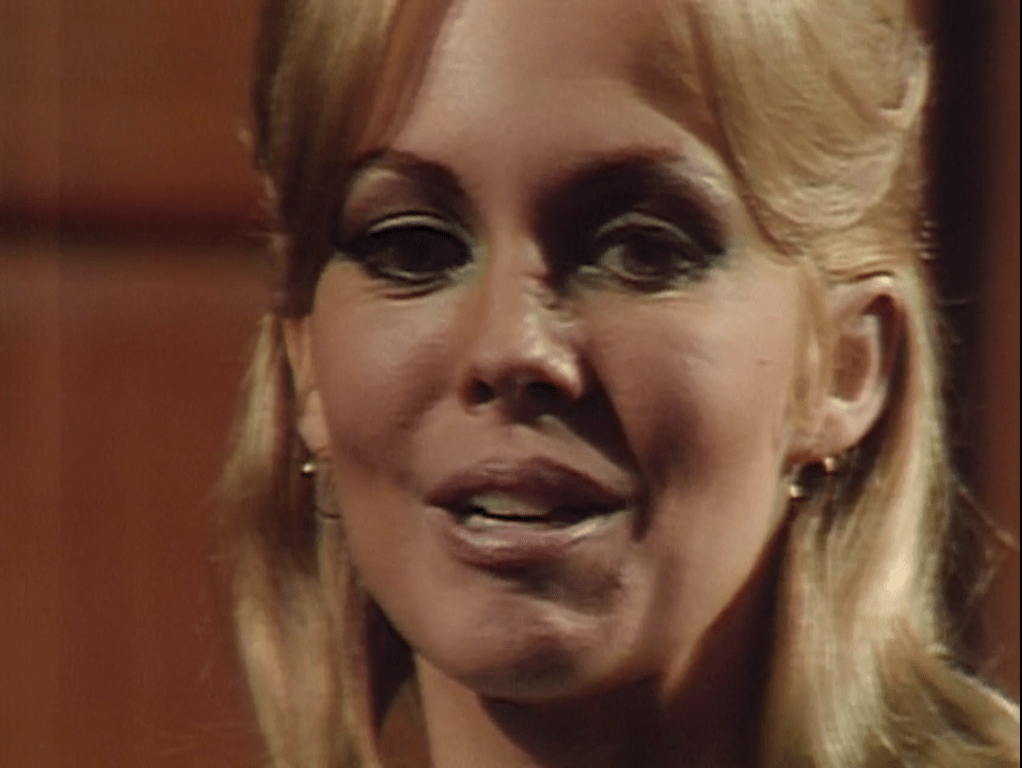
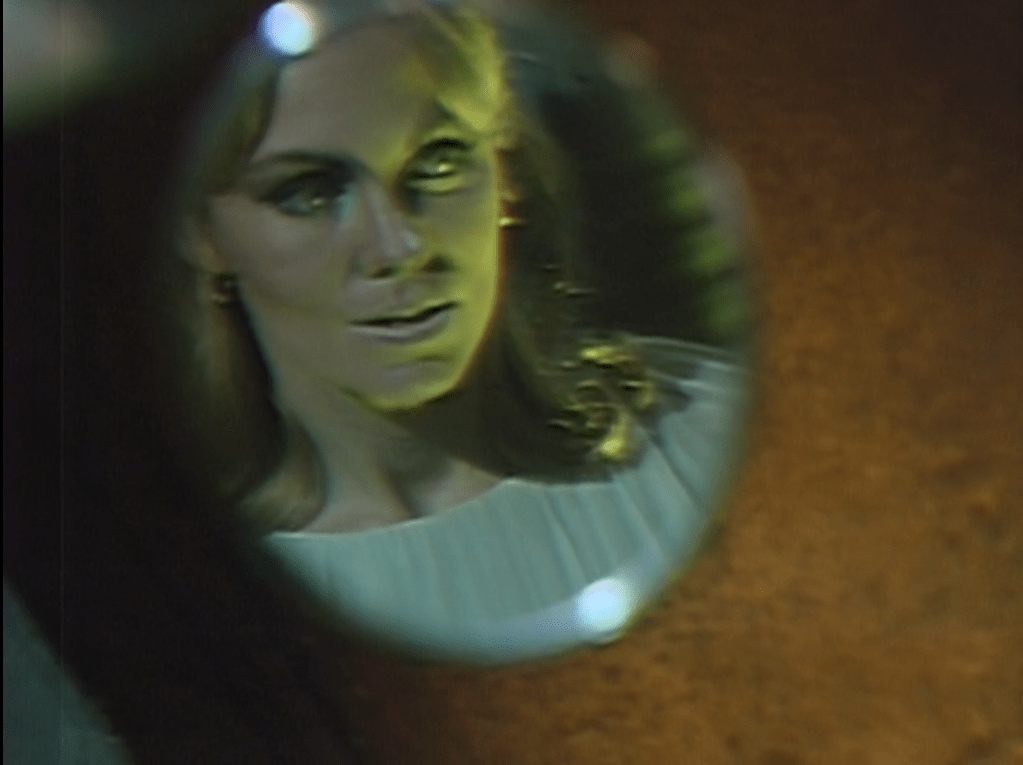
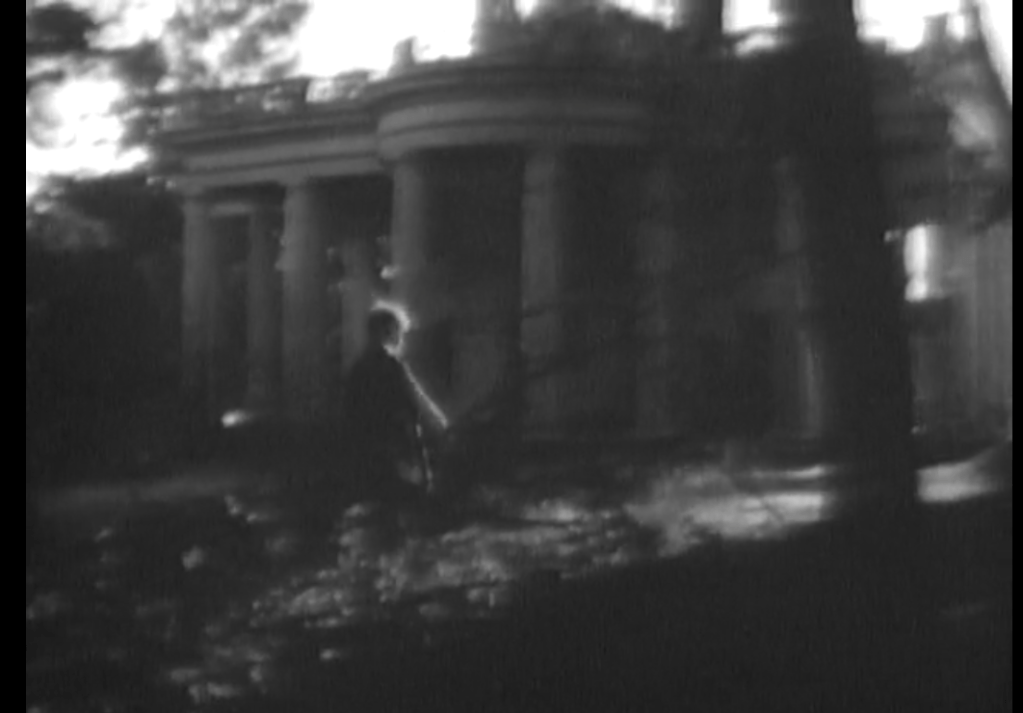
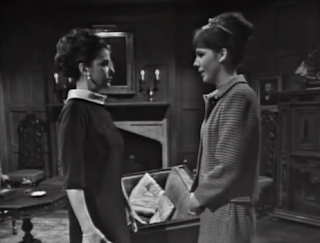
Like many episodes of Dark Shadows, this one ran long and ended with credits only for the cast and for Dan Curtis Productions. The entry on the Dark Shadows wiki says that the director was Lela Swift. I am sure that it was in fact directed by Henry Kaplan. This shot of Nancy Barrett as heiress Carolyn Collins Stoddard is proof positive:

There is another flagrant Kaplanism in today’s first scene between antique shop owners Philip and Megan Todd (Christopher Bernau and Marie Wallace.) Philip enters from upstairs. He stops with his waist at the top of the frame. That’s where he stays for the first part of the scene, ending with Megan raising a paper that covers part of her face. Evidently what’s happening between the characters is none of the audience’s business.

Swift was a talented and ambitious visual artist, Kaplan a sloppy and unimaginative one. He relied heavily on closeups. When it dawned on him that it was dull to hold the frame just beyond the edges of an actor’s face, his response was to zoom in and give us an extreme closeup of some part of the actor’s face. It’s above average for him that the first shot above includes Miss Barrett’s eyes- he specialized in shots displaying the face from the nostrils down, and often held them even after the actors had to move, leaving us with the sight of an ear drifting out of our view.

Even when Kaplan’s tight little frames do not keep us from figuring out what is happening in a scene, they deprive us of the energy that comes from seeing the players interact with each other. We don’t get statements and reactions simultaneously, and we don’t see the actors using the space between them to tell us how the characters feel about each other. Kaplan was also a pretty bad director of actors, regularly poking them with a stick as his way of telling them he wanted them to play a scene differently and on one occasion fastening a handle to a child actor so that he could physically place him on his mark during rehearsal. So perhaps his mania for closeups reflected a lack of awareness of what actors do and how the choices they make contribute to the audience’s experience. As a result of his insensitivity to these and other visual aspects of the medium, Kaplan’s episodes would often be better suited to radio than to television.

Fortunately, the dialogue today is peppered with snappy lines. So Danny Horn devotes his post about the episode on his great Dark Shadows Every Day to a selection of memorable pieces of dialogue. That also makes me suspect the wiki is not entirely correct. It attributes the script to Gordon Russell, an able writer overall but one who is not at all given to bons mots. I use bits of dialogue whenever possible as the titles of these posts, and I often have to search very hard through Russell’s to find suitable ones. It was Violet Welles who excelled at producing those. Russell and Welles often collaborated, so it could be that he wrote a draft to which she added the quotable quotes.

The current story centers on a mysterious cult that has sent time traveler Barnabas Collins back to 1969 from a long sojourn in 1897, by way of a couple of days in 1796. Under the influence of the cult, Barnabas is being a real jerk to his friend, mad scientist Julia Hoffman. Barnabas was a vampire for a long time, and even when he is free of the effects of that curse he habitually resorts to murder to solve his problems. But the victims of those murders are imaginary, played by actors who will go on to find other work, so we don’t usually stay mad at him for any length of time when he commits them. His friendship with Julia, on the other hand, is the emotional core of the show. Barnabas’ coldness to her in yesterday’s episode and today’s leads us to see what the cult is doing to him as the greatest crime anyone has ever committed on Dark Shadows.

Barnabas was a pop culture phenomenon familiar to many millions of people who never saw a single minute of Dark Shadows. The show’s fanbase largely consisted of his devoted followers. So a story about a cult which co-opts him as its leader and changes his personality so that he is impossible to get along with directly addresses a fear that must have blacked out the mind of Dan Curtis every time the postal service truck loaded with Jonathan Frid’s fan mail backed up at ABC Studio 16.

Barnabas brought a box with him from his visit to the eighteenth century, and it is of the utmost importance to the vast eternal plan the cult is working on that the box not be opened until the right time. So Barnabas put it on the mantel in his living room, and when Julia was standing a few inches from him he lifted it from the mantel and placed it on a table in the middle of the room. When she asked what it was, he became flustered and refused to answer any questions about it.

When Julia left the house, Barnabas left the room, with the front door unlocked and the box still on the table. Today, we open with Julia coming back in, hearing the sound of breathing coming from the box, finding its key on the table next to it, and placing the key in its lock. Barnabas comes in just in time to stop her opening it, but we can see that the cult probably could have chosen an agent with a better sense of operational security. Barnabas’ function in the story is to make messes that other people will have to clean up, so as soon as we heard that the box must not under any circumstances be opened we expected him to leave it where it would inevitably fall into the hands of someone bent on opening it, though it is a bit disappointing he has done so this quickly.

After he has taken the box from her, Barnabas berates Julia, orders her from his house, and tells her he owes her nothing. He abruptly sweetens up and tells her that he is only carrying on that way because of some kind of temporal jet lag. He reminds her that when she traveled back in time in September, she was very ill for a while; he suggests that his surly mood might be the result of the same shock that caused that reaction. About a minute after he starts on this new tack, just as Julia has started smiling again, a knock comes at the door. It is Carolyn.

We don’t know what effect the cult’s co-optation of him has had on Barnabas, but regular viewers know that characters on Dark Shadows are always acquiring one magical power and losing another. For the last few months of the 1897 segment, the show’s main villain was sorcerer Count Petofi. One of Petofi’s signature moves was to become aware of visitors shortly before they arrived. It could be that the writers have decided to give the cultified Barnabas that power, and that it was because Carolyn was on her way that he wanted to put Julia in a good mood.

That interpretation is supported by what follows. Carolyn is delighted to see Barnabas; she hadn’t known he was back from his trip to 1897. She hugs him and he smiles, a stark contrast to his icy reaction when Julia hugged him yesterday. She wants to talk about Chris Jennings, a young man she dated a few times and whom she has been told is dangerous. Julia and Barnabas have befriended Chris and know that he is a werewolf. Julia thinks she can somehow control Chris’ transformations, and she urges Carolyn to think well of him. Barnabas tells her to trust her instincts and to avoid Chris. He keeps telling her that she is too important to be allowed to come to harm. Later, he visits Carolyn in her home, the great house on the estate of Collinwood, and he keeps going on and on about how important she is and how confident he is about her future. He also gives her a silver pentagram, an amulet to ward off werewolves, and urges her to wear it at all times. He subsequently has another scene with Julia in his own house, and he is just as cold and dismissive as he was in the first scene, exploding at her for being “irrational.” Evidently the cult has plans for Carolyn, but not for Julia.

Julia bought a painting from the Todds the other day, and now they have received a telegram offering to buy it regardless of price. Julia goes to their shop and discusses the telegram with them. She believes that the telegram, which is signed “Corey,” may actually be from Quentin Collins, a distant cousin of Barnabas’ whom he befriended during his time in 1897 and who may have been immortalized by a magical portrait painted by the same artist responsible for the picture Julia bought. She tells the Todds that she is not certain she wants to part with the painting, but that she would very much like to meet “Mr Corey,” and that she believes others in town would also like to do so. She urges them to reply to the telegram with an invitation.

Barnabas stands over the box. We hear his thoughts as he mulls over his questions about it. He suddenly declares “It is time!” Then he goes to his chair and sits down. Evidently, it is time to take a load off.

Barnabas has a vision of one of the hooded figures who inducted him into the cult. The figure, a man named Oberon, addresses him as “Master” and tells him that he is to give the box to people who wake him by knocking at his door. There is a knocking, he does awaken, and he goes to the door.

Episode 641: Your time is now

In #2, high-born ne’er-do-well Roger Collins saw governess Victoria Winters standing at the edge of a high cliff overlooking the ocean. She didn’t know he was there until he startled her by asking her if she was planning to jump. As the weeks go on, Vicki will learn of other women who have leapt to their deaths from that spot, including a story that over the years two governesses were among them and that legend says a third will someday follow suit. The cliff is the face of Widows’ Hill, named after women whose husbands never returned home from the sea; several times during storms an eerie note sounds in the wind, a note known as “The Widows’ Wail,” which the locals believe to be the ghosts of the Widows announcing that a tragic death will soon take place.

Vicki stands at the edge of the cliff again at the end of this installment while the Widows’ Wail sounds. She is distraught that she has herself become a widow and is dwelling on the idea that she can be reunited with her husband in death.

Though occult expert Timothy Eliot Stokes told her earlier in the episode that “Your time is now!,” Vicki’s time as a lively part of the show in fact ran out in March 1967, with the resolution of the story about her effort to befriend her charge, Roger’s strange and troubled young son David. Actress Alexandra Moltke Isles finally gave up on the character and left Dark Shadows after #627. Her successor in the role, Betsy Durkin, has essentially nothing to work with. We do not share her grief for the husband she is mourning; he was one of Dark Shadows‘ most repellent characters, and it is such a relief that he is away that we sympathize only too much with everyone who tells her to stop bringing him up. Nor do we have any other reason to care about her, since she is relevant to no ongoing plotlines. Even longtime viewers who remember the foreshadowing of Vicki’s possible death by a jump off the cliff will not react strongly to the sight of her there, since Miss Durkin is not Mrs Isles and does not bring her screen iconography to the reprise of the theme.

This phase of the show actually belongs to a character introduced in #632, eleven year old Amy Jennings. When Amy meets Stokes today she announces that she likes him because he is funny; he replies that he is pleased to find that “My appeal extends to all ages now.” Indeed it does; in its first year, Dark Shadows was very much aimed at adults, some of whom remembered Joan Bennett as one of the great movie stars of the 1930s and 1940s and were impressed by her presence in the cast as matriarch Liz, some of whom appreciated it as a specimen of slow-paced, highly atmospheric Gothic romance, and some of whom were fascinated by the story of Vicki and David and its theme of a grownup trying to make a difference in the life of a troubled child. But by the time Stokes arrived in #464, Dark Shadows had become a kids’ show. As Thayer David plays him, Stokes is amusing enough that anyone can like him, but the absolute seriousness with which he regularly expounds the most preposterous mumbo-jumbo is designed to make him a favorite of the very young.

Amy likes Stokes. Screenshot by Dark Shadows Before I Die.

Amy’s friendship with David develops in scenes that kids will find engaging, as they go exploring the big haunted house of Collinwood and find their way into spooky adventures. She also takes the lead in her relationships with adults more consistently than David ever did. While in the first year and a half of the show David often knew things the adults didn’t know, that was usually because he accepted the facts they refused to see. No matter what he said or did, he couldn’t move them from their habits of denial and evasion. But Amy has sources of information that the grownups around her don’t have. So today she has a vision of her brother Chris in some kind of terrible trouble. When she tells Vicki and Liz about her vision, Liz tries to telephone Chris and is deeply disturbed when he doesn’t answer. As my wife, Mrs Acilius, pointed out, it is after one o’clock in the morning, so you wouldn’t expect her to attach great importance to his failure to pick up the phone. That she does suggests that she is taking Amy seriously.

Returning viewers know that Amy’s vision is correct. Chris is a werewolf, and he just killed a barmaid. That Amy not only has a paranormal means of knowing how Chris is doing, but that she is also able to get through to the adults and influence their actions, suggests that she will have a major impact on the werewolf story as long as it continues. Indeed, she already has- the werewolf was about to eat Liz the other day, but backed off when he saw Amy nearby.

Amy is central to the other storyline that is beginning at this point. That is “The Haunting of Collinwood,” in which the ghost of Liz and Roger’s’ great-uncle Quentin Collins is going to be creating difficulties for everyone. Amy and David went into the long-deserted west wing of the house and retrieved an antique telephone from a room there. Though its cord is cut, Amy can sometimes hear Quentin’s voice through its receiver. When she is alone and worried about Chris, she picks the telephone up and asks for Quentin. She is disappointed he does not answer. None of the adults knows about Quentin’s ghost or the telephone. Not even David has heard more than Quentin’s breathing through the receiver. Again, Amy is uniquely positioned to understand and affect the action.

According to the closing credits, this week’s five episodes were directed by “Penberry Jones.” The name “Penberry Jones” is unknown to Google aside from these credits, and it sounds like a joke of some sort. Though the fansites all mention the improbability of Jones’ name and the likelihood that it is a pseudonym, none that I could find offers any clue as to who might have been behind that pseudonym. From the early 1970s until the quarantines of Covid-19 in 2020, Dark Shadows fans would organize festivals a couple of times every year at which panels of people who had been involved in making the show took questions from the audience. If any of those audiences asked who Penberry Jones was, either they did not get an answer or that answer was not recorded.

The name “Penberry” may remind longtime viewers of Dark Shadows of episode #83, which is about Roger burying a pen. Roger was a major villain then, and his part gave actor Louis Edmonds an opportunity to show what he could do. Roger has long since been demoted to occasional comic relief; one might imagine that Edmonds wanted to take a turn in the director’s chair, and that he chose his whimsical pseudonym as a nod to his character’s origins. Appealing as that idea may be, it does not seem at all likely. So many of the panel discussions among cast members abounded in fond stories about Edmonds that surely someone would have mentioned it if he had directed five episodes.

Indeed, most of the longer-lived members of the cast participated in so many of those panels that they all had moments when they had to grope more or less desperately for something fresh to say. If anyone whose name fans would recognize and who worked closely with the cast were “Penberry Jones,” it’s hard to imagine that one or another of them wouldn’t have brought it up in one of those moments.

Whoever it was must have been known to executive producer Dan Curtis and line producer Bob Costello, and probably quite well known to them. The Directors Guild of America does allow its members to change the names under which they are credited, as for example John Walter Sullivan was allowed to direct several episodes of Dark Shadows as “Jack Sullivan” and several more as “Sean Dhu Sullivan.” But it does not allow them simply to use pseudonyms at will. It wasn’t until 1969 that directors working in features could be billed as “Alan Smithee,” and then they had to prove that they did not really have control of the final product before they were allowed to substitute that name for their own. The first television production credited to “Alan Smithee” didn’t appear until 1970. So it is unlikely that “Penberry Jones” directed any screen productions under any other name. Curtis and Costello probably wouldn’t have chosen a first-time director with no imminent prospects of other screen work unless it were someone they already knew and trusted.

If “Penberry Jones” didn’t cover anyone the cast knew well or a director who worked under another name, but was someone who was close to Dan Curtis or Bob Costello, it should be possible to compile a short list of suspects. I’m not so deeply immersed in the behind-the-scenes lore that I can compile that list myself, but maybe you are. If so, I’d like to hear from you in the comments!

The director’s name isn’t the only puzzle in the closing credits. Every previous episode of Dark Shadows ended with the credits playing in front of a stationary shot of one or another set. It was always one shot per closing credits sequence. This time they start with a stationary shot of Vicki’s room, then cut to a stationary shot of the foyer. It’s hard to see what the point of that transition is. Perhaps we could ask “Penberry Jones,” if we had any idea who that was.

Episode 576: Enough to occupy your mind

Well-meaning governess Vicki is engaged to marry an unpleasant man named Peter who prefers to be called Jeff. Vicki knows that Peter/ Jeff has some kind of job that keeps him busy during the day. She does not know that he has been spending all night working at a second job. He is helping to build a Frankenstein’s monster. This second job is unpaid; his incentive is that if the monster is not built, an already existing Frankenstein’s monster named Adam has said that he will kill Vicki and everyone else in the great house of Collinwood.

As we open today, Peter/ Jeff is bitten by vampire Angelique. After Peter/ Jeff regains consciousness, Angelique starts giving him orders. He ignores them, and she bites him again. After that, he seems dazed and agrees to do whatever she commands. She wants him to hook her up to the body under construction and to use her “life force” to animate it. He tells her that he doesn’t know how to do that, and that the body isn’t ready to come to life in any case. Turns out she needn’t have bothered.

Meanwhile, Vicki gets some news. Roger, brother of matriarch Liz, tells her that he wants to send Peter/ Jeff on a six-week training program along with two junior executives from the Collins family business, and that if he works out there will be a job for him at the end of it. Vicki is dazzled by the offer.

Peter/ Jeff comes by. Roger meets him alone in the drawing room to make the offer. Peter/ Jeff can neither leave the Frankenstein project nor tell Roger about it. He has to turn the offer down without explanation, leaving Roger offended. Vicki then asks Peter/ Jeff what he was thinking, and he can’t explain the situation to her, either. She is frustrated that she tells him everything about herself, but she can’t get any information from him. She says that the offer must have represented a “family decision” on the part of the Collinses, implying that Peter/ Jeff’s refusal will reflect badly on both of them in their eyes.

When Dark Shadows started in June 1966, Vicki was its chief protagonist, Roger its most menacing villain, and the Collinses’ business interests a major part of the story. Vicki receded to the margins after her most interesting storyline, her difficult relationship with her charge David, was resolved in March 1967, and by that time Roger had become harmless and the business had long since ceased to be a source of interest. When we hear Roger talking about a job for Peter/ Jeff, for a moment it seems that he and the business might once again be important, and that Vicki might again have something to do with the plot. Vicki’s disappointment in her beau reminds us that the character doesn’t really have a place on the show any more.

Upstairs, Liz is taking clothes out of her closet and talking about them with her daughter Carolyn. They jar longtime viewers when they look at a particular dress and reminisce that they bought it on a trip to Boston. For the first 55 weeks of the show, Liz was a recluse who hadn’t left home since Carolyn was an infant. I suspect Liz had worn that dress during that period, and wish I’d looked for it when we were on those episodes during this watch-through. There certainly hasn’t been enough time since then for the trip to Boston to evoke the nostalgic tone in which they describe it, or for the dress to have fallen so far out of fashion that the ladies agree it is time to throw it away.

The Liz-is-a-recluse story was never exciting, and once they ditched it the show was quick to give us scenes of Liz happily going out. It is sometimes said that Dark Shadows is what Star Trek would have been if they had replaced space travel with agoraphobia, and Liz’ seclusion was the first exploration of this topic. Following the deep cut into the early days of the show in Roger’s offer to Peter/ Jeff with a moment when such a prominent part of its first year is simply forgotten is so typical of this period’s episodes that I wonder if some of the dialogue was written by uncredited contributors who weren’t up to date on bygone story points.

Carolyn is glad that Liz, who just recently escaped from a mental hospital, is taking an interest in her wardrobe. Liz lets her down hard when she says that she wants to get rid of as many belongings as possible in the short time before her death. Carolyn tries to tell her that she isn’t dying, but Liz refuses to listen. She demands that Carolyn promise to have an open casket at her funeral.

Liz was in the mental hospital because of a psychological disturbance with which Angelique afflicted her some months ago. When she did that, Angelique was a witch. Since then, Angelique has been stripped of her witchly powers, killed, and brought back to the world as a vampire. You might think Angelique’s spells would all have been broken when she was de-witched; that has been the pattern on Dark Shadows previously. For example, when blonde fire witch Laura vanished in #191, the spell she had cast that caused Liz to mope around and be obsessed with death until she was sent off to a hospital was broken. Longtime viewers wonder if Liz’ continuing obsession with death and her paranoid fear of being buried alive are natural symptoms of the trauma Angelique put her through, and if she just needs better therapy than she was getting in the hospital.

Liz has a dream. It opens with Angelique looking directly into the camera. Angelique is wearing the same costume she wore in the scene with Peter/ Jeff and laughing. When Liz knew Angelique, she never dressed that way, she wore a black wig, and so far as the audience knows she never let Liz hear her signature evil laugh. So it seems that Liz’ current troubles are indeed a part of Angelique’s ongoing spell.

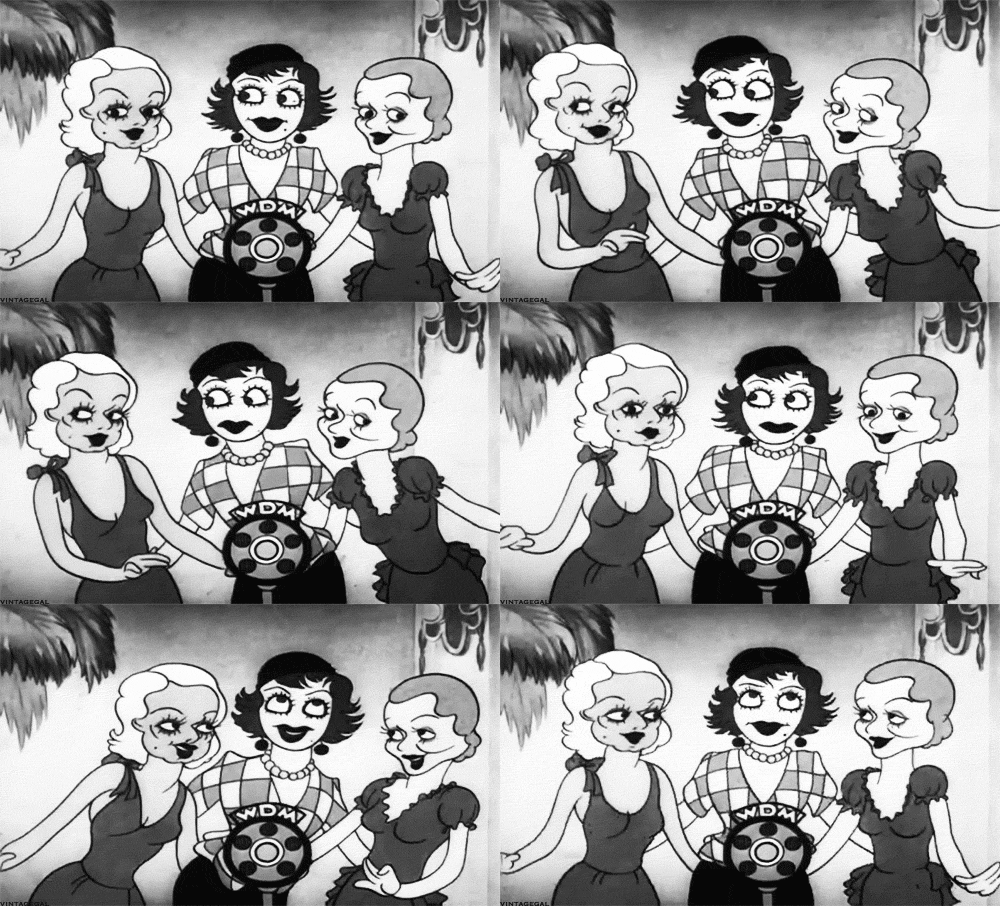
Facing us, Angelique tells Liz that she will be plagued by her obsessions until she dies. This is enough to trigger PTSD flashbacks in regular viewers. Twenty weeks ago, in #477, Angelique was looking at us when she described “The Dream Curse,” an abysmally repetitious, ultimately pointless storyline that dragged on for months. Joan Bennett was a fine actress and a great star, but there was only so much even she could do with a character who just mopes around and talks about death, and Dark Shadows has already made her do it more than once. In a comment on Danny Horn’s post about this episode, I wondered if Angelique couldn’t have cast a spell on Liz that isn’t just a retread of one we’ve seen before, and suggested one that would give her “a compulsion to put on a top hat and tails and sing and dance.” Here’s an animated gif of a cartoon showing Joan Bennett’s sister Constance dancing with Jean Harlow and Joan Crawford; it has more entertainment value than did the entire Dream Curse, and might serve as a consolation to those of us left shaking by Angelique’s threat to clog up the story again:

Episode 575: This rotten collection of death

How Revolting and Disgusting You Really Are

Suave warlock Nicholas Blair has a job for a woman. Talking to his subordinate, vampire Angelique, he says that the job must go to “the most evil woman who ever lived.” At this, Angelique breaks into a smile, then raises her head proudly. Nicholas then says, “Someone like Lucrezia Borgia.” At this, Angelique’s face falls, and she protests that Lucrezia is dead.

Angelique, flattered when she thinks Nicholas is describing her as “The most evil woman who ever lived.”

Nicholas brushes this objection off, saying that “The spirit of evil can be made to live again.” Longtime viewers may have been wondering whether Lucrezia Borgia would make an appearance, since her name has come up more than once. In #152, sarcastic dandy Roger insulted his sister, reclusive matriarch Liz, by comparing her to Lucrezia; in #178, Roger insulted his niece, heiress Carolyn, in the same way; and in #523, Carolyn brought up Lucrezia to insult Angelique, whom she knew when Angelique was calling herself Cassandra and was married to Roger. Perhaps we might have imagined some kind of story where Roger turns out to have some kind of supernatural connection to Lucrezia.

Nicholas continues teasing Angelique, bringing up the Countess Elizabeth Bathory, alleged serial killer and blood drinker of the 16th and 17th centuries. Angelique calls that lady “a vile woman,” in a tone that suggests she knew her personally. From November 1967 through March 1968, Dark Shadows was a costume drama set in the 1790s, and Angelique was its chief villain. She was not a vampire then, but a witch. Her spells were very powerful, but she was quite clumsy in her use of them, suggesting that she was a young woman new to witchcraft. Perhaps this line is meant to open the door to a retcon, one which will make it possible to tell stories about Angelique set in even earlier periods than the 1790s segment.

Nicholas agrees that the countess was “a vile woman,” and repeats that epithet as the first in a list of her qualifications for the job he has in mind- “ambitious, cunning, devious, unprincipled, decadent!” He finally concludes his teasing of Angelique and tells her that he will not hire her for the job. She is disappointed, as one of the benefits of the job is release from vampirism. She leaves the room. In the corridor, she flashes a smile which regular viewers recognize as a sign that she is going to defy Nicholas and try to seize what he would not give her.

The Only Filthy Way It Could Be Done

The job is an unusual one. Nicholas has persuaded Frankenstein’s monster Adam to confront old world gentleman Barnabas Collins and mad scientist Julia Hoffman with a threat. If Julia and Barnabas do not repeat the procedure that created Adam and produce a woman who will be his mate, Adam will kill everyone in and around the great house of Collinwood. Subjected to that extortion, they undertake the project.

The procedure not only involves building a body from parts of corpses and running electrical charges through it, but also requires that the body be somehow connected to a person who will serve as its “life force.” It is energy drained from this person that will animate the body. Barnabas was Adam’s “life force.” Before the procedure, Barnabas was a vampire. Serving as Adam’s “life force” put his vampirism into remission. Nicholas talked about this with Angelique, raising her hopes that he would let her escape from vampirism the same way, only to dash those hopes cruelly.

Julia completed the experiment that brought Adam to life after the death of another mad scientist, Eric Lang. Lang had built the body and the apparatus, and had left detailed notes. Julia had studied those notes for some time before she knew which switches to throw and which dials to turn. Under Adam’s threat, Julia has rebuilt the apparatus in Barnabas’ basement and she has a cadaver there which she is using for parts. Barnabas has ordered his servant Willie to help with the grave robbing. Barnabas has also enlisted the aid of Lang’s former grave robber, an unpleasant man named Peter who prefers to be called Jeff. The equipment needs a lot of tending, and Peter/ Jeff is the lab tech on that detail.

A Nice, New, Clean Slab of Flesh

Peter/ Jeff is by himself in the basement lab when Professor Timothy Eliot Stokes walks in. It’s news to Peter/ Jeff that Stokes is aware of the project, but he tells him that he knows everything about it. Stokes stays so calm as he examines the apparatus and looks at the cadaver that one supposes he must know a great deal.

Stokes asks Peter/ Jeff how the equipment runs when Barnabas’ house has no electricity. Peter/ Jeff says that Julia installed a generator. This must be some unusual kind of generator, since it runs in absolute silence. Later in the episode, Stokes will have a conversation with another character about how Barnabas doesn’t have a telephone.

When Barnabas was a vampire, he didn’t want meter readers or other workers dropping by unannounced and he had no use for modern conveniences. So of course he did not connect his house to the electric grid or to telephone service in those days. As for other utilities, it is a fairly prominent bit of lore that vampires cannot tolerate running water, so of course he wasn’t going to have any plumbing. But he’s been unvamped for almost six months now, so he may as well just update his house. Stokes’ lines today lampshade the problems he creates by refusing to do so.

Another unannounced visitor interrupts Stokes’ conversation with Peter/ Jeff. It is Adam. He is upset to find Stokes in the lab. Stokes once took Adam in and taught him English, and in those days Adam considered Stokes to be his best friend. But Stokes shocked Adam when he broke the news to him that he was an artificially constructed man, and has thoroughly alienated him by trying to talk him out of the violent lifestyle Nicholas has persuaded him to adopt.

Adam goes on a self-pitying rant when Stokes tries to reason with him. Peter/ Jeff interrupts and tells Adam something Stokes left out of his birds and bees talk, that he was built out of parts of dead bodies. Peter/ Jeff taunts Adam about this in a speech that is full of such gems that I suspect it was written, not by the credited author of today’s script, Gordon Russell, but by Russell’s frequent uncredited collaborator Violet Welles. Welles’ name will start to appear in the credits in 711, and fans of the show recognize the sparkle that marks her dialogue.

Peter/ Jeff tries to stab Adam. Adam easily disarms him and holds the knife at his throat. Stokes tells Adam that without Peter/ Jeff the project will be delayed. Adam then flings Peter/ Jeff to the floor. Peter/ Jeff is played by Roger Davis, an actor who had a big television career and was irritating in every part. Mr Davis is so annoying on Dark Shadows that Mrs Acilius and I can’t be the only ones who are disappointed when Adam doesn’t kill his character off the show and who cheer when he throws him to the floor.

Peter/ Jeff gets up and leaves the lab. Adam demands Stokes bring him back to resume working. Knowing how violent Adam is, Stokes follows Peter/ Jeff to the great house of Collinwood. Peter/ Jeff is meeting his fiancée, well-meaning governess Vicki, there, planning to take her out for a date. Stokes tells him that they will be in grave danger from Adam unless he goes back to the lab at once. Peter/ Jeff looks out the window, and sees Adam peering in. Adam actually opens the window and reaches into the drawing room while Vicki and Peter/ Jeff are there; it is hard to understand how Vicki doesn’t notice him. Peter/ Jeff makes an excuse, and goes back to the lab.

We see him back at work. The camera pans up to a mirror. It holds on the mirror for several seconds while we see Angelique’s reflection. Previously, they have stressed that vampires do not cast reflections. There have been several moments when actors have missed their marks or other production faults have occurred that left us seeing a vampire in a mirror, but this is obviously intentional, and it is jarring to regular viewers.

Angelique’s reflection

Angelique and Peter/ Jeff talk for a moment, then she bites him. Evidently she plans to enslave him and use his access to the laboratory to force her way into the role of “life force” for Adam’s mate. So far, almost every victim of a vampire we have seen has been left unable to do the work s/he was doing before being bitten, so regular viewers might suspect that Angelique’s ploy will simply incapacitate Peter/ Jeff from helping with the project. This expectation becomes all the more substantial when we remember the many times Angelique’s schemes have blown up in her face. The less likely it seems to us Angelique will succeed, the less effective this week-ending cliffhanger will be.

Episode 245: Microscopic views of hideous malignancies

Two of the best blogs about Dark Shadows share the same web address. One is Dark Shadows Every Day, a series of more than a thousand well-crafted, insightful, often hilarious essays by Danny Horn about episodes #210 through #1245 and related topics. The other is the group blog that Danny’s readers maintain in the comment threads under each of his posts. The commenters outdid themselves in their remarks on Danny’s post about this episode.

At the beginning of the episode, addled quack Dr Woodard has figured out that the two victims of vampire Barnabas Collins, sorely bedraggled blood thrall Willie Loomis and missing local girl Maggie Evans, have something in common. He hopes that if he can compare a sample of Willie’s blood with Maggie’s he will figure out what that is. Willie is terrified that this will lead to the exposure of Barnabas. Puzzlingly, Barnabas is unworried and orders Willie to cooperate. Only after Willie has given the blood and the doctor has left do we learn that Barnabas switched Willie’s sample with a normal one. “DS Willie” comments:

Barnabas is seriously messing with Willie’s mind in this one. So much of what Barnabas says has double meanings, even triple. Of course he’s playing with Woodard too, but Woodard never realizes it.

For one thing, just after Willie’s blood is taken, Barnabas makes creepy blood comments, ending with “…surrendering your utmost self” and his next line “Now, you had no choice.” I suspect this is all meant more for Willie than for the doctor. Willie had no choice but to surrender his utmost self.

Barnabas delights in repeatedly demonstrating his control over Willie, all to the doctor’s approval. When Willie flares up momentarily at Dr. Woodard’s remark about understanding being frightened, Barnabas immediately brings Willie to heel with a harsh word and harsher look.

Later Barnabas jerks Willie’s chain some more, just because he can, and to tighten his control even more. It’s classic Stockholm syndrome type stuff. The victim is abused and in absolute fear for his life, and yet any lessening of the captor’s threats or violence can be perceived as mercy, bonding the victim to his captor.

His shirt in Barnabas’ menacing grasp, Willie swears he would never, never betray Barnabas. He is only thrown to the ground instead of being choked or beaten. Barnabas proceeds to make Willie feel stupid and disloyal and dishonorable and undeserving of future protection. Add enthrallment on top of that. Oh, and the police having Willie as their top suspect, and Jason having beaten and threatened to kill Willie, even though Willie was trying to protect him.

It is actually pretty amazing that Willie has held up under the strain. He is in full-on survival mode, and yet still has the decency to try to shield Maggie and others insofar as he can, given his powerlessness.

Hey, what was up with Barnabas saying Willie’s blood is a “delicate little flower painted on glass”? He says it twice (once to Woodard and once to Willie) while looking directly at the slide. That doesn’t come across as a remark about blood in general.

“DS Willie,” on Dark Shadows Every Day, 13 October 2018 at 12:38 AM Pacific time

He adds another comment:

Oh. Barnabas was using yet another method to get Willie under his thumb: verbally emasculating him with the “delicate little flower” reference to Willie’s blood on the slide. But I think Willie was so relieved that he missed the diss.

“DS Willie,” on Dark Shadows Every Day, 26 December 2018 at 5:57 PM Pacific time

I made a contribution of my own to the thread. In response to Danny’s unfavorable comparison of Dr Woodard with Bram Stoker’s Professor Van Helsing, I commented:

Screenshot by Dark Shadows Before I Die

I don’t think Woodard is Van Helsing at all. He’s Dr John Seward, treating Lucy and Renfield and baffled by the whole thing until he calls in his brilliant old professor. The mysterious Hoffman, one of the best men in the field, that’s the expert who is going to shake things up.

Seward is young, dynamic, and ready for adventure, while Woodard is middle aged, pudgy, and ready for an afternoon tee-time at the local country club. But that change is necessary. Readers of the novel have plenty of time to think about the sort of group that might go on the expedition Van Helsing organizes, and will expect a bunch of high-spirited youths. On a soap, a character like Seward would be the heroine’s new love interest, and Dark Shadows is flailing about trying to figure out what to do with the love interests Vicki and Maggie have now. The last thing they want right now is another bold, handsome young man who is apparently under a vow of celibacy.

“Acilius,” on Dark Shadows Every Day, 19 May 2023 at 7:26 PM Pacific time

In response to Danny’s remark that Jonathan Frid’s bobbles make it hard to guess what lines the script originally gave vampire Barnabas Collins, commenter “TD” replies:

#1. “Now, in a way, isn’t that understandable?

#2. “After all, blood is the life force.

#3. “It reaches into the deepest recesses of both the heart, and the brain.

#4. “It is the familiar of our complete being.

#5. “To surrender even one drop of it is to suggest a partial surrender of one’s utmost self.”

I’m not so sure this is actual Fridspeak. Yes, it’s kind of gibberishy, but it does make grammatical sense and some sort of syntactical sense. Frid delivers it smoothly and with confidence, unlike his halting fumblings when he can’t remember his lines. When he says this, it’s in a close-up shot, and he’s looking down. My guess is that he is reading it directly from a script. Also, this is Joe Caldwell’s first script (or first credited script–he did some writing on earlier Ron Sproat scripts, if another website is accurate). Maybe this is Caldwell exhibiting the enthusiasm of a first solo outing. Dr. Woodard has a couple of hi-falutin’ and rhetorically “poetic” (and gibberishy) speeches of his own in this episode.

Also, might this episode be marked as the first one to demonstrate the “reluctant” or “sympathetic” vampire in Barnabas’s character? In this episode (in another speechy series of lines), when Dr. Woodard and Barnabas are discussing the “madman” who broke into Woodard’s office and stole the blood sample, we get this exchange:

Dr. Woodard: You know, it’s the peculiar magnificence of the human spirit that’s required to provide the potential for such corruption. [See? This is like the Barnabas “blood is the life force” speech–who talks like this???]
Barnabas: Yes, I know what you mean. Whoever he is, he must certainly be, at one and the same time, more than a man…and less than a man.
Dr. Woodard: You seem almost sorry for him.
Barnabas: Sorry? No, I’m not sorry. The truth is, I loathe him. I loathe him very, very deeply.

“TD” on Dark Shadows Every Day, 2 June 2017 at 11:06 AM Pacific time

I agree with “TD” that today’s dialogue is marred by purple passages; I would go so far as to say that none of the lines would have survived a rewrite. Not among the lines delivered by the human actors, anyway- our beagle was fascinated when the hound howled on the soundtrack.

I should mention that at least one perceptive critic of Dark Shadows disagrees with me and “TD” about the script. Patrick McCray’s Dark Shadows Daybook is in its own way the equal of the two blogs at Dark Shadows Every Day. Patrick wrote two posts about this episode. In one from 2016, he wrote that “The language is poetic and evocative. Barnabas has moments of self-loathing and ambiguity that are gorgeously, hauntingly phrased, and the same can be said for Woodard’s exploration of science and mystery.” In 2019, he went so far as to call it “the best written episode of the series.”

John and Christine Scoleri also include some interesting material in the post about this episode on their recap-heavy blog Dark Shadows Before I Die. I particularly liked the series of screenshots at the end of the post captioned with some of the purple prose from today’s dialogue.

Episode 232: One quick day

Maggie Evans, The Nicest Girl in Town, has been sick in bed. As long as the sun is up, she is very weak, has no memory of what’s been going on, and can sleep. When darkness comes on, she has wild mood swings and has to be physically restrained from running out into the night.

Moreover, the people who have spent the most time trying to help Maggie have no idea what is wrong with her and don’t seem to be making any progress towards finding out. Her doctor is as ignorant of medicine as are the writers, which is to say completely. The parts assigned to her father Sam and her boyfriend Joe consist of variations on the theme of helplessness.

As this episode begins, Maggie is still in bed, Joe is still sitting with her, and they are still at a loss to understand the situation or develop any plans. After yesterday’s episode, in which the actors labored mightily to inject three minutes of nonverbal storytelling into the half hour window Dark Shadows filled, things are looking pretty grim for the audience.

But then we get a sign of hope. Joe calls well-meaning governess Vicki and asks her to sit with Maggie. At the end of #229, Vicki realized that Maggie’s condition is the same as that which befell the luckless Willie Loomis a few weeks back. Moreover, Vicki is our point-of-view character, and she has consistently been the first to catch on to information after it has been shown to the audience. In the storyline centering on blonde fire witch Laura Murdoch Collins, Vicki led the team that opposed Laura’s attempt to burn her son David to death, and ultimately rescued David as Laura vanished in the flames. So if a battle is going to be waged for Maggie’s sake, we expect Vicki to be a central figure in it.

When Vicki takes Joe’s call, she is in the foyer of the great house of Collinwood. Seagoing con man Jason McGuire is in the same space, and asks her about Maggie. Vicki hates Jason, who is flagrantly blackmailing reclusive matriarch Liz. Vicki keeps trying to excuse herself without answering his questions, and won’t make eye contact with him. But Jason insists, and she tells him enough that he, too, recognizes that Maggie is suffering from the same thing that happened to Willie.

If we remember the ending of #229, this is a poignant moment. If Vicki and Jason could work together, they could solve the puzzle and discover that the mysterious Barnabas Collins is in fact a vampire who has enslaved Willie and is preying on Maggie. But Vicki’s eminently justified loathing of Jason, combined with Jason’s own shortcomings, makes this impossible. As a result, Barnabas is free to go on wreaking havoc.

While Vicki makes her way to Maggie’s house,* Jason goes to the Old House on the grounds of Collinwood to call on Willie. He finds that his onetime henchman’s face is badly bruised and scraped. Regular viewers know that Barnabas used his heavy cane to give Willie a beating the other day, and these disfigurements confirm that Barnabas is quite uninhibited in his use of violence.

Jason discovers Willie’s wounds

Jason reminds Willie that he has found him a couple of times in Eagle Hill cemetery.** After one of those visits, Willie turned up very sick, with two little punctures in his skin and a great loss of blood. Though he was desperately weak during the day, at night he gained strength and ran out. Now, Maggie Evans has been found wandering in the same cemetery, and she exhibits the same symptoms.

Jason tells Willie that he won’t tolerate anything that might bring the police to Collinwood, and demands to know what is behind the troubles he and Maggie have had. Willie tells him it isn’t wise to probe into that matter. When Jason says that sounds like a threat, Willie replies that it is simply a warning. “Threat or warning, I don’t need either from you!” Willie has a strange faraway look as he replies “OK… but, at the moment, it’s all I have to give.” Willie then says “You’ll have to excuse me, but Mr Collins doesn’t like my entertaining guests.”

The reluctant host

The dialogue between Jason and Willie in this scene is spare and elegant, without a wasted word. The actors match it, giving delicate performances of a sort the scripts rarely support.*** As Willie, John Karlen begins it trying to conceal his wounds from Jason and scampering about the set looking for a place to hide. As Jason, Dennis Patrick begins in a stern but solicitous manner. When Jason cannot get Willie to tell him how his face was hurt, Jason finally declares “I’m not going to concern myself with what happened to you.” He then becomes more directly menacing, but with a faint undercurrent of panic as his fear that whatever is happening with Willie will upset his own plans grows. He loses his advantage, and Willie stops trying to hide. By the time the scene ends, Willie is in control. Jason promises to find out what Willie is up to, and Willie replies “Fortunately, you’re not a man who keeps his promises. Fortunately for you, that is.”

The scene is not only an improvement over the repetitious jabbering we heard in the episode Malcolm Marmorstein wrote yesterday, but such a departure from the usual standards of the show in this period that it’s hard to believe it was actually written by Ron Sproat, as the credits say it was. Joe Caldwell has been making uncredited contributions to the scripts for months now, and I believe this scene must have been one of his.

Vicki doesn’t know about Willie’s connection to Eagle Hill. She also doesn’t know that it was Willie who called to tell her where to find Maggie, something Jason figures out in his scene with Willie. Again, if it were possible for Vicki and Jason to pool their knowledge, things would start moving very quickly.

Back in the Evans cottage, Joe tells Vicki that Maggie is not herself. “I was in that room with her most of the day. I never missed her so much in my life.” I think that line was also one of Caldwell’s. Sproat was capable of writing the occasional lapidary epigram, as indeed was Marmorstein, but neither of them had much feeling for what the actors could do. So few people could deliver that line in as natural a tone as Joel Crothers achieves that it must have come from a writer who had Crothers’ voice in his head.

When Maggie was alone with Joe, she yelled at him to go away and never come back. Then, she sounded like a sick person who didn’t know what she was saying. With Vicki, she says very calmly that she and Joe must never see each other again as long as she lives. It leaves no doubt that she is protecting him, wanting him to stay away from her as she is absorbed into Barnabas’ world of the undead. That was clear enough to the audience yesterday, when she found herself receiving a transfusion of Joe’s blood and screamed that she didn’t want anyone’s blood, especially not his. If Vicki were able to add Jason’s information about Willie to what she already knows, she might begin to suspect something like it.

The thunder roars, the french windows swing open, and an ominous silhouette appears in the lightning. It is the figure of a man in a cape, holding a cane in his left hand.**** Vicki stifles a scream. The lightning illuminates the night again, and the figure is gone. Vicki rushes to close the windows, ignoring Maggie’s plea to leave them open.

Now you see him
Now you don’t

After closing the windows, Vicki turns to Maggie, bends over, and creaks out in a frightened voice “Ma-a-aggie!” Maggie responds “It’s all right… it’s all right now… it’s all right.” We cut to the closing credits, wondering just how wrong Maggie’s version of “all right” has become.

*How, I’d like to know? It’s unlikely she walked- Collinwood is miles from town, it’s a dark and stormy night, and several local women have been attacked by an assailant who is still unidentified and at large. But she doesn’t ask anyone to lend her a car, as she always has when she has wanted to go anywhere in previous episodes. Joe doesn’t say anything about coming to get her. And there hasn’t been any indication that she herself has acquired a car, or a bicycle, or a pogo stick.

**The show is still equivocating on the name of the cemetery. When it was first mentioned in #209, it was called “Eagle’s Hill.” Vicki and Sam still call it that, but the other characters who have mentioned it call it “Eagle Hill.” Eventually that latter form will become usual.

***John Karlen uses a vaguely Southern accent at some moments today. The first Willie Loomis, James Hall, is from Mississippi, and Karlen sometimes tries to make his version of the character sound like he also came from that part of the world. Eventually he will give up on that, and Willie, like Karlen, will be a native of Brooklyn.

****As a private joke,amusing only to me, I think of this as “Barnabas Collins #4.” Before the part was cast, producer Robert Costello was the model in the first stages of the painting of the portrait of Barnabas. Then stand-in Timothy Gordon played the hand that darts out of Barnabas’ coffin and grabs Willie’s throat in #210. Jonathan Frid first appeared in #211, making him Barnabas Collins #3. Today, stand-in Alfred Dillay becomes Barnabas Collins #4.

Episode 167: The power to do more

We open in the drawing room of the great house on the estate of Collinwood. Well-meaning governess Vicki is taking a page from her adversary, blonde fire witch Laura, and staring into the flames of the hearth. She delivers a speech to visiting parapsychologist Dr Guthrie. Even though today’s script is credited to Ron Sproat, the speech is full of the kind of elevated language and overwrought imagery fans of Dark Shadows usually associate with writer Malcolm Marmorstein. I suspect Marmorstein actually wrote this speech. Marmorstein’s flowery gibberish will defeat actor after actor until a Canadian character man with a Shakespearean background joins the cast and gets it all to himself. From him, it will sound gorgeous.

As Vicki, Alexandra Moltke Isles delivers the speech with her back slightly arched, her shoulders still, her face rigid, and her voice raised to an almost operatic level. It’s as big a performance as we have seen her give, and it very nearly sells the purple prose she has to utter. She’s describing a dream that her charge, strange and troubled boy David, told her that he had while he was staying with his mother Laura. There’s fire, and it’s very dark, and David and Laura are alone in infinite space, and a whole lot of other hugger-mugger.

In several of Vicki’s scenes with her boyfriend, instantly forgettable young lawyer Frank, Mrs Isles has had to project this combination of a personality forceful enough to lead a battle against supernatural evil with a mind struggling to find its way through a situation with no conventional points of reference. In those previous scenes, that combination was a feature of Vicki and Frank’s relationship. Playing the same combination in a scene without Frank, it becomes a feature of Vicki’s characterization. She pulls it off as well as anyone could, considering the lines she has to say.

Guthrie’s speeches are just as badly overwritten. John Lasell takes a different approach to them. He hunches his shoulders forward, speaks in a quieter and slightly higher-pitched voice than usual, and looks at his feet a lot. He is giving his scene partner as much room as possible for her larger than life turn by making himself very small. It’s a challenge to remember anything that is said in this scene, but the image the two actors create lingers. We see Vicki as the leader ready to drive the action on behalf of the forces of daylight and Guthrie as the sage seared by his contact with the powers of the dark.

In the cottage on the grounds of the same estate, Laura is talking with her estranged husband, high-born ne’er-do-well Roger. She says over and over that she hasn’t much time- she must take their son David immediately. Roger asks why she is so hurried all of a sudden. She tries to evade the question, stirring his suspicions.

Roger tells Laura that he can’t oblige her in any case. He must stay on the good side of his sister, reclusive matriarch Liz. Liz is dead set against Laura taking David. Laura cast a spell on Liz a couple of weeks ago, and now she is in a hospital, catatonic. Roger lives as a guest in Liz’ house and receives a paycheck from her business. If she returns and finds that he has sent David away with Laura, she might put him in a position where he has no alternative but to work for a living. Laura should know her husband well enough to know he would go to any lengths to avoid that horrifying prospect.

Back in the great house, Guthrie talks with Vicki and flighty heiress Carolyn about his idea of holding a séance. Carolyn talks through her feelings about it, and decides that her initial reluctance is a matter of fear. Roger comes in, and they tell him about the idea. Louis Edmonds has a lot of fun with Roger’s lines denouncing Guthrie’s “quackery.” Roger ultimately agrees to participate if it will get rid of Guthrie. When he learns that Guthrie wants Laura to take part as well, he reacts incredulously.

Roger facing the “quack”

When Guthrie first came on the show, it was indicated that he would be staying in the house. But at the end of this scene, Vicki shows him out. Evidently he has taken rooms somewhere else. It’s confusing.

Carolyn is sure Laura can’t be talked into attending their séance. Nor does she see any other reason to keep her around. Over Vicki’s objections, she declares that she will confront Laura with evidence that she has been lying about what she did the night Liz was taken ill, and that once she has done this she will order her to leave the estate.

Carolyn does go to Laura’s cottage. She leads Laura to repeat the lies she told. When she springs the evidence on her, Laura tells more lies. Carolyn refuses to accept them, and Laura makes a menacing reply. Carolyn holds her ground, but does not order Laura to leave.

The episode originally aired on Valentine’s Day in 1967 (as they would say on the show, exactly 56 years ago!!!!) Mrs Isles was in the spirit of the holiday, as witness her blowing a kiss to the camera while holding the slate.

The announcements over the closing credits are delivered by someone other than ABC staff announcer Bob Lloyd. It sounds like the same voice we heard giving the announcements at the end of #156. I miss Bob!

Episode 146: Laura Collins exists mostly in your imagination

At the end of yesterday’s episode, Maggie Evans, The Nicest Girl in Town, and her boyfriend, hardworking young fisherman Joe Haskell, had gone out to look for Maggie’s father, drunken artist Sam Evans. Maggie and Joe wound up carrying Sam home from the tavern.

Joe left the Evans cottage, Maggie went to the kitchen to brew up some coffee, and Sam lit a cigarette and passed out. The cigarette fell on some newspapers and started a fire.

While the fire began, the face of blonde fire witch Laura Collins was superimposed on the image of Sam. Some mysterious force has compelled Sam to paint pictures of Laura naked and in flames. Laura objects to these portraits. She came to the Evans cottage the afternoon before the fire and told Sam she would find a way to stop him painting any more of them. Her face appearing over the fire, along with spooky music and everything else the show has told us about Laura, demonstrates that she is casting a spell on Sam with the intention of making good her threat.

Today, Sam regains consciousness and sees the fire. He tries to put it out with his hands, burning them badly. Maggie comes running and beats the flames out with a rug.

The current storyline hinges on the idea that Laura’s supernatural powers make her a deadly threat to her son, strange and troubled boy David Collins, and perhaps to others as well. The outcome of this spell creates suspense as the audience wonders if Laura is mighty enough to keep the narrative arc going. After all, causing Sam to pass out and mess himself does not take much. There’s no suggestion that any magical abilities reside in Bob the bartender, yet he manages to do that just about every night, and he collects a paycheck for it to boot. For all we know, Laura’s spell might have been a total failure- it might be a sheer coincidence that she was trying to make him pass out and drop a lit cigarette when that’s what he was going to do anyway.

Maggie scolds Sam for his drinking. To Maggie’s exasperation, he raves that Laura started the fire. As he goes on and on about an unnamed power that has been controlling his behavior, Maggie responds “I think they call it alcohol.” Yesterday, Maggie was talking to Joe about laying aside her role enabling her father’s alcoholism and leaving the town of Collinsport altogether. Regular viewers will remember that conversation today, when she tells Sam that she is approaching the limit of what she will take from him. Sam loves Maggie more than anything, and he desperately tries to convince her that he is telling the truth. She sees his desperation, and we see her struggle to make herself say that nothing can convince her of a story like the one he is telling her.

As the voice of correction, Maggie is perfectly reasonable, perfectly justified, and perfectly mistaken. Sam is indeed the plaything of uncanny powers. A couple of weeks ago, they gave us scene after scene full of sound and fury, repeating the point that some spiritual force was making Sam paint Laura’s picture. We see today how little of that was necessary- Laura’s likeness and the theremin music are plenty to show us that the fire is in line with a spell she is casting. But Maggie, while she has often said that she wants to avoid the estate of Collinwood because she believes the stories that ghosts and ghouls haunt it, refuses to entertain the idea that there is anything unearthly at the root of Sam’s troubles. She says that she has to have evidence she can look at out in the open, and that she isn’t going to listen to Sam’s talk about unseen and unknowable powers. Although we know that Sam is right and Maggie is wrong about the particulars of this incident, to the extent that Maggie is speaking to her father as an adult child of an alcoholic she is the voice of the audience.

Meanwhile, Laura is sitting by the hearth in the drawing room at the great house of Collinwood. She is casting her spell on Sam. Reclusive matriarch Liz enters and tries to get Laura’s attention. When Laura finally looks up, her face is contorted in an unattractive expression. Liz remarks on it, and Laura asks if she looked ugly. Liz says yes, then for a fraction of a second looks embarrassed when she realizes that she told another woman that she was ugly. She quickly makes some meaningless remarks in a courteous voice. It is a small moment, but Joan Bennett extracts the jewel of comedy from it quite deftly.

Laura interrupted in mid-casting. Screenshot by Dark Shadows Before I Die

Laura has come to Collinwood to re-establish a relationship with David. After years away, she wants to take David and leave. David’s father, high-born ne’er-do-well Roger, is all for this plan, but Liz is determined to thwart it. As the only male of his generation in the family, David represents the sole hope that the name of Collins will continue. As the custodian of the family’s past and future, Liz wants to be the chief maternal presence in David’s life. Besides, she never leaves the estate, so she needs all the company she can get.

Liz tells Laura that, while she had agreed that Laura could take David if their relationship were to make the right sort of progress, she is not at all satisfied that such is happening. Her objections don’t make much sense, and if the audience hadn’t been informed that Laura is an uncanny being whose plans will likely lead to David’s death we would probably be appalled at how unfair she is.

Roger shows up and takes Laura’s side. While the two of them stand firm against Liz’ wispy arguments, a knock comes at the front door. It is Maggie. Laura is shocked to see her- apparently she had expected her spell to do enough damage to the Evans cottage that Maggie would be unable to go visiting tonight. Laura’s reaction is dramatic enough, and the music behind it is overstated enough, that we may think Laura expected to kill Maggie. Again, the indications of Laura’s failure lead us to wonder if she is enough of a witch to deliver the supernatural thriller we have been led to expect.

Maggie wants to tell Laura about Sam’s accident, and to lament that Sam’s obsession with Laura has led him to the idea that she somehow caused it. Roger is indignant that Sam would say such things about his estranged wife, and storms off to the Evans cottage to give Sam a piece of his mind. Liz, on the other hand, is intrigued by Sam’s ideas and wants Maggie to give as many details as possible about Laura’s visit to the cottage earlier that day.

When we were watching the episode, Mrs Acilius wondered if Liz’ interest in Maggie’s story was a sign that she had noticed something eerie about Laura during their previous acquaintance. My interpretation was that Liz is so desperate to find information she can use to present Laura as an unfit mother that she is ready to listen when the town drunk claims she cast a spell on him. As reasonable, justified, and wrong as Maggie was in her scolding of Sam, so unreasonable, unjustified, and right is Liz in her conversation with Laura.

When Maggie says that Laura had threatened to stop Sam painting pictures of her naked and in flames, Liz asks what threat she made. Laura answers that all she said was that she would find a way to stop him. With a look of suspicion on her face, Liz asks what she was planning to do when she said that. “Just what I did do,” Laura answers. After a pause, she specifies, “Turn the matter over to Roger.”

In the Evans cottage, Roger reads the Riot Act to Sam. Louis Edmonds was a master of sarcastic dialogue, and Roger’s lines in this scene give him many chances to shine. Indeed, he and David Ford have a blast playing Roger and Sam’s mutual hatred. When Roger ridicules his claim to be subject to mystic powers, Sam replies in a taunting voice that Roger is in as much trouble as he is. The two men jeer contemptuously at each other, and it is a wonder to behold.

Mrs Acilius was particularly impressed by the contrast between the opening scene with Maggie scolding Sam and the closing scene with Roger railing at him. Sam’s two interlocutors make the same basic point, but the differences between them as individuals and between their respective relationships to Sam tell us entirely different things. Sam hates Roger almost as much as he loves Maggie, and their hostility is as explosive as Sam’s scene with Maggie is poignant. Maggie’s lovable, down-to-earth persona makes her the polar opposite of Roger with his haughty manner, sharp tongue, and utterly debased moral stature. In her scene, Maggie was to an extent the voice of the audience; insofar as Roger is continuing the lesson Maggie began teaching Sam, he is taking over in that capacity. It is quite a different thing for us to relate to The Nicest Girl in Town as our voice than it is for us to see a virtueless snob like Roger in that capacity, and so Roger’s first moments berating Sam in the Evans cottage whip us around fast.

Sam confirms that he has been driven to paint another picture of Laura, and Roger announces that he will destroy it. Sam doesn’t object. When Roger goes over to the painting, he sees that most of it has already been burned away. Sam is shocked to see this- the fire was on the other side of the room, and nothing in the several feet between a burned spot on the carpet and the painting has been touched by the flames. With this, the suspense is resolved- we know that Laura’s fire magic did achieve a result that Sam’s drinking could not. So the show will have a story to tell after all.

The script is credited to Malcolm Marmorstein, who was by far the worst writer on Dark Shadows. It is difficult for me to believe that someone who delivered so many low points wrote a script this good all by himself. Joe Caldwell was making uncredited contributions to the writing by this time, and he was so much better than Marmorstein that I am inclined to suspect that he wrote this one.

I suppose Marmorstein might just have been having a good day. There don’t seem to be any surviving documents identifying those contributors to the writing whose names didn’t appear in the on-screen credits for any given episode, so we can only guess which ones Caldwell worked on in his first several months on the show. But the structure, dialogue, and pacing of this one feel a lot more like the ones with his name on them than they do like the general run of Marmorstein’s work.

Episode 113: I’ve got another contemplation

The writers didn’t always put a lot of effort into Dark Shadows’ opening voiceovers, but today’s is exceptionally dire:

My name is Victoria Winters. 

Collinwood is still living up to its name as a ghost-ridden house where deaths have gone unsolved. Except that in this case, the murderer is known. Only his whereabouts are unknown. But much like a wounded animal at bay, he has taken refuge in the one place where he thinks he will be safe. The Old House has already been searched thoroughly, so Matthew Morgan feels this is one place the police will not look again.

“Collinwood is still living up to its name”- it is still in the woods and is still occupied by people called Collins? No, “its name as a ghost-ridden house.” So, it is living up to its reputation, not to its name.

Then we get three short sentences beginning with “Except,” “But,” and “Only.” If the narrator has to issue three retractions in fifteen words, it’s difficult to be optimistic about what will happen when people start exchanging dialogue.

“But much like a wounded animal at bay, he has taken refuge in the one place where he thinks he will be safe.” How does that make him more like a wounded animal at bay than like any other creature who is aware of only “one place where he thinks he will be safe”?

“The Old House has already been searched thoroughly”- that sounds OK, until about 30 seconds into the episode, when Matthew lets himself into a secret chamber of the Old House that only he knows about. When you say a house has been searched “thoroughly,” I for one assume you mean that the searchers figured out how many rooms were in it.

This is the final script credited to Francis Swann. That sloppy, confused narration doesn’t sound like his writing. Maybe he was in such a rush to be done with Dark Shadows that he didn’t bother to take a second look at the opening voiceover once he’d pounded it out of his typewriter.

Or maybe he didn’t write it at all. Malcolm Marmorstein’s name will appear in the credits soon, and Marmorstein was eminently capable of writing something that lousy. The actors have an unusually hard time with their lines today, as if the teleplay got to them later than usual. Swann hasn’t written an episode since #106, and that one felt very much like his farewell. So it could be that Marmorstein was supposed to write this one, got stuck, and Swann came in to bail him out.

Further supporting that theory is a change of texture between the first half of the episode and the second half. After the prologue showing the fugitive Matthew hiding in the Old House, we go to the room in the Collinsport Inn occupied by dashing action hero Burke Devlin. Mrs Johnson, housekeeper at Collinwood and spy for Burke, visits him there. She recaps the last couple of episodes for him. The scene is listless and disjointed, in part because of the actors going up- at one point Clarice Blackburn actually prompts Mitch Ryan with Burke’s next line- but also because they have so little to work with when they do remember what they’re supposed to say.

After Mrs Johnson leaves Burke’s room, strange and troubled boy David Collins drops in on him. Mitch Ryan and David Henesy were always fun to watch together, and they manage to get a good deal of interest out of an opening exchange in which David tries to get Burke to admit that Mrs Johnson is his agent inside the Collins home. They then go into Burke’s kitchen, where they talk about their respective grudges against David’s father, high-born ne’er do-well Roger Collins. That’s an emotionally charged topic, and the kitchen is an intimate space. But the conversation is dull. The actors don’t look at each other very much- even when they aren’t reading off the teleprompter, they keep casting their eyes to the floor, as if they’re having trouble staying awake. You can’t blame them if they are sleepy- there’s nothing new in their lines.

The second half of the episode takes us back to Collinwood, and all of a sudden it comes to life. In the foyer, an authoritative-sounding Mrs Johnson scolds David for not hanging his coat up properly. He then puts her on the spot with his ideas about her and Burke. Once he has her good and nervous, he tells her he’s going to the Old House to talk to the ghosts. Mrs Johnson takes the supernatural very seriously, and responds to that idea with some words spoken in a deeply hushed tone. She finally dismisses him with a brusque command to be back for dinner. After the door closes behind him, she looks about for a moment, pensive. Taking Mrs Johnson through these moods, Clarice Blackburn traces a clear line of emotional development that gives the scene a healthy dose of dramatic interest.

We are then treated to a previously unseen location insert in which David is skipping along the path to the Old House. It’s a lovely little scene, dreamlike and eerie:

David skipping on his way to the Old House

David stands before the portrait of Josette Collins and asks for information about Matthew. The portrait isn’t talking, but Matthew himself appears. David tells Matthew that he doesn’t believe he is a murderer, and that the two of them can investigate and prove his innocence. When David tells Matthew he has no choice but to trust him, Matthew asks “Ain’t I?” Returning viewers remember that in the previous two episodes, well-meaning governess Vicki and reclusive matriarch Liz both asked Matthew to trust them. In response, he tried to kill Vicki, and only his fanatical devotion to Liz kept him from doing the same to her. David’s blithe self-assurance stops Matthew this time, and he agrees to stay in the Old House and let David take care of him.

This episode is the first time we see the secret chamber off the parlor of the Old House. Much will happen there. Another first comes when Matthew is deciding whether to trust David or to kill him. He goes to the window of the parlor. We cut to the outside, and see him in the window thinking murderous thoughts. Many, many times next year and the year after we will see another character, one not yet introduced, in that window, vowing to kill someone or other.

The Old House isn’t the only place where today brings firsts. Up to this point the proper way for people to dispose of their coats when entering the great house of Collinwood has been to fold them and place them on a polished table in the foyer. But this time, David responds to Mrs Johnson’s reproof by taking his coat to a space next to the door where he mimes placing it on a hanger. In later years, we will actually see a set dressing there that can pass for a closet, but for now we just have to imagine one exists.

Episode 63: The world around it

Each episode of Dark Shadows begins with a voiceover. In this phase of the show, the voiceovers are all narrated by Alexandra Moltke Isles in character as Victoria Winters, well-meaning governess, and are brief passages of almost purely decorative prose, meant only to set a mood and to vanish from the audience’s memory as soon as the action starts. Art Wallace and Francis Swann, the writers credited for the first 97 episodes, were old pros who had been turning out scripts for decades, and were good at staying out of their own way. That’s why I haven’t yet said anything about any of the opening voiceovers- when Wallace or Swann set out to write something forgettable, they succeeded. By the time I started writing, I had no recollection of them whatever.

Today’s opening voiceover is unusually substantive, so much so that it threatens to leave a trace in the audience’s mind:

My name is Victoria Winters. Once again it is quiet in Collinwood. There is no sound but the ticking of the great clock in the entrance hall. And the lonely footsteps of a woman who hasn’t left its grounds in eighteen years. A woman whose life is limited to musty corridors and the endless beat of a grandfather clock. A beat that seems to ignore the vitality of the world around it.

Vicki names herself, names the estate where she lives, talks about how quiet it is, mentions the clock, tells the audience that the lady of the house is a recluse who hasn’t left home in eighteen years, complains about the air quality in the house, brings the clock up again, and assures us that interesting things are happening everywhere except here. It leaves us wondering why Vicki is so hung up on the clock, why she doesn’t run the vacuum cleaner herself, and why, if the entire world surrounding Collinwood is chock full of vitality, they don’t turn the camera in some other direction.

That’s the sort of thing we’re going to get from Wallace and Swann’s immediate successors, Ron Sproat and Malcolm Marmorstein. In writing their opening voiceovers, Sproat and Marmorstein fell between two stools. They didn’t write brief, deliberately forgettable passages as Wallace and Swann had done; nor did they integrate the opening voiceovers into the action of the show, as would happen in later years when the story is moving very fast and the episodes start with detailed recaps of events so far. Instead, Sproat and Marmorstein saw the voiceovers as vehicles for long passages of flowery, over-developed imagery. Those are certainly no more effective at setting a mood than were Wallace and Swann’s brief remarks, but they do both try the patience of the audience and linger as distractions. That’s one of the things that prejudices viewers against the character of Vicki- since so many episodes from the Sproat/ Marmorstein era start with Vicki rambling on about the weather or making vague remarks about “one small boy” or whatever, the first impression she leaves on viewers who start watching with episodes from that period is that of a prattling fool.

While Wallace and Swann are the only writers whose names have appeared in the credits thus far, it is very possible that others not credited contributed additional bits. I may be wrong, but my nose catches a whiff of Marmorstein in these six strange, distracting sentences. The description of the clock while we’re looking at it, the specified number of years since reclusive matriarch Liz has left the estate, the evocation of the “musty corridors,” the yearning glance at the eventful world outside, are all typical of Marmorstein’s attempts to turn the voiceovers into freestanding dramatic monologues, but without identifiable characters or plot development.

Today’s episode doesn’t shed much light on Vicki’s relationship to the clock or on the standards of cleanliness in the great house of Collinwood. Instead, it’s a kaleidoscope episode, in which each change of scene varies the combination of characters who interact on each set. The action plays out on two sets this time, the foyer/ drawing room representing the downstairs of the great house, and the Blue Whale tavern, representing the low and bustling life of the village. Because the sets typify the “musty corridors” inside the house and the “vitality of the world around it,” the episode is also a diptych of sorts- not Art Wallace’s usual diptych contrasting two pairs of people, but a diptych contrasting two places and the attitudes those places inspire in the people who spend time in them.

The five pieces tumbling about in today’s kaleidoscope are reclusive matriarch Liz, tightly-wound handyman Matthew, flighty heiress Carolyn, hardworking young fisherman Joe, and Maggie, the nicest girl in town. The regular bartender at the Blue Whale gets a fair bit of screen time as well. In the first 63 episodes, he’s answered to names including “Joe,” Andy,” “Mike,” and “Punchy.” Today, Joe the fisherman calls the bartender “Punchy,” a name he called him most recently in episode 56, the same episode where drunken artist Sam calls him “Mike.” Maybe we’re supposed to think that the young men know the bartender as “Punchy,” the older men as “Mike.” Eventually the show settles on the name “Bob” for him, perhaps because the performer’s name was Bob O’Connell. In one episode (#319,) Sam calls him “Ba-ba-roony,” giving rise to the idea that his name is Bob Rooney.

Liz appears only at Collinwood, of course; Joe and the bartender appear only in the bar. The others migrate back and forth between the two sets. We first see Carolyn with Joe in the bar, talking about what a flop their date has been and how pointless their whole relationship is. Maggie interrupts this thrilling conversation, looking for her father, Sam the drunken artist. After puzzling Carolyn and Joe with a number of cryptic remarks, Maggie gives up looking for her father and goes to Collinwood to look for high-born ne’er-do-well Roger. Roger isn’t home, so she winds up talking to Liz. This is the 63rd episode, and it’s the first time we’ve seen these two major characters together.

Screenshot by Dark Shadows Before I Die

We first see Matthew in Collinwood, telling Liz how much he wants to help her. He then goes to the bar, where Carolyn and Joe see him. Matthew is looking for dashing action hero Burke Devlin, whom he hates. He implies to Carolyn and Joe that Burke is to blame for the death of beloved local man Bill Malloy. Joe doesn’t like Burke any more than Matthew does. The instant he hears Matthew’s idea, he is all in on it. Carolyn resists the suggestion.

Carolyn goes home to Collinwood. Maggie has explained to Liz that Burke has been saying terrible things about her father, that she can’t find her father to ask him about Burke’s allegations, and that Roger might know something about them. Liz urges Maggie to believe in her father, and to regard Burke as a dangerous, unscrupulous man capable of many dark deeds. Hearing the last part of this, Carolyn asks her mother if she believes that Burke is capable of murder. Yes, Liz says, she does believe that he is capable of that.