Episode 255: My fair lady

Accustomed to Her Face

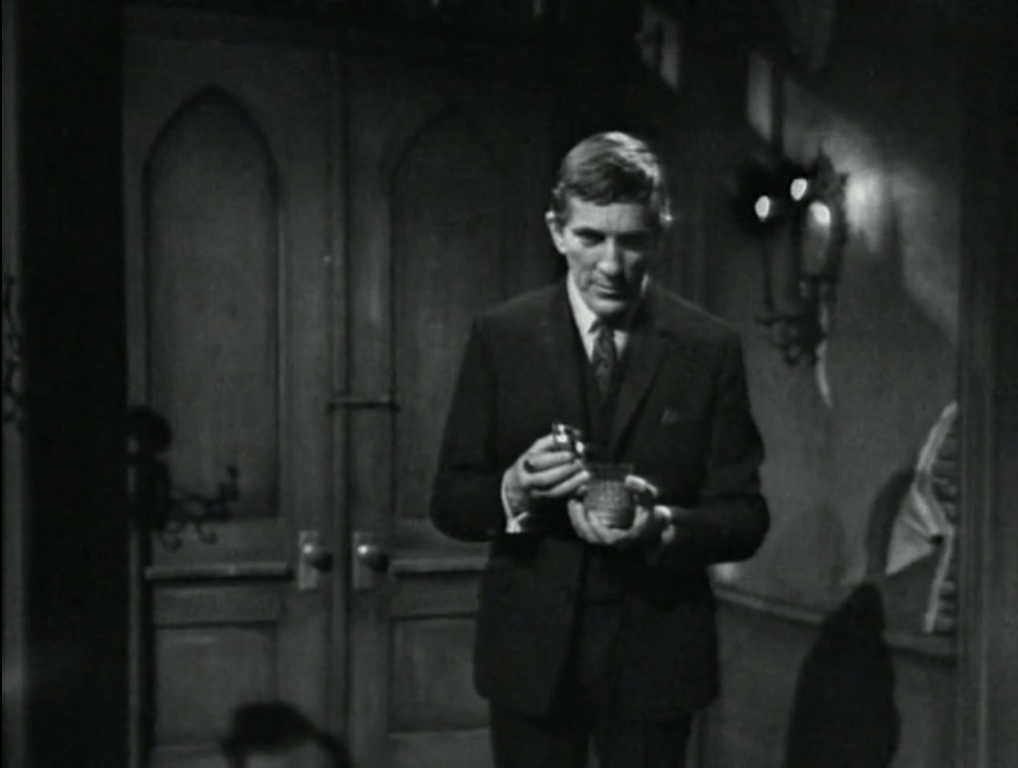
Imperious eccentric Barnabas Collins wants to reinvent working girl Maggie Evans as a member of his class- genteel in manner, florid in speech, thirsty for the blood of the living. Willie Loomis does not believe Barnabas’ plan will work, but because of the nature of their relationship he of course helps him with it. Living in their house, Maggie sometimes seems to be well on her way to developing the traits Barnabas is trying to inculcate in her, but at other times protests that she will never change.

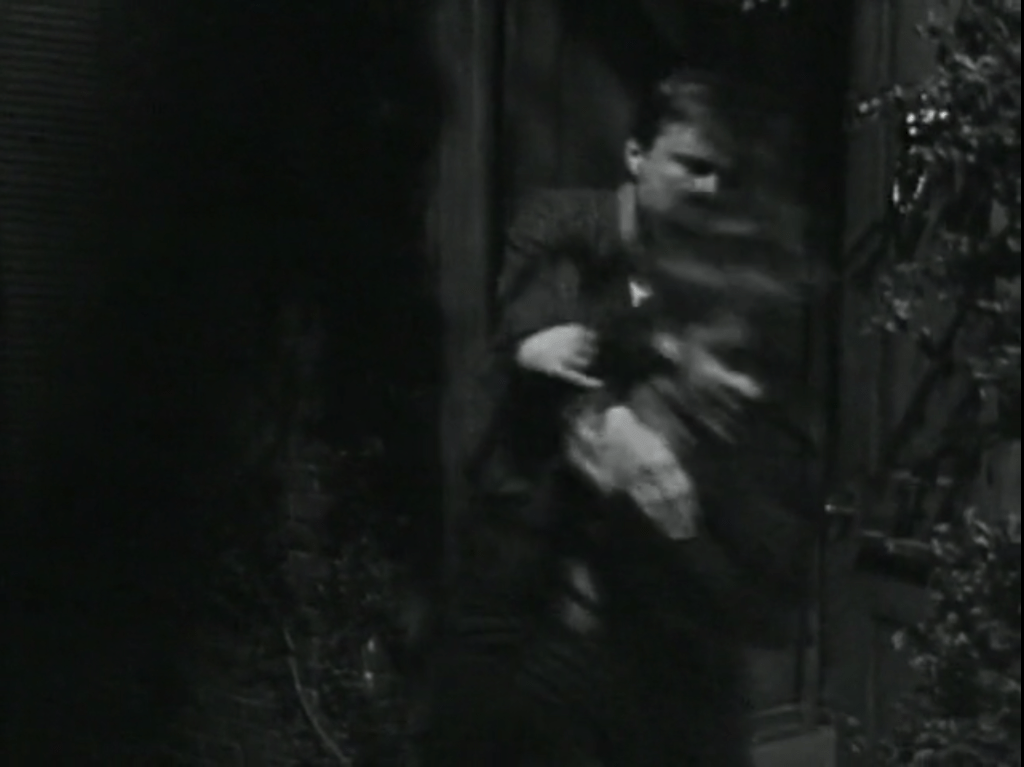
Maggie’s father Sam is a drinking man. He comes to the house today to get some cash from Barnabas. Sam doesn’t know about Barnabas’ project; his visit has nothing to do with Maggie. He is an artist, and is delivering a portrait Barnabas commissioned him to paint.

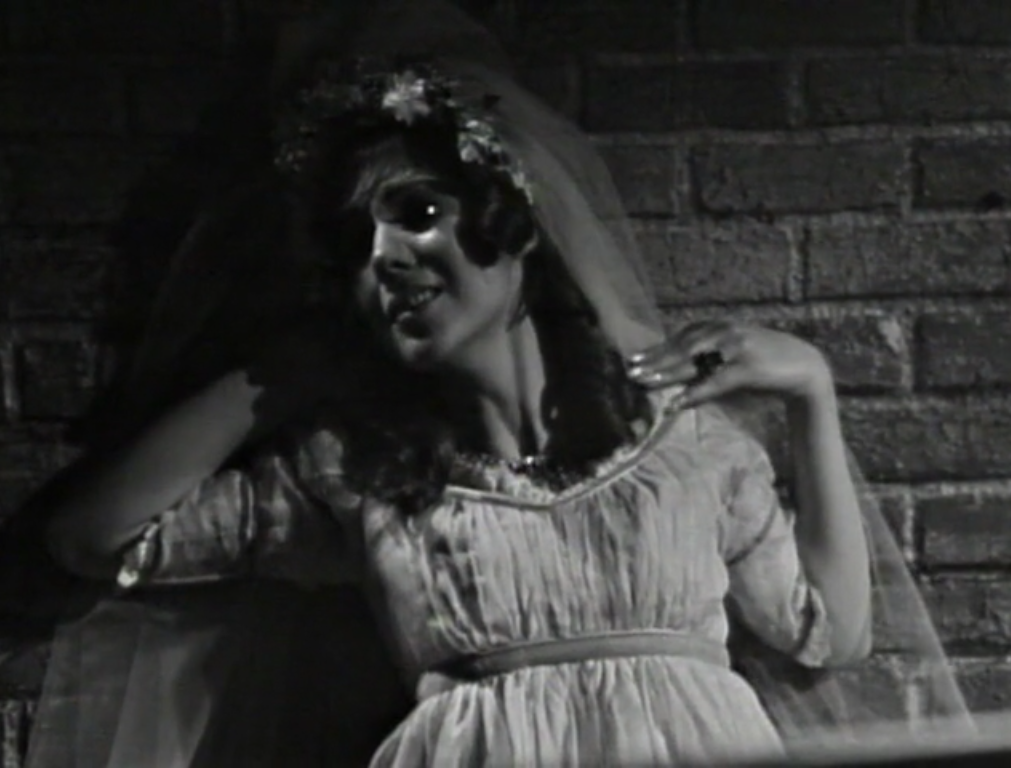
The episode ends with a musical number. Maggie is in the basement prison cell where Barnabas keeps her between elocution lessons. Through the bars of her door, she sees and hears a little girl in eighteenth century garb singing “London Bridge is Falling Down.” The girl sings an obscure variant of the song with a verse that runs “Take the key and lock her up, lock her up, lock her up. Take the key and lock her up, my fair lady.”

Falling down.
Screenshot by Dark Shadows Before I Die

Up to this point, the Barnabas story has been a mashup of Dracula with the 1932 film The Mummy. There isn’t any particular reference to vampirism today. Maggie’s neck is uncovered throughout the episode, and we don’t even see the bite marks. It’s all about The Mummy and its possible sources.

Imhotep’s attempt in The Mummy to turn Helen Grosvenor into Princess Ankh-esen-amun may have been inspired in part by George Bernard Shaw’s Pygmalion. Imhotep only has Helen in his custody for a few minutes of screen time and those minutes are so heavy with images of Egyptian antiquities, suggestions of magic, and the threat of extreme violence that they never find time for an explicit comparison.

Dark Shadows, on the other hand, keeps Maggie in Barnabas’ house for weeks and weeks, so it’s inevitable that sooner or later they would explore the connection. Thanks to Lerner and Loewe, the story of Pygmalion was very familiar to American audiences in 1967. It’s only surprising that Sam isn’t getting married in the morning, Maggie’s boyfriend Joe doesn’t tell us that he’s often walked down Barnabas’ street before, and Maggie never shouts at a race horse to move its bloomin’ arse. Considering the alarmingly awkward movements people in Collinsport make when music is playing, there was never any prospect she could have danced all night.

Just You Wait

Maggie uses the word “undead” to describe Barnabas. The first time we heard that word on Dark Shadows was in #183, when parapsychologist Dr Guthrie told blonde fire witch Laura Murdoch Collins that he believed her to be “the undead.” Though Laura’s story owed many structural elements to Bram Stoker’s Dracula, not least Guthrie’s own depiction as a Van Helsing-like figure, she was not a vampire. So “undead” is not simply a euphemism for “vampire” on this show, though it is true they will avoid saying “vampire” until Barnabas’ 41st week.

Regular viewers who find a reminder of Laura in the word “undead” will be especially interested in today’s ending. When Laura was first on the show, she was a vague presence. There were indications that she wasn’t so much a person as she was a whole collection of phenomena, some of them physical, some of them purely spectral, each of them with its own purposes. As Laura became more dynamic, those phenomena resolved themselves into the deadly fire witch and her adversary, the benevolent ghost of Josette Collins.

Like Laura, Barnabas seems to have stirred up numerous uncanny forces with his arrival. The clearest indication of this so far has been the howling of dogs when he is forming an evil plan, a howling which is not related to his physical location and which, often as not, hampers his efforts. There have also been some shenanigans with the doors in his house which don’t seem to have a natural explanation and which he wouldn’t have had a motive to arrange. The appearance of the mysterious girl* suggests that this time, the antagonist will pull a whole new cast of characters out of the supernatural back-world behind the main setting of the show.

*The girl is a lot less mysterious than she ought to be, since the closing credits identify her as “Sarah Collins.” That’s enough to tell even first-time viewers that she is a member of the ancient and esteemed Collins family that is at the center of the show. It gives more away to regular viewers. The tomb from which Barnabas emerged has marked graves for his parents, Joshua and Naomi, and his sister, Sarah, who died in childhood.

And right before Sarah appears, Barnabas was looking at Josette’s portrait. From #70 to #191, that portrait would glow when the ghost of Josette was about to do something. So if we didn’t know her name, we might think that the girl was an ally Josette had recruited, or perhaps Josette herself in a different form than the adult ghost we have seen before. That in turn would send us into the weekend speculating about the ghostly adversaries who might be lining up to oppose Barnabas. Giving the name, even to viewers who’ve forgotten about Barnabas’ sister, limits our speculations to possible one-on-one confrontations.

Episode 254: As much fun as a bag of spiders

Reclusive matriarch Liz and well-meaning governess Vicki are in the drawing room of the great house of Collinwood. Liz is depressed because her daughter Carolyn is dating motorcycle enthusiast Buzz. She asks Vicki if she has any idea how to break Carolyn and Buzz up, then answers her own question. Liz knows that Carolyn is protesting her engagement to seagoing con man Jason McGuire, and that only by breaking it off with Jason can she change things with Carolyn.

When Liz claims that she is marrying Jason because she wants to, Vicki says it’s none of her business. Vicki has seen abundant evidence that Jason is blackmailing Liz, and won’t pretend she hasn’t. She manages to be quite respectful to her employer without backing down an inch. Despite herself, Liz is impressed with Vicki’s firmness and diplomacy.

Alexandra Moltke Isles was cast as Vicki because she and Joan Bennett looked so much alike, and this is one of the scenes that uses their resemblance to show Vicki as a reflection of Liz. As Vicki is finding tactful ways to express her suspicions, she says things that we have heard Liz say and that we know she is thinking. Each time she does so, Joan Bennett does a quarter turn one direction from the shoulders and a quarter turn the other direction from the neck, as if she were being twisted open. When Liz tells Vicki to stop, she calls her “Victoria,” a name we haven’t heard her use since 1966, and when Vicki asks permission to leave the room she responds, in a near-whisper, with the usual “Vicki.” This alternation also suggests twisting, and to regular viewers who remember that Liz has a secret connected with the fact that “Her name is Victoria” it is another twisting open.

Meanwhile, Jason is entering the Blue Whale tavern with his former henchman, Willie Loomis. Jason wants to confront Willie with the fact that he saw him in town earlier in the day selling a piece of jewelry. Willie says that he was selling it on behalf of his employer, wealthy eccentric Barnabas Collins. Jason knows of Willie’s obsessive fascination with jewels and his tendency to steal them, and does not believe that Barnabas would entrust him with such a task. What Jason does not know is that Barnabas is a vampire and Willie is his sorely bedraggled blood-thrall. As such, Barnabas has a power over Willie that makes it rational to entrust the most remarkable tasks to him.

Carolyn and Buzz enter. They almost leave when Carolyn sees Jason and Willie. Jason and Willie rise and meet them at the door. Jason assures Carolyn that they were just going. Before they do, he taunts Carolyn with his engagement to Liz.

On Tuesday, Carolyn and Buzz started dancing together in the drawing room. Buzz made a few very graceful moves, saw Carolyn going into the Collinsport Convulsion, and sat down to observe. Today, Buzz sees two background players twitching awkwardly while the jukebox plays and declines Carolyn’s invitation to join her on the dance floor. He wants to stop drinking, saying that he is looking for something that will make him feel like he’s never lived before, while “drinking only makes you feel drunk.” It sounds a little bit like he’s going to offer Carolyn a drug stronger than alcohol, but by the end of the scene he just wants to get back on his bike. Liz’ fears to the contrary, Buzz seems pretty darned wholesome.

While Carolyn and Buzz are on their way out of the tavern, hardworking young fisherman Joe comes in. Carolyn asks Buzz to wait outside while she talks with Joe. Buzz reluctantly agrees to spend a few minutes alone with his bike.

Carolyn and Joe were dating when the show started, and there was a whole storyline about how they were tired of each other and couldn’t get themselves sufficiently organized to break up. Their scenes together reminded us that the 1960s were the decade in which Michelangelo Antonioni used the cinema to explore the nature and significance of boredom.

But they are far from boring today. After he and Carolyn finally called it quits, Joe started seeing Maggie Evans, The Nicest Girl in Town. Maggie is now missing and feared dead. Carolyn sits next to Joe at the bar and expresses her sympathies. When I say that Nancy Barrett’s acting style was to throw herself unreservedly into whatever the script gave her character to do that day, it may sound like I’m saying she was undisciplined or that she lacked subtlety. That is not at all what I mean, and in this scene she does one of the most delicate drunk acts I’ve ever seen. Carolyn sits a fraction of an inch too close to Joe, tilts her head back a fraction of a degree too far, opens her eyes the tiniest bit too wide, and speaks ever so slightly too slowly. No one of those signs would even be noticeable by itself, but together they make it very clear why Buzz was anxious that he and Carolyn should leave their drinks unfinished.

Back in the drawing room, Jason is badgering Liz into setting the date for their wedding. Carolyn and Buzz come back, and Jason tells them he and Liz will be married two weeks from tonight. Carolyn says that she and Buzz ought to get married the same night. Buzz is delighted when she first says this, and is still smiling when she insists she is being serious.

Buzz delighted with Carolyn’s proposal.
Screenshot by Dark Shadows Before I Die

My wife, Mrs Acilius, urged me to call this one “A piece of that action,” something Jason says to Willie. Trekkie that she is, that seemed irresistible to her. But Joe’s line that Buzz seems to be “about as much fun as a bag of spiders” is the funniest of the many witty lines in today’s script, and when you remember that Dark Shadows has, since December of 1966, been basically a horror story, you have to think that in its terms a bag of spiders might be a lot of fun. So that had to be the title.

Episode 253: Ring cycle

Vampire Barnabas Collins is keeping Maggie Evans, The Nicest Girl in Town, in a prison cell in his basement. He won’t let her out until she discards her personality and adopts that of his long-lost love Josette. That would seem to rule Maggie out as a source of plot development for quite some time.

Writer Joe Caldwell knew that he was not the first dramatist to have to tell a story in which one of the main female characters is cooped up. In ancient Athens, women of citizen rank were supposed to be immured in the house, hidden away from all men outside their immediate families. While the reality was a great deal more complicated, audiences at the city’s dramatic festivals liked to see plays set in a world that approximated that ideal. So tragedians like Euripides, and after him the Greek and Roman playwrights of the New Comedy, devised a whole repertoire of ways that ladies could send messages to their boyfriends without leaving home.

One of the most prominent of these methods was the dispatch of an identifiable token by a household servant. Since many people, both men and women, wore rings with unique decorations, rings were very often used for this purpose. In plays where the heroine has been captured by pirates and is being held prisoner by someone to whom the pirates made a gift of her, as in Plautus’ Miles Gloriosus (sometimes translated into English as The Swaggering Soldier,) the heroine and her accomplices will use the villain’s greed or that of his servant to trick them into taking a valuable ring and showing it to someone who will be able to help her. Plautus would have been relatively familiar to audiences in 1967, and very much front-of-mind for the Broadway-oriented people involved in making Dark Shadows, because of the success of the 1962 show A Funny Thing Happened on the Way to the Forum and its 1966 film version, both of which end with a recognition prompted by the sight of an unusual ring.

Maggie doesn’t seem to be up on her New Comedy. In the first part of the episode, she asks Barnabas to take her ring to her father to let him know she is still alive. Barnabas is insulted that she would think he was dumb enough to do that.

There is some good dialogue in this scene, and Kathryn Leigh Scott and Jonathan Frid are always fun to watch together, but we have to share Barnabas’ reaction. Until today, Maggie had been one of the few characters on the show who had never done or said anything inexplicably stupid, and asking Barnabas to give her father the ring breaks that streak. Barnabas’ complaint lampshades the problem, which does help a bit- it gives us time to think that maybe Maggie is trying to distract Barnabas from another plan she is cooking up, or maybe the script is telling us that she is so desperate she doesn’t know what she’s doing.

Later, Barnabas’ sorely-bedraggled blood thrall Willie Loomis comes to check in on Maggie. Willie is so obsessed with jewels that when Maggie offered him a diamond necklace on Friday, he turned his back on Barnabas’ coffin while she stood there preparing to stab him through the heart. Maggie persuades Willie to take her ring as a token of her gratitude for keeping Barnabas from killing her on Monday. That marks a good recovery from the earlier dumbness, and gets us off to a fresh start.

Strange and troubled boy David Collins sneaks into Barnabas’ house through an unlocked window. He often visited the house in the months before Barnabas was introduced to Dark Shadows, when the ghost of Josette was the principal supernatural presence on the show and the house was her stronghold. David can’t feel her presence there now, and calls for her forlornly as he wanders through the front parlor.

Willie catches David and demands to know why he is in the house. David tries to defend his indefensible behavior, and when that fails he goes on the attack. He says that he knows what Barnabas and Willie are doing. Willie tenses and asks what it is they are doing. David says they are hurting Josette. Willie listens until he is sure that David is talking only about the ghost, not about Maggie. Then he picks David up and throws him out the front door. There is so much hilarious stuff in this part that not even the bit in the middle when Willie briefly thinks he may have to murder David dampens the mood.

Willie picks David up…
…and throws him down.

In the course of bodily ejecting David from the house, Willie drops the ring. David finds it on the ground while he is getting back onto his feet. He calls to Willie and tries to return the ring, but Willie has already locked the door and will give no response but shouts of “Go away!” David takes a good long look at the ring and goes home to the great house of Collinwood.

Well-meaning governess Vicki greets him there, scolding him for having gone so far from the house. She notices the ring in his hand. This moment comes straight out of ancient comedy- David’s clothes have pockets, after all, but this scene is written for an actor wearing a pallium and a terracotta mask. David won’t tell Vicki where he found the ring, and she examines it. She has seen that there is an inscription in it and is just about able to read it when a knock comes at the door.

It is Barnabas. He tells David that he wants to apologize for Willie’s forcible ejection of him from his house. Vicki turns to David and asks if that’s where he was. The boy has little choice but to admit it, and suggests that the ghost of Josette invited him. Vicki asks if he found the ring at Barnabas’ house. Barnabas, startled by the mention of a ring, asks to see it. He claims that it is a family heirloom which he gave Willie to sell. He takes it, and in a genial voice suggests David steer clear of Willie.

Back home, Barnabas returns to Maggie’s cell. She pretends to be coming around to believing that she is Josette. Barnabas shows her the ring and shatters her hopes. He leaves. Rather than end the episode with a shot of her staring helpless through the barred door, we follow Maggie into the cell and see her slam shut the lid of Josette’s music box. We see her thwarted, but no less able to take action than she was when we began.

Caldwell deserves credit for a fine script, aside from the awkwardness in Maggie’s early scene with Barnabas. Director John Sedwick keeps it looking clean and crisp, and the final shot of Maggie in her cell is a triumph of timing. Best of all, the actors all liked each other and were having fun working together today, and that gives an irresistible energy to the finished product. The result is the fourteenth episode, and the first since #182 early in March, that I would label “Genuinely Good.”

Episode 252: I know we swing, and that’s all I have to know

Frustrated that her mother, reclusive matriarch Liz, has decided to marry seagoing con man Jason McGuire, flighty heiress Carolyn spends the day and night with motorcycle enthusiast Buzz Hackett.

Buzz is modeled on the biker dude villains of Beach Blanket Bingo. Some of his mannerisms, such as speaking in a Beatnik slang that was a decade and a half out of date by 1967 and wearing sunglasses when he rides his motorcycle at night, would have been a little too broadly comic even for that movie, and are ludicrously out of place on the rather solemn Dark Shadows. The very sight of Buzz therefore raises a laugh.

I mean really

Nancy Barrett’s acting style was to throw herself unreservedly into whatever the script had her character doing that day, and seeing her present Carolyn as a newly minted biker mama is hilarious from beginning to end. When Carolyn and Buzz show up at the Blue Whale tavern, she’s already sloppily drunk. They see well-meaning governess Vicki and hardworking young fisherman Joe at a table, and Carolyn insists they go over and greet them. Vicki and Joe give Buzz and Carolyn frosty stares, which are of course the main ingredients of drawing room comedy.

If Vicki put on a police uniform, Carolyn wore a big feathered headdress, and Joe were a construction worker, they could make beautiful music together

As Danny Horn points out in his post about the episode on Dark Shadows Every Day, Buzz is actually pretty nice. That’s a good comic move- the obvious outsider is the one who knows enough to be uncomfortable, while the one who has been a central member of the cast from the first week is oblivious to the social awkwardness surrounding her. If it were the other way around, we might feel sorry for Buzz or be angry with him, but since we know that Carolyn’s place is essentially secure we can laugh at her uninhibited behavior, no matter how much it may make others squirm.

Buzz takes Carolyn home to the great house of Collinwood, parking his motorcycle a few feet from the front door. That isn’t a sign of inconsideration- there only are a few feet in front of the door, they’d be off the set if he parked any further away. It’s still pretty funny to see.

Buzz and Carolyn

Inside the house, Buzz jokes about riding his bike up the main staircase. Carolyn laughs, then urges him actually to do it. He refuses, clearly appalled that she would want such a thing.

Carolyn shocks Buzz

They go into the drawing room. Carolyn picks up a transistor radio and finds some dance music. Buzz is ready to dance, but takes a seat when Carolyn goes into the violent, rhythm-less jerks people in Collinsport do when music is playing. Buzz watches her, apparently ready to provide first aid.

As Carolyn’s performance of the Collinsport Convulsion ends with her falling face first, Liz comes downstairs. She protests against Carolyn and Buzz making so much noise at 3 AM. For the first time, Buzz is rude. He does not stand up when Liz comes into the room, and when Carolyn introduces her as “Mommy,” he greets her with “Hiya, Mommy!” Liz orders him to go.

Before Buzz has a chance to comply, Carolyn starts taunting her mother, yelling at her that her name will soon be “Mrs McGuire!” Liz retreats up the stairs as Carolyn taunts her with repetitions of this name. When Liz is on the landing, Carolyn and Buzz clench and kiss passionately. While they kiss, we see Liz above and behind them, trying to exit the scene. As it happens, the door she is supposed to go out is stuck, so she has to struggle with the knob until she’s out of the frame. Thus, the longest period of intentional comedy on the show ends, not with a break into angry melodrama, but with a huge unintended laugh. It is one of the few truly perfect things ever seen on television.

Door’s stuck

As Buzz, Michael Hadge really isn’t much of an actor- he shouts his lines and goes slack whenever he isn’t speaking. That doesn’t matter so much today. Nancy Barrett’s high-energy performance, the other cast members’ skill at comedy of manners, and the mere sight of Buzz combine to keep the audience in stitches throughout.

Still, I can’t help but wonder what might have been. Yesterday, vampire Barnabas Collins threatened to murder his blood thrall, the sorely bedraggled Willie Loomis. Viewers watching on first run might have wondered if Buzz was going to be his replacement. They might have, that is, if Buzz were played by an actor in the same league as John Karlen. With Mr Hadge in the role, that suspense never gets off the ground.

One of the little games I play in my head when the show gets boring is to ask who else might have taken a part and to imagine how it would have changed with that other actor in the cast. So, if Harvey Keitel was available to dance in the background at the Blue Whale in #33, then surely Mr Keitel’s friend Robert De Niro would have taken a speaking part in #252. Actors inspire screenwriters, and if Mr De Niro had played Buzz I would have wanted to write this line for him to speak to Liz: “Mrs Stoddard, you got me all wrong. You think I want to hurt you, or take something from you, but that’s not the way it is. Me and Carolyn, we’re just trying to have a good time.” Mr Hadge’s shouting wouldn’t have made much of a line like that, but delivered by Mr De Niro to Joan Bennett it could have started a scene between Buzz and Liz that would have expanded his role beyond comic relief and earned him a permanent place in the cast.

It may be for the best that it didn’t work out that way. A De Niro-Buzz might have been such a hit that Dark Shadows never would have got round to becoming the excursion into sheer lunacy that we know and love. And Martin Scorsese might never have been able to get soap opera star/ teen idol Robert De Niro to answer his phone calls.

Closing Miscellany

There are some other notable moments today. We might wonder why Vicki and Joe are sitting together in the Blue Whale, when Vicki has been dating dashing action hero Burke. In fact, the script originally called for Vicki to be out with Burke, but actor Mitch Ryan showed up too drunk to work the day they taped this one and was fired off the show. Burke gave up on his big storyline over ten weeks ago and there hasn’t been a reason for him to be on the show since. Besides, the same cast of characters cannot indefinitely include one whose type is “dashing action hero” and another whose type is “vampire.” The vampire is already pulling in bigger audiences than anything else they’ve done, so Burke has to go. Still, Ryan was such a charismatic screen presence that he was a high point in every episode he appeared in, so it’s sad we’ve seen him for the last time.

The bartender brings drinks to Vicki and Joe’s table and Joe calls him “Bob.” They have settled on this name by now. The same performer, Bob O’Connell, has been playing the bartender since the first week, but in the opening months of the show he had a long list of names. My favorite was “Punchy.”

There is some new music in the jukebox at the tavern and more new music while Carolyn and Buzz are outside the front doors of Collinwood. In the tavern we hear something with brass, and at the doors we hear a low-key saxophone solo.

The closing credits give Buzz’ last name as “Hackett.” We heard about a businessman named Hackett in #223, but Buzz doesn’t seem to be related to him. In the Blue Whale, Carolyn says that her mother has more money than Buzz will ever see, to which Buzz laughingly replies “That isn’t much!”

Patrick McCray’s post about this episode on his Dark Shadows Daybook is fun. I especially enjoyed his description of Michael Hadge’s performance as a merger of “Russ Tamblyn with Truman Capote.”

Episode 251: Madness preferable to sanity

We reprise the final scene of Friday’s episode, in which vampire Barnabas Collins catches his prisoner Maggie Evans trying to stab him. He flashes his fangs at her.

Doctor Teeth and the Electric Mayhem

The first time around, this had been the climax of a number of powerfully realized scenes, so it still carried a punch despite the silliness of the fangs. From a standing start, though, the result is a bad laugh.

In the 45 seconds following the first commercial, ABC staff announcer Bill Rice* summarizes the action of the previous week’s episodes.** This recap comes so close to exhausting every event we saw in those 110 minutes of scripted drama that regular viewers will have another unintended laugh.

The recap was inserted because many ABC stations preempted Dark Shadows to cover a United Nations debate about the Vietnam War. The show was about as resolutely disengaged from contemporary politics as it was possible to be, but conjoining US policy in Vietnam with a character like Barnabas, who combines a vast capacity for killing with a desperate need to be loved, does bring certain thoughts to mind.

Barnabas and Maggie have a conversation about his inclination to kill her. Barnabas’ sorely bedraggled blood-thrall Willie Loomis joins in, saying that Barnabas will have to kill him first. This would not seem to present Barnabas with any difficulty at all. Willie wouldn’t be missed- everyone else on the show remembers Willie from the days before he met Barnabas, when he was dangerously unstable ruffian Willie Loomis, and has been urging Barnabas to get rid of him. Nor would it be especially difficult for Barnabas to replace Willie- he just has to bite someone else, and that other person will become his new slave. But Barnabas stands around arguing with Willie and Maggie. When someone knocks on the front door, he scolds Willie for failing to keep it locked, such a humdrum complaint under the circumstances as to bring another bad laugh. Barnabas leaves Willie and Maggie in the basement while he answers the door. Before he goes, he sticks out his lower lip, a facial expression known as “pouting.”

Barnabas pouts

The visitor is well-meaning governess Vicki, who tells Barnabas that the sheriff has ordered that no woman go out alone at night. Some think it strange to send a woman out alone at night to carry this message to a man who is indoors, but considering what we’ve seen of the sheriff, doing the exact opposite of what he commands would seem always to be the wisest course.

Vicki notices an antique music box on a table in Barnabas’ front parlor. Vicki admires its tune and makes a few not-very-coherent remarks about “the past” while it is playing. Barnabas has been using this music box as a tool to hypnotize Maggie into believing that she is his long-lost love Josette. After Vicki leaves, he opens it again, then looks at the door through which she left. He turns his head and smiles, looking very much like someone who has just had an exciting new idea.

Lightbulb moment

Meanwhile, Maggie and Willie talk to each other in the basement. The two of them had one of the most electrifying scenes of the entire series down there Friday. The last traces of that energy have been piddled away by the time Barnabas comes back downstairs and resumes his conversation with them.

Willie urges Barnabas to look at Maggie and see how beautiful she is. Barnabas says “No” and looks away. Coming at a moment of high dramatic tension, this might have been powerful. When we sit down as an audience, we enter into a sort of agreement that if the show includes something worth seeing, we will look at it. So when we see a character refusing to look at a sight as well worth contemplating as was the young Kathryn Leigh Scott,*** we might be shocked. But there has been too much idle chatter, and the memory of Barnabas’ pout is so fresh, that all we can think of is a petulant child saying “I don’t wanna look at her!”

Barnabas announces that he will not kill Maggie right away. He tells her that he will make her suffer torments worse than anyone has ever known so that death will finally come as a blessed relief, then locks her up in the prison cell in the basement of the house. What, your house doesn’t have a prison cell in its basement? It’s a standard feature of homes in Collinsport, as we will come to see in future episodes.

Barnabas goes to the great house of Collinwood and talks to Vicki. He brings a handkerchief that, legend has it, was a gift from the queen of France to Josette. They babble about “the past” and Barnabas invites her to drop in at his house “some day.” He says “day,” even though he’s busy being dead every day until sunset. And doesn’t specify when- any old time, if she hears screams coming from the basement she’ll probably just ignore them.

Evidently Barnabas is thinking of Vicki as a backup Josette in case Maggie doesn’t come around. This marks a retreat from #240 and #241, when strange and troubled boy David Collins, who has seen Josette’s ghost many times, saw Maggie in the gown Barnabas gave her and said that she must have been Josette because she looked “exactly the same” as he had seen her before. That suggested, not only that Barnabas chose Maggie because of her looks, but also that he might be right in thinking that she is Josette’s reincarnation. This storyline is modeled on the 1932 Universal film The Mummy, in which Imhotep’s idea that Helen Grosvenor is the reincarnation of his lost love Princess Ankh-esen-amun is substantiated when Zita Johann plays both roles. If Vicki and Maggie are interchangeable, then all of that goes by the boards.

*Presumably no relation to the main character of Gene Roddenberry’s 1963-4 CBS TV series The Lieutenant, one episode of which was written by Art Wallace.

**As transcribed by the Dark Shadows wiki:

For those who have missed the last few episodes of Dark Shadows: Elizabeth Collins [Stoddard,] at Jason McGuire’s insistence, has taken Vicki, Carolyn, and Roger into the basement room and convinces them that it holds no mystery. They don’t realize that beneath the flagstones on the floor is concealed the room’s secret—the body of Elizabeth’s husband, Paul. Elizabeth, now realizing that the secret can never be told, announces to the family that she and Jason will be married. Maggie Evans escaped from Barnabas and attempted to get to her father, but was recaptured and told by Barnabas that unless she assumes the identity of Josette Collins, she will die. Realizing that she can never escape, Maggie attempts to destroy Barnabas.

The title card shown during the recap

***Or for that matter as is the not-so-young Miss Scott of today, she’s one of the best looking octogenarians around.

Episode 250: A servant’s name

Maggie Evans, the Nicest Girl in Town, has been the prisoner of vampire Barnabas Collins for some time. At rise, she is in front of her mirror, struggling to remember who she is. Her name and her father’s come back to her, but then the music box Barnabas gave her starts playing, and she begins to believe that she is Barnabas’ long-lost love Josette. This scene takes about a minute more than is necessary.

She renews the struggle later, and this time overcomes the hypnotic power of the music box. She decides to pretend that she believes that she is Josette in order to trick Barnabas and Barnabas’ sorely bedraggled blood thrall Willie into giving her enough freedom to escape. She fools them, only to hear Barnabas tell Willie that her compliance means that the time has come for the final part of his plan.

Maggie hears carpentry work, and sneaks down to the basement. She finds Barnabas watching Willie build a coffin. It sits next to the coffin in which Barnabas spends his days. It becomes clear that once Maggie is fully Josettified, she will be a vampire as well. Unfortunately, Jonathan Frid has a great deal of trouble with his lines in this scene. I don’t usually mind Frid’s bobbles, but his line troubles here take us out of what needs to be a terrifying moment.

In the morning, Maggie goes back to the basement. Willie finds her there. He is not convinced that she believes she is Josette. He presses her, and she finally breaks down and gives up the act.

Maggie shows Willie the diamond necklace Barnabas gave her as a present for their wedding, and tells him it will be his if they destroy Barnabas and escape. Willie’s fascination with jewels was what led him to undertake the grave-robbing expedition that freed Barnabas in the first place, and the necklace does distract him for a little while. But then he hears Barnabas’ heartbeat. He heard that sound before, in #208, #209, #210, and #217, but in those episodes no one else could hear it. Maggie can, since Barnabas has been drinking her blood too, but she can still resist the vampire’s spell. She is holding a large awl, ready to drive it into Barnabas’ heart, but Willie cannot overcome his urge to protect his master. He disarms Maggie.

We see Maggie in her room and hear Barnabas’ voice on the soundtrack going over what she heard him say in the basement. This is the first time an interior monologue has played quotes from another character. They aren’t the lines Jonathan Frid actually delivered, but cleaned-up, intelligible lines, presumably the ones that were in the script.

As sunset nears, Willie takes Maggie back to the basement. He leaves, telling her that she and Barnabas must be alone when he completes “the ceremony.” She finds the awl, picks it up, and opens the coffin. Before she can drive it into Barnabas’ heart, he awakens and shows his fangs. She screams and presses herself against the brick wall behind her.

Back to the wall

This is the second episode credited to writer Joe Caldwell, and is certainly the best teleplay Dark Shadows has seen since Francis Swann left the show in November of 1966. Like Swann and Art Wallace, Caldwell understood what actors could do and knew how to give them a platform to show their stuff.

Aside from Frid’s one bad scene, the actors excel. In 1967, Kathryn Leigh Scott was already a highly trained actress. Maggie Evans, on the other hand, has never acted before. When Maggie is pretending to believe she is Josette, Miss Scott shows her giving a crude imitation of Barnabas’ high-flown style, mixed with some prancing movements you might see from a little girl playing the princess in a school play. Barnabas is so desperate to believe that his lunatic scheme is working that he falls for it completely. When he and Maggie are in the front parlor together, he responds to her amateur performance as a sign that she is matching his pomposity, which of course thrills him.

When Willie and Maggie are in the basement, John Karlen plays his earthy skepticism with a simplicity that makes Maggie’s pretending look ridiculous. When Maggie gives up her act and whispers a plea for Willie to help her, Miss Scott matches the force of Karlen’s performance and the resulting encounter is as powerful as anything the show ever achieves.

The episode is good enough that we barely noticed some major lapses in story logic. If Maggie can sneak down to the basement to eavesdrop on Barnabas and Willie, why can’t she slip out the front door? She knows how to get from Barnabas’ house to the great house of Collinwood, where she has friends and there is a telephone to call the sheriff.

And when did she learn that you can destroy vampires by driving stakes through their hearts? She’s lived in Collinsport all her life, and no one in that town has ever heard of vampires. Granted, the show would move a lot faster and could have more layers of irony if the characters had read Dracula and seen movies from Universal and Hammer, but this is the first hint that any of them has.

My wife, Mrs Acilius, was very interested in the fact that Maggie calls herself “Maggie, or Margaret” in this one. First time we hear the name Margaret! I’m not sure why that impressed her so much, but she’s very bright, so I’m sure it’s important. All I can think of is that “Maggie” waits tables in the diner, cleans up after her Pop has had one drink too many, and is everybody’s pal, while “Margaret” is a saint’s name, and a queen’s name. So Margaret might have a bigger destiny than we’ve seen.

Episode 249: The most pitiful exhibition I’ve ever seen

Seagoing con man Jason McGuire stands outside the drawing room of the great house of Collinwood, eavesdropping. The conversation is among heiress Carolyn, Carolyn’s uncle Roger, and well-meaning governess Vicki. Carolyn tells Roger and Vicki that she wants to stop Jason from blackmailing her mother, reclusive matriarch Liz, into marriage. She doesn’t know what hold Jason has over Liz, but is sure it has to do with something secreted in a locked room in the basement. Roger agrees to help Carolyn break into the room.

Jason reports this conversation to Liz and suggests they give Carolyn the key to the room. What Liz is desperate to hide is that Jason buried the body of her husband, Paul Stoddard, under the floor there eighteen years ago. Jason tells her that he sealed the floor up well enough that there is nothing to see unless you start digging. Liz is unsure, and Jason offers to go to the room and look.

First-time viewers may not make much of this, but those who have been watching from the beginning will be exasperated. Liz has gone into the room herself many times over the years; Vicki has even caught her coming out of it. When they take us to the room and show us that there is nothing interesting to see there, they are telling us that there was no point to any of the scenes where Liz gets frantic at the prospect of someone going into the room. It’s a slap in the face of the audience.

The cast assembles in the room and pokes around a little. They don’t open all the trunks and cases; there is a big barrel that could hold the remains of several missing husbands, and they never so much as look at that. After this has gone on for some time, Jason declares that it is “The most pitiful exhibition I’ve ever seen.” That’s good, it’s always fun when the villain has a chance to put the audience’s feelings into words. After they go back upstairs, Roger says that he’s never been more embarrassed in his life. Louis Edmonds delivers that line with tremendous feeling, it doesn’t sound like he had to act at all.

The whole miserable mess leads to Liz and Jason announcing their engagement, something Carolyn had been talking about when she lamented for “Poor mother- abandoned in her first marriage, blackmailed into a second.” But Carolyn, Roger, and Vicki all look shocked, a dramatic sting plays on the soundtrack, and the closing credits start to roll, as if this were some kind of news.

Closing Miscellany

On his great Dark Shadows Every Day, Danny Horn analyzes the action of the episode as a series of devices to prevent anything interesting happening. He also goes through much of the unbelievably repetitious dialogue that clutters it up. He’s hilarious, the post is highly recommended.

When Jason goes to the basement to make sure that there is nothing there worth looking at, he shines his flashlight directly into the camera several times. It’s a flashlight we haven’t seen before, with a bulb mounted on top of a box. I’ve never been a particular flashlight aficionado, but that prop is the most dynamic part of today’s show.

Flashlight mounted on a box
Jason enters the basement
Looking at an old shirt

Episode 248: The bride of Barnabas Collins

At the end of yesterday’s installment, artist Sam Evans looked out the window of his house and saw his daughter, missing local girl Maggie. Today, the sheriff shows up and reports that he and his men couldn’t find anything to substantiate Sam’s report. The sheriff then tries to convince Sam that he didn’t really see Maggie at all. When last we see Sam, he is telling himself that it was only his imagination.

Maggie had escaped from the custody of vampire Barnabas Collins and Barnabas’ sorely bedraggled blood thrall, Willie Loomis. Today, Barnabas meets Maggie in the graveyard, chokes her, and takes her into the tomb where he spent a century or two. He declares that he will punish her for trying to leave him.

As Barnabas talks, Maggie seems inclined to go along with his plan to annihilate her personality and replace it with that of his long-dead love, Josette. He wonders aloud if the punishment he was planning is necessary after all. But then she remembers that she is holding her father’s pipe, and she calls out “Pop!” Barnabas then takes her to the hidden room in the back of the tomb and shuts her up in his old coffin.

Director Lela Swift was uncharacteristically sloppy with the framing yesterday, but today she makes up for it with one of the most remembered shots of the entire series. When Barnabas shuts Maggie up in the coffin, we see him from her point of view. Claustrophobic viewers beware!

Barnabas closing the lid

The next morning, Willie releases Maggie from the coffin, takes her back to Barnabas’ house, and urges her to convince herself that she is Josette. For a while, she tries it. We start to wonder if Willie will have as much success with Maggie as the sheriff had with her father. But then she looks in the mirror and shouts “I’m Maggie Evans!”

That may not sound like much story for 22 minutes, but it never feels slow. Swift and the actors are all in fine form today.

On the other hand, there are a couple of script problems. The sheriff is written as such a fool that we can’t help but be distracted, and the scene between Maggie and Barnabas in the outer section of the tomb goes on too long. But even at its lowest points the actors just about save it. Dana Elcar always makes it seem that Sheriff Patterson knows more than he’s letting on, so it isn’t until he starts trying to talk Sam into believing he didn’t really see Maggie that we get the sinking feeling that he is absolutely useless. And Jonathan Frid and Kathryn Leigh Scott are electric as Barnabas and Maggie, so much so that we could forgive the scene between them even if it had been twice as repetitious as it fact is. With two consecutive episodes including as much good stuff as was in yesterday’s and today’s, it’s starting to seem like they are due to land one in the ranks of the Genuinely Good Episodes any day now.

Episode 247: A fix on this man’s character

Artist Sam Evans can think of nothing but his daughter Maggie, The Nicest Girl in Town. Maggie disappeared from the hospital weeks ago, and the police haven’t found a clue as to how she got out or where she is. Sam’s friend, dashing action hero Burke Devlin, drops by Sam’s house and offers to take him to dinner. Sam isn’t hungry. Burke urges Sam to work on a painting; he says he can’t concentrate.

Burke brings up the idea of Sam painting a portrait of him. Burke did commission Sam to paint him in #22, and for weeks and weeks afterward Sam vacillated about doing so. That was part of the since-abandoned “Revenge of Burke Devlin” storyline. In the notes about this episode on the Dark Shadows wiki, we read that “the episode’s writer seems unaware of the portrait-painting history between Sam and Burke, the fact that it was a sore subject, and even of the general animosity between the two.” I don’t think that is necessarily so. Burke gave up on his revenge in #201, and everyone was thoroughly bored by the topic well before then. So I suspect this conversation is telling us that Burke and Sam have turned the page on all that.

Before Maggie disappeared, Sam had been painting a portrait of mysterious eccentric Barnabas Collins. Barnabas insisted on working only at night and on doing all the painting at his place, the Old House on the estate of Collinwood, which does not have electricity. Since Maggie vanished, Sam has offered to take the canvas home and work on it there, but Barnabas would not let it leave his house. Tonight, Sam decides to go to Barnabas’ and do some painting by candlelight.

Sam knocks on Barnabas’ door. Barnabas’ servant, Willie Loomis, answers. Before he met Barnabas, Willie was a dangerously unstable ruffian. Willie menaced Sam and Maggie in the local tavern so severely that Burke had to beat him to a pulp, and Sam came away from the experience hating Willie. But in his time working on the portrait, Sam has come to believe that Willie is a changed man.

Willie explains that Barnabas is away, that he doesn’t know when he will be back, and that he isn’t supposed to let anyone in the house in his absence. Sam protests that he is no stranger, and that he is sure Barnabas will want the portrait finished. Willie finally suggests that he take the canvas home and work on it there. That’s what Sam has wanted to do all along, so he is delighted to hear it. He carries the painting to his station wagon while Willie carries the easel. The two are in a jolly mood as they leave the house, seeming very much like good friends.

Sam leaves his pipe on a table in the front parlor of Barnabas’ house. In the first months of the show he went back and forth between smoking this pipe with its white bowl carved into a likeness of George Washington and puffing on cigarettes. We haven’t seen the pipe in a long while, but today we get a number of closeups of it. The first comes before Sam leaves home to go visit Barnabas, and the second when he and Willie are on their way to the station wagon.

The pipe in the Evans cottage
The pipe at Barnabas’ house

As soon as Sam and Willie are outside, a figure draped in white comes down the stairs into the parlor. It is Maggie. It turns out Barnabas is the one who is holding Maggie. He has taken his cue from the 1932 film The Mummy, in which Boris Karloff is an undead creature who tries to convince a woman that she is the reincarnation of his lost love so that he can kill her and bring her back to life as that other person. Barnabas, it turns out, is a vampire. He wants to erase Maggie’s personality, replace it with that of his long-lost Josette, and then turn her into a vampire.

Maggie is sufficiently under Barnabas’ sway that doesn’t know who she is, but she is not fully convinced that she is Josette. When she picks up her father’s pipe she seems to remember something. She doesn’t sniff it, but a pipe is a highly aromatic object, and scents are powerful drivers of memory.

Maggie reaches for the pipe
Something comes back to Maggie’s mind

Maggie wanders back upstairs, keeping the pipe with her. Sam and Willie come in, and Sam is mystified that his pipe has vanished. When Willie says he must have left it outside, Sam starts to argue. Seeing that the pipe isn’t in the room and believing there is no one else in the house, Sam laughingly calls himself absent minded and asks Willie to keep an eye out for it.

Maggie wanders back downstairs after her father has gone. She and Willie argue about whether she ought to leave her room and who she is. She doesn’t let on that she knows anything about the pipe. She goes upstairs again, and Willie goes to the basement.

This is the first time we have seen the basement, and we get a long look at it. There is a metal door with a barred window, big cobwebs, a stone staircase, big candelabra, and a coffin. The coffin lid opens, and we see Barnabas inside. This is the first time we’ve seen him there.

Barnabas asks Willie why he has come. When Willie tells him he has news, Barnabas beckons him closer. When Willie obeys, he grabs him by the throat. When Willie has delivered his report, he flings him to the floor, apparently on general principles. He stands over Willie’s crumpled form and gives a lecture about the importance of keeping visitors out of the house during the day. Notably, he does not object to sending the canvas home with Sam.

Maggie wanders downstairs a third time. We see her face and hear her recorded voice on the soundtrack. This is the third instance of interior monologue on Dark Shadows, after we heard Willie thinking at the portrait of Barnabas in #205 and #208. As Willie did not know who Barnabas was or why he was drawn towards him when we heard his thoughts, so today Maggie does not know who she is or what Barnabas is doing to her. She looks at the pipe in her hand, concludes that there is someone she must take it to, and walks out the front door.

In the Evans cottage, Sam is working on the portrait of Barnabas when Burke comes in with a sandwich to share. They chat about the painting. Sam explains that he can’t get the eyes right- they keep looking cold and forbidding, while he and Burke agree that Barnabas doesn’t seem that way at all.

We cut back to the Old House, where Barnabas is sitting in his armchair, giving Willie some orders. He may not seem cold and forbidding to Sam, but he couldn’t be more blatantly malevolent than he is with Willie. When they discover that Maggie is gone, Barnabas and Willie run out the front door.

This is the first episode in which Barnabas is just a total bastard the entire time. When he is with people who don’t know that he is a vampire, he plays the role of the Collins family’s mild-mannered cousin from England; Barnabas is so committed to that performance that we wonder to what extent he is a monster pretending to be a nice guy, and to what extent he is a nice guy forced to function as a monster. When we’ve seen him alone with Maggie, he has obviously been a crazy person, but a twisted sweetness comes peeping out as he talks about his longing for Josette. Even in his previous scenes alone with Willie, scenes that have more than once ended with him beating Willie unmercifully, Barnabas has allowed Willie to go on talking about his feelings much longer than he would have to if he were entirely sincere when he tells Willie that his inner life is of no consequence. But there isn’t the least flicker of warmth in either of Barnabas’ scenes today.

In the Evans cottage, Sam is puzzling over the portrait while Burke is in the kitchen. Maggie comes drifting into view in the window behind Sam. The Evans cottage has been a prominent feature of the show from its early days, and the foliage visible through the window has changed often enough from episode to episode that regular viewers know there is an actual space behind it, but this is the first time we have seen a person there. In her white dress, with her dazed expression and her wafting movements, Maggie looks like a ghost. Sam sees her and is startled. He calls her name. She disappears. Sam and Burke run out of the house to look for her.

There are some significant flaws in the episode. The opening scene between Sam and Burke goes on too long, the repeated closeups on the pipe are embarrassingly heavy-handed, and Maggie’s three trips downstairs are one too many. There are also some badly framed shots, surprisingly so for director Lela Swift. For example, I cropped the fifth image above to zoom in on Sam and Maggie. Here is what actually appears in the show, cluttered with distracting junk on all sides and devoting more screen space to David Ford’s butt than anyone wanted to see:

Moon over Collinsport

Still, there is a lot of good stuff in the episode, and the ending is very effective. It is far from a gem by any reasonable standard, but it may be the best script Malcolm Marmorstein ever wrote.

Episode 246: A woman gets lonely

For the first months of Dark Shadows, the ancient and esteemed Collins family of Collinsport, Maine was deeply in debt and running out of money. Their nemesis, dashing action hero Burke Devlin, had become a corporate raider and was back in town, determined to strip them of their assets and leave them in poverty.

Now, the “Revenge of Burke Devlin” arc has fizzled to nothing. Burke himself formally gave up on it in #201. So we don’t hear any more about the Collinses’ financial insecurity. Indeed, they are being retconned as terribly rich.

Seagoing con man Jason McGuire showed up in #193 and set about blackmailing reclusive matriarch Liz out of the Collinses’ great wealth. He threatens to tell the police that one night, eighteen years ago, Liz killed her husband, Paul Stoddard, and that he helped her bury Stoddard’s body in a locked room in the basement of the mansion. Liz hasn’t left home since that night, and she gives in to all of Jason’s demands. Now, he is demanding that she marry him, and it appears she is giving in even to that.

Jason is an in-betweener meant to sweep away the few non-paranormal storylines left since Burke’s peace-out. They have waited rather too long to introduce him. When the Collinses had a great name but little money, we could believe that Liz would be immobilized with fear of disgrace. But now, when we hear that she inadvertently hit Stoddard so hard he died, we just wonder why she didn’t immediately call a lawyer. People as rich as the Collinses are coming to seem call lawyers as often as the rest of us brush our teeth, and they get away with far worse deeds than one Jason is using to control Liz.

A lawyer does show up at the house today, but Liz isn’t telling him what happened that long ago night or what Jason has been doing for the last ten weeks. Instead, she asks to be formally divorced from Stoddard. Her brother, high-born ne’er-do-well Roger, realizes that this is a preliminary to marrying Jason, a prospect that horrifies him.

When Roger passes the news on to Liz’ daughter Carolyn, Carolyn confronts Liz and Jason in the drawing room. She tells Liz that she knows Jason is blackmailing her and that it is obvious that whatever secret he is threatening to expose has to do with something in the locked room. She demands Liz give her the key. Liz denies everything and flees. Jason tells Carolyn that he will try to persuade Liz to give her the key, to which Carolyn replies with contemptuous disbelief.

Closing Miscellany

There are a few moments when characters allude to other storylines, past and present. Roger, Carolyn, and well-meaning governess Vicki all talk about missing local girl Maggie Evans and the vampire attacks in Collinsport. When Liz first tells Roger she is getting a divorce, Roger says that neither of them was cut out for marriage. Roger does not mention the name of his ex-wife, blonde fire witch Laura Murdoch Collins, but regular viewers remember her well as the principal antagonist on Dark Shadows from #126-#191.

When people take off their coats in the foyer of Collinwood, they usually lay them on a polished table. Several weeks ago they introduced a coat closet, but not everyone has made the switch. Today, Liz’ lawyer puts his coat neither on the table nor in the closet, but flings it at Carolyn so that it lands on her shoulder. This is presented so blandly that I wonder if they are telling us that this is an accepted custom in-universe.

Coat-rack Carolyn