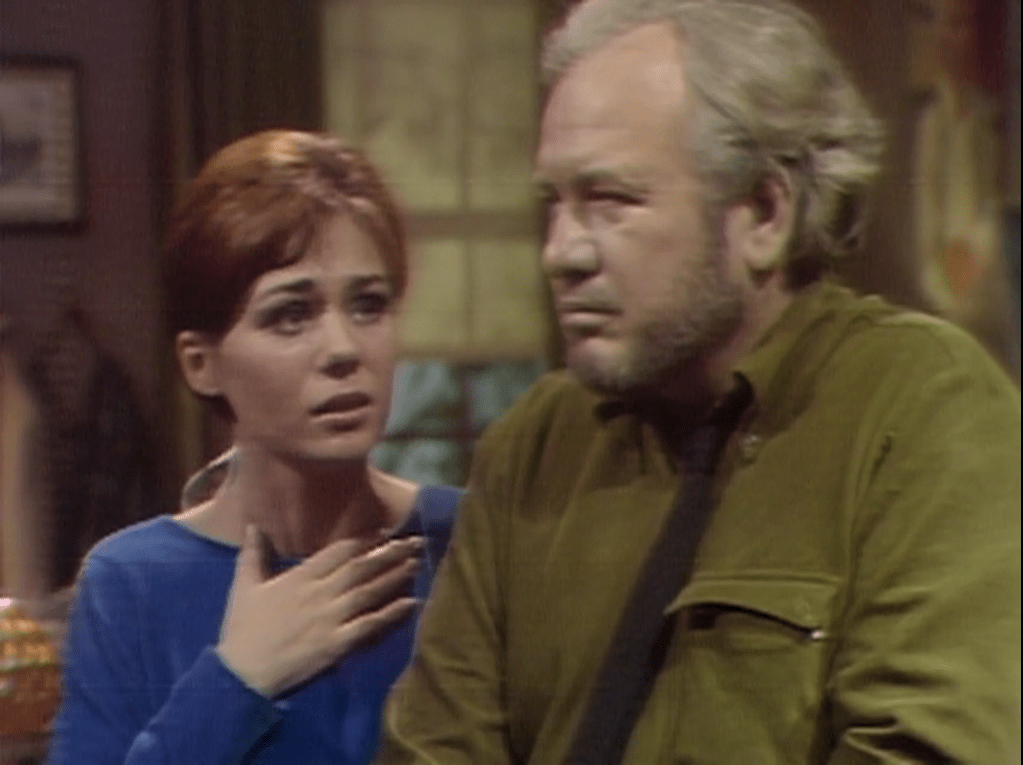
Word spreads that local physician Dave Woodard has died. Several people fear that he may have been murdered. At the end of the episode, artist Sam Evans and his daughter Maggie, The Nicest Girl in Town, get a phone call from the sheriff. An autopsy has been conducted, and Woodard’s death has been ruled a heart attack.
Relieved, Maggie smiles and says that Woodard’s death was the result of natural causes. She is repeating the word “natural” when a sound like that of flatulence is heard. She breaks off at “natur-” and looks wonderingly at Sam.
Her look asks “Did you just…”
If Kathryn Leigh Scott had played the scene straight through, we could have thought that the sound came from a piece of equipment turning at a joint that hadn’t had enough oil or something like that. Her reaction leaves little doubt that David Ford had made a little television history.
Considering that the show was done essentially live-to-tape, I guess it was just a matter of time before an actor audibly broke wind on camera. At least the perpetrator wasn’t someone who is supposed to seem sexy.
Mad scientist Julia Hoffman and vampire Barnabas Collins are visiting Dr Dave Woodard in his office. Woodard has stolen the notebook in which Julia has recorded the truth about Barnabas and is planning to hand it over to the sheriff. At Barnabas’ insistence, Julia has prepared a hypodermic with a potion that will induce a heart attack. He orders her to give Woodard the lethal injection.
In her reluctance to kill her onetime friend, Julia suggests that Barnabas turn Woodard into a vampire. Julia believes she will soon find a cure for vampirism. So, Woodard will just be one more patient who will benefit from her imminent success. Neither he nor Barnabas receives her brainstorm with any great enthusiasm.
Woodard claims that, even if he became a vampire, he would have free will and would be able to fight Barnabas and destroy himself. He then asserts that Barnabas, too, has the ability to do the right thing. As viewers of drama, we are predisposed to believe that characters whom we hear talking and who have motivations we can understand are at liberty to choose what they will do, so we may believe that Woodard is right. But we haven’t seen any evidence to support his contention.
Julia keeps trying to postpone the killing. Exasperated with her procrastination, Barnabas tells her to hand him the hypodermic. She does so. As he is about to give the shot, Woodard claims to see the ghost of Barnabas’ little sister Sarah. Barnabas is so desperate to see Sarah that he falls for this and lets Woodard go. Julia calls out “Stop him!”
Barnabas is furious that Woodard has hit him at his most sensitive spot. As he regains his grip on Woodard, he jabs him in the shoulder with the needle. While Woodard crumples at his feet, Barnabas picks up on the words Woodard had earlier used to describe him, exclaiming “Loathsome I am, and evil! You can mock me for that, but leave my pain alone!” Even after that exclamation, Barnabas asks Julia if Sarah really was there. We don’t see her, but we do hear the strains of “London Bridge,” a song that has always before told us that Sarah is present.
Barnabas places Woodard’s corpse in the desk chair. He appears to be enjoying himself hugely while he taunts Julia for her squeamishness. He asks her, as a medical doctor, to verify that Woodard is dead; she can’t bring herself even to look at the body. She wants to leave immediately; he asks if she plans to leave the needle on Woodard’s desk. Once she puts the murder weapon in her purse, she again wants to rush out; he asks if she is planning to leave the notebook in Woodard’s pocket.
Even after they return to his house, Barnabas continues tormenting Julia. He tells her she will soon grow accustomed to her new identity as a murderer. She resists the label, and he magnanimously agrees to share half the responsibility for the killing. She says she will stop trying to cure him and go away; he tells her that will no longer be possible. They need each other more than ever now. When he tells her that he is her only friend, she hears Woodard’s voice saying “You no longer have friends.” As those words sound, so do the notes of “London Bridge.”
Barnabas is at his most compelling in these scenes, thanks to the actor who plays him. Jonathan Frid’s style of acting was rather old-fashioned even in 1967, but his achievement today is extraordinary. He takes us on a dizzying ride from horror at the brutal killing of Dr Woodard, to pity for the vastly lonely man longing for his little sister, and back to horror at Barnabas’ glee in bestowing the title of murderer on Julia. I can’t imagine any performer doing a better job.
The killing of Dr Woodard is quite a shock. It is only the second premeditated murder we see on Dark Shadows. Undead fire witch Laura Murdoch Collins used black magic to cause parapsychologist Peter Guthrie to have a fatal car crash in #186. There’s no magic this time- this is a plain old death by poisoning. We also saw Barnabas kill seagoing con man Jason McGuire, but that was not a premeditated act. Jason opened Barnabas’ coffin at sunset, and Barnabas, apparently by reflex, strangled him. That’s a reflex many of us might understand, I’m certainly not at my best when I first wake up. So when Barnabas wrestles with Woodard and jabs him with the needle, we are entering new territory.
When Julia and Barnabas are back in his house, she throws the needle into the fireplace. The Dark Shadows wiki disapproves of this action:
The destruction of the murder weapon was taken more lightly in this scene than it would have been in real life. The heat from a normal fireplace would not be hot enough to melt glass. The metal needle would have been blackened, and if someone looked through the ashes thoroughly, it would have been discovered. Had the syringe been discovered, Woodard’s death would have been ruled a homicide.
Dark Shadows wiki, episode 341.
I don’t see why the presence of a warmed-over medical sharp in Barnabas’ fireplace would mean that “Woodard’s death would have been ruled a homicide.” The police haven’t made any connection between Woodard’s death and Barnabas’ house. Even if they had, they would have no reason to suppose a hypodermic needle in his fireplace would have anything to do with Woodard. Julia is keeping it quiet that she is a medical doctor, but it isn’t a secret from the authorities. She spends most of her time at Barnabas’ house and is treating him for what she believes to be a rare blood disease, so she’s likely to have all sorts of medical supplies there. It is never specified what the chemical was that caused Woodard’s death, but if it was potassium chloride, it would have had the effects Julia describes and the heat of the fireplace would be sufficient to cause it to disappear without a trace in a little flash of dark purple flame. And of course potassium chloride dissolves in the bloodstream so completely that even a large dose of it cannot be detected in a normal postmortem examination. Unless they had dripped some of it into Woodard’s ashtray, Julia and Barnabas would have no reason to believe that the police would be looking for potassium chloride.
Julia moves to throw her notebook into the fire after the needle. Barnabas intercepts it in a move that looks so much like what you’d see on a basketball court that I count it as a blooper.
In between the scenes with Barnabas and Julia, there is some stuff with the sheriff and artist Sam Evans. The sheriff ambles into The Blue Whale tavern and finds Sam starting his fourth shot of whisky. They talk about Woodard, and Sam insists they go to his office to look for him. For the first 40 weeks of Dark Shadows, Sam’s alcoholism was a substantial story element, part of the “Revenge of Burke Devlin” arc. When that arc finally dried up in #201, Sam’s alcoholism went away. He’s a social drinker now. Still, he used to be the town drunk, and apparently that’s a higher post than sheriff. The sheriff follows Sam’s orders and accompanies him to Woodard’s office.
They knock on the office door. There is no answer. Sam suggests they break the door down. They haven’t tried to turn the knob, so they have no reason to suppose it is locked. Returning viewers will recall that yesterday Julia just walked into the office, without even knocking, and she and Barnabas did not lock the door behind them. So we can be fairly sure it is not locked. Still, orders are orders, so when the Town Drunk (Retired) says it’s time to break the door down, the sheriff watches him respectfully. Of course the whole set is made of a sheet of plywood, so when Sam “flings himself” against the door, he has to maintain a ludicrous gentleness to keep any part of it standing.
Inside, they find Woodard dead in his chair. Their response is bewildering. At first they are going to call for help, but then decide that because Woodard is dead there is no point. Eventually the sheriff remembers that he ought to call the coroner. They also take turns declaring that they believe Woodard’s death was the result of foul play.
Dave Woodard, MD, has learned that Barnabas Collins is a vampire and mad scientist Julia Hoffman is his co-conspirator. We see Barnabas at home, pressuring Julia into helping him murder Woodard before he can go to the authorities. After a great show of reluctance, Julia prepares a hypodermic of some potion or other that will induce cardiac arrest. When Barnabas insists she administer the lethal injection herself, Julia resumes her attempt to find a way out. Barnabas finally allows her to go to Woodard and tell him that his only options are to cooperate with them and make a great contribution to medical science, or to go out into the night and suffer an unimaginably horrible death when Barnabas catches him.
Julia does go to Woodard’s office, and does deliver this message. Woodard replies that he doesn’t have to go anywhere to tell the sheriff about Barnabas and Julia. He picks up his telephone and starts dialing. High-pitched sounds play, and Woodard sees the shadow of a bat at his window. Yesterday we heard that Julia considered Woodard the most brilliant student in their medical school class, and we can see why- even though this was decades before Covid-19 or Nipah or other bat-borne viruses were in the news, he is transfixed by the outline of the squeaky little guy.
Perhaps Woodard is less prescient about bats as vectors for disease than he is mindful of the experiences of his young friend, strange and troubled boy David Collins. In #330, Barnabas sent a large bat to frighten David in his bedroom. Today, Barnabas materializes inside Woodard’s office after the bat has done its thing outside. This is the first indication we have had that Barnabas has the power to transport himself through walls.
Unfortunately, the National Association of Broadcast Engineers and Technicians were on strike during principal photography for this episode. No doubt the process shot of Barnabas’ materialization was added after they came back to work, but they could do only so much with the footage that the network executives and other amateurs had left them. The Barnabas who appears in Woodard’s office today is about three feet tall and is missing a chunk of his head.
Mini-Bar may be the funniest consequence of this attempt at strikebreaking, but there is another that isn’t amusing at all. Woodard is played by some stooge who took over the part when Robert Gerringer, who has been struggling valiantly since May to find something interesting to highlight in a character who usually doesn’t know anything and isn’t allowed to advance the plot, honored the NABET picket line. The scab annoys the audience every time he opens his mouth today, breathing directly onto his microphone, getting tangled up in trivial lines, and veering between a barking tone and a whine as high-pitched as the sounds the bat makes.
The result of his incompetence is that a conflict the audience is supposed to be experiencing as suspense does not come off. We’re supposed to be torn as Julia is torn, wanting Woodard’s threat to the continuation of the story to be removed, but feeling horror at the thought that he will be killed. Gerringer could have made us feel those incompatible desires, but this alleged actor makes us want nothing but that he be removed from our television screens as soon as possible and by any means necessary. So we find ourselves cheerfully rooting for the vampire and the mad scientist to get on with murder.
This episode was taped during a National Association of Broadcast Engineers and Technicians strike. While the camera operators picketed outside, network executives and other amateurs were handling the equipment. It shows. As the episode begins, there is a lot of chatter and miscellaneous noise off camera; none of the shots is properly focused; each zoom shot moves at alarmingly fast pace; and at one point the camera swings wild. Dark Shadows was produced under such poor conditions that any one of those things might have made its way even into an episode made by trained professionals, but today is the single roughest cut yet.
At least the technical incompetence of the suits has some funny results. That can’t be said of the work of the alleged actor scabbing in the role of Dr Dave Woodard. Robert Gerringer, who started playing Woodard in May, honored his union obligations and refused to cross the NABET picket line; the stooge replacing him is so monotonous in his delivery of dialogue and so undistinguished in his bodily movement that he is little more than a blank spot on the screen. Much of this episode is devoted to him rummaging around looking for some papers; it would take considerably more skill than non-Woodard ever displays to make that interesting to watch.
The actor is so dull that he ruins one of the major sources of suspense. We ought to be conflicted about Barnabas’ plan to kill Woodard, because while we want the story to advance and Barnabas to stay on the show, we don’t want the good guys to be killed. Moreover, Woodard is the only one now who fully understands and supports one of our favorite characters, strange and troubled boy David. We certainly shouldn’t want David to lose his only backer. But this guy is such a waste of screen space that it is fatally easy for us to root for the character’s death.
There are a few interesting moments scattered here and there in Ron Sproat’s script. Mad scientist Julia Hoffman tells vampire Barnabas Collins that she tried to quell Woodard’s suspicions by telling him Barnabas had a rare blood disease that she was trying to treat. In fact, Julia does believe that vampirism is a rare blood disease, and she is trying to cure Barnabas of it, so she wasn’t lying when she told him that. It’s always startling to find Julia resorting to the truth.
Julia also tells Barnabas that Woodard came up with an idea she has encouraged him to believe, that she is in love with Barnabas. Barnabas laughs at this notion, and Julia objects that it doesn’t seem so preposterous to her. An incredulous look on his face, Barnabas glances at her wig, then at her clothes. He has a point- it really does not look like an ensemble a woman would wear if she was into dudes.
Yesterday’s episode gave us several clues that Julia is in fact attracted to Barnabas. Today, she not only seems hurt when Barnabas laughs at the idea she might be falling for him, but she flashes a look of jealousy later when he says something extravagantly complimentary about well-meaning governess Vicki. As my wife, Mrs Acilius, pointed out, this makes it rather unsettling when Julia remarks that she had thought Barnabas was incapable of feeling any emotion, even fear. We know that Julia is a very strange person, but as we find out what she looks for in a partner we start to wonder just how strange she is.
Barnabas is bewildered by everything Julia says and does. When she says she is surprised that he is frightened by Woodard’s investigation into him, he says that of course he is frightened, as it could easily result in his extinction. When she goes on to say that she had thought him a totally unemotional being, he becomes for a moment the audience’s point of view character- he doesn’t say anything, just gives her a look as if she is completely nuts.
At the moment, Barnabas is especially vulnerable because Julia is keeping her notes on the experiment in a little box in her bedroom at the great house of Collinwood. That is an odd place for them. She presumably makes the notes while she is working in her laboratory in the basement of Barnabas’ house, and she consults them while she is there. The laboratory is well-hidden- Woodard and local man Burke Devlin searched the basement in #333, and found no trace of it. So it doesn’t make any sense to create another danger of exposure by keeping them anywhere but there. Of course Woodard sneaks into Julia’s room today and finds the notes.
Housekeeper Mrs Johnson is in this one, after fourteen and a half weeks away. In fact, it’s only her second appearance since #211, the episode in which she was the first character to exchange lines with Barnabas. It’s great to have her back, though of course it saddens me that Clarice Blackburn crossed a picket line.
Dr Dave Woodard is onto vampire Barnabas Collins’ terrible secret. Woodard doesn’t think he can share his suspicions with the sheriff or a medical colleague or an expert in the supernatural or with any of his friends. Still, he has to tell someone. So he has gone to Barnabas and told him all about it. Barnabas tells him he’s crazy and orders him out of his house.
On his way out, Woodard crosses paths with his medical school classmate and onetime friend Julia Hoffman. He had introduced Julia to the case of Barnabas’ victim Maggie Evans, The Nicest Girl in Town, hoping that her dual qualification as an expert in psychiatry and hematology meant that she would be the perfect person to find out what happened to Maggie. He knows now that Barnabas was the source of Maggie’s troubles, and that Julia has gone over to Barnabas’ side. The doctors engage in a brief verbal sparring match, then Julia goes into the house. Woodard pretends to leave, then crouches by the window where we have already seen several people eavesdrop on Barnabas’ conversations. Even though Julia herself is one of those people, neither she nor Barnabas thinks to look out the window before they launch into a hugely incriminating conversation.
Among the more important pieces of information Woodard learns are that Julia is performing an experiment on Barnabas, that she is keeping notes on that experiment, and that she keeps those notes in a box in her room at the great house of Collinwood. For some unaccountable reason, she thinks that no one will look for them there.
Barnabas demands that Julia find out how much Woodard knows. He butters her up a bit, telling her that while she has said that Woodard was the most brilliant student in their medical school class, he is sure he can’t have been more than the second most brilliant. He even calls her “my dear,” the first time he has addressed her as anything more affectionate than “doctor.” She is facing away from him when he says all this, and we see her brighten. By the time she exits, she looks positively blissful.
Julia thrills to Barnabas’ non-hostile talk.
Perhaps this suggests that Julia is falling in love with Barnabas. She does get carried away with sympathy for him earlier in the scene, when he is whining about his situation and she exclaims “Poor Barnabas!” Perhaps it’s just that she has been spending all her time with him for months and is relieved to get some friendly attention. Whatever the cause of it, her excitement must be considerable- she even allows herself to bring up a topic to which she has never before so much as alluded, and says that “They didn’t take me as seriously as they should have because I’m a woman.”
Julia calls on Woodard at his office. She tries to sell him on an idea he himself had in #324, that she’s hanging around because she’s fallen in love with Barnabas. He confronts her with a list of the medical supplies she has ordered recently. She ignores the list and keeps saying that she is just a woman in love. Woodard isn’t having it, and she ultimately resorts to warning him that for his own good, he must stop asking questions.
Meanwhile, there is some activity at the great house. Well-meaning governess Vicki receives a visit from her depressing fiancé Burke. The two of them had hoped to buy a “house by the sea” that turned out to be unsaleable because of provisions in an old Collins family will. Matriarch Liz eavesdrops as they talk about this, then enters the room and offers to let them live in the long-abandoned west wing of Collinwood until the house they want becomes available. Vicki loves the idea, Burke is hesitant.
Liz eavesdrops on Burke and Vicki.
This echoes a theme of the first few months of the show, when Burke wanted to take possession of Collinwood and throw the Collinses out. In response, Liz vowed that Burke would never spend a night under its roof. This offer shows viewers who have been watching from the beginning how far we have come since those days.
We open on a set we haven’t seen since #180, the archives of the old cemetery north of town. There, a scene plays out between two actors who aren’t really on the show. Daniel F. Keyes created the role of the Caretaker of the cemetery; Robert Gerringer took over the role of Dr Dave Woodard some months ago and did as much with it as anyone could. But neither of those men was willing to cross a picket line and break the National Association of Broadcast Engineers and Technicians strike, and so they were replaced with a couple of stooges.
The stooges are both terrible. Patrick McCray, Danny Horn, and John and Christine Scoleri all go into detail documenting non-Woodard’s incompetence, but the non-Caretaker is just as bad. Patrick McCray memorably described the Caretaker, in Keyes’ realization, as a “refugee from the EC comics universe.” This fellow has none of Keyes’ zest or whimsy; he simply recites his lines.
At one point, the non-Caretaker tells non-Woodard that it will take some time for him to locate the document he is asking about. Non-Woodard replies “Take your time!” We then have about ninety seconds of the non-Caretaker sorting through papers. The show is moving away from the real-time staging that had often marked its earlier phases, so this comes as a surprise.
The episodes in which the archive set was introduced included a lot of talk about the geography of the cemeteries around the town of Collinsport. They told us that the old cemetery north of town was the resting place of the Stockbridges, Radcliffes, and some other old families, but that most of the Collinses were buried in their own private cemetery elsewhere. They also mentioned a public cemetery closer to town where the remains of less aristocratic Collinsporters might be found. In today’s opening scene, non-Woodard tells the non-Caretaker that they had met previously in Eagle Hill Cemetery. Eagle Hill is the name now associated with the old cemetery north of town. So perhaps this building, which also houses a tomb in which several of the Stockbridges were laid to rest, is not in Eagle Hill Cemetery, but one of the others.
Reading roomStacksThe Tomb of the Stockbridges.
In his last few episodes, Robert Gerringer had a couple of scenes in which he and David Henesy established a close relationship between Woodard and strange and troubled boy David Collins. Today, non-Woodard sits on the couch in the drawing room at Collinwood and tells David he has come to believe everything he has been saying, including the stories that have led the other adults to call in a psychiatrist. As my wife, Mrs Acilius, pointed out, that would have been a great payoff from Gerringer’s earlier scenes if he had been in it. It might have been effective enough if any competent actor had played the part of Woodard. Certainly Mr Henesy’s performance gives non-Woodard plenty to respond to. But he barks out his lines as if they were written in all-caps with randomly distributed exclamation points. It is a miserable disappointment.
There is also a scene where David’s father, high-born ne’er-do-well Roger, tries to convince his sister, matriarch Liz, that they ought to send David to military school. This both harks back to the first 39 weeks of Dark Shadows, when Roger openly hated his son and jumped at every chance to send him away, and illustrates the changes that have taken place since then, as Liz acknowledges that Roger is motivated by a sincere concern for David’s well-being. The scene is intelligently written and exquisitely acted. The high caliber of their work makes it all the more distressing to see Joan Bennett and Louis Edmonds on a scab job. David Henesy was ten years old, and had a stereotypical stage mother, so you can excuse his presence and marvel at his accomplished performance. But these two old pros don’t have any business on the wrong side of a strike.
Nor does Jonathan Frid. When non-Woodard goes to confront Barnabas, there are moments when Frid seems to be showing his own irritation with his scene-mate more than his character’s with his adversary. As well he might- neither man knows his lines particularly well, but even when Frid stops and looks down he expresses emotions Barnabas might well be feeling, and he is fascinating to watch. When non-Woodard doesn’t know what words he’s supposed to bark, he drifts away into nothing. But it serves Frid right to have to play off this loser- by this point, he knows full well that without him the show wouldn’t be on the air. He had no excuse at all for crossing that picket line.
The cemetery’s combination archive/ tomb was a prominent part of the storyline of undead fire witch Laura Murdoch Collins. That storyline approached its climax in #183 when Peter Guthrie, PhD, confronted Laura in her home about being “The Undead,” prompting her to kill him. An episode beginning on that set and ending with someone holding a doctoral degree confronting an undead menace would seem to be an obvious callback to that story. Guthrie’s confrontation had a point- he wanted to offer to help Laura find a place in the world of the living if she would desist from her evil plans, an idea which Woodard’s old medical school classmate Dr Julia Hoffman picked up in her quest to cure Barnabas of vampirism. By contrast with Guthrie and Julia, Woodard is just being a fool.
Early in the story of vampire Barnabas Collins, local physician Dave Woodard decided to call in an expert from out of town. Dr Julia Hoffman was doubly qualified as a specialist in psychiatry and hematology, and so she seemed to be ideally suited to make sense of the baffling occurrences taking place around Collinsport. Readers of Bram Stoker’s Dracula will recognize Woodard as the counterpart of Dr John Seward and Julia as Professor Abraham Van Helsing.
Now, Woodard realizes that Julia has gone over to Barnabas’ side. So, crafted to be the stolid Seward, he must try to do the work of Van Helsing. Today, he manages to meet and talk with the ghost of Barnabas’ little sister Sarah, persuades her to show him the secret chamber in the tomb where her body is buried, and confronts Julia.
Sarah complains that “People don’t keep secrets anymore.” She’s had it with this damn century.
All of this would have been very powerful had Woodard been played by Robert Gerringer. Gerringer played the part starting in May. For most of that time, Woodard had little information and no power to advance the plot. He was largely confined to scenes that groaned under the weight of recapping. Gerringer made this thankless role as interesting as anyone could, managing to shade Woodard’s internal life so that we could see how confusing it would be for a trained scientist to confront facts that could be explained only by reference to the supernatural.
Gerringer’s acting style stands apart from those of his cast-mates. Most of the cast of Dark Shadows knew nothing at all about daytime serials when they joined the show, and they don’t sound or move in ways that are typical of the genre. But Gerringer’s voice is that of every doctor in the soaps my mother watched when I was a kid. His presence on Dark Shadows is a constant reminder of the incongruity of a vampire as a regular character on a soap opera in 1967.
Unfortunately, Gerringer is not in this one. The National Association of Broadcast Engineers and Technicians were on strike when this episode was made, and Gerringer refused to cross their picket line. So his part is being played by someone else, and the intended effect of the whole thing is badly blunted.
There’s also a scene between well-meaning governess Vicki and her depressing boyfriend Burke. There was some talk a while ago about them buying a “house by the sea,” and they make it clear today that we won’t be hearing much more about that. That never really amounted to a story, and it’s something of a disappointment that it is a dead end.
Gordon Russell’s script contains an interesting scene. A psychiatrist brought in to examine strange and troubled boy David Collins gives a little speech attributing David’s fear of his cousin Barnabas to various unresolved traumas he has recently experienced. This speech sounds very plausible to the adults who listen to it, and might go some way towards explaining the appeal of Dark Shadows to its audience. But we know that David’s fears are entirely rational and that Barnabas really is a vampire. When the psychiatrist mentions that Barnabas had fangs in one of David’s dreams, family doctor Dave Woodard catches up with us and realizes that Barnabas really does have fangs and that he used them to inflict bite marks on some of his patients.
Episode 335 of Dark Shadows was a scab job done during the October 1967 National Association of Broadcast Employees and Technicians strike. In March of that year, at a time when Dark Shadows was at rock bottom in the ratings, the actors stayed out in support of the announcers and newscasters when they went on strike, and the show survived even though it went dark by the time the strike ended. Now, the vampire story is pulling in more viewers every week, making it a valuable property to ABC. But it is at this time that executive producer Dan Curtis told the cast that he would pay their union fines if they crossed the NABET picket line, and most of them did, with network executives and their stooges handling the equipment.
Sad to say, only two cast members did the right thing by the technicians. Robert Gerringer, who played Woodard, was one of those. Even if he had been a good actor, the scab stealing food from the mouths of Robert Gerringer’s children wouldn’t have been able to deliver on the moment when Woodard figures out that Barnabas is a vampire- we need Gerringer for that. He is the person we’ve grown used to seeing in the part, and his self-consciously soap operatic style of acting sets him apart from the rest of the cast and highlights the weirdness of this story playing out on a daytime serial in 1967.
But the scab isn’t a good actor. His most memorable moment comes when Joan Bennett, as matriarch Liz, bobbles a line, and he corrects her. She flashes a look of anger, but what does she expect? What she is doing is no better than what he is- if anything, it’s worse, because she was a big star and could have called a halt to the whole filthy disgrace if she’d lived up to her obligations as a member of AFTRA.
I’m writing this in September 2023, month three of the SAG-AFTRA actors’ strike and month five of the Writer’s Guild of America strike, so I’m even angrier about the whole thing than I usually would be. But I always find it hard to watch material produced under these conditions.
The character of Maggie Evans wasn’t in any of the episodes produced during the strike, so Kathryn Leigh Scott wasn’t involved in breaking it. She is walking a picket line today, and in her column she wrote about the particular issues at stake in the 2023 strikes. Different matters hung in the balance in 1967, but it’s always true that we live in a society, for the love of God, and if working people don’t stick together they don’t have anything.
High-born ne’er-do-well Roger Collins was the first of Dark Shadows’ icy, calculating villains, and Roger’s son, strange and troubled boy David, was the first of its adorable homicidal maniacs. By the time David’s mother, blonde fire witch Laura Murdoch Collins, went up in smoke in #191, well-meaning governess Vicki had converted David from evil to good, and the subsumption of the “Revenge of Burke Devlin” storyline into Laura’s arc had set Roger on the path to becoming occasional comic relief.
Now, bumbling vampire Barnabas Collins combines the roles Roger and David pioneered. Barnabas has been so inept at keeping his secrets that David has learned some of them and is frantically trying to warn the adults about him, but he has shown enough calculation in his damage control that most of the adults receive David’s warnings as signs of mental illness.
The highlights of today’s episode are two sequences in which Roger makes himself remarkably vulnerable to his old nemesis Burke Devlin and family doctor Dave Woodard. Early on, Burke and Woodard are telling him that David is a frightened boy, and Roger answers them with a speech in which he claims that all boys live in constant terror. “I was a child in this house. I was terrified of the darkness in the corners and frightened to walk along the corridors by myself. I used to think that all the people in these Collins portraits… all those dead people… stared at me wherever I went… looked at me with piercing eyes… hated me! Well, I outgrew it, and so will David.” Burke and Woodard simply ignore Roger’s speech- evidently they are true New England men, and cannot imagine talking to each other about their feelings. After Burke and Woodard leave Roger, he looks at the portrait of Jeremiah Collins above the fireplace in the drawing room, and recoils in fear.
Roger, alone with the portrait of Jeremiah Collins, and still scared out of his wits. Screenshot by Dark Shadows Before I Die.
After Burke and Woodard have talked with David a while, they come back to ask Roger’s permission to take the boy to look for a secret chamber he says can be found in the Collins family mausoleum. Roger says in reply that they should forget about looking into tombs and get a psychiatrist who can look into David’s mind. He says that David “is like a person on a thin wire, very high off the ground… Any minute he may fall and plunge downward- out of our reach forever.”
Again, Burke and Woodard don’t react to Roger’s speech at all. Viewers who have been with the show from the beginning, though, will see these two scenes as a significant retcon. For the first 38 weeks of Dark Shadows, Roger openly hated David, was eager to get rid of him, and exploited his troubles for his own advantage. Perhaps the single most shocking scene in the entire series came in #68, when Roger coolly manipulated David into making an attempt on Vicki’s life. But now Roger is a caring father whose concern for David drives him to make the most astonishing emotional displays.
In the scene between Roger’s speeches, David told Burke and Woodard about two vacant coffins he has seen. Woodard, who is inclined to believe David is onto something, can’t help but try his hand at psychotherapy, and asks David if he isn’t terribly afraid of coffins. Again, long-time fans will remember that matriarch Liz went eighteen years without once willingly leaving home, because she thought that the murdered body of her husband Paul Stoddard was buried in the basement. In #275, it turned out that Stoddard’s supposed grave held only an empty trunk. Burke was there when that came to light, and Woodard probably knows about it too. So he might well imagine that David would have a lot of unresolved feelings surrounding the image of a vacant coffin. The Liz-is-a-recluse story was a dud from the beginning, so it is understandable it hasn’t been referenced in months, but it’s a shame Woodard doesn’t have the chance to clue new viewers into what may well be on his mind.
Also in that scene, David tells Burke and Woodard he will have to break a promise he made to his friend, the ghost of ten-year-old Sarah Collins. When he says this, the wind blows the window to his room open, and the strains of “London Bridge” play on a wooden flute. When David asks the men if they can hear the music, they make it clear that they can. He tells them that it is Sarah objecting that he ought not to share her secret, but that he has no choice.
He takes them to the Tomb of the Collinses, where Sarah and her parents are buried. He tries to open the panel to the secret chamber, but it has been locked. When Burke and Woodard tell him they don’t believe that there is a secret chamber, he finds Sarah’s flute on her mother’s crypt. This is enough to convince Woodard that there is something to David’s story.
In life, Sarah was Barnabas’ sister. Her current relationship to Barnabas echoes Liz’ relationship to Roger, and the relationship developing between Barnabas and mad scientist Julia Hoffman. She tries to prevent him from committing crimes, but she will not allow him to be caught once he has committed them. At the moment, the crime Barnabas is busiest committing is an attempt to spread the idea that David is insane and to trick the adults into giving him inappropriate psychiatric treatment. So Sarah leaves her flute where it will give David’s doctor evidence that he is not ill at all. On the other hand, Barnabas has reason to fear that if the secret chamber becomes generally known, he will be exposed and destroyed. So she swears David to secrecy about it, and is upset when he is going to violate that secrecy. The usual Dark Shadows dynamic, seen in both the Liz/ Roger and Julia/ Barnabas relationships, is that of Bossy Big Sister and Bratty Little Brother; Sarah is Barnabas’ little sister, and she isn’t exactly bossy, but the end result is similar.
A few days after Dark Shadows began, we learned that high-born ne’er-do-well Roger Collins had squandered his entire inheritance. He and his son, strange and troubled boy David, then moved into Roger’s childhood home, the great house of Collinwood. The house belongs to Roger’s sister Liz. Roger lives there as her guest, and draws a salary from her business as an employee.
Time and again, Liz tells Roger that he must behave himself; time and again, she shields him from the consequences of his actions. Liz may want to believe that she is a model of adult authority, but in fact their relationship is one of Bossy Big Sister and Bratty Little Brother.
Liz extends that enabling behavior to the rest of the family. In episode #10, David overheard Roger in the drawing room, telling Liz that he wanted to send him away to school. Liz refused, because she saw that as Roger’s attempt to resign his responsibilities as a father. For his part, David reacted by tampering with the brakes on Roger’s car so that they would fail when he was driving down a steep hill and kill him. His murder plan failed. When Liz discovered it in #32 she lied to the sheriff in order to keep the whole thing quiet, and a few days later she ordered the family’s handyman to take the blame for the crash.
David had no big sister. Liz’ daughter Carolyn would later become a surrogate sister to him, but through the first months of the show she took no interest at all in her cousin. David spent his time with his well-meaning governess, Vicki. David was certainly bratty towards Vicki, trying to frame her for his attempt on Roger’s life in #27, and making an attempt on hers in #84. But while Vicki was glad to be sisterly towards David, she did not fall into the same pattern with him that traps Liz and Roger. She listened to him patiently, and enforced rules firmly. In response, David not only stopped committing crimes against Vicki, but when his mother, undead fire witch Laura Murdoch Collins, tried to claim him, he chose life with Vicki over death with her. Episode #191, the last installment of Dark Shadows 1.0, ends with David in Vicki’s arms, his new mother consoling him for the loss of his original mother.
Roger and Liz are minor characters in Dark Shadows 2.0, and Vicki is fast fading into the background as well. But #332 and #333 take us back to the first weeks. Yesterday, David again overheard his father in the drawing room saying he wanted to send him away to “a special school” where psychotherapy can cure him of his weird ideas. But Vicki’s influence has realigned David from evil to good, so that instead of trying to kill his father, he tries to collect evidence that his ideas are not a product of mental illness. In that effort, he went to the Old House on the estate and came upon the coffin in which his cousin Barnabas Collins, a vampire, rests during the day. Barnabas found him there and was closing in on him when mad scientist Julia Hoffman came into the house.
“Are you afraid of me?”
Julia and Barnabas are at the center of the show now, and they reproduce Liz and Roger’s Bossy Big Sister/ Bratty Little Brother dynamic. When Barnabas announces that someone or other “must die!,” Julia talks him out of doing anything to bring that death about. Sometimes she threatens to expose him, sometimes she promises to cure him of vampirism, sometimes she wears him down with lists of the practical difficulties of the murders he would like to commit.
But Julia also conceals and destroys evidence of Barnabas’ crimes. She induces grave amnesia in his victim Maggie Evans, and lets his sorely bedraggled blood thrall Willie Loomis take the blame for abducting Maggie. In fact, she very nearly killed Willie when it looked like he might not go down quietly. She may have rescued David today, but she protects Barnabas all the time, and it seems to be just a matter of time before she becomes an active participant in a murder for his sake.
Back in the great house, local man Burke Devlin is conferring with Dave Woodard, MD. Burke says that he is worried about David’s “fantasies,” to which Woodard replies “If they are fantasies.” Woodard is coming to believe that Barnabas is an uncanny being responsible for Maggie’s abduction and the other troubles the town of Collinsport has seen recently, and he takes everything David says very seriously. When David comes home and announces that he found the coffin, that Barnabas tried to kill him, and that Barnabas is a dead thing that can move around at night, Woodard listens intently.
Julia comes in, as does Roger. Julia dismisses all of David’s assertions. She claims to have seen Barnabas’ basement, and to know that there is no coffin there. David looks at Julia, and asks in an oddly calm voice “Why are you lying?” Roger is appalled at this question, but Woodard studies David carefully as he asks it and studies Julia’s reaction just as closely afterward.
“Why are you lying?”
In #331, Woodard gave David a sleeping pill and asked him questions about the strange goings-on. Robert Gerringer and David Henesy played that scene marvelously. Gerringer showed Woodard’s struggle, as a man of science, to come to terms with a set of facts that made logical sense only in a world where supernatural forces are at work, while Mr Henesy showed David’s desperation to find a responsible adult who will listen to what he knows. Gerringer also showed Woodard’s tender affection for David, tugging the covers of his bed over him when he fell asleep. As Woodard watches David today, we see the same intellectual crisis and the same tenderness that he played then.
Roger demands David apologize to Julia. He will not. Woodard says they ought to go look at Barnabas’ basement and see if there really is a coffin there. Roger is horrified by the implied insult to his cousin, and forbids any such thing. Burke points out that Roger is in no position to forbid it, and accompanies Woodard to the Old House.
There, Barnabas presents himself as shocked that Burke and Woodard want to search his basement. Woodard is polite about the whole thing, but Burke is an utter swine, declaring that they won’t leave until Barnabas submits to their demand. This is not the first time returning viewers have seen Burke impose himself as an unwanted house-guest, and it doesn’t get more attractive the more we see it. When Barnabas orders them to leave, Burke says they will come back “with a search warrant!” Even under the law codes of soap opera land, this would seem to be an empty threat- neither of them is a police officer, and while it may be eccentric to keep a vacant coffin in your basement I can’t think of a reason to suppose it would be a crime. Watching this scene, my wife, Mrs Acilius, said that Burke is so obnoxious that he makes us root for Barnabas despite everything we know.
Burke and Woodard start to go, and Barnabas relents. He takes them to the basement. The coffin is usually in the main area at the foot of the stairs, but when the three of them get there some crates and a trunk are stacked up on that spot.
No coffin.
Burke goes down a little corridor and sees nothing there, either.
Burke in the corridor.
Burke and Woodard are embarrassed, and Barnabas grins. We know that he had moved the coffin so that when someone came to check out David’s story they would see nothing, and that his resistance to Burke and Woodard’s requests to search was put on for effect. Barnabas spends most of his time with other people pretending to be a living man born in the twentieth century; his grin is that of an actor who finds he has given a particularly convincing performance.
Receiving his ovation.
We had seen corridors in the basement when Barnabas was holding Maggie prisoner there. We saw them most prominently in the episode that ended with her escape, #260. In that one, they looked very extensive. He had kept Maggie in a prison cell at the end of one of those corridors. That cell had been there since Barnabas’ time as a living being in a previous century, but none of the many people who had visited the basement before Barnabas moved in, including Burke in #118, had seen the cell. So there must be quite a bit of space down there that only Barnabas knows about, but he has chosen to put his most embarrassing possession in the one place no one coming to the basement could fail to notice. It’s like the old days, when you’d go to visit a single guy at home and find that he had left sexually explicit magazines or videos on his coffee table.





 Dark Shadows Commentary