In November 1967, well-meaning governess Vicki Winters came unstuck in time and found herself marooned in the late eighteenth century. She took the audience with her, and for 19 weeks Dark Shadows was a costume drama set in that period.
Joel Crothers, who in the parts of Dark Shadows set in the 1960s plays hardworking young fisherman Joe Haskell, played roguish naval officer Nathan Forbes in the 1790s segment. Crothers was too capable an actor for Joe ever to be uninteresting to watch, but his scrupulous honesty and unfailingly wholesome desires keep him from making anything happen. Nathan comes as a revelation. Starting as a basically friendly fellow with some conspicuous weaknesses, Nathan steadily evolved into a very cold villain. Along the way, he figured in genuinely funny comic scenes and displayed rich psychological complexity. When Vicki brought us back to a contemporary setting in March 1968, it was more than a little sad to see Crothers return to duty as earnest Joe.
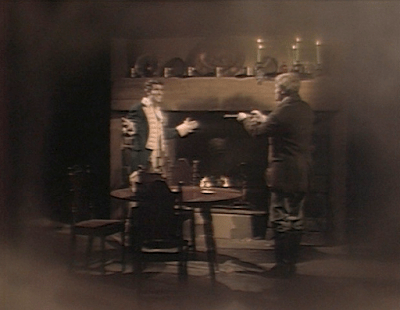
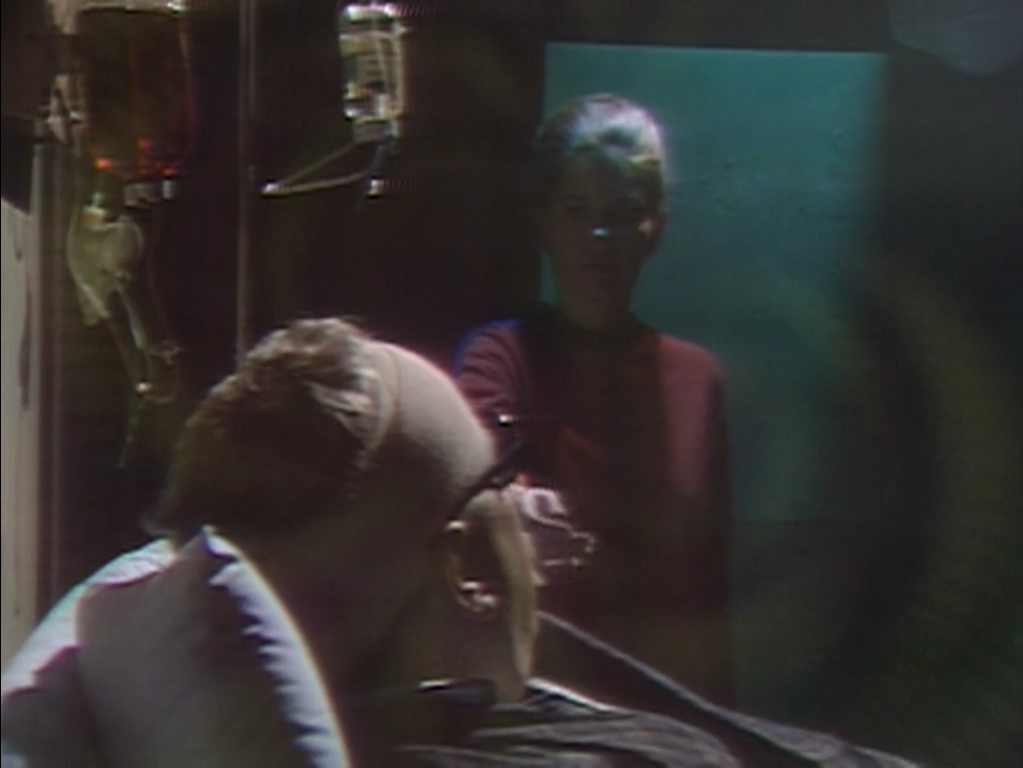
We get another visit from Nathan today. In the eighteenth century, Vicki stumbled into a romance with an unpleasant man named Peter Bradford. Peter has followed her to the present, but has amnesia and angrily refuses to believe Vicki when she tells him who he really is. Today, Peter has a dream in which he confronts Nathan. He fires a gun at Nathan, and is bewildered when Nathan only laughs. Nathan explains that Peter can’t kill him, because he’s already dead.
This scene plays out in front of a table and mantelpiece which we saw together in #459. In that one, it was Nathan who fired a shot with results that bewildered him. His target was Barnabas Collins, who smiled and told Nathan he could not kill him because he was already dead. Barnabas, a vampire, strangled Nathan not long after.
Joe is in the next room while Peter has this dream. He hears Peter talking in his sleep, and comes in to wake him up. When he does so, Peter mistakes him for Nathan and tries to strangle him.
This is not the first time Peter has picked up where Barnabas left off. Barnabas had some vague intention of joining with Vicki in one or another sort of relationship, and now Peter is the one who is in a confusing and unsatisfying relationship with her. Mad scientist Eric Lang built a Frankenstein’s monster, intending for Barnabas to leave his own body and wake up in it; Lang intended to cut Peter’s head off and sew it onto the creature. Had that plan succeeded, actor Roger Davis would have traded the part of Peter for that of Barnabas. It is not immediately clear why the makers of Dark Shadows want us to bracket Peter and Barnabas together, but evidently they do.
The first episode of Dark Shadows, broadcast on ABC-TV on 27 June 1966, was a moody, atmospheric Gothic drama, characterized above all by its hushed tone. For months afterward, the show was almost an essay on the theme of quietness. Now we come to the second anniversary of that premiere, and quietness is the last thing we hear.
This installment marks the final farewell of the show’s single loudest character, revenant witchfinder the Rev’d Mr Trask. In #519, Trask performed an exorcism on the witch variously known as Angelique Bouchard Collins and Cassandra Blair Collins. The exorcism seemed to be a great success; it ended with Angelique/ Cassandra vanishing into thin air, and she has not been seen since. That might have left someone watching Dark Shadows for the first time with the impression that it is a specifically Christian show and Trask is one of its heroes.
Today, they take steps to correct that impression. A man calling himself Nicholas Blair and claiming to be Angelique/ Cassandra’s brother has turned up on the great estate of Collinwood. In the basement of the Old House on the estate, he finds Trask’s skeleton. He conjures Trask up and interrogates him. Trask declares Nicholas to be a tool of the devil. Regular viewers know that this is something Trask says to all the fellas, but this time he is obviously correct. He goes into the same exorcism rite that produced such spectacular results with Angelique/ Cassandra. Nicholas simply turns around and gives him a sarcastic little round of applause. Nicholas keeps making demands of Trask. Trask takes a cross from under his cloak. Nicholas recoils from that. Trask vanishes, but his skeleton is still missing, suggesting that he has not found peace.
That Trask’s exorcism worked on Angelique/ Cassandra but not on Nicholas suggests that it is not a means through which God acts in the world, but is just another magical weapon that can be wielded with greater or lesser effect depending on the skill and strengths those involved. His loyalty to “THE ALMIGHTY!!!” has given Trask enough power to defeat Angelique/ Cassandra, but Nicholas ranks higher than she does in the hierarchy of “THE DE-VILLL!!!,” high enough that Trask’s mumbo-jumbo cannot reach him. The cross has its effect, but with that Trask is setting aside his own efforts and calling directly on the boss. Nicholas is quite certain that he can undo the effects of the exorcism, so for all we know, he might be able to call his own home office for help sufficient to overcome his aversion to the sign of the cross.
The show not only puts Christianity and the spiritual forces of darkness on a par as sources of magical power, they aren’t even the only such sources. Though we don’t hear about any of them today, scientists and doctors Peter Guthrie, Julia Hoffman, Eric Lang, and Timothy Eliot Stokes apparently acquired supernatural abilities along with their advanced degrees. We even know that Guthrie was a professor of psychology at Dartmouth College. So the Dartmouth Department of Psychological and Brian Sciences joins Christianity and diabolism as reservoirs of uncanny might.
In the great house on the estate, heiress Carolyn Collins Stoddard tells Nicholas that Angelique/ Cassandra alienated the Collins family by her dalliance with local attorney Tony Peterson. Nicholas goes to the village of Collinsport and calls on Tony, whom he realizes Angelique/ Cassandra ensorcelled into serving as her cat’s paw. Angelique/ Cassandra put Tony into a trance by having him strike his cigarette lighter; Nicholas achieves the same effect by opening his cigarette case. Tony really needs to stop smoking.
When he first sees Tony, Nicholas is stunned by his resemblance to Trask. They are both played by Jerry Lacy, and Angelique/ Cassandra told him that she chose him because he reminded her of her old acquaintance. We already know that there is a mystical connection between Tony and Trask; Tony was the medium through whom Trask spoke at the séance which led to his return to the world of the living. While he has Tony entranced, Nicholas extracts information from him that only Trask could have known. This suggests a notion of reincarnation that would have reminded viewers of what many of them probably thought Hindus and Buddhists believed, and would thus suggest a syncretistic approach to religion that would represent another step away from the Sunday-morning flavor that the ending of #519 might have left.
We return to the great house. Well-meaning governess Vicki opens the front door and finds her boyfriend, an unpleasant man named Peter who prefers to be called Jeff. With this, a Christian world-view is pushed still further into the background, as a scene featuring Peter/ Jeff is enough to make anyone doubt the existence of a just and loving God.
Vicki and Peter/ Jeff talk about various events that don’t have anything to do with the show. He paws her awkwardly, and his hands dart to her neck as if he were about to strangle her. While he is out of the room for a moment, Trask materializes and tries to warn Vicki that “THE DE-VILLL!!!” is nearby. Before he can tell her that it’s Nicholas she should be worried about, Peter/ Jeff comes back in and starts yelling. At the sight of Peter/ Jeff, Trask wrinkles his nose and fades into nothingness, never to be seen again. Peter/ Jeff probably got a lot of that.
A stranger comes to the great house on the estate of Collinwood and introduces himself as Nicholas Blair, brother of Cassandra Blair Collins. Cassandra’s husband Roger Collins is shocked; Cassandra had never mentioned that she had a brother. Moreover, she has been missing for the last 24 hours, and Roger is convinced something terrible has happened to her. Roger’s distant cousin Barnabas Collins and Dr Julia Hoffman are also shocked, but for a different reason. They know that Cassandra is actually Angelique, a wicked witch who, in the 1790s, turned Barnabas into a vampire. She recently returned to the world of the living when Barnabas’ vampirism went into remission, and she tried to implement a plan to bring it back in full force. When Angelique/ Cassandra went missing, they hoped it meant that she had been defeated. Nicholas’ arrival replaces their hopes with the fear of new battles.
Nicholas at first assumed that Barnabas was Angelique/ Cassandra’s husband, and told him “I should have recognized you anywhere!” This is a sure sign of trouble- Barnabas, who was in fact briefly married to Angelique in 1796, has not been out of the state of Maine since 1795, and has never been photographed. Nicholas says that he has recently been on Martinique, where Barnabas first met Angelique in the eighteenth century, and that he is a “citizen of the world” with no fixed address. He assures Roger that it is Cassandra’s way to disappear abruptly, and that she is sure to return.
Roger, Julia, Barnabas, and Nicholas in the drawing room.
Roger takes Nicholas to the bedroom he and Angelique/ Cassandra share. He shows Nicholas a portrait of Angelique which returning viewers know to have a mysterious connection with Angelique/ Cassandra’s physical being. Roger leaves the room, and Nicholas talks to the portrait. He asks Angelique if she can hear him, and a musical cue associated with her plays on the soundtrack. The cue cuts out, and Nicholas follows up with another question. Dark Shadows stood out from the daytime soaps of the period in having an orchestral score instead of an organ accompanying the action. The meta-theatrical touch of a character who can hear that score is a major departure. It is something people at the time would have seen in animated shorts from Warner Brothers, but likely not anywhere else. Since the biggest and fastest-growing share of Dark Shadows’ audience at this point was children under the age of 13, there was a risk that adult viewers might take that association with cartoons as a sign that it was time for them to find something else to do with their mid-afternoons.
Back in his own house on the same estate, Barnabas finds his servant Willie Loomis holding a rifle. Willie says that he is afraid that man named Adam will come to the house. Barnabas dismisses that fear and orders Willie to put the rifle away. Willie objects. Barnabas repeats the command and leaves. Willie grumbles, but does as he was told. We see a face peering in at the window.
The face belongs to hardworking young fisherman Joe Haskell. Returning viewers know that Barnabas held Joe’s fiancée Maggie prisoner from May to June of 1967 and was extremely cruel to her. When the case was being investigated, Barnabas framed Willie for those crimes. Willie was sent to a mental hospital, and Barnabas had Willie released and brought him back to work for him some weeks ago. Joe thinks that Willie is the perpetrator, and has no patience with him. He knocks on the door and demands Willie let him in.
Joe insists that Willie tell him what he knows about Adam. Willie tries to evade his questions. When Willie says that Adam dislikes him, Joe responds”that means he knows you.” Joe twists Willie’s arm while repeating his questions. Once Joe releases him, Willie runs off and comes back with the rifle. He points it at Joe and orders him out of the house. Joe complies, but says that he will be back, and that he will be having words with Barnabas.
Later, Willie is in the basement. Some bricks are missing from a wall, exposing a skeleton hanging from the ceiling. Viewers who have been with Dark Shadows all along will recognize the basement of Barnabas’ house as a redress of the set that represented the basement of the main house in the first year of the show. The spot with the missing bricks was where a door stood that was always locked in those days. For the first 54 weeks of Dark Shadows, matriarch Liz thought that her husband’s corpse was buried behind that door. That belief turned out to be mistaken, but now we see that there are indeed human remains in the most similar possible spot. We might wonder what else Liz might have been less wrong about than at first sight appeared.
We watch Willie preparing to fill in the missing bricks, leaving the skeleton in place. After all, judging by Liz’ old way of thinking, that’s what ought to be in a space like that. We hear Willie’s interior monologue. He is making himself laugh with a pun on his own name when a stagehand wanders into the shot.
Uh, hello?
That moment of unintentional humor gives way to a scene rich in intentional comedy. Willie goes upstairs and finds that Nicholas has let himself into the house. Nicholas entrances him and extracts information from him. Willie tells him about a meeting with a ghost- “the one downstairs,” he specifies. Nicholas directs Willie to sit down, to remain in a blissed-out state until he leaves, and then to forget all about their encounter.
Nicholas goes to the basement, looks at the skeleton, and calls it “Reverend Trask!” Willie hadn’t given him this name; evidently he recognizes Trask the same way he recognized Barnabas.
Professor Timothy Eliot Stokes (Thayer David) comes home and greets his house-guest Adam (Robert Rodan.) He says that he envies Adam his freedom from the responsibility of attending lectures delivered by people who are “inferior” to him. However snobby Stokes’ attitude towards his faculty colleagues may be, we immediately see that it does not extend to people who lack educational credentials. He takes out a deck of flashcards with words as short as “car” and as long as “dictionary” and is delighted with Adam’s ability to read them aloud.
The Professor takes pleasure in his pupil’s progress.
From November 1967 to March 1968, Dark Shadows was a costume drama set in the 1790s and Thayer David played Stokes’ ancestor Ben, a servant indentured to the mighty Collins family. We saw kindly scion Barnabas Collins (Jonathan Frid) teach Ben to read. Barnabas became a vampire in those days; his vampirism went into remission only a few months ago, when he went through an experimental treatment that involved Adam’s creation as a Frankenstein’s monster. To the extent that Adam is Barnabas’ responsibility, Stokes is repaying his ancestor’s debt to him in kind.
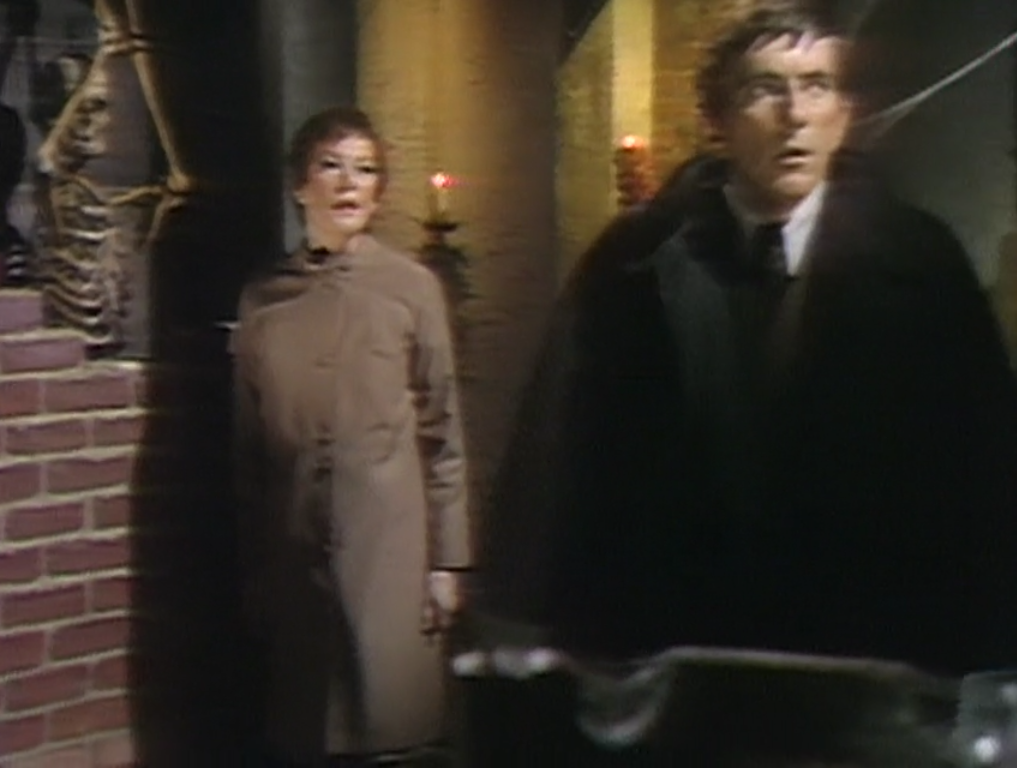
Barnabas and his friend Dr Julia Hoffman (Grayson Hall) knock on Stokes’ door. Stokes does not know that Barnabas used to be a vampire or what he and Julia had to do with Adam’s creation, but he knows enough to distrust them deeply. He insists Adam hide in the back bedroom before he will let Barnabas and Julia in.
Barnabas and Julia tell Stokes that they telephoned him earlier. He explains that he was out, and they say that someone answered the phone and breathed audibly into the receiver, but did not speak. Before he can suggest they misdialled, they notice that his receiver is still off the hook. He speculates that his cleaning lady, who obviously does not exist, must have done it. He furrows his brow and sounds quite stern when he expresses his disapproval of this imaginary person’s behavior. Barnabas and Julia can’t do anything with that, so they change the subject to the matters they originally wanted to discuss.
Those amount to a recap of the storyline concerning wicked witch Cassandra Blair Collins, who in the 1790s was known as Angelique Bouchard Collins. As Angelique, she was the one who made Barnabas a vampire. She returned to the world of the living in the spring of 1968 in a bid to reactivate that curse. Now she has gone missing, and Barnabas and Julia are hoping she is gone forever. While Stokes is in the dark about Barnabas’ past and his true nature, he knows plenty about Angelique/ Cassandra. He tells Barnabas and Julia that to test their hypothesis, they must find the portrait of Angelique that turned up shortly before Angelique/ Cassandra herself returned.
Barnabas and Julia search for the portrait in the great house of Collinwood, where Angelique/ Cassandra has been living as the wife of Roger Collins (Louis Edmonds.) Julia keeps Roger busy downstairs while Barnabas roots around in Roger and Angelique/ Cassandra’s bedroom. The soundtrack plays a recording of Barnabas’ thoughts about his search while we see him staring at the room. When these interior monologues were new to the show, they tended to be very informative. Lately they’ve had less substance, and this one is totally unnecessary.
It turns out that the search itself was equally unnecessary. As soon as Barnabas makes his way back to the drawing room, Roger pulls out the portrait and shows it to him and Julia. Roger found it in the back of a dark closet, but is badly faded, as if it had been left in direct sunlight for a great many days. Barnabas and Julia know that the portrait has some mysterious connection with Angelique’ Cassandra’s physical being, so this is grounds for hope that she is on the way out.
That hope is dashed within seconds. Barnabas answers the front door, and finds a stranger. The man tells Barnabas he should have recognized him at once- “Cassandra’s husband!” Barnabas was briefly Angelique’s husband, 172 years before, but does not bring that up. Instead, he directs the man’s attention to Roger. The man is unfazed when Roger announces that he, not Barnabas, is married to Cassandra. The man then introduces himself as “Cassandra’s brother!” Barnabas and Julia react with shock.
Permanent house-guest Julia Hoffman walks into the great house of Collinwood and greets Roger Collins with a chipper “Good morning, Rodgie!” This is the second time we have heard Roger addressed as “Rodgie.” The first time was in #103, when he called to well-meaning governess Victoria Winters with “Oh, Vicki!” and she responded with “Oh, Rodgie!” That was a disastrous blooper; at that point, Roger was the show’s chief villain and Vicki was supposed to be terrified that he was about to murder her. Roger has long since been rendered harmless, and Julia is in a breezy mood, so “Rodgie” seems appropriate.
Roger’s own mood is anything but cheerful. His wife Cassandra hasn’t been seen since last night, and there is no indication where she might be. He is convinced something must have happened to her, and he calls the police.
Julia knows that Cassandra is actually Angelique, a wicked witch who in the 1790s turned Barnabas Collins into a vampire. Now Barnabas’ vampirism has gone into remission, and Angelique/ Cassandra is determined to revive her curse on him. The other day, Julia and some other people conjured up another personage from the 1790s, the Rev’d Mr Trask, a fanatical but wildly inept witchfinder. Julia hopes that Angelique/ Cassandra’s absence means that Trask has destroyed her.
Barnabas stops by. Julia tells him of her theory. He can’t believe Angelique/ Cassandra is really gone. They go to Barnabas’ house and look in the alcove in the basement where, in 1796, Barnabas murdered Trask by hanging him from the ceiling and bricking him up. Trask’s bones had disappeared when Julia and the others brought him back to life, but are there again now. Julia takes this to mean that he is at peace, not a condition usually associated with hanging from a ceiling in a bricked-up little space, and that Angelique/ Cassandra must therefore have been defeated once and for all. At no point does it occur to them to take Trask’s bones down and give him a more respectful resting place. Apparently they consider human remains a standard part of household decor.
Trask, Julia, and Barnabas.
Back in the great house, Julia finds evidence that Angelique/ Cassandra’s powers are still at work. Matriarch Liz is still under a spell Angelique/ Cassandra cast and believes herself to be Naomi Collins, mother of Barnabas. She believes her brother Roger to be Naomi’s husband Joshua and Julia to be houseguest the Countess DuPrés. Most alarming, Liz has all the knowledge Naomi had in the hour before her suicide. She even mentions to Roger and Julia that Barnabas is “the living dead.” Roger and Liz don’t know that Barnabas was a vampire, and Julia doesn’t want them finding out.
Julia goes back to Barnabas’ house and confers with him about the situation. Barnabas says that Roger knows more about the family history than Liz does, and that if he starts hearing the actual facts there is a great danger he will figure everything out. This is a change- previously the show had always indicated that while Liz took some interest in the Collinses of years gone by, Roger took none.
We cut back to the great house and see Liz sitting at the desk in the drawing room. She is putting a note in an envelope addressed to “Joshua.” Regular viewers saw Naomi sit at this same desk and put a note in just such an envelope in #458. As Naomi did then, Liz pours a snifter of brandy, takes a container from the desk drawer, pours a powder from the container into the brandy, then drinks it. She again follows Naomi’s lead when she goes upstairs.
Barnabas and Julia enter. Julia asks exactly what Naomi did before she died. He starts telling the story, and she finds the note. Barnabas says Naomi died in the tower room; they go there, and find Liz. She talks to Barnabas as if she were Naomi and he were her accursed son. She collapses in his arms, as Naomi did in 1796.
Roger Collins is on the telephone in the foyer of the great house of Collinwood. He is assuring the caller that it will be fine if Maggie, whom returning viewers know to be The Nicest Girl in Town, comes to stay. He says that he and Cassandra will be glad to have her for as long as she wants to be with them, and that he is sure Liz will approve. First time viewers thus learn that Roger has a wife named Cassandra, and that they live as guests in a house belonging to someone called Liz. A moment later, Liz enters, and is too distracted to hear anything Roger says to her.
Roger ends the phone call, and follows Liz into the drawing room. She stares out the window and makes a gloomy remark about death. He says he understands she must be very upset about Sam Evans. Returning viewers know that Sam was Maggie’s father, and that he died in yesterday’s episode. Roger goes on about how it is natural to be grieved at the loss of a friend like Sam, but soon learns that Liz’ mood has nothing to do with Sam’s demise- it’s news to her that he is dead.
Roger’s lines will startle longtime viewers. For the first 40 weeks of the show, Roger and Sam were united by a deep and abiding mutual hatred, and since then they have had no contact at all. Roger’s words about Sam as a family friend are so far from what we have previously seen that they should be considered a retcon.
Liz and Roger spend several minutes in the drawing room. She keeps going on about the all-pervasive reality of death, and he keeps urging her to see a doctor. There isn’t much to their lines, but Joan Bennett and Louis Edmonds were such extraordinary screen performers that it’s always fun to watch them together. This scene might be a particular pleasure to longtime viewers, who have rarely seen Roger as the responsible adult in any encounter.
We dissolve to a bedroom where a young woman in a black wig is sifting through some powders, looking directly into the camera, and telling Liz that her obsession with death will become even worse than it already is and will have dire consequences. Liz will believe that she is someone else, a woman who lived and died in another century, and may die by the same poison that killed that person.
There is a knock at the door. It is Roger. The woman hides her powders and lets him in. He addresses her as Cassandra and asks why the door was locked. Thus first-time viewers learn that she is his wife, that this is their room, that she is a witch, and that Liz’ problem is the result of a spell she has cast.
Cassandra tells Roger that she locked the door because David kept pestering her about Sam’s death and she wanted a moment to herself. With that, first-time viewers find out that David is Roger’s son, that Cassandra is his stepmother, and that she expects Roger to consider locking him out of the room an appropriate response to his grief about Sam.
Roger does not so consider it, and is bewildered by what Cassandra tells him. He tells Cassandra that Liz is in a bad way, and he is worried about her. Cassandra says she did not know that Roger was so concerned about his family. Baffled by this, Roger says that of course he is concerned, Liz is his sister. This tells first time viewers both what Roger’s relationship to Liz is, and that Cassandra has so little sense of family that she cannot imagine how other people feel.
Regular viewers will learn more. In the first year of the show, Roger’s keynote was his lack of loyalty to the family. That has now been set aside once and for all, and his normal attachment to his son and his sister provide a contrast with Cassandra’s apparently sociopathic coldness. Further, we saw a great deal of Cassandra from November 1967 through March 1968, when the show was a costume drama set in the 1790s and she was called Angelique. We saw then that Angelique had no conception of family or friendship, and that her idea of love begins and ends with her control over a person.
Cassandra promises to join Roger downstairs for a game of bridge in half an hour. He leaves, and she gets back to work spellcasting. As she does so, a figure in a black cassock materializes behind her. She turns, and the figure vanishes. In a quizzical tone, she says Roger’s name, revealing that she did not see the figure or realize that it is a supernatural presence. Together with her locking the door, scrambling to hide her magical paraphernalia when Roger knocked, lying to cover what she was doing, and failing to understand what a person with a reasonable amount of human empathy would consider acceptable behavior, her puzzlement shows that whatever her powers may be, they have definite limits.
Back in the foyer, another young woman with black hair lets a man into the house. She calls him Joe, and he calls her Vicki. Joe and Vicki talk about Sam’s death and about Maggie. Joe says that he wants to marry Maggie as soon as possible and to move away. Vicki is all for their marriage, but does not want them to go. Joe talks about how close he and Sam were. Longtime viewers will remember that when Sam and Roger were enemies, Sam was the town drunk. Even then, Joe was always happy to help him in whatever way he could, and did not see his condition as any obstacle to marrying Maggie.
Liz enters and angrily addresses Joe as “Lieutenant Forbes.” Joe has never heard of Lieutenant Forbes, and cannot understand why Liz, who knows him well, would not recognize him. Vicki clearly does know who Liz is talking about, and manages to calm her down. After Liz apologizes and hastens away, Vicki answers Joe’s questions only by saying that Forbes is someone from “the past.” Since we heard Cassandra talk about Liz taking on the personality of someone who lived in “another century,” this suggests that Vicki, too, has an unnatural familiarity with that same century.
Joe wants to go upstairs to the room where Maggie is sleeping so that he will be the first person she sees when she wakes up. Vicki is about to lead him to Maggie when Cassandra insists she join her in the drawing room to talk about David. Vicki tells Joe which door to open, and complies with Cassandra’s directions. This shows that Vicki is a member of the household staff whose responsibilities have to do with David. Regular viewers know that she is his governess, and that they are very close.
Cassandra tells Vicki that David has been asking about Sam’s last words. Vicki says that he addressed them to Maggie, not to her, and implies that she did not hear them. When Cassandra continues probing, Vicki protests. She asks if Cassandra can’t see that she is upset. Considering how clueless Cassandra was about human feelings in her conversation with Roger, it is entirely possible that she cannot. Vicki tells her that Liz is deeply depressed; Cassandra feigns ignorance. Vicki says in a cold voice, “You wouldn’t know anything about that,” then leaves.
Longtime viewers know that it was Vicki who came unstuck in time in #365 and took us with her to the 1790s. During her nineteen weeks in the past, Vicki came to know not only Forbes, but Angelique. She knows perfectly well that Angelique and Cassandra are the same person, that she is a witch, and that she is a deadly menace to everyone. She likely suspects that Liz’ depression is the consequence of one of Cassandra’s spells, and the tone of her parting remark would suggest that she does. Further, those who saw the show yesterday know that Vicki is lying about Sam’s last words. They were addressed to her, and she heard them clearly. She is choosing not to repeat them to Cassandra lest Cassandra use them for her nefarious purposes.
Cassandra is alone in the drawing room for only a few seconds. She is joined there by the same figure who had appeared in her room. This time she sees him. He confronts her.
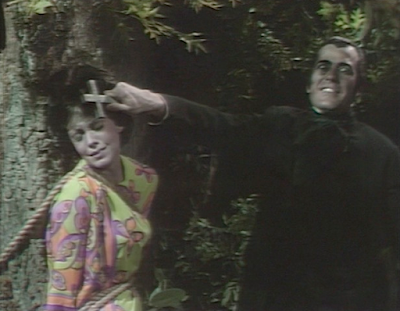
Regular viewers know that the figure is the Rev’d Mr Trask, a fanatical witchfinder who mistook Vicki for the witch in the 1790s and sent her to the gallows. He tells Cassandra that he now has the opportunity to correct that error. He shows her a cross, from which she recoils. We cut to a scene in the woods. Trask has tied Cassandra to a tree and performs an exorcism on her. This is Trask’s go-to technique; he tied Vicki to a tree in #385 and performed an exorcism on her in #386. Since Cassandra actually is in league with the devil (or as Trask would say, THE DE-VILLL!!!,) he has more success this time. Cassandra vanishes and leaves the ropes hanging on the tree.
A first-time viewer might take this climax as an indication that Dark Shadows is a Christian show and Trask is its hero. Not only is Trask going after the right target, he is clearly making some headway. He says all the right things about casting the evil out of Cassandra and saving whatever good is left in her. His delivery of his lines is so fervent that Mrs Acilius, a vigorous Christian, cheered him on. In fact, Trask’s wild incompetence throughout the 1790s segment led to one disaster after another, and was of a piece with the show’s light regard for religion. Not until #450 did a cross provoke a reaction from a monster; that was the first suggestion the show gave that there might be anything to Christianity, and the scenes between Cassandra and Trask today are the second.
Dark Shadows borrows story points freely from all sorts of books, plays, movies, and folklore. So far, it has steered clear of Christianity as a source. For obvious reasons- most of the audience is at least nominally Christian, and Christianity is, in one way or another, a live option for the rest. So it’s a topic that can take over very quickly once it is introduced. I suppose a specifically Christian version of Dark Shadows could have worked, but I can’t imagine that the staff they had would have been particularly interested in making a show like that. So when it looks like they are going to let Trask have even a temporary win, we see the show running one of its boldest risks yet.
We open in a hospital room where Sam Evans is in bed, wearing dark glasses. This would tell a first time viewer that Sam is blind, and also that he’s reckless about his glasses.
Sam is begging his daughter Maggie to bring her friend Vicki around so he can tell her about a dream he just had. Vicki shows up and invites Sam to tell her the dream. This leads to a dramatic musical sting and a cut to the opening title. The first time viewer, still worried that Sam might nod off and break his glasses, will be unlikely to see why Vicki’s willingness to listen to Sam’s dream should be a concerning development.
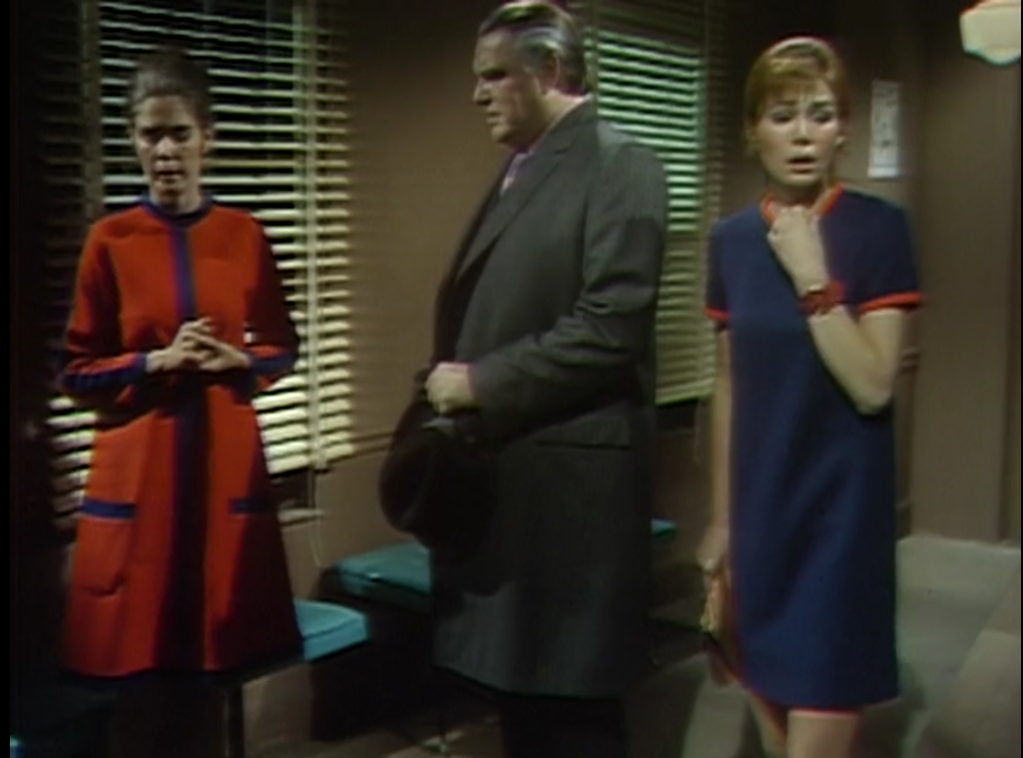
Sam starts to describe his dream. A knock on the door interrupts him. It is Timothy Eliot Stokes. Stokes orders Vicki out of the room. Stokes is wearing a suit, not a white coat, and is addressed as “Professor.” So it should be clear to the first-time viewer that he is not a medical doctor, has no authority in the hospital, and is not particularly close to Vicki, Maggie, or Sam. The women resist his commands, but when it becomes clear he won’t back down they humor him.
In the corridor outside Sam’s room, Vicki tells Stokes “I hope you have some explanation.” He replies “The situation required drastic action.” “Is that all you have to say?” “No, I might add you should be grateful to me.” Thus the first-time viewer learns that Stokes does not feel obligated to be polite to young, pretty women.
Stokes tells Vicki that “Your recent experience in the past has taught you some rather frightening things about witchcraft.” Vicki agrees with this statement. Maggie turns away and looks out into space, wondering what the heck these lunatics are talking about. At last the first-time viewer has an on-screen representative.
Stokes describes a “Dream Curse,” in which a series of people all have the same nightmare. Each dreamer is compelled to tell the nightmare to a particular person who appeared in it. That person then has the nightmare, featuring a third person, and awakens with the same compulsion to tell the nightmare to that person, keeping the cycle going. Vicki declares that she doesn’t know what Stokes is talking about, but Maggie seems to. Vicki grudgingly agrees not to go into Sam’s room, but refuses to leave the corridor.
Maggie reacts to Stokes’ explanation.
Returning viewers know that Maggie was the first to have the nightmare. It will also stretch their credulity that Vicki hasn’t heard about it. Maggie is one of Vicki’s dearest friends, and the nightmare was a terrifying experience that weighed on her for quite some time. The person Maggie passed the nightmare to was Vicki’s boyfriend Peter, who prefers to be called Jeff. Not only has neither Maggie nor Peter/ Jeff told Vicki about the nightmare, neither has any of the three people who have already had the nightmare and who live with her in the great house of Collinwood. These are heiress Carolyn, whom Vicki has addressed as “my best friend”; strange and troubled boy David, who is Vicki’s charge in her job as governess and who feels very close to her; and housekeeper Mrs Johnson, who habitually tells everyone everything she knows.
It will also be strange to those who have been watching the show that Stokes does not tell Vicki the key thing about the Dream Curse, that it is aimed at old world gentleman Barnabas Collins. Vicki is extremely fond of Barnabas; Stokes knows this, because in #509, he told her that he was doing battle with a witch whose goal was to kill Barnabas, and she was most eager to help him. If he told her that by listening to Sam’s account of the dream she would be bringing Barnabas one step closer to death, surely he would have persuaded her to go home. But, as my wife Mrs Acilius pointed out while we were watching the episode, that would let Vicki back into the story. Stokes, like Barnabas and several other major characters, is working to keep Vicki from becoming relevant to any ongoing plot.
Stokes has to leave the hospital to attend to another matter. While Maggie was leading the way out of the hospital room, he looked out the window and saw a man looking in. The man is Adam, a very tall, phenomenally strong, peculiarly inarticulate fellow whom Stokes met at Sam and Maggie’s cottage a few days ago. Stokes is eager to get to know Adam. He lets himself into the cottage and waits there until Adam comes by. Adam is confused to find him there, but Stokes quickly persuades him to come home with him. Stokes promises to give him food and become his friend. The two of them are quite cheerful as they walk out the front door.
The camera repeatedly focuses on a stickpin Stokes dropped on the rug, suggesting that he will get in trouble for having let himself into the cottage without Maggie’s permission. That suggestion is clearer to the first-time viewer than to those who know what’s been happening. Stokes had been in the cottage with Sam not long before, and could easily claim to have dropped the stickpin on that occasion.
Back in the hospital corridor, Vicki hears Sam crying out in agony. She goes to his room. Maggie joins her there, and Sam starts describing the nightmare. Maggie recognizes it as the one that caused her such distress when she had it, and her eyes dart to Vicki. She tells Vicki she doesn’t have to stay. Vicki insists, and a look of panic starts to form on Maggie’s face. Sam doesn’t get far into the nightmare before he dies.
Returning viewers will remember that the luckless Willie Loomis was interrupted in his attempt to tell Carolyn the nightmare in #506, and that when she next went to sleep she could have only the part of the nightmare he had described. So we wonder if Vicki will have the same problem.
We may wonder about something else. Stokes, as an expert on witchcraft, has several times said that a Dream Curse is designed to “end with a death.” We may wonder if Sam’s death will end it before it gets to Barnabas.
That would represent a stinging defeat for the witch. Sam was once a fairly important character, but long ago receded to the margins of the show. He made his debut in #5, and has been played by David Ford since #35. Originally he was a tormented alcoholic, driven to drink by his part in the injustice done long ago to dashing action hero Burke Devlin. Burke’s storyline fizzled out completely in #201, and since then Sam has made only intermittent appearances, mostly as support for Maggie, who is herself usually a secondary character. To launch an attack on the show’s breakout star and hit a tertiary player would be quite embarrassing to any villain. Maybe the witch’s next plan will wind up falling on Bob the Bartender, and the one after that will hit one of the sheriff’s feeble-minded deputies.
Kathryn Leigh Scott tells some stories about Sam’s death scene that do not fit with what is on the tape. In her 1986 book My Scrapbook Memories of Dark Shadows, she writes about the teleprompter falling over and making a loud noise and Ford shouting “Where is it!?” In appearances at Dark Shadows conventions, she has said that the lines Ford improvised to replace the ones he couldn’t read ran over time, and that in her desperation to get to the next break she pushed a pillow on his face and nearly smothered him while saying “Don’t die, Pop!” In his post on Dark Shadows Every Day, Danny Horn says that Miss Scott’s “anecdote was entirely made up. None of that happened.”
I reserve judgment. Maybe the episode we have is a second take. It runs unusually smoothly up to Sam’s death scene, as if the cast had had more practice with its parts than usual. We know that, in spite of all the spectacular bloopers and other production errors they left in, they did sometimes start over, and the incidents Miss Scott described might well have been enough to warrant that.
Wiggèd witch Cassandra shakes off an attempt to burn her and finds out that Sam Evans, an artist whom she blinded a little while ago, is in the hospital with a severe head injury. Sam is on the critical list.
Cassandra has cast an elaborate spell that takes the form of a series of nightmares one person after another has. Sage Timothy Eliot Stokes managed to stop the dream curse a while ago, but Cassandra is determined to restart it. Sam must be the next person to have the dream, so she goes to his hospital room and puts a powder in his drinking water that does the trick.
We see Sam’s dream, as we saw the dream when each of the previous nine people had it. The dream is an opportunity for the actors to emote as fiercely as they want, and most of them seem at least a little bit silly as they go through the exercise. Today, David Ford is the most ridiculous yet. He has to scream several times, and we find that screaming was not one of his strengths as an actor. In fact, every time he did it Mrs Acilius and I laughed out loud. The other person in his dream, the well-meaning Vicki, is played by Alexandra Moltke Isles. Mrs Isles has a ghostly quality that makes her very effective as a mysterious figure in a nightmare. Next to her, Ford seems to be some random guy in a bathrobe who just wandered onto the set.
Vicki beckons Sam to the dream room.
Sam wakes up from his dream and begs his daughter Maggie to get her friend Vicki to come over. Only by telling her about it can he be relieved of the agony that comes to those who have had the dream. Regular viewers know that if he does this, Vicki will have the dream. In a soliloquy, Cassandra tells us that Vicki will pass the dream to recovering vampire Barnabas. Her purpose in setting the curse was to turn Barnabas back into an active vampire; this will therefore be the last step to her success.
Stokes knows how the curse works and knows that Barnabas will die if the dream gets back to him. He does not know that Barnabas was a vampire, much less that Cassandra wants him to revert to vampirism. Maggie was the first to have the dream and knows that Stokes is an expert on it. She does not know that it is designed to kill someone at its culmination. So she sends for both Vicki and Stokes. At the end of the episode, Vicki is at Sam’s bedside, inviting him to tell her the dream; Stokes is still on his way.
Cassandra chose Maggie to be the first to have the dream because she resembles Barnabas’ lost love, gracious lady Josette. They look so much alike that they are the same actress. She does not tell us why she chose Vicki to be the last, but Vicki had extensive contact with Josette’s ghost in the first 39 weeks of the show, and from November 1967 to March 1968 traveled back in time and got to know Josette as a living being. When Josette was alive, Cassandra was known as Angelique. She was a lady’s maid in Josette’s family’s home, and secretly hated the young mistress. Barnabas had an affair with Angelique until he realized he could marry Josette, when he discarded the servant and pursued the mistress. Eventually, Barnabas’ attachment to Josette led the enraged Angelique to turn him into a vampire. So it is logical that Angelique/ Cassandra uses the two women closest to Josette as the first and last instruments in her campaign to revamp Barnabas. It does make it all the more ironic that Stokes lumped strange and troubled boy David, who for the first months of the show was more involved with Josette’s ghost than anyone else, among the “comparative strangers” who have the dream when Barnabas is in relatively little danger.
We open with a reprise of yesterday’s close, with mad scientist Julia Hoffman and servant Willie Loomis in the basement of the Old House on the estate of Collinwood. They hear a sobbing in the air; Julia knows it is the sound of the ghost of gracious lady Josette. Yesterday, the sobbing sounded like Kathryn Leigh Scott, who played Josette in the part of Dark Shadows set in the 1790s; today, it is a recording used in the early months of the series when a mysterious sobbing was heard coming from the basement of the great house on the estate. That sobbing was implied at that time to be Josette also, but in #272 it turned out to be matriarch Elizabeth Collins Stoddard. Using the same recording for Josette, and playing it on a redress of the set used for the basement at the great house, would seem to be a way of admitting to longtime viewers that it was a mistake to resolve the Mystery of the Sobbing Woman that way.
The performer on the old recording is Florence Stanley. Stanley would become nationally famous in the 1970s as Bernice, wife of Sergeant Fish on Barney Miller and later on a spinoff series titled Fish. Fish was played by Abe Vigoda, who will later appear in a couple of episodes of Dark Shadows. I doubt very much Stanley and Vigoda ever talked with each other about their experiences on the show, but it makes me happy that they were both alums.
Abe Vigoda and Florence Stanley as Phil and Bernice Fish.
Julia figures out that recovering vampire Barnabas Collins has been bricked up behind a wall in the basement by the vengeful spirit of eighteenth century witchfinder the Rev’d Mr Trask. She orders Willie to chisel away the bricks and rescue Barnabas. Willie is confused and frightened by what Julia has told him, and resists her command. As he chips away, he is interrupted first by a strange, sudden chill and then by the feeling of a hand on his shoulder. Julia conjured Trask up at a séance held on this spot a few days ago. But she at first refuses to acknowledge that he can be a real obstacle to Willie’s compliance with her commands, so she tells Willie to “shut up!” and get back to work. When Trask becomes visible to them both, Julia has no choice but to address herself to him.
Julia tells Trask that, as a man of God, he must know that murder is wrong. This changes nothing; evidently Trask’s moral theology has evolved considerably since his physical death. Then she tells him that if he wants to correct a terrible mistake he made in life, he should forget about Barnabas and turn to the witch he hunted then, who now calls herself Cassandra Collins and lives at the great house on the estate. Again, no change. When Julia says that Cassandra is the one who ultimately caused Trask’s own misfortunes and that if he is going to take revenge on someone, it should be her, he disappears and the cold, clammy feeling of a ghostly presence goes with him. Willie gets back to work, and they get Barnabas out of his predicament in the nick of time.
In the great house, Cassandra plays a scene with Elizabeth. Cassandra has caused Elizabeth to be obsessed with death, and now causes her to believe she is one of her own collateral ancestors, Naomi Collins, who died in 1796. Cassandra leads Elizabeth to Naomi’s tomb and shows her the stone wall plates inscribed with the dates of the people buried there.
Cassandra does some more spellcasting to deepen Elizabeth’s misery and confusion. Elizabeth resists and runs out; Cassandra laughs gleefully. Her laughter stops when Trask appears to her, a torch glowing in his hand. He tells her that she is the witch, and that he has come to burn her. He commands “Burn, witch, burn!” and she bursts into flames.
The scene in the basement is great fun, as is Cassandra’s confrontation with Trask. But the parts with Cassandra and Elizabeth drag. This is the second time Elizabeth has moped around hopelessly and thought of nothing but death; the first time was a year ago, in late June and early July 1967. It was deadly dull then, and is no better now. The show simply does not know what to do with Elizabeth, and usually wastes the great talents of Joan Bennett.
There are a couple of famous production faults at the tomb. When they get there, the plate over Naomi’s casket still reads “born, 1761; died, 1821,” as it did before the show settled on the 1790s as the decisive period. When Cassandra causes Elizabeth to see the tomb as incomplete and still awaiting Naomi’s interment, the inscription is covered by a piece of cardboard painted to match the stone and clumsily pasted on it.
A lot of wonderful acting in this one. We start off with Willie Loomis (John Karlen,) staggering into the cottage Maggie Evans (Kathryn Leigh Scott) shares with her father Sam (David Ford.) Yesterday, Maggie’s boyfriend Joe beat Willie up. Maggie invites Willie in, comforts him, tries to treat his wounds, and agrees to drive him home. Joe had excellent reasons for insisting Willie stay away from Maggie, and those reasons might lead returning viewers to react to the beginning of the scene with frustration. But Karlen and Miss Scott are so good together that they very smoothly defuse that frustration, and we soon find ourselves as absorbed in the scene as we were in the many scenes the same actors shared in May and June of 1967, when Maggie was the prisoner of Barnabas the vampire* and Willie, as Barnabas’ slave, was trying desperately to reduce her suffering.
A very tall man named Adam (Robert Rodan) comes to the open front door and announces “Willie bad!” Maggie has no idea who Adam is. Adam enters the cottage and clarifies his intention with a declaration of “Kill Willie!” Willie tries to talk Adam out of this plan, and reminds him of the good times they had together. Maggie tells Adam that Willie is hurt, and Adam looks concerned when he responds “Willie hurt?” Rodan gets the same flicker of light into Adam’s eyes that you might see in the eyes of a toddler who is intrigued to hear that someone is having feelings he wouldn’t have expected them to have. Before long, though, Adam is angry again. Maggie takes a hammer and tries to hit Adam, leading Adam to state a new plan- “Kill Maggie!”
Sam comes home. Sam befriended Adam during a trip Maggie recently took out of town. He tells Maggie to stand behind him. She does, and he talks to Adam about their friendship. Adam agrees that Sam is his friend and that he would never hurt him, but he refuses to agree when Sam tells him that Maggie is also his friend. Maggie makes a move that confuses Adam. Trying to get at her, Adam hits Sam very hard. Adam sees that he has knocked Sam down, and he runs away.
We see Adam in the woods, and for the first time hear his voice in a pre-recorded monologue telling us his thoughts. “Afraid! Adam afraid! Adam bad! Adam hurt friend!” Rodan’s acting is more than sufficient to enable us to figure out that this was what Adam was thinking even without the monologue, but he does such a good job of voice acting that I don’t really begrudge it. Crude as the lines are, Rodan simultaneously expresses fine shades of fear and guilt through them.
Willie and Maggie have another scene in the Evans cottage. She is stern with him now, demanding to know what Willie knows about Adam. Willie denies that he knows anything, and she points out that when he was trying to calm Adam he appealed to several facts from their previous acquaintance. Willie tells a story to cover that up, essentially the same story Barnabas made up to tell the sheriff in #505. Maggie is a lot smarter than the sheriff- that isn’t saying much, chewing gum is a lot smarter than the sheriff- and even he didn’t buy this line when Barnabas was pushing it. She tells Willie in a firm tone that she will continue to ask questions until she gets answers she can believe. She explicitly tells him she will ask Barnabas. Maggie’s firmness and Willie’s barely controlled panic make for another gripping encounter.
Willie goes back home to Barnabas’ house. Barnabas’ best friend Julia Hoffman (Grayson Hall) is there. Willie tells Julia they have to find Adam before the police do, since he now knows enough words to get them all in a lot of trouble. Usually when Julia and Willie have their staff conferences, she is firmly in charge and full of ideas. But she is at a complete loss today. She has no idea how to capture Adam, and she doesn’t know where Barnabas is.
What’s more, Julia has just seen a ghost. She heard sobbing coming from the basement, and when she went down there she saw a woman in white whom she recognized as Josette Collins, deceased. Josette dematerialized in front of her. Now the sobbing starts back up, and Julia accompanies Willie to the basement.
Josette is already gone when they get there. Julia tells Willie what she saw earlier. She figures out that Barnabas is bricked up behind the wall where Josette’s ghost had stood. She explains her reasoning in terms that viewers who have seen the last several episodes will be able to follow, but which don’t make a bit of sense to Willie. His sharp befuddlement and her vague certitude make for a laugh-out-loud funny scene.
In the early months of the show, several characters heard a sobbing woman in the locked room in the basement of the great house of Collinwood. It was strongly implied in a number of those episodes that the woman was the ghost of Josette. In #272, matriarch Liz said that she herself was the one who did the sobbing. That didn’t fit very well with what we had seen, but by that point the show had reconceived Josette as part of Barnabas’ story and stopped involving her ghost in the action. Longtime viewers have a strong reminder of the “Sobbing Woman” story today, since Barnabas’ basement is a redress of the set used for the basement of the great house and the alcove where he is walled up is in the same place as the door to locked room in basement of great house.
*Maggie has amnesia about all that, and thinks Barnabas is her friend. His vampirism is in remission now.





 Dark Shadows Commentary