In the spring of 1969, the twin crises created by the malign ghost of Quentin Collins and the werewolf curse upon drifter Chris Jennings had combined to kill a number of people, bring others to the point of death, and make life on the estate of Collinwood utterly intolerable. Recovering vampire Barnabas Collins and his friends found some I Ching wands in Quentin’s old room and tried to use them to communicate with the ghost. Instead, they caused Barnabas to come unstuck in time. In #701, Barnabas found himself in the year 1897, his own curse of vampirism once again in full force.
Today, Barnabas bites Quentin’s girlfriend, maidservant Beth Chavez, and makes her tell him everything she knows about the werewolf curse. He was in a position to know all of this before he bit her; much of it he could have figured out if he had been paying attention to the information available to him in the late 1960s. But the show has been gaining lots of new viewers lately, and they probably appreciate the recap.
Quentin was married to a woman named Jenny, who unknown to him was the sister of ethnic stereotype Magda Rákóczi. Quentin left Jenny in 1895. Neither Quentin nor Magda knew at that time that Jenny was pregnant. Quentin’s siblings Edward and Judith put the story out that Jenny had gone away, and locked her up in a room hidden in the house. They enlisted Beth, her former maid, to be Jenny’s keeper. By the time she gave birth to boy-girl twins, Jenny had gone entirely insane.
In #720, Jenny escaped and stabbed Quentin. She escaped again in #748, and Quentin strangled her. When Magda found out that Quentin had killed Jenny, she cursed him and his male descendants to be werewolves. In #763, Beth told Magda about the twins; Magda’s reaction made it clear to Beth that she was powerless to lift the curse. Regular viewers already know that. The audience first heard Magda’s name months before she appeared on the show, when she spoke at a séance in #642 and expressed deep regret about “my currrrrse,” which we knew to be connected to both Quentin and the werewolf. In #684 and #685, Barnabas found a silver pentagram that Quentin and Beth bought in 1897 on a chain around the neck of a dead baby, and identified it as an amulet to ward off werewolves. Barnabas learned yesterday that Beth had bought the pentagram, and she confirms today that it is for Quentin’s son to wear. She also bought a similar pendant for herself, and is wearing it.
There is a full moon tonight, and most of the episode is taken up with the mechanics of people getting ready to go into the woods to hunt the werewolf, coming back from the woods where they have been hunting the werewolf, and telephoning to ask others to join in hunting the werewolf.
Magda has a pistol and loads it with silver bullets. Some wonder where Magda came up with silver bullets, but in a comment on Danny Horn’s post about the episode at Dark Shadows Every Day someone posting as “cslh324” reminds us that in #757 Magda persuaded undead blonde fire witch Laura to give her the money to buy silver bullets with which to shoot Barnabas. One of Magda’s purposes in putting this plan forward was to get Laura to leave her alone in the room so that she could steal a magical doodad from her, but it turns out Magda really did buy the silver bullets.
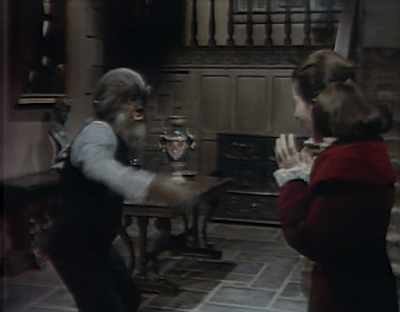
The werewolf gets into the great house of Collinwood and attacks Judith. Beth shows up in the nick of time and shows the werewolf her pentagram. He flees. Judith asks why the werewolf would run away from her, and Beth refuses to explain. At first she denies that it happened, then she asserts that the werewolf is probably as afraid of them as they are of him.
The confrontation between Judith and the werewolf includes a spectacular stunt. The werewolf jumps over the railing on the walkway above the foyer and holds a stationary two-point landing on the floor twelve feet below. Alex Stevens deserves high praise for that.
When we hear the sound effects associated with the werewolf or see the consequences of his attacks or catch a glimpse of him as a blur in the middle of a cloud of shattering glass, we can be afraid of him. Unfortunately, the show often gives us a long look at him, and he is not scary at all. They didn’t have the schedule or the makeup budget to cover his whole body in fur, so he wears Quentin’s suit. Seeing him standing there in that little outfit you don’t want Magda to shoot him with her silver bullets. At most, you might swat him with a rolled-up newspaper and tell him he is a bad doggie.
You have to stop killing people, or you won’t get any more bickies! Screenshot by Dark Shadows Before I Die.
Beth does not want Judith to suspect that Quentin is the werewolf, but it really doesn’t make any sense that she won’t tell her about the apotropaic power of the silver pentagram. You’d think she would want everyone on the estate and in the neighboring village of Collinsport to wear such pendants for the duration of Quentin’s curse. Surely she could come up with some explanation as to how she knew about the silver pentagram that wouldn’t invite questions she couldn’t answer.
The Kindest, Warmest, Bravest, Most Wonderful Human Being I’ve Ever Known in My Life
The show is doing an homage to The Manchurian Candidate this week, with schoolteacher Tim Shaw brainwashed into becoming an assassin when he sees the Queen of Spades. We open with the plan going awry. Lawyer/ warlock Evan Hanley did the brainwashing with the intention that Tim would kill someone else, but when he shows Tim the card, Tim tries to kill him. As Evan, Humbert Allen Astredo shows us a man suddenly becoming frightened and just as suddenly making up his mind to be brave. In other episodes, Astredo has already shown us Evan responding to fear in other ways. He really was a remarkably good actor, and it is a pleasure to see how much variety he can find in his parts.
Later, we see Judith Collins, the mistress of Collinwood, playing solitaire. Tim comes to the house. We know that each episode ends with a cliffhanger, and so this leads us to expect that we will end today with Tim’s hands around Judith’s throat. But that is a misdirection. In fact, Judith turns the Queen of Spades away from Tim at the last second, and he leaves the room without attacking her.
Slight Enough to Vanish, But Too Dense to Live
Tim’s brainwashing is a B-story on the show right now, and it would throw off the rhythm of the week to end two consecutive episodes with cliffhangers from it. The A-story is about the rakish Quentin Collins, who has been cursed to become a werewolf. There is a full moon tonight, and the sheriff’s department is roaming the grounds of the great estate of Collinwood with guns looking for the wolf who walks like a man. Joining in the search is Quentin’s distant cousin, Barnabas Collins, who is, unknown to all but a very few people, a vampire. Barnabas has traveled back in time to the year 1897, and among the things he is hoping to do is to learn how the werewolf curse that has afflicted his friend Chris Jennings in the 1960s first began.
Barnabas learned in 1969 that in 1897 Quentin and a woman named Beth Chavez paid a man named Ezra Braithwaite to make a silver pendant in the form of a pentagram and that a baby boy was buried in that year wearing that pendant. Tonight, Ezra telephones Barnabas at the great house of Collinwood and tells him that Beth just came in, ordered such a pendant, and told him to send the bill to Quentin.
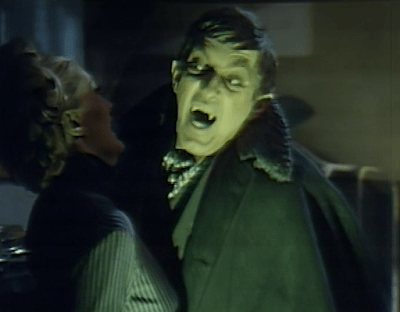
Barnabas knows that the pentagram was an amulet meant to ward off werewolves. Beth is Quentin’s girlfriend, a fact that is no secret to anyone, not even Barnabas. So you might assume Barnabas would have figured out that Quentin is the werewolf. But apparently he has not. He materializes inside Beth’s room and demands she tells him who the werewolf is. When she refuses, he bites her. That bite is the cliffhanger.
Barnabas occasionally makes remarks about how he wants to keep the original timeline intact so that the people he knew in the 1960s will still be there when he gets back. But he’s been feasting on the people he meets in 1897 with abandon. Beth is the fourth resident of Collinwood he has bitten, and he has killed at least two young women in the village. Moreover, his approach to every problem he encounters or imagines is to confront the most powerful person associated with it and antagonize them immediately. It’s hard to see how he expects anything to remain unchanged after he inserts this rampage into the history of the late Victorian age.
But You Wouldn’t Know Anything About That
Judith tells Barnabas today that Beth came to Collinwood as a lady’s maid two years ago. Beth claims to have a cousin in town to Judith today while lying to cover up her trip to Braithwaite’s, and when Barnabas asks Judith if Beth is from Collinsport she mentions this cousin as her reason for believing that she is. Judith clearly knows very little about Beth, and cares less.
The lady who brought Beth as her maid was Quentin’s then-wife, Jenny, who was secretly a member of the Romani people. In #701 it was hinted that Beth was concealing a Romani origin of her own. Casting the tall, blonde, blue-eyed, pale Terrayne Crawford as Beth would seem to indicate that they were not committed to following up this hint, but in today’s scenes with Judith they do go out of their way to emphasize that Beth’s background is a mystery.
The Woman Who Never Left
Beth has been helping the family hide the fact that Jenny went mad and bore twins after Quentin left her. Quentin murdered Jenny in #748, eliminating the need for a servant to cover up her existence, and the twins, about whom Quentin does not know, are firmly ensconced in the care of a woman in the village named Mrs Fillmore. In #750, Judith fired Beth, but it didn’t take. Beth never left the house, and after a while the family started giving her orders again. Today Beth tells Judith that Mrs Fillmore reports that the boy twin is feverish, and asks to be kept on staff until he gets well. Judith agrees.
Judith tells Beth that she has decided to tell Quentin about the twins. She hopes that is what will prompt her brother to cast aside his selfish ways and become a mature adult. Beth is horrified and begs her not to do so. Judith, puzzled, says that Beth has always urged her to tell Quentin. She asks why she has changed her mind, and she makes up something obviously false about Quentin being unable to cope with the news that his son has a fever.
Yesterday, Beth learned that Quentin’s curse is hereditary. Returning viewers might wonder if she is afraid that Quentin will also learn that, and that if he does he might kill his children to prevent them passing it on. He does keep saying that he would rather be dead than have the curse, so he might talk himself into regarding such a murder as an act of mercy.
Featuring Edward Marshall as Ezra Braithwaite
Edward Marshall plays Ezra, a part played in #684 and #685 as an 87 year old man living in the year 1969 by Abe Vigoda (who was 48 at the time, but he and the makeup department both knew their business well enough that he was entirely convincing.) Mr Marshall appeared in #669 as unsightly ex-convict Harry Johnson, a part originally created by the not-always-stellar Craig Slocum. Mr Marshall gave Harry the same attitude and many of the same mannerisms Slocum had given him, but was so much more fun to watch that I wanted to see a lot more of him.
Parts of Harry’s costume and most of his surly demeanor are recycled in the 1897 segment in the character of dimwitted groundskeeper Dirk Wilkins, played by the repulsive Roger Davis. Whenever Dirk is on screen, I imagine Mr Marshall in Mr Davis’ place. I recommend that bit of mental recasting, it goes a long way towards making Dirk bearable. Unfortunately this is Mr Marshall’s final appearance on Dark Shadows.
Schoolteacher Tim Shaw was introduced in #731. The name “Shaw” is common enough that few viewers are likely to have found any significance in it at the time. It is true that Dark Shadows is at this point a costume drama set in 1897 and that George Bernard Shaw was coming into his own as a playwright in that year. The show was written, acted, and directed largely by theater people, and is so self-consciously stagy that it is possible there might be a reference of some kind to Bernard Shaw in a character’s name. But there doesn’t seem to be anything especially Shavian about Tim.
Today we learn the reason Tim was called Shaw. Satanist Evan Hanley gives Tim a potion that robs him of his will. He holds up a deck of playing cards and tells him that when he sees the Queen of Spades he will know it is time for him to murder someone. In Richard Condon’s 1959 novel The Manchurian Candidate, soldier Raymond Shaw was brainwashed into becoming an assassin when he saw the Queen of Hearts; in the John Frankenheimer’s 1962 film based on the novel, Raymond’s trigger was the Queen of Diamonds.
Frankenheimer’s film is one of the supreme examples of a movie that shouldn’t have worked, but did. No part of the plot stands up to rational analysis for one second, but when the tale is told through stark black and white imagery that puts us deep in the world of a nightmare it is spellbinding. Unfortunately, the irrationality of the plan the villains carry out and of the other characters’ responses to their evil deeds in The Manchurian Candidate are on full display in this homage, without the paranoid verve that makes the movie compelling. All by itself the potion puts Tim so deep in Evan’s power that he gladly goes to witch Magda Rákóczi to buy poison and insists she sell it to him even after she has pointed out that it is useful for nothing but murder. It doesn’t seem there is anything left for the card to add to the control Evan has over him.
It gets worse. Evan is acting as the agent of the evil Rev’d Gregory Trask. Trask is unhappily married to a woman named Minerva, and is blackmailing Evan into sending an assassin to kill her. When Evan shows Tim the card today, he confirms that the intended victim is a woman. But why not have him kill Trask? As my wife, Mrs Acilius, points out, if Trask dies, Evan will be free of the threat of blackmail. So if he is prepared to be a party to murder, you’d think he would forget Minerva and commit the crime he has a motive to commit.
The highlight of today’s episode doesn’t have anything to do with Evan, Tim, Minerva, or Trask. It is a scene between Magda and sometime maidservant Beth.
Beth has come to the Old House on the great estate of Collinwood to plead with Magda to lift a curse she has placed on Beth’s boyfriend, rakish Quentin Collins. Quentin murdered his estranged wife, Magda’s sister Jenny, and as revenge Magda turned him into a werewolf. Magda is unimpressed with anything Beth says until she tells her that in spite of everything, she will marry Quentin and go away with him. Magda marvels at this and asks Beth if she will really go through with it knowing that any son Quentin might have will suffer from the same curse. Shocked, Beth asks Magda if she means what she has said, and she repeats that Quentin’s son will also be a werewolf. Beth replies that in that case, Magda has laid a curse upon her own kin.
Magda dismisses this, saying that Jenny had no children by Quentin. Beth says she is wrong, that Jenny bore twins, a boy and a girl. Beth lays the story out systematically, and it dawns on Magda that she is telling the truth. Magda calls out to Jenny’s spirit and begs forgiveness, saying she did not know. Beth says that it is time to lift the curse, and Magda tells her to get a pentagram and make sure the boy wears it all the days of his life. Beth has her own moment of horrified realization. “And… you can’t end it? Can you?”
Beth realizes Magda does not know how to undo the curse.
Terrayne Crawford had some weaknesses as an actress that severely undercut her in her first weeks as Beth. But this scene is right in her wheelhouse. She is flawless as she portrays Beth’s progression from weepy begging to methodical explanation to utter shock. And Grayson Hall of course brings great power and vivid color to Magda.
We’ve been waiting for this scene since #642, months before Magda first appeared in #701, let alone before she placed the curse on Quentin in #750. In that episode, back in December 1968, the show took place in a contemporary setting. The characters had noticed some strange goings-on, and held a séance as part of their inquiry. The spirit they reached was Magda, who spoke regretfully of “my currrrse!” It’s taken more than 24 weeks, but Magda has finally learned what she already knew when we first heard from her.
In December 1967, Dark Shadows was a costume drama set in the 1790s. In that month it introduced the Rev’d Mr Trask, a witch-hunter from Salem, Massachusetts, came to central Maine* to drive witchcraft out of the village of Collinsport and off the estate of Collinwood. Trask was bad at this job; wicked witch Angelique easily deceived him into blaming well-meaning governess Victoria Winters for her own crimes, leading to Vicki’s hanging and exacerbating the consequences of Angelique’s evil spells.
Now the show has relocated to the year 1897, and a descendant of Trask is among the villains. He is the Rev’d Mr Gregory Trask, and he runs a boarding school along lines dictated by his own sadistic delight in punishing innocent children.
Fans often say that while the original Trask** was a sincere believer who did harm because of his fanaticism, Gregory is a hypocrite who uses a pretense of religion to enable his perversions and his greed. I think the truth is more complicated, and more interesting, than this. In #441, the original Trask found the strangled body of a professionally agreeable lady named Maude Browning in his bed; it had been placed there to frame him for Maude’s murder. Trask’s principles, were he to follow them, would seem to imply that he should go directly to the authorities. If the worst happened and they hanged him, to the extent that he was targeted because of his Christian witness his death would win for him an everlasting crown of martyrdom. But fear got the better of Trask. He enlisted a man named Nathan Forbes to help him hide Maude’s remains, and went on from there to expand his conspiracy to suborn Nathan’s perjured testimony against Vicki. Considering the emphasis the Reformed movement put on the Ten Commandments, Trask could not have been unaware of the sinfulness of bearing false witness against a neighbor.
I think Trask’s fanaticism led him to overestimate the importance of the success of his mission in this world. It is not enough that he will be vindicated in the courts of God; God must be vindicated through Trask’s success in the courts of Massachusetts. Thus it is his very sincerity that turns Trask into a hypocrite. Eric Hoffer’s book The True Believer was one of the most influential publications of the 1960s; Trask, the fanatic-turned-hypocrite, could easily have found a home in its pages.
Gregory Trask is certainly a hypocrite. Today we hear Gregory’s wife Minerva talk about women he has dallied with over the years. Gregory comes upon Satanists Quentin Collins and Evan Hanley in the act of summoning the Devil; Gregory’s response is to blackmail Evan into using his command of the black arts to cast a spell to brainwash hapless schoolteacher Tim Shaw into murdering Minerva. We have seen in previous episodes that Gregory has plans for spinster Judith Collins and her enormous fortune; Minerva’s death, if it can be arranged just so, will leave him well-positioned to marry Judith and become the Master of Collinwood.
As his ancestor’s very sincerity turned him into a hypocrite, so Gregory’s hypocrisy occasionally turns him into a sincere believer in his own powers, if not exactly in God. We saw in #735 that Gregory does not take the same pleasure in reading the Bible that he does in leafing through his “Punishment Book,” a ledger which evidently details his abuse of the children attending his school. But he does read it and quote it, and when in #726 he encountered a case of possession, he immediately and with untroubled self-assurance set to work performing an exorcism. The possession was real, and so far as Gregory could tell his exorcism was successful. He reacted to that apparent success with a serenity that betrayed no suggestion that he had ever doubted that he was the right person to cast out the spiritual forces of darkness.
As the original Trask was a stranger to the routine play-acting that makes ordinary social life bearable and therefore gave himself permission to become a party to the most horrendous deceptions, so Gregory wears his mask so tightly that his face grows to fit it. Dark Shadows was often very self-conscious about showing characters who were acting; its greatest success, vampire Barnabas Collins, won over the audience when they saw him trying desperately hard to play the role of a living man native to the twentieth century. In the Trasks, we see men who do not know that they are acting and therefore cannot manage the effect that the parts they play in everyday life have on their personalities.
Gregory does have a tight mental focus on his projects. When he goes to Evan with his blackmail demands, Evan has learned of his eye for the ladies, and is hoping to use that information to lower his price. So his opening gambit is to describe himself as a man who drifts from one idea to another as other men drift from one woman to another. Three times he says the word “woman,” in each case as the last word of a sentence, in each case about twice as loudly as the words before it. Gregory is unimpressed, and Evan realizes he doesn’t have anything definite to use against Gregory. He crumbles and agrees to Gregory’s extreme demand.
Gregory’s academic standards seem considerably less exacting than are his expectations of his co-conspirators. He mentions to Tim today that when he was a young teacher, the first class he ever taught was in elementary Latin. He challenges Tim to translate the words amo, amas, amat; Tim wearily replies “I love, you love, he loves.” “Very good!” exclaims Gregory. Traditionally the first words students learned on the first day of Latin class were amo, amas, amat, amamus, amatis, amant– I love, you love, s/he loves, we love, you (plural) love, they love. “Very good!” would seem to be an outrageously inflated appraisal to apply to someone who has merely recognized the first three of those six words.
Gregory sends Tim to Evan’s house to read a Latin document that has some bearing on a legal matter that has come up in Evan’s work as an attorney. As it happens, I went to graduate school in ancient Greek and Latin at the University of Texas at Austin, and local attorneys would sometimes call our department asking for someone to help them translate Latin they had found in old Spanish legal documents. They would usually refer those calls to the ablest Latinists among us, since the legal Latin used in the Spanish Empire in the days it ruled Texas was rather a specialized form of the language. Tim can virtually speed-read Evan’s document, suggesting that “amo, amas, amat” was not a particularly stringent test of his abilities.
*Maine was part of Massachusetts until 1821.
**Who is never given a first name. One of the Big Finish audio dramas refers to him as “Vilorus Trask” and actor Jerry Lacy once said he thought his name should have been “Orville.” Neither of those sounds like a very plausible name for a junior-grade Puritan divine of the late eighteenth century. So we are left calling him “the original Trask.” My wife, Mrs Acilius, points out that this seems to suggest that Gregory should be “the extra-crispy Trask.” Maybe he will die by fire, as others have done.
In November 1968, the production staff of Dark Shadows was planning to introduce the Devil as a character. But a lot of fundamentalist Protestants and traditionalist Roman Catholics were making noise just then about the ungodly nature of network TV programming in general and of Dark Shadows in particular, so they decided to scale him back a little. In the scripts for #628 and #629, he was called “Balberith,” and in the credits he was listed as “Diabolos.” In The Dark Shadows Companion, writer Sam Hall is quoted as saying “We demoted him from the Devil to a devil, just one of Hell’s Associate Vice Presidents in Charge of Witchcraft.”
By the spring of 1969, the show had been a hit for quite a while, and the ratings were still climbing. So they could get away with things that had been off limits before. When vampire Barnabas Collins joined the cast in April 1967, ABC’s office of Standards and Practices decreed that he would have to bite his blood thrall, the luckless Willie Loomis, on the wrist rather than the neck, hoping that would keep the viewers from seeing anything homoerotic in their relationship. But when Barnabas traveled back in time to 1897 in #701, he immediately bit a man named Sandor Rákóczi on the neck, and yesterday we saw that he had bitten dimwitted servant Dirk Wilkins, again on the neck.
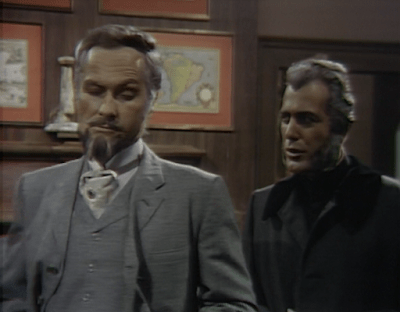
In this episode, a knock comes at the door while lawyer/ warlock Evan Hanley is asleep. Evan finds his friend and fellow Satanist Quentin Collins, profoundly drunk and asking for help. Quentin has been turned into a werewolf, and tomorrow night there will be another full moon. He pleads with Evan to help release him from the curse.
Evan says that he has no powers. In the course of his conversation with Quentin, it comes up that Evan is adept in black magic, and that the two of them have together managed to raise demonic spirits. So Evan suggests Quentin come back the next day for a ceremony in which they will summon “The supreme power of the underworld.” Quentin asks if Evan is referring to the Devil, and Evan affirms that he is. In the subsequent rite, Evan uses not only the word “Devil,” but says and repeats the name “Satan… Satan!”
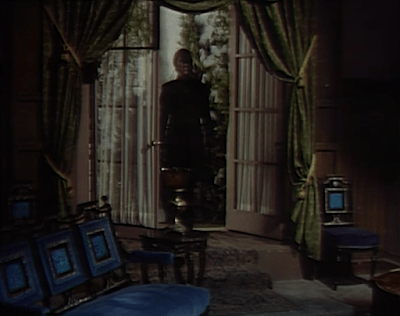
Even Diabolos, whom I think of less as an Associate Vice President of Hell than as an assistant regional manager for upper New England in the black magic division of some company to which the Devil has outsourced some of his less urgent terrestrial operations, was irked when witches expected him to come to them. Their summoning ceremonies ended with them finding themselves in his office, which appeared to be located in space he had rented in a corner of Barnabas’ basement. So regular viewers will be skeptical of the closing cliffhanger, when a shadowed figure appears in the window at the climax of the ceremony meant to summon Old Scratch himself.
My wife, Mrs Acilius, gives another reason to doubt that the figure really will turn out to be Satan. The most potent villains on Dark Shadows have all been female. The first supernatural menace was undead blonde fire witch Laura Murdoch Collins, who joined the show in December 1966 and transformed it from a more or less conventional soap into a thriller about the spiritual forces of darkness.
Barnabas came in Laura’s wake and brought a new audience, but the show was as slow-paced in his first months as it had been before Laura came. It was only when Barnabas teamed up with mad scientist Julia Hoffman in #291 that the plot started to move at a speed that could hold the attention of the preteen viewers Barnabas attracted.
From November 1967 to March 1968, the show was a costume drama set in the 1790s. We saw then that Barnabas became a vampire because of a curse placed on him by wicked witch Angelique. Angelique’s manic behavior kept the 1790s segment moving at breakneck speed, and the show never really slowed down again thereafter.
Late in 1968, we met the all-destroying ghost of Quentin Collins and the terrible werewolf Chris Jennings. Barnabas came to 1897 as a result of his efforts to find out what was behind these two menaces. What we have found is that they are both the products of a curse placed by another female character, Sandor’s wife, the charmingly amoral Magda.
Angelique herself has come to 1897 to plague Barnabas. Laura was present at the great estate of Collinwood in that year as well. Last week was devoted to a battle between Angelique and Laura, representing a contest between two versions of Dark Shadows. It was a foregone conclusion that Angelique would win that battle- no one believes we are going back to the sedate, atmospheric, tantalizingly spooky show that ran early in 1967. But the two women were far more compelling adversaries than were any two men who have squared off against each other on the show. If you put Satan on stage, you can’t very well top him with a bigger Big Bad, so once we see that the figure in the French windows is male, we can’t really believe that Evan and Quentin’s visitor is the one they have invited.
Diana Millay’s Laura Murdoch Collins was instrumental in two of the most important turns in the development of Dark Shadows. When she was on the show from December 1966 to March 1967, she was its first supernatural menace, marking its transition from the Gothic melodrama of its first months to the monster-driven thriller it became. And in her current tour of duty, in April and May of 1969, it is while doing battle against Laura that Barnabas and Quentin Collins become friends, a friendship that will be central to the show from now on.
Today is Laura’s final appearance. Her sendoff is startling. After she bursts into flames, we cut directly to the closing credits, already in progress with Jonathan Frid’s credit for the part of Barnabas scrolling over an image of the outside of the great house typically shown during the opening voiceover. The bottom of the image is atypically cut off, creating a letterbox effect. None of this is in itself spectacular, but each part of it is a deviation from the usual format. Taken together, it leaves us with the feeling that Laura must have exited by way of the control room.
In the opening reprise, Laura thinks she is waking her son Jamison. She pulls the covers back from Jamison’s bed, and finds that she has been talking to a pile of pillows. In the corner of the room, Laura’s fellow undead blonde fire witch Angelique bursts out laughing.
Well might Angelique laugh. Not only is it ridiculous to see an ancient and terrible creature like Laura fall for so childishly simple a trick, but heaping up pillows under covers to make it look like someone is in bed is a favorite practice of Angelique’s. In #402, Barnabas went to Angelique’s bedroom intending to stab her, only to find her in the corner laughing at him after he had chopped up some pillows under her blanket.
It is fitting that Angelique is the one who destroys Laura. Matthew Hall, son of Sam and Grayson Hall, writes in the essay he contributed to The Dark Shadows Companion that when he and his father were among the writers developing the reboot of Dark Shadows that aired briefly on NBC early in 1991, the idea of including a version of Laura was rejected because “the Phoenix was virtually a test run of all the ideas that would subsequently reach fruition in the character of Angelique. Thus: Laura’s ability to cast spells that set fire to distant things is but one if Angelique’s large arsenal of tricks. Of course, on the original show, advantage was taken of how evenly matched these two characters were: they fought viciously during one episode.” There are some odd things in this assessment, but it is certainly that a character like Laura, who was frightening precisely because she herself was unknowable and her presence implied a world that humans could never hope to understand, had no place on a show where the supernatural is represented by figures like Angelique and Barnabas, whose feelings and intentions are overwhelmingly obvious and all too relatable.
Laura’s children are hidden from her in a room in the east wing of Collinwood. It is in this room, in front of them, that she burns up. The east wing has been mentioned only a few times, mostly by actors who were supposed to say “west wing.” This is the first episode with a scene set in the east wing.
Dark Shadows‘ first supernatural menace, on the show from December 1966 to March 1967, was undead blonde fire witch Laura Murdoch Collins. In those days, we learned that at intervals of exactly 100 years Laura incinerated herself and her young son, always a boy named David, and that she (but not the Davids) rose from the ashes as a humanoid Phoenix. Well-meaning governess Victoria Winters led the resistance to Laura.
The story came to its climax as Laura she tried to take her son, Vicki’s charge David Collins, to the fate that had claimed David Stockbridge in 1767, David Radcliffe in 1867, and who knows how many other Davids in the preceding centuries. At the final moment, David Collins ran from the burning shack to which Laura had brought him and found his way to Vicki’s arms. With that, he chose Vicki and life over his mother and death, and Dark Shadows 1.0 reached its conclusion.
Dark Shadows 2.0 picked up immediately after, and focused on another supernatural villain, vampire Barnabas Collins. There isn’t an established mythology for filicidal humanoid Phoenixes, so the writers had leaned heavily on Bram Stoker’s Dracula and on stage and film adaptations of the novel for the structure and details of the Laura story. For example, in many scenes they went out of their way to show that Laura never eats or drinks. They eventually established that Barnabas doesn’t eat or drink either, but when he first came on they had to show that they were not just repeating what they had done so shortly before. So in #221, Barnabas clearly drinks a cup of coffee.
The original plan had apparently been that Barnabas would wreak terror for thirteen weeks while Vicki gradually figured out what was going on, organized a force to do battle with him, and then staked him in #275, destroying him in the last episode the ABC network was likely to air before cancelling the show. But Barnabas brought a new audience with him, prompting ABC to renew for another thirteen weeks. So his destruction had to be postponed indefinitely, and Vicki wound up on the margins of the story. She became Barnabas’ friend and stalwart defender before ultimately disappearing altogether.
Since then, Dark Shadows has been reinvented several times. Version 3.0 ran from November 1967 through March 1968; it was a costume drama set in the 1790s, to which Vicki had been transported by the mysterious powers represented by the ghost of Barnabas’ little sister Sarah. Version 4.0 ran from March through November 1968; it was a Monster Mash in which a variety of vampires, Frankensteins, witches, and other refugees from the Universal Studios back catalog stumbled over each other in an ever-more futile search for a coherent plot. Version 5.0 began in November 1968 with two stories revolving around nine year old Amy Jennings. These were the Haunting of Collinwood by the malign ghost of Quentin Collins, who represented a special threat to Amy, and the Werewolf Curse on Amy’s big brother Chris. I don’t know what was in the original flimsies, but I suspect this portion of the show was originally meant to be much shorter than it is and to serve as a prologue to Version 5.0.1, a costume drama set in 1897, when Quentin was alive and the werewolf curse began. It shows signs of having been greatly extended when Quentin’s ghost started to attract a large and fervent fan-base and the producers were unsure whether he could keep that following as a living being.
We finally went back to 1897 in #701, twelve weeks ago. Barnabas, who at the beginning of the Monster Mash period was freed of the effects of the vampire curse, tried to save Amy, Chris, and everyone else at Collinwood by doing some mumbo-jumbo, and found himself transported back in time. Having traveled to the past, he has once again become a vampire.
Among the many people Barnabas has met during his uncertain and frightening journey to the past is another iteration of Laura. It turns out that he remembers her from 1767, when he was a child and she was married to his uncle. She at first accepted his story that he was the great-grandson of the original Barnabas. He was a small boy when she burned that time, and all she can see is that her new acquaintance has a family resemblance to that boy. But he knew that she was planning to incinerate her children, among them the ancestor of the Collinses whom he knows at Collinwood in the 1960s, and he has been flagrantly aggressive in his opposition to her. She has learned that he is a vampire, and has tried to destroy him.
The highlight of today’s episode comes when Laura enters the foyer of the great house and Barnabas pops up to greet her. He calls her Laura Stockbridge, and she begins talking about what he was like as a boy. She refers to their similarity, implying that she is herself a type of vampire. She tells him he shouldn’t oppose her, and he says that he would want her to stop him if he were about to do what she is planning. She says that he cannot know what her plans are. He assures her he does know, and she lists all the people with whom he may have discussed her, dismissing each in turn as an unreliable source. Barnabas keeps smiling. For a thrilling moment, we wonder if his key informant was Vicki. Perhaps she told him about her encounter with the Laura of 1966-1967, and he knows everything she figured out in those days.
Alas, it is not so. Barnabas opens a door and reveals the slumped figure of Laura’s dimwitted thrall Dirk. Earlier Barnabas, in bat form, had attached Dirk to prevent him bringing a letter to the house that would have exposed Barnabas’ secret. Barnabas tells Laura he hasn’t killed Dirk, merely bitten him and questioned him. In the first two-thirds of the episode, Dirk, played by the always-regrettable Roger Davis, kept grabbing Laura and pawing at her; at one point Diana Millay does an adroit little judo move to block his hand before he can put it on her left breast. As a result of these scenes and countless others in which Mr Davis engaged in similar behavior, many in the audience will groan with disappointment when Barnabas says that Dirk is not dead.
Millay and Jonathan Frid are wonderful in this scene. Laura’s lines are perfectly suited to display Millay’s gift for subtle emotional transitions, and Frid’s delivery shows what he can do when he has time to learn his part and the lines do not require him to verbalize the character’s every thought. Mr Davis is also well within his range, playing as he does an unconscious and apparently dead body. He should have specialized in that, it’s the first thing we’ve seen him do really well in all of his many appearances on the show.
Undead blonde fire witches Laura and Angelique are trying to destroy each other, using Laura’s son Jamison and Jamison’s uncle Quentin as their cat’s paws. At the beginning of the episode, it looks like the spell Angelique and Quentin are casting is about to incinerate Laura; at the end, it looks like the spell Laura is casting is incinerating Angelique. In between, Quentin’s sister Judith notices that something is wrong with Jamison, and suspects that whatever Quentin and Angelique are up to is the cause.
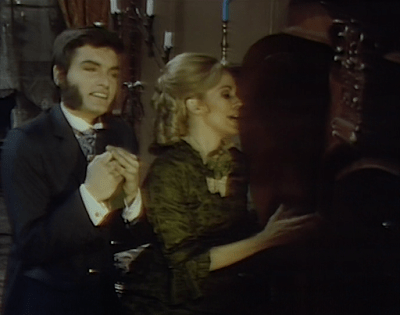
Quentin and Laura get all religioused-up asking the gods of ancient Egypt to help them against Laura. Screenshot by Dark Shadows Before I Die.
Laura is just about out of story, so we can see that she will be leaving the show soon. She has important relationships to all the characters on the show right now, so her departure will kick this segment of Dark Shadows, a costume drama set in the year 1897, into a new phase. Today’s episode is too deeply involved with the back and forth in the battle of the witches to give much indication as to what that next phase will be, but Judith’s perceptiveness suggests that whatever it is will keep up the rapid pace set in the first twelve weeks of the flashback, unencumbered by characters who slow things down by refusing to face facts.
Longtime viewers will be intrigued by variations on some familiar themes. Angelique orders Quentin to bring her a mirror and then leave the Old House on the great estate of Collinwood. Obviously she is going to use it to cast a spell that will protect her from Laura, but she refuses to tell Quentin the particulars. We know well how powerful reflections are in the universe of Dark Shadows; Wallace McBride of the Collinsport Historical Society made some very penetrating observations about how that motif was already in place in episode #1 in his 18 April 2020 post on that treasured, but now only intermittently available, site.
Later, Laura is in the drawing room at the great house on the estate about to tell Judith the secret of the mysterious Barnabas Collins, but Angelique enters, makes googly eyes at Laura, and thereby robs her of the power to speak. When the show had its first séance in #170 and #171, it was held in this room and another iteration of Laura was in attendance. It was that Laura who looked at the medium with bulging eyes when she began to speak, and that medium struggled to speak just as Laura does now. So today we see the tables turned on Laura.
Quentin and Angelique are alone for a moment in the foyer of the great house. He backs her against the portrait of Barnabas that hangs there and asks why she prefers Barnabas to him. That is a question that will have occurred to the audience. The two of them look great together and have a lot of fun together, while Barnabas hates Angelique. All she does is kill his family and friends to punish him for refusing to love her. She brushes Quentin off and orders him to go back to the Old House.
In the final scene, Quentin returns to the Old House and is baffled to find that Angelique not only got there before him, but that she has had time to play a long game of solitaire since returning from the great house. She dismisses his questions and tells him that she wants him to be with her when “it happens.” Before he can find the words to ask what she is expecting, she bursts into flames.
It seems that Angelique is in two places at once. More precisely, it seems that there are two of her, one that Quentin left in the great house, and another who was in the Old House all along waiting to be incinerated by Laura’s spells. Presumably the one in the Old House is a Doppelgänger that Angelique used the mirror to create. Nowadays, the idea of a home-made Doppelgänger fabricated to serve a specific purpose will remind many people of the 2017 season of Twin Peaks, with its concept of a “tulpa.” The Buddhist concept of the tulpa was indeed in circulation in the USA in the 1960s; Annie Besant had introduced it to the Theosophist movement, which had many followers in the Midwest, where writer Sam Hall was born. But Besant and her fans seem to have used the word in a sense closer to its original, in which people attaining Buddha-hood have the power to send copies of themselves back into the world to teach others pursuing enlightenment. Later heirs of Theosophy have tried to develop a non-Buddhist meaning for the word tulpa, but using it to refer to a lookalike that some practitioner of black magic can whip up to do a job appears to be the intellectual property of Lynch/ Frost Productions.
Be that as it may, we have seen ever since Laura was first on the show from December 1966 to March 1967 that each of the supernatural beings on Dark Shadows is a complex of related but independent phenomena, some of which may work at cross-purposes with each other. Angelique in particular seems to create another version of herself and send it out into the world each time she casts a spell. Since others of Angelique’s creatures have gone on to defy her, even trying to kill her, it must have come as a relief to know that this time the Doppelgänger would be going up in flames by nightfall.
Undead blonde fire witch Laura is in the act of driving a stake into the heart of vampire Barnabas when she is interrupted by another undead blonde fire witch, Angelique. Angelique announces that she will always be there to thwart any attempt to stake Barnabas, which rather tends to deflate the suspense inherent in having a protagonist who is a vampire. The two of them exchange threats, and Laura finds that she can hold Angelique at bay by generating the right kind of fire.
Laura leaves Barnabas’ house. His unwilling sidekick, thoroughly human witch Magda, sees her and asks what she was doing there. Laura does not answer, but Angelique enters and tells her. Angelique says that Barnabas would doubtless wreak a terrible vengeance if he found out what had happened while Magda was away. Angelique orders Magda to go to the great house of Collinwood and fetch a fourth witch, black magic enthusiast Quentin. Magda complies reluctantly.
Quentin is falling down drunk, which is not unusual. He has a better excuse than he typically does, however, since he just found out that Magda turned him into a werewolf. He is furious to see her. He says that no matter what she thinks, he will not “lie down and die!” This elicits a laugh from Magda, who points out that he can barely stand up. She tells him that Angelique has ordered him to come to Barnabas’ house, and that he cannot oppose her.
In the house, Angelique tells Quentin he must help her defend Barnabas from Laura. Quentin moans that he is in no condition to help anyone, which only makes Angelique impatient. Unlike her and Magda, Quentin does not know that Barnabas is a vampire, so Angelique keeps reminding herself to say that Barnabas has gone away for the day and that Laura will be a threat to him when he comes back tonight. Quentin tells Angelique about a trinket Laura received from some of the gods of ancient Egypt that keeps her alive, and she sends Magda to steal it from her.
Magda goes to Laura’s cottage. Magda tells Laura that she has more reason to hate Barnabas than she does, since Barnabas enslaved her husband Sandor. She wants Barnabas to be destroyed, but if Laura tells the authorities about him Sandor, too, will be killed. The dramatic date is 1897, and the state of Maine abolished the death penalty in 1887, so Magda is afraid of an extrajudicial killing rather than an execution for complicity in Barnabas’ murders.
Laura tells her that it is necessary to expose Barnabas if he is to be destroyed, but Magda tells her of another way. She says that vampires can be killed by silver bullets through the heart. Laura goes to get money for Magda to buy silver and have it made into bullets. While she is out of the room, Magda steals the trinket. It seems that Magda has given herself a chance to get rid of both Laura and Barnabas.
Once Angelique has the trinket, she tells Quentin that he will have to perform a ceremony using his copy of the Egyptian Book of the Dead. He is still heavily hungover and balks at the orders, but she gives him no choice. Once he starts his incantation, he breaks into a big smile, clasps the book to his chest, and preaches the phrases like a megachurch pastor when the collection plates are circulating. We cut to Angelique. Her expression is so admiring it is hard to tell whether the reaction is the character’s or the actress’. Angelique does some mumbo-jumbo with objects in the fireplace.
In her cottage, Laura struggles. She looks frantically for the trinket, then prays to Amun-Ra. The final shot of her is filtered to distort her image. It turns her eyes into little black coals, which is an effective visual metaphor.
Laura has been important in the history of the show and is key to this little period of the plot, but it is fairly clear that she is a short-timer now. All she cares about is taking her children away and burning them to death so that she can renew her own existence, and she keeps saying she is on a tight deadline for that project. We can be sure she won’t succeed, and even if she does she will be off the show. So she really could die, making the cliffhanger more suspenseful than usual.
Soaps classically divided the days of the week so that very little happened on Tuesday or Wednesday, Thursdays were devoted to plot mechanics setting up a big development, Fridays would show that big development and end with a memorable cliffhanger, and Mondays would resolve the cliffhanger and give a lot of recap to bring new viewers up to speed. Dark Shadows never followed this formula. These last three episodes are a case in point. #755 was all about Laura trying and failing to figure out whether Barnabas was a vampire. That was a mid-week throwaway if ever there was one, but it aired on a Friday. Yesterday she got confirmation that he was, and we ended with a fine cliffhanger with her holding the stake and mallet beside Barnabas’ open coffin. That aired on Monday, but was a perfect Thursday scene-setter. Today, a Tuesday, we have a whiz-bang battle of the witches, with new alignments and new dangers, a great Friday climax with a cliffhanger fitting for the end of any week.
Violet Welles was far and away the best writer of dialogue on Dark Shadows, and today’s script is so full of gems that even the plot summary on the Dark Shadows wiki is full of quotes. I can hardly blame the editor for that deviation from the usual format, there is so much good stuff I would have been tempted to transcribe the entire script if someone else had not already done so.
Undead blonde fire witch Laura Murdoch Collins realizes that Barnabas Collins is a vampire, and that when he was alive he was the “strange, dreamy boy with sad eyes” she was fond of in the 1760s, when she was married to his uncle. Laura and Barnabas confront each other in a graveyard at the beginning of the episode; she tells him he is not human. He passes up the opportunity to reply “So few people are, these days.” At the end of the episode, Laura and her witless henchman Dirk let themselves into Barnabas’ house after dawn. She has a mallet and stake, he has a pistol to ensure no one interferes.
It means something to longtime viewers that we end today with Laura poised to destroy Barnabas. It was Laura who cleared the way for Barnabas’ first introduction. She was the show’s first supernatural menace when she was on from December 1966 to March 1967, and her story was structured very much like Bram Stoker’s Dracula. That was successful enough that the following month they introduced Barnabas as Dracula Mark II. That Laura knew Barnabas in the 1760s when she was already what she is and he was still a boy also nods to this history.
Laura went up in smoke in March 1967, when the show took place in a contemporary setting, and reappeared in April 1969, when it was a costume drama set in 1897. In the interval, Dark Shadows changed from a slow-paced, moody Gothic drama meant for an audience largely consisting of people who were fans of Joan Bennett’s in the 1930’s to a slam-bang supernatural thriller with a huge following among preteens. In her first tour as Laura, Diana Millay could focus on her strengths in dry comedy and subtle psychological drama. This time around, she recognizes the new demographic and plays Laura like a villain on Batman. At times it seems odd that Dirk isn’t wearing a jumpsuit with his name stenciled on it.
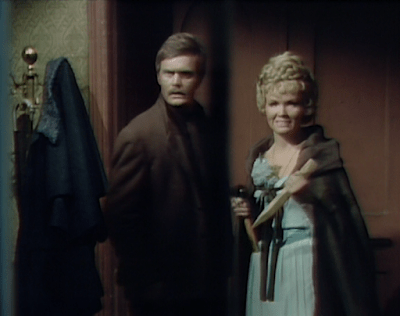
Perhaps when she hits the stake with the mallet, the word “Whack!” will be printed in a bubble on the screen. Screenshot by Dark Shadows Before I Die.
Meanwhile, Barnabas materializes inside a classroom at a school where Laura’s nine-year old daughter Nora is alone. Nora tells Barnabas that she is not happy at the school and that she and her twelve year old brother Jamison want to leave with their mother. Barnabas tells her to “Look into my eyes!” and he puts the zap on her. When he is done, he tells her that their conversation will be their secret. She smiles, looks directly into the camera, and tells the audience “I like secrets!” Denise Nickerson had a talent for delivering lines to the camera, and ever since she joined the show in November 1968 they’ve had her do that quite often. Rather too often, I’m sorry to say- it can chill the audience to see a character who is so disconnected from everyone else that they just start talking to us if the effect is used sparingly, but they have her do it so frequently that it has lost its force by now.
Nora and Jamison’s school is a miserable place, less a center of learning than a dungeon where the sadistic Rev’d Gregory Trask gleefully inflicts unwarranted and cruel punishments on both children and teachers. Trask’s daughter Charity is a member of the faculty, and since #727 she has also been Barnabas’ blood thrall. In #753, we saw Charity acting as her father’s second in command at the school, enforcing a particularly vicious sanction against Jamison. It did not then seem that her subjection to Barnabas had modified her role in her father’s operation at all.
When Charity enters and finds Barnabas with Nora, her two enslavements come into conflict. Barnabas tells her that Laura will be coming to the school to see Nora soon, and orders her to let her in. Charity is very confused and starts talking about her father and his rules. Barnabas bites her, leaving her more tranquil but quite weak.
Laura knocks on the door. Charity finds that Barnabas has vanished, and lets her in. She demands to see Nora, saying that she will take her away. Charity says that no relatives are allowed to visit the children at night, and that she will need permission from others to allow Laura to take Nora. Laura insists, and eventually Charity complies. She sends Nora down, and brings her packed suitcase. But Nora has told her mother that she does not want to go. We saw in 1967 that Laura’s children must go with her willingly if she is to perform her evil mission, and so she has to yield. She looks at the collar Charity has drawn up to cover her neck, and says that she will not tell her father that two of Nora’s relatives have visited her tonight.
Some of the actors have trouble with the names “Laura” and “Nora” today. It really was a mistake to give Nickerson’s character a name that rhymes with “Laura.” In #354, set in 1967, matriarch Elizabeth Collins Stoddard told her daughter Carolyn that “Aunt Catherine” would be overjoyed to host her in her home in Boston, and that this never-before mentioned aunt gives wonderful parties attended by men Carolyn’s own age. Catherine cannot have been Elizabeth’s sister or a member of Carolyn’s father’s family; she must be Elizabeth’s own aunt. Nora is the only one of Elizabeth’s aunts we ever hear about, and she would have been 79 in 1967. As a grande dame of Boston society, she might still have been giving big parties featuring people of all ages, and so naming the character “Catherine” would have closed that loop.
It would also have opened the door for another story to add some action to the rather slow period leading up to the 1897 flashback. Aunt Catherine could have come to Collinwood from Boston in 1969 and met the evil ghost of the roguish Quentin Collins. Recognizing her favorite uncle but knowing that he came to a dark and mysterious end, that would have set up a confrontation that might have led to an enigmatic conclusion. Quentin killed other adults who knew about him, but his relationship with Catherine would have made it maladroit to bring their encounter to so straightforward a climax. Better to have her disappear inexplicably. That disappearance would be followed by signs that the disturbances in the house had suddenly grown far more dangerous. We would wonder if Catherine had joined with Quentin as another evil spirit, or if the two of them were doing battle in some unseen realm and inflicting collateral damage in the world of the living.
I have an idea who they should have cast as Aunt Catherine. Isabella Hoopes played dying matriarch Edith Collins at the beginning of the 1897 segment, and she was great fun. Had we been introduced to Hoopes as the spry and sophisticated Aunt Catherine, her turn as Edith would have been even richer. When Quentin chokes and threatens to kill Edith, we would try to read their interaction as a clue to what happened between him and Catherine before her disappearance. When Edith haunts Quentin after her death, we would look for clues as to what happened to Catherine after her disappearance. And of course Nickerson’s role as Catherine’s younger self would have gained another dimension, not only as we watch her interactions with Quentin, but also as we compare her personality at the age of nine to that of the octogenarian we had met previously.
I even have some dialogue Catherine could have exchanged with the Collinses of 1969:
Catherine: Roger, I hear you have married again. Will you present me to your wife this time? I must admit I took it rather personally that I could never meet Laura.
Roger: I’m sorry, Aunt Catherine. Cassandra and I have already gone our separate ways.
Catherine: Oh, I’m the one who should be sorry- it was tactless of me not to know… We Collinses have never have had much luck in marriage, have we?
Elizabeth: You and Uncle Ambrose were happy.
Catherine: Yes. Happy… But there wasn’t much luck to that. After all, he was my fourth husband and I was his third wife. We simply applied the lessons of experience.
Carolyn: So there is hope. After your disappointments, you found your grand passion.
Catherine (a look of frank disbelief on her face): Not exactly. (Pause.) Carolyn, your mother told me some time ago you were the one involved in a grand passion. His name is- what- Bud?
Carolyn: Buzz?
Catherine: Yes, Buzz. I should have remembered that, I once knew a Navy flyer who went by that name. If your Uncle Roger won’t be introducing me to anyone, will you at least present me to Buzz?
Carolyn: Oh, it ended between me and Buzz some time back. He’s left town.
Catherine: Ah, too bad. I’d have liked to meet another Buzz, the one I knew was so elegant.
Elizabeth: This one was hardly elegant. He rode a motorcycle, and that was his whole life. He always wore leather clothing and dark glasses, with a long beard and a ragged mop of hair. You never saw the like, Aunt Catherine.
Catherine: On the contrary, I have seen the like every often. Just such men make up your cousin William’s preferred milieu.
Carolyn (laughing): I once told mother I was going to marry Buzz, but that was an empty threat. Buzz isn’t the sort of man who really wants a wife.
Catherine: Neither is William.
(Elizabeth, Roger, and Carolyn fall silent. After a moment, they all start talking at once.)
Elizabeth: Have you seen-
Roger: How is old Mr-
Carolyn: Was your trip-
(They fall silent again. Another awkward pause ensues.)
Elizabeth: Do you know that there is another Collins at Collinwood?
Catherine: Oh?
Elizabeth: Yes, a distant cousin of ours, from England. His name is Barnabas Collins.
Catherine (furrows her brow): Barnabas Collins? Named for the man in the foyer?
Elizabeth: Yes, the portrait is of his ancestor.
Catherine: How odd. When I was a girl, I asked the old people around here about all of the portraits. They were happy to go on at length about all the others, but they were always tongue-tied when we got to that one. Left me with the impression there was something exceptionally sinister about it, or about the man. Of course that only piqued my curiosity.
Carolyn (suddenly defensive): There is certainly nothing sinister about our Barnabas!
Catherine: Nothing sinister? Are you sure he is a Collins?
(Roger and Elizabeth chuckle, Carolyn flushes.)
Elizabeth: Oh, he is a Collins, all right. He’s quite an expert on the family’s past. I’m sure the two of you would have a great deal to talk about.
Catherine: I’m sure. But I would rather choose another topic. At my age I can’t forget that I will soon be part of the past. I would like to keep my eyes on the future while I still have one.
This scene would have left longtime viewers with some suspense-generating questions. Why did Roger’s wife Laura go out of her way to avoid Catherine? Who were the “old people” at Collinwood in Catherine’s childhood? What did they know about Barnabas? Further, Laura and Buzz were so emblematic of two of the early phases of Dark Shadows that involving Catherine in a conversation referring to both of them would promise that she will be woven in with the whole narrative structure of the show.
Moreover, seeing a Collins who had spent decades far from Collinwood might give us a fresh perspective on the main characters. We see only those whose minds and hearts have been deformed by the many curses that loom over the estate. Meeting one who has been outside their influence for so long would suggest what it has cost the others to stay on the estate. We might then feel anew the tragedy that we have been taking for granted.



 Dark Shadows Commentary