
In #210, dangerously unstable ruffian Willie Loomis found a coffin wrapped in chains in an old mausoleum and jumped to the conclusion that it was full of jewels. He broke the chains and opened the coffin, only to find that it actually contained vampire Barnabas Collins. Barnabas bit Willie and enslaved him.
Now, Barnabas has traveled to an alternate universe. In this “Parallel Time,” Willie’s counterpart is a writer, the author of several novels and of a biography of Barnabas’ own counterpart, who died a natural death in 1830. This Will Loomis lives in the Old House on the estate of Collinwood, which corresponds to Barnabas’ home in his own universe. Will’s wife, the former Carolyn Collins Stoddard, was the first person Barnabas met upon arriving in Parallel Time. Barnabas took Carolyn as his blood thrall, and he has shown her a room in the basement of the Old House that she never knew existed. He stashed a coffin there.
Three of Will’s novels were bestsellers made into feature films, but he and Carolyn are now acutely short of funds. We see why today. Carolyn explains to Barnabas that Will won’t be home until the Eagle closes. Barnabas asks what the Eagle is. He should know- that was the name of the tavern in his Collinsport in the 1790s and again in 1897, and he knew it in both eras. The same place was called the Blue Whale in the 1960s in the main continuity, but evidently it kept its old name here.
Will comes staggering home. He recognizes Barnabas’ profile from a sketch of the subject of the biography he wrote. Carolyn explains that Barnabas is that man’s descendant. When Barnabas says that he read Will’s book and admires it, Will brightens, as authors do, and says that the occasion calls for a drink. At first he insists on putting Barnabas up as a houseguest, free of charge, but Carolyn persuades him to let Barnabas pay rent. It’s anyone’s guess how Barnabas will be paying for anything- he stumbled into “Parallel Time” quite inadvertently, without stuffing his pockets or putting on a money belt or making any other preparations. But Will and Carolyn have an extensive discussion about charging Barnabas rent in this scene, and they bring it up again later. Evidently the writers want us to think about it.
The next day, Will suggests that he and Carolyn go to the great house on the estate to meet the new mistress, the bride of Carolyn’s uncle Quentin. Carolyn pleads a migraine, and Will goes by himself. Housekeeper Julia Hoffman is about to introduce him when he cuts her off. He tells the new Mrs Collins that he knew her father. She is the former Maggie Evans. The past tense about her father Sam is news to returning viewers- yesterday Sam was mentioned in terms that left it unclear whether he was still alive, and we might have hoped to see him. In the main continuity, Sam was killed by a Frankenstein’s monster in June 1968, but that monster would not have existed in this universe.
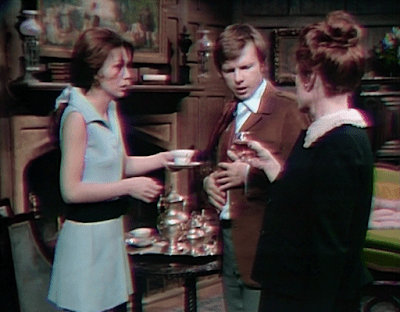
Will says that he and Sam spent many a night drinking together at the Eagle. The new Mrs Collins is not visibly pleased to be reminded of her father’s drinking habit. She offers Will a cup of tea, and he refuses. He avers that tannic acid is bad for the health. Hoffman is at hand with a glass of brandy, and she chuckles when she agrees with him that she can tell Maggie his views about beverages. Hoffman leaves, and Will urgently whispers to Maggie that he must not trust Hoffman.
Later, Maggie will go to Angelique’s old room in the east wing of the house and overhear Hoffman telling the portrait of Angelique that hangs there that she has her on the run. Hoffman cackles with glee at Maggie’s discomfort. Maggie opens the door and asks her what’s going on; Hoffman quickly composes herself and says that the staff hasn’t had a chance to tidy up the east wing sufficiently to welcome the new mistress.
Back in the Old House, Will wonders why Carolyn seems so weak. She passes out, and he sees the puncture wounds on her neck. At daybreak, Will waiting for Barnabas by the coffin. He holds him at bay with a large cross and forces him to explain who he is and where he came from. Barnabas tells Will to let him die. Will says he has other plans. He orders Barnabas to open the coffin. There is an even larger cross mounted inside the lid. He says that he will get a book out of Barnabas, and that that book will be his salvation. He makes Barnabas get in the coffin, and chains it shut. To the extent that this universe is a mirror image of the one we have known, we might have expected that Will would believe he could obtain a fortune by putting chains on the coffin, as Willie thought he could obtain one by smashing them off.
The scene between Will and Maggie brings out several of the problems with the current A story, a reworking of Daphne Du Maurier’s Rebecca in which Maggie is the second Mrs de Winter and Hoffman is Mrs Danvers. Maggie Prime has an iconography that goes back to #1, which makes it hard for us to believe that would be overwhelmed by the subtle intimidations that overwhelm Du Maurier’s anxiety-ridden heroine. When we met the Sam of the original continuity in June 1966, he was an alcoholic. Even after the story that was supposed to make Sam’s alcoholism interesting fizzled out and he was retconned as a social drinker, Maggie retained many Adult Child of an Alcoholic traits, such as beginning each utterance with an irrelevant laugh. So Maggie’s reaction to Will’s reminiscence about boozing it up with Parallel Sam goes a long way to confirming that this is the same ol’ Maggie we’ve known all along and leads us to expect her to be as capable as Maggie would be of meeting the challenges before her.
Also, while Kathryn Leigh Scott is a wonderful actress and a great asset to the show, she makes a bad choice in playing Maggie Collins. In the costume drama segment set in 1897, Miss Scott started out as neurotic intellectual Rachel Drummond. Rachel was terribly fragile, the survivor of an abusive childhood that left her with paralyzingly low self-esteem. Miss Scott went small as Rachel, taking a subtle approach that required us to watch her closely as we tried to figure out what she was feeling and thinking. But as Maggie Collins, Miss Scott cycles through five or six facial expressions per minute and crafts a distinctive emphasis on multiple syllables per sentence. The directors famously didn’t give the actors much guidance on Dark Shadows– John Karlen said that when he first took on the role of Willie, all Lela Swift told him was “Go!” But either Swift or today’s helmsman, Henry Kaplan, should have taken Miss Scott aside and told her she was overacting and giving Maggie Collins too vivid a personality.
Further, Will is only one of many allies who present themselves to Maggie in her showdown with the memory of Quentin’s first wife, the glamorous Angelique. The second Mrs de Winter feels herself all alone at the estate of Manderley, but Maggie can’t very well feel that way at Collinwood. Not only do people who live there keep making it clear they are on her side, she has a sister to whom she starts writing a letter today, who represents support from and connection with the outside world.
Worst of all, Hoffman is absolutely transparent. In the novel, it is not clear until the very end whether Mrs Danvers is even hostile to the second Mrs de Winter. Du Maurier keeps us guessing for 400 pages whether the whole thing is in the protagonist’s fevered imagination. But the cackling Maggie overhears when Hoffman is having her conversation with the portrait is not even the most flagrant sign she has so far given of her plans.
I outlined these and other objections in a long comment on Danny Horn’s post about this episode on his great Dark Shadows Every Day in January 2021. I still agree with most of what I wrote there, and will be coming back to the topic many times over the next few months.
 Dark Shadows Commentary