
Most of this one is taken up watching people argue with each other about whether they should hold a séance. This puts longtime viewers on familiar ground. We’ve seen fourteen séances on Dark Shadows over the years, and have heard about others. Many of those we’ve seen have been preceded by the sort of wrangling we see today. The most spectacular case was #365. That installment was structured just like this one, one quarrel after another about the idea of the séance, then in the final scene the séance is held and comes to a shock ending.
Episode 365 came at the end of a period when the show was as slow-paced as it ever would be, and when such story elements as they had were all coming to an end. The episode was surprisingly fast-moving and exciting, mostly due to the visual artistry of director Lela Swift. Not only did Swift use a visual strategy that told more of a story than you might have thought was available had you read the script, but her skillful blocking and fluid use of the camera allowed the actors to project a great deal of energy. The shock ending, which the ABC network had spoiled with a series of promos but which I don’t think anyone could have seen coming otherwise, was the show’s first trip back in time. At the climax of the séance, well-meaning governess Vicki came unstuck in time and found herself transported to the year 1795.
Now, Vicki is long gone and mostly forgotten. The show has traveled in time again, not backward but sideways. We are in an alternate universe, which the show insists on calling “Parallel Time.” In this continuity, counterparts of familiar characters have different personalities and are arranged in different relationships than are the people we know.
The episode is much less effective than was #365, not so much from the absence of Vicki or the presence of any of the new characters, but because the director’s chair is occupied by the hapless Henry Kaplan. Kaplan stood at the opposite extreme from Swift. His idea of a well-composed sequence of images was one closeup after another, punctuated by extreme closeups showing us what an actor’s ear looked like when she was speaking a crucial line of dialogue. He takes the trouble to set up some two-shots and even three-shots today, but they put the actors in such cramped little frames that they don’t dare move without a furtive glance at the camera.
The master of the great house of Collinwood is drunken sourpuss Quentin Collins. His penniless siblings and permanent houseguests Elizabeth Collins Stoddard and Roger Collins have just come home from a trip out of town to find family friend Sabrina Stuart in the drawing room, demanding that they hold the séance that Quentin’s wife Angelique ordained for this night. They are shocked, because the night on which Angelique said there would be a séance fell six months before. Sabrina is having some kind of fit that causes her to be unalterably certain that this night is that one.
Angelique died of a stroke at that séance, and Liz and Roger are horrified at the idea of reenacting it. Sabrina’s fiancé, mad scientist Cyrus Longworth, says that she went through a traumatic experience the night before, when a strange man forced his way into her room and terrorized her. He then reports a conversation with a psychiatrist who suggests humoring Sabrina and holding another séance. Cyrus brings Bruno Hess, musician, lover of Angelique, and all-around sleaze to join in the reenactment.
While Roger and Liz were away, Angelique’s identical twin sister, Alexis Stokes, came to stay at Collinwood. Quentin neglected to inform even the people who were in the house at the time that this had happened, setting Alexis up for one terribly awkward encounter after another with people who thought she was her sister returned from the grave. Quentin and Alexis also got alarmingly cozy with each other, prompting his new wife, the former Maggie Evans, to walk out on him after barely a week in residence at Collinwood. So it is no surprise that he didn’t bother to telephone Liz and Roger and let them know they would see Angelique’s identical twin sister when they came home.
Roger is standing in Angelique’s old bedroom, holding a one-sided conversation with her portrait. We know that he is in the habit of doing this; it was what he was doing when first we saw him in #975. Quentin probably knows about it too, since several other people in the house have the same habit and even those who don’t spend a surprisingly large amount of time going in and out of Angelique’s room. Roger turns around and sees Alexis. Believing her to be Angelique redivivus, he nearly faints. She gives him her hand to assure him she is not a ghost, and he will later introduce her to Liz as Angelique’s sister.
Roger’s counterpart in the main continuity was Dark Shadows‘ first Big Bad, a charming, dissolute, narcissistic, cowardly, lecherous wastrel. That Roger Collins was supposed to be killed off when Vicki exposed his crimes, but Louis Edmonds made him such a joy to watch that this was out of the question. Dark Shadows had not yet figured out that a villain could be a permanent part of the cast, so when they decided to keep Roger around they nerfed him into a basically harmless supporting character. He developed gradually from the functional sociopath who in #68 coldly manipulated his own nine year old son David into a murder attempt on Vicki to the stoutly virtuous family man who made his final exit in #979 with a fatherly hand on David’s shoulder.
The Quentin of the main continuity made his debut in #646 as a ghost bent on annihilating all of his surviving relatives. From #701 to #884, Dark Shadows was a costume drama set in 1897, when we met Quentin as a living being. In those days, he was very much what Roger had been in 1966, only younger, sexier, and on a show that isn’t afraid to keep villains around indefinitely. He became a huge breakout hit, and a magic spell was cast that kept him from dying or aging. So when the show returned to contemporary dress at the end of 1969, Quentin was there, alive and intact.
Upon his arrival in 1969, Quentin found himself in the same position Roger had occupied two and a half years before. Everyone wanted him to be a big part of the show, but there was nothing for him to do. Unlike Roger, he was free to be evil, but also unlike him he had no connections to anyone who had anything he wanted to take. In some ways, Quentin is in an even worse position than Roger was. Even in his lovable gay uncle phase, Roger could admit to his sister Liz in #273 that he would have blackmailed her if he had had the chance, an admission that Quentin merrily echoed in #702 when he laughed at his sister Judith’s attempt to buy him off with $1500, boasting that he could blow through that much in a single night, even in a sleepy little place like Collinsport, and that he would shamelessly come back for more. He has no one to do anything like that with now.
Quentin can charm his way to an easy living. In December 1969, mad scientist Julia Hoffman and Broadway star Olivia Corey fought over which of them would get to pay Quentin’s hotel bill, a conflict that was motivated by some story points but that is the sort of thing that might happen to a man who looks like a young David Selby. On a fast-paced supernatural thriller, you have to be something a lot juicier than a mercenary Kept Man to count for much as a villain. No one in the Nixon era owes Quentin anything, so he can’t exploit anyone the way he did Judith and the rest of his immediate family. He has fallen into service as henchman to Julia and her best friend, his distant cousin vampire Barnabas Collins, but something big is going to have to change to find him another place at the center of the action.
Since that is the same problem that cost them Roger, it makes since that in this mirror universe Quentin’s counterpart and Roger’s are revisiting some stages of the development of the Roger from the main continuity. When Parallel Roger first appeared in #975 and #976, he seemed to be, if not the utterly depraved villain of the early days, at least the spineless, snobby, but amusingly sarcastic figure he was through most of 1967. Today he seems to be closer to the responsible family man he dead-ended into being.
This Roger is the first to articulate the reasons why it is inadvisable to reenact a ceremony that cost a life the last time it was attempted. Roger’s position recalls his role in #170, when he was the principal opponent of the first séance shown on Dark Shadows. In that, he was the unwitting stooge of his estranged wife, undead fire witch Laura Murdoch Collins, but the objections he came up with were all about the importance of social respectability and of refraining from doing the thing which is not done, fitting into the image of him as a shallow and unimaginative person. The fact of Angelique’s death gives his objections today a firmer footing and presents him as a representative of sober good sense, but does not make him seem any more dynamic than his counterpart in the main continuity did in #170.
Quentin learns of the proposed séance when Cyrus and Bruno enter the house. He is angry at the sight of Bruno, and reminds him he is not welcome there. Cyrus explains that Bruno is needed for the séance. This increases Quentin’s anger, and he tells Cyrus and Bruno to “go to another house and work your black magic, boys.” They insist on staying, and suggest that Alexis sit in Angelique’s place. After all, Bruno says, why shouldn’t she see exactly how her sister died, from her sister’s point of view. At this Quentin’s anger turns to total rage, and he has to be restrained from attacking Bruno physically. Alexis wants to hold the séance, though, and Quentin gives in. He refuses to participate, but allows the others to gather in the drawing room.
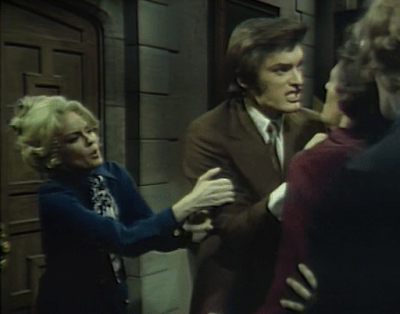
Roger was never given to violence that required his direct personal involvement. Quentin’s reaction to Cyrus and Bruno’s awful idea suggests that the writers are trying to find a way forward for his character. The well-justified repugnance he feels for Bruno, the grotesquely morbid nature of the proposed reenactment, and the breathtakingly irresponsible suggestion that Alexis do the very thing it killed her sister to do, all call for a forceful response. His lunge at Bruno is manful in the best sense, and leads us to wonder if they might try to develop Quentin’s vices into the basis of some kind of heroic action.
When he scornfully tells Bruno and Cyrus to go somewhere else with their “black magic, boys,” it is clear that the writers are thinking in terms of what is possible for Quentin. In 1897, the original Quentin and his fellow Satanist Evan Hanley would hang out in the cottage on the estate corresponding to the one where Bruno lives in this timeline and do all sorts of ill-intended mumbo-jumbo. They could easily have been called “The Black Magic Boys.” That Quentin stood at the opposite pole from this one. Perhaps as the story progresses, we will see these contraries fuse into something more sustainable.
Although we are in “Parallel Time,” a development like that might have good effects on the Quentin of the main continuity as well. Roger’s character changed massively after the flashbacks to 1795 and 1897, merging with the deeply flawed, yet sturdily upright family men whom Edmonds played in those periods. So if they can build a version of Quentin in this universe who is still narcissistic but also capable of saving the day, that might point the way to transforming the Quentin in the established “time-band” into a character who can carry the show as he did for so many months in 1969.
The séance goes forward. Cyrus conducts, and Sabrina goes into the trance. She shouts the word “murder” over and again, and breaks the circle of fingers to point at Alexis. Alexis passes out. That’s the closing cliffhanger. We can be sure Alexis is not dead- it wouldn’t leave the story anywhere to go. Besides, they commissioned a gorgeous full-sized portrait of Lara Parker as Angelique for this storyline. That thing must have cost at least $5000, maybe twice that, and they will never be able to use it again after they go back to the main continuity. There’s no way they are going to blow that much money on a set decoration unless they are planning to feature it in another couple of months of episodes.
 Dark Shadows Commentary