The few minutes of action preceding the opening credits of a TV show are sometimes called the “hook,” the thrilling segment that will so intrigue the audience that they can’t turn away. Today’s hook takes place in the drawing room at the great house of Collinwood. High-born ne’er-do-well Roger Collins is muttering to himself as he tries to remember where he left a pen. We can hardly expect them to maintain that level of excitement for the entire half-hour.
Roger asks well-meaning governess Vicki to help him dissuade his sister, reclusive matriarch Liz, from hiring a new housekeeper. Liz walks in and humiliates Roger in front of Vicki, reminding him that he lives in her house as a guest and has no right to tell her how to run it.
Roger goes to the beach and looks for something, presumably the pen. He doesn’t find it. In frustration, he throws a rock into the ocean.
Throwing the rock
Later, Roger sits in on a conversation between Liz and hardworking young fisherman Joe. When Liz talks about giving Joe a promotion in the company she owns, Roger speaks up and says he thought that it was his place to make those decisions. Liz grimaces at Roger’s presumption, and says that she is sure he will agree with what she decides. Roger is again humiliated in front of someone he has more than once dismissed as a social inferior.
Roger goes to the foyer outside the drawing room. He sits uneasily on the table while Liz and Joe continue their meeting. His adoring niece, flighty heiress Carolyn, sees him there.
Sitting uneasily
Roger tells Carolyn that he and Vicki had seen Joe on a date with Maggie Evans, The Nicest Girl in Town, the night before. This is a misrepresentation of the facts- they had indeed seen Joe and Maggie together, but he knows they hadn’t planned to meet, and Maggie’s father was with them.
It is also a vicious thing for him to say to Carolyn. Joe and Carolyn are a couple. It’s true that Carolyn is lukewarm about Joe. The reason Joe ran into Maggie and her father was that he was looking for her after she broke a date with him to go for a drive by herself. But she is also quick-tempered and jealous. When Joe emerges from the meeting with Liz, Carolyn rages at him, as Roger must have expected her to do. His only motivation for telling her that he had seen Joe and Maggie talking to each other and representing what he saw between them as a date appears to be idle cruelty- he can’t accomplish anything else, so he’ll torture Carolyn and Joe for amusement.
At the end of the episode, Roger sees that Vicki found the pen he was looking for. Since the pen may be a piece of evidence that will connect him to a homicide, we may wonder what he will do to Vicki should she learn its significance. After all, he actually likes Carolyn, and he doesn’t hesitate to use her as a victim in his sadistic pastimes. Vicki, on the other hand, is someone he has never wanted to have around. If he sees her as a threat to his freedom there’s no telling what he might do.
Problem child David Collins enters the restaurant at the Collinsport Inn. Mrs Sarah Johnson, longtime housekeeper to the late Bill Malloy, is confronting dashing action hero Burke Devlin, declaring that he is to blame for Bill’s death. David angrily defends Burke. Burke whisks him out of the restaurant into the hotel lobby.
Little does David know that the confrontation between Burke and Mrs Johnson was staged for the benefit of his family, the ancient and esteemed Collinses. The two of them are scheming to have Mrs Johnson placed on the Collinses’ domestic staff as housekeeper so that she can spy on Burke’s enemy, David’s father, high-born ne’er-do-well Roger Collins.
Burke and David have a charming little scene in the lobby. David stumbles over many of his words. These are probably flubs, but they fit so perfectly with what we would expect a highly agitated nine year old to sound like that the writer might have wished he’d put them in the script. David says that he and Burke are two of a kind, that everyone in the world is against them, and that he wants to murder them all. Burke asks if this wouldn’t be a bit of a drastic solution. While David ponders that question, Burke ushers him up to his suite.
There, David asks if it is true that he told his aunt, reclusive matriarch Liz, that he would use any means at his disposal to strip the family of all its assets. Burke says that he offered to buy the house, and reminds David that he himself had suggested Burke do that so the two of them could enjoy a freewheeling bachelor existence there. David accepts this at once and is all smiles. He then tells Burke that his governess, Miss Victoria Winters, has been teaching him about the Civil War. The theme of divided loyalties has been weighing on him- how can he choose between two sides led by Liz and Burke, the only two people he likes? Burke tells him they will just have to work out a peaceful solution, and David smiles again.
David Henesy and Mitchell Ryan were not only excellent actors- preternaturally so, in the case of the preteen Henesy- but were also such appealing personalities that scenes featuring the two of them are irresistible. These particular scenes build Burke up as a villain. In his conversations with Mrs Johnson and in a couple of phone conversations, he has made it clear that he is indeed committed to destroying the Collinses. Even if this is the first episode we have seen, we know that he is lying to David and tricking him into helping with the annihilation of his birthright. Returning viewers have seen him being even more explicit about his plans on many occasions. So our loyalties are as divided as David’s- we are eager to see more interactions between Mitch Ryan and David Henesy, but are appalled by what is going on between Burke Devlin and David Collins.
High-born ne’er-do-well Roger Collins talks on the phone with his sometime partner in crime, drunken artist Sam Evans. They agree to meet in Collinsport’s tavern, The Blue Whale. After Roger gets off the phone, well-meaning governess Vicki passes by. He invites her to come with him to the tavern. Up to this point Roger has often been quite unpleasant to Vicki and she has been wary of him. Also, he is a married man, and she has reason to suspect that he is her uncle. On the other hand, he is no longer a suspect in an active homicide investigation, and she hasn’t had a date in months. So she accepts.
Most of the episode takes place in the Blue Whale. Sam is there with his daughter, Maggie, The Nicest Girl in Town. Hardworking young fisherman Joe joins them, and they invent a drinking game. Every time someone mentions the name “Collins,” the table must drink a toast to “Collins of Collinsport!” Getting into a situation where you have to take a drink every time Sam wants one isn’t a particularly prudent thing to do, but Maggie and Joe are in a daring mood.
Maggie has clearly set her cap for Joe. She gives him a frankly aggressive look that is startling to see in the face of The Nicest Girl in Town. Startling, but most welcome- Joe is still trapped in a useless storyline where he is boyfriend to flighty heiress Carolyn. But when we see him having a good time with Maggie, we can finally see the light at the end of that tunnel.
Roger and Vicki show up. Roger and Sam go off and talk about something or other having to do with their dark doings. This conversation is meaningful only to the two of them. At this point, even the sheriff has lost interest in Roger and Sam’s little conspiracy. The actors are fun to watch- Louis Edmonds and David Ford always enjoyed playing off each other- but the audience certainly can’t be expected to keep track of whatever they’re talking about.
Vicki joins Maggie and Joe for some pleasant chatter about a couple of plot points the audience might want to keep in mind. Roger, frustrated by his talk with Sam, comes to the young people’s table and insults them. Joe, though he is an employee of the Collins family business, offers to fight Roger in defense of Maggie’s honor. Vicki and Sam break the fight up before Joe can throw his first punch. Roger announces that he has a headache and takes Vicki home.
Once there, Vicki thanks Roger for the evening, with no apparent sarcasm in her voice. He apologizes, and promises to take her out again. She sounds genuinely excited by the idea of another such outing. Who knows, next time maybe she will get something to eat, or a drink, or more than three minutes of conversation before she has to stop a fistfight and go home.
If Roger really is Vicki’s uncle- that is, if his sister, reclusive matriarch Liz, is secretly Vicki’s mother, as the show has been hinting pretty heavily- then a romance between Vicki and Roger would seem to be a soap opera cliche. Liz has struggled to keep Vicki from finding out anything about her origins. If Liz sees Vicki about to enter into an incestuous marriage, she might feel forced to stand up at the wedding when the minister asks if anyone present knows why these two may not be joined in lawful matrimony and to expose the secret.
The jukebox at the Blue Whale plays some music we haven’t heard before. The Dark Shadows wiki identifies it as a series of tracks from Les and Larry Elgart’s album “The New Elgart Touch.” It’s a step down from the tracks by Robert Cobert the jukebox has played so far, but it is a fitting accompaniment to the dancing of this guy. In most places he would be thought awkward, but by the standards of Collinsport he is indistinguishable from Fred Astaire:
Yesterday, dashing action hero Burke Devlin announced to the ancient and esteemed Collins family that he intends to drive them out of business and take all their holdings. He then muddied the waters by offering to pay them an inflated price for their dilapidated old house. Still, everyone came away with the impression that Burke had openly declared himself to be the deadly enemy of the Collinses.
Problem child David Collins wasn’t in that episode, and he refuses to believe the characters who were when they tell him that his idol Burke has said that he is out to strip the Collinses of their assets. The only person David likes, aside from Burke, is his aunt, reclusive matriarch Liz. He struggles when forced to choose sides between them. His misery and frustration grow palpably throughout the episode.
At least David can still do something he likes. His cousin, flighty heiress Carolyn, tries to get him to return a photograph of Burke that he stole. While she is in his room, he taunts Carolyn with the idea that Burke isn’t really attracted to her, but that he prefers well-meaning governess Vicki. This infuriates Carolyn, much to David’s satisfaction.
The photo itself is a bit of a mystery. It shows Burke striking oil:
The show has repeatedly told us that Burke grew up poor, that he was still poor when he went to prison, and that he was penniless, despised, and alone in the world when he got out of prison just five years ago. Yet now, he owns a corporate raiding firm, and is a millionaire many times over. They’ve dwelt on this time frame so much that even a soap opera audience is likely to start wondering how he got so rich so quickly. The photo may be an attempt to answer that question. Everyone knows that if you strike oil, you can become a millionaire overnight. Of course, you would have to own the mineral rights to the land the oil is on to profit from such a discovery, and would also need to secure drilling equipment and to hire a crew to operate it if you’re going to make the strike in the first place. How an indigent person fresh out of the state penitentiary is supposed to have paid for those things is not really easier to explain than how he could start a private equity concern.
Both yesterday’s episode and today’s include references to Liz’ estranged husband, Carolyn’s father Paul Stoddard. Yesterday’s included a reference to another character we have yet to see, Laura Collins. Laura is David’s mother, the estranged wife of high-born ne’er-do-well Roger Collins, and the onetime fiancee of Burke. These two had been mentioned only a handful of times in the first months of the show, and neither was given a name until well into it. That they are coming up more often now might lead us to wonder if we will be meeting one or both of them sooner or later.
Dashing action hero Burke Devlin pays yet another visit to the great house of Collinwood. He announces to its residents, the ancient and esteemed Collins family, that he intends to take control of all their properties, including the house. He is buying up their debts and will use them to seize their businesses. He offers to pay them for the house, though. He even offers to pay for it at higher than the market value.
Ne’er-do-well Roger Collins urges his sister, reclusive matriarch Liz, to take Burke’s offer for the house. It’s a huge, gloomy, impractical place, and they would be better off without it. He doesn’t mention that the cash might come in handy when Burke starts calling in all the notes they have no way of meeting. Liz won’t hear of it, and vows to fight.
Flighty heiress Carolyn and well-meaning governess Vicki process their feelings about the matter. Carolyn is wounded by the evidence that Burke never really wanted to be her boyfriend- not that he ever said he did, but she kept hoping. Vicki wonders what Burke is thinking, and whether he understands his own motives. He admits that he may not- after all, if he’s trying to avenge the wrongs the Collinses have done him by bankrupting them and collecting their assets, why not just watch their house fall into his lap with the cannery, the fishing boats, and whatever else they may have, leaving them with nothing?
With this post we say goodbye to one of the bloggers who has kept us company. This was the last episode Marc Masse discussed on his blog Dark Shadows from the Beginning. His posts usually include stimulating insights, sometimes remarkable scholarship, and occasionally material that is in one way or another frustrating. Still, he is always well worth reading.
Among his most extraordinary contributions was about the story of the sabotaging of Roger’s car, a.k.a. The Saga of the Bleeder Valve. That story began when we, accompanying Vicki, saw Burke standing by Roger’s car in episode 13.
Burke tells Vicki that he was looking at Roger’s car because he was thinking of buying one like it, an explanation she finds unconvincing.
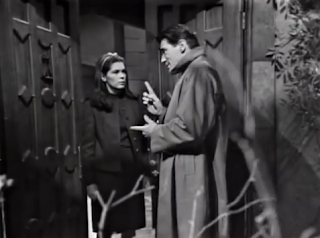
In his post about episode 46, Masse includes a long section about similarities between the Saga of the Bleeder Valve and a particular episode of The Alfred Hitchcock Hour. He convinces me that Art Wallace and Lela Swift had studied that episode. You’ll notice from his screenshots that that John Cassavetes even had the same haircut that Mitch Ryan wore as Burke:
Source material for the missing brake valve storyline on Dark Shadows can also be found in The Alfred Hitchcock Hour anthology series. In the episode Murder Case (season 2, episode 19; aired March 6, 1964), Gena Rowlands plays an actress (Diana Justin) in London married to a rich diamond merchant (Charles Justin) played by Murray Matheson. Diana isn’t really in love with her much older husband Charles, but since he is the main financial backer of a play she is starring in, her success is ensured… that is until the boyfriend she dropped so she could run off to England and start a production company with her rich husband, a struggling actor named Lee Griffin (played by John Cassavetes), manages to wangle his way through an audition and secure a part in the play by getting Diana to pass a good word along to the author and director of the production. Lee gets Diana to agree to resume their former relationship, and in no time the pair are in cahoots to relieve Diana of her marital obligations and in the process secure a huge windfall by plotting to have the old man bumped off. To accomplish this, they arrange for Charles to have an automobile accident; this is where the similarities to the missing brake valve story on Dark Shadows come into play.
One afternoon, on a visit up to the country home where Diana and Charles live, which is situated high up on a hilly area, Lee gets an idea when he comments on how the type of car that Charles drives is famous for its brakes.
To compromise the functioning of the car’s brake system, Lee first uses a wrench to loosen something, probably the bleeder valve…
…after which he pumps the brake pedal several times so there won’t be any hydraulic fluid left for when Charles next gets behind the wheel.
Just after completing the task, and with the wrench still in his back pocket, Charles walks in to find Lee there standing by his car, just like in Dark Shadows episode 13 when Victoria Winters walks into the Collinwood garage to find Burke near Roger’s car. To diffuse the situation, Lee explains to Charles: “I was, uh, just admiring your car. It’s, uh, fabulous!”
That night Lee and Diana have a performance in London; to set the plan in motion, Lee phones Charles from backstage while the play is still on and concocts a story about nearly having gotten into an accident on their drive into London due to a careless young motorist, which left Diana shaken up, and suggesting to Charles that he drive down to London to take his wife home…
…which he agrees to, just like in Dark Shadows episode 15 when Roger agrees to drive into town to meet with Burke at the Blue Whale.
Similar to how Roger in episode 17 is shown to have miraculously escaped with just a sprained arm and a few stitches to the forehead, Charles winds up crashing head on into a tractor that was just starting up the hill; despite that the car ended up a total loss, Charles was extremely lucky in having sustained only a couple of cracked ribs and a slight concussion.
The missing brake valve story on Dark Shadows never really did feel like something that would ordinarily be presented on a daytime serial drama. Instead, thus far Dark Shadows has taken its cue from 1940s film noir for atmosphere, Broadway theater style for acting performances, and nighttime mystery suspense anthology programs for subject matter. Is it any wonder that Dark Shadows would go on to evolve into the cultural phenomenon it would later become? A truly one of a kind blend of widely varying influences.
In his post for episode 76, Masse includes the audio of Joan Bennett singing “Sentimental Moments” in the 1955 film We’re No Angels. I’d never heard of the song, and had no idea she sang. Indeed she was not a Singer with a capital S, but her gentle, precise phrasing is perfect for this strange, sad little tune. I think of it as a farewell to Masse and his blog.
We open on the top of Widow’s Hill. We’ve seen this place several times, but only in spot-lit night-time scenes. Fully lit and fully dressed, I declare it to be a new set.
The crest of Widow’s Hill in the daytime
High-born ne’er-do-well Roger Collins is blissfully staring out at the sea when rough-hewn caretaker Matthew Morgan approaches. Matthew sees only the danger of the summit with its sheer drop to the sea and stones far below, leading Roger to reprove him for his lack of aesthetic sense.
When Roger tells him that the reason he is so very happy is that the coroner has declared that the death of beloved local man Bill Malloy was an accident, Matthew is slow to believe that the sheriff will stop coming around the estate of Collinwood to investigate a possible homicide. Roger assures Matthew that the coroner is the final authority. Matthew brings up Roger’s enemy, dashing action hero Burke Devlin. The sheriff may have to defer to the coroner’s judgment, but Burke is determined to make life as miserable as possible for Roger and the other Collinses, no matter what anyone says. Roger answers lightly, suggesting possible ways Matthew could murder Burke should he present too grave a nuisance. Shocked by Roger’s dark humor, Matthew says “You oughtn’t make jokes like that Mr Collins, people might not understand.” Roger listens to him with a serious look on his face, as if he’s trying very hard to imagine what it might be like to be the sort of person who could go five minutes without making a naughty joke of some kind.
Meanwhile, at the great house on the estate, well-meaning governess Vicki is preparing to go for a long walk. Flighty heiress Carolyn comes twirling up to her and tries to start a conversation. Vicki’s guard is up; episode 73 may have been Wednesday for us, but for Vicki it was just a couple of hours ago. She’s angry and bewildered by Carolyn’s ferocious verbal attack on her at the beginning of the episode, and by her tale-bearing from the middle of the episode that nearly cost Vicki her job. When Vicki tells Carolyn she doesn’t want an argument, Carolyn responds with a startled “Oh!” She’s forgotten all about her earlier nastiness. She makes a nebulous quasi-apology, then tells Vicki about the coroner’s verdict. Faced with Carolyn’s absolute joy at the news, Vicki can’t help but warm up to her. The two of them stand at the window and joke about starting a musical act, in which the two of them will be singers and Matthew will accompany them on the harp.
Laughing at Vicki’s joke
Carolyn would like Vicki to stay in the house with her until Roger comes back, but when she sees that Vicki is determined to take a walk, she suggests Lookout Point. When Matthew comes in and tells the girls that Roger is on the top of Widow’s Hill, Vicki volunteers to stop there on her way and tell Roger that Carolyn wants to see him.
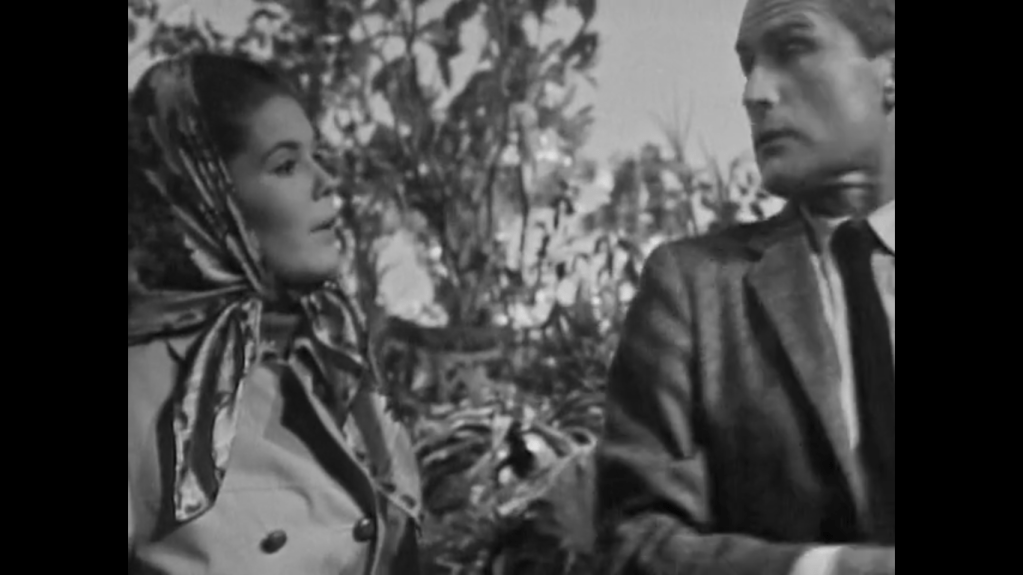
At the hilltop, we see Vicki behind some foliage, looking at Roger. Roger is still looking out to sea, lost to the world in his elation about the news from the coroner. From this position, she asks Roger if he’s planning to jump. He is startled, and objects that it isn’t very nice to sneak up on someone standing at the edge of a cliff.
Vicki behind the foliageVicki startles Roger
Vicki reminds him that he first introduced himself to her on exactly this spot, with exactly those words. He laughs and offers a belated apology. She smiles and accepts it. The two of them have such a sweet little scene together that we might wonder if it really will turn out like Jane Eyre, and the orphaned governess will marry the ranking male of the family. I suppose that was possible, at this stage of the series.
Vicki and Roger sharing a laugh
Vicki tells Roger she is on her way to Lookout Point. Roger darkens, asking her why she wants to go there. She tells him Carolyn suggested it. He tells her it might be the place where Bill Malloy died. This does not deter Vicki, and so he urges her to go at once, since the tide will be coming in soon.
Back at the great house, Carolyn greets Roger as a returning hero. She then teasingly tells him that he has stolen a valuable piece of property from Burke Devlin. Roger can’t imagine what she’s talking about. She tells him that he never returned the custom-made, silver-filigreed fountain pen that Burke gave her. Carolyn has to go on at some length about the pen before Roger remembers it. Even when it does come back to him, Roger is utterly unconcerned with the pen, making jokes about the lengths he will go to to replace it. Carolyn explains that it is important to her- she’s responsible for it, and doesn’t want to incur a debt to Burke by losing it.
Roger listens to her as she tries to figure out where he could have lost it. As she narrows it down further and further, a look of terror suddenly appears on his face. He begins to search for the pen frantically, tells Carolyn that finding the pen is far more important to him than it is to her, and is alarmed to find out that she has told Matthew about the pen.
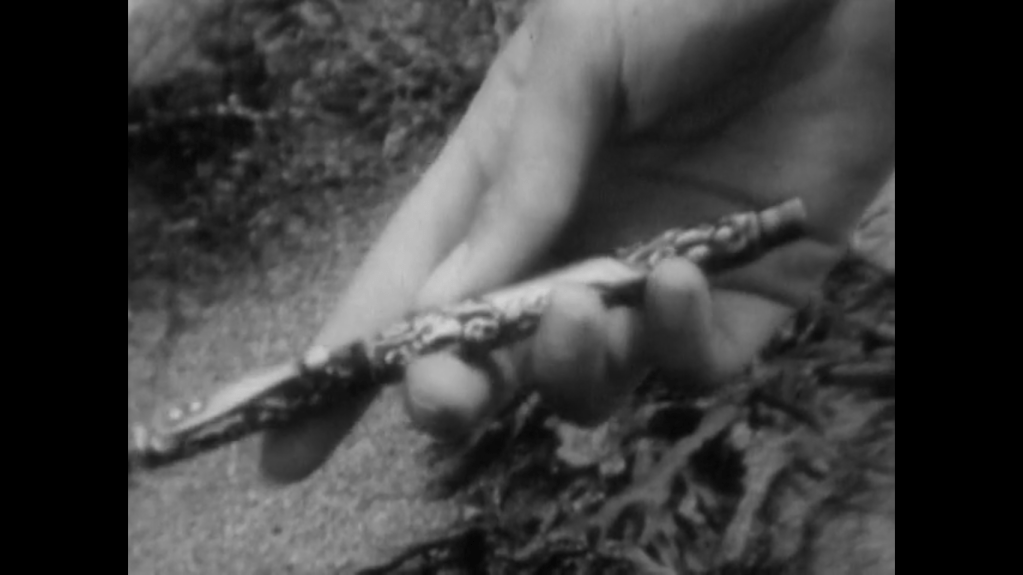
We see Vicki walking along the beach where Bill Malloy may have died. She looks down. There, among the seaweed and driftwood, she finds Burke’s pen.
The penVicki reacts to her discovery
This is the sixth episode with location footage out of the last eight. A week ago Wednesday we saw a recycled shot of Roger walking towards his office and waving at someone on a boat. Last Friday Vicki and David walked through the woods to the Old House, Matthew also went to the Old House, and the ghost of Josette danced among the columns outside the Old House. Monday Vicki and Roger toured glamorous downtown Collinsport. Wednesday we saw Sam walking along the street a couple of times. Yesterday we saw Burke walking along the street and entering the hotel. Today, Vicki leaves the house to go to Widow’s Hill, then walks along the beach and finds the pen. The series will never let us have that much fresh air again, so we ought to enjoy it while we can.
Dark Shadows revolves around the unearthing of the long-buried secrets of the ancient and wealthy Collins family. In today’s episode, the members of the family are so spectacularly indiscreet that we might wonder how any of them could keep a secret buried from one commercial break to the next, let alone store up enough to keep them busy for 1225 episodes.
Dashing action hero Burke Devlin unlocks the door to his hotel suite and finds problem child David Collins waiting for him inside. David cheerfully explains how he made his way past the locked door. When Burke tells him that what he has done is illegal, David replies that “Nothing is against the law unless you get caught.” Startled to hear a nine year old express so nihilistic a world view, Burke asked where he heard such a thing. David says he heard it from Burke. Burke says that he doesn’t remember saying it, and that if he did say it he was wrong. David asks Burke if he’s ever killed anyone. “Not that I remember,” he replies- not exactly a reassuring statement, considering that he just told David about something he doesn’t remember. And of course returning viewers will recall that Burke went to prison for a fatal hit-and-run that took place when he was drunk and blacked out.
David goes on to tell Burke everything he knows, or thinks he knows, about the death of beloved local man Bill Malloy. He tells him that he has derived most of his information from voices he hears when he is alone in his room at night. He can’t keep this to himself, even though he expects it to discredit him in Burke’s eyes. He looks forlornly out the window as he struggles with telling Burke:
David looking for alternatives
There is a knock. At Burke’s suggestion, David hides in the kitchen. Burke opens the door and finds David’s cousin, flighty heiress Carolyn. Carolyn is upset with Burke, thinking that Burke is dating well-meaning governess Vicki and that he has yet another girlfriend hidden somewhere in the suite. Burke is relaxed. Carolyn’s obvious jealousy amuses him, and her denials of it amuse him even more. When Carolyn discovers that Burke’s guest is not a girlfriend, but David, their flustered reactions to each other amuse him most of all. Burke puts a glass of fruit juice* in Carolyn’s hand; she holds it, but refuses to take a drink. Eventually Burke’s good cheer wins out, and the three of them are all laughing together.
The tension doesn’t dissipate completely, however, until after Carolyn has brought up a point we haven’t heard about for several weeks. Burke had given Carolyn an engraved pen. Roger had insisted she give it back to Burke. He took it from her with the intention of returning it to Burke the night Bill Malloy died. He mentioned it to Burke that night, but found that the pen wasn’t on him. The whole matter was forgotten until Carolyn raises it here.
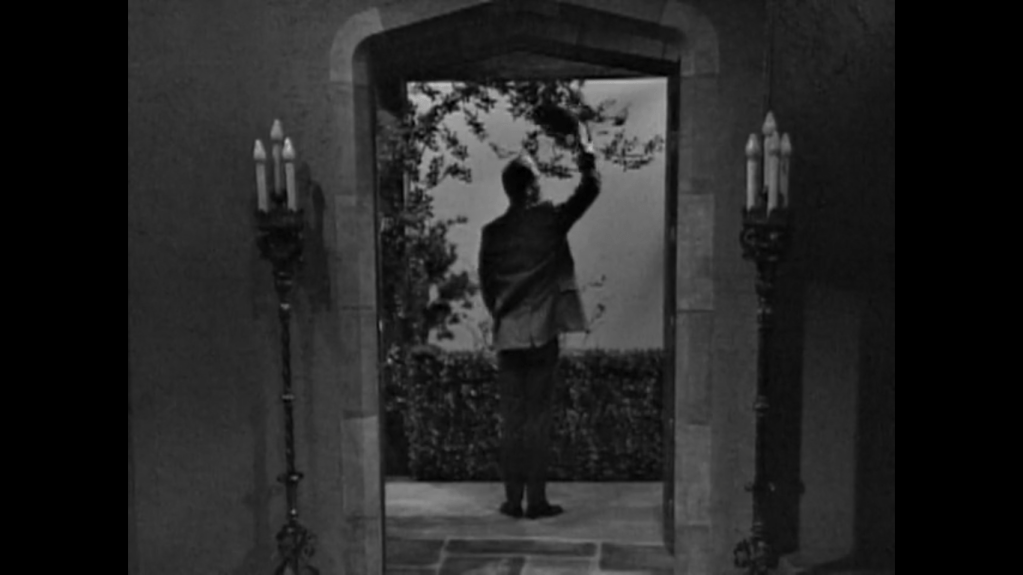
Meanwhile, at the great house of Collinwood, reclusive matriarch Liz and her brother, high-born ne’er-do-well Roger, have heard the news that the coroner ruled Bill Malloy’s death an accident. After weeks of attention from the sheriff in connection with a possible homicide, Roger is elated at this verdict. He is so unrestrained in his jubilation that his sister looks at him with renewed suspicion. When she tells him in so many words that it did occur to her that he might have killed Bill, he responds very lightly, saying that she must be relieved she doesn’t have to think about that any more. He insists she drink a toast with him. He puts a glass of brandy in her hand. She holds it, but refuses to take a drink. She tells him that his son David has run off and is probably with Burke. Roger responds that “Today, on this glorious day of days, neither David nor Burke exist for me!” He then goes fluttering off, taking his celebration into the world outside. He almost dances as he puts his hat on:
Jolly Roger
Carolyn and David are still in Burke’s hotel suite. She makes a telephone call, and comes back with news she is excited to share. Her mother Liz has told her of the coroner’s verdict. Burke, who has responded to everything else with an urbane and chipper demeanor, bursts out in rage, demanding that Carolyn take David and get out of his room. When she complies, we see him looking out his window. Seen from the outside, ex-convict Burke looks like a prisoner dolefully peering through the bars of his cell.
Behind bars again
Burke goes to the sheriff’s office to rage some more, Carolyn and David go back to the house to chat with Liz. The big idea is that the Malloy case is now closed. Everyone except Burke is happy about that; he vows he won’t accept it. The audience is in suspense. The show has built the case up so much for the last several weeks that it would seem ridiculous simply to move on. However, there was a previous mystery story, the investigation into Roger’s near-fatal car accident, and the family managed to hush that up. So regular viewers might wonder if this one will end equally abruptly.
*The “Burke Devlin Special,” previously prepared for David on his first visit to Burke’s quarters in episode 29, at the height of the story about the investigation into Roger’s accident.
The first 19 weeks of Dark Shadows were credited to writers Art Wallace and Francis Swann. Wallace and Swann both specialized in finely etched character studies. So the plot doesn’t move very quickly in those opening months, but the actors do get an opportunity to show their stuff.
Every member of yesterday’s all-female cast, Alexandra Moltke Isles, Nancy Barrett, Joan Bennett, Kathryn Leigh Scott, and Clarice Blackburn, had at least one emotionally charged scene that gave her a star turn. Each made the most of it. Today’s episode is quieter. Most of it consists of people waiting for the coroner to rule whether the death of beloved local man Bill Malloy was an accident or homicide.
Joan Bennett and Kathryn Leigh Scott are back as reclusive matriarch Liz and restaurant operator Maggie. They are joined by David Henesy as problem child David Collins, David Ford as drunken artist Sam, and Dana Elcar as the sheriff.
Sam goes into the sheriff’s office to ask about the coroner’s report, and quickly realizes that no matter what he does or says, he keeps making himself look like a suspect in Bill’s death. Sam’s anxiety plays effectively against the sheriff’s serenity.
At the great house of Collinwood, David thinks he has a card to play against well-meaning governess Vicki. He tells Liz that Vicki never showed up to give him his lessons for the day. To his disappointment, Liz tells David that she knows all about that, that Vicki isn’t in trouble, and that she will be his governess for years to come. The two of them have a very nice scene in which David tries to convince his aunt that he will never like Vicki and Liz isn’t having it.
The sheriff comes to Collinwood to tell Liz that the coroner ruled Bill’s death an accident. As he is approaching, David runs out the front door. There’s a bit of unintentional humor there- Liz is calling David to come back to the house when we hear a car. It sounds as if the nine-year old David is driving away.
David goes to the restaurant, where Maggie and her father Sam are having one of their depressing conversations about the consequences of his alcoholism. Maggie introduces David to Sam. David smiles when Sam addresses him as “Mr Collins,” and is excited to learn that Sam is a professional artist. A happy moment is budding until Sam asks David how his father is doing. David hates his father. If he knew that Sam also hates him, they would no doubt become fast friends. But he seems to think Sam and his father are friends, and so he rushes off. It’s a poignant bit.
Well-meaning governess Vicki sits placidly in her bedroom at the great house of Collinwood, sewing and looking out the window. Flighty heiress Carolyn comes in and loudly berates Vicki for spending the day away from her charge, problem child David. Carolyn saw Vicki coming home as a passenger in a car driven by the family’s arch-nemesis, dashing action hero Burke Devlin, and jumped to the conclusion that Vicki was both on a date with Burke and on Burke’s side in his conflict with her family. Vicki is at first bewildered by Carolyn’s rage, and then confronts her with her own record of infatuation with Burke.
This scene shows how well cast Nancy Barrett and Alexandra Moltke Isles were as Carolyn and Vicki respectively. Miss Barrett throws herself completely into whatever her character is supposed to be doing at any given moment, a perfect style for the role of someone who is stormy and unpredictable. Mrs Isles takes a very deliberate approach to her part, working her way from the center of Vicki’s thoughts out to whatever lines she has to deliver. That suits the role of someone who is often baffled by the strange goings-on around her and who gradually gathers the strength to stand up for herself.
Carolyn is on her way to the front door when her mother, reclusive matriarch Liz, asks her where she’s going. Still upset after her confrontation with Vicki, Carolyn snaps at Liz and gives sarcastic answers. Eventually she tells her that Vicki didn’t give David his lessons for the day, that she spent the day with Burke, and that she brought Burke home with her. Alarmed by this report, Liz heads upstairs towards Vicki’s room. Carolyn remembers her latest project, persuading her mother to take Mrs Sarah Johnson onto the domestic staff as a housekeeper. Liz cuts her off, saying that she has no time to think of hiring a housekeeper- all she can think about is firing a governess.
After Liz leaves the foyer to fire Vicki because Carolyn has led her to suspect she might be a spy for Burke, Carolyn picks up the telephone. She tries to call Burke. Evidently the infatuation Vicki had brought up to her is still driving Carolyn to inexplicable actions.
Mrs Johnson is in the restaurant at the Collinsport Inn. In fact, we first see her on the pay-phone there, talking to Burke about her plan to join the staff at Collinwood so she can work as a spy for him. Patrick McCray makes a nice remark about this on his Dark Shadows Daybook:
[P]lanting a spy for Burke Devlin is just the touch of espionage intrigue that Collinwood needs. Finally, someone can actually be the spy that Vicki is suddenly accused of working as. (In the same episode no less, with the irony and subtlety of an anvil landing in your lap.) That kind of duality — especially among the backstairs staff — is a concession to the dramatic thinking that DARK SHADOWS kinda lost over the years. The show gained plot, but it lost those opportunities for characters to reflect one another. As it reached a supernatural frenzy, this earlier, authorial delicacy was a necessary casualty. However, it’s vital to know that a sculpted duality like Mrs. Johnson and Vicki is an instinct buried in the program’s DNA.
I think he paints with a bit of a broad brush when he says that “this earlier authorial delicacy was a necessary casualty.” The frenzied pace of the later years didn’t stop Joe Caldwell or Violet Welles from crafting dramatic miniatures Art Wallace and Francis Swann would have been proud of. While Sam Hall and Gordon Russell were no miniaturists and did often value slam-bang story development over every other consideration, they did take time to show characters in each other’s reflections. Indeed, the whole “1970 Parallel Time” arc is months and months of nothing but “opportunities for characters to reflect one another,” and the actors could often make those reflections interesting (at least the first two or three times you saw them.) Of course, there are also large numbers of episodes written by Ron Sproat and Malcolm Marmorstein, but you can’t blame their shortcomings on excessively rapid pacing.
Mrs Johnson is a difficult customer for Maggie Evans, who runs the restaurant. She sends a sandwich back because she disapproves of the mayonnaise, and the look on Maggie’s face shows us that the cost of that sandwich is coming out of her paycheck. Mrs Johnson insists her meal be served in courses, demands that Maggie sit at her table, and gives her a tip of 10 cents (I checked- 10 cents in October 1966 would have the same purchasing power as 90 cents in October 2022. You could take that to your local hardware store, buy several nails, and still have enough left to operate a gumball machine.) She declares that the death of her late employer, beloved local man Bill Malloy, was no accident, and that according to the Bible someone will have to pay for it. When Carolyn comes into the restaurant, Maggie leaps at the opportunity to leave Mrs Johnson and wait on her.
Clarice Blackburn must have had tremendous fun playing Mrs Johnson in these sequences. The character is exaggerated almost to the level of what would become Dark Shadows’ “Go back to your grave!” house style of acting, so that there is no need to worry about overacting. Besides, so many performers wait tables that one of the standard responses young people in Los Angeles get when they tell people they are actors is “Great! What restaurant?” So it must always be gratifying to play a character who will show the world what a bad restaurant customer looks like.
As Maggie, Kathryn Leigh Scott also has a juicy role today. We usually see her in one of two settings. Either she is in the restaurant, where she is required to be nice to everyone, or she is at home with her father, drunken artist Sam. As the adult child of an alcoholic, she has a thousand habits designed to keep the mood light. When she is dealing with Mrs Johnson, Miss Scott shows us what Maggie looks like when her Nicest Girl In Town persona is stretched to the max.
When she greets Carolyn, Maggie goes right into the chirpiest version of that persona. It’s a version that brings home the continuity between Maggie’s relationship to her father and her relationship to her customers. She speaks the first few syllables of each of her lines through a laugh. Many Dark Shadows fans complain about that as a habit of Kathryn Leigh Scott’s, but it’s a habit of Maggie’s. And if you start watching the series from episode 1, seeing all the scenes in the Evans cottage between Maggie and Sam, you’ll recognize it as something many adult children of alcoholics do. At the risk of giving away a spoiler, I’ll say that Sam will eventually cut back on his drinking, and some time after that will be written out of the show altogether. But Maggie’s character is formed in these weeks, when Sam is drunk all the time. Some of Miss Scott’s other characters on the show have similar habits, but those are the characters who are presented as Maggie Evans by other means, so they would have to be recognizable as her.
Carolyn tries to explain to Maggie, sotto voce, why Mrs Johnson is so upset, and Maggie drops her Nicest Girl In Town voice completely for a second- “I know who she is,” she rasps. Carolyn has been friendly to Maggie, and is equally friendly when she goes to sit with Mrs Johnson and tries to talk her into taking the job as housekeeper at Collinwood, assuming that her mother will offer it to her. After Mrs Johnson leaves, Maggie tells Carolyn that she has never been able to stand her- “She’s always given me the willies. I don’t know why,” she says, looking thoughtfully off into the middle distance.
Carolyn’s friendliness to the working class Maggie and Mrs Johnson is a welcome relief from her terribly snobbish sneer at Vicki as “Little Orphan Annie” who should “go back to your precious foundling home.” And it’s an opportunity for Nancy Barrett to take her performance from one emotional extreme to another within a single episode.
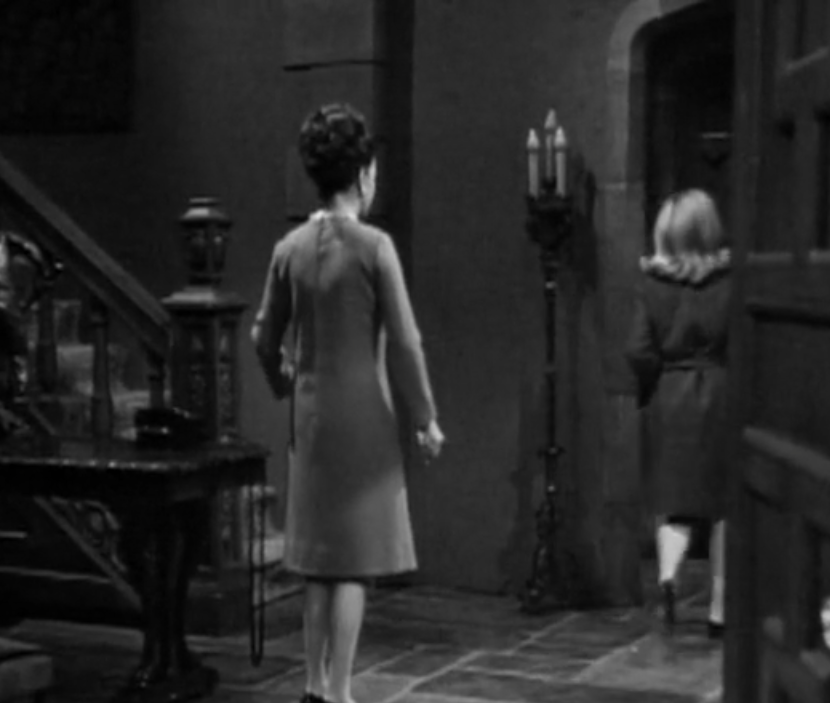
Back in the mansion, Liz confronts Vicki about not giving David his lessons. Vicki replies that Liz’ brother, high-born ne’er-do-well Roger, had said that he would tell Liz that he had taken Vicki on a tour of the cannery and had given David the day off. When Vicki hears Liz on the telephone confirming this with Roger, she blows up at Liz. She objects to being checked up on, she objects to being accused of lying, and, turning to look at the last spot where she had seen Carolyn, she objects to being accused of stealing people’s boyfriends. After she is done with her objections, she walks over to Liz. With their backs to the camera, the women quietly apologize to each other. Vicki explains that her protests mark the only way she can go on living in the house. Liz for the first time calls Vicki by her first name. Hearing this conversation when they are looking away from us is remarkably effective at creating a sense that they are sharing an intimate moment- more is happening between the two of them than even the audience can know.
Mrs Isles and Joan Bennett, as Liz, both play a wide array of emotions in their two scenes together, and do so brilliantly. It’s particularly interesting to compare Liz’ startled reaction to Carolyn’s snapping at her in the foyer when she asks her where she’s going to with her startled reaction to Vicki raising her voice at her in the drawing room when she’s been on the phone with Roger. They are two quite distinct startles. We see Liz from behind when Carolyn startles her. From that angle, we see the muscles in the back of her neck tense, signifying anger. That startle gives way to a parental sternness. The startle Vicki provokes is shown in profile. Liz pulls back a little, suggesting guilt. It leads to a rapid retreat.
Friday’s episode ended, not with a cliffhanger, but with a visitation from the supernatural, as we saw the ghost of Josette Collins descend from her portrait and pirouette around the columns of the mansion she haunts. Today, Roger and Vicki sit in the diner, where he gives her a lecture about the sardine-packing business.
The apparition of Josette was the climax of an episode featuring more exterior footage than we have seen thus far. Today, we have several more location inserts, as we see Roger and Vicki walking around the village of Collinsport. As that one came to a climax with a new set- the Old House- this one also ends with our first look at a new set- the outside of the front doors of the great house of Collinwood.
These attention-getting moves prompt us to look for something big. The makers of the show tell us in so many words that the business story isn’t it.
After Roger has told Vicki a few facts about the sardine industry, she asks how the fishermen know where to look for sardines. He makes it clear that he has reached the limit of his willingness to discuss the topic with a dismissive, “Oh… luck. And experience.” Only when his enemy Burke comes in and he wants to look busy does Roger return to the subject with gusto. After Vicki has toured the cannery, Burke asks if Roger showed her “the place where they cut the heads off the fish.” Neither of those characters would watch a show about the sardine industry, or expect anyone else to do so. When they tell us that the business Burke is scheming to seize from Roger’s family doesn’t seem like exciting narrative fodder even to the two of them, the makers of Dark Shadows are telling us to forget about the business stories and focus on the sort of thing we saw at the end of Friday’s installment.
There is one bit of trivia that I hold onto from this episode. Vicki mentions to Roger that she finds it amusing that the family’s wealth began with the whaling industry and now comes from sardines- from the greatest giants of the sea to some of the tiniest fish in the ocean. An origin as whalers fits with the idea they have at this period of the show, that the Collins family first became wealthy in the 1830s.
Later, they will push them back in time, and present them as having already been rich long before then. That would rule out whaling as the first source of the Collinses’ riches. The New England whaling industry was a creation of the nineteenth century. The region’s wealth prior to that time was founded on cod fishing.
One of the major themes of the show in this period is that the Collinses are much less rich and operate on a much smaller scale than they did in the past. The transition from whales to sardines is an obvious metaphor for that decline. So obvious, in fact, that Vicki’s remark is rather a tactless one.














 Dark Shadows Commentary