Episode 563: A kind of magician

Beverly Hope Atkinson

This episode features the first appearance on Dark Shadows by an actor of color, and the only speaking part any non-White performer ever had. (CORRECTION: Mr Nakamura, played by Sho Onodera in #903, has a couple of lines.) This fact is made even more depressing because that performer fits so perfectly into the show that a first time viewer would assume she had been a major player from episode #1.

Beverly Hope Atkinson plays an unnamed nurse who meets suave warlock Nicholas Blair when he is trying to make his way into a hospital room occupied by Tom Jennings, a victim of one of Nicholas’ evil schemes. She firmly refuses him admittance. When Maggie Evans, The Nicest Girl in Town, enters and asks to see Tom, the unnamed nurse smiles brightly and says “Of course, Maggie!” in a tone that makes it sound like they’ve been friends all their lives. She then shuts the door before Nicholas can follow. He asks her why Maggie can go in and he cannot, and she tells him sternly that Maggie has permission from the doctor.
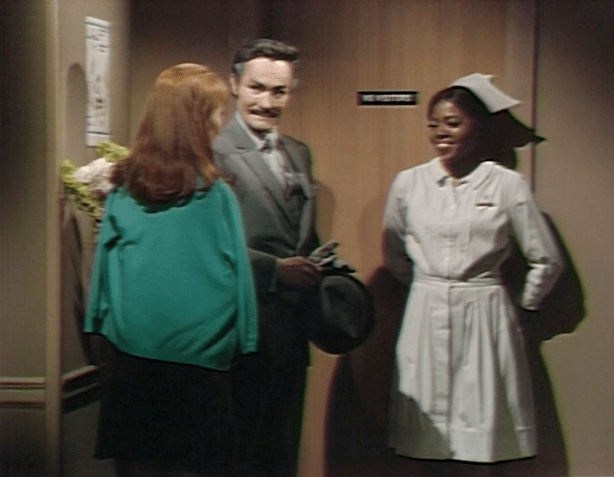
Unnamed nurse is happy to see Maggie. Screenshot by Dark Shadows Before I Die.

I have a fanfic idea about Atkinson’s nurse that I originally posted as a comment on Danny Horn’s Dark Shadows Every Day. I can’t find it there, but here is a copy of it:

In the first 42 weeks of the show, when the supernatural was in the background and the stories were slow, it would have been easy to have a couple of tea party scenes at the Evans cottage where Maggie and her lifelong friend, Unnamed Nurse, recap whatever is going on. Those scenes could have led to a whole exploration of the tension between the working-class people in the village and the jerks in the big house on the hill. That in turn could have led to the introduction of Unnamed Nurse’s family, headed by Unnamed’s parents, Mr and Mrs Nurse, including her brothers, Young Mr Nurse and Master Nurse, and her sister, Moody Miss Nurse. We could then have seen the ancestors of the Nurse family in each of the flashback segments and analogues of them in Parallel Time.

At some point in my musings about this idea, I decided the family should be named “Wilson” (if I had a reason for this, I’ve forgotten it, but I now think of Atkinson’s character as Nurse Wilson,) and that in a flashback segment we should learn that they are descended from free persons of color who settled in Collinsport before the Civil War and were the first proprietors of the Collinsport Inn. Some wicked deed by a member of the Collins family knocked them out of the entrepreneurial class long ago, and they’ve been working their way back up the socio-economic ladder ever since.

We met Maggie in #1 as the waitress at the diner in the Collinsport Inn. She, her late father Sam, and her fiancé, hardworking young fisherman Joe Haskell, have been Dark Shadows‘ main representatives of the people in the village. Her house, the modest counterpoint to the mansions on the Collins family’s great estate, has been familiar to us from the beginning, and is the place where we have seen most vividly what the Collinses’ doings have meant for the people who work for their businesses and live in their town. So, as a frequent visitor there, the nurse could have given a whole new dimension to the drama, showing that it isn’t just one family whose lives hang in the balance, but that a whole community is exposed to the consequences of what happens on the hill.

The Blue Whale

Joe is sitting alone at a table in the Blue Whale tavern, and he looks terrible. He’s pale and fidgety, looking around and periodically jumping up to peek out the window.

Maggie comes in and joins Joe. At first she is angry with him- he stood her up last night, without so much as a telephone call. She sees how upset he is and her anger is mixed with worry. He pounds on the table while the camera is tight on her. Her startled reaction reminds us of the early months of the show, when Sam was a self-pitying drunk and Maggie was a sophisticated portrait of an Adult Child of an Alcoholic.

Maggie startled. Screenshot by Dark Shadows Before I Die.

After that moment, Maggie gets very quiet. When Joe says with alarm that it is getting dark, she responds that “It usually does, at this time of day.” It’s inherently funny to hear someone make that kind of matter-of-fact statement in response to an inexplicably intense remark, but also poignant to those of us who remember Maggie’s early interactions with Sam. From childhood on, simple rationality must have seemed to Maggie like a joke in the face of the overpowering irrationality at the center of her life.

As it happens, Joe is indeed exhibiting addicted behavior. But he isn’t hooked on alcohol. Instead, he is under the power of a vampire. Angelique, who was once the wicked witch who first made Barnabas Collins a vampire, found herself reduced to bloodsucker status when she displeased Nicholas. At Nicholas’ direction, she bit Joe the other day, and now Joe is desperate to hear her summons and report for another bite. She does call, and he does dash out, leaving a bewildered Maggie behind.

It was at the Blue Whale that we first met Joe, back in #3. Then, he was an upstanding young man who indignantly rejected the attempts of one of the Collins family’s sworn enemies to bribe him into spying against them. We’ve seen him in the tavern many times since then, always as the doughty representative of the wholesome and intelligible world against the sinister and supernatural. For example, in #215 it was a deeply troubled Joe who brought the news to Maggie and others at the Blue Whale that the cows on his uncle’s farm had been somehow drained of blood, news which turned out to be the first sign of vampirism in the area. This is the first time we’ve seen the Blue Whale since #358, back in November, and the first time a scene has closed with the formerly very familiar Blue Whale jukebox dance tunes in even longer than that. Longtime viewers see a loop closing. Joe leaves the place where he has most often shown himself as one who dwells in the daylight and goes down to the deepest dark.

Once Joe is gone, Nicholas enters. He engages Maggie in conversation, and talks his way into the seat Joe vacated. Soon he is doing magic tricks for her and she is agreeing to have dinner with him. He brings up the idea of staying out all night, and she seems amenable. Where is her old friend the nurse when you need her?

The Fix

Joe lets himself into Nicholas’ house, a place by the sea that he is renting from the Collinses. Angelique is there. Joe laments his dependency on her, and asks if she was the one who attacked Tom, whom he identifies as his cousin. Perhaps the son of the uncle whose cows fell victim to Barnabas long ago! She doesn’t bother to deny it. She tells him that they will both visit Tom tonight. She bites Joe.

Joe visits Tom, who has emerged from the coma in which Angelique’s first bite left him. He tells Joe all about Angelique’s attack on him. He says he knows how bizarre the story sounds, but that he hopes that if he has Joe to vouch for him he will be able to make the police take it seriously. Joe gives Tom a few perfunctory assurances, then opens the window. Joe explains that he is doing this because it is hot in the room. Tom does not agree that it is hot, but Joe insists, and Tom is too ill to argue long.

Joe leaves, and we jump forward to 2 AM. The window is still open- apparently no nurse was on duty. Perhaps the hospital thought Beverly Hope Atkinson’s character did such a good job on the day shift that the patients could just cruise along through the night. We hear a bat squeaking, and Angelique appears. She bites Tom.

In Barnabas’ first weeks on Dark Shadows, the show made heavy use of the idea that vampires can enter a lodging only when they have been invited. For example, he went to the diner after hours so that Maggie would have to invite him in, and later went to her house and stood just outside the front door for a noticeably long time before she explicitly asked him to enter. They haven’t done anything with that idea in a long time, but neither have they very clearly contradicted it. Perhaps Joe’s opening of the window is the invitation Angelique needs to make her way into the hospital.

Episode 494: They were meant for me

From #227 to #260, Maggie Evans, The Nicest Girl in Town, was under the influence of vampire Barnabas Collins. As Barnabas tried to brainwash Maggie so that her personality would disappear and that of his lost love Josette would take its place, she began to rebel against him. From #251 until she escaped in #260, Barnabas kept Maggie locked up in a prison cell in his basement.

Throughout this whole period, Barnabas’ sorely bedraggled blood thrall Willie Loomis tried to spare Maggie the worst. Willie anonymously telephoned Maggie’s friend Vicki in #230 so she and her friends could interrupt Barnabas’ first attempt to take Maggie into custody; while Maggie was Barnabas’ prisoner he several times pleaded with Barnabas to show her mercy; and when in #260 Barnabas had decided to kill Maggie with extreme cruelty, Willie brought a glass of poison to her cell so she could die painlessly.

Now, Barnabas’ vampirism is in remission. He has brought Willie back to work for him, arranging his release from the mental hospital where he was confined after Barnabas framed him for all of his crimes against Maggie. It is by no means clear what effect Barnabas’ loss of his vampire powers has had on Willie. At times he seems to be confused and childlike; at times, to be the dangerously unstable ruffian he was before he fell into Barnabas’ clutches. But he is still fascinated by Maggie, and still longs for her friendship. The very night Barnabas brought him home from the hospital, Willie sneaked off to visit Maggie and tell her he was innocent.

For her part, Maggie’s memories of her experience with Barnabas were excluded from her conscious mind when mad scientist Julia Hoffman hypnotized her. The other day, Maggie had a nightmare as part of the “Dream Curse,” and in the course of the nightmare she heard the sound of Josette’s music box, which Barnabas forced her to listen to while in captivity. She also saw a skull with eyes, suggesting that her deepest fear has to do with the dead watching her. Since Barnabas, as a vampire, was dead and yet kept Maggie under surveillance, this image combines with the music to suggest that Maggie’s memory might soon return.

Today, Willie is minding Adam, a Frankenstein’s monster whom Julia brought to life in a procedure meant to cure Barnabas of his vampirism once and for all. Barnabas and Julia have no idea what to do with Adam, and so they have chained him up in Maggie’s old cell. Barnabas’ jewel box is stashed behind the secret panel Maggie used to escape from the cell, and Willie shows Adam some of its shinier contents to calm him.

Among the shiniest are a pair of emerald earrings. Barnabas has been talking to Willie as if Willie remembers everything that happened when he was his blood thrall, yet Willie has not confirmed that this is so. When he sees the earrings, Willie gets very intense. He says that he saw Josette wearing them, then realizes that it was Maggie. Perhaps Barnabas, by modeling the conversations they used to have, is inadvertently providing the therapy Willie needs to recover his memory.

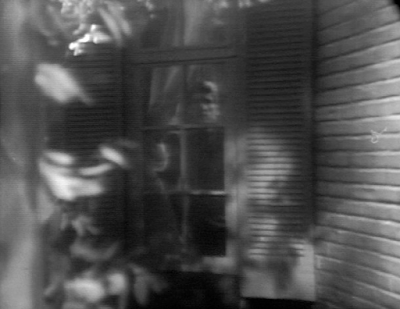
Willie decides to give the earrings to Maggie. He goes to Maggie’s house and peeks through the window. He sees her with her boyfriend Joe. When he came to the house the other day to tell Maggie he never meant to hurt her, she was terrified and Joe stated as a matter of fact that he would kill Willie if he ever came near Maggie again. Willie does not knock on the door to greet the two of them.

Instead, he slips into the house while they are out of the room. He plants the earrings in Maggie’s purse, and is gone by the time she and Joe come back. Maggie finds the earrings. The tinkling sound of Josette’s music box plays on the soundtrack while she looks at them. She is fascinated:

The earrings drive Maggie crazy. Screenshot by Dark Shadows Before I Die.

Maggie says that the earrings “remind me of something- something I’ve forgotten. I know they don’t belong to me yet. But somehow when I look at them, I seem to think they were meant for me- I mean from the start. They are lovely, a very beautiful and thoughtful gift. Only a man who has gazed into my eyes with deepest love would know they were meant for me.” As she delivers these lines, Kathryn Leigh Scott fades out of Maggie’s voice, into the tones she used while playing Josette from #370 to #430.

Barnabas’ attempt to turn Maggie into Josette would have reminded many viewers at the time of the 1932 film The Mummy, in which the undead Imhotep (played by Boris Karloff, whose voice Jonathan Frid often seems to be imitating as Barnabas) abducts the beautiful young Helen Grosvenor, whom he believes to be the reincarnation of his lost love, the Princes Ankh-esen-amun. In that movie, Helen and the Princess were both played by Zita Johanns, suggesting that Imhotep was onto something. From November 1967 to March 1968, Dark Shadows was a costume drama set in the 1790s and we saw that Maggie and Josette are both played by Kathryn Leigh Scott, suggesting the same about Barnabas. The bleakness and horror of Barnabas’ treatment of Maggie in the summer of 1967 makes this suggestion a daring one, and that Maggie makes a speech blissfully describing the one who looked at her and saw Josette as a “man who gazed into my eyes with deepest love” in the middle of an episode that begins and ends in the cell where he confined her and planned to torture her to death is more daring still.

I don’t think the risk pays off. Miss Scott was usually one of the most reliable performers on Dark Shadows. She found Maggie in her relationship to her father Sam, whose drinking problem was a major story point for the first 40 weeks of the show, and articulates the character as a series of very intelligent answers to the question “How would an Adult Child of an Alcoholic respond to this situation?” This scene presents her with a very complex challenge, as she is supposed to show that the earrings have jarred loose some fragment of a memory but to keep us guessing just what that fragment is. Joel Crothers plays Joe’s disquiet at the appearance of the earrings with a simplicity that sets Miss Scott up for a star turn. But she doesn’t seem to have any idea what to make of her lines. For the first time on the show, she is physically stiff and vocally overbearing. As a result of her atypical overacting, the scene does not deliver the sense of mystery and foreboding it requires. It just leaves the audience confused.

Episode 368/369: Whole future

In 1966 and 1967, supernatural menaces Laura Murdoch Collins and Barnabas Collins would often be seen staring out the windows of their houses on the great estate of Collinwood, sending psychic energy towards the targets of their sinister plans. In 1795, Barnabas is neither supernatural nor menacing, but we already see him peering out one of those windows. He is not projecting bad vibes into the world, but is worried about his beloved fiancée, Josette DuPrés. She is supposed to arrive soon, in fact was supposed to arrive some time ago. Now there is a storm, and he hopes she is not at sea.

Earliest window-stare, by dramatic date. Screenshot by Dark Shadows Before I Die.

The audience’s main point-of-view character in 1966 and for most of 1967 was well-meaning governess Vicki. Now Vicki has come unstuck in time, and found herself in this extended flashback to the eighteenth century. Since she will know Barnabas and regard him as a close friend in the 1960s, she is at her ease talking to him now. Although she is a member of the staff in his family’s house in a period when it was customary for masters to summon their servants with bells and communicate with them only in direct commands, Barnabas is a remarkably genial and democratic sort who welcomes her casual manner.

Vicki has already annoyed the audience several times by blurting out information that makes it obvious to the other characters that she does not belong in their world. She does that again in this scene. Barnabas is worried something may have happened to Josette, and Vicki tells him that she will arrive safely. He is surprised by the assurance with which she delivers this prediction, and asks if she is clairvoyant. She realizes that she has been indiscreet, and denies that she is. He is unconvinced.

Barnabas’ father, haughty overlord Joshua Collins, enters. He is appalled to find his son socializing with a servant. He dispatches Vicki to the nursery to look after her charge, his young daughter Sarah. He demands to know why Barnabas is not tending to his own duties at the family’s shipyard. They begin to quarrel, when a knock comes at the door.

Barnabas opens the door to find a woman named Angelique, whom he identifies as maid to Josette’s aunt, the Countess DuPrés. Angelique says that the countess was on her way to Collinwood, but that her carriage is stuck in the mud. Joshua orders Barnabas to send a footman to rescue her. Angelique is the first character we have met in 1795 who is not played by a performer we have seen in the first 73 weeks of the show.

Enter Angelique. Screenshot by Dark Shadows Before I Die.

Joshua goes to his wife, Naomi. Naomi is an alcoholic, a fact of which we are made aware because almost her every scene begins with a shot of her drinking alone. That’s what she is doing before Joshua finds her. He scolds her for her drinking; she complains that he doesn’t allow her to do anything else. She can’t even pass the time with a book- we saw Monday that Naomi is completely illiterate.

Glug glug glug. Screenshot by Dark Shadows Before I Die.

Naomi’s alcoholism is both a nod to the concern of first-wave feminism with the atrophy of the elite housewife, and a suggestive side-light on Barnabas as we knew him in the 1967 segment. Then, Barnabas abducted Maggie Evans, The Nicest Girl in Town, and tried by more or less magical means to replace her personality with that of Josette. For the first 40 weeks of Dark Shadows, Maggie’s father’s alcoholism had been a substantial story element, and she would always retain a number of classic Adult Child of an Alcoholic (ACoA, in the lingo of the recovery movement) characteristics, such as beginning utterances with a little laugh to prove that she is happy. Now that we know that Barnabas is also an ACoA, we can wonder if that shared experience was part of the reason he was drawn to Maggie.

The countess arrives. Since she is played by Grayson Hall, who also plays mad scientist Julia Hoffman in the parts of the show set in the 1960s, Vicki blurts out “Julia!” when she sees her. Hall had also been nominated for an Academy Award for her performance as Judith Fellowes in the 1964 film Night of the Iguana; if Vicki is going to keep the audience up to date on the cast’s resumes, it would have been more interesting if she’d exclaimed “Judith!” Vicki explains that the countess looks like someone she once knew who was named Julia, a remark which irritates the countess, who would like to think her appearance is distinctive. Vicki has certainly not made a favorable impression on this grand lady.

Joshua tells the countess he is surprised that “You still affect a title” when “France has followed our example and become a republic.” His pride in this development, after the Terror and in the bloodiest year of the wars in the Vendée, marks Joshua as a member of the Jeffersonian party in US politics. The Federalists and others had long since turned against the French Revolution by that year.

The countess tells Joshua that it is precisely because France has become a republic that she chooses to live on the island of Martinique. That answers a question that some fans ask about Angelique- why is she white? If the DuPrés family lives on Martinique and are major sugar planters there, they must hold a great many African people in slavery. When we hear that they are bringing a servant with them, we expect that servant to be Black. When we learn that the the countess is an emigré, we realize that she brought Angelique with her from France.

The countess may solve one puzzle for us in her exchange with Joshua, but she presents us with another. Josette’s father André is the countess’ brother, yet he is never referred to as a count. Indeed, when he appears, we will see him answer to “Mr DuPrés.” Perhaps he renounced his title, as many French aristocrats did during the Revolution.

Whatever the explanation, “DuPrés” would seem to represent a missed opportunity. When Josette was first mentioned, in the early months of Dark Shadows, her maiden name was given as “LaFrenière.” It would have been a nice touch to have kept that name for Josette and her father, and to have reserved “DuPrés” as the name of the countess’ late husband.

“LaFrenière” had been a perfect choice because of its class ambiguity for a show about an aristocratic family in the state of Maine- it was originally the family name of the barons of Fresnes, and could therefore be a sign of a senior order of nobility, but is also a very widespread name in Quebec. So “Josette LaFrenière” might either have been a French noblewoman who deigned to marry into the mercantile Collins family at the apex of their prestige, or a working class girl from the north who eloped with the boss’ son.

The choice of Martinique as Josette’s place of origin might add a new twist to this class ambiguity. The Empress Josephine grew up there as a member of the untitled but ancient Tascher family, who, like the fictional DuPrés family, owned an enormous sugar plantation on the island. The Taschers of Martinique went back and forth between Martinique and metropolitan France, and Josephine herself was living there in 1779 when she married her first husband, the Vicomte de Beauharnais. Josephine herself was in prison when the vicomte was guillotined in 1794, one of the last to die in the Reign of Terror, and she was freed just a few days later. The next year, she recovered her husband’s property, and a year after that married the young general Napoleon Bonaparte. It seems likely that the similarity between the names “Josephine” and “Josette” was writer Sam Hall’s inspiration for placing Josette’s origins on Martinique. Association with a figure who was at once a grand lady and an example of very steep upward social mobility could synthesize the two possible Josettes LaFrenière into a single figure.

Had they developed the story of the family’s relationship with the town of Collinsport more richly in Dark Shadows 1.0 and 2.0, they could have used this ambiguity to build up suspense that would be resolved today, in the third episode of Dark Shadows 3.0. Since they did so little with that theme in those days, when the story was moving very slowly and it would have been relatively easy to fit just about anything in, I suppose we shouldn’t be surprised that they drop it so completely at this period of the show, when the story is flowing at a breakneck speed.

The countess’ lofty aristocratic manner stings Joshua. Alone with Naomi, he loudly proclaims his belief that all men are equal. We already know enough about Joshua’s tyranny over his household that this absurd little speech must be an intentional spoof of the rich landowners who supported the Jeffersonian party in the early decades of the Republic. Again, this would be funnier and more poignant if the show had done more with social class in its first 73 weeks.

Barnabas sees the countess dealing out tarot cards. He tells her she is too sophisticated for them, and is reluctant to sit with her while she uses them to read his fortune. The moment she says that the cards suggest a connection between him and the concept of infinity, his skepticism evaporates instantly and he excitedly asks if that means he will live forever. The countess cautions that his jubilation at this idea may be misplaced. She notices the “Wicked Woman” card, and takes a significant look at Vicki. Evidently the audience is not alone in objecting to Vicki’s brainless nattering about what the show used to be like.*

Angelique comes to Barnabas’ room. It turns out the two of them had a brief affair when he was first on Martinique, and she expects to resume it. He is not at all pleased at her attentions.

Not how every man would react to a passionate embrace from Lara Parker… Screenshot by Dark Shadows Before I Die.

Barnabas explains that he was already falling in love with Josette when he and Angelique had their fling, but that he didn’t really know her. He couldn’t believe that she would reciprocate his feelings, and consoled himself by dallying with Angelique. This explanation goes over with her about as well as you’d expect, and she storms out of the room, vowing that she will get her way in the end.

We know that the tarot cards are giving accurate information, because the show leans heavily on the uncanny and they wouldn’t have spent so much time on a gimmick that wasn’t meant to advance the plot. We also know that Vicki is not the Wicked Woman the countess is looking for. That leaves Angelique, and we can assume that her wickedness will express itself in some supernatural action taken to avenge herself on Barnabas. Since we know that Barnabas will become a vampire, we wonder if it is Angelique who makes him one.

Closing Miscellany

I usually refer to surviving cast members with courtesy titles and to deceased ones by surname alone. So Alexandra Moltke Isles is “Mrs Isles,” which has been her professional name for 56 years, David Henesy is “Mr Henesy,” Nancy Barrett is “Miss Barrett,” etc, while Jonathan Frid, Joan Bennett, Louis Edmonds, and Grayson Hall are just “Frid,” “Bennett,” “Edmonds,” and “Hall.” Until last month, I’d been looking forward to saying lots of things about “Miss Parker” and her portrayal of Angelique, but Lara Parker died on 12 October 2023. So she’s just going to be “Parker,” and I’m going to be sad about it.

Artist Teri S. Wood has created a number of short animations about Angelique and Barnabas. This one is based on their two-scene at the end of today’s episode:

https://www.youtube.com/watch?v=pyxI0q2aOIk

Patrick McCray has a post about this episode that mystifies me. He writes that “After seven months of hearing about Angelique, today, she enters. So, no pressure Lara. You only have to live up to a half year of build-up.” Uh, what? There has been absolutely no reference to Angelique on the show before today. I can think of an interpretation of the story that might retroject Angelique into episodes #211-365, and I will talk about it next week. But I don’t think it is an interpretation Patrick would favor.

He also talks about David Ball’s method of reading plays from the ending back to the beginning and then from the beginning forward, so that the ending comes to seem implicit in everything else. He allows that Dark Shadows has more than one ending, but I would say he doesn’t go far enough. I’d say the series has ten endings. The first came in #191, when Laura went up in smoke while her son David found refuge in Vicki’s arms. That ending defined Dark Shadows 1.0 as the story of David’s escape from his evil, undead mother Laura, and his adoption of Vicki as his new, life-affirming mother. The second came in #364, when Barnabas met the ghost of his little sister Sarah, she commanded him to be nice to the living, and he went right on with his murderous plans. That ending defined Dark Shadows 2.0 as the story of Barnabas’ irredeemable evil.

Two of the other endings will feature Angelique dying in Barnabas’ arms, and Patrick suggests that those make the whole show the story of their relationship. I don’t buy it at all. Each of the ten parts is about what it is about, and even those two episodes with Angelique dying derive more dramatic charge from other moments.

*Making connections with the first 73 weeks is my job!

Episode 321: How many times do I have to tell you?

Maggie Evans, The Nicest Girl in Town, is not allowed to leave home. The yard outside her door is full of policemen. They are hoping that a rumor that her amnesia is breaking and she will soon remember who abducted her and held her prisoner will draw that person out of hiding. If he approaches the house, they will… it isn’t clear what they will do, exactly. Whatever they do, Maggie hopes that it will end the danger so that she can get back to her normal life.

Maggie and her father Sam talk about the situation. This conversation doesn’t advance the plot or give the audience new information, but it is somewhat interesting to people who have been watching the show from the beginning. For the first 40 weeks of the show, Sam was an alcoholic and Maggie’s attempts to keep him out of trouble were a substantial part of the story. Adult Child of an Alcoholic (ACoA, in the lingo of the twelve step movement) mannerisms such as advertising that she is happy by starting utterances with a laugh and stressing whatever syllables have a rising pitch are still a major part of Maggie’s characterization.

Father and daughter

But Sam isn’t an alcoholic anymore. Not only doesn’t his drinking cause him problems, but we’ve seen him function as a social drinker. He keeps a bottle of whiskey in the living room of the Evans cottage and occasionally takes a drink or two; he often goes to The Blue Whale tavern and enjoys happy hour there. But he declines drinks when they are offered at inconvenient times, doesn’t get drunk, doesn’t have trouble with his work, and Maggie doesn’t have any complaints. The other day, the show referred back to Sam’s drinking days. He and the sheriff went to The Blue Whale, where Sam started the rumor about Maggie’s memory. Sam pretended to be drunk and the sheriff pretended to hush him while he declared that Maggie would be leading the police to her captor any day now. But he was stone sober the whole time, even though he had had a drink at home before leaving for the tavern.

The show dropped the theme of Sam’s alcoholism when it gave up on the storyline of “The Revenge of Burke Devlin.” Sam had started drinking because of the events behind that storyline and his drunkenness made it unpredictable what role he would play in it. Since that ended in #201, the writers don’t seem to see a point in presenting Sam as an alcoholic, even as one in recovery. But I think that is a mistake. The actors and directors remember that Sam has that history, and it adds depth to both David Ford’s portrayal of Sam and Kathryn Leigh Scott’s of Maggie. You wouldn’t have to spend any more screen time presenting Sam as a recovering alcoholic than they spend now presenting him as a social drinker. All he’d have to do is reply to a remark about booze by saying that he never touches the stuff anymore, and you’ve made the point.

Viewers who have been with the show from the beginning will look at Sam and Maggie’s heart-to-heart talk and remember the scenes from the first 40 weeks where Maggie wound up playing the parent in the parent-child relationship. Seeing him really function as a father here will not only reassure us that they are free of that now, but will also explain why Maggie kept falling into all of the patterns of behavior that enabled Sam when he was a drunk. Today, he’s the Daddy she knew before alcohol got the better of him, the one she was always sure was still in there someplace.

Sam leaves the room, and Maggie gets a visitor. After Sam had assured Maggie that the house was so well-guarded no one could get in, we saw a shot of the permanently nine year old ghost of Sarah Collins outdoors, peering over a picket fence.

Looking for a friend

Maggie falls asleep, and wakes to find Sarah in the room with her. Maggie repeatedly asks Sarah how she got in, and Sarah keeps declining to answer. Maggie keeps trying to get her father into the room, and Sarah keeps telling her that if a third person comes in, she will have to go away. Sarah finds that Maggie is not in possession of the doll she gave her, and tells her that she will have to get it back as soon as possible and keep it with her at all times. Maggie asks more than one question about that as well, and Sarah again tells her that she can’t explain. Sarah gets to be quite exasperated that she has to keep reviewing the ghost rules with Maggie.

Sarah can not believe Maggie still doesn’t get it.

Several characters have entertained the possibility that Sarah might be a ghost, among them Maggie and Sam. They keep snapping back from really believing that she is. In the early months of the show, characters had speculated that there might be ghosts on and around the great estate of Collinwood, but they couldn’t let go of the idea that they lived in a world that basically made sense according to the usual natural laws. So no matter what they saw, they kept retreating from the full implications of the supernatural events that came to be a more and more obvious part of their experiences. Sarah’s impatience with Maggie today is reflected in the impatience many viewers of the show express when characters who have had encounter after encounter with the paranormal won’t stop droning on about how there must be a perfectly logical explanation.

Sarah keeps repeating herself and Maggie keeps missing the point. Maggie tells Sarah that she will like Sam, who likes little girls. That again is a poignant line to those who are thinking about the happy life Maggie had with her father before he started drinking and that has only recently resumed, though it is lost on newer viewers. We also know that Sarah already likes Sam- she visited him in this house in #260 and told him where to find Maggie.

But in the world of Dark Shadows, ghosts cannot appear to more than one person at a time. For example, in #141 strange and troubled boy David Collins took his mother, undead fire witch Laura Murdoch Collins, to the Old House on the grounds of Collinwood, hoping that the ghost of Josette Collins would appear to her. He left her alone in the house, explaining that Josette appears only to one person at a time. Josette did communicate with Laura after David left, though Laura concealed that fact from her son.

We’ve seen only two exceptions to the rule that ghosts appear to one person at a time. The first case was in #165, when Josette manifested herself in a room with David and Laura. The second time was in #294, when Sarah herself helped Maggie escape from the mental hospital where mad scientist Julia Hoffman was keeping her for evil reasons. Both Maggie and her nurse could see Sarah that time.

But those were special occasions. It was such a strain for Josette to present herself to two people that she could shimmer into view only when David was asleep, and a few words from Laura were enough to shoo her away before he could wake up, though he did feel her presence afterward. And Sarah’s appearance to Maggie and the nurse lasted for only a few seconds. Viewers reminded of Sarah’s earlier appearance to Sam will remember that she vanished before he finished a sketch of her that she very much wanted him to give her, so however great a power she might represent, we know that it is not entirely under her control. She can do what she is supposed to do and tell people what they are supposed to know, but she cannot simply do as she wishes, and when she has completed an assigned task or entered an uncongenial situation she will disappear.

Eventually Maggie insists on opening the door and calling to Sam. Of course Sarah has vanished when he enters, of course the men guarding the house didn’t see her, and of course Sam and Maggie fret that if Sarah could come and go unobserved so could the person they are trying to catch. Those bits bring on our frustration with characters who don’t get that they are living in a universe pervaded with supernatural beings. If they were proceeding from the premise that Sarah was a ghost and considering the possibility that Maggie’s captor may also have been some kind of uncanny being, that would indicate that the action is about to start moving a lot faster. As it is, it’s just filler.

Meanwhile, Julia has left her hospital and come to Collinwood, where she is in league with Maggie’s captor, vampire Barnabas Collins. Barnabas has heard the rumor that Maggie is recovering from her amnesia. Julia induced that amnesia to keep Maggie from exposing him and inconveniencing her.

In Friday’s episode, Julia tried to talk Barnabas out of killing Maggie. He had calmly and suavely told her that he had no choice but to yield to her arguments, and she had been satisfied that she had persuaded him. Today, he tells his sorely bedraggled blood-thrall Willie Loomis that he will set out for the Evans cottage as soon as the clouds cover the moon and give him a deep enough cover of darkness.

Willie sneaks over to the terrace at the great house of Collinwood, where he informs Julia of Barnabas’ intentions. Julia cannot believe that her powers of persuasion failed to win Barnabas away from his plan to kill Maggie. Willie has to repeat himself time and again, until he grows as exasperated with Julia as Sarah was with Maggie.

This is the first time we have seen Julia in denial. It’s understandable that she would overestimate her ability to bend Barnabas to her will- not only has she had a great deal of success so far at dominating their relationship, but she is usually able to manipulate people to a fantastic degree. When she induced Maggie’s current amnesia, she took her in a matter of minutes from a state in which she remembered everything that had happened to her to one in which an impenetrable mental block covered exactly the period in which Barnabas abused her. Someone who can do that might well have difficulty grasping the fact that she has not turned someone to her way of thinking.

Barnabas stares out the window of his house in the direction of the Evans cottage and thinks murderous thoughts about Maggie. My wife and I often laugh about the comment Danny Horn made on this scene in his post about this episode on his blog Dark Shadows Every Day:

Meanwhile, the dogs are howling, and Barnabas is standing at the window, staring out into the night.

“Goodbye, Maggie Evans,” he thinks. “I might have loved you. I might have spared you. Now… you must die.”

Man, what a diva. He even has backup singers.

Danny Horn, “Episode 321: What We Talk About When We Talk About Ghosts,” Dark Shadows Every Day, 3 February 2014

When the show dwells on the dog-noise, Mrs Acilius and I often turn to each other, say “the backup singers!,” and laugh. When we watched this episode yesterday, we laughed louder than usual because our beagle joined in with them, right on cue. He often looks up when the howling starts, the backup singers are the stars of the show as far as he is concerned, but it is unusual for him to sing along. They must be in particularly good voice in this one.

Episode 296: Safe tonight

Maggie Evans, The Nicest Girl in Town, has come back to Collinsport. This is bad news for vampire Barnabas Collins, who kept Maggie prisoner and fears she will expose him. Barnabas’ new accomplice, mad scientist Julia Hoffman, has erased Maggie’s memory and assures him she is no longer a threat to him.

Barnabas is unconvinced that Maggie’s amnesia will last. As he grows more agitated, Julia grows calmer. This contrast reaches its climax when Julia blithely lights a cigarette from Barnabas’ candelabra and he reacts with stunned bewilderment.

Julia lights up. Screen capture by The Collinsport Historical Society.

Julia tells Barnabas he has no choice but to trust her and leave Maggie be. He says that it would seem so. It doesn’t seem so to the audience- we know all Barnabas has to do is bite Julia to bring her under his power.

Julia shows herself out, a spring in her step. Once Barnabas is alone, he hears a rooster announce the dawn. He mutters that Maggie is safe for the moment, but that he will kill her tonight.

By now, there are three groups of characters on Dark Shadows: those who know Barnabas is a vampire; those who do not know this, but do know that supernatural doings are afoot; and those who think the show is still the Gothic romance/ noir thriller it was in its first weeks. Those in category one can move the story along very quickly, those in category two can nudge it forward a bit, and those in category three are blocking figures who slow things down.

When she was Barnabas’ victim, Maggie was in category one. Now she’s fallen back into category three. She has even resumed her vocal habits of showing herself to be happy by starting every statement with a laugh in her voice and of exaggerating the stress on whatever words have a rising intonation. She had those classic Adult Child of an Alcoholic mannerisms in the early days of Dark Shadows, when her father’s drinking problem was a story element. Months ago they revised him as a social drinker, so it’s like she’s been spliced in from tapes of old episodes. The question of Maggie’s memory therefore generates suspense, not only because we don’t want Barnabas to kill her, but also because we don’t want her to end up in a narrative dead end and fade from the foreground of the show.

Episode 295: A special kind of music

Maggie Evans, The Nicest Girl in Town, has come back to Collinsport. This is a surprise to everyone. Months ago, Maggie had escaped from an unknown captor who drained her blood and deranged her mind. Maggie’s family doctor, addled quack Dave Woodard, had persuaded her father and her fiancé to join him in telling everyone that she was dead and to lock her up in a mental hospital a hundred miles north of town. Evidently, Woodard thought that if the captor believed he had got away with his crimes, he would turn into a solid citizen and a good neighbor.

The mental hospital where Woodard sent Maggie was administered by Dr Julia Hoffman, an MD whose specialties in psychiatry and hematology made her seem like the perfect person to oversee Maggie’s care. Unfortunately for Maggie, Julia is also a mad scientist. She has for years dreamed of finding a vampire on whom she can try an experimental treatment that will turn him back into a human. Julia quickly recognized Maggie’s condition as a symptom of vampire attacks, and eventually identified Barnabas Collins as the vampire who held Maggie prisoner. She has now met Barnabas and promised to keep Maggie in a state of amnesia so long as he cooperates with her experiments.

Yesterday, the ghost of Barnabas’ nine year old sister Sarah liberated Maggie from Julia’s hospital and transported her back to Collinsport. This had such a great effect on everyone that the show is now in color.

Barnabas goes to the great house of Collinwood and tells Julia that Maggie has come back. He declares that he will have to kill her. Julia forbids him to kill Maggie, on the grounds that doing so would ruin years of her work. Talented a liar as Julia is, she comes up with this so quickly and in such a tense situation that it is hard to believe it is not her true reason for wanting to leave Maggie alive.

Barnabas clarifies the matter further when he says that he will kill Julia first. He follows Julia around the drawing room, apparently thinking of strangling her then and there. She keeps talking, and he can’t resist responding. The telephone rings, and she answers. It is Woodard, calling her to come to his office and take over treatment of Maggie. Julia triumphantly assures Barnabas that once she has done her work, Maggie will never remember what he did to her.

In Woodard’s office, Maggie’s memory is rushing back. She tells her friend Vicki that when she was being held prisoner she spent time in a special room where she smelled a sweet, powerful fragrance and heard a special kind of music. She had told Julia about those sense impressions in a session in #282, and when in #289 Vicki told Julia about a special room in Barnabas’ house where there was a jar of jasmine perfume and an antique music box, Julia had reconstructed Barnabas’ entire plan. When she hinted to Vicki that Barnabas was trying to recreate the late Josette Collins, Vicki had become defensive and stormed off, indicating that Julia is casting an unflattering light on something Vicki has been looking at through a romantic lens.

The camera is tight on Vicki’s face when Maggie mentions the room, the fragrance, and the music. Vicki’s face darkens in response to each point, a little bit more each time. She seizes on the key word of each statement, rephrasing it as a question- “Special room?… Special scent?… Special music?” So far on Dark Shadows, every plot has come to its climax as a result of Vicki figuring out what’s going on. So each of these reactions generates its own little jolt of suspense.

Special room?
Special scent?
Special music?

By the time Julia gets there, Maggie is saying that she remembers everything. Julia hustles Woodard out of the room, and is alone with Maggie when Maggie says that Barnabas Collins was her captor. She describes him as a creature from the world of the dead. She allows that this description is difficult to believe, but Julia assures her that she believes everything she tells her. Julia then tells her that they must stabilize her memory so that she will not regress to the miserable state she was in when first they met. She takes out a jeweled medallion and hypnotizes Maggie.

Woodard waits outside his office while Julia works on Maggie. Finally, Julia opens the door and asks if he would like to see the change in her. Woodard eagerly goes into his office.

He asks Maggie how she is. As she answers, she sounds just like she did before she fell into Barnabas’ clutches. She has regained her Adult Child of an Alcoholic habits of advertising her happiness by starting every utterance with a laugh in her voice and putting exaggerated stress on almost every syllable with a rising pitch. She tells him that “Apparently, there was something wrong with my memory, but I’m fine now.” He asks what happened to her when she was gone, and she has no idea what he means. She remembers falling asleep in her own bed, and then she found herself here with Dr Hoffman. If he could just tell her what happened in between, she’s sure she will be just fine.

Woodard is shocked, but Julia flashes a look of glee. She does remember to put on her worried face after Woodard looks at her, but the smile never really leaves her eyes.

Julia suppressing a cackle. Screeenshot by Dark Shadows Before I Die.
Julia concerned. Screenshot by Dark Shadows Before I Die.

That Julia was able to achieve so precise and extensive a mutilation of Maggie’s memory in so short a time would suggest that she spent the whole period Maggie was under her care laying the groundwork for it. That would in turn tend to confirm that her only interest in Maggie is as a tool to gain access to Barnabas as a subject for her experiment.

Closing Miscellany

As the opening title sequence begins, an ABC staff announcer says he brings “Good news! This program, Dark Shadows, is now being presented in color.”

Opinions may vary as to how good this news was. In the 1960s and 1970s, most television sets in the USA did not receive in color. So even programming that was made in color had to be composed first to look good in black and white. It took a big budget and a relaxed production schedule to make a show that would also benefit from color, and Dark Shadows never had either of those things. When a sense of atmosphere is especially important, as it usually is early in a storyline, it is best to watch the show with the color turned off.

Still, directors Lela Swift and John Sedwick were ambitious visual artists, and before long there will be some moments when they find ways to turn the muddy, cruddy TV colors of the era to their advantage. The camera operators will learn their craft even more quickly. Today, only a few closeups really meet broadcast standards, while every other shot is badly out of focus. There aren’t many other episodes like that, at least not until the woeful Henry Kaplan becomes one of the directors in December 1968.

This is not only the first color episode, but also the first one where the words “Dark Shadows” swoop and swirl around on the screen during the opening titles. I’m sure that was a very impressive effect in 1967.

When we saw Julia hypnotize Maggie in their sessions in the hospital, she shone a penlight in her eyes. This is the first time she uses the medallion. That is an example of the use of color- the medallion wouldn’t have been anything special in black and white.

Julia’s medallion. Screenshot by Dark Shadows Before I Die.

Episode 207: Just fate

Today we’re in Collinsport’s night spot, The Blue Whale tavern. Seagoing con man Jason McGuire is at the bar, trying to convince his henchman, dangerously unstable Willie Loomis, to stop acting like he’s about to rape every woman he meets before they get thrown out of town.

A party comes in consisting of artist Sam Evans, Sam’s daughter Maggie, and Maggie’s boyfriend Joe. Dashing action hero Burke Devlin enters and joins Sam, Maggie, and Joe at their table. Burke has confronted Willie a couple of times, and Willie tells Jason that they are fated to have it out sooner or later. Jason tries to persuade him to abandon this idea, telling him that Burke would be a useful friend and a formidable enemy.

Jason delights Willie by telling him that Burke is an ex-convict. John Karlen brings such enormous joy to Willie’s reaction to this news that it lightens the whole atmosphere of the episode.

Jason buys Burke a drink and tells him that Willie is secretly a nice person. He and Burke find that they both have a high opinion of psychoanalysis, of all things, but their shared admiration of the Freudian school does not lead them to agree about Willie.

Sam goes to the bar, leaving Maggie and Joe to themselves. A bit later, Joe has to leave Maggie alone for a few minutes while he makes a telephone call to check in with a situation at work. He urges her to stay at the table and avoid Willie. She notices that Willie is talking to her father, and is alarmed. Joe tells her not to worry- from what they’ve seen, it appears that Willie only likes to hurt girls.

At first, Willie and Sam’s conversation is cheery enough. Willie is impressed with Sam’s beard, and even more impressed that Sam is a professional painter. For a moment, we catch a glimpse of Willie, not as an explosively violent felon, but as an awkward guy who is trying to make a friend. This passes when the idea of nude models pops into Willie’s head, and he asks again and again where Sam keeps the naked ladies. Sam tells Willie that he doesn’t use live models, at first politely, then with irritation. Willie responds with his usual vicious menace.

Maggie goes up to intercede. This would seem to be an odd choice. Jason is at the next table, and when Willie was harassing her and picking a fight with Joe last week she saw Jason rein Willie in. She knows that Jason is eager to smooth things over with the people Willie has already alienated, so it would be logical to appeal to him. Burke and Joe are nearby as well, and have both made it clear that they are ready to fight Willie. If either of them goes to Willie, he will be distracted and Sam will have a clear avenue of escape. And of course Bob the bartender really ought to have thrown Willie out of the tavern long ago. Maggie, on the other hand, will attract Willie’s leering attentions and complicate her father’s attempt to get away from Willie by making him feel he has to defend her.

From his first appearance in #5, Sam was a heavy-drinking sad-sack. Today, Sam seems to have become a social drinker. He’s gone out with friends for a couple of rounds, and is pleasant and calm the whole time. Soap operas are allowed to reinvent characters as often as they like. If Sam’s alcoholism isn’t story-productive anymore, they are free to forget about it.

The problem with this scene is that Maggie hasn’t forgotten. Maggie’s whole character is that of an Adult Child of an Alcoholic. It makes sense that an ACoA, seeing her father in trouble, would cast aside all rational calculations and rush up to protect him. But if Sam isn’t an alcoholic anymore, Maggie is just a very nice girl who laughs at inappropriate times.

Burke comes to Maggie and Sam’s rescue. Willie draws a knife on Burke, they circle, Burke disarms Willie and knocks him to the floor.

We’ve seen many couples move about on the floor of The Blue Whale while music was playing, and usually their movements have been so awkward and irregular that it is not clear that what they are doing ought to be called “dancing.” But Burke and Willie’s fight is a remarkably well-executed bit of choreography. At one point Willie brushes against the bar, and it wobbles, showing that it is a plywood construction that weighs about eight pounds. But it doesn’t wobble again, even though the fighters both make a lot of very dynamic movements within inches of it, and at the end of the fight Willie looks like he is being smashed into it.

Burke about to deliver the knockout blow. Screenshot by Dark Shadows Before I Die

After the fight, Willie and Jason meet in a back alley, the first time we have seen that set. Jason assures Willie that he will eventually get his cut of the proceeds of Jason’s evil scheme, but tells him he will have to leave town right away. Willie vows to kill Burke.

The jukebox at The Blue Whale plays throughout the episode. In addition to Robert Cobert’s usual “Blue Whale” compositions, we hear Les and Larry Elgart’s versions of a couple of Beatles tunes and of a Glenn Miller number.

Episode 200: Say it again, Sam

Maggie Evans, The Nicest Girl in Town, wants to be proud of her father, drunken artist Sam. That’s been difficult these last ten years, which he has spent establishing himself as the town drunk. It’s especially difficult this week, when Sam has admitted to her that he started drinking after he took a bribe from high-born ne’er-do-well Roger Collins to withhold evidence that might have kept dashing action hero Burke Devlin from going to prison.

Maggie comes home today to find Sam and Burke together. She bends down to Sam and asks if he told Burke. “Everything,” Sam replies. Maggie hugs him and says “I’m proud of you, Papa.” Her initial reaction is a flash of joy that the lying is over, but fear of what Burke will do with the information comes on immediately. There is one marvelous moment when we can see the smile on her lips and the fear in her eyes simultaneously. Maggie’s complex affect while telling Sam that she is proud of him fits the occasion. A confession of the sort Sam has made is an unusual thing for a daughter to be proud of, but as an Adult Child of an Alcoholic Maggie has learned to take pride where she can.

Maggie, happy and afraid

She turns to Burke and tries to convince him that Sam has punished himself enough already. Burke believes he spent five years in prison because of what Sam did, and is not impressed by Maggie’s pleas. He says that he wants to take his time before he decides what he will do to Sam and Roger.

At the great house of Collinwood, Roger is quarreling with seagoing con man Jason McGuire. Jason is blackmailing Roger’s sister, reclusive matriarch Liz, and forcing her to let him stay in the house. Roger finds Jason’s presence intolerable. When Roger tells Jason that he is a guest in the house, Jason tells Roger that it is Liz’ house, bringing up the fact that Roger is Liz’ guest as well. Humiliated by the reminder that he squandered his inheritance and reduced himself to a footing of equality with Jason, Roger adopts an even haughtier than usual manner.

Liz enters, and Roger and Jason present their cases to her. Jason’s first three conversations with Liz were iterations of the same dismal scene. The two of them are alone in the drawing room, he makes demands on her, she resists, he threatens to expose the secret he knows about her, she capitulates. Today, they are still in the drawing room, and the formal structure is the same. Still, Roger is with them. So the demands, the resistance, and the threat are expressed in more subtle language, and we see Liz struggling to conceal her emotions from Roger. So Round Four offers the audience a bit more dramatic interest than did Rounds Two and Three.

Liz and Jason do have a two-scene in the drawing room after Roger droops away towards bed. Jason demands that Liz stop Roger challenging him. Jason doesn’t quite threaten Liz over this, and she doesn’t capitulate. He insists that she say good night to him. She is looking away from him, her face in full view of the camera, showing us that the last thing she wants to do is say anything pleasant. At length, she gives in and says it. Her yielding on this apparently small point hits the audience as hard as did her bigger concessions in the first three confrontations. When he leaves her alone in the room, she slumps down, looking utterly defeated.

A knock comes at the door. Liz wearily trudges to answer it. When the caller identifies himself as Sam Evans having urgent business with Roger, she protests that it is the middle of the night and any business can wait until a decent hour. Sam insists, and she opens the door to implore him to go away and let her rest. Startled to see Burke, she takes a half step back, and Burke takes a step forward. She tries to close the doors on them, and Burke holds them open. She surrenders, letting them into the foyer, but continues to tell them they should make an appointment to see Roger in town tomorrow. Roger comes out to see what the noise is, and is shocked to see Burke and Sam together.

Episode 199: About as welcome as poison ivy

Yesterday’s episode ended with a powerful scene in which Maggie Evans, The Nicest Girl in Town, learned the terrible secret her father, drunken artist Sam Evans, has been keeping for the last ten years. Today begins with a reprise of that scene.

Sam has admitted that one night he saw a car barreling down the highway, swerving wildly from lane to lane. It hit and killed a man, then sped off. Sam could see the driver, high-born ne’er-do-well Roger Collins. Dashing action hero Burke Devlin was passed out in the back seat, and Roger’s future wife, blonde fire witch Laura Murdoch, was also in the car. The night after the collision, Roger showed up at the Evans cottage and offered Sam $15,000 for some paintings.*

Sam tells Maggie that he knew this was a bribe to secure his silence. He explains that at that time, Maggie’s mother was very sick with the illness that would ultimately take her life, and that he had no way of earning enough money to meet even the family’s basic expenses. With the money from Roger, he was able to give Maggie’s mother everything he had always wanted her to have. The more Sam explains that he traded his conscience for money, the more Maggie looks down at herself and sees her waitress’ uniform. Apparently she can’t help thinking about where the household income has been coming from in the years since Sam’s big sale, and assessing Sam’s current contribution to their balance of expenses.

Maggie talks slowly, choosing her words with care and her themes with tact. She acknowledges that it would have been hard to refuse Roger’s money under the circumstances, and Sam exclaims that it would have been impossible. Maggie turns away with a look of distress, as if she suspects that another sort of person might have found it entirely possible to say no to Roger. She leaves that topic alone, and focuses on how shocked she is that Sam kept quiet when Burke was tried, convicted, and sentenced to five years in prison on the premise that he had been the driver.

Sam asks Maggie what he can do or say to regain her respect. She suggests he go to Burke and confess to him. Sam asks if she wants him to go to jail; she says no, of course she doesn’t want that. He swears he will quit drinking; wearily, she tells him she hopes he sticks with it this time. Eventually she stops responding to what he says, and just answers his pleas by announcing that she has a date to get ready for.

This exchange is divided into two scenes. The second begins with some repetition of points from the first, but that actually works to strengthen the drama- it shows us that Sam is desperate to find some way of making things right with Maggie that doesn’t involve volunteering for a prison sentence.** When Maggie has left for her date, we see Sam stew around for a moment. Finally, he picks up the telephone and calls Burke. By that time, we can see that he really has exhausted every possible alternative.

In between the two Sam/ Maggie scenes, we see Burke having dinner with well-meaning governess Vicki at Collinsport’s only night spot, The Blue Whale. Vicki is telling Burke everything she knows about the current doings at the great house of Collinwood. She is worried about reclusive matriarch Liz, who hasn’t been herself lately, and uncomfortable around Liz’ houseguest, seagoing con man Jason McGuire. Burke has never heard of Jason. As the Collins family’s sworn enemy, Burke of course listens attentively to all the intelligence Vicki has gathered. One does wonder what the Collinses think of their governess blabbing so much to Burke, who casually mentions in response to one of Vicki’s expressions of concern for Liz that he is trying to drive her out of business.

Jason shows up in the tavern and approaches Vicki. She introduces him to Burke. While they are exchanging pleasantries, a young man enters and smiles. He calls to Jason, who hastens away from Burke and Vicki to talk alone with him.

The young man leers at Vicki. Burke gets up and says he wants to confront the young man, but Vicki insists he sit back down. The young man continues leering at Vicki, and Jason pleads with him to stop. The man’s tone and bearing are threatening, and his habit of referring to himself in the third person while talking about the things to which “Willie” is entitled emphasizes the note of menace. When another customer brushes against him, Willie jumps up. Three men, Jason, Bob the bartender, and a background player*** restrain him from punching the guy. Burke and Vicki comment on Jason’s choice of friends.

Willie forlornly watches a man leave, taking with him his chance to beat him up

Actor James Hall does a fine job of showing Willie as a dangerously unstable man. His staring at Vicki unsettles everyone, a fact which seems to please him. As soon as he stops talking, the airy manner he adopts when he declares that his current lodgings are “not Willie’s style” or that “Willie is not a patient man,” disappears and his face settles into a look of depression. The brush that sets him off into his spasm of violence is so light and so brief as to be noticeable only in a prison laundry. When Jason, Bob, and the man from the background hold him and he realizes he has missed his chance to beat someone up, his rage at once gives way to a hollow look of yearning and sorrow, as if he is in mourning for the violence that might have been. He would be right at home on a cross-country killing spree, but it’s hard to see what use Jason would have for him. Jason is a con man and blackmailer, two forms of criminality that require the ability to gain some measure of trust from a victim, and no one would trust Hall’s Willie for even a fraction of a second.

If it turns out that Jason has more than one piece of compromising information on Liz, Willie might make sense. Let’s say that, when she and her long-absent husband lived together, they found themselves implicated in a number of Jason’s crimes, and some of those involved hyper-violent hoodlums. Then when Liz sees Willie, she might find herself falling back into an old trap and try to figure out a new way to free herself from it. But if all Jason knows about Liz is what he has threatened to reveal in his three conversations with her so far, Willie would seem to be an unsolvable puzzle.

Burke shows up at the Evans cottage and tells Sam that he received his message. Since Sam had told the clerk at Burke’s hotel that he was calling in connection with an emergency, Burke keeps pressing him to explain what he wanted to say. Sam keeps stalling. Despite his promise to Maggie a few minutes ago to quit drinking, his stalling involves a couple of shots of booze. Finally Sam screws up his courage and tells Burke everything. Burke declares “I knew it!”

*According to the Bureau of Labor Statistics online CPI calculator, $15,000 in the summer of 1956 would have the same purchasing power as $165,905.41 in March of 2023.

**I am curious as to what Sam’s legal position would actually have been. He tells Maggie that neither he nor Roger said anything about the accident when he gave him the money; Sam simply assumed he was taking a bribe. Since Roger did receive the paintings, and famed art dealer Portia Fitzsimmons has told Sam that the paintings would now be worth a great deal of money, only Sam’s confession of his corrupt motive would suggest that he did anything ten years ago that it might be possible to prosecute him for. Besides, he never committed perjury or lied to law enforcement- he never said anything at all. It would seem the most they could have got him on at the time would have been failure to report an accident, and surely the statute of limitations on that misdemeanor would have expired after ten years.

His more recent behavior would seem to present a more serious problem. Ever since Burke came back to town in episode 1, Sam and Roger have been talking to each other about the accident and its aftermath, meeting in public places and confirming over and over that the money was a bribe. Moreover, Sam has spent the last few days blackmailing Roger, threatening to go to Burke unless Roger produces the paintings in time for him to have Portia Fitzsimmons show them in her gallery. Roger has not been able to find the paintings. So going to Burke, or even to the police, could be interpreted as an act in furtherance of Sam’s blackmail scheme, and therefore as itself felonious. It is no wonder that when Sam went to the telephone, my wife, Mrs Acilius, was shouting at the screen “Call a lawyer!”

***Who according to the Dark Shadows wiki worked under the name “Frank Reich.” Since “Frankreich” is the German name for France, I assumed that “Frank Reich” was an obvious pseudonym. But it turns out there are a number of people in the world whose actual given name is “Frank Reich,” some of them well-known, so who can say.

Episode 198: Only up to a point

In the drawing room of the great house of Collinwood, seagoing con man Jason McGuire has his third conversation with reclusive matriarch Liz. It is identical in form and content to their first two conversations. He makes a demand, she resists, he threatens to expose her one and only secret, and she gives in.

Liz’ brother, high-born ne’er-do-well Roger, is also being blackmailed. His blackmailer is drunken artist Sam Evans. Unlike Jason, Sam is someone we know and have reason to like. And unlike Jason and Liz, Sam and Roger do not repeat the same conversation every time we see them.

Moreover, Jason is acting against the interests of the audience, while Sam is trying to achieve something we might like. Jason is working to isolate Liz and to drain her funds. Those goals reduce the range of stories the show can tell, limiting a major character’s interactions with the rest of the cast and cutting back on the power of the family at the center of the series from making things happen in town. Sam wants to get hold of some old paintings of his, which will give him a chance at making a big splash in New York. If Sam succeeds, future episodes will be set at least partly in the midtown Manhattan art world. That would be a radical departure from the show we’ve been watching, but a radical departure of some kind is inevitable if Dark Shadows is to keep going at all. Dark Shadows 1.0 finished its liveliest stories when blonde fire witch Laura Murdoch Collins vanished two weeks ago, and if Dark Shadows 2.0 is going to hold our attention it is going to have to come up with something very fresh.

Ten years ago, Roger paid Sam $15,000 and received from him ten paintings. These paintings have suddenly become fashionable, and a prominent art dealer has come to Sam asking about them. The real reason Roger gave Sam the money was nothing to do with the paintings, but to bribe him. The paintings changed hands only to cover the bribe.

Sam had seen a fatal hit and run accident, and knew that Roger, not dashing action hero Burke Devlin, was the driver. Burke went to prison for the crime, and has been trying ever since to prove that Roger was responsible. Now Sam threatens to go to Burke unless Roger produces the paintings. Roger has been searching Collinwood for the paintings, but he cannot find them.

The highlights of the episode are two scenes between Sam and his daughter Maggie. In the first, we see Sam drinking and talking to himself while Maggie is in the room getting ready to go to work. Maggie knows that her father has a great opportunity and that the man who has the paintings is keeping him from realizing it. She doesn’t know who that man is. She keeps asking questions, and he keeps getting upset. He shouts “Are you going to work or aren’t you!?” Then he apologizes and tells her he didn’t mean to raise his voice. She says bitterly that she should be used to it by now. He tells her that what he’s doing, he’s doing for her, that if he succeeds she will get everything she has coming to her. She isn’t impressed, and doesn’t have much to say.

As Maggie, Kathryn Leigh Scott does a fine job of showing an Adult Child of an Alcoholic trying to distinguish between the challenges the outside world is presenting to her father and those he has brought on himself. She’s looking for a way to simultaneously be Sam’s ally against the man who is keeping the paintings from him and to stand firm as an opponent of his drinking. Above all, she is trying not to let her pity for him harden into contempt. As Sam, David Ford is alternately so self-absorbed he apparently forgets Maggie is in the room, so angry he doesn’t care what he says to her, and so hopelessly dependent on her that he all but transforms into a baby. When he is looking up at Maggie and telling her all he hopes to do for her, Sam looks for all the world like a toddler trying to keep his mommy from being angry with him. It’s a heartbreaking finish.

Sam telling Maggie his hopes. Screenshot by Dark Shadows Before I Die

Their second scene is even more powerful. Maggie comes home from work to find a groggy Sam slumped in a low chair. Once he has come back to life, Sam tells her that the man was in the house while she was at work, and that he can’t find the paintings. He lets slip that the man lives in Collinwood. Maggie realizes that it must be Roger. Sam tries to deny it, but since Roger is the only man who lives there he is stuck. He can hardly claim that well-meaning governess Vicki, a 20 year old woman, was a man ten years ago, or that she paid $15,000 for ten paintings to put on display in her cubicle at the Hammond Foundling Home. He briefly claims that “Collinwood” was a slip of the tongue, but can’t keep that lie up.

Sam finally admits that Roger is the man. Maggie asks why Roger bought the paintings. Sam asks if she really wants to hear him say it. When she says she does, he starts to speak, but falls abruptly silent in the middle of a sentence. While he looks down in shame, she blurts out that he took the money as a bribe to keep silent about Roger’s crime and to consign Burke to prison. She has suspected this for some time, but is devastated to say the words and see her father’s face.

Of all the questions the two blackmail plots might prompt the show to answer, how Maggie and Sam’s relationship will change as the result of the disclosure of his secrets is the most interesting. So it should be no surprise these two scenes are among the strongest we’ve seen in months.

Closing miscellany:

At one point in the episode, we see Jason talking on the telephone to someone named “Willie.” This marks the first time we hear this name on Dark Shadows.

During a conversation with Roger, Jason sits at the piano and pokes at a few keys. This is the first time since flighty heiress Carolyn tried her hand at “Chopsticks” in #119 that a member of the cast makes use of the instrument.

Roger and Liz have a scene in the basement of Collinwood. Roger’s fear of blackmail leads him to hope that he might find Sam’s paintings in a locked room there, while Liz’ fear of blackmail leads her to forbid that anyone ever go into that room. When Roger asks Liz what is in there, she refers to her long-absent husband, Paul Stoddard: “They are… ah… old things of Paul’s. Yes, that’s it! I put his things in there.” This is so obviously a lie she is making up on the spot that we laughed out loud. Joan Bennett must have meant to elicit this reaction.