Episode 34: You amaze me, Miss Winters

Everyone who is going to know that David tried to kill his father now knows it, and Liz has decreed that the incident will have no consequences. So we’re back to the basic story elements laid out in week one, as modified in subsequent episodes to make sure everyone had plenty of people to talk to.

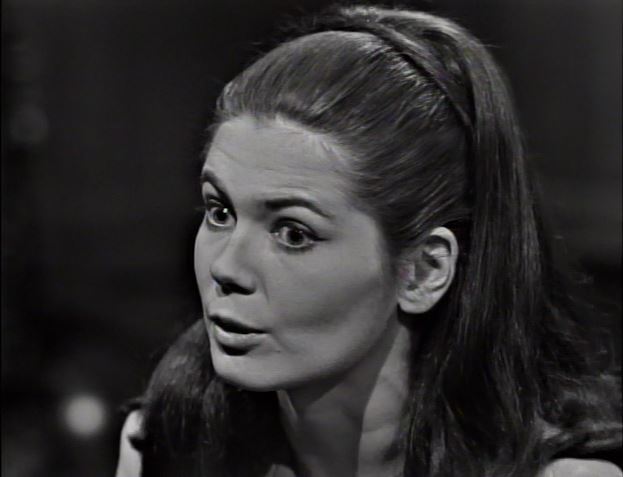
Vicki is at the Blue Whale. Harvey Keitel is gone, but Burke is still there, so she sits with him. He asks her why she joined him. She looks off into space and says “Inches, feet, miles.” He tells her she reminds him of a drink that fizzes and foams, but he isn’t sure what kind. He asks what she’d like to have for dinner. She replies “I’d rather go to your hotel room.” He flashes the same dopey grin any fellow would in this situation, and says “You amaze me, Miss Winters.”

Vicki is supposed to be a street kid from NYC, so we can assume she knows how to go about finding inches when she wants them, and that she’s no stranger to feet, either. Miles may be in short supply in the city, but she’s willing to learn. It turns out that all she wants from Burke is a look at the report his private investigator prepared about her. In the hotel room, she tells him what the audience knows about her origins and about Liz’s refusal to give a straight answer to the question of why she hired her. She looks through the report, and says it doesn’t tell her anything she didn’t already know. He orders two steak dinners from the hotel restaurant.

A knock comes on the door. It isn’t room service; it’s Joe, come to repay Burke for settling his bar tab. Joe is about to tell Burke he still doesn’t like him, when Vicki comes out of the bathroom. Joe excuses himself, startled to see her. Vicki goes a moment later, leaving Burke alone, waiting for two steak dinners.

I summed up my reaction to this episode in a comment on John and Christine Scoleri’s Dark Shadows Before I Die:

“Miss Winters, you amaze me.” Me too! Any woman as young and attractive as Vicki in a town as small and gossipy as Collinsport would be the scandal of the month if she went unchaperoned to a bachelor’s hotel room. When the woman lives with and works for the richest family in town and the bachelor is their sworn enemy, “indiscreet” isn’t any fraction of the word needed to describe her boldness.

Burke has time and again talked about how gossipy Collinsport is. For example, in episode 27, he seemed almost unhinged as he told his associate Bronson about how deeply secretive his investigations of the Collins family holdings would have to be, since anything that happens in or near the town of Collinsport is immediately known to everyone there. So we have to assume that he plans to get everyone talking about his evening with Vicki.

At this point in the show, we usually have to guess what Burke’s plans are, and even when they are revealed we can’t decide whether they are good or evil. In the case of his attempt to get rumors going about himself and Vicki, I think it’s a little more straightforward. He keeps telling her she should get away from the Collinses and leave town. If the Collinses think she’s involved with Burke, Vicki is very likely to find herself on a train back to New York. Maybe not to the Hammond Foundling Home- Burke might have a little apartment in the East Village where Vicki can stay until she finds something…

Episode 27: In your room

Vicki tells Carolyn that David was the one who sabotaged Roger’s car, which Carolyn accepts as fact almost immediately. The story does build a foundation for Carolyn’s reaction- she repeatedly calls David a monster, and has been guilt-stricken at the thought that she let Burke into the house to commit the crime. But it is also the first example of what will become the hallmark of all of Nancy Barrett’s performances on the show. Her characters are the first to throw themselves into whatever is going on. She comes to serve as a one-woman chorus backing whoever happens to be the protagonist at the moment.

Liz still refuses to face the facts about David. When Vicki finds David’s Mechano magazine in her underwear drawer with the page about hydraulic braking systems marked, she and Carolyn see it as evidence that David had access both to the drawer and to the technical information he needed to commit the crime. Liz sees it differently, saying in a distant, ghostly voice “It was in your room, Miss Winters.”

Liz’ ghostliness is highlighted strikingly earlier in the episode. In the upstairs hallway, Carolyn is chattering away about ghosts, both the metaphorical ghosts of current problems resulting from past conflicts and the literal ghosts that, she would have you know, most definitely exist. Vicki looks at the door to the rest of the house which inexplicably opened and closed itself a few episodes back, and gasps as it opens again. This time it’s Liz coming out, having looked for David in the closed-off wing. Liz is impatient with the girls’ talk of ghosts, but her manner and appearance as she enters through that door are spectral.

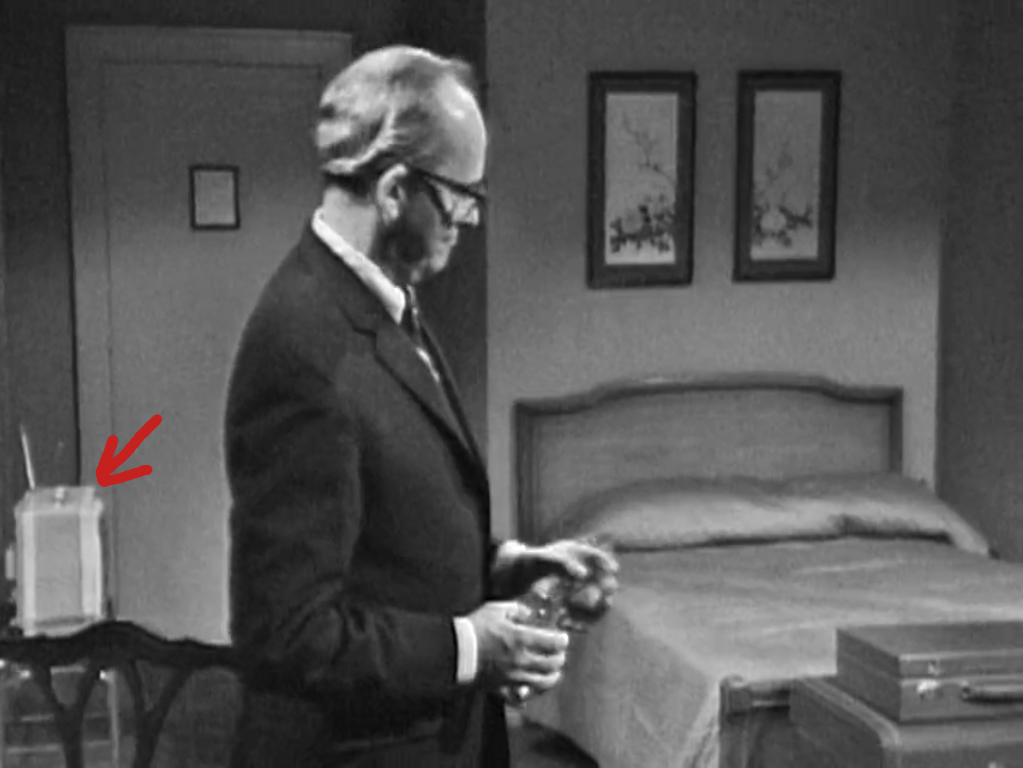
The other setting in today’s diptych is a hotel room in Bangor.* Burke is meeting a private investigator there. He’s giving him a tough assignment. He wants more information about the Collinses in less time than the investigator had originally expected. He also wants the job done in absolute secrecy, and if the Collinses catch wind of the project the investigator will suffer dire consequences. The investigator is played by Barnard Hughes, a highly accomplished actor, and his skills are needed. Burke is being harsh and unreasonable, and the investigator is being deferential. Hughes is able to give his character enough texture that he seems to be keeping his dignity. Without that, Burke would have come off as a bully. The audience has to like Burke, so Hughes makes an important contribution to the show in this, his only appearance.

There’s an irony to Burke’s hard-driving intensity. He’s looking for information to hurt the Collinses, while the women at Collinwood have information far more damaging to the family than anything he’s sending his man to look for. So we’re in suspense as to what he’ll do when he catches up to them.

*In a comment on Danny Horn’s Dark Shadows Every Day, “TD” points out that the hotel room in Bangor has a television set, the first such device we see on Dark Shadows. We will not see another until 1970. That one will be in a parallel universe. We never do see a TV set in the Collinsport of the main continuity.

Evidently Mr Bronson had the hotel send a TV up to his room.

Episode 25: A neat way of managing people

The episode revolves around a letter to Victoria from the Hammond Foundling Home. The letter reports that no one connected with the Home had ever heard of the Elizabeth Collins Stoddard or any of the other Collinses before the letter came offering Vicki the job as David’s governess. This letter has set Elizabeth into a panic, since it exposes as a lie her story that Roger was friends with someone connected to the Home and that that person had recommended her. It sets David into an even more extreme panic, since he is terrified that his father will send him away to some kind of institution where children are kept and the Hammond Foundling Home is such an institution.

In her panic, Elizabeth demands that Roger sit down with Vicki and corroborate her lie. Roger is worried that Burke, who has hired private investigators to look into Vicki’s background, will discover some piece of information that will damage the family, and wants Elizabeth to confide in him. He is insistent enough about this to raise the audience’s hopes that in some future episode, we will get answers about Vicki through dialogue between the two of them. For now, she shuts him down by threatening to throw him out of the house unless he obeys her.

When Roger does talk with Vicki, she reminds him that she had asked him if she knew anything about her or about the reason she was hired when they first met. He had said no, and in every way showed bafflement about how Elizabeth heard of her. He tries to explain that away by saying that he was distracted by worry about Burke, and tries to deflect further questions by saying that his contact is a donor who wishes to remain anonymous.

Vicki is obviously unconvinced. Alexandra Moltke Isles has strabismus, and in her closeups during the scene with Roger she turns this to her advantage. Her eyes seem to be moving independently of each other, a more polite expression than eye-rolling, but just as effective at communicating disbelief. Marc Masse captured the effect quite well in this still image, on his Dark Shadows from the Beginning:

Roger’s remark to Elizabeth in this line, that she has “a neat way of managing people,” applies equally well to Vicki in her scene with him. At the end of the conversation, she knows that he was lying, and he knows that she knows. She also knows that he is under his sister’s thumb, not a threat to her position no matter how uncomfortable he may find her presence on the staff, and he knows that she knows that.

David’s panic leads him to take a less devious path than does his aunt, but ultimately an even more disastrous one. He steals the letter from Vicki. His father catches him with it and returns it to her.

Vicki herself is less concerned with the letter than with a thought we saw take shape in the back of her mind at the end of episode 23. She asks David about the magazines on auto mechanics he likes to read, about how he learns to put things together and take them apart. David responds with a denial that he sabotaged his father’s car; Vicki calmly replies that she hadn’t accused him of that.

Vicki comes into the drawing room and tells Elizabeth that David has been acting strangely ever since his father’s car went off the road, that when the sheriff came he was overwhelmed with the thought that he would be arrested, etc. Elizabeth dismisses the topic brusquely, seeing no significance in it. Vicki persists in the topic, reminding her that the sheriff said they should try to think of someone other than Burke who might want to kill Roger. Elizabeth declares “There is no one else”; at that, Roger sashays into the room and declares “Except my loving son, of course.”

Elizabeth has even less patience with this remark from Roger than with whatever it is Vicki is saying, and moves along so that Roger can tell Vicki the lie she has ordained. In the course of that conversation, she again says that they don’t actually know that Burke was the saboteur, a point that is no more meaningful to Roger than it had been to his sister.

Afterward, she goes back to her room and finds that David has stolen the letter again. She goes to his room to look for it. She doesn’t find it. Instead, she finds the bleeder valve, evidence that her suspicions are correct.

Episode 23: The dignity of my badge

Roger has finally deigned to notify the police of his suspicion that Burke Devlin tampered with his brakes in an attempt to kill him. In story time, that was twelve hours ago. In the interim, both Roger and Bill Malloy have gone to Burke’s room and told him everything they know and think they know. Roger presented Burke with Vicki and her testimony. The newspaper has run a front-page story about it.

The sheriff is peeved that Roger is bringing him into it only now. Roger explains that his goal in giving Burke all the evidence in advance of any investigation was to persuade him to leave town, but that he never had the opportunity to present that idea to Burke.

Upstairs, Vicki is trying to teach David a lesson about the history of Maine. Considering that we learned in episode 13 that Vicki has never heard of Augusta, the capital of the state, it’s difficult to be optimistic about that instruction. But every scene between David and Vicki in his room is worth watching. No matter what lines they may be required to say, David Henesy and Alexandra Moltke Isles always use body language, facial expression, tone of voice, and spatial position to convey the emotions appropriate to their characters. As episode follows episode, those emotions shift from wild hostility on David’s part and patient solicitude on Vicki’s to genuine affection and trust. It’s the one story-line that really works in the first 42 weeks of the show.

David made some incriminating remarks to Vicki and his aunt the night of his father’s wreck; they both thought he was simply expressing his guilt over his hostility to his father. In this one, he asks Vicki if she ever tried to kill anyone. She tells a story of some fist-fighting she did at the Hammond Foundling Home, and says that’s as close as she got. She looks happy telling David that story, not because it’s a happy story, but because it’s a chance to make a connection.

She isn’t happy at the end of the episode- when David grabs at the bleeder valve and the other adults ignore his action, we see it dawn on her that he is the culprit.

I had a lot to say about this episode in the comments section of John and Christine Scoleri’s Dark Shadows Before I Die. Here it is:

I don’t agree that Constable Carter seems intelligent. He greets David by asking his name. If a cop has been on the job for over ten years in Collinsport, a town under the shadow of a big house called Collinwood, home of the the Collins Cannery and the Collins Fishing Fleet, and he still doesn’t know the four members of the Collins family, he’s an idiot.

Of course, he is sensible when he’s demanding to know why Roger waited twelve hours before coming to him and expressing incredulity at Roger’s visit to Devlin. Characters in soaps and suchlike productions are always declaring they have to do their own investigations before they can go to the police, and often this is treated in the story as if it were a reasonable thing to do. But every step of the way they’ve lampshaded the preposterousness of it. Vicki kept telling him it was a bad idea before he did it, last episode Sam reacted scornfully when he told him what he repeats to the constable here, that he wanted to give Devlin a chance to leave town and never come back. And the constable shows the same scorn for the idea today.

Those scenes make Vicki, Sam, and the constable look smarter than Roger, but we’ve seen enough of Roger to know that he isn’t a fool. Something is clouding his judgment, something more complicated and slipperier than the stories that have been suggested to us so far. Roger is hiding more than one thing, and he doesn’t trust himself with his own secrets.

David looks at the camera again today, when he’s eavesdropping on the conversation with the constable. An effective tactic- we the audience know what he knows, and he seems to be pleading with us to keep quiet.

Another meaningful look at the end of the episode. When the constable, who is an idiot, says cheerfully that now we’ll know how David’s fingerprints got on the wrench, Vicki gives David a grim little glance. Just for a second- but not only is it the last moment of the episode and therefore emphatic, it is also the second time we’ve seen her give David that look. The first time was in his room, when he was betraying himself with some remarks about how terrible it would be to go to prison. We can see a terrible idea starting to form in the back of Vicki’s mind.

Episode 21: “Carolyn’s mother is a witch.”

In the teaser, Carolyn asks Vicki what’s on her mind. “The meaning of life?” “No, just the opposite- death.” Exchanges like that go a long way towards explaining the appeal the show has to depressives. Casting makes a difference, too- actresses Nancy Barrett and Alexandra Moltke Isles seem to be far from death-obsessed, so they can deliver the most preposterously gloomy lines without boring the audience.

After the first break, Vicki and Carolyn are having breakfast in the kitchen. As it always does, that set creates an intimate atmosphere which makes it seem natural that the characters should share confidences. Carolyn confesses her feelings of guilt at having brought Burke to the house; Vicki confesses that she doesn’t believe Burke tampered with Roger’s brakes. For some reason, Vicki tells Carolyn that when she was six years old, an attendant at the foundling home played a prank and told her that her birth parents would be coming for her. All of Vicki’s stories about her childhood are like that, it’s no wonder she feels at home in Collinwood.

There’s a scene between Bill Malloy and Burke in Burke’s room. It’s always interesting to see actors as talented as Mitch Ryan and Frank Schofield playing off each other. It is puzzling that a Collins family retainer as loyal and intelligent as Bill would go to Burke before the police have a chance to question him or search his room and tell him everything he knows and suspects about the crime. But Roger has already tipped his hand to Burke, so another indiscretion isn’t going to damage the prospects of the prosecution by much. This scene, in which Burke is eating breakfast while Bill is confronting him with his suspicions, is intercut with the scene in which Vicki and Carolyn are eating breakfast and consoling each other. So, opposite extremes- former friends in a hostile setting, new friends in a nurturing setting.

Carolyn tells Liz that Vicki doesn’t think Burke is guilty. Liz responds that she doesn’t “care what Miss Winters thinks.” Liz then collapses into pity for Carolyn and guilt about herself as a mother. She remembers that when Carolyn was a child, she would come home from school crying because the other children taunted her, saying that “Carolyn’s mother is a witch.”

That’s an interesting story, because it implies that Carolyn went to the school in town. How did she get there? It’s much too far to walk. Did a school bus come up the hill to Collinwood to pick her up and drop her off? That’s a bit hard to imagine. Liz doesn’t want anyone around the place. Sooner or later, some adventurous child would slip off the bus with Carolyn and go exploring the grounds, no doubt finding a way into the house itself. Roger didn’t live there until recently, and Liz has never set foot outside the grounds since Carolyn’s birth. The only servant on the estate is Matthew, and he and Carolyn are not at all close, not as they would be if he’d taken her to and from school every day in her childhood.

That leaves Bill Malloy. He comes to the house more or less daily to go over business with Liz- perhaps he used to combine those visits with picking Carolyn up for school and dropping her off afterward. He is very close to her, calling her “Princess.” He’d have to pick her up very early in the morning, since his responsibilities involve supervision of the fishing boats. She might still have been in her pajamas. She’d have needed to get dressed and have breakfast at Bill’s house. We learn later that he has a housekeeper who has been with him many years; much, much later, that housekeeper will reminisce with Carolyn about brushing her hair for her when she was a little girl. So maybe that was it…

Vicki talks with Liz and Carolyn about the private investigator Burke has hired to look into her background. Liz doesn’t want to talk about anything that touches on how she heard about Vicki and what she knows about her, but by a skillful line of Socratic questioning, Vicki leads Liz to the conclusion that something about her origins might be embarrassing to someone associated with Collinwood. Liz walks out of the room, as Euthyphro walks out when Plato’s Socrates springs a similar trap for him, and we can see how smart and determined Vicki is.

Scenes that focus on the question of Vicki’s origins tend not to get much attention from fandom, perhaps because the whole story-line ultimately fizzled out with no resolution. But watching it forward, not thinking about what comes later, we can see some strong scenes devoted to it.

Episode 20: A mockery to the future

In episode 18, Roger (Louis Edmonds) had demanded Vicki (Alexandra Moltke Isles) come with him to Burke’s hotel room, where they will tell Burke (Mitch Ryan) about all the evidence they have connecting him to Roger’s car wreck. Vicki repeatedly protests in that episode that it would be better to take this information to the police. In this one, they arrive at the hotel, and again Vicki objects that they really should be going to the police. Roger, however, is a man obsessed. He asks Vicki to wait in the restaurant while he goes to Burke’s room, telling her that it may not be necessary for her to join him.

Sam (Mark Allen) comes to the restaurant looking for his daughter Maggie. Finding that Maggie isn’t at work, he invites himself to Vicki’s table. Their previous encounter had been a strange and frightening one on the top of Widow’s Hill; Vicki is no more comfortable with Sam now than she had been then. He bellows at her, she reacts with quietly frosty disdain. These attitudes may have less to do with the script or the direction than with Mark Allen’s limitations as an actor; he bellows all of his lines in this episode, and quiet frostiness is as effective a technique as any other for holding onto the audience while sharing a scene with an incompetent loudmouth.

There’s no incompetence in the scenes in Burke’s room. Louis Edmonds and Mitch Ryan were first-rate stage actors, and their confrontation is a terrific fireworks display. When Roger brings Vicki up to tell Burke what she saw him do in the garage, she again plays the scene quietly, an effective counterpoint to the artillery blasts the men have been letting loose.

In the Evans cottage, Sam finds that Maggie (Kathryn Leigh Scott) has been home all this time. When Allen bellows at her, Scott bellows back at him, a far less effective tactic than the quiet intensity Mrs Isles had used earlier. The scene has some potential- the situation is that an alcoholic finds that his adult daughter has been checking up on him, he resents it, and they have a fight about all of the ways in which she has been forced to take on the parental role in their relationship. But as a shouting match, it might as well be about anything, or about nothing.

Returning home after their confrontation with Devlin, Roger and Vicki say goodnight in the foyer. Time and again in these early episodes, people have urged Vicki to leave Collinsport while she still can. Even in this episode, Burke had told her that. But as they part ways for the night, Vicki to her bedroom and Roger to the brandy bottle, Roger tells her that as a witness, “you can’t leave now.”

That line is effective enough, but if the scene between Sam and Maggie had worked it would have been very powerful. The Evanses, father and daughter, are a case of two people who are trapped, trapped in Collinsport, trapped with each other, trapped with his alcoholism and her sense of obligation to keep him alive. As written, the scene could have brought all that out, and induced a claustrophobic sense in the audience that would have made Roger’s line feel like a death sentence. As ruined by Mark Allen, it just leaves us with the sense that we’re watching a show that needs some recasting.

Episode 15: I think he’s beginning to trust me

I left two comments about this episode on John and Christine Scoleri’s Dark Shadows Before I Die. A long one about its place in the overall development of the show’s stories:

This is a vitally important episode. The scene in David’s room is the first of many in which David Henesy and Alexandra Moltke Isles act their way out of weak writing to establish a relationship between two characters who can always make a connection with each other. Their body language, tones of voice, etc, triumph over some remarkably tedious dialogue to show us what people look like when they’re starting to trust each other. The growth of that relationship is really the only story that works in the first 42 weeks of the show. The big events involving characters we’ve only heard about or who will soon be recast matter insofar as they represent developments in that story, and other events don’t matter at all.

The scene that Liz and Roger play out in the drawing room while Vicki and David are talking upstairs is important in its own way. That these conversations are going on simultaneously is an example of the mirroring of Vicki and Liz that is such a strong motif in the first 42. Vicki is open and uncomplicated as she tries to talk David down from his superheated hostility to his father; Liz is guarded and double-minded as she tries to talk Roger back up to fear of Devlin. In the contrast between the two women, we see the difference between the innocent one with no past, and the frightened one with nothing but a past.

The contrast between father and son plays out in those scenes, and also in the two brief scenes between them. Roger’s narcissism renders him utterly childish, making no effort to take his son’s feelings into account or to understand Devlin’s motives. David’s fear and pain drive him to mimic adult behavior with absurd and indeed horrifying results. Liz tries to make Roger grow up, as Vicki tries to free David to be a child, but Roger’s inability to take anyone’s feelings but his own seriously dooms both efforts.

The moments between Liz and Vicki call for comment. Later on in the series, these characters will be stuck in many frustrating scenes where they inexplicably fail to pass on information that would resolve story points. At first glance, Vicki’s failure to tell Roger about Burke’s presence in the garage and Liz’s failure to pass the word of it on to him after Vicki tells her may seem to be the first of those failures. But Vicki has no reason to trust Roger, and very little to suspect Burke of wrongdoing. On what she’s seen of Roger so far, she can only assume that if she tells him what she saw he will jump to the most sinister possible conclusion and enlist her in his mad campaign against Burke. Liz seems relatively reasonable, at least on the topic of Burke Devlin, so by telling her Vicki is both satisfying an obligation and reducing the likelihood that she will be a party to slander. Indeed, Liz and Vicki tell each other quite a bit about themselves, much more than they will later on.

And a short one about a point that bothers many viewers:

Oh, and Liz’s failure to repeat Vicki’s news to Roger isn’t a problem. Liz is deeply preoccupied, and Vicki’s report wouldn’t be particularly interesting to anyone who hadn’t been watching the show.

Episode 14: We’re all pals again

We see David looking for a place to hide a small metal valve. He settles on Vicki’s underwear drawer. She catches him going through it; he runs off, and she finds nothing missing. She would apparently rather not think about what he was doing in that particular drawer. Later, he will claim that he was trying to slip a present into the drawer- a seashell, at first; then, a magazine.

Alone in the upstairs hallway, Vicki sees the locked door to the closed-off part of the house open and close, apparently by itself. At first, she thinks it’s David playing a prank on her, but he comes out of his room so soon after that there doesn’t seem to be any way he could have done it. The show has been using the idea of ghosts in episode after episode to suggest that something big is about to happen; now, for the first time, we see an event that is either a supernatural manifestation or an elaborate, Scooby Doo-esque hoax perpetrated by some unknown person for some unknown reason. So what she’s doing now- looking for David, trying to figure out what he’s been up to- is directly connected to something that is disturbing the supernatural back-world of Collinwood. It may be a while before the back-world erupts into the foreground, and even longer before it crowds out everything else and becomes the whole show. But that little valve represents the first irretrievable step on the path that will lead to what Dark Shadows became.

This is also the first episode in which Vicki gets to make someone laugh. Carolyn says that she and Joe will probably go to a movie, because “What else is there to do in this town?” To which Vicki replies “You could get into a fight in a bar.” It’s also the last episode in which Vicki is allowed to make a joke. Humorlessness one of the things that will eventually squeeze the life out of the character. Alexandra Moltke Isles delivers her one good joke well enough that it clearly could have been otherwise. Those of us who wish Vicki had stayed at the center of the show all the way through can’t help but feel sad that it wasn’t to be.

Episode 6: “Winters! Victoria Winters!”

Looking for David in the basement of Collinwood, Vicki encounters caretaker Matthew Morgan. No one has bothered to tell Matthew that a new person will be coming to the house, so he assumes she is a burglar and confronts her accordingly. Liz shows up, telling Matthew that Vicki belongs in the house and telling Vicki that she doesn’t belong in the basement.

In week one, Liz refused all requests for information about who Vicki was and why she hired her to be David’s governess. But at least she had told the other members of the household that Vicki would be coming. She hasn’t told even that to Matthew, notwithstanding the fact that, as she will explain to Vicki in this episode 13, Matthew is a “strange and violent man.” By taking the job and living in the house, Vicki, our point of view character, has made herself dependent on Liz; we the audience are also dependent on Liz, in that the stories in these first months all revolve around actions Liz will or won’t take. So it’s doubly unnerving that she is so very stingy with information.

George Mitchell, who plays Matthew here and in his next few appearances, is the sort of actor we often see in the first 42 weeks of the show. He is essentially a miniaturist, who builds a character one finely etched mannerism at a time. His successor in the role, Thayer David, worked at the opposite extreme, becoming the first exponent of the Dark Shadows house style of acting (often called “Go Back to Your Grave!” because of Lara Parker’s explanation of it.) Without that style, the show wouldn’t have become what it did in the period which people remember, so I can’t regret the recasting. But I do wish we could somehow see what it would have been like had George Mitchell carried the character through his whole arc of development. He could have played something I think Art Wallace could have written, a closely observed, sensitively explored psychological study.

There’s another what-might-have-been moment when Vicki tries to make friends with Matthew. He introduces himself to her with a gruff “Morgan! Matthew Morgan!” To which she replies, mimicking his down-east accent, “Wintahs! Victoria Wintahs!” It isn’t much of a joke, and Matthew isn’t amused. But it’s hard not to wonder what Vicki might have become if she’d been allowed to make the occasional joke as the series went on.

Episode 4: Frightening a new friend

Here’s the comment I left on the Scoleris’ Dark Shadows Before I Die blog entry about this episode:

Interesting how the early episodes tiptoe towards the supernatural. Burke, Roger, and Carolyn all use the word “ghost” metaphorically, to refer to unresolved conflicts from the past that are still causing problems in the present. Liz and Vicki, each in her turn, responds by saying there are no such things as literal ghosts, only to hear the first person assert that there absolutely are. Giving this same little conversation to both Liz and Vicki is one of the ways the show tries to establish Liz and Vicki as mirrors of each other, of presenting Liz’s current life as a possible future for Vicki and of Vicki as a revenant of Liz’s past.

The sobbing sounds Vicki hears in this one are the first occurrences that would have to be explained as the act either of a ghost or of someone trying to make Vicki believe there are ghosts. The next such moment will come in episode 14, and there will be several more in the weeks and months ahead. This tiptoeing is what the Dark Shadows wiki on fandom tracks as “Ghostwatch.”

In view of the near-sexlessness of the later years of the show, it’s striking how frank this one is. Roger’s aggressiveness towards Victoria is plainly sexual. Liz catches him trying to sneak into Victoria’s bedroom, he derides her attempt to regulate his “morals.” He offers Victoria a drink, they talk about pleasure and pain in words that so clearly about sex that they barely qualify as sens double. Indeed, that is the only moment in the whole series when Victoria seems like what she’s supposed to be, a street kid from NYC. And the flirtation between Uncle Roger and his niece Carolyn is so blatant that it’s a wonder how Louis Edmonds and Nancy Barrett keep the scene from making the audience either laugh or feel ill.