Episode 860: I just say things

Edward Collins isn’t what he seems. His stuffy manner is real enough, as are his kind impulses when he sees people in distress. But he allows those who meet him to believe that he is the heir to the vast Collins family fortune, which in fact belongs in its entirety to his sister Judith. Judith is currently an inmate in a mental hospital. During her absence, her husband, the odious Gregory Trask, exercises control of all the family’s assets. Edward hopes to get out from under Trask’s thumb by marrying the dowager countess of Hampshire, a young American woman named Kitty Soames. He befriended Kitty while a houseguest of the late Earl’s, and now that she is widowed and is his guest at the great house of Collinwood he sees an opportunity to take over the Hampshire interests.

Kitty isn’t what she seems. The Earl was bankrupt when he died. He had lost all his wealth and been driven to suicide by sorcerer Count Petofi. Kitty wrote a letter to her mother the other day saying that unless she marries Edward and becomes the mistress of Collinwood she didn’t think she could raise train fare from central Maine to her home in Pennsylvania. Nor is this all. If Kitty were simply without funds, she and Edward would be on an even footing. But she is not what she seems in a metaphysical sense as well as a financial one. She is intermittently possessed by the ghost of the late Josette Collins. Regular viewers have reason to believe that she is Josette’s reincarnation, and that the fits of possession are part of the process by which Josette is reuniting her spirit with her body. But the characters don’t know what we know. As far as they are concerned, Kitty seems to be a plain lunatic.

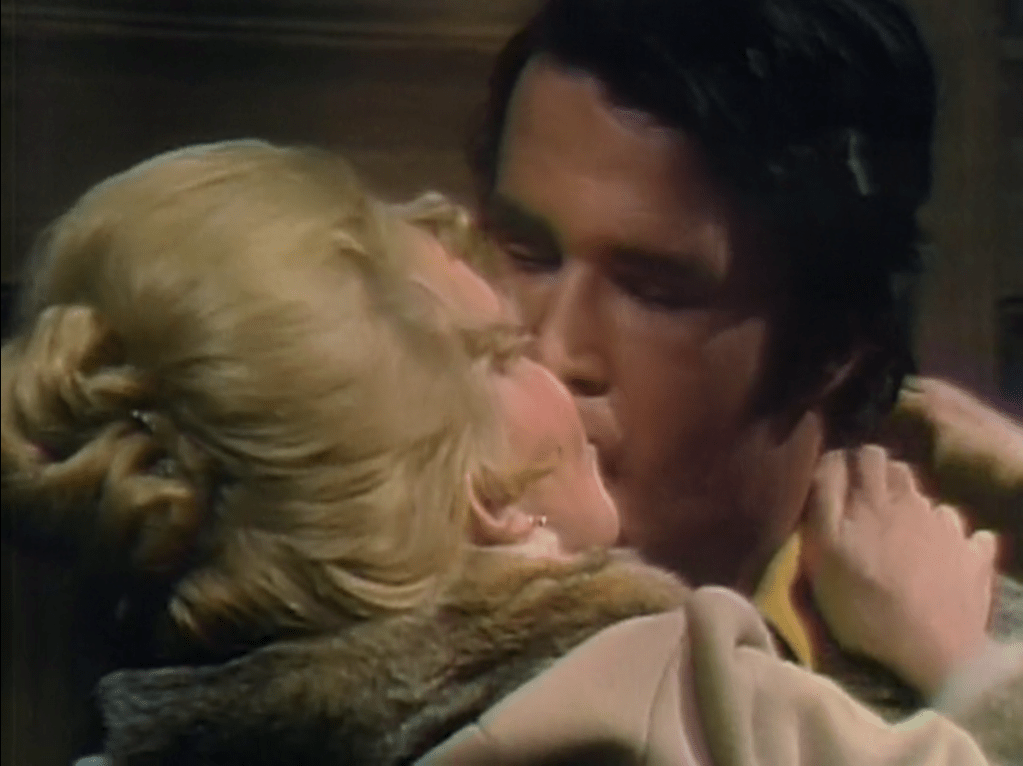
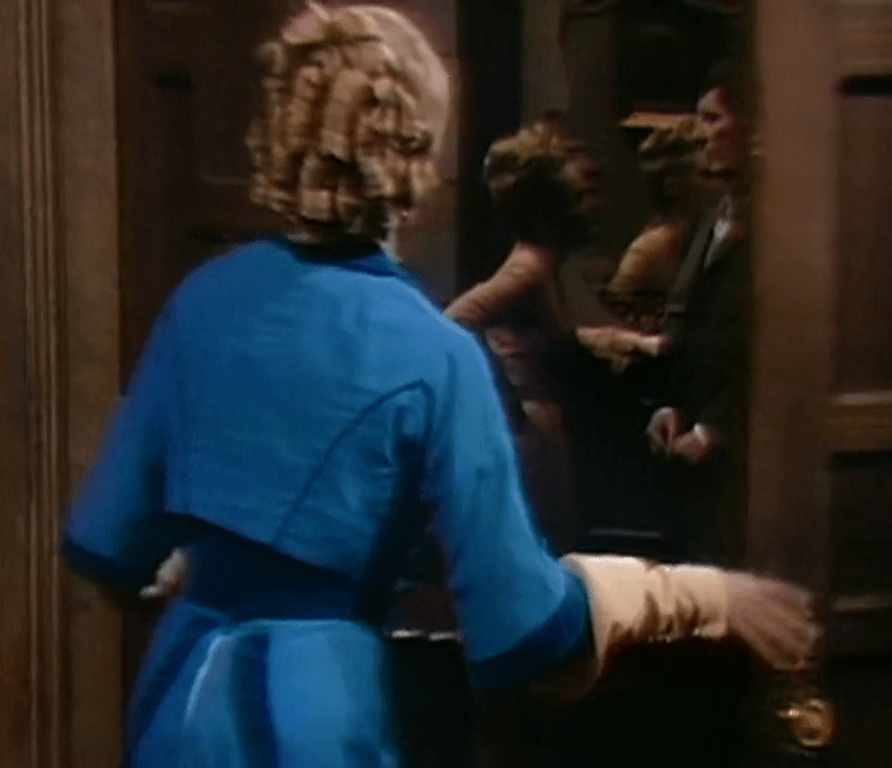
At rise, Edward catches Kitty in his brother Quentin’s room. She is rummaging through an armoire, apparently looking for something. He asks her what she is doing, and she feigns one of her fits. Kitty is not nearly as good an actress as Kathryn Leigh Scott; she doesn’t fool us for a minute. But Edward believes her. He gently escorts her out of the room. As they leave, we see a face peering at them from the shadows. It is Quentin’s face.

Downstairs, we hear Kitty’s thoughts as she takes satisfaction in having fooled Edward into thinking she was having a fit. Mental health professionals often talk about how people learn to use the resources they have, so that patients who carry diagnoses of major disturbances will sometimes find ways to exaggerate their symptoms for effect. It’s true that psychotic episodes are not usually an asset in the husband-hunting business, but everyone in the segment of Dark Shadows set in 1897 has some issue or other, and Edward really does have a soft spot for mentally ill women (unless they are married to Quentin, but that’s another thing altogether.) So Kitty may as well play up her particular case of dissociative identity disorder.

Kitty was in Quentin’s room trying to steal a portrait of him. She was doing this from her fear of Petofi, whom she believed to have ordered her to bring him the portrait before 9 PM lest he use his magical powers and make her vanish. It is almost that time now, and she has no idea how to find the portrait, let alone get it to him before the deadline. While she is worrying about this situation, a woman named Angelique enters.

Angelique isn’t what she seems. She is one of Quentin’s fiancées, and Edward takes her to be an innocent woman, about 30 years old, who has been hard done by in the course of the supernatural doings of the last several months. In fact, she is a wicked witch who wrought immense destruction the first time she was at Collinwood, in the 1790s, and again the second time, in 1968. She has traveled back in time to 1897, and has been one of the most powerful participants in all of the strange goings-on.

Kitty tells Angelique that she saw Petofi in the vacant rectory on Pine Road, and that he told her the woman who had been squatting there vanished into thin air before his eyes. At this, Angelique turns and rushes off to investigate. It dawns on Kitty that Angelique knows more than she is saying. We cut to the drawing room, where Edward is bracing for a conversation with Quentin.

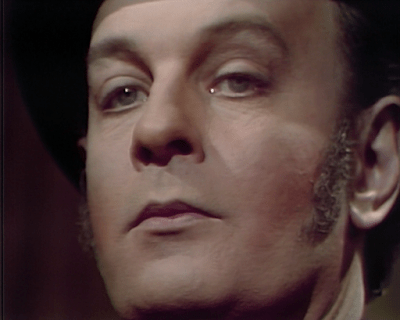
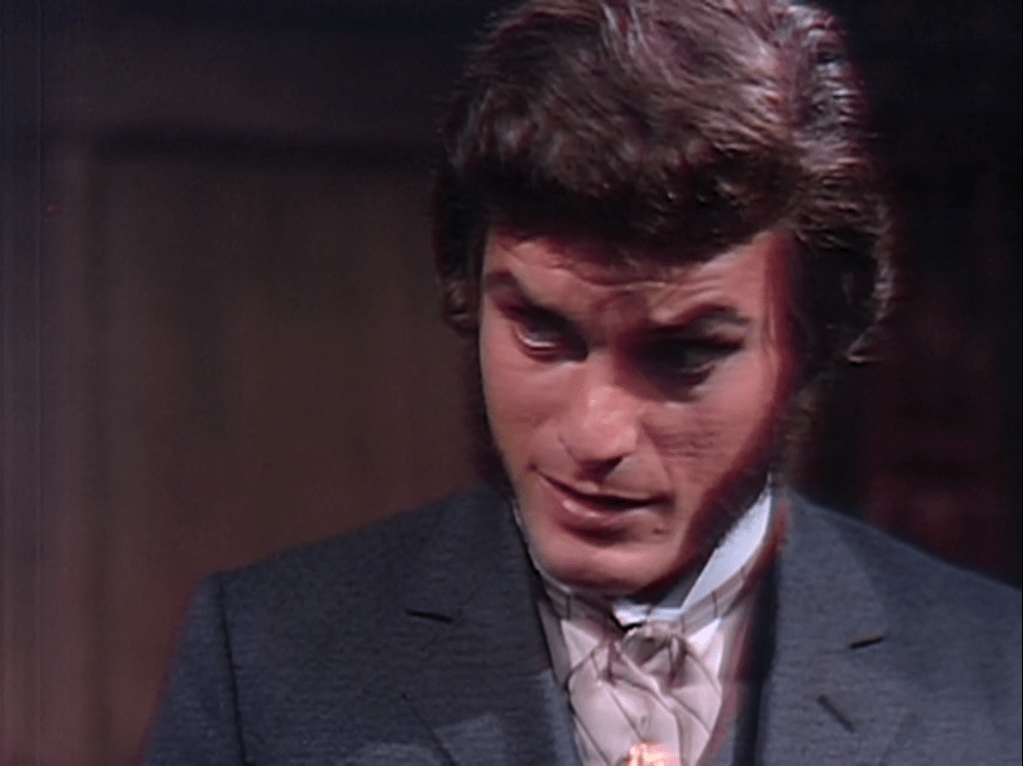
Quentin isn’t what he seems. In fact, he isn’t Quentin at all. Petofi forcibly swapped bodies with him a few days ago. It is Petofi, using Quentin’s body as a disguise, who confronts Edward and demands to know what he and Kitty were doing in the room. I refer to this form of Petofi as Q-Petofi, and the Quentin who looks like Petofi as P-Quentin.

Q-Petofi confronts Edward. Screenshot by Dark Shadows Before I Die.

Edward tells Q-Petofi that Kitty had had a “seizure.” Q-Petofi expresses skepticism about this claim. He proceeds to tell Edward that Kitty’s late husband died in poverty, shortly after being released from prison for a jewel theft. Edward is thunderstruck. He calls the story a lie, and forbids Q-Petofi from repeating it to anyone.

Kitty goes to the village of Collinsport, and pays a visit to The Blue Whale, the local tavern. She wants to see the entertainer, Miss Pansy Faye.

Pansy isn’t what she seems. She has met the Collinses twice. Miss Charity Trask, daughter of Gregory and enforcer in his operation, came to the great house in #727 and took up residence when her father married Judith. Pansy Faye, mentalist and Cockney showgirl, came to the estate in #771 as the coldly cynical fiancée of the childlike Carl Collins. Pansy was killed the night she arrived. A few weeks later, Pansy started to take possession of Charity, and in #819 Petofi erased Charity’s personality altogether and gave her body over to Pansy.

When Kitty enters, Pansy is alone in the bar. She is picking out her theme song on the piano. When Petofi was in the process of switching bodies with Quentin, Quentin was with Pansy in this room. Petofi took control of him briefly and played the same song on this piano. He played it very impressively.

Kitty is desperate to find out what is happening to her, and she knows that Pansy has powers. Once Pansy assures her that she doesn’t work for Count Petofi, Kitty offers her a diamond-encrusted brooch in return for information. Pansy is offended. She says that she will take a gift in return for her services after she has rendered them, but that she does not accept payment in advance. She tells Kitty that there is one way to find out what is happening to her, which is to have a séance. Kitty gets up to leave, and Pansy presses the brooch on her.

The diamond brooch is a puzzle. Perhaps Kitty was lying to her mother when she said that she couldn’t buy a train ticket to Pennsylvania? Or perhaps the brooch is part of the late Earl’s ill-gotten gains, and Kitty doesn’t want to show it to anyone more reputable than Pansy.

Nancy Barrett’s approach to all her roles on Dark Shadows was to throw herself completely into whatever the character was doing at any given moment. That isn’t to say that her performances lacked nuance or that she didn’t support her scene partners, but that her method was to take her part from the outside in, letting the action supply the motivation. As Kitty, Miss Scott has opportunities to take this same approach. But in Kitty and Pansy’s scene in the Blue Whale, she deliberately lets Miss Barrett drive the action. Since Pansy has already completed a process of possession and transformation like that into which Kitty is now entering, Miss Scott can convey a great deal of information about Kitty’s state of mind by giving rather subtle reactions to Pansy’s behavior.

Back at Collinwood, Edward and Q-Petofi are drinking. Edward shakes his head at his brother’s ability alternately to enrage him and charm him. Q-Petofi asks him to be the best man at his wedding to Angelique; Edward agrees at once. Angelique enters, and Edward exits.

Angelique says that she doesn’t want to get married after all. Q-Petofi insists they go ahead. She points out that it was her idea, and he was extremely reluctant to agree to it. This is true- the engagement was part of Angelique’s price for invoking the power of Satan to break spells Petofi had cast on Edward and his son Jamison. While Q-Petofi has managed to copy Quentin’s behavior towards Edward almost exactly, his behavior towards Angelique has been radically different than was Quentin’s. We don’t know what Angelique has made of this.

Edward finds Kitty and Pansy preparing the séance. After an initial protest, he declares he will join them. It ends with a visual quote from Dark Shadows‘ first séance, back in #170. As in that episode, a hooded figure appears in the doorway.

The hooded figure in #170 turned out to be undead blonde fire witch Laura Murdoch Collins. Another iteration of Laura was on the show as Edward’s estranged wife in April and May. It seems unlikely she is coming back, so longtime viewers are in suspense as to the significance of the allusion.

The hooded figure today is Natalie Norwick, making the last of her seven appearances as an uncredited stand-in on Dark Shadows. Norwick was in many plays on Broadway, as the lead in more than one, appeared in three feature films, and worked steadily in television from 1945 until the mid 1960s. She retired from acting in 1982, returning to the Broadway stage as understudy to her friend Julie Harris in 145 performances of The Gin Game from 1997 and 1998 when she was in her mid-70s. When Harris had a fall in 1999, Norwick took over the part, playing it in Florida and Washington, DC. She was chiefly based in Los Angeles in the late 1960s; perhaps she took the stand-in work to pay some bills during visits back east.

Norwick is best remembered for a single supporting performance on television in 1966. She appeared in “The Conscience of the King,” an episode of the original Star Trek, as Martha Leighton, the wife of Captain Kirk’s troubled friend Tom. She didn’t get much screen time, but she made the most of it. After Tom is murdered, she plays Martha’s understated reaction with a quietness that startles you no matter how many times you’ve seen it. Norwick is another of the significant talents one wishes Dark Shadows had found more to do with.

Episode 858: Despite all appearances

Sorcerer Count Petofi has forced the devastatingly handsome Quentin Collins to trade bodies with him. So Thayer David is now playing Quentin, a forlorn and helpless figure who goes around begging people to listen to his lunatic story, while David Selby plays Petofi as a gleefully cruel young man who takes advantage of all the pleasures available to Quentin. I will refer to Thayer David’s character as P-Quentin and David Selby’s as Q-Petofi.

Q-Petofi goes to Beth Chavez, who used to be a maidservant in the great house of Collinwood and is now one of Quentin’s fiancées, more or less. Beth is in what she identifies as her room. It looks very much like the set that represented her room in the servants quarters of Collinwood, but it is explicitly stated that this room is somewhere else. Maybe she took it with her as part of her severance package.

Beth is terrified of the count, whose slave she was for a while after she left Collinwood. P-Quentin manages to get her to take note of his words, though she seems sure that what he is saying is another of the count’s tricks. He tells the story of how twelve year old Jamison Collins found her about to commit suicide because of what his Uncle Quentin did to her and has refused to speak to him since. He pleads with her to go to Collinwood and see if the man who appears to be Quentin knows the same story.

Beth does go, and she does put Q-Petofi to the test. He has no idea what she is talking about, and tries to bluff his way out by saying that Jamison’s estrangement from him is too painful to discuss. He then yells at Beth, declaring that he knows the count put her up to asking him about Jamison. That means that he and Beth both know that he failed the test. Beth might become P-Quentin’s first ally. Unless, that is, Q-Petofi kills her before she can- there doesn’t seem to be anything stopping him.

P-Quentin does have other potential allies. One is Julia Hoffman, MD. A mad scientist from the twentieth century, Julia followed her friend, vampire Barnabas Collins, after he had traveled through time from the year 1969 here to 1897. An experimental treatment briefly freed Barnabas from the effects of vampirism in the spring of 1968; when she arrived from the future, Julia began trying to replicate that treatment. Most people now think that Barnabas has been destroyed, staked in his coffin in #845. But in #849 we saw that Julia was still working on the treatment, and in #853 someone named Kitty Soames barged into Julia’s hiding place and, possessed by the ghost of Barnabas’ lost love Josette, identified the room where Barnabas was hiding. Quentin, at that time still occupying his own body, was with Kitty at the time and realized that she was right. This alarmed Julia, because even though she and Barnabas regarded Quentin as a friend, they knew that he was already under Petofi’s influence and could not be trusted to keep a secret from him.

Another person who might come to P-Quentin’s aid against Q-Petofi is Angelique, the wicked witch who made Barnabas a vampire in the first place. At this point in 1897, Angelique is another of Quentin’s fiancées. Resenting Petofi’s influence over her prospective husband, she met with Julia in #842 and devised the plan they have been following since. Angelique has a couple of scenes with Q-Petofi in the drawing room at Collinwood today; she notices that his behavior is very different from what Quentin’s has been, but does not suspect that it is Petofi’s mind behind the face.

Angelique calls on Julia in her hiding place. Julia keeps hearing some sound effects we last heard during The Experiment, a storyline that ran through May and June of 1968, when she was building a Frankenstein’s monster in order to permanently cure Barnabas’ vampirism. She describes them as sounding like wind. Angelique cannot hear them, nor can she hear the voices which Julia also hears. When Julia recognizes the voices as occult expert Timothy Eliot Stokes and sarcastic dandy Roger Collins, she realizes that they are coming from 1969. The reason she can hear them and Angelique cannot is that she has a physical body in that year, while Angelique is all here, in 1897. Julia tells Angelique she cannot stay in 1897 much longer, and Angelique agrees to take over her part in what remains of their plan.

After Angelique has left her alone, Julia finds that Stokes and Roger can hear her if she shouts. This only lasts for a moment. The sounds fade, and she loses the connection altogether.

P-Quentin comes to Julia’s place. Thinking he is Petofi, she declines to speak to him. He insists he is Quentin. When he tells her some information they had shared privately, she decides he is telling the truth and starts calling him Quentin. In fact, she calls him “Quentin, Quentin,” as she often calls Barnabas “Barnabas, Barnabas.” She is about to tell him the next steps of the plan when she vanishes.

The lady vanishes. Screenshot by Dark Shadows Before I Die.

The first time traveler we saw vanish in this way was an unpleasant man named Peter Bradford whose personality largely consisted of yelling at people that he preferred to be called “Jeff Clark.” Peter/ Jeff was from the 1790s, but tried everyone’s patience for much of 1968, when the show took place in a contemporary setting. He faded away, returning to his own time, in #637. We didn’t hear any sound effects before he disappeared. The Experiment was still very fresh in our minds at that point, so the sound effects we hear today would not have been available, and besides, no one cares what the world sounds like to Peter/ Jeff. It was just a relief that he was finally gone.

Julia is as appealing a character as Peter/ Jeff was repellent, and it’s sad to see her go. We’ve had some signs lately that the 1897 segment will soon be ending, but we’ve had those signs before, and they’ve kept restarting it. If Julia isn’t coming back to this period, we can only hope that if it goes on much longer, they will find a way to intercut episodes set in 1897 with others set in 1969, where we will be able to spend time with her.

Episode 853: Strange and horrifying spirits

Kitty Soames, a young American woman who is the dowager Countess of Hampshire, is gradually turning into Josette DuPrés, who has been dead for 101 years. Kitty is staying at the great house on the estate of Collinwood. Also among the houseguests is Angelique, the immortal, time-traveling wicked witch who was responsible for Josette’s death.

Kitty has been getting information about Angelique, apparently from Josette’s ghost. She interrogates Angelique’s fiancé, rakish libertine Quentin Collins. Quentin does not give her any useful information about Angelique. When Kitty asks if Angelique has ever lived in England, Angelique herself enters and says that she has not. Kitty asks Angelique if she was ever a servant. Angelique made it quite clear yesterday that she knows perfectly well what is happening to Kitty, but she regards the transformation as a nuisance and does not want to help it along. She chooses to pretend that Kitty is being a snob, and says that Quentin is not marrying beneath his station. With that, Kitty has nowhere to go but back to her room.

Angelique has made an alliance with Julia Hoffman, MD, a fellow time-traveler from the late 1960s. Julia followed her friend and the object of Angelique’s lunatic obsessions, vampire Barnabas Collins, to 1897. Barnabas is now believed to have been destroyed, but we’ve already seen that Julia is continuing work replicating the experimental procedure that put his vampirism into abeyance for a little while in the spring of 1968. Today, Angelique brings some medical supplies to Julia in her hiding place, and Julia asks if she can come a little earlier the next day.

The two women sit down and have a friendly chat. Longtime viewers will find this breathtaking. Angelique was at Collinwood in 1968, wearing a black wig, calling herself Cassandra, and functioning as Julia and Barnabas’ bitterest enemy. Now that Angelique has turned to Quentin and has let go of her drive to dominate Barnabas, she and Julia have made an alliance against sorcerer Count Petofi. Their animosity set aside, they can commiserate about the difficulty of a life yoked to Barnabas.

“Ugh, vampires, all the good ones are either obsessed with recreating their dead ex or gay.” Screenshot by Dark Shadows Before I Die.

Angelique wants to liberate Quentin, whom Petofi has enslaved. Julia is horrified today when Kitty, in Josette mode, bursts into her hiding place and demands to see Barnabas. Quentin follows her in and hears her ask why she is keeping Barnabas in the next room. Neither Kitty nor Quentin believe Julia when she keeps insisting that Barnabas is no more. If Quentin knows that Barnabas is still around, Petofi will soon know it as well, and that can only be bad news.

Petofi is not content keeping Quentin as a slave. He wants to abuse him even more totally. We saw the other day that Petofi wants to swap bodies with Quentin as his means of escaping from his deadly enemies, the Rroma people. Petofi visits Quentin in the drawing room at Collinwood this evening and gives him a scalp massage. Quentin notices Petofi’s ring, and agrees that he would like a new life. He falls asleep, then wakes up to find Petofi’s ring on his finger. To his alarm, he cannot take it off. My wife, Mrs Acilius, called out to the screen to suggest he spray some Windex on his finger, but that wasn’t invented until 1933 and the dramatic date is 1897. Presumably the transfer of the ring is the first step towards Quentin’s eviction from his own body and his replacement in it by Petofi.

Closing Miscellany

Danny Horn’s post about the episode at his great Dark Shadows Every Day is a study of Kathryn Leigh Scott’s facial expressions. His thesis is that Miss Scott is imitating Grayson Hall, who plays Julia. Later in the series there will be a moment when Miss Scott imitates Hall in a scene they play together; Hall’s reaction then will be hilarious.

Kitty sees the portrait of Barnabas Collins hanging in the foyer on the spot by the front door. She Josettifies and becomes fascinated by it. Stuffy but lovable Edward Collins had the portrait removed when Barnabas was exposed as a vampire some time ago, and is shocked to find that it has returned. Presumably whatever supernatural agency is Josettifying Kitty put it there. Longtime viewers, who remember how active Josette’s own ghost was at Collinwood before Barnabas first appeared on the show, will think she is the likeliest suspect.

When Kitty/ Josette is kneeling beside the grave of Josette’s husband Jeremiah Collins (spelled “Jerimiah” on the marker,) Edward shows up and tells her that she was married, not to Jeremiah, but to the late Gerald Soames Earl of Hampshire. That was the first time it dawned on me that both Josette and Kitty married guys named Jerry.

Angelique’s intrusion into the scene between Quentin and Kitty might have been more effective if the camera hadn’t swung wide and shown her standing outside the door waiting to make her entrance. We don’t see Angelique eavesdropping, but Lara Parker standing well upstage waiting to make her entrance.

Episode 852: All kinds of spells on people

From November 1967 to March 1968, Dark Shadows was set in the 1790s. The cast included Kathryn Leigh Scott as the gracious Josette, Louis Edmonds as haughty overlord Joshua Collins, and Lara Parker as wicked witch Angelique. Now, the dramatic date is 1897. Miss Scott plays Kitty Soames, an American who went to England to be a governess, married the Earl of Hampshire, and is now widowed, penniless, and scheming to land another rich husband. Edmonds takes the role of stuffy but lovable Edward Collins, who is the focus of Kitty’s ambition. Parker is still Angelique, who is both immortal and a time-traveler.

Ever since arriving at the great house of Collinwood in #844, Kitty has been having psychological breaks during which she acts like Josette. She therefore appears to be suffering from a severe mental illness, an impression which would tend to get in the way when trying to win a new spouse. Today these breaks take a new turn.

Kitty is walking in the woods on the grounds of Collinwood when she is overwhelmed by the sense that she is being watched, and furthermore that the person watching her knows her well and wishes her ill. She runs into the house and flings herself at Edward, describing this paranoid episode to him. Edward has only begun to talk her down when his brother, rakish libertine Quentin, enters with his own fiancée. The fiancée is Angelique.

Edward is about to introduce the two ladies, who have never met. Before he can do so, Kitty becomes Josette. In Josette’s voice, she denounces Angelique. She then grabs her by the throat and vows to kill her for what she has done.

Angelique was responsible for the deaths of Josette and many others at Collinwood in the 1790s, and has been obsessively hostile to her throughout the centuries. When she was first conjured up from Hell to be part of the 1897 segment in #711, she went to the Old House on the estate, looked at the portrait of Josette that hangs over the mantel in the front parlor there, and declared “I am Angelique and I hate you!” During her lifetime, Josette was oblivious to Angelique’s enmity. She knew Angelique as a lady’s maid in service to her aunt, and regarded her as a close friend. But on Dark Shadows, death is a learning opportunity, and we see today that when she is animated by Josette’s spirit Kitty knows everything Angelique hid from Josette when she was alive.

Edward and Quentin separate Kitty and Angelique. In a private conversation with Quentin, Angelique makes it clear to the audience that she knows exactly what is happening with Kitty, and that she regards it as a minor nuisance. Quentin has troubles of his own, and doesn’t ask for an explanation.

Meanwhile, Kitty and Edward have a private conversation of their own. Edward tells Kitty that she is just upset because of her late husband’s death, and assures her that he will help her recover. She flashes a cunning smile at the camera. Well she might- not many people are so good at attaching themselves to rich guys that they can turn a psychotic episode to their advantage.

Kitty takes satisfaction in a job well done. Screenshot by Dark Shadows Before I Die.

Kitty has a dream in which Angelique is her servant and is addressing her as “Mademoiselle.” In the dream, Angelique delivers an arrangement of flowers and a book of poetry that Josette’s fiancé wants her to have before their impending wedding. When she wakes up, Kitty finds the arrangement and the book by her bedside, and she realizes that what is happening to her is not simply a mental aberration.

The dream will puzzle new viewers, even those who know that Angelique was a servant in Josette’s household. When Angelique is busy being Evil, she often laughs a maniacal laugh that breaks in the middle with a sharp intake of breath. She keeps doing this throughout the dream, which doesn’t fit at all with the action of bringing a present from a lover. She also tells Josette that her happy life is of the sort that makes the gods jealous, and speaks the lines with an undisguised and exaggerated hostility that leads into another gale of maniacal laughter. People who have joined the show in the last year will wonder why Angelique is being so crudely obvious.

Lara Parker used to say that she didn’t really learn to act until Humbert Allen Astredo joined the cast of Dark Shadows in June 1968. She’d taken acting classes and appeared in plays and so on, but it wasn’t until Astredo explained acting techniques to her while they were rehearsing that it all clicked in her head. You really can see a sudden improvement in her performances at that time. The dream Josette transmits to Kitty’s mind takes her to a time, not only when Angelique was a servant, but when Lara Parker was not a particularly good actress. The contrast between the reliably capable professional we see in most of the episode and the often bombastic student who appears in the dream makes us appreciate just how far she came in a short time.

Episode 851: Common cause

Rakish libertine Quentin Collins races to the train station to meet his fiancée, the lovely and mysterious Amanda Harris. He thinks he sees her, but it is actually another young woman wearing a remarkably similar outfit. She tells him the train to New York City left a few minutes ago; Quentin knows Amanda was on it, and that she thinks his absence means that their relationship is over. The young woman was quite miffed when Quentin first approached her, but by the time he offers his second apology her look has gone from indignant to concerned to yearning. The guy’s got game, you have to grant him that.

It’s been less than a minute since he made a bad first impression on her, and she’s ready to run off with him. Screenshot by Dark Shadows Before I Die.

Quentin was detained by a fistfight with a repulsive little man called Charles Delaware Tate. Tate is an artist whose works sometimes have magical powers. His portrait of Quentin, for example, keeps Quentin from turning into a werewolf and ensures him against physical harm. Since Tate is obsessed with Amanda, he stole the portrait from Quentin when he learned Amanda was planning to leave with him. Quentin dared not leave without it, and went to Tate’s studio to demand its return. He very satisfyingly beat Tate senseless, but he did not find the portrait, and now he fears he has lost Amanda forever.

We cut to Tate’s studio. Tate is lying on the floor where he fell when Quentin finished hitting him. Unfortunately, he gets up. Sorcerer Count Petofi, who granted Tate the power to make magical artworks some years ago, enters. He tells Tate that it was stupid to steal Quentin’s portrait. Tate pretends not to know what Petofi is talking about, irritating him and us. Petofi says that he will have to be punished. After he forces Tate to draw a sketch of a pretty woman, he squeezes his wrists, helps himself to Quentin’s portrait, and says what sounds very much like a final goodbye. He exits, and Tate sits down with his pad and pencil. He discovers that he is no longer able to draw, not even a straight line.

These days, Dark Shadows is a costume drama set in 1897. Most of the time between 1966 and 1968, it took place in a contemporary setting. In those days, the set now used as Tate’s studio was the Evans cottage, home to artist Sam Evans, a drunken sad sack, and his daughter Maggie, The Nicest Girl in Town. In December of 1966 and January of 1967, the ghost of the gracious Josette compelled Sam to paint alarming images of Laura Murdoch Collins.

It turned out Josette was doing this because she knew the characters were not all that bright and she had to literally paint them a picture to explain that Laura was an undead fire witch bent on incinerating her young son David. Laura tried to thwart Josette’s plan by harming Sam. In #146, Laura caused a fire at the Evans cottage that burned Sam’s hands, temporarily depriving him of the ability to paint. Petofi’s disabling of Tate on the same set will bring this incident back to longtime viewers. Especially so, since Josette is in the air at this point in the show. In #844, a character named Kitty joined the cast. She keeps having mental flashbacks to things only Josette would remember, and Josette’s music box appeared on Kitty’s table at a time when Josette’s ghost seemed to be the likeliest agency to have put it there. Perhaps she will insert herself into Tate’s story for some reason.

When we were watching the scene between Tate and Petofi, my wife, Mrs Acilius, said that she very much wished someone else were playing Tate. Violet Welles’ script gives whoever is playing Tate a lot of opportunity to show what he can do in that scene. Roger Davis is a highly trained actor who has a long list of stage and screen credits, but he is almost always very unpleasant to watch on Dark Shadows, and he wastes the potentially fascinating dialogue Welles gave him. When Mr Davis is particularly trying, I usually try to make the scenes bearable by imagining what Frederic Forrest, who was a featured background player in #137, would have done in his place. But the echo of the story about Sam makes me wonder what David Ford would have done as Tate. Ford was in his forties, smallish and pudgy, so a David Ford Tate could not believably have had a fistfight with a character played by the very tall and fit 28 year old David Selby. But he might have been a subtle enough villain that such an exchange would not have been called for. Moreover, the incestuous undertone of Tate’s desire for Amanda, who is the product of one of his magical paintings and therefore a kind of daughter to him, would have been all the more disturbing had Tate been played by the man we knew as Maggie’s father in the 1960s and, when the show was set in the 1790s, as Josette’s.

Back home at the great house of Collinwood, Quentin receives a visit from Tim Shaw, Amanda’s ex and a would-be sleazy operator. He demands Tim tell him what he knows about Amanda’s life in New York before they came to Collinwood. Tim declares he will tell him nothing, to which Quentin responds by choking him and flinging him to the floor. Tim then burbles out everything he knows, which turns out to be nothing of the slightest use. Quentin picks Tim up and throws him out the front door in the most humiliating possible way. We cheer this on almost as joyously as we cheered Quentin’s beating of Tate Friday, but for the opposite reason. Mr Davis is a genuinely disagreeable person who ruins episode after episode, and it was him we were angry with. We chanted at the screen, not “Quen-tin! Quen-tin! Quen-tin!,” but “Da-vid! Da-vid! Da-vid!” hoping Mr Selby would pay him back for all his on-screen assaults on the women and children in the cast. But Don Briscoe was as nice a guy as Tim has become despicable, and he and Mr Selby enjoyed working together. You can see Briscoe’s joy in performance in the way he holds on to a little yellow piece of paper representing a note from Amanda all through the beating Quentin administers. Even the shot of Quentin shoving Tim out with his buttocks prominent is the product of Briscoe’s enthusiastic use of his body to demonstrate Tim’s total defeat.

Quentin throws Tim’s sorry ass out the door. Screenshot by Dark Shadows Before I Die.

Quentin’s other fiancée, wicked witch Angelique, comes downstairs to ask what the ruckus was about. Quentin makes up a transparent lie about having a financial interest in some firm in Boston, and says that he and Tim were quarreling about the details of it. Angelique lets him go on with this for a while and to say that he is leaving for Boston, then insists that they set a date for their wedding. He begs off, claiming not to know how long he will be away.

Petofi enters, and tells Angelique about Quentin’s plan to go to New York and look for Amanda. He also tells her that they now have a common cause, and proposes an alliance. Each of them is so powerful, and so evil, that this is a sobering prospect.

When Quentin returns to the foyer, it is his turn to be alone with Petofi. Quentin knows that Petofi gave Tate both the power to create the portrait that freed him of his curse and the commission to do so, and that he is therefore beholden to Petofi for his continued humanity. Part of his motivation for fleeing to New York with Amanda was his hope that he could escape the slavery Petofi has imposed on him as the price of that benefice. When Petofi tells Quentin he has come to see him before he goes, Quentin is momentarily stunned, and then makes a brave little noise to the effect that Petofi can’t stop him. Petofi assures him that he does not want to stop him. It doesn’t matter in the least to him where Quentin is- he can control him from anywhere.

Petofi calls on Tim at his room in the inn. He deepens Tim’s misery by pretending he doesn’t believe what Tim told him about Tate’s magical powers. As he leaves, he takes a brooch that belonged to Amanda.

Quentin is at the train station. Angelique appears there, and tells him not to go. He says that he doesn’t care if she kills him. It will be consolation enough to have died walking away from her. She says that she will not harm him in any way. This causes him to open his eyes wide in terror as it dawns on him what she means. She produces Amanda’s brooch and a doll. She positions the pin of the brooch over the doll’s chest and says that no matter where Amanda is, she will die a horrible death when the pin impales the doll.

Closing Miscellany

The actress who plays the young woman Quentin meets at the train station is billed in the credits as “Amy Yaekerson,” the only person known to Google ever to be called “Yaekerson” and known only for this appearance. But in a comment on Danny Horn’s post about the episode at his great Dark Shadows Every Day, a commenter known as “miles” pointed out that there are lots of people named “Yakerson.” He went on to identify an Amy Yakerson born in New York City on 1 April 1946, and to find a 1966 notice of a play featuring an actress of that name and probably of that age in the New York Daily News. I followed that up with some Googling of my own; the only Amy Yakerson I can find who is online today was born in Connecticut in 1954, so I don’t know where Amy Yakerson, star of stage and screen, is now.

We saw some of Sam’s paintings in Tate’s studio Friday and today, twenty-some years before Sam was born. Tate hides the portrait of Quentin behind one of Sam’s seascapes, and Sam’s portrait of Maggie’s mother is on the floor next to him when we see him lying there in the aftermath of the fight. John and Christine Scoleri have the details in their post about Friday’s episode at Dark Shadows Before I Die.

Episode 847: Some new and astounding piece of information

Julia Hoffman, MD, has followed her friend, vampire Barnabas Collins, on an uncertain and frightening journey into the past. They are now in the year 1897, where Barnabas hopes to prevent disasters that would befall the Collins family in 1969. Today, Julia is in their hiding place, the old rectory on Pine Road, trying to replicate the experimental treatment that put Barnabas’ vampirism into remission for a while early in 1968. A knock comes at the door.

It is Julia and Barnabas’ current arch-nemesis, sorcerer Count Petofi. Julia reacts to the sight of him with fear. Petofi assures Julia that he does not now have any intention of making another attempt on her life. He tells her that she is alive thanks to the incompetence of his henchman Aristide and to Barnabas’ bravery, but that if she finds herself in danger again she must not count on Barnabas to save her. When he tells her that this is because a woman drove a stake through Barnabas’ heart, Julia reacts with shock. She asks if Petofi plans to hand her back over to Aristide for another try; he says that his plan is rather to keep her under constant surveillance so that when she returns to 1969, he will go along with her.

Julia learns that Barnabas is dead, and not just because it is daytime. Screenshot by Dark Shadows Before I Die.

Julia’s displays of fear and bravery are a bit of an attention-getter for returning viewers. Last week she learned that it is only her “astral body” that is in 1897, while her physical body is in 1969. She is therefore immune to any physical harm. It is tactically sound to keep this information from Petofi, of course, but characters on Dark Shadows do not always have sufficient discretion to observe this basic rule of gamesmanship. Barnabas particularly is in the habit of showing all his cards to his enemies while hiding everything from those who would like to help him, and even Julia, who is the smartest character on the show, has done the same thing from time to time. The most celebrated example is probably #619, when she marched into a hostile warlock’s living room, told him everything he wanted to know, and somehow walked away the winner. But today not only does she keep shtum during the scene, the show doesn’t even let the audience in on what she’s doing. First time viewers are as much in the dark as Petofi is.

Later, Julia goes to the great house of Collinwood to tell rakish libertine Quentin Collins that Barnabas had asked her to take a message to him in the event that he died. Quentin is in terrible danger from Petofi, and must flee at once. Quentin says that he has already come to that conclusion, and urges her to do the same. Julia tells him that she cannot. Barnabas left several tasks uncompleted that must be attended to for the future of the Collins family to take its necessary shape. She assures Quentin that she is not in as much danger as he is. She says that Petofi thinks she is his ticket to 1969, and that he will not kill her. Again, she does not even hint at her immunity to physical harm.

Earlier in the episode, Petofi had ordered Quentin to keep watch on Julia. When he resisted, Petofi reminded him that if it were not for his intervention, Quentin would be a werewolf and the lovely Amanda Harris, whom Quentin has asked to run off with him, would be lethally mauled the next time she is in his vicinity during a full Moon. Quentin has betrayed Barnabas and Julia on Petofi’s orders before, and we have little doubt that he will do so again.

Barnabas knew that Quentin was under Petofi’s control, and he shared his information with Julia. The other day he told Quentin where his coffin was kept during the day, leading directly to his staking. Longtime viewers may have taken this as another example of Barnabas showing his cards to his enemies. Those watching closely will have noticed an enigmatic look Barnabas gave Quentin as he was leaving the room at the end of that conversation, and will have asked if he was up to something. That Julia holds back the fact that she cannot be killed in 1897 suggests that she knows that whatever she tells Quentin will get back to Petofi. This will prompt us to ask the same question.

Last week, Julia made an agreement with wicked witch Angelique to fight Petofi together. Angelique would not tell her what her plan of action was, but when Julia looked in the mirror and saw, not her own reflection, but Angelique’s, she said that she understood what the plan was and knew that it would work. So if we have been watching regularly, we are likely confident that Julia, Angelique, and Barnabas have a surprise in store for Petofi.

One of Petofi’s vulnerabilities is prominently featured today. As a supervillain, he is committed to the idea of exercising as much control as possible over the world. With that commitment comes a blind spot. He is slow to understand events that take place outside anyone’s control. When he learned that Barnabas and Julia had traveled through time while meditating on I Ching wands, he himself cast such wands, meditated on them, and had a terrifying experience. He was convinced Julia had directed that experience, and it was when she could not tell him how she had done so or how to subject the consequences of meditation to his will that he ordered Aristide to kill her.

Petofi has now learned that Julia was telling the truth when she said that the effects of the meditative state were not within her power. But he is still experimenting with the wands, trying to develop a technique to subdue the power that meditation on them unlocks. He uses a man named Tim Shaw as the subject of his experiment today; Tim has a vision in which a masked man, who turns out to be Quentin, kills Amanda.

Tim had come to Petofi with the news of Barnabas’ death, hoping to collect some kind of reward from him. Petofi was quite cheerful at the news, but uninterested in the details until Tim told him that the killer was a woman he knows by the name Charity Trask. That threw Petofi for a loop, and he went to Quentin.

Petofi had ordered Quentin to stake Barnabas. He congratulated him on manipulating Charity into doing it for him, and was visibly disconcerted when Quentin said it was an accident Charity followed him- he hadn’t even known she was there. Again, Petofi’s overestimation of the efficacy of plans reveals a soft spot. If Angelique, Julia, and Barnabas can strike him there, they have an excellent chance of bringing him down.

Episode 842: Some kind of an unnatural creature

Mad scientist Julia Hoffman has traveled back in time to the year 1897 to help her friend, vampire Barnabas Collins. Julia has fallen into the clutches of sorcerer Count Petofi and is bound and gagged in Petofi’s lair. A loaded revolver is tied to the doorknob, rigged to fire a round through her heart when the door opens.

Barnabas has learned where Julia is, but not about the death-trap in which she is ensconced. He storms into the building, turns the doorknob, and thereby discharges the gun. He sees Julia slumped over in her chair, and shouts at Petofi’s henchman that he will kill him. He then goes to Julia and finds that she is alive. There is a bullet-hole through the back of her chair, but she herself is unharmed.

Julia declares that there is only one explanation for this phenomenon that makes sense. Considering the kinds of stories that play out on Dark Shadows, we would think that an explanation that makes sense would be the one we could discard immediately, but Julia plows ahead. When she traveled back in time, only her “astral body” made the trip. Her physical body is still in 1969. For his part, Barnabas had a body in 1897, trapped in a sealed coffin. That body is hosting his personality, which is why he is subject to physical injury. But Julia is in no danger. When she later says that she can disregard Petofi’s threats, Barnabas says that if he finds out the truth, Petofi will just find another way to immobilize her, so she has to lie low.

Petofi is so powerful that Barnabas does not believe that he and Julia can fight him by themselves. So he tells Julia to summon wicked witch Angelique. Barnabas and Angelique have been enemies for centuries, but he thinks they have a common cause now. Angelique is determined to marry his cousin Quentin, whom he has befriended and Petofi has enslaved. So Barnabas expects she will agree to help fight Petofi.

Angelique does come in response to Julia’s message. She remembers Julia from time she herself spent in the 1960s, and is shocked to find her in 1897. Julia refuses to explain how she made her way back in time. She says that if Angelique can come to 1897 from 1968, she oughtn’t to be surprised she has come there from 1969. Angelique responds that Julia is not like herself and Barnabas. “I’m human,” says Julia. Since she is separated from her proper body, she isn’t fully human, not at the moment, but she still takes evident satisfaction in applying the label to herself. This marks a contrast with Angelique, who was offended earlier in the episode when Petofi laughed and taunted her for being “so human.” Julia and Angelique then snipe at each other about their respective relationships to Barnabas.

Julia says that it is essential Barnabas should “complete his mission” and solve the problems they were facing in 1969. Angelique responds that he will never be able to do that, because he has changed history too much in the time he has spent in 1897. This remark is intriguing for regular viewers. Barnabas’ six months of bungling around, picking fights, and committing murders must have had major consequences for what came after. That gives the show two ways forward. When Barnabas and Julia go back to a contemporary setting, they might meet an entirely different cast of characters and have to find a place for themselves in an alternate universe. Or they might do what they did when the show’s first time-travel story ended in March 1968, and dramatize the force of the Collins family’s propensity for denial. The head of the family in the 1790s decided to compel everyone in and around the village of Collinsport to pretend that none of the events we had seen had ever taken place, and when the costume drama segment ended we found that he had made that pretense stick ever since.

After Julia points out that it is to her advantage to emancipate Quentin from his bondage to Petofi, Angelique agrees to help. She still will not answer Julia’s questions. After she leaves the room, Julia looks in the mirror, sees an image of Angelique, and says that now she understands what she is going to do and believes it will work. That puts her one up on the audience.

Julia looks for an image of herself, and finds Angelique. Screenshot by Dark Shadows Before I Die.

The scene pairs Julia and Angelique as two women whose lives have been shaped by their pursuit of Barnabas. Their bickering makes this similarity explicit. When Julia looks in the mirror and sees Angelique, they put very heavy emphasis on the similarity. In a brilliant, but now inaccessible, post on the great Collinsport Historical Society,* Wallace McBride wrote that “On Dark Shadows, your reflection always tells the truth.” He demonstrated that on the show, reflections are very strongly coded as true, so much so that they must be making a serious statement when they give us an image like this one. They are committing to the idea that Julia is, in some important way, the same as Angelique.

There are also a couple of scenes featuring the repulsive Roger Davis as artist Charles Delaware Tate. Mr Davis is especially hard to take in a scene with Donna McKechnie as the mysterious Amanda Harris. Miss McKechnie had already done outstanding work on Broadway as a singer and dancer by this time, but she felt herself to be a beginner as an actress, and she could not conceal her discomfort when Mr Davis shouted his lines. The 4:3 aspect ratio of old-time American television meant that the performers spent much of their time only a few inches from each other, and when Mr Davis yells in Miss McKechnie’s ear, she winces. He clutches at her arm, and she recoils; before she can relax from that invasion of her space, he slams down on a table, making a loud noise and causing her to jump.

Mr Davis’ incessant shouting will bring back memories for viewers who have been with the show from the beginning. The scene takes place on a set which is known in the parts of Dark Shadows set in the 1960s as the Evans Cottage. The Evans Cottage was home to drunken sad-sack Sam Evans and his daughter Maggie, The Nicest Girl in Town. Sam, like Tate, was an artist, and the artworks scattered around the set in the 1897 segment remind us of the cottage’s iconography.

The first seven times we saw Sam, between #5 and #22, he was played by an actor called Mark Allen. Like Mr Davis, Allen had considerable training as an actor and a long resume of stage and screen appearances. Also like him, he is just terrible. Mr Davis did have extensive skills and could on occasion give nuanced performances, though he rarely chose to do so. He much preferred spending his time roughing up the women and children in the cast.

But Allen never once did a good job of acting. In each of his episodes, he either shouted every line with the same ear-splitting bellow, or whined every line in the same putrid snivel. Allen didn’t assault his scene partners on camera, as Mr Davis routinely did, though Kathryn Leigh Scott, who played Maggie, has made it clear that she did not feel safe in scenes where they embraced. Moreover, in some corners of fandom there are persistent rumors about abusive behavior off-camera that led to Allen’s dismissal. People claim to have heard remarks cast members and others associated with the show let drop at Dark Shadows conventions over the years, and from those remarks they come to some alarming conclusions about what Allen did behind the scenes. Who knows if those conclusions are correct, or if the people who report the remarks even heard them clearly, but Allen was so unpleasant as a screen presence that it is tempting to believe the worst about him.

The point of Tate’s scene with Amanda is that she does not want to believe that she is an artificial being who came to life when he painted a portrait that looked like her. Tate’s success as an artist is the result of magic powers Petofi gave him; he just recently learned that he can make things pop into existence by drawing or painting them. To convince Amanda that he has this power, Tate sketches an imaginary man. She screams, and we see her looking at the man who has come into being.

This seems like a bad choice on Tate’s part. Why not draw an inanimate object instead? If he’d drawn a hat or a gold bar or a gemstone, he could just have given it to Amanda with his compliments. But now he has a 25 year old man whom he is obligated to help make his way in the world. If an inanimate object wasn’t a striking enough image to send the episode out with a dash of spectacle, then Tate could have created a farm animal, such as a donkey or a goat. If Amanda didn’t want such an animal, Tate could just shoo it outside and be confident someone would claim it- Collinsport is supposed to be a tiny town in the middle of a rural area, after all. But for all the irresponsible behavior we’ve come to accept from characters on Dark Shadows, we are not going to be able simply to forget about this human being. They are going to have to do something to account for him.

*A site which has now been taken over by a “crypto-based casino” outfit! You’d be safer at Collinwood.

Episode 836: The grownup world

It is 8 September 1969, and the ghost of Quentin Collins has rendered the great house of Collinwood uninhabitable. The family, including permanent house guest Julia Hoffman, have been staying at the Old House on the estate while recovering vampire Barnabas Collins is on a trip back in time to 1897, when Quentin was killed and the trouble started. But Julia has received a letter Barnabas wrote to her in September 1897 indicating that, as of that date, his mission was about to end in total failure, and so she decides to take matters into her own hands. First, she must learn exactly how and when Quentin died.

Julia goes to the great house and follows the sound of Quentin’s theme song to the tower room. There, she finds the ghost of maidservant Beth, who was one of Quentin’s many lovers. When Beth is in a shadowy corner, she puts on a ghostly voice and tells Julia that her name would mean nothing to her. As soon as she comes into the light, Julia says that they’ve met several times, and soon she is calling her by name. Along with the fact that, as Beth, Terrayne Crawford is just standing there in the same light as Grayson Hall, with no practical effect whatsoever to suggest ghostliness, this deflates whatever feeling we are supposed to have that we are witnessing an encounter with the supernatural.

Julia insists Beth tell her how Quentin died. When the ghost of Barnabas’ nine year old sister Sarah Collins was on the show from June to November 1967, she would often insist on the Ghost Rules and vanish if people put direct questions to her. But Beth just wanders around a little, moans to Quentin that she has no choice but to tell Julia what she wants to know, and starts dishing. Again, they aren’t making ghosts like they used to.

Beth tells Julia that on 10 September 1897, she found out Quentin was going to marry a woman named Angelique. Quentin did not tell her this news himself; he left it to Angelique to do so, making the blow fall all the more heavily. This will remind longtime viewers of #392, when Barnabas could not bring himself to tell his ex-fiancée Josette that he was engaged to Angelique, leaving Angelique to tell Josette herself in #393. Josette waited until #425 to leap to her death from the cliff at Widows’ Hill, but things move faster now. Beth went straight from her conversation with Angelique to her room, where she had a bottle labeled “Poison.”

Sensible shopper that she is, Beth buys her poison in the Generic section of the murder weapon store. Screenshot by Dark Shadows Before I Die.

Before she could do away with herself, Beth was interrupted by a knock on the door from twelve year old Jamison Collins. Jamison came in to show her a puzzle he had solved, then saw the bottle. He demanded to know what was going on, and she admitted that she was planning to kill herself because Quentin was going to marry Angelique. He stopped her doing that, but after he left to confront Quentin she took a loaded revolver out of her dresser.

Jamison found Quentin in the drawing room, in Angelique’s arms. Angelique at first dismissed Jamison, saying that his uncle was too busy to speak with him, but Jamison held his ground and insisted on seeing Quentin alone. Quentin obliged, but would answer Jamison’s questions only with airy assertions that he is too young to understand the situation. Jamison is so composed and forceful, and Quentin’s behavior is so flagrantly irresponsible, that we might expect Jamison to ask to be spared lectures on maturity from a man so much more childish than he. Instead, Jamison simply becomes angry and tells Quentin that after what he has done to Beth, he wants nothing more to do with him.

In #767, Jamison had a dream in which Quentin’s ghost said that his death was preceded by three events. The first two events happened shortly after. The third event was that Jamison rejected him. This has now happened, and in the dream Quentin said that once that took place “There was almost no time left for Quentin Collins.” Indeed, shortly after Jamison stalks off Beth shows up with her revolver and shoots Quentin. He staggers from the drawing room and goes upstairs. Since the staircase is made of eleven steps and is eight feet tall, that’s some pretty fancy staggering for a man who has just taken a round to the midsection. Quentin keeps staggering all the way to the tower room, where Beth shoots him a few more times.

We cut back to 1969, where Beth tells Julia she killed herself the day after she killed Quentin. She doesn’t seem to be done talking when Julia excuses herself. Say what you will about Sarah, she always left them wanting more.

Julia finds twelve year old David Collins, Jamison’s grandson, in the drawing room with Quentin’s ghost. Since Barnabas took us back in time with him in #701, we’ve got to know the living Quentin quite well, and he is a charming rascal who has very little in common with the silent, family-annihilating ghost we saw late in 1968. Beth’s story does very little to explain how the one turned into the other. The ghost has been draining the life from David; Julia orders David to come away from him, and he does. David lies down on the couch, and Julia examines him. She finds that he is weak, but resting comfortably.

Occult expert Timothy Eliot Stokes enters. Quentin’s ghost has vanished. Stokes calls Julia by her first name, something he had not done prior to this episode, and asks after David. She at first says he will be all right, then checks on him again. She cannot find a pulse, and declares him dead. Julia has performed wonders in her work as a medical doctor, but her death pronouncements are so often wrong that this does not give much grounds for alarm. However, we then hear Quentin’s voice laughing maniacally, darkening David’s prospects.

Terrayne Crawford seems to be such a nice person that it distresses me to point out that she was not a very good actress. But in this one, Beth’s lack of supernatural quality and Julia’s bland reaction to her make it seem like writer Gordon Russell and director Lela Swift were conspiring to vent their exasperation with Miss Crawford’s limits. She can play one emotion at a time, so that when Beth is shocked to learn that Quentin is going to marry someone else she is only and entirely Shocked. When Beth is suicidal, she is only and entirely Sad; when she decides to take Quentin’s life instead of her own, she is only and entirely Gleeful; when she tells Julia that her vengeance did not relieve her sorrow over Quentin, we can see that’s true, because she is only and entirely Sorrowful. The result is like looking at a series of wood block cuts illustrating various emotions. It’s all very clear and quite vivid, but there’s no sense of development from one scene to the next. Had Miss Crawford been able to lay one emotion over another and play two or more of them at a time, the grin on Beth’s face when she kills Quentin would have shown us that all the layers of complexity of feeling had finally been stripped away and only hatred was left. That would have been a tremendous climax for the character. But since there was never any such complexity to start with, it’s just another block cut.

Often when I see disappointing performances on Dark Shadows, I think of other actors in the cast and try to imagine what they would have done with the part. Gail Strickland, like Miss Crawford, is a tall, thin woman whose chin juts out on a horizontal line, and she was on the show as doomed schoolteacher Dorcas Trilling for a couple of episodes in May. Dorcas’ role would have been well within Miss Crawford’s competence, and in her long and distinguished career Miss Strickland proved she could do just about anything. So on a day like this, I envision a different, much more nuanced Beth. The episode in my imagination is really stellar, I wish you could see it.

Today, David Henesy plays both his 1897 character Jamison Collins and his 1960s character David Collins. He is not credited for either of those roles, but for Daniel Collins, whom he played when the show was set in the 1790s back in late 1967 and early 1968.

Episode 831: The most loquacious people I know

Sorcerer Count Petofi enters the great house of Collinwood, carrying a large painting covered with a cloth. He finds the hypocritical Rev’d Gregory Trask, who is at the moment master of the house, standing in the drawing room, dazed. Petofi realizes that Angelique the witch cast cast a spell on Trask, and that this spell is part of her effort to obstruct his own evil plans.

Petofi meets broad ethnic stereotype Magda Rákóczi in the foyer. He forces her to tell him that Angelique is upstairs, in Quentin Collins’ suite. He exits, taking the painting with him.

Angelique is casting a spell, ordering Trask to point a revolver at his temple. She is about to make him squeeze the trigger when Petofi surprises her. He overpowers her, both physically and in terms of the spell, and frees Trask.

Petofi dominates Angelique. Screenshot by Dark Shadows Before I Die.

Quentin is in the prison cell in the basement. Together with the scene between Petofi and Angelique, this circumstance will ring bells for longtime viewers. We first saw this cell in #401, when the show was set in 1795. In that part of the series, Thayer David played much-put-upon indentured servant Ben Stokes, who was a plaything in Angelique’s hands. Ben was the first prisoner confined to the cell, when haughty overlord Joshua Collins was punishing him for some or other things he had been powerless to prevent. Now, the dramatic date is 1897, and the same actor is playing Petofi, who stands at the opposite extreme from Ben. Angelique is not much better able to resist Petofi than Ben had been to resist her, and so far from being a place where he will be imprisoned the cell is just another place for him to exercise his power over everyone else.

Quentin is in the cell because he is a werewolf, and this is the night of a full Moon. The closing cliffhanger comes when Trask, released from Angelique’s spell, comes and tells him he will watch him transform into the animal, then go get the police.

Episode 829: Miss Moon Eyes

The dramatic date is 28 August 1897. On 23 July, in #803, sorcerer Count Petofi cast a spell on stuffy Edward Collins. Ever since, Edward has believed he was a valet recently separated from the service of the Earl of Hampshire. This led Edward’s brother, the rakish Quentin, to follow the Collinses’ long-established procedure for responding to mental illness and lock him up in the room on top of the tower in the great house of Collinwood.

In #816, broadcast on 11 August 1969 and therefore set on 11 August 1897, Petofi brought something even stranger on Edward’s twelve year old son Jamison. He called the spirit of Jamison’s grandson David to project itself from 1969 and to take possession of Jamison. In 1969, David is deathly ill because Quentin’s ghost had besieged him and everyone else at Collinwood. Now, Jamison too is dying, and in the moments he has been able to speak he has let the living Quentin in on the fact that he will eventually become a family-annihilating ghost.

Wicked witch Angelique has made a bargain with Quentin. She will try to restore Jamison and Edward to their usual selves, and if she succeeds Quentin will marry her. We see her beside Jamison, talking earnestly with him, praying loudly to “the Master of Darkness” to cure him and Edward so that she and Quentin can devote themselves to the service of that supernatural personage. In 1968, when the show was in contemporary dress, Angelique and others used a lot of euphemisms like “Master of Darkness,” but lately the ratings are high enough that the ABC network’s office of Standards and Practices has been letting them say the name “Satan.” I suppose Angelique’s persistence in the former phrasing shows that she’s still devoted to the old time religion.

Satan comes through, and Jamison and Edward are freed. This leads to a bit of awkwardness in each case. Quentin and Edward’s step-niece Charity Trask has lost her personality as the result of another of Petofi’s spells, and is now hosting that of the late Pansy Faye, Cockney showgirl and onetime fiancée of Quentin and Edward’s late brother Carl. Charity/ Pansy is exploring the great house when she comes to the locked door of the tower room. She hears Edward inside calling for help. He is still in his valet persona, and he is delighted with her when she promises to get a key and let him out. Edward returns to himself, with no memory of anything that has happened since 23 July, while Charity/ Pansy is away. When she comes back up and opens the door, she finds that he is in a foul mood and that he disapproves of her intensely. She is understandably miffed at his apparent fickleness and ingratitude.

For his part, Jamison’s quite different experience has left him with some memories. He tells Angelique of images that are floating around in his mind. She recognizes them as things associated with Petofi, and is distressed. She tells him he is better off not knowing what they are. Quentin is more distressed when Jamison looks at him and asks why he is trying to kill David Collins. Jamison can’t explain who David Collins is or how he learned that Quentin was trying to kill him, but this does confirm everything Quentin has gathered about his post-mortem destiny.

While Edward comforts Jamison in the study, Quentin and Angelique meet in the drawing room. She asks if he will honor his end of their deal; he says that he will, though he makes abundant protests about his reluctance to do so. Charity/ Pansy eavesdrops at the door. She has decided that she will marry Quentin, and is horrified to hear this conversation.

Edward enters and asks Angelique to excuse him and his brother. She exits, and Edward declares that the first order of business must be to hunt and destroy vampire Barnabas Collins. Quentin is appalled at this. He tries to tell Edward that Petofi is their most immediate threat; after he explains who Petofi is, Edward agrees that they will get around to fighting him at the appropriate time, but he insists that Barnabas is their main concern.

Edward exits, and Charity/ Pansy enters. She tells Quentin that she overheard his conversation with Angelique. She says that he will not marry Angelique. Quentin bitterly responds that he will, and that there is nothing she can do to stop it. At this, Charity/ Pansy picks up a knife and tries to stab Quentin. Quentin holds her at bay, and Edward enters in time to see what is happening and to get Charity/ Pansy off of Quentin. Quentin says that Charity/ Pansy’s condition is further evidence of the need to focus on fighting Petofi, but Edward will not swerve from his determination to concentrate on Barnabas. Moreover, he decides that he will now quiet Charity/ Pansy himself. He sends Quentin out of the room and prepares to give Charity/ Pansy a stern talking-to.

Charity/ Pansy’s attempt to prevent Quentin’s marriage to Angelique by stabbing him is of a piece with her attempt to break up Quentin’s relationship with maidservant Beth in #823/824 by poisoning Beth’s brandy. The original Pansy, whom we saw as a live person in #771, was not exactly nice. She was cold, hard, and cynical, trying to exploit the childlike Carl. But she didn’t seem to be bent towards physical violence. That appears to be Charity’s contribution to the composite being that the two of them now make up.

Before Edward can deliver whatever lecture he had planned to give Charity/ Pansy, she goes into a trance. The live Pansy had done a stage act as a “mentalist” and fortune teller, and was astonished in #771 when she tried to do her act at Collinwood and found herself actually channeling spirits from the great beyond. Now Charity/ Pansy routinely acts as a medium.

Charity/ Pansy announces that something terrible will happen on 10 September. Countdowns don’t usually work as a source of suspense on soaps. They might be all right in a play or a feature film, where we know that there will be a final curtain or a last frame after which the imaginary universe will cease to exist, but so long as the series is scheduled to come on every weekday at 4 PM, we know that there is always going to be room to move any deadline a little further out. Besides, since Dark Shadows was done virtually live to tape, they could rarely predict with any accuracy just how many ticks of the clock it would take to get all the movements made and dialogue spoken before the crisis is supposed to be reached. But “10 September” is in a slightly different category. Quentin explicitly says on screen that today is 28 August, which was indeed the original broadcast date in 1969. And when Edward says that his last memories are of 23 July, he is indeed referencing the original broadcast date of #803. So when Charity/ Pansy says “10 September,” she is committing the show to something in the real world. We may well sit up and take notice.

Charity/ Pansy has a vision of what will happen on that date. She sees Angelique looking at a portrait of Quentin in the drawing room. Red paint is dripping from the figure’s chest into a pool on the floor. That pool is next to a trail of other drops of red. In her mind’s eye, Charity/ Pansy follows the drops into the foyer, up the stairs, and into the tower. There, she sees Angelique opening the door to the tower room and finding Quentin sprawled, a sheet of red plastic, or perhaps construction paper, on his chest. Charity/ Pansy screams and runs out. From the dramatic music and Charity/ Pansy’s agitated reaction, I take it the object lying on Quentin’s chest is meant to suggest blood.

Through Charity/ Pansy’s eyes. Screenshot by Dark Shadows Before I Die.

The acting is all very strong today. I was fascinated with Nancy Barrett’s use of her face to highlight Charity/ Pansy’s makeup. She relaxes her jaw muscles slightly more than usual, causing the dark treatment around her eyes to stand out. That in turn creates a visual metaphor labeling Charity/ Pansy a “painted lady.”

My wife, Mrs Acilius, was particularly impressed with Louis Edmonds’ realization of Edward. When the spell breaks and he becomes himself again, Edward is alone in an empty room. He has no dialogue, no props, and no scene partner to work with. Yet he instantly conveys what has happened. Even first time viewers will understand that the obliging servant has now become a stuffy authority figure.

Edward’s towering indignation when Quentin first tells him he was the one who locked him in the tower room gives way instantly when Quentin explains that he was under a delusion at the time. Edmonds executes that transition so smoothly that first time viewers will not notice the oddness of it, but longtime fans who remember the many previous occasions when the Collinses locked each other there as a response to mental illness will chuckle.

One of the prominent features of Edward’s personality is his warm relationship with his children. This sets him apart from the first two characters Louis Edmonds played on the show, high-born ne’er-do-well Roger Collins and haughty overlord Joshua Collins. Edward’s dialogue in his scene alone with Jamison involves several discrete points of information, and it would have been understandable if the affection he displays for Jamison while he getting all of those words across had been either perfunctory or mawkish. But he and David Henesy get the emotions exactly right while also delivering the lines very clearly.

Edward’s preoccupation with Barnabas is a delicious little bit of commentary on the show itself. Dark Shadows‘ ratings, chronically low during its first 42 weeks on the air, perked up when it added Barnabas to the cast in April 1967. That summer, schoolkids curious to see a vampire on daytime TV made it into a hit, and not long after Barnabas became one of the pop culture sensations of the 1960s, instantly recognizable to many millions of people who never watched the show. To this day, people who have heard of Dark Shadows are likely to refer to it as “the vampire soap opera from the 60s.” It was Barnabas who took us with him to 1897, when he traveled back in time in the course of his attempt to rescue David from Quentin’s ghost, and for the first months of the 1897 storyline he was the only character who knew what was at stake for the 1969 version of the Collinses in the events going on around him.

But now Barnabas is on the fringes of the story, and Quentin, Angelique, and Petofi all know about 1969. Edward’s idea that the action has to focus on Barnabas is evidence that he hasn’t been watching the show. Petofi is the principal antagonist now, Quentin the chief protagonist, and Barnabas can be absent for weeks at a time while they and others find all sorts of things to do. This represents, not Barnabas’ failure, but his ultimate success. Before he was introduced, every story revolved around well-meaning governess Vicki, the main character. A soap opera can’t really have a main character. It needs to keep multiple storylines running at once, occasionally intersecting with each other, often running for long periods with little or no interaction. When one person had to be at the center of every development, the result was slow and claustrophobic.

Barnabas blew that confining structure open, because as a vampire his function in the story was not to solve problems, but to create problems for other people to solve. So no matter how much time they spent focusing on him, he always directed our attention towards everyone else. We wondered who would catch on to his secret, who would fall victim to his malign intentions, who would find a way to fight him, etc. When a mad scientist managed to free Barnabas of the effects of the vampire curse, he retained his function as a problem-maker, even when he set out to be a problem solver. Every time he announced that he had a plan, we looked forward to seeing how the rest of the cast would react to that plan’s rapid and catastrophic collapse.

Barnabas is as hapless in 1897 as he has been in every other time period, as witness the fact that he has been exposed as a vampire and driven into hiding. But he isn’t even the show’s Screw-Up-in-Chief now. That title belongs to broad ethnic stereotype Magda Rákóczi. In #807, Petofi compelled Magda to review the preceding 22 weeks of the show and admit that she had precipitated every plotline. The first of those was the release of Barnabas into the world of 1897, so that his crimes and misadventures are just a subcategory of hers. Since Magda is played by Grayson Hall, who in her original role of Julia Hoffman is waiting for us in 1969, we can be confident she won’t be coming back to contemporary dress with us, but for the moment she has relegated Barnabas to the status of a secondary character.