Vampire Angelique has bitten her onetime husband, old world gentleman Barnabas Collins, and brought him under her power. Barnabas asks if she plans to make him a vampire again, restoring the curse she placed on him when she was alive and they were married, 172 years before. Angelique is herself subordinate to suave warlock Nicholas Blair, and does not know what Nicholas’ plans are. All she can say in response is “Possibly.”
Barnabas keeps bringing up mad scientist Julia Hoffman and occult expert Timothy Eliot Stokes, who are waiting for him in his house. When Barnabas says that they will be suspicious if he does not return soon, Angelique replies “Let them be suspicious. It doesn’t matter to me.” When Barnabas asks what he can tell Julia and Stokes, Angelique replies “Tell them anything. Tell them the truth.” At that, a smile spreads across her face. We’ve already heard Julia ask Stokes what they will do if Barnabas is in trouble, and Stokes’ reply that there is nothing they can do. When Angelique suggests Barnabas tell Julia and Stokes the truth, her smile suggests that she has come to the same conclusion.
“Tell them anything. Tell them the truth.”
Angelique is usually so frantic in her manner and so monomaniacally focused on her goal that she does not seem to have any unspoken thoughts at all. But today she is tranquil, utterly satisfied with what she has done to Barnabas. “Tell them the truth” and the smile afterward are a turning point for the character. She has what she wants, and now something else is going on inside her head, something we would not have expected and can’t quite figure out.
It doesn’t last. A moment later, she is insisting that Barnabas must find a way to keep Julia and Stokes’ suspicions under control. But for a few seconds, a vista opened before us, and we caught a glimpse of an entirely new direction the show might take, both with Angelique’s character and with the relationship of a vampire to a victim. It even seemed possible that the alternately frenzied and glum secret-keeping that gives Dark Shadows its rhythm might give way to something entirely new. When that vista disappears, we find ourselves going back over some old familiar ground, but the sense of possibility does not quite leave us.
Angelique bites Barnabas twice today. Lara Parker was much shorter than Jonathan Frid, and the first time she bites him she has to get to his neck from a standing start with only a couple of seconds before the shot fades out to the opening titles. Her straining to get to her tiptoes was so obvious it made me and Mrs Acilius laugh out loud. But the second time, she comes at him from several feet away, and she takes the opportunity to make a sweeping turn and end with a balletic rise to en pointe, I believe using the rolling motion known as relevé. Frid helps Parker somewhat by bowing his head while Barnabas pleads with Angelique not to bite him. That one looks great.
Recovering vampire Barnabas Collins has determined to let himself into a house occupied by suave warlock Nicholas Blair. He knows that Nicholas is harboring Frankenstein’s monsters named Adam and Eve, that Eve is the reincarnation of a homicidal maniac, and that Nicholas has sinister plans for the pair. Once in the house, he intends to kill Eve.
Most of the episode is taken up with Barnabas’ preparation for this mission. He works with his friends, mad scientist Julia Hoffman and occult expert Timothy Eliot Stokes, to ensure that Nicholas will be out of the house when Barnabas gets there. When he goes into the room where he expects to find Eve, Barnabas discovers that she is not there. Instead, he is greeted by his erstwhile wife, Angelique. Angelique is now a vampire. We end with her baring her fangs at him.
Beneath all the homicidal and fantastic elements is a classic situation of farce. A man sneaks into a house hoping to meet a young woman, only to come face to face with his ex-wife. There are several notes of intentional comedy. Keeping Nicholas distracted, Stokes gives him a long lecture about the history of the Collins family. When he starts in on the details of their shipping interests, Nicholas squirms, jumps up, and thinks of someplace else he ought to be. Stokes and Julia destroy that excuse, and Nicholas sinks sadly back into his chair, bracing himself to hear more.
It dawns on Nicholas he will have to listen to the rest of Stokes’ disquisition. Screenshot by Dark Shadows Before I Die.
When Barnabas first enters Eve’s room, he thinks he sees a figure in her bed, only to find that there are pillows piled up under the covers. Angelique pulled that on him in #403, and Julia did the same thing in #291. Longtime viewers are left wondering when he will fall for the same trick a fourth time.
I do wish writer Gordon Russell had called on his frequent collaborator Violet Welles for help with this one. There are four or five nice laughs, but the tone immediately subsides back to seriousness between them. Welles had a gift for glittering dialogue that could have kept us chuckling throughout.
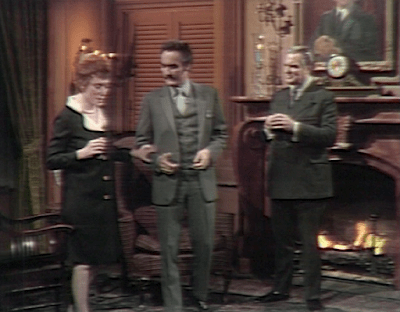
Recovering vampire Barnabas Collins and mad scientist Julia Hoffman are wearing complementary gray outfits today. Julia has a yellow blouse under her gray jacket; Barnabas’ shirt is white, but his tie is flecked with yellow florets that match Julia’s top. Barnabas and Julia have been inseparable for some time, but this is the first time they have coordinated their outfits. I suspect director Lela Swift and wardrobe mistress Ramse Mostoller collaborated to emphasize Barnabas and Julia’s bond.
I don’t know how Julia’s blouse shows up on your screen, but I assure you it is yellow and it matches the bits in Barnabas’ tie. As Julia’s outfit mirrors Barnabas’ so the ring in his portrait above the mantel mirrors the one on his finger.
In separate scenes, we see heiress Carolyn and Frankenstein’s monster Adam. Adam is in love with Carolyn, and she has recently started admitting that she has deeper feelings for him than she had once believed herself capable of. Each of them wears a bright green sweater today. Adam’s sweater was a gift from Carolyn; perhaps she bought them as a matching set.
There’s also some back and forth involving unsightly ex-convict Harry Johnson and suave warlock Nicholas Blair. Their outfits are unique, which is no surprise. They are disconnected not only from each other, but also from the other characters, because they stand at opposite extremes in the story. Nicholas has the most complete understanding of what is going on and the most ability to affect events, Harry the least of both those things. Harry tries to sell Nicholas some information; Nicholas isn’t interested in paying him. A threat on his lips, Harry goes to leave Nicholas’ house. He finds that he can’t open the door. Within seconds of trying to frighten Nicholas into submission, Harry starts begging him to come open the door. That leads to some magic tricks which show just how ridiculously far out of his depth Harry is in his attempt to strong-arm Nicholas. Granted, Harry was out of his depth earlier in the episode when he tried to play hardball with Carolyn, so you’d think he’d have developed a sense of his limitations by now.
Suave warlock Nicholas Blair is entertaining two guests in his home. They are Frankenstein’s monsters. The man is named Adam; in the 22 weeks since he came to life, Adam has learned to speak fluent English, to play chess, and to discuss the writings of Sigmund Freud, but he is still very unsure in his dealings with other people. Desperate to be loved but quick to resort to violence, he always winds up taking orders from someone or other.
The woman is named Eve. Created to be Adam’s mate, she came to life only in #596, but has all the memories and personality of Danielle Roget, a homicidal maniac who lived in France and America in the late eighteenth century. Her connection to Danielle was the result of Nicholas’ doing; when he learned of Adam’s existence, Nicholas decided to use him to found a new humanoid species, a race who would owe their existence to Satan rather than to God. In furtherance of that plan, Nicholas said in #575 he wanted to infuse Adam’s mate with the spirit of “the most evil woman who ever lived,” and he settled on Danielle as that woman.
We see today that Nicholas has over-egged his pudding. The thoroughly sincere Adam bores Eve/ Danielle to tears. She can barely stand to look at him while he tries to woo her, and sends him off to bed. She approaches Nicholas and suggests that he become her lover, preferably after she has killed Adam. Nicholas is amused by the idea, but tells Eve/ Danielle that unless she sticks with Adam, he will kill her. If Nicholas wants the two of them to found a whole new breed of creatures who will subdue the Earth for the Devil, he probably should have picked a woman whose vices ran less to violence and more to lust.
Shortly after Eve/ Danielle came to life, a wind blew into the room where she was staying, indicating that a ghostly visitor had come to her. She addressed it as “mon petit” and said “I will not go back.” Today, the same visitor appears at the Old House on the great estate of Collinwood, home of recovering vampire Barnabas Collins. The ghostly wind knocks a book off Barnabas’ shelf written in 1798 by one Philippe Cordier. Occult expert Timothy Eliot Stokes is visiting Barnabas and Barnabas’ inseparable friend, mad scientist Julia Hoffman. Stokes decrees that the three of them must hold a séance at once.
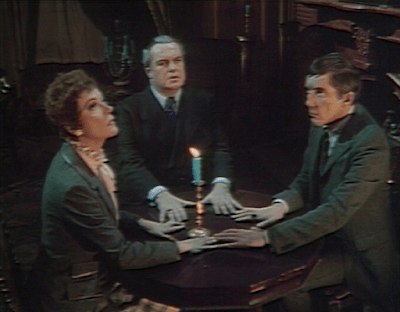
When there is a séance on Dark Shadows, there are three indispensable roles. There must be someone who gives instructions and supervises the proceedings, usually with considerable gruffness. The first time a séance was held in this room, using this table, was in #186, back in March 1967. Well-meaning governess Vicki was the supervisor that time, and it was startling to see her cast aside her demure manner to take the same gruff tone others would adopt in that role. It is not unusual for Stokes to be gruff, but since Julia and Barnabas have both attended multiple séances before, his tone will strike regular viewers as unnecessary.
The second indispensable role is that of medium. That role falls to Barnabas today. He passes out and starts moaning. At this point the third role comes into play. It is Julia who must express alarm and try to break the trance. As supervisor, Stokes must then sternly rebuke her and insist that the dead be allowed to speak through the medium.
Barnabas speaks a few phrases in French, as Vicki had spoken in French when the spirit of the gracious Josette possessed her in Dark Shadows’ very first séance, in #170 and #171 in February of 1967. He also speaks English with a French accent. Some fans like to poke fun at Jonathan Frid for the French accent that comes out of Barnabas’ mouth today, as indeed some liked to poke fun at Alexandra Moltke Isles for the accent that came out of Vicki’s. To those people I can only say, if those accents sound funny to you, just go to France- you will laugh all day long, because that’s how French people actually talk.
Through Barnabas, Philippe Cordier says that he has been lonely since Danielle’s spirit left him to return to the world of the living. Combined with Eve/Danielle’s refusal to “go back,” this implies that Philippe is Danielle’s boyfriend in Hell. He vows to kill “the man who says he loves her,” viz Adam, which seems illogical- if he wants her to leave the upper world and come back to him in Hell, he could achieve that simply by killing her. If he wants to punish the person who took her away from him, again Adam is the wrong target- it was Nicholas who picked Danielle. Adam had nothing to do with it. But Philippe, even though he was a published author when he was alive, is not an intellect now, only a spirit seeking vengeance. He is raw energy untrammeled by mind, and there is no reasoning with him.
Frid’s turn as Philippe is impressive. We’ve seen Barnabas in many moods, but he always has something to lose and almost always has something to hide. Frid often said that he played him as, first and foremost, a liar. But there is nothing disingenuous about Philippe. He is pure rage. In this tiny performance, Frid embodies that rage, and does not at all remind us of Barnabas.
Adam and Barnabas have a mystical connection that gives them a Corsican Brothers relationship. So far we have only seen this in action twice, both times when Barnabas was suffocating and Adam had trouble breathing. It does not work consistently, and it is not clear if Barnabas will suffer any of Adam’s pain. Indeed, when Adam fell off a cliff and nearly died, it didn’t bother Barnabas a bit. But apparently the bond does in fact go in both directions. When, after the séance, Philippe goes to Nicholas’ house and starts strangling Adam, Barnabas also starts choking.
In February and March of 1967 Dark Shadows was still aimed mostly at an adult audience made up of people who were impressed that the cast included Joan Bennett. But this episode demonstrates how completely it has since become a kids’ show. The first two séances resulted from long preparation, involved great effort, and produced tantalizingly vague, elusive messages. But this time around, the characters see signs of a ghost, Stokes immediately declares it’s time for a séance, and within two minutes Philippe Cordier is complaining about how he has to put himself back on the dating market of the damned. My wife, Mrs Acilius, pointed out that this is like something you would see in a story written by a small child. If the barrier between the dead and the living is inconvenient to the progression of the story, then you throw it out the window and proceed as if you could call up a ghost and have a conversation any time you wanted.
Maggie Evans, The Nicest Girl in Town, is wandering in the woods. She is wearing her nightgown and staggering for lack of food. She has just escaped from the hidden chamber in the old Collins family mausoleum, where Willie Loomis had been holding her prisoner for some days.
Maggie in the woods.
Willie had abducted Maggie because he wanted to protect her from the evil plans of his master, recovering vampire Barnabas Collins, and Barnabas’ friend, mad scientist Julia Hoffman. Because of his choice of hiding place he found that he had a new problem on his hands even after Barnabas and Julia had moved on to another victim. When Barnabas was in the full grip of the vampire curse in May and June of 1967, he had preyed upon Maggie, and the hidden chamber was one of the places he had taken her for torture.
After Maggie escaped from Barnabas, she was taken to a mental hospital. Julia was her psychiatrist, and in August 1967 she abused her position to hypnotize Maggie into forgetting her ordeal. When Willie took her to the hidden chamber, Maggie’s memory quickly came back. Willie is hopelessly dependent on Barnabas and Julia, and could see no alternative to keeping Maggie locked up once she became a threat to them. Yesterday, young David Collins found Maggie and freed her, and now she is trying to find her way to the sheriff’s office to tell her story.
It occurs to Maggie that the sheriff might not believe her once she starts accusing a member of the family that owns the town of being a vampire. He might be particularly skeptical when her psychiatrist comes along and tells them about how she behaved while she was an inmate in the mental hospital. Maggie decides that her ex-fiancé, the lately unemployed Joe Haskell, will believe her story and protect her, so she sets off for his apartment.
Maggie opens Joe’s door to find a blonde woman with her mouth on his neck. She faints. When she comes to, the woman is gone and Joe is apologizing for his inability to explain what is going on. Maggie tells him he doesn’t have to explain. She understands perfectly what has been happening to him, since the same thing happened to her. The woman is a vampire, and Joe has been showing the same symptoms Maggie showed when Barnabas started feeding on her.
Maggie urges Joe to leave town with her, right now. They should get in his car and drive, just drive until they are far, far away. Joe’s eyes are bright and he repeats the key words, clearly excited about the idea. It seems for a moment they might give it a try. A knock comes at the door. Maggie begs Joe not to answer it, but he is compelled to do so. Perhaps this is a symptom of being under the vampire’s power. Or perhaps it may just be a sign that he is a character on Dark Shadows, which usually devotes about 10% of its screen time to people answering doors. At the end of the scene, it is clear that Joe will answer the door, but we do not see what happens next.
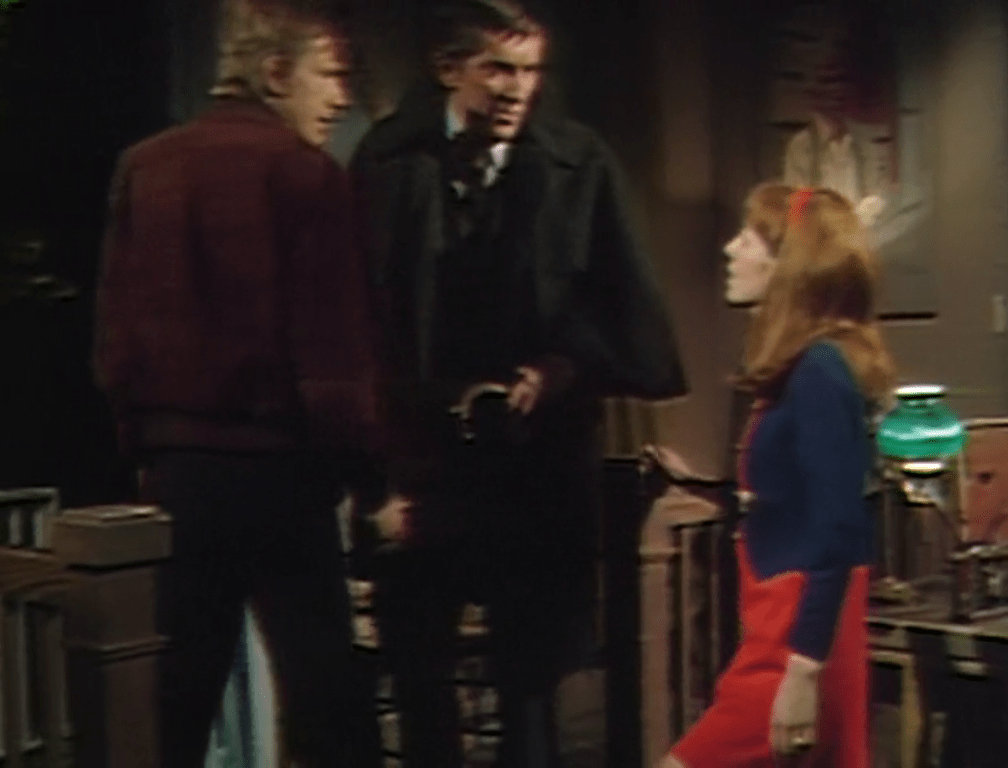
Later that evening, Maggie Evans, The Nicest Girl in Town, is at home looking at some sketches her late father made. She is wearing a red dress under a smart blue jacket, her hair well-styled. She seems quite=the comfortable. She answers the door, and finds old world gentleman Barnabas Collins and Barnabas’ servant, the high-strung Willie. They tell her that Joe had stopped by their house and brought them a message that Maggie wants to see them.
Maggie happily invites her old friends in. She shows them the sketches, and tells them her late father made them the year before while he was preparing to paint a portrait of Barnabas. She says it occurred to her Barnabas might want the sketches. He accepts them gratefully, and asks if that was the only reason she wanted to see them. Smiling, she says that it was. She mentions that she hasn’t seen Willie for three or four weeks. Willie agrees that she has not seen him in that time. Barnabas says they will have to be going; Maggie is disappointed they can’t stay for a cup of coffee.
Maggie wishes her friends Barnabas and Willie could stay longer.
Returning viewers will already know what Barnabas and Willie figure out in the final scene, that suave warlock Nicholas wiped Maggie’s memory. Unlike the, we are familiar with the plot mechanics that would have motivated Nicholas to do this.
The contrast between the frantic urgency of the scene between Maggie and Joe and the subsequent placidity of the scene in Maggie’s house makes for an effective single episode. The gold standard of anthology series, The Twilight Zone, often drew just that contrast as people would struggle more and more desperately for freedom, that struggle would mount to a fever pitch in a scene that seemed like it just might lead to something, then an event we don’t quite see thwarts them and all of a sudden everything is calm and peaceful and utterly hopeless. Three of my favorite examples are “Number Twelve Looks Just Like You,” “It’s a Good Life,” and “The Lateness of the Hour.” It’s especially piquant to see that scenario play out so much of the story is presented to us from the viewpoint of the villains. Barnabas and Julia generate so much of the show’s interest that none of its fans really wants to see them get their just deserts, and so it makes us squirm a bit when we see that they can evade punishment only by a triumph of evil over good. Writer Ron Sproat deserves credit for developing this structure expertly.
But Dark Shadows is not an anthology series, and as a segment in an ongoing serial, the whole thing is quite frustrating. When Maggie understands what is happening to Joe and can talk to him about it, there is a chance they will be able to make plans and take action that might have consequences for the story. But the mind-wipe just takes the last several weeks of the show and throws them in the trash. All that time we spent cooped up with Maggie and Willie in the hidden chamber? Never mind, it wasn’t important.
In a comment on Danny Horn’s Dark Shadows Every Day, “Mark Perigard” wonders what might have been:
The scenes between Maggie and Joe are just brilliant. For viewers, it’s like we’re being treated to a seven-course meal we’ve been promised for over a year – and then they snatch the tray away and tell us to suck on crumbs.
How incredible – how daring would it have been to show Maggie fighting for Joe’s sanity and life against the supernatural forces of Collinwood? DS would have a truly proactive heroine. One can imagine Maggie ultimately, reluctantly forming an alliance with Barnabas and Julia against Angelique and Nicholas.
Instead we got another mind-wipe. We was robbed.
Comment left at 11:46 Pacific time, 6 March 2015 by “Mark Perigard,” on “Episode 599: Live, Die, Repeat,” Danny Horn, Dark Shadows Every Day
I can see how that might have played out. Maggie gets to the sheriff’s office and tells him her whole story. He listens intently and instructs his assistant to take notes. When she finishes, he says “Bring her in.” The assistant goes to the door and ushers Julia in. “It’s just as you said, doctor,” the sheriff says. “She has lost her mind completely.”
Maggie would then go back to the mental hospital. While she was there, Nicholas would try to get at her. He would overplay his hand and reveal that he is a warlock. Maggie would realize that Nicholas is responsible for the vampire attack on Joe and that he is at odds with Barnabas and Julia. That’s when she makes her uneasy alliance with her old tormentors and the story really gets going.
A mysterious woman appears at the front door of the Old House on the great estate of Collinwood. She introduces herself to the master of the house, old world gentleman Barnabas Collins, under the name Leona Eltridge. The door opens further and we see that Leona is accompanied by Frankenstein’s monster Adam. She tells Barnabas that she has come to donate her “life force” to an experiment meant to create a bride for Adam. Barnabas has many questions, none of which Leona will answer. Adam orders Barnabas to find mad scientist Julia Hoffman and ushers Leona to an upstairs bedroom.
Erica Fitz as Danielle/Leona. Some participants on message boards think she looks masculine. Those people are very confused. Screenshot by Dark Shadows Before I Die.
There, Adam tells Leona that he doesn’t know any more about her than Barnabas does. She tells him that he doesn’t need to know more, and reminds him that they must not let Barnabas or Julia know that they met for the first time this night. Moreover, no one must know that she has any connection with suave warlock Nicholas Blair.
Julia shows up with occult expert Timothy Eliot Stokes. Barnabas tells them about Leona, and Adam enters, demanding she start the experiment at once. Julia goes to the basement laboratory, and Stokes goes to question Leona.
Leona tells Stokes that she was in love with Adam’s creator, the late Dr Eric Lang. She also claims to be suffering from a terminal illness, and to have only a short time before she will die a painful death. She therefore wants to continue Lang’s work, and has no fear of the danger involved in the experiment.
Stokes, Julia, and Barnabas all regard Leona’s story as, in Julia’s words, “too pat and sentimental” to be true, but they have little choice but to comply with Adam’s demands. In fact, we know that Leona is really Danielle Roget, an eighteenth century homicidal maniac whom Nicholas conjured up yesterday. Nicholas himself has developed a crush on Maggie Evans, The Nicest Girl in Town, which puts the lie to his pretense to be a stranger to human emotions. That Nicholas thinks anyone who knew the fiendish Lang would believe Danielle/Leona’s sappy story suggests that he might be an even bigger softie than his attraction to the magnificently wholesome Maggie would indicates.
Stokes figures out how the name “Eltridge” is spelled, which somehow means that he must hurry off to work on something or other. In the basement, Julia directs Danielle/Leona to the donor’s table. She offers her a painkiller, which she refuses. Adam watches the experiment. When Danielle/Leona flatlines, Julia pronounces her dead and says that the experiment has been a failure. Adam tells Barnabas and Julia that he ought to kill them. Barnabas disagrees. Before they can explore the issue in any depth, the Bride comes to life and Adam cheers up.
The opening voiceover says that if Barnabas realized that Danielle/Leona was “one of the living dead,” his reaction would be terror. Barnabas was himself a vampire for 172 years, so you might think he would be happy to meet someone with whom he had so much in common, but maybe not.
Frankenstein’s monster Adam has threatened to kill everyone in the great house of Collinwood unless old world gentleman Barnabas and mad scientist Julia create a mate for him. They are to do this by building a woman out of parts scavenged from corpses and draining someone’s “life force” into her. Adam has a crush on heiress Carolyn, so he insisted she be the “life force” donor. Under the influence of suave warlock Nicholas, Carolyn volunteered to serve in that capacity. On Monday, Adam figured out that Carolyn is in love with him, so he told her there was no need to complete the procedure. They could just marry each other. She reacted to that with evident confusion, her own feelings competing with Nicholas’ spell. Nicholas’ influence won out, and Carolyn insisted on going through with the experiment.
The experiment failed to bring the mate to life, and left Carolyn badly injured. After a soulful conversation with Adam in the upstairs bedroom, she lost consciousness. Julia pronounced her dead. Adam then went to Barnabas and declared that he would make good on his threat. He knocked Barnabas down and stalked out of the house. When Julia saw how badly Barnabas was hurt, she went back up to the bedroom to get her medical bag. She found that Carolyn’s body was gone.
Barnabas and Julia wonder where Carolyn’s remains could be and how they can prevent Adam killing everyone. Barnabas’ servant Willie returns to the house to tell them about another crisis. In May and June of 1967, when Barnabas was a vampire, Maggie, The Nicest Girl in Town, was his victim. He imprisoned and tortured her. In August of that year, Julia abused her position as Maggie’s psychiatrist to hypnotize her so that she would forget all about her ordeal. Now Maggie’s memory has come back, and Willie is keeping her locked up in the hidden chamber of the old Collins family mausoleum. Willie tells Barnabas and Julia that Maggie has figured out how to get out of the chamber, and that she is staying there now only because he knocked her out with chloroform. It’s just a matter of time before she gets away.
Willie also says that he saw Adam a few minutes before. Adam was sitting quietly under a tree. He did not have Carolyn’s body with him. Julia wonders if that means that Adam has decided not to go through with his threats, but Barnabas is not so optimistic.
In the Mausoleum
We see Maggie awaken in the mausoleum. She goes to open the door, only to find Julia standing behind it. Julia blocks the exit and enters. Maggie is afraid Barnabas has sent Julia to kill her. Julia can deny that, but denies nothing else Maggie says. Maggie confronts her as Barnabas’ accomplice and walks toward her; Julia backs away, and Maggie chases her around the coffin in the center of the little space. Julia tells Maggie that she will never get out of the chamber unless she cooperates. Julia tries to hypnotize Maggie, but that only succeeds in reminding her of how Julia erased her memory before. Julia admits that she did that, and tells Maggie her only hope for survival is to let her do it again. Maggie says she would rather die than submit to such a thing. When we first met Julia, she was a doctor whose ambition to treat a vampire led her to betray a patient’s trust, but who could still tell herself that she was serving a greater good. Now, we see that she has lost her moral compass completely. This scene is a showcase for both Grayson Hall and Kathryn Leigh Scott.
A Fanfic Interlude
Julia has been inseparable from Barnabas long enough that it is possible for daily viewers to forget that she was introduced in scenes with Maggie, and that it was by betraying Maggie’s trust that she earned her place as a main character. This scene reminds us of that history, but it doesn’t really make sense. Julia must know that if she calls on Maggie in the hidden chamber where she is being held prisoner, it will be obvious to her that she is in league with her captors. If she wants Maggie trust her so that she can hypnotize her, she will have to deceive her in some way. Julia is the show’s most fluent and plausible liar, so you might assume she would have come up with an effective stratagem.
Mrs Acilius and I came up with a method that might have worked. Imagine an episode that opens with Maggie alone in the hidden chamber. The door opens, and Willie enters. Maggie confronts him with enough information to bring the audience up to date with her situation. Maggie hits him with something, stunning him momentarily. She is opening the door when he grabs her and puts a cloth over her nose. She passes out.
After the opening titles, Maggie comes to in her old prison cell in Barnabas’ basement. She finds that Julia is also there, chained to the wall. Julia tells her that she has only recently discovered the full truth about Barnabas, and that he locked her up to keep her quiet. Maggie knows how close Julia and Barnabas have been for the last year, and is skeptical. At the end of Act One, Maggie is still unsure whether she can trust her.
In Act Two, Barnabas comes in and threatens both women. He lets slip that Maggie found a way to escape from the cell in June 1967. By the time he leaves, Maggie believes that Julia is on her side. In Act Three, Julia asks Maggie how she escaped the year before. That part of Maggie’s memory hasn’t come back, so Julia offers to hypnotize her so that she will remember. Maggie agrees. Julia produces her medallion, and Maggie goes under. We dissolve to the aftermath of the hypnosis. Maggie is asleep on the cot in the cell; she is smiling. Julia is taking the fetter off; it was never locked. Barnabas and Willie open the door; Julia says that Maggie’s memory has been wiped clean again. She will be asleep for an hour, so they should take her home now.
That would not only remind us how Julia began, show us how she has turned out, and explain how Maggie lost her memory, but it would also give us a glimpse of the old, evil Barnabas who first made the show a hit. Barnabas spent his first year as a bloodthirsty ghoul pretending to be a kindly cousin from England; it would be interesting to see the humanized Barnabas pretending to be his old self.
Meanwhile, In the Episode They Actually Made…
Julia leaves the mausoleum and goes back to Barnabas’ house. She tells him the hypnosis failed. At that, Barnabas decides the time has come for him to go to the surviving members of the family in the great house and tell them the truth. Julia tries to talk him out of it, and he says he will do what he can to “exonerate” her from responsibility for the crimes they have committed together. But with Adam and Maggie both at large, he feels he can no longer keep secrets. Just as Julia has lost her conscience it seems that Barnabas, who earlier this week told Julia he would murder Maggie if she couldn’t keep her quiet, may at last have found his.
At the door of the great house, Barnabas wrestles with doubts:
I can’t go through with it. I can’t tell them Carolyn is dead. I’d be forced to tell them about the experiments, Adam, everything Julia and I have done. And if the truth starts to come out, where will it end? Where?… No. I can’t think about that. The family has to know that Carolyn is dead–how she died! I have to tell them no matter what happens to me. No matter what happens. I must tell them!
He finally knocks on the door, and is thunderstruck when Carolyn opens it, looking the picture of health. This might have been an effective surprise if Barnabas’ voiceover soliloquy hadn’t given us ninety seconds to think about who might open the door, and realize there is only one possible candidate.
Frankenstein’s monster Adam has demanded that old world gentleman Barnabas and mad scientist Julia build him a mate. The other day, he added a condition, specifying that heiress Carolyn must donate the “life force” that will animate this new woman. The body is constructed, the equipment is ready, and yesterday Carolyn presented herself as a volunteer. So we have every reason to expect today’s episode to end with the introduction of Adam’s bride.
That’s certainly what Adam expects. He lets himself in Barnabas’ house, finds Julia in the foyer calling servant Willie to join her on an excursion, and asks why she is not working in the basement laboratory. She makes up a story about having to go off and attend a patient; Adam is intelligent enough to know that Willie would be no help on a house call, and he forces her into an additional lie, claiming that she was going to drop Willie off in the village of Collinsport along her way. Barnabas comes upstairs and rails at Adam for a while.
Adam in charge. Screenshot by Dark Shadows Before I Die.
In fact, Julia and Willie were on their way to the hidden chamber inside the old Collins family mausoleum. Before Adam decreed Carolyn would donate the “life force,” Barnabas and Julia were planning to impose that task on Maggie, The Nicest Girl in Town. Willie has a crush on Maggie, so he took it on himself to abduct her before Barnabas and Julia could fulfill that evil intention.
Willie had drugged Maggie with chloroform when he took her from her bedroom. When she woke up in the hidden chamber, she started to remember what happened to her in May and June of 1967. Willie reacted to that with panic. In those days, Barnabas was a vampire. He took Maggie as his victim. He imprisoned her, tortured her, and tried to replace her personality with that of his lost love, the gracious Josette. After Maggie escaped from Barnabas, she fell into Julia’s clutches. Julia eventually hypnotized her so that she forgot all about her ordeal and thought that Barnabas was a swell guy.
Barnabas was cured of vampirism when he donated the “life force” that animates Adam. Repeating to Julia the news that Willie brought, he laments the unfairness of it all:
Can you imagine the police coming here now?
Now that I am free of my affliction,
and now to pay the penalty for those first months
at Collinwood?
I can’t, Julia. I won’t.
It would be interesting if Maggie were to reach the police. She could not only show them the hidden chamber and its secrets, including perhaps the body Barnabas and Willie buried in its floor in #276, but would also lead them to Barnabas’ basement. On their way to the prison cell where Barnabas locked Maggie up, they couldn’t help but notice the female cadaver constructed of parts salvaged from various corpses Willie dug up from their graves. Even investigators as maladroit as the Collinsport sheriff’s department would likely be able to think of some pointed questions to ask in the face of all that.
Barnabas demands that Julia go to the mausoleum and use her powers of hypnosis to re-erase Maggie’s memory. Julia says the experiment is at such a critical point that she can’t leave it. To that, Barnabas replies “If you will not silence Maggie Evans, I must.” Barnabas does not specify the means by which he will “silence” her, and he lost all his supernatural powers when he was freed of vampirism. So this would seem to be a declaration of intent to commit murder. It is no wonder Julia was prepared to try her methods if that was the alternative.
Barnabas has not told Adam about his former vampirism, and he doesn’t like to talk about what he did to Maggie. At one point today, he exclaims to Willie “Those days are gone! Anyone who remembers them should forget them now, including you!” Rather than bring Adam into his circle of confidence, he repeats Julia’s lies and adds a lot of bluster. That doesn’t move things along very effectively; it leaves time for Willie to run upstairs, get a rifle, and threaten Adam. Adam disarms him and uses the weapon to get Julia back to the lab.
The episode peters out in the basement with Julia still fiddling with knobs and Carolyn still upstairs taking a nap. Adam rhapsodizes about how beautiful his mate will be. She is being created by the same process that engendered him, and he is convinced that he is unbearably ugly, so it is unclear where he got this expectation. He says she will be as beautiful as Carolyn. He knows that Barnabas was his “life force” donor, and he doesn’t look anything like him, so her role in the experiment doesn’t explain it.
I usually have an intense dislike for dramas about people being held prisoner by intruders in their homes. Since Barnabas, Julia, and Willie are all violent felons who ought to be locked up, and since Adam spent the first weeks of his life as a recipient of shocking abuse at their hands, I can make an exception for this one.
In 1968, a drama about a home invasion in which the captor gets the best lines would have brought three films to mind for most of the adults in the audience: The Petrified Forest (1936,) in which Humphrey Bogart became a star in the role of the captor; Key Largo (1948,) in which Bogart cemented his troubled good-guy image as one of the captives; and The Desperate Hours (1955,) in which Bogart was again, and for the last time in his career, cast as a villain. Since this is so much a Humphrey Bogart situation, it is too bad the character of Tony Peterson is no longer on the show. Tony consisted primarily of Jerry Lacy’s Humphrey Bogart imitation, and it would have been neat to see him in this scenario.
In August 1967, Maggie Evans, The Nicest Girl in Town, was about to expose old world gentleman Barnabas Collins as a vampire. In the nick of time, Maggie’s doctor, mad scientist Julia Hoffman, hypnotized her and blocked all memory of her time as Barnabas’ victim.
Today, suave warlock Nicholas puts a magical zap on the mind of heiress Carolyn Collins Stoddard to induce her to take part in an experiment meant to produce a mate for Frankenstein’s monster Adam. All this mind control makes for a low level of suspense. If traumatic memories can be erased and personal motives overriden by whatever mumbo-jumbo is convenient, there is no reason to suppose that the story’s events will have consequences or that there is any point in getting to know the characters.
This episode includes a tacit acknowledgement of the problem. The other day, Willie Loomis, Barnabas’ bedraggled servant, overheard Barnabas and Julia discussing another evil plan for Maggie. Willie has a crush on Maggie, so he resolved to foil that plan. He has abducted Maggie and is holding her in the hidden chamber inside the old Collins family mausoleum. This turns out to be the worst possible choice of location. Barnabas tortured Maggie there when she was his victim, and in a series of dream sequences those events come back to her. At the end of this episode, Maggie exclaims “I know what Barnabas Collins is!”
Now, Barnabas is not in fact a vampire at the moment. An experiment involving the creation of a Frankenstein’s monster freed him from the effects of that curse. But it would cause a lot of trouble for Barnabas, Julia, Willie, and the plot if Maggie were to go to the police and identify Barnabas as the man who held her prisoner. So Maggie’s closing exclamation might encourage us to hope that the show will swear off its habit of turning its characters into each other’s puppets.
In April 1968, mad scientist Eric Lang promised Barnabas Collins that he could cure him of vampirism. The cure was an experimental procedure modeled on the one in Hammer Studios’ 1967 film Frankenstein Created Woman. A body constructed of parts salvaged from several fresh corpses was to be associated with Barnabas, and when the procedure was complete Lang expected Barnabas’ body to be dead and his mind to awaken in the constructed body. After Lang’s death, Barnabas’ friend, Dr Julia Hoffman, completed the experiment. To their surprise, the procedure ends with both Barnabas and the new man alive. Barnabas named the new man Adam. They take Adam to the dungeon in Barnabas’ house, and keep him there in horrifyingly bad conditions until he escapes. Adam of course hates Barnabas and Julia.
Lately, Adam has been hiding out in a long-deserted part of the great house of Collinwood. Heiress Carolyn Collins Stoddard took pity on him and has been looking after him there. He has fallen in love with Carolyn, to her embarrassment and his frustration. Carolyn has delegated the day-to-day responsibility for looking after Adam to unsightly ex-convict Harry Johnson. Adam’s former protector, occult expert Timothy Eliot Stokes, visits from time to time. Adam’s most frequent and most influential visitor is suave warlock Nicholas Blair. Carolyn and Stokes are good, Nicholas is evil, and Harry is just distasteful.
When Nicholas found out about Adam, he forgot about whatever plans he may previously have had and focused on the goal of founding a new humanoid race. He has talked Adam into demanding Barnabas and Julia repeat the experiment to build a mate for him. Adam threatened to kill well-meaning governess Vicki Winters unless they complied. Now there is a patchwork female corpse and a lot of scientific equipment in Barnabas’ basement. All that is missing is a woman to donate her “life force.”
Barnabas and Julia were plotting to use Maggie Evans, The Nicest Girl in Town. When Barnabas was a vampire in May and June of 1967, he abducted Maggie and tortured her in an attempt to erase her personality and replace it with that of his lost love, the gracious Josette. When that evil scheme collapsed, Maggie escaped and Julia used her preternatural powers of hypnosis to block her memories. Ever since, Maggie has had no idea of what happened during those two months, and she has thought of Barnabas as a wonderful person. Barnabas wants Julia to use those same powers first to bring Maggie to the basement lab, and then to block her memory in case she survives.
Barnabas’ much-put-upon servant, Willie Loomis, overheard this plan. Willie has a crush on Maggie. He tried to talk Barnabas and Julia out of their fell intentions, and when they would not listen he tried to persuade Maggie to leave town. She wouldn’t listen either, so he took it upon himself to abduct Maggie. He stole some chloroform from the lab, broke into her room, and took her to the hidden chamber inside the old Collins family mausoleum.
We open today in the front parlor of the Old House, where Adam is coolly explaining to Barnabas that he does not want Maggie to donate the “life force” for his mate. Barnabas angrily explains that it must be Maggie, because Julia has proven that she can control her. Besides, Maggie lives alone, so she can go missing for several days before anyone knows she is gone. Barnabas is the chief protagonist of this show, by the way.
Adam says that the only woman whose “life force” he wants to animate his bride is Carolyn. Barnabas says that this is impossible. Adam has been gradually learning the details of the experiment that brought him to life; only now does Barnabas tell him that in the original plan, he would die and come back to life in his body. Adam is bewildered by this. “How could you hate yourself so much that you wanted to change your body?” Barnabas does not want to confess his his former vampirism, so Adam doesn’t get an answer.
Adam meets Nicholas at the gazebo on the grounds of the estate. Nicholas wants him to ignore everything Barnabas said, but Adam is giving deep thought to all of it. It was Nicholas’ idea that Carolyn should provide the “life force,” and Adam enthusiastically agreed, believing this meant that his mate would be like her. He says now that he and Barnabas do not recognize themselves in each other, and Nicholas tries to brush this very apt observation off by saying that Barnabas would hide his similarities. Adam demands Nicholas assure him that Carolyn will not be subjected to any violence. She must want to participate in the experiment. As my wife, Mrs Acilius, pointed out, that condition is indeed a similarity with his “life force” donor- Barnabas had been preoccupied with the idea that Maggie and his other female victims would eventually come to him of their own will. While Nicholas is trying to quell the big guy’s concern, Willie happens by.
Adam starts to figure everything out, and wants to reason with Nicholas.
Adam hides while Nicholas confronts Willie. He puts a magic zap on Willie to compel him to release Maggie. After Willie goes, Nicholas tells Adam he will use the same painless technique to cause Carolyn to cooperate. Adam is skeptical, but Nicholas assures him that his doubts will be settled when he sees that Maggie is free before daybreak.
That may not quite work out. Willie made the worst possible choice of hiding place when he stashed Maggie in the hidden chamber of the mausoleum. Barnabas took her to that chamber for torture when she was his prisoner, and shortly after she awoke there her memory started to come back. By the end of today’s episode, she remembers that Barnabas was her captor. When Willie returns, he will find that he has quite a problem on his hands.












 Dark Shadows Commentary