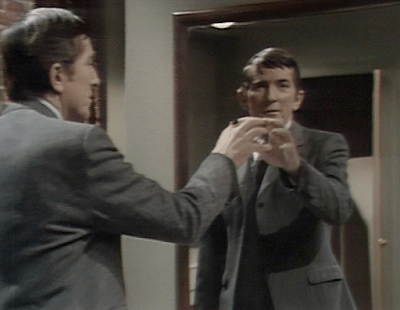
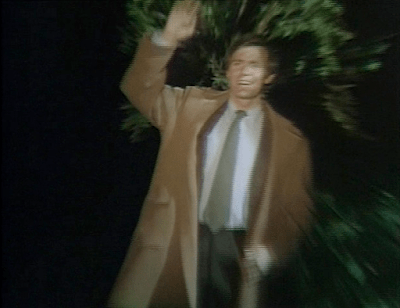
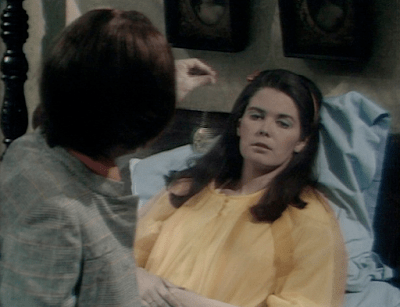
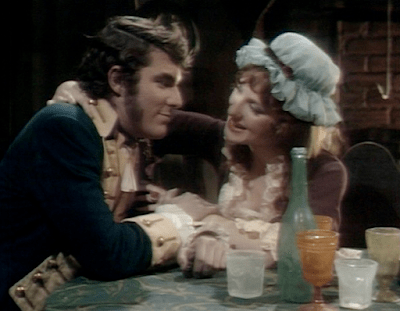
For months now, fluttery heiress Millicent Collins has been staying at the great house of Collinwood as the guest of her cousin Joshua and Joshua’s wife Naomi. Tonight, she returns to the drawing room after a moonlight stroll and makes a series of statements that bewilder Joshua and Naomi.
Joshua and Naomi wonder what Millicent could possibly be talking about. Screenshot by Dark Shadows Before I Die.
Millicent tells her hosts that she has seen their son Barnabas. Joshua and Naomi are shocked to hear this, because they know that Barnabas has died. Believing that Barnabas died of the plague and that this news would scare the workers away from the family’s shipyard, Joshua put the word out that Barnabas went to England. Millicent saw Barnabas standing in the graveyard, near the secret chamber where his coffin is hidden. This further shocks Joshua and Naomi.
Millicent says that she needs Barnabas. He is the only member of the family who has fought a duel, and there is a family matter that can be settled only by dueling. Joshua and Naomi have no idea what she is talking about. She tells them she has learned that naval officer Nathan Forbes, to whom she recently became engaged, was already married. That hits them so hard they almost embrace her, something characters on this show do not do. They are supposed to be New Englanders, after all. She shies away from them.
What neither his parents nor Naomi know is that Barnabas rises from the dead by night and walks the earth as a vampire. The only living person privy to this secret is Barnabas’ friend, much put-upon servant Ben Stokes.
Ben saw Millicent at the graveyard, moments after Barnabas vanished into thin air. He tried desperately to convince her that she did not see Barnabas, repeating Joshua’s story that he has gone to England. He tried to bargain with her, promising to look for Barnabas and tell her if he finds him. His insistent denials that she saw what she knows she saw frustrated her. She told him that she wants to be buried in the mausoleum, and that she thinks of herself as already dead, dead as of today, no matter how long her body may survive. She told him her grave marker should reflect this date of death. He begged her to let him walk her back to Collinwood. Irritated with him, she allowed him only to follow her at a distance.
Millicent complains to Joshua and Naomi that Ben kept telling her that Barnabas had gone to England. She says that he must be punished. Joshua has been telling Millicent she is ill, and he wants Ben to stick to the official story. But he is such a tyrant that he cannot help but warm to the idea of punishing Ben. He ends the episode by expressing his vigorous agreement with Millicent.
Ben and Millicent are both wonderful today. Millicent has dozens of lines, all of them quotable, and most of them quoted in Danny Horn’s post about this episode. Nancy Barrett developed a deliberately stagy style for Millicent that always works, and today it reaches its summit.
As Ben, Thayer David has a subtler part to play, and he does it perfectly in this one. In an opening scene with Barnabas, he begins with a gruff expression of distaste for the horrible things Barnabas does, and before we know it is pleading with him not to allow himself to be destroyed. In a tiny bit of time, with only a few lines to speak and only a few opportunities to show his face, he takes us from loathing for the vampire to devotion to his friend, and at no point does the transition feel forced.
Naomi and Joshua have recently lost both of their children, among other loved ones, and there doesn’t seem to be any end to the death that surrounds them. Joan Bennett and Louis Edmonds fully connect us to their grief today. Dark Shadows too rarely gives these two extraordinary actors a chance to show what they can do, and both of them make great use of this opportunity.
Barnabas’ part is somewhat ridiculous. Today, he outdoes himself in narcissism, describing the death of his true love Josette solely as a thing that happened to him. But we know going in that that’s his deal- as a vampire, he is a metaphor for selfishness, and he was pretty self-centered even when he was alive. By this time, Jonathan Frid’s performance has made this preposterous creature into a major phenomenon of the era’s pop culture, and when he is this deep in his wheelhouse he does not disappoint. The result is a surprisingly strong entry in the series.
In episode #2 of Dark Shadows, well-meaning governess Vicki first visited the precipice known as Widows’ Hill. She was standing near the edge when high-born ne’er-do-well Roger Collins crept up on her, breaking his silence with a loud voice in a deliberate attempt to startle her. He tells her that she wouldn’t be the first to jump to her death from Widows’ Hill. The precipice is thus established as a place of danger.
Roger surprises Vicki atop Widows’ Hill.
In #5, Vicki again stood atop Widows’ Hill, and again a man she had never met startled her there. He was drunken artist Sam Evans, and he told Vicki the story of Josette Collins, a grand lady of a previous century who leapt to her death from the cliff.
In the same episode, strange and troubled boy David Collins mentions the ghosts of “The Widows” to Vicki. Later, we will hear that these are the ghosts of women who jumped to their deaths from Widows’ Hill at various moments in the nineteenth century. In #12, we will learn of “The Widows’ Wail,” a peculiar sound that can be heard in the wind around Widows’ Hill on nights when the ghosts of these sad women are restless. We will hear the Widows’ Wail several times, most effectively in #344, when Vicki is trying to talk her depressing fiancé Burke out of going on an airplane journey from which he will never return, leaving her a widow before she can become a bride.
The association of Widows’ Hill with deadly danger is reinforced in #50, when Vicki and heiress Carolyn look down from it and see the corpse of beloved local man Bill Malloy on the rocks below.
Bill in the water, as seen from the precipice of Widows’ Hill. Screenshot by Dark Shadows Before I Die.
In #75, we hark back to Vicki’s first meeting with Roger. Vicki finds Roger standing on the spot where she had stood when he startled her in #2. She reenacts that scene with the roles reversed. He exclaims angrily that she might have caused him to fall; she reminds him that he had done the same to her. He laughs happily and apologizes. They have a sweet little moment together after that, but his protest shows that she really was in danger then, and that she is none too safe now.
The death of Bill set off a series of events that ended with crazed handyman Matthew Morgan abducting Vicki, holding her bound and gagged in the Old House on the estate of Collinwood, and bringing an ax with the express intention of chopping her head off. At the last moment, he is stopped from decapitating Vicki by the manifested ghosts of Josette, the Widows, and Bill. When Bill appears with Josette and the Widows, it ceases to matter that he died somewhere else and only washed up below Widows’ Hill. Thereafter he is joined with them, and like their deaths, his death belongs to that place.
The Dead of Widows Hill confront Matthew. Josette manifested earlier in the episode, and is represented here by her portrait above the mantel. Screenshot by Dark Shadows Before I Die.
In #266, the Widows briefly reemerged from the supernatural back-world implicit in the action into the story, this time associated with a malign intention towards the characters. Reclusive matriarch Liz heard their voices luring her to throw herself off Widows’ Hill. We haven’t heard about them since then.
Josette’s ghost was central to the action from #126 to #191, when she and Vicki together protected David from his mother, undead fire witch Laura Murdoch Collins. That Laura posed a danger to David was not clear to the characters in #139 and #140, when Laura startled David while he was at the edge of the precipice on Widows’ Hill. Vicki rescued him, then urged him to go to his mother.
In #185, Sam and Vicki visited the Old House, the seat of Josette’s power. Sam saw the portrait of Josette that hangs over the mantel. He asked if she was “the lady who went over the cliff.” Again, we join the image of Widows’ Hill with the concept of danger and the role of David’s protectress. Sam and Vicki came to the Old House to hold a séance. Josette speaks through Vicki at séances, suggesting that in sharing her role with regard to David, Vicki’s personality is coming to merge with that of Josette.
In April 1967, vampire Barnabas Collins succeeded Laura as Dark Shadows‘ resident supernatural menace. Barnabas was too dynamic an adversary for wispy presences like Josette and the Widows to oppose. In #212, he went to the Old House and told Josette’s portrait that her power there was at an end. In #223 and #240, David lamented that the family had lost its tutelary spirit.
With that, Josette ceased to be an active presence. She lost the role of David’s protectress, and with it her link to Vicki. But Josette is still an important element of the show. Instead of a guardian who intervenes in the story, she becomes the object of Barnabas’ obsession. Instead of a companion who acts with Vicki, speaks through her, and inspires her devotion, she becomes Barnabas’ motivation to victimize women, Vicki perhaps to be among them. Vicki’s personality may yet be replaced, not by a merger with Josette’s spirit, but by Barnabas’ insane plan to find a woman he can brainwash into becoming a facsimile of his long-lost, long-dead love.
The transformation of Josette from an active presence to the object of Barnabas’ delusions revolves around Widows’ Hill. In #233, Barnabas tells Vicki and Carolyn a story about Josette’s fatal leap. He says that she threw herself off the cliff to escape a lover with whom she quarreled there. Vicki was a bright person in those days, and she figured out that the lover must have been Barnabas Collins. She believes the Barnabas in question to have been the ancestor of the one she knows, but of course it is the man himself, as he was in that previous century. When Barnabas realizes that Vicki has picked up more information than he intended to disclose, he reacts apprehensively, and seems as if he is thinking about killing her. Barnabas would revise the story of Josette’s death many times, most notably in #345, when told it while standing on Widows’ Hill with his associate, mad scientist Julia Hoffman.
At the end of #365, the visible foreground and the implicit back-world traded places when Vicki came unstuck in time and found herself in the late eighteenth century. When she first arrived in the year 1795, Barnabas and Josette were living beings, as was Barnabas’ little sister Sarah, whose ghost haunted Collinwood in 1967. Sarah is dead and gone now; Barnabas is dead, but as a vampire he is not at all gone. He’s been sucking Josette’s blood, and today he plans to kill her so that she can rise as his undead bride.
Barnabas became the star of Dark Shadows and turned it into a hit with his efforts to scam everyone into believing that he was a living man native to the twentieth century. When Vicki first found herself in 1795, we may have hoped to see her running an equally suspenseful con game. But the show hasn’t given her any such thing to do. Instead, she flailed around helplessly. Lately, she’s taken to telling everyone how and when they will die. That has led to her imprisonment on charges of witchcraft. She told Josette and her aunt, the Countess DuPrés, that Josette would throw herself to her death off Widows’ Hill. The countess has been trying desperately to keep Josette off the hill, and Barnabas doesn’t want her to go there either. But the ghost of wicked witch Angelique tricks her into going there tonight.
Barnabas realizes what has happened. He races to Widows’ Hill. He sees Josette there. Angelique causes Josette to see a gruesome image of a vampiric version of herself, and brings it home that it reflects Barnabas’ plans for her. Barnabas approaches; terrified, Josette flees, and goes over the cliff.
For a scene that we’ve been hearing about for all 85 weeks Dark Shadows has been on the air, Josette’s death is not very impressive visually. Since they are going to pan from Josette and Barnabas over to the ghoul version of Josette, they have to put the camera very close to the action. The whole sequence also has to be in a low contrast color scheme for the ghoul version to have its effect. The tight frame and the drab palette make it impossible to create an illusion of space, leaving Jonathan Frid and Kathryn Leigh Scott looking like a couple of people monkeying around in a tiny television studio. At times we see so little of the set that it is not clear what’s happening. We don’t even see the edge of the cliff, blunting the effect of the climactic fall.
The introduction of the living Josette to the ensemble during the 1795 segment reduced the character’s importance in the show’s mythology. That is not any reflection on Miss Scott’s performance, or even of the scripts she had to work with or the direction she had to follow. It is the consequence of the whole idea of supernaturalism. To accept the idea of the supernatural is to believe that what seems to be weak is in fact strong. The dead, to all outward appearances, would seem to be utterly powerless, and the living would seem to have a monopoly on the means of making things happen in the world. But phantoms and revenants and zombies and vampires and the rest are supposed to have overwhelming advantages that we can defeat only by precise application of knowledge that only the rarest sort of people have. Likewise, people who are disadvantaged by the social order of the visible world are supposed to have access to powers in the supernatural realm that leave even the most eminent people at their mercy. So servant girl Angelique brought lofty aristocrats Barnabas and Josette to the very lowest of positions.
As a living person, Josette is charming, kindly, and beautiful. But she is not at all forceful. She cannot be. If she were, her ghost could not have gained the potency it would have in the 1960s. Our acquaintance with the living Josette has been a long anticlimax to the tales of her sovereign haunting of Collinwood. Her death scene is an anticlimax to that anticlimax. Widows’ Hill itself will continue to be a place of danger and death, but Josette will no longer be its patroness in the way she was before this episode.
Nathan Forbes, naval officer and scoundrel, goes to the Old House on the great estate of Collinwood and finds his estranged wife Suki dying. With her last breath, Suki gasps out the name “Barnabas Collins.”
Nathan goes to the great house and informs the master of the estate, haughty tyrant Joshua Collins, of what he has found. Joshua accompanies Nathan to the Old House. Suki told the Collinses that she was Nathan’s sister, lest she disrupt Nathan’s engagement to fluttery heiress Millicent Collins, a second cousin of Joshua. Suki had planned to force Nathan to divert a large percentage of Millicent’s vast wealth to her. Unaware of the true nature of Suki’s relationship to Nathan, Joshua is only mildly suspicious that Nathan might have murdered her.
Nathan brings up the fact that in her dying words Suki named Joshua’s son. This irritates Joshua, who reminds Nathan that Barnabas has gone to England. Nathan tells Joshua that he thought he saw Barnabas the other night, from a distance, in the dark. Considering that the most Nathan could have been sure he saw under those conditions was Barnabas’ coat, no one would be impressed by such an account. It’s an unusual coat, but there’s nothing to prove Barnabas didn’t get rid of it and wear a new one to England. Joshua is particularly bland about Nathan’s thought that he may have seen Barnabas, since he made up the story that Barnabas went to England to conceal the fact that he died. Joshua believes that Barnabas died of the plague, and that if that news got out the men wouldn’t show up to work at the family’s shipyard. So he does not share Nathan’s suspicion that Barnabas may have had something to do with Suki’s death.
What we know that Joshua does not is that after his death, Barnabas became a vampire. Suki discovered him in the Old House, and he was indeed the one who murdered her. But so far as anyone can tell, Nathan is the only suspect, and whoever learns that Suki was actually his wife will have to regard him as something more than a suspect.
Joshua and Nathan are about to search the house when the gracious Josette comes staggering downstairs. Josette had come to Collinwood to marry Barnabas, had been put under a spell that caused her to marry Barnabas’ uncle Jeremiah instead, and was miserable when both Barnabas and Jeremiah were dead. Now Barnabas has bitten Josette and is planning to kill her and raise her as his vampire bride.
When Suki was killed, everyone around the estate was involved in a search because Josette had gone missing. Joshua and Nathan are shocked to find her here, and even more shocked by her physical condition. She reaches the foot of the stairs, says Barnabas’ name, and collapses.
Joshua and Nathan bring Josette back to the great house. Joshua orders his wife Naomi to look after Josette; Nathan tells Millicent that Suki is dead. When Naomi asks Joshua if Josette said anything when they found her, he lies, concealing Barnabas’ name. Naomi knows as much about Barnabas’ death as Joshua does; that he lies to her suggests that he himself is unsure what to make of the situation.
Millicent decides to make herself useful. She goes through Suki’s papers, looking for the address of the maiden aunt in Baltimore whom Suki told her was the only living relative she and Nathan had. While Nathan tries frantically to stop her, Millicent finds Suki and Nathan’s marriage certificate. She bursts into tears and runs away. The comedy portion of the Millicent and Nathan story has ended.
As Josette, Kathryn Leigh Scott has some scenes in bed today, adding to many such scenes she has already had. Her character in the parts of Dark Shadows set in the 1960s is Maggie Evans, The Nicest Girl in Town. Maggie also spends a lot of time in bed. In their post about this episode on Dark Shadows Before I Die, John and Christine Scoleri speculate that Miss Scott must have been the best-rested member of the cast, and append an album of screenshots from 22 scenes we have seen so far where Miss Scott was in bed to substantiate their case.
Yesterday, 5 February 1796, the Countess DuPrés visited suspected witch Victoria Winters in the Collinsport gaol. The countess begged Vicki to lift the spell that she believes to be causing her niece, the gracious Josette, to behave strangely. Vicki responded that she had cast no spell on Josette or anyone else. She claimed that she was not a witch at all, but an unwilling and well-meaning time traveler displaced from the year 1968. As it happens, this is true.
Vicki told the countess that according to the history and legend she learned in the 1960s, Josette will soon die. The last events leading to her death will be triggered when she loses a ring with a black onyx stone. Vicki’s remarks settled any lingering doubts the countess may have. She is now certain that Vicki is a witch, and that when she claims to be warning people against upcoming dangers she is in fact taunting them with her own cruel plans.
In Josette’s room, the countess discovers that Josette has somehow come into possession of just such a ring as Vicki described. Josette refuses to tell her where it came from. Later, the countess stands in the foyer of the great house of Collinwood, studying the portrait of the late Barnabas Collins that hangs there. She recognizes Josette’s new ring as the one in the portrait. Well might she recognize it- she knew Barnabas well, he died only a couple of weeks before, and he wore the ring all the time. He and Josette had been engaged to marry each other, and never gave up their passionate attachment even after they married other people. It is hard to think of a reason why the countess would not have thought of Barnabas at the moment Vicki began describing the ring, much less as soon as she saw it on Josette’s finger.
Barnabas’ father, haughty overlord Joshua, asks the countess what she finds so interesting about the portrait. She asks if the ring was part of a set; he answers that it was unique. He begins to reminisce about Barnabas’ great fondness for the ring. His warm look of recollection gives way to an expression of deep pain, and he stops himself as he is about to say that he left it on Barnabas’ finger when he buried him. He refuses to say any more about Barnabas.
The countess and Joshua do not like each other very much, but they are of one mind about Vicki. It is inexplicable that the countess does not tell Joshua about Vicki’s prediction and about the fact that Josette now has Barnabas’ ring. Her reticence sets up a dramatic moment, when Josette comes downstairs, faints, and Joshua finds the ring on her finger. But that moment would only have been more dramatic if it had also been the first time the countess saw Josette with the ring. Vicki’s description of a ring should have been more than enough to prompt her to study the portrait and ask Joshua about Barnabas’ ring, but perhaps not enough to embolden her to say much to Joshua. The scene in Josette’s room makes a hash of the countess’ motivations here, and leaves Joshua’s discovery of the ring as a pointless repetition.
Joshua goes to Barnabas’ coffin, hidden in a secret chamber of the family mausoleum. He talks to Barnabas for a while. He admits that he was a cold and distant father, but vows to take a terrible revenge on anyone who might have disturbed his rest. He opens the coffin and finds that it is empty. His shock is chiefly to do with the disappearance of the body, but can only be sharpened when he realizes that instead of delivering his heartfelt confession to his son’s corpse he was in the somewhat ridiculous position of delivering it to a piece of furniture. This is a characteristic situation for Joshua- when he is ready to open up about his feelings, he finds that no one is there who can even appear to be listening.
Returning viewers know that no one robbed Barnabas’ grave. He has become a vampire. He gave Josette the ring himself, after biting her and telling her she would become his undead bride. All of this has been concealed from Joshua, the countess, and Vicki. Barnabas shows up today and has a forgettable scene with Josette. They get involved with the secret passage leading out of her bedroom.
Josette’s room will be Vicki’s in the 1960s, when she is the governess at Collinwood, and we saw in #412 that she knows about the secret passage. There is one other thing you would expect Vicki to have known. Barnabas returned to prey upon the living in April of 1967; Vicki knew him from then until she came unstuck in time in November of that year, though she thought he was alive. He wore the ring with the black onyx stone all the time in 1967, just as he did in 1795. Vicki was familiar with the portrait, which still hung there in her time. She believed its subject to be the ancestor of her acquaintance, knew that it was the same ring, and knew that the “original” Barnabas had been Josette’s lover. So if Vicki read a book or heard a legend that described the ring in connection with Josette, you would think she would have put one and one together and come up with two.
The Countess DuPrés (Grayson Hall) complains to her niece, gracious lady Josette (Kathryn Leigh Scott,) that life on the great estate of Collinwood is nothing but “a series of prepared speeches.” It’s hard to top that for commentary on this episode, but I do have a couple of things to add.
Josette has been seeing her lover and onetime fiancée, the late Barnabas Collins. Since his death, Barnabas has become a vampire. On Friday, he bit Josette. Now, she is trying to conceal her neck wounds from her aunt.
Josette, her neck wounds visible. Screenshot by Dark Shadows Before I Die. These wounds are a single piece of makeup. Kathryn Leigh Scott still has it, she showed it in a Dark Shadows cast reunion on Zoom in 2020. The other cast members didn’t know why she wanted it any more than I do. Screenshot by Dark Shadows Before I Die.
Those who have been watching Dark Shadows for a while will find this story all too familiar. Until #365, the show was set in contemporary times, 1966 to 1967. Since then, it has been set in the years from 1795 to 1796. In the segments set in the 1960s, Miss Scott plays Maggie Evans, The Nicest Girl in Town, and Hall plays mad scientist Julia Hoffman. Maggie was Barnabas’ victim in May and June of 1967, and after she escaped from him, Julia was her psychiatrist. The countess is different enough from Julia that Hall has a lot of room to maneuver. But there are only so many ways an actor can convey the idea that her character is in a daze and alternately blissful and defensive. So Miss Scott winds up recycling the performance she gave as Maggie, and the result is pretty stale.
We traveled back to the 18th century with well-meaning governess Vicki. Vicki has not in any way adapted to her new environment, with the result that she is now in gaol on charges of witchcraft. When the countess visits her today, Vicki tells her that she is from the 1960s and that in that period she had learned from history and legend that a grim fate awaits Josette. The countess concludes from Vicki’s presentation that she is indeed a witch, and that she is not giving her warnings, but is cruelly gloating over the evil spells she has cast.
Vicki is accompanied by her gaoler/ defense attorney/ boyfriend, Peter. Peter had tried to stop her blabbing to the countess, and asks her why she did it. Vicki says that she is counting on the idea that if she keeps telling the truth, people will have to believe her. Peter asks her to think of how she would react if someone from the 21st century traveled to 1968 and went around telling everyone how and when they were going to die. At this, Vicki’s eyes widen. “Oh, Peter, what a fool I’ve been!”
At that, we can hear the sound of the viewing public giving up on Vicki once and for all. Peter isn’t even the first person to try to explain her situation to her. Both kindly gentleman Jeremiah Collins and caddish naval officer Nathan Forbes gave her explicit instructions about her need to lie and scam her way through her predicament, and neither of them made any impression on her. Movie reviewer Roger Ebert famously described stories that work only because the characters do things the average member of the audience would be too smart to do “idiot plots”; for the last eleven weeks, Vicki has been the Designated Dum-Dum at the heart of the most irritating idiot plot imaginable.
There actually is a very sweet little scene between Vicki and Peter right after that low point. She tells him about airplanes and other features of twentieth century life, and he tries to figure out what she’s talking about. Almost all of the anger we feel towards Vicki for being written so badly and towards Peter for being played by Roger Davis melts away by the end of that scene.
One of the most story-productive relationships in the first 40 weeks of Dark Shadows was that between reclusive matriarch Elizabeth Collins Stoddard and her brother, high-born ne’er-do-well Roger Collins. Having squandered his entire inheritance, Roger lived as a guest in Liz’ house and drew a salary from her business. She tried to order him to rein in his bad behavior, but time and again wound up shielding him from accountability. When she does that, she reduces herself from authoritative to bossy.
In the summer of 1967, the relationship between mad scientist Julia Hoffman and vampire Barnabas Collins began to follow the same dynamic of Bossy Big Sister/ Bratty Little Brother. Appealing to her professional standing as a medical doctor doubly qualified in hematology and psychiatry and to her situational awareness as a native of the twentieth century, she makes efforts to convince him that not every problem has to be solved by murder. When he disregards her advice and kills people anyway, she covers up for him. Realizing that she is stuck with Barnabas for the rest of her life, Julia tries to drum up a romantic relationship with him, but he is not interested. Eventually, she will come to be “like a sister” to him in more senses of that phrase than she would like. In the years to come, we will even see storylines in which the two of them explicitly masquerade as siblings.
Dark Shadows took a break from its contemporary setting and began an extended stay in the late 18th century beginning in November 1967. We’ve already caught a glimpse of the Bossy Big Sister/ Bratty Little Brother dynamic in this period, when haughty overlord Joshua Collins found himself taking orders from his sister, repressed spinster Abigail. Today, we take a bit of a self-referential turn as a character decides to deliberately mimic this trope.
Caddish naval officer Nathan Forbes has talked fluttery heiress Millicent Collins into marrying him. Millicent is very rich and beautiful, Nathan is charming and handsome, and there are many reasons to think they might make a happy couple. There is one small problem. A very small problem, really; not more than five feet tall and well under 100 pounds. It is Nathan’s current wife, Suki. Suki has found out what Nathan is up to, and wants a cut of his take. To his surprise and discomfort, she shows up today at the great house of Collinwood and introduces herself to Millicent as Nathan’s sister.
The Millicent/ Nathan story has been a lot of fun so far, and Suki is just fantastic. Actress Jane Draper gives a performance as big as her body is small, and Suki instantly sees through Nathan’s every lie, which is to say his every utterance. She dominates every scene she is in.
Yesterday, Suki walked in on Nathan at The Eagle tavern and took charge of the place. Today, she is in command of the drawing room at Collinwood. Nathan and Millicent serve up one straight line after another, every one of which Suki answers by saying something unexpected and exciting.
Suki looks out the window and sees Barnabas looking in. She doesn’t know who he is, much less that he is a vampire, but she can recognize a miserable creep when she sees one. He throws her off her form, and we dissolve to an upstairs bedroom.
The rest of the episode is a scene where Barnabas lets himself into the bedroom occupied by his ex-fiancée, the gracious Josette. He tells Josette they can never be together again, but won’t explain why. She says she wants to be with him no matter what. He bites her. They’ve been telegraphing this scene all week. It’s a complete anticlimax, and it does nothing to make up for Barnabas interrupting our time with Suki.
For a show that plundered story ideas from virtually everywhere, Dark Shadows was remarkably wary of lifting anything from the Bible. Suki’s claim to be Nathan’s sister is something of an exception. It reminds us of Abraham, who twice in Genesis passes off his wife Sarai/ Sarah as his sister and then recommends that his son do the same with his wife Rebecca. The 1795 flashback is supposed to explain the origin of the accursed Collins family for us, to answer the question “Who are Barnabas’ kin?” as Genesis answers the question “Who are Joseph’s kin?” So Suki is in tune with the rationale of the segment when she draws on that book. While Genesis explains and justifies a patriarchal order of society, so that Sarah and Rebecca just go along with Abraham’s loony schemes, daytime serials are aimed at a mostly female audience and need self-starting female characters. So it is only to be expected that the gimmick will be at Suki’s initiative this time.
In yesterday’s episode, Barnabas Collins extracted a promise from his friend, much put-upon servant Ben Stokes. Barnabas had decided that the curse that has made him a vampire and condemned whoever loves him to death must end. Ben reluctantly agreed to come back after dawn to the secret chamber in the Collins mausoleum where Barnabas’ coffin is hidden and drive a stake through his heart.
The curse was the work of wicked witch Angelique. Eight minutes after Barnabas discovered he was a vampire, he killed Angelique. But when Ben was about to keep his promise and end Barnabas’ curse, her disembodied head appeared before Ben’s eyes, her voice resounded in his ears, and the mallet and stake vanished from his hands. Angelique declared that the curse would be fulfilled in its entirety, and ordered Ben to take that word to Barnabas after dusk.
Every viewer who has seen even one episode of Dark Shadows knows that Barnabas will react to this news by choking Ben. If we’ve been watching the 11 weeks so far that the show has been set in the years 1795 and 1796, we know that he won’t kill Ben or seriously injure him, since that would leave the main character without anyone to talk to. So there is no need for today’s opening scene, in which Ben gives Barnabas the news, he chokes him for a little bit, then lets him go.
After Barnabas leaves Ben alone in the secret chamber of the Collins mausoleum, Angelique’s disembodied head floats into view again. The floating head gag was reasonably effective when it was used for undead fire witch Laura Murdoch Collins in late 1966 and early 1967, because there were so few special effects of any kind on Dark Shadows at that time that associating one with Laura set her apart from the other characters and showed that she was an invader in the world in which they operated. But double-exposures and Chromakey and puppetry and other gimmicks have become routine these last several months, so it isn’t very impressive now. It certainly isn’t powerful enough to justify its use in three scenes today.
While still with Ben in the secret chamber, Angelique says that she will cause the gracious Josette to go to Barnabas so that Barnabas may be the death of her. She starts calling Josette’s name, and her voice morphs into Barnabas’. They do an impressive job syncing her lips with his voice. We dissolve to Josette’s bedroom, where the voice of Barnabas continues to call her name. Then all of a sudden we hear Angelique’s laugh. Does Josette hear that part too? It messes up the only really effective part of the episode.
Angelique’s floating head appears again and gives an intricate explanation of a dream Josette is about to have. This echoes the sequences we saw in 1967 in which mad scientist Julia Hoffman hypnotized imperiled heroines and made them forget information that might have led to the exposure of the many crimes she and Barnabas have committed. After Angelique’s long preface, Josette finally has the dream. It is shown to us in a luridly colored sequence, and in it Angelique shows Josette the mausoleum where Barnabas’ coffin is hidden.
Apricot dream. Screenshot by Dark Shadows Before I Die.
As we might have predicted, Josette goes to the mausoleum when she wakes up. Just as predictably, she meets Ben on the way, and he tries to talk her out of going there. Of course Angelique’s floating head appears yet again and forces Ben to scurry off.
We’ve known since #5 that Josette will die by jumping off the precipice known as Widow’s Hill. In #185, we learned that in the 1960s she was still famous in the village of Collinsport as “the lady who went over the cliff.” In #233, Barnabas revealed that she jumped because he frightened her while she was up there. So when Barnabas finds Josette in the outer room of the mausoleum and tells her that she is in grave danger, there is no real suspense- we know that she is not going to die this way. Like everything else we see today, it is filler.
Frustrated by the failure of the episode to advance the plot, Danny Horn devotes his post about it to a discussion of the 1845-1847 serialized novel Varney the Vampire. I sympathize; I toyed with the idea of posting a two-sentence summary of the action followed by an essay about the greatest of all moving pictures about a floating head, John Boorman’s 1974 masterpiece Zardoz. But I don’t want to work that hard. Danny may have called his blog Dark Shadows Every Day, but he lavished so much effort on each post that they were often separated by weeks or months. I want the episode commentaries here to appear on the 56th anniversary of their original broadcast, and so I’m not going to do the kind of extra work Danny used to do.
The terrace at the great house of Collinwood is a set where characters often behave as if things are possible that the audience knows won’t happen. Couples make dates we know they will never keep and talk about weddings we know one of them won’t live to see. Today, much put-upon servant Ben sees grand lady Josette there. He urges her to leave Collinwood, and she says she is planning to do so. Ben is overjoyed. He, and he alone, knows that Josette’s lost love Barnabas has become a vampire and is obsessed with her. When Josette talks about leaving, Ben hopes she will escape from the danger Barnabas represents.
The placement of this scene at the terrace is one of several pieces of evidence that Ben’s hopes will be dashed. We have known since #5 that Josette is fated to jump to her death from the precipice known as Widow’s Hill. We learned in #233 that she did this because she saw Barnabas up there and was horrified by what he had become. Josette’s death is such an important part of the show’s backstory that we are sure she will not escape her doom. Moreover, we have seen bewildered time-traveler Vicki try to persuade Josette to go away before it is too late. Everything Vicki has done since arriving in the year 1795 has backfired, so that is another sign that Josette will not leave.
Toward the end of the scene on the terrace, Josette asks Ben if he can hear a sound of distant laughter. He says that he didn’t hear it, and neither did she. He urges her to get some sleep, and they go their separate ways.
After sunrise, Ben goes to the secret chamber in the Collins family mausoleum where Barnabas’ coffin is hidden. Obeying Barnabas’ command, he has brought a stake made of holly wood and a mallet. When he was alive, Barnabas had been a friend and benefactor to Ben. Ben finds it difficult to stake him, but is just about to do so when a loud sound of laughter, punctuated by sharp intakes of breath, comes on the soundtrack. The head of wicked witch Angelique floats onto the screen. This visual effect had been a signature of undead fire witch Laura Murdoch Collins when she was on Dark Shadows late in 1966 and early in 1967; it is the first time we have seen it since Laura went up in smoke in #191.
It was Angelique who cursed Barnabas to become a vampire. As her head floats in front of Ben, we hear her recorded voice telling him her curse will be fulfilled. When Ben says she can’t stop him, she points out that the stake and mallet have vanished from his hands. She orders him to leave the chamber. He is to come back tonight and tell Barnabas that they will never escape her power.
In his post about this episode onDark Shadows Every Day, Danny Horn argues that since Barnabas just killed Angelique in #411, she hasn’t been gone long enough to make her return particularly effective. I agree. Even if the scene were well-conceived and well-executed in every other way, that alone would make it disappointing. But there are some other substantial problems. Angelique regretted the curse she put on Barnabas, and her last mortal act was to try to stake him to keep him from rising as a vampire. Nothing she says today explains the reversal of her attitude.
The repetition of the effect from the Laura story isn’t much of a problem, not only because it has been a long time since they’ve used it, but also because the show had such low ratings when Laura was on that most viewers watching now never saw it then. What is a problem is the execution of the effect. Angelique’s voice is a tinny recording that sounds very bad when she laughs, and they keep sliding the floating head around in the frame trying to square it with Ben’s line of sight. So far from terrifying us, the result simply irritates.
We open in the drawing room of the great house of Collinwood, where Naomi Collins (Joan Bennett) is drinking alone. Her husband Joshua (Louis Edmonds) enters, returning home after an absence of some days, and greets Naomi with a loud expression of scorn for her alcoholism. She looks up and recites these lines: “A little bird flew to the window. It hovered there for a moment, and then flew away. The first bird of the morning.” Many times, Joan Bennett found ways to show the viewers of Dark Shadows why she had been one of the biggest movie stars of her generation, but this is not one of those times. She delivers this little speech stiffly, as if embarrassed by it.
Joshua is about to leave the room when Naomi tells him that their daughter Sarah died the night before, on her eleventh birthday. He is thunderstruck and says that he cannot believe it. Naomi replies, “Yes, that is what we must do- not believe it!” With this line, Joan Bennett recovers her footing. As matriarch Elizabeth Collins Stoddard in the first 73 weeks of Dark Shadows, when the show was set in 1966 and 1967, Bennett created a character who had devoted her entire life to this motto. Now that the show is set in the late 18th century, we see that the Collinses had been living by it for hundreds of years. Once she starts playing a character who is wrestling with denial, Bennett is in familiar territory, and she is terrific to watch.
Joshua believes that the bewildered Victoria Winters (Alexandra Moltke Isles) is a witch, and that a spell she cast on Sarah caused her death. He goes to the gaol in the village of Collinsport where Vicki is being held, awaiting trial on witchcraft charges. We see her in her cell, the first time we have seen this set. Joshua confronts her there. She denies his accusation. She tells him she is a time-traveler displaced from 1967 and that she has been trying to use her knowledge of history to rescue people from the fates that she has read about. This is true, as it happens, but of course Joshua is not favorably impressed. He tells her to enjoy the few sunsets and sunrises that she will see between now and the day she is put to death.
A week before, Naomi and Joshua’s other child, their forty-ish son Barnabas (Jonathan Frid,) had died of a mysterious illness. Joshua decreed that no one must know that Barnabas had died. He had Barnabas’ body interred in a secret chamber hidden inside the Collins family mausoleum, and put out the word that Barnabas had gone to England.
Unknown to Joshua or Naomi, Barnabas has become a vampire. Joshua’s remark to Vicki about sunrises and sunsets thus carried an ironic charge for regular viewers. When Barnabas emerges from his coffin after this sunset, his friend, much put-upon servant Ben Stokes (Thayer David,) tells him Sarah has died. Barnabas blames himself for this. Sarah had seen him with blood on his face, and in her fear had run away. Alone in the night, she suffered from exposure. Barnabas tells Ben that he will go into the village of Collinsport, confess everything to the authorities, and let the sunlight destroy him. At least that will save Vicki. Ben pleads with him to find another way, but Barnabas insists.
Sarah’s remains have been deposited in a vault in the outer part of the mausoleum. Naomi comes in to look at the vault again; Joshua follows her. Naomi has many bitter words for Joshua; he is ready to lament the deaths of their children. Barnabas and Ben, hiding inside the secret chamber, listen to this painful conversation.
Joshua losing his grip on NaomiBarnabas and Ben eavesdrop.
For viewers who have been watching Dark Shadows from the beginning, the scene of Barnabas and Ben eavesdropping on Joshua and Naomi evokes two earlier scenes with particular force. In #318, Barnabas and his associate, mad scientist Julia Hoffman, stood on the same spots where Barnabas and Ben stand now, listening as two local men talking in the outer chamber revealed knowledge that might expose their many crimes. In #118, crazed groundskeeper Matthew Morgan, also played by Thayer David, held Vicki prisoner in a different secret chamber, and the two of them listened as another pair of local men searched for Vicki just outside. In those episodes, Frid and David played men who were bent on murder, but whom we knew to be unlikely to kill their intended targets. Today, they are playing characters who are both desperate to stop killing, but we know that they are doomed to take more lives.
After Naomi and Joshua leave, Barnabas tells Ben he cannot turn himself in. The family must not be disgraced. He tells Ben to come back in the morning with a stake made of holly and to drive it through his heart. He gives him this command in just the same words the witch Angelique had used in #410. Ben had not at that time known what had become of Barnabas, and had complied only because he was under Angelique’s power. He resists Barnabas’ command now, saying that he cannot destroy one who has been a true friend to him. Barnabas tells him he is already destroyed, and that staking him will be a mercy. Ben reluctantly agrees.
When Dark Shadows first aired in June 1966, it kept hinting that behind the action we saw there was a back-world of supernatural presences some of whom might eventually interact with the characters. Often these hints occurred in conversations between a character native to the village of Collinsport and newly arrived governess Vicki. The local would use the word “ghost” metaphorically to refer to unresolved conflicts around the estate of Collinwood, Vicki would shriek “You don’t mean you believe in ghosts!?,” and the other would say that he damn well did believe in ghosts and that if Vicki stuck around long enough she would, too.
The first ghost whose name we heard was Josette, mentioned in #5 as a grand lady from France who came to town to marry Jeremiah Collins, was unhappy with him, and threw herself to her death from the precipice known as Widows’ Hill. Josette manifested herself on camera in #70 and rescued Vicki from murderous groundskeeper Matthew Morgan in #126. In that climactic encounter, we saw Josette and a group of other wraiths. Joining the ghosts of women who jumped from Widows’ Hill at various points in the 19th century was the ghost of Bill Malloy, who had been a living character in the first ten weeks of the show and had shimmered into view as a ghost and sang a song in #85. This assemblage suggests that the spectres haunting Collinwood know each other and act with a common purpose at least occasionally.
The first supernatural menace to appear on the show was undead fire witch Laura Murdoch Collins, mother of strange and troubled boy David. Josette warned several characters of the threat Laura posed to David. Josette herself was unable to fight Laura directly. In #165, she manifested in the room where Laura held the sleeping David, but had to retreat when Laura ordered her to go. Thereafter it was up to Vicki, advised by Josette, to organize the opposition to Laura. If #126 showed that the benevolent spirits can act together to defeat a threat from a mortal man, #165 and its aftermath showed that they must withdraw into the back-world when the enemy is of an uncanny nature.
In April of 1967, vampire Barnabas Collins succeeded Laura as the show’s new danger from beyond the grave. In #212, Barnabas went to the Old House at Collinwood, the place where Josette is most present, and told her portrait above the mantel that her power was at an end. In #223 and #240, Josette’s friend David felt her absence from the Old House and lamented that the family had lost its tutelary spirit. With that, we bid farewell to the wispy presences we had seen in #126. A vampire is too dynamic an adversary for them. It seemed for a period that the show had simplified its ontology- there are those who live by the laws of nature we know, there is Barnabas, and that is that.
That period ended in #255. Barnabas has passed himself off as a cousin from the Collins family’s long-lost English branch and settled in to the Old House. He is keeping Maggie Evans, The Nicest Girl in Town, as a prisoner in a barred cell in the basement. Maggie looks out her window and sees a little girl in 18th century garb sitting in the corridor. The girl is holding a doll and singing “London Bridge.” She does not respond to Maggie’s attempts to get her attention.
In the next several episodes, we learn that the little girl’s name is Sarah, that she has a big brother, and that she can’t find anyone she knows. Even if the closing credits hadn’t immediately given away the fact that she is the ghost of Barnabas’ little sister, we would be able to gather that she is a supernatural being who was pulled out of the back-world when Barnabas rose from the grave. For the next 22 weeks, Sarah keeps popping up in the world of 1967. We wonder what she will do next, when she and Barnabas will confront each other, and what other paranormal beings are waiting to erupt into the visible world.
In #365, the major characters held a séance to contact Sarah and ask her what she was trying to tell them. Sarah spoke through Vicki and said that she would not appear to them again. She also said that she wanted to “tell the story from the beginning.” With that, Vicki vanished from the table and a woman in an 18th century dress appeared in her place. The woman identified herself as Phyllis Wick, governess to Sarah Collins, and demanded to know where she was. Meanwhile, Vicki found herself in the year 1795, in Phyllis’ place. At a stroke, the back-world and the foreground are interchanged.
Now it is 26 January 1796, Sarah’s eleventh birthday. She is not having a happy one. Last night she found Barnabas in the family mausoleum with blood smeared on his face. She may not know that he has become a vampire, but she knows that something has gone horribly wrong with him. She runs off and hides behind a tombstone. By the time faithful servant Ben finds her and carries her home, she is severely weakened by exposure. She cannot speak, but mouths Barnabas’ name and looks distressed. Her mother Naomi and cousin Millicent keep vigil at her bedside.
Night falls; Barnabas rises again, and Ben tells him that Sarah is gravely ill. Barnabas resolves to visit her. Unable to talk him out of this plan, Ben offers to help him get into her room unobserved.
Ben relieves Naomi and Millicent, then ushers Barnabas into the room. Barnabas tries to reassure Sarah. Eventually she warms to him. She regains the power of speech, and with her first words she asks her brother to hold her. He does. She tells him she will always love him, then dies in his arms.
This is Sharon Smyth’s last appearance on Dark Shadows. As a child, she had some rather obvious limitations as an actress, a fact Sharon Smyth Lentz cheerfully acknowledges nowadays. During her first 22 weeks, she was playing a ghost, so there were many scenes where all she had to do was seem vague and detached and she could be effective. The story moved very slowly during that period, giving the writers and directors time to figure out her strengths. Near the end of it, she excelled in two scenes with a lot of dialogue. In #348 she had a complicated, serious conversation with heiress Carolyn Collins Stoddard, and in #364 she had her confrontation with Barnabas. Supported by Nancy Barrett and Jonathan Frid, she executed those scenes very well indeed.
In 1795, Sarah is alive and the plot moves at a breakneck pace. Under those conditions, it would have taken intricate advance planning to craft scenes that would have been in Sharon Smyth’s range. But the writers of Dark Shadows rarely had time to do any advance planning. When the show was moving slowly enough, they could usually hit all the major points the audience would expect to see, but there are some glaring omissions in 1795. Young Daniel Collins will be played by David Henesy, who also plays David Collins. Since the relationship between Vicki and David had been the core of the first 39 weeks of the show and the relationship between Sarah’s ghost and David had been one of the most intriguing elements of the 22 weeks she was haunting Collinwood, it is particularly disappointing that we barely see Vicki with Sarah and never see Sarah and Daniel together at all.
I first saw Dark Shadows on the SciFi Channel, as it was then called, in the 1990s. I saw a handful of episodes on random mornings when I happened to be off work. They whetted my curiosity about the show, but I left it to chance until I saw an episode with Sarah’s ghost. Then I decided to set my VCR and watch regularly until I found an explanation for what was going on with her. The whole idea of supernaturalism is that there are phenomena which defy explanation, so of course I never reached that point. Naturally, I got hooked on the show within a couple of weeks.
On his Dark Shadows Every Day, Danny Horn rather unfairly, albeit hilariously, griped that “Sharon stopped acting after Dark Shadows, or possibly during.” When she looks back on her days as a child actress, Mrs Lentz talks about how excited her mother was to meet show biz celebrities, and says that her main gratification was in pleasing her. But she has fond memories of many castmates, and says that her favorite person to run lines with was Jonathan Frid. So there is something sweet about her ending her time on the show in his arms.