Episode 622: A position to help each other

Well-meaning governess Vicki is on the terrace of the great estate of Collinwood. A man known variously as Peter and Jeff keeps clutching at Vicki’s arms so sharply that her biceps pulse, then holds her with one hand and paws her with the other as she stands rigidly still. First time viewers, knowing only that Dark Shadows features stories of monsters and crime, would think that the man had some power over the woman and that they were seeing him abuse that power. They would be right. Unfortunately, the man and woman are not Peter/ Jeff and Vicki, but actors Roger Davis and Alexandra Moltke Isles. Vicki is supposed to be in love with Peter/ Jeff and reluctant to part from him, but the instant she has spoken her last line she turns her face from him and runs away, without the slightest attempt to suggest that she wants to linger.
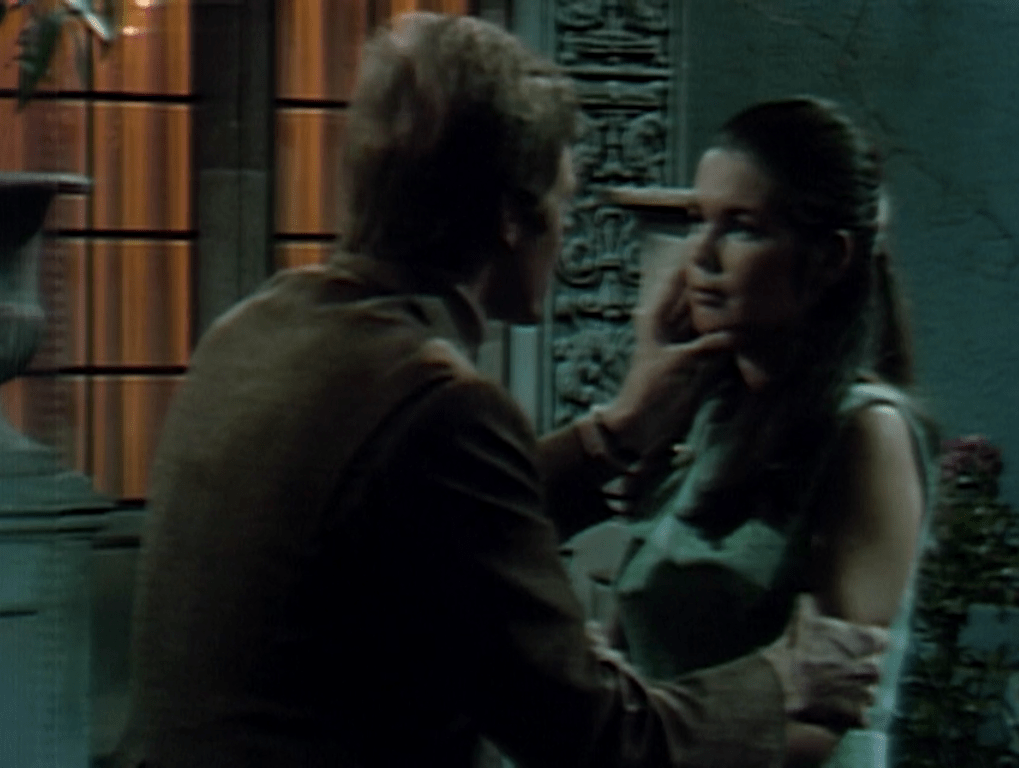
Roger Davis has his fun.

After Vicki escapes from Peter/ Jeff’s repellent attentions, a woman named Eve emerges from the bushes. Peter/ Jeff is angry with her. He grabs her roughly and throws her out of the frame. Peter/ Jeff then stalks off. Eve comes back into the frame. It’s a relief to see her upright and well-put-together- Mr Davis shoved Marie Wallace so hard she had to struggle to right herself as she spun out of view. It looked like she might have slammed her head against the floor.
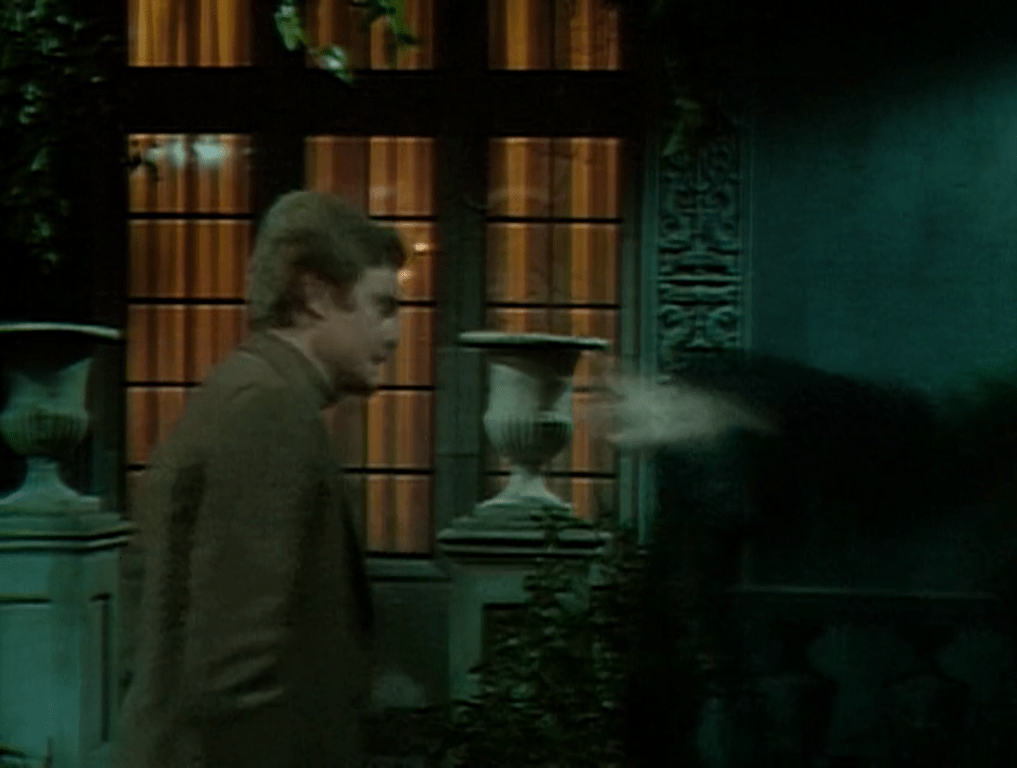
Marie Wallace using her arm to regain her balance and keep from sustaining a serious injury.

In a comment on Danny Horn’s post about this episode on his blog Dark Shadows Every Day, Marc Masse reports what happened when this scene came up at a panel discussion at a Dark Shadows convention many years later:

This was the episode where Grabby Davis got so overly excited in his scene with Marie Wallace on the terrace that he grabbed her by the arms and threw her completely out of frame. You see her struggling to remain on her feet as she stumbles off to the right. Some 20 years later at a fan convention (it’s in Dark Shadows 25th Anniversary Special from the disc set that has the last episode of the series), Marie Wallace brought this up as Roger Davis was telling the audience of how they (or rather he) would cut up and laugh and have fun while they were making the episode, and of how they would just laugh off their flubs. Wallace then broke in to remind Davis of episode 622 as she recalled, “Hey, Roger? I didn’t laugh when you threw me out of frame in that scene, on camera. Remember that? Several times?” She explained to the audience how all during dress rehearsal he’d never touch her and then when he’d done it on camera he’d come up to her and apologize profusely, but Wallace told him then and there at the convention that she never believed him.

Marc Masse, as “Prisoner of the Night,” in a comment left 8 April 2015 on “Episode 622: Heated Conversations on Somebody Else’s Lawn,” Danny Horn, Dark Shadows Every Day, 8 April 2015.

In a response to another post of Danny’s, Marc added that in the same video you can see actress Donna Wandrey’s appalled reaction to Mr Davis’ statement, and her increasingly visible disdain for him as Miss Wallace makes her case against him.

After Peter/ Jeff is gone, another visitor comes and addresses Eve by name. She is Angelique. Angelique is not a Roger Davis character, she is merely a vampire, so everyone can relax.

Regular viewers have been wondering what would happen when Angelique shared a scene with Eve. Marie Wallace’s style as Eve relies on many of the same techniques Lara Parker uses as Angelique. Both use an elevated style with many catches of breath, changes of volume in mid-sentence, and striking of oratorical poses. Each was capable of making this exaggerated method work, but no one could conceal its profound silliness, and a scene consisting of two characters both using it would be too ridiculous even to make a good joke in a cartoon. What actually happens is that Parker demonstrates the quietest possible version of the style, while Miss Wallace shows a more typically brassy version. Recognizing their approaches as two poles of the same axis, we are not only interested in their encounter, but also in what they show us about the craft of acting.

Angelique persuades Eve to join her in an alliance against warlock Nicholas. This might be an exciting development. Nicholas is the show’s chief villain at the moment, and between them Angelique and Eve just might be able to bring him down. It is also the first alliance we have seen take shape in a long time. Many characters have tried to control other characters, to deceive them, to imprison them, to enslave them, to brain-wash them. But the only group working towards a common end is made up of old world gentleman Barnabas, mad scientist Julia, occult expert Stokes, and servant Willie. That team formed long ago, has not managed to get anywhere lately, and is, at the moment, immobilized by Barnabas’ absence. Yesterday Julia tried to form an alliance with Nicholas against Angelique, but at the last minute his inability to talk with her forthrightly aborted that effort. So it is refreshing to see that the show is still capable of imagining a new alliance.

Danny’s post about this one is one of his very best, a composition in free verse weaving together quotes from the dialogue with retellings of the overarching narrative with meditations on a number of topics that the episode touches on. If you are a Dark Shadows fan and haven’t read Dark Shadows Every Day, this is a fine post to start with. It’s like a song- you may not understand all the lyrics the first time you hear it, but the sound of it will carry you along.

The comments below it include some great stuff too. I’ve already mentioned Marc Masse’s remark about Marie Wallace’s confrontation with Roger Davis. There are also two fanfic ideas about how the show might have resolved the question of who Vicki’s parents were. Someone posting under the name “William” had this plausible one:

My own theory: Victoria the daughter of Jamison Collins and Betty Hanscomb. So she’s Roger and Liz’s half-sister. Liz knows and Roger doesn’t.

Jamison aggressively seduces Betty, on whom Roger had teenage crush. He makes her pregnant and then coldly casts her out. A pregnant Betty shows up at Collinwood and tells Liz and Roger about what happened.

Roger confronts his father in a fit of rage in the Tower Room during one of Collinwood’s famous storms.

Jamison Collins has a heart attack during the confrontation, and Roger leaves him in the room to die. Roger staggers out, and Liz finds her father dead.

Roger has a complete breakdown and is sent to Windcliff, where Dr. Julius Hoffman, uncle of Julia Hoffman, wipes out his memory of that night in the summer of 1946.

Liz, with the help of new guy in town Paul Stoddard, pays off Betty Hanscomb to leave town and arranges for her half-sister to be raised at the foundling home in New York. Grateful to Paul for his help, Liz starts to fall for his charms …

(And this is why Liz is so fond of Victoria, but not like she is with Carolyn. And this is why she refuses to tell Roger anything about why she brought Victoria back).

–“William,” in a comment left 22 August 2016 on “Episode 622: Heated Conversations on Somebody Else’s Lawn,” Danny Horn, Dark Shadows Every Day, 8 April 2015.

That has a lot of potential. Liz doesn’t seem ever to have loved Paul, she did marry him shortly after her father’s death, and Roger’s attitude towards Vicki in the first months of the show was a strange mixture of extreme hostility and obvious attraction. “William’s” story would account for all of those things. But it doesn’t hold a pale blue candle to this theory posted by Pedro Cabezuelo:

Everybody, we’re missing the obvious! Vicki IS Betty Hanscombe!!!!! Somehow she managed to time travel AGAIN and ended up in Collinsport circa the 1940s and adopted the Betty Hanscombe identity, working her way as a servant at Collinwood. She had an affair with Paul Stoddard, gave birth to herself (at which point the adult Vicki ceased to exist) and THAT’S what caused all the irreperable harm to the time stream/parallel time/anything else you want to blame on Vicki.

Pedro Cabezuelo, in a comment left 10 April 2015 on “Episode 622: Heated Conversations on Somebody Else’s Lawn, Danny Horn, Dark Shadows Every Day, 8 April 2015.

I have my own fanfic idea about Vicki’s origin. I’ve shared it here before, and will again. But Pedro’s is so good I want it to be the last word today.

Episode 541: Creating a living human being

When Dark Shadows began in the summer of 1966, its most intelligent character was also its most dangerous, strange and troubled boy David Collins. David twice came within an inch of committing the perfect murder, first when he sabotaged his father Roger’s car, then when he trapped his governess Vicki in a room in the long-deserted west wing of the great house of Collinwood.

The only story that consistently worked in those days was the relationship between David and Vicki, and that was solely due to actors David Henesy and Alexandra Moltke Isles. While the writers gave them terrible dialogue- at one point having Vicki read aloud to David from a reference book on the geography of Maine- they used their faces, voices, and movements to show us what was going on inside the characters. Mr Henesy always looked like an angry boy who was grimly determined to keep hating his governess even though he couldn’t help but like her, while Mrs Isles always looked like a fearless young woman who was determined to befriend a boy who might make an attempt on her life at any moment. As David relented from his hatred, we could see a friendship budding between them, even if the words were still no good.

The story of Vicki and David had its climactic phase from December 1966 to March 1967, when his mother Laura Murdoch Collins was on the show. Laura was Dark Shadows’ first supernatural menace, an undead fire witch who planned to incinerate herself and David so that she could attain a new life. When David ran from the burning Laura into Vicki’s arms in #191, he chose her and life over Laura and death. She thus became his new mother, and their story was complete.

Since then, the show has found very little for David to do. Yesterday, he was wandering around the house with a tape recorder. He told his stepmother Cassandra that he couldn’t figure out how to play a tape. The preoccupied Cassandra sent him away, and he asked his cousin Carolyn to help him. Carolyn made it clear that all you do is press the button labeled “Play.” Two years ago, David could sabotage a brake cylinder to fail at precisely the spot on the road where it would be likeliest to lead to a fatal crash, but now he can’t grasp the concept of “Press play to listen to the tape”?

Longtime viewers will see a missed opportunity here. Cassandra is a wicked witch, also known as Angelique. In #492, Angelique/ Cassandra cast a spell that caused David to forget some incriminating information about her, so we know that he is subject to her power. Vicki knows a great deal about Angelique/ Cassandra; they could easily give us a series of scenes in which Vicki tries to warn David about his stepmother, but his mind is clouded. Instead, we never see Vicki and David alone together during this phase of the show, and Angelique/ Cassandra rarely does anything more with David than display irritation and order him to go away.

David eventually played the tape for Angelique/ Cassandra. She reacted with great excitement, since it included a message that explained why she failed in her attempt to restore the vampire curse she once placed on David’s distant cousin Barnabas Collins. She sends David away and keeps the tape recorder.

Angelique/ Cassandra won’t let David take the tape recorder back to his room. Screenshot by Dark Shadows Before I Die.

Angelique/ Cassandra informs her supervisor, suave warlock Nicholas, that she can re-vamp Barnabas if she kills Frankenstein’s monster Adam. Fascinated by the idea of an artificially constructed human being, Nicholas loses interest in Barnabas and instructs Angelique/ Cassandra to find out more about Adam.

In #532/533, Nicholas met Maggie, The Nicest Girl in Town. Nicholas was obviously smitten with Maggie, putting the lie to his taunting of Angelique/ Cassandra for her ability to feel an emotional attachment to Barnabas and his own claim to be motivated solely by a devotion to evil for its own sake. After he gives Angelique/ Cassandra her orders, Nicholas goes to Maggie’s house. Ostensibly this is to find out if she knows where Adam might be, but she so obviously does not that it is clear he just wants to see her. He asks her about her hospitalized fiancé Joe, admires her late father’s paintings, and offers to buy one of them at a high price and lend it back to her. Maggie seems to be quite charmed by him. Nicholas’ “Evil, be thou my good” schtick can be fun to watch for short periods, but if he is going to be a major character for any length of time he will need a more complex inner life. His attraction to Maggie is a step towards giving him one.

David goes to Barnabas’ house. He tells Barnabas’ friend Julia that at least twice this evening he has listened to a message on a tape recorder that had something to do with Barnabas and Adam, but he can’t remember any of the details. He does remember that Angelique/ Cassandra got excited when he played it for her, but that’s it. If Angelique/ Cassandra had cast a spell on David, his forgetfulness would be understandable. If Vicki and Angelique/ Cassandra were locked in battle for David’s allegiance, it could be dramatic. But as it is, the show has chosen simply to present David as an abject moron, and that is infuriating.

Julia and David go back to the great house, where they find Nicholas and Angelique/ Cassandra with the tape recorder. Nicholas and Angelique/ Cassandra leave, and Julia and David play the tape. It no longer has the original message, but instead has the witches’ sabbath portion of Berlioz’ Symphonie Fantastique. David furrows his brow, then comes up with the bright suggestion that Angelique/ Cassandra, who has been in possession of the tape the entire time, may just possibly be the one who made the change. Again, since we have not seen Angelique/ Cassandra cast a spell to confuse David’s thinking, this incredible stupidity can do nothing but exasperate the audience.

They don’t even have the excuse that the current writing staff doesn’t know that David used to be interesting. The gimmick of replacing important information on a reel-to-reel tape with an audio signature suggestive of the culprit is a callback to #172, when Laura thwarted parapsychologist Dr Peter Guthrie by replacing an audio recording of a séance with the sound of fire crackling. If they can recall that bit, surely they can remember that David used to have a functioning brain.

In the early days of the show, Vicki was on a quest to find out who her parents were and why they left her at a foundling home when she was an infant. In #60, Vicki stumbled upon a portrait Maggie’s father Sam painted twenty years before of a woman who looked just like her. Vicki wondered if this woman, whose name was Betty Hanscombe, might have been her mother or aunt. Sam gave Vicki the painting then, but it is back in Maggie’s house today, and Nicholas picks it up at one point. We don’t get a very good look at it, but you can buy a reproduction of it on canvas for $25.99 plus shipping from someone on Etsy, it looks nice.

Nicholas examines the Betty Hanscombe portrait. Screenshot by Dark Shadows Before I Die.

Episode 97: Paint her soul

Dark Shadows tells the story of the great house of Collinwood and its residents, the ancient and esteemed Collins family. From the first episode, some of the most important elements of the house’s visual impact are the portraits of the Collins ancestors that decorate its drawing room and foyer.

The foyer is dominated by a portrait identified as Benjamin Collins. In episode 2, well-meaning governess Vicki feels so intimidated by Benjamin’s portrait that she looks at it, says “Boo!,” and runs away:

Boo to Benjamin. Screenshot by Dark Shadows Before I Die

The drawing room is home to several portraits. The two that have been most frequently discussed so far on the show are those of Isaac Collins, which moves around a bit but usually hangs by the piano, and of Jeremiah Collins, which has a secure home above the mantle. Reclusive matriarch Liz used the portrait of Isaac as a visual aid in a lecture about family history that she delivered to her nephew, strange and troubled boy David, in episode 17:

Liz lectures David. Screenshot by Dark Shadows Before I Die

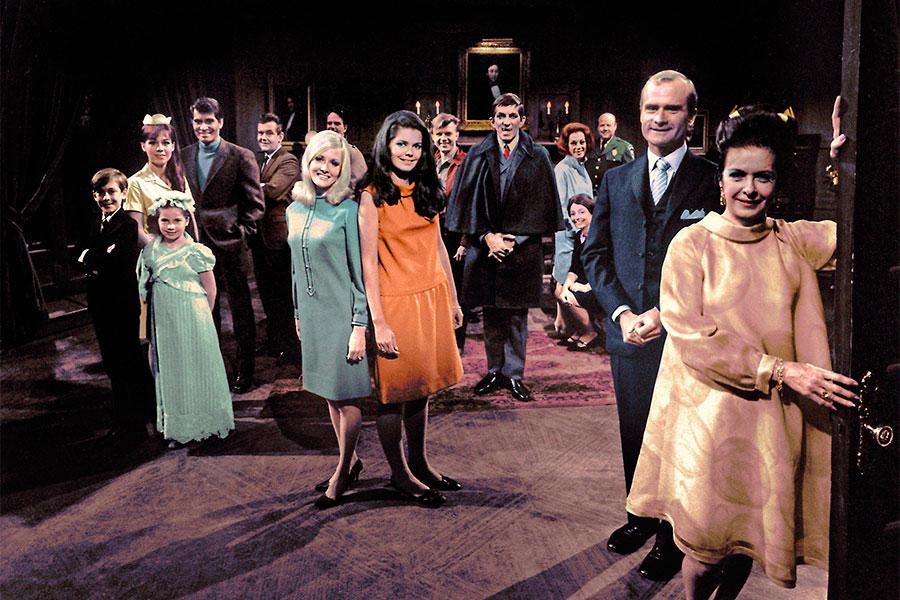
The portrait of Jeremiah features prominently in almost every scene in the drawing room. Since the drawing room is the single most important set in the series, that makes the portrait one of its stars. It’s only appropriate that it looked over this June 1967 publicity photo of the cast:

By November of 1966, we have seen three stories about portraits. The first starts in episode 22 and drags on for quite a while. Dashing action hero Burke Devlin calls on drunken artist Sam Evans and commissions him to paint his portrait, specifying that it is to be the same size and style as the portraits in Collinwood. Burke is scheming to take the house away from the Collinses, and to hang a portrait of himself in one of its most conspicuous spots. For about six weeks, high-born ne’er-do-well Roger Collins frantically tries to bully Sam into canceling the commission. Roger doesn’t care about Burke’s plans for the house. He is just afraid that in the course of the sittings Burke will learn a dark and terrible secret he and Sam share.

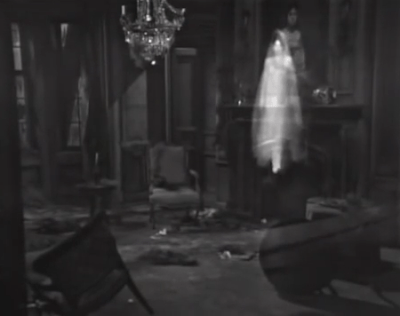
Another story takes place within a single episode, episode 70. We get our first look at The Old House and the portrait of Josette Collins that presides over its parlor. After everyone has left, the portrait begins to glow, and the ghost of Josette comes walking out of the portrait:

Josette steps out. Screenshot by Dark Shadows Before I Die

Today’s major theme is a story that began in episode 60. Visiting the Evans cottage, Vicki found a portrait that she herself strongly resembles. Sam told her that he painted it 25 years ago, and that the model was a local woman named Betty Hanscombe. This excited Vicki, who grew up a foundling and is on a quest to find out who her birth parents were. Vicki wondered if Betty Hanscombe might be her long-lost mother, or if some nearby relative of hers might be. Sam disappointed Vicki’s hopes as soon as he had raised them, telling her that Betty died before Vicki was born and that she has no relatives in the area. Since then, Vicki’s interest in the portrait has been revived. She learned that there was once a butler at Collinwood called Hanscombe. She has formed a vague hope that one of her parents was a member of a central Maine family named Hanscombe, and she is trying to track them down.

Today, Vicki goes back to the Evans cottage and asks Sam for another look at the portrait of Betty Hanscombe. Sam is in a good mood; before Vicki shows up, he’s singing, and his baritone voice sounds like he’s ready to appear in musicals on Broadway. Uncharacteristically, he is sober, a fact demonstrated by his almost successful attempt to thread a needle. He gives Vicki a courtly reception, recaps what he told her about Betty Hanscombe and the painting seven and a half weeks ago, and when she persists in showing interest makes a gift of the portrait to her. She’s flabbergasted by his generosity, though considering that he painted it twenty five years ago and hasn’t sold it yet he may as well be generous.

While Vicki is at the Evans cottage, Liz summons her brother Roger to the drawing room. She has deduced that Vicki is not going to forget about Betty Hanscombe or her portrait, and instructs Roger that their goal is to stuff those topics into the deepest possible obscurity.

Vicki returns with the portrait and shows it to Liz and Roger. Roger watches Liz and listens to her declare that it looks nothing like Vicki. Liz then directs Roger to look at the painting, and he dutifully echoes her statement. Since it is in fact a painting of Alexandra Moltke Isles, we can sympathize with Vicki’s disbelief at the position they are taking. She seems to be about to give up when flighty heiress Carolyn walks into the room, looks at the painting, and asks Vicki when she had her portrait done. “It looks exactly like you!” It’s a terrific ending for the episode, and leaves us wondering what will come of the Betty Hanscombe story.*

Vicki shows the portrait of Betty Hanscombe to Liz and Roger. Screenshot by Dark Shadows Before I Die

Episode 60: Double, double

Soap operas are supposed to have a weekly rhythm. Fridays bring a whirlwind of flashy, unexpected events, building up to a big cliffhanger. On Monday, the cliffhanger is resolved and the flashy, unexpected stuff is sorted out so that new viewers can find their way into the show. On Tuesdays and Wednesdays, you experiment with new storylines that may or may not go anywhere, and on Thursdays you set up for another boffo Friday.

At no point in its run did Dark Shadows adhere to this pattern. This week, for example, has had four relatively fast-paced episodes on Monday through Thursday, then slows down for a Friday episode consisting of a couple of leisurely conversations. Conversations in which the audience is presented with a lot of basic exposition, but still, a big shift down in dramatic intensity from the four days leading up to it. A bit later, after writer Art Wallace leaves the show, there will be weeks with no apparent structure at all, certainly no boffo whirlwind Fridays. After the show becomes a hit and Sam Hall takes the lead among the writing staff, every day will be a whirlwind, and every commercial break a cliffhanger.

One of today’s conversations takes place in the home Maggie Evans, the nicest girl in town, shares with her father, drunken artist Sam. The other takes place in the sheriff’s office.

Maggie has brought well-meaning governess Vicki home for dinner. They talk about Vicki’s quest to learn the secret of her origins and about the manslaughter case that sent dashing action hero Burke Devlin to prison ten years ago. Meanwhile, Burke has barged into the sheriff’s office and is demanding information about the ongoing investigation into the mysterious death of plant manager Bill Malloy. The sheriff gives Burke more answers than it would be proper for an investigator to give a member of the public in real life, but nonetheless frustrates his need to dash into heroic action. Burke leaves the sheriff’s office, and barges into the Evans cottage as dinner is served. The Friday cliffhanger is Burke asking if he may join the Evanses and Vicki for dinner.

I suppose you could call this one of Art Wallace’s diptychs. Both conversations feature insistent questioners and reluctant responders. Burke improperly demands information from the sheriff. The sheriff parries his demands, observing Burke’s reactions as he sizes him up as a suspect in the case. The sheriff remains very much in control of the situation. As in previous episodes, we see that the sheriff alone exercises power in the sheriff’s office. By contrast, Sam loses control entirely in the face of his two questioners. Again as in previous episodes, we see that Sam has no power to resolve a conflict, whether at home or anywhere else.

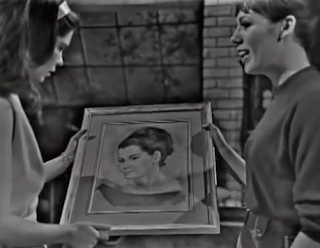
That’s the dramatic content of the episode. The expository content is much more involved. Vicki looks through Sam’s paintings, and finds a portrait that strongly resembles her. When Sam tells her that the painting is 25 years old and that the model was a Collinsport girl, Vicki is excited, thinking she may have found a relative. Sam tells her he doesn’t believe that’s possible. He had heard that the model, whose name was Betty Hanscombe, had died a few months after he painted her portrait, years before Vicki was born, and that she had no living relatives.

Vicki and Maggie hold the portrait of Betty Hanscombe
Screenshot by Dark Shadows Before I Die

Note that Sam had only heard that Betty died. She had left town before then, and had no close connections to anyone with whom Sam was in touch. He could easily have heard wrong. So experienced soap opera watchers will brace themselves for the possibility that Betty Hanscombe will make a surprise entrance at some point and reveal herself to be Vicki’s mother and someone else’s secret half-sister.

When Maggie and Vicki ask Sam about the manslaughter case, he becomes agitated. Trapped into telling the story, he takes a drink and looks away from the young women. He tells essentially the same story high-born ne’er-do-well Roger had told his sister, reclusive matriarch Liz, in episode 32, but with some details added.

Burke and Roger were extremely close in those days, ten years ago. For a moment, Sam seems to be having trouble finding the words to express just how close. Along with Burke’s girlfriend Laura, they went drinking one night at a bar on the road between Collinsport and Bangor. Witnesses at the bar testified that Burke was so drunk they had to carry him to his car, and that he insisted on driving. Roger and Laura were his passengers. Burke himself admitted that he blacked out and couldn’t remember the drive. At some point, the car hit and killed a man named Hansen and kept going. At the trial, Roger and Laura testified that Burke was driving when his car hit Hansen. Burke thought that he might have got out of the driver’s seat and handed the keys to Roger before the accident. Burke was convicted, and publicly swore that he would avenge himself on Roger. A week after he was sentenced, Roger and Laura were married.

So that’s the basis for “The Revenge of Burke Devlin” storyline. I’m not a criminal lawyer, but I wonder if Burke wouldn’t have been guilty of manslaughter no matter who was behind the wheel at the moment of the collision. By all accounts, Burke drove drunk, and was drunk in his car when it killed someone. If at some point he stopped driving and handed the keys to someone else whom he knew also to be drunk, that would indeed add to that person’s culpability, but I don’t see how it would clear Burke’s name. To do that, Burke would have to change the events themselves.

To make sense of the storyline, perhaps we can revisit the tale of the night of the accident. Two lovers and their friend were in a car involved in a hit and run. Afterward, one lover turned against the other, and took up with the friend. Everyone thought the lovers before that night were Burke and Laura, and that the friend was Roger. But if the men were lovers and Laura were the friend tagging along on their date, Burke’s frantic campaign to alter the past and Roger’s grim determination to hide it take on a new significance.

The cast of the show and its writing staff were largely drawn from Broadway, where in the 1950s, 60s, and 70s many playwrights had hits with dramas in which some people try to rewrite history and others try to conceal it in desperate attempts to erase unconventional sexual relationships. Indeed, when Sam stumbles in his attempt to find words to describe the bygone intimacy Roger and Burke shared, we can’t help but remember that Sam is played by David Ford, fresh off a long engagement as Big Daddy in a production of Cat on a Hot Tin Roof. It is by no means fanciful to wonder if that stumble hints at the suspicion of a relationship Tennessee Williams would have found interesting.

Miscellaneous:

At the end of his post about this episode on Dark Shadows from the Beginning, Marc Masse goes on at length about other things you might have seen on television in mid-September 1966. This is not my favorite feature of his blog, but this time it includes a couple of irresistible bits from commercials featuring Dark Shadows cast members. Here’s a still from a spot in which David Henesy sells cereal (with a side of racism, but it’s hard to imagine that was his fault):

Screenshot by Dark Shadows from the Beginning

The same post features an audio clip of Thayer David selling NyQuil. Here’s the commercial: