
Old world gentleman Barnabas Collins has fallen afoul of a shape-shifting monster from beyond time and space who once hoped people would call him “Jabe.” The monster, who has settled for the name “Jeb,” turns Barnabas back into what he was from the 1790s until 1968, a vampire.
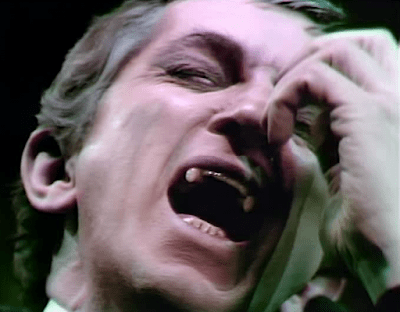
Re-vamped, Barnabas suddenly gets a lot of gray in his hair and a much darker complexion. Makeup artist Vince Loscalzo deserves a lot of credit for these bits of color, they are placed perfectly to emphasize the look of anguish as Barnabas realizes what has happened to him and struggles to resist his urges. The actors’ faces were the medium of Loscalzo’s art, and he outdid himself with these complements to Jonathan Frid’s face.
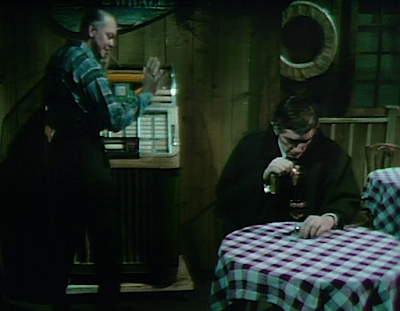
We see Barnabas sitting at a table in The Blue Whale, the tavern in the village of Collinsport. He is the only patron in the room. He has a glass of reddish liquid in front of him, and the bartender is moving around the room. The bartender looks at Barnabas, as if to ask, “How do you like your glass of AB negative, Mr Collins?” But he turns away and moves on.
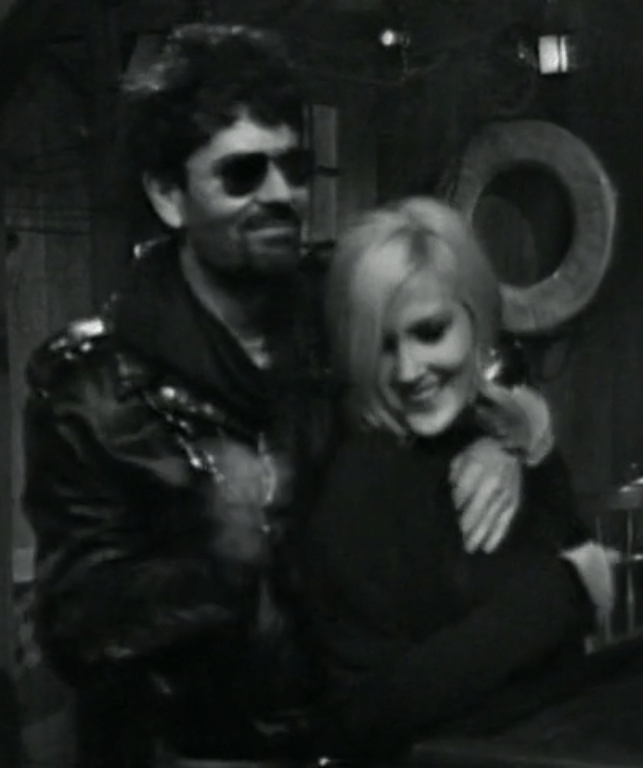
A young woman enters. Barnabas invites her to join him at his table. He sees that she is wearing a pendant that identifies her as a member of the secret cult that serves Jabe and other creatures who intend to seize control of the Earth, supplanting humankind. Barnabas introduces himself, and says that he was the one who made it possible for Jabe to come to life. This is true, but it is also true that he has become disaffected from the cult. Even after Jabe turned him back into a vampire, Barnabas is still determined to thwart it.
The young woman introduces herself as Nelle Gunston, who was recruited into the cult while living a dreary life with her parents in Virginia. Nelle tells Barnabas that everything has changed for her since she joined the cult. She says that she will gladly do anything she can to advance its objectives, including murder. They have this conversation in nice loud voices while the bartender is nearby.
Barnabas’ friends, mad scientist Julia Hoffman and recovering werewolf Quentin Collins, enter. He introduces them to Nelle, then explains to them that he and Nelle have a private matter to discuss. Quentin and Julia go to the bar, where Quentin orders brandies. They talk about Nelle’s pendant and their fear that Barnabas is falling back under the power of the cult while the bartender is in their space serving them drinks. Evidently they’ve learned to rely on his discretion. They are still deep in conversation when Barnabas leaves with Nelle.
Barnabas takes Nelle back to his place on the pretext that Jabe will meet them there. She asks him why it is so dark in there; he asks her how she got into the cult. She catches on that Jabe is not coming and that Barnabas is not loyal to him. She draws a knife and is about to stab Barnabas when he bares his fangs to her.
Quentin and Julia let themselves into Barnabas’ house. They find Nelle dead on the floor and Barnabas wallowing in self-pity next to her. Julia takes a second look at Nelle and sees the puncture wounds on her neck. She tells Barnabas she will renew the treatments that first put his vampirism into remission two years before; he says there is something else he has to do first. After he rushes out, Quentin and Julia talk about how they will hide Nelle’s body.
Nelle was the perfect victim for Barnabas- no one in town knew her, no one expected her to come, no one will notice she is missing. And he is determined to weaken the cult, so reducing its numbers by one fits his goals.
Barnabas goes to the antique shop in the village. Jabe is in an upstairs room; Barnabas is convinced that Jabe can assume his true form and lay it down only in that room. We saw him do that in a house on an island many miles away in #946, and he told Barnabas that he had done so in #947, but apparently that doesn’t count, somehow. Jabe is far more powerful in his true form than he is when he is man-shaped, but he cannot mingle with humans in that form. So Barnabas believes that he will limit Jabe’s options if he destroys the room. He pours gasoline all around the first floor of the shop and sets a match to it.
Nelle is played by Elizabeth Eis, in her first appearance on Dark Shadows. They say that the first thing actors have to do to work effectively is to pay attention to each other. Eis shows how far this can take you. She listens ravenously to everything Frid says and never takes her eyes off him. The script doesn’t give her a huge amount to work with, but simply by giving her scene partner her total attention she creates a sensational performance. The producers noticed; she will be back later this year in two quite different roles.
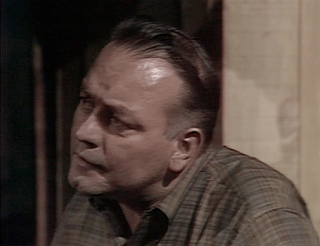
This episode is the last time we see either the Blue Whale or Bob O’Connell as the Bartender. The Blue Whale was an important part of the show from its debut in June 1966 until the first costume drama insert began in November 1967. O’Connell appeared as the Bartender in 60 episodes (three of them as other bartenders in other periods of history) and had speaking parts in 6. It’s too bad he doesn’t get to say anything today, but at least he is in the closing credits.






 Dark Shadows Commentary