Vampire Barnabas Collins has decided that he will eventually kill his sometime accomplice turned bête-noire, mad scientist Julia Hoffman. Julia has decided that her only possible helper is the ghost of Barnabas’s ten year-old sister, Sarah.
Julia goes to Sarah’s grave in the Tomb of the Collinses and calls to her. She hears the strains of “London Bridge,” then sees Sarah. Sarah tells Julia that she will not help her, because she killed someone she liked, Dr Dave Woodard. Julia tries to put the blame for that crime on Barnabas, but Sarah declares that she helped him. We heard “London Bridge” in the background during the murder scene in #341, so we know that Sarah saw the crime and Julia will not be able to deceive her.
In this scene, Sarah says that she cannot act directly against Barnabas. This is a striking moment, because it is the first time Sarah has spoken her brother’s name out loud. Sarah’s statement explains why she watched as Barnabas and Julia killed Woodard, and also why so many of her attempts to protect her friends from him have ended up with them in worse shape than before and Barnabas insulated from all accountability.
When Julia was working with Barnabas, she too made desultory attempts to restrain his worst tendencies, while always protecting him from the consequences of his actions. The dynamic between them mirrored the Bossy Big Sister/ Bratty Little Brother pattern that matriarch Liz and her brother Roger have been modeling from the first day of the series. Seeing Julia with Barnabas’ literal sister, we see that this dynamic has defined the Collinses for centuries.
High-born ne’er-do-well Roger Collins was the first of Dark Shadows’ icy, calculating villains, and Roger’s son, strange and troubled boy David, was the first of its adorable homicidal maniacs. By the time David’s mother, blonde fire witch Laura Murdoch Collins, went up in smoke in #191, well-meaning governess Vicki had converted David from evil to good, and the subsumption of the “Revenge of Burke Devlin” storyline into Laura’s arc had set Roger on the path to becoming occasional comic relief.
Now, bumbling vampire Barnabas Collins combines the roles Roger and David pioneered. Barnabas has been so inept at keeping his secrets that David has learned some of them and is frantically trying to warn the adults about him, but he has shown enough calculation in his damage control that most of the adults receive David’s warnings as signs of mental illness.
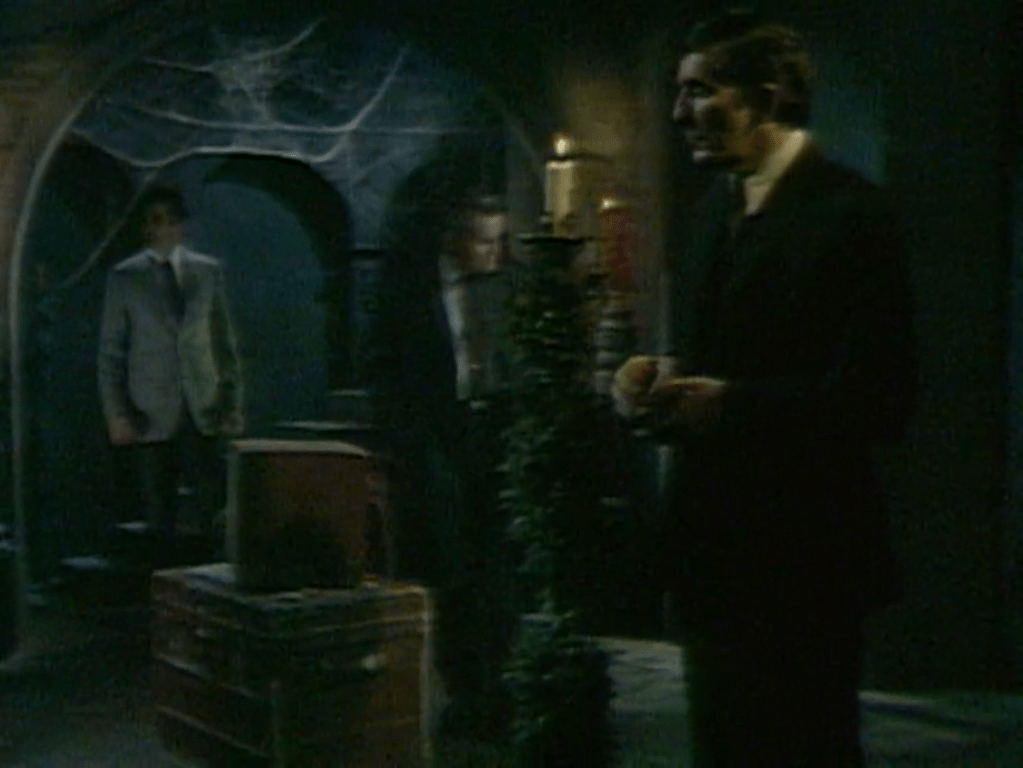
The highlights of today’s episode are two sequences in which Roger makes himself remarkably vulnerable to his old nemesis Burke Devlin and family doctor Dave Woodard. Early on, Burke and Woodard are telling him that David is a frightened boy, and Roger answers them with a speech in which he claims that all boys live in constant terror. “I was a child in this house. I was terrified of the darkness in the corners and frightened to walk along the corridors by myself. I used to think that all the people in these Collins portraits… all those dead people… stared at me wherever I went… looked at me with piercing eyes… hated me! Well, I outgrew it, and so will David.” Burke and Woodard simply ignore Roger’s speech- evidently they are true New England men, and cannot imagine talking to each other about their feelings. After Burke and Woodard leave Roger, he looks at the portrait of Jeremiah Collins above the fireplace in the drawing room, and recoils in fear.
Roger, alone with the portrait of Jeremiah Collins, and still scared out of his wits. Screenshot by Dark Shadows Before I Die.
After Burke and Woodard have talked with David a while, they come back to ask Roger’s permission to take the boy to look for a secret chamber he says can be found in the Collins family mausoleum. Roger says in reply that they should forget about looking into tombs and get a psychiatrist who can look into David’s mind. He says that David “is like a person on a thin wire, very high off the ground… Any minute he may fall and plunge downward- out of our reach forever.”
Again, Burke and Woodard don’t react to Roger’s speech at all. Viewers who have been with the show from the beginning, though, will see these two scenes as a significant retcon. For the first 38 weeks of Dark Shadows, Roger openly hated David, was eager to get rid of him, and exploited his troubles for his own advantage. Perhaps the single most shocking scene in the entire series came in #68, when Roger coolly manipulated David into making an attempt on Vicki’s life. But now Roger is a caring father whose concern for David drives him to make the most astonishing emotional displays.
In the scene between Roger’s speeches, David told Burke and Woodard about two vacant coffins he has seen. Woodard, who is inclined to believe David is onto something, can’t help but try his hand at psychotherapy, and asks David if he isn’t terribly afraid of coffins. Again, long-time fans will remember that matriarch Liz went eighteen years without once willingly leaving home, because she thought that the murdered body of her husband Paul Stoddard was buried in the basement. In #275, it turned out that Stoddard’s supposed grave held only an empty trunk. Burke was there when that came to light, and Woodard probably knows about it too. So he might well imagine that David would have a lot of unresolved feelings surrounding the image of a vacant coffin. The Liz-is-a-recluse story was a dud from the beginning, so it is understandable it hasn’t been referenced in months, but it’s a shame Woodard doesn’t have the chance to clue new viewers into what may well be on his mind.
Also in that scene, David tells Burke and Woodard he will have to break a promise he made to his friend, the ghost of ten-year-old Sarah Collins. When he says this, the wind blows the window to his room open, and the strains of “London Bridge” play on a wooden flute. When David asks the men if they can hear the music, they make it clear that they can. He tells them that it is Sarah objecting that he ought not to share her secret, but that he has no choice.
He takes them to the Tomb of the Collinses, where Sarah and her parents are buried. He tries to open the panel to the secret chamber, but it has been locked. When Burke and Woodard tell him they don’t believe that there is a secret chamber, he finds Sarah’s flute on her mother’s crypt. This is enough to convince Woodard that there is something to David’s story.
In life, Sarah was Barnabas’ sister. Her current relationship to Barnabas echoes Liz’ relationship to Roger, and the relationship developing between Barnabas and mad scientist Julia Hoffman. She tries to prevent him from committing crimes, but she will not allow him to be caught once he has committed them. At the moment, the crime Barnabas is busiest committing is an attempt to spread the idea that David is insane and to trick the adults into giving him inappropriate psychiatric treatment. So Sarah leaves her flute where it will give David’s doctor evidence that he is not ill at all. On the other hand, Barnabas has reason to fear that if the secret chamber becomes generally known, he will be exposed and destroyed. So she swears David to secrecy about it, and is upset when he is going to violate that secrecy. The usual Dark Shadows dynamic, seen in both the Liz/ Roger and Julia/ Barnabas relationships, is that of Bossy Big Sister and Bratty Little Brother; Sarah is Barnabas’ little sister, and she isn’t exactly bossy, but the end result is similar.
A few days after Dark Shadows began, we learned that high-born ne’er-do-well Roger Collins had squandered his entire inheritance. He and his son, strange and troubled boy David, then moved into Roger’s childhood home, the great house of Collinwood. The house belongs to Roger’s sister Liz. Roger lives there as her guest, and draws a salary from her business as an employee.
Time and again, Liz tells Roger that he must behave himself; time and again, she shields him from the consequences of his actions. Liz may want to believe that she is a model of adult authority, but in fact their relationship is one of Bossy Big Sister and Bratty Little Brother.
Liz extends that enabling behavior to the rest of the family. In episode #10, David overheard Roger in the drawing room, telling Liz that he wanted to send him away to school. Liz refused, because she saw that as Roger’s attempt to resign his responsibilities as a father. For his part, David reacted by tampering with the brakes on Roger’s car so that they would fail when he was driving down a steep hill and kill him. His murder plan failed. When Liz discovered it in #32 she lied to the sheriff in order to keep the whole thing quiet, and a few days later she ordered the family’s handyman to take the blame for the crash.
David had no big sister. Liz’ daughter Carolyn would later become a surrogate sister to him, but through the first months of the show she took no interest at all in her cousin. David spent his time with his well-meaning governess, Vicki. David was certainly bratty towards Vicki, trying to frame her for his attempt on Roger’s life in #27, and making an attempt on hers in #84. But while Vicki was glad to be sisterly towards David, she did not fall into the same pattern with him that traps Liz and Roger. She listened to him patiently, and enforced rules firmly. In response, David not only stopped committing crimes against Vicki, but when his mother, undead fire witch Laura Murdoch Collins, tried to claim him, he chose life with Vicki over death with her. Episode #191, the last installment of Dark Shadows 1.0, ends with David in Vicki’s arms, his new mother consoling him for the loss of his original mother.
Roger and Liz are minor characters in Dark Shadows 2.0, and Vicki is fast fading into the background as well. But #332 and #333 take us back to the first weeks. Yesterday, David again overheard his father in the drawing room saying he wanted to send him away to “a special school” where psychotherapy can cure him of his weird ideas. But Vicki’s influence has realigned David from evil to good, so that instead of trying to kill his father, he tries to collect evidence that his ideas are not a product of mental illness. In that effort, he went to the Old House on the estate and came upon the coffin in which his cousin Barnabas Collins, a vampire, rests during the day. Barnabas found him there and was closing in on him when mad scientist Julia Hoffman came into the house.
“Are you afraid of me?”
Julia and Barnabas are at the center of the show now, and they reproduce Liz and Roger’s Bossy Big Sister/ Bratty Little Brother dynamic. When Barnabas announces that someone or other “must die!,” Julia talks him out of doing anything to bring that death about. Sometimes she threatens to expose him, sometimes she promises to cure him of vampirism, sometimes she wears him down with lists of the practical difficulties of the murders he would like to commit.
But Julia also conceals and destroys evidence of Barnabas’ crimes. She induces grave amnesia in his victim Maggie Evans, and lets his sorely bedraggled blood thrall Willie Loomis take the blame for abducting Maggie. In fact, she very nearly killed Willie when it looked like he might not go down quietly. She may have rescued David today, but she protects Barnabas all the time, and it seems to be just a matter of time before she becomes an active participant in a murder for his sake.
Back in the great house, local man Burke Devlin is conferring with Dave Woodard, MD. Burke says that he is worried about David’s “fantasies,” to which Woodard replies “If they are fantasies.” Woodard is coming to believe that Barnabas is an uncanny being responsible for Maggie’s abduction and the other troubles the town of Collinsport has seen recently, and he takes everything David says very seriously. When David comes home and announces that he found the coffin, that Barnabas tried to kill him, and that Barnabas is a dead thing that can move around at night, Woodard listens intently.
Julia comes in, as does Roger. Julia dismisses all of David’s assertions. She claims to have seen Barnabas’ basement, and to know that there is no coffin there. David looks at Julia, and asks in an oddly calm voice “Why are you lying?” Roger is appalled at this question, but Woodard studies David carefully as he asks it and studies Julia’s reaction just as closely afterward.
“Why are you lying?”
In #331, Woodard gave David a sleeping pill and asked him questions about the strange goings-on. Robert Gerringer and David Henesy played that scene marvelously. Gerringer showed Woodard’s struggle, as a man of science, to come to terms with a set of facts that made logical sense only in a world where supernatural forces are at work, while Mr Henesy showed David’s desperation to find a responsible adult who will listen to what he knows. Gerringer also showed Woodard’s tender affection for David, tugging the covers of his bed over him when he fell asleep. As Woodard watches David today, we see the same intellectual crisis and the same tenderness that he played then.
Roger demands David apologize to Julia. He will not. Woodard says they ought to go look at Barnabas’ basement and see if there really is a coffin there. Roger is horrified by the implied insult to his cousin, and forbids any such thing. Burke points out that Roger is in no position to forbid it, and accompanies Woodard to the Old House.
There, Barnabas presents himself as shocked that Burke and Woodard want to search his basement. Woodard is polite about the whole thing, but Burke is an utter swine, declaring that they won’t leave until Barnabas submits to their demand. This is not the first time returning viewers have seen Burke impose himself as an unwanted house-guest, and it doesn’t get more attractive the more we see it. When Barnabas orders them to leave, Burke says they will come back “with a search warrant!” Even under the law codes of soap opera land, this would seem to be an empty threat- neither of them is a police officer, and while it may be eccentric to keep a vacant coffin in your basement I can’t think of a reason to suppose it would be a crime. Watching this scene, my wife, Mrs Acilius, said that Burke is so obnoxious that he makes us root for Barnabas despite everything we know.
Burke and Woodard start to go, and Barnabas relents. He takes them to the basement. The coffin is usually in the main area at the foot of the stairs, but when the three of them get there some crates and a trunk are stacked up on that spot.
No coffin.
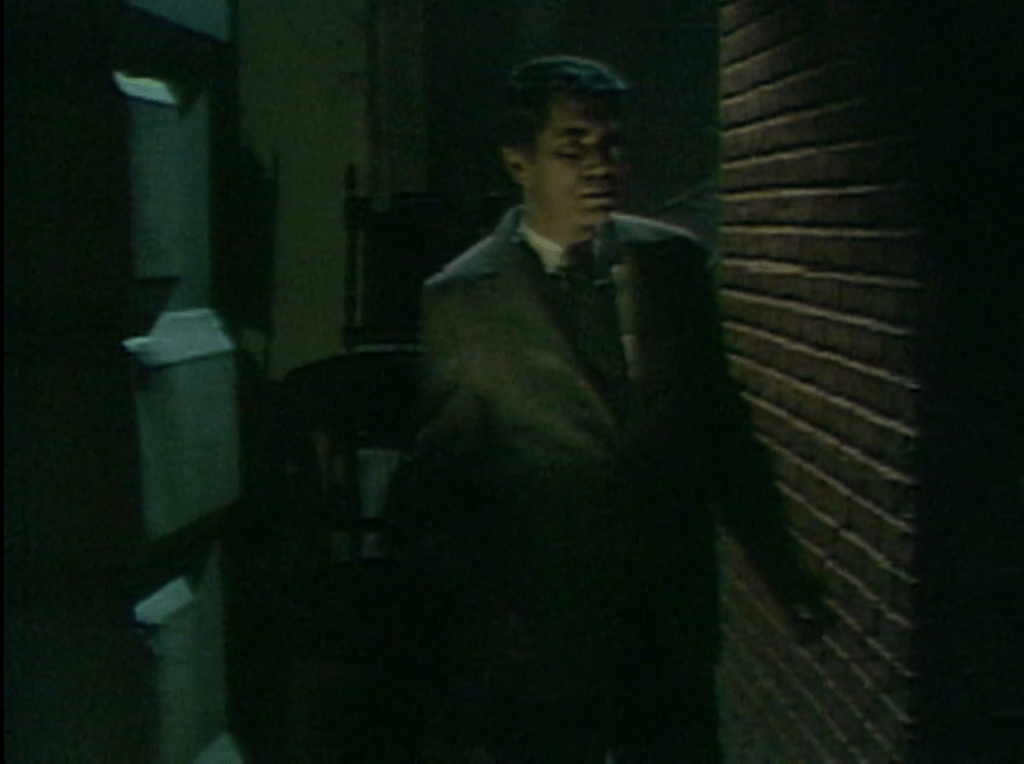
Burke goes down a little corridor and sees nothing there, either.
Burke in the corridor.
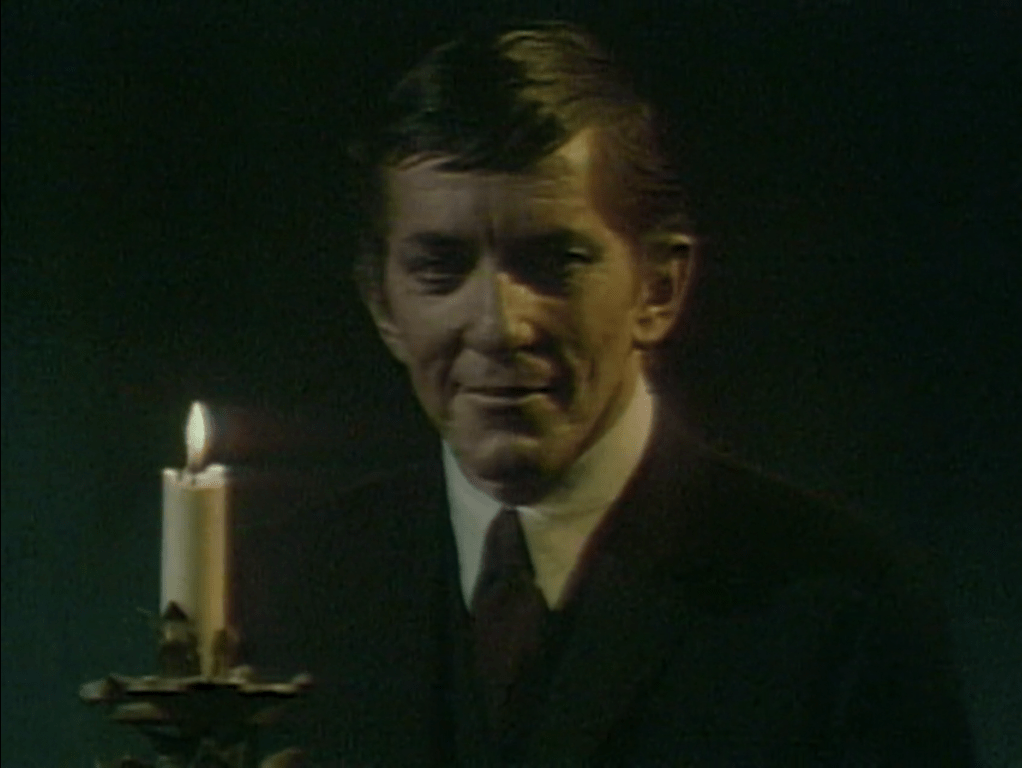
Burke and Woodard are embarrassed, and Barnabas grins. We know that he had moved the coffin so that when someone came to check out David’s story they would see nothing, and that his resistance to Burke and Woodard’s requests to search was put on for effect. Barnabas spends most of his time with other people pretending to be a living man born in the twentieth century; his grin is that of an actor who finds he has given a particularly convincing performance.
Receiving his ovation.
We had seen corridors in the basement when Barnabas was holding Maggie prisoner there. We saw them most prominently in the episode that ended with her escape, #260. In that one, they looked very extensive. He had kept Maggie in a prison cell at the end of one of those corridors. That cell had been there since Barnabas’ time as a living being in a previous century, but none of the many people who had visited the basement before Barnabas moved in, including Burke in #118, had seen the cell. So there must be quite a bit of space down there that only Barnabas knows about, but he has chosen to put his most embarrassing possession in the one place no one coming to the basement could fail to notice. It’s like the old days, when you’d go to visit a single guy at home and find that he had left sexually explicit magazines or videos on his coffee table.
Dangerously unstable ruffian Willie Loomis spent a week staring at the eighteenth century portrait of Barnabas Collins in the foyer of the great house of Collinwood back in April, then tried to rob Barnabas’ grave. That turned out to be an awkward situation when Willie found that Barnabas wasn’t entirely dead. Barnabas was a vampire who bit Willie, turned him into his sorely bedraggled blood thrall, and had lots of conversations with him. Yesterday, Willie was written out of the show.
Today we open with strange and troubled boy David Collins staring at the same portrait. As Willie was obsessed with the idea that there were jewels hidden in the Collins mausoleum in the old cemetery north of town, where in fact Barnabas’ coffin was hidden, so David is preoccupied with the idea that Barnabas has something terrible stashed in the basement of the Old House on the estate, where in fact his new coffin is hidden. As Willie sneaked off to the cemetery on his ill-starred expedition, David will sneak off to the Old House today and try to search Barnabas’ basement.
Unlike Willie, David is not driven by greed. He is afraid of Barnabas, and his friend, the ten year old ghost of Barnabas’ sister Sarah, has told him that he must not go to the Old House. But his aunt Liz and his father Roger dismiss his attempts to warn them about Barnabas, and he thinks it is his duty to provide them with evidence. So he screws up his courage and makes his way across the property.
David lets himself into the Old House by opening the parlor window. Not only have we seen David do this before, but Willie’s sometime friend, seagoing con man Jason McGuire, got into the house the same way in #274. Barnabas would kill Jason when he reached the basement in #275, so you might think he’d have put a lock on that window by now.
Jason’s fate is certainly on the minds of returning viewers when David tries to open the basement door. It comes as a relief when he finds the door locked. Barnabas’ co-conspirator, mad scientist Julia Hoffman, catches him there.
Julia demands to know what David is doing in the house, and he tries to brazen it out. He claims that he has a right to be there, since it belongs to his Aunt Liz. This is a bit of a murky point- we never see Liz transfer title to Barnabas, but she and others act as if he owns the place and its contents. Julia doesn’t clarify it when she responds that Liz gave the house to Barnabas- she doesn’t deny that it still belongs to Liz, only says that it also belongs to Barnabas.
Back in the great house, Roger is banging away at the piano. We saw Liz play the piano in #47 and #91, a reference to the conception of her character writer Art Wallace developed in his original story bible, titled Shadows on the Wall, in which she, like similar characters in a couple of TV plays he wrote in the 1950s under the title “The House,” gave piano lessons. Since then, Liz’ daughter Carolyn tried her hand at “Chopsticks” in #119 and used the piano as a prop in a teen rebel scene in #258, and Jason poked at a few keys in #198. Roger isn’t exactly Vladimir Horowitz, but he’s the first one we’ve seen who actually achieves a melody.
Liz comes in and tells Roger that David isn’t in his room. They fret over David’s attitude towards Barnabas. Julia brings David home and tells Liz and Roger where she found him. After an angry scene between father and son, David goes upstairs, and Liz scolds Roger for his inept parenting. In these as in all of Liz and Roger’s scenes together, we see a bossy big sister who tries to govern her bratty little brother, but who ultimately abets all of his worst behavior.
In the Old House, Barnabas notices that Julia is troubled. He keeps asking what’s on her mind, and she has difficulty deflecting his questions. This is odd- Julia has been established as a master of deception, and Barnabas is the most selfish creature in the universe. All she has to do is start talking about something that does not affect him directly, and he will lose interest at once. Rather than talk about her personal finances, or the job from which she is apparently on an indefinite leave of absence, or some ache or pain she might have, or how sad she is to miss her Aunt Zelda’s birthday, she brings up Willie. That does get Barnabas’ mind off her tension, but it also reminds him of David. He thinks David knows too much about him, and is thinking of murdering him. Julia assures him that the boy doesn’t know so very much, that whatever he does know he hasn’t told anyone, and that if he does say something his reputation as an overly imaginative child will lead the adults to ignore him.
From the beginning of the series, we’ve heard people say that David is “imaginative.” The audience finds an irony in this, since we have never seen David show any imagination whatsoever. All his stories of ghosts are strictly literal accounts of apparitions he has seen. We’ve seen some drawings he has done and heard quotes from some essays he has written. Some of these are technically accomplished for a person his age, but they are just as literal as his ghost stories. And when he tells lies to cover his various misdeeds, he tells simple little tales that fall apart at once.
In #327, well-meaning governess Vicki became the first character to dissent from the “David is a highly imaginative child” orthodoxy. Liz and local man Burke Devlin were dismissing David’s laboriously accurate account of his latest encounter with Sarah as a sign of his “imagination,” and Vicki interrupted with “I don’t think it has anything to do with his imagination.” Now, Barnabas goes a step further. After pronouncing the word “imaginative” in a truly marvelous way that makes it sound like something I’ve never heard before, he tells Julia that she has given him an idea. Frightened, she asks what he means. All he will say is “You’ll see.”
Roger goes to David’s room and has a friendly talk with his son. Throughout the conversation and afterward, David is thinking intensely, trying hard to figure out what his next step should be.
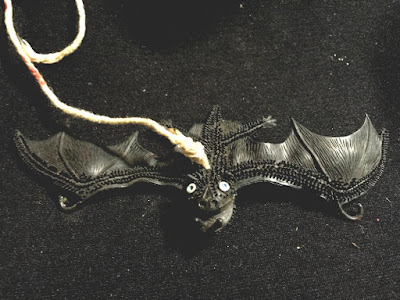
Once he is alone in the room, the window blows open and a bat enters. More precisely, a bat-shaped marionette is brought in on clearly visible strings by a pole that casts a shadow we can see the entire time, but no one who has been watching the show up to this point will doubt for a second that David’s fear, as depicted by David Henesy, is fully justified. David tries to flee from the bat, but he cannot open the door to escape from his room. His back against the door, David slides onto the floor and screams as the bat comes near him.
When Barnabas is about to attack someone, dogs start howling. Sometimes this works to his advantage, but it so often puts his intended victims on their guard that it doesn’t really seem to be something he is doing on purpose. So this bat represents something new. Perhaps Barnabas is using magic to control a bat- if so, it marks the first time we have seen Barnabas use magic to project influence over something other than a human mind. Or perhaps he himself has assumed the form of a bat. If so, that is the first indication we’ve had that he has shape shifting powers. In either case, Barnabas’ powers have just gone up a level.
Closing Miscellany
The bat was created by famed puppeteer Bil Baird. Most famous today for the puppets he created for “The Lonely Goatherd” sequence in The Sound of Music, Baird was a frequent guest on television programs like The Ed Sullivan Show, and Jim Henson cited Baird’s own TV series, the short lived Life with Snarky Parker, as a major influence on the Muppets. In December 1966, Baird opened a marionette theater in New York City, at 59 Barrow Street in Greenwich Village; it operated until 1978, and many leading puppeteers, including dozens who would go on to work with Henson, were members of its company in those years.
This is the last episode to end with ABC staff announcer Bob Lloyd saying “Dark Shadows is a Dan Curtis production.” We do hear the announcement again in February of 1969, but that won’t be because Lloyd has returned- they used an old recording for the music under the closing credits that day, and they picked one with him on it.
Fans of Dark Shadows will often talk about “the early episodes” which ended with Lloyd making that announcement. So I suppose #330 is the last of “the early episodes.”
Danny Horn’s post about this one on Dark Shadows Every Dayincludes a morphology of episode endings. He divides them into five categories, Haiku,* Restatement of Threat, ** New Information,*** Crisis Point,**** and Spectacle.***** It’s an intriguing scheme, and he makes a good case for it.
*Danny explains that “Haiku” “aren’t necessarily recognizable as endings in the traditional sense, because nothing is resolved and no progress is made. It’s just a little moment when a character pauses, and possibly has a feeling about something… In some extreme cases, the audience may not realize that the episode is over until halfway through The Dating Game.”
**Restatement of Threat, at this period of Dark Shadows, usually means Barnabas looking at us through his window and saying that someone or other “must die!” Which of course means that you can safely sell a million dollar life insurance policy to that character.
***”A New Information ending provides an actual plot point, which either advances the story another step, or tells us something that we didn’t know.”
****”The Crisis Point cliffhanger is the big game-changer, and for best effect, it should come at the end of a sequence that’s been building up for a while. This is a big turn in the story, and it should feel satisfying and thrilling… The defining feature of a Crisis Point ending is that the resolution marks a change in the status quo, ending one chapter and setting up the next.”
***** “Obviously, plot advancement is always welcome, but every once in a while the show needs to set its sights a little higher. These are the moments when the show goes above and beyond, in order to surprise and dazzle you… The point of a Spectacle is: You can’t take your eyes off the screen. Housewives in the audience have put down the iron, and switched off the vacuum. Teenagers have stopped swatting at their siblings… A Crisis Point cliffhanger will bring you back for the next episode, because you want to see what happens next. But a Spectacle cliffhanger is bigger than that — you’ll be coming back for the next episode, but it’s because you can’t believe what you’re seeing, and maybe tomorrow they’ll do it again.”
In the late 1960s and early 1970s, most households in the USA had television sets that received only in black and white. So the first requirement of any program’s visual strategy was that it look good on those sets. Prime-time programs with big budgets and long production schedules could sometimes look good in black and white and dazzling in color; the most noteworthy example was the 1966-1968 Batman series. But even most prime-time shows limited themselves to a palette that resembled a plate of processed baby food, with the green of strained peas next to the orange of puréed carrots and the purple of mashed prunes. The use of color on a show like Dark Shadows, which every week had to crank out five episodes on a total budget of $70,000, could rarely rise even to the level of a well-presented infant’s breakfast. Directors Lela Swift and John Sedwick were ambitious visual artists who sometimes managed to use color to advantage, but most of the time the color is a gimmick as worthless as any spear pointed at the viewer of a 3D movie.
Today begins with a reprise of the dream sequence that ended Friday’s episode so effectively. But where that episode survived only on a black and white kinescope, the original videotape of this one has come down to us. As a result, we see the dream in color today. Black and white images are abstract; color images, even when they are composed of only two or three flat colors, make everything literal. So while the dream we saw in Friday’s ending was a terrifying message from a mysterious realm, today’s opening is something that might trouble the sleep of someone who ate a big meal too soon before bedtime.
Strange and troubled boy David wakes up from his nightmare, and well-meaning governess Vicki tries to calm him down. David is frustrated that Vicki won’t take him seriously when he tells her that he learned from the dream that his cousin Barnabas is an undead ghoul and that his friend Sarah is a ghost. We know that he is right, but after the color version of the dream, we can understand why Vicki thinks all he needs is a warm glass of milk.
Meanwhile, Barnabas is at home, being unpleasant to his co-conspirator, mad scientist Julia Hoffman. He snaps at Julia for sitting in his house browsing through medical journals. This is unfair of him- since Julia is concealing her medical degree and pretending to be an historian studying the old families of New England, she can’t very well read medical journals anywhere else.
What is really bothering Barnabas is that his sorely bedraggled blood thrall Willie isn’t dead yet. The authorities have decided to blame Willie for the many unsolved crimes Barnabas himself committed, primarily because Willie is poor and unpopular, and if he dies of the gunshot wounds the police inflicted on him in #322, they will close all those cases. Yet Willie “clings to life with leech-like persistence.” Barnabas fears that Willie will make a miraculous recovery and set about “writing his memoirs.” Barnabas wants to break into the hospital and kill Willie, but Julia persuades him this would be counterproductive.
Barnabas then starts talking about his inclination to kill David. Julia persuades him that she can hypnotize David so that he will no longer be curious about him. In both parts of the conversation, Barnabas is a pouting child, Julia an authoritative figure, though because of her amorality ultimately a no less childish one. We see again the Bossy Big Sister/ Bratty Little Brother dynamic that has been at the heart of Dark Shadows since the first episode, when we were introduced to matriarch Liz and her brother, high-born ne’er-do-well Roger.
Back at the great house of Collinwood, Julia asks Liz and Vicki if she might talk alone with David about his fear of Barnabas. She explains that she has had some experience of child psychology. This led my wife, Mrs Acilius, to exclaim that Julia has forgotten her cover story and is presenting herself as what she actually is, a medical doctor dually qualified as a specialist in psychiatry and hematology. Liz remarks that Julia is “a woman of many talents.” This is not the first time Liz seems suspicious of Julia, but she nonetheless agrees to bring David to meet with her alone in the drawing room.
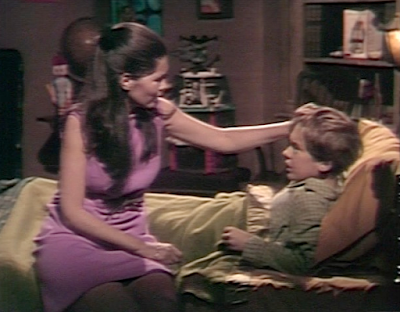
Julia and David sit on the couch, and she takes out the medallion she shows to people while she is hypnotizing them. David recognizes the medallion from his dream. He saw a faceless woman wearing Julia’s wig and coat showing him that medallion. He declares that the dream was warning him against Julia, and runs off, calling to Vicki.
When Dark Shadows began, one of the most important relationships was that between matriarch Elizabeth Collins Stoddard and her brother, high-born ne’er-do-well Roger Collins. Liz and Roger each had a terrible secret to hide. In the work of hiding, they embodied opposite extremes. Liz was motivated to conceal her secret by a fear that she would damage the reputation of the Collins family and the fortunes of its members. Her morbidly intense concern for the family’s position both made her a prisoner in her home and gave her a certain air of nobility. Roger’s motives for hiding his secret were wholly selfish, and he was a symbol of lack of family feeling. So much so that he squandered his entire inheritance, jumped at a chance to sell the ancestral seat to his sworn enemy, and openly hated his own son.
Since Roger was living in Liz’ house as her guest and working in her business as an employee, it fell to her to rein in her impossibly irresponsible younger brother. But the very quality that led her to try to exercise authority over him undercut her efforts to do so. Liz’ devotion to the Collins family compelled her to try to keep Roger on the strait and narrow path, but that same devotion prevented her from taking any action against him so harsh that it might actually deter him from misconduct. Further, her own secret compromised her moral authority and kept her from engaging with anyone outside the family. So she wound up less as a commanding matriarch than as a bossy big sister.
Liz and Roger both let go of their secrets, Roger in #201, Liz in #270. Roger is still far from heroic, but he no longer gives Liz the nightmares he once did. Liz is still mindful of the family’s good name, but there is nothing keeping her from following through on whatever orders she might give. So Liz and Roger’s Bossy Big Sister/ Bratty Little Brother dynamic is no longer a productive story element.
Now, the show is reintroducing the same dynamic with another pair of characters. Mad scientist Julia Hoffman is conducting an experiment which she hopes will turn vampire Barnabas Collins into a real boy. When Barnabas threatens to murder her, she becomes impatient and tells him to stop being ridiculous. When he threatens to murder other people, she threatens to discontinue the experiment unless he starts behaving. He usually responds to Julia’s orders by pouting, sulking, and giving in to her.
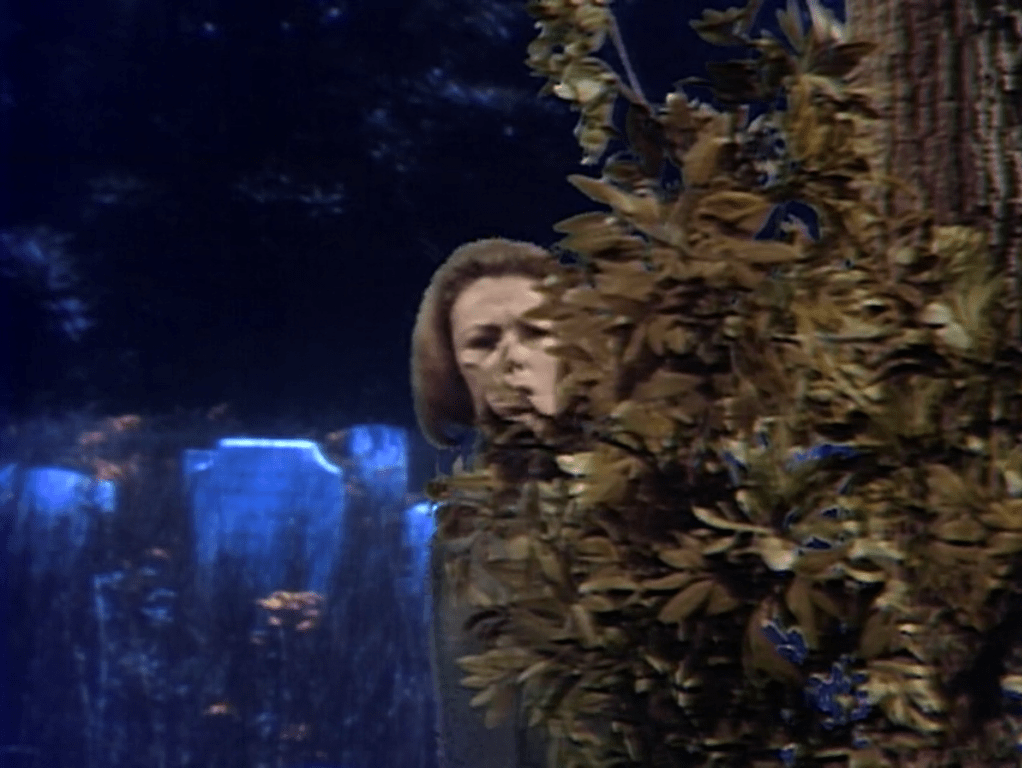
In the opening scene, Julia was in Barnabas’ house. He told her that he was likely to kill Roger’s ten year old son David because he thinks David might know that he is a vampire. Julia demanded that he leave David alone, prompting him to walk out of his own house. She then followed him to the old cemetery north of town, where Barnabas heard her footsteps in the distance and she hid behind a tree.
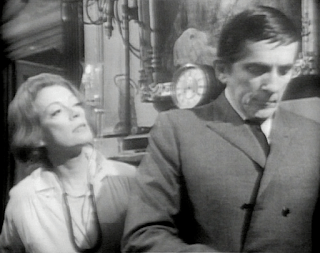
This woman holds a medical doctorate and is qualified in two unrelated specialties.
Barnabas enters the Tomb of the Collinses. Julia confronts him there, insisting he tell her what secret about the place he is keeping from her. He demands that she leave and threatens to kill her if she does not. He tells her that he ought to stash her corpse nearby, “along with”- then interrupts himself. Regular viewers know that Barnabas killed seagoing con man Jason McGuire in #275 and buried him in the secret chamber inside the tomb in #276. Jason has barely been mentioned since, not once in any scene featuring Julia. When she asks Barnabas what he is talking about, he says “Never mind.”
Julia presses Barnabas with “You’ve shared all your other secrets with me. You have no choice but to share this one with me too.” The logic of this statement eludes me, but all Barnabas can do when Julia has made it is to walk backward away from her, staggering into a corner and pouting at her.
Barnabas, stunned by the force of Julia’s reasoning.
Meanwhile, Sam and Dave are walking through the cemetery.
No, not that Sam and Dave. Local artist Sam Evans and addled quack Dr Dave Woodard have noticed that a series of odd occurrences have taken place in the vicinity of the tomb lately and have come to the cemetery to investigate. They run into the old caretaker, who delays them with his usual warnings about the unquiet spirits of the dead.
Alas, the final appearance of Daniel F. Keyes as the Caretaker.
Back in the tomb, Barnabas is telling Julia everything she wants to know. He lets her into the secret chamber and explains that he was imprisoned there in a coffin for many years, freed only when the luckless Willie Loomis accidentally released him to prey upon the living. Julia listens, showing pity as Barnabas recounts his woes.
Barnabas finds David’s pocket knife, proving that the boy was in the chamber and convincing Barnabas that he must kill him. He takes the knife close to Julia in a gesture that might be threatening, were its blade intact. The broken blade negates the threat and emphasizes Barnabas’ powerlessness before Julia. Since 1967 was the heyday of Freudianism in the USA, it is likely that many in the original audience would have seen it not only as a useless tool, but also as a phallic symbol. As such, not only its brokenness, but also the fact that it was made to be carried by a little boy, would make the point that Barnabas brings no sexual potency to his relationship with Julia. Her own behavior towards him may be childlike, but in her eyes he is a smaller child than she is.
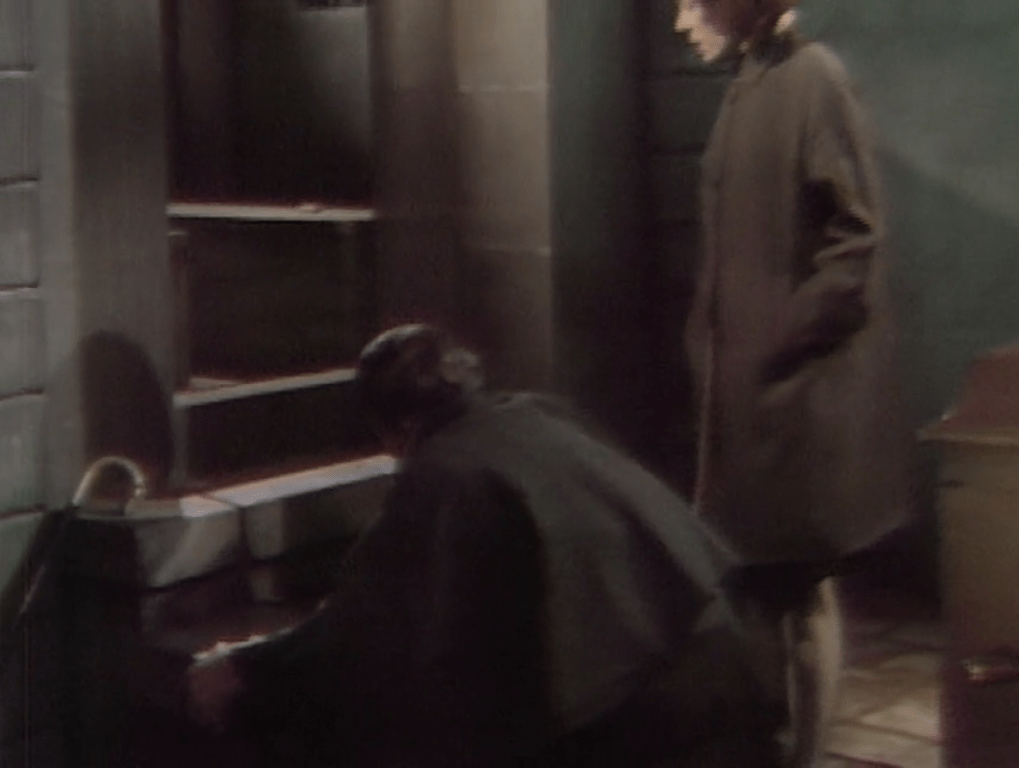
Julia protests, claiming that someone else might have left the knife there. Barnabas dismisses her assertions, but does not regain control of the situation. As they prepare to leave the chamber, he kneels and she stands over him, watching him open the panel.
On his knees before her.
They hear Sam and Dave approach. (Still not the cool ones.) They scurry back into the secret chamber, as David had done when he heard Barnabas and Willie approaching the tomb in #310. They listen to the men discuss the facts that have brought them to the tomb, and grow steadily more alarmed as they realize how close they are to discovering Barnabas’ terrible secret.
This is the first episode not to include any actors who were signed to the show at the time production began. The character of Sam Evans was at that time played by a loud man called Mark Allen; Allen’s last episode was #22, taped on 12 July 1966, and David Ford’s first was #35, taped on 29 July. The Caretaker was introduced in #154, Barnabas in #210,* Dave Woodard in #219,** and Julia in #265.
*As the hand of stand-in Alfred Dillay- Jonathan Frid wouldn’t appear until #211. Though the portrait he sat for was on screen in #204, and was identified as that of Barnabas Collins in #205.
**Played by Richard Woods. Robert Gerringer took over the part in #231.
When new writers start working on Dark Shadows, they do some inventorying of ongoing and disused storylines. When Ron Sproat came aboard in November of 1966, he contrived a lot of scenes that served to mark storylines as “To be developed” or “To be discarded.” Now Gordon Russell has begun to be credited with scripts. He addresses continuity questions with brief lines of dialogue.
For example, for the last forty weeks the show has been equivocating about when it was that Barnabas Collins lived as a human being. Sometimes they say that he died and became a vampire in the 1830s. That fits with the original idea that Jeremiah Collins built the great house of Collinwood for his bride Josette in that decade, because Barnabas is supposed to have loved Josette and hated Jeremiah. At other times, they have pushed Barnabas, Josette, and Jeremiah back into the eighteenth century.
Now Barnabas has risen from the grave. Mad scientist Julia Hoffman has developed a series of injections to cure him of vampirism and turn him into a real boy. When Julia finds that Barnabas has heard the ghostly voice of his sister, nine year old Sarah, she declares that “The injection can wait!” and wants to talk all about Sarah. When Barnabas tries to avoid the subject, saying that Sarah has been dead for nearly 200 years, Julia replies “So have you.” That would seem to nail down that continuity question.
Julia speculates that Barnabas has subconsciously willed Sarah to return to the living, because she symbolizes the kindly side of his nature. There have been a bunch of possible explanations for why Sarah emerged shortly after Barnabas did; evidently this is the one we will be going with, at least for a while.
Barnabas has been looking through an album of family portraits, Sarah’s among them. He tells Julia that he is particularly intrigued by another portrait in the same volume, that of Jeremiah. He says that Burke Devlin, depressing boyfriend of well-meaning governess Vicki, bears a striking resemblance to Jeremiah. This point was first made in #280, when Burke came to a costume party at Barnabas’ in Jeremiah’s clothing and Barnabas was shocked by the resemblance. Barnabas says that he will be a happy man when Burke is as dead as Jeremiah. This tells us, not only that Barnabas is serious about his hostility to Burke, but also that we can expect some connection between Jeremiah and Burke to be developed.
Julia chases Barnabas around his living room until he hangs his head and mutters a promise not to hurt anyone, not even Burke, as long as there is a chance the injections will work. This helps both to explain why Barnabas has been so harmless lately and to reinforce the Bossy Big Sister/ Bratty Little Brother dynamic that is forming between him and Julia.
Julia goes to the great house. Matriarch Liz is under the impression that Julia is an historian writing a book about the old families of New England, and letting her stay in the mansion on the understanding that she is doing research into the Collinses. Liz asks about Julia’s previous books. Julia evades the question, saying that only scholars have ever heard of them. Liz mentions that she was a recluse for eighteen years, during which time she read so widely that she became aware of many scholarly books. Julia seizes on Liz’ reference to her time as a recluse, and asks a series of questions about it. Observing Julia’s facility at deflecting questions she doesn’t want to answer, Liz says that “If you are as nimble with the written word as you are with the spoken, you must be a very interesting writer.” This conversation not only marks Liz’ period of seclusion as an extinct topic, but also shows that Julia’s cover story is not going to be solid enough to cover her operations indefinitely. Moreover, it gives Joan Bennett a chance to show what Liz sounds like when she is smart.
Vicki meets Burke in the courtyard of the great house. She asks him why he’s late. He says he had a meeting with his lawyer, James Blair (a character we last saw in #95 and last heard mentioned in #133.) The reference to Blair tells regular viewers that Burke’s business interests may have something to do with an upcoming storyline.
Vicki asks what the meeting was about. Burke says it was to do with a message from London, then declares he didn’t come to talk about business. At the end of yesterday’s episode, Burke placed a call to London to initiate an investigation of Barnabas, so we know that he has already received some information about him. We also know that he is keeping the investigation secret from Vicki.
Burke brings up the marriage proposal he made to Vicki when last they saw each other. She says that she doesn’t know enough about him to be comfortable making a decision. In particular, she doesn’t know how he made his money or who his business associates are. In response to that, he launches into a speech dismissing those concerns as matters of “the past,” saying that he wants her to think only about “the future.” Considering that Burke won’t even tell Vicki what business he was conducting twenty minutes ago, “the past” that is off limits to her stretches right up to the present. This tells even first time viewers that Burke is a secretive and untrustworthy man likely to drag a wife into some shady enterprises.
It rings even louder warning bells for regular viewers. At this point in Dark Shadows, “the past” is how the characters refer to the vampire arc, which is the only ongoing storyline. Several times, Burke has angrily demanded Vicki renounce interest in “the past,” by which he means her attempts to stay relevant to the plot. As he has made those demands, he has accused her of being crazy when she told him that she saw and heard phenomena that we also saw and heard, in some cases phenomena that Burke himself is in a position to know are real. On Thursday, Burke enlisted Julia’s support in his effort to gaslight Vicki; in that conversation, Julia asked Burke if, when he said Vicki must “live in the present,” he meant that she must live with him, and he confirmed that he did. So Burke’s evasiveness in this scene shows that he is likely to be an abusive husband who will devote himself to controlling Vicki and stifling her contributions to the story.
The show is making something of an effort to launch a storyline in which Vicki and Burke will get married and move into a long-vacant “house by the sea” that has some kind of association with Barnabas and therefore with the supernatural. So the parade of red flags that Burke sends marching in front of his proposal may tell us to expect a story in which Vicki, the long-suffering wife confined to a haunted house, loses contact with the world of the living.
Perhaps that is where we will see Burke’s connection to Jeremiah. Maybe Burke will be possessed by the spirit of Jeremiah, and under that possession his abuse of Vicki will intensify. It is also possible that Burke will be revealed as a descendant of Jeremiah. On Friday, the story of Burke’s childhood was retconned, introducing the idea that his father left the family when Burke was nine. Perhaps it will turn out that he did this after he found out that Burke was the product of an extramarital dalliance with a Collins. That in turn might revive another paternity question concerning a nine year old boy. For months, the show hinted that Burke, not Liz’ brother Roger, was the father of strange and troubled boy David Collins. If Burke is a Collins bar sinister, then David can be his natural son and still retain his symbolic importance as the last in the male line of the family.
Whatever the nature of Burke’s connection to Jeremiah, Vicki’s eventual flight from him might lead her into the vampire story. Since Barnabas thinks he wants Vicki to be his next victim, he has been solicitous towards her, and she regards him warmly. My wife, Mrs Acilius, points out a sort of visual pun implicit in the prospect of Vicki choosing Barnabas over Burke. As played by Anthony George, Burke is an astonishingly poor kisser. As a vampire, Barnabas gives what might be called “the kiss of death.” A woman might prefer a single kiss of death to a lifetime of the impossibly awkward kisses of George.
Vicki caves in and agrees to marry Burke, even though he won’t answer any of her questions. They go into the drawing room and announce this ominous news to Liz, Barnabas, and Julia. Barnabas responds by looking off into space and exclaiming “Jeremiah!” Again, whatever relationship develops between Burke and Jeremiah, we know that Barnabas is committed to resisting its influence on Vicki.
Barnabas cannot conceal his dismay. He and Julia leave, explaining that they had planned to spend the evening together in town. Liz remarks that Barnabas was happy when he came, and sad when he left. Still, the idea that he and Julia might be going on a date is enough to keep Burke smiling.
In the courtyard, Barnabas tells Julia that he will give her his full cooperation as she tries to cure him of vampirism. He explains he wants to become human again so that he can prevent Vicki from marrying Burke.
This is rather alarming for the viewers. Dark Shadows became a hit when a vampire joined the cast. If the Burke/ Vicki/ Barnabas story is going to be just another daytime soap love triangle among humans, you may as well watch The Guiding Light. The foreboding dun dun DUNN! that ends each episode has rarely seemed more apt than it does coming on the heels of this grim prospect.
Sorely bedraggled blood thrall Willie Loomis tries to tell his master, vampire Barnabas Collins, that his plans for well-meaning governess Vicki Winters are unlikely to come to fruition. Barnabas wants Vicki to volunteer to become his vampire bride, a goal he has done remarkably little to advance. Even when Vicki invited herself to spend the night in his house, he couldn’t be bothered to bite her. Now she’s getting serious about her depressing boyfriend, Burke Devlin, and Willie thinks Barnabas has missed his chance.
Barnabas responds to Willie’s opinion as we might expect- he grabs him by the throat and threatens to kill him. He sends him away with orders to follow Vicki and Burke on their date and to report on every detail of their conversations.
Mad scientist Julia Hoffman is trying to cure Barnabas of his vampirism, and she brings him substantially the same message, along with a command to leave Vicki alone. Barnabas has enough hope that Julia’s experiments will succeed that he can’t treat her as he does Willie. So he evades her questions, pouts at her orders, and sulks when he finds himself having to go along with her.
The scene looks very much like the interactions we saw in the early months of the show between matriarch Liz and her brother, high-born ne’er-do-well Roger. Those were sometimes echoed in the interactions Vicki had with her charge, Roger’s son strange and troubled boy David. The bossy big sister/ bratty little brother pattern is on its way to becoming the signature relationship of Dark Shadows.
Meanwhile, Willie has been following his orders. He saw Burke and Vicki make several laughably awkward attempts to kiss each other, then heard Burke propose marriage to Vicki. Vicki asked for time to think it over.
When Willie reports this to Barnabas, he says he is sure she will say yes. Barnabas says that there will be no marriage, and proclaims “Burke Devlin must die!”
For sixteen weeks, starting with the introduction of seagoing con man Jason McGuire in #193 and ending today, Dark Shadows has subjected its viewers to a storyline about Jason blackmailing reclusive matriarch Elizabeth Collins Stoddard. Thirteen times in those sixteen weeks, we saw iterations of the same dreary scene- Jason makes a demand of Liz, Liz resists, he threatens to expose her terrible secret, she capitulates.
Now, Liz has exposed her own terrible secret. She has told everyone that eighteen years ago, she killed her husband Paul Stoddard and Jason buried Stoddard in the basement of the great house of Collinwood. Jason denied that Stoddard’s body could be found there, and as we open Sheriff Patterson and Fake Shemp Burke Devlin are digging up the basement to see who is right.
Liz and her brother Roger are in the drawing room. He asks why she didn’t confide her terrible secret in him. She says that perhaps she was too proud of her role as his older sister and the family’s moral compass. He admits that, if had told him the secret, he probably would have used it to blackmail her himself. This startling admission tells us just how completely isolated Liz is.
It tells regular viewers more than that. When Dark Shadows began, Roger was a deep-dyed villain. He hasn’t been directly connected to an ongoing storyline since his estranged wife, Laura Murdoch Collins, vanished in #191, and in the months since has figured as an immature, ineffectual person, a bratty little brother dependent on Liz’ money and unable to help her against Jason. With this admission he harks back to his first incarnation, and makes us wonder if we will see another side of him. If he has the strength to admit his villainy, perhaps he has the strength to change.
Meanwhile, Burke and the sheriff have turned up a trunk in the floor of the basement. It is empty and clean. There is no sign that there ever was a body in it.
Viewers who have been with the show from the beginning will think of Laura. Laura had died in Phoenix, Arizona shortly before showing up in Collinsport. After the apparently alive Laura had been in Collinsport for some time, her corpse mysteriously vanished from the morgue back in Maricopa County. Upon inspection, the graves of several of her ancestors turned out to be empty and clean. The Laura arc swallowed up most of the non-paranormal story elements left over from Dark Shadows’ early days as a Gothic romance tinged with the suggestion of a noir crime drama, and the blackmail plot is meant to sweep the last of them away and get the show on track as a supernatural thriller/ horror story. So we might think that the empty trunk is a sign that there was something not of this world about Stoddard.
They retreat from that intriguing possibility, as yesterday they retreated from the evidence they had already given us that a ghost haunted the place of Stoddard’s supposed burial. Jason admits to Liz that he and Stoddard cooked up a scheme where Stoddard would pretend to be dead so that he and Jason could help themselves to a big chunk of her wealth, then go away to live the high life. Jason says that he saw Stoddard in Hong Kong a bit over ten years ago, and that so far as he knows he is still alive and well.
Liz doesn’t want to press charges against Jason- she simply wants him to go away. Roger demands that Jason be charged with blackmail. In front of the sheriff, Roger announces that he is outraged at the money Jason took from Liz, including “business money.” This might make us wonder about Liz’ own criminal exposure. In #242, Roger told Liz that the company’s accounts were out of balance. We knew it was because she was slipping money to Jason, and they made a big enough point of her meeting with the accountants and telling them lies so that they would fix the books that for a moment it seemed like they were getting ready for a story about her getting in trouble for falsifying business documents.
That was dropped right away, and it doesn’t seem likely that Liz will be charged for paying hush money to Jason. Not many people in the USA in 1967 had any understanding of the crime of obstruction of justice. It wasn’t until the Senate Committee investigating the Watergate affair broadcast its hearings live in 1973 that the average viewer of daytime television would learn that giving a person money to stay away from the police is a felony. Before then, even many trained lawyers, among them several of the Watergate defendants, did not grasp this. So we can be confident that such matters would not enter Soap Opera Law in the 1960s.
The blackmail arc was dredged up from Art Wallace’s original story bible for Dark Shadows, called Shadows on the Wall. The first time Wallace told the story was in a 1954 installment of an anthology TV series called The Web; that segment was titled “The House,” and he had to pad it a bit to fill out a 30 minute time slot. In 1957, Wallace stretched “The House” to even greater length, into an hour-long entry in another dramatic anthology, Goodyear Playhouse. Wallace left Dark Shadows in October 1966, but the series has been hanging from the old rope he sold Dan Curtis for four full months now. Jason will still be on the show for a couple more days, but we’ve finally seen the last of this drab tale.
A mysterious little girl in eighteenth century garb shows up outside the dungeon cell where vampire Barnabas Collins is keeping his victim, Maggie Evans. The girl stands with her back to Maggie’s cell and sings a couple of verses of “London Bridge” over and over while tossing a ball. Maggie pleads with her to stop singing, to get away before Barnabas and his sorely bedraggled blood thrall Willie Loomis catch her, and to tell someone that she has seen her. The girl does not acknowledge Maggie in any way.
Seconds after the girl has strolled slowly away, Willie comes by the same path she had taken. Maggie is bewildered that Willie didn’t see her. She urges Willie to escape from Barnabas. Willie gives a big speech about how he thinks about escaping all the time, and that when he is in his car he has sometimes tried to keep driving. But Barnabas’ power keeps pulling him back. Regular viewers will be interested in this confirmation that Willie has a car.*
At the great house of Collinwood, strange and troubled boy David Collins is impatient with the geography lesson his governess Vicki is trying to give him. In the first 39 weeks of the show, the only set which consistently saw interesting scenes was David’s room, where he and Vicki became friends during his lessons. They don’t have the studio space to build that set today, so this lesson is conducted in the drawing room. When flighty heiress Carolyn comes into the room, Vicki sends David to play outside. Since the interrupted lesson was about Australia, he hops away kangaroo-style.
Vicki and Carolyn talk about Carolyn’s boyfriend, motorcycle enthusiast Buzz. Buzz is a refugee from Beach Blanket Bingo, so broadly comic a figure that he might have been too silly even for the biker gang in that movie and its sequels. Unfortunately, Buzz doesn’t show up today, and Vicki and Carolyn’s conversation is a pure specimen of old-time soap opera earnestness. There is an odd moment when Vicki asks Carolyn “How far do you intend to go with Buzz?” and Carolyn answers “All the way!” At the end of the scene, Carolyn uses the phrase “all the way” again. She’s talking about her plan to marry Buzz, but “all the way” was such a familiar euphemism for sexual intercourse in the 1960s that it is hard to imagine it wasn’t intentional on some level. When Carolyn tells Vicki that she and Buzz will go “all the way” while Vicki watches, we wonder what weddings are like in Collinsport.**
David has gone to the yard around Barnabas’ house. We see a location insert of him on the swing set there. This footage is reused from #130, when we discovered that he was being watched by his mother, blonde fire witch Laura Murdoch Collins. Laura had died sometime previously, but it didn’t take.
Now, he is being watched again. The mysterious little girl from the dungeon has made her way up to the porch and calls to him as “Boy!” When he tells her his name is David, she says “I know.” She gives her name as Sarah, and asks him to play with her. They toss her ball back and forth, and he finds fault with her fondness for “London Bridge.” She says she used to go to school, a long time ago. She lives around there, but everyone she lives with went away and left her all alone. She excuses herself to go look for them. Willie then comes out of the house. David tells him about Sarah, and Willie shoos him away.
Playing catch as best you can when you’re on a tiny set, photographed in 4X3. Screenshot byDark Shadows Before I Die
That Sarah can come and go from the dungeon without being seen shows that she is one of the ghosts who haunt the house. David has seen several of these, but does not recognize her. Her behavior in the opening scenes leaves us wondering if she is aware of Maggie’s presence; if not, she may simply be an apparition, unable to interact with the living characters.
When Sarah meets David, not only is she able to converse with him, but her ability to play catch with him using the ball she brought with her shows that she has a physical body and that she can manipulate material objects. That makes it all the more puzzling that she did not answer Maggie. Was she ignoring her, or was she somehow less capable in the dungeon than she is on the porch?
When Sarah uses the words “a long time ago,” we suspect that she knows she is a ghost and she has been displaced to a future century. But then she becomes confused as to where her people are, and is filled with a terrible urgency to go look for them. Again it is ambiguous just what sort of being Sarah is and what she can do.
There is always a vagueness about the supernatural- if you could explain a phenomenon fully in words and measurements, it wouldn’t be in that category at all. The key to holding an audience’s attention with a story about ghosts and such is to intrigue them with questions that seem like they might have answers and to use them to lead to another, equally imponderable set of questions before the first set gets old. So it is a promising sign that Sarah is introduced while we are still asking what Barnabas can do, what he wants to accomplish, what he needs for survival, and how he got to be the way he is.
That we see David in a lesson with Vicki and then hear him talking with Sarah about how neither of them goes to school anymore is also interesting to regular viewers. Dark Shadows is just about a year old. It started with Vicki’s arrival at Collinwood, where reclusive matriarch Liz had summoned her to teach David. David and his father, Liz’ impecunious brother Roger Collins, had been living at Collinwood for about a month. Before then, they had lived in Augusta, Maine, where David went to school.
When Vicki showed up, Roger objected that he knew nothing about her, and Liz refused to tell him or Vicki how she knew that she existed or why she chose her to be David’s governess. The show has been hinting very heavily that Vicki is Liz’ biological daughter and that Liz is desperate to keep that relationship secret. It is also clear that Liz wants above all for David to grow into her idea of a male Collins, an idea to which her bratty little brother Roger does not in any way conform.
Barnabas’ plan for Maggie is a ghoulish parody of Liz’ for David. He wants to erase her personality and replace it with that of his long-lost love, Josette Collins. Over the generations since her death, Josette has become the patroness of the Collins family and the emblem of its perfect female member. And of course Barnabas is as anxious to hide the secrets in his basement as Liz is to hide those in hers. That Sarah appears to both Maggie and David emphasizes that Barnabas is a funhouse mirror reflection of Liz.
Back in the great house, David hears Buzz’ motorcycle and tells Carolyn that he is there for her. She can’t quite bring herself to tell David that she and Buzz are planning to get married, but does encourage his interest in going for a bike ride with Buzz. As she leaves, he brilliantly mimes motorcycle riding.
David gives Vicki a detailed account of his encounter with Sarah. She is disappointed he didn’t bring her home. Though it is her job to be David’s only friend, Vicki is no more enthusiastic about his isolation from playmates his own age than Willie is about Barnabas’ treatment of Maggie.
Back in the dungeon, Willie finds that Maggie has not eaten. They share a sad moment. He leaves, and Sarah reappears. Maggie talks to her. At first, she doesn’t respond. But then she turns to her and says “If you see my big brother, don’t tell him you saw me. He doesn’t like anybody to come down here.” Then she leaves, a spring in her step.
The last time a ghost spoke to an imprisoned woman was in the same house, in #126. That time, Vicki was bound and gagged and hidden in a secret room on the main floor by crazed handyman Matthew Morgan. When Matthew had gone to get an ax with which to decapitate Vicki, the ghost of Josette had appeared to her and said, in a perfectly cheerful voice,*** “Do not be afraid.” Josette didn’t untie Vicki or anything, she just told her that and vanished. Later in the episode, she and some other ghosts scare Matthew to death before he can kill Vicki. When Sarah goes away from the stunned Maggie and skips along the floor, regular viewers might remember that event and see a promise that Sarah has something up her sleeve.
Closing Miscellany
Sarah is identified in the closing credits as “Sarah Collins,” the name given in #211 for Barnabas’ sister who died in childhood. That rather blunts the surprise of her closing reference to her “big brother.”
Sarah’s identity raises a couple of other questions. Barnabas’ house was the original Collins family home, and he and Sarah would have lived there. The cell in which he keeps Maggie is covered with cobwebs, evidently a feature of the house from its beginning. When she tells Maggie that her big brother “doesn’t like anybody to come down here,” she is speaking from experience- the adults don’t like it when you go near the jail cell in the basement.
Slavery was a legal institution in Massachusetts**** until 1783, and indentured servitude under conditions not so far removed from those to which slaves were subject continued long after. The Old House has been described as a “huge mansion,” so presumably its owners would have held people under at least one of these statuses. As a Collins of the eighteenth century, Sarah’s blithe attitude towards someone held in the cell would seem to be chillingly appropriate.
Sarah’s address to David as “Boy!” when she knows his name is also interesting coming from her. To be sure, if she had called him by name before they met, he would have known right away that there was something very strange about her. Since he has seen many ghosts and knows that ghosts congregate in and around the Old House, he may have identified her as one right away.
On the other hand, during the “Revenge of Burke Devlin” storyline that ran from #1-#201, there was considerable doubt as to whether David was Roger’s natural son or Burke’s. That doubt came to a head when Laura was on the show. Laura only left 13 weeks ago, and Burke is still hanging around. As far as we know, the question may come back up, and David Collins may turn out to be David Devlin. In that case, Sarah may have chosen to call him “boy” because she is a Collins and therefore better than everyone who is not.
I posted a couple of long comments about this episode on Danny Horn’s Dark Shadows Every Day. I won’t copy them here, because they contain spoilers for people who haven’t seen the whole series. But I’ll link to them- under the post about this episode, I argued that Sarah’s introduction was the most important plot development in the entire series; and under a post about a much later episode, I wish one of the words in her closing line had been different.
*Regular viewers are interested in some weird stuff, what can I say.
**My wife, Mrs Acilius, is very much taken with the actresses’ recollections of how Louis Edmonds, who played Roger, would make them laugh so hard during rehearsals that it was sometimes difficult for them to stay in character during filming. She says it is just as well that Roger wasn’t in this episode, because there is no way they could have got through this scene if he had been.
***Provided by Kathryn Leigh Scott, who also plays Maggie.










 Dark Shadows Commentary