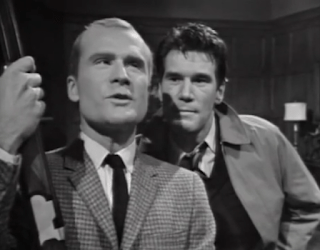
Episode 154: Died by fire!

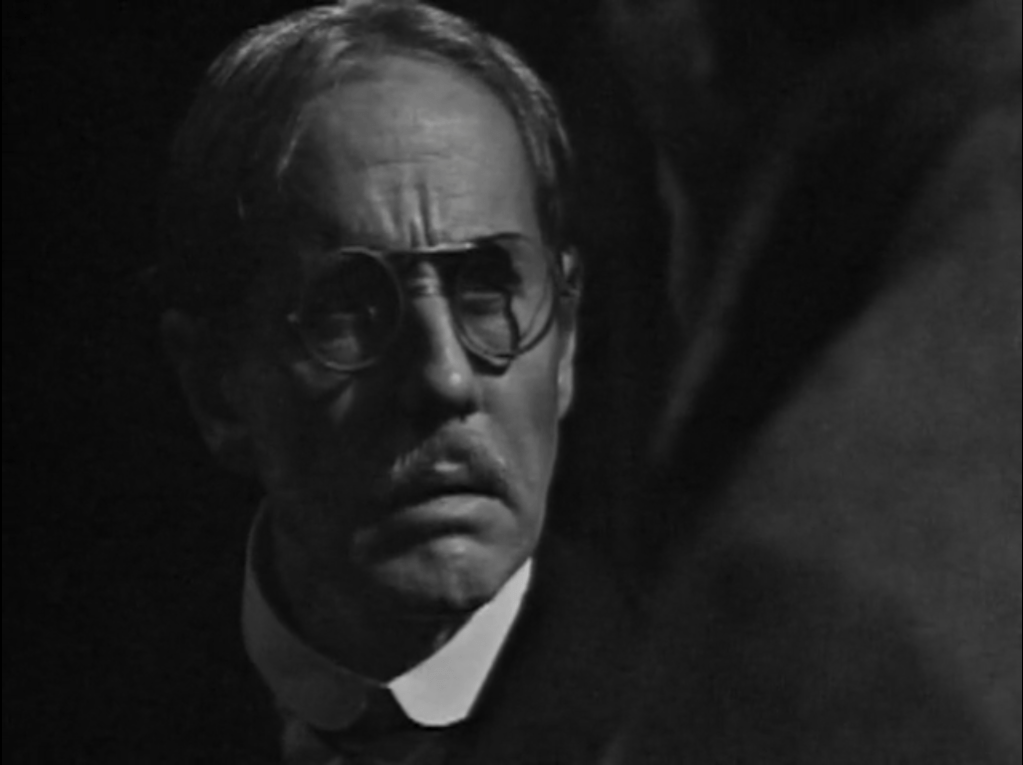
Eventually, Dark Shadows became the kind of pop culture phenomenon that even people who never saw the show couldn’t really avoid. Most such things spawn catchphrases that become widely familiar and remain so for years. Think of Star Trek with “Beam me up!” or “Warp speed.” To my knowledge, Dark Shadows was an exception to that, with no phrases or expressions spreading beyond its fans. But if it had already been a hit when today’s episode aired, I think a character we meet in it would have been the source of two catchphrases. That character is Cemetery Caretaker, played by Daniel F. Keyes.

Under the influence of the ghost of Josette Collins, well-meaning governess Vicki has ordered her boyfriend, instantly forgettable lawyer Frank, to take her to a graveyard out in the country someplace. Vicki knocks on the door of a building there, and at length an aged figure in a celluloid collar and wire-frame glasses opens the door. He stands mute for the first minute Vicki and Frank talk to him. When he finally starts speaking, he asks them if they are alive.

Guy’s got star quality

Frank doesn’t show any surprise at the question. You wouldn’t really expect him to- with his personality, he must get that a lot. He assures the caretaker that yes, he and Vicki are alive. The caretaker explains that he often hears knocking at the door, but it is usually the unquiet spirits of the dead.

Some months from now, the caretaker will introduce his second memorable phrase, “The dead must rest!” At this first appearance, we learn why they must. If the dead aren’t resting, they’re going to be keeping him awake all night, and he has things to do in the morning.

Frank tells the caretaker that they are lost. Vicki contradicts him and insists that this is where she is supposed to be. Frank apologizes for bothering him and tries to go; Vicki insists on staying. The caretaker lets them into the building.

Inside, Vicki and Frank find a strange combination of archive and mausoleum. By the standards of Dark Shadows, it’s a big, elaborate new set, a definite sign that something important is happening.

The front room of the caretaker’s building
Vicki examines one of the bookcases
Entering the archive area
In the archive area

Vicki keeps talking about how fresh the air is, and how full of the scent of jasmine. The caretaker is bewildered by her words, and Frank says the only scents he can detect are must and mold. The audience knows that the scent of jasmine is a sign that the ghost of Josette Collins is trying to attract a character’s attention.

Vicki declares that the source of the scent is in a connected room. The caretaker is reluctant to let Vicki and Frank into that room. He says that it is the final resting place of those members of the illustrious Stockbridge family* who died particularly gruesome deaths. Vicki pleads with him, and he gives in. He does insist that while in the crypt, they must be very quiet- “So quiet, even they can’t hear.”

Entering the crypt area
Examining a plaque

The caretaker talks in a not-particularly hushed stage voice the entire time they are in the crypt, so he must not think the dead have such great hearing after all. He tells the stories of the crimes and accidents that took the lives of each of the people whose remains lie behind the large stone plaques on the wall. When he comes to the last of them, L. Murdoch Stockbridge, Frank interrupts him. “L. Murdoch! I’ve seen that name on legal documents around the office a hundred times!” Frank is handling the divorce of high-born ne’er-do-well Roger Collins from his mysterious and long-absent wife, Laura Murdoch Collins.

Examining THE plaque

Frank asks about L. Murdoch Stockbridge. The caretaker doesn’t know what the L. stood for. He does know that she was a woman, and he can describe the circumstances of her death. One night in 1767, a candle set the curtains around her bed ablaze, and she burned to death. Such remains as are in the niche are little but ashes. He says, and then repeats, “L. Murdoch Stockbridge died by fire! L. Murdoch Stockbridge died by fire!” Once Vicki learns about L. Murdoch Stockbridge, the scent of jasmine disappears and she is in the same dank musty space as Frank and the caretaker.

I heard she died by fire

It’s been three years since Mrs Acilius and I first saw these episodes, and I can still make her laugh by putting on an old man voice and saying “Died by fire!” Sometimes we find ourselves in situations where everyone is being very serious, and someone mentions that a person “died by fire.” I glance at her, and find her biting her lip to keep from laughing out loud. That’s why I say that if Dark Shadows had been at the peak of its popularity in January of 1967, “Died by fire!” would have been one of the great pop culture catchphrases of the period.

Back at the great house of Collinwood, wildly indiscreet housekeeper Mrs Johnson comes into the drawing room while Roger is at his usual station, leaning on the cabinet where the brandy is kept and draining a snifter. She asks him if she can bring him anything. Those are the words, but the voice spells out a stern sermon about the evils of alcohol. Roger goes to sit down, saying nothing of consequence but saying it in a way that makes clear he dislikes and resents her.

Laura enters. Roger sends Mrs Johnson off to make coffee. Alone in the drawing room, Roger and Laura argue about all the things they have been arguing about since she returned from her long absence. There is no new information in the dialogue, but it is good to see another side of Roger. Lately we’ve seen him almost exclusively as the bratty little brother of reclusive matriarch Liz, and his interactions with other characters are dominated by the narcissism that is most fully expressed in his scenes with Liz. When he is the unloving father of strange and troubled boy David, the unsettlingly flirtatious uncle of flighty heiress Carolyn, the cowardly foe of dashing action hero Burke Devlin, or the malign co-conspirator of drunken artist Sam Evans, we see vices that we can trace back directly to his certainty that Liz will always shelter him from the consequences of his actions, whatever they may be. When he stands up to Laura in this scene, we see that there is a semi-functional adult somewhere inside Roger.

Roger and Laura realize that Mrs Johnson has been eavesdropping on their conversation. They are worried about what she might have heard. They do not know what regular viewers know, that she is a paid agent of Roger’s enemy Burke, placed in the house to spy on the Collinses. They do know that she has a big mouth, though, and since the last words they spoke were about a crime they want to keep covered up that’s enough to give them pause.

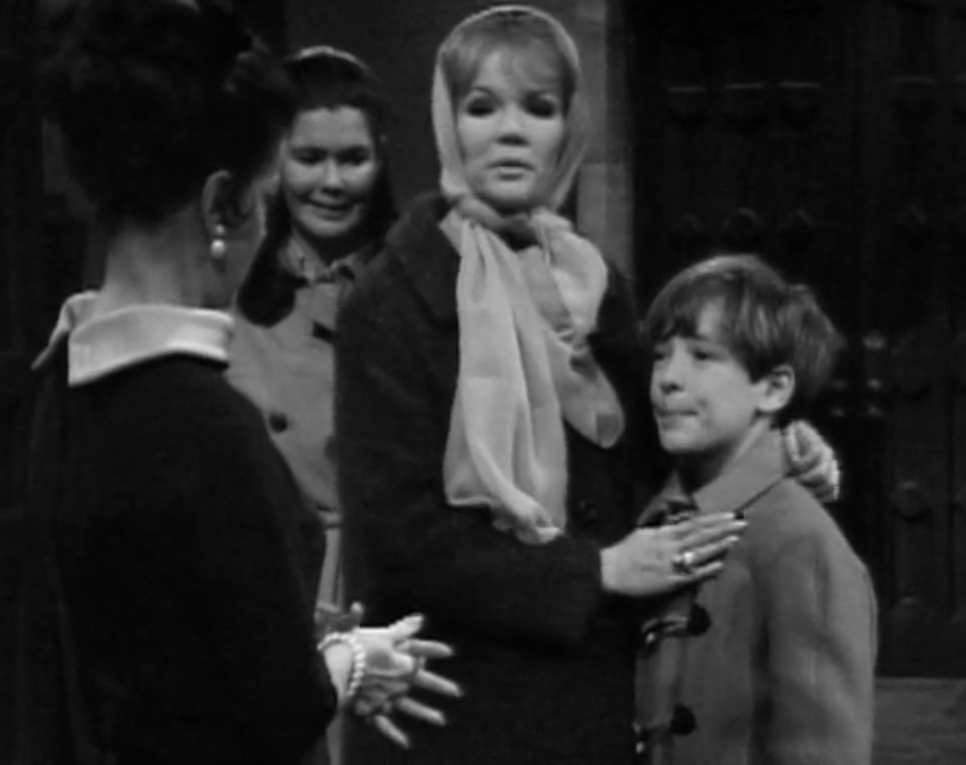
Frank brings Vicki home to Collinwood. Standing outside the front door, they remark on the caretaker’s frequent muttering of “died by fire! Died by fire!”

Reviewing their visit to the caretaker

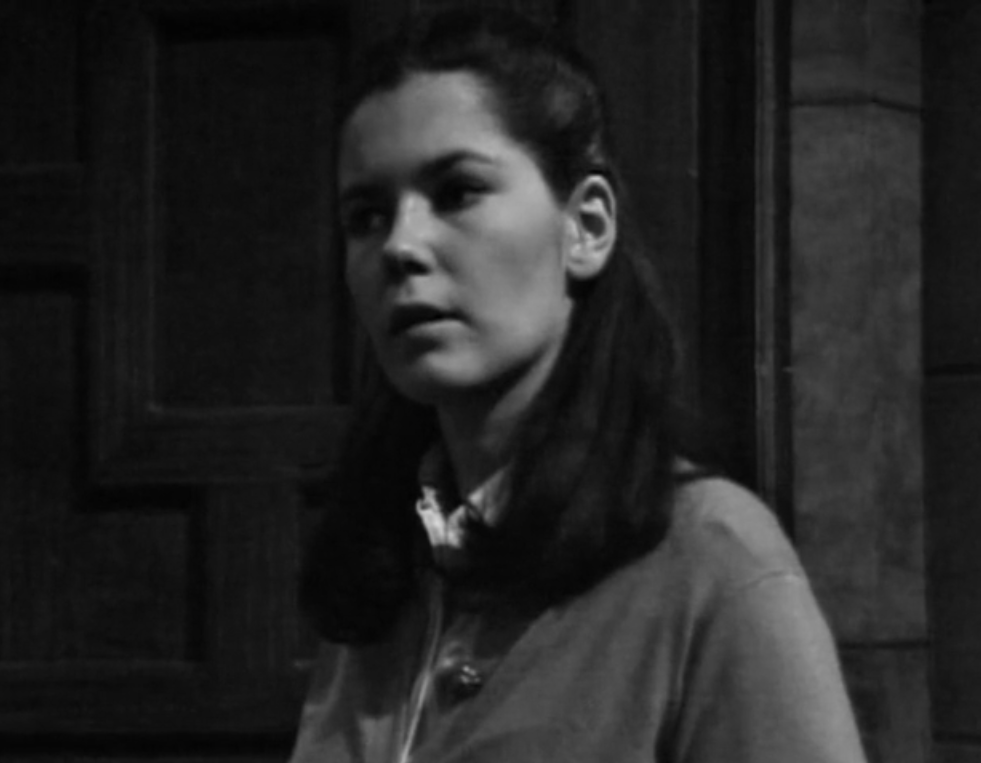
Vicki reviews all of the strange occurrences that have taken place since Laura’s return. She sums up the whole course of any story about people investigating the supernatural- “It seems connected- and yet so unconnected.” By the laws of nature as science describes them, by the ordinary logic of waking life, none of the events she lists means anything. It’s only after you accept the idea that uncanny forces are at work that they form a pattern pointing to Laura. The audience can accept that, because we can hear the theremin on the soundtrack. Vicki and Frank have a harder time.

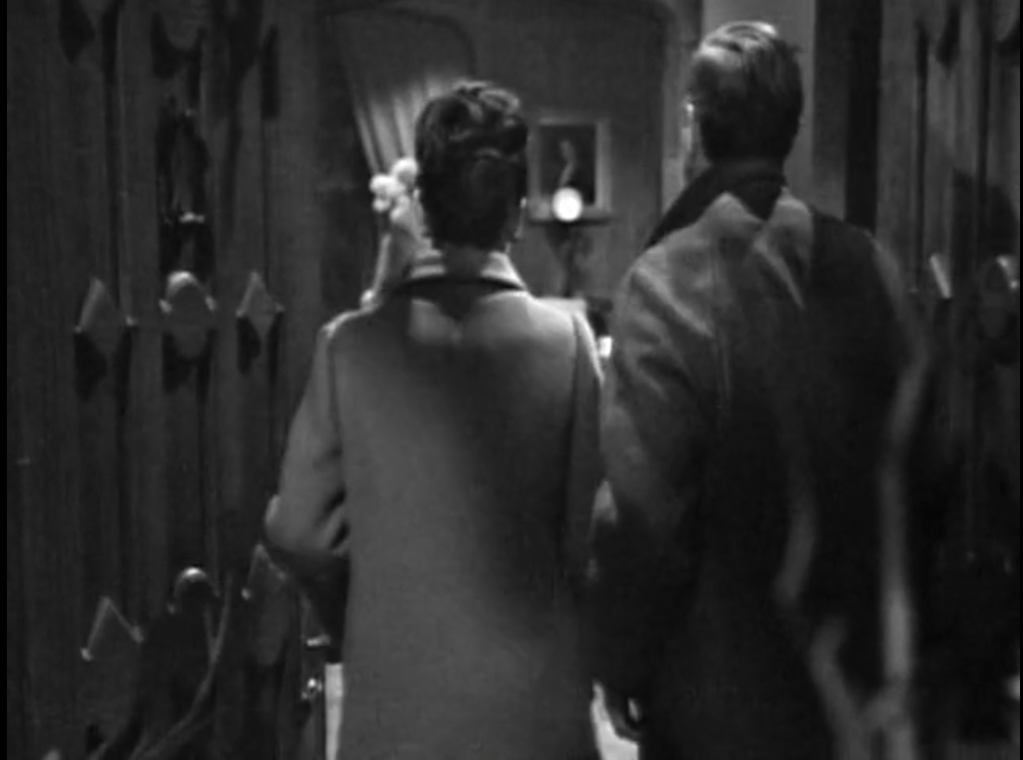
Frank tells Vicki he has to get home. She invites him in for a drink. He replies “You make it a stiff one, and you’re on!” That’s what you need before a long drive on dark, winding roads, to get tanked up on a lot of booze. They open the doors and walk into the house. The camera dwells on them as they make this procession. As they had gone through doors that led to L. Murdoch Stockbridge, now they go through the doors that lead to L. Murdoch Collins.

Entering the house

Vicki and Frank join Roger and Laura in the drawing room. The men drink brandy, the women sip coffee. Vicki asks Laura about her family background, claiming that David is curious about it. Laura responds merely that her family is a distinguished one and had been in the area for a long time.

Roger tells Frank that he will be hearing from Lieutenant Riley of the state police tomorrow. Laura objects that she doesn’t want to talk about Riley’s message, Roger says there won’t be any conversation- he will simply announce the lieutenant’s laughable news. The authorities in Phoenix, Arizona are convinced that a charred corpse found in Laura’s apartment there is hers, and that she died when the apartment building burned to the ground. Vicki looks at Laura, and with a strange smile says “Laura Murdoch Collins died by fire.”

“Laura Murdoch Collins died by fire”

*The caretaker was deeply versed in the lore of the Stockbridge family, and told Vicki and Frank that most of the graves in this eighteenth century cemetery were theirs. Yet he showed no glimmer of recognition when Vicki mentioned Josette Collins to him. That suggests that the Stockbridges were leading citizens of the area before the Collinses rose to prominence.

It might be interesting if someone would write a story in which the first Collinses were servants of the Stockbridges who got rich by doing their dirty work. Maybe the first and darkest shadow of all was that some colonial Collins scabbed on his fellow employees when they were trying to get a fair deal from the Stockbridges. I’m not up on Dark Shadows fanfic, for all I know there may be whole novels out there on this theme.

Episode 147: Certain things unsaid

Well-meaning governess Vicki walks in on an ugly scene in the bedroom of her charge, strange and troubled boy David Collins. David is yelling a threat at his father, high-born ne’er-do-well Roger. Roger has come to the room to remove a painting showing David’s mother, the mysterious and long-absent Laura, naked and in flames. David says that if Roger takes the painting, he will never talk to his mother again.

Laura has recently returned, and wants to divorce Roger and leave with David. Roger is enthusiastic about this plan. His sister, reclusive matriarch Liz, is very much against it. Roger is dependent on Liz, not only because he lives as a guest in Liz’ house and works as an employee of her business, but also because of the whole psychological structure of their relationship. So he must appease her. Laura has agreed with Liz that she won’t take David unless David is willing to go with her.

Before Vicki entered the room, Roger had been trying to convince David that he doesn’t hate him and isn’t trying to get rid of him by sending him away with his mother. Had he been successful in that attempt, David might have tried to keep Roger away from the painting by threatening not to talk to him, but instead he brings up the idea that he might doom Roger to continue living with him. Faced with that prospect, Roger capitulates.

Laura enters. She and David leave the room. Laura and David continue talking to each other after they are out of the frame. We hear Laura’s voice trailing off as they leave. I believe this is the first time we have seen this done on Dark Shadows, and I don’t recall it in later episodes. I think it’s a nice touch. That characters fall silent the moment we can no longer see them tends to call our attention to how small the sets were. Hearing Laura’s voice gradually fade away makes it easier to imagine that the action is taking place in a huge mansion.

Roger and Vicki stay behind. Roger tells Vicki that he ought to be angry with her. It was she who brought the painting to the great house of Collinwood and gave it to David. Vicki says she can’t explain why she did those things- some unnamed force came over her. She connects that unexplained compulsion with other odd things that have happened since Laura came back. When Roger asks if she is suggesting that Laura is somehow responsible for these events, Vicki won’t commit herself one way or the other.

When Vicki fell under whatever unknown power drove her to ask for the painting and give it to David in #142, her face wasn’t on camera. As a result, the episode played out as a series of moments when Vicki kept doing bizarre things for no reason we could feel. The result was a day spent with Dumb Vicki, a version of the character who emerges when the writers need something done and can’t come up with a motivation for any character to do it. As the one who gets the most screen time, it falls to Vicki to take actions or deliver lines simply because they are in the script.

This remark to Roger marks the opposite extreme from Dumb Vicki. Vicki has surmised information that the show has given the audience, but there is no particular reason why she should know it. We tend to forgive protagonists for being absurdly knowledgeable when their knowledge moves the story along, but Vicki’s insight into Laura’s place at the center of a web of supernatural occurrences doesn’t advance the plot today. As a result, Clairvoyant Vicki is left in almost as useless a position as Dumb Vicki.

One story development we briefly hoped it might have led to would be a self-aware twist on “The Turn of the Screw,” in which the members of the household notice that the governess is banging on about ghostly presences and worry that this is a neurotic symptom that will make her a bad influence on children. That hope is disappointed a moment after Vicki has delivered her lines. She leaves the room and Roger tries to remove the painting from the wall. We see him struggle, as if some invisible being is pulling him away from the painting. He looks disoriented and gives up. Having been overcome by a force like the one Vicki says made her bring the painting into the house, Roger is in no position to question her fitness for her job.

Downstairs, Laura meets Vicki. Laura tells Vicki that David is avoiding her, that he seems to be afraid of her again as he was when she first came back. She asks Vicki to arrange a meeting on neutral ground between her and David, something Vicki had done a couple of weeks ago and that had opened a brief period when David was warm to Laura. Vicki demurs. She says that David is badly disturbed, and that she is afraid of doing anything that might disturb him further. She herself is extremely uncomfortable around Laura.

Vicki rubbing her hands nervously

David comes into the room. He reacts with alarm when he sees Laura, and clings to the spot furthest from her.

David seeks shelter from Laura

When Laura suggests they spend the afternoon together, David says he has homework to do. When Laura says that Vicki will let him do his homework later, Vicki says that it is up to David. When Laura touches the top of his head, David runs upstairs.

Vicki and David have become very close. They’ve spent a lot of time together and seen all the same ghosts. Vicki’s attitude mirrors David’s closely enough in this scene that we wonder what sort of connection is developing between them.

Maybe some kind of telepathy is starting to link David and Vicki. Or maybe the explanation is more mundane, and they are just growing emotionally dependent on each other. David’s father is dependent on his big sister Liz, and the show has been hinting very heavily from the first week that Vicki is Liz’ secret daughter. Perhaps these first cousins are in danger of recreating the Bossy Big Sister/ Bratty Little Brother dynamic that has dominated their parents’ lives.

Whatever is going on between Vicki and David, Laura can hardly be expected to be happy with Vicki for bringing the painting to him. Now that Vicki is showing dread of her and refusing to help in her efforts to warm David up, Laura has an incentive to make Vicki look bad. Perhaps we will see someone accusing Vicki of thinking she is the governess in “The Turn of the Screw” after all.

Desperate to talk to someone about her feelings, Vicki slips into the town of Collinsport and visits dashing action hero Burke Devlin in his hotel room. Burke is Roger’s sworn enemy, and in his campaign to right the wrongs he believes Roger has visited upon him he is trying to destroy the whole Collins family. The last time Vicki went to Burke’s room was in #114, when she mentioned these facts as a reason she could never speak to him again. Since then, she’s been kidnapped and held prisoner by an escaped killer, and Burke went to great lengths to help in the search for her. So now they are back on speaking terms.

Vicki tells Burke everything she knows and everything she suspects about Laura. Burke doesn’t see what Vicki is driving at, but he does take note when she tells him that Laura and Roger are perfectly comfortable together. He has been hoping that Laura, who was his girlfriend before she married Roger, will join with him in his quest for vengeance, and has fondly imagined Roger quaking with fear of what she might do. Vicki’s report that Roger and Laura are quite relaxed around each other comes as a nasty shock to Burke.

While Vicki is in his room, Burke receives a phone call from Laura. Vicki listens to Burke’s side of the conversation as they arrange to meet at one of their old trysting places, a pier on the waterfront located right next to a fog machine stuck on overdrive.

Foggy Collinsport

Burke and Laura talk about old times. Burke wants Laura to tell him that David might be his son. This strikes me as an odd moment. Burke hasn’t been presented as someone suffering from amnesia- surely he remembers what he and Laura got up to as well as she does. He knows David’s date of birth. And he has been presented as a worldly-wise fellow who, even in the resolutely celibate world of Dark Shadows, very likely knows how babies are made. In #32, Roger mentioned that David was born only eight months after he and Laura became a couple. If that were fresh in our minds, we might suppose Burke wants to know whether David was born prematurely. Since the point hasn’t been mentioned in over 22 weeks, we are left wondering what Burke imagines Laura might be able to tell him that he doesn’t already know.

Burke asks Laura if she hates Roger. When she says she has reason to, he says that he hears she hasn’t been acting like she hates him. Laura asks who told him that, and he says it was Vicki. Laura is surprised that Burke and Vicki were discussing her, then says that she’s just putting on an act so that Roger won’t oppose her efforts to take David.

One does wonder why Burke revealed that Vicki was his source. Not only will that serve to prejudice Laura against her, the fact that Vicki has met with Burke and given him information about the doings at Collinwood is powerful ammunition she can use against Vicki when she talks to Liz and Roger.

Throughout the scene, Laura keeps an eye on Burke, gauging his reactions to everything she says. Burke is divided within himself. He wonders out loud why he doesn’t hate Laura and mistrust her when she did as much to harm him as Roger did, but also tells her that when they are together all his anger melts away and she alone is real to him.

Watchful Laura, divided Burke
Burke split by Laura’s shadow

Episode 140: Some call it Paradise

On his blog Dark Shadows Every Day, Danny Horn discussed the soap opera term “supercouple”:

This is the thing that people miss when they talk about soap opera couples. Two characters don’t have to be in love with each other to be a “couple” — although they often are, which is why people think that’s the definition.

Two characters are a “couple” when a scene with them together is way more interesting than a scene with them apart. It makes absolutely no difference whether they love each other, or hate each other, or they’re partners, or best friends. Kirk and Spock are a couple. Ernie and Bert are a couple.

Dark Shadows Every Day, Episode 473: The Twin Dilemma

By Danny’s definition, Dark Shadows‘ first supercouple is well-meaning governess Vicki and her charge, strange and troubled boy David Collins. Most of the storylines the series started with- Vicki’s quest for her origins, dashing action hero Burke Devlin’s quest for revenge on high-born ne’er-do-well Roger, reclusive matriarch Liz’ insistence that certain parts of the house never be entered, the doomed romance between flighty heiress Carolyn and hardworking young fisherman Joe, etc- either dribble away to nothing or never really get started. But Vicki’s attempt to befriend David is interesting every time we see the two of them together on screen.

That is entirely down to the actors. The scripts give David the same viciously hostile lines of dialogue over and again, require Vicki to read aloud from textbooks about the geography of Maine, and lock Vicki up in windowless rooms for what seem like eons. But David Henesy and Alexandra Moltke Isles, with their facial expressions, tones of voice, gestures, use of space, etc, create the impression of a relationship steadily growing in emotional complexity and importance. When David finally looks up into Vicki’s eyes and declares “I love you, Miss Winters!” in #89, this body language gives us a context within which we can feel that a plot-line has moved forward. In the months since that statement, David and Vicki have grown closer, and now they are quite cozy.

So much so, in fact, that there is a danger that they might end up recreating the interpersonal dynamic that Liz and Roger model and that will become Dark Shadows’ signature- a relationship between a bossy big sister and her bratty little brother. Liz continually tries to control Roger’s behavior so that he will not be bad, and when her efforts fail, as they invariably do, she covers up for him and shields him from accountability. Earlier this week, as Vicki explained David to himself and he clutched at her for support after he had done shocking things, we could see how after a time they might fall into that pattern.

Today, they seem to put that danger behind them once and for all. David’s mother, the mysterious and long-absent Laura, has come back and wants to take David to live with her. David has wanted this for years, but in the days since Laura’s return has come to be deathly afraid of her. Vicki has met with Laura and arranged to cross paths with Laura when she and David take their afternoon walk. Vicki’s theory, which has quite a bit of evidence behind it, is that David is only afraid of rejection, and that if he can see his mother in a setting where nothing will be expected of him he will start to relax.

The first result of this encounter is that David slips off a high cliff, clinging for his life to a crumbling rock on its edge. This would seem to be a negative outcome. Vicki rescues him, embraces him, and talks him into going to his mother.

Vicki holds David and urges him to go to his mother

David sees that Laura is crying and apologizes to her. They embrace and warm to each other. David, Laura, and Vicki walk back to the house together. David’s father, Roger, and his aunt, Liz, are impressed with the progress Vicki has made.

Happy at home

Dark Shadows began on a sort of 14 week schedule. Coming at the end of the first 14 weeks, episode 70 gave us our first visit to the haunted Old House and our first unambiguous sighting of a ghost. At the end of the third 14 weeks, episode 210 will end with a hand darting out of a coffin and rebooting the show entirely. Today, the conclusion of the second 14 week period is perhaps less spectacular, but in its own way just as pivotal as those other milestone episodes.

With David’s apology for making his mother cry and his resolution to open up to her, he is becoming significantly less bratty. With her handing of David off to Laura, Vicki is renouncing her opportunity to be bossy, and indeed to become a surrogate sister to him. With that danger out of the way and an untroubled friendship established between them, the Vicki/ David arc seems to have reached a logical conclusion. The series will have to find a new supercouple, or a clutch of new storylines, if it is to hold our attention in the long term.

Perhaps Laura and David will be the new pair at the center of the show. They are together at the beginning and end of the second half of the episode, and in between Laura gets some information about David to which she gives an intriguing reaction.

At the beginning of that second half, the five characters in today’s episode share a meal in the kitchen at Collinwood. The richest people in town live in a huge mansion, and this is their dining room:

Family dinner

I suppose Liz and her daughter, flighty heiress Carolyn, lived alone in the house for 18 years, ending with Roger and David’s arrival sometime last spring. So perhaps there is a bigger dining room sealed off somewhere. Be that as it may, the smallness of the kitchen is one of its most valuable features as a set. Scenes there have an intimacy that makes it natural for characters to share important information with each other. Indeed, almost every time we’ve seen the kitchen, we’ve seen someone pick up information that led them to take action that advanced the plot.

Liz and Roger mention that Laura hasn’t eaten anything. Roger follows that with jokes about the cooking abilities of Mrs Johnson, Collinwood’s housekeeper. Laura not eating is a familiar theme to the audience. The first several times we saw Laura she was in the restaurant at the Collinsport Inn. Maggie Evans, keeper of that restaurant, remarked that Laura never ate during any of her visits there, and yesterday she didn’t touch the breakfast Vicki brought her. The emphasis they keep putting on this point is one of many signs they’ve offered that there is something uncanny about her.

After the others have left the little table, Liz exchanges a few words with Laura. She mentions that David is a highly imaginative child, who even supposes that he talks with the ghosts of Collinwood. At this, Laura opens her eyes wide, shifts in her seat, looks straight ahead, and says that that does sound like pure fantasy. Liz adds that he spends a lot of time with the ghosts. Laura glances back in Liz’ direction and says that perhaps now he will spend more time with her.

One might imagine that a long-absent mother, hearing that her son thinks he spends a lot of time in conversation with ghosts, would be concerned for his mental health. A reaction like the one Laura gives Liz might be a sign of such concern. But we’ve had so many hints that Laura is herself somehow connected to the supernatural that this does not seem to be a likely explanation. More probably, her discomfort is a sign that David’s sensitivity to the uncanny and his communication with the ghosts might lead him to learn something about her that she does not want him to know.

Laura and David sit by the fire in the drawing room. Vicki has scolded David for his habit of standing at the doors to the drawing room and eavesdropping on conversations taking place inside. Now, it’s Vicki’s turn to stand on the same spot and eavesdrop on a conversation involving David.

Vicki listens in

David has asked Laura to tell him about the place she comes from. “Some call it Paradise,” she says. She starts describing a hot, sunny place with palm trees. Her last known address before appearing in Collinsport was Phoenix, Arizona, so maybe that’s what she’s talking about. But as she goes on, the description sounds less and less like that city, and more and more like the places we hear about in the legends of the Holy Grail. The air is always fragrant with the flowers that bloom continually, and the trees are the proper nesting places of a creature that figures prominently in the Grail legends, the Phoenix. David has never heard of the Phoenix, and Laura tells him an elaborate version of its story.

In episode 128, Maggie sat at Laura’s table in the restaurant and Laura told her the story of the Phoenix. When Maggie told her father, drunken artist Sam, that a mysterious blonde woman who used to live in Collinsport had told her that tale, Sam had reacted as if he recognized the story as one Laura used to tell. The version she told Maggie, though, was a relatively brief one, and was by way of an etymology for the name of her most recent hometown. The version she tells David today is much more elaborate. It evokes a whole world, claims that world as her home and therefore as David’s, and invites David to take his rightful place under the sign of the Phoenix.

As Vicki hears Laura reach the climax of the story, a sudden wind blows the front doors open, and a fraction of a second later blows the drawing room doors open as well. Laura looks up and sees Vicki eavesdropping. She is a bit startled to see her, though not as startled as Vicki is to be seen:

Vicki caught eavesdropping

After a brief moment- less than a second- Laura turns from Vicki and to the fire. She and David peer into the flames.

Peering into the flames together

Laura turns from the flames and looks at David. The episode closes with her look of satisfaction as she sees her son fascinated by the fire.

Watching David watch the fire

The doors have blown open before when the show wanted us to think that supernatural forces are at work in the house. Laura herself may control some supernatural forces, but it seems unlikely that she is the author of this incident. It interrupts her story just as she is declaring that “The Phoenix is reborn!,” her reaction shows that she didn’t know or particularly care that Vicki was eavesdropping, and her turn to the fire would suggest that she is concerned the wind might have extinguished the flames. Perhaps we are supposed to think that Laura’s presence and her plans have stirred up one or more of the ghosts Liz mentioned to Laura after dinner, and that the gust of wind was a sign of their presence. That would in turn suggest that the weeks ahead will feature a conflict between Laura’s uncanny powers and those of the spirits lurking in the back-world implicit in the action of the show.

Episode 119: We criss-crossed paths a dozen times

Nothing today but recapping.

The actors do what they can to hold it together, and there are a couple of memorable lines. Reclusive matriarch Liz calls her daughter, flighty heiress Carolyn, a “young girl” during yet another conversation pleading with her to stop dating the family’s arch-nemesis, dashing action hero Burke Devlin. Carolyn asks when her mother will admit that she is a woman. “When it is a fact,” Liz replies. Carolyn declares that “It won’t be a woman who bestows that title on me, but a man- Burke Devlin!” Everyone in Collinsport seems to be living according to a rule of chastity, so Carolyn’s open declaration that she plans to have sex with Burke is rather startling.

Liz’ brother, high-born ne’er-do-well Roger, comes home. Liz tells Roger that well-meaning governess Vicki is missing and may be in danger. Roger refuses to take an interest in the matter. When Liz is shocked by his indifference, he says that she sometimes expects too much of him. Considering that Burke and hardworking young fisherman Joe are searching the grounds of the estate for Vicki, and that the sheriff’s department has been involved in the search as well, Roger’s disregard for Vicki is not merely cavalier, but childish in the extreme.

When Roger finds out that Carolyn had been on a date with Burke, he tries to take the authoritative tone that her mother had taken with her earlier. Neither Carolyn nor Liz is impressed with the attempt this boy-man is making to impersonate a paterfamilias. Liz and Roger are the prototype for Dark Shadows‘ most characteristic relationship, that between a bossy big sister and her bratty little brother. She tries to correct his behavior, and when he disappoints her she shields him from accountability. In this scene, she sees yet again how useless he really is.

Burke and Joe come to the house to report that their search for well-meaning governess Vicki has been fruitless. Roger makes one sarcastic remark after another to Burke. Louis Edmonds is so skilled at delivering acerbic dialogue that these lines are fun to listen to, even though they don’t advance the plot or add to our understanding of the characters in any way.

Burke and Roger having words. Screenshot by Dark Shadows Before I Die

It’s a shame the scene isn’t better written. During the nineteen weeks when Art Wallace and Francis Swann were in charge of writing the show, they hinted that there may have been some kind of sexual relationship between Burke and Roger. This time, Burke has borrowed Roger’s shotgun, and Roger very conspicuously handles the gun after Burke returns it to him. He unloads it, and for no reason that we can see reloads it. As directed by Lela Swift, the actors are uncomfortably close to each other, and can’t keep themselves from getting closer as they exchange their wildly bitter remarks. In the hands of Wallace or Swann, or for that matter of almost any moderately competent writer, that scene would have made sense as a Freudian interlude. But today belongs to Malcolm Marmorstein, and the evidence of repressed sexuality doesn’t add up to much.

Carolyn tries to break the tension in the drawing room by playing “Chopsticks” on the piano. All she gets for her trouble is an irritated look from her mother.

Joe and Carolyn were dating when the series started. All we saw of their relationship was one breakup scene after another. They have a nice loud one today. If there had ever been anything between them, it would be a dramatic moment.

Earlier in the episode, Burke had told Joe he didn’t think he would ever really put his attachment to Carolyn behind him. We’ve seen Joe have a couple of happy dates with Maggie Evans, The Nicest Girl in Town, and are hoping the two of them will have a storyline together. The prospect that Burke may be right and we may be sentenced to sit through yet more bickering between Joe and Carolyn is too dreary for words.

Episode 105: Concrete evidence

Dashing action hero Burke Devlin visits the sheriff in his office. He brings the sheriff up to date on the recent threats well-meaning governess Vicki has faced. He also tells the sheriff that Vicki had found a pen belonging to Burke on a beach, and that he thinks that high-born ne’er-do-well Roger Collins dropped the pen there while murdering beloved local man Bill Malloy. Burke also thinks that Roger is the one who has been menacing Vicki. He asks the sheriff if he will play along with a scheme that might put some “concrete evidence” behind his beliefs.

In the great house of Collinwood, Roger faces a series of very sharply pointed questions about Vicki’s problems from his sister, reclusive matriarch Liz. He denies everything, including things Liz can prove to be true. He tries to say that Vicki is untrustworthy because she claims to have seen a ghost dripping wet seaweed on the floor in the west wing of the house. Liz reminds Roger that they investigated that claim, and found the wet seaweed just where Vicki said it would be.

The sheriff and Burke show up at the house. In the mood established by their conversation, Liz and Roger are left feeling trapped and small, as this shot none-too-subtly shows:

Collinsport Gothic. Screenshot by Dark Shadows Before I Die

The sheriff asks to see Vicki. Liz explains that she gave her a sedative and sent her to bed. He then questions Roger and Liz about the stories Burke has told. Liz downplays Vicki’s experiences; Roger makes another attempt to sell the idea that Vicki is nuts because she claims to have seen a ghost. When Burke brings up the topic of the pen, Liz is at a loss- it is the first she has heard of it. Roger tries to brazen it out. When Burke produces a pen identical to the one Vicki found, he flails and finally denies that the pens are at all alike. The sheriff asks Liz to send both Vicki and flighty heiress Carolyn to his office first thing in the morning to examine the pen.

Liz tells Roger that she is confident Carolyn and Vicki will tell the sheriff the truth. When he tells her he needs time to think, she replies that he doesn’t need any time to think of more lies. He declares that there is something he must attend to immediately, and rushes out of the house. Liz watches her little brother leave the house, frustrated in her attempts first to correct his behavior, then to shield him from its consequences.

Roger goes to the peak of Widow’s Hill. He had stolen the pen Vicki found and buried it under a rock there. He digs it up. As he looks at it, Burke and the sheriff appear and thank him for saving them a lot of trouble.

Art Wallace’s original story bible for Dark Shadows had called for Roger to have his final scene on this spot. Vicki was to have found evidence that would send Roger to prison, he was to attempt to kill her by throwing her off the peak of Widow’s Hill. She would avoid that fate when Roger instead went over the cliff himself. As it has worked out, Louis Edmonds is too appealing an actor to lose. So Roger stays on the show as a suspect in an investigation, perhaps as a defendant in a trial. It won’t be the last time Dark Shadows extends an attractive villain’s stay on the show by playing out different events on the set where his story was originally meant to end.

Episode 104: Chamber of horrors

In the great house of Collinwood, well-meaning governess Vicki is terrified of high-born ne’er-do-well Roger Collins. She had found evidence that led her to suspect Roger of murdering beloved local man Bill Malloy. Roger learned of her suspicions and told her a story that has left her unsure what to think.

In yesterday’s episode, someone unlocked the door to Vicki’s room and started to enter while she was in bed. She screamed, and the door slammed shut. Seconds later, Roger came. He denied having unlocked the door or seen anyone else in the hallway.

Today, Vicki is discussing that event with reclusive matriarch Liz. Vicki won’t explicitly say anything against Liz’ brother Roger, and Liz will not draw any conclusions about him in front of her. When Liz says she can’t imagine who might be in the house that Vicki could have reason to fear, gruff caretaker Matthew enters. This is not the least subtle clue the show has given us that we should consider Matthew a potential threat to Vicki.

Vicki tries to call her friend Maggie Evans. She talks to Maggie’s father, drunken artist Sam. Sam asks her to meet him at the local tavern to discuss a painting he did long ago of a woman to whom Vicki thinks she might be related.

After Vicki has left, Roger comes home. Liz is unhappy that he did not return her call when she telephoned him at his office in the business she owns. He is unrepentant. When she questions him about Vicki, he tells her that he thinks Vicki should leave Collinwood. He says that she is not safe there because she knows too much about the death of Bill Malloy. This does not leave Liz with a particularly sunny view of her bratty little brother.

At the tavern, Sam admits to Vicki that he doesn’t have anything to tell her about the painting. He wants to pump her for information about her suspicions. Vicki says she has something to say to Maggie about that subject, but only to her- she doesn’t want to go through it any more often than necessary. She refuses to tell Sam anything. When Sam gets overheated, she gets up to leave the table. He touches her sleeve. She gives him a look that goes from startled to commanding to wondering to pitying to just sad in the space of fifth of a second. He shrinks into his seat, and she sits back down. He offers her a ride home, she says she would rather walk. After she goes, he gulps a drink, then follows her out.

On the road, a car tries to run Vicki down. They’ve introduced a new set dressing for this scene. I like the signpost:

Between Brock Harbor and Collinsport

Vicki must have lost her keys when the car was coming at her, because she pounds on the front door of Collinwood until Liz lets her in. Vicki describes the incident, saying that the car deliberately swerved to hit her. In answer to Liz’ questions, Vicki says she couldn’t see anything but the headlights, and declines to call the sheriff. “I can’t talk to the sheriff. I can’t talk to anyone.” Liz mentions that Roger has left the house, and says it’s too bad he didn’t find her. Vicki replies “Maybe he did.” Liz responds to that by fetching a sedative and insisting Vicki take it.*

While Liz is out of the room, Vicki telephones dashing action hero Burke Devlin and tells him of the incident with the car. We hear only her side of the conversation, but we can presume Burke will do something about it.

*The first of countless sedatives that will be consumed in the drawing room of Collinwood in the years ahead. If the show had lasted another decade, the Ramones might have written a replacement for Robert Cobert’s piece for theremin as its theme song .

Episode 93: A little wrong about David

Strange and troubled boy David Collins talks with his father, high-born ne’er-do-well Roger, about David’s governess, the well-meaning Vicki. David wants Vicki to stay on. Puzzled by this, Roger lists some of the cruelties David has meted out to Vicki. David explains that he has changed his mind about her since he did those things. Roger asks why. David explains that Vicki has seen the ghost of beloved local man Bill Malloy, and that if she sees the ghost again, it might reveal that Roger murdered Bill. Roger responds to this remark by slapping David across the face. David is shocked, and runs to his aunt, reclusive matriarch Liz, to complain.

Roger is well-established as an abusive parent. He has time and again spoken openly of his hatred for his son, and more than once we have seen him manipulate the rage with which he has filled David so that the boy will do his dirty work for him. This is the first time we’ve seen him engage in physical violence. David’s disbelieving reaction and his assumption that he has the right to complain support the idea that Roger has previously limited himself to psychological abuse.

The actors are such pros that I find it hard to imagine Louis Edmonds really made contact with David Henesy when he swung his hand. But Henesy visibly flinches a second before the slap, as if he expected to be hit. Maybe Edmonds came close enough in dress rehearsal that Henesy couldn’t help being scared.

Roger hits David. Screenshot by Dark Shadows Before I Die

When David runs to Liz, he finds that she is busy trying to reason with her own strange and troubled child, flighty heiress Carolyn. Carolyn is annoyed by David’s interruption, and dismisses his claims about Roger out of hand. Even after Roger proclaims that he did hit David and will do it again if he doesn’t stop babbling about ghosts, Carolyn says that she believes David made the whole thing up. Liz sends Roger, but not Carolyn, out of the room, and talks to David about the incident. Liz walks him back to his room, not saying much as he seethes and says that he wishes his father were dead.

Liz returns to her conversation with Carolyn, trying to talk her out of her obsession with the family’s arch-nemesis, dashing action hero Burke Devlin. Liz understands the fascination- how could she not? Carolyn is a vigorous young woman, and she’s already broken up with the only other attractive man on the show, hardworking young fisherman Joe. So Liz shares some information about how miserable her marriage to Carolyn’s father was, tells her that Joe reminds her of the man she wishes she had married instead, and urges her to try to patch things up with him.

Roger reappears and pouts to his sister Liz. He claims that Vicki is a bad influence on David and demands that Liz fire her. Liz refuses to do so, or to take anything Roger says at all seriously. When he refers to the idea that he might take David and leave her house, she tells him she is sure that her money means more to him than does his son. His response to that is to slam his hand on the piano and to concede her point.

The Liz/ Roger moments today focus on Dark Shadows‘ most characteristic relationship, that between a Bossy Big Sister and her Bratty Little Brother. Liz fails to address Roger’s hitting David for the same reason she fails to address his psychological abuse of the boy- facing either problem would require acknowledging that Roger is a father and that he has the responsibilities of a grown man. Liz is deeply invested in treating him like a naughty little boy whose behavior she will try to correct when the two of them are alone together, but for whom she will always cover when the grownups are around.

Her cutting remark about Roger’s attachment to her money shows the same pattern. When it’s just the two of them, Liz scolds him for living off her. But when there was a prospect he would face consequences for his spendthrift ways, she borrowed against everything she has to pay his way out of trouble.

In a world of Bossy Big Sisters and Bratty Little Brothers, David is adrift. He’s bratty enough, but has no sister. The obvious candidate for a substitute big sister, his cousin Carolyn, makes it clear today she couldn’t be less interested in David. Regular viewers know that Roger and David moved into the house not long before episode 1, that Carolyn didn’t grow up with David, and that she was not happy when he ended her long reign as an only child. Aunt Liz likes David very much, but she has spent too much time protecting Roger from accountability to protect anyone from Roger. Vicki is determined to befriend David, and now that she has seen a ghost there is a chance she will succeed. But she is far too mentally healthy to reenact with him the pattern the Collinses of Collinwood are bred to expect. To accept Vicki’s friendship, David will have to learn an altogether new way of relating to another person. 

Episode 59: He sort of talked me out of it

Yet another G. G. E.- Genuinely Good Episode. There have been several of those this week.

The sheriff is in the big dark house on the estate of Collinwood, questioning high-born ne’er-do-well Roger about the mysterious death of plant manager Bill Malloy. Roger’s sister, reclusive matriarch Liz, joins them. They deny knowing anything, including things we’ve seen them find out in previous episodes. Much of the conversation is to do with drunken artist Sam Evans and the idea that Sam might be keeping a secret.

Roger’s son, nine year old problem child David, is all smiles when he drops in on his well-meaning governess Vicki. Convinced that she can befriend David, Vicki responds instantly to his smile. She asks why he’s so chipper. He says that it’s because he will never see his father again. The sheriff has come to arrest him for murder.

Vicki asks him if the sheriff said that he was going to arrest Roger, and David admits that he did not. But David is sure that he will. He is sure he is guilty. He lists the three sources of information he has that confirm for him that his father killed Bill- the ghosts of the Widows told him, he saw it in his crystal ball, and he used a tide table to calculate the spot at which Bill fell in the water. When Vicki insists that he doesn’t know what he’s talking about, he says she’s just refusing to face facts because she’s afraid his father will kill her, too. By the end of what had begun with the sound of a very cozy conversation, David tells Vicki that he might not be unhappy if his father does murder her.

Vicki keeps her eyes on David throughout this conversation, listens carefully even when he keeps talking after she’s told him to stop, and looks thoughtful after he leaves the room. As Vicki and David, Alexandra Moltke Isles and David Henesy play a wide enough range of emotions in this scene that we, in spite of the dialogue, can see why Vicki is still sure she and David will someday be friends.

Vicki trying to think of a way to reach David

David goes downstairs in time to see the sheriff leaving. He asks him if he’s arresting his father. The sheriff says he’d thought about it, but that Roger talked him out of it. That’s a pretty weird thing for a policeman to tell a boy, but Dana Elcar, as the sheriff, is such an engaging presence that we can accept it, somehow. I think it’s because he makes a show of choosing his words carefully and plays the scene with an eye on Roger, so that we can regard his strange words as a tactic to unsettle his suspect.

David gives the sheriff the book of maps and tide tables, open to the page where he marked the spot at which he believes Bill went into the water. The sheriff thanks David and tells him to keep up the detective work. David and Roger stare daggers at each other. In this staring match, David Henesy and Louis Edmonds, as Roger, do such a compelling job of embodying filial hate that the audience can respond in only one of two ways- either it will send a chill down your spine, or you’ll laugh out loud. This time we laughed, because we’ve seen so much of the show we feel we know the actors and know that they had great fun with scenes like this. I think we were chilled the first time through, though.

David and Roger stare at each other
Staring contest

After the sheriff leaves, Liz tells Roger that she has now lied to the sheriff for him, and demands that he tell her the truth. Roger says that he, not dashing action hero Burke Devlin, was responsible for a killing ten years ago, that his testimony at the trial that sent Burke to prison was a lie, and that he murdered Bill because he was afraid Bill would expose that lie. Liz trembles, sits down, says “It can’t be true,” then Roger bursts out that of course it can’t be true, not one word of it is true. Having heard the story out loud, Liz is happy to disbelieve it.

David listened to this conversation through the keyhole. When Vicki catches him listening, David declares that he had heard his father admit his crimes. He heard the denial as well, but that did not make the impression on him that it made on his aunt. He is as highly motivated to accept the confession as Liz is to reject it.

After David is sent to his room, Liz and Roger ask Vicki what he told her he heard. Vicki says it was nothing- “His imagination.” She is on her way into town to have dinner with friends. Liz asks who those friends are. Vicki tells her they are Maggie Evans and Maggie’s father.

Vicki leaves, and Liz asks Roger if Maggie Evans’ father is Sam Evans. Yes, says Roger. Why does that bother you, asks Liz. Roger denies that it bothers him, and stomps away up the stairs. Liz looks thoughtful, much as Vicki had looked thoughtful when David talked about her as a potential murder victim and walked out of her room.

Liz wonders about Roger

Denial, the psychological defense mechanism, presents a rich challenge to an actor. Liz cannot allow herself to believe that Roger is guilty of the crimes that have been discussed in this episode, and so she gladly accepts his declaration that “not one ugly word” of his confession to her was true. Yet Liz is an intelligent woman, and she knows her brother extremely well. She certainly knows him well enough to know that he is a scoundrel through and through, and it is obvious he has a great deal to hide in connection with these events. So as Liz, Joan Bennett has to play a person who simultaneously rejects an idea and accepts it. That’s a challenge to which she rises brilliantly.

The comparison between Vicki’s pensive moment after David leaves her room and Liz’ pensive moment after Roger leaves the foyer highlights the similarities between Roger and David. Those similarities are prominent this week. In yesterday’s episode, David was cool as a cucumber while others stormed and raged. Today, Roger plays it cool while confessing to a list of serious crimes, some of which he actually committed, and then exposes that list as a tactic to force Liz to deny his guilt. When David is in Vicki’s room, Vicki compares him to his father, to which David replies that he never killed anyone. If she were less concerned with winning David’s friendship, Vicki could have told him it wasn’t for lack of trying- he did tamper with the brakes on his father’s car and cause him a serious wreck, after all.

We can only assume that Roger has always been like this, that he once was what David is, and that unless something changes David will someday be what Roger is. Vicki’s pensiveness is all about the future, about the difference she might be able to make for David. Liz’ reaches into the past, back to all the times she, as Roger’s bossy big sister, tried to keep her bratty little brother out of trouble, and to cover up for him when he slipped beyond her influence. Whatever approach Vicki comes up with in her quest for David’s friendship, then, will have to be different from the approach Liz took to Roger throughout their early days.

Episode 50: He wasn’t there again today

This one is so good that I can’t resist going over it scene by scene. It has a wide variety of mood and image, tautly structured in a clearly told story, subtly realized by highly accomplished acting, and memorably presented in superb photography and imaginative sound design.

Well-meaning governess Vicki, out for a night-time stroll, makes her way to the crest of Widow’s Hill, where flighty heiress Carolyn stands looking down at the ocean swirling a hundred feet below. “Advance and be recognized! Friend or foe?” Carolyn challenges. Seeing Vicki, she remarks “Even the tutors are out tonight.”

Despite her whimsical greeting, Carolyn is in a low mood. She’s wondering at her own inability to take hardworking young fisherman Joe Haskell’s desire to marry her seriously. She tries to interest Vicki in some of the ghost stories that surround the great estate of Collinwood, while the wind whips around the hill making the eerie sound known as “The Widows’ Wail.” Vicki stoutly insists on reducing all of Carolyn’s tales to psychology and asking her about her feelings. You can really see Nancy Barrett’s Carolyn trying to maintain a light tone despite her gloom, and in Alexandra Moltke Isles’ Vicki you can just as easily see a determination to cut through the nonsense and stick to what’s real, a determination fueled partly by her empathy for Carolyn and partly by her reflexive rejection of the weirdness of her new home in the old dark house.

In the house, troubled rich boy David Collins is complaining to his aunt Liz that the ghosts won’t let him sleep. Liz tells him to turn the lights on and chase them away. Unsatisfied by that response, David persists. Liz tells him that she has no time for him now and sends him to his room. Ten year old David Henesy trades these well-written lines with veteran movie star Joan Bennett as her professional equal. David Collins continually does nasty things to characters we like, refuses to take responsibility for any of his wrong-doing, and becomes violently surly when interrupted in his endless bouts of self-pity. He ought by rights to be a difficult character to take. But David Henesy finds something lovable in him, and brings that out clearly enough that he’s always a welcome presence on screen.

Vicki and Carolyn come to the house. Liz is disappointed they aren’t her ne’er-do-well brother Roger. Liz had ordered Roger to leave his desk at her company and come home early in the afternoon. She has questions about the disappearance of plant manager Bill Malloy, and about Roger’s lie that he hadn’t seen Malloy the night before. It’s well after 10 PM now, and no one has seen or heard from Roger since Liz called him.

Carolyn and Vicki have tea and try to take Liz’ mind off her worries, but without success. Liz scolds Carolyn for bringing up the ghost stories at a time when everyone is worried about Bill Malloy, but she can’t long keep herself from drifting off into the tale of the two women who died falling off the cliff, and the third who will someday follow them. That drifting, as Joan Bennett plays it, speaks volumes about Liz’ state of mind. She’s agitated about Bill Malloy, about Roger, about the possible connection between their two absences. That agitation gives way to hopelessness.

Roger comes home. Liz greets him with a demand for explanations. He responds with perfect insouciance, informing his sister, in whose house he lives as a guest and from whose business he draws a salary on her sufferance, that he is going to the kitchen to make a sandwich. Louis Edmonds’ delivery of Roger’s lines is brilliantly funny- we laughed out loud.

Liz most definitely does not see the humor. She has a brief scene by herself after he goes off to prepare his snack. All she does is watch him leave the foyer, turn, walk a few steps to the drawing room, and take a seat. With no dialogue and no mugging for the camera, she shows anger, disbelief, exasperation, and despair. It is a wonderfully economical performance, quite as extraordinary as is Edmonds’ comic turn preceding it.

In Vicki’s room, we see the word “death” scrawled on her mirror in all caps. Vicki enters, dragging David behind her. She demands to know who wrote it. He insists that the ghosts of the Widows did it. Vicki remarks that it is surprising that the Widows have the same handwriting as David. Carolyn enters, sees the word, and scolds David. Vicki silences Carolyn with a glance and asserts control of the situation. Only when Vicki threatens to tell Liz about the word does David erase it, though he still insists it was the Widows who wrote it, not him.

After David has left the room, Carolyn tells Vicki how horrid David is. Vicki perks up and makes a series of jokes about the Widows. She’s in such a chipper mood as soon as David is out of earshot that she must have been putting on an act presenting herself to him as angry. Much to Carolyn’s mystification, Vicki likes David and is confident that sooner or later she will make friends with him.

At another point in the series, this scene might have been padded out to fill a whole episode. Today, Art Wallace writes a quick and forceful interlude, showing us everything we need to know about what the three characters in it are like and where they stand in their relationships to each other, shedding some light on the idea of the ghosts of the Widows, then moving on to the next story point. The writing is as economical as the acting, and as absorbing.

Liz and Roger have a confrontation in the drawing room. Liz asks why Roger didn’t come home when she told him to. He tells her that he went to Bill Malloy’s cousins’ house to see if Bill had been there, and that he simply forgot to tell her he would be making the trip. This response is so unsatisfactory that it seems to double the anger with which Liz puts her next question- why did he lie to her when he denied having seen Bill Malloy last night? Roger tries to weasel out of answering that question, and does manage to get Liz to give him some information he can use to craft more plausible lies, but does not get himself off the hook.

The relationship between Liz and Roger is the first of Dark Shadows’ several relationships between a Bossy Big Sister and a Bratty Little Brother. In Liz and Roger’s case, they are literally older sister and younger brother; the most important such relationship will be a figurative one, between Julia and Barnabas. But it’s Liz and Roger who set the pattern. Roger’s impossible behavior in this scene is certainly among the finest examples of brattiness among all the little brothers, and Liz shows with crystal clarity the limitations of the power of the Bossy Big Sister when confronted with a truly horrid Bratty Little Brother.

Carolyn and Vicki come downstairs. They are going back to the crest of the hill to look for Carolyn’s wristwatch. Once they’ve left, Liz meets David at the top of the stairs. She tells David that they are looking for a wristwatch. “That’s not what they’ll find- they’ll find death” replies the boy. Last episode, David received the gift of a crystal ball; that marked the beginning of his career as a clairvoyant.

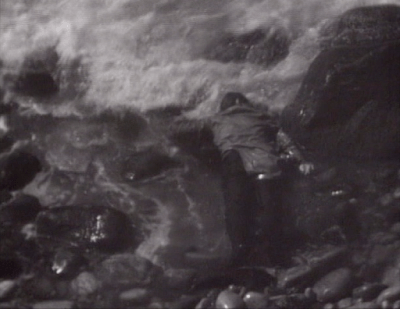
No sooner has the seer made his prediction than we hear Vicki screaming. Looking down from the cliff, she and Carolyn see a figure on the beach- a man face-down in the water. We hear the tide and the wind, sounds of nature on a large scale, and the immobile figure seems to represent something vast and inevitable.

Face down in the water, wearing an overcoat, with a flask in his back pocket
Screenshot by Dark Shadows Before I Die

My usual themes: Bossy Big Sister/ Bratty Little Brother

In 281 of the posts that follow, I link to comments I made on Danny Horn’s blog, “Dark Shadows Every Day.”

Not all of these comments were absolutely unique. Several times it occurred to me that a Dark Shadows features a number of older sisters who clean up messes that their misbehaving younger brothers make, and that a variety of male-female relationships on the show take on the dynamic of a bossy big sister and her bratty little brother. Danny doesn’t cover the first 209 episodes of the show, when we learn that Roger Collins has managed to squander his entire inheritance, half of the family fortune, and that his older sister Elizabeth Collins Stoddard has gone deeply into debt to contain the damage that his irresponsibility has done to the family business. Elizabeth takes Roger into her house, and alternates between demanding that he reform his ways and enabling his ongoing bad conduct. She takes charge of the raising of Roger’s son David and puts Roger to work in the family business, setting bounds to Roger’s crapulence but also insulating him from its consequences.

My first remarks about this theme were in a comment on episode 565:

Watching this episode, I just realized the main relationship in DARK SHADOWS- Bossy Big Sister/ Bratty Little Brother. Liz and Roger are literally that, and each one’s struggle to safeguard their relationship by keeping the other in the dark about their shameful secrets is the background of every storyline in the first 209 episodes. Carolyn and David become the functional equivalent of a Bossy Big Sister and a Bratty Little Brother, and that’s the development that makes Carolyn a relatable character.

In Julia and Barnabas, we have the supreme example of such a relationship. They fall into it naturally; Julia is used to giving orders, and Barnabas is used to disobeying them. From the moment Julia lit her cigarette on the candles in the old house, she’s been Barnabas’ Bossy Big Sister, pursuing one plan after another meant for his own good. He’s been alternately pouting at her, raging against her, and clinging to her, at once resenting her demands on him and craving her validation for his narcissism. The climax of the episode, when they both know that a he-vampire is roaming about in search of a victim but it occurs to neither Julia nor Barnabas that Julia might be in danger, shows how deeply they have embedded themselves in these roles. Barnabas won’t even let Vicki walk to her car alone, and Julia, hearing the dognoise, understands why. But when Julia tells Barnabas that she will close up the lab and leave shortly after he goes out to join Willie, implying that she’s going to walk all the way back to the Great House by herself, he just leaves. Of course nothing will happen to Big Sis, she’ll always be OK.

That’s also why I don’t see how slashfic positing a sexual relationship between Barnabas and Julia can work. They are so much Bossy Big Sister and Bratty Little Brother that no matter how much time they spent telling themselves that they aren’t actually related, it would still be impossibly weird to try to be something else to each other.

I returned to the theme in a remark about episode 572, where Jonathan Frid gives a line-reading so pouty that I wonder if he was consciously trying to depict Barnabas as a bratty little brother to Julia:

I love the way Jonathan Frid pouts the line “I was afraid your visit would be pointless.” He’s every inch the bratty little brother upset that his big sister went out when he didn’t want her to go.

By episode 648, the idea has moved me to fanfic:

Cavada Humphrey looks quite a bit like Jonathan Frid. I wonder what 1795 would have been like if Barnabas had had an older sister who bossed him around, stood around during his ridiculously childish fits of petulance, occasionally acted as his conscience, and time and again serve as his enabler and protector. It would have been funny to see Grayson Hall’s Countess express disapproval of such a relationship.

Heck, that older sister could have been Sarah. Just because she’s a child in her ghost form doesn’t mean she has to have died at that age. Maybe she comes back in the form in which her relationship to her brother took its permanent shape, when she was about nine and he was about seven. Of course, that possibility is foreclosed at Sarah’s first appearance, when she tells Maggie not to let her “big brother” know she saw her, but I suppose they could have retconned that away with a phony flashback where she says “little brother.”

I revisited these points a few times- Danny’s blog consists of over a thousand posts, one each for episodes 210-1245, plus a few dozen about properties related to Dark Shadows, and each post has its own discussion thread. So it isn’t bad netiquette to repeat yourself a bit from one thread to another- there is always a chance someone who didn’t see a comment previously posted elsewhere will take an interest when you post a similar one. But I did try to keep from making a bore of myself to those who read everything.

I could have mentioned some other bossy big sister/ bratty little brother combos. In a comment on the 1897 storyline, I alluded to the relationship between Judith Collins Trask and her feckless younger brothers. Judith’s arc doesn’t really allow her to be a bossy big sister to any of her three bratty little brothers. But each of them does find himself attached to at least one woman who is stronger than he is, and who might well treat him as Elizabeth does Roger and as Julia does Barnabas.

It’s a shame Terry Crawford wasn’t a more accomplished actress in the 1960s- in the scripts Beth fluctuates between indulging Quentin in his every vice and insisting that he clean up his act. That’s the bossy big sister/ bratty little brother dynamic we’ve seen so many times, but unlike any previous pair who have enacted it Beth and Quentin are lovers and are not social equals. It would be interesting to explore the dynamic in that context, but Ms Crawford’s performance is so wooden that you sometimes have to think about her scenes after it is over and call to memory the dialogue and the visual composition before it strikes you what the point was.

Pansy Faye isn’t on the show very long, unfortunately but she’s clearly in the driver’s seat in her relationship with her thoroughly clownish husband Carl Collins. And Edward Collins is much the weaker personality in his connections with both his estranged wife Laura and with Kitty Soames. So each of those men was looking for a woman who was forceful enough to take charge of him, but indulgent enough to allow him to continue in all his established habits.

I also made only one brief reference to the bossy big sister/ bratty little brother dynamic in the discussions of the 1840 storyline. That’s rather odd- after all, in that one Julia actually presents herself to the family as Barnabas’ sister, and he is forced to go along with the pretense.

I did not refer to the theme in my comments on posts about “The Haunting of Collinwood” by the ghost of Quentin, and I made only a single reference to it in my comments on posts about the “Re-Haunting of Collinwood” by the ghost of mini-Quentin Gerard. Indeed, that single reference is to Julia’s failure to focus her bossiness on Barnabas. I dropped the ball there, I think- the relationship between David and Amy in the original “Haunting of Collinwood” is at its most interesting when it mixes elements of the bossy big sister/ bratty little brother dynamic with other types of interaction, while the bland, lifeless relationships between David and Hallie on the one hand and between Tad and Carrie on the other in the “Re-Haunting of Collinwood” could benefit from some kind of structure.

I also left the theme unmentioned in my comments regarding the show’s dying days, the 1841 Parallel Time storyline of episodes 1199-1245. That’s understandable- the show did not develop any bossy big sister/ bratty little brother relationships in that period. But there was an implicit one- Miss Julia Collins was the sister of Justin Collins, and she had functioned as head of the household during his years of madness. Justin dies a few episodes into the story, without sharing a scene with Julia, and she is left as a bossy big sister with no bratty brother to whom she can attach herself. Meanwhile, Bramwell is a thoroughly bratty man with no big sister. It’s rather sad for the loyal audience, having enjoyed so many scenes in which Grayson Hall and Jonathan Frid had enormous fun with the bossy big sister/ bratty little brother pattern, seeing them drift separately through these dreary episodes.

The closest we get to a bossy big sister/ bratty little brother scene in the dying days of the show is also the one genuinely irresistible moment of that segment. In episode 1215, Flora Collins (Joan Bennett) and her son Morgan (Keith Prentice) are walking through the woods on their way to Biddleford’s Creek. He whines about the pointlessness of the trip, she scolds him, and we get a brilliant little glimpse of what their relationship must have been like since he first learned to talk. That authoritative mother/ whiny son moment left me, not only wanting more such scenes between them, but also wishing it had been presented in contrast with a bossy big sister/ bratty little brother relationship elsewhere in the show.