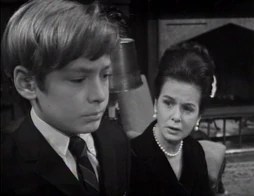
Episode 172: The sound of fire

Friday, Dark Shadows showed us its first séance. Yesterday, the people who attended that séance tried to figure out what it meant. Today, word of the séance starts to get out to people who weren’t there.

These three episodes also involve wrapping up a lot of loose ends that only people who watched the show from the beginning will remember. Friday’s episode harked back to the ghostly image we saw in #30. Yesterday’s episode drew a line under the alarmingly inappropriate crush flighty heiress Carolyn had on her Uncle Roger in the first few weeks of the show. Today, dashing action hero Burke Devlin shows that he is still laboring under a misunderstanding that led him to a dead end in #89 and #99.

In those episodes, Burke was trying to take his revenge on the ancient and esteemed Collins family by hiring the most valued employees away from their cannery. He was confident he would succeed in this plan because he had more money than the Collinses. In #89, he explained that confidence to his lawyer with a bunch of cliches rich guys use when they are villains in old movies: “Money talks. Money buys loyalty. Everyone has their price. Name it and you can buy them. Some just come a little higher than others, that’s all, but everyone is for sale.”

Those men all rebuffed Burke’s offer, as hardworking young fisherman Joe had refused Burke’s attempt to buy his loyalty in #3. Burke believes that the Collinses’ power comes from their money. His failures suggest that it is more nearly the other way around. The Collinses dominate the town of Collinsport because the population is so much in the habit of deferring to them that they can’t really imagine any other way of life. Simply by living in town, they have been indoctrinated into an ideology that puts the Collinses at the center of everything. Though from the perspective of the outside world Burke may have come back to town as a representative of high finance and large-scale capitalism, in the eyes of the locals he might as well be trying to start a communist revolution.

The one Collinsport resident who has agreed to take Burke’s money as payment for working against the Collinses is Mrs Johnson. For many years, Mrs Johnson had been the faithful housekeeper to cannery manager Bill Malloy. In her first appearances, Mrs Johnson talked of her unrequited love for Bill and her conviction that the Collinses were responsible for his death. Wanting revenge on them, she agreed to Burke’s plan to take a job as housekeeper at Collinwood and to give him whatever information she could gather. He has been paying her ever since.

Today, Mrs Johnson comes to Burke’s room and announces she has some information she would give him even if he weren’t paying her. This remark will strike regular viewers as absurd. Those who remember Mrs Johnson’s early appearances know that her motivation for joining with Burke was not his money, but her drive for vengeance. Those who have seen her since, including earlier in this episode, know that she always tells everyone she meets everything she knows. Her usual conversational gambit is to declare “I mind my own business, and expect others to do the same!” and then divulge the entire contents of her awareness, including everything she learned by her incessant eavesdropping on everyone in the house.  

In Mrs Johnson’s case, Burke is overlooking not only the power of ideology, but also the persistence of personal habits. Mrs Johnson not only does not need to be paid to give information; no amount of money could keep her from giving information. She can’t be incentivized out of telling too much, because she doesn’t know that she is doing it. She is perfectly sincere when she says “I mind my business!” or “I’m not a gossip!” or makes any of her other usual protestations.

One thing Burke and Mrs Johnson have in common is a tender regard for well-meaning governess Vicki. The séance was very hard on Vicki, because her body was the scene of a battle between the ghost of Josette Collins and blonde fire witch Laura. Josette had possessed Vicki in order to warn the company about Laura, but Laura used her own powers to drive Josette from Vicki before she could say her name. Now Vicki is spending the day sick in bed. After talking with Burke, Mrs Johnson goes back to Collinwood and takes it upon herself to keep anyone from bothering Vicki.

The first person to try to see Vicki is visiting parapsychologist Dr Guthrie. Mrs Johnson stands on the stairs and forbids him to go up. He tries to persuade her that, as a doctor, he might be able to help. She responds that the only way he will get to Vicki’s room is by knocking her down and walking over her. At that, he gives up and goes to the drawing room.

Keeping Guthrie at bay

Laura then comes to the house and tries to see Vicki. Mrs Johnson takes exactly the same line with her. Laura is more aggressive than Guthrie had been, and tries to walk past Mrs Johnson. Mrs Johnson puts her arm in the way to physically block her. Laura too gives up and goes to the drawing room.

Keeping Laura at bay

There, she finds Dr Guthrie listening to the audiotape he made of the séance and taking notes. We hear Vicki’s voice desperately muttering about “le tombeau vide” before he sees Laura and shuts the player off. He explains that he does not want anyone who was at the séance to hear the recording, as he does not want it to color their recollections.

Laura and Guthrie talk about the tape recorder and about his use of electronic devices in his work as a scientist. Not even actors as capable as Diana Millay and John Lasell can make this dialogue seem to have much point. But a few weeks ago, friend of the blog Courtley Manor called my attention to a 1957 novel for children, David and the Phoenix, by Edward Ormondroyd. I think there is a reference to that book in this scene.

Ormondroyd’s David is a preteen boy who climbs a mountain and finds himself in a magical realm where he comes face to face with the Phoenix. The Phoenix is initially guarded with David, but relaxes when David says that he doesn’t know any scientists. Evidently the Phoenix’ great goal is to be left alone, and scientists were to learn that there really was such a bird as the Phoenix that goal would forever pass out of reach.

Some of the similarities between Dark Shadows’ “Phoenix” storyline and David and the Phoenix may be the result of common source material. In #140, Laura tells David that her real home is a magical world that sounds quite a bit like the place Ormondroyd’s David stumbles upon. But from the 1930s through the 1960s, the legends of the Holy Grail were a staple of university English departments in the USA, and many of those associate the Phoenix with just such places. So it could be that both Edward Ormondroyd and Malcolm Marmorstein had read Wolfram of Eschenbach or someone like him. And “David” was an extremely common name for boys born in the USA in the 1940s and 1950s, so that could be a coincidence.

But when The Scientist appears in Ormondroyd’s book and emerges as the great enemy of the Phoenix, Ormondroyd presents The Scientist in terms of his equipment. He must wait for his equipment to arrive before he can act against the Phoenix, he puts a great deal of effort into transporting his equipment and setting it up, and he suffers his climactic defeat when the Phoenix sabotages his equipment. So readers of Ormondroyd’s book would have to see a nod to it in this conversation between Guthrie the Scientist and Laura the Phoenix.

After Laura has left, Guthrie calls urgently to Mrs Johnson. He asks her if she touched the tape recorder. She tells him she wouldn’t touch the machine with a ten-foot pole. He plays the tape back, and shows that the sounds of the séance have been replaced with the sounds of a crackling fire. Ormondroyd’s readers will remember that The Scientist did not give up after the Phoenix destroyed his equipment, and will expect Guthrie to try to find new ways to fight Laura.

When we heard the crackling on the tape, Mrs Acilius jokingly asked me when the show was made. “This was before Watergate, right?” Yes, indeed; Dark Shadows was not making a reference to the 18 1/2 minute gap in the Nixon tapes. While the consensus among scholars today is that that gap was caused accidentally, it is amusing to imagine that someone in the White House in those days was a Dark Shadows fan and took a page from Laura’s book. I guess the president’s daughter Tricia was into the show for a while, but even if the erasure were deliberate she wouldn’t have been a very likely suspect.
Episode 157: Exactly 100 years

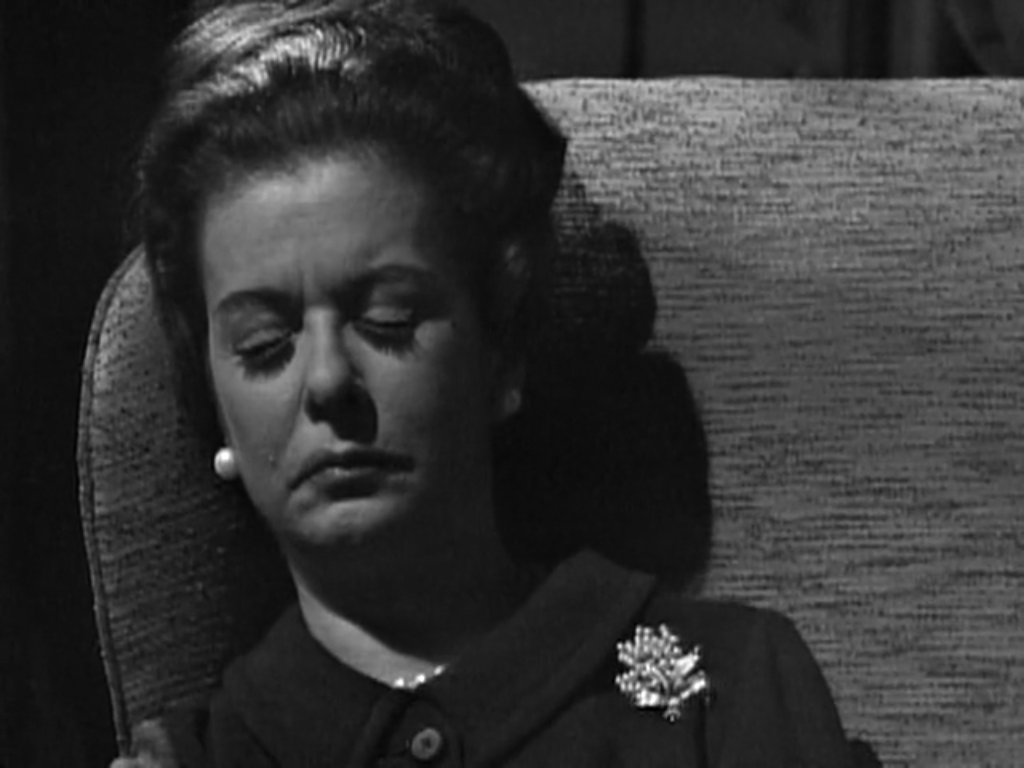
In episode 10, reclusive matriarch Liz had napped in a chair in the drawing room of the great house of Collinwood. Her sleep was troubled by unpleasant dreams; we saw her shifting in the chair and heard her muttering about ghosts. Strange and troubled boy David awakened her when he came in, having just sabotaged his father’s car in an attempt to murder him.

Liz’ troubled sleep in episode 10

Today, we open with well-meaning governess Vicki sleeping in the same chair, showing the same signs of discomfort, and muttering in her sleep words she had heard Liz say in a mad scene at the end of yesterday’s episode: “fire… stone… bird…”

Vicki’s troubled sleep in episode 157

Vicki awakens, not to find David returning from a homicidal errand, but to be overwhelmed by the presence of the ghost of Josette Collins. She smells Josette’s jasmine perfume, and the picture is out of focus. She walks around the room talking to Josette, whom we can neither see nor hear. She agrees to some instruction from Josette only she can hear.

Vicki’s boyfriend, instantly forgettable young lawyer Frank, shows up. He is complaining that Vicki called him at 5 AM, asked him to come over at once, and still won’t explain why.

Liz’ brother, high-born ne’er-do-well Roger Collins, appears at the top of the stairs and demands to know what Frank is doing in the house. Vicki claims that she wants Frank to take her for a drive in the country to help her clear her head. This makes sense to Roger. Liz is in a very bad way, for no reason the doctors can determine, and it has been a rough night in the house. Roger tells Vicki that he thinks it would be a good idea if she and Frank did take a drive. He is going to need a lot of help today, and the more relaxed Vicki is, the better able she will be to provide it.

The audience knows what Vicki has come to suspect, that Roger’s estranged wife Laura is a blonde fire witch who is responsible for Liz’ condition. Laura is staying in the cottage on the estate and she and Roger have begun the process of divorce. Laura and Liz clashed about guardianship of David, and Laura responded by casting a spell on Liz. With something like this in mind, Vicki wants Frank to take her back to a cemetery where they found some clues about Laura last week.

It is interesting to see Vicki with Frank in this episode. She is usually very demure, rarely looking anyone directly in the eye and consistently using a soft, delicate voice. She is that way today when Roger is around. But she looks straight at Frank and tells him in a crisp, candid tone just what they are going to do and why they are going to do it. That’s one of the reasons I keep wishing someone other than Conard Fowkes had played Frank. Fowkes is so dull that he simply could not survive on a show like Dark Shadows, but Frank is a character who gives us a chance to see a seldom-glimpsed side of Vicki.

Frank and Vicki visit the Caretaker of the cemetery outside town. In the archives of his building, Vicki smells jasmine and feels Josette’s presence. The Caretaker catches a distant whiff of jasmine too, but only Vicki’s nose can lead her to where Josette wants her to go. Josette pushes a book off a shelf and opens it to a page about a Laura Murdoch Radcliffe, who died by fire in Collinsport in 1867. Since they already know of another Laura Murdoch who died by fire there in 1767 and of someone who is medically indistinguishable from Laura Murdoch Collins who died by fire in Arizona earlier this year (1967,) Vicki finds great significance in the interval of 100 years. She tells Frank that the Laura Murdochs who died in Collinsport in 1767 and 1867 and the woman who died in Arizona this year are parts of the same corporate entity that is represented by the woman staying in the cottage.

Patrick McCray and Wallace McBride of “The Collinsport Historical Society” gave up writing daily episode commentaries around the time Ron Sproat joined the writing staff of Dark Shadows, but McCray does have a post about this episode. As usual, his remarks are thought-provoking:

We are about fifty episodes away from the introduction of Barnabas Collins, and you can feel the show straining with the need for it. We are at least watching a supernatural show, now. Going back to something less exotic will take the charm of a Dennis Patrick to pull off. He and Laura have something new that they are bringing/will bring to the show. One of the problems with the first six months of the show is how sad it is. The villains are wracked with guilt, somewhat grating in their personalities, and driven by necessity. Laura changes that. Her contribution to the show is less supernatural than philosophical. She likes who she is. She likes what she’s doing. She is demented enough to see that burning David alive is just dandy. Contrast this with Roger. He just wanted to be left alone, like a quietly queeny, ineffectual Hulk. 

The Dark Shadows Daybook, 24 January 2018

I’m not at all sure Laura “likes what she’s doing.” Most of the time, what she’s doing is sitting motionless by the fire. She is stirred from that position only when someone calls for her, and then only with difficulty.

The only times happiness registers on Diana Millay’s face are when Laura is talking to David and telling him about the blissful life that awaits in the fantastic realm she comes from, not about the path she must take to approach that realm. At other times, her dominant mood is weariness and her manner is so distant as to be inscrutable. With characters other than David, she is energetic and immediate only when she flies into a rage.

We don’t even know how many of her there are. Vicki tells Frank at the end of today’s episode that Laura seems to be made up of four components, but the audience also knows of ghostly apparitions that seem to travel with those corporeal Lauras and to be at least partly independent of them. Maybe somewhere in that complex there is a spirit that delights in the idea of taking David into a pyre, but we don’t see that delight.

McCray goes on:

Burke? He just wanted to even the odds. I get that. But his victory would mean shutting down Collinwood, and that gives any viewer mixed feelings. As much as I like Burke, his storyline misfired because you’re left with nobody to root for. If Burke wins, the show has to end, and that’s not going to happen. For Burke to lose, justice must elude him once more, and a character we like goes away. I suppose that the show originally was so Vicki-centric that we weren’t supposed to care for either Team Burke or Team Collins compared with Team Winters. With the arrival of Laura, all of this changes. (I say this because Matthew was a loon and couldn’t take pride in his wrongdoing.) Like Burke and Roger or not, everyone is pitted against/used by the first in a series of Gloucesters employed by the series to delight viewers. 

Ibid

McCray is exactly right that Burke’s original storyline could never be resolved. The character had an even bigger problem that prevented the writers from coming up with a new storyline for him. That problem is his type. As a dashing action hero, sooner or later he’s going to have to rescue someone. Yet he never gets to save anyone from anything.

The first three rescues on the show are all rescues of Vicki. David locks her up and leaves her to die in the abandoned part of the great house of Collinwood. Burke doesn’t have access to that part of the house, so she ends up being rescued by Roger, of all people. That adds some complexity to Vicki’s attitude to Roger, keeps her from catching on to some plot points she isn’t supposed to understand yet, and most importantly enlarges the obstacles keeping her from befriending David, thereby enriching the one narrative arc that works every time we see it.

Next, gruff groundskeeper Matthew tries to break Vicki’s neck in the cottage. Liz saves her that time. It would have to be her, since she is the only person Matthew listens to. That’s the in-universe reason. Also, Joan Bennett is the biggest star on the show, the origin of the relationship between Liz and Vicki is supposed to be the biggest secret in the show, and the mostly-female audience of a daytime soap might be interested in a scene where a female character saves the day. So it is more satisfying all around to have Liz rescue Vicki from Matthew than it would have been to have Burke barge in.

When Matthew is holding Vicki prisoner in the Old House on the estate and is about to swing an ax at her head, Burke is in the area looking for her. But it is the ghosts of Josette and the Widows, accompanied by the ghost of beloved local man Bill Malloy, who rescue Vicki then. Burke and Roger show up after the fact and walk her home. The show has spent so much time building up the ghosts and the supernatural back-world behind the continuity in which the characters operate that it would be a cheat if they did not come forward at this point and bring a story to its climax. Again, Burke is left on the outside looking in.

Now David needs rescuing, but since the show’s most reliably interesting storyline has been the budding friendship between David and Vicki, she is the only one who can be his rescuer. Burke is got out of the way by having Laura entrance him with the memory of their old love. Since the threat to David is supernatural, this is also an opportunity to bring the ghosts back into play.

When the vampire story begins, Burke will become entirely superfluous. A dashing action hero can’t allow a bloodsucking fiend to run amok. But stop the vampire, and you stop the first ratings generator the show has ever had. So that will finish Burke once and for all.

Further:

I may be so-so on the Phoenix as a big bad on the show, partly because she was such an out-there villain, grounded in an unclear mythology. Nonetheless, she ushered in a sentient, supernatural threat and a new school of evil that finally gave viewers a moral compass to lead them through Collinsport.

Ibid.

It may be pedantic to point this out, but it is the nature of supernatural mythologies to be unclear. Once you pass the point where the laws of nature that we can examine out in the open apply, it’s up to the audience to guess at what the alternative structure of cause and effect might be. The storytellers can guide our guesses. Vicki’s discovery that the three Laura Murdochs died by fire in 1767, 1867, and 1967 leads her to tell us that the hundredth anniversary of the previous fire has the power to cause the next one. The power of anniversaries will indeed become a major part of Dark Shadows’ cosmology, coming up in several future storylines, and is the inspiration for my posting these blog entries at 4:00 pm Eastern time on the 56th anniversary of each episode’s original broadcast.

When you get to vampires and witches and Frankensteins and werewolves and other relatively familiar monsters, you can draw on horror movies produced by Universal Studios in the 1930s and endlessly shown on television since the 1950s, and beyond those on the plays, novels, and folklore from which those movies derived some of their imagery. That reduces the amount of explaining the protagonist has to do. We all know what blood and bats and wooden stakes and crosses and mirrors and daylight signify in connection with vampires, for example. That creates an impression that there are clear and logical rules, but when you hang out with the vampire for a thousand episodes you start to realize just how little sense any of those rules really make.

Laura is interesting precisely because she starts without any of that unearned sense of clarity. The show has to build her up to the point where she makes enough sense that we are in suspense, but not to go beyond that point and explain so much that we can’t avoid realizing how disconnected she is from the world we live in. I’d say they strike that balance quite well.

Moreover, because we have so little information about Laura, she is the perfect adversary for the supernatural beings we have met so far on the show. The ghosts of Josette and the Widows are definitely around, but they are deep in the background, seldom seen, even more seldom heard, and when they do intervene in the visible world their actions are brief and the consequences of them ambiguous. These vague, distant presences are credible as a counterforce to a figure as undefined as Laura, but have to evaporate when a menace appears that calls for a dynamic response sustained over a long period. Since the show has spent so much time hinting around about Josette and the Widows, it would be a shame if they hadn’t come up with a supernatural adversary for them to engage.

Back to McCray:

This episode is rich in atmosphere and menace, but anything involving the mysterious Caretaker will do that. It serves up Collins history as a net that strangles generation after generation… and the place where the answers to today’s mysteries will be found. The show has always been about the past… Paul Stoddard, the car accident, Vicki’s parentage… but (Widows notwithstanding) never beyond the lifetimes of the protagonists. By having our heroes deal with ancient dangers that still long to cause harm, DARK SHADOWS truly begins.

Ibid.

I demur from lines like “Dark Shadows truly begins” at some point other than episode 1. The whole wild ride of improvisation and reinvention is what I find irresistible. Each period of the show has some connections to the one immediately before it, but as time goes on there is absolutely no telling where they will go. Watching this part, the so-called “Phoenix” story, you can just about see how it follows from the moody, atmospheric showcase that Art Wallace and Francis Swann’s scripts provided for fine acting, ambitious visual compositions, and evocations of Gothic romance in the first 20 weeks of the series. And you can just about see how the period of the show that comes after it is resolved follows from the Phoenix. But when you look at the stories they will be doing in 1968 and later, all you can do is ask how they could possibly have found their way from here to there. Going along for that chaotic, meandering journey is the fun of it, and you deny yourself a little bit of that fun every time you ignore or downgrade an episode.

I also have reservations about the remark that “This episode… serves up Collins history as a net that strangles generation after generation.” The 1767 incarnation of Laura Murdoch married into the Stockbridge family, and the Caretaker told us they were great and powerful. The 1867 version of her married into the Radcliffes, and the Caretaker is shocked to find that her parents are not listed in his records- the Radcliffes were so high and mighty that none of them would ever have married someone whose parents were not known. So the history that strangles generation after generation is not the history of a single family, but something about the part of central Maine where Collinsport is. “Laura Murdoch” is a curse that falls on each prominent family in the region in its turn.

Episode 155: Around her little finger

We open in the hotel suite occupied by dashing action hero Burke Devlin. Burke is getting a briefing from a paid agent of his whom he placed in the home of his enemies, the ancient and esteemed Collins family. This agent is wildly indiscreet housekeeper Mrs Johnson.

Mrs Johnson has come to report on a conversation between high-born ne’er-do-well Roger Collins and Roger’s estranged wife, the mysterious and long-absent Laura. Mrs Johnson overheard Laura telling Roger that she is keeping Burke pacified by pretending that she will testify on his behalf in a retrial of a long-ago criminal case. When Mrs Johnson relays this to Burke, he flies into a rage. He demands to know who is paying her to defame Laura. Mrs Johnson stands up to his abuse, and he apologizes.

Mitch Ryan and Clarice Blackburn were outstanding actors, and it’s always fun to see them play a scene together. But this doesn’t really make much sense. Whatever Laura’s plans, it is hardly likely that she would advance them by telling Roger that she is going to side with Burke. Since this is a conversation Burke is having with a secret agent in his employ, the audience would expect him to understand deception.

Meanwhile, Laura is in the cottage where she is staying on the grounds of the great estate of Collinwood. She has a visitor- her son, strange and troubled boy David. The head of the Collins family, reclusive matriarch Liz, has forbidden Laura to see David and ordered her to leave the estate. Laura repeatedly urges David to keep his visit to her a secret. She gives him a music box, reminding him to hide it from everyone in the great house.

Moments after David gets home, Liz catches him with the music box. She recognizes it as Laura’s and scolds him for visiting her. She tries to explain why he can’t see his mother. David takes this badly, shouting at her that he doesn’t love her. When she objects that this is a terrible thing to say, he tells her he hates her.

Liz sets out for Laura’s cottage. Laura is there, but she is not alone. Burke has come to ask about the conversation Mrs Johnson overheard. Several days ago, Burke had asked her about her relations with Roger, naming well-meaning governess Vicki as his source. Today, Laura asks if Vicki has been talking again. Thoughtlessly, Burke won’t answer, further convincing Laura that Vicki is her enemy.

Laura starts crying. Burke’s anger evaporates. He embraces her and kisses her. At that moment, Liz enters.

Burke, whom we first saw today in his role as spymaster, tells Liz he’s glad that happened because he likes to have everything out in the open. Liz, who has sealed up most of her house and hasn’t left the estate in eighteen years because she is trying to cover up some hideous secret, says that she also likes that. Burke leaves.

Liz demands Laura leave the estate no later than tomorrow morning, and vows that she will never have custody of David. Laura says that no power on earth can keep her from her son, and tells Liz she will learn to her cost what she is capable of.

Back in the house, Laura’s face is superimposed over the screen as Liz grows faint. Liz starts climbing the stairs. She calls for help, naming Roger and well-meaning governess Vicki. We see her start to fall. Then we see her sprawled at the bottom of the stairs.

Liz under Laura’s spell. Screenshot by Dark Shadows Before I Die

The process shot makes it clear that Laura is using witchcraft to control Liz. Burke’s behavior is also uncharacteristic, but it is an open question whether it is the result of Laura casting a magic spell on him, of his own emotions leading him to make a fool of himself, or of sloppy work on the part of the writers.

Episode 127: More like me than the portrait

Well-meaning governess Vicki has been rescued from her ordeal as prisoner of the homicidal fugitive Matthew. Now Matthew is dead, Vicki is home, and dashing action hero Burke is having a truce with his sworn enemies, the ancient and esteemed Collins family, during which they try to figure out what the heck just happened.

Vicki is very clear that she saw the ghost of Josette Collins and that a bunch of other ghosts came and scared Matthew to death. The others aren’t quite willing to accept that, but they don’t have any other explanations.

Vicki tells reclusive matriarch Liz that she saw a resemblance to her own face in the ghost of Josette. The show has been hinting pretty heavily that Vicki is Liz’ illegitimate daughter, and Liz reacts to Vicki’s speculation that Josette might be one of her ancestors with a visible shock. She scrambles to cover that feeling and in her most demure voice (which, since she is played by Joan Bennett, is the most demure voice ever heard) says that if she were that would make her a Collins, “and that hardly seems likely.” She also says that Vicki does not resemble the portrait of Josette Collins.

Vicki says that if you look closely at the portrait, there is a resemblance. And so there is. The eyes are the right distance apart, the nose and mouth are about right, and the coloring is the same. The cheeks and chin are a little different, but considering that it is an oil painting rather than a photograph, it is possible that Alexandra Moltke Isles could have sat for it.

Shortly before Matthew took her prisoner, Vicki had told Burke that because he was her employers’ enemy, she could never speak to him again. That’s gone out the window now. Burke visits her in her bedroom, and they have a nice chat. Liz tells Burke that he can bring nothing but trouble to Vicki and flighty heiress Carolyn, to whom she refers as “the girls” and between whom she pointedly draws no distinctions. Not only is the prospect of a Vicki/ Burke relationship back in the cards, but Liz’ denial that Vicki is her daughter and Carolyn’s half-sister is getting thinner and thinner.

Episode 126: Do not be afraid

In the long-abandoned Old House on the estate of Collinwood, fugitive Matthew is sharpening the ax with which he plans to kill his prisoner, well-meaning governess Vicki. In the great house on the same estate, strange and troubled boy David is struggling with himself. His hated father, high-born ne’er-do-well Roger Collins, and his idol, dashing action hero Burke Devlin, are waiting for him to tell what he knows about Matthew and Vicki, and he keeps asking for assurances that he won’t be punished if he tells.

While David’s pathological fear of punishment keeps her rescuers at bay, Matthew finishes sharpening his ax. In the secret chamber where she is bound to a chair, Vicki receives a visitor- the ghost of Josette Collins. The ghost tells her she need not be afraid. Vicki asks why not. The ghost simply repeats herself and vanishes. It is by no means clear that the ghosts mean to save Vicki from Matthew, or that they could keep him from killing her if that is what they want.

David finally tells Burke and Roger where Vicki is, and they get some shotguns. David delays their departure still further by pleading to go along with them. Meanwhile, Matthew is in front of Vicki, starting to swing his ax at her head.

Matthew hears ghostly voices and breaks off in mid-swing. He runs out of the hidden chamber to the parlor, where the ghost of beloved local man Bill Malloy comes strolling in to the room, singing one of the more family-friendly verses of “What Do You Do With a Drunken Sailor?” Matthew starts swinging his ax wildly at the ghost, which laughs at him. Four more ghosts, representing the famed “Widows,” follow, and he swings at them.

Bill and the Widows. Screenshot by Dark Shadows Before I Die

In her place of confinement, Vicki can hear Matthew screaming, but cannot hear the ghosts plaguing him. She calls out to Matthew, who falls silent. Burke and Roger come in, she calls to them, they find her and release her from her bonds. Matthew in a chair in the parlor, dead of fright.

With its six ghosts, this is one of the most spectacular episodes of the entire series. It is also one of the most effective. It’s no wonder Patrick McCray resumed his posting about episodes with this one after skipping a couple of months’ worth.

It is notable that Burke and Roger do not actually save Vicki- the ghosts of Bill and the Widows do. When Matthew first tried to kill Vicki in episode 111, it was reclusive matriarch Liz who saved her. Now, it is again a female-led effort, though as the victim of Matthew’s first homicide Bill does get a chance to help. I suppose that fits with the nature of the genre- daytime soaps are addressed to a predominantly female audience, so it only makes sense that female characters will drive most of the major plot points. It doesn’t bode well for the future development of Burke- he’s a dashing action hero, after all, and if all the dashing actions are going to be precipitated by women, girls, and feminine ghosts he’s likely to be left out in the cold.

Episode 123: A nice dungeon

The restaurant at the Collinsport Inn appeared in the very first episode of Dark Shadows. Well-meaning governess Vicki arrives in town, and stops there on her way to her new home in the great house on the estate of Collinwood. Counter-woman Maggie Evans, The Nicest Girl in Town, gave Vicki a bit of a hard time at first, but quickly emerged as the person likeliest to be her friend. And indeed, Vicki and Maggie have visited each other, had heart-to-heart talks, etc.

We’ve seen the restaurant many times since. As part of the inn, it has always figured as territory associated with dashing action hero Burke Devlin, arch-nemesis of Vicki’s employers, the ancient and esteemed Collins family. It was Burke who brought Vicki to the inn and therefore sent her Maggie’s way, and the major scenes in the restaurant since have revolved around Burke and his doings. By making the whole complex of the inn an extension of Burke’s personality, it established him as a force equal to the Collinses with their mansion and its precincts.*

Today marks a shift in the use of the set from a symbol of Burke’s power to a neutral space where new characters are introduced without giving away their relationships to the ongoing storylines. While Burke figures in the conversation, he doesn’t appear in the episode, and the action does not depend on what he has done.

Maggie presides over the place. Her interactions with newcomers begin from the fact that she works there. The only other public spaces we’ve seen are the Blue Whale tavern, where the bartender does not speak and any conversations start as part of whatever story the speakers are involved in, and the sheriff’s office, which is nobody’s idea of a casual hangout. So Maggie is elected Welcoming Committee.

A blonde woman in a stylish hat takes a seat at a table while Maggie is at the counter bantering with her boyfriend-in-waiting, hardworking young fisherman Joe. Joe tells Maggie that the woman looks familiar, but that he can’t quite place her. After Joe leaves, Maggie gives the woman a menu, pours her a cup of coffee, and talks with her.

The mystery woman in her stylish hat. Screenshot by Dark Shadows Before I Die

The woman asks about Grace, whom Maggie replaced at the restaurant five years ago. She confirms that she lived in Collinsport when Grace ran the restaurant. Since she is from Collinsport, Maggie is surprised that she came to town on the bus and is staying at the inn. The woman asks about the Collinses. Maggie says that high-born ne’er-do-well Roger Collins is the same as ever, only more so. When the woman asks what that means, Maggie explains that he is the person in town likeliest to play the role of Ebenezer Scrooge.** The woman asks about Roger’s son, strange and troubled boy David Collins. She is happy when Maggie says that David is a cute, clever boy, and startled when she says that “a nice dungeon would help” him to be easier to live with.

The woman is never named, but returning viewers will have a very short list of people she might be. The ongoing storylines are:

  • Vicki’s quest to learn the identity of her birth parents. The woman doesn’t look anything like Vicki, and the one potential lead Vicki has discovered in her time in Collinsport is a portrait of a woman who looks exactly like her. If the woman is connected with that storyline, therefore, it would likely be in some roundabout way- we wouldn’t expect them to cast a blonde actress as a close relative of the brunette Vicki after the big deal they made of that portrait.
  • The mistress of Collinwood, reclusive matriarch Liz, hasn’t left home in eighteen years and no one knows why. Liz is the first person the woman asks about, so it could be that she has come to shed some light on this puzzle. The only women who lived in the house eighteen years before who have gone away since were the servants, so it could be that this woman is a former Collins family servant who has come into money.
  • Homicidal fugitive Matthew’s abduction of Vicki. Matthew has always been friendless, and his only relative is an elderly brother. He has always lived in poverty, and did not know the servants who were connected with the house before Liz became a recluse. So it is difficult to see what connection he could have to this woman. On the other hand, the ghosts with whom the show has been teasing us since the first week have been making their presence very strongly felt as that story reaches its climax. The woman may have some connection with the supernatural back-world of the series, and that may somehow link her to Matthew or Vicki.
  • Vicki’s love-life. Vicki and Burke had been spending a lot of time together, but she has told him that because he is the enemy of her employers they can never see each other again. Burke doesn’t seem to be ready to accept this. Since she has been missing, Burke has taken an aggressive part in searching for her. Vicki has been seeing instantly forgettable young lawyer Frank, but we haven’t seen him since she’s been abducted (that I recall; the guy is very forgettable.) The woman seems to be a bit too sophisticated for Frank, but she may be a rival for Burke’s affections.
  • Joe’s breakup with flighty heiress Carolyn and his budding romance with Maggie. Maggie doesn’t recognize the woman at all, Joe can’t identify her, and their working-class backgrounds make her almost as unlikely a connection for them as she is for Matthew. Still, if she is a former servant at Collinwood, she might have some connection with one or the other of their families.
  • Burke’s quest to avenge himself on the Collinses in general and Roger in particular. There is a woman involved in Burke’s grudge against Roger- Roger and a woman named Laura were in Burke’s car when it killed a pedestrian. They both testified that Burke was driving, saw him sentenced to prison for manslaughter, then married each other. Burke swears that Roger was driving, and Laura was apparently Burke’s girlfriend, certainly not Roger’s, before the night of the fatal collision. Laura is still married to Roger, though they have lived apart for some time, and she is David’s mother. The mystery woman’s reactions to Maggie’s descriptions of Roger and David would make sense if she were Laura, as would her evident affluence and her separation from friends or relatives.
  • Vicki’s effort to befriend David. If the woman is David’s mother, she could complicate this, the quietest but most consistently successful of all the show’s storylines.

Maggie’s reference to “a nice dungeon” is ironic. There are dungeons about, both literal and figurative. Matthew is keeping Vicki bound and gagged in one inside the long-abandoned Old House on the grounds of Collinwood, where his helper David visits him today. David doesn’t know that Matthew is holding Vicki until the end of the episode, when he stumbles upon her. As David Collins, David Henesy gives a splendid reaction to this shocking sight:

Old friends meet in new places. Screenshot by Dark Shadows Before I Die

Before the mystery woman enters, Maggie herself seems to be in a kind of dungeon. Her dungeon is built not of stone walls or iron bars, but of careless writing. Joe is filthy and exhausted after many long hours searching for Vicki, who is missing and may be in the clutches of a murderer. Even though she is Vicki’s close friend and The Nicest Girl in Town, Maggie doesn’t show a moment of concern for her. She giggles, jokes, and smiles all the way through her conversation with Joe. Not only is her dialogue out of character, it is composed entirely of cliches that remind you forcibly that you’re watching a 56 year old soap opera. For example, when Joe mentions that he crossed paths with Carolyn in Burke’s hotel room, she exclaims, “That is a convention!” The dread Malcolm Marmorstein strikes again…

*My wife, Mrs Acilius, developed this point in our discussion of the episode.

**Louis Edmonds would indeed have made a marvelous Scrooge. It’s too bad the cast of Dark Shadows didn’t get round to performing A Christmas Carol until 2021, two full decades after his death. It was a great performance, highly recommended, and is followed by a Q & A every fan of the series will find fascinating.

Episode 91: Everything she knows

Well-meaning governess Vicki, fresh from imprisonment at the hands of strange and troubled boy David Collins, gets a few days off work to visit Bangor, Maine. Flighty heiress Carolyn had agreed to drive her to the bus station in the town of Collinsport. Carolyn doesn’t have a job, go to school, or seem to have anything else to do, so why she and Vicki don’t just take a road trip together is unclear.

They wait for the bus at the local restaurant. From there, Carolyn telephones dashing action hero Burke Devlin, her family’s arch-nemesis and the object of her own obsessive crush, and invites him to join the two of them at their table.

Carolyn tells Burke that Vicki has recently seen the ghost of beloved local man Bill Malloy. Vicki tries not to give Burke any additional information. When Burke learns of Vicki’s plans, he volunteers to take her to Bangor in his car. She declines, but he won’t take no for an answer. I don’t drive, and I admire the way this scene shows how hard it can be for a non-driver to decline a ride.

When Burke leaves to get Vicki’s bags, Carolyn blows up at her. Carolyn tells Vicki that she must have known she came to town hoping to see Burke and spend the evening with him. Vicki did not know any such thing. After all, Burke has openly declared his intention of forcing Carolyn’s entire family into bankruptcy and disgrace, and she has expressed remorse for her infatuation with him. When Carolyn makes it clear she is still chasing Burke, Vicki doesn’t know what to say.

The Collinsport Historical Society says that Carolyn spends this week alienating the audience, and her passive-aggressive behavior towards Vicki is indeed exasperating. Watching the scene in the restaurant, it makes perfect sense that Vicki would decide that escaping Carolyn is worth the risk of getting in trouble with her employers by spending an hour with Burke.

Back home at the great house of Collinwood, Carolyn hears her mother, reclusive matriarch Liz, playing the piano. She makes a lot of noise when she comes in, ensuring that her mother will call her into the drawing room. Once there, Carolyn puts on a great show of being upset. She gives partial, teasing answers to each of her mother’s questions, drawing her in as best she can. She finally declares that Vicki is not to be trusted. She reveals that Vicki is in a car with Burke, probably telling him everything she knows about the Collinses and Collinwood. We then cut to Vicki and Burke in the car, where she is telling him everything she knows about her recent sighting of Bill Malloy’s ghost in the house.

Burke asks Vicki about Bill’s ghost. Screenshot by Dark Shadows Before I Die

Again, the scene in the restaurant explains Vicki’s behavior. Carolyn had told Burke so much about it that it would be hard for Vicki or anyone else to see much point in trying to keep the rest of the story from him. When Burke wants her to say that the ghost accused someone in the house of murder, she insists that it only said it was someone in Collinsport, not Collinwood.

Carolyn has always been tempestuous, and Vicki has always been quick to forgive her. Perhaps now that the relationship between Vicki and David is about to enter a quieter, more complicated phase, the makers of the show wanted to ensure that there would be a continual source of conflict within the house. That might explain why they have chosen to feature Carolyn’s nastier side so heavily this week.

Episode 79: I’ll hate you in public

Problem child David Collins enters the restaurant at the Collinsport Inn. Mrs Sarah Johnson, longtime housekeeper to the late Bill Malloy, is confronting dashing action hero Burke Devlin, declaring that he is to blame for Bill’s death. David angrily defends Burke. Burke whisks him out of the restaurant into the hotel lobby.

Screenshot by Dark Shadows Before I Die

Little does David know that the confrontation between Burke and Mrs Johnson was staged for the benefit of his family, the ancient and esteemed Collinses. The two of them are scheming to have Mrs Johnson placed on the Collinses’ domestic staff as housekeeper so that she can spy on Burke’s enemy, David’s father, high-born ne’er-do-well Roger Collins.

Burke and David have a charming little scene in the lobby. David stumbles over many of his words. These are probably flubs, but they fit so perfectly with what we would expect a highly agitated nine year old to sound like that the writer might have wished he’d put them in the script. David says that he and Burke are two of a kind, that everyone in the world is against them, and that he wants to murder them all. Burke asks if this wouldn’t be a bit of a drastic solution. While David ponders that question, Burke ushers him up to his suite.

There, David asks if it is true that he told his aunt, reclusive matriarch Liz, that he would use any means at his disposal to strip the family of all its assets. Burke says that he offered to buy the house, and reminds David that he himself had suggested Burke do that so the two of them could enjoy a freewheeling bachelor existence there. David accepts this at once and is all smiles. He then tells Burke that his governess, Miss Victoria Winters, has been teaching him about the Civil War. The theme of divided loyalties has been weighing on him- how can he choose between two sides led by Liz and Burke, the only two people he likes? Burke tells him they will just have to work out a peaceful solution, and David smiles again.

Screenshot by Dark Shadows Before I Die

David Henesy and Mitchell Ryan were not only excellent actors- preternaturally so, in the case of the preteen Henesy- but were also such appealing personalities that scenes featuring the two of them are irresistible. These particular scenes build Burke up as a villain. In his conversations with Mrs Johnson and in a couple of phone conversations, he has made it clear that he is indeed committed to destroying the Collinses. Even if this is the first episode we have seen, we know that he is lying to David and tricking him into helping with the annihilation of his birthright. Returning viewers have seen him being even more explicit about his plans on many occasions. So our loyalties are as divided as David’s- we are eager to see more interactions between Mitch Ryan and David Henesy, but are appalled by what is going on between Burke Devlin and David Collins.

Episode 77: Burke Devlin, Burke Devlin, Burke Devlin!

Screenshot by the Dark Shadows wiki

Yesterday, dashing action hero Burke Devlin announced to the ancient and esteemed Collins family that he intends to drive them out of business and take all their holdings. He then muddied the waters by offering to pay them an inflated price for their dilapidated old house. Still, everyone came away with the impression that Burke had openly declared himself to be the deadly enemy of the Collinses.

Problem child David Collins wasn’t in that episode, and he refuses to believe the characters who were when they tell him that his idol Burke has said that he is out to strip the Collinses of their assets. The only person David likes, aside from Burke, is his aunt, reclusive matriarch Liz. He struggles when forced to choose sides between them. His misery and frustration grow palpably throughout the episode.

At least David can still do something he likes. His cousin, flighty heiress Carolyn, tries to get him to return a photograph of Burke that he stole. While she is in his room, he taunts Carolyn with the idea that Burke isn’t really attracted to her, but that he prefers well-meaning governess Vicki. This infuriates Carolyn, much to David’s satisfaction.

The photo itself is a bit of a mystery. It shows Burke striking oil:

Screenshot by The Collinsport Historical Society

The show has repeatedly told us that Burke grew up poor, that he was still poor when he went to prison, and that he was penniless, despised, and alone in the world when he got out of prison just five years ago. Yet now, he owns a corporate raiding firm, and is a millionaire many times over. They’ve dwelt on this time frame so much that even a soap opera audience is likely to start wondering how he got so rich so quickly. The photo may be an attempt to answer that question. Everyone knows that if you strike oil, you can become a millionaire overnight. Of course, you would have to own the mineral rights to the land the oil is on to profit from such a discovery, and would also need to secure drilling equipment and to hire a crew to operate it if you’re going to make the strike in the first place. How an indigent person fresh out of the state penitentiary is supposed to have paid for those things is not really easier to explain than how he could start a private equity concern.

Both yesterday’s episode and today’s include references to Liz’ estranged husband, Carolyn’s father Paul Stoddard. Yesterday’s included a reference to another character we have yet to see, Laura Collins. Laura is David’s mother, the estranged wife of high-born ne’er-do-well Roger Collins, and the onetime fiancee of Burke. These two had been mentioned only a handful of times in the first months of the show, and neither was given a name until well into it. That they are coming up more often now might lead us to wonder if we will be meeting one or both of them sooner or later.

Episode 76: His own shadow

Dashing action hero Burke Devlin pays yet another visit to the great house of Collinwood. He announces to its residents, the ancient and esteemed Collins family, that he intends to take control of all their properties, including the house. He is buying up their debts and will use them to seize their businesses. He offers to pay them for the house, though. He even offers to pay for it at higher than the market value.

Screen capture by Dark Shadows from the Beginning

Ne’er-do-well Roger Collins urges his sister, reclusive matriarch Liz, to take Burke’s offer for the house. It’s a huge, gloomy, impractical place, and they would be better off without it. He doesn’t mention that the cash might come in handy when Burke starts calling in all the notes they have no way of meeting. Liz won’t hear of it, and vows to fight.

Flighty heiress Carolyn and well-meaning governess Vicki process their feelings about the matter. Carolyn is wounded by the evidence that Burke never really wanted to be her boyfriend- not that he ever said he did, but she kept hoping. Vicki wonders what Burke is thinking, and whether he understands his own motives. He admits that he may not- after all, if he’s trying to avenge the wrongs the Collinses have done him by bankrupting them and collecting their assets, why not just watch their house fall into his lap with the cannery, the fishing boats, and whatever else they may have, leaving them with nothing?

With this post we say goodbye to one of the bloggers who has kept us company. This was the last episode Marc Masse discussed on his blog Dark Shadows from the Beginning. His posts usually include stimulating insights, sometimes remarkable scholarship, and occasionally material that is in one way or another frustrating. Still, he is always well worth reading.

Among his most extraordinary contributions was about the story of the sabotaging of Roger’s car, a.k.a. The Saga of the Bleeder Valve. That story began when we, accompanying Vicki, saw Burke standing by Roger’s car in episode 13.

Burke and Vicki in the garage, from Dark Shadows from the Beginning

Burke tells Vicki that he was looking at Roger’s car because he was thinking of buying one like it, an explanation she finds unconvincing.

In his post about episode 46, Masse includes a long section about similarities between the Saga of the Bleeder Valve and a particular episode of The Alfred Hitchcock Hour. He convinces me that Art Wallace and Lela Swift had studied that episode. You’ll notice from his screenshots that that John Cassavetes even had the same haircut that Mitch Ryan wore as Burke:

Source material for the missing brake valve storyline on Dark Shadows can also be found in The Alfred Hitchcock Hour anthology series. In the episode Murder Case (season 2, episode 19; aired March 6, 1964), Gena Rowlands plays an actress (Diana Justin) in London married to a rich diamond merchant (Charles Justin) played by Murray Matheson. Diana isn’t really in love with her much older husband Charles, but since he is the main financial backer of a play she is starring in, her success is ensured… that is until the boyfriend she dropped so she could run off to England and start a production company with her rich husband, a struggling actor named Lee Griffin (played by John Cassavetes), manages to wangle his way through an audition and secure a part in the play by getting Diana to pass a good word along to the author and director of the production. Lee gets Diana to agree to resume their former relationship, and in no time the pair are in cahoots to relieve Diana of her marital obligations and in the process secure a huge windfall by plotting to have the old man bumped off. To accomplish this, they arrange for Charles to have an automobile accident; this is where the similarities to the missing brake valve story on Dark Shadows come into play.

One afternoon, on a visit up to the country home where Diana and Charles live, which is situated high up on a hilly area, Lee gets an idea when he comments on how the type of car that Charles drives is famous for its brakes.

Alfred Hitchcock Hour_Murder Case_Lee comments on the brakes for Charles' car_ep46

To compromise the functioning of the car’s brake system, Lee first uses a wrench to loosen something, probably the bleeder valve…

Alfred Hitchcock Hour_Murder Case_Lee uses a wrench to loosen the brake system_ep46

…after which he pumps the brake pedal several times so there won’t be any hydraulic fluid left for when Charles next gets behind the wheel.

Alfred Hitchcock Hour_Murder Case_Lee pumps the brakes free of hydraulic fluid_ep46

Just after completing the task, and with the wrench still in his back pocket, Charles walks in to find Lee there standing by his car, just like in Dark Shadows episode 13 when Victoria Winters walks into the Collinwood garage to find Burke near Roger’s car. To diffuse the situation, Lee explains to Charles: “I was, uh, just admiring your car. It’s, uh, fabulous!”

Alfred Hitchcock Hour_Murder Case_Lee and Charles chatting in the garage_ep46

That night Lee and Diana have a performance in London; to set the plan in motion, Lee phones Charles from backstage while the play is still on and concocts a story about nearly having gotten into an accident on their drive into London due to a careless young motorist, which left Diana shaken up, and suggesting to Charles that he drive down to London to take his wife home…

Alfred Hitchcock Hour_Murder Case_Lee phones Charles from London_ep46

…which he agrees to, just like in Dark Shadows episode 15 when Roger agrees to drive into town to meet with Burke at the Blue Whale.

Alfred Hitchcock Hour_Murder Case_Charles in the garage getting set for the drive to London_ep46

Similar to how Roger in episode 17 is shown to have miraculously escaped with just a sprained arm and a few stitches to the forehead, Charles winds up crashing head on into a tractor that was just starting up the hill; despite that the car ended up a total loss, Charles was extremely lucky in having sustained only a couple of cracked ribs and a slight concussion.

Alfred Hitchcock Hour_Murder Case_Charles escaped the accident with only minor injuries_ep46

The missing brake valve story on Dark Shadows never really did feel like something that would ordinarily be presented on a daytime serial drama. Instead, thus far Dark Shadows has taken its cue from 1940s film noir for atmosphere, Broadway theater style for acting performances, and nighttime mystery suspense anthology programs for subject matter. Is it any wonder that Dark Shadows would go on to evolve into the cultural phenomenon it would later become? A truly one of a kind blend of widely varying influences.

Marc Masse, Dark Shadows from the Beginning, “Episode 46: Destroy Me, Pt.1,” 3 February 2019

In his post for episode 76, Masse includes the audio of Joan Bennett singing “Sentimental Moments” in the 1955 film We’re No Angels. I’d never heard of the song, and had no idea she sang. Indeed she was not a Singer with a capital S, but her gentle, precise phrasing is perfect for this strange, sad little tune. I think of it as a farewell to Masse and his blog.